

Luke 16:3
Greek (Tischendorf 8th ed.) Luke 16:3 appears in the Greek New Testament. The text above is from the Tischendorf 8th edition. Each word links to its Strong’s number and a concise gloss. Click any word for its full Thayer’s Greek Lexicon entry.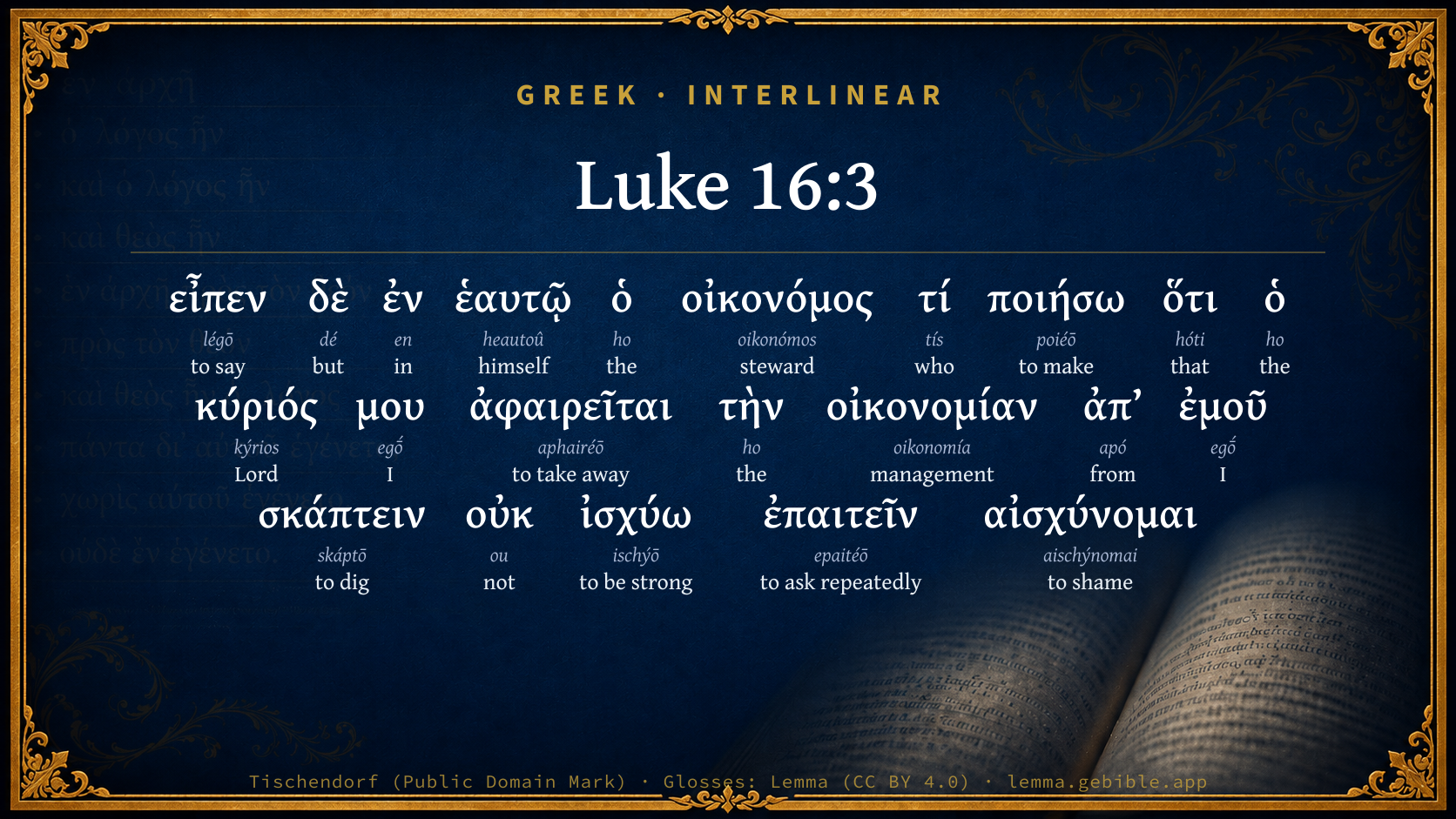
"The manager said within himself, 'What will I do, seeing that my lord is taking away the management position from me? I don't have strength to dig. I am ashamed to beg.
Download a study sheet
One document with this verse’s original text, its word-by-word gloss line, the meaning frame, cross-references with their text, attributed commentary, and full source and license credits — printable, and it pastes into notes with its structure intact.
This verse Autodidact and up
A passage Seminary Student
Up to 50 verses in one chapter. A passage sheet keeps up to 6 commentary sources and 12 cross-references per verse, in the order this page ranks them, and says so on the sheet whenever that leaves anything out. Ask for a single verse and you get the Autodidact verse sheet above.
Everything on this page stays free to read, with no account — the sheet is a download of what is already on screen, not access to it.
Compare translations 3
The same verse in 3 English versions, stacked beneath the original-language interlinear above. Click any original word for its lexicon entry.
Each is an independent rendering of the whole verse — the interlinear is not word-aligned to these translations.
Highlighted words mark where these versions differ — a whole-verse word diff, not a word-by-word alignment.
-
World English Bible Public Domain
"The manager said within himself, 'What will I do, seeing that my lord is taking away the management position from me? I don't have strength to dig. I am ashamed to beg.
-
King James Version Public Domain
Then the steward said within himself, What shall I do? for my lord taketh away from me the stewardship: I cannot dig; to beg I am ashamed.
-
unfoldingWord Literal Text CC BY-SA 4.0
Then the manager said to himself, ‘What should I do, since my master is taking away the management from me? I am not strong to dig. I am ashamed to beg.
unfoldingWord Literal Text — © unfoldingWord, licensed CC BY-SA 4.0. Word-aligned USFM3 via Door43 (git.door43.org/unfoldingWord/en_ult).
Show all 19 translations
Every available English version of this verse, each an independent rendering of the whole verse.
-
World English Bible Public Domain
"The manager said within himself, 'What will I do, seeing that my lord is taking away the management position from me? I don't have strength to dig. I am ashamed to beg.
-
Berean Standard Bible Public Domain
The manager said to himself, ‘What shall I do, now that my master is taking away my position? I am too weak to dig and too ashamed to beg.
-
Majority Standard Bible Public Domain
The manager said to himself, ‘What shall I do, now that my master is taking away my position? I am too weak to dig and too ashamed to beg.
-
King James Version Public Domain
Then the steward said within himself, What shall I do? for my lord taketh away from me the stewardship: I cannot dig; to beg I am ashamed.
-
American Standard Version (1901) Public Domain
And the steward said within himself, What shall I do, seeing that my lord taketh away the stewardship from me? I have not strength to dig; to beg I am ashamed.
-
Revised Version (1885) Public Domain
And the steward said within himself, What shall I do, seeing that my lord taketh away the stewardship from me? I have not strength to dig; to beg I am ashamed.
-
Geneva Bible (1599) Public Domain
Then the stewarde saide within himselfe, What shall I doe? for my master taketh away from me the stewardship. I cannot digge, and to begge I am ashamed.
-
Douay-Rheims (1899) Public Domain
And the steward said within himself: What shall I do, because my lord taketh away from me the stewardship? To dig I am not able; to beg I am ashamed.
-
Young's Literal Translation Public Domain
`And the steward said in himself, What shall I do, because my lord doth take away the stewardship from me? to dig I am not able, to beg I am ashamed: --
-
Literal Standard Version CC BY-SA 4.0
And the steward said in himself, What will I do, because my lord takes away the stewardship from me? I am not able to dig, I am ashamed to beg—
-
Unlocked Literal Bible CC BY-SA 4.0
The manager said to himself, 'What should I do, since my master is taking away my management job? I do not have strength to dig, and I am ashamed to beg.
-
unfoldingWord Literal Text CC BY-SA 4.0
Then the manager said to himself, ‘What should I do, since my master is taking away the management from me? I am not strong to dig. I am ashamed to beg.
-
Darby Bible Public Domain
And the steward said within himself, What shall I do; for my lord is taking the stewardship from me? I am not able to dig; I am ashamed to beg.
-
World Messianic Bible Public Domain
“The manager said within himself, ‘What will I do, seeing that my lord is taking away the management position from me? I don’t have strength to dig. I am ashamed to beg.
-
Webster's Bible Public Domain
Then the steward said within himself, What shall I do? for my lord taketh from me the stewardship: I cannot dig; I am ashamed to beg.
-
Free Bible Version CC BY-SA 4.0
The manager said to himself, ‘Now what will I do since my master is going to fire me from my job? I'm not strong enough to dig, and I'm ashamed to beg.
-
Bible in Basic English Public Domain
And the servant said to himself, What am I to do now that my lord takes away my position? I have not enough strength for working in the fields, and I would be shamed if I made requests for money from people in the streets.
-
Text-Critical English NT CC BY 4.0
The steward said to himself, ‘What should I do, now that my master is taking my stewardship away from me? I am not strong enough to dig, and I am ashamed to beg.
-
Tyndale New Testament (1534) Public Domain
The stewarde sayd with in him selfe: what shall I do? for my master will take awaye from me the stewarde shippe. I cannot digge and to begge I am ashamed.
Literal Standard Version (2020), Covenant Press — licensed CC BY-SA 4.0. Text via the HelloAO Bible API (eBible.org). Unlocked Literal Bible (unfoldingWord) — licensed CC BY-SA 4.0. Text via the HelloAO Bible API (eBible.org). unfoldingWord Literal Text — © unfoldingWord, licensed CC BY-SA 4.0. Word-aligned USFM3 via Door43 (git.door43.org/unfoldingWord/en_ult). Free Bible Version, Dr. Jonathan Gallagher — licensed CC BY-SA 4.0. Text via the HelloAO Bible API (eBible.org).
Word by word
More ways to search: Search by grammar → Find every occurrence → Compare this word →
Practice this passage: Drill this verse → Learn its vocabulary →
- Appears 2× in the Greek New Testament
- First appears here
- Part of Speech
- Verb
- Tense
- Present
- Voice
- Active
- Mood
- Infinitive
Full Thayer's Definition
- εἶπεν légō G3004 “to say” Verb, Aorist, Active, Indicative, 3rd person, Singular
- δὲ dé G1161 “but” Conjunction
- ἐν en G1722 “in” Preposition
- ἑαυτῷ heautoû G1438 “himself” Reflexive pronoun, 3rd person, Dative, Singular, Masculine
- ὁ ho G3588 “the” Article, Nominative, Singular, Masculine
- οἰκονόμος oikonómos G3623 “steward” Noun, Nominative, Singular, Masculine
- τί tís G5101 “who” Interrogative pronoun, Accusative, Singular, Neuter
- ποιήσω poiéō G4160 “to make” Verb, Aorist, Active, Subjunctive, 1st person, Singular
- ὅτι hóti G3754 “that” Conjunction
- ὁ ho G3588 “the” Article, Nominative, Singular, Masculine
- κύριός kýrios G2962 “Lord” Noun, Nominative, Singular, Masculine
- μου egṓ G1473 “I” Personal pronoun, 1st person, Genitive, Singular
- ἀφαιρεῖται aphairéō G851 “to take away” Verb, Present, Middle, Indicative, 3rd person, Singular
- τὴν ho G3588 “the” Article, Accusative, Singular, Feminine
- οἰκονομίαν oikonomía G3622 “management” Noun, Accusative, Singular, Feminine
- ἀπ’ apó G575 “from” Preposition
- ἐμοῦ egṓ G1473 “I” Personal pronoun, 1st person, Genitive, Singular
- σκάπτειν skáptō G4626 “to dig” Verb, Present, Active, Infinitive
- οὐκ ou G3756 “not” Particle, Negative
- ἰσχύω ischýō G2480 “to be strong” Verb, Present, Active, Indicative, 1st person, Singular
- ἐπαιτεῖν epaitéō G1871 “to ask repeatedly” Verb, Present, Active, Infinitive
- αἰσχύνομαι aischýnomai G153 “to shame” Verb, Present, Middle, Indicative, 1st person, Singular
About this verse
These counts appear in no published source. They are computed here, from the morphology-tagged text and Lemma’s own curated glosses. What Lemma adds →
- 22
- words
- 19
- distinct lemmas
- Gospels
- section
Notable vocabulary
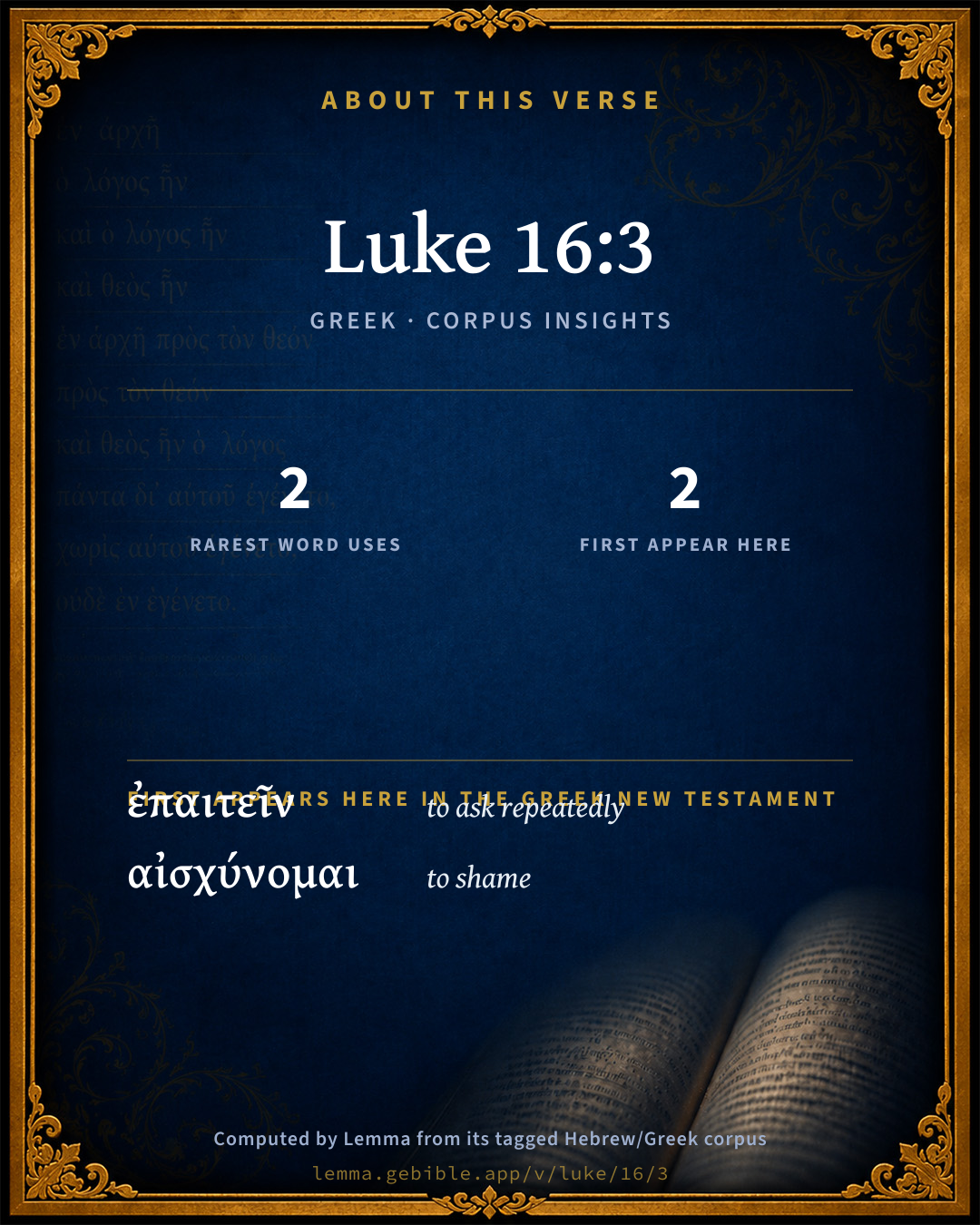
The rarest word here is ἐπαιτεῖν to ask repeatedly G1871 — appearing just 2 times in the whole Greek New Testament.
First appearance in Scripture
These words make their first canonical appearance in the Greek New Testament here:
Shared distinctive vocabulary
ἐπαιτεῖν to ask repeatedly G1871 occurs in 2 verses of the Greek New Testament. Also found in:
Cross-references
23Topical passages linked to Luke 16:3 in the Treasury of Scripture Knowledge — connected by theme and wording, ordered by reader-vote popularity; previews shown in the World English Bible.
- Esther 6:6 So Haman came in. The king said to him, What shall be done to the man whom the king delights to honor? Now Haman said in his heart, To whom would the king delight to do honor more than to myself?
- Proverbs 13:4 The soul of the sluggard desires, and has nothing, But the desire of the diligent shall be fully satisfied.
- Proverbs 18:9 One who is slack in his work Is brother to him who is a master of destruction.
- Proverbs 19:15 Slothfulness casts into a deep sleep. The idle soul shall suffer hunger.
- Proverbs 20:4 The sluggard will not plow by reason of the winter; Therefore he shall beg in harvest, and have nothing.
- Proverbs 21:25–26 The desire of the sluggard kills him, For his hands refuse to labor.
- Proverbs 24:30–34 I went by the field of the sluggard, By the vineyard of the man void of understanding;
- Proverbs 26:13–16 The sluggard says, "There is a lion in the road! A fierce lion roams the streets!"
- Proverbs 27:23–27 Know well the state of your flocks, And pay attention to your herds:
- Proverbs 29:21 He who pampers his servant from youth Will have him become a son in the end.
- Isaiah 10:3 What will you do in the day of visitation, and in the desolation which shall come from far? to whom will you flee for help? and where will you leave your glory?
- Jeremiah 5:31 the prophets prophesy falsely, and the priests bear rule by their means; and my people love to have it so: and what will you do in the end of it?
- Hosea 9:5 What will you do in the day of solemn assembly, And in the day of the feast of Yahweh?
- Mark 10:46 They came to Jericho. As he went out from Jericho, with his disciples and a great multitude, the son of Timaeus, Bartimaeus, a blind beggar, was sitting by the road.
- Luke 12:17 He reasoned within himself, saying, 'What will I do, because I don't have room to store my crops?'
- Luke 16:20 A certain beggar, named Lazarus, was laid at his gate, full of sores,
- Luke 16:22 It happened that the beggar died, and that he was carried away by the angels to Abraham's bosom. The rich man also died, and was buried.
- Luke 18:4 He wouldn't for a while, but afterward he said to himself, 'Though I neither fear God, nor respect man,
- John 9:8 The neighbors therefore, and those who saw that he was blind before, said, "Isn't this he who sat and begged?"
- Acts 3:2 A certain man who was lame from his mother's womb was being carried, whom they laid daily at the door of the temple which is called Beautiful, to ask gifts for the needy of those who entered into the temple.
- 2 Thessalonians 3:11 For we hear of some who walk among you in rebellion, who don't work at all, but are busybodies.
- Proverbs 15:19 The way of the sluggard is like a thorn patch, But the path of the upright is a highway.
- Acts 9:6 But rise up, and enter into the city, and you will be told what you must do."
Cross-references courtesy of OpenBible.info (CC BY 4.0).
Lesson kit
Teaching starters — assembled from the data on this page, not authored interpretation. Every prompt links to the verse data it draws on. Edit before teaching.
Luke, in the Gospels, opens this verse with 22 words (19 distinct Greek lemmas). Its most distinctive word is epaitéō (“to ask repeatedly”). A historical commentator’s framing appears above. Read the whole chapter for the surrounding context.
Discussion questions
- How does “to ask repeatedly” (epaitéō) shape what this verse is saying?
- 2 words make their first appearance in Scripture here. What does this debut establish?
- How does Luke 18:35, which shares the word «to ask repeatedly», read alongside this verse?
- What does the repetition of “the” (3× in this one verse) do in this verse?
- The translations on this page render this verse differently — a whole-verse word diff, not a word-by-word alignment. What might account for the different wordings?
- Compare how Tyndale Open Study Notes and Bengel's Gnomon read this verse. Where do they agree or differ?
Things to notice
- 2 words make their first canonical appearance in Scripture here.
- These translations choose different wording for 20 words in this verse.
- “the” occurs 3× in this single verse.
- 19 distinct Greek lemmas span 22 words in this verse.
Commentary
Notes on Luke 16:3 from classic Christian and Jewish commentators (each source and its license shown beneath its notes). The classic Christian expositions comment on the surrounding passage and are grouped to its opening verse, so a note may address several verses; the Jewish commentaries on the Tanakh (Rashi and others) are per-verse, so they appear only where the commentator wrote on this verse.
Lemma curates 59 commentaries, every one of them public domain or Creative Commons licensed, each selected and text-cleaned for this edition rather than reprinted as found. About our sources →
Tyndale Open Study Notes
Tyndale Open Resources
Tyndale Open Study Notes — © Tyndale Open Resources, licensed CC BY-SA 4.0. Text via the HelloAO Bible API.
Bengel's Gnomon
Johann Albrecht Bengel
Bengel's Gnomon of the New Testament — English translation (T&T Clark, Edinburgh, 1860) — public domain. Text from a community e-Sword module.
Meyer's Critical & Exegetical Commentary
Heinrich August Wilhelm Meyer
Meyer — Critical and Exegetical Commentary on the New Testament — English translation by Peter Christie, edited by Frederick Crombie (T&T Clark, 1880) — public domain. Text from a community e-Sword module.
Expositor's Greek Testament
ed. W. Robertson Nicoll
The Expositor's Greek Testament, edited by W. Robertson Nicoll (1897–1910) — public domain. Text from a community e-Sword module.
Jamieson, Fausset & Brown
Robert Jamieson, A. R. Fausset & David Brown
Jamieson, Fausset & Brown — Commentary Critical and Explanatory on the Whole Bible (1871) — public domain (CC PDM 1.0). Text via the HelloAO Bible API.
Adam Clarke's Commentary
Adam Clarke's Commentary on the Bible (1810–1826) — public domain. Text from a community e-Sword/MySword module.
Ellicott's Commentary for English Readers
A Bible Commentary for English Readers, edited by Charles John Ellicott (1878–1897) — public domain. Text from a community e-Sword module.
The Cambridge Bible for Schools and Colleges
gen. ed. J. J. S. Perowne
The Cambridge Bible for Schools and Colleges (gen. ed. J. J. S. Perowne; Cambridge University Press, 1878–1918) — public domain. Text from a community e-Sword module.
John Gill's Exposition
John Gill's Exposition of the Whole Bible (1746–1763) — public domain (CC PDM 1.0). Text via the HelloAO Bible API.
Trapp's Complete Commentary
John Trapp
John Trapp, A Commentary or Exposition upon All the Books of the Old and New Testament (1647–1656) — public domain. Text from a community e-Sword module.
Albert Barnes' Notes on the Bible
Albert Barnes' Notes on the Bible (1834–1885) — public domain. Text from a community e-Sword/MySword module.
Whedon's Commentary on the Bible
Daniel D. Whedon
Daniel D. Whedon (gen. ed.), Commentary on the Old and New Testaments (1874–1909) — public domain. Text from a community e-Sword module.
The Pulpit Commentary
The Pulpit Commentary (1880–1919), ed. H.D.M. Spence-Jones & Joseph S. Exell — public domain. Text from a community e-Sword module.
John Wesley's Explanatory Notes
John Wesley, Explanatory Notes Upon the Whole Bible (1754–1765) — public domain. Text via the GEBible commentary corpus.
Kretzmann's Popular Commentary
Paul E. Kretzmann
Paul E. Kretzmann, Popular Commentary of the Bible (1921–1924) — public domain. Text from a community e-Sword module.
unfoldingWord translationNotes
Door43 World Missions Community
unfoldingWord translationNotes — © Distant Shores Media and the Door43 World Missions Community, licensed CC BY-SA 4.0. Source: git.door43.org/Door43/en_tn.
Cambridge Greek Testament for Schools and Colleges
Cambridge Greek Testament for Schools and Colleges (Cambridge University Press, 1896; 21 vols, various authors incl. Carr, Maclear, Plummer, Farrar, Lumby, Moule, M. R. James, Simcox) — public domain. Text from a community e-Sword module.
Alford’s Greek Testament
Henry Alford
Henry Alford, The Greek Testament (1849–1861) — public domain. Text from a community e-Sword module.
International Critical Commentary
International Critical Commentary — older volumes (1896–1929), various authors — public domain. Text from a community e-Sword module.
Vincent's Word Studies in the New Testament
Marvin R. Vincent
Marvin R. Vincent, Word Studies in the New Testament (1887–1900) — public domain. Text from a community e-Sword/MySword module.