

Matthew 25:16
Greek (Tischendorf 8th ed.) Matthew 25:16 appears in the Greek New Testament. The text above is from the Tischendorf 8th edition. Each word links to its Strong’s number and a concise gloss. Click any word for its full Thayer’s Greek Lexicon entry.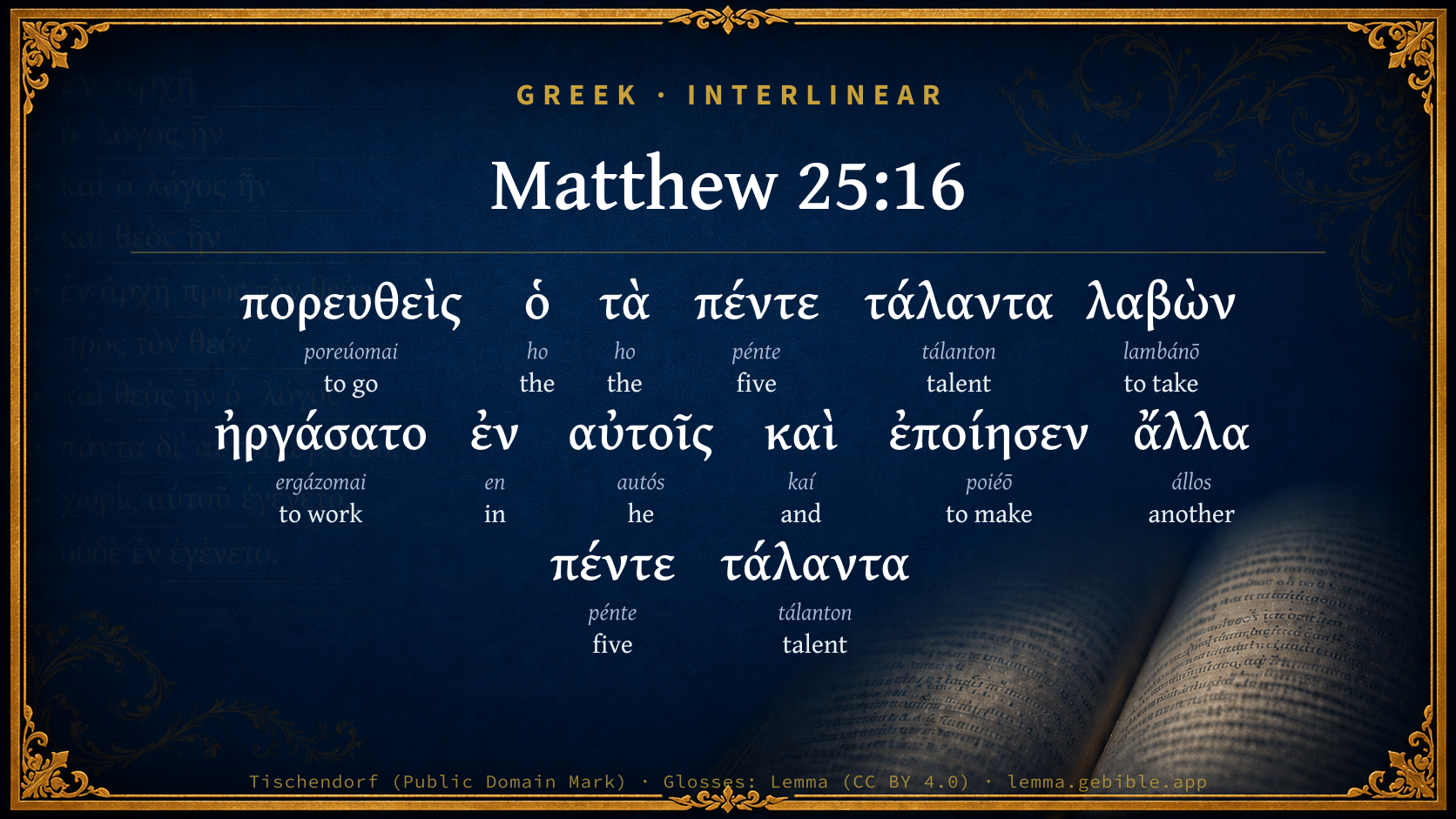
Immediately he who received the five talents went and traded with them, and made another five talents.
Download a study sheet
One document with this verse’s original text, its word-by-word gloss line, the meaning frame, cross-references with their text, attributed commentary, and full source and license credits — printable, and it pastes into notes with its structure intact.
This verse Autodidact and up
A passage Seminary Student
Up to 50 verses in one chapter. A passage sheet keeps up to 6 commentary sources and 12 cross-references per verse, in the order this page ranks them, and says so on the sheet whenever that leaves anything out. Ask for a single verse and you get the Autodidact verse sheet above.
Everything on this page stays free to read, with no account — the sheet is a download of what is already on screen, not access to it.
Compare translations 3
The same verse in 3 English versions, stacked beneath the original-language interlinear above. Click any original word for its lexicon entry.
Each is an independent rendering of the whole verse — the interlinear is not word-aligned to these translations.
Highlighted words mark where these versions differ — a whole-verse word diff, not a word-by-word alignment.
-
World English Bible Public Domain
Immediately he who received the five talents went and traded with them, and made another five talents.
-
King James Version Public Domain
Then he that had received the five talents went and traded with the same, and made them other five talents.
-
unfoldingWord Literal Text CC BY-SA 4.0
Having gone, the one having received the five talents traded with them and gained another five talents.
unfoldingWord Literal Text — © unfoldingWord, licensed CC BY-SA 4.0. Word-aligned USFM3 via Door43 (git.door43.org/unfoldingWord/en_ult).
Show all 19 translations
Every available English version of this verse, each an independent rendering of the whole verse.
-
World English Bible Public Domain
Immediately he who received the five talents went and traded with them, and made another five talents.
-
Berean Standard Bible Public Domain
The servant who had received the five talents went at once and put them to work and gained five more.
-
Majority Standard Bible Public Domain
The servant who had received the five talents went at once and put them to work and made five more talents.
-
King James Version Public Domain
Then he that had received the five talents went and traded with the same, and made them other five talents.
-
American Standard Version (1901) Public Domain
Straightway he that received the five talents went and traded with them, and made other five talents.
-
Revised Version (1885) Public Domain
Straightway he that received the five talents went and traded with them, and made other five talents.
-
Geneva Bible (1599) Public Domain
Then he that had receiued the fiue talents, went and occupied with them, and gained other fiue talents.
-
Douay-Rheims (1899) Public Domain
And he that had received the five talents, went his way, and traded with the same, and gained other five.
-
Young's Literal Translation Public Domain
`And he who did receive the five talents, having gone, wrought with them, and made other five talents;
-
Literal Standard Version CC BY-SA 4.0
And he who received the five talents, having gone, worked with them, and made five other talents;
-
Unlocked Literal Bible CC BY-SA 4.0
The one who received the five talents went at once and invested them and made another five talents.
-
unfoldingWord Literal Text CC BY-SA 4.0
Having gone, the one having received the five talents traded with them and gained another five talents.
-
Darby Bible Public Domain
And he that had received the five talents went and trafficked with them, and made five other talents.
-
World Messianic Bible Public Domain
Immediately he who received the five talents went and traded with them, and made another five talents.
-
Webster's Bible Public Domain
Then he that had received the five talents, went and traded with the same, and gained other five talents.
-
Free Bible Version CC BY-SA 4.0
Immediately the one with five talents went and invested them in a business, and made another five talents.
-
Bible in Basic English Public Domain
Straight away he who had been given the five talents went and did trade with them, and made five more.
-
Text-Critical English NT CC BY 4.0
The man who had received the five talents went and traded with them, and made five more talents.
-
Tyndale New Testament (1534) Public Domain
Then he that had receaved the fyve talentes went and bestowed them and wanne other fyve talentes.
Literal Standard Version (2020), Covenant Press — licensed CC BY-SA 4.0. Text via the HelloAO Bible API (eBible.org). Unlocked Literal Bible (unfoldingWord) — licensed CC BY-SA 4.0. Text via the HelloAO Bible API (eBible.org). unfoldingWord Literal Text — © unfoldingWord, licensed CC BY-SA 4.0. Word-aligned USFM3 via Door43 (git.door43.org/unfoldingWord/en_ult). Free Bible Version, Dr. Jonathan Gallagher — licensed CC BY-SA 4.0. Text via the HelloAO Bible API (eBible.org).
Word by word
More ways to search: Search by grammar → Find every occurrence → Compare this word →
Practice this passage: Drill this verse → Learn its vocabulary →
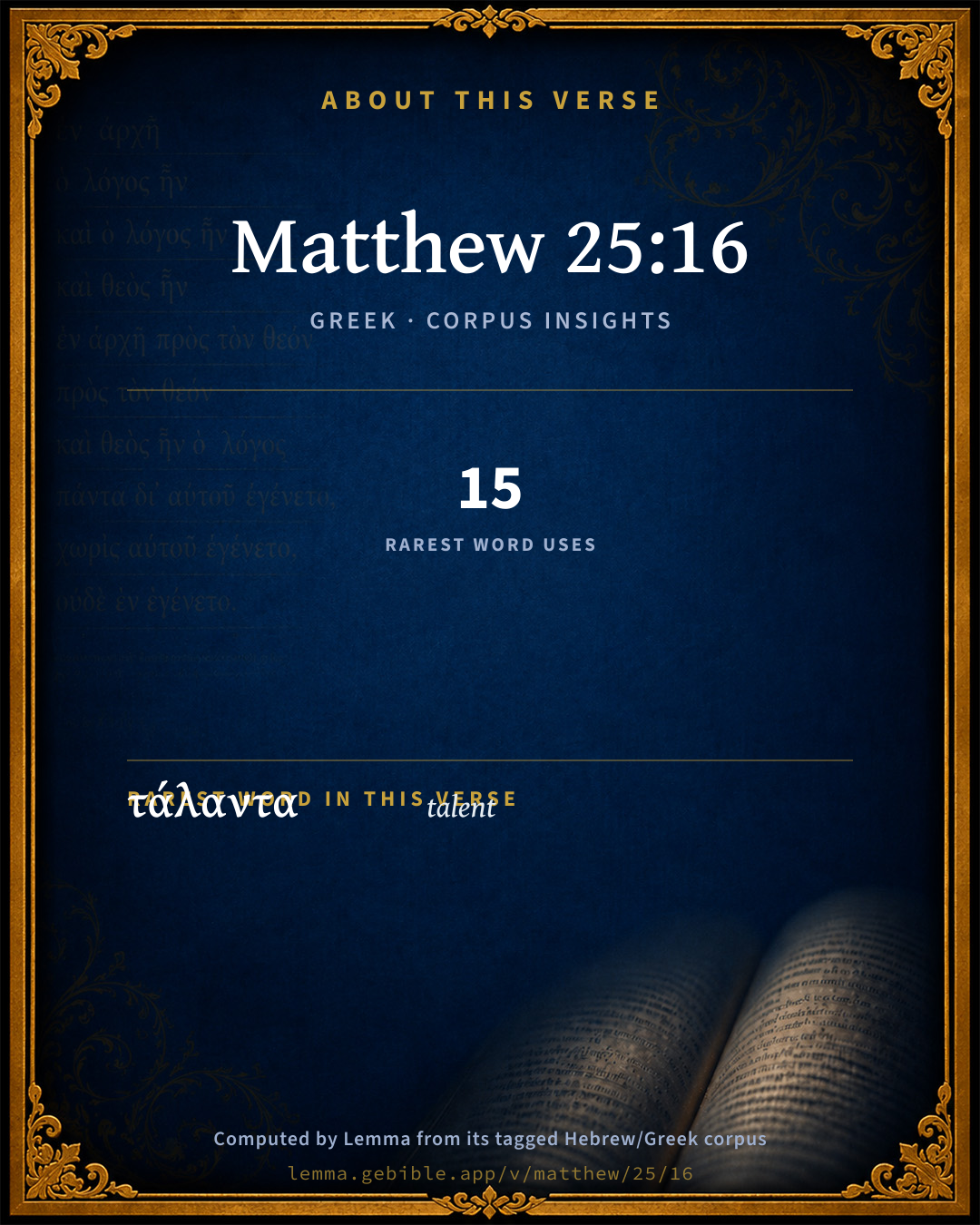
- Appears 15× in the Greek New Testament
- First appears at Matthew 18:24
- Part of Speech
- Noun
- Case
- Accusative
- Number
- Plural
- Gender
- Neuter
Full Thayer's Definition
- πορευθεὶς poreúomai G4198 “to go” Verb, Aorist, Passive deponent, Participle, Nominative, Singular, Masculine
- ὁ ho G3588 “the” Article, Nominative, Singular, Masculine
- τὰ ho G3588 “the” Article, Accusative, Plural, Neuter
- πέντε pénte G4002 “five” Adjective, Numeral (indeclinable)
- τάλαντα tálanton G5007 “talent” Noun, Accusative, Plural, Neuter
- λαβὼν lambánō G2983 “to take” Verb, Aorist, Active, Participle, Nominative, Singular, Masculine
- ἠργάσατο ergázomai G2038 “to work” Verb, Aorist, Middle deponent, Indicative, 3rd person, Singular
- ἐν en G1722 “in” Preposition
- αὐτοῖς autós G846 “he” Personal pronoun, Dative, Plural, Neuter
- καὶ kaí G2532 “and” Conjunction
- ἐποίησεν poiéō G4160 “to make” Verb, Aorist, Active, Indicative, 3rd person, Singular
- ἄλλα állos G243 “another” Adjective, Accusative, Plural, Neuter
- πέντε pénte G4002 “five” Adjective, Numeral (indeclinable)
- τάλαντα tálanton G5007 “talent” Noun, Accusative, Plural, Neuter
About this verse
These counts appear in no published source. They are computed here, from the morphology-tagged text and Lemma’s own curated glosses. What Lemma adds →
- 14
- words
- 11
- distinct lemmas
- Gospels
- section
Cross-references
24Topical passages linked to Matthew 25:16 in the Treasury of Scripture Knowledge — connected by theme and wording, ordered by reader-vote popularity; previews shown in the World English Bible.
- 1 Timothy 6:17–18 Charge those who are rich in this present world that they not be haughty, nor have their hope set on the uncertainty of riches, but on the living God, who richly provides us with everything to enjoy;
- 2 Timothy 2:6 The farmers who labor must be the first to get a share of the crops.
- Philemon 1:6–7 that the fellowship of your faith may become effective, in the knowledge of every good thing which is in us in Christ Jesus.
- 3 John 1:5–8 Beloved, you do a faithful work in whatever you accomplish for those who are brothers and strangers.
- 2 Chronicles 33:15–16 He took away the foreign gods, and the idol out of the house of Yahweh, and all the altars that he had built in the mountain of the house of Yahweh, and in Jerusalem, and cast them out of the city.
- Nehemiah 5:14–19 Moreover from the time that I was appointed to be their governor in the land of Judah, from the twentieth year even to the two and thirtieth year of Artaxerxes the king, [that is], twelve years, I and my brothers have not eaten the bread of the governor.
- Isaiah 23:18 Her merchandise and her hire shall be holiness to Yahweh: it shall not be treasured nor laid up; for her merchandise shall be for those who dwell before Yahweh, to eat sufficiently, and for durable clothing.
- Isaiah 60:5–16 Then you shall see and be radiant, and your heart shall thrill and be enlarged; because the abundance of the sea shall be turned to you, the wealth of the nations shall come to you.
- Acts 13:36 For David, after he had in his own generation served the counsel of God, fell asleep, and was laid with his fathers, and saw decay.
- Romans 15:18–19 For I will not dare to speak of any things except those which Christ worked through me, for the obedience of the Gentiles, by word and deed,
- 1 Corinthians 9:16–23 For if I preach the Gospel, I have nothing to boast about; for necessity is laid on me; but woe is to me, if I don't preach the Gospel.
- 2 Timothy 4:5–8 But you be sober in all things, suffer hardship, do the work of an evangelist, and fulfill your ministry.
- 2 Samuel 7:1–3 It happened, when the king lived in his house, and Yahweh had given him rest from all his enemies round about,
- 1 Chronicles 13:1–3 David consulted with the captains of thousands and of hundreds, even with every leader.
- 1 Chronicles 22:1–19 Then David said, This is the house of Yahweh God, and this is the altar of burnt-offering for Israel.
- 1 Chronicles 28:2–29:17 Then David the king stood up on his feet, and said, Hear me, my brothers, and my people: as for me, it was in my heart to build a house of rest for the ark of the covenant of Yahweh, and for the footstool of our God; and I had made ready for the building.
- 2 Chronicles 1:9–10 Now, Yahweh God, let your promise to David my father be established; for you have made me king over a people like the dust of the earth in multitude.
- 2 Chronicles 15:8–15 When Asa heard these words, and the prophecy of Oded the prophet, he took courage, and put away the abominations out of all the land of Judah and Benjamin, and out of the cities which he had taken from the hill-country of Ephraim; and he renewed the altar of Yahweh, that was before the porch of Yahweh.
- 2 Chronicles 17:3–9 Yahweh was with Jehoshaphat, because he walked in the first ways of his father David, and didn't seek the Baals,
- 2 Chronicles 19:4–10 Jehoshaphat lived at Jerusalem: and he went out again among the people from Beersheba to the hill-country of Ephraim, and brought them back to Yahweh, the God of their fathers.
- 2 Chronicles 31:20–21 Thus did Hezekiah throughout all Judah; and he worked that which was good and right and faithful before Yahweh his God.
- 2 Chronicles 34:1–33 Josiah was eight years old when he began to reign; and he reigned thirty-one years in Jerusalem.
- Isaiah 49:23 Kings shall be your nursing fathers, and their queens your nursing mothers: they shall bow down to you with their faces to the earth, and lick the dust of your feet; and you shall know that I am Yahweh; and those who wait for me shall not be disappointed.
- 1 Corinthians 15:10 But by the grace of God I am what I am. His grace which was bestowed on me was not futile, but I worked more than all of them; yet not I, but the grace of God which was with me.
Cross-references courtesy of OpenBible.info (CC BY 4.0).
Where the printed editions differ
1 variantPlaces in this verse where the major printed Greek editions disagree on the wording in a way that affects the translation — a comparison of editions, not a manuscript-by-manuscript collation. The editions are the modern critical texts (Nestlé-Aland 28/27, SBL, Westcott-Hort, Tregelles, Tyndale House) and the traditional texts behind the KJV (the Textus Receptus and the Byzantine/Majority text). It is not a claim about which reading is original.
-
Extra text
τάλαντα·
“talents;”
In TRByz Not in NA28NA27TynSBLWHTregτάλαντα· (talanta) 'talents;' is only in traditional manuscripts (TR+Byz)
Textual data: Translators Amalgamated Greek New Testament (STEPBible TAGNT) · CC BY 4.0.
Lesson kit
Teaching starters — assembled from the data on this page, not authored interpretation. Every prompt links to the verse data it draws on. Edit before teaching.
Matthew, in the Gospels, opens this verse with 14 words (11 distinct Greek lemmas). Its most distinctive word is tálanton (“talent”). A historical commentator’s framing appears above. Read the whole chapter for the surrounding context.
Discussion questions
- How does “talent” (tálanton) shape what this verse is saying?
- Matthew 18:24 shares the word «talent» with this verse. How do the two illuminate each other?
- “five” occurs 2× in this one verse. What is the effect of the repetition?
- These translations render this verse differently. What is at stake in choosing one wording over another?
- Reading how Joseph Benson's Commentary and Meyer's Critical & Exegetical Commentary read this verse, where do the two commentators agree and where do they part?
Things to notice
- These translations choose different wording for 12 words in this verse.
- “five” occurs 2× in this single verse.
- 11 distinct Greek lemmas span 14 words in this verse.
Commentary
Notes on Matthew 25:16 from classic Christian and Jewish commentators (each source and its license shown beneath its notes). The classic Christian expositions comment on the surrounding passage and are grouped to its opening verse, so a note may address several verses; the Jewish commentaries on the Tanakh (Rashi and others) are per-verse, so they appear only where the commentator wrote on this verse.
Lemma curates 59 commentaries, every one of them public domain or Creative Commons licensed, each selected and text-cleaned for this edition rather than reprinted as found. About our sources →
Joseph Benson's Commentary
Joseph Benson's Commentary on the Old and New Testaments (1811–1818) — public domain. Text from a community e-Sword module.
Meyer's Critical & Exegetical Commentary
Heinrich August Wilhelm Meyer
Meyer — Critical and Exegetical Commentary on the New Testament — English translation by Peter Christie, edited by Frederick Crombie (T&T Clark, 1880) — public domain. Text from a community e-Sword module.
Expositor's Greek Testament
ed. W. Robertson Nicoll
The Expositor's Greek Testament, edited by W. Robertson Nicoll (1897–1910) — public domain. Text from a community e-Sword module.
Ellicott's Commentary for English Readers
A Bible Commentary for English Readers, edited by Charles John Ellicott (1878–1897) — public domain. Text from a community e-Sword module.
The Cambridge Bible for Schools and Colleges
gen. ed. J. J. S. Perowne
The Cambridge Bible for Schools and Colleges (gen. ed. J. J. S. Perowne; Cambridge University Press, 1878–1918) — public domain. Text from a community e-Sword module.
John Gill's Exposition
John Gill's Exposition of the Whole Bible (1746–1763) — public domain (CC PDM 1.0). Text via the HelloAO Bible API.
Trapp's Complete Commentary
John Trapp
John Trapp, A Commentary or Exposition upon All the Books of the Old and New Testament (1647–1656) — public domain. Text from a community e-Sword module.
Albert Barnes' Notes on the Bible
Albert Barnes' Notes on the Bible (1834–1885) — public domain. Text from a community e-Sword/MySword module.
Matthew Poole's English Annotations
Matthew Poole's English Annotations on the Holy Bible (1683–1685) — public domain. Text from a community e-Sword/MySword module.
Whedon's Commentary on the Bible
Daniel D. Whedon
Daniel D. Whedon (gen. ed.), Commentary on the Old and New Testaments (1874–1909) — public domain. Text from a community e-Sword module.
The Pulpit Commentary
The Pulpit Commentary (1880–1919), ed. H.D.M. Spence-Jones & Joseph S. Exell — public domain. Text from a community e-Sword module.
Burkitt's Expository Notes on the New Testament
William Burkitt
William Burkitt's Expository Notes on the New Testament (1700–1703) — public domain. Text from a community e-Sword module.
The People's New Testament
B. W. Johnson
B. W. Johnson's The People's New Testament with Notes (1889–1891) — public domain. Electronic text from the Christian Classics Ethereal Library (CCEL) ThML edition.
Cambridge Greek Testament for Schools and Colleges
Cambridge Greek Testament for Schools and Colleges (Cambridge University Press, 1896; 21 vols, various authors incl. Carr, Maclear, Plummer, Farrar, Lumby, Moule, M. R. James, Simcox) — public domain. Text from a community e-Sword module.
Alford’s Greek Testament
Henry Alford
Henry Alford, The Greek Testament (1849–1861) — public domain. Text from a community e-Sword module.
International Critical Commentary
International Critical Commentary — older volumes (1896–1929), various authors — public domain. Text from a community e-Sword module.
Vincent's Word Studies in the New Testament
Marvin R. Vincent
Marvin R. Vincent, Word Studies in the New Testament (1887–1900) — public domain. Text from a community e-Sword/MySword module.