Matthew 28:15

Greek (Tischendorf 8th ed.) Matthew 28:15 appears in the Greek New Testament. The text above is from the Tischendorf 8th edition. Each word links to its Strong’s number and a concise gloss. Click any word for its full Thayer’s Greek Lexicon entry.
Download image
Cite this verse

Matthew 28:15 (World English Bible). Public Domain. Lemma interlinear Bible study tool, https://lemma.gebible.app/v/matthew/28/15.

Show BibTeX & RIS
BibTeX
RIS
English Translation
So they took the money and did as they were told. This saying was spread abroad among the Jews, and continues until this day.
World English Bible · Public Domain
Download a study sheet

One document with this verse’s original text, its word-by-word gloss line, the meaning frame, cross-references with their text, attributed commentary, and full source and license credits — printable, and it pastes into notes with its structure intact.

This verse Autodidact and up

Study sheet (.html) Plain text (.txt)

A passage Seminary Student

Up to 50 verses in one chapter. A passage sheet keeps up to 6 commentary sources and 12 cross-references per verse, in the order this page ranks them, and says so on the sheet whenever that leaves anything out. Ask for a single verse and you get the Autodidact verse sheet above.

Everything on this page stays free to read, with no account — the sheet is a download of what is already on screen, not access to it.

Want to remove ads? Support Godless Engineer
Compare translations 3

The same verse in 3 English versions, stacked beneath the original-language interlinear above. Click any original word for its lexicon entry.

Each is an independent rendering of the whole verse — the interlinear is not word-aligned to these translations.

Highlighted words mark where these versions differ — a whole-verse word diff, not a word-by-word alignment.

  • World English Bible Public Domain
    So they took the money and did as they were told. This saying was spread abroad among the Jews, and continues until this day.
  • King James Version Public Domain
    So they took the money, and did as they were taught: and this saying is commonly reported among the Jews until this day.
  • unfoldingWord Literal Text CC BY-SA 4.0
    And they, having taken the pieces of silver, did as they were taught. And this word has been reported among the Jews until today.

unfoldingWord Literal Text — © unfoldingWord, licensed CC BY-SA 4.0. Word-aligned USFM3 via Door43 (git.door43.org/unfoldingWord/en_ult).

Versions to compare (up to 4)

3 of 4 selected

Show all 19 translations

Every available English version of this verse, each an independent rendering of the whole verse.

  • World English Bible Public Domain
    So they took the money and did as they were told. This saying was spread abroad among the Jews, and continues until this day.
  • Berean Standard Bible Public Domain
    So the guards took the money and did as they were instructed. And this account has been circulated among the Jews to this very day.
  • Majority Standard Bible Public Domain
    So the guards took the money and did as they were instructed. And this account has been circulated among the Jews to this very day.
  • King James Version Public Domain
    So they took the money, and did as they were taught: and this saying is commonly reported among the Jews until this day.
  • American Standard Version (1901) Public Domain
    So they took the money, and did as they were taught: and this saying was spread abroad among the Jews, `and continueth' until this day.
  • Revised Version (1885) Public Domain
    So they took the money, and did as they were taught: and this saying was spread abroad among the Jews, and continueth until this day.
  • Geneva Bible (1599) Public Domain
    So they tooke the money, and did as they were taught: and this saying is noysed among the Iewes vnto this day.
  • Douay-Rheims (1899) Public Domain
    So they taking the money, did as they were taught: and this word was spread abroad among the Jews even unto this day.
  • Young's Literal Translation Public Domain
    And they, having received the money, did as they were taught, and this account was spread abroad among Jews till this day.
  • Literal Standard Version CC BY-SA 4.0
    And they, having received the money, did as they were taught, and this account was spread abroad among Jews until this day.
  • Unlocked Literal Bible CC BY-SA 4.0
    So the soldiers took the money and did as they had been instructed. This report spread widely among the Jews and continues even today.
  • unfoldingWord Literal Text CC BY-SA 4.0
    And they, having taken the pieces of silver, did as they were taught. And this word has been reported among the Jews until today.
  • Darby Bible Public Domain
    And they took the money and did as they had been taught. And this report is current among the Jews until this day.
  • World Messianic Bible Public Domain
    So they took the money and did as they were told. This saying was spread abroad among the Judeans, and continues until today.
  • Webster's Bible Public Domain
    So they took the money, and did as they were instructed: and this saying is commonly reported among the Jews until this day.
  • Free Bible Version CC BY-SA 4.0
    So the soldiers took the money and did what they were told. This story has been spread among the Jewish people to this very day.
  • Bible in Basic English Public Domain
    So they took the money, and did as they had been ordered: and this account has been current among the Jews till the present time.
  • Text-Critical English NT CC BY 4.0
    So they took the money and did as they had been instructed. And this story is still being spread among the Jews today.
  • Tyndale New Testament (1534) Public Domain
    And they toke the money and dyd as they were taught. And this sayinge is noysed amonge the Iewes vnto this daye.

Literal Standard Version (2020), Covenant Press — licensed CC BY-SA 4.0. Text via the HelloAO Bible API (eBible.org). Unlocked Literal Bible (unfoldingWord) — licensed CC BY-SA 4.0. Text via the HelloAO Bible API (eBible.org). unfoldingWord Literal Text — © unfoldingWord, licensed CC BY-SA 4.0. Word-aligned USFM3 via Door43 (git.door43.org/unfoldingWord/en_ult). Free Bible Version, Dr. Jonathan Gallagher — licensed CC BY-SA 4.0. Text via the HelloAO Bible API (eBible.org).

Word by word

More ways to search: Search by grammar → Find every occurrence → Compare this word →

Practice this passage: Drill this verse → Learn its vocabulary →

μέχρι
méchri
G3360
“as far as”
Adverb
Part of Speech
Adverb
Full Thayer's Definition

Origin: from G3372

TDNT: None

1. as far as, until
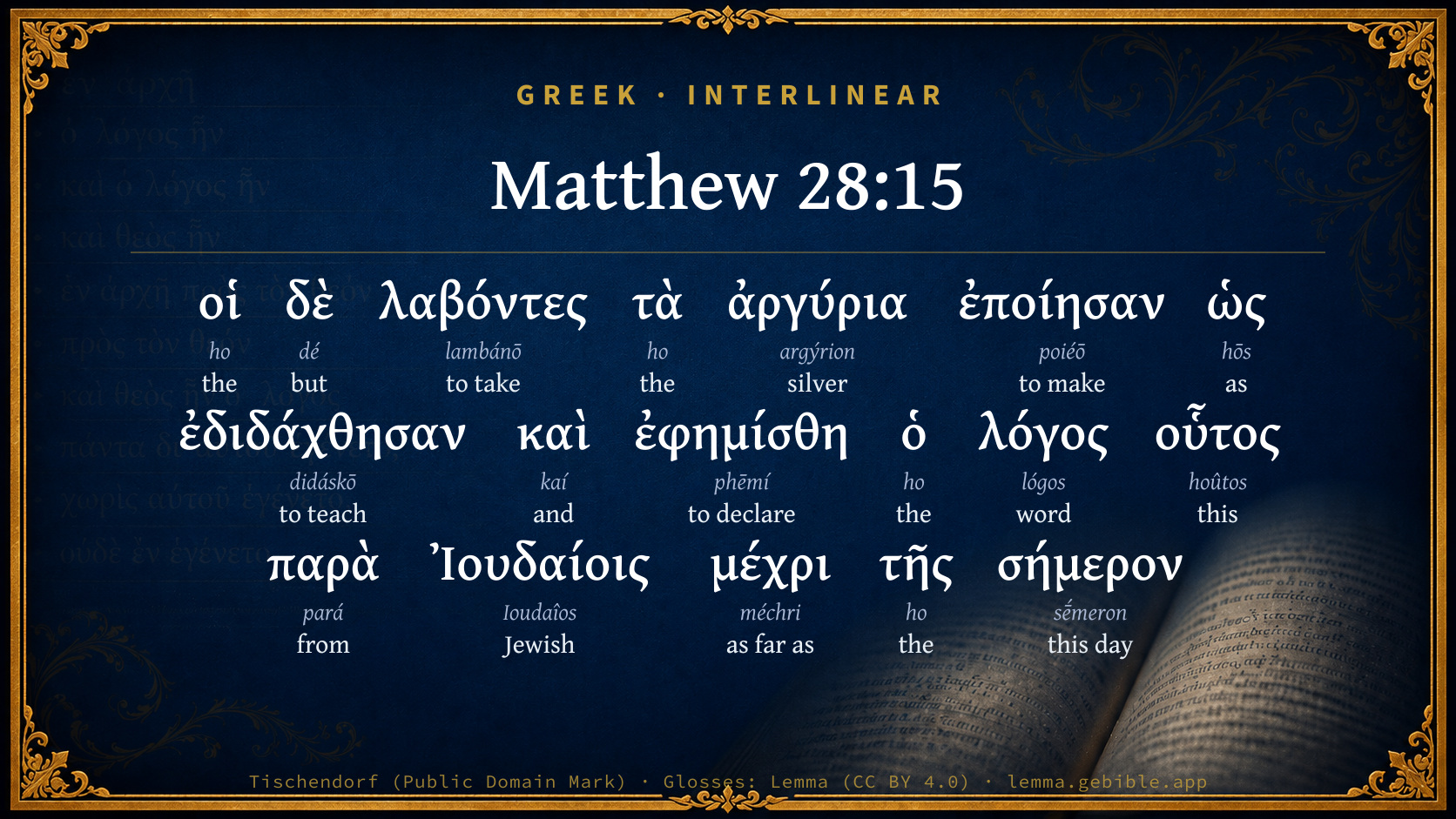
  1. οἱ ho G3588 “the” Article, Nominative, Plural, Masculine
  2. δὲ dé G1161 “but” Conjunction
  3. λαβόντες lambánō G2983 “to take” Verb, Aorist, Active, Participle, Nominative, Plural, Masculine
  4. τὰ ho G3588 “the” Article, Accusative, Plural, Neuter
  5. ἀργύρια argýrion G694 “silver” Noun, Accusative, Plural, Neuter
  6. ἐποίησαν poiéō G4160 “to make” Verb, Aorist, Active, Indicative, 3rd person, Plural
  7. ὡς hōs G5613 “as” Adverb
  8. ἐδιδάχθησαν didáskō G1321 “to teach” Verb, Aorist, Passive, Indicative, 3rd person, Plural
  9. καὶ kaí G2532 “and” Conjunction
  10. ἐφημίσθη phēmí G5346 “to declare” Verb, Aorist, Passive, Indicative, 3rd person, Singular
  11. ὁ ho G3588 “the” Article, Nominative, Singular, Masculine
  12. λόγος lógos G3056 “word” Noun, Nominative, Singular, Masculine
  13. οὗτος hoûtos G3778 “this” Demonstrative pronoun, Nominative, Singular, Masculine
  14. παρὰ pará G3844 “from” Preposition
  15. Ἰουδαίοις Ioudaîos G2453 “Jewish” Adjective, Dative, Plural, Masculine
  16. τῆς ho G3588 “the” Article, Genitive, Singular, Feminine
  17. σήμερον sḗmeron G4594 “this day” Adverb

About this verse

These counts appear in no published source. They are computed here, from the morphology-tagged text and Lemma’s own curated glosses. What Lemma adds →

18
words
15
distinct lemmas
Gospels
section

Notable vocabulary

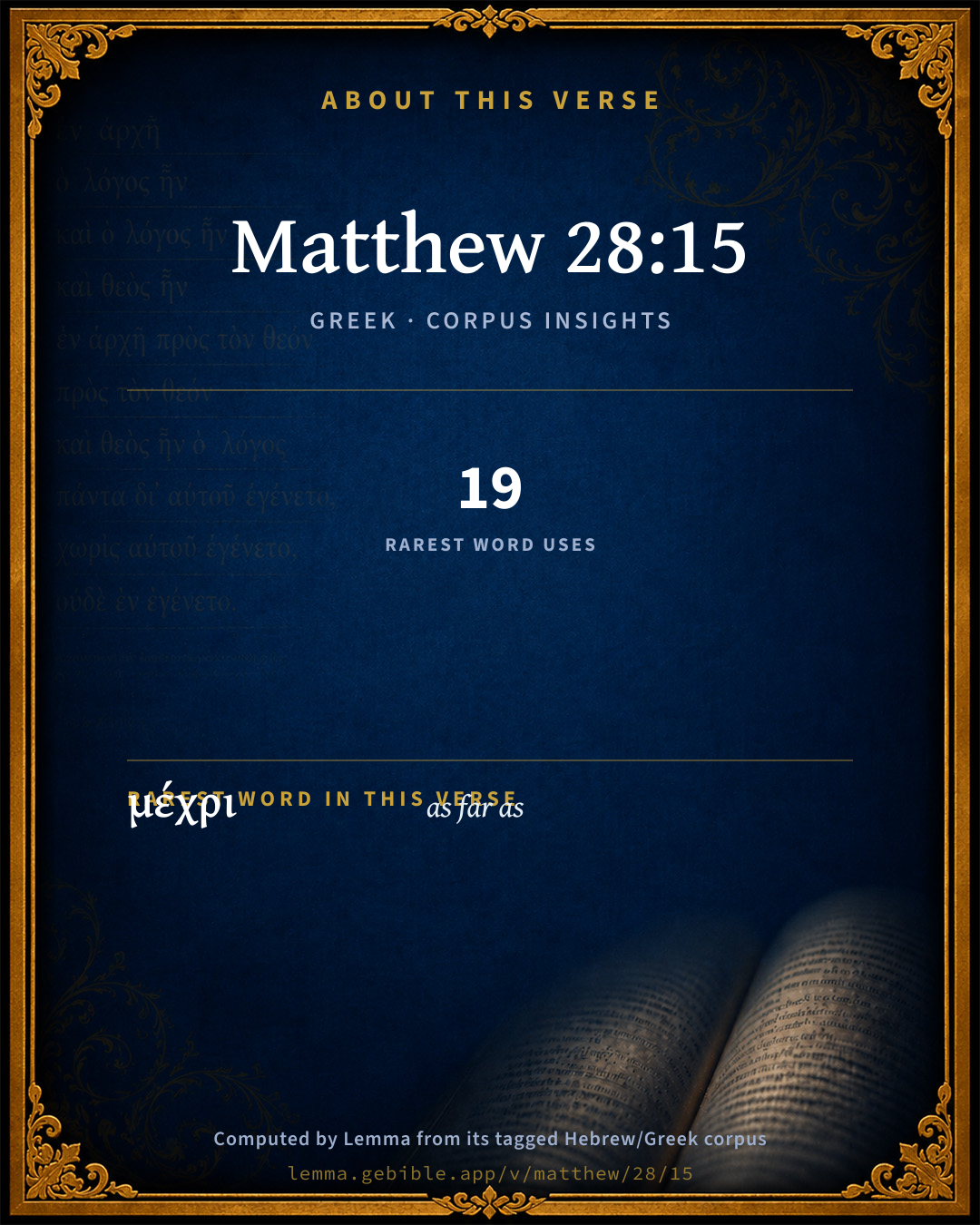
The rarest word here is μέχρι as far as G3360 — appearing just 19 times in the whole Greek New Testament.

Shared distinctive vocabulary

μέχρι as far as G3360 occurs in 19 verses of the Greek New Testament. Also found in:

Repetition

A word recurs within this verse:

Cross-references

3

Topical passages linked to Matthew 28:15 in the Treasury of Scripture Knowledge — connected by theme and wording, ordered by reader-vote popularity; previews shown in the World English Bible.

  • Matthew 27:8 Therefore that field was called "The Field of Blood" to this day.
  • 1 Timothy 6:10 For the love of money is a root of all kinds of evil. Some have been led astray from the faith in their greed, and have pierced themselves through with many sorrows.
  • Matthew 26:15 and said, "What are you willing to give me, that I should deliver him to you?" They weighed out for him thirty pieces of silver.

Cross-references courtesy of OpenBible.info (CC BY 4.0).

Commentary

Notes on Matthew 28:15 from classic Christian and Jewish commentators (each source and its license shown beneath its notes). The classic Christian expositions comment on the surrounding passage and are grouped to its opening verse, so a note may address several verses; the Jewish commentaries on the Tanakh (Rashi and others) are per-verse, so they appear only where the commentator wrote on this verse.

Lemma curates 59 commentaries, every one of them public domain or Creative Commons licensed, each selected and text-cleaned for this edition rather than reprinted as found. About our sources →

Joseph Benson's Commentary

Mat 28:15. So they took the money — They did not, either on the score of conscience, or on account of the palpable falsehood of the story they were to propagate, refuse the bribe that was offered them by the chief priests. Their love of money, as is common with wicked men, pushed them on headlong, so that they did not mind the many improbabilities implied in the lie, nor the horrid iniquity of it. And, though they had been greatly confounded with the vision of the angels, and the earthquake, the panic was by this time worn off. Besides, they did not consider the vision as connected with morality; or, if they did, the priests would endeavour to persuade them that it was nothing real, but the mere effect of their own imagination, terrified by seeing one rise from the dead. The only objection, therefore, made by the soldiers, to their complying with the desire of the priests, was, that by publishing such a story, they would acknowledge such a gross neglect of duty as would expose them to severe punishment, if the governor should hear of it. But to make them easy on this head, the priests promised to give such a representation of the matter to Pilate, that no harm should befall them. This only obstacle, therefore, being removed, the soldiers did as they were desired. They told everywhere the lie which the priests had put into their mouths: a lie the most impudent and barefaced that could be contrived, but which the priests and other members of the council were anxious to have propagated, because they hoped it would be swallowed by many without examination. Nor were they deceived in their expectation; for, improbable as the story was, it gained general credit among the enemies of Jesus, and was currently reported, as Matthew here tells us, at the time he wrote his gospel. Unluckily, however, for the cause of infidelity, it was only some of the watch who came to the chief priests; the rest had gone to their garrison, where no doubt they told their comrades what had happened. And even those who came to the chief priests would not be backward to speak of the extraordinary event as they passed along the streets, if they chanced to meet with any of their acquaintance. Far less would they conceal the matter in the high-priest’s palace, while they waited to be called in. None can doubt this who attend to the nature and operation of human passions, and the eagerness which all men naturally have to tell a wonderful story, not to mention the desire which these soldiers must have felt to justify themselves for quitting their posts. The truth, therefore, that Jesus was actually risen, in spite of all the endeavours of the chief priests to suppress it, came abroad, and doubtless became a subject of consideration and inquiry with many, who had not been Christ’s disciples; and the more they considered the evidences of it, and compared it with the false story which the priests had prevailed on some of the guard to propagate, the more such as were unprejudiced must be inclined to believe the former and reject the latter, which latter it was evident the priests themselves did not believe. For if they had believed it, doubtless, with a view to prove it, and justify themselves in their hostility to Christ and his cause, they would have narrowly examined where the apostles had been all that night, and would have made search for Christ’s body, which, if found, would at once have confuted the testimony of the apostles respecting his resurrection, and have proved their great guilt in endeavouring, by its removal, to palm a lie upon mankind, and establish an imposture of a most heinous nature and pernicious tendency. It is probable, therefore, that an impression in favour of the truth was made on the minds of many persons, and gained ground daily, and that this had considerable influence in preparing them for the reception of the gospel: which circumstance may, partly at least, account for the wonderful success of the ministry of Peter and the other apostles at and after the day of pentecost. To counteract, however, every impression of this kind, and confirm the Jews, whether in Jerusalem or elsewhere, in their prejudices against Christianity, the chief priests and elders were unwearied in their endeavours. “They even” (says Justin Martyr, Dialog. cum Tryph., p. 368) “sent chosen men of considerable rank over all the world, not only in the general to represent the Christians as an impious sect, but to assert that the body of Jesus was torn out of his tomb by night, and the persons who thus fraudulently conveyed it away, took occasion from thence to report that he rose from the dead and ascended into heaven.” Which message is spoken of as having been sent before the destruction of Jerusalem.

Joseph Benson's Commentary on the Old and New Testaments (1811–1818) — public domain. Text from a community e-Sword module.

Tyndale Open Study Notes

Tyndale Open Resources

28:15 still tell it today: Justin Martyr wrote to Jews of his day (about AD 165), “You have sent . . . men throughout all the world to proclaim, ‘A godless and lawless heresy has sprung from one Jesus, a Galilean deceiver, whom we crucified, but his disciples stole him by night from the tomb . . . and now [the disciples] deceive men by asserting that he has risen from the dead and ascended into heaven’” (Justin Martyr, Dialogue with Trypho 108). This misinformation probably became widespread after the disciples began to proclaim Jesus’ resurrection (see Acts 2:22-36).

Tyndale Open Study Notes — © Tyndale Open Resources, licensed CC BY-SA 4.0. Text via the HelloAO Bible API.

Bengel's Gnomon

Johann Albrecht Bengel

Mat 28:15. Διεφημίσθη, has been commonly reported) There are many things of this kind by which the wretched Jews keep themselves in error.[1230]

[1230] And how signal are the injuries which are subsequently given birth to by even a single false representation!—V. g.

Mat 28:16. εἰς τὴν Γαλιλάιαν, into Galilee) This very appearance was the most solemn of all, being the one which the Lord had promised before His passion. And it is not without good reason that it is held to be the same one as that at which “more than 500 brethren” were present “at once,” 1Co 15:6. For the Lord appeared to Paul after His ascension: but the rest of the Apostles (1Co 15:7) had not at that time need any more, as Paul had, of such a vision. No doubt at Jerusalem, after the ascension, only 120 disciples are reckoned (Act 1:15). But Galilee contained far more disciples than that number.—Harm., p. 611.

Bengel's Gnomon of the New Testament — English translation (T&T Clark, Edinburgh, 1860) — public domain. Text from a community e-Sword module.

Expositor's Greek Testament

ed. W. Robertson Nicoll

Mat 28:15 . his verse states that the soldiers did as instructed, so originating a theft theory, which, according to our evangelist, was current in his day in Jewish circles at the time he wrote.

The Expositor's Greek Testament, edited by W. Robertson Nicoll (1897–1910) — public domain. Text from a community e-Sword module.

Jamieson, Fausset & Brown

Robert Jamieson, A. R. Fausset & David Brown

So they took the money, and did as they were taught--thus consenting to brand themselves with infamy.

and this saying is commonly reported among the Jews until this day--to the date of the publication of this Gospel. The wonder is that so clumsy and incredible a story lasted so long. But those who are resolved not to come to the light will catch at straws. JUSTIN MARTYR, who flourished about A.D. 170, says, in his Dialogue with Trypho the Jew, that the Jews dispersed the story by means of special messengers sent to every country.

Jamieson, Fausset & Brown — Commentary Critical and Explanatory on the Whole Bible (1871) — public domain (CC PDM 1.0). Text via the HelloAO Bible API.

Adam Clarke's Commentary

Verse 15. Until this day.] That is to say, the time in which Matthew wrote his Gospel; which is supposed by some to have been eight, by others eighteen, and by others thirty years after our Lord's resurrection.

Adam Clarke's Commentary on the Bible (1810–1826) — public domain. Text from a community e-Sword/MySword module.

Ellicott's Commentary for English Readers

(15) This saying is commonly reported.—The passage is interesting as the earliest indication of a counter-statement to the witness borne by the disciples, and as in part explaining the partial non-acceptance of their testimony. The phrase “until this day” suggests some considerable interval—say, at least, fifteen or twenty years—between the facts recorded and the composition of the narrative. (See Note on Mat_27:8.) Justin Martyr mentions the report as current among the Jews of his time, the Jews having sent “chosen men” into all parts of the world to propagate it (Dial. 100 Tryph. c. 108).

A Bible Commentary for English Readers, edited by Charles John Ellicott (1878–1897) — public domain. Text from a community e-Sword module.

The Cambridge Bible for Schools and Colleges

gen. ed. J. J. S. Perowne

15. this saying is commonly reported among the Jews until this day] Hence St Matthew found it especially needful to narrate the true facts.

The Cambridge Bible for Schools and Colleges (gen. ed. J. J. S. Perowne; Cambridge University Press, 1878–1918) — public domain. Text from a community e-Sword module.

John Gill's Exposition

So they took the money, and did as they were taught,.... Though they had been just now in the greatest fright and consternation imaginable, at the sight of the angel, and knew what was done; yet being men of no religion or conscience, were tempted with the money, and took it, and reported every where what had been put into their mouths by the chief priests and elders.

And this saying is commonly reported among the Jews unto this day; to the time that Matthew wrote this Gospel; which according to the subscriptions to a most ancient copy of Beza's, and the Syriac and Arabic versions of De Dieu, was in the "eighth" year after our Lord's ascension; though others make it to be the "ninth"; and others the "fifteenth". The sense is, not that this narrative the evangelist gives, that the sanhedrim bribed the soldiers to give out such a lying story, was known to the Jews, and commonly reported by them; though some take this to be the sense; but that it was reported and believed among the Jews in common, to that time, that the disciples of Christ did really come in the night, and steal away the body of Christ, while the watch slept: to such judicial blindness, and hardness of heart, were they given up, as to believe a lie, and which had no appearance of truth in it. They have since contrived a more monstrous and ridiculous story than this. They say (e), that Judas, seeing where the body was laid, and the disciples sitting upon the tomb, and mourning over it, in the middle of the night, took his opportunity to take away the body, and buried it in his own garden, under a current of water; having first turned the water another way, and then put it in the same course as before; and which he afterwards discovered to the Jews; and the body was taken up and exposed, and insulted in the most ignominious manner: but alas! Judas had hanged himself some days before; and had he been living, would not have been capable of doing what they ascribe unto him.

(e) Toldos Jesu, p. 18, 19, 21.

John Gill's Exposition of the Whole Bible (1746–1763) — public domain (CC PDM 1.0). Text via the HelloAO Bible API.

Trapp's Complete Commentary

John Trapp

15 So they took the money, and did as they were taught: and this saying is commonly reported among the Jews until this day.

Ver. 15. So they took the money] So sequacious are such men to sin, where anything is to be gotten by it. Balaam will venture hard for the wages of wickedness. Set but a wedge of gold in sight, and Joshua, that could stop the sun in his course, cannot stay Achan from fingering it.

And this saying is commonly reported] They were given up to believe this lie, "because they received not the love of the truth, that they might be saved," 2Th 2:10. There are those who sense it otherwise. This saying is commonly reported; that is, this vile imposture of the priests and soldiers, wretchedly conspiring to cozen (deceive) the world with such a base lie, is sufficiently known for a piece of knavery, and is so resented to this day. Think the same of the Trent conventicle carried by the pope and his agents with so much finesse, &c., but so as now all is come out, to their eternal infamy.

John Trapp, A Commentary or Exposition upon All the Books of the Old and New Testament (1647–1656) — public domain. Text from a community e-Sword module.

Albert Barnes' Notes on the Bible

This saying is commonly reported - This account of the disappearance of the body of Jesus from the sepulchre is commonly given.

Until this day - The time when Matthew wrote this gospel that is, about 30 years after the resurrection.

The resurrection of the Lord Jesus, of which an account is given in this chapter, is one of the most important doctrines of the Christian religion, and is attested by the strongest evidence that can be adduced in favor of any ancient fact. Let it be considered:

1. That he had often foretold his own death and resurrection. See Mat 12:40; Mat 16:21; Mat 20:19.

2. There was no doubt that he was really dead. Of this the Jews. the Romans, and the disciples were all equally well satisfied.

3. Every proper precaution was taken to prevent his removal by stealth. A guard, usually consisting of sixty men, was placed there for the express purpose of keeping him, and the sepulchre was secured by a large stone and by a seal.

4. On the third day the body was missing. In this all were agreed. The high priests did not dare to call that in question. They labored, therefore, to account for it. The disciples affirmed that he was alive. The Jews hired the Roman soldiers to affirm that he was stolen while they slept, and succeeded in making many of the people believe it.

This account of the Jews is attended with the following difficulties and absurdities:

The Roman guard was composed usually of 60 men, and they were stationed there for the express purpose of guarding the body of Jesus. The punishment of “sleeping” while on guard in the Roman army was “death,” and it is perfectly incredible that those soldiers should expose themselves in this manner to death. The disciples were few in number, unarmed, weak, and timid. They had just fled before those who took Jesus in the garden, and how can it be believed that in so short a time they would dare to attempt to take away from a Roman guard of armed men what they were expressly set to defend? How could the disciples presume that they would find the Roman soldiers asleep? or, if they should, how was it possible to remove the stone and the body without awaking even “one” of their number? The “regularity and order” of the grave-clothes Joh 20:6-7 show that the body had not been stolen. When men rob graves of the bodies of the dead, they do not wait coolly to fold up the grave-clothes and lay them carefully by themselves. If the soldiers were “asleep,” how did they, or how could they know that the disciples stole the body away? If they were “awake,” why did they suffer it?

The whole account, therefore, was intrinsically absurd. On the other hand, the account given by the disciples is perfectly natural and credible.

1. They account for the reason why the soldiers did not see the Saviour when he rose. Terrified at the vision of an angel, they became as dead men.

2. They affirmed that they saw him. All the apostles affirmed this, and many others.

3. They affirmed it in Jerusalem, in the presence of the Jews, before the high priests and the people. See the Acts of the Apostles. If the Jews really believed the account which they themselves had given, why did they not apprehend the apostles, and prove them guilty of the theft and of falsehood? - things which they never attempted, and which show, therefore, that they did not credit their own report.

4. In regard to the Saviour they could not be deceived. They had been with him three years. They knew him as a friend. They again ate and drank with him; they put their fingers into his hands and side; they conversed with him; they were with him 40 days. There were enough of them to bear witness. Law commonly requires not more than one or two competent witnesses, but here were eleven plain, honest men, who affirmed in all places and at all times that they had seen him. Can it be possible that they could be deceived Then all faith in testimony must be given up.

5. They gave every possible evidence of their sincerity. They were persecuted, ridiculed, scourged, and put to death for affirming this. Yet not one of them ever expressed the least doubt of its truth. They bore everything rather than to deny that they had seen him. They had no motive in doing this but the love of truth. They obtained no wealth by it, no honor, no pleasure. They gave themselves up to great and unparalleled sufferings - going from land to land; crossing almost every sea; enduring the dangers, toils, and privations of almost every clime - for the simple object of affirming everywhere that a Saviour died and rose. If they knew this was an imposition - and if it had been they would have known it - in what way is this remarkable conduct to be accounted for? Do men conduct in this way for nothing? and especially in a plain case, where all that can be required is the testimony of the senses?

6. The world believed them. Three thousand of the Jews themselves believed in the risen Saviour on the day of Pentecost, but 50 days after his resurrection, Act 2:41. Multitudes of other Jews believed during the lives of the apostles. Thousands of Gentiles believed also, and in 300 years the belief that Jesus rose had spread over and changed the whole Roman empire. If the apostles had been deceivers, that was the age in which they could most easily have been detected. Yet that was the age when converts were most rapidly multiplied, and God affixed His seal to their testimony that it was true.

Albert Barnes' Notes on the Bible (1834–1885) — public domain. Text from a community e-Sword/MySword module.

Whedon's Commentary on the Bible

Daniel D. Whedon

15. This saying — This solution of the disappearance of the body. Commonly reported — Diffused among the Jewish nation. It is still held by many modern so-called rationalists. Until this day — Until the time that Matthew wrote, which was probably some eight years after the fact. Meanwhile the apostles had been constantly preaching the fact at Jerusalem from the day of its occurrence, and they had no doubt encountered this solution at every turn.

Daniel D. Whedon (gen. ed.), Commentary on the Old and New Testaments (1874–1909) — public domain. Text from a community e-Sword module.

The Pulpit Commentary

This saying; viz. the theft of the body by the disciples. Is commonly reported (was spread abroad) among the Jews until this day; i.e. and continues to be reported until this day. This was true when St. Matthew wrote, and it is true at the present time, though thoughtful Jews of late years have adopted the idea that the apostles, in their excited state, were deceived by visions of Christ which they took for substantial realities. (see on Mat_27:64) In the passage of Justin Martyr ("Dial. cum Tryph.," 108.) we are told that the Jews sent emissaries in all directions to spread this false report. The evangelist shows the origin of this most improbable tale, and virtually challenges any other explanation of the miracle than the authentic one.

The Pulpit Commentary (1880–1919), ed. H.D.M. Spence-Jones & Joseph S. Exell — public domain. Text from a community e-Sword module.

The People's New Testament

B. W. Johnson

15. This saying is commonly reported … until this day. It was still current among the Jews when Justin Martyr wrote in the second century, at least a hundred years after Matthew penned these words.

B. W. Johnson's The People's New Testament with Notes (1889–1891) — public domain. Electronic text from the Christian Classics Ethereal Library (CCEL) ThML edition.

Cambridge Greek Testament for Schools and Colleges

15. διεφημίσθη μέχρι τῆς σήμερον. Hence St Matthew found it especially needful to narrate the true facts. An aorist qualified by an adverb of present time has the force of a perfect definite. The note of time therefore, like the use of γέγονεν (ch. Mat 1:22, Mat 22:4), implies that the events described were still of comparatively recent memory.

Cambridge Greek Testament for Schools and Colleges (Cambridge University Press, 1896; 21 vols, various authors incl. Carr, Maclear, Plummer, Farrar, Lumby, Moule, M. R. James, Simcox) — public domain. Text from a community e-Sword module.

Alford’s Greek Testament

Henry Alford

15.] Justin Martyr, Dial. c. Tryph. § 108, p. 202, says, καὶ οὐ μόνον οὐ μετενοήσατε μαθόντες αὐτὸν ἀναστάντα ἐκ νεκρῶν, ἀλλὰ ἄνδρας χειροτονήσαντες ἐκλεκτούς, εἰς πᾶσαν τὴν οἰκουμένην ἐπέμψατε κηρύσσοντες ὅτι αἵρεσίς τις ἄθεος καὶ ἄνομος ἐγήγερται ἀπὸ Ἰησοῦ τινος Γαλιλαίου πλάνου (see ch. 27:63) ὃν σταυρωσάντων ὑμῶν οἱ μαθηταὶ αὐτοῦ κλέψαντες κ.τ.λ.

ὁ λόγος οὗτος—this account of the matter. Eisenmenger (Entdecktes Judenthum, cited by Meyer and De Wette) gives an expansion of this lie of the Jews from the book called Toldoth Jeschu.

Henry Alford, The Greek Testament (1849–1861) — public domain. Text from a community e-Sword module.

International Critical Commentary

15. And they took the money, and did as they were instructed: and this account was noised abroad among the Jews until this day.]—διαφημίζειν] Cf. 9:31, Mar 1:45.

(M?)

International Critical Commentary — older volumes (1896–1929), various authors — public domain. Text from a community e-Sword module.

Lesson kit

Teaching starters — assembled from the data on this page, not authored interpretation. Every prompt links to the verse data it draws on. Edit before teaching.

Matthew, in the Gospels, opens this verse with 18 words (15 distinct Greek lemmas). Its most distinctive word is méchri (“as far as”). A historical commentator’s framing appears above. Read the whole chapter for the surrounding context.

Discussion questions

  1. What does “as far as” (méchri) contribute to the verse as a whole?
  2. Matthew 11:23 shares the word «as far as» with this verse. How do the two illuminate each other?
  3. “the” occurs 4× in this one verse. What is the effect of the repetition?
  4. The translations on this page render this verse differently — a whole-verse word diff, not a word-by-word alignment. What might account for the different wordings?
  5. Reading how Joseph Benson's Commentary and Tyndale Open Study Notes read this verse, where do the two commentators agree and where do they part?

Things to notice

Reading settings

Reading text

Shown beneath each verse's original-language words.

Old Testament
Old Testament edition

Read the OT as the Masoretic Hebrew (MT) or the Greek Septuagint (LXX).

English shown for the Greek Septuagint (in the Hebrew ↔ Greek comparison).

Comparing translations? Open the Compare panel on any verse page to stack up to four side by side.