Mark 14:8

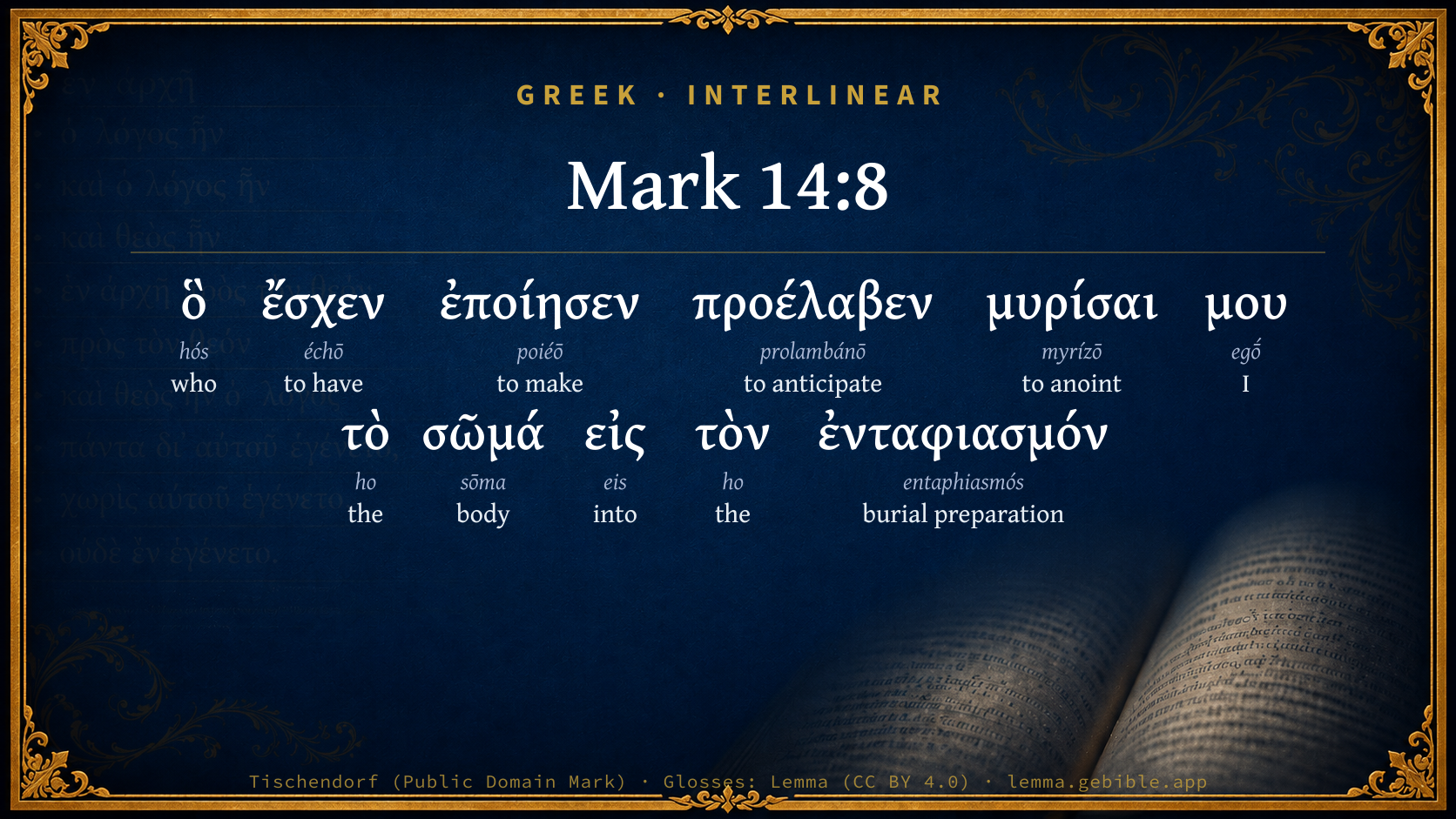
Greek (Tischendorf 8th ed.) Mark 14:8 appears in the Greek New Testament. The text above is from the Tischendorf 8th edition. Each word links to its Strong’s number and a concise gloss. Click any word for its full Thayer’s Greek Lexicon entry.
Download image
Cite this verse

Mark 14:8 (World English Bible). Public Domain. Lemma interlinear Bible study tool, https://lemma.gebible.app/v/mark/14/8.

Show BibTeX & RIS
BibTeX
RIS
English Translation
She has done what she could. She has anointed my body beforehand for the burying.
World English Bible · Public Domain
Highlights
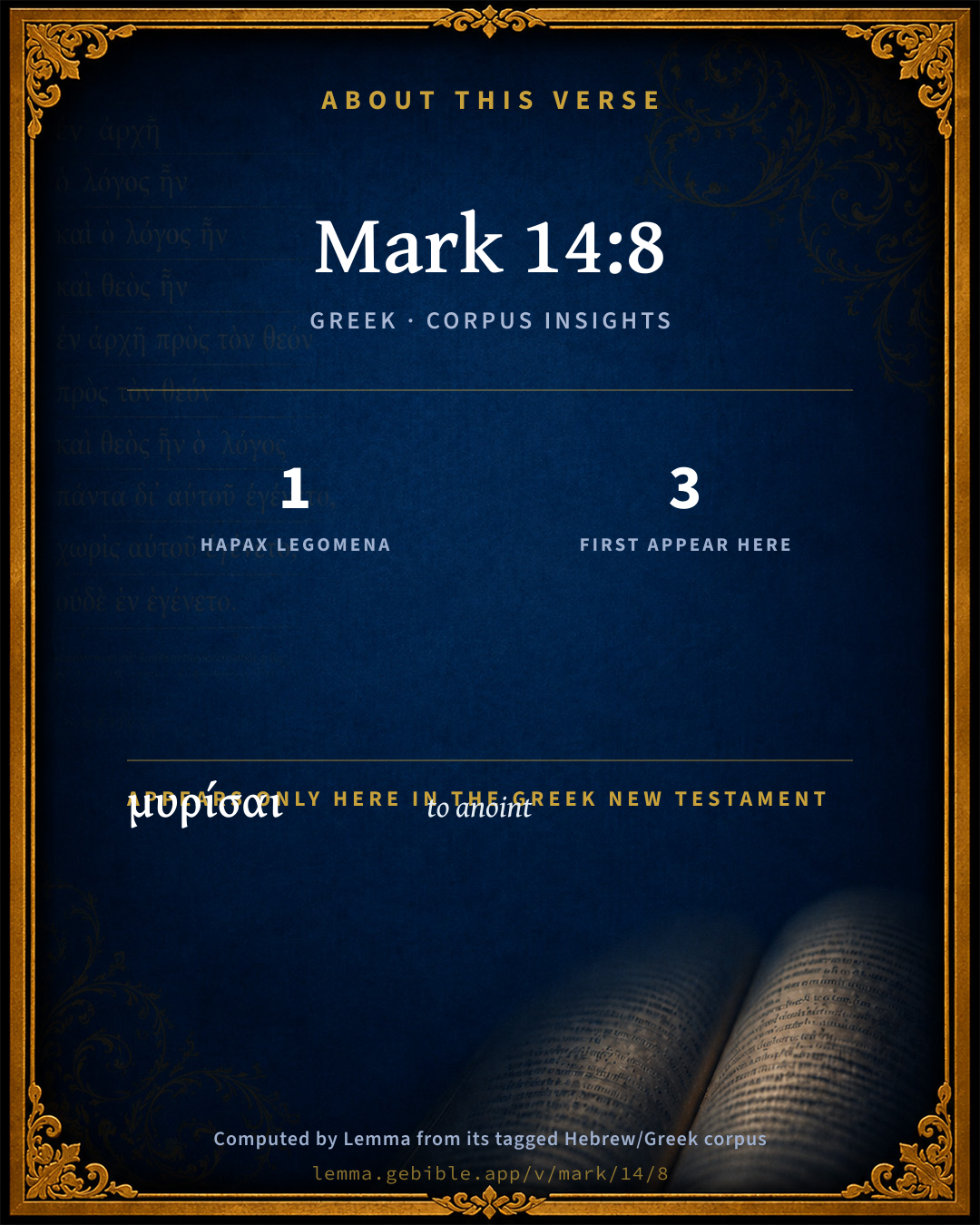
  • 1 hapax legomenon — only here in the Greek New Testament
  • 3 first appearances in the Greek New Testament
Full analysis ↓
Download a study sheet

One document with this verse’s original text, its word-by-word gloss line, the meaning frame, cross-references with their text, attributed commentary, and full source and license credits — printable, and it pastes into notes with its structure intact.

This verse Autodidact and up

Study sheet (.html) Plain text (.txt)

A passage Seminary Student

Up to 50 verses in one chapter. A passage sheet keeps up to 6 commentary sources and 12 cross-references per verse, in the order this page ranks them, and says so on the sheet whenever that leaves anything out. Ask for a single verse and you get the Autodidact verse sheet above.

Everything on this page stays free to read, with no account — the sheet is a download of what is already on screen, not access to it.

Want to remove ads? Support Godless Engineer
Compare translations 3

The same verse in 3 English versions, stacked beneath the original-language interlinear above. Click any original word for its lexicon entry.

Each is an independent rendering of the whole verse — the interlinear is not word-aligned to these translations.

Highlighted words mark where these versions differ — a whole-verse word diff, not a word-by-word alignment.

  • World English Bible Public Domain
    She has done what she could. She has anointed my body beforehand for the burying.
  • King James Version Public Domain
    She hath done what she could: she is come aforehand to anoint my body to the burying.
  • unfoldingWord Literal Text CC BY-SA 4.0
    What she had, she did. She anticipated to anoint my body for burial.

unfoldingWord Literal Text — © unfoldingWord, licensed CC BY-SA 4.0. Word-aligned USFM3 via Door43 (git.door43.org/unfoldingWord/en_ult).

Versions to compare (up to 4)

3 of 4 selected

Show all 19 translations

Every available English version of this verse, each an independent rendering of the whole verse.

  • World English Bible Public Domain
    She has done what she could. She has anointed my body beforehand for the burying.
  • Berean Standard Bible Public Domain
    She has done what she could to anoint My body in advance of My burial.
  • Majority Standard Bible Public Domain
    She has done what she could to anoint My body in advance of My burial.
  • King James Version Public Domain
    She hath done what she could: she is come aforehand to anoint my body to the burying.
  • American Standard Version (1901) Public Domain
    She hath done what she could; she hath anointed my body beforehand for the burying.
  • Revised Version (1885) Public Domain
    She hath done what she could: she hath anointed my body aforehand for the burying.
  • Geneva Bible (1599) Public Domain
    She hath done that she coulde: she came afore hand to anoynt my body to the burying.
  • Douay-Rheims (1899) Public Domain
    She hath done what she could: she is come beforehand to anoint my body for burial.
  • Young's Literal Translation Public Domain
    what she could she did, she anticipated to anoint my body for the embalming.
  • Literal Standard Version CC BY-SA 4.0
    she did what she could, she anticipated to anoint My body for the embalming.
  • Unlocked Literal Bible CC BY-SA 4.0
    She has done what she could. She has anointed my body for burial.
  • unfoldingWord Literal Text CC BY-SA 4.0
    What she had, she did. She anticipated to anoint my body for burial.
  • Darby Bible Public Domain
    What *she* could she has done. She has beforehand anointed my body for the burial.
  • World Messianic Bible Public Domain
    She has done what she could. She has anointed my body beforehand for the burying.
  • Webster's Bible Public Domain
    She hath done what she could: she is come beforehand to anoint my body to the burying.
  • Free Bible Version CC BY-SA 4.0
    She did what she could: she anointed my body in anticipation of my burial.
  • Bible in Basic English Public Domain
    She has done what she was able: she has put oil on my body to make it ready for its last resting-place.
  • Text-Critical English NT CC BY 4.0
    She has done what she could; she has anointed my body beforehand to prepare me for burial.
  • Tyndale New Testament (1534) Public Domain
    She hath done that she coulde: she came a fore honde to anoynt my boddy to his buryinge warde.

Literal Standard Version (2020), Covenant Press — licensed CC BY-SA 4.0. Text via the HelloAO Bible API (eBible.org). Unlocked Literal Bible (unfoldingWord) — licensed CC BY-SA 4.0. Text via the HelloAO Bible API (eBible.org). unfoldingWord Literal Text — © unfoldingWord, licensed CC BY-SA 4.0. Word-aligned USFM3 via Door43 (git.door43.org/unfoldingWord/en_ult). Free Bible Version, Dr. Jonathan Gallagher — licensed CC BY-SA 4.0. Text via the HelloAO Bible API (eBible.org).

Word by word

More ways to search: Search by grammar → Find every occurrence → Compare this word →

Practice this passage: Drill this verse → Learn its vocabulary →

About this verse

These counts appear in no published source. They are computed here, from the morphology-tagged text and Lemma’s own curated glosses. What Lemma adds →

11
words
10
distinct lemmas
Gospels
section

Notable vocabulary

1 hapax legomenon — a word that appears only here in the entire Greek New Testament:

  • μυρίσαι to anoint G3462

First appearance in Scripture

These words make their first canonical appearance in the Greek New Testament here:

  • προέλαβεν to anticipate G4301
  • μυρίσαι to anoint G3462
  • ἐνταφιασμόν burial preparation G1780

Shared distinctive vocabulary

ἐνταφιασμόν burial preparation G1780 occurs in 2 verses of the Greek New Testament. Also found in:

Repetition

A word recurs within this verse:

Cross-references

11

Topical passages linked to Mark 14:8 in the Treasury of Scripture Knowledge — connected by theme and wording, ordered by reader-vote popularity; previews shown in the World English Bible.

  • 2 Corinthians 8:12 For if the readiness is there, it is acceptable according to what you have, not according to what you don't have.
  • John 12:7 But Jesus said, "Leave her alone. She has kept this for the day of my burial.
  • 2 Chronicles 31:20–21 Thus did Hezekiah throughout all Judah; and he worked that which was good and right and faithful before Yahweh his God.
  • Mark 15:42–16:1 When evening had now come, because it was the Preparation Day, that is, the day before the Sabbath,
  • Luke 23:53–24:3 He took it down, and wrapped it in a linen cloth, and laid him in a tomb that was cut in stone, where no one had ever been laid.
  • 2 Corinthians 8:1–3 Moreover, brothers, we make known to you the grace of God which has been given in the assemblies of Macedonia;
  • 1 Chronicles 29:1–17 David the king said to all the assembly, Solomon my son, whom alone God has chosen, is yet young and tender, and the work is great; for the palace is not for man, but for Yahweh God.
  • 2 Chronicles 34:19–33 It happened, when the king had heard the words of the law, that he tore his clothes.
  • 1 Chronicles 28:2–3 Then David the king stood up on his feet, and said, Hear me, my brothers, and my people: as for me, it was in my heart to build a house of rest for the ark of the covenant of Yahweh, and for the footstool of our God; and I had made ready for the building.
  • Psalms 110:3 Your people offer themselves willingly in the day of your power, in holy array. Out of the womb of the morning, you have the dew of your youth.
  • John 19:32–42 Therefore the soldiers came, and broke the legs of the first, and of the other who was crucified with him;

Cross-references courtesy of OpenBible.info (CC BY 4.0).

Commentary

Notes on Mark 14:8 from classic Christian and Jewish commentators (each source and its license shown beneath its notes). The classic Christian expositions comment on the surrounding passage and are grouped to its opening verse, so a note may address several verses; the Jewish commentaries on the Tanakh (Rashi and others) are per-verse, so they appear only where the commentator wrote on this verse.

Lemma curates 59 commentaries, every one of them public domain or Creative Commons licensed, each selected and text-cleaned for this edition rather than reprinted as found. About our sources →

The Biblical Illustrator

Joseph S. Exell

Mar_14:8

She hath done what she could.

Do what you can

I. That the Lord Jesus likes His people to be doing Christians. She did something. She did what she could. Hence the praises bestowed upon her. The great Head of the Church likes doing Christians. Christians who show their Christianity in their lives. True religion is not made up of general notions and abstract opinions-of certain views, and doctrines, feelings, and sentiments. Useful as these things are, they are not everything. The wheels of the machine must move. The clock must go as well as have a handsome case and face. It matters little what a man thinks, feels, and wishes in religion, if he never gets further than that. What does he do? How does he live?

1. Doing is the only satisfactory proof that a man is a living member of the Lord.

2. Doing is the only satisfactory proof that your Christianity is a real work of the spirit. Talking and profession are cheap and easy things. But doing requires trouble and self-denial.

3. Doing is the only evidence that will avail a man in the day of judgment. (Mat_25:31, etc.)

II. That all true Christians can do something, and that all should do what they can. Now I know well the devil labours to make true Christians do nothing. Doing Christians are the devils greatest enemies.

1. Satan will tell some that they are too young to do anything. Believe him not: that is a lie. Yet a little while and the enemy will say, you are too old, and it is too late.

2. Satan will tell others that they stand alone too much to do any good. Martin Luther, Mahomet, Napoleon-all are cases in point. They all rose from the ranks. They stood alone at first. They owed nothing to position or patronage.

3. Satan will tell others that they have no power to do anything. He will say, you have no gifts, no talents, no influence.

4. But Satan will tell some that they have no opportunities for doing anything-no door open on any side.

5. Do you ask me what you can do? I reply, there is something for every true Christian in England to do. Have you not the power of doing good by your life? you may work wonders by steady consistency and patient continuance in well-doing. (Bishop J. C. Ryle.)

Work and joy

A young girl, in one of her pensive moods, wrote thus in her journal: If I dared I would ask God why am I placed in this world? and what have I to do? My days are idly spent, and I do not even regret their swift passing away. If I might but do some good to myself or another, if only for the short space of a moment each day! A few days later her views were wider and brighter, and she wrote again: Why, nothing is easier! I have but to give a cup of cold water to one of Christs little ones. Paths of service are sure to open before willing feet. When the Spirit of God puts a benevolent impulse in the soul the providence of God will open a channel for its outflowing. Thousands of Gods afflicted children would be inexpressibly touched if Christian young women would sing to them of His love and the home beyond the tide. (Bishop J. C. Ryle.)

Good works the fruit of faith and love

I. The incident here recorded comprised the conduct of a certain woman on a particular occasion, together with the treatment which she received; first, from some of the persons present, and secondly, from Jesus Himself. Those present, not having the same affection and veneration for Jesus which the woman had, found fault with her conduct. But what treatment did she receive from Jesus? And Jesus said, etc. Here we see in the first place, how our Saviour defended the woman, and reproved and exposed those who had blamed her. Let us notice also in the second place, that Jesus not only defended the woman, but even praised and commended her.

II. To draw from this incident some instructive inferences.

1. We may hence infer that those works which Jesus Christ accounts to be good are such as spring from faith in, and love to Him.

2. Such good works, such acts of love and faith, will not always, nor even in general, obtain the favour and applause of the world. To the world the good works of the Christian are seldom either intelligible or gratifying. Propose, for instance, to worldly persons to join with you in supporting some charity at a distance; they will tell you how it is abused and perverted, and that there are poor at home to whom we are required to attend. Thus selfishness and avarice plead their cause, and lead men to evade their plainest duties.

3. We may infer from the passage before us that those good works, those fruits of faith and love, which the world misunderstands, misrepresents, and censures, are yet graciously noticed, and favourably accepted by Jesus Christ. My brethren, what encouraging and consolatory reflections are these to all such as are endeavouring to serve the Lord Christ, and to be fruitful in good works! Regard not the sneers and reproaches of ungodly persons. Behave to them with meekness and kindness. Overcome their evil with good. (Edward Cooper.)

The motive and measure of Christian duty

I. The motive of Christian duty. Love is that motive-the very principle which fills the mind of Deity. It was love which brought the Saviour down, and led Him through all the scenes of His earthly sufferings and the cross. Christ has loved you; therefore do what you may, for His sake. No higher motive than this can be urged.

II. The amount of service required. The amount of ability is the measure of duty. What we can do, we ought to do-cheerfully and honestly. Use the balance of the sanctuary to make sure that thou art not defrauding thy God. (S. Robins.)

Christ accepts the humblest gifts

Christ asks no impossibilities. That woman brought an alabaster box. What was it to Jesus? Why, He owns all the fragrance of earth and heaven; but He took it. He was satisfied with it. If it had been a wooden box He would have been just as well satisfied had it been the best one she could bring. I hear someone say: If I only had this, that, or the other thing, I would do so much for God. In the last day, it may be found that a cup of cold water given in the name of a disciple gets as rich a reward as the founding of a kingdom; and that the sewing girls needle may be as honourable in Gods sight as a kings sceptre; and that the grandest eulogium that was ever uttered about anyone was. She hath done what she could. There she sits at the head of the Sabbath school class, and she says: I wish I understood the Scriptures in Greek and Hebrew. I wish I had more facility for instruction. I wish I could get the attention of my class. I wish I could bring them all to Christ. Do not worry. Christ does not want you to know the Scripture in Greek and Hebrew. Do as well as you can, and from the throne the proclamation will flame forth: Crown that princess. She hath done what she could. There is a man toiling for Christ. He does not get on much. He is discouraged when he hears Paul thunder and Edward Payson pray. He says: I wonder if I will ever join the song of heaven. He wonders if it would not look odd for him to stand amid the apostles who preached and the martyrs who flamed. Greater will be his wonder on the day when he shall find out that many who were first in the Church on earth are last in the Church of heaven; and when he sees the procession winding up among the thrones of the sorrowing ones who never again shall weep, and the weary ones who never again shall get tired, and the poor who never again shall beg, and Christ, regardless of all antecedents, will upon the heads of His disciples place a crown made from the gold of the eternal hills, set in with pearl from the celestial sea, inscribed with the words: He hath done what he could. (Dr. Talmage.)

Doing something for Christ

A man in America, who depended for support entirely on his own exertions, subscribed five dollars annually in support of the Bombay schools. His friends inquired, why he gave so much, and how he could afford it? He replied: I have been for some time wishing to do something for Christs cause, but I cannot preach, neither can I pray in public, to anyones edification, nor can I talk to people; but I have hands, and I can work.

She hath done what she could.-

Acceptance of the heart

In many aspects this is one of the most encouraging expressions of our Lord. It was uttered in defence of a woman who ventured to approach Him under the unceremonious impulse of affection, destitute, so far as we know, of any recommendation from family circumstance or social distinction, but urged solely by an irresistible longing to do something, however humble or irregular, in behalf of this Divine friend, who has gained the unutterable, enthusiastic devotion of her soul.

I. This answer of our Lords plainly and powerfully asserts the superior worth of the hearts feeling over any outward acts. The very form of the expression implies that, in one sense, she had done but little. Yet that little was enough. It was a test of her sincerity. It said distinctly that she was in earnest. It demonstrated the deep and tender attachment of her soul. One pennys worth, if it is only the utmost that self-denial can do, is as good for that as ten thousand shekels. The whole spiritual meaning of gifts consists in the disposition of the giver.

II. These words bestow a blessing on the feeling of personal affection towards Christ. Have you ever had that mingled sense of gratitude and love towards a person which made you long, above all things, to find out some way of serving him, and made it a positive pain to be denied that privilege? Did Christianity not provide an outlet for this feeling, it would fail to secure a practical hold on human sympathies.

III. These words affirm, for true goodness, a complete independence of place. Acceptance with God is as possible in small fortunes, or limited reputations, as in influential and powerful circles. No one, therefore, is excused from doing what he can, nor is there one to whom the whole infinite wealth of Christs favour is not offered.

IV. Ability is the measure of responsibility. No soul is tasked beyond its power. Gods commandment never passes the line of a possible obedience, and so never goes over from justice to tyranny. What we fail to render in actual work (through our human frailty), He mercifully permits us through Christ to make up in those penitent and self-renouncing affections which gain forgiveness and open the way of reconciliation. Still, let us solemnly ask ourselves, even after making allowance for this, Have I done what I could? Has my service to the Master reached the full measure of the powers and gifts, the capacities of affection and the opportunities of well-doing, with which my Master has entrusted me?

V. Take these three thoughts as the practical substance of the subject.

1. This saying of Jesus is dangerously perverted and shamefully abused, if we take it as excusing us from the utmost effort in well-doing, and a laborious progress in Christs service. We must summon into the Masters service every power, every energy, every affection, every hour of life. No laxities, and no apologies. Nothing less than entire consecration is demanded of us.

2. In order to serve Christ acceptably, we have not to revolutionize our lot, nor to seek other conditions than those Providence supplies. The place is nothing; the heart is all.

3. There is no service thoroughly right which does not directly acknowledge and honour the Saviour. The hearts offering to Him is the beginning of all righteousness. (Bishop F. D. Huntington.)

Various ways of serving Christ

The Father has appointed many ways in which we may walk toward His face, and run on His errands. Work is the way for strength; lying still is the way for infirmity,-if only there are trust and prayer in both. There is some instruction in a picture I have read of, which represents the lives of twin brothers diverging from the cradle. One, by study, becomes a learned and skilful physician, reaching great riches and honours by ministering to the sick. The other has no talent for books, and no memory, and so no science; he becomes a poor, strolling musician, but spends his days in consoling, by his lute, sufferings that are beyond all medicine. The brothers are shown meeting at the close of their career. The vagrant is sick and worn out, and the brother prescribes for him out of his learning, and gathers ingenious compounds for his relief; but, meantime, he to whom God gave another gift, touches his instrument for the solace of the great mans shattered nerves, and heals his benefactors disordered spirit. (Bishop F. D. Huntington.)

Characteristics of fervent love to Christ

1. Willing service.

2. Costly sacrifices. (Wm. Marsh.)

What a woman may do

An American paper tells the story of a woman who, because tired of a life mainly spent in eating and dressing, resolved to devote herself and her money to a nobler purpose. At the close of the war, she went to a sandy island off the Atlantic coast, where about two hundred persons were living in poverty and ignorance, and there she established her home, with the intention of benefiting the inhabitants. She began by teaching, by example, how to cultivate the land lucratively. Then she established a school for the children, and afterwards a church. Now the island is a thriving nation, with an industrious and moral population, the change being the work of one woman.

All may be useful

Many true saints are unable to render much service to the cause of God. See, then, the gardeners going down to the pond, and dipping in their watering pots to carry the refreshing liquid to the flowers. A child comes into the garden and wishes to help, and yonder is a little watering pot for him. Note well the little water pot, though it does not hold so much, yet carries the same water to the plants; and it does not make any difference to the flowers which receive that water, whether it came out of the big pot or the little pot, so long as it is the same water, and they get it. You who are as little children in Gods Church, you who do not know much, but try to tell to ethers what little you do know; if it be the same gospel truth, and be blessed by the same Spirit, it will not matter to the souls who are blessed by you, whether they were converted or comforted by a man of one or ten talents. (C. H. Spurgeon.)

Usefulness of common actions

It is the bubbling stream that flows gently, the little rivulet which flows along day and night by the farmhouse, that is useful, rather than the swollen flood or warring cataract. Niagara excites our wonder; and we stand amazed at the powerful greatness of God there, as He pours in from the hollow of His hand. But one Niagara is enough for the continent of the world, while the same world requires thousand and tens of thousands of silver fountains and gently flowing rivulets, that water every farm and meadow, and every garden, and shall flow on every day and night with their gentle quiet beauty. So with the acts of our lives. It is not by great deeds, like those of the martyrs, that good is to be done, but by the daily and quiet virtues of life. (A. Barnes.)

She hath done what she could.-

All may win this encomium

This encomium is just as sufficient and adequate for the ablest as the most infirm; it is enough for such as Elizabeth Fry, Hannah More, and Madame Adorna, and no more than enough for the unlettered woman carried out from an obscure lane last week, having died in the joy of her Lord, and her name never seen in printed letters, perhaps, till it was enrolled in the record of the dead. When I read a description of Kaiserswerth, near Dusseldorf, on the Rhine-of that vast establishment of Christian mercy, with its hospital, insane asylum, Magdalen retreat, charity schools, and institutions for training the most scientific nurses and accomplished teachers, graduating superintendents for the humane houses of both Europe and America, and a few miles away another building for the rest and refreshment of those that have been worn down by the fatigues of these voluntary labours of love,-when I see how, throughout, charity has been systematized by skill, and benevolence perfected by perseverance, and then behold the benefits flowing forth to be extended and multiplied, in ever enlarging proportions, over the whole sick and suffering and groaning earth,-I am as much ashamed and humbled before this devoted Pastor Fleidner, whose active spirit and benevolent genius have called up all this busy and organized kingdom of Good Samaritanism about him to glorify the age, as I suppose my sisters are before the beautiful and accomplished baroness who has laid down youth, rank, and wealth as an offering to sorrow and disease; or before the high-born, gifted, and admired English girl (Florence Nightingale) who came to Kaiserswerth as a pupil, and then reproduced the same wonders of consolation and healing for sick and destitute governesses,-not amidst the rural quiet and sweet verdure of her own paternal home in Hampshire, but in a dismal street in London. Yet we ought all to remember that these, too, only did what they could; that, if we do that, Gods honours are impartial; that if we do not that, then ours is indeed the shame of the shortcoming. (Bishop F. D. Huntington.)

What we can do we are bound to do

This language of the Saviour most naturally associates itself with the closing up of lifes great account. Of how many among us, when that trial hour comes, with all its retrospections and searching examinations, can those glorious words be spoken? We cannot recall nor judge the dead. They are in the hands of the All-Just. But we can speak to one another as yet living. How many of us are so striving righteously, and watching soberly, and praying earnestly, that this shall be the just and consoling eulogy-They have done what they could? The busy man of affairs, the successful one, the disappointed and losing one, the young adventurer, the older and long-trusted, and finally unfortunate one,-those that have prospered by others industry, and those that have been ruined by others crimes,-has each one of them done what he could? The wife or mother, whose very name is sacred, because the sacred office of forming character is her perpetual duty, the lonely woman that has only her own heart to discipline, the young girl that has so few cares for herself that God requires many of her for the less-favoured,-has each done what she could? The bereaved parent, the desolate widow suddenly summoned to take up the dreary and dreadful burden of solitary suffering,-has each done what she could? is each one doing what she can? Christ draws near to us and repeats the question. He turns and puts it, with twofold solemnity and sadness, to those that leave Him and pass away. To all that sit at His feet and follow in His steps in the spirit of her who poured the fragrant offering on His head, He is ready to speak the same benediction with His infinite love,-hiding in it the sure promise of life everlasting. I said we cannot adjudge the deservings of the departed. But we can guard ourselves against those hallucinations of mortal glory, and all those artificial illusions, which are so apt to cheat our souls, and obscure the plain truth. There goes to his august repose, enveloped in imperial pomps, the ruler of the worlds mightiest, vastest empire. Fifty-seven millions of human souls, embracing nine different races of men, with a million soldiers, drew their daily breath subject to his direct and despotic will; but not all of so many millions could add one single breath to his prostrate lungs. Eight millions of square miles of territory were yesterday ruled by his word; now he needs not eight feet, out of it all. The guns of massive fortresses on the huge ramparts that guard widely divided waters made a continent tremble in their volleying answers to his edicts, and the haughtiest noblemen of the world bent at his smile or frown. Common cabinets and kings were perplexed and afraid at the cunning of his brain, as boys are of their master, and the armies of the strongest governments, after his own, felt the globe to be a more conquerable and practicable domain the moment they knew he was dead. But he is dead. And neither the millions of acres nor men, the fortresses nor the fears, the armies nor the brain, shall make it a whit easier, but harder rather, for his single soul-when it goes alone, disrobed of crown and purple, into the presence of the King of kings, whose right it is to reign-to answer that simple question, Hast thou done for Me-ah! for Me-what thou couldst? Canst thou stand with the lowly and powerless woman who crept with the box of ointment to her Redeemers feet, and who shall have the story of that act of love told for a memorial of her wherever the everlasting gospel is preached, when the history of Cossack and Czar shall be dim as that of princes before the flood, and on to the end of time? But here, close by us, falls asleep a meek, patient girl,-a faithful sister, an obedient daughter, a mild and friendly counsellor of a few children that she knew, ruler of none on earth but her own patient spirit, and thereby made greater than he that taketh a city, or prevents its being taken. She, too, dies, and no anxious hemispheres dispute about the report, nor do kingdoms mourn, nor cowardly assemblies clap their hands, when the report is confirmed. And in the day when the secrets of all hearts shall be revealed, our only question is, which of these two shall be found nearest to Him who sitteth on the one throne, and shall wear the crown which is a crown of life. (Bishop F. D. Huntington.)

She hath done what she could.

A whole city visited by one woman

An intelligent, industrious, and kind-hearted woman in Russia became a Christian. Her labours were transformed into Christian labours, and were followed up with an ardour and perseverance seldom exceeded. In her visits to the poor, she carried books and tracts as well as food and raiment; and when she found persons unable to read, which was frequently the ease, she made it a point to read to them, and to explain what they could not understand. Her prompt assistance was, in a great measure, instrumental in a zealous agent becoming extensively engaged in the circulation of the Scriptures. She gave him two of the first Finnish Bibles that ever passed through his hands; and when there was a great demand for the sacred volume in that language, she actually sold her watch, in order to furnish one hundred Bibles to the poor at reduced prices. She took, as her sphere for visiting, the whole city of St. Petersburg, perambulating it alone, and succeeded beyond all expectations. In the course of a few months she sold more than 1,500 Bibles and Testaments; and in this blessed work she persevered, while hundreds derived advantage from her visits.

A little boys effort

Children, I want each of you to bring a new scholar to the school with you next Sunday, said the superintendent of a Sunday school to his scholars one day. I cant get any new scholars, said several of the children to themselves. Ill try what I can do, was the whispered response of a few others. One of the latter class went home to his father, and said, Father, will you go to the Sunday school with me? I cant read, my son, replied the father, with a look of shame. Our teachers will teach you, dear father, answered the boy, with respect and feeling in his tones. Well, Ill go, said the father. He went, learned to read, sought and found the Saviour, and at length became a colporteur. Years passed on, and that man had established four hundred Sunday schools, into which thirty-five thousand children were gathered! Thus you see what trying did. That boys efforts were like a tiny rill, which soon swells into a brook, and at length becomes a river. His efforts, by Gods grace, saved his father; and his father, being saved, led thirty-five thousand children to the Sunday school.

The Biblical Illustrator, edited by Joseph S. Exell (c. 1880s–1900s) — public domain. Text from a community e-Sword module.

Tyndale Open Study Notes

Tyndale Open Resources

14:8 Jesus interprets the woman’s action. She had anointed his body in preparation for his burial. Whether the woman was consciously motivated by Jesus’ imminent death is unclear; her loving act served the purpose Jesus assigned it.

Tyndale Open Study Notes — © Tyndale Open Resources, licensed CC BY-SA 4.0. Text via the HelloAO Bible API.

Bengel's Gnomon

Johann Albrecht Bengel

Mar 14:8. Ὅ, What) An abbreviated mode of expression; i.e. What she had, she has freely bestowed; and what she could, she hath done; or else, what she had [it in her power] to do, she hath done.—αὕτη, she, emphatically coheres with ἔσχεν, she had. Hardly any one else of those, who were in attendance on Jesus, had so costly ointment. It was divinely designed and appointed for the purpose of this being done.—προέλαβε, she has anticipated [she is come aforehand] to) It would not have been becoming for the body of Christ, which knew not corruption, to have been anointed after death; on this account it was anointed beforehand.

Bengel's Gnomon of the New Testament — English translation (T&T Clark, Edinburgh, 1860) — public domain. Text from a community e-Sword module.

Expositor's Greek Testament

ed. W. Robertson Nicoll

Mar 14:8 . ὃ ἔσχεν (suppl. ποιεῖν ), what she had to do she did; the reference being not to the measure of her power (wealth) but to her opportunity: she did what lay to her hand, and could only be done then . προέλαβε μυρίσαι , she anticipated the anointing; the latter verb here only, the former in 1Co 11:21 , Gal 6:1 . ἐνταφιασμόν : the noun answering to the verb in Mt., here and in John and in one place in the classics.

The Expositor's Greek Testament, edited by W. Robertson Nicoll (1897–1910) — public domain. Text from a community e-Sword module.

Geneva Bible (1599)

Geneva Bible translators

This woman by the secret instinct of the Spirit, anointing Christ, setteth before men’s eyes, his death and burial which were at hand.

Geneva Bible (1599) marginal notes — public domain. Text via Bolls.life.

Adam Clarke's Commentary

Verse 8. To anoint my body to the burying.] εις τον ενταφιασμον, against, or in reference to, its embalmment, thus pointing out my death and the embalmment of my body, for the bodies of persons of distinction were wrapped up in aromatics to preserve them from putrefaction. See Clarke on Mt 26:12.

Adam Clarke's Commentary on the Bible (1810–1826) — public domain. Text from a community e-Sword/MySword module.

The Cambridge Bible for Schools and Colleges

gen. ed. J. J. S. Perowne

8. she is come aforehand] The word thus rendered only occurs three times in the New Testament. (1) Here; (2) 1Co_11:21, “for in eating every one taketh before other his own supper;” (3) Gal_6:1, “if a man be overtaken in a fault,” = “be surprised or detected in the act of committing any sin.” It denotes (1) to take beforehand; (2) to take before another; (3) to outstrip, get the start of, anticipate.

The Cambridge Bible for Schools and Colleges (gen. ed. J. J. S. Perowne; Cambridge University Press, 1878–1918) — public domain. Text from a community e-Sword module.

John Gill's Exposition

She hath done what she could,.... What she had in her heart, and in the power of her hands to do; she hath done according to her ability, and her good will; and if she had not done it now, she could not have done it at all.

She is come aforehand to anoint my body to the burying; or, "as if it was to bury me", as the Syriac version renders it. Christ signifies by this, that he should shortly die, and that this woman came before hand to anoint him, and, as it were, to perform the funeral rites before he was dead; it being revealed to her by the Spirit, that Jesus would quickly die, and she should not be able to perform this good work when dead, and therefore came to do it before; or, at least, she was directed by the Spirit of God, because she would be prevented doing it afterwards; See Gill on Mat 26:12.

John Gill's Exposition of the Whole Bible (1746–1763) — public domain (CC PDM 1.0). Text via the HelloAO Bible API.

Trapp's Complete Commentary

John Trapp

8 She hath done what she could: she is come aforehand to anoint my body to the burying.

Ver. 8. {See Trapp on "Mat 26:12"}

John Trapp, A Commentary or Exposition upon All the Books of the Old and New Testament (1647–1656) — public domain. Text from a community e-Sword module.

The Pulpit Commentary

She hath done what she could. She seized the opportunity, which might not occur again, of doing honor to her Lord by anointing him with her very best. Our Lord might have excused this action, and have praised it as a practical evidence of her gratitude, her humility, and her love for him. But instead of dwelling on these things, he said, She hath anointed my body aforehand for the burying. Our Lord here, of course, alludes to the spices and ointments with which the Jews wrapped up the bodies of their dead before their burial. Not that this was what Mary intended. She could hardly have dreamed of his death and burial so near at hand. But she was moved by the Holy Spirit to do this, at this particular time, as though in anticipation of his death and burial.

The Pulpit Commentary (1880–1919), ed. H.D.M. Spence-Jones & Joseph S. Exell — public domain. Text from a community e-Sword module.

Cambridge Greek Testament for Schools and Colleges

8. ὃ ἔσχεν ἐποίησεν. She did what she could. This class. use of ἔχω is freq. in Lk. (Luk 7:42; Luk 12:4; Luk 14:14) and Acts (Act 4:14; Act 23:17-19, etc.). For the sense see on 2Co 8:12.

προέλαβεν μυρίσαι. She hath been beforehand in anointing. She anticipated the funeral rite. Jn tells us that myrrh and aloes, but not unguents, were placed round the Body, and Mk and Lk. say that women prepared to anoint Him, but that He had risen before they could do so. So Mary alone has this honour. Μυρίζω is classical, but occurs here only in Bibl. Grk. Professional embalmers were called ἐνταφιασταί, and ἐνταφιάζω = “embalm” (Gen 50:2). So also in papyri.

Cambridge Greek Testament for Schools and Colleges (Cambridge University Press, 1896; 21 vols, various authors incl. Carr, Maclear, Plummer, Farrar, Lumby, Moule, M. R. James, Simcox) — public domain. Text from a community e-Sword module.

Alford’s Greek Testament

Henry Alford

8.] We have here again a striking addition peculiar to Mark—ὃ ἔσχεν ἐποίησεν—she did what she could: a similar praise to that given to the poor widow, ch. 12:44—πάντα ὅσα εἶχεν ἔβαλεν. We have also the expression προέλαβεν μυρίσαι, shewing, as I have observed on Matt., that the act was one of prospective love, grounded on the deepest apprehension of the reality of our Lord’s announcement of His approaching death.

Henry Alford, The Greek Testament (1849–1861) — public domain. Text from a community e-Sword module.

International Critical Commentary

8. ὃ ἔσχεν ἐποίησε—She did what she could.1 προέλαβε μυρίσαι—She anticipated the anointing.2 This is an unintended meaning which the act gains from its place so near our Lord’s death. Unconsciously, she has rendered to him, while still living, the honors of burial. ἐνταφιασμόν3—preparation for burial. J. says, “Suffer her to keep it for the day of my preparation for burial,”4 a decided lowering of the meaning.

Omit αὕτη, this (woman), Tisch. (Treg.) WH. RV. א BL 1, 13, 28, 69, 209, 346, two mss. Lat. Vet. Memph. Harcl. ἔσχεν, instead of εἶχεν, Tisch. Treg. WH. RV. and most sources.

International Critical Commentary — older volumes (1896–1929), various authors — public domain. Text from a community e-Sword module.

Vincent's Word Studies in the New Testament

Marvin R. Vincent

She hath done what she could [ο εσχεν εποιησεν] . Lit., what she had she did. Peculiar to Mark.

She is come aforehand to anoint [προελαβεν μυρισαι] . Lit., she anticipated to anoint. Rev., hath anointed beforehand. The verb murizw is found only here.

Marvin R. Vincent, Word Studies in the New Testament (1887–1900) — public domain. Text from a community e-Sword/MySword module.

Lesson kit

Teaching starters — assembled from the data on this page, not authored interpretation. Every prompt links to the verse data it draws on. Edit before teaching.

Mark, in the Gospels, opens this verse with 11 words (10 distinct Greek lemmas). Its most distinctive word is myrízō (“to anoint”). A historical commentator’s framing appears above. Read the whole chapter for the surrounding context.

Discussion questions

  1. The word myrízō carries the sense “to anoint.” How does it shape the verse?
  2. This verse holds 1 word here found nowhere else in the Greek New Testament. What might the rare word draw attention to?
  3. 3 words here appear for the first time in Scripture. What is being introduced at this debut?
  4. John 12:7 shares the word «burial preparation» with this verse. How do the two illuminate each other?
  5. “the” occurs 2× in this one verse. What is the effect of the repetition?
  6. These translations render this verse differently. What is at stake in choosing one wording over another?
  7. Reading how The Biblical Illustrator and Tyndale Open Study Notes read this verse, where do the two commentators agree and where do they part?

Things to notice

  • 1 word in this verse appears nowhere else in the Greek New Testament.
  • 3 words make their first canonical appearance in Scripture here.
  • These translations choose different wording for 13 words in this verse.
  • “the” occurs 2× in this single verse.
  • 10 distinct Greek lemmas span 11 words in this verse.

Reading settings

Reading text

Shown beneath each verse's original-language words.

Old Testament
Old Testament edition

Read the OT as the Masoretic Hebrew (MT) or the Greek Septuagint (LXX).

English shown for the Greek Septuagint (in the Hebrew ↔ Greek comparison).

Comparing translations? Open the Compare panel on any verse page to stack up to four side by side.