Matthew 25:40

Greek (Tischendorf 8th ed.) Matthew 25:40 appears in the Greek New Testament. The text above is from the Tischendorf 8th edition. Each word links to its Strong’s number and a concise gloss. Click any word for its full Thayer’s Greek Lexicon entry.
Download image
Cite this verse

Matthew 25:40 (World English Bible). Public Domain. Lemma interlinear Bible study tool, https://lemma.gebible.app/v/matthew/25/40.

Show BibTeX & RIS
BibTeX
RIS
English Translation
"The King will answer them, 'Most assuredly I tell you, inasmuch as you did it to one of the least of these my brothers, you did it to me.'
World English Bible · Public Domain
Download a study sheet

One document with this verse’s original text, its word-by-word gloss line, the meaning frame, cross-references with their text, attributed commentary, and full source and license credits — printable, and it pastes into notes with its structure intact.

This verse Autodidact and up

Study sheet (.html) Plain text (.txt)

A passage Seminary Student

Up to 50 verses in one chapter. A passage sheet keeps up to 6 commentary sources and 12 cross-references per verse, in the order this page ranks them, and says so on the sheet whenever that leaves anything out. Ask for a single verse and you get the Autodidact verse sheet above.

Everything on this page stays free to read, with no account — the sheet is a download of what is already on screen, not access to it.

Want to remove ads? Support Godless Engineer
Compare translations 3

The same verse in 3 English versions, stacked beneath the original-language interlinear above. Click any original word for its lexicon entry.

Each is an independent rendering of the whole verse — the interlinear is not word-aligned to these translations.

Highlighted words mark where these versions differ — a whole-verse word diff, not a word-by-word alignment.

  • World English Bible Public Domain
    "The King will answer them, 'Most assuredly I tell you, inasmuch as you did it to one of the least of these my brothers, you did it to me.'
  • King James Version Public Domain
    And the King shall answer and say unto them, Verily I say unto you, Inasmuch as ye have done it unto one of the least of these my brethren, ye have done it unto me.
  • unfoldingWord Literal Text CC BY-SA 4.0
    And answering, the King will say to them, ‘Truly I say to you, as much as you did for one of the least of these brothers of mine, you did for me.’

unfoldingWord Literal Text — © unfoldingWord, licensed CC BY-SA 4.0. Word-aligned USFM3 via Door43 (git.door43.org/unfoldingWord/en_ult).

Versions to compare (up to 4)

3 of 4 selected

Show all 19 translations

Every available English version of this verse, each an independent rendering of the whole verse.

  • World English Bible Public Domain
    "The King will answer them, 'Most assuredly I tell you, inasmuch as you did it to one of the least of these my brothers, you did it to me.'
  • Berean Standard Bible Public Domain
    And the King will reply, ‘Truly I tell you, whatever you did for one of the least of these brothers of Mine, you did for Me.’
  • Majority Standard Bible Public Domain
    And the King will reply, ‘Truly I tell you, whatever you did for one of the least of these brothers of Mine, you did for Me.’
  • King James Version Public Domain
    And the King shall answer and say unto them, Verily I say unto you, Inasmuch as ye have done it unto one of the least of these my brethren, ye have done it unto me.
  • American Standard Version (1901) Public Domain
    And the King shall answer and say unto them, Verily I say unto you, Inasmuch as ye did it unto one of these my brethren, `even' these least, ye did it unto me.
  • Revised Version (1885) Public Domain
    And the King shall answer and say unto them, Verily I say unto you, Inasmuch as ye did it unto one of these my brethren, even these least, ye did it unto me.
  • Geneva Bible (1599) Public Domain
    And the King shall answere, and say vnto them, Verely I say vnto you, in as much as ye haue done it vnto one of the least of these my brethre, ye haue done it to me.
  • Douay-Rheims (1899) Public Domain
    And the king answering, shall say to them: Amen I say to you, as long as you did it to one of these my least brethren, you did it to me.
  • Young's Literal Translation Public Domain
    `And the king answering, shall say to them, Verily I say to you, Inasmuch as ye did `it' to one of these my brethren -- the least -- to me ye did `it'.
  • Literal Standard Version CC BY-SA 4.0
    And the King answering, will say to them, Truly I say to you, inasmuch as you did [it] to one of these My brothers—the least—you did [it] to Me.
  • Unlocked Literal Bible CC BY-SA 4.0
    Then the King will answer and say to them, 'Truly I say to you, what you did for one of the least of these brothers of mine, you did it for me.'
  • unfoldingWord Literal Text CC BY-SA 4.0
    And answering, the King will say to them, ‘Truly I say to you, as much as you did for one of the least of these brothers of mine, you did for me.’
  • Darby Bible Public Domain
    And the King answering shall say to them, Verily, I say to you, Inasmuch as ye have done it to one of the least of these my brethren, ye have done it to me.
  • World Messianic Bible Public Domain
    “The King will answer them, ‘Most certainly I tell you, because you did it to one of the least of these my brothers, you did it to me.’
  • Webster's Bible Public Domain
    And the king will answer and say to them, Verily I say to you, Inasmuch as ye have done it to one of the least of these my brethren, ye have done it to me.
  • Free Bible Version CC BY-SA 4.0
    The king will tell them, ‘I tell you the truth: whatever you did for one of these least important brothers of mine you did for me.’
  • Bible in Basic English Public Domain
    And the King will make answer and say to them, Truly I say to you, Because you did it to the least of these my brothers, you did it to me.
  • Text-Critical English NT CC BY 4.0
    The King will answer them, ‘Truly I say to you, inasmuch as you did it to one of the least of these my brothers, you did it to me.’
  • Tyndale New Testament (1534) Public Domain
    And the kynge shall answere and saye vnto them: verely I saye vnto you: in as moche as ye have done it vnto one of the leest of these my brethren ye have done it to me.

Literal Standard Version (2020), Covenant Press — licensed CC BY-SA 4.0. Text via the HelloAO Bible API (eBible.org). Unlocked Literal Bible (unfoldingWord) — licensed CC BY-SA 4.0. Text via the HelloAO Bible API (eBible.org). unfoldingWord Literal Text — © unfoldingWord, licensed CC BY-SA 4.0. Word-aligned USFM3 via Door43 (git.door43.org/unfoldingWord/en_ult). Free Bible Version, Dr. Jonathan Gallagher — licensed CC BY-SA 4.0. Text via the HelloAO Bible API (eBible.org).

Word by word

More ways to search: Search by grammar → Find every occurrence → Compare this word →

Practice this passage: Drill this verse → Learn its vocabulary →

ἐλαχίστων
eláchistos
G1646
“least”
Adjective, Genitive, Plural, Masculine, Superlative
Part of Speech
Adjective
Case
Genitive
Number
Plural
Gender
Masculine
Degree
Superlative
Full Thayer's Definition

Origin: "superlative of elachus (short); used as equivalent to G3398 "

TDNT: 14:48,6

1. smallest least a. in size b. in amount: of management of affairs c. in importance: what is the least moment d. in authority: of commandments e. in the estimation of men: of persons f. in rank and excellence: of persons
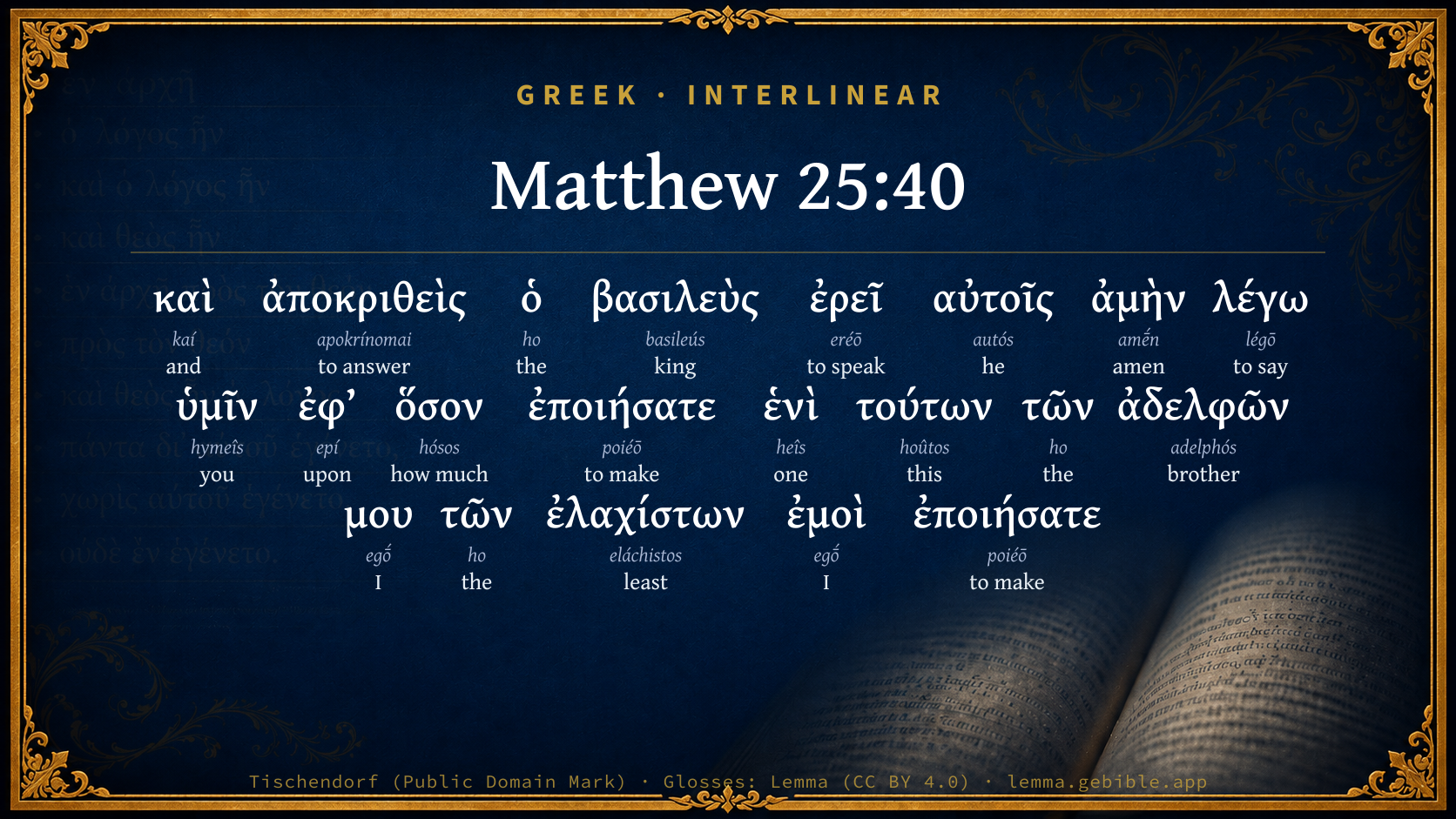
  1. καὶ kaí G2532 “and” Conjunction
  2. ἀποκριθεὶς apokrínomai G611 “to answer” Verb, Aorist, Passive deponent, Participle, Nominative, Singular, Masculine
  3. ὁ ho G3588 “the” Article, Nominative, Singular, Masculine
  4. βασιλεὺς basileús G935 “king” Noun, Nominative, Singular, Masculine
  5. ἐρεῖ eréō G2046 “to speak” Verb, Future, Active, Indicative, 3rd person, Singular
  6. αὐτοῖς autós G846 “he” Personal pronoun, Dative, Plural, Masculine
  7. ἀμὴν amḗn G281 “amen” Hebrew transliteration
  8. λέγω légō G3004 “to say” Verb, Present, Active, Indicative, 1st person, Singular
  9. ὑμῖν hymeîs G5210 “you” Personal pronoun, 2nd person, Dative, Plural
  10. ἐφ’ epí G1909 “upon” Preposition
  11. ὅσον hósos G3745 “how much” Correlative pronoun, Accusative, Singular, Neuter
  12. ἐποιήσατε poiéō G4160 “to make” Verb, Aorist, Active, Indicative, 2nd person, Plural
  13. ἑνὶ heîs G1520 “one” Adjective, Dative, Singular, Masculine
  14. τούτων hoûtos G3778 “this” Demonstrative pronoun, Genitive, Plural, Masculine
  15. τῶν ho G3588 “the” Article, Genitive, Plural, Masculine
  16. ἀδελφῶν adelphós G80 “brother” Noun, Genitive, Plural, Masculine
  17. μου egṓ G1473 “I” Personal pronoun, 1st person, Genitive, Singular
  18. τῶν ho G3588 “the” Article, Genitive, Plural, Masculine
  19. ἐμοὶ egṓ G1473 “I” Personal pronoun, 1st person, Dative, Singular
  20. ἐποιήσατε poiéō G4160 “to make” Verb, Aorist, Active, Indicative, 2nd person, Plural

About this verse

These counts appear in no published source. They are computed here, from the morphology-tagged text and Lemma’s own curated glosses. What Lemma adds →

21
words
17
distinct lemmas
Gospels
section

Notable vocabulary

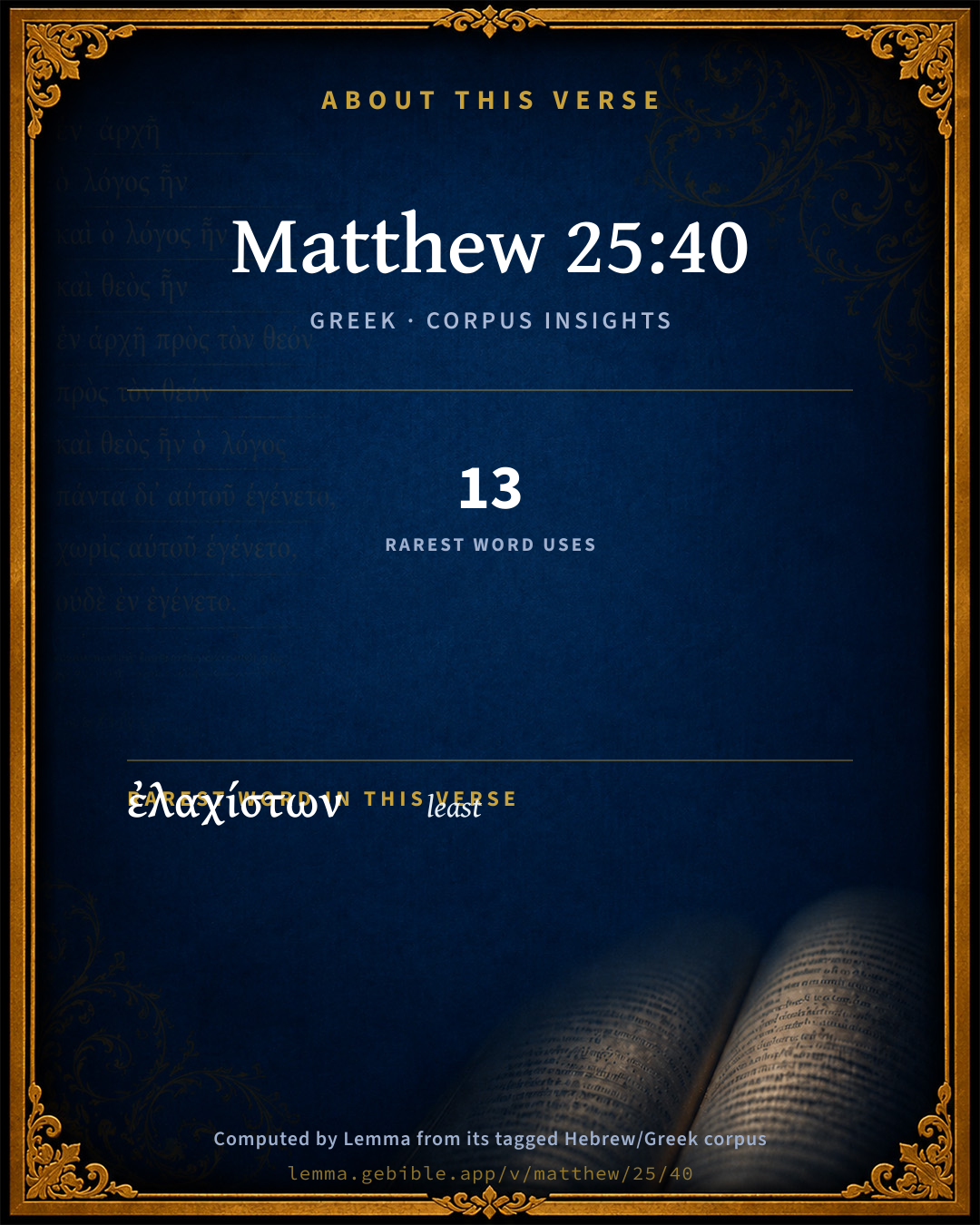
The rarest word here is ἐλαχίστων least G1646 — appearing just 13 times in the whole Greek New Testament.

Shared distinctive vocabulary

ἐλαχίστων least G1646 occurs in 11 verses of the Greek New Testament. Also found in:

Repetition

Words recur within this verse:

  • ἐποιήσατε to make G4160 ×2
  • ὁ the G3588 ×3
  • μου I G1473 ×2

Cross-references

34

Topical passages linked to Matthew 25:40 in the Treasury of Scripture Knowledge — connected by theme and wording, ordered by reader-vote popularity; previews shown in the World English Bible.

  • Proverbs 19:17 He who has pity on the poor lends to Yahweh; He will reward him.
  • Proverbs 14:31 He who oppresses the poor shows contempt for his Maker, But he who is kind to the needy honors him.
  • Matthew 10:42 Whoever gives one of these little ones just a cup of cold water to drink in the name of a disciple, most assuredly I tell you he will in no way lose his reward."
  • Mark 9:41 For whoever will give you a cup of water to drink in my name, because you are Christ's, most assuredly I tell you, he will in no way lose his reward.
  • 1 Peter 1:22 Seeing you have purified your souls in your obedience to the truth through the Spirit in sincere brotherly affection, love one another from the heart fervently:
  • Matthew 18:5–6 Whoever receives one such little child in my name receives me,
  • Galatians 5:6 For in Christ Jesus neither circumcision amounts to anything, nor uncircumcision, but faith working through love.
  • Matthew 10:40 He who receives you receives me, and he who receives me receives him who sent me.
  • 1 John 3:14–19 We know that we have passed out of death into life, because we love the brothers. He who doesn't love his brother remains in death.
  • 1 John 4:7–12 Beloved, let us love one another, for love is of God; and everyone who loves is born of God, and knows God.
  • Matthew 18:10 See that you don't despise one of these little ones, for I tell you that in heaven their angels always see the face of my Father who is in heaven.
  • Galatians 5:22 But the fruit of the Spirit is love, joy, peace, patience, kindness, goodness, faithfulness,
  • John 21:15–17 So when they had eaten their breakfast, Jesus said to Simon Peter, "Simon, son of Jonah, do you love me more than these?" He said to him, "Yes, Lord; you know that I have affection for you." He said to him, "Feed my lambs."
  • 2 Corinthians 5:14–15 For the love of Christ constrains us; because we judge thus, that one died for all, therefore all died.
  • 2 Corinthians 8:7–9 But as you abound in everything, in faith, utterance, knowledge, all earnestness, and in your love to us, see that you also abound in this grace.
  • 1 Thessalonians 4:9–10 But concerning brotherly love, you have no need that one write to you. For you yourselves are taught by God to love one another,
  • Hebrews 6:10 For God is not unrighteous, so as to forget your work and the labor of love which you showed toward his name, in that you served the saints, and still do serve them.
  • 1 John 4:20–5:2 If a man says, "I love God," and hates his brother, he is a liar; for he who doesn't love his brother whom he has seen, how can he love God whom he has not seen?
  • Galatians 5:13 For you, brothers, were called for freedom. Only don't use your freedom for gain to the flesh, but through love be servants to one another.
  • Ephesians 5:30 because we are members of his body, of his flesh and bones.
  • 2 Samuel 9:7 David said to him, "Don't be afraid of him; for I will surely show you kindness for Jonathan your father's sake, and will restore you all the land of Saul your father; and you shall eat bread at my table continually."
  • Mark 3:34–35 Looking around at those who sat around him, he said, "Behold, my mother and my brothers!
  • Acts 9:4–5 He fell on the earth, and heard a voice saying to him, "Saul, Saul, why do you persecute me?"
  • Matthew 25:34 Then the King will tell those on his right hand, 'Come, blessed of my Father, inherit the Kingdom prepared for you from the foundation of the world;
  • Matthew 28:10 Then Jesus said to them, "Don't be afraid. Go tell my brothers that they should go into Galilee, and there they will see me."
  • John 19:26–27 Therefore when Jesus saw his mother, and the disciple whom he loved standing there, he said to his mother, "Woman, behold your son!"
  • 2 Samuel 9:1 David said, Is there yet any who is left of the house of Saul, that I may show him kindness for Jonathan's sake?
  • Matthew 12:49–50 He stretched out his hand towards his disciples, and said, "Behold, my mother and my brothers!
  • Romans 8:29 For whom he foreknew, he also predestined to be conformed to the image of his Son, that he might be the firstborn among many brothers.
  • 1 Corinthians 16:21–22 This greeting is by me, Paul, with my own hand.
  • 2 Corinthians 4:5 For we don't preach ourselves, but Christ Jesus as Lord, and ourselves as your servants for Jesus' sake;
  • Hebrews 2:11–15 For both he who sanctifies and those who are sanctified are all from one, for which cause he is not ashamed to call them brothers,
  • John 20:17 Jesus said to her, "Don't touch me, for I haven't yet ascended to my Father; but go to my brothers, and tell them, 'I am ascending to my Father and your Father, to my God and your God.'"
  • Proverbs 25:6–7 Don't exalt yourself in the presence of the king, Or claim a place among great men;

Cross-references courtesy of OpenBible.info (CC BY 4.0).

Commentary

Notes on Matthew 25:40 from classic Christian and Jewish commentators (each source and its license shown beneath its notes). The classic Christian expositions comment on the surrounding passage and are grouped to its opening verse, so a note may address several verses; the Jewish commentaries on the Tanakh (Rashi and others) are per-verse, so they appear only where the commentator wrote on this verse.

Lemma curates 59 commentaries, every one of them public domain or Creative Commons licensed, each selected and text-cleaned for this edition rather than reprinted as found. About our sources →

Tyndale Open Study Notes

Tyndale Open Resources

25:40 my brothers and sisters: This expresses either Jesus’ solidarity with his disciples (see 10:42; 18:1-14; Gal 6:10) or Jesus’ solidarity with humanity in general, irrespective of the faith of the one being helped (see Matt 6:1-4; 25:43; Prov 19:17). The use of brothers and sisters points to the first interpretation (Matt 12:46-50; 18:15-35; 23:8; 28:10) but does not invalidate social responsibility for other people in general (see Luke 10:30-37).

Tyndale Open Study Notes — © Tyndale Open Resources, licensed CC BY-SA 4.0. Text via the HelloAO Bible API.

Bengel's Gnomon

Johann Albrecht Bengel

Mat 25:40. Ἐφʼ ὅσον, inasmuch as, in as far as) An intensifying particle. Without doubt, even individual acts will be brought forward.—ἑνὶ, unto one) All things are accurately reckoned up; nothing is omitted. Even a solitary occasion is frequently of great importance in either direction; see Mat 25:45.—τούτων, of these) used demonstratively.—τῶν ἀδελφῶν Μου, My brethren) It is better to do good to the good than to the wicked; yet these are not excluded from the operation of Christian love (see Mat 5:44), provided that a due precedence be preserved in the character of the men and works. Men, the more that they are honoured, treat so much the more proudly those with whom they are connected (suos): not so Jesus: at the commencement of His ministry He frequently called His followers disciples; then, when speaking of His cross (Joh 13:33), He once called them little sons,[1103] and (Joh 15:15) friends; after His resurrection (Joh 21:5), παιδία, children,[1104] and brethren (cf. ch. Mat 28:10; Joh 20:17; and cf. therewith Ib. Mat 13:1); and this appellation He will repeat at the judgment-day. How great is the glory of the faithful! see Heb 2:10-12, etc. During the time of His humiliation (exinanitionis) the honour of Jesus was guarded, lest from such an appellation He might appear to be of merely common rank; but in His state of exaltation no such danger exists. Observe, however—(1) that Christ addresses no one as brother in the vocative; the case is different in ch. Mat 12:48-49, and Heb 2:11-12; (2) that Scripture does not call Christ our brother; and (3) that it would not have been suitable in Peter, for example, to have said, Brother, instead of Lord, in Joh 21:15; Joh 21:20; Joh 21:7 (see Ibid. Mat 13:13). Even James, called by others the Lord’s brother, calls himself the servant of God and of the Lord Jesus Christ, Jas 1:1. Jude also, in the first verse of his epistle, calls himself the servant of Jesus Christ and brother of James; see also Mat 23:8; Luk 22:32. Amongst mortals, unequal fraternity is so maintained, that the superior friend honours the inferior by the title of brother; whilst the inferior addresses the superior by his title of honour. Thus also the heavenly court has its own etiquette, without any conflict between humility and confidence. Thus, also, the appellation of friend appears one-sided, so that the Lord calls His own, “friends,” but is not so called by them: see Joh 15:15. We must except the faith whose freedom of speech attains to that of the Canticles.—τῶν ἐλαχίστων, of the least) sc. outwardly, or even inwardly. A certain species is pointed out in the whole genus of saints: there are some who have received, others who have conferred favours.—Ἐμοὶ ἐποιήσατε, ye have done it unto Me) not merely to Me also, but TO ME absolutely; cf. οὐδὲ Ἐμοὶ ἐποιήσατε, neither have ye done it unto Me, Mat 25:45.

[1103] Filiolos. The word in the original is τέκνια, plural of τέκνιον, which is the diminutive of τέκνον—child or offspring—derived from τίκτω, to bring forth.—(I. B.)

[1104] Puerulos—παιδία being the plural of παιδίον, which is the diminutive of παῖς.—(I. B.)

Bengel's Gnomon of the New Testament — English translation (T&T Clark, Edinburgh, 1860) — public domain. Text from a community e-Sword module.

Expositor's Greek Testament

ed. W. Robertson Nicoll

Mat 25:40 ἐφʼ ὅσον , n so far as = καθʼ ὅσον (Heb 7:20 ), used of time in Mat 9:15 . ἑνὶ … ἐλαχίστων , the Judge’s brethren spoken of as a body apart, not subjects , but rather instruments , of judgment. This makes for the non-Christian position of the judged. The brethren are the Christian poor and needy and suffering, in the first place, but ultimately and inferentially any suffering people anywhere. Christian sufferers represent Christ, and human sufferers represent Christians. τῶν ἐλαχίστων seems to be in apposition with ἀδελφῶν , suggesting the idea that the brethren of the Son of Man are the insignificant of mankind, those likely to be overlooked, despised, neglected ( cf. Mat 10:42 , Mat 18:5 ).

The Expositor's Greek Testament, edited by W. Robertson Nicoll (1897–1910) — public domain. Text from a community e-Sword module.

Adam Clarke's Commentary

Verse 40. Inasmuch as ye have done it unto one of the least of these my brethren] The meanest follower of Christ is acknowledged by him as his brother! What infinite condescension! Those, whom many would scorn to set with the dogs of their flock, are brothers and sisters of the blessed Jesus, and shall soon be set among the princes of his people.

Adam Clarke's Commentary on the Bible (1810–1826) — public domain. Text from a community e-Sword/MySword module.

Ellicott's Commentary for English Readers

(40) Inasmuch as ye have done it unto one of the least of these my brethren.—The words are true, in different degrees of intensity, in proportion as the relationship is consciously recognised, of every member of the family of man. Of all it is true that He, the Lord, who took their flesh and blood, “is not ashamed to call them brethren” (Heb_2:11). We have here, in its highest and divinest form, that utterance of sympathy which we admire even in one of like passions with ourselves. We find that He too “counts nothing human alien from Himself.”

A Bible Commentary for English Readers, edited by Charles John Ellicott (1878–1897) — public domain. Text from a community e-Sword module.

The Cambridge Bible for Schools and Colleges

gen. ed. J. J. S. Perowne

40. ye have done it unto me] This unconscious personal service of Christ may be contrasted with the conscious but unreal knowledge of Christ assumed by false prophets; see Luk_13:26.

Christ identifies Himself with His Church, as in His words to Saul, “Why persecutest thou me?” (Act_9:4).

The Cambridge Bible for Schools and Colleges (gen. ed. J. J. S. Perowne; Cambridge University Press, 1878–1918) — public domain. Text from a community e-Sword module.

John Gill's Exposition

Then shall he also say unto them on his left hand,.... The goats, the foolish virgins, and slothful and wicked servants,

depart from me: a like expression is used by him to preachers of the word, and professors of religion, that are mere nominal ones. Mat 7:23 and such are intended here, who professed to be on Christ's side, had been in his visible church, and hoped to have been with him for ever; but having nothing but the lamp of a profession, and some external works to trust to, they are bid to be gone from him; they are banished his presence, which is what is commonly called the punishment of loss; the loss of the presence of God, Father, Son, and Spirit, angels, and saints; and is thought to be greater than the punishment of sense, hereafter expressed. The character given of them, which is the reverse of the former, is,

ye cursed; for having sinned against God, and his righteous law, they are cursed by it, which curses everyone that is under its works, as these were, and do not perfectly fulfil whatsoever it requires; and so were justly rejected of God, and hated by him: and therefore are condemned and sent,

into everlasting fire: by which is meant, the wrath of God; and the phrase expresses the intolerable fierceness of it, and its perpetual continuance; the sense of which, without intermission, will ever be felt in the conscience; and is the punishment of sense, the wicked will for ever endure: it may also intend the pit and prison of hell, where these torments will be for ever inflicted; and so hell is called by the Jews (k), the hell , "eternal fire", or "everlasting burning": and is here said to be

prepared for the devil and his angels; for Satan, or Beelzebub, the prince of devils, and all his principalities and powers under him: it is not said to be prepared for these persons, though it was, and who were foreordained to this condemnation, but for the devil and his angels; showing, that the same punishment will be inflicted on hypocrites and carnal professors, as on the devils themselves; and it is indeed of such, that the devouring fire, and everlasting burnings are spoken, in Isa 33:14, to which this passage seems to have some respect; for no where else is mention made of this everlasting fire: it is not said neither when it was prepared. It is a notion of the Jews (l), that the angels were created on the second day; and it should seem by them, that they fell the same day; hence it is a prevailing opinion among them (m), that hell was made on the second day of the creation; though at, other times, they reckon hell among the seven things which were created before the world was (n), and which may be reconciled together: for as heaven, the place of the saints' happiness, was prepared from the foundation of the world, or on the first day of its creation, though the happiness itself was provided long before; so hell, the place of the torments of the devils and wicked, though it was not made or prepared until the second day of the creation, when, according to this opinion, the angels were made and fell; yet the punishment they were to endure there, was appointed before the world was; and so hell is said to.

, "be ordained from eternity", because of their sins (o),

(k) Targum in Isa. xxxiii. 14. (l) Targum Jon. in Gen. i. 26. Pirke Eliezer, c. 4. (m) Targum in Cant. viii. 6. T. Bab. Pesach. fol. 54. 1. Zohar in Gen. fol. 13. 3. & 30. 2. & in Exod. fol. 61. 4. & in Deut. fol. 120. 1. Bereshit Rabba, sect. 4. fol. 4. 1. & sect. 21. fol. 19. 1. Shemot Rabba, sect. 15. fol. 101. 4. Tzeror Hammor, fol. 1. 2. & 121. & 1. 2. & 130. 3. (n) T. Bab. Pesach. fol. 54. 1. & Nedar. fol. 39. 2. Zokar in Lev. fol. 14. 4. Targum Jon. in Gen iii. 24. (o) Targum in Isa. xxx. 33.

John Gill's Exposition of the Whole Bible (1746–1763) — public domain (CC PDM 1.0). Text via the HelloAO Bible API.

Trapp's Complete Commentary

John Trapp

40 And the King shall answer and say unto them, Verily I say unto you, Inasmuch as ye have done it unto one of the least of these my brethren, ye have done it unto me.

Ver. 40. One of the least of these my brethren] What a comfort is this, that our own Brother shall judge us, who is much more compassionate than any Joseph. What an honour, that Christ calls us his brethren. What an obligation is such a dignity to all possible duty, that we stain not our kindred. Antigonus being invited to a place where a notable harlot was to be present, asked counsel of Menedemus what he should do. He bade him only remember that he was a king’s son. Remember we that we are Christ the King’s brethren, and it may prove a singular preservative. Vellem si non essem Imperator, said Scipio, when a harlot was offered unto him, I would, if I were not general. Take thou the pillage of the field, said Themistocles to his friend: Ανελου σεαυτω, συ γαρ ουκ ει θημιστοκλης, for thou art not Themistocles.

Ye have done it unto me] Christ, saith Salvian, is, Mendicorum maximus, the greatest beggar, as one that shareth in all the saints’ necessities; and who would but relieve necessitous Christ? Find some Mephibosheth, in whom we may seal up love to deceased Jonathan. My goodness extendeth not to thee, saith David, but to the saints, Christ’s receivers, Psa 16:2-3. Mr Fox never denied beggar that asked in Jesus’ name. And being once asked whether he knew a certain poor man who had received succour from him in time of trouble, he answered, I remember him well: I tell you, I forget lords and ladies to remember such.

John Trapp, A Commentary or Exposition upon All the Books of the Old and New Testament (1647–1656) — public domain. Text from a community e-Sword module.

Albert Barnes' Notes on the Bible

One of the least of these - One of the obscurest, the least known, the poorest, the most despised and afflicted.

My brethren - Either those who are Christians, whom he condescends to call brethren, or those who are afflicted, poor, and persecuted, who are his brethren and companions in suffering, and who suffer as he did on earth. See Heb 2:11; Mat 12:50. How great is the condescension and kindness of the Judge of the world, thus to reward our actions, and to consider what we have done to the poor as done to him!

Albert Barnes' Notes on the Bible (1834–1885) — public domain. Text from a community e-Sword/MySword module.

Haydock's Catholic Bible Commentary

As long as you did it to one of these, my least brethren. Can there be a more forcible motive to charity, than the assurance of revelation that the Son of God will accept all good of offices done to the afflicted, as done to himself. This condescension of the part of Jesus Christ, will fill the elect with sentiments of profound admiration and astonishment. --- Then with fire in his eyes, and terror in his countenance, he shall say to the wicked: Depart from me, ye cursed, into everlasting fire, which was prepared for the devil and his angels. It was not originally created for rebellious man; for man was created subsequently to the fall and damnation of the rebel angels: and though he imitated their transgression, the sentence of everlasting burning was reversed by Jesus Christ ... By his blood man has been redeemed from eternal punishment. If many, notwithstanding, are yet condemned to never-ending flames, they are punished under the quality of the slaves of the devil: for as they have wilfully followed his rebellious example, they must expect with him to participate in his torments. (Consult. i. John iii. 8.)

George Leo Haydock (1774–1849), Haydock's Catholic Family Bible and Commentary, 1859 edition — public domain. Excludes Psalms (Douay-Rheims chapter numbering differs from Protestant) and Deuterocanonical books (Catholic canon only).

Whedon's Commentary on the Bible

Daniel D. Whedon

40. Ye have done it unto me — By a turn of surpassing beauty the Lord confers an infinite value upon the least of their good or approvable acts. It was done to him. Eternal glory is the thanks he returns for personal favours. He identifies himself with the humblest object of charity, and assumes that all mercy done is done to him. He holds himself remunerator for all the good done.

Daniel D. Whedon (gen. ed.), Commentary on the Old and New Testaments (1874–1909) — public domain. Text from a community e-Sword module.

The Pulpit Commentary

The King shall answer. The royal Judge condescends to explain the meaning of the seeming paradox. Inasmuch as; ef oson , rendered in the Vulgate quamdiu, rather, quatenus, in which sense the phrase is found also in Rom_11:13. Unto one of the least of these my brethren. That is, not the apostles, nor specially but all the afflicted who have fellowship with Christ in his sufferings and Any such he is not ashamed to call his brethren. Ye have done (ye did) it unto me. The Lord so perfectly identifies himself with the human family, whose nature he assumed, that he made their sorrows sufferings his own, (Isa_53:4 Isa_63:9 Mat_8:17) he suffered with the sufferers; his perfect sympathy placed him in their position; in all their affliction he was afflicted From this identification it follows that he regards that which is done to others as done to himself. Thus he could expostulate the persecutor, "Saul, Saul, why persecutest thou me?" And we have the amazing revelation that he receives with the same graciousness the pious workings of natural religion in the case of those who know no better.

Christ"s acceptance of vicarious service.

What is striking and suggestive is, that our Lord should make no reference to the cultured and. sanctified personal life of his disciples, but fix attention on their service to others, their sympathies, generosities, and charities. At first it may seem as if his praise rested on their good works; but soon we come to see that what our Lord accepts is the best indication of character, and precisely of Christly character. There is a sort of goodness which is only sentimental. Thai goodness is always self-centred and self-sphered. That goodness Christ neither approves nor accepts. That goodness is essentially un-Christly. There is a goodness which finds expression in serving others for Christ"s sake; serving others because we have not Christ to serve. That goodness is principle. That goodness is Christ-likeness. "Even Christ pleased not himself;" "I am among you as he that serveth.

I VICARIOUS SERVICE IS SERVING OTHERS. To mutual service humanity is called. To the special service of all distressed; disabled, and suffering ones, the Christian humanity is called. This "serving others" becomes an absolutely efficient and sufficient test of the Christ-spirit in us. Christ was good; but we know it because he "went about doing good." Over his whole life shines the glory of something done to relieve, and comfort, and raise, and save his fellow men.

II VICARIOUS SERVICE IS SERVING CHRIST THROUGH SERVING OTHERS. It is not mere neighbourliness, sympathy, or charity, that is here commended. These, standing alone, are not the conditions of acceptance with Christ. He was speaking to his own disciples. The basis of acceptance for them was their love to him and trust in him. But they could not show such love directly to Jesus. Perhaps it would have been easier for them if they could. We are all put under this strain. We cannot minister to Jesus himself; will we minister to him vicariously, through his suffering brethren? When he comes for his reckoning, it is of this our Lord will take account; and if he finds we have been, consciously, vicarious ministrants, he will say, "Inasmuch as ye did it unto one of the least of these my brethren, ye did it unto me." Charity, for Christ"s sake, is acceptable.

III VICARIOUS SERVICE OF CHRIST, THROUGH THE SERVICE OF OTHERS, PROVES IN THE END TO BE THE BEST SERVICE OF OURSELVES. For we "enter the joy of our Lord." But this point needs to be presented with great care, lest self-seeking considerations, entering in, should spoil the Christly service. R.T.

The Pulpit Commentary (1880–1919), ed. H.D.M. Spence-Jones & Joseph S. Exell — public domain. Text from a community e-Sword module.

John Wesley's Explanatory Notes

Inasmuch as ye did it to one of the least of these my brethren, ye did it to me - What encouragement is here to assist the household of faith? But let us likewise remember to do good to all men.

John Wesley, Explanatory Notes Upon the Whole Bible (1754–1765) — public domain. Text via the GEBible commentary corpus.

The People's New Testament

B. W. Johnson

40. Inasmuch as ye have done it unto one of the least of these my brethren, ye have done it unto me. The righteous understood well that they had often, in the name and from the love of Christ, ministered to his brethren, the poor and suffering saints, but they had never understood that their Lord accepted this as a personal service to himself. It should be distinctly noted, (1) that the saved are the righteous, or those whose sins have been washed away by Christ; (2) they are those who have lived and acted in the name of Christ, or have been obedient to his will; (3) they have been full of the love of Christ and have faithfully ministered to the distressed, especially to those of the household of faith. The love of Christ implies love of the brethren, and of all mankind.

B. W. Johnson's The People's New Testament with Notes (1889–1891) — public domain. Electronic text from the Christian Classics Ethereal Library (CCEL) ThML edition.

Cambridge Greek Testament for Schools and Colleges

40. ἐφʼ ὅσον. ‘So far as,’ ἐπὶ denotes the point to which the action extends.

ἐμοὶ ἐποιήσατε. This unconscious personal service of Christ may be contrasted with the conscious but unreal knowledge of Christ assumed by false prophets; see Luk 13:26.

Christ identifies Himself with his Church, as in his words to Saul, τί με διώκεις; (Act 9:4).

Cambridge Greek Testament for Schools and Colleges (Cambridge University Press, 1896; 21 vols, various authors incl. Carr, Maclear, Plummer, Farrar, Lumby, Moule, M. R. James, Simcox) — public domain. Text from a community e-Sword module.

International Critical Commentary

40. And the King shall answer and say to them, Verily I say to you, Inasmuch as ye did it to one of the least of these My brethren, ye did it to Me.] Cf. 10:42.

(L)

International Critical Commentary — older volumes (1896–1929), various authors — public domain. Text from a community e-Sword module.

Vincent's Word Studies in the New Testament

Marvin R. Vincent

The least. The word in the Greek order is emphatic : One of these my brethren, the least. So Rev., even these least.

Marvin R. Vincent, Word Studies in the New Testament (1887–1900) — public domain. Text from a community e-Sword/MySword module.

Lesson kit

Teaching starters — assembled from the data on this page, not authored interpretation. Every prompt links to the verse data it draws on. Edit before teaching.

Matthew, in the Gospels, opens this verse with 21 words (17 distinct Greek lemmas). Its most distinctive word is eláchistos (“least”). A historical commentator’s framing appears above. Read the whole chapter for the surrounding context.

Discussion questions

  1. How does “least” (eláchistos) shape what this verse is saying?
  2. How does Matthew 2:6, which shares the word «least», read alongside this verse?
  3. What does the repetition of “to make” (2× in this one verse) do in this verse?
  4. These translations render this verse differently. What is at stake in choosing one wording over another?
  5. Compare how Tyndale Open Study Notes and Bengel's Gnomon read this verse. Where do they agree or differ?

Things to notice

Reading settings

Reading text

Shown beneath each verse's original-language words.

Old Testament
Old Testament edition

Read the OT as the Masoretic Hebrew (MT) or the Greek Septuagint (LXX).

English shown for the Greek Septuagint (in the Hebrew ↔ Greek comparison).

Comparing translations? Open the Compare panel on any verse page to stack up to four side by side.