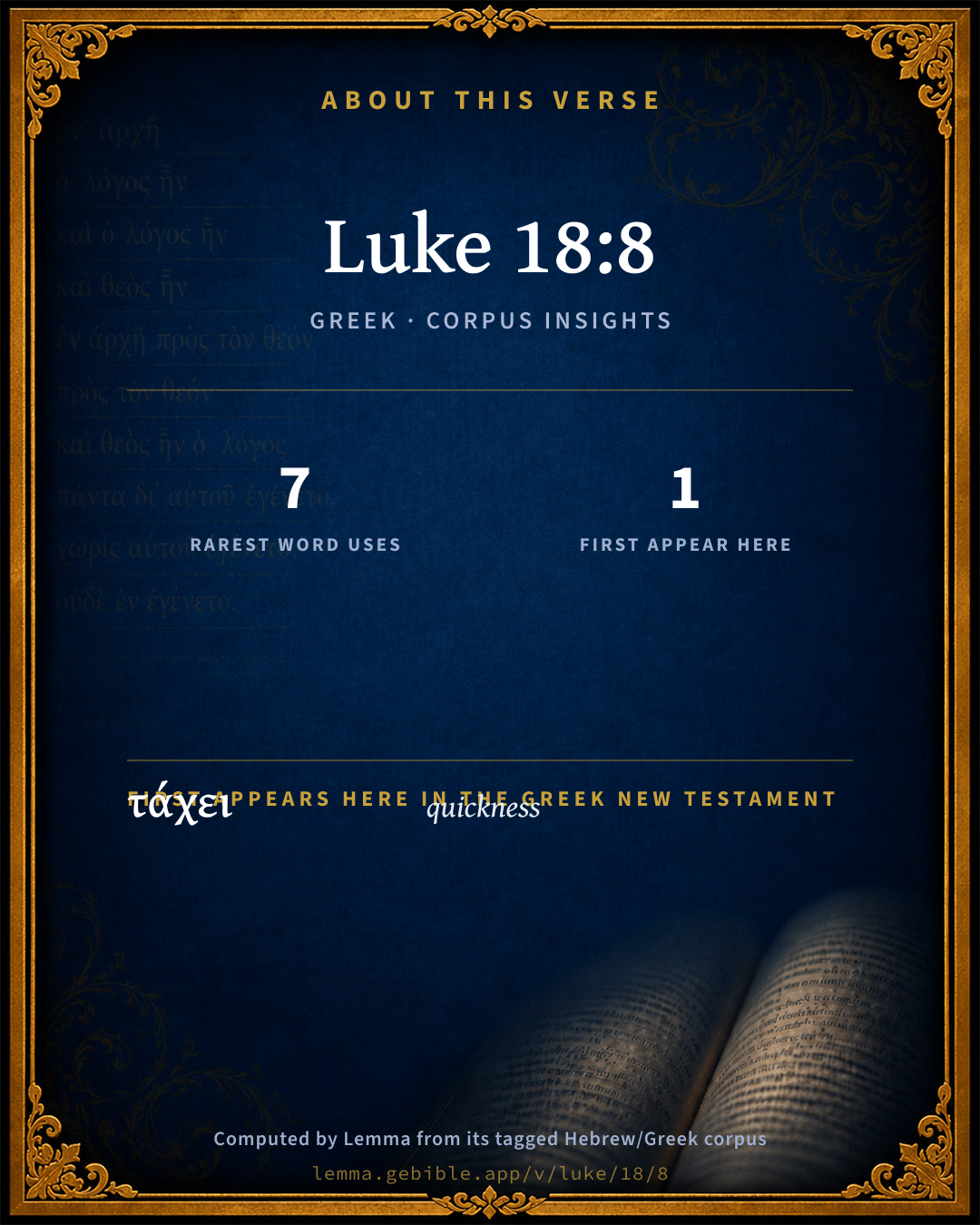
Luke 18:8

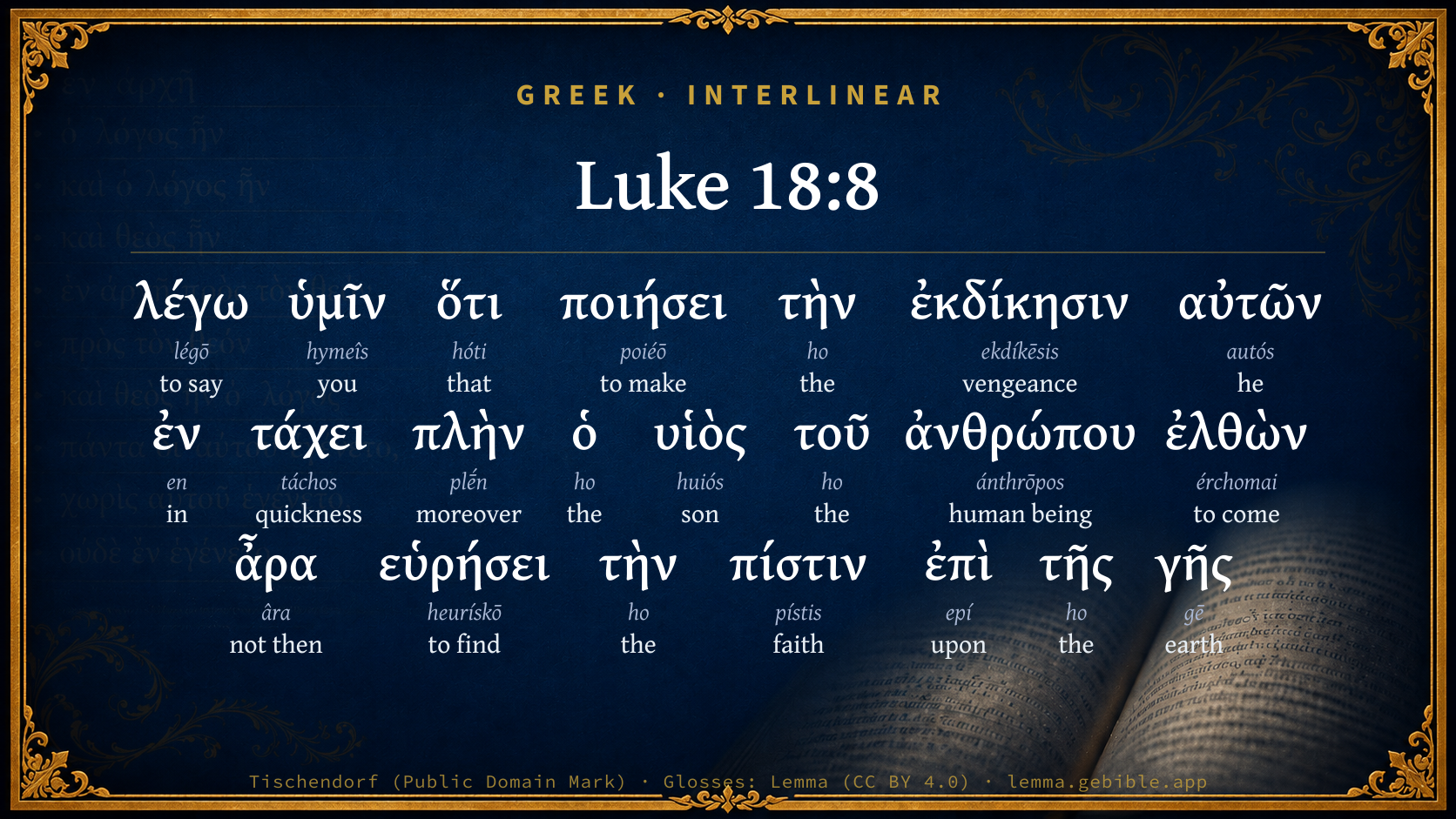
Greek (Tischendorf 8th ed.) Luke 18:8 appears in the Greek New Testament. The text above is from the Tischendorf 8th edition. Each word links to its Strong’s number and a concise gloss. Click any word for its full Thayer’s Greek Lexicon entry.
Download image
Cite this verse

Luke 18:8 (World English Bible). Public Domain. Lemma interlinear Bible study tool, https://lemma.gebible.app/v/luke/18/8.

Show BibTeX & RIS
BibTeX
RIS
English Translation
I tell you that he will avenge them quickly. Nevertheless, when the Son of Man comes, will he find faith on the earth?"
World English Bible · Public Domain
Highlights
  • 1 first appearance in the Greek New Testament
Full analysis ↓
Download a study sheet

One document with this verse’s original text, its word-by-word gloss line, the meaning frame, cross-references with their text, attributed commentary, and full source and license credits — printable, and it pastes into notes with its structure intact.

This verse Autodidact and up

Study sheet (.html) Plain text (.txt)

A passage Seminary Student

Up to 50 verses in one chapter. A passage sheet keeps up to 6 commentary sources and 12 cross-references per verse, in the order this page ranks them, and says so on the sheet whenever that leaves anything out. Ask for a single verse and you get the Autodidact verse sheet above.

Everything on this page stays free to read, with no account — the sheet is a download of what is already on screen, not access to it.

Want to remove ads? Support Godless Engineer
Compare translations 3

The same verse in 3 English versions, stacked beneath the original-language interlinear above. Click any original word for its lexicon entry.

Each is an independent rendering of the whole verse — the interlinear is not word-aligned to these translations.

Highlighted words mark where these versions differ — a whole-verse word diff, not a word-by-word alignment.

  • World English Bible Public Domain
    I tell you that he will avenge them quickly. Nevertheless, when the Son of Man comes, will he find faith on the earth?"
  • King James Version Public Domain
    I tell you that he will avenge them speedily. Nevertheless when the Son of man cometh, shall he find faith on the earth?
  • unfoldingWord Literal Text CC BY-SA 4.0
    I say to you that he will do the vindication of them quickly. Nevertheless, the Son of Man having come, will he indeed find faith on the earth?”

unfoldingWord Literal Text — © unfoldingWord, licensed CC BY-SA 4.0. Word-aligned USFM3 via Door43 (git.door43.org/unfoldingWord/en_ult).

Versions to compare (up to 4)

3 of 4 selected

Show all 19 translations

Every available English version of this verse, each an independent rendering of the whole verse.

  • World English Bible Public Domain
    I tell you that he will avenge them quickly. Nevertheless, when the Son of Man comes, will he find faith on the earth?"
  • Berean Standard Bible Public Domain
    I tell you, He will promptly carry out justice on their behalf. Nevertheless, when the Son of Man comes, will He find faith on earth?”
  • Majority Standard Bible Public Domain
    I tell you, He will promptly carry out justice on their behalf. Nevertheless, when the Son of Man comes, will He find faith on earth?”
  • King James Version Public Domain
    I tell you that he will avenge them speedily. Nevertheless when the Son of man cometh, shall he find faith on the earth?
  • American Standard Version (1901) Public Domain
    I say unto you, that he will avenge them speedily. Nevertheless, when the Son of man cometh, shall he find faith on the earth?
  • Revised Version (1885) Public Domain
    I say unto you, that he will avenge them speedily. Howbeit when the Son of man cometh, shall he find faith on the earth?
  • Geneva Bible (1599) Public Domain
    I tell you he will auenge them quickly: but when the Sonne of man commeth, shall he finde faith on the earth?
  • Douay-Rheims (1899) Public Domain
    I say to you, that he will quickly revenge them. But yet the Son of man, when he cometh, shall he find, think you, faith on earth?
  • Young's Literal Translation Public Domain
    I say to you, that He will execute the justice to them quickly; but the Son of Man having come, shall he find the faith upon the earth?'
  • Literal Standard Version CC BY-SA 4.0
    I say to you that He will execute justice to them quickly; but the Son of Man having come, will He find faith on the earth?”
  • Unlocked Literal Bible CC BY-SA 4.0
    I say to you that he will bring justice to them speedily. Even so, when the Son of Man comes, will he indeed find faith on the earth?”
  • unfoldingWord Literal Text CC BY-SA 4.0
    I say to you that he will do the vindication of them quickly. Nevertheless, the Son of Man having come, will he indeed find faith on the earth?”
  • Darby Bible Public Domain
    I say unto you that he will avenge them speedily. But when the Son of man comes, shall he indeed find faith on the earth?
  • World Messianic Bible Public Domain
    I tell you that he will avenge them quickly. Nevertheless, when the Son of Man comes, will he find faith on the earth?”
  • Webster's Bible Public Domain
    I tell you that he will avenge them speedily. Nevertheless, when the Son of man cometh, will he find faith on the earth?
  • Free Bible Version CC BY-SA 4.0
    No, I tell you, he will give them justice quickly. However, when the Son of man comes, will he find people on earth who trust in him?”
  • Bible in Basic English Public Domain
    I say to you that he will quickly do right in their cause. But when the Son of man comes, will there be any faith on earth?
  • Text-Critical English NT CC BY 4.0
    I tell you that he will bring about justice for them quickly. Nevertheless, when the Son of Man comes, will he find faith on the earth?”
  • Tyndale New Testament (1534) Public Domain
    I tell you he will avenge them and that quickly. Neverthelesse when the sonne of man cometh suppose ye that he shall fynde faithe on the erthe.

Literal Standard Version (2020), Covenant Press — licensed CC BY-SA 4.0. Text via the HelloAO Bible API (eBible.org). Unlocked Literal Bible (unfoldingWord) — licensed CC BY-SA 4.0. Text via the HelloAO Bible API (eBible.org). unfoldingWord Literal Text — © unfoldingWord, licensed CC BY-SA 4.0. Word-aligned USFM3 via Door43 (git.door43.org/unfoldingWord/en_ult). Free Bible Version, Dr. Jonathan Gallagher — licensed CC BY-SA 4.0. Text via the HelloAO Bible API (eBible.org).

Word by word

More ways to search: Search by grammar → Find every occurrence → Compare this word →

Practice this passage: Drill this verse → Learn its vocabulary →

τάχει
táchos
G5034
“quickness”
Noun, Dative, Singular, Neuter
Part of Speech
Noun
Case
Dative
Number
Singular
Gender
Neuter
Full Thayer's Definition

Origin: from the same as G5036

TDNT: None

1. quickness, speed
  1. λέγω légō G3004 “to say” Verb, Present, Active, Indicative, 1st person, Singular
  2. ὑμῖν hymeîs G5210 “you” Personal pronoun, 2nd person, Dative, Plural
  3. ὅτι hóti G3754 “that” Conjunction
  4. ποιήσει poiéō G4160 “to make” Verb, Future, Active, Indicative, 3rd person, Singular
  5. τὴν ho G3588 “the” Article, Accusative, Singular, Feminine
  6. ἐκδίκησιν ekdíkēsis G1557 “vengeance” Noun, Accusative, Singular, Feminine
  7. αὐτῶν autós G846 “he” Personal pronoun, Genitive, Plural, Masculine
  8. ἐν en G1722 “in” Preposition
  9. πλὴν plḗn G4133 “moreover” Adverb
  10. ὁ ho G3588 “the” Article, Nominative, Singular, Masculine
  11. υἱὸς huiós G5207 “son” Noun, Nominative, Singular, Masculine
  12. τοῦ ho G3588 “the” Article, Genitive, Singular, Masculine
  13. ἀνθρώπου ánthrōpos G444 “human being” Noun, Genitive, Singular, Masculine
  14. ἐλθὼν érchomai G2064 “to come” Verb, Aorist, Active, Participle, Nominative, Singular, Masculine
  15. ἆρα âra G687 “not then” Particle, Interrogative
  16. εὑρήσει heurískō G2147 “to find” Verb, Future, Active, Indicative, 3rd person, Singular
  17. τὴν ho G3588 “the” Article, Accusative, Singular, Feminine
  18. πίστιν pístis G4102 “faith” Noun, Accusative, Singular, Feminine
  19. ἐπὶ epí G1909 “upon” Preposition
  20. τῆς ho G3588 “the” Article, Genitive, Singular, Feminine
  21. γῆς gē G1093 “earth” Noun, Genitive, Singular, Feminine

About this verse

These counts appear in no published source. They are computed here, from the morphology-tagged text and Lemma’s own curated glosses. What Lemma adds →

22
words
18
distinct lemmas
Gospels
section

Notable vocabulary

The rarest word here is τάχει quickness G5034 — appearing just 7 times in the whole Greek New Testament.

First appearance in Scripture

This word makes its first canonical appearance in the Greek New Testament here:

  • τάχει quickness G5034

Shared distinctive vocabulary

τάχει quickness G5034 occurs in 7 verses of the Greek New Testament. Also found in:

Repetition

A word recurs within this verse:

Cross-references

10

Topical passages linked to Luke 18:8 in the Treasury of Scripture Knowledge — connected by theme and wording, ordered by reader-vote popularity; previews shown in the World English Bible.

  • Hebrews 10:23–26 let us hold fast the confession of our hope unyieldingly. For he who promised is faithful.
  • 2 Peter 3:8–9 But don't forget this one thing, beloved, that one day is with the Lord as a thousand years, and a thousand years as one day.
  • Psalms 46:5 God is in her midst. She shall not be moved. God will help her at dawn.
  • Matthew 24:9–13 Then they will deliver you up to oppression, and will kill you. You will be hated by all of the nations for my name's sake.
  • Luke 17:26–30 As it happened in the days of Noah, even so will it be also in the days of the Son of Man.
  • Psalms 143:7–9 Hurry to answer me, Yahweh. My spirit fails. Don't hide your face from me, So that I don't become like those who go down into the pit.
  • Matthew 24:24 For there will arise false christs, and false prophets, and they will show great signs and wonders, so as to lead astray, if possible, even the chosen ones.
  • 1 Thessalonians 5:1–3 But concerning the times and the seasons, brothers, you have no need that anything be written to you.
  • 2 Peter 2:3 In covetousness they will exploit you with deceptive words: whose sentence now from of old doesn't linger, and their destruction will not slumber.
  • James 5:1–8 Come now, you rich, weep and howl for your miseries that are coming on you.

Cross-references courtesy of OpenBible.info (CC BY 4.0).

Commentary

Notes on Luke 18:8 from classic Christian and Jewish commentators (each source and its license shown beneath its notes). The classic Christian expositions comment on the surrounding passage and are grouped to its opening verse, so a note may address several verses; the Jewish commentaries on the Tanakh (Rashi and others) are per-verse, so they appear only where the commentator wrote on this verse.

Lemma curates 59 commentaries, every one of them public domain or Creative Commons licensed, each selected and text-cleaned for this edition rather than reprinted as found. About our sources →

MacLaren's Expositions of Holy Scripture

Alexander MacLaren

Mark - Luke

THREE KINDS OF PRAYING

THE CREDULITY OF UNBELIEF

Mar 13:6. - Luk 18:8.

It was the same generation that is represented in these two texts as void of faith in the Son of Man, and as credulously giving heed to impostors. Unbelief and superstition are closely allied. Religion is so vital a necessity, that if the true form of it be cast aside, some false form will be eagerly seized in order to fill the aching void. Men cannot permanently live without some sort of a faith in the Unseen, but they can determine whether it shall be a worthy recognition of a worthy conception of that Unseen, or a debasing superstition. An epoch of materialism in philosophic thought has always been followed by violent reaction, in which quacks and fanatics have reaped rich harvests. If the dark is not peopled with one loved Face, our busy imagination will fill it with a crowd of horrible ones.

Just as a sailor, looking out into the night over a solitary, islandless sea, sees shapes; intolerant of the islandless expanse, makes land out of fogbanks; and, sick of silence, hears ‘airy tongues’ in the moanings of the wind and the slow roll of the waves, so men shudderingly look into the dark unknown, and if they see not their Father there, will either shut their eyes or strain them in gazing it into shape. The sight of Him is religion, the closed eye is infidelity, the strained gaze is superstition. The second and the third are each so unsatisfying that they perpetually pass over into one another and destroy one another, as when I shut my eyes, I see slowly shaping itself a coloured image of my eye, which soon flickers and fluctuates into black nothingness again, and then rises once more, once more to fade. Men, if they believe not in God, then do service to ‘them which by nature are no gods.’

But let us come to more immediately Christian thoughts. Christ does what men so urgently require to be done, that if they do not believe in Him they will be forced to shape out for themselves some fancied ways of doing it. The emotions which men cherish towards Him so irrepressibly need an object to rest on, that if not He, then some far less worthy one, will be chosen to receive them.

It is just to the illustration of these thoughts that I seek to turn now, and in such alternatives as these-

I. Reception of Christ as the Revealer is the only escape from unmanly submission to unworthy pretenders.

That function is one which the instincts of men teach them that they need.

Christ comes to satisfy the need as the visible true embodiment of the Father’s love, of the Father’s wisdom.

If He be rejected-what then? Why, not that the men who reject will contentedly continue in darkness-that is never possible; but that some manner or other of satisfying the clamant need will be had recourse to, and then that to it will be transferred the submission and credence that should have been His. If we have Him for our Teacher and Guide, then all other teachers and guides will take their right places. We shall not angrily repel their power, nor talk loudly about ‘the right of private judgment,’ and our independence of all men’s thoughts. We are not so independent. We shall thankfully accept all help from all men wiser, better, more manly than ourselves, whether they give us uttered words of wisdom and beauty, having ‘grace poured into their lips,’ or whether they give us lives ennobled by strenuous effort, or whether they give us greater treasure than all these-the sight once more of a loving heart. All is good, all is helpful, all we shall receive; but in proportion to the felt obligations we are laid under to them will be the felt authority of that saying, ‘Call no man your master on earth, for One is your Master, even Christ.’ That command forbids our slavishly accepting any human domination over our faith, but it no less emphatically forbids our contemptuously rejecting any human helper of our joy, for it closes with ‘and all ye are brethren’-bound then to mutual observance, mutual helpfulness, mutual respect for each other’s individuality, mutual avoidance of needless division. To have Him for his Guide makes the human guide gentle and tender among his disciples ‘as a nurse among her children,’ for he remembers ‘the gentleness of Christ,’ and he dare not be other than an imitator of Him. A Christian teacher’s spirit will always be, ‘not for that we have dominion over your faith, but we are helpers of your joy’; his most earnest word, ‘I beseech you, therefore, brethren’; his constant desire, ‘He must increase. I must decrease.’ And to have Christ for our Guide makes the taught lovingly submissive to all who by largeness of gifts and graces are set by Him above them, and yet lovingly recalcitrant at any attempt to compel adhesion or force dogmas. The one freedom from undue dependence on men and men’s opinions lies in this submission to Jesus. Then we can say, when need is, ‘I have a Master. To Him I submit; if you seek to be master, I demur: of them who seemed to be somewhat, whatsoever they were, it maketh no matter to me.’

But the greatest danger is not that our guides shall insist on our submission, but that we shall insist on giving it. It is for all of us such a burden to have the management of our own fate, the forming of our own opinions, the fearful responsibility of our own destiny, that we are all only too ready to say to some man or other, from love or from laziness, ‘Where thou goest, I will go; thy people shall be my people, and thy God my God.’

Few things are more strange and tragic than the eagerness with which people who are a great deal too enlightened to render allegiance to Jesus Christ will install some teacher of their own choosing as their authoritative master, will swallow his dicta, swear by him, and glory in being called by his name. What they think it derogatory to their mental independence to give to the Teacher of Nazareth, they freely give to their chosen oracle. It is not in ‘the last times’ only that men who will not endure sound teaching ‘heap to themselves teachers after their own lusts,’ and have ‘the ears’ which are fast closed to ‘the Truth’ wide open ‘to fables.’

On the small scale we see this melancholy perversity of conduct exemplified in every little coterie and school of unbelievers.

On the great scale Mohammedanism and Buddhism, with their millions of adherents, write the same tragic truth large in the history of the world.

II. Faith in the reconciling Christ is the only sure deliverance from debasing reliance on false means of reconciliation.

In a very profound sense ignorance and sin are the same fact regarded under two different aspects. And in the depths of their natures men have the longing for some Power who shall put away sin, as they have the longing for one that will dispel ignorance. The consciousness of alienation from God lies in the human heart, dormant indeed for the most part, but like a coiled, hibernating snake, ready to wake and strike its poison into the veins. Christ by His great work, and specially by His sacrificial death, meets that universal need.

But closely as His work fits men’s needs, it sharply opposes some of their wishes, and of their interpretations of their needs. The Jew ‘demands a sign,’ the Greek craves a reasoned system of ‘wisdom,’ and both concur in finding the Cross an ‘offence.’

But the rejection of Jesus as the Reconciler does not quiet the cravings, which make themselves heard at some time or other in most consciences, for deliverance from the dominion and from the guilt of sin. And men are driven to adopt other expedients to fill up the void which their turning away from Jesus has left. Sometimes they fall back on a vague reliance on a vague assertion that ‘God is merciful’; sometimes they reason themselves into a belief-or, at any rate, an assertion-that the conception of sin is an error, and that men are not guilty. Sometimes they manage to silence the inward voice that accuses and condemns, by dint of not listening to it or drowning it by other noises.

But these expedients fail them some time or other, and then, if they have not cast the burden of their sin and their sins on the great Reconciler, they either have to weary themselves with painful and vain efforts to be their own redeemers, or they fall under the domination of a priest.

Hence the hideous penances of heathenism; and hence, too, the power of sacramentarian and sacerdotal perversions of evangelical truth.

III. Faith in Christ as the Regenerator is the only deliverance from baseless hopes for the world.

The world is today full of moaning voices crying, ‘Art thou He that should come, or do we look for another?’ and it is full of confident voices proclaiming other means of its regeneration than letting Christ ‘make all things new.’

The conviction that society needs to be reconstituted on other principles is spread everywhere, and is often associated with intense disbelief in Christ the Regenerator.

Has not the past proved that all schemes for the regeneration of society which do not grapple with the fact of sin, and which do not provide a means of infusing into human nature a new impulse and direction, will end in failure, and are only too likely to end in blood? These two requirements are met by Jesus, and by Him only, and whoever rejects Him and His gift of pardon and cleansing, and His inbreathing of a new life into the individual, will fail in his effort, however earnest and noble in many aspects, to redeem society and bring about a fair new world.

It is pitiable to see the waste of high aspiration and eager effort in so many quarters today. But that waste is sure to attend every scheme which does not start from the recognition of Christ’s work as the basis of the world’s transformation, and does not crown Him as the King, because He is the Saviour, of mankind.

Alexander MacLaren, Expositions of Holy Scripture (1904–1910) — public domain. Text from a community e-Sword module.

Scofield Reference Notes

C. I. Scofield

faith

The reference is not to personal faith, but to belief in the whole body of revealed truth. (Cf) Rom 1:5; 1Co 16:13; 2Co 13:5; Col 1:23; Col 2:7; Tit 1:13; Jud 1:3.

See "Apostasy," above, in marg. of Luk 18:8.

(See Scofield "2Ti 3:1").

Son of man (See Scofield "Mat 8:20").

The Scofield Reference Bible (1917 edition), notes by C. I. Scofield — public domain. Text from a community e-Sword module.

Godbey's Commentary on the New Testament

William B. Godbey

OUR LORD’S SECOND COMING

Luk 17:22; Luk 18:8. “And He said to the disciples, The days will come when you will desire to see one of the days of the Son of man, and shall not see it.” Having answered the captious question of those critical Pharisees, informing them that the kingdom of God, which comes by the silent, invisible work of the Holy Ghost in the heart, is already among them, though in their gross spiritual blindness they are utterly unapprehensive of the fact, He now turns and addresses His disciples with reference to Himself, stating to them that the days will soon come when they will desire to see one of the days of the Son of man and shall not see it. As this is only about eight or nine days before His crucifixion, He notifies them that, having been with them three years, He is going to leave them, and they will desire to see Him and be with Him as hitherto, but shall not be able; this idea of His departure and return now running on into a beautiful and sublime revelation and exposition of His return back to the earth, where they will see Him again.

William B. Godbey, Commentary on the New Testament (1896–1900) — public domain. Text from a community e-Sword module.

Tyndale Open Study Notes

Tyndale Open Resources

18:8 when the Son of Man returns: This is an allusion to Dan 7:13-14. • how many will he find on the earth who have faith? The question is whether believers will remain faithful through the trials that will precede the coming of the Son of Man (see Matt 24:10-12; 2 Thes 2:3; 1 Tim 4:1).

Tyndale Open Study Notes — © Tyndale Open Resources, licensed CC BY-SA 4.0. Text via the HelloAO Bible API.

Bengel's Gnomon

Johann Albrecht Bengel

Luk 18:8. Ἐν τάχει) He will both “effect the avenging of His elect,” and effect it speedily.—πλὴν ὁ Υἱὸς τοῦ ἀνθρώπου ἐλθὼν ἆρα εὑρήσει τὴν πίστιν ἐπὶ τῆς γῆς; nevertheless when the Son of man shall come, whether shall He find faith on the earth?) πλὴν, nevertheless, it is not so much the prayers of the pious (inasmuch as their faith, which evinces itself in their ‘crying,’ shall be reduced to a marvellous paucity and smallness) as the goodness and justice of God, which will accelerate the consummation. The πλὴν nevertheless, and the ἆρα, num [an interrogative which expects an answer in the negative], have great ἦθος (characteristic feeling and graphic power); the negative assertion being modified and tempered by the interrogative form of the sentence. For He shall come, before that the faith of the godly utterly fails. He does not declare that faith shall be universal; nor does He say that faith shall have been utterly at an end on the earth, replete as it shall be with iniquities and calamities, inasmuch as faith had not utterly ceased upon it even at the time of the flood, Heb 11:7. It was deemed [by God] right that there should be persons who should receive the Messiah, at His first coming, with faith: Luk 1:17 [It was John the Baptist’s office accordingly “to make ready a people prepared for the Lord”]; much more therefore will it be deemed right that there should be believers, to whom He is hereafter to come, having been long expected by them [Psa 72:5-7; Psa 72:17]; Mat 24:31; Mat 23:39; Mat 25:1, et seqq. [“Five wise” were found when He came]; 2Th 1:10; 1Th 4:17; 1Co 15:51; Heb 9:28; Rev 22:20.—ὁ Υἱὸς τοῦ ἀνθρώπου, the Son of man) to Whom the judgment has been assigned, Joh 5:22; Joh 5:27.—ἐλθὼν, when the Son of man shall come) from heaven. For the antithesis, on the earth, follows. From the verb εὑρήσει, shall He find, the participle ἐλθὼν has the force of a future: and He is speaking of His coming to avenge His saints: 2Th 1:8: that is to say, He is speaking of His coming visibly for the last judgment; as the appellation, “Son of man,” leads us to infer. Comp. ch. Luk 17:24; Luk 17:20.—εὑρήσει, shall He find) Comp. ch. Luk 7:9 [Jesus as to the centurion, “I have not found so great faith,” viz. though looking for it].—τὴν πίστιν) the faith, whereby the godly trust in the Lord, and cry to Him. The hope of better times is neither confirmed nor discouraged (weakened) by this declaration. The worst of all times, and that most full of careless security, shall succeed to the better times,—a time most widely removed from (most alien to) faith, a time running on to the very coming of the Son of man.

Bengel's Gnomon of the New Testament — English translation (T&T Clark, Edinburgh, 1860) — public domain. Text from a community e-Sword module.

Meyer's Critical & Exegetical Commentary

Heinrich August Wilhelm Meyer

Luk_18:8. An answer to the two parts of the preceding question: (1) ποιήσει … αὐτῶν, and (2) ἐν τάχει.

This ἐν τάχει is the opposite of delay (μακροθυμεῖ, Luk_18:7): quickly, without delay (Act_12:7; Act_22:18; Act_25:4; Rom_16:20; 1Ti_3:14; Rev_1:1; Rev_2:5; Rev_22:6; Wis_18:14; Pind. Nem. v. 35; Xen. Cyr. vi. 1. 12), declaring the speedy advent[224] of the Parousia (Luk_9:27), at which shall follow the ἐκδίκησις.

ΠΛῊΝ Ὁ ΥἹῸς Κ.Τ.Λ.] It is to be accentuated ἎΡΑ (so also Lachmann and Tischendorf); comp. on Gal_2:17. In connection with the glad promise, to wit, which Jesus has just given in reference to the elect, there comes painfully into His consciousness the thought what a want of faith in Him He would nevertheless meet with at His Parousia. This He expresses in the sorrowful question: Nevertheless will the Son of man when He is come find faith on the earth? Theophylact well says: ἐν σχήματι ἐρωτήσεως τὸ σπάνιον τῶν τότε εὑρεθησομένων πιστῶν ὑποσημαίνων. The subject: Ὁ ΥἹῸς Τ. ἈΝΘΡ. and ἘΛΘΏΝ is, with a sorrowful emphasis, placed before the interrogative ἆρα, on account of the contrast with what follows. See Klotz, ad Devar. p. 183. The πίστις is the faith in Jesus the Messiah, which many of His confessors not persevering unto the end will have given up, so that they do not belong to the elect (Mat_24:5; Mat_24:10 ff., Mat_24:24), and He will meet them as unbelievers.[225] Hence there is no reason for concluding from the passage before us (de Wette), that the putting of the parable into its present shape probably belongs to a time when the hope of the Parousia had begun somewhat to waver (2Pe_3:3 f.).

ἐπὶ τῆς γῆς] is correlative with the coming down from heaven, which is meant by ἐλθών.

[224] It is in vain to weary oneself and twist about in the attempt to explain away this simple meaning of the words, as, for example, Ebrard does on Rev_1:1, p. 104. There is only this to be said, that the final deliverance, how long soever it may appear to be delayed as to its beginning, shall still be so internally and potentially hastened that it shall be made an unexpectedly hasty ending to the condition of tribulation that precedes it. See, on the other hand, Düsterdieck.

[225] So many, as the Lord sees, shall be seduced into unbelief (as to the ἐνεστὼς αἰὼν πονηρός, comp. on Gal_1:4), that in grief thereat He puts the question generally, whether He shall find faith. Herein lies a sorrowful hyperbole of expression.

Meyer — Critical and Exegetical Commentary on the New Testament — English translation by Peter Christie, edited by Frederick Crombie (T&T Clark, 1880) — public domain. Text from a community e-Sword module.

Expositor's Greek Testament

ed. W. Robertson Nicoll

Luk 18:8 . ἐν τάχει , quickly, quite compatible with delay; quickly when the hour comes = suddenly. πλὴν , yet; in spite of the alleged speed, the time will seem so long that, etc. ἆρα , so to be taken (not ἄρα ), as bearing a major force of reasoning, and interrogative. The two words are one in essence, but ἆρα has more emphasis in utterance, and therefore the first syllable is lengthened, and it stands at the beginning of a sentence, here before εὑρήσει ; cf. Gal 2:17 . On the two particles vide Klotz in Dev. , p. 180. πίστιν : not absolutely, but in reference to the second coming, hope deferred making the heart sick.

The Expositor's Greek Testament, edited by W. Robertson Nicoll (1897–1910) — public domain. Text from a community e-Sword module.

Jamieson, Fausset & Brown

Robert Jamieson, A. R. Fausset & David Brown

speedily--as if pained at the long delay, impatient for the destined moment to interpose. (Compare Pro 29:1.)

Nevertheless, &c.--that is, Yet ere the Son of man comes to redress the wrongs of His Church, so low will the hope of relief sink, through the length of the delay, that one will be fain to ask, Will He find any faith of a coming avenger left on the earth? From this we learn: (1) That the primary and historical reference of this parable is to the Church in its widowed, desolate, oppressed, defenseless condition during the present absence of her Lord in the heavens; (2) That in these circumstances importunate, persevering prayer for deliverance is the Church's fitting exercise; (3) That notwithstanding every encouragement to this, so long will the answer be delayed, while the need of relief continues the same, and all hope of deliverance will have nearly died out, and "faith" of Christ's coming scarcely to be found. But the application of the parable to prayer in general is so obvious as to have nearly hidden its more direct reference, and so precious that one cannot allow it to disappear in any public and historical interpretation.

Jamieson, Fausset & Brown — Commentary Critical and Explanatory on the Whole Bible (1871) — public domain (CC PDM 1.0). Text via the HelloAO Bible API.

Adam Clarke's Commentary

Verse 8. He will avenge them speedily.] Or, He will do them justice speedily - εν ταχει, instantly, in a trice.

1. Because he has promised it; and

2. Because he is inclined to do it.

When the Son of man cometh] To require the produce of the seed of the kingdom sown among this people.

Shall he find faith on the earth?] Or rather, Shall he find fidelity in this land? Shall he find that the soil has brought forth a harvest proportioned to the culture bestowed on it? No! And therefore he destroyed that land.

Adam Clarke's Commentary on the Bible (1810–1826) — public domain. Text from a community e-Sword/MySword module.

Ellicott's Commentary for English Readers

(8) When the Son of man cometh, shall he find faith?—The question implies, it is obvious, an answer in the negative. When St. Luke wrote his Gospel, men were witnessing a primary, though partial, fulfilment of the prophecy. Iniquity was abounding, and the love of many was waxing cold. And yet in one sense He was near, even at the doors (Jas_5:8-9), when men thought that the wheels of His chariot drove slowly. So has it been, and so will it be, in the great “days of the Lord” in the Church’s history, which are preludes of the final Advent; so shall it be in that Advent itself.

A Bible Commentary for English Readers, edited by Charles John Ellicott (1878–1897) — public domain. Text from a community e-Sword module.

The Cambridge Bible for Schools and Colleges

gen. ed. J. J. S. Perowne

8. he will avenge them] Isa_63:4; Psa_9:12, “When He maketh inquisition for blood, He remembereth them, He forgetteth not the cry of the humble.” “Yet a little while,” Heb_10:37; 2Pe_3:8-9. The best comment on the Parable and our Lord’s explanation of it may be found in His own Discourses, John 14, 15.

speedily] in reality (2Pe_3:8) though not in semblance.

shall he find faith on the earth?] Rather, shall He find this faith on the earth? So St Peter tells of scoffers in the last days who shall say “Where is the promise of His coming?” 2Pe_3:3-4; and before that day “the love of many shall wax cold,” Mat_24:12; 2Th_2:3. Even the faith of God’s elect will in the last days be sorely tried (Mat_24:22).

The Cambridge Bible for Schools and Colleges (gen. ed. J. J. S. Perowne; Cambridge University Press, 1878–1918) — public domain. Text from a community e-Sword module.

John Gill's Exposition

I tell you that he will avenge them speedily,.... As he did in a few years after the death of Christ, when God's elect among the Jews were singled out, and gathered in from them, and were delivered from their persecutors, and saved from temporal ruin and destruction, whilst the Roman army made sad havoc of their enemies; and so will he do in the end of the world.

Nevertheless, when the son of man cometh; either to destroy Jerusalem, or to judge the world:

shall he find faith on the earth? either in the land of Judea, the believers being removed from thence, and scattered among the Gentiles, and not a man, at least in Jerusalem, that had any faith in Jesus, as the Messiah; or in the world at the last day: there will then be little of the doctrine of faith, and less of the grace of faith, and still less of the exercise of faith, particularly in prayer, and especially about the coming of Christ; it will be little thought of, and expected, or faith little exercised about it. With this agree some expressions in the Jewish writings (s):

"Says R. Jose, the holy, blessed God, will not be revealed to Israel, but in the time, , "that faith is not found among them."''

And elsewhere (t), speaking of the times of the Messiah, and of a star that shall then appear, it is said

"when that star shall be seen in the world at that time mighty wars shall be stirred up in the world, on all the four sides, , "and faith will not be found" among them.''

They seem to regard the first coming of the Messiah: and which was true with respect to the majority of their nation; and the same holds good with regard to his second coming; in the apocrypha it says:

"Nevertheless as coming the tokens, behold, the days shall come, that they which dwell upon earth shall be taken in a great number, and the way of truth shall be hidden, and the land shall be barren of faith.'' (2 Esdras 5:1)

(s) Zohar in Gen. fol. 118. 1. (t) Ib. in Num. fol. 86. 1.

John Gill's Exposition of the Whole Bible (1746–1763) — public domain (CC PDM 1.0). Text via the HelloAO Bible API.

Trapp's Complete Commentary

John Trapp

8 I tell you that he will avenge them speedily. Nevertheless when the Son of man cometh, shall he find faith on the earth?

Ver. 8. Shall he find faith upon earth?] God often stays so long till the saints have done looking for him, when they have forgotten their prayers, and he comes, as it were, out of an engine.

John Trapp, A Commentary or Exposition upon All the Books of the Old and New Testament (1647–1656) — public domain. Text from a community e-Sword module.

Albert Barnes' Notes on the Bible

Speedily - Suddenly, unexpectedly. He will surely vindicate them, and that at a time, perhaps, when they were nearly ready to give over and to sink into despair. This may refer to the deliverance of the disciples from their approaching trials and persecutions among the Jews; or, in general, to the fact that God will interpose and aid his people.

Nevertheless - But. Notwithstanding this. Though this is true that God will avenge his elect, yet will he find his elect “faithful?” The danger is not that “God” will be unfaithful - he will surely be true to his promises; but the danger is that his elect - his afflicted people - will be discouraged; will not persevere in prayer; will not continue to have confidence in him; and will, under heavy trials, sink into despondency. The sole meaning of this phrase, therefore, is, that “there is more danger that his people would grow weary, than that God would be found unfaithful and fail to avenge his elect.” For this cause Christ spoke the parable, and by the “design” of the parable this passage is to be interpreted.

Son of man cometh - This probably refers to the approaching destruction of Jerusalem - the coming of the Messiah, by his mighty power, to abolish the ancient dispensation and to set up the new.

Faith - The word “faith” is sometimes taken to denote the “whole” of religion, and it has been understood in this sense here; but there is a close connection in what Christ says, and it should be understood as referring to what he said before. The truth that he had been teaching was, that God would deliver his people from their calamities and save them, though he suffered them to be long tried. He asks them here whether, when he came, he should find “this faith,” or a belief of “this truth,” among his followers? Would they be found persevering in prayer, and “believing” that God would yet avenge them; or would they cease to pray “always, and faint?” This is not to be understood, therefore, as affirming that when Christ comes to judgment there will be few Christians on the earth, and that the world will be overrun with wickedness. That “may be” true, but it is not the truth taught here.

The earth - The land referring particularly to the land of Judea. The discussion had particular reference to their trials and persecutions in that land. This question implies that “in” those trials many professed disciples might faint and turn back, and many of his “real” followers almost lose sight of this great truth, and begin to inquire whether God would interpose to save them. The same question may be asked respecting any other remarkable visitation of the Son of God in affliction. When tried and persecuted, do “we” believe that God will avenge us? Do “we” pray always and not faint? Have “we” faith to believe that, though clouds and darkness are round about him, yet righteousness and judgment are the habitation of his throne? And when storms of persecution assail us, can “we” go to God and confidently commit our cause to him, and believe that he will bring forth our righteousness as the light, and our judgment as the noon-day?

Albert Barnes' Notes on the Bible (1834–1885) — public domain. Text from a community e-Sword/MySword module.

Haydock's Catholic Bible Commentary

In the Greek, although he suffer for the present the elect to be oppressed. (Bible de Vence) --- Our divine Redeemer adds, this, to shew that faith must necessarily accompany our prayers. For whosoever prays for what he does not believe he shall obtain, will pray in vain; let us, therefore, entreat the Father of mercies to grant us the grace of prayer, and firmness in faith; for faith produces prayer, and prayer produces firmness of faith. (St. Augustine, de verb. Dom. Serm 36.) --- But of this there is little left on the earth, and there will be still less at the second coming of the Son of God.

George Leo Haydock (1774–1849), Haydock's Catholic Family Bible and Commentary, 1859 edition — public domain. Excludes Psalms (Douay-Rheims chapter numbering differs from Protestant) and Deuterocanonical books (Catholic canon only).

Whedon's Commentary on the Bible

Daniel D. Whedon

8. Speedily—Here is the grand contradiction reconciled in regard to the time of our Lord’s Second Coming.

He will bear with them long—He will avenge them speedily. The time is both distant and near. It is distant to man’s eye; near to the view of Him who measures by the chronology of his own eternity.

When the Son of man cometh—Our Lord here intimates that in a most solemn and important sense the faith of the Church will scarce hold out until his Second Coming. She will all but faint in her prayer and watchfulness before that day. This is clearly in unison with those texts which represent that it will be upon an apostate earth that the judgment throne of Christ will appear. 2Pe_3:4. See Rev_20:7. Even after the millennium, Satan is released from prison, and deceives again the nations who had before been under the reign of Christ with his saints. The judgment scenes occur immediately after the tribulation of those days. See on Mat_24:29. Notwithstanding, therefore, the certainty that Christ will in due time avenge his elect, the prayer of the Church may hardly last, and faith upon earth may scarce be found. This by no means proves that the number of the saved will be finally few. The elect, gathered during the millennium day, may be a multitude which no man can number, immensely surpassing the entire catalogue of the damned.

Daniel D. Whedon (gen. ed.), Commentary on the Old and New Testaments (1874–1909) — public domain. Text from a community e-Sword module.

The Pulpit Commentary

I tell you that he will avenge them speedily. "Non bientot, mais bien rite" (Godet). It means that God will act in accordance with his servant"s prayer, not soon, but suddenly; sure and sudden at the crisis the action of Divine providence comes at the last "as a thief in the night.

Nevertheless when the Son of man cometh, shall he find faith on the earth? These difficult words seem to point at least to a fear lest, the second coming being long delayed, true faith would have died out of the hearts even of the godly. Such a fear might be Jesus"; for we know, from his own lips, that to him, while on earth and wearing the body of humiliation, the day and hour of the second advent was not known. Was not our Lord speaking with the same sad onlook in his parable of the virgins, when he said, "they all slumbered and slept," wise virgins as well as foolish? (Mat_25:5) "It is often the case that God"s action as a Deliverer is delayed until his people have ceased to hope for deliverance. So it was with Israel in Egypt; so was it with her again in Babylon. "Grief was calm and hope was dead" among the exiles when the word came that they were to return to their own land; and then the news seemed too good to be true. They were "like them that dream" when they heard the good tidings. This method of Divine action long delay followed by a sudden crisis so frankly recognized by Christ, is one to which we find it hard to reconcile ourselves. These parables help us so far, but they do not settle everything. They contain no philosophy of Divine delay, but simply a proclamation of the fact, and an assurance that, in spite of delay, all will go well at the last with those who trust in God" (Professor Bruce).

Our unbelief.

"Nevertheless when the Son of man cometh, shall he find faith on the earth?" These words have no special reference, if they have any at all, to the condition of the world at the "second coming" of Christ. In order to understand and appreciate them, we must consider

I WHAT IS THE FORCE AND RANGE OF THIS EXPRESSION, "the coming of the Son of man." And it will be found on investigation that it signifies any special manifestation of God"s power or any special appearance of Christ either in Person or in providence. This may be:

1. In mercy; including the Incarnation, when the Son of man came "not to destroy but to save" the world; the Resurrection, when he came in power and triumph from the other world; the Day of Pentecost, when he came in marvellous outpouring of Divine influence upon the world.

2. In judgment; including the destruction of Jerusalem; the day of death to each human being; the day of judgment itself, when "before him shall be gathered all nations.

II WHAT IS THE APPLICATION OF IT IN THE TEXT. A widow appeals for redress against "her adversary" (the defendant) to an unprincipled judge. He puts her off until her importunity makes him listen and respond in order to save himself from annoyance. Arguing a fortiori, our Lord contends that God, the righteous Judge, will most certainly grant to his own people (children) the requests they make of him (see previous homily). But, continues the great Teacher, who had such a perfect insight into our nature, when he does that, and "comes" in judgment to his foes and in mercy to his friends, will he find his friends expecting him? will they be looking for his appearing? will their attitude be one of holy expectation, of instant recognition, and of devout thankfulness? or will they not, after all their asking, be positively surprised and even incredulous at his manifestation? He will come most assuredly, but when he comes, will he find faith on the earth?

III WHAT ILLUSTRATIONS WE HAVE OF THE TRUTH OF IT.

1. We have two striking scriptural illustrations.

(1) Christ"s own coming, after his resurrection, to his disciples. Instead of looking for him and welcoming him, according to his word (ver. 33), they were astounded and incredulous. (Luk_24:11, Luk_24:22, Luk_24:23, Luk_24:37) He did not "find faith" in them.

(2) His coming in providential deliverance to Peter. When the Church had been praying without ceasing for him, they should have been hoping for a Divine visitation in response to their prayer. Nevertheless, when it came, were they not found unbelieving and astonished? (Act_12:5, Act_12:15) Are we much better than they?

2. Christ"s coming in judgment. Such narrow and false interpretations as the Jews were apt to put upon sudden and sad calamities (Luk_13:1-4) we must scrupulously avoid. But when we see a man who has defied all laws, human and Divine, brought down into shame and ruin, or when we see a guilty empire which was founded on violence, sustained by force, and nourished in corruption, stricken down by defeat and reduced to dishonour and disaster, shall we be surprised as if a strange thing had happened? or shall we not rather feel that this is precisely what we had every reason to expect from the righteousness of the Divine Ruler?

3. Christ"s coming in grace and mercy. When the Christian family, in answer to earnest and continued prayer, is just saved from serious embarrassment and perhaps from disgrace; when the Christian Church, after much pleading for God"s Spirit, receives marked and manifest tokens of the presence and power of God in the midst of it; when the Christian teacher or preacher, as the issue of much devout and faithful work, finds many souls to be seeking the life which is of God; is the attitude of that family, that Church, that teacher, one of calm expectation and devout acquiescence? or is it not rather one of surprise, if not even of incredulity? When we have been imploring the Son of man to come, and he comes at our appeal, does he find us awaiting and expecting him? Surely, with fuller and deeper faith on our part, there would be a more frequent coming on the part of our gracious Lord in life-giving power and blessing. C.

The Pulpit Commentary (1880–1919), ed. H.D.M. Spence-Jones & Joseph S. Exell — public domain. Text from a community e-Sword module.

John Wesley's Explanatory Notes

Yet when the Son of man cometh, will he find faith upon earth - Yet notwithstanding all the instances both of his long suffering and of his justice, whenever he shall remarkably appear, against their enemies in this age or in after ages, how few true believers will be found upon earth!

John Wesley, Explanatory Notes Upon the Whole Bible (1754–1765) — public domain. Text via the GEBible commentary corpus.

Cambridge Greek Testament for Schools and Colleges

8. ποιήσει τὴν ἐκδίκησιν αὐτῶν. Isa 63:4; Psa 9:12, “When He maketh inquisition for blood, He remembereth them, He forgetteth not the cry of the humble.” “Yet a little while,” Heb 10:37; 2Pe 3:8-9. The best comment on the Parable and our Lord’s explanation of it may be found in His own Discourses, John 14, 15.

ἐν τάχει. ‘Speedily,’ in reality (2Pe 3:8) though not in semblance.

ἆρα εὑρήσει τὴν πίστιν; ‘Shall He find this faith on the earth?’ So St Peter tells of scoffers in the last days who shall say “Where is the promise of His coming?” 2Pe 3:3-4; and before that day “the love of many shall wax cold,” Mat 24:12; 2Th 2:3. Even the faith of God’s elect will in the last days be sorely tried (Mat 24:22). Ἆρα is like the Latin num. Comp. Gal 2:17 ἆρα Χριστὸς ἁμαρτίας διάκονος;

Cambridge Greek Testament for Schools and Colleges (Cambridge University Press, 1896; 21 vols, various authors incl. Carr, Maclear, Plummer, Farrar, Lumby, Moule, M. R. James, Simcox) — public domain. Text from a community e-Sword module.

Alford’s Greek Testament

Henry Alford

8.] ἐν τάχει will not bear the meaning ‘swiftly,’ i.e. ‘suddenly, when it comes,’ but (see reff.) is shortly—soon, speedily, as E. V. And this is no inconsistency with μακροθυμεῖ: see 2Pe 3:8, 2Pe 3:9.

πλὴν …] See the beginning of this note. This can hardly be, as Meyer interprets it, that the painful thought suddenly occurs to the Lord, how many there will be even at His coming who will not have received Him as the Messiah: for ἡ πίστις, though ‘faith’ generally, is yet here faith in reference to the object of the parable—faith which has endured in prayer without fainting. Or the meaning may be general and objective; as in reff.

Henry Alford, The Greek Testament (1849–1861) — public domain. Text from a community e-Sword module.

International Critical Commentary

8. ἐν τάχει. “Quickly, without delay”; celeriter (a), confestim (d), cito (Vulg.). Although He bears long, and t suffering seems to delay, yet He really acts speedily. This interpretation is confirmed by Act 12:7, Act 12:22:18, Act 12:25:4; Rom 16:20; 1Ti 3:14; Rev 1:1, Rev 22:6. Other, prefer repente, inopinato. Thus Godet says, that although God delays to act, yet. when the moment comes, He acts swiftly, as at the Deluge and the destruction of Sodom. So Didon, l’heure sonnée, la Vengeance sera Foudroyante (J. C. Ch. 9. p. 614). In any case, the ἐν τάξει is placed last with emphasis.

πλήν. “Howbeit (certain as the Messiah’s deliverance of His people is, a sorrowful question arises) the Son of Man, when He come, will He find faith on the earth?” The πλήν is not im Uebrigen (Weiss), nor seulement (Godet), but doch (Luther), cependant (Lasserre). Latin Versions have verum (d), tamen (b i l q), or verumtamen (Vulg.). Note the emphatic order, both ὁ υἱὸς τ. ἀνθρ. and ἐλθών being placed before the interrogative practicle. Yet Syr-Sin. has, “Shall the Son of man come and find.”

Only here and Gal 2:17 (where some prefer ἄρα) is ἆρα found in N.T. In LXX it a always followed by γε (Gen 18:13, Gen 18:26:9, 37:10; Jer 4:10), but without γε it is freq. in Sym. Latin Versions have numquid (b c i l q) or putas (Vulg.). See B lass on Act 8:30.

τὴν πίστν. “The necessary faith, the faith in question, faith in Jesus as the Messiah and Saviour.” Others prefer “the faith which perseveres in prayer,” or again “loyalty to Himself,” which is much the same as faith in Christ. The answer to this desponding question, which seems, but only seems, “to call in question the success of our Lord’s whole mediatorial work,” has been given by anticipation 27:26: the majority, not only of mankind but of Christians, will be absorbed in worldly pursuits, and only a few will ‘endure to the end” (Mat 24:12, Mat 24:13). No doubt is expressed or implied as to the coming of the Son of Man, but only as to what will find.

There is therefore no reason for conjecturing that the parable received its present from at a time when belief in the Second Advent was waning. Still is there for interpreting it of the Christian Church seeking, help from pagan magistrates against Jewish persecutors, and then concluding that it must have been composed after the time of S. Luke (De Wette). On the other hand, Hilgenfeld sees in the thirst for vengeance, which (he thinks) inspires the parable, evidence of its being one of the oldest portions of the Third Gospel.

International Critical Commentary — older volumes (1896–1929), various authors — public domain. Text from a community e-Sword module.

Vincent's Word Studies in the New Testament

Marvin R. Vincent

Nevertheless. Notwithstanding God is certain to vindicate, will the Son of man find on earth a persistence in faith answering to the widow 's?

Marvin R. Vincent, Word Studies in the New Testament (1887–1900) — public domain. Text from a community e-Sword/MySword module.

Lesson kit

Teaching starters — assembled from the data on this page, not authored interpretation. Every prompt links to the verse data it draws on. Edit before teaching.

Luke, in the Gospels, opens this verse with 22 words (18 distinct Greek lemmas). Its most distinctive word is táchos (“quickness”). A historical commentator’s framing appears above. Read the whole chapter for the surrounding context.

Discussion questions

  1. What does “quickness” (táchos) contribute to the verse as a whole?
  2. The word “quickness” first appears here in Scripture. What is being introduced at this debut?
  3. Acts 12:7 shares the word «quickness» with this verse. How do the two illuminate each other?
  4. “the” occurs 5× in this one verse. What is the effect of the repetition?
  5. These translations render this verse differently. What is at stake in choosing one wording over another?
  6. Reading how MacLaren's Expositions of Holy Scripture and Scofield Reference Notes read this verse, where do the two commentators agree and where do they part?

Things to notice

  • 1 word makes its first canonical appearance in Scripture here.
  • These translations choose different wording for 14 words in this verse.
  • “the” occurs 5× in this single verse.
  • 18 distinct Greek lemmas span 22 words in this verse.

Reading settings

Reading text

Shown beneath each verse's original-language words.

Old Testament
Old Testament edition

Read the OT as the Masoretic Hebrew (MT) or the Greek Septuagint (LXX).

English shown for the Greek Septuagint (in the Hebrew ↔ Greek comparison).

Comparing translations? Open the Compare panel on any verse page to stack up to four side by side.