
Mark 3:16

Greek (Tischendorf 8th ed.) Mark 3:16 appears in the Greek New Testament. The text above is from the Tischendorf 8th edition. Each word links to its Strong’s number and a concise gloss. Click any word for its full Thayer’s Greek Lexicon entry.
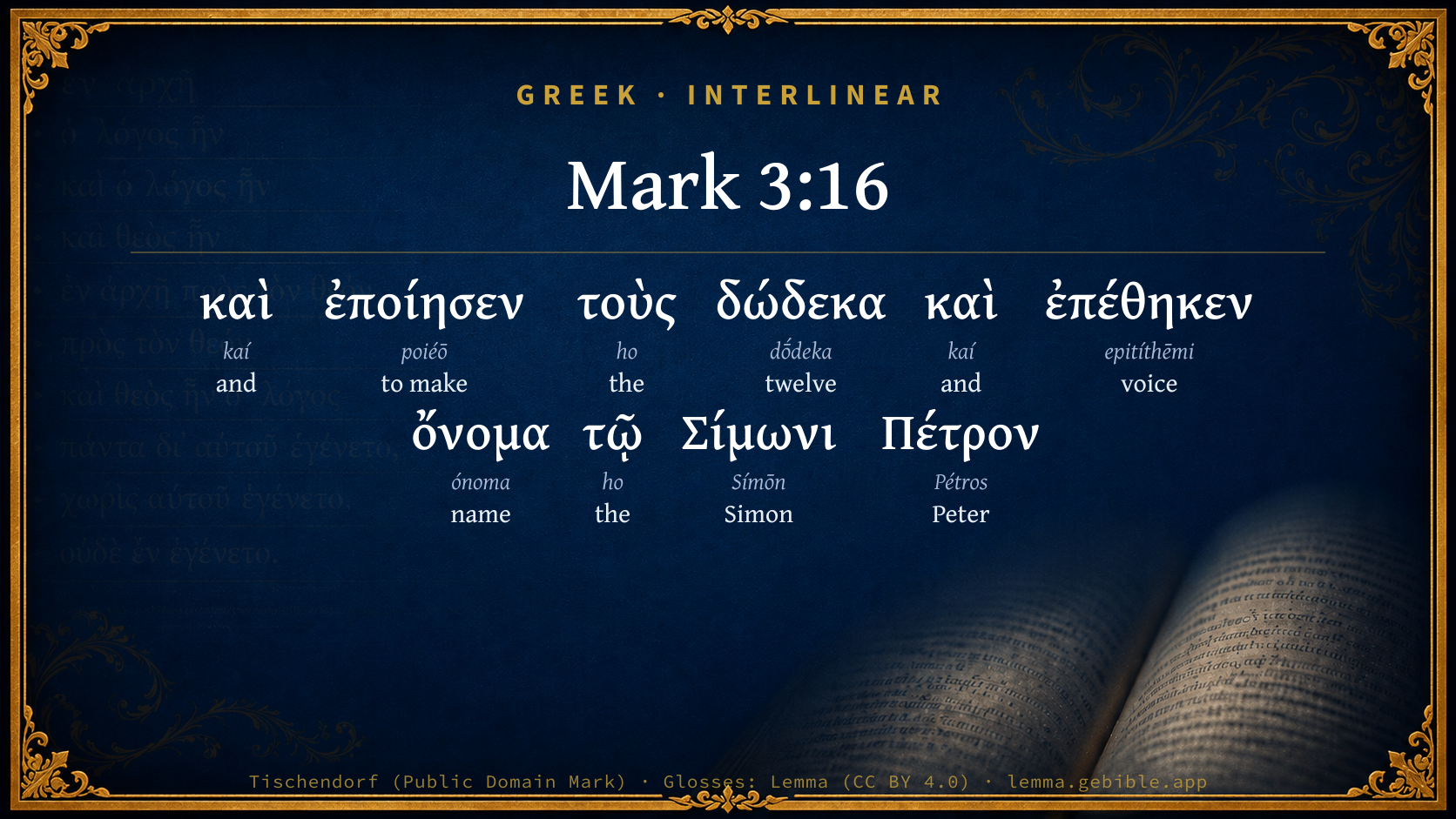
Download image
Cite this verse

Mark 3:16 (World English Bible). Public Domain. Lemma interlinear Bible study tool, https://lemma.gebible.app/v/mark/3/16.

Show BibTeX & RIS
BibTeX
RIS
English Translation
Simon, to whom he gave the name Peter;
World English Bible · Public Domain
Download a study sheet

One document with this verse’s original text, its word-by-word gloss line, the meaning frame, cross-references with their text, attributed commentary, and full source and license credits — printable, and it pastes into notes with its structure intact.

This verse Autodidact and up

Study sheet (.html) Plain text (.txt)

A passage Seminary Student

Up to 50 verses in one chapter. A passage sheet keeps up to 6 commentary sources and 12 cross-references per verse, in the order this page ranks them, and says so on the sheet whenever that leaves anything out. Ask for a single verse and you get the Autodidact verse sheet above.

Everything on this page stays free to read, with no account — the sheet is a download of what is already on screen, not access to it.

Want to remove ads? Support Godless Engineer
Compare translations 3

The same verse in 3 English versions, stacked beneath the original-language interlinear above. Click any original word for its lexicon entry.

Each is an independent rendering of the whole verse — the interlinear is not word-aligned to these translations.

Highlighted words mark where these versions differ — a whole-verse word diff, not a word-by-word alignment.

  • World English Bible Public Domain
    Simon, to whom he gave the name Peter;
  • King James Version Public Domain
    And Simon he surnamed Peter;
  • unfoldingWord Literal Text CC BY-SA 4.0
    And he appointed the Twelve, and he gave to Simon the name Peter;

unfoldingWord Literal Text — © unfoldingWord, licensed CC BY-SA 4.0. Word-aligned USFM3 via Door43 (git.door43.org/unfoldingWord/en_ult).

Versions to compare (up to 4)

3 of 4 selected

Show all 19 translations

Every available English version of this verse, each an independent rendering of the whole verse.

  • World English Bible Public Domain
    Simon, to whom he gave the name Peter;
  • Berean Standard Bible Public Domain
    These are the twelve He appointed: Simon (whom He named Peter),
  • Majority Standard Bible Public Domain
    Simon (whom He named Peter),
  • King James Version Public Domain
    And Simon he surnamed Peter;
  • American Standard Version (1901) Public Domain
    and Simon he surnamed Peter;
  • Revised Version (1885) Public Domain
    and Simon he surnamed Peter;
  • Geneva Bible (1599) Public Domain
    And the first was Simon, and hee named Simon, Peter,
  • Douay-Rheims (1899) Public Domain
    And to Simon he gave the name Peter:
  • Young's Literal Translation Public Domain
    And he put on Simon the name Peter;
  • Literal Standard Version CC BY-SA 4.0
    And He put on Simon the name Peter;
  • Unlocked Literal Bible CC BY-SA 4.0
    Then he appointed the twelve: Simon, to whom he gave the name Peter;
  • unfoldingWord Literal Text CC BY-SA 4.0
    And he appointed the Twelve, and he gave to Simon the name Peter;
  • Darby Bible Public Domain
    And he gave to Simon the surname of Peter;
  • World Messianic Bible Public Domain
    Simon (to whom he gave the name Peter);
  • Webster's Bible Public Domain
    And Simon he surnamed Peter.
  • Free Bible Version CC BY-SA 4.0
    These are the twelve he chose: Simon (whom he called Peter),
  • Bible in Basic English Public Domain
    To Simon he gave the second name of Peter;
  • Text-Critical English NT CC BY 4.0
    He appointed Simon (whom he gave the name Peter);
  • Tyndale New Testament (1534) Public Domain
    And he gave vnto Simon to name Peter.

Literal Standard Version (2020), Covenant Press — licensed CC BY-SA 4.0. Text via the HelloAO Bible API (eBible.org). Unlocked Literal Bible (unfoldingWord) — licensed CC BY-SA 4.0. Text via the HelloAO Bible API (eBible.org). unfoldingWord Literal Text — © unfoldingWord, licensed CC BY-SA 4.0. Word-aligned USFM3 via Door43 (git.door43.org/unfoldingWord/en_ult). Free Bible Version, Dr. Jonathan Gallagher — licensed CC BY-SA 4.0. Text via the HelloAO Bible API (eBible.org).

Word by word

More ways to search: Search by grammar → Find every occurrence → Compare this word →

Practice this passage: Drill this verse → Learn its vocabulary →

About this verse

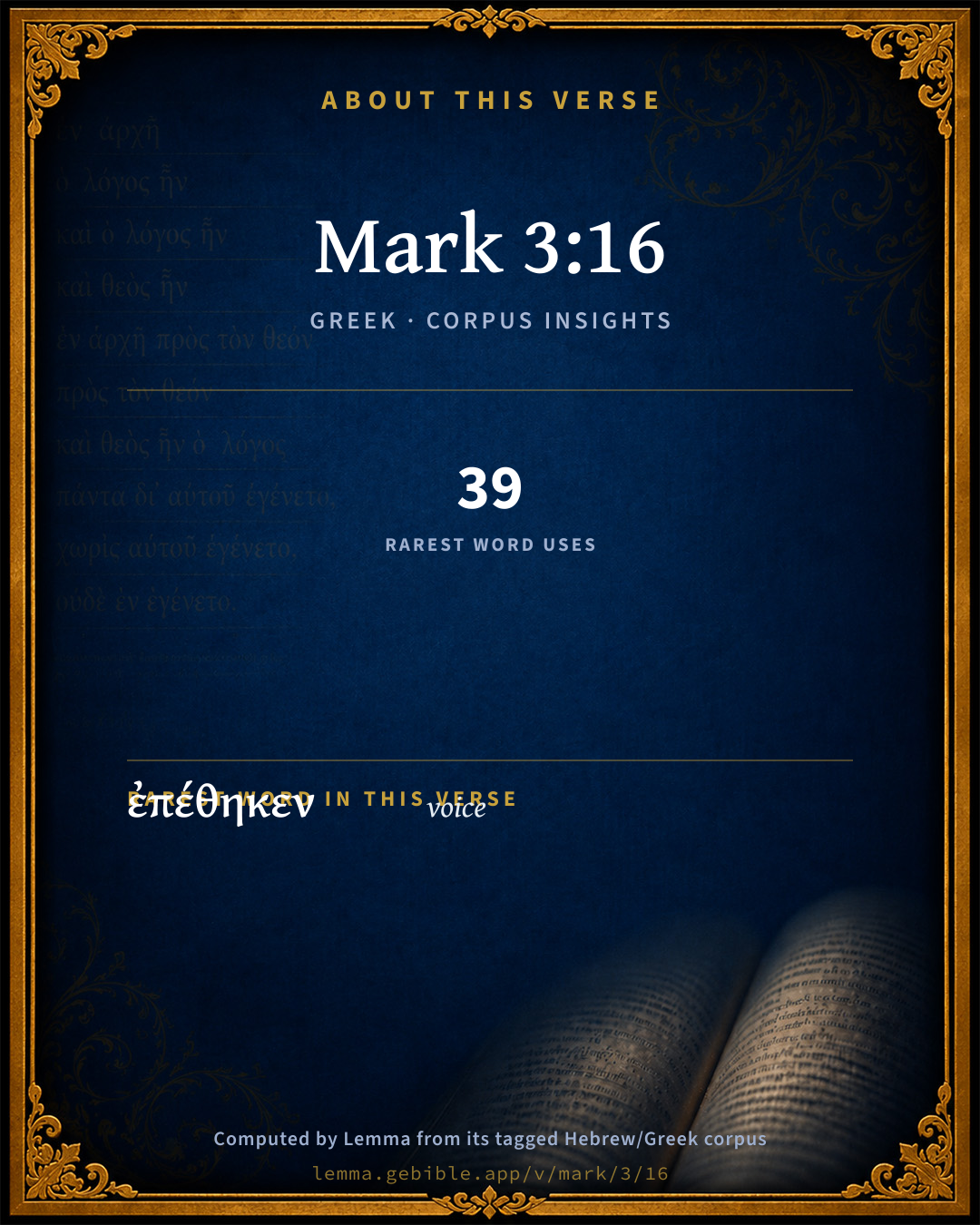
These counts appear in no published source. They are computed here, from the morphology-tagged text and Lemma’s own curated glosses. What Lemma adds →

10
words
8
distinct lemmas
Gospels
section

Shared distinctive vocabulary

ἐπέθηκεν voice G2007 occurs in 38 verses of the Greek New Testament. Also found in:
Repetition

Words recur within this verse:

Cross-references

11

Topical passages linked to Mark 3:16 in the Treasury of Scripture Knowledge — connected by theme and wording, ordered by reader-vote popularity; previews shown in the World English Bible.

  • John 1:42 He brought him to Jesus. Jesus looked at him, and said, "You are Simon the son of Jonah. You shall be called Cephas" (which is by interpretation, Peter).
  • Acts 1:13 When they had come in, they went up into the upper room, where they were staying; that is Peter, John, James, Andrew, Philip, Thomas, Bartholomew, Matthew, James the son of Alphaeus, Simon the Zealot, and Judas the son of James.
  • Matthew 10:2–4 Now the names of the twelve apostles are these. The first, Simon, who is called Peter; Andrew, his brother; James the son of Zebedee; John, his brother;
  • Matthew 16:16–18 Simon Peter answered, "You are the Christ, the Son of the living God."
  • Mark 1:16 Passing along by the sea of Galilee, he saw Simon and Andrew the brother of Simon casting a net in the sea, for they were fishermen.
  • 1 Corinthians 1:12 Now I mean this, that each one of you says, "I follow Paul," "I follow Apollos," "I follow Cephas," and, "I follow Christ."
  • 1 Corinthians 3:22 whether Paul, or Apollos, or Cephas, or the world, or life, or death, or things present, or things to come. All are yours,
  • 1 Corinthians 9:5 Have we no right to take along a wife who is a believer, even as the rest of the apostles, and the brothers of the Lord, and Cephas?
  • Galatians 2:7–9 but to the contrary, when they saw that I had been entrusted with the Gospel for the uncircumcision, even as Peter with the Gospel for the circumcision
  • 2 Peter 1:1 Simon Peter, a servant and apostle of Jesus Christ, to those who have obtained a like precious faith with us in the righteousness of our God and Savior, Jesus Christ:
  • Luke 6:14–16 Simon, whom he also named Peter; Andrew, his brother; James; John; Philip; Bartholomew;

Cross-references courtesy of OpenBible.info (CC BY 4.0).

Where the printed editions differ

2 variants

Places in this verse where the major printed Greek editions disagree on the wording in a way that affects the translation — a comparison of editions, not a manuscript-by-manuscript collation. The editions are the modern critical texts (Nestlé-Aland 28/27, SBL, Westcott-Hort, Tregelles, Tyndale House) and the traditional texts behind the KJV (the Textus Receptus and the Byzantine/Majority text). It is not a claim about which reading is original.

  1. Extra text
    καὶ

    “And”

    In NA27TynSBLWHTregByz Not in NA28TR
  2. Extra text
    ἐποίησεν τοὺς δώδεκα

    “He appointed the Twelve”

    In NA27SBLWH Not in NA28TynTregTRByz

    καὶ ἐποίησεν τοὺς δώδεκα (kai epoiēsen tous dōdeka) 'And He appointed the Twelve' is only in older manuscripts (NA27+SBL+WH)

Textual data: Translators Amalgamated Greek New Testament (STEPBible TAGNT) · CC BY 4.0.

Commentary

Notes on Mark 3:16 from classic Christian and Jewish commentators (each source and its license shown beneath its notes). The classic Christian expositions comment on the surrounding passage and are grouped to its opening verse, so a note may address several verses; the Jewish commentaries on the Tanakh (Rashi and others) are per-verse, so they appear only where the commentator wrote on this verse.

Lemma curates 59 commentaries, every one of them public domain or Creative Commons licensed, each selected and text-cleaned for this edition rather than reprinted as found. About our sources →

The Cambridge Bible for Schools and Colleges

gen. ed. J. J. S. Perowne

16. and Simon] We have in the New Testament four lists of the Apostles: (a) Mat_10:2; (b) Mar_3:16; (c) Luk_6:14; (d) Act_1:13. The position of some of the names varies in the lists, but in all four the leaders of the three groups are the same, Peter, Philip, and James, the son of Alphæus, while in all four Judas Iscariot is placed last. According to St Mark’s catalogue they may be arranged in three groups:

(i) 1 Peter.

2 James.

3 John.

4 Andrew.

(ii) 5 Philip.

6 Bartholomew.

7 Matthew.

8 Thomas.

(iii) 9 James the Less.

10 Thaddæus.

11 Simon the Cananite.

12 Judas Iscariot.

(a) Group i

i. Simon. The name of Simeon (Act_15:14) or Simon, a “hearer,” the son of Jonas (Joh_1:42; Joh_21:16), whom our Lord surnamed Peter or Cephas, the Rock-man, stands first in all the four lists. He was brought up in his father’s occupation, as a fisherman on the Galilean lake, and lived originally at Bethsaida, and afterwards in a house at Capernaum (Mar_1:21; Mar_1:29). His earliest call came to him through his brother Andrew, who told him the Messias, the “Anointed One,” had been found in the Person of the Lord (Joh_1:43). His second call took place on the lake near Capernaum, where he and the other three in this group were fishing. He is specially prominent on various occasions before the rest of the Apostles. Sometimes he speaks in their name (Mat_19:27; Luk_12:41); sometimes answers when all are addressed (Mat_16:16; Mar_8:29); sometimes he is addressed as principal, even among the favoured Three by our Lord Himself (Mat_26:40; Luk_22:31); sometimes he is appealed to by others as representing the rest (Mat_17:24; Act_2:37). After the Ascension he assumes a position of special prominence (Act_1:15; Act_2:14; Act_4:8; Act_5:29).

The Cambridge Bible for Schools and Colleges (gen. ed. J. J. S. Perowne; Cambridge University Press, 1878–1918) — public domain. Text from a community e-Sword module.

Whedon's Commentary on the Bible

Daniel D. Whedon

THE LIST OF THE APOSTLES, Mar_3:16-19.

Compare Mat_10:2-4, Luk_1:14-17.

16. Surnamed Peter — Meaning rock. Mark seems to name the apostles very much in couples. See notes on Mat_10:2-4.

Daniel D. Whedon (gen. ed.), Commentary on the Old and New Testaments (1874–1909) — public domain. Text from a community e-Sword module.

Tyndale Open Study Notes

Tyndale Open Resources

3:16-18 Simon and Andrew were brothers, as were James and John (1:16-20). • Peter is the Greek equivalent of the Aramaic kepa’, meaning “rock.”

Tyndale Open Study Notes — © Tyndale Open Resources, licensed CC BY-SA 4.0. Text via the HelloAO Bible API.

Bengel's Gnomon

Johann Albrecht Bengel

Mar 3:16. Ἐπέθηκε, He put upon) It is a mark of Lordship to give a surname; this He gave also to James and John jointly, Mar 3:17; but to Peter first of all before them. So in the catalogue of the twelve spies of the land of Canaan, mention is made of Joshua receiving that name instead of Hosea; Num 13:4-16.

Bengel's Gnomon of the New Testament — English translation (T&T Clark, Edinburgh, 1860) — public domain. Text from a community e-Sword module.

Expositor's Greek Testament

ed. W. Robertson Nicoll

Mar 3:16 . καὶ ἐποίησεν τ . δ ., and He appointed as the Twelve the following persons, the twelve names mentioned being the object of ἐποίησε , and τοὺς δ . being in apposition. Πέτρον is the first name, but it comes in very awkwardly as the object of the verb ἐπέθηκε . We must take the grammar as it stands, content that we know, in spite of crude construction, what is meant. Fritzsche (after Beza, Erasmus, etc.) seeks to rectify the construction by prefixing, on slender critical authority, πρῶτον Σίμωνα , then bracketing as a parenthesis καὶ ἐπέθηκε … Πέτρον = first Simon (and He gave to Simon the name Peter).

The Expositor's Greek Testament, edited by W. Robertson Nicoll (1897–1910) — public domain. Text from a community e-Sword module.

Adam Clarke's Commentary

Verse 16. Simon, &c.] See Clarke on Mt 10:2, &c.

Adam Clarke's Commentary on the Bible (1810–1826) — public domain. Text from a community e-Sword/MySword module.

Ellicott's Commentary for English Readers

(16-19) And Simon he surnamed.—On the list of the Apostles see Notes on Mat_10:2-4.

A Bible Commentary for English Readers, edited by Charles John Ellicott (1878–1897) — public domain. Text from a community e-Sword module.

John Gill's Exposition

And Simon he surnamed Peter. Or Cephas, which signifies a rock, or stone, because of his courage and constancy, his strength and fortitude, steadiness and firmness of mind: this name was imposed upon him, not at the time of his mission as an apostle; nor when he made that noble confession of his faith in Christ, as the Son of the living God, at which time this name was taken notice of; but when Christ first called him to be his disciple and apostle; see Joh 1:42.

.

Mark 3:17

mar 3:17

mar 3:17

mar 3:17And James the son of Zebedee, and John the brother of James,.... These are mentioned next, as being first called after Peter and Andrew:

and he surnamed them Boanerges, which is, the sons of thunder: either because of their loud and sonorous voice; or their warm zeal for Christ, and fervency in their ministry: or for their courage in opposing the enemies of Christ, and the power that went along with their words; which either put to confusion and silence, or issued in conviction and conversion. The Syriac version reads, "Benai Regesh", and the Persic, "Beni Reg'sch". The Jews, as our learned countryman Mr. Broughton has observed (w), sometimes pronounce "Scheva" by on, as Noabyim", for "Nebyim"; so here, "Boanerges" for Benereges", or "Benerges". There is a city which was in the tribe of Dan, mentioned in Jos 19:45, which is called "Bene-berak, the sons of lightning"; and is spoken of in the Jewish (x) writings, as a place where several of the Rabbins met, and conversed together: the reason of this name may be inquired after.

(w) Broughton's Requ. of Consent, in his Works, p. 620. (x) Haggada Shel Pesach. p. 6. Ed. Rittangel. & in Seder Tephillot, Ed. Basil, fol. 243. 1. Juchasin, fol. 36. 1.

John Gill's Exposition of the Whole Bible (1746–1763) — public domain (CC PDM 1.0). Text via the HelloAO Bible API.

Trapp's Complete Commentary

John Trapp

16 And Simon he surnamed Peter;

Ver. 16. And Simon he surnamed Peter] Not now, but after that famous confession of his, Mat 16:16.

John Trapp, A Commentary or Exposition upon All the Books of the Old and New Testament (1647–1656) — public domain. Text from a community e-Sword module.

Haydock's Catholic Bible Commentary

The evangelist here gives the names of the twelve. First, Simon, to whom he gave the name of Peter, in Greek, Petron, which signifies a rock; thus shewing that upon him his Church should be founded, as on a rock, never to be overturned. (Tirinus) --- Polus, in his Synopsis Criticorum on this verse says that some Greek copies have, Proton Simona, First, Simon, which he believes to be the genuine reading: "nec dubito quin hæc sit germana lectio."

George Leo Haydock (1774–1849), Haydock's Catholic Family Bible and Commentary, 1859 edition — public domain. Excludes Psalms (Douay-Rheims chapter numbering differs from Protestant) and Deuterocanonical books (Catholic canon only).

Matthew Poole's English Annotations

Matthew nameth the apostles upon his relating the history of their mission, or sending out; Mark nameth them upon their election, or first choice. Both these evangelists agree with Luke in their names, saving that Luke calleth him Judas whom Matthew calls Lebbaeus, and Mark, Thaddaeus, so that he had three names. Christ changeth the name of Simon, whom he called Cephas, or Peter, Joh 1:42; we have the reason, Mat 16:18; he also changed the names of James and John, the sons of Zebedee, calling them Boanerges, about the etymology of which name critics must dispute. The evangelists tell us it signifieth Sons of thunder, thereby minding them of their duty, to cry aloud, and to preach the gospel as on the housetops; or perhaps declaring what he knew was in the fervour and warmth of their spirits. We must not here inquire too narrowly into the secret counsels of God, in suffering a son of perdition to come into the number of his first ministers: Christ did it not because he did not know what was in his heart, for before that he showed himself a devil, by informing against his Master, Christ told his disciples that he had chosen twelve, and one of them was a devil; nor yet because he had no others to send, he had multitudes of disciples, and he who of stones could have raised up children to Abraham, could easily have fitted out a person for this service; nor yet did he do it to let in any sots and scandalous persons into the ministry, for we read of no scandal in Judas’s life. We ought to believe that God had wise ends in the permission of this, and that Christ did out of infinite wisdom do this, though we possibly are not able to give a satisfactory account in the case. What if we should say that Christ by this:

1. Instructed those that after his ascension should have the care of the church, not to pretend to judge of secret things, but only to judge as man ought to judge, according to the outward appearance, leaving the judgment of the heart to God alone.

2. God by this arms his people against the scandal of wicked ministers, such in whom corruption may break out after their entrance into that holy function, though before no such thing appeared, that they may not think the ministerial acts performed by them to have been nullities.

3. God by this also lets us know, that the efficacy of the ordinance doth not depend upon the goodness of the spiritual state of the minister that administers.

A bell may call others to hear the word, though itself receives no benefit by it. In the mean time here is no warrant either for people to choose, or the governors of a church to ordain, lewd and visibly scandalous persons. Judas was no such person; nor yet for people to own, or the governors of churches to continue, lewd and scandalous persons in the ministry, God ordinarily not blessing the labours of such. No sooner had Judas discovered himself, but he went out and hanged himself. Christ no longer allowed him his company, nor the disciples their fellowship. There is a great deal of difference with relation to our fellowship and communion, between secret wickedness concealed in the heart and open and scandalous sinning, though both be alike dangerous to the soul of the sinner.

Matthew Poole's English Annotations on the Holy Bible (1683–1685) — public domain. Text from a community e-Sword/MySword module.

The Pulpit Commentary

Vers. 16, 17. And Simon he surnamed Peter. Our Lord had previously declared that Simon should be so called. But St. Mark avoids as much as possible the recognition of any special honor belonging to St. Peter; so he here simply mentions the fact of this surname having been given to him, a fact which was necessary in order that he might be identified. All the early Christian writers held that Peter was virtually the author of this Gospel. Simon, or Simeon, is from a Hebrew word, meaning "to hear." James the son of Zebedee, so called to distinguish him from the other James; and John his brother. In St. Matthew"s list, Andrew is mentioned next after Peter, as his brother, and the first called. But here St. Mark mentions James and John first after Peter; these three, Peter and James and John, being the three leading apostles. Of James and John, James is mentioned first, as the eldest of the two brothers. And them he surnamed Boanerges, which is, Sons of thunder. "Boanerges" is the Aramaic pronunciation of the Hebrew Bne-ragesh; Bne, sons, and ragesh, thunder. The word was not intended as a term of reproach; although it fitly expressed that natural impetuosity and vehemence of character, which showed itself in their desire to bring down fire from heaven upon the Samaritan village, and in their ambitious request that they might have the highest places of honor in his coming kingdom. But their natural dispositions, under the Holy Spirit"s influence, were gradually transformed so as to serve the cause of Christ, and their fiery zeal was transmuted into the steady flame of Christian earnestness and love, so as to become an element of great power in their new life as Christians. Christ called these men "Sons of thunder" because he would make their natural dispositions, when restrained and elevated by his grace, the great instruments of spreading his Gospel. He destined them for high service in his kingdom. By their holy lives they were to be as lightning, and by their preaching they were to be as thunder to rouse unbelievers, and to bring them to repentance and a holy life. It was no doubt on account of this zeal that James fell so early a victim to the wrath of Herod. A different lot was that which fell to St. John. Spared to a ripe old age, he influenced the early Church by his writings and his teaching. His Gospel begins as with the voice of thunder, "In the beginning was the Word, and the Word was with God, and the Word was God." Beza and others, followed by Dr. Morisen, have thought that this distinctive name was given by our Lord to the two brothers on account of some deep-toned peculiarity of voice, which was of much service to them in impressing the message of the Gospel of the kingdom upon their hearers.

The Pulpit Commentary (1880–1919), ed. H.D.M. Spence-Jones & Joseph S. Exell — public domain. Text from a community e-Sword module.

John Wesley's Explanatory Notes

He surnamed them sons of thunder - Both with respect to the warmth and impetuosity of their spirit, their fervent manner of preaching, and the power of their word.

John Wesley, Explanatory Notes Upon the Whole Bible (1754–1765) — public domain. Text via the GEBible commentary corpus.

The People's New Testament

B. W. Johnson

16. Simon he surnamed Peter. He did this previously (John 1:42).

B. W. Johnson's The People's New Testament with Notes (1889–1891) — public domain. Electronic text from the Christian Classics Ethereal Library (CCEL) ThML edition.

Cambridge Greek Testament for Schools and Colleges

16. καὶ ἐποίησεν τοὺς δώδεκα ([502][503][504][505][506][507]) is to be retained; [508][509]2[510][511] etc. omit as superfluous.

[502] Codex Sinaiticus. 4th cent. Discovered by Tischendorf in 1859 at the Monastery of St Katharine on Mount Sinai. Now at St Petersburg. The whole Gospel, ending at Mar 16:8. Photographic facsimile, 1911.

[503] Codex Vaticanus. 4th cent., but perhaps a little later than א. In the Vatican Library almost since its foundation by Pope Nicolas V., and one of its greatest treasures. The whole Gospel, ending at Mar 16:8. Photographic facsimile, 1889.

[504] Codex Ephraemi. 5th cent. A palimpsest: the original writing has been partially rubbed out, and the works of Ephraem the Syrian have been written over it; but a great deal of the original writing has been recovered; of Mark we have Mar 1:17 to Mar 6:31, Mar 8:5 to Mar 12:29, Mar 13:19 to Mar 16:20. In the National Library at Paris.

[505] An asterisk denotes that the word is not found elsewhere in N.T., and such words are included in the index, even if there is no note on them in the commentary.

[506] Codex Sangallensis. 9th or 10th cent. Contains the Gospels nearly complete, with an interlinear Latin translation. The text of Mark is specially good, agreeing often with CL. At St Gall.

[507] Codex Beratinus. 6th cent. Contains Mar 1:1 to Mar 14:62.

[508] Codex Alexandrinus. 5th cent. Brought by Cyril Lucar, Patriarch of Constantinople, from Alexandria, and afterwards presented by him to King Charles I. in 1628. In the British Museum. The whole Gospel. Photographic facsimile, 1879.

[509] Codex Ephraemi. 5th cent. A palimpsest: the original writing has been partially rubbed out, and the works of Ephraem the Syrian have been written over it; but a great deal of the original writing has been recovered; of Mark we have Mar 1:17 to Mar 6:31, Mar 8:5 to Mar 12:29, Mar 13:19 to Mar 16:20. In the National Library at Paris.

[510] Codex Bezae. 6th cent. Has a Latin translation (d) side by side with the Greek text, and the two do not quite always agree. Presented by Beza to the University Library of Cambridge in 1581. Remarkable for its frequent divergences from other texts. Contains Mark, except Mar 16:15-20, which has been added by a later hand. Photographic facsimile, 1899.

[511] Codex Regius. 8th cent. An important witness. At Paris. Contains Mar 1:1 to Mar 10:15; Mar 10:30 to Mar 15:1; Mar 15:20 to Mar 16:20, but the shorter ending is inserted between Mar 16:8 and Mar 16:9, showing that the scribe preferred it to the longer one.

16. καὶ ἐποίησεν τοὺς δώδεκα. See crit. note. This repetition is some slight confirmation of the genuineness of οὓς καὶ ἀπ. ὠν. It implies that so much has intervened as to make repetition advisable; but, without οὓ καὶ ἀπ. ὠν., the interruption is slight. Καὶ is almost our “Well.” “Well, as I said, He appointed the Twelve”; “the Twelve” because they have been mentioned before and because the expression was so familiar. Similarly, we have first “seventy-two” and then “the seventy-two” (Luk 10:1; Luk 10:17).

καὶ ἐπέθηκεν ὄνομα. This need not mean that the name was given there and then, any more than Mar 3:14 need mean that the title Apostle was given there and then. Mk’s want of literary skill is conspicuous here; the meaning is clear, but the construction is confused, owing to the list of the Apostles being broken by the mention of the special names given to Simon and the sons of Zebedee. Cf. Mar 4:15; Mar 4:26; Mar 4:31, Mar 6:8-9, Mar 7:2-5; Mar 7:11-12, Mar 13:34.

Πέτρον. The Aramaic equivalent Κηφᾶς occurs Joh 1:43 and four times each in 1 Cor. and Gal. It means “a rock,” or more often “a stone,” and is used of precious stones, hailstones, etc. It is uncertain whether the name points to the character which Simon already possessed (which is hardly in harmony with facts), or to the character which he was to acquire, or to the office which was conferred on him, or to the fact that he was the first stone in laying the foundation of the Church (Mat 16:18). Outside the four lists, Peter is mentioned, by one name or another, 182 times in N.T.

It is often observed that in all four lists (Mk, Mt., Lk., and Acts) the Twelve are arranged in three quaternions, with Peter head of the first quaternion, Philip of the second, and James of Alphaeus of the third. The other three names in each quaternion vary in order, but in Mk, Mt., and Lk. the traitor is always last, and in Acts his place is vacant. Here the sons of Zebedee are between the other two brothers, either because they, like Simon, received a special name from Christ, or because, with him, they form the ἐκλεκτῶν ἐκλεκτότεροι on various occasions (Mar 5:37, Mar 9:2, Mar 14:33). If James and John were first cousins of our Lord, their mother Salome being sister of His Mother (Joh 19:25), this might be another reason for placing them next to the πρῶτος. Here and Mar 5:37, and nowhere else in N.T., John is designated “the brother óf James,” while in Act 12:2 we have “James the brother of John.” Here it is necessary to distinguish John the Apostle from John the Baptist; in Acts it is necessary to distinguish James the Apostle from James the brother of the Lord. Is it possible that Mk is also distinguishing “John the brother of James” from “John whose surname was Mark”? Those who did not know, might fancy that the Evangelist was an Apostle.

Cambridge Greek Testament for Schools and Colleges (Cambridge University Press, 1896; 21 vols, various authors incl. Carr, Maclear, Plummer, Farrar, Lumby, Moule, M. R. James, Simcox) — public domain. Text from a community e-Sword module.

Alford’s Greek Testament

Henry Alford

16. καὶ ἐπ.…] for Σίμωνα, ᾧ ἐπ.…

On the list of the Apostles, see note at Mat 10:2. The name, according to Mark, seems to be now first given. This, at all events, does not look like the testimony of Peter: but perhaps the words are not to be so accurately pressed.

Henry Alford, The Greek Testament (1849–1861) — public domain. Text from a community e-Sword module.

International Critical Commentary

16. καὶ ἐπέθηκε.

Καὶ ἐποίησεν τοὺς δώδεκα, and he appointed the twelve, is inserted before καὶ ἐπέθηκε by Tisch. WH. RV.marg. א BC* Δ.

καὶ ἐπέθηκε interrupts the structure of the sentence, which is resumed in the next verse. The names that follow are in apposition with τοὺς δώδεκα in the inserted clause, and the enumeration is interrupted to give the descriptive names assigned to some of them by Jesus.

Πέτρον—Peter. Mt. gives the only explanation of this name given to Simon, in ch. 16:18. But neither in this passage nor in that, is there any definite indication that it was at either time that the name was given him. J. 1:42, however, assigns the giving of the name to a time much earlier than either, immediately after the Baptism. Πέτρον means a rock. The masculine form, instead of Πέτρα, is due to its being appropriated as the name of a man.

International Critical Commentary — older volumes (1896–1929), various authors — public domain. Text from a community e-Sword module.

Vincent's Word Studies in the New Testament

Marvin R. Vincent

And Simon he surnamed Peter. Mark relates only his naming and not his appointment, leaving his appointment to be understood.

Marvin R. Vincent, Word Studies in the New Testament (1887–1900) — public domain. Text from a community e-Sword/MySword module.

Lesson kit

Teaching starters — assembled from the data on this page, not authored interpretation. Every prompt links to the verse data it draws on. Edit before teaching.

Mark, in the Gospels, opens this verse with 10 words (8 distinct Greek lemmas). Its most distinctive word is epitíthēmi (“voice”). A historical commentator’s framing appears above. Read the whole chapter for the surrounding context.

Discussion questions

  1. How does “voice” (epitíthēmi) shape what this verse is saying?
  2. How does Matthew 9:18, which shares the word «voice», read alongside this verse?
  3. What does the repetition of “and” (2× in this one verse) do in this verse?
  4. These translations render this verse differently; the difference is in the English rendering, not the original. What questions does that raise?
  5. Compare how The Cambridge Bible for Schools and Colleges and Whedon's Commentary on the Bible read this verse. Where do they agree or differ?

Things to notice

  • These translations choose different wording for 6 words in this verse.
  • “and” occurs 2× in this single verse.
  • 8 distinct Greek lemmas span 10 words in this verse.

Reading settings

Reading text

Shown beneath each verse's original-language words.

Old Testament
Old Testament edition

Read the OT as the Masoretic Hebrew (MT) or the Greek Septuagint (LXX).

English shown for the Greek Septuagint (in the Hebrew ↔ Greek comparison).

Comparing translations? Open the Compare panel on any verse page to stack up to four side by side.