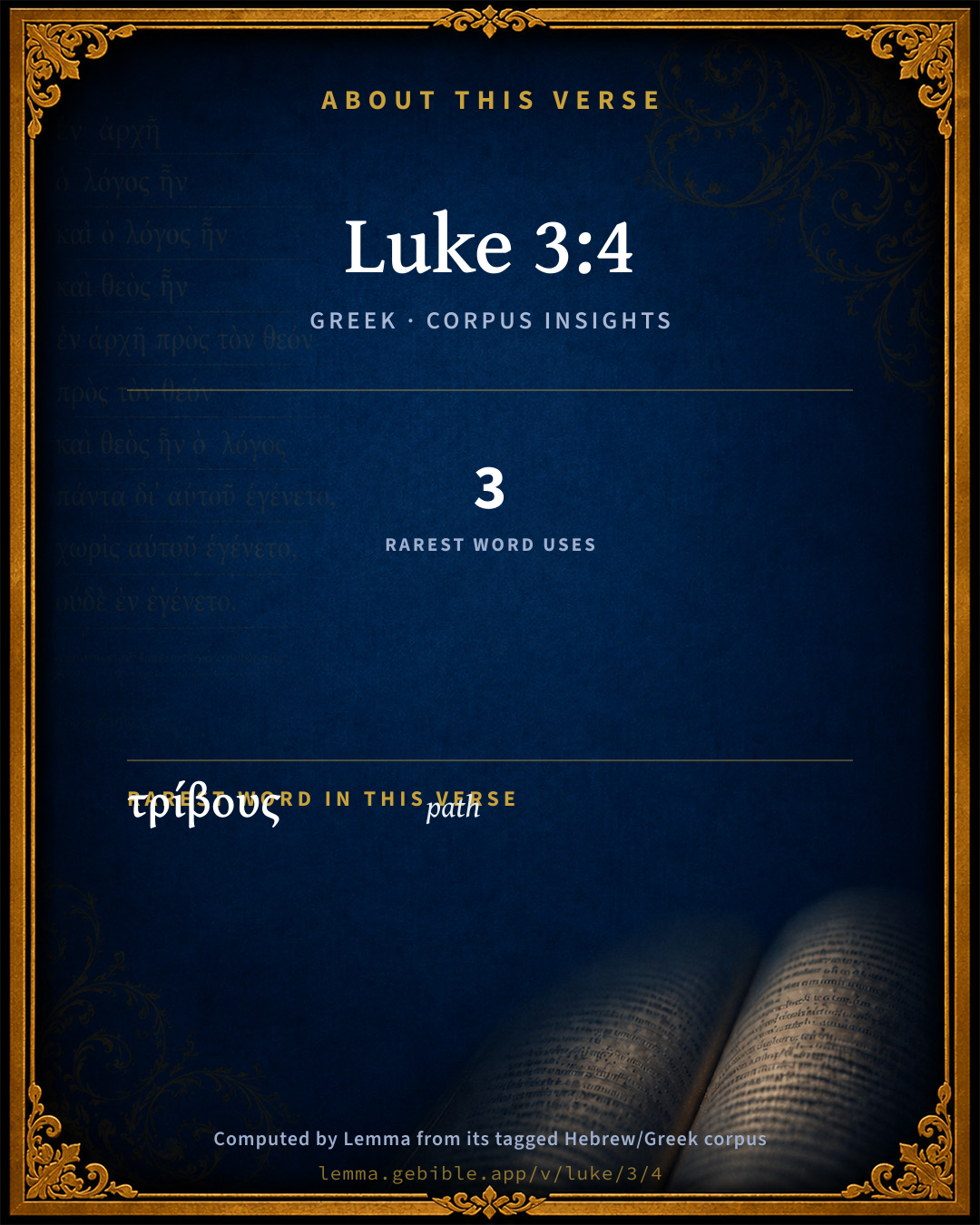
Luke 3:4

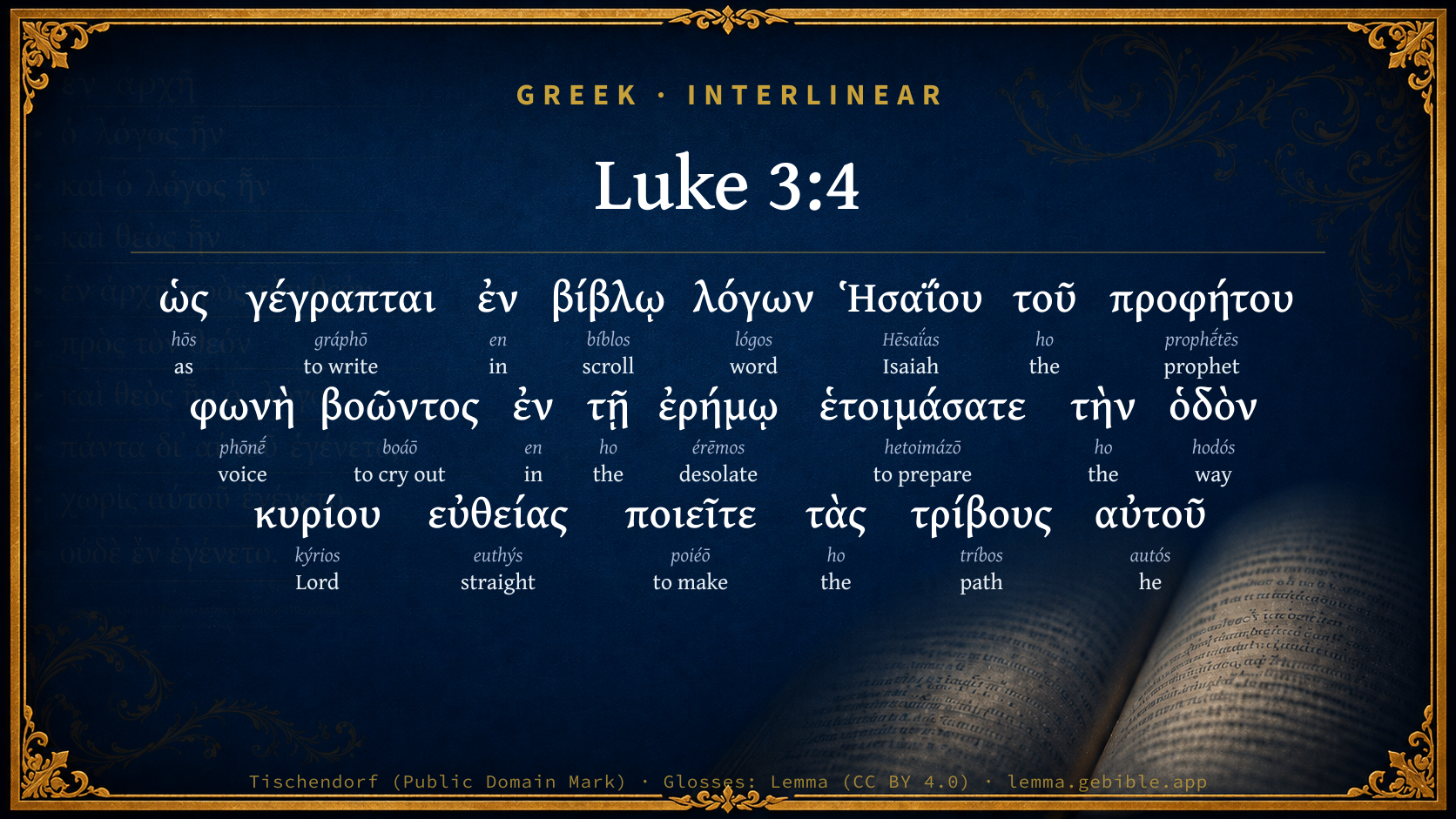
Greek (Tischendorf 8th ed.) Luke 3:4 appears in the Greek New Testament. The text above is from the Tischendorf 8th edition. Each word links to its Strong’s number and a concise gloss. Click any word for its full Thayer’s Greek Lexicon entry.
Download image
Cite this verse

Luke 3:4 (World English Bible). Public Domain. Lemma interlinear Bible study tool, https://lemma.gebible.app/v/luke/3/4.

Show BibTeX & RIS
BibTeX
RIS
English Translation
As it is written in the book of the words of Isaiah the prophet, "The voice of one crying in the wilderness, 'Make ready the way of the Lord. Make his paths straight.
World English Bible · Public Domain
Download a study sheet

One document with this verse’s original text, its word-by-word gloss line, the meaning frame, cross-references with their text, attributed commentary, and full source and license credits — printable, and it pastes into notes with its structure intact.

This verse Autodidact and up

Study sheet (.html) Plain text (.txt)

A passage Seminary Student

Up to 50 verses in one chapter. A passage sheet keeps up to 6 commentary sources and 12 cross-references per verse, in the order this page ranks them, and says so on the sheet whenever that leaves anything out. Ask for a single verse and you get the Autodidact verse sheet above.

Everything on this page stays free to read, with no account — the sheet is a download of what is already on screen, not access to it.

Want to remove ads? Support Godless Engineer
Compare translations 3

The same verse in 3 English versions, stacked beneath the original-language interlinear above. Click any original word for its lexicon entry.

Each is an independent rendering of the whole verse — the interlinear is not word-aligned to these translations.

Highlighted words mark where these versions differ — a whole-verse word diff, not a word-by-word alignment.

  • World English Bible Public Domain
    As it is written in the book of the words of Isaiah the prophet, "The voice of one crying in the wilderness, 'Make ready the way of the Lord. Make his paths straight.
  • King James Version Public Domain
    As it is written in the book of the words of Esaias the prophet, saying, The voice of one crying in the wilderness, Prepare ye the way of the Lord, make his paths straight.
  • unfoldingWord Literal Text CC BY-SA 4.0
    As it is written in the book of the words of Isaiah the prophet, “A voice of one calling out in the wilderness, ‘Make ready the way of the Lord, make his paths straight.

unfoldingWord Literal Text — © unfoldingWord, licensed CC BY-SA 4.0. Word-aligned USFM3 via Door43 (git.door43.org/unfoldingWord/en_ult).

Versions to compare (up to 4)

3 of 4 selected

Show all 19 translations

Every available English version of this verse, each an independent rendering of the whole verse.

  • World English Bible Public Domain
    As it is written in the book of the words of Isaiah the prophet, "The voice of one crying in the wilderness, 'Make ready the way of the Lord. Make his paths straight.
  • Berean Standard Bible Public Domain
    as it is written in the book of the words of Isaiah the prophet: “A voice of one calling in the wilderness, ‘Prepare the way for the Lord, make straight paths for Him.
  • Majority Standard Bible Public Domain
    as it is written in the book of the words of Isaiah the prophet: “A voice of one calling in the wilderness, ‘Prepare the way for the Lord, make straight paths for Him.
  • King James Version Public Domain
    As it is written in the book of the words of Esaias the prophet, saying, The voice of one crying in the wilderness, Prepare ye the way of the Lord, make his paths straight.
  • American Standard Version (1901) Public Domain
    as it is written in the book of the words of Isaiah the prophet, The voice of one crying in the wilderness, Make ye ready the way of the Lord, Make his paths straight.
  • Revised Version (1885) Public Domain
    as it is written in the book of the words of Isaiah the prophet, The voice of one crying in the wilderness, Make ye ready the way of the Lord, Make his paths straight.
  • Geneva Bible (1599) Public Domain
    As it is written in the booke of the sayings of Esaias the Prophet, which saith, The voyce of him that crieth in the wildernes is, Prepare ye the way of the Lord: make his paths straight.
  • Douay-Rheims (1899) Public Domain
    As it was written in the book of the sayings of Isaias the prophet: A voice of one crying in the wilderness: Prepare ye the way of the Lord, make straight his paths.
  • Young's Literal Translation Public Domain
    as it hath been written in the scroll of the words of Isaiah the prophet, saying, `A voice of one crying in the wilderness, Prepare ye the way of the Lord, straight make ye His paths;
  • Literal Standard Version CC BY-SA 4.0
    as it has been written in the scroll of the words of Isaiah the prophet: “A voice of one crying in the wilderness: Prepare the way of the LORD, || Make His paths straight;
  • Unlocked Literal Bible CC BY-SA 4.0
    As it is written in the book of the words of Isaiah the prophet, “A voice of one calling out in the wilderness, 'Make ready the way of the Lord, make his paths straight.
  • unfoldingWord Literal Text CC BY-SA 4.0
    As it is written in the book of the words of Isaiah the prophet, “A voice of one calling out in the wilderness, ‘Make ready the way of the Lord, make his paths straight.
  • Darby Bible Public Domain
    as it is written in [the] book of [the] words of Esaias the prophet: Voice of one crying in the wilderness: Prepare ye the way of [the] Lord, make straight his paths.
  • World Messianic Bible Public Domain
    As it is written in the scroll of the words of Isaiah the prophet, “The voice of one crying in the wilderness, ‘Make ready the way of the Lord. Make his paths straight.
  • Webster's Bible Public Domain
    As it is written in the book of the words of Isaiah the prophet, saying, The voice of one crying in the wilderness, Prepare ye the way of the Lord, make his paths straight.
  • Free Bible Version CC BY-SA 4.0
    As Isaiah the prophet wrote: “A voice was heard crying out in the desert, ‘Prepare the way of the Lord: make his paths straight.
  • Bible in Basic English Public Domain
    As it says in the book of the words of Isaiah the prophet, The voice of one crying in the waste land, Make ready the way of the Lord, make his roads straight.
  • Text-Critical English NT CC BY 4.0
    as it is written in the book of the words of the prophet Isaiah, “The voice of one crying out in the wilderness, ‘Prepare the way for the Lord; make his paths straight.
  • Tyndale New Testament (1534) Public Domain
    at it is written in the boke of the sayinges of Esaias the Prophet which sayeth: The voyce of a cryar in wyldernes prepare the waye of the Lorde make hys pathes strayght.

Literal Standard Version (2020), Covenant Press — licensed CC BY-SA 4.0. Text via the HelloAO Bible API (eBible.org). Unlocked Literal Bible (unfoldingWord) — licensed CC BY-SA 4.0. Text via the HelloAO Bible API (eBible.org). unfoldingWord Literal Text — © unfoldingWord, licensed CC BY-SA 4.0. Word-aligned USFM3 via Door43 (git.door43.org/unfoldingWord/en_ult). Free Bible Version, Dr. Jonathan Gallagher — licensed CC BY-SA 4.0. Text via the HelloAO Bible API (eBible.org).

Word by word

More ways to search: Search by grammar → Find every occurrence → Compare this word →

Practice this passage: Drill this verse → Learn its vocabulary →

τρίβους
tríbos
G5147
“path”
Noun, Accusative, Plural, Feminine
Part of Speech
Noun
Case
Accusative
Number
Plural
Gender
Feminine
Full Thayer's Definition

Origin: "from tribo (to "rub", akin to teiro, truo, and the base of G5131 , G5134 )"

TDNT: None

1. a worn way, a path
  1. ὡς hōs G5613 “as” Adverb
  2. γέγραπται gráphō G1125 “to write” Verb, Perfect, Passive, Indicative, 3rd person, Singular
  3. ἐν en G1722 “in” Preposition
  4. βίβλῳ bíblos G976 “scroll” Noun, Dative, Singular, Feminine
  5. λόγων lógos G3056 “word” Noun, Genitive, Plural, Masculine
  6. Ἡσαΐου Hēsaḯas G2268 “Isaiah” Noun, Genitive, Singular, Masculine
  7. τοῦ ho G3588 “the” Article, Genitive, Singular, Masculine
  8. προφήτου prophḗtēs G4396 “prophet” Noun, Genitive, Singular, Masculine
  9. φωνὴ phōnḗ G5456 “voice” Noun, Nominative, Singular, Feminine
  10. βοῶντος boáō G994 “to cry out” Verb, Present, Active, Participle, Genitive, Singular, Masculine
  11. ἐν en G1722 “in” Preposition
  12. τῇ ho G3588 “the” Article, Dative, Singular, Feminine
  13. ἐρήμῳ érēmos G2048 “desolate” Adjective, Dative, Singular, Feminine
  14. ἑτοιμάσατε hetoimázō G2090 “to prepare” Verb, Aorist, Active, Imperative, 2nd person, Plural
  15. τὴν ho G3588 “the” Article, Accusative, Singular, Feminine
  16. ὁδὸν hodós G3598 “way” Noun, Accusative, Singular, Feminine
  17. κυρίου kýrios G2962 “Lord” Noun, Genitive, Singular, Masculine
  18. εὐθείας euthýs G2117 “straight” Adjective, Accusative, Plural, Feminine
  19. ποιεῖτε poiéō G4160 “to make” Verb, Present, Active, Imperative, 2nd person, Plural
  20. τὰς ho G3588 “the” Article, Accusative, Plural, Feminine
  21. αὐτοῦ autós G846 “he” Personal pronoun, Genitive, Singular, Masculine

About this verse

These counts appear in no published source. They are computed here, from the morphology-tagged text and Lemma’s own curated glosses. What Lemma adds →

22
words
18
distinct lemmas
Gospels
section

Notable vocabulary

The rarest word here is τρίβους path G5147 — appearing just 3 times in the whole Greek New Testament.

Shared distinctive vocabulary

τρίβους path G5147 occurs in 3 verses of the Greek New Testament. Also found in:

Repetition

Words recur within this verse:

Cross-references

12

Topical passages linked to Luke 3:4 in the Treasury of Scripture Knowledge — connected by theme and wording, ordered by reader-vote popularity; previews shown in the World English Bible.

  • Isaiah 40:3–5 The voice of one who cries, Prepare you in the wilderness the way of Yahweh; make level in the desert a highway for our God.
  • John 1:23 He said, "I am the voice of one crying in the wilderness, 'Make straight the way of the Lord,' as Isaiah the prophet said."
  • Luke 1:76–79 And you, child, will be called a prophet of the Most High, For you will go before the face of the Lord to make ready his ways,
  • Isaiah 62:10 Go through, go through the gates; prepare you the way of the people; cast up, cast up the highway; gather out the stones; lift up an ensign for the peoples.
  • John 1:7 The same came as a witness, that he might testify about the light, that all might believe through him.
  • John 1:26–36 John answered them, "I baptize in water, but among you stands one whom you don't know.
  • John 3:28–36 You yourselves testify that I said, 'I am not the Christ,' but, 'I have been sent before him.'
  • Luke 1:16–17 He will turn many of the children of Israel to the Lord, their God.
  • Isaiah 57:14 He will say, Cast up, cast up, prepare the way, take up the stumbling-block out of the way of my people.
  • Malachi 4:6 He will turn the hearts of the fathers to the children, and the hearts of the children to their fathers, lest I come and strike the earth with a curse."
  • Matthew 3:3 For this is he who was spoken of by Isaiah the prophet, saying, "The voice of one crying in the wilderness, Make ready the way of the Lord, Make his paths straight."
  • Mark 1:3 The voice of one crying in the wilderness, 'Make ready the way of the Lord! Make his paths straight!'"

Cross-references courtesy of OpenBible.info (CC BY 4.0).

Commentary

Notes on Luke 3:4 from classic Christian and Jewish commentators (each source and its license shown beneath its notes). The classic Christian expositions comment on the surrounding passage and are grouped to its opening verse, so a note may address several verses; the Jewish commentaries on the Tanakh (Rashi and others) are per-verse, so they appear only where the commentator wrote on this verse.

Lemma curates 59 commentaries, every one of them public domain or Creative Commons licensed, each selected and text-cleaned for this edition rather than reprinted as found. About our sources →

The Biblical Illustrator

Joseph S. Exell

Luk_3:4

The voice of one crying in the wilderness

Self-effacement

John Baptist is a type of those who resolve, at all risks, to discharge their duty and to deliver the message entrusted to them by God, without one single thought of self, without one transient wish to appear themselves in the matter.

There is no indolence here, nor cowardice. There is simply an absence of any ambition to be prominent, and of any desire to hear their name whispered among the crowd. It is enough to be a voice--to preach Gods Word, and not their own; to pursue some truth which is not to enhance their own reputation; to advocate some cause which is not to redound to their own advantage. Alas 1 how few are such persons; but how precious in proportion to their rarity I If any of us, then, be on the way to the attainment of this high grace, let us be supremely careful that our own selfeffacement be both genuine in itself and be a sacrifice offered to a worthy cause. For if I merely surrender to the first comer, or abdicate in favour of some worse person than myself, the very humility that should have been for my wealth, becomes to me an occasion of falling. Instances are not uncommon, in every ones circle of acquaintance, where a man has surrendered not his pleasures, or his advantages, but his principles, to some other persons opinion. But if a single persons private opinion be sometimes thus overpowering, what must the combined force of a thousand peoples opinion, of public opinion, be! Every one, it is obvious, has a visual horizon of his own, in the centre of which he lives and moves and has his being; and just so every one has a social circle--a world (as the Bible calls it) of his own, amid which he lives, and which reacts too often with fatal influence upon his character. We must, by prayer and watchful circumspection, safeguard this precious grace of humble self-effacement, lest we expend it on unworthy objects. (Canon G. H. Curteis.)

Admission to the kingdom

I. 1. The one thing that is essential in order that we may enter the kingdom of God is that we should be sincere. It was the evident sincerity of John the Baptist which drew around him the sinners of Judea, even rough soldiers and mercenary tax-gatherers. He demands sincerity in return. He could not do with professions unless they were accompanied by fruits worthy of repentance.

2. But there were those who came out to Johns baptism in insincerity.

II. It is not necessarily a proof of sincerity that we are keenly interested in the religious movements which are agitating mens minds. It is a better test when we are willing, in all simplicity, to put away those special sins which are hindering us from surrendering ourselves to the rule of God. (Canon Vernon Hutton, M. A.)

The voice in the wilderness

When the tale of bricks is doubled, then comes Moses: this is an apothegm familiar among the Jews even to the present day, and rehearsed in their stories of the past. But Moses came twice; and, the first time, he was abruptly rejected. The Prophet like unto Moses, promised and at last announced to our sin-enslaved race as the Redeemer, was introduced by a forerunner, who was not accepted any more than his Master. John the Baptist was ultimately beheaded for his reward of fidelity; and the Lord Jesus was crucified. Thus it comes about that Christs sad history strikes back on Johns, and gives it an unexpected interpretation. Very true have proved those words of Heinrich Heine: Wheresoever a great soul in this world has uttered its thoughts, there always has been Golgotha. Affairs had now reached the last crisis. Pontius Pilate was misgoverning Judea, filling history with extortions and infamies of crime. A new Herod, worthy of the name, was shaming the people with villainous lusts and defections in faith, his desperate morals fitly keeping pace with his downward career in apostasy. Suddenly was heard a voice in the wilderness. There was singular pathos in it, as there is in all human tones that have power. But it had, besides that, a sort of vibrating ring in it which intimated a challenge. Experts say that idiots, even in the midst of a gibbering frolic, will pause abruptly to listen to the sound of a musical instrument; perhaps some vague recollection of primal harmonies in a healthy nature before it was shattered may be awakened at the stir near by; the soul seems seeking to render answer, but only succeeds in giving wistful attention. That was not a loud voice in those days down by the Dead Sea, but all Judea heard it, and up the Jordan it rushed with more than the usual celerity; it certainly in due time reached the villagers in the land of Gennesareth, for some of them journeyed at once towards it--notably, Simon son of Jonas, and John, and James, and Andrew, who were destined to figure in the train of Jesus Christ. (C. S. Robinson, D. D.)

The reality of the Baptist

John the Baptist was a reality. This poor world of ours has been so often trifled with, that it has learned to be satisfied thoroughly only with what is honest and true. There could be no ordinary possibility of mistaking such a man; he was genuine. And he shook that miserable generation of hypocrites as might have been expected. Virgil tells us that when AEneas descended into Hades to visit his father, he came to Charons ferry across the dark river; as he stepped into the light boat, accustomed to carry only spirits, so heavy a burden of a real and living man made the craft tremble and creek dismally through all the length of its sewed seams. We can presume that the hollow forms of social life in those wretched days were writhed and strained, if not shattered, by an uncompromising reality of manhood like that of John the Baptist at the Jordan. He was a man among the shadows of men. He had an actual idea. He shook off the shams of religion, and told souls a great deal more about religion itself than they ever knew before. He put himself within the reach of living people, and down on their planes of existence. Only he shred away the veils and tinsels and mockeries of an outward show, and with an unsparing hand tore up the traditions and mere commandments of Pharisees. (C. S. Robinson, D. D. )

Repentance is not alike in all

Let every man come to God in his own way. God made you on purpose, and me on purpose, and He does not say to you, Repent, and feel as Deacon A. feels, or, Repent, and feel as your minister feels, but, Come just as you are, with your mind and heart and education and circumstances. You are too apt to feel that your religious experience must be the same as others have; but where will you find analogies for this? Certainly not in nature. Gods works do not come from His hand like coins from the mint. It seems as if it were a necessity that each one should be in some sort distinct from every other. No two leaves on the same tree are precisely alike; no two buds on one bush have the same unfolding, nor do they seek to have. (H. W. Beecher.)

The Baptists gospel

John, too, had a gospel to preach, though at the first sounding of it there was terribleness enough in the tone. John preached the baptism of repentance, but, behold, it was repentance with hope, repentance and the remission of sins. John the Baptist is not a mere historic figure; his ministry represents a great fact which has a prominent place in the spiritual transformation and progress of mankind; his voice of repentance must always be first heard; his call to humiliation must always, in the first instance, bow down the soul; and after the thunder and fire of his ministry will come the still small voice of redeeming and welcoming love. John did not appear before his contemporaries without connection with all the solemn and beautiful past of Jewish history. Though he came from the wilderness, yet, as to the spiritual aspects of his ministry, he came up from the region of holy prophecy, and upon him there rested the benediction of holy men of old. It is something, after all, to feel that, as preachers of repentance and grace, we are not speaking in our own name, or clothing our words with the petty authority of merely personal position; the ages repeat their demands in our voices; the prophets are heard again when we speak in the name of Jesus Christ. Johns speech seemed to be regulated by the music of prophecy. This quotation from the Book of Isaiah is like the sounding of a military march, the anthem of those who move on to momentary battle, followed by everlasting triumph. In this prophecy it will be observed that there is the same combination of the human and Divine which is found throughout the whole of the gospel scheme: men are called upon to make straight paths for the Lord, and they are also called upon to work out their own salvation; they are exhorted to prepare the way, as they were commanded to roll away the stone from the door of the sepulchre; and when they have done their little part, there comes the full outflow of the Divine sympathy, power, and love. Nothing can exceed in minuteness and completeness the description which is given in verses 5 and 6. The sixth verse contains the grandest utterance that can possibly be put into human words, All flesh shall see the salvation of God. (J. Parker, D. D.)

Character and mission of the Baptist

These words, quoted by John the Baptist, had been spoken seven hundred years before by Isaiah. Nearly three hundred years after that, Malachi closed the course of Scripture with these remarkable words: Behold, I will send you Elijah the prophet, &c. Then intervened a period of four hundred years, during which the voice of prophecy was mute, and all that was left to guide the Israelite was that of which Malachi reminded him in the previous verses: Remember ye the law of Moses My servant. And then, when these four hundred years were closed, suddenly, immediately before the Messiahs advent, there appeared in the wilderness a wonderful man, living a life like that of Isaiah and Elias, applying to himself this prophecy of Isaiah, and having applied to him by Christ that of Malachi concerning Elijah. I propose to endeavour to answer these two questions.

1. By what right, and in what sense, are these two prophecies, the one originally spoken by Isaiah of himself, and the other distinctly marking out a particular man Elias, referred to John the Baptist? And--

2. In what sense was John the forerunner of the Redeemer, preparing His way before Him?

I. Now, to understand on what principle these words are applicable to John, we must carry along with us the leading principle of prophecy. It is not merely a prediction of separate events, but far rather an announcement of principles; through the interpretation of the present the prophets predicted the future; for the announcement of every principle connected with a fact is a prediction of all future events that shall occur under similar circumstances. For instance, the astronomer, in the announcement of the eclipse, has so plainly discovered the principles that regulate it as to be able to foretell without a doubt the very moment of its return. Thus it was that our Lord and the prophets applied their prophecy. The prophet Malachi uses the name of Elijah, and says, Before another great and dreadful day come, another man shall rise up in the same spirit as Elijah. Our blessed Lord applies this prophecy to John the Baptist. He told men that Elias truly shall first come and restore all things, but that the Elias that was to come was not the Elias they had expected, but one in the spirit and power of Elias, who should turn the hearts of the fathers, &c. He thus reminded them that what the prophet meant was not a resurrection of the man, but of his spirit.

II. In the next place we return an answer to the second question proposed--In what sense was John the forerunner, &c. The expression of theprophet a figurative one. In Eastern countries, when a monarch desired to pay a visit to a distant part of his dominions, he was accustomed to send his messengers before him to demand of the inhabitants of every part through which he was to pass that they should make his road easy by filling valleys and cutting through hills. Precisely in the same way was John the Baptist to prepare the way for Christ. He came proclaiming a King, declaring the conditions without which the kingdom could not come, and without which the King could not reign. The first of these conditions was this: he prepared the way for Christ by declaring private righteousness preparatory to public reformation. Change yourselves, or to you at least no kingdom of God can come.

2. John prepared the way for the advent of the Messiah by a simple assertion that right is right, and wrong, wrong.

3. The Baptist prepared the way for the Messiah by teaching simple truths, falling back upon first principles. Observe that all this was to prepare the way for Christ--it was not Christ. Yet in all ages the baptism of John in the laver of duty must precede the baptism of Christ in the laver of self-sacrifice. (F. W. Robertson, M. A)

JOHN THE BAPTIST.

Also of John a calling and a crying

Rang in Bethabara till strength was spent,

Cared not for counsel, stayed not for replying,

John had one message for the world--REPENT.

John, than which man a sadder or a greater

Not till this day has been of woman born;

John, like some iron peak by the Creator

Fired with the red glow of the rushing morn.

Thus, when the sun shall rise and overcome it,

Stands in his shining desolate and bare,

Yet not the less the inexorable summit

Flamed him his signal to the upper air.

(F. W. H. Myers.)

Preparing the way of the Lord in worship

The way of the Lord should be prepared in our hearts. If we would have the Lord come to us in our Sabbath worship, we must think of Him in our week-day work. As it often is now, when the Sabbath comes, the gathered rubbish of a whole week must be cleared away. The way of the Lord is blocked up by the remembrance of the weeks cares, h man brings his business right up to the borders of the Sabbath, and, of course, the Sabbath itself is full of it. Boxes and barrels, bales, dry goods, groceries and hardware, remain over in the mind from the weeks work and worry. Now, a man has no more right to take these things with him in his thoughts, than to leave his goods exposed for display and sale in his store. If it were not for disturbing others, he might just as well take his ledgers and invoices with him to church, and be making out his bills and checking off his goods while there, as to be doing these things in his thought all day. He might just as well wheel his boxes and bales right into the aisle, as to have them present to mental vision all the time. Jesus drove out the traders from the temple with a scourge of cords. But if He should come into our modern churches and drive out all who in their thoughts have brought money, and merchandise, and trade into the house of God, He would leave some very small congregations. If all the business that is planned in church were really transacted there, it would make that a busier place than ever the Jewish Temple was in the days of the Passover. If we would enjoy the Sabbath as a day of rest and communion with God, we must drive these money-changers of our thought out from the sacred temple of our hearts, and let those hearts be again the temples of the Holy Ghost. We must prepare for the day, not merely by laying aside our work, but by excluding it from our hearts, that God may come and dwell there. Thus, in all things, we must prepare for Gods work. We must lay our plans for it, and shape our affairs for it. The Lord comes to reign, if He comes at all. We must so prepare the way that He can come and can reign. There must be forethought as well as good will; preparation as well as diligence. It is true the Lord sometimes comes suddenly to His temple. But when He thus comes, Who shall abide the day of His coming? for He shall be like a refiners fire.

All may assist in preparing the way of the Lord

Not one little brown and withered leaf falls to the ground on one of the November days but the shape of the plant is changed; so there is not one little act of yours, one whispered prayer that His kingdom may come, but becomes a factor in the worlds redemption. If I can only place one little golden brick in the pavement of the Lords highway, I will place it there, that coming generations may walk thereon to the heavenly city. (Phillips Brooks, D. D.)

Various ways in which the way of the Lord has been prepared

Strangely, too, the movements of science, art, and commerce seem to wait on ministerial life. Printing had just been invented in time to give the Bible to the people in the period of the Reformation. The magnetic needle was applied to navigation to send that Bible and its preachers to all lands. The spirit of exploration, which has sought out every island, and is now engaged in revealing the character of Central Africa and the steppes of Asia; the study of all languages; the preparation of grammars and lexicons; the knowledge of the currents of the air and the water, of the powers of steam and electricity--all these are so many voices crying, Prepare ye the way of the Lord! They are so many indications that when man will carry Gods message all the power of Omnipotence waits on his service. (M. Simpson, D. D.)

St. John the Baptist

How shall we picture John the Baptist to ourselves? Great painters, greater than the world seems likely to see again, have exercised their fancy upon his face, his figure, his actions. We must put out of our minds, I fear, at once, many of the loveliest of them all; those in which Raffaelle and others have depicted the child John, in his camels hair raiments, with a childs cross in his hand, worshipping the Infant Christ. There is also one exquisite picture, by Annibale Caracci, if I recollect rightly, in which the blessed Babe is lying asleep, and the blessed virgin signs to St. John, pressing forward to adore Him, not to waken his sleeping Lord and God. But such imaginations, beautiful as they are, and true in a heavenly and spiritual sense, are not historic fact. For St. John the Baptist said himself, I knew Him not. The best picture of him which I can recollect is the great one by Guido, of the magnificent lad sitting on the rock, half clad in his camels-hair robe, his stalwart hand lifted up to denounce he hardly knows what, save that things are going all wrong, utterly wrong to him; his beautiful mouth open to preach he hardly knows what, save that he has a message from God, of which he is half conscious as yet--that he is a forerunner, a prophet, a foreteller of something and some one which is to come, and which yet is very near at hand. The wild rocks are around him, the clear sky is over him, and nothing more. There, aloft and in the mountains, alone with nature and with God, he preaches to a generation sunk in covetousness, superstition, party-spirit, and the rest of the seven devils which brought on the fall of his native land, and which will bring on the fall of every land on earth, preaches to them, I say, what? The most common, let me say boldly, the most vulgar--in the good sense of the old word--the most vulgar morality. He tells them that an awful ruin was coming unless they repented and mended. How fearfully true his words were the next fifty years proved. The axe, he said, was laid to the root of the tree; and the axe was the heathen Roman, even them master of the land. But God, not the Roman Caesar only, was laying the axe. The people, the farming class, came to him with, What shall we do? : He has nothing but plain morality for them. The publicans, the renegades who were farming the taxes of the Roman conquerers, and making their base profit out of their countrymens slavery, came to him, Master, what shall we do? He does not tell them not to be publicans. He does not tell his countrymen to rebel, though he must have been sorely tempted to do it. All he says is, Make the bad and base arrangement as good as you can; exact no more, &c. The soldiers, poor fellows, came to him. Whether they were Herods mercenaries, or real gallant Roman soldiers, we are not told. Either had unlimited power under a military despotism, in an anarchic and half-enslaved country; but whichever they were, he has the same answer to them of common morality, You are what you are; you are where you are.

Do what you have to do as well as you can. Do no violence to any man, &c. Ah, wise politician, ah, clear and rational spirit, who knows and tells others to do the duty which lies nearest them; who sees (as old Greek Hesiod says) how much bigger the half is than the whole; who, in the hour of his countrys deepest degradation, had Divine courage to say, Our deliverance lies, not in rebellion, but in doing right. But he has sterner words. Pharisees, the separatists, the religious men, who think themselves holier than any one else; and Sadducees, materialist men of the world, who sneer at the unseen, the unknown, the heroic, came to him. And for Pharisee and Sadducee--for the man who prides himself on believing more than his neighbours, and for the man who prides himself on believing less--he has the same answer. Both are exclusive, inhuman, while they are pretending to be more than human. He knew them well, for he was born and bred among them, and he forestalls our Lords words to them, O generation of vipers, who hath warned you to flee from the wrath to come? (Charles Kingsley, M. A.)

The Biblical Illustrator, edited by Joseph S. Exell (c. 1880s–1900s) — public domain. Text from a community e-Sword module.

Tyndale Open Study Notes

Tyndale Open Resources

3:4-6 The quotation is from Isa 40:3-5 (Greek version); it speaks of God’s delivering the Jews from exile in Babylon. After the Jews had returned from exile (Ezra 1–2), the passage became associated with God’s end-time salvation. John shouted in the wilderness to prepare God’s people for the Lord’s coming. God’s salvation is portrayed as a new exodus, bringing deliverance like the first exodus from Egypt. • Clear the road for him! . . . the rough places made smooth: The image reflects the Middle Eastern practice of preparing a road at the approach of a king, something like “rolling out the red carpet” (cp. Luke 19:36-38).

Tyndale Open Study Notes — © Tyndale Open Resources, licensed CC BY-SA 4.0. Text via the HelloAO Bible API.

Bengel's Gnomon

Johann Albrecht Bengel

Luk 3:4. Ὡς, even as) Repentance is described in Luk 3:4-5, remission of sins is implied in Luk 3:6.—ἐν βιβλίῳ λόγων, in the book of the words) The book of Isaiah consists of certain portions and sentences [orationibus], and as these were joined together, none could slip out and be lost. So the book of the Psalms, ch. Luk 20:4-6.—φωνὴ—τρίβους αὐτοῦ—τὰ σκολιὰ—αἱ τραχεῖαι—καὶ ὄψέται, κ.τ.λ.) Isa 40:3-5; The passage stands thus in the LXX. φωνὴ—τρίβους τοῦ Θεοῦ ἡμῶν—πάντα τὰ σκολιὰ—ἡ τραχεῖα εἰς πέδια—καὶ ὀφθήσεται ἡ δόξα Κυρίου, καἰ ὄψεται πᾶσα σὰρξ τὸ σωτήριον τοῦ Θεοῦ, ὅτι Κύριος ἐλάλησε, the voice—the paths of our God—all the crooked things—the rough way made into plains—and the glory of the Lord shall be seen, and all flesh shall see the salvation of God, because [or that] the Lord hath spoken it.

Bengel's Gnomon of the New Testament — English translation (T&T Clark, Edinburgh, 1860) — public domain. Text from a community e-Sword module.

Meyer's Critical & Exegetical Commentary

Heinrich August Wilhelm Meyer

Luk_3:4-6. See on Mat_3:3. Luke continues the quotation of Isa_40:3 down to the end of Luk_3:5, following the LXX. freely. The appeal to this prophetic oracle was one of the commonplaces of the evangelic tradition in respect of the history of John, and betokens therefore, even in Luke, no special source; he only gives itunless a Pauline purpose is to be attributed to his words (Holtzmann)more fully than Matthew, Mark, and John (Luk_1:23).

In ὡς γέγραπται the same thing is implied that Matthew expresses by οὗτος γάρ ἐστιν ὁ ῥηθείς.

φάραγξ] Ravine, Thuc. ii. 67. 4; Dem. 793. 6; Polyb. vii. 15. 8; Jdt_2:8. This and the following particulars were types of the moral obstacles which were to be removed by the repentance demanded by John for the restoration of the people well prepared for the reception of the Messiah (Luk_1:17). There is much arbitrary trifling on the part of the Fathers and others in interpreting[71] the particulars of this passage.

The futures are not imperative in force, but declare what will happen in consequence of the command, ἑτοιμάσατε κ.τ.λ. Καὶ ὄψεται κ.τ.λ. ought to have guarded against the taking the expressions imperatively.

On the use of the Cyrenaic (Herod. iv. 199) word ΒΟΥΝΌς, hill, in Greek, see Schweighäuser, Lex. Herod. I. p. 125 f.; Sturz, Dial. Al. p. 154; Lobeck, ad Phryn. p. 356.

εἰς εὐθεῖαν] scil. ὁδόν. See Lobeck, Paralip. p. 363; Winer, p. 521 [E. T. 738 f.].

αἱ τραχεῖαι] scil. ὁδοί, from what follows, the rough, uneven ways.

λείας] smooth. Comp. Xen. Mem. iii. 10. 1 : τὰ τραχέα καὶ τὰ λεῖα.

τὸ σωτήρ. τ. Θεοῦ] See on Luk_2:30. It is an addition of the LXX. The salvation of God is the Messianic salvation which will appear in and with the advent of the Messiah before all eyes (ὄψεται πᾶσα σάρξ). As to ΠᾶΣΑ ΣΆΡΞ, all flesh, designating men according to their need of deliverance, and pointing to the universal destination of Gods salvation, see on Act_2:16.

[71] Well says Grotius: Nimirum est anxia eorum περιεργία, qui in dictis ἀλληγορουμένοις singulas partes minutatim excutiunt … cum satis sit in re tota comparationem intelligi.

Meyer — Critical and Exegetical Commentary on the New Testament — English translation by Peter Christie, edited by Frederick Crombie (T&T Clark, 1880) — public domain. Text from a community e-Sword module.

Expositor's Greek Testament

ed. W. Robertson Nicoll

Luk 3:4 . βίβλῳ λόγων : Lk. has his own way of introducing the prophetic citation (“in the book of the words”), as he also follows his own course as to the words quoted. Whereas Mt. and Mk. are content to cite just so much as suffices to set forth the general idea of preparing the way of the Lord, Lk. quotes in continuation the words which describe pictorially the process of preparation (Luk 3:5 ), also those which describe the grand result: all mankind experiencing the saving grace of God (Luk 3:6 ). The universalistic bias appears here again.

The Expositor's Greek Testament, edited by W. Robertson Nicoll (1897–1910) — public domain. Text from a community e-Sword module.

Adam Clarke's Commentary

Verse 4. Prepare ye the way] It was customary for the Hindoo kings, when on journeys, to send a certain class of the people two or three days before them, to command the inhabitants to clear the ways. A very necessary precaution where there are no public roads. - WARD.

Adam Clarke's Commentary on the Bible (1810–1826) — public domain. Text from a community e-Sword/MySword module.

Ellicott's Commentary for English Readers

(4) The voice of one crying in the wilderness.—See Note on Mat_3:3.

(4) From David to Abraham there is a general agreement, the only variation being that, in some MSS., the names of Arni and Admei in St. Luke (Luk_3:33) replace the Aram of St. Matthew.

(4) The comparative slight variation here is such as may easily have arisen in the process of transcription from an Aramaic document into Greek. The received reading, “Aram,” was probably a correction in order to bring the genealogy into agreement with St. Matthew’s.

A Bible Commentary for English Readers, edited by Charles John Ellicott (1878–1897) — public domain. Text from a community e-Sword module.

The Cambridge Bible for Schools and Colleges

gen. ed. J. J. S. Perowne

4. Esaias the prophet] Isa_40:3.

saying] This word should be omitted with א, B, D, L, &c.

The voice] Rather, A voice. The Hebrew original may be rendered “Hark one crieth.”

of one crying in the wilderness] Hence comes the common expression for hopeless warnings, vox clamantis in deserto. Probably, however, the “in the wilderness” should be attached to the words uttered by the voice, as is required by the parallelism of Hebrew poetry:

“Prepare ye in the wilderness a way for Jehovah,

Lay even in the desert a highway for our God.”

The wilderness is metaphorically the barren waste of the Jewish life in that day (Isa_35:1).

the way of the Lord] Comp. Isa_35:8-10, “And a highway shall be there, and a way, and it shall be called the way of holiness: the unclean shall not pass over it … And the ransomed of the Lord shall return, and come to Zion.”

The Cambridge Bible for Schools and Colleges (gen. ed. J. J. S. Perowne; Cambridge University Press, 1878–1918) — public domain. Text from a community e-Sword module.

John Gill's Exposition

As it is written in the book of the words of Esaias the prophet,.... Isa 40:3

saying, the voice of one crying in the wilderness, Prepare ye the way of the Lord make his paths straight; See Gill on Mat 3:3.

John Gill's Exposition of the Whole Bible (1746–1763) — public domain (CC PDM 1.0). Text via the HelloAO Bible API.

Trapp's Complete Commentary

John Trapp

4 As it is written in the book of the words of Esaias the prophet, saying, The voice of one crying in the wilderness, Prepare ye the way of the Lord, make his paths straight.

Ver. 4. In the book of the words of Esaias] Called a great roll, Isa 8:1; (because it treats of great things, maxima in minimo), and said to be written with the pen of a man, that is, clearly that the simplest of men may understand it, Deu 30:11.

John Trapp, A Commentary or Exposition upon All the Books of the Old and New Testament (1647–1656) — public domain. Text from a community e-Sword module.

Matthew Poole's English Annotations

All four of the evangelists apply that prophecy, Isa 40:3-5, to John the Baptist. Luke only repeats what is Luk 3:5,6 and in Isa 40:4,5, and he doth but shortly repeat what is in the prophet, Luk 3:5; the prophet saith, And the glory of the Lord shall be revealed, and all flesh shall see it together: for the mouth of the Lord hath spoken it. But there is nothing more usual than for the writers in the New Testament, in their quotations out of the Old Testament, to repeat the sum of the sense, not the words strictly. For the understanding of that prophecy, we must know, that there the prophet Isaiah was sent to comfort those amongst the Jews who feared God, partly with the assurance of them that they should return from Babylon, their warfare should have an end, Cyrus should deliver them; partly with the assurance of them of a far greater deliverance, in and by the coming of the Messiah (of whom Cyrus was but a type): to this purpose the prophet sets out both Cyrus, and in that type Christ’s coming, as if both were present and at hand. Kings and great princes coming (especially with armies) have usually some coming before them, as pioneers, to prepare their way, by levelling rough places, and removing whatsoever is in the way of their motions, and filling up holes and ditches, &c.; nor are they far off when once their harbingers and pioneers are arrived, or are seen coming. John is here set out as a harbinger to Christ, to prepare his way, or a pioneer, to fill up ditches, throw down hills, to make rough ways smooth, and every way to prepare the way for him: that all flesh might see the salvation of God. And as princes that have wildernesses to pass through have more need of their pioneers to prepare and smooth their ways; so the state of the Jews being now confused, as a wilderness, and corrupt above measure, John the Baptist was sent before to cry in the wilderness, &c. This I take to be the true sense of the prophecy, and that it is mighty vain to strain these metaphorical phrases, and inquire what is meant by valleys, mountains, and crooked ways; they all most certainly signify the same thing, viz. whatsoever might be a hinderance to people’s receiving of Christ; and to philosophize further about them, is but to show the luxury of our wit, rather than any solidity of judgment. The whole scope of these three verses is but to show, that as kings, and princes, and governors of armies, have used to have harbingers and pioneers, or other officers, to go before them, to remove things out of the way of them and their retinue, and to prepare their way; so had Christ, and John the Baptist was the man whom the Lord pitched upon for that purpose, by his preaching to bring men to it sense of their sins, and off from their wicked courses, and to show them their need of a Saviour; that so when Christ came himself forth to preach, people might not be wholly ignorant, but in some measure prepared to receive the joyful tidings of the gospel, which he brought unto them.

Matthew Poole's English Annotations on the Holy Bible (1683–1685) — public domain. Text from a community e-Sword/MySword module.

The Pulpit Commentary

As it is written in the book of the words of Esaias the prophet, saying, voice of one crying in the wilderness. The prophet quoted (Isa_40:3) had been writing in his solitude, or more probably in some great popular assembly preaching to the people. There was doubtless at that time much national trouble threatening Israel; the future of the chosen race looked very dark and gloomy, within and without. We can hear the man of God speaking with intense earnestness, and looking on to brighter times. "Comfort ye, comfort ye my people, saith your God. Speak ye comfortably to Jerusalem, and cry unto her, that her warfare is accomplished, that her iniquity is pardoned," etc.; and then a sudden burst when the prophet, bending forward and straining his ears to hear some sound none other caught but he, goes on in his rapt utterance I hear a voice, "The voice of him that crieth in the wilderness, Prepare ye the way of the Lord." Prepare ye the way of the Lord, make his paths straight. The image is a simple one, and in the East one well knows, where the roads are comparatively few, and where they do exist are often in a bad state, when a sovereign is about to visit any part of his dominions, or still more if the march of an army has to be arranged for, the roads require considerable preparation. Josephus ("Bell. Jud:," 3:6) describes the advance of the Emperor Vespasian"s army, and specially mentions how the pioneers and the vanguard had to make the road even and straight, and, if it were anywhere rough hard to be passed over, to plane it. There was a Jewish legend that this special pioneering work in the desert was done by the pillar of cloud and fire, which brought low the mountains and filled the valleys before the Israelitic march. John"s special work was to prepare the way for the advent of a Messiah very different to the one the people looked for to prepare his way by a spiritual reformation in the heart, the mind, and the character.

The Pulpit Commentary (1880–1919), ed. H.D.M. Spence-Jones & Joseph S. Exell — public domain. Text from a community e-Sword module.

John Wesley's Explanatory Notes

Isaiah xl, 3.

John Wesley, Explanatory Notes Upon the Whole Bible (1754–1765) — public domain. Text via the GEBible commentary corpus.

unfoldingWord translationNotes

Door43 World Missions Community

General Information:

The author, Luke, quotes a passage from Isaiah the prophet concerning John the Baptist.

As it is written in the book of the words of Isaiah the prophet

These words introduce a quotation from the prophet Isaiah. They can be stated in active form, and the missing words can be supplied. AT: "This happened as Isaiah the prophet had written in the book that contains his words" or "John fulfilled the message that the prophet Isaiah had written in his book" (See: Active or Passive and Ellipsis)

A voice of one calling out in the wilderness

This can be expressed as a sentence. AT: "The voice of one calling out in the wilderness is heard" or "They hear the sound of someone calling out in the wilderness"

Make ready the way of the Lord, make his paths straight

The second command explains or adds more detail to the first.

Make ready the way of the Lord

"Get the road ready for the Lord." Doing this represents preparing to hear the Lord's message when he comes. People do this by repenting of their sins. AT: "Prepare to hear the Lord's message when he comes" or "Repent and be ready for the Lord to come" (See: Metaphor and Assumed Knowledge and Implicit Information)

the way

"the path" or "the road"

translationWords

written

word

Isaiah

prophet

voice

lord

unfoldingWord translationNotes — © Distant Shores Media and the Door43 World Missions Community, licensed CC BY-SA 4.0. Source: git.door43.org/Door43/en_tn.

Cambridge Greek Testament for Schools and Colleges

4. Ἡσαΐου τοῦ προφήτου. Isa 40:3.

[λέγοντος.] This word should be omitted with אBDL, &c.

φωνή. ‘A voice.’ The Hebrew original may be rendered “Hark, one crieth.” St Luke does not follow the other Synoptists in the identification of John with the promised Elias (Mat 17:13; Mar 9:13).

βοῶντος ἐν τῇ ἐρήμῳ. Hence comes the common expression for hopeless warnings, vox clamantis in deserto. Probably, however, the “in the wilderness” should be attached to the words uttered by the voice, as is required by the parallelism of Hebrew poetry:

“Prepare ye in the wilderness a way for Jehovah,

Level in the desert a highway for our God.”

The wilderness is metaphorically the barren waste of the Jewish life in that day (Isa 35:1).

ὁδὸν κυρίου. Comp. Isa 35:8-10, “And a highway shall be there, and a way, and it shall be called the way of holiness: the unclean shall not pass over it … And the ransomed of the Lord shall return, and come to Zion.”

Cambridge Greek Testament for Schools and Colleges (Cambridge University Press, 1896; 21 vols, various authors incl. Carr, Maclear, Plummer, Farrar, Lumby, Moule, M. R. James, Simcox) — public domain. Text from a community e-Sword module.

International Critical Commentary

4. ἐν βίβλῳ λόγων. With the exception of Php 4:3, ἐν βίβλῳ is peculiar to Lk. (20:42; Act 1:20, Act 7:42). The form βίβλος is usual where the meaning is a writing or document, βύβλος where the plant or papyrus as writing material is intended (Hdt. 2:96, 3, 5:58. 3). For λόγοι in the sense of the “utterances of a teacher or prophet” comp. Act 20:35; Amo 1:1.

φωνὴ βοῶντος … τὰς τρίβους αὐτοῦ. From Mat 3:3 and Mar 1:3 we see that, in the tradition of which all three make use, these words were quoted as applying to the Baptist. This is therefore a primitive interpretation; and we learn from Joh 1:23 that it originated with the Baptist himself. John was a φωνή making known the Λόγος. “The whole man was a sermon.” The message was more than the messenger, and hence the messenger is regarded as mainly a voice. Jn. has εὐθύνατε for εὐθείας ποιεῖτε (1:23), and this looks as if he were translating direct from the Hebrew, which has one word and not two. The quotation in the other three is identical, and (with the substitution of αὐτοῦ for τοῦ Θεοῦ [ἡμῶν] verbatim as LXX. Lk. quotes Isa 40:4, Isa 40:5 as well as 40:3, and here slightly varies from LXX, having εὐθείας for εὐθεῖαν, and αἱ τραχεῖαι εἰς ὁδοὺς λείας, for ἡ τραχεῖα εἰς πεδία.1

ἐν τῇ ἐρήμῳ. It is possible to take these words with ἑτοιμάσατε rather than with φωνὴ βοῶντος: but here, as in Mt. and Mk., the latter arrangement is more natural—vox clamantis in deserto. Barnabas (9:3) connects them with βοῶντος. It is evident from the scenery which is mentioned that it is in a desert that the road for the coming King has to be made. The details symbolize the moral obstacles which have to be removed by the repentance baptism of John, in order to prepare the people for the reception of the Messiah, or (as some prefer) of Jehovah (Isa 35:8-10). That Lk. means the Messiah is shown by the substitution of αὐτοῦ for τοῦ Θεοῦ: and that this interpretation is in accordance with the primitive tradition is shown by the fact that all three Gospels have this substitution. Just as Oriental monarchs, when making a royal progress, send a courier before them to exhort the population to prepare roads, so the Messiah sends His herald to exhort His own people (Joh 1:11) to prepare their hearts for His coming.

International Critical Commentary — older volumes (1896–1929), various authors — public domain. Text from a community e-Sword module.

Vincent's Word Studies in the New Testament

Marvin R. Vincent

Isaiah. In this prophetic citation Mark adds to Isaiah Mal 3:1, which does not appear in either Matthew or Luke. Luke adds vv. 4, 5 of Isaiah 40, which do not appear in the others.

Paths [τριβους] . From tribw, to rub or wear. Hence beaten tracks.

Marvin R. Vincent, Word Studies in the New Testament (1887–1900) — public domain. Text from a community e-Sword/MySword module.

Lesson kit

Teaching starters — assembled from the data on this page, not authored interpretation. Every prompt links to the verse data it draws on. Edit before teaching.

Luke, in the Gospels, opens this verse with 22 words (18 distinct Greek lemmas). Its most distinctive word is tríbos (“path”). A historical commentator’s framing appears above. Read the whole chapter for the surrounding context.

Discussion questions

  1. How does “path” (tríbos) shape what this verse is saying?
  2. Matthew 3:3 shares the word «path» with this verse. How do the two illuminate each other?
  3. “the” occurs 4× in this one verse. What is the effect of the repetition?
  4. These translations render this verse differently. What is at stake in choosing one wording over another?
  5. Reading how The Biblical Illustrator and Tyndale Open Study Notes read this verse, where do the two commentators agree and where do they part?

Things to notice

Reading settings

Reading text

Shown beneath each verse's original-language words.

Old Testament
Old Testament edition

Read the OT as the Masoretic Hebrew (MT) or the Greek Septuagint (LXX).

English shown for the Greek Septuagint (in the Hebrew ↔ Greek comparison).

Comparing translations? Open the Compare panel on any verse page to stack up to four side by side.