
Matthew 23:5

Greek (Tischendorf 8th ed.) Matthew 23:5 appears in the Greek New Testament. The text above is from the Tischendorf 8th edition. Each word links to its Strong’s number and a concise gloss. Click any word for its full Thayer’s Greek Lexicon entry.
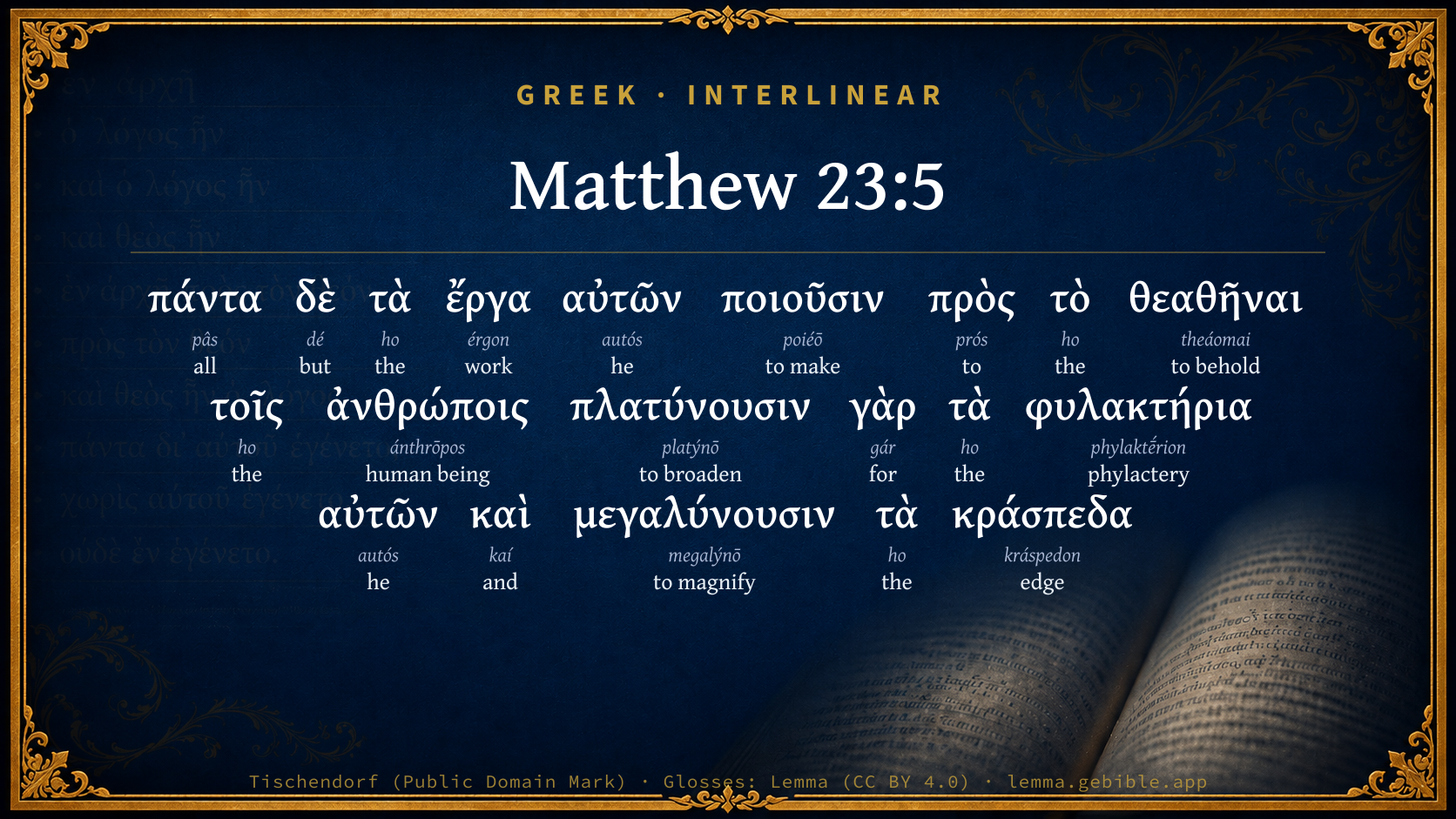
Download image
Cite this verse

Matthew 23:5 (World English Bible). Public Domain. Lemma interlinear Bible study tool, https://lemma.gebible.app/v/matthew/23/5.

Show BibTeX & RIS
BibTeX
RIS
English Translation
But all their works they do to be seen by men. They make their phylacteries broad, enlarge the fringes of their garments,
World English Bible · Public Domain
Highlights
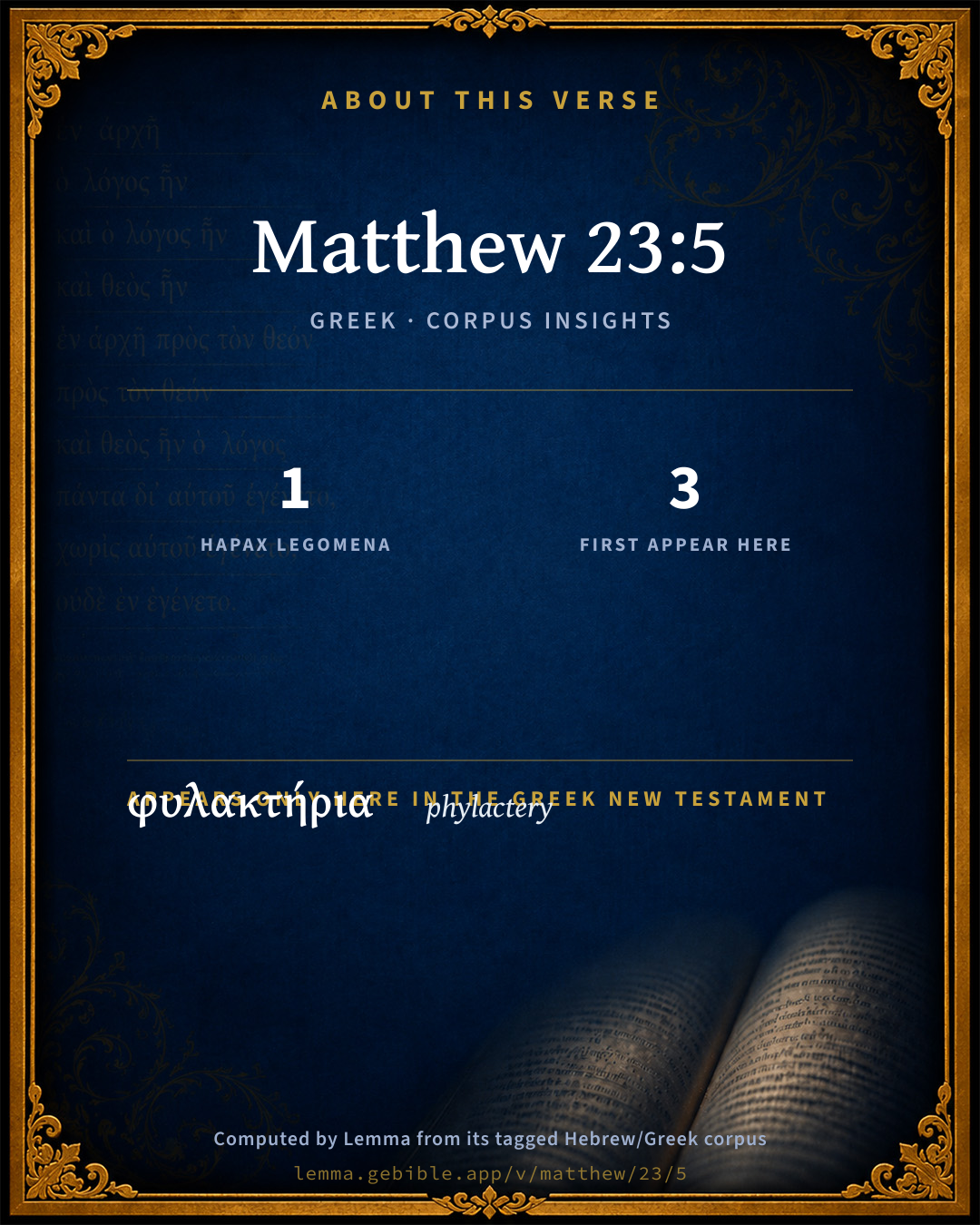
  • 1 hapax legomenon — only here in the Greek New Testament
  • 3 first appearances in the Greek New Testament
Full analysis ↓
Download a study sheet

One document with this verse’s original text, its word-by-word gloss line, the meaning frame, cross-references with their text, attributed commentary, and full source and license credits — printable, and it pastes into notes with its structure intact.

This verse Autodidact and up

Study sheet (.html) Plain text (.txt)

A passage Seminary Student

Up to 50 verses in one chapter. A passage sheet keeps up to 6 commentary sources and 12 cross-references per verse, in the order this page ranks them, and says so on the sheet whenever that leaves anything out. Ask for a single verse and you get the Autodidact verse sheet above.

Everything on this page stays free to read, with no account — the sheet is a download of what is already on screen, not access to it.

Want to remove ads? Support Godless Engineer
Compare translations 3

The same verse in 3 English versions, stacked beneath the original-language interlinear above. Click any original word for its lexicon entry.

Each is an independent rendering of the whole verse — the interlinear is not word-aligned to these translations.

Highlighted words mark where these versions differ — a whole-verse word diff, not a word-by-word alignment.

  • World English Bible Public Domain
    But all their works they do to be seen by men. They make their phylacteries broad, enlarge the fringes of their garments,
  • King James Version Public Domain
    But all their works they do for to be seen of men: they make broad their phylacteries, and enlarge the borders of their garments,
  • unfoldingWord Literal Text CC BY-SA 4.0
    But they do all their deeds to be seen by men. For they broaden their phylacteries and they lengthen their tassels.

unfoldingWord Literal Text — © unfoldingWord, licensed CC BY-SA 4.0. Word-aligned USFM3 via Door43 (git.door43.org/unfoldingWord/en_ult).

Versions to compare (up to 4)

3 of 4 selected

Show all 19 translations

Every available English version of this verse, each an independent rendering of the whole verse.

  • World English Bible Public Domain
    But all their works they do to be seen by men. They make their phylacteries broad, enlarge the fringes of their garments,
  • Berean Standard Bible Public Domain
    All their deeds are done for men to see. They broaden their phylacteries and lengthen their tassels.
  • Majority Standard Bible Public Domain
    All their deeds are done for men to see. They broaden their phylacteries and lengthen the tassels of their garments.
  • King James Version Public Domain
    But all their works they do for to be seen of men: they make broad their phylacteries, and enlarge the borders of their garments,
  • American Standard Version (1901) Public Domain
    But all their works they do to be seen of men: for they make broad their phylacteries, and enlarge the borders `of their garments',
  • Revised Version (1885) Public Domain
    But all their works they do for to be seen of men: for they make broad their phylacteries, and enlarge the borders of their garments,
  • Geneva Bible (1599) Public Domain
    All their workes they doe for to be seene of men: for they make their phylacteries broad, and make long the frindges of their garments,
  • Douay-Rheims (1899) Public Domain
    And all their works they do for to be seen of men. For they make their phylacteries broad, and enlarge their fringes.
  • Young's Literal Translation Public Domain
    `And all their works they do to be seen by men, and they make broad their phylacteries, and enlarge the fringes of their garments,
  • Literal Standard Version CC BY-SA 4.0
    And all their works they do to be seen by men, and they make broad their phylacteries, and enlarge the fringes of their garments,
  • Unlocked Literal Bible CC BY-SA 4.0
    They do all their deeds to be seen by people. For they make their phylacteries wide, and they enlarge the edges of their garments.
  • unfoldingWord Literal Text CC BY-SA 4.0
    But they do all their deeds to be seen by men. For they broaden their phylacteries and they lengthen their tassels.
  • Darby Bible Public Domain
    And all their works they do to be seen of men: for they make broad their phylacteries and enlarge the borders [of their garments],
  • World Messianic Bible Public Domain
    But they do all their works to be seen by men. They make their phylacteries broad and enlarge the fringes of their garments,
  • Webster's Bible Public Domain
    But all their works they do to be seen by men: they make broad their phylacteries, and enlarge the borders of their garments,
  • Free Bible Version CC BY-SA 4.0
    Everything they do is to make sure they get noticed. They make themselves large prayer boxes to wear and long tassels on their clothes.
  • Bible in Basic English Public Domain
    But all their works they do so as to be seen by men: for they make wide their phylacteries, and the edges of their robes,
  • Text-Critical English NT CC BY 4.0
    They do all their works to be seen by others. They make their phylacteries wide and the fringes of their garments long.
  • Tyndale New Testament (1534) Public Domain
    All their workes they do for to be sene of me. They set abroade their philateries and make large borders on there garmetes

Literal Standard Version (2020), Covenant Press — licensed CC BY-SA 4.0. Text via the HelloAO Bible API (eBible.org). Unlocked Literal Bible (unfoldingWord) — licensed CC BY-SA 4.0. Text via the HelloAO Bible API (eBible.org). unfoldingWord Literal Text — © unfoldingWord, licensed CC BY-SA 4.0. Word-aligned USFM3 via Door43 (git.door43.org/unfoldingWord/en_ult). Free Bible Version, Dr. Jonathan Gallagher — licensed CC BY-SA 4.0. Text via the HelloAO Bible API (eBible.org).

Word by word

More ways to search: Search by grammar → Find every occurrence → Compare this word →

Practice this passage: Drill this verse → Learn its vocabulary →

φυλακτήρια
phylaktḗrion
G5440
“phylactery”
Noun, Accusative, Plural, Neuter
Part of Speech
Noun
Case
Accusative
Number
Plural
Gender
Neuter
Full Thayer's Definition

Origin: neuter of a derivative of G5442

TDNT: None

1. a fortified place provided with a garrison, a station for a guard or garrison 2. a preservative or safeguard , an amulet. The Jews used this word to describe small strips of parchment on which were written the following passages of the law of Moses, Ex. 13:1-10 , 11-16 ; Dt. 6:4-9 , 11:13-21 , and which, enclosed in small cases, they were accustomed when engaged in prayer to wear fastened by a leather strap to the forehead and to the left arm over against the heart, in order that they might thus be solemnly reminded of the duty of keeping the commands of God in the head and in the heart, according to the directions given in Ex. 13:16 , Dt. 6:8 , 11:18 ; These scrolls were thought to have the power, like amulets, to avert various evils and to drive away demons. The Pharisees were accustomed to widen, make broad, their phylacteries, that they might render them more conspicuous and show themselves to be more eager than the majority to be reminded of the law of God.
  1. πάντα pâs G3956 “all” Adjective, Accusative, Plural, Neuter
  2. δὲ dé G1161 “but” Conjunction
  3. τὰ ho G3588 “the” Article, Accusative, Plural, Neuter
  4. ἔργα érgon G2041 “work” Noun, Accusative, Plural, Neuter
  5. αὐτῶν autós G846 “he” Personal pronoun, Genitive, Plural, Masculine
  6. ποιοῦσιν poiéō G4160 “to make” Verb, Present, Active, Indicative, 3rd person, Plural
  7. πρὸς prós G4314 “to” Preposition
  8. τὸ ho G3588 “the” Article, Accusative, Singular, Neuter
  9. θεαθῆναι theáomai G2300 “to behold” Verb, Aorist, Passive, Infinitive
  10. τοῖς ho G3588 “the” Article, Dative, Plural, Masculine
  11. ἀνθρώποις ánthrōpos G444 “human being” Noun, Dative, Plural, Masculine
  12. πλατύνουσιν platýnō G4115 “to broaden” Verb, Present, Active, Indicative, 3rd person, Plural
  13. γὰρ gár G1063 “for” Conjunction
  14. τὰ ho G3588 “the” Article, Accusative, Plural, Neuter
  15. αὐτῶν autós G846 “he” Personal pronoun, Genitive, Plural, Masculine
  16. καὶ kaí G2532 “and” Conjunction
  17. μεγαλύνουσιν megalýnō G3170 “to magnify” Verb, Present, Active, Indicative, 3rd person, Plural
  18. τὰ ho G3588 “the” Article, Accusative, Plural, Neuter
  19. κράσπεδα kráspedon G2899 “edge” Noun, Accusative, Plural, Neuter

About this verse

These counts appear in no published source. They are computed here, from the morphology-tagged text and Lemma’s own curated glosses. What Lemma adds →

20
words
15
distinct lemmas
Gospels
section

Notable vocabulary

1 hapax legomenon — a word that appears only here in the entire Greek New Testament:

  • φυλακτήρια phylactery G5440

First appearance in Scripture

These words make their first canonical appearance in the Greek New Testament here:

  • πλατύνουσιν to broaden G4115
  • φυλακτήρια phylactery G5440
  • μεγαλύνουσιν to magnify G3170

Shared distinctive vocabulary

πλατύνουσιν to broaden G4115 occurs in 3 verses of the Greek New Testament. Also found in:
Repetition

Words recur within this verse:

  • τὰ the G3588 ×5
  • αὐτῶν he G846 ×2

Cross-references

18

Topical passages linked to Matthew 23:5 in the Treasury of Scripture Knowledge — connected by theme and wording, ordered by reader-vote popularity; previews shown in the World English Bible.

  • Matthew 6:1–16 "Be careful that you don't do your charitable giving before men, to be seen by them, or else you have no reward from your Father who is in heaven.
  • John 12:43 for they loved men's praise more than God's praise.
  • Deuteronomy 6:8 You shall bind them for a sign on your hand, and they shall be for symbols between your eyes.
  • Luke 16:15 He said to them, "You are those who justify yourselves in the sight of men, but God knows your hearts. For that which is exalted among men is an abomination in the sight of God.
  • John 5:44 How can you believe, who receive glory from one another, and you don't seek the glory that comes from the only God?
  • Philippians 2:3 doing nothing through rivalry or through conceit, but in humility, each counting others better than himself;
  • Numbers 15:38–39 Speak to the children of Israel, and bid those who they make them fringes in the borders of their garments throughout their generations, and that they put on the fringe of each border a cord of blue:
  • Exodus 13:9 It shall be for a sign to you on your hand, and for a memorial between your eyes, that the law of Yahweh may be in your mouth; for with a strong hand Yahweh has brought you out of Egypt.
  • Deuteronomy 22:12 You shall make you fringes on the four borders of your cloak, with which you cover yourself.
  • Proverbs 6:21–23 Bind them continually on your heart. Tie them around your neck.
  • Luke 20:47–21:1 who devour widows' houses, and for a pretense make long prayers: these will receive greater condemnation."
  • Proverbs 3:3 Don't let kindness and truth forsake you. Bind them around your neck. Write them on the tablet of your heart.
  • Matthew 9:20 Behold, a woman who had an issue of blood for twelve years came behind him, and touched the tassels of his garment;
  • John 7:18 He who speaks from himself seeks his own glory, but he who seeks the glory of him who sent him, the same is true, and no unrighteousness is in him.
  • Philippians 1:15 Some indeed preach Christ even out of envy and strife, and some also out of good will.
  • Deuteronomy 11:18 Therefore shall you lay up these my words in your heart and in your soul; and you shall bind them for a sign on your hand, and they shall be for symbols between your eyes.
  • 2 Kings 10:16 He said, Come with me, and see my zeal for Yahweh. So they made him ride in his chariot.
  • 2 Thessalonians 2:4 he who opposes and exalts himself against all that is called God or that is worshiped; so that he sits as God in the temple of God, setting himself up as God.

Cross-references courtesy of OpenBible.info (CC BY 4.0).

Where the printed editions differ

1 variant

Places in this verse where the major printed Greek editions disagree on the wording in a way that affects the translation — a comparison of editions, not a manuscript-by-manuscript collation. The editions are the modern critical texts (Nestlé-Aland 28/27, SBL, Westcott-Hort, Tregelles, Tyndale House) and the traditional texts behind the KJV (the Textus Receptus and the Byzantine/Majority text). It is not a claim about which reading is original.

  1. Extra text
    ἱματίων αὐτῶν.

    “of garments of them.”

    In TRByz Not in NA28NA27TynSBLWHTreg

    ἱματίων αὐτῶν. (himatiōn autōn) 'of garments of them.' is only in traditional manuscripts (TR+Byz)

Textual data: Translators Amalgamated Greek New Testament (STEPBible TAGNT) · CC BY 4.0.

Commentary

Notes on Matthew 23:5 from classic Christian and Jewish commentators (each source and its license shown beneath its notes). The classic Christian expositions comment on the surrounding passage and are grouped to its opening verse, so a note may address several verses; the Jewish commentaries on the Tanakh (Rashi and others) are per-verse, so they appear only where the commentator wrote on this verse.

Lemma curates 59 commentaries, every one of them public domain or Creative Commons licensed, each selected and text-cleaned for this edition rather than reprinted as found. About our sources →

Adam Clarke's Commentary

Verse 5. All their works they do for to be seen of men] In pointing out the corruptions of these men, our Lord gives us the distinguishing characteristics of all false teachers, whether Jewish or Christian.

1. They live not according to the truths they preach. They say, and do not, Mt 23:3.

2. They are severe to others, point out the narrowest road to heaven, and walk in the broad road themselves. They bind on burdens, c., Mt 23:4.

3. They affect to appear righteous, and are strict observers of certain rites, c., while destitute of the power of godliness. They make broad their phylacteries, &c., Mt 23:5.

4. They love worldly entertainments, go to feast wherever they are asked, and seek Church preferments. They love the chief places at feasts, and chief seats in the synagogues, Mt 23:6.

5. They love and seek public respect and high titles, salutations in the market-place, (for they are seldom in their studies,) and to be called of men rabbi-eminent teacher, though they have no title to it, either from the excellence or fruit of their teaching. When these marks are found in a man who professes to be a minister of Christ, charity itself will assert he is a thief and a robber-he has climbed over the wall of the sheepfold, or broken it down in order to get in.

Phylacteries] φυλακτηρια, from φυλασσω, to keep or preserve. These were small slips of parchment or vellum, on which certain portions of the law were written. The Jews tied these about their foreheads and arms, for three different purposes.

1. To put them in mind of those precepts which they should constantly observe.

2. To procure them reverence and respect in the sight of the heathen. And

3. To act as amulets or charms to drive away evil spirits.

The first use of these phylacteries is evident from their name.

The second use appears from what is said on the subject from the Gemara, Beracoth, chap. 1., quoted by Kypke. "Whence is it proved that phylacteries, (תפילין, tephilin,) are the strength of Israel? - Ans. From what is written, De 28:10. All the, people of the earth shall see that thou art called by the name [of יהוה Jehovah] - and they shall be afraid of thee.

The third use of them appears from the Targum, on Cant. So 8:3. His left hand is under my head, &c. "The congregation of Israel hath said, I am elect above all people, because I bind my phylacteries on my left hand, and on my head, and the scroll is fixed to the right side of my gate, the third part of which looks to my bed-chamber, that DAEMONS may not be permitted to INJURE me."

An original phylactery lies now before me. It is a piece of fine vellum, about eighteen inches long, and an inch and quarter broad. It is divided into four unequal compartments: in the first is written, in a very fair character, with many apices, after the mode of the German Jews, the first ten verses of Exod. 10, (Ex 13:1-10) in the second compartment is written, from the eleventh to the sixteenth verse of the same chapter (Ex 13:11-16), inclusive in the third, from the fourth to the ninth verse (De 6:4-9), inclusive, of Deut. 6., beginning with, Hear, O Israel, c. in the fourth, from the thirteenth to the twenty-first verse, inclusive, of Deut. 11 (De 11:13-21).

These passages seem to be chosen in vindication of the use of the phylactery itself, as the reader will see on consulting them: Bind them for a SIGN upon thy HAND - and for FRONTLETS between thy EYES-write them upon the POSTS of thy HOUSE, and upon thy GATES all which commands the Jews took in the most literal sense.

Even the phylactery became an important appendage to a Pharisee's character, insomuch that some of them wore them very broad, either that they might have the more written on them, or that, the characters being larger, they might be the more visible, and that they might hereby acquire greater esteem among the common people, as being more than ordinarily religious. For the same reason, they wore the fringes of their garments of an unusual length. Moses had commanded (Nu 15:38-39) the children of Israel to put fringes to the borders of their garments, that, when they looked upon even these distinct threads, they might remember, not only the law in general, but also the very minutiae, or smaller parts of all the precepts, rites, and ceremonies, belonging to it. As these hypocrites were destitute of all the life and power of religion within, they endeavoured to supply its place by phylacteries and fringes without. See Clark's note on "Ex 13:9".

Adam Clarke's Commentary on the Bible (1810–1826) — public domain. Text from a community e-Sword/MySword module.

Joseph Benson's Commentary

Mat 23:5-7. All their works they do to be seen of men — They have the praise of men in view in all their actions. Hence they are constant and abundant in those duties of religion which come under the observation of men; but with respect to those that are of a more spiritual nature, and lie between God and their own souls, or should be performed in the retirements of their closets, they desire to be excused. As the mere form of godliness will procure them a name to live, which is all they aim at; they therefore trouble not themselves about the power of it, which is essential to being alive indeed. They make broad their phylacteries — The Jews understanding those words literally, It shall be as a token upon thy hand, and as frontlets between thine eyes, (Exo 13:16;) And thou shalt bind these words for a sign upon thy hand, and they shall be as frontlets between thine eyes, (Deu 6:8,) used to wear little scrolls of paper or parchment bound on their wrists and foreheads, on which several texts of Scripture were written. These they supposed, as a kind of charm, would preserve them from danger. And hence they seemed to have been called phylacteries, or preservatives. See the notes on these passages. And enlarge the borders (or fringes) of their garments — Which God had enjoined them to wear, to remind them of doing all the commandments, Num 15:38. These, as well as their phylacteries, the Pharisees affected to wear broader and larger than other men. And love the uppermost rooms at feasts, &c. — In which guests of the first quality were used to sit; and the chief seats in the synagogues — “There showing their pride, where they ought to have taught others humility.” — Theophylact. And greetings, or salutations, in the markets — And other places of common concourse. And to be called of men, Rabbi, rabbi — A title of honour, which they were fond of having repeated at every sentence. “The word rabbi properly signifies great, and was prefixed to the names of those doctors who had rendered themselves remarkable by the extent of their learning, or who were the authors of new schemes in divinity; heads of sects, whose fame had gained them many followers. This title the Jewish doctors were particularly fond of, because it was a high compliment paid to their understanding, gave them vast authority with their disciples, and made them look big in the eyes of the world. It was the very next thing to infallible.”

Joseph Benson's Commentary on the Old and New Testaments (1811–1818) — public domain. Text from a community e-Sword module.

Tyndale Open Study Notes

Tyndale Open Resources

23:5 prayer boxes: Pious Jews wore, on the head and upper left arm, a small pouch or box (phylactery) containing written copies of important Old Testament commands (see Deut 6:6-9; 11:18-19). • Wearing tassels was another custom associated with piety (see Matt 9:20; see also Num 15:38-41). Lengthening the tassels called attention to their wearer’s pious practices.

Tyndale Open Study Notes — © Tyndale Open Resources, licensed CC BY-SA 4.0. Text via the HelloAO Bible API.

Bengel's Gnomon

Johann Albrecht Bengel

Mat 23:5. Δὲ, but) sc. although they appear to do many good things.—φυλακτήρια, phylacteries) see Exo 13:9; Exo 13:16; Deu 6:8; Deu 11:18.—κράσπεδα, fringes) see Num 15:38.

Bengel's Gnomon of the New Testament — English translation (T&T Clark, Edinburgh, 1860) — public domain. Text from a community e-Sword module.

Meyer's Critical & Exegetical Commentary

Heinrich August Wilhelm Meyer

Mat_23:5-7. Comp. Luk_11:43 f.

φυλακτήρια, amulets, were the תְּפִּלִּיו, the strips of parchment with passages of Scripture, viz. Deu_11:13-22; Deu_6:4-10, Exo_13:11-17; Exo_13:1-11, written upon them. They were enclosed in small boxes, and, in accordance with Exo_13:9; Exo_13:16, Deu_6:8; Deu_11:18, worn during prayer, some on the forehead, some on the left arm next the heart. They were intended to remind the wearer that it was his duty to fulfil the law with head and heart, and, at the same time, to serve the purpose of protecting him from the influence of evil spirits. Joseph. Antt. iv. 8. 13; Lund, Jüd. Heiligith., ed. Wolf, p. 898 ff.; Keil, Arch. I. p. 342 f.

πλατύνουσι] they broaden their φυλακτήρια, i.e. they make them broader than those of others, in order that they may thereby become duly conspicuous. Corresponding to this is: μεγαλύνουσι, they enlarge. On the κράσπεδα, see on Mat_9:20.

τὴν πρωτοκλισίαν] the foremost couch at table, i.e. according to Luk_14:8 ff. (Joseph. Antt. xv. 2. 4), the uppermost place on the divan, which the Greeks also regarded as the place of honour (Plut. Symp. p. 619 B). The Persians and Romans, on the other hand, looked upon the place in the middle as the most distinguished. The term is met with only in the synoptical Gospels and the Fathers. Suidas: πρωτοκλισία· ἡ πρώτη καθέδρα.

ῥαββὶ, ῥαββί] רַבִּי, רַבִּי (διδάσκαλε, Joh_1:39; with yod paragogic). The reduplication serves to show how profound the reverence is. Comp. Mar_14:15; Mat_7:21 f. For the view that Rabbi (like our Dr.) was the title used in addressing learned teachers as early as the time of Jesus (especially since Hillels time), see Lightfoot, also Pressel in Herzogs Encykl. XII. p. 471; Ewald, Gesch. Chr. p. 305.

Meyer — Critical and Exegetical Commentary on the New Testament — English translation by Peter Christie, edited by Frederick Crombie (T&T Clark, 1880) — public domain. Text from a community e-Sword module.

Expositor's Greek Testament

ed. W. Robertson Nicoll

Mat 23:5-7 . The foregoing statement is of course to be taken cum grano . Teachers who absolutely disregarded their own laws would soon forfeit all respect. In point of fact they made a great show of zeal in doing. Jesus therefore goes on to tax them with acting from low motives.

Mat 23:5 . πάντα δὲ , etc., in so far as they comply with their rules they act with a view to be seen of men. This is a repetition of an old charge (Mat 6 ). πλατύνουσι γὰρ , etc.: illustrative instances drawn from the phylacteries and the tassels attached to the upper garment, the former being broadened, the latter lengthened to attract notice. The phylacteries ( φυλακτήρια ) were an admirable symbol at once of Pharisaic ostentation and Pharisaic make-believe. They were little boxes attached to the forehead and the left arm near the heart, containing pieces of parchment with certain texts written on them (Exo 13:1-16 ; Deu 6:4-10 ; Deu 11:13-22 ) containing figurative injunctions to keep in memory God’s laws and dealings, afterwards mechanically interpreted, whence these visible symbols of obedience on forehead and arm. The size of the phylacteries indexed the measure of zeal, and the wearing of large ones was apt to take the place of obedience. It was with the Pharisees as with Carlyle’s advertising hatter, who sent a cart through the street with a huge hat in it instead of making good hats. For details on phylacteries and fringes consult works on Jewish antiquities. Lund, Jüdiscken Heiligthümer (1701), has a chapter (p. 796) on the dress of the Pharisees with pictorial illustrations. It has been discussed whether the name φυλ . points to the keeping of the law or to the use of these things as amulets to ward off harm. The former was doubtless originally in view, but the superstitious abuse would soon creep in. The word is the equivalent in Hellenistic Greek for the Chaldee תפלין , prayers.

The Expositor's Greek Testament, edited by W. Robertson Nicoll (1897–1910) — public domain. Text from a community e-Sword module.

Geneva Bible (1599)

Geneva Bible translators

Word for word, Twisted tassels of thread which hung at the nethermost hems of their garments.

Hypocrites are ambitious.

It was a thread, or ribbon of blue silk in the fringe of a corner, the beholding whereof made them to remember the laws and ordinances of God: and therefore was it called a Phylactery, as ye would say, a keeper, Num. 15:38; Deut. 6:8, which order the Jews afterward abused, as they do nowadays, which hang the St. John’s Gospels about their necks: a thing condemned many years ago in the Council of Antioch.

Geneva Bible (1599) marginal notes — public domain. Text via Bolls.life.

Jamieson, Fausset & Brown

Robert Jamieson, A. R. Fausset & David Brown

But all their works they do for to be seen of men--Whatever good they do, or zeal they show, has but one motive--human applause.

they make broad their phylacteries--strips of parchment with Scripture--texts on them, worn on the forehead, arm, and side, in time of prayer.

and enlarge the borders of their garments--fringes of their upper garments (Num 15:37-40).

Jamieson, Fausset & Brown — Commentary Critical and Explanatory on the Whole Bible (1871) — public domain (CC PDM 1.0). Text via the HelloAO Bible API.

Ellicott's Commentary for English Readers

(5) To be seen of men.—As with a clear insight into the root-evil of Pharisaism, and of all kindred forms of the religious life, our Lord fixes, as before in Mat_6:1-18, on the love of man’s applause as that which vitiated the highest ethical teaching and the most rigorous outward holiness. The fact, which we learn from Joh_12:42-43, that many “among the chief rulers” were in their hearts convinced of His claims, and yet were afraid to confess Him, gives a special emphasis to the rebuke. They may have been among those who listened to it with the consciousness that He spake of them.

Phylacteries.—The Greek word (phylacterion) from which the English is derived signifies “safe-guard or preservative,” and was probably applied under the idea that the phylacteries were charms or amulets against the evil eye or the power of evil spirits. This was the common meaning of the word in later Greek, and it is hardly likely to have risen among the Hellenistic Jews to the higher sense which has sometimes been ascribed to it, of being a means to keep men in mind of the obligations of the Law. Singularly enough, it is not used by the LXX. translators for the “frontlets” of Exo_13:16, Deu_6:8; Deu_11:18 and the only place in the Old Testament where it is found is for the “cushions” of Eze_13:18. The Hebrew word in common use from our Lord’s time onward has been tephillin, or Prayers. The things so named were worn by well-nigh all Jews as soon as they became Children of the Law, i.e., at thirteen. They consisted of a small box containing the four passages in which frontlets are mentioned (Exo_13:2-16; Deu_6:4-9; Deu_11:13-22), written on four slips of vellum for the phylactery of the head, and on one for that of the arm. This is fastened by a loop to thin leather straps, which are twisted in the one case round the arm, with the box on the heart, in the other, round the head, with the box on the brow. They were worn commonly during the act of prayer (hence the Hebrew name), and by those who made a show of perpetual devotion and study of the Law, during the whole day. The Pharisees, in their ostentatious show of piety, made either the box or the straps wider than the common size, and wore them as they walked to and fro in the streets, or prayed standing (Mat_6:5), that men might see and admire them.

The borders of their garments.—The word is the same as the “hem” of the garment (Mat_9:20) worn by our Lord. The practice rested on Num_15:37-41, which enjoined a “ribband” or “thread” of blue (the colour symbolical of heaven) to be put into the fringe or tassels of the outer cloak or plaid. The other threads were white, and the number of threads 613, as coinciding with the number of precepts in the Law, as counted by the scribes. The fringes in question were worn, as we see, by our Lord (see Notes on Mat_9:20; Mat_14:36), and probably by the disciples. It was reserved for the Pharisees to make them so conspicuous as to attract men’s notice.

A Bible Commentary for English Readers, edited by Charles John Ellicott (1878–1897) — public domain. Text from a community e-Sword module.

The Cambridge Bible for Schools and Colleges

gen. ed. J. J. S. Perowne

5. phylacteries] Greek φυλακτήρια = “defences,” and in late Greek “amulets” or “charms.” The Hebrew name, tephillin, which is still in use, signifies “prayers.” They were slips of parchment inscribed with four portions of the Law (Exo_12:3-16; Deu_6:5-9; Deu_11:13-21) enclosed in little cases or boxes made of calf-skin, and fastened by leather straps to the left arm and on the forehead, in accordance with a literal interpretation of Exo_13:16 and Deu_6:8. To make the phylacteries, or rather the cases which contained them, broad and conspicuous was to assume a character of superior piety, for the phylacteries were symbols of devotion.

Jesus does not prohibit the practice of wearing phylacteries, but the ostentatious enlargement of them. It is thought by many that our Saviour Himself wore phylacteries.

enlarge the borders of their garments] Strictly, the fringe of the talith, or cloak: another instance of ostentation; the blue threads in the fringe, the colour of the sky—were a type of heavenly purity. Our Lord Himself wore the fringed talith (see ch. Mat_9:20); the offence of the Pharisees consisted in enlarging the symbolical fringes.

The Cambridge Bible for Schools and Colleges (gen. ed. J. J. S. Perowne; Cambridge University Press, 1878–1918) — public domain. Text from a community e-Sword module.

John Gill's Exposition

But all their works they do for to be seen of men,.... All their prayers, alms deeds, and fastings, were all done in a public manner, that men might behold them, and they might have applause and glory from them: they sought neither the glory of God, nor the good of their fellow creatures, nor any spiritual advantage and pleasure to themselves, in their performances; they neither attended to moral duties, nor ceremonious rites, nor the traditions of their fathers, any further than they could be seen by men in them, and keep up their credit and esteem among them. Hence,

they make broad their phylacteries: these were four sections of the law, wrote on parchments, folded up in the skin of a clean beast, and tied to the head and hand. The four sections were these following, viz. the "first", was Exo 13:2 the "second", was Exo 13:11 the "third", was Deu 6:4 the "fourth", was Deu 11:13. Those that were for the head, were written and rolled up separately, and put in four distinct places, in one skin, which was fastened with strings to the crown of the head, towards the face, about the place where the hair ends, and where an infant's brain is tender; and they took care to place them in the middle, that so they might be between the eyes. Those that were for the hand, were written in four columns, on one parchment, which being rolled up, was fastened to the inside of the left arm, where it is fleshy, between the shoulder and the elbow, that so it might be over against the heart (u). These, they imagined, were commanded them by God, in Exo 13:16 whereas the sense of these passages only is, that the goodness of God in delivering them out of Egypt, and the words of the law, should be continually before them, in their minds and memories, as if they had tokens on their hands, and frontlets between their eyes; but they understood them literally, and observed them in the above manner. These the Jews call "Tephillin", because they use them in time of prayer, and look upon them as useful, to put them in mind of that duty: they are here called "phylacteries", because they thought they kept them in the fear of God, preserved in them the memory of the law, and them from sin; yea, from evil spirits, and diseases of the body. They imagined there was a great deal of holiness in, and valued themselves much upon the use of them (w); and the Pharisees, because they would be thought to be more holy and religious, and more observant of the law than others, wore these things broader than the rest of the people;

and enlarge the borders of their garments. These were the fringes which they put upon the borders of their garments, and on them a ribbon of blue, to put them in mind of the commandments, to obey them, Num 15:38. The observance of this law is of so much consequence with the Jews, that they make all the commandments to depend on it (x); and say, that it is equal to them all, and that he that is guilty of the breach of it, is worthy of death (y): they ascribe the like virtue to these fringes, as to their phylacteries, and think themselves much the better for the wearing them; and the Pharisees, because they would appear with a greater air of sanctity and devotion than others, made their's larger. We (z) read of one Ben Tzitzith Hacceseth, a man of this complexion, who was so called, because his Tzitzith, or fringes, were drawn upon, a pillow; and there are some that say, that the pillow was bore between the great men of Rome: it was drawn after him, not upon the ground, but upon a cloth or tapestry, and the train supported by noblemen, as is pretended. This was one of those, that enlarged the Tzitzith, or fringes, beyond the ordinary size; hence Mark calls it, "long clothing."

(u) Targ. Jon. Jarchi, & Baal Hatturim in Exod. xiii. 16. & Deut. vi. 8. Maimon. Hilch. Tephillin, c. 1. sect. 1. & c. 2. sect. 2. & c. 3. sect. 1, 2, 3, 4, 5, 6. & c. 4. sect. 1, 2. (w) Maimon. ib. c. 4. sect. 25, 26. Moses Kotsensis Mitzvot Tora, pr. affirm. 3. 23. Targ. in Cant. viii. 3. (x) Maimon. Hilch. Tzitzith, c. 3. sect. 12. (y) T. Bab. Nedarim, fol. 25, 1. Shebuot, fol. 29. 1. & Menachot, fol. 43. 2. (z) T. Bab. Gittin, fol. 56. 1.

John Gill's Exposition of the Whole Bible (1746–1763) — public domain (CC PDM 1.0). Text via the HelloAO Bible API.

Trapp's Complete Commentary

John Trapp

5 But all their works they do for to be seen of men: they make broad their phylacteries, and enlarge the borders of their garments,

Ver. 5. To be seen of men] Theatrically, thrasonically, and for ostentation, as stage players, or painted faces. {See Trapp on "Mat 6:2"} {See Trapp on "Mat 6:5"} Saints more seek to be good than seem to be so.

They make broad their phylacteries] That is, conservatories, so called. 1. Because by the use of them the law was kept in remembrance. 2. Because the superstitious Pharisees conceited, that by the wearing of them about their necks, themselves might be kept from danger, as by so many spells: what they were, see the notes above, on Mat 22:40.

Enlarge the borders of their garments] God had charged the Pharisees to bind the law to their hand, and before their eyes, Deu 6:8, wherein (as Jerome and Theophylact well interpret it) he meant the meditation and practice of his law. They (saith a learned author) like unto the foolish patient, which when the physician bids him take the prescript, eats up the paper; {a} if they could but get a list of parchment upon their left arm and next their heart, and another scroll to tie upon their forehead, and four corners of fringe, or (if these be denied) a red thread in their hand, thought they might say, "Blessed be thou of the Lord, I have done the commandment of the Lord," 1Sa 15:13. What was this but, as Mr Tyndale said in another case, to think to quench their thirst by sucking the ale bowl?

{a} Ac si puellus audito patris pii vestigiis insistendum, patris iter facientis singula vestigia observaret, et in iisdem pedes suos poneret.

John Trapp, A Commentary or Exposition upon All the Books of the Old and New Testament (1647–1656) — public domain. Text from a community e-Sword module.

Albert Barnes' Notes on the Bible

Their phylacteries - The word “phylactery” comes from a word signifying to keep, preserve, or guard. The name was given because phylacteries were worn as amulets or charms, and were supposed to defend or preserve those who wore them from evil. They were small slips of parchment or vellum, on which were written certain portions of the Old Testament. The practice of using phylacteries was founded on a literal interpretation of that passage where God commands the Hebrews to have the law as a sign on their foreheads, and as frontlets between their eyes, Exo 13:16; compare Pro 3:1, Pro 3:3; Pro 6:21. One kind of phylactery was called a “frontlet,” and was composed of four pieces of parchment, on the first of which was written Exo 12:2-10; on the second, Exo 13:11-21; on the third, Deu 6:4-9; and on the fourth, Deu 11:18-21. These pieces of parchment, thus inscribed, they enclosed in a piece of tough skin, making a square, on one side of which is placed the Hebrew letter shin (שׁ sh) and bound them round their foreheads with a thong or ribbon when they went to the synagogue. Some wore them evening and morning; others only at the morning prayer.

As the token upon the hand was required, as well as the frontlets between the eyes Exo 13:16, the Jews made two rolls of parchment, written in square letters, with an ink made on purpose, and with much care. They were rolled up to a point, and enclosed in a sort of case of black calf-skin. They were put upon a square bit of the same leather, whence hung a thong of the same, of about a finger in breadth, and about 2 feet long. These rolls were placed at the bending of the left arm, and after one end of the thong had been made into a little knot in the form of the Hebrew letter yod (י y), it was wound about the arm in a spiral line, which ended at the top of the middle finger. The Pharisees enlarged them, or made them wider than other people, either that they might make the letters larger or write more on them, to show, as they supposed, that they had special reverence for the law.

Enlarge the borders of their garments - This refers to the loose threads which were attached to the borders of the outer garment as a fringe. This fringe was commanded in order to distinguish them from ether nations, and that they might remember to keep the commandments of God, Num 15:38-40; Deu 22:12. The Pharisees made them broader than other people wore them, to show that they had special respect for the law.

Albert Barnes' Notes on the Bible (1834–1885) — public domain. Text from a community e-Sword/MySword module.

Haydock's Catholic Bible Commentary

Phylacteries.[1] These were pieces or scrolls of parchment, on which were written the ten commandments, or some sentences of the law, which the Jews were accustomed to fasten to their foreheads, or their arms, to put them in mind of their duty. Thus they interpreted those words. (Deuteronomy vi. 8.) Thou shalt tie them as a sign on thy hand: and they shall be, and move before thy eyes. Perhaps all the Jews, and even our Saviour himself, wore them; and that he only blames the hypocrisy and vanity of the Scribes and Pharisees, who affected to have them larger than others; and they did the like as to the fringes which the Jews wore on their garments. (Witham) --- That is, parchments, on which they wrote the ten commandments, and carried on their foreheads before their eyes: which the Pharisees affected to wear broader than other men: so to seem more zealous for the law. (Challoner) --- The word Phylacterion, which is found both in the Greek and Latin Vulgate, properly signifies a preservation. It was a piece of parchment which the Jews carried round their heads from one ear to the other, and round their arms like bracelets, and upon which were written certain words of the law. Since the origin of the sect of Pharisees, they began to attach to these bands of parchment chimerical virtues, such as preservatives of maladies, and preservations from the insults of devils; hence the name phylacterion. (Bible de Vence)

===============================

[BIBLIOGRAPHY]

Phylacteria. Greek: phulakteria. Conservatoria, or preservatoria. See St. Jerome on this place, p. 188, and St. John Chrysostom, hom. lxxii. in Matt.

George Leo Haydock (1774–1849), Haydock's Catholic Family Bible and Commentary, 1859 edition — public domain. Excludes Psalms (Douay-Rheims chapter numbering differs from Protestant) and Deuterocanonical books (Catholic canon only).

Matthew Poole's English Annotations

Our Saviour had, Mat 23:4 blamed the Pharisees for not living up to what they taught, pressing the law of God on others, but not doing nor endeavouring to observe it themselves. Here he blames them for doing what good things they did for ostentation, to be seen of men; and abounding in their ritual performances of more minute concernment, in the mean time neglecting their moral duties.

All their works they do for to be seen of men; this is their main end, to be seen of men; for this he had reflected on them, Mat 6:1-34.

They make broad their phylacteries, and enlarge the borders of their garments. For the right understanding of this we must have recourse to Num 15:37-40, And the Lord spoke unto Moses, saying, Speak unto the children of Israel, and bid them that they make them fringes in the borders of their garments throughout their generations, and that they put upon the fringe of the borders a riband of blue: and it shall be unto you for a fringe, that ye may look upon it, and remember all the commandments of the Lord, and do them; and that ye seek not after your own heart and your own eyes, after which ye use to go a whoring: that ye may remember, and do all my commandments. Deu 22:12, Thou shalt make thee fringes upon the four quarters of thy vesture, wherewith thou coverest thyself. In obedience to this law, the Jews did generally wear such garments that had fringes and blue ribands annexed to them. The Jews at this day do it not, because, as they pretend, they have lost the true way of dying the blue colour, required in the law. The end why God commanded them is expressed, that ye may look upon it, and remember all the commandments of the Lord, and do them; and be restrained from their own inventions and imaginations in God’s service. They were also a note of distinction of the Jews from other people. Besides these, God commanding that they should bind his laws for a sign upon their hands, and as frontlets between their eyes, Deu 6:6-8, they made them parchments, in which the precepts of the law were written, which they bound to their foreheads and arms. These were called phylacteries, from φυλαττω, to keep, things wherein the law was kept. The Pharisees, for a boast how zealous keepers they were of the law of God, (than which they did nothing less), made these phylacteries and ribands broader, and their fringes much longer, than other men’s: this is that making broad their phylacteries, and enlarging the borders of their garments, which our Lord here reflects upon, done only for ostentation, and that they might be seen of men.

Matthew Poole's English Annotations on the Holy Bible (1683–1685) — public domain. Text from a community e-Sword/MySword module.

Whedon's Commentary on the Bible

Daniel D. Whedon

5. Phylacteries — The Greek word signifying preservatives. The phylactery was a passage of Scripture, written on parchment, folded up, and tied on the forehead, so that it should be always in front of their eyes. This was a kind of mechanical observance of Deu_6:8, where Moses says of his laws: “Thou shalt bind them for a sign upon thine hand, and they shall be as frontlets between thine eyes.” The phylactery became in popular estimation, an amulet to repel demons, diseases, and other evils. Enlarge the borders of their garments — Moses had ordered the Israelites to distinguish themselves from the heathen by fringes of blue, in the borders of their garments. So, as circumcision distinguished their bodies, these borders distinguished their dress. To mark their intense Judaism, these men affected a very broad border. A strong exhibition of national feeling in this way was intended to secure popularity. It was done in order to be seen of men.

Daniel D. Whedon (gen. ed.), Commentary on the Old and New Testaments (1874–1909) — public domain. Text from a community e-Sword module.

John Wesley's Explanatory Notes

Their phylacteries - The Jews, understanding those words literally, It shall be as a token upon thy hand, and as frontlets between thine eyes, Exod. xiii, 16. And thou shalt bind these words for a sign upon thine hand, and they shall be as frontlets between thine eyes, Deut. vi, 8; used to wear little scrolls of paper or parchment, bound on their wrist and foreheads, on which several texts of Scripture were writ. These they supposed, as a kind of charm, would preserve them from danger. And hence they seem to have been called phylacteries, or preservatives. The fringes of their garments - Which God had enjoined them to wear, to remind them of doing all the commandments, Num. xv, 38. These, as well as their phylacteries, the Pharisees affected to wear broader and larger than other men. Mark xii, 38.

John Wesley, Explanatory Notes Upon the Whole Bible (1754–1765) — public domain. Text via the GEBible commentary corpus.

Scofield Reference Notes

C. I. Scofield

phylacteries

Passages of Scripture enclosed in a small case, bound upon arm or forehead, Deu 6:8.

The Scofield Reference Bible (1917 edition), notes by C. I. Scofield — public domain. Text from a community e-Sword module.

Kretzmann's Popular Commentary

Paul E. Kretzmann

Their passion for honor from men:

v. 5. But all their works they do for to be seen of men; they make broad their phylacteries, and enlarge the borders of their garments,

v. 6. and love the uppermost rooms at feasts and the chief seats in the synagogues,

v. 7. and greetings in the markets, and to be called of men, Rabbi, Rabbi.

In public, where they were before the eyes of the people, the Pharisees and scribes were models of piety and virtue. Their works, all their public acts, were done with that object in mind, for they were actors that performed beautifully. A few instances of such hypocritical behavior are given. God had commanded the Jews, Deu 6:8, that they should bind His words for a sign upon the hand and as frontlets between the eyes. This the Jewish leaders explained in the literal sense. Hence the phylacteries, or remembrancers, strips of vellum or parchment, about an inch wide and from twelve to eighteen inches long, on which were written Deu 11:13-21; Deu 6:4-9; Exo 13:11-16; Exo 13:1-10. These were placed in tiny chests or boxes, one of which was fastened to the forehead, for the intellect and mind, the other to the left arm, for the heart. The Pharisees made these remembrancers of the Law exceptionally large, either in the size of the parchment or of the letters in which the texts were written. In the same way the Pharisees exaggerated in the matter of the borders, tassels, or fringes on their garments, which the Jews wore according to Num 15:37-40, to remind them of the commandments of the Lord. They were fastened to the garments with blue ribbons, since blue was the symbolical color of God, of heaven, of His covenant, and of faithfulness. Verses from the Law were usually woven into these strips. In making these borders very wide and conspicuous, the scribes and Pharisees wanted to parade their zeal for the Law of God. In the same way they dearly loved, and always tried to get for themselves, the highest seat, the first sofa, the place of honor at a festive meal; they always chose the seat reserved for the elders in the synagogue; their vanity craved the formal address of the public teacher, when the lay people deferentially called them Rabbi. It was an inordinate, a sickening ambition.

Paul E. Kretzmann, Popular Commentary of the Bible (1921–1924) — public domain. Text from a community e-Sword module.

Burkitt's Expository Notes on the New Testament

William Burkitt

In these words our blessed Saviour admonishes his disciples and the multitude to take heed of imitating the Pharisees in their ostentation and hypocrisy, in their ambition and vain-glory; and he instances, in three particulars, wherein they expressed it:

1. All their works, says Christ, they do to be seen of men. To do good works that men may see them, is a duty; but to do all or any of our works to be seen of men, is hypocrisy.

2. They make broad their phylacteries, and enlarge the borders of their garments. These phylacteries were certain scrolls and labels of parchment, in which were written the ten commandments, and some sections of the law; these they tied to their foreheads, and pinned upon their left sleeve, that the law of God might be continually before their eyes, and perpetually in their remembrance. This ceremony they judged God prescribed them, Thou shalt bind them for a sign upon thine hand, and they shall be as frontlets between thine eyes Deu 6:8. By enlarging the borders of their garments, our Saviour points at the fringes and blue ribbons which the Jews did wear upon their garments, in obedience to the command, wear upon their garments, Num 15:37-38. As the threads in those fringes and ribbons close woven together, did represent the connection, complication, and inseparable conjunction of God’s commandments among themselves; so the wearing of these fringes was to put them in mind of the law of God, that which way soever they turned their eyes, they might meet with some pious admonition to keep the law of God. Now the vain-glorious Pharisees, that they might be thought more mindful of the law of God than other men, did make their phylacteries broader, and their fringes thicker and longer than other men.

3. They fondly affected and ambitiously contended for the first and uppermost seats in all conventions, as at feast, and in the synagogues, and loved to have titles of honour, such as rabbi, master, father, and doctor, put upon them. Now that which our Saviour condemns, is the Pharisees fond affection of these little things, and unduly seeking their own honour and glory. It was not their taking, but their loving, the uppermost rooms at feasts, that Christ condemns.

From the whole, Note, 1. That hypocrites are fond of affecting ceremonial observations and outward parts of commanded duties, neglecting the substance of religion itself. These Pharisees were carrying a library of God’s law on their clothes, scarce a letter of it in their hearts. They wore the law of God, as frontlets before their eyes, but not engraven on the tables of their hearts.

Observe, 2. That the nature of hypocrisy is to study more to seem religious in the sight of men, than to be religious indeed before God. The hypocrite is the world’s saint, and not God’s: he courts the world’s acceptation more than the divine favour and approbation.

William Burkitt's Expository Notes on the New Testament (1700–1703) — public domain. Text from a community e-Sword module.

The People's New Testament

B. W. Johnson

5. To be seen of men. Instead of touching the burdens with their little finger, by an effort to keep the law in its spirit, their whole object was to appear holy before men. Make broad their phylacteries. A band was drawn over the forehead, or around the arm, and to this was attached a small calfskin box, in which were placed passages of Scripture. For this they quoted Exod. 13:16. The passages worn so ostentatiously were Exod. 12:2–10; 13:11–21; Deut. 6:4–9; 11:18–21. To make them “broad” was to enlarge the case containing the Scripture, so as to make it more conspicuous. Enlarge the borders. The fringes worn as enjoined in Num. 15:38, to remind them “of doing all the commandments.” To enlarge these would make them more conspicuous.

B. W. Johnson's The People's New Testament with Notes (1889–1891) — public domain. Electronic text from the Christian Classics Ethereal Library (CCEL) ThML edition.

Cambridge Greek Testament for Schools and Colleges

5. In textus receptus τῶν ἱματίων αὐτῶν follows κράσπεδα. Rightly omitted.

5. τὰ φυλακτήρια. Literally, ‘defences,’ and in late Greek ‘amulets’ or ‘charms.’ The Hebrew name, tephillin, which is still in use, signifies ‘prayers.’ They were slips of parchment inscribed with four portions of the Law (Exo 12:3-17; Deu 6:4-9; Deu 11:13-21) enclosed in little cases or boxes made of calf-skin, and fastened by leather straps to the left arm and on the forehead, in accordance with a literal interpretation of Exo 13:16 and Deu 6:8. To make the phylacteries, or rather the cases which contained them, broad and conspicuous was to assume a character of superior piety, for the phylacteries were symbols of devotion.

Jesus does not prohibit the practice of wearing phylacteries, but the ostentatious enlargement of them. It is thought by many that our Saviour Himself wore phylacteries.

μεγαλύνουσιν τὰ κράσπεδα. Strictly, the fringe of the tallith, or cloak: another instance of ostentation; the blue threads in the fringe the colour of the sky—were a type of heavenly purity. Our Lord Himself wore the fringed tallith (see ch. Mat 9:20); the offence of the Pharisees consisted in enlarging the symbolical fringes.

τὰ κράσπεδα. Cp. Theocr. II. 53, τοῦτʼ ἀπὸ τᾶς χλαίνας τὸ κράσπεδον ὤλεσε Δέλφις. The singular is rare.

Cambridge Greek Testament for Schools and Colleges (Cambridge University Press, 1896; 21 vols, various authors incl. Carr, Maclear, Plummer, Farrar, Lumby, Moule, M. R. James, Simcox) — public domain. Text from a community e-Sword module.

Alford’s Greek Testament

Henry Alford

5-7.] But whatever they do perform, has but one motive.

φυλακ., Heb. Totaphoth, or subsequently and more generally, Tephillin (see Gesen. Thes. Hebr., and Buxtorf, Lex. Rabbin.), were strips of parchment with certain passages of Scripture, viz. Exo 13:11-16 and 1-10: Deu 11:13-21; Deu 6:4-9, written on them, and worn on the forehead between the eyes, on the left side next the heart, and on the left arm. The name in the text was given because they were considered as charms. They appear not to have been worn till after the captivity; and are still in use among the Rabbinical Jews. Their use appears to have arisen from a superstitious interpretation of Exo 13:9: Deu 6:8, Deu 6:9. See Jos. Antt. iv. 8. 13. The fringes were commanded to be worn for a memorial, Num 15:38. See note on ch. 9:20.

6,

Henry Alford, The Greek Testament (1849–1861) — public domain. Text from a community e-Sword module.

International Critical Commentary

5. And all their works they do to be seen of men: for they make wide their phylacteries, and enlarge their tassels.] The verse emphasises a special vice which was eating into the heart of the whole Pharisaic system. For φυλακτήρια, see DB., “Phylacteries.” For κράσπεδα, cf. on 9:20.

(M L)

5. τὰ φυλακτήρια αὐτῶν] S1 S2 have “the thongs of their frontlets.”—μεγαλύνουσιν τὰ κράσπεδα] S1 S2 have “lengthen the fringe(s) of their cloaks.” The translators are influenced by knowledge of Jewish practice and custom.

International Critical Commentary — older volumes (1896–1929), various authors — public domain. Text from a community e-Sword module.

Vincent's Word Studies in the New Testament

Marvin R. Vincent

To be seen [προς το θεαθηναι] . See Mt 6:1, where the same word occurs. The scribes and Pharisees deport themselves with a view to being contemplated as actors in a theatre; so that men may fix their gaze upon them admiringly.

Phylacteries - Borders of their garments [φυλακτηριακρασπεδα] . Phylacteries, called by the Rabbis tephillin, prayer - fillets, were worn on the left arm, toward the heart, and on the forehead. They were capsules containing on parchment these four passages of Scripture : Exo 13:1 - 10; Exo 13:11 - 16; Deu 6:4 - 9; Deu 11:13 - 21. That for the head was to consist of a box with four compartments, each containing a slip of parchment inscribed with one of the four passages. Each of these slips was to be tied up with well - washed hair from a calf 's tail; lest, if tied with wool or thread, any fungoid growth should ever pollute them. The phylactery of the arm was to contain a single slip, with the same our passages written in four columns of seven lines each. The black leather straps by which they were fastened were wound seven times round the arm and three times round the hand. They were reverenced by the Rabbis as highly as the scriptures, and, like them, might be rescued from the flames on a Sabbath. They profanely imagined that God wore the tephillin.

The Greek word transcribed phylacteries in our version is from fulassw, to watch or guard. It means originally a guarded post, a fort; then, generally, a safeguard or preservative, and therefore an amulet. Sir J. Cheke renders guards. They were treated as such by the Rabbis. It is said, for instance, that the courtiers of a certain king, intending to kill a Rabbi, were deterred by seeing that the straps of his phylacteries shone like bands of fire. It was also said that they prevented all hostile demons from injuring any Israelite. See on Mt 9:20, for borders.

Marvin R. Vincent, Word Studies in the New Testament (1887–1900) — public domain. Text from a community e-Sword/MySword module.

Lesson kit

Teaching starters — assembled from the data on this page, not authored interpretation. Every prompt links to the verse data it draws on. Edit before teaching.

Matthew, in the Gospels, opens this verse with 20 words (15 distinct Greek lemmas). Its most distinctive word is phylaktḗrion (“phylactery”). A historical commentator’s framing appears above. Read the whole chapter for the surrounding context.

Discussion questions

  1. The word phylaktḗrion carries the sense “phylactery.” How does it shape the verse?
  2. This verse holds 1 word here found nowhere else in the Greek New Testament. What might the rare word draw attention to?
  3. 3 words here appear for the first time in Scripture. What is being introduced at this debut?
  4. 2 Corinthians 6:11 shares the word «to broaden» with this verse. How do the two illuminate each other?
  5. “the” occurs 5× in this one verse. What is the effect of the repetition?
  6. The translations on this page render this verse differently — a whole-verse word diff, not a word-by-word alignment. What might account for the different wordings?
  7. Reading how Adam Clarke's Commentary and Joseph Benson's Commentary read this verse, where do the two commentators agree and where do they part?

Things to notice

  • 1 word in this verse appears nowhere else in the Greek New Testament.
  • 3 words make their first canonical appearance in Scripture here.
  • These translations choose different wording for 11 words in this verse.
  • “the” occurs 5× in this single verse.
  • 15 distinct Greek lemmas span 20 words in this verse.

Reading settings

Reading text

Shown beneath each verse's original-language words.

Old Testament
Old Testament edition

Read the OT as the Masoretic Hebrew (MT) or the Greek Septuagint (LXX).

English shown for the Greek Septuagint (in the Hebrew ↔ Greek comparison).

Comparing translations? Open the Compare panel on any verse page to stack up to four side by side.