
Matthew 12:12

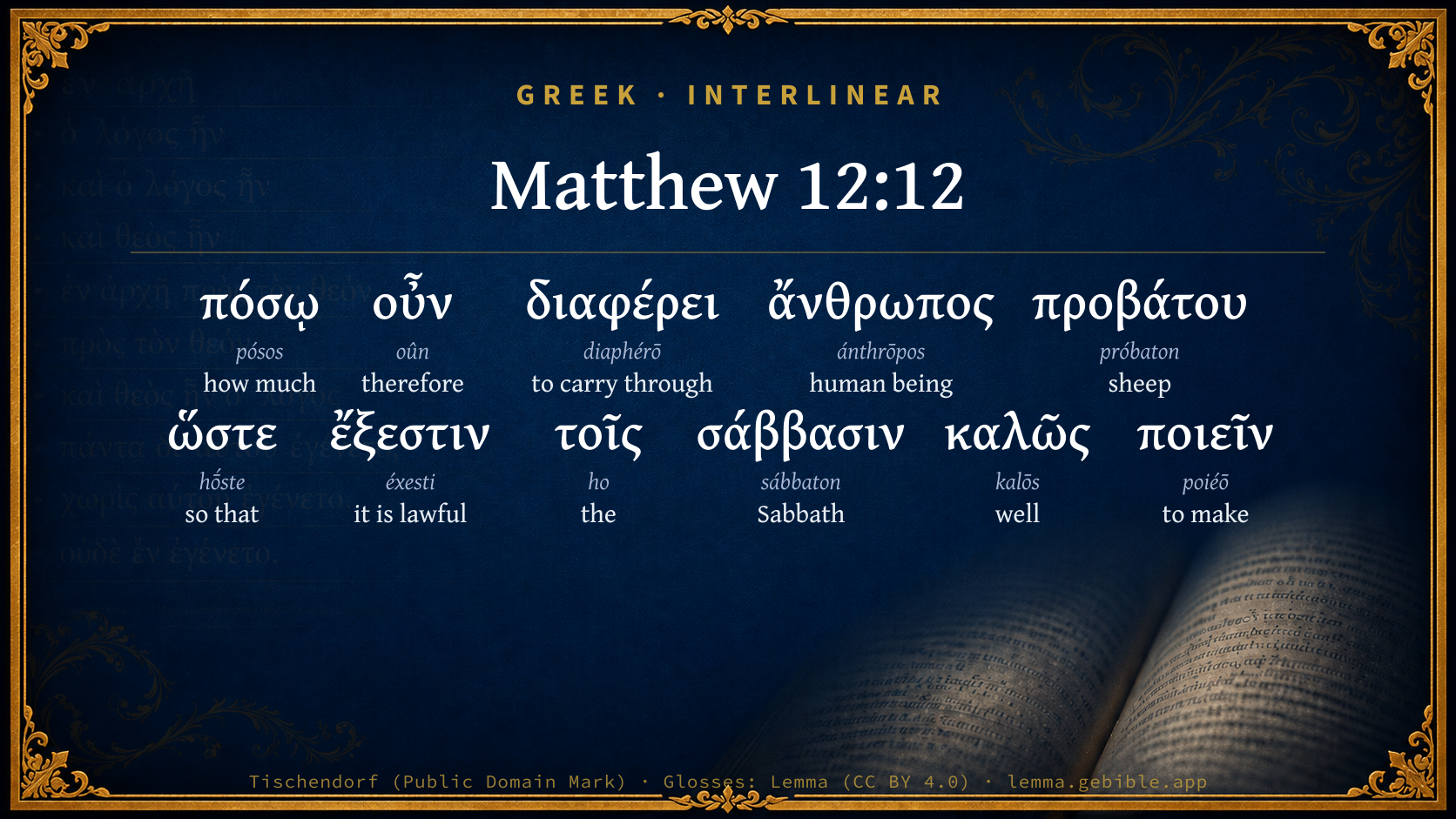
Greek (Tischendorf 8th ed.) Matthew 12:12 appears in the Greek New Testament. The text above is from the Tischendorf 8th edition. Each word links to its Strong’s number and a concise gloss. Click any word for its full Thayer’s Greek Lexicon entry.
Download image
Cite this verse

Matthew 12:12 (World English Bible). Public Domain. Lemma interlinear Bible study tool, https://lemma.gebible.app/v/matthew/12/12.

Show BibTeX & RIS
BibTeX
RIS
English Translation
Of how much more value then is a man than a sheep! Therefore it is lawful to do good on the Sabbath day."
World English Bible · Public Domain
Highlights
  • 1 first appearance in the Greek New Testament
Full analysis ↓
Download a study sheet

One document with this verse’s original text, its word-by-word gloss line, the meaning frame, cross-references with their text, attributed commentary, and full source and license credits — printable, and it pastes into notes with its structure intact.

This verse Autodidact and up

Study sheet (.html) Plain text (.txt)

A passage Seminary Student

Up to 50 verses in one chapter. A passage sheet keeps up to 6 commentary sources and 12 cross-references per verse, in the order this page ranks them, and says so on the sheet whenever that leaves anything out. Ask for a single verse and you get the Autodidact verse sheet above.

Everything on this page stays free to read, with no account — the sheet is a download of what is already on screen, not access to it.

Want to remove ads? Support Godless Engineer
Compare translations 3

The same verse in 3 English versions, stacked beneath the original-language interlinear above. Click any original word for its lexicon entry.

Each is an independent rendering of the whole verse — the interlinear is not word-aligned to these translations.

Highlighted words mark where these versions differ — a whole-verse word diff, not a word-by-word alignment.

  • World English Bible Public Domain
    Of how much more value then is a man than a sheep! Therefore it is lawful to do good on the Sabbath day."
  • King James Version Public Domain
    How much then is a man better than a sheep? Wherefore it is lawful to do well on the sabbath days.
  • unfoldingWord Literal Text CC BY-SA 4.0
    How much more valuable, then, a man than a sheep? Therefore, it is lawful to do good on the Sabbaths.”

unfoldingWord Literal Text — © unfoldingWord, licensed CC BY-SA 4.0. Word-aligned USFM3 via Door43 (git.door43.org/unfoldingWord/en_ult).

Versions to compare (up to 4)

3 of 4 selected

Show all 19 translations

Every available English version of this verse, each an independent rendering of the whole verse.

  • World English Bible Public Domain
    Of how much more value then is a man than a sheep! Therefore it is lawful to do good on the Sabbath day."
  • Berean Standard Bible Public Domain
    How much more valuable is a man than a sheep! Therefore it is lawful to do good on the Sabbath.”
  • Majority Standard Bible Public Domain
    How much more valuable is a man than a sheep! Therefore it is lawful to do good on the Sabbath.”
  • King James Version Public Domain
    How much then is a man better than a sheep? Wherefore it is lawful to do well on the sabbath days.
  • American Standard Version (1901) Public Domain
    How much then is a man of more value than a sheep! Wherefore it is lawful to do good on the sabbath day.
  • Revised Version (1885) Public Domain
    How much then is a man of more value than a sheep! Wherefore it is lawful to do good on the sabbath day.
  • Geneva Bible (1599) Public Domain
    How much more then is a man better then a sheepe? therefore, it is lawfull to doe well on a Sabbath day.
  • Douay-Rheims (1899) Public Domain
    How much better is a man than a sheep? Therefore it it lawful to do a good deed on the sabbath days.
  • Young's Literal Translation Public Domain
    How much better, therefore, is a man than a sheep? -- so that it is lawful on the sabbaths to do good.'
  • Literal Standard Version CC BY-SA 4.0
    How much better, therefore, is a man than a sheep? So that it is lawful on the Sabbaths to do good.”
  • Unlocked Literal Bible CC BY-SA 4.0
    How much more valuable, then, is a man than a sheep! Therefore it is lawful to do good on the Sabbath.”
  • unfoldingWord Literal Text CC BY-SA 4.0
    How much more valuable, then, a man than a sheep? Therefore, it is lawful to do good on the Sabbaths.”
  • Darby Bible Public Domain
    How much better then is a man than a sheep! So that it is lawful to do well on the sabbath.
  • World Messianic Bible Public Domain
    Of how much more value then is a man than a sheep! Therefore it is lawful to do good on the Sabbath day.”
  • Webster's Bible Public Domain
    How much then is a man better than a sheep? wherefore it is lawful to do well on the sabbath days.
  • Free Bible Version CC BY-SA 4.0
    “Don't you think a human being is worth much more than a sheep? So yes, you are allowed to do good on the Sabbath.”
  • Bible in Basic English Public Domain
    Of how much more value is a man than a sheep! For this reason it is right to do good on the Sabbath day.
  • Text-Critical English NT CC BY 4.0
    Of how much more value is a person than a sheep! So then, it is lawful to do good on the Sabbath.”
  • Tyndale New Testament (1534) Public Domain
    And how moche is a man better the a shepe? Wherfore it is lefull to do a good dede on the saboth dayes.

Literal Standard Version (2020), Covenant Press — licensed CC BY-SA 4.0. Text via the HelloAO Bible API (eBible.org). Unlocked Literal Bible (unfoldingWord) — licensed CC BY-SA 4.0. Text via the HelloAO Bible API (eBible.org). unfoldingWord Literal Text — © unfoldingWord, licensed CC BY-SA 4.0. Word-aligned USFM3 via Door43 (git.door43.org/unfoldingWord/en_ult). Free Bible Version, Dr. Jonathan Gallagher — licensed CC BY-SA 4.0. Text via the HelloAO Bible API (eBible.org).

Word by word

More ways to search: Search by grammar → Find every occurrence → Compare this word →

Practice this passage: Drill this verse → Learn its vocabulary →

διαφέρει
diaphérō
G1308
“to carry through”
Verb, Present, Active, Indicative, 3rd person, Singular
Part of Speech
Verb
Tense
Present
Voice
Active
Mood
Indicative
Person
3rd person
Number
Singular
Full Thayer's Definition

Origin: from G1223 and G5342

TDNT: 10:02,1

1. to bear or carry through any place 2. to carry different ways a. to carry in different directions, to different places 1. of people who are carried hither and thither in a ship, driven to and fro b. to differ, to test, prove, the good things that differ, 1. to distinguish between good and evil, lawful and unlawful, to approve of things that excel, to differ from one 2. to excel, surpass one c. impersonally, it makes a difference, it matters, is of importance
  1. πόσῳ pósos G4214 “how much” Correlative/interrogative pronoun, Dative, Singular, Neuter
  2. οὖν oûn G3767 “therefore” Conjunction
  3. ἄνθρωπος ánthrōpos G444 “human being” Noun, Nominative, Singular, Masculine
  4. προβάτου próbaton G4263 “sheep” Noun, Genitive, Singular, Neuter
  5. ὥστε hṓste G5620 “so that” Conjunction
  6. ἔξεστιν éxesti G1832 “it is lawful” Verb, Present, Active, Indicative, 3rd person, Singular
  7. τοῖς ho G3588 “the” Article, Dative, Plural, Neuter
  8. σάββασιν sábbaton G4521 “Sabbath” Noun, Dative, Plural, Neuter
  9. καλῶς kalōs G2573 “well” Adverb
  10. ποιεῖν poiéō G4160 “to make” Verb, Present, Active, Infinitive

About this verse

These counts appear in no published source. They are computed here, from the morphology-tagged text and Lemma’s own curated glosses. What Lemma adds →

11
words
11
distinct lemmas
Gospels
section

Notable vocabulary

The rarest word here is διαφέρει to carry through G1308 — appearing just 13 times in the whole Greek New Testament.

First appearance in Scripture

This word makes its first canonical appearance in the Greek New Testament here:

Shared distinctive vocabulary

διαφέρει to carry through G1308 occurs in 13 verses of the Greek New Testament. Also found in:

Cross-references

5

Topical passages linked to Matthew 12:12 in the Treasury of Scripture Knowledge — connected by theme and wording, ordered by reader-vote popularity; previews shown in the World English Bible.

  • Matthew 6:26 See the birds of the sky, that they don't sow, neither do they reap, nor gather into barns. Your heavenly Father feeds them. Aren't you of much more value than they?
  • Luke 6:9 Then Jesus said to them, "I will ask you something: Is it lawful on the Sabbath to do good, or to do harm? To save a life, or to kill?"
  • Matthew 10:31 Therefore don't be afraid. You are of more value than many sparrows.
  • Mark 3:4 He said to them, "Is it lawful on the Sabbath day to do good, or to do harm? To save a life, or to kill?" But they were silent.
  • Luke 12:24 Consider the ravens: they don't sow, they don't reap, they have no warehouse or barn, and God feeds them. How much more valuable are you than birds!

Cross-references courtesy of OpenBible.info (CC BY 4.0).

Commentary

Notes on Matthew 12:12 from classic Christian and Jewish commentators (each source and its license shown beneath its notes). The classic Christian expositions comment on the surrounding passage and are grouped to its opening verse, so a note may address several verses; the Jewish commentaries on the Tanakh (Rashi and others) are per-verse, so they appear only where the commentator wrote on this verse.

Lemma curates 59 commentaries, every one of them public domain or Creative Commons licensed, each selected and text-cleaned for this edition rather than reprinted as found. About our sources →

The Biblical Illustrator

Joseph S. Exell

Mat_12:12

How much then is a man better than a sheep!

The dignity inherent in mans nature

This is not a question, but an exclamation, and it is so punctuated in the Revised Version.

Exclamation rare with our Lord; He can say great things without becoming perturbed. How much, then, is a man better than a sheep?

1. Our reading of this exclamation is not appreciative till we realize that in it the Son of Man was not propounding a theory, but uncovering an experience. He is hinting here at what He knew. He knew what was in man-was conscious of Himself; we are not. I do not know what we should say if we could understand all that it means to be a man. Almost every one has times when he stands in awe of himself. Christ utters no word that cheapens man. He exhorts to humility, but humility is a symptom of dignity. Conceit one thing; sense of worth another.

2. Even sin, too, has about it something that in this matter is pleasantly suggestive. It is better to be a man that sins than a sheep that cannot. A mans moral corruption is index of the native moral grandeur. It is important that men should be saved, because there is so much for them to be saved to as well as from.

3. There is in man, also, a certain power to transcend limitations that gives him just a flavour of infinitude. The spirit chafes under restraints; has a sense continually of something outside that it has not yet gotten to; makes for itself a larger and larger world; stretches itself back in memory, and forward in surmise.

4. It is rather in the line of this to say that we are persuaded how great a thing it is to be a man, by observing the ease with which man can receive a Divine revelation. Man and God will have to be understood as standing to one another within intelligent reach. It is not the fact that there can be a Divine revelation so much as what it contains that convinces us of the dignity inherent in our nature. The cross proves Gods esteem for the sinner. Mans worth explains redemption; not redemption mans worth. (C. H. Parkhurst.)

A sense of self-worth not conceit

The two take cognizance of different matters. My conceit occupies itself with what I have that is different from others; my sense of worth occupies itself with what I am in common with others. Conceit therefore separates men, while just sense of worth only draws them more closely together. Hence where there is the largest self-respect there will be always the largest and gentlest respect for other people. Once in a while we are a surprise to ourselves; are stirred at times by what we seem to get upon the track of when we take deep, quiet counsel with our own hearts. We appear to be upon the edge of something. Every soul has what it calls its grand moments. A sort of refraction appears for an instant to throw above our horizon lights that are not yet risen. (C. H. Parkhurst.)

Self-worth aids our realization of God

Mens estimate of God will maintain a certain proportion with their estimate of themselves. Even shadows keep a certain ratio with the objects that cast them. Christianity gives us a deepening sense of human worth, and through that deepened sense of human worth we reach a higher sense of Gods worth, and theology is bound to expand along the brightening lines of the human self-consciousness; and the gospel and humanity play backward and forward upon one another, like the sun which brightens the eye so that it can see the sun; like the stars which wake up the eye so that it can find more of the stars. (C. H. Parkhurst.)

Capacity for evil indicative of worth

A mans moral corruption is index of the native moral grandeur of the man; just as the wealth of weeds in a field, equally with the wealth of wheat in the same field, measures the potency and richness of the soil. The strength of the spring can be calculated as well by the distance which the pendulum swings to the left of the perpendicular, as by the distance of its swing to the right. There is the same degree of sinfulness in a sin as there is of personal worth in the man that commits it. Here, too, the shadow keeps a ratio with the object that casts it; and the blackness of the shadow will vary with the brightness of the sunshine that gets excluded. (C. H. Parkhurst.)

Man greater than matter

We are like the bird in the cage that is kept inside the bars, but lives in continuous communication with the air and light without, as though animated still with a sense of freedom that has been forgotten. The Shinarites built into the air. The giants piled Ossa on Pelion. Everything is to us small because there is a larger; everything partial because there is a whole. Assurance continually runs ahead of verification. Everything that gets in our way is felt by us almost as an impropriety and an indignity. In one way the earth is larger than we, in others it is a great deal smaller. It is compelled to loan itself to our service. Mind masters matter. We tame and harness the forces of nature and put them to our work. The sea that separates the continents is made over into a highway to connect them. We play off the energies of nature upon each other, and set the mountain torrent to boring a roadway through the very mountain it flows off from. We rub out distance and talk through the air to Chicago, and tie our letters to the lightning and post them under the sea to London, Constantinople, and Calcutta. Pent in the body we are, and yet domiciled in all the earth; a sort of adumbration of omnipresence. In the same way thought gets into the sky, slips around upon the ocean of space from star to star as easily as a birch canoe among the islands of any mundane archipelago; finds out what has been transpiring in the heavens for a million years; fixes latitudes and longitudes of suns a thousand years away as the light flies; learns their secrets, weighs them, measures them, exacts from them their biography and their kinships; reads in the star-beams the story of stellar composition; finds the unity that pervades the whole; translates the phenomena of the heavens into terms of terrestrial event; gets at the language in which all the worlds unconsciously think, the lines along which they instinctively act. It is grander to think a world than to be a world. To be able to conceive of a universe is fraught with richer sublimity than to be a universe. We rejoice in the great created world. It pleased God when He had made it, and it pleases us because our tastes are like His. We can discover the laws which work in it. A natural law is a Divine thought. In detecting and threading those laws then we are following where Gods mind has gone on before. Mind can construe only what mind constructs, and only when the mind that construes matches the mind that constructs. In this way nature is a mirror that shows both Gods face and our own; and scientific truth is only religious truth secularly conceived. (C. H. Parkhurst.)

The dignity of man as compared with the animal

I. Man is better than the animal.

1. In origin.

2. In endowments.

3. In destiny.

II. Practical lessons.

1. He ought to live better than an animal.

2. He is better worth saving. (American Homiletic Review.)

Better than a sheep

I. That a sheep is worth something, and is very useful.

II. How much are you better than a sheep?

1. You can use Gods Word. Every child can read the Bible.

2. You are better than a sheep, because you are to be praised or blamed for what you do.

3. Because you can grow better than you are now.

III. Because we are so much better than sheep Jesus Christ came to seek and save us,

IV. Because we are better, than sheep God and his angels are glad over every one that repents of sin. (W. Harris.)

The Biblical Illustrator, edited by Joseph S. Exell (c. 1880s–1900s) — public domain. Text from a community e-Sword module.

Bengel's Gnomon

Johann Albrecht Bengel

Mat 12:12. Τοῖς σάββασι, on the Sabbaths) For a good deed is not to be procrastinated.—καλῶς ποιεῖν, to do well) sc. to either a man or a sheep, nay, to a man much more than to a sheep.[556] We must not on the Sabbath-day perform daily wonted tasks for hire, although we may do those things which time and place suggest to us for the good of our neighbour and all other living creatures, and especially for the honour of God.[557]

[556] Some one may think that there was danger in delay as regards the sheep, but that a man affected with a bodily infirmity for such a length of time, might easily be put off for once from one day to another day. But the answer is, it was the fitting time that the relief should be given, when the patient met the physician. A larger crowd of men was assembled together on the Sabbath, who were thus enabled to be spectators of the miracle, and to be profited (won over) by it.—V. g.

[557] Mat 12:14. οἱ δὲ Φαρισαὶοι) It was not with the same laborious exertion as is needed in order to pluck ears of corn, and to draw out a sheep from a pit, that Jesus had effected the cure, but by mere words spoken. It was a pure undiluted benefit conferred without difficulty (pains): and yet blind men, notwithstanding, were regarding His act as if the Sabbath were profaned by it.—V. g.

Bengel's Gnomon of the New Testament — English translation (T&T Clark, Edinburgh, 1860) — public domain. Text from a community e-Sword module.

Meyer's Critical & Exegetical Commentary

Heinrich August Wilhelm Meyer

Mat_12:12. Οὖν] Inference founded on the value which, according to Mat_12:11, is no doubt set upon an animal in such circumstances, notwithstanding the laws of Sabbath observance: Of how much greater consequence, then, is a man than a sheep? The answer is already involved in the question itself (is of far more consequence, and so on); but the final conclusion is: therefore it is allowable to do what is right on the Sabbath. By means of the general expression καλῶς ποιεῖν, which does not mean to be beneficent (Kuinoel, de Wette, Bleek), but recte agere (Act_10:33; 1Co_7:38 f.; Php_4:14; Jam_2:8; Jam_2:19; 2Pe_1:19; 3Jn_1:6), the θεραπεύειν is ranked under the category of duty, and the moral absurdity of the question in Mat_12:10 is thereby exposed. So, by this adroit handling of the argument, the inference of Jesus is secured against all contradiction; de Wettes objection, to the effect that it might have been asked whether the healing did not admit of delay, is founded on a misunderstanding of the καλῶς ποιεῖν. This latter is the moral rule by which resting or working on the Sabbath is to be determined.

Meyer — Critical and Exegetical Commentary on the New Testament — English translation by Peter Christie, edited by Frederick Crombie (T&T Clark, 1880) — public domain. Text from a community e-Sword module.

Expositor's Greek Testament

ed. W. Robertson Nicoll

Mat 12:12 . πόσῳ οὖν διαφέρει , etc. This is another of those simple yet far-reaching utterances by which Christ suggested rather than formulated His doctrine of the infinite worth of man. By how much does a human being differ from a sheep? That is the question which Christian civilisation has not even yet adequately answered. This illustration from common life is not in Mark and Luke. Luke has something similar in the Sabbath cure, reported in Mat 14:1-6 . Some critics think that Matthew combines the two incidents, drawing from his two sources, Mark and the Logia. ὥστε , therefore, and so introducing here rather an independent sentence than a dependent clause expressive of result. καλῶς ποιεῖν : in effect, to do good = εὖ ποιεῖν , i.e. , in the present case to heal, θεραπεύειν , though in Act 10:33 , 1Co 7:37 , the phrase seems to mean to do the morally right, in which sense Meyer and Weiss take it here also. Elsner, and after him Fritzsche, take it as = præclare agere , pointing to the ensuing miracle. By this brief prophetic utterance, Jesus sweeps away legal pedantries and casuistries, and goes straight to the heart of the matter. Beneficent action never unseasonable, of the essence of the Kingdom of God; therefore as permissible and incumbent on Sabbath as on other days. Spoken out of the depths of His religious consciousness, and a direct corollary from His benignant conception of God ( vide Holtz., H. C., p. 91).

The Expositor's Greek Testament, edited by W. Robertson Nicoll (1897–1910) — public domain. Text from a community e-Sword module.

Jamieson, Fausset & Brown

Robert Jamieson, A. R. Fausset & David Brown

How much then is a man better than a sheep?--Resistless appeal! "A righteous man regardeth the life of his beast" (Pro 12:10), and would instinctively rescue it from death or suffering on the sabbath day; how much more his nobler fellow man! But the reasoning, as given in the other two Gospels, is singularly striking: "But He knew their thoughts, and said to the man which had the withered hand, Rise up, and stand forth in the midst. And he arose and stood forth. Then said Jesus unto them, I will ask you one thing: Is it lawful on the sabbath days to do good, or to do evil? to save life or to destroy it?" (Luk 6:8-9), or as in Mark (Mar 3:4), "to kill?" He thus shuts them up to this startling alternative: "Not to do good, when it is in the power of our hand to do it, is to do evil; not to save life, when we can, is to kill"--and must the letter of the sabbath rest be kept at this expense? This unexpected thrust shut their mouths. By this great ethical principle our Lord, we see, held Himself bound, as man. But here we must turn to Mark, whose graphic details make the second Gospel so exceedingly precious. "When He had looked round about on them with anger, being grieved for the hardness of their hearts, He saith unto the man" (Mar 3:5). This is one of the very few passages in the Gospel history which reveal our Lord's feelings. How holy this anger was appears from the "grief" which mingled with it at "the hardness of their hearts."

Jamieson, Fausset & Brown — Commentary Critical and Explanatory on the Whole Bible (1871) — public domain (CC PDM 1.0). Text via the HelloAO Bible API.

Adam Clarke's Commentary

Verse 12. How much then is a man better than a sheep?] Our Lord's argument is what is called argumentum ad hominem; they are taken on their own ground, and confuted on their own maxims and conduct. There are many persons who call themselves Christians, who do more for a beast of burden or pleasure than they do for a man for whom Christ died! Many spend that on coursers, spaniels, and hounds, of which multitudes of the followers of Christ are destitute:-but this also shall come to judgment.

Wherefore, it is lawful to do well, &c.] This was allowed by a multitude of Jewish canons. See Schoettgen.

Adam Clarke's Commentary on the Bible (1810–1826) — public domain. Text from a community e-Sword/MySword module.

The Cambridge Bible for Schools and Colleges

gen. ed. J. J. S. Perowne

12. How much then is a man better than a sheep?] Cp. “ye are of more value than many sparrows,” ch. Mat_10:31.

The Cambridge Bible for Schools and Colleges (gen. ed. J. J. S. Perowne; Cambridge University Press, 1878–1918) — public domain. Text from a community e-Sword module.

John Gill's Exposition

Then saith he to the man,.... That is, after he had looked round about upon them, to observe their countenances; and what answer they would make to his arguments; and with anger for their inhumanity and cruelty; being grieved for the hardness of their hearts, i.e. their unmercifulness to their fellow creatures, and the stupidity and blindness of their minds, being ignorant of the Scriptures, and of the sabbath, the nature, use, and Lord of it; which things are observed by the Evangelist Mark; then, in a commanding authoritative way, almighty power going along with his word, he says to the man who stood forth before him, and the Pharisees,

stretch forth thine hand, which was before contracted and shrivelled up;

and he stretched it forth with all the ease imaginable, and was, not only able to do this, but to make use of it any way;

for it was restored whole like as the other; his left hand, which had never been damaged. This was an instance of Christ's power; a proof of the lawfulness of healing on the sabbath day; and a rebuke to the Pharisees for their cruelty and uncharitableness. This man was an emblem of the inability of men to do anything that is spiritually good, and of the power and efficacy of divine grace to enable persons to stretch out their hands, and do things which they of themselves are not equal to.

John Gill's Exposition of the Whole Bible (1746–1763) — public domain (CC PDM 1.0). Text via the HelloAO Bible API.

Trapp's Complete Commentary

John Trapp

12 How much then is a man better than a sheep? Wherefore it is lawful to do well on the sabbath days.

Ver. 12. It is lawful to do well] Nay, it is needful, since not to do well is to do ill, and not to save a life, or a soul, is to destroy it, Mar 3:4. Not to do justice is injustice, and not to show mercy is no better than cruelty, non faciendo nocens, sed patiendo fuit. Aul. de Claud.

John Trapp, A Commentary or Exposition upon All the Books of the Old and New Testament (1647–1656) — public domain. Text from a community e-Sword module.

Whedon's Commentary on the Bible

Daniel D. Whedon

12. A man better than a sheep — By as much as a man is better than a brute, by so much is it more justifiable to heal this man than to rescue your cattle.

The physician performs his work of preserving health and life rightfully on the Sabbath day; though a conscientious one will allow his profession to interfere as little as possible with his Sabbath duties. And so, though it is not lawful to employ the day in making property, it may be lawful to prevent destruction, as in case of fire.

Daniel D. Whedon (gen. ed.), Commentary on the Old and New Testaments (1874–1909) — public domain. Text from a community e-Sword module.

The Pulpit Commentary

How much then is a man better than a sheep?. (Mat_6:26 Mat_10:31) Wherefore it is lawful to do well (to do good, Revised Version) on the sabbath days. He answers their question about healing (ver. 10) by enunciating a general principle which would cover more. "Doing good" (perhaps merely "well-doing," Act_10:33 1Co_7:37; but probably "doing good to" another, cf. Luk_6:26, Luk_6:27; and the parallel passages here, agayopoihsai h kakopoihsai) is to be one test by which the duty of resting or of working on the sabbath is to be determined.

The Pulpit Commentary (1880–1919), ed. H.D.M. Spence-Jones & Joseph S. Exell — public domain. Text from a community e-Sword module.

John Wesley's Explanatory Notes

It is lawful to do good on the Sabbath day - To save a beast, much more a man.

John Wesley, Explanatory Notes Upon the Whole Bible (1754–1765) — public domain. Text via the GEBible commentary corpus.

The People's New Testament

B. W. Johnson

12. How much then is a man better than a sheep? If sheep can be lifted out of its suffering on the Sabbath, why not much more a man? Wherefore it is lawful to do good on the Sabbath days. If the Sabbath day would preclude one from doing good, then it would be an evil.

B. W. Johnson's The People's New Testament with Notes (1889–1891) — public domain. Electronic text from the Christian Classics Ethereal Library (CCEL) ThML edition.

Cambridge Greek Testament for Schools and Colleges

12. διαφέρει. Cp. ch. Mat 10:31, πολλῶν στρουθίων διαφέρετε ὑμεῖς.

Cambridge Greek Testament for Schools and Colleges (Cambridge University Press, 1896; 21 vols, various authors incl. Carr, Maclear, Plummer, Farrar, Lumby, Moule, M. R. James, Simcox) — public domain. Text from a community e-Sword module.

International Critical Commentary

12. The editor now wishes to illustrate the grounds of the hostility of the Pharisees to the Messiah and His work. For material for this he goes back to the earlier point at which he left Mk.’s narrative, i.e. 2:23. He borrows Mar 2:23-28 = Mat 12:1-8, and also the next section, Mar 3:1-6 = Mat 12:9-14. In vv. 15-21 he summarises Mar 3:7-12, and adds a reference to the Old Testament. As he has already inserted Mar 3:13-19a, this brings him to 3:19b-21. For this he substitutes Mat 12:22-23, thus completing a series of three incidents illustrative of Pharisaic hostility. For arrangement in threes, see Introduction, p. lxv.

(L) 12. How much therefore is a man better than a sheep? So that it is lawful to do well on the Sabbath.] Lk. has similar sayings differently worded in another miracle, 14:1-6. There is no sufficient reason for thinking that the two Evangelists drew from a common source.

12. πόσῳ οὖν διαφέρει] Cf. 10:31 πολλῶν στρουθίων διαφέρετε, 6:26 οὐχ ὑμεῖς μᾶλλον διαφέρετε αὐτῶν.

International Critical Commentary — older volumes (1896–1929), various authors — public domain. Text from a community e-Sword module.

Lesson kit

Teaching starters — assembled from the data on this page, not authored interpretation. Every prompt links to the verse data it draws on. Edit before teaching.

Matthew, in the Gospels, opens this verse with 11 words (11 distinct Greek lemmas). Its most distinctive word is diaphérō (“to carry through”). A historical commentator’s framing appears above. Read the whole chapter for the surrounding context.

Discussion questions

  1. The word diaphérō carries the sense “to carry through.” How does it shape the verse?
  2. The word “well” first appears here in Scripture. What is being introduced at this debut?
  3. Matthew 6:26 shares the word «to carry through» with this verse. How do the two illuminate each other?
  4. These translations render this verse differently. What is at stake in choosing one wording over another?
  5. Reading how The Biblical Illustrator and Bengel's Gnomon read this verse, where do the two commentators agree and where do they part?

Things to notice

  • 1 word makes its first canonical appearance in Scripture here.
  • These translations choose different wording for 12 words in this verse.
  • 11 distinct Greek lemmas span 11 words in this verse.

Reading settings

Reading text

Shown beneath each verse's original-language words.

Old Testament
Old Testament edition

Read the OT as the Masoretic Hebrew (MT) or the Greek Septuagint (LXX).

English shown for the Greek Septuagint (in the Hebrew ↔ Greek comparison).

Comparing translations? Open the Compare panel on any verse page to stack up to four side by side.