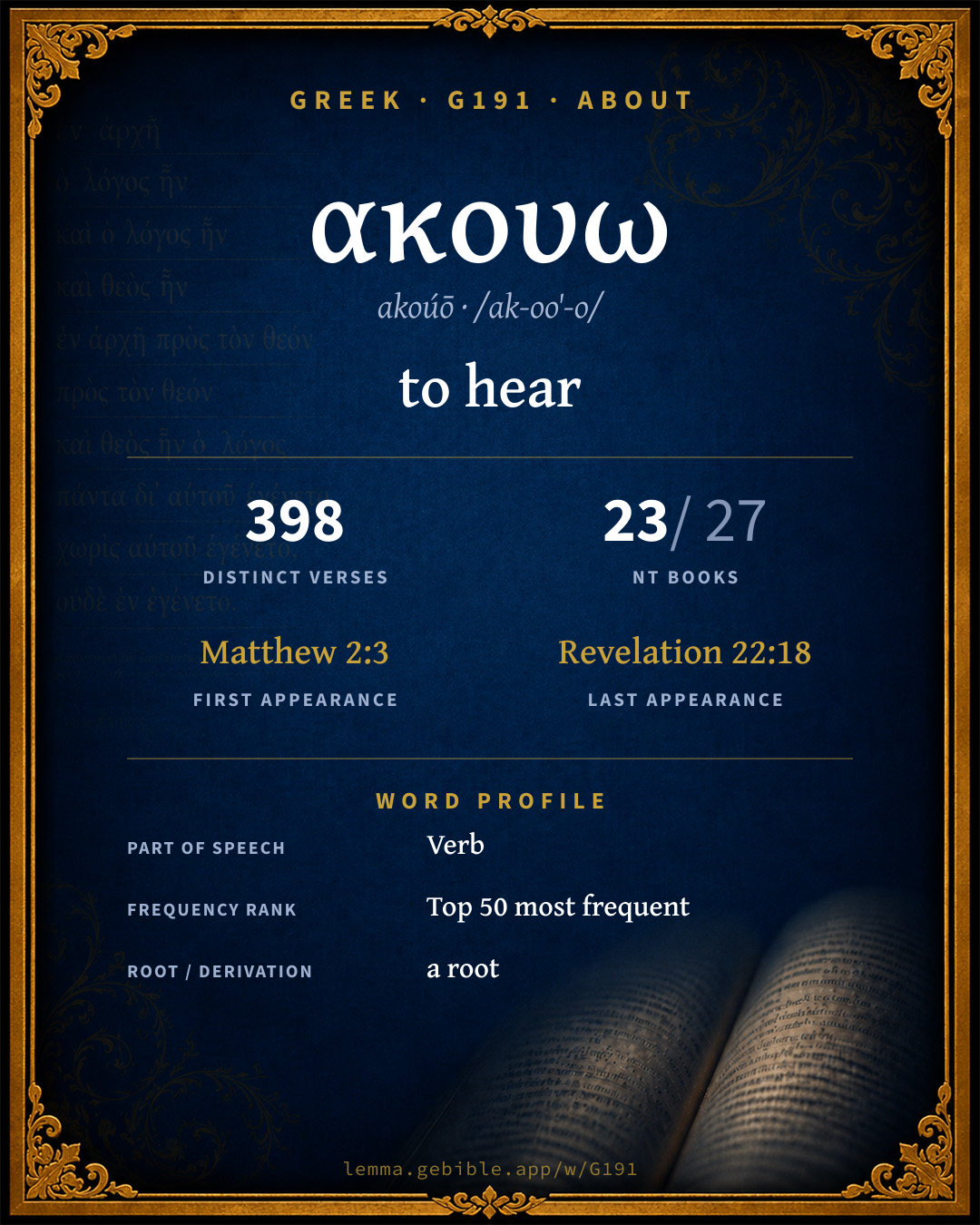
ἀκούω
to hear
‘to hear’ is one of 8 main senses fuller range ↓
Full lexicon entry — Thayer's Greek Lexicon
From Thayer's Greek Lexicon
Where this word appears
See every Aorist-tense verb in the Greek New Testament →
Grammar key — what these labels mean
Part of speech
- Verb
- An action or state-of-being word.
Tense
- Aorist
- Action viewed as a simple whole, without regard to duration — often past (perfective aspect).
- Present
- Ongoing or general action in present time (imperfective aspect).
- Imperfect
- Continuous or repeated action in past time (“was writing”).
- Perfect
- A completed past action with continuing present results.
- Future
- Action expected in future time.
Voice
- Active
- The subject performs the action.
- Passive
- The subject receives the action.
- Middle deponent
- Middle in form but active in meaning.
Mood
- Participle
- A verbal adjective (“writing,” “having written”).
- Indicative
- States a fact or asks a factual question (the mood of reality).
- Infinitive
- A verbal noun (“to write”), unmarked for person or number.
- Imperative
- Expresses a command or request.
- Subjunctive
- Expresses probability, purpose, or possibility (the mood of contingency).
Case
- Nominative
- The case of the subject (and the predicate nominative).
- Accusative
- The case of the direct object and of extent.
- Genitive
- The case of source, possession, or “of” — answers “whose / from what.”
- Dative
- The case of the indirect object, means, or location — “to / for / with / in.”
Person
- 1st person
- The speaker (“I / we”).
- 2nd person
- The one addressed (“you”).
- 3rd person
- The one spoken about (“he / she / it / they”).
Gender
- Masculine
- Grammatically masculine.
- Feminine
- Grammatically feminine.
- Neuter
- Grammatically neuter.
Number
- Plural
- More than one.
- Singular
- One.
Grammatical forms 57 distinct
- Verb, Aorist, Active, Participle, Nominative, Plural, Masculine 52 times (12%)
- Verb, Aorist, Active, Indicative, 1st person, Singular 35 times (8%)
- Verb, Aorist, Active, Participle, Nominative, Singular, Masculine 33 times (8%)
- Verb, Aorist, Active, Indicative, 2nd person, Plural 26 times (6%)
- Verb, Aorist, Active, Indicative, 3rd person, Plural 19 times (4%)
- Verb, Present, Active, Infinitive 19 times (4%)
- Verb, Aorist, Active, Indicative, 3rd person, Singular 17 times (4%)
- Verb, Aorist, Active, Infinitive 17 times (4%)
+49 more forms (209 occurrences)
Parsed forms decoded from the imported morphology (Robinson–Tischendorf, public domain), counted across 427 parsed occurrences — not distinct verses.
Page 2 of 2 — showing verses 201–398 of 398 distinct verses where G191 appears, across 23 books. Click any verse to open its interlinear word-by-word view. Verse text shown in the World English Bible for context — . Each verse’s Greek form is shown with its reference; the English is not keyword-highlighted, since the data carries no word-level English alignment. Use “Compare translations” on any verse to read it across multiple English versions. This concordance covers the Greek New Testament; Septuagint (Greek Old Testament) occurrences of this word are not indexed here.
John 54 verses
- John 12:34 ἠκούσαμεν aor act ind 1pl The multitude answered him, "We have heard out of the law that the Christ remains forever. How do you say, 'The Son of Man must be lifted up?' Who is this Son of Man?"
- John 12:47 ἀκούσῃ aor act subj 3sg If anyone listens to my sayings, and doesn't believe, I don't judge him. For I came not to judge the world, but to save the world.
- John 14:24 ἀκούετε pres act ind 2pl He who doesn't love me doesn't keep my words. The word which you hear isn't mine, but the Father's who sent me.
- John 14:28 ἠκούσατε aor act ind 2pl You heard how I told you, 'I go away, and I come to you.' If you loved me, you would have rejoiced, because I said 'I am going to my Father;' for the Father is greater than I.
- John 15:15 ἤκουσα aor act ind 1sg No longer do I call you servants, for the servant doesn't know what his lord does. But I have called you friends, for everything that I heard from my Father, I have made known to you.
- John 16:13 ἀκούει pres act ind 3sg However when he, the Spirit of truth, has come, he will guide you into all truth, for he will not speak from himself; but whatever he hears, he will speak. He will declare to you things that are coming.
- John 18:21 ἀκηκοότας perf act ptcp acc pl masc attic Why do you ask me? Ask those who have heard me what I said to them. Behold, these know the things which I said."
- John 18:37 ἀκούει pres act ind 3sg Pilate therefore said to him, "Are you a king then?" Jesus answered, "You say that I am a king. For this reason I have been born, and for this reason I have come into the world, that I should testify to the truth. Everyone who is of the truth listens to my voice."
- John 19:8 ἤκουσεν aor act ind 3sg When therefore Pilate heard this saying, he was more afraid.
- John 19:13 ἀκούσας aor act ptcp nom sg masc When Pilate therefore heard these words, he brought Jesus out, and sat down on the judgment seat at a place called "The Pavement," but in Hebrew, "Gabbatha."
- John 21:7 ἀκούσας aor act ptcp nom sg masc That disciple therefore whom Jesus loved said to Peter, "It's the Lord!" So when Simon Peter heard that it was the Lord, he wrapped his coat around him (for he was naked), and threw himself into the sea.
Acts 85 verses
- Acts 1:4 ἠκούσατέ aor act ind 2pl Being assembled together with them, he charged them, "Don't depart from Jerusalem, but wait for the promise of the Father, which you heard from me.
- Acts 2:6 ἤκουον impf act ind 3pl When this sound was heard, the multitude came together, and were bewildered, because everyone heard them speaking in his own language.
- Acts 2:8 ἀκούομεν pres act ind 1pl How do we hear, everyone in our own native language?
- Acts 2:11 ἀκούομεν pres act ind 1pl Cretans and Arabians: we hear them speaking in our languages the mighty works of God!"
- Acts 2:22 ἀκούσατε aor act impv 2pl "Men of Israel, hear these words! Jesus of Nazareth, a man approved by God to you by mighty works and wonders and signs which God did by him in the midst of you, even as you yourselves know,
- Acts 2:33 ἀκούετε pres act ind 2pl Being therefore exalted by the right hand of God, and having received from the Father the promise of the Holy Spirit, he has poured out this, which you now see and hear.
- Acts 2:37 Ἀκούσαντες aor act ptcp nom pl masc Now when they heard this, they were cut to the heart, and said to Peter and the rest of the apostles, "Brothers, what shall we do?"
- Acts 3:22 ἀκούσεσθε fut mid.dep ind 2pl For Moses indeed said to the fathers, 'The Lord God will raise up a prophet for you from among your brothers, like me. You shall listen to him in all things whatever he says to you.
- Acts 3:23 ἀκούσῃ aor act subj 3sg It will be, that every soul that will not listen to that prophet will be utterly destroyed from among the people.'
- Acts 4:4 ἀκουσάντων aor act ptcp gen pl masc But many of those who heard the word believed, and the number of the men came to be about five thousand.
- Acts 4:19 ἀκούειν pres act inf But Peter and John answered them, "Whether it is right in the sight of God to listen to you rather than to God, judge for yourselves,
- Acts 4:20 ἠκούσαμεν aor act ind 1pl for we can't help telling the things which we saw and heard."
- Acts 4:24 ἀκούσαντες aor act ptcp nom pl masc When they heard it, they lifted up their voice to God with one accord, and said, "O Lord, you are God, who made the heaven, the earth, the sea, and all that is in them;
- Acts 5:5 ἀκούων ἀκούοντας pres act ptcp nom sg masc pres act ptcp acc pl masc Ananias, hearing these words, fell down and died. Great fear came on all who heard these things.
- Acts 5:11 ἀκούοντας pres act ptcp acc pl masc Great fear came on the whole assembly, and on all who heard these things.
- Acts 5:21 ἀκούσαντες aor act ptcp nom pl masc When they heard this, they entered into the temple about daybreak, and taught. But the high priest came, and those who were with him, and called the council together, and all the senate of the children of Israel, and sent to the prison to have them brought.
- Acts 5:24 ἤκουσαν aor act ind 3pl Now when the high priest, the captain of the temple, and the chief priests heard these words, they were very perplexed about them and what might become of this.
- Acts 5:33 ἀκούσαντες aor act ptcp nom pl masc But they, when they heard this, were cut to the heart, and determined to kill them.
- Acts 6:11 ἀκηκόαμεν perf act ind 1pl attic Then they secretly induced men to say, "We have heard him speak blasphemous words against Moses and God."
- Acts 6:14 ἀκηκόαμεν perf act ind 1pl attic For we have heard him say that this Jesus of Nazareth will destroy this place, and will change the customs which Moses delivered to us."
- Acts 7:2 ἀκούσατε aor act impv 2pl He said, "Brothers and fathers, listen. The God of glory appeared to our father Abraham, when he was in Mesopotamia, before he lived in Haran,
- Acts 7:12 ἀκούσας aor act ptcp nom sg masc But when Jacob heard that there was grain in Egypt, he sent out our fathers the first time.
- Acts 7:34 ἤκουσα aor act ind 1sg I have surely seen the affliction of my people that is in Egypt, and have heard their groaning. I have come down to deliver them. Now come, I will send you into Egypt.'
- Acts 7:54 Ἀκούοντες pres act ptcp nom pl masc Now when they heard these things, they were cut to the heart, and they gnashed at him with their teeth.
- Acts 8:6 ἀκούειν pres act inf The multitudes listened with one accord to the things that were spoken by Philip, when they heard and saw the signs which he did.
- Acts 8:14 ἀκούσαντες aor act ptcp nom pl masc Now when the apostles who were at Jerusalem heard that Samaria had received the word of God, they sent Peter and John to them,
- Acts 8:30 ἤκουσεν aor act ind 3sg Philip ran to him, and heard him reading Isaiah the prophet, and said, "Do you understand what you are reading?"
- Acts 9:4 ἤκουσεν aor act ind 3sg He fell on the earth, and heard a voice saying to him, "Saul, Saul, why do you persecute me?"
- Acts 9:7 ἀκούοντες pres act ptcp nom pl masc The men who traveled with him stood speechless, hearing the sound, but seeing no one.
- Acts 9:13 ἤκουσα aor act ind 1sg But Ananias answered, "Lord, I have heard from many about this man, how much evil he did to your saints at Jerusalem.
- Acts 9:21 ἀκούοντες pres act ptcp nom pl masc All who heard him were amazed, and said, "Isn't this he who in Jerusalem made havoc of those who called on this name? And he had come here intending to bring them bound before the chief priests!"
- Acts 9:38 ἀκούσαντες aor act ptcp nom pl masc As Lydda was near Joppa, the disciples, hearing that Peter was there, sent two men to him, imploring him not to delay in coming to them.
- Acts 10:22 ἀκοῦσαι aor act inf They said, "Cornelius, a centurion, a righteous man and one who fears God, and well spoken of by all the nation of the Jews, was directed by a holy angel to invite you to his house, and to listen to what you say."
- Acts 10:33 ἀκοῦσαι aor act inf Therefore I sent to you at once, and it was good of you to come. Now therefore we are all here present in the sight of God to hear all things that have been commanded you by God."
- Acts 10:44 ἀκούοντας pres act ptcp acc pl masc While Peter was still speaking these words, the Holy Spirit fell on all those who heard the word.
- Acts 10:46 ἤκουον impf act ind 3pl For they heard them speaking in other languages and magnifying God. Then Peter answered,
- Acts 11:1 Ἤκουσαν aor act ind 3pl Now the apostles and the brothers who were in Judea heard that the Gentiles had also received the word of God.
- Acts 11:7 ἤκουσα aor act ind 1sg I also heard a voice saying to me, 'Rise, Peter, kill and eat!'
- Acts 11:18 ἀκούσαντες aor act ptcp nom pl masc When they heard these things, they held their peace, and glorified God, saying, "Then God has also granted to the Gentiles repentance to life!"
- Acts 11:22 Ἠκούσθη aor pass ind 3sg The report concerning them came to the ears of the assembly which was in Jerusalem. They sent out Barnabas to go as far as Antioch,
- Acts 13:7 ἀκοῦσαι aor act inf who was with the proconsul, Sergius Paulus, a man of understanding. This man summoned Barnabas and Saul, and sought to hear the word of God.
- Acts 13:16 ἀκούσατε aor act impv 2pl Paul stood up, and beckoning with his hand said, "Men of Israel, and you who fear God, listen.
- Acts 13:44 ἀκοῦσαι aor act inf The next Sabbath almost the whole city was gathered together to hear the word of God.
- Acts 13:48 ἀκούοντα pres act ptcp nom pl neut As the Gentiles heard this, they were glad, and glorified the word of God. As many as were appointed to eternal life believed.
- Acts 14:9 ἤκουσεν aor act ind 3sg He was listening to Paul speaking, who, fastening eyes on him, and seeing that he had faith to be made whole,
- Acts 14:14 ἀκούσαντες aor act ptcp nom pl masc But when the apostles, Barnabas and Paul, heard of it, they tore their clothes, and sprang into the multitude, crying out,
- Acts 15:7 ἀκοῦσαι aor act inf When there had been much discussion, Peter rose up and said to them, "Brothers, you know that a good while ago God made choice among you, that by my mouth the Gentiles should hear the word of the Gospel, and believe.
- Acts 15:12 ἤκουον impf act ind 3pl All the multitude kept silence, and they listened to Barnabas and Paul reporting what signs and wonders God had done among the Gentiles through them.
- Acts 15:13 ἀκούσατέ aor act impv 2pl After they were silent, James answered, "Brothers, listen to me.
- Acts 15:24 ἠκούσαμεν aor act ind 1pl Because we have heard that some who went out from us have troubled you with words, unsettling your souls, saying, 'You must be circumcised and keep the law,' to whom we gave no commandment;
- Acts 16:14 ἤκουεν impf act ind 3sg A certain woman named Lydia, a seller of purple, of the city of Thyatira, one who worshiped God, heard us; whose heart the Lord opened to listen to the things which were spoken by Paul.
- Acts 16:38 ἀκούσαντες aor act ptcp nom pl masc The sergeants reported these words to the magistrates, and they were afraid when they heard that they were Romans,
- Acts 17:8 ἀκούοντας pres act ptcp acc pl masc The multitude and the rulers of the city were troubled when they heard these things.
- Acts 17:21 ἀκούειν pres act inf Now all the Athenians and the strangers living there spent their time in nothing else, but either to tell or to hear some new thing.
- Acts 17:32 ἀκούσαντες ἀκουσόμεθά aor act ptcp nom pl masc fut mid.dep ind 1pl Now when they heard of the resurrection of the dead, some mocked; but others said, "We want to hear you again concerning this."
- Acts 18:8 ἀκούοντες pres act ptcp nom pl masc Crispus, the ruler of the synagogue, believed in the Lord with all his house. Many of the Corinthians, when they heard, believed and were baptized.
- Acts 18:26 ἀκούσαντες aor act ptcp nom pl masc He began to speak boldly in the synagogue. But when Priscilla and Aquila heard him, they took him aside, and explained to him the way of God more accurately.
- Acts 19:2 ἠκούσαμεν aor act ind 1pl He said to them, "Did you receive the Holy Spirit when you believed?" They said to him, "No, we haven't even heard that there is a Holy Spirit."
- Acts 19:5 ἀκούσαντες aor act ptcp nom pl masc When they heard this, they were baptized in the name of the Lord Jesus.
- Acts 19:10 ἀκοῦσαι aor act inf This continued for two years, so that all those who lived in Asia heard the word of the Lord Jesus, both Jews and Greeks.
- Acts 19:26 ἀκούετε pres act ind 2pl You see and hear, that not at Ephesus alone, but almost throughout all Asia, this Paul has persuaded and turned away many people, saying that they are no gods, that are made with hands.
- Acts 19:28 ἀκούσαντες aor act ptcp nom pl masc When they heard this they were filled with anger, and cried out, saying, "Great is Artemis of the Ephesians!"
- Acts 21:12 ἠκούσαμεν aor act ind 1pl When we heard these things, both we and they of that place begged him not to go up to Jerusalem.
- Acts 21:20 ἀκούσαντες aor act ptcp nom pl masc They, when they heard it, glorified God. They said to him, "You see, brother, how many thousands there are among the Jews of those who have believed, and they are all zealous for the law.
- Acts 21:22 ἀκούσονται fut mid.dep ind 3pl What then? The assembly must certainly meet, for they will hear that you have come.
- Acts 22:1 ἀκούσατέ aor act impv 2pl "Brothers and fathers, listen to the defense which I now make to you."
- Acts 22:2 ἀκούσαντες aor act ptcp nom pl masc When they heard that he spoke to them in the Hebrew language, they were even more quiet. He said,
- Acts 22:7 ἤκουσα aor act ind 1sg I fell to the ground, and heard a voice saying to me, 'Saul, Saul, why are you persecuting me?'
- Acts 22:9 ἤκουσαν aor act ind 3pl "Those who were with me indeed saw the light and were afraid, but they didn't understand the voice of him who spoke to me.
- Acts 22:14 ἀκοῦσαι aor act inf He said, 'The God of our fathers has appointed you to know his will, and to see the Righteous One, and to hear a voice from his mouth.
- Acts 22:15 ἤκουσας aor act ind 2sg For you will be a witness for him to all men of what you have seen and heard.
- Acts 22:22 Ἤκουον impf act ind 3pl They listened to him until he said that; then they lifted up their voice, and said, "Rid the earth of this fellow, for he isn't fit to live!"
- Acts 22:26 ἀκούσας aor act ptcp nom sg masc When the centurion heard it, he went to the commanding officer and told him, "Watch what you are about to do, for this man is a Roman!"
- Acts 23:16 Ἀκούσας aor act ptcp nom sg masc But Paul's sister's son heard of their lying in wait, and he came and entered into the barracks and told Paul.
- Acts 24:4 ἀκοῦσαί aor act inf But, that I don't delay you, I entreat you to bear with us and hear a few words.
- Acts 24:24 ἤκουσεν aor act ind 3sg But after some days, Felix came with Drusilla, his wife, who was a Jewess, and sent for Paul, and heard him concerning the faith in Christ Jesus.
- Acts 25:22 ἀκοῦσαι ἀκούσῃ aor act inf fut mid.dep ind 2sg Agrippa said to Festus, "I also would like to hear the man myself." "Tomorrow," he said, "you shall hear him."
- Acts 26:3 ἀκοῦσαί aor act inf especially because you are expert in all customs and questions which are among the Jews. Therefore I beg you to hear me patiently.
- Acts 26:14 ἤκουσα aor act ind 1sg When we had all fallen to the earth, I heard a voice saying to me in the Hebrew language, 'Saul, Saul, why are you persecuting me? It is hard for you to kick against the goads.'
- Acts 26:29 ἀκούοντάς pres act ptcp acc pl masc Paul said, "I pray to God, that whether with little or with much, not only you, but also all that hear me this day, might become such as I am, except for these bonds."
- Acts 28:15 ἀκούσαντες aor act ptcp nom pl masc From there the brothers, when they heard of us, came to meet us as far as The Market of Appius and The Three Taverns. When Paul saw them, he thanked God, and took courage.
- Acts 28:22 ἀκοῦσαι aor act inf But we desire to hear from you what you think. For, as concerning this sect, it is known to us that everywhere it is spoken against."
- Acts 28:26 ἀκούσετε fut act ind 2pl saying, 'Go to this people, and say, In hearing, you will hear, But will in no way understand. In seeing, you will see, But will in no way perceive.
- Acts 28:27 ἤκουσαν ἀκούσωσιν aor act ind 3pl aor act subj 3pl For this people's heart has grown callous. Their ears are dull of hearing. Their eyes they have closed. Lest they should see with their eyes, Hear with their ears, Understand with their heart, And would turn again, And I would heal them.'
- Acts 28:28 ἀκούσονται fut mid.dep ind 3pl "Be it known therefore to you, that the salvation of God is sent to the Gentiles. They will also listen."
Romans 4 verses
- Romans 10:14 ἤκουσαν ἀκούσονται aor act ind 3pl fut mid.dep ind 3pl How then will they call on him in whom they have not believed? How will they believe in him whom they have not heard? How will they hear without a preacher?
- Romans 10:18 ἤκουσαν aor act ind 3pl But I say, didn't they hear? Yes, most assuredly, "Their sound went out into all the earth, Their words to the ends of the world."
- Romans 11:8 ἀκούειν pres act inf According as it is written, "God gave them a spirit of stupor, eyes that they should not see, and ears that they should not hear, to this very day."
- Romans 15:21 ἀκηκόασιν perf act ind 3pl attic But, as it is written, "They will see, to whom no news of him came. They who haven't heard will understand."
1 Corinthians 4 verses
- 1 Corinthians 2:9 ἤκουσεν aor act ind 3sg But as it is written, "Things which an eye didn't see, and an ear didn't hear, Which didn't enter into the heart of man, These God has prepared for those who love him."
- 1 Corinthians 5:1 ἀκούεται pres pass ind 3sg It is actually reported that there is sexual immorality among you, and such sexual immorality as is not even named among the Gentiles, that one has his father's wife.
- 1 Corinthians 11:18 ἀκούω pres act ind 1sg For first of all, when you come together in the assembly, I hear that divisions exist among you, and I partly believe it.
- 1 Corinthians 14:2 ἀκούει pres act ind 3sg For he who speaks in another language speaks not to men, but to God; for no one understands; but in the Spirit he speaks mysteries.
2 Corinthians 2 verses
- 2 Corinthians 12:4 ἤκουσεν aor act ind 3sg how he was caught up into Paradise, and heard unspeakable words, which it is not lawful for a man to utter.
- 2 Corinthians 12:6 ἀκούει pres act ind 3sg For if I would desire to boast, I will not be foolish; for I will speak the truth. But I forbear, so that no man may account of me above that which he sees in me, or hears from me.
Galatians 3 verses
- Galatians 1:13 ἠκούσατε aor act ind 2pl For you have heard of my way of living in time past in the Jews' religion, how that beyond measure I persecuted the assembly of God, and ravaged it.
- Galatians 1:23 ἀκούοντες pres act ptcp nom pl masc but they only heard: "He who once persecuted us now preaches the faith that he once tried to destroy."
- Galatians 4:21 ἀκούετε pres act ind 2pl Tell me, you that desire to be under the law, don't you listen to the law?
Ephesians 5 verses
- Ephesians 1:13 ἀκούσαντες aor act ptcp nom pl masc in whom you also, having heard the word of the truth, the Gospel of your salvation,--in whom, having also believed, you were sealed with the Holy Spirit of promise,
- Ephesians 1:15 ἀκούσας aor act ptcp nom sg masc For this cause I also, having heard of the faith in the Lord Jesus which is among you, and the love which you have toward all the saints,
- Ephesians 3:2 ἠκούσατε aor act ind 2pl if it is so that you have heard of the administration of that grace of God which was given me toward you;
- Ephesians 4:21 ἠκούσατε aor act ind 2pl if indeed you heard him, and were taught in him, even as truth is in Jesus:
- Ephesians 4:29 ἀκούουσιν pres act ptcp dat pl masc Let no corrupt speech proceed out of your mouth, but such as is good for building up as the need may be, that it may give grace to those who hear.
Philippians 4 verses
- Philippians 1:27 ἀκούω pres act subj 1sg Only let your manner of life be worthy of the Gospel of Christ, that, whether I come and see you or am absent, I may hear of your state, that you stand firm in one spirit, with one soul striving for the faith of the Gospel;
- Philippians 1:30 ἀκούετε pres act ind 2pl having the same conflict which you saw in me, and now hear is in me.
- Philippians 2:26 ἠκούσατε aor act ind 2pl since he longed for you all, and was very troubled, because you had heard that he was sick.
- Philippians 4:9 ἠκούσατε aor act ind 2pl The things which you learned, received, heard, and saw in me: do these things, and the God of peace will be with you.
Colossians 4 verses
- Colossians 1:4 ἀκούσαντες aor act ptcp nom pl masc having heard of your faith in Christ Jesus, and of the love which you have toward all the saints,
- Colossians 1:6 ἠκούσατε aor act ind 2pl which has come to you; even as it is in all the world and is bearing fruit and growing, as it does in you also, since the day you heard and knew the grace of God in truth;
- Colossians 1:9 ἠκούσαμεν aor act ind 1pl For this cause, we also, since the day we heard this, don't cease praying and making requests for you, that you may be filled with the knowledge of his will in all spiritual wisdom and understanding,
- Colossians 1:23 ἠκούσατε aor act ind 2pl if it is so that you continue in the faith, grounded and steadfast, and not moved away from the hope of the Gospel which you heard, which is being proclaimed in all creation under heaven; of which I, Paul, was made a servant.
2 Thessalonians 1 verse
1 Timothy 1 verse
2 Timothy 4 verses
- 2 Timothy 1:13 ἤκουσας aor act ind 2sg Hold the pattern of sound words which you have heard from me, in faith and love which is in Christ Jesus.
- 2 Timothy 2:2 ἤκουσας aor act ind 2sg The things which you have heard from me among many witnesses, commit the same to faithful men, who will be able to teach others also.
- 2 Timothy 2:14 ἀκουόντων pres act ptcp gen pl masc Remind them of these things, charging them in the sight of the Lord, that they don't argue about words, to no profit, to the subverting of those who hear.
- 2 Timothy 4:17 ἀκούσωσιν aor act subj 3pl But the Lord stood by me, and strengthened me, that through me the message might be fully proclaimed, and that all the Gentiles might hear; and I was delivered out of the mouth of the lion.
Philemon 1 verse
Hebrews 8 verses
- Hebrews 2:1 ἀκουσθεῖσιν aor pass ptcp dat pl neut Therefore we ought to pay greater attention to the things that were heard, lest perhaps we drift away.
- Hebrews 2:3 ἀκουσάντων aor act ptcp gen pl masc how will we escape if we neglect so great a salvation-- which at the first having been spoken through the Lord, was confirmed to us by those who heard;
- Hebrews 3:7 ἀκούσητε aor act subj 2pl Therefore, even as the Holy Spirit says, "Today if you will hear his voice,
- Hebrews 3:15 ἀκούσητε aor act subj 2pl while it is said, "Today if you will hear his voice, Don't harden your hearts, as in the rebellion."
- Hebrews 3:16 ἀκούσαντες aor act ptcp nom pl masc For who, when they heard, rebelled? No, didn't all those who came out of Egypt by Moses?
- Hebrews 4:2 ἀκούσασιν aor act ptcp dat pl masc For indeed we have had good news preached to us, even as they also did, but the word they heard didn't profit them, because it wasn't mixed with faith by those who heard.
- Hebrews 4:7 ἀκούσητε aor act subj 2pl he again defines a certain day, today, saying through David so long a time afterward (just as has been said), "Today if you will hear his voice, Don't harden your hearts."
- Hebrews 12:19 ἀκούσαντες aor act ptcp nom pl masc the sound of a trumpet, and the voice of words; which those who heard it begged that not one more word should be spoken to them,
James 3 verses
- James 1:19 ἀκοῦσαι aor act inf So, then, my beloved brothers, let every man be swift to hear, slow to speak, and slow to anger;
- James 2:5 Ἀκούσατε aor act impv 2pl Listen, my beloved brothers. Didn't God choose those who are poor in this world to be rich in faith, and heirs of the Kingdom which he promised to those who love him?
- James 5:11 ἠκούσατε aor act ind 2pl Behold, we call them blessed who endured. You have heard of the patience of Job, and have seen the Lord in the outcome, and how the Lord is full of compassion and mercy.
2 Peter 1 verse
1 John 12 verses
- 1 John 1:1 ἀκηκόαμεν perf act ind 1pl attic That which was from the beginning, that which we have heard, that which we have seen with our eyes, that which we saw, and our hands touched, concerning the Word of life
- 1 John 1:3 ἀκηκόαμεν perf act ind 1pl attic that which we have seen and heard we declare to you, that you also may have fellowship with us. Yes, and our fellowship is with the Father, and with his Son, Jesus Christ.
- 1 John 1:5 ἀκηκόαμεν perf act ind 1pl attic This is the message which we have heard from him and announce to you, that God is light, and in him is no darkness at all.
- 1 John 2:7 ἠκούσατε aor act ind 2pl Brothers, I write no new commandment to you, but an old commandment which you had from the beginning. The old commandment is the word which you heard from the beginning.
- 1 John 2:18 ἠκούσατε aor act ind 2pl Little children, these are the end times, and as you heard that the Antichrist is coming, even now many antichrists have arisen. By this we know that it is the end times.
- 1 John 2:24 ἠκούσατε ἠκούσατε aor act ind 2pl aor act ind 2pl Therefore, as for you, let that remain in you which you heard from the beginning. If that which you heard from the beginning remains in you, you also will remain in the Son, and in the Father.
- 1 John 3:11 ἠκούσατε aor act ind 2pl For this is the message which you heard from the beginning, that we should love one another;
- 1 John 4:3 ἀκηκόατε perf act ind 2pl attic and every spirit who doesn't confess that Jesus Christ has come in the flesh is not of God, and this is the spirit of the antichrist, of whom you have heard that it comes. Now it is in the world already.
- 1 John 4:5 ἀκούει pres act ind 3sg They are of the world. Therefore they speak of the world, and the world hears them.
- 1 John 4:6 ἀκούει ἀκούει pres act ind 3sg pres act ind 3sg We are of God. He who knows God listens to us. He who is not of God doesn't listen to us. By this we know the spirit of truth, and the spirit of error.
- 1 John 5:14 ἀκούει pres act ind 3sg This is the boldness which we have toward him, that, if we ask anything according to his will, he listens to us.
- 1 John 5:15 ἀκούει pres act ind 3sg And if we know that he listens to us, whatever we ask, we know that we have the petitions which we have asked of him.
2 John 1 verse
3 John 1 verse
Revelation 43 verses
- Revelation 1:3 ἀκούοντες pres act ptcp nom pl masc Blessed is he who reads and those who hear the words of the prophecy, and keep the things that are written in it, for the time is at hand.
- Revelation 1:10 ἤκουσα aor act ind 1sg I was in the Spirit on the Lord's day, and I heard behind me a loud voice, like a trumpet
- Revelation 2:7 ἀκουσάτω aor act impv 3sg He who has an ear, let him hear what the Spirit says to the assemblies. To him who overcomes I will give to eat of the tree of life, which is in the Paradise of my God.
- Revelation 2:11 ἀκουσάτω aor act impv 3sg He who has an ear, let him hear what the Spirit says to the assemblies. He who overcomes won't be harmed by the second death.
- Revelation 2:17 ἀκουσάτω aor act impv 3sg He who has an ear, let him hear what the Spirit says to the assemblies. To him who overcomes, to him I will give of the hidden manna, and I will give him a white stone, and on the stone a new name written, which no one knows but he who receives it.
- Revelation 2:29 ἀκουσάτω aor act impv 3sg He who has an ear, let him hear what the Spirit says to the assemblies.
- Revelation 3:3 ἤκουσας aor act ind 2sg Remember therefore how you have received and heard. Keep it, and repent. If therefore you won't watch, I will come as a thief, and you won't know what hour I will come upon you.
- Revelation 3:6 ἀκουσάτω aor act impv 3sg He who has an ear, let him hear what the Spirit says to the assemblies.
- Revelation 3:13 ἀκουσάτω aor act impv 3sg He who has an ear, let him hear what the Spirit says to the assemblies.
- Revelation 3:20 ἀκούσῃ aor act subj 3sg Behold, I stand at the door and knock. If anyone hears my voice and opens the door, then I will come in to him, and will dine with him, and he with me.
- Revelation 3:22 ἀκουσάτω aor act impv 3sg He who has an ear, let him hear what the Spirit says to the assemblies."
- Revelation 4:1 ἤκουσα aor act ind 1sg After these things I looked and saw a door opened in heaven, and the first voice that I heard, like a trumpet speaking with me, was one saying, "Come up here, and I will show you the things which must happen after this."
- Revelation 5:11 ἤκουσα aor act ind 1sg I saw, and I heard something like a voice of many angels around the throne, the living creatures, and the elders; and the number of them was ten thousands of ten thousands, and thousands of thousands;
- Revelation 5:13 ἤκουσα aor act ind 1sg I heard every created thing which is in heaven, on the earth, under the earth, on the sea, and everything in them, saying, "To him who sits on the throne, and to the Lamb be the blessing, the honor, the glory, and the dominion, forever and ever! Amen!"
- Revelation 6:1 ἤκουσα aor act ind 1sg I saw that the Lamb opened one of the seven seals, and I heard one of the four living creatures saying, as with a voice of thunder, "Come and see!"
- Revelation 6:3 ἤκουσα aor act ind 1sg When he opened the second seal, I heard the second living creature saying, "Come!"
- Revelation 6:5 ἤκουσα aor act ind 1sg When he opened the third seal, I heard the third living creature saying, "Come and see!" And behold, a black horse, and he who sat on it had a balance in his hand.
- Revelation 6:6 ἤκουσα aor act ind 1sg I heard a voice in the midst of the four living creatures saying, "A choenix of wheat for a denarius, and three choenix of barley for a denarius! Don't damage the oil and the wine!"
- Revelation 6:7 ἤκουσα aor act ind 1sg When he opened the fourth seal, I heard the fourth living creature saying, "Come and see!"
- Revelation 7:4 ἤκουσα aor act ind 1sg I heard the number of those who were sealed, one hundred forty-four thousand, sealed out of every tribe of the children of Israel:
- Revelation 8:13 ἤκουσα aor act ind 1sg I saw, and I heard an eagle, flying in mid heaven, saying with a loud voice, "Woe! Woe! Woe for those who dwell on the earth, because of the other voices of the trumpets of the three angels, who are yet to sound!"
- Revelation 9:13 ἤκουσα aor act ind 1sg The sixth angel sounded. I heard a voice from the horns of the golden altar which is before God,
- Revelation 9:16 ἤκουσα aor act ind 1sg The number of the armies of the horsemen was two hundred million. I heard the number of them.
- Revelation 9:20 ἀκούειν pres act inf The rest of mankind, who were not killed with these plagues, didn't repent of the works of their hands, that they wouldn't worship demons, and the idols of gold, and of silver, and of brass, and of stone, and of wood; which can neither see, nor hear, nor walk.
- Revelation 10:4 ἤκουσα aor act ind 1sg When the seven thunders sounded, I was about to write; but I heard a voice from the sky saying, "Seal up the things which the seven thunders said, and don't write them."
- Revelation 10:8 ἤκουσα aor act ind 1sg The voice which I heard from heaven, again speaking with me, said, "Go, take the book which is open in the hand of the angel who stands on the sea and on the land."
- Revelation 11:12 ἤκουσαν aor act ind 3pl I heard a loud voice from heaven saying to them, "Come up here!" They went up into heaven in the cloud, and their enemies saw them.
- Revelation 12:10 ἤκουσα aor act ind 1sg I heard a loud voice in heaven, saying, "Now is come the salvation, the power, and the Kingdom of our God, and the authority of his Christ; for the accuser of our brothers has been thrown down, who accuses them before our God day and night.
- Revelation 13:9 ἀκουσάτω aor act impv 3sg If anyone has an ear, let him hear.
- Revelation 14:2 ἤκουσα ἤκουσα aor act ind 1sg aor act ind 1sg I heard a sound from heaven, like the sound of many waters, and like the sound of a great thunder. The sound which I heard was like that of harpists playing on their harps.
- Revelation 14:13 ἤκουσα aor act ind 1sg I heard the voice from heaven saying, "Write, 'Blessed are the dead who die in the Lord from now on.'" "Yes," says the Spirit, "that they may rest from their labors; for their works follow with them."
- Revelation 16:1 ἤκουσα aor act ind 1sg I heard a loud voice out of the temple, saying to the seven angels, "Go and pour out the seven bowls of the wrath of God on the earth!"
- Revelation 16:5 ἤκουσα aor act ind 1sg I heard the angel of the waters saying, "You are righteous, who are and who were, you Holy One, because you have judged these things.
- Revelation 16:7 ἤκουσα aor act ind 1sg I heard the altar saying, "Yes, Lord God, the Almighty, true and righteous are your judgments."
- Revelation 18:4 ἤκουσα aor act ind 1sg I heard another voice from heaven, saying, "Come out of her, my people, that you have no participation in her sins, and that you don't receive of her plagues,
- Revelation 18:22 ἀκουσθῇ ἀκουσθῇ aor pass subj 3sg aor pass subj 3sg The voice of harpists, minstrels, flute players, and trumpeters will be heard no more at all in you. No craftsman, of whatever craft, will be found any more at all in you. The sound of a mill will be heard no more at all in you.
- Revelation 18:23 ἀκουσθῇ aor pass subj 3sg The light of a lamp will shine no more at all in you. The voice of the bridegroom and of the bride will be heard no more at all in you; for your merchants were the princes of the earth; for with your sorcery all the nations were deceived.
- Revelation 19:1 ἤκουσα aor act ind 1sg After these things I heard something like a loud voice of a great multitude in heaven, saying, "Hallelujah! Salvation, power, and glory belong to our God:
- Revelation 19:6 ἤκουσα aor act ind 1sg I heard something like the voice of a great multitude, and like the voice of many waters, and like the voice of mighty thunders, saying, "Hallelujah! For the Lord our God, the Almighty, reigns!
- Revelation 21:3 ἤκουσα aor act ind 1sg I heard a loud voice out of heaven saying, "Behold, God's dwelling is with people, and he will dwell with them, and they will be his people, and God himself will be with them as their God.
- Revelation 22:8 ἀκούων ἤκουσα pres act ptcp nom sg masc aor act ind 1sg Now I, John, am the one who heard and saw these things. When I heard and saw, I fell down to worship before the feet of the angel who had shown me these things.
- Revelation 22:17 ἀκούων pres act ptcp nom sg masc The Spirit and the bride say, "Come!" He who hears, let him say, "Come!" He who is thirsty, let him come. He who desires, let him take the water of life freely.
- Revelation 22:18 ἀκούοντι pres act ptcp dat sg masc I testify to everyone who hears the words of the prophecy of this book, if anyone adds to them, may God add to him the plagues which are written in this book.
About this entry
At a glance — auto-summarized from this page’s data, not written by a person. Every figure links to its source below. This summary describes the numbers; it doesn’t interpret them.
At its core, ακουω (akoúō) means “to hear.” Translators differ — “heard” in the King James Version, then “having heard” (unfoldingWord Literal Text), as the renderings breakdown shows. It turns up in 398 verses across 23 books, a common footprint. It first appears in Matthew 2:3. Ranging over 8 senses, it is not a single-sense word. Each statement above links to its evidence; the full detail follows below.
Gloss history
Strong's 1890 vs modern scholarship

About this word
Strong's G191 catalogs a Greek word from the Greek New Testament.
These counts are not copied from any lexicon or concordance. They are computed here, from the morphology-tagged Greek New Testament. What Lemma adds →
- 398
- distinct verses
- The word appears in 398 distinct verses.
- 23 / 27
- NT books
- The word appears in 23 of 27 New Testament books.
- #44
- by frequency
- Top 50 most frequent Greek words (rank 44 of 5,347 Greek words by occurrence).
View all 398 occurrences in the concordance →
By section of the New Testament
By traditional corpus
Conventional, traditional groupings — biblical authorship is debated, so this is a traditional corpus grouping, not an authorship claim. Some books belong to more than one corpus (Luke is in both the Gospels and the Lukan corpus, and so on), so these shares overlap and need not total 100%. Each figure is a share of the word’s 398 distinct verses.
- Gospels 211 verses · 53%
- Lukan (Luke–Acts) 144 verses · 36%
- Johannine 111 verses · 28%
- Revelation 43 verses · 11%
- Pauline corpus 33 verses · 8%
- General (Catholic) Epistles 18 verses · 5%
- Hebrews 8 verses · 2%
How translations render this word
Counts come from each version’s own published word-to-Strong’s tagging or interlinear alignment — an approximate guide to how each version renders this word, not a word-level alignment the data otherwise carries. Because each total is that version’s own tagged count, the per-version totals vary from one another and need not match the appearance or distinct-verse counts above. These counts may also differ from a printed concordance because Lemma counts each distinctly tagged rendering and does not collapse phrase taggings into a single head-word total. This is a fixed set of word-tagged versions (KJV, ASV, BSB, ULT) and does not change with the reading translation you choose elsewhere. Each version’s license is shown beside its name below (and on Sources).
- King James Version: Heard 95×, Hear 72×, I heard 25×
- American Standard Version: Heard 91×, Hear 68×, They heard 30×
- Berean Standard Bible: Heard 80×, Hear 46×, I heard 27×
- unfoldingWord Literal Text: Having heard 62×, Hear 57×, Heard 38×
King James Version Public Domain
Renders G191 across 453 tagged occurrences — most commonly:
Plus other, less common renderings. Plus 58 renderings that appear only once — usually multi-word phrases or single function words the recovered tagging swept in, not distinct renderings. Not rendered by a distinct English word in 1 further occurrence.
American Standard Version Public Domain
Renders G191 across 460 tagged occurrences — most commonly:
Plus other, less common renderings. Plus 70 renderings that appear only once — usually multi-word phrases or single function words the recovered tagging swept in, not distinct renderings.
Berean Standard Bible Public Domain
Renders G191 across 422 tagged occurrences — most commonly:
Plus other, less common renderings. Plus 82 renderings that appear only once — usually multi-word phrases or single function words the recovered tagging swept in, not distinct renderings. Not rendered by a distinct English word in 5 further occurrences.
unfoldingWord Literal Text CC BY-SA 4.0
Renders G191 across 490 tagged occurrences — most commonly:
Plus other, less common renderings. Plus 64 renderings that appear only once — usually multi-word phrases or single function words the recovered tagging swept in, not distinct renderings.
8 senses in Thayer's, in lexicon order
The 8 senses Thayer's distinguishes for this word, in lexicon order (not ranked by frequency or importance). The full entry — with sub-senses — is in the Lexicon Entry tab.
- to be endowed with the faculty of hearing, not deaf
- to attend to, consider what is or has been said
- to understand, perceive the sense of what is said
- to perceive by the ear what is announced in one's presence
- to get by hearing learn
- a thing comes to one's ears, to find out, learn
- to give ear to a teaching or a teacher
- to comprehend, to understand
Word origin
Origin: a root
A primary verb; to hear (in various senses): - give (in the) audience (of) come (to the ears) ([shall]) hear (-er -ken) be noised be reported understand.
— Strong’s Exhaustive Concordance (1890), public domain.
Forms in the corpus
The 68 distinct written forms G191 takes in the Greek New Testament, most frequent first — each parse links to that tense’s occurrences in the concordance.
The 60 most common forms are shown; 8 rarer forms follow in the full concordance.
Same root — word family
Other Thayer's entries built from the same root as G191, grouped by Strong’s listed origin. These share a root / origin per the lexicon — not necessarily a shared meaning. Each links to that word’s own entry.
Derived from this word
Compare all same-root words → They share a root, not necessarily a meaning.
Septuagint usage
The same Greek word ακουω appears 854 times in the Greek Old Testament (Septuagint), across 798 verses in 37 books.
- 854
- LXX occurrences
- Tagged occurrences of this Greek word in the Septuagint.
- 798
- verses
- Distinct Septuagint verses containing this word.
- 37 / 39
- OT books
- The word appears in 37 of the 39 Old Testament books.
Sample Septuagint occurrences
- Genesis 3:8 ἀκούω
- Exodus 2:15 ἀκούω
- Leviticus 5:1 ἀκούω
- Numbers 7:89 ἀκούω
- Deuteronomy 1:17 ἀκούω
- Joshua 1:17 ἀκούω
- Judges 3:4 ἀκούω
- Ruth 1:6 ἀκούω
- 1 Samuel 1:13 ἀκούω
- 2 Samuel 3:28 ἀκούω
- 1 Kings 1:11 ἀκούω
- 2 Kings 3:21 ἀκούω
Septuagint occurrences (same lexeme)
Every verse where the same Strong’s number (G191) appears in the Greek Septuagint — showing the first 50 of 798. Verse text shown in the World English Bible for context; the Greek form is the matched word — the English is not keyword-highlighted.
- Genesis 3:8 ἀκούω They heard the voice of Yahweh God walking in the garden in the cool of the day, and the man and his wife hid themselves from the presence of Yahweh God among the trees of the garden.
- Genesis 3:10 ἀκούω The man said, "I heard your voice in the garden, and I was afraid, because I was naked; and I hid myself."
- Genesis 3:17 ἀκούω To Adam he said, "Because you have listened to your wife's voice, and have eaten of the tree, of which I commanded you, saying, 'You shall not eat of it,' cursed is the ground for your sake. In toil you will eat of it all the days of your life.
- Genesis 4:23 ἀκούω Lamech said to his wives, "Adah and Zillah, Hear my voice, You wives of Lamech, listen to my speech, For I have slain a man for wounding me, A young man for bruising me.
- Genesis 11:7 ἀκούω Come, let's go down, and there confuse their language, that they may not understand one another's speech."
- Genesis 14:14 ἀκούω When Abram heard that his relative was taken captive, he led forth his trained men, born in his house, three hundred and eighteen, and pursued as far as Dan.
- Genesis 18:10 ἀκούω He said, "I will certainly return to you when the season comes round. Behold, Sarah your wife will have a son." Sarah heard in the tent door, which was behind him.
- Genesis 21:6 ἀκούω Sarah said, "God has made me laugh. Everyone who hears will laugh with me."
- Genesis 21:12 ἀκούω God said to Abraham, "Don't let it be grievous in your sight because of the boy, and because of your handmaid. In all that Sarah says to you, listen to her voice. For from Isaac will your seed be called.
- Genesis 21:26 ἀκούω Abimelech said, "I don't know who has done this thing. Neither did you tell me, neither did I hear of it, until today."
- Genesis 23:6 ἀκούω "Hear us, my lord. You are a prince of God among us. In the choice of our tombs bury your dead. None of us will withhold from you his tomb, but that you may bury your dead."
- Genesis 23:8 ἀκούω He talked with them, saying, "If it be your mind that I should bury my dead out of my sight, hear me, and entreat for me to Ephron the son of Zohar,
- Genesis 23:10 ἀκούω Now Ephron was sitting in the midst of the children of Heth. Ephron the Hittite answered Abraham in the hearing of the children of Heth, even of all who went in at the gate of his city, saying,
- Genesis 23:11 ἀκούω "No, my lord, hear me. I give you the field, and I give you the cave that is in it. In the presence of the children of my people I give it to you. Bury your dead."
- Genesis 23:13 ἀκούω He spoke to Ephron in the audience of the people of the land, saying, "But if you will, please hear me. I will give the price of the field. Take it from me, and I will bury my dead there."
- Genesis 23:15 ἀκούω "My lord, listen to me. What is a piece of land worth four hundred shekels of silver between me and you? Therefore bury your dead."
- Genesis 23:16 ἀκούω Abraham listened to Ephron. Abraham weighed to Ephron the silver which he had named in the audience of the children of Heth, four hundred shekels of silver, according to the current merchants' standard.
- Genesis 24:30 ἀκούω It happened, when he saw the ring, and the bracelets on his sister's hands, and when he heard the words of Rebekah his sister, saying, "This is what the man said to me," that he came to the man. Behold, he was standing by the camels at the spring.
- Genesis 24:52 ἀκούω It happened that when Abraham's servant heard their words, he bowed himself down to the earth to Yahweh.
- Genesis 27:5 ἀκούω Rebekah heard when Isaac spoke to Esau his son. Esau went to the field to hunt for venison, and to bring it.
- Genesis 27:6 ἀκούω Rebekah spoke to Jacob her son, saying, "Behold, I heard your father speak to Esau your brother, saying,
- Genesis 27:8 ἀκούω Now therefore, my son, obey my voice according to that which I command you.
- Genesis 27:34 ἀκούω When Esau heard the words of his father, he cried with an exceeding great and bitter cry, and said to his father, "Bless me, even me also, my father."
- Genesis 27:43 ἀκούω Now therefore, my son, obey my voice. Arise, flee to Laban, my brother, in Haran.
- Genesis 28:7 ἀκούω and that Jacob obeyed his father and his mother, and was gone to Paddan Aram.
- Genesis 29:13 ἀκούω It happened, when Laban heard the news of Jacob, his sister's son, that he ran to meet Jacob, and embraced him, and kissed him, and brought him to his house. Jacob told Laban all these things.
- Genesis 29:33 ἀκούω She conceived again, and bare a son, and said, "Because Yahweh has heard that I am hated, he has therefore given me this son also." She named him Simeon.
- Genesis 31:1 ἀκούω He heard the words of Laban's sons, saying, "Jacob has taken away all that was our father's. From that which was our father's, has he gotten all this wealth."
- Genesis 34:5 ἀκούω Now Jacob heard that he had defiled Dinah, his daughter; and his sons were with his cattle in the field. Jacob held his peace until they came.
- Genesis 34:7 ἀκούω The sons of Jacob came in from the field when they heard it. The men were grieved, and they were very angry, because he had done folly in Israel in lying with Jacob's daughter; which thing ought not to be done.
- Genesis 35:22 ἀκούω It happened, while Israel lived in that land, that Reuben went and lay with Bilhah, his father's concubine, and Israel heard of it. Now the sons of Jacob were twelve.
- Genesis 37:6 ἀκούω He said to them, "Please hear this dream which I have dreamed:
- Genesis 37:17 ἀκούω The man said, "They have left here, for I heard them say, 'Let us go to Dothan.'" Joseph went after his brothers, and found them in Dothan.
- Genesis 37:21 ἀκούω Reuben heard it, and delivered him out of their hand, and said, "Let's not take his life."
- Genesis 37:27 ἀκούω Come, and let's sell him to the Ishmaelites, and not let our hand be on him; for he is our brother, our flesh." His brothers listened to him.
- Genesis 39:15 ἀκούω It happened, when he heard that I lifted up my voice and cried, that he left his garment by me, and ran outside."
- Genesis 39:18 ἀκούω and it happened, as I lifted up my voice and cried, that he left his garment by me, and ran outside."
- Genesis 39:19 ἀκούω It happened, when his master heard the words of his wife, which she spoke to him, saying, "This is what your servant did to me," that his wrath was kindled.
- Genesis 41:15 ἀκούω Pharaoh said to Joseph, "I have dreamed a dream, and there is no one who can interpret it. I have heard it said of you, that when you hear a dream you can interpret it."
- Genesis 42:2 ἀκούω He said, "Behold, I have heard that there is grain in Egypt. Go down there, and buy for us from there, so that we may live, and not die."
- Genesis 42:23 ἀκούω They didn't know that Joseph understood them; for there was an interpreter between them.
- Genesis 43:25 ἀκούω They made ready the present for Joseph's coming at noon, for they heard that they should eat bread there.
- Genesis 45:2 ἀκούω He wept aloud. The Egyptians heard, and the house of Pharaoh heard.
- Genesis 47:5 ἀκούω Pharaoh spoke to Joseph, saying, "Your father and your brothers have come to you.
- Genesis 49:2 ἀκούω Assemble yourselves, and hear, you sons of Jacob; Listen to Israel, your father.
- Exodus 2:15 ἀκούω Now when Pharaoh heard this thing, he sought to kill Moses. But Moses fled from the face of Pharaoh, and lived in the land of Midian, and he sat down by a well.
- Exodus 3:7 ἀκούω Yahweh said, "I have surely seen the affliction of my people who are in Egypt, and have heard their cry because of their taskmasters, for I know their sorrows.
- Exodus 15:14 ἀκούω The peoples have heard. They tremble. Pangs have taken hold on the inhabitants of Philistia.
- Exodus 15:26 ἀκούω and he said, "If you will diligently listen to the voice of Yahweh your God, and will do that which is right in his eyes, and will pay attention to his commandments, and keep all his statutes, I will put none of the diseases on you, which I have put on the Egyptians; for I am Yahweh who heals you."
- Exodus 18:1 ἀκούω Now Jethro, the priest of Midian, Moses' father-in-law, heard of all that God had done for Moses, and for Israel his people, how that Yahweh had brought Israel out of Egypt.
These are occurrences of the same Greek lexeme (G191) in the Septuagint — not a translation of any one Hebrew word. The store carries no word-level Hebrew↔Greek alignment, so no Hebrew original is asserted here. Counts come from the recovered LXX Strong's tagging — high-frequency vocabulary is well covered, while rare or late forms may be untagged — so they reflect tagged occurrences and may slightly undercount.