John 16:13

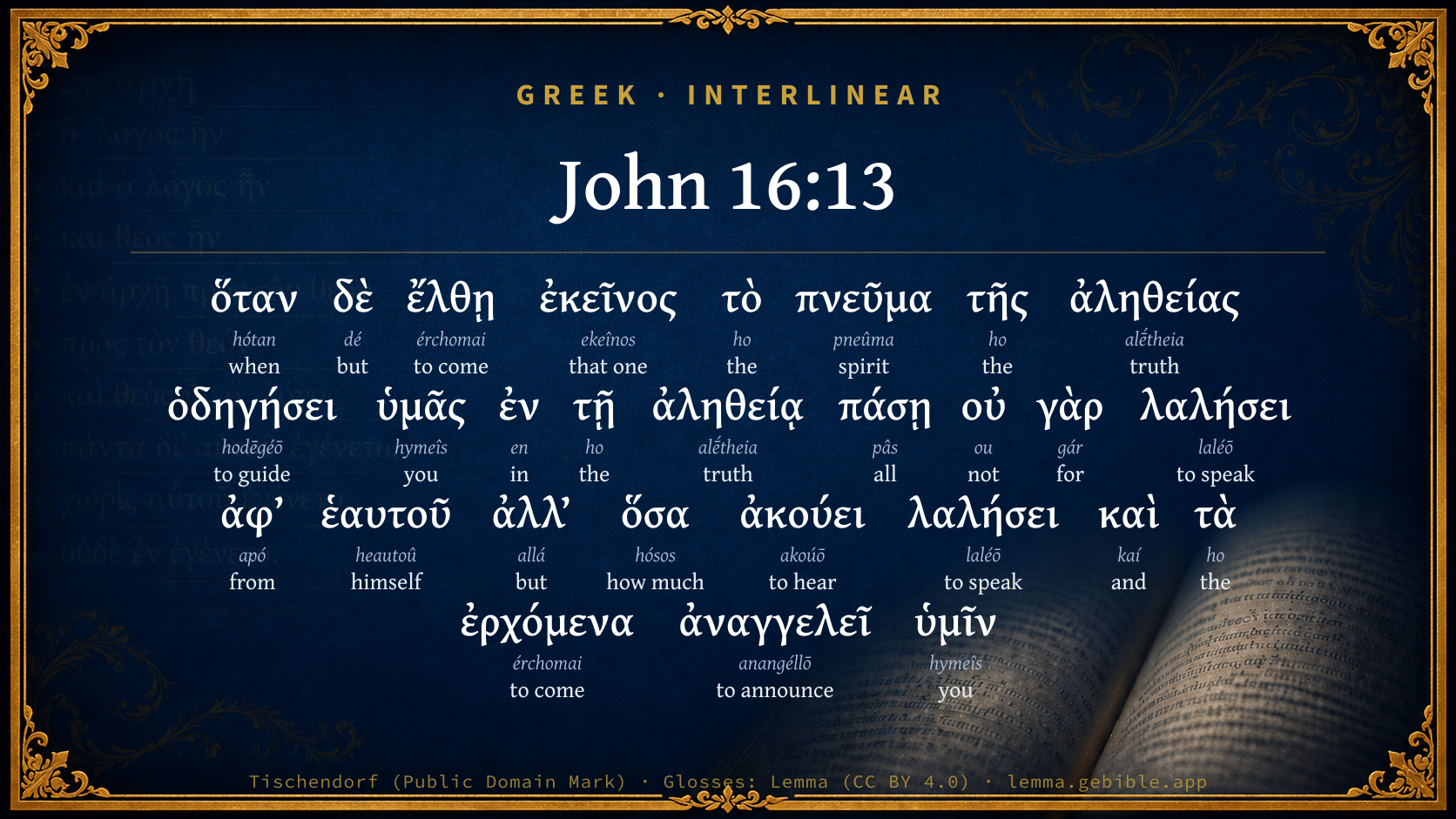
Greek (Tischendorf 8th ed.) John 16:13 appears in the Greek New Testament. The text above is from the Tischendorf 8th edition. Each word links to its Strong’s number and a concise gloss. Click any word for its full Thayer’s Greek Lexicon entry.
Download image
Cite this verse

John 16:13 (World English Bible). Public Domain. Lemma interlinear Bible study tool, https://lemma.gebible.app/v/john/16/13.

Show BibTeX & RIS
BibTeX
RIS
English Translation
However when he, the Spirit of truth, has come, he will guide you into all truth, for he will not speak from himself; but whatever he hears, he will speak. He will declare to you things that are coming.
World English Bible · Public Domain
Download a study sheet

One document with this verse’s original text, its word-by-word gloss line, the meaning frame, cross-references with their text, attributed commentary, and full source and license credits — printable, and it pastes into notes with its structure intact.

This verse Autodidact and up

Study sheet (.html) Plain text (.txt)

A passage Seminary Student

Up to 50 verses in one chapter. A passage sheet keeps up to 6 commentary sources and 12 cross-references per verse, in the order this page ranks them, and says so on the sheet whenever that leaves anything out. Ask for a single verse and you get the Autodidact verse sheet above.

Everything on this page stays free to read, with no account — the sheet is a download of what is already on screen, not access to it.

Want to remove ads? Support Godless Engineer
Compare translations 3

The same verse in 3 English versions, stacked beneath the original-language interlinear above. Click any original word for its lexicon entry.

Each is an independent rendering of the whole verse — the interlinear is not word-aligned to these translations.

Highlighted words mark where these versions differ — a whole-verse word diff, not a word-by-word alignment.

  • World English Bible Public Domain
    However when he, the Spirit of truth, has come, he will guide you into all truth, for he will not speak from himself; but whatever he hears, he will speak. He will declare to you things that are coming.
  • King James Version Public Domain
    Howbeit when he, the Spirit of truth, is come, he will guide you into all truth: for he shall not speak of himself; but whatsoever he shall hear, that shall he speak: and he will shew you things to come.
  • unfoldingWord Literal Text CC BY-SA 4.0
    But when that one, the Spirit of Truth, comes, he will guide you into the whole truth, for he will not speak from himself, but he will say whatever he will hear, and he will announce to you the things coming.

unfoldingWord Literal Text — © unfoldingWord, licensed CC BY-SA 4.0. Word-aligned USFM3 via Door43 (git.door43.org/unfoldingWord/en_ult).

Versions to compare (up to 4)

3 of 4 selected

Show all 19 translations

Every available English version of this verse, each an independent rendering of the whole verse.

  • World English Bible Public Domain
    However when he, the Spirit of truth, has come, he will guide you into all truth, for he will not speak from himself; but whatever he hears, he will speak. He will declare to you things that are coming.
  • Berean Standard Bible Public Domain
    However, when the Spirit of truth comes, He will guide you into all truth. For He will not speak on His own, but He will speak what He hears, and He will declare to you what is to come.
  • Majority Standard Bible Public Domain
    However, when the Spirit of truth comes, He will guide you into all truth. For He will not speak on His own, but He will speak what He hears, and He will declare to you what is to come.
  • King James Version Public Domain
    Howbeit when he, the Spirit of truth, is come, he will guide you into all truth: for he shall not speak of himself; but whatsoever he shall hear, that shall he speak: and he will shew you things to come.
  • American Standard Version (1901) Public Domain
    Howbeit when he, the Spirit of truth, is come, he shall guide you into all the truth: for he shall not speak from himself; but what things soever he shall hear, `these' shall he speak: and he shall declare unto you the things that are to come.
  • Revised Version (1885) Public Domain
    Howbeit when he, the Spirit of truth, is come, he shall guide you into all the truth: for he shall not speak from himself; but what things soever he shall hear, these shall he speak: and he shall declare unto you the things that are to come.
  • Geneva Bible (1599) Public Domain
    Howbeit, when he is come which is the Spirit of trueth, he will leade you into all trueth: for he shall not speake of himselfe, but whatsoeuer he shall heare, shall he speake, and he will shew you the things to come.
  • Douay-Rheims (1899) Public Domain
    But when he, the Spirit of truth, is come, he will teach you all truth. For he shall not speak of himself; but what things soever he shall hear, he shall speak; and the things that are to come, he shall shew you.
  • Young's Literal Translation Public Domain
    and when He may come -- the Spirit of truth -- He will guide you to all the truth, for He will not speak from Himself, but as many things as He will hear He will speak, and the coming things He will tell you;
  • Literal Standard Version CC BY-SA 4.0
    and when He may come—the Spirit of truth—He will guide you to all the truth, for He will not speak from Himself, but as many things as He will hear He will speak, and the coming things He will tell you;
  • Unlocked Literal Bible CC BY-SA 4.0
    But when he, the Spirit of Truth, comes, he will guide you into all the truth, for he will not speak from himself. But he will say whatever he hears, and he will tell you things that are to come.
  • unfoldingWord Literal Text CC BY-SA 4.0
    But when that one, the Spirit of Truth, comes, he will guide you into the whole truth, for he will not speak from himself, but he will say whatever he will hear, and he will announce to you the things coming.
  • Darby Bible Public Domain
    But when *he* is come, the Spirit of truth, he shall guide you into all the truth: for he shall not speak from himself; but whatsoever he shall hear he shall speak; and he will announce to you what is coming.
  • World Messianic Bible Public Domain
    However, when he, the Spirit of truth, has come, he will guide you into all truth, for he will not speak from himself; but whatever he hears, he will speak. He will declare to you things that are coming.
  • Webster's Bible Public Domain
    But, when he, the Spirit of truth is come, he will guide you into all the truth: for he will not speak from himself; but whatever he shall hear, that will he speak: and he will show you things to come.
  • Free Bible Version CC BY-SA 4.0
    However, when the Spirit of truth comes, he will teach you the whole truth. He doesn't speak for himself, but he only says what he hears, and he will tell you what's going to happen.
  • Bible in Basic English Public Domain
    However, when he, the Spirit of true knowledge, has come, he will be your guide into all true knowledge: for his words will not come from himself, but whatever has come to his hearing, that he will say: and he will make clear to you the things to come.
  • Text-Critical English NT CC BY 4.0
    When the Spirit of truth comes, he will guide you into all truth, for he will not speak on his own authority, but whatever he hears he will speak, and he will declare to you what is to come.
  • Tyndale New Testament (1534) Public Domain
    How be it when he is come (I meane the sprete of truthe) he will leade yon into all trueth. He shall not speake of him selfe: but whatsoever he shall heare that shall he speake and he will shewe you thinges to come.

Literal Standard Version (2020), Covenant Press — licensed CC BY-SA 4.0. Text via the HelloAO Bible API (eBible.org). Unlocked Literal Bible (unfoldingWord) — licensed CC BY-SA 4.0. Text via the HelloAO Bible API (eBible.org). unfoldingWord Literal Text — © unfoldingWord, licensed CC BY-SA 4.0. Word-aligned USFM3 via Door43 (git.door43.org/unfoldingWord/en_ult). Free Bible Version, Dr. Jonathan Gallagher — licensed CC BY-SA 4.0. Text via the HelloAO Bible API (eBible.org).

Word by word

More ways to search: Search by grammar → Find every occurrence → Compare this word →

Practice this passage: Drill this verse → Learn its vocabulary →

ὁδηγήσει
hodēgéō
G3594
“to guide”
Verb, Future, Active, Indicative, 3rd person, Singular
Part of Speech
Verb
Tense
Future
Voice
Active
Mood
Indicative
Person
3rd person
Number
Singular
Full Thayer's Definition

Origin: from G3595

TDNT: 06:37,7

1. to be a guide, lead on one's way, to guide 2. to be a guide or a teacher a. to give guidance to
  1. ὅταν hótan G3752 “when” Conjunction
  2. δὲ dé G1161 “but” Conjunction
  3. ἔλθῃ érchomai G2064 “to come” Verb, Aorist, Active, Subjunctive, 3rd person, Singular
  4. ἐκεῖνος ekeînos G1565 “that one” Demonstrative pronoun, Nominative, Singular, Masculine
  5. τὸ ho G3588 “the” Article, Nominative, Singular, Neuter
  6. πνεῦμα pneûma G4151 “spirit” Noun, Nominative, Singular, Neuter
  7. τῆς ho G3588 “the” Article, Genitive, Singular, Feminine
  8. ἀληθείας alḗtheia G225 “truth” Noun, Genitive, Singular, Feminine
  9. ὑμᾶς hymeîs G5210 “you” Personal pronoun, 2nd person, Accusative, Plural
  10. ἐν en G1722 “in” Preposition
  11. τῇ ho G3588 “the” Article, Dative, Singular, Feminine
  12. ἀληθείᾳ alḗtheia G225 “truth” Noun, Dative, Singular, Feminine
  13. πάσῃ pâs G3956 “all” Adjective, Dative, Singular, Feminine
  14. οὐ ou G3756 “not” Particle, Negative
  15. γὰρ gár G1063 “for” Conjunction
  16. λαλήσει laléō G2980 “to speak” Verb, Future, Active, Indicative, 3rd person, Singular
  17. ἀφ’ apó G575 “from” Preposition
  18. ἑαυτοῦ heautoû G1438 “himself” Reflexive pronoun, 3rd person, Genitive, Singular, Masculine
  19. ἀλλ’ allá G235 “but” Conjunction
  20. ὅσα hósos G3745 “how much” Correlative pronoun, Accusative, Plural, Neuter
  21. ἀκούει akoúō G191 “to hear” Verb, Present, Active, Indicative, 3rd person, Singular
  22. λαλήσει laléō G2980 “to speak” Verb, Future, Active, Indicative, 3rd person, Singular
  23. καὶ kaí G2532 “and” Conjunction
  24. τὰ ho G3588 “the” Article, Accusative, Plural, Neuter
  25. ἐρχόμενα érchomai G2064 “to come” Verb, Present, Middle or Passive deponent, Participle, Accusative, Plural, Neuter
  26. ἀναγγελεῖ anangéllō G312 “to announce” Verb, Future, Active, Indicative, 3rd person, Singular
  27. ὑμῖν hymeîs G5210 “you” Personal pronoun, 2nd person, Dative, Plural

About this verse

These counts appear in no published source. They are computed here, from the morphology-tagged text and Lemma’s own curated glosses. What Lemma adds →

28
words
21
distinct lemmas
Gospels
section

Notable vocabulary

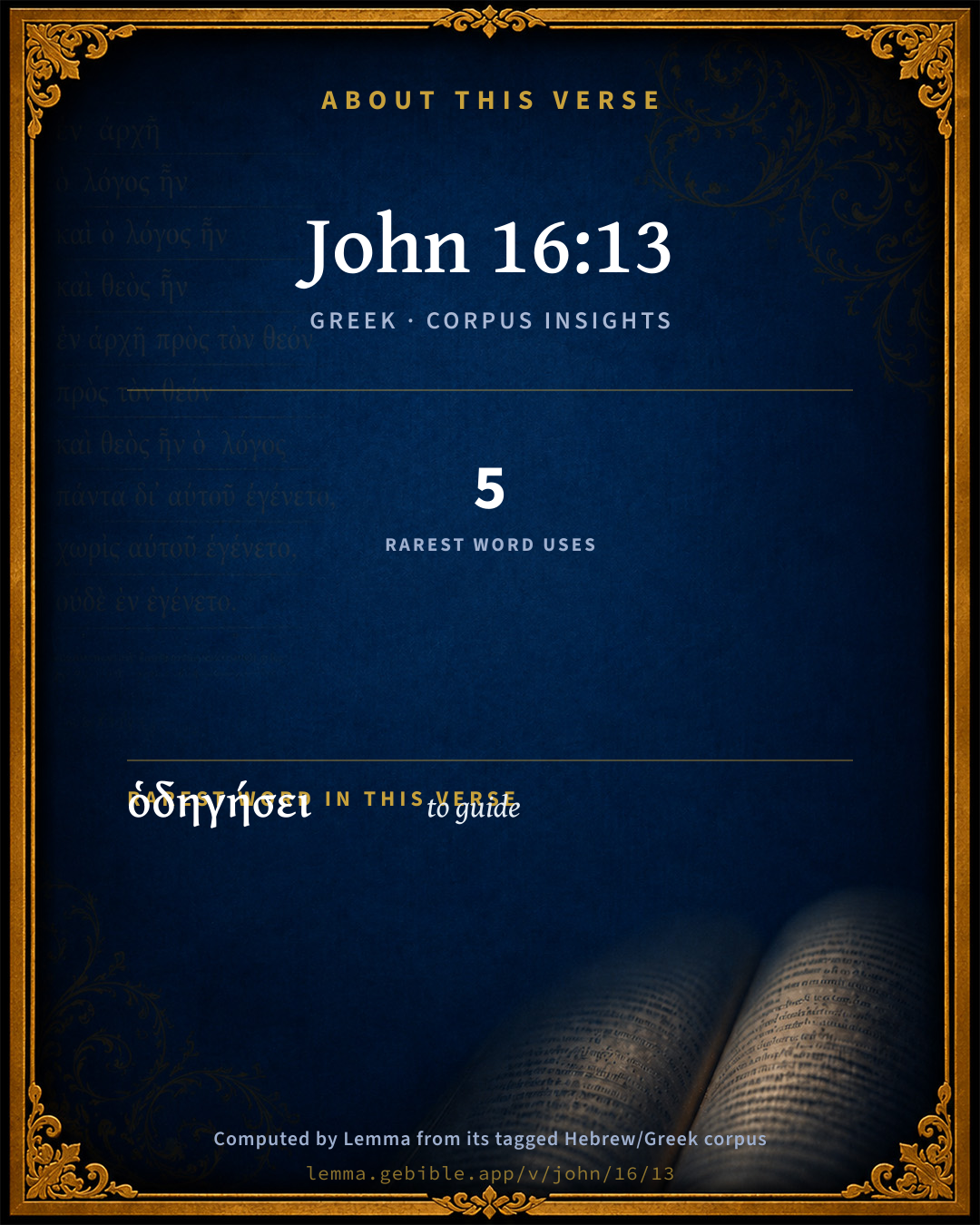
The rarest word here is ὁδηγήσει to guide G3594 — appearing just 5 times in the whole Greek New Testament.

Shared distinctive vocabulary

ὁδηγήσει to guide G3594 occurs in 5 verses of the Greek New Testament. Also found in:

Repetition

Words recur within this verse:

  • ἔλθῃ to come G2064 ×2
  • ἀληθείας truth G225 ×2
  • λαλήσει to speak G2980 ×2
  • τὸ the G3588 ×4
  • ὑμᾶς you G5210 ×2

Cross-references

28

Topical passages linked to John 16:13 in the Treasury of Scripture Knowledge — connected by theme and wording, ordered by reader-vote popularity; previews shown in the World English Bible.

  • John 14:26 But the Counselor, the Holy Spirit, whom the Father will send in my name, he will teach you all things, and will remind you of all that I said to you.
  • 1 Corinthians 2:10–13 But to us, God revealed them through the Spirit. For the Spirit searches all things, yes, the deep things of God.
  • John 14:17 the Spirit of truth, whom the world can't receive; for it doesn't see him, neither knows him. You know him, for he lives with you, and will be in you.
  • John 15:26 "When the Counselor has come, whom I will send to you from the Father, the Spirit of truth, who proceeds from the Father, he will testify about me.
  • 1 John 2:27 As for you, the anointing which you received from him remains in you, and you don't need for anyone to teach you. But as his anointing teaches you concerning all things, and is true, and is no lie, and even as it taught you, you will remain in him.
  • 1 John 2:20 You have an anointing from the Holy One, and you know the truth.
  • Acts 2:17–18 'It will be in the last days, says God, That I will pour out my Spirit on all flesh. Your sons and your daughters will prophesy. Your young men will see visions. Your old men will dream dreams.
  • John 12:49 For I spoke not from myself, but the Father who sent me, he gave me a commandment, what I should say, and what I should speak.
  • John 7:16–18 Jesus therefore answered them, "My teaching is not mine, but his who sent me.
  • 1 John 4:6 We are of God. He who knows God listens to us. He who is not of God doesn't listen to us. By this we know the spirit of truth, and the spirit of error.
  • 2 Timothy 3:1–5 But know this, that in the last days, grievous times will come.
  • John 14:6 Jesus said to him, "I am the way, the truth, and the life. No one comes to the Father, except through me.
  • 1 Timothy 4:1–3 But the Spirit says expressly that in later times some will fall away from the faith, paying attention to seducing spirits and doctrines of demons,
  • John 8:38 I say the things which I have seen with my Father; and you also do the things which you have seen with your father."
  • Revelation 1:19 Write therefore the things which you have seen, and the things which are, and the things which will happen hereafter;
  • 2 Thessalonians 2:3 Let no one deceive you in any way. For it will not be, unless the departure comes first, and the man of sin is revealed, the son of destruction,
  • Revelation 22:1–21 He showed me a river of water of life, clear as crystal, proceeding out of the throne of God and of the Lamb,
  • Revelation 1:1 This is the Revelation of Jesus Christ, which God gave him to show to his servants the things which must happen soon, which he sent and made known by his angel to his servant, John,
  • Joel 2:28 "It will happen afterward, that I will pour out my Spirit on all flesh; And your sons and your daughters will prophesy. Your old men will dream dreams. Your young men will see visions.
  • Acts 27:24 saying, 'Don't be afraid, Paul. You must stand before Caesar. Behold, God has granted you all those who sail with you.'
  • 2 Thessalonians 2:12 that they all might be judged who didn't believe the truth, but had pleasure in unrighteousness.
  • Acts 21:9–11 Now this man had four virgin daughters who prophesied.
  • John 3:32 What he has seen and heard, of that he testifies; and no one receives his witness.
  • Acts 20:23 except that the Holy Spirit testifies in every city, saying that bonds and afflictions wait for me.
  • Ephesians 4:7–15 But to each one of us was the grace given according to the measure of the gift of Christ.
  • Acts 11:28 One of them named Agabus stood up, and indicated by the Spirit that there should be a great famine all over the world, which also happened in the days of Claudius.
  • 2 Peter 2:1–22 But there also arose false prophets among the people, as among you also there will be false teachers, who will secretly bring in destructive heresies, denying even the Master who bought them, bringing on themselves swift destruction.
  • Revelation 6:1–17 I saw that the Lamb opened one of the seven seals, and I heard one of the four living creatures saying, as with a voice of thunder, "Come and see!"

Cross-references courtesy of OpenBible.info (CC BY 4.0).

Commentary

Notes on John 16:13 from classic Christian and Jewish commentators (each source and its license shown beneath its notes). The classic Christian expositions comment on the surrounding passage and are grouped to its opening verse, so a note may address several verses; the Jewish commentaries on the Tanakh (Rashi and others) are per-verse, so they appear only where the commentator wrote on this verse.

Lemma curates 59 commentaries, every one of them public domain or Creative Commons licensed, each selected and text-cleaned for this edition rather than reprinted as found. About our sources →

The Biblical Illustrator

Joseph S. Exell

Joh_16:13

When He, the Spirit of Truth, is come

The Spirit of Truth

What is meant by all truth?

It is better to take for granted that the Bible always means what it says--all the truth of nature as well as of the gospel, of science as well as of religion. Aholiab was, doubtless, a skilled mechanic before the effusion of the Spirit; but after he became the best carpenter of the nation. So with Bezaleel. I am glad to acknowledge that the great thinkers of the world have not been wholly unguided by the Holy Ghost. Great discoverers are almost invariably devout: Pythagoras, Socrates, and Plato--Kepler, Newton, and Faraday.

Even nature confides her secrets to none except to men of deep piety. Tyndall and Huxley are very brilliant; but they have not yet established their right to be classed with the great. The truth which makes for our salvation is here mainly intended. Note, the Spirit guides into all truth

I. IN RESPECT OF REVELATION. This means that the Spirit will

1. Speak nothing but the truth, for He shall not speak from Himself, &c. This is the Saviours infallible proof of the trustworthiness of His own teaching, and urges the same in support of the infallibility of the Spirits illumination. If you hear any one speaking from himself, boasting much in his originality, you may rest assured that his discovery will turn out to be shallow and worthless. For truth is not a thing that comes from, but to, man. He never strikes it--it always strikes him. Accordingly, great discoverers never claim much credit. I am but a child, said Newton, gathering pebbles on the shore of the great sea of truth. He felt that all the credit due to him was that of seeing the pebbles--the credit of making them belonged to another. You cannot originate truth--only discover it; you cannot make it--only see it. If you make it, it is no longer truth, but a lie. Wherefore it is averred of the evil spirit that he speaketh of his own, and therefore of necessity speaketh a lie. But whatsoever the Spirit heareth in the exalted fellowship of the Trinity in Unity, that speaketh He.

2. Inspire the truth already extant in the world, and only waiting the breath of inspiration to quicken it. True holy men of God spake as they were moved by the Holy Ghost, but every Scripture is God-inspired. Not only the writers, but their writings, are all alive with the breath of God. God breathed into it the breath of life, and the Bible became a living book. The inspired men are dead, but the inspired truths are living. They are warm now with the breath of the Eternal. One of the rare excellencies of the Bible is its warmth. Its temperature is many degrees higher than that of any other book. Whereas the same truths in other religions and philosophies sink down to freezing-point, in Christianity they invariably rise to blood-heat. Here are two bars of steel. They are precisely of the same make, shape, weight, size. But put them on the ground near a heap of rubbish, and the difference will be manifest. Whilst one lies inert, the other exerts a potent influence on the whole mass, disturbing the needles and nails and iron filings. What is the matter? One has been magnetized. And here are two truths, one in heathen philosophy, the other in the gospel. They are as similar as two truths can be. But the truth as contained in

Greek or Chinese philosophy lies barren and inoperative; but the same truth as uttered by Jesus Christ enters as a living quickening force into human life. In Christianity it has been magnetized, inspired.

3. Revealed new truths. Eye hath not seen, &c. The truths of nature are only His surface thoughts, and therefore within the range of created intellects. But the truths of the gospel are His deep things, too deep for human reason ever to fathom, but which, nevertheless, God has shown to us by His Spirit. In the context the things of God are called the things of Jesus Christ. As Columbus took possession of the continent of America in the name of Christ, so Christ took possession of the continent of truth in His own name--He has stamped on every truth His own private mark. This is the final test whether any doctrine be of the inspiration of the Spirit. Does it glorify Christ? Many teachers went out in the apostolic age claiming to be Divinely commissioned; but this was the test whereby the spirits were tried. Many novel doctrines are promulgated to-day, labelled with the names of able and scholarly men. Do they glorify Christ? If not, beware of them. What do you think of Ecce Homo? asked a lady once of Professor Duncan. What does Ecce Homo think of Christ? asked the old Rabbi back. I cannot tell; that it is which puzzles me, answered the lady. Well, deliberately answered the sick professor, if any book, after a careful perusal of it, leaves you in doubt what it thinks and what you ought to think about Christ, there is something radically wrong in it. Every sound book, doctrine, sermon, glorifies Christ.

II. IN RESPECT OF EXPOSITION.

1. The nature of the Spirits influence.

(1) Guide; not only to show the road, but travel along it. To direct strangers in a strange country is much; to accompany them till they reach their destination is more. Thus the Holy Spirit takes us by the hand, as it were, and leads us to a reasonable apprehension of the great doctrines of salvation. This partly indicates the difference between the influence of the Spirit under the Old Testament and under the New. Then He moved. The prophets were borne along before the breath of the Spirit, like ships before the wind, a force outside them and behind them driving them irresistibly along. The Spirit sometimes fell suddenly upon them, and sometimes left them quite as suddenly; but in either case they were thrown half dead on the ground. But guide denotes steady, constant, uniform influence.

(2) And He will guide you, not to, but into. You cannot properly judge truth except from within. Go and examine a coloured window. From without it looks a mixed, unmeaning, vulgar blotch of paint. But enter the cathedral, look upon it between you and the light, and it is gloriously transfigured. Similarly the fundamental truths of the gospel, such as the atonement and justification, are unto the Jews a stumbling-block, &c. But study them from within, look at them between you and the light of God and the eternal judgment, and they become the power of God and the wisdom of God.

2. The subjects of His guidance. You, not the apostles only. The Spirit influences the mental movements of the weakest saint. The Spirit mysteriously invigorates the mind. The unction from the Holy One oils the wheels marvellously. Look at Saul, the son of Kish, and Peter. This, however, does not mean the total extinction of all differences between believers in their scholastic attainments; but it does mean the abolition of all difference in their spiritual apprehension of the saving truths of the gospel. Long sight has no advantage over short sight in examining the heavens. Both can see the sun, neither can see behind and beyond. The dullest, obtusest believer sees as far as the Sun of Righteousness, and your most learned occupants of professorial chairs cannot see an inch behind and beyond.

3. The scope of the Spirits influence. All, not into some, but into all. Not at once, for guidance is a gradual process.

(1) The history of doctrine is none other than the history of the Divine guidance of the Church into the truth. He guided the Church fathers into the truth concerning the Person of Christ; the Reformers into the truth of justification; the Puritans and Methodists into the doctrine of regeneration. Well, has the Bible been exhausted? Oh no; other truths remain to reward the patient and prayerful study of generations to come. The Spirit guides as fast as the body of the Church can follow, and will not desist till every chapter of the Bible has been emptied of its contents. God has much light to break out of the Bible yet. There are more acorns in Bashan than oaks, and there are more seeds of truth in the words of Christ than have yet developed into doctrines. If that be the case, you ask, What shall we do with the creeds, the confessions, and standards of faith? We shall respect the old, and, if need arise, make new ones. Creeds are not intended to shut out new truths, but to shut in old. Creeds do not set limits to faith, only to unbelief. Creeds are not hindrances to progress, but to retrogression, and so lose the ground it has gained through much agony of thought and prayer. They do not tie down the mind and impede its flight upwards; they tie up the mind and stop its flight downward. What minds have soared higher than those who think it no degradation and no bondage to subscribe to the hoary creeds of Christendom? Creeds are the garners where the Church lays by its ripe truths for the support and comfort of its children in years to come. But because we store the ripe fruit, does that make us negligent of the orchard? Let the history of the Church answer.

(2) You are welcome to go out on voyages of discovery to find out new islands or continents of truth. Only remember the condition--under the guidance of the Holy Ghost. No prophecy of the Scripture is of any private interpretation; and a good reason why, Prophecy came not in old time by the will of man. The Spirit, who inspired the Bible, He only can adequately interpret it. But what about the right of private judgment? I have profound respect for that when it is a holy judgment, under the guidance of the Holy Ghost. But I have not confidence in it when it is a depraved judgment, under the dominion of the evil spirit. The other evening I visited the Houses of Parliament, and observed that a soft, pure light was shed down on the floor from above the ceiling. I could see the light, but not the flame. Methought the Scriptures were illuminated in the same manner, from above the ceiling; the source of the light is in God, not in man. Let us, then, seek that illumination. We study human commentaries, but let us not forget the commentary of the Holy Ghost. When the Council of Trent sat, when an embarrassing question arose, the ecclesiastics submitted the points in dispute to the final arbitrament of the pope and cardinals. In due time the answer returned, prefaced with It seemeth good to the Holy Ghost and to us. This happened so frequently that it passed into a proverb that the Holy Ghost was being sent in the popes portmanteau. But we need not send to Rome to learn the mind of the Spirit, for He dwelleth with you, and shall be in you.

(3) This is the Protestant counterpart to the Romish doctrine of the infallibility of the pope. He will guide you infallibly; but it is another question if you will follow infallibly. But wait awhile. The Bible is an infallible book; the Spirit is an infallible interpreter; and between them both men will grow infallible by and by.

III. IN RESPECT OF APPLICATION. This suggests that the Spirit

1. Whets the truth, puts edge on the ministry of the Word. My speech and my preaching was not with enticing words, &c. Now when they heard this, they were pricked in their hearts, &c. Not tickled, amused, entertained, but pierced through. The sermons men like are refined, polished, full of flowers. But read Peters sermon on the day of Pentecost; it bristles like a hawthorn bush. The great need of the modern pulpit is sermons with fewer flowers and sharper pricks.

2. Imparts warmth to the ministry. He will baptize you with the Holy Ghost and with fire. Warmth is an essential element in the Scriptures; it is an essential element in the ministry. The chief difference between genius and talent seems to me to consist, not in the amount of light, but in the amount of heat; not in the knowledge, but in the fire. The erudition of Ben Jonson was profounder than that of Shakespeare; the knowledge of Whewell was more extensive than that of Carlyle; the information of many a Scott was more capacious than that of Robert Burns. Where, then, was the genius? Not in the knowledge, but in the fire. (J. C. Jones, D. D.)

The Spirit of Truth

The Holy Spirit, who was given for the reproof and conviction of the world, was given also for the enlightenment and edification of the Church.

I. THE DESIGNATION OF THE HOLY GHOST. The Father is the absolute Truth, the one eternal source of all truth. The Divine Son reveals, embodies, and bears witness to the truth. But the Spirit, coming into contact with souls, brings the truth home to them with power.

II. HIS COMING. Whilst believing in the eternal existence and activity of the Third Person in the Trinity, Christians apprehend what has been called the temporal mission of the Comforter. As there was a time for the advent of the Son, so was there a time for the full gift of the Spirit, viz., when the full truth had been revealed in Christ. The Spirit came conspicuously on the Day of Pentecost to remain for ever.

III. HIS OFFICE.

1. Generally--to lead Christians, not into every kind of truth, but the truth as in Jesus. As a master leads a pupil through a picture gallery, as a tutor leads a scholar through a science or a language, so does the Spirit lead us through the realm of spiritual truth.

2. Specially--to reveal what is Christs to His people: He shall take of Mine. Not only did He inspire apostles to record the facts of Christs ministry, and to expound the doctrines growing out of those facts, but He enables every Christian to realize and appropriate the blessings Christ brings to man.

3. Prophetically to unfold things to come. Thus to Peter was unfolded the mystery of the inclusion of the Gentiles in the fold; to Paul the doctrine of the resurrection; to John the glories of the eternal future.

IV. HIS END AND AIM. The glory of Christ, as secured by the achievement of the purposes of our Saviours ministry, and as manifested by the praise and fame accruing to Him both on earth and in heaven. (Family Churchman.)

Divine guidance

I. OUR CIRCUMSTANCES AS NEEDING A GUIDE.

1. Our entire ignorance of our journey. There is not a man in the world that knows anything of the way to happiness or heaven without this Spirit.

2. Our frowardness. We are rash and heady and obstinate. We rush on heedless of consequences. We hit on some one path or other, and it is sure to be a wrong one; but onward we go. Many tell us that it leads to death, and many times we are told so, but on we go. We therefore need a guide.

3. Our pride. We are by nature full of self-consequence. We think we know the way. If any tell us of it, we soon reply, We know these things as well as you. We have not lived so long in the world for nothing. We do not want your teaching, &c. Such never ask for wisdom, lest they should by that request confess their ignorance. We therefore need a guide.

II. THE EXCELLENCIES OF THE GUIDE HERE PROMISED US.

1. He has perfect knowledge of the way. A blind guide will be no guide. We should discard such, should they offer to conduct. This Guide knows the way, every step of the way; knows all truth, and where truth leads.

2. He is faithful. This is essential in a guide. If we trust to a guide we give up ourselves to his care.

3. He is condescending and familiar. This in a guide will make him a pleasant companion. A guide that will describe the surrounding scenery, and lead us into a knowledge of objects as we pass, will endear him and make our journeying easy. This Spirit is a Guide that stoops to converse with us by the way. Sometimes He tells us some sweet truths, as the

Fathers everlasting love, the Saviours finished work. Sometimes He shows some instructive objects. Look yonder, do you see that pillar? That is Lots wife: she left Sodom, and left all her furniture behind, and, against the command of God, she turned her head to look as if she hankered after that she left behind, and the Lord turned her into a pillar of salt. Look, there is Demas, who, having loved this present evil world, has left Paul and the gospel that he might embrace it. See, yonder is the place of skulls; that is Golgotha, where Christ fought with principalities and powers, and overcame, having destroyed Death.

III. THE EXECUTION OF HIS WORK. He shall guide you into all truth; wherein we have three particulars to open.

1. The way in which the Spirit leads. That way is the way of truth. Respecting this way of truth there are these particulars which commend it. Gospel truth is a pleasant way to walk in (Pro_3:17). There is nothing in this way to grieve or distress: its prospects are all good; it holds up to view a God reconciled in Christ. There is no pleasure equal to that which is found in walking in this way. True it is that Christians are not always happy, but that is not from any gloominess in the path of gospel grace. They step aside or walk carelessly, and so lose their comfort. Gospel truth is also a peaceful way to walk in: her paths are peace. Gospel truth, again, is a straight and even way to walk in. Gospel truth is a free way to walk in. Whosoever will may walk there. Gospel truth, in which the Spirit leads, is also a near way to walk in. We often choose the nearest way. It is but a step from misery to mercy, from nature to grace, from a fallen, ruined condition to a state of acceptance with God. Gospel truth, in fine, is a permanent way to walk in. There will never be another.

2. But where does the way of truth lead? We often ask where this or that pathway leads; in what direction or to what place. This leads to three places. To the Christ of God, the truth as it is in Jesus; truth centres in Him. This way leads to His person, fulness, work, love, and salvation. To the throne of grace. Truth tends that way. He that follows the word will call upon God. To the heavenly glory. Truth reveals heaven with all its glory, and shows itself the way.

3. How this Spirit, as a guide, leads in the way of truth. By putting us into the way. By nature we are all out of the way. By keeping us in the way when in. We are prone to wander. Did this Guide leave us we should soon leave the way. By upholding in the way. We are in danger of falling. By bringing us to our journeys end. He shall abide with you for ever. And for what but for this very purpose, to perfect that which concerneth us? Give up the soul to this Guide. (The Evangelist.)

The Spirit of Truth

This appellation teaches that He is the soul of truth, the life inside the truth, the sap within the gospel doctrines, keeping them fresh and green. But for the Spirit as a circulating, vitalizing sap within them, they would all shrivel up; the tree of life would wither and die, and its leaves would all drop to the ground. Examine the truths contained in other religions--how withered and dry they look. Examine the same truths in the religion of Christ--they throb with life and are clothed with verdure. (J. C. Jones, D. D.)

The Holy Spirit our Guide

People making the journey from earth to heaven need a guide. This they have in the Holy Spirit.

I. THIS PROMISE WAS MADE TO THE APOSTLES TO QUALIFY THEM FOR THEIR OFFICE. It included

1. The coming of the Spirit at a set time.

2. To guide them into all truth.

3. To show them things to come.

II. THIS PROMISE WAS FULFILLED

1. In the Pentecostal baptism.

2. In their preaching the risen Saviour.

3. In their founding the Christian Church.

4. In their writing the New Testament.

III. THIS PROMISE EXTENDS TO US.

1. In our reading the Bible.

2. In our understanding its truths.

3. In our living a life in conformity therewith.

IV. INFERENCES.

1. We have the power to accept or to reject the Holy Spirit as our Guide.

2. If we reject Him He will reprove us of sin, of righteousness, and of judgment.

3. If we accept Him He will dwell in us that we may know the things that are freely given us of God (1Co_2:9-16). (L. O.Thompson.)

The Spirit guiding into all truth

Truth may be compared to some cave or grotto, with wondrous stalactites hanging from the roof, and others starting from the floor; a cavern glittering with spar and abounding in marvels. Before entering the cavern you inquire for a guide, who comes with his lighted flambeau. He conducts you down to a considerable depth, and you find yourself in the midst of the cave. He leads you through different chambers. Here he points you to a little stream rushing from amid the rocks, and indicates its rise and progress; there he points to some peculiar rock and tells you its name, then takes you into a large natural hall, tells you how many persons once feasted in it, and so on. Truth is a grand series of caverns, it is our glory to have so great and wise a Conductor as the Holy Spirit. Imagine that we are coming to the darkness of it. He is a light shining in the midst of us to guide us. And by the light He shows us wondrous things. He teaches us by suggestion, direction, and illumination. (C. H.Spurgeon.)

The progressive revelation of truth by the Spirit

In theology, as in every other department of human knowledge, there is a law of progress. Truths which in one age are almost latent, or recognized simply and insulatedly by faith, on the authority of a positive declaration, are brought out more distinctly by subsequent ages, and ranged in their mutual connection--in their position as parts of the system of truth. Not, however, that this progress is always an advance along the line of truth in theology any more than in other sciences. Mans path bends aside, winds, twists, seems almost to return up on itself. His orbit has its aphelia as well as its perihelia. When he has made a lodgment in a new field of knowledge, he will set about building a tower, the top of which, he fancies, shall reach to heaven; and generations, it may be, will spend their lives in working at such a tower (e.g., the schoolmen)

, until the Spirit of division and confusion comes down among the workmen. Thus, one system after another has passed away, each, however, leaving behind some contribution greater or less, to the general stock of theological truth. Meanwhile, Gods word stands fast, even as the heavens and the earth. To the words of Scripture we cannot add; nor may we take away from them. But truth is set before us livingly, by examples, by principles, in the germ, not by the enunciation of a formal dogmatic system, according to which the thoughts of men were to be classed and rubricated for ever after; nor can any human scheme or system make out a title to the possession of such an absolute conclusive ultimatum. The right theory of development by no means implies that each later age must necessarily have a fuller and deeper knowledge of Divine things than its predecessors, the very reverse having notoriously been often the case. For the world is ever wrestling to draw man away from the truth, and will often prevail, as Jacob did over the angel; and when faith is at a low ebb, when the visible and material predominate in mens hearts and minds over the invisible, the ideal, the spiritual theology, must needs dwindle and decay. But when there is a revival of faith, if this revival coincides with, or is succeeded by a period of energetic thought, a deeper or clearer insight will be gained into certain portions of truth, especially appropriate to the circumstances and exigencies of the age, and which have not yet been set forth in their fulness--the true doctrine of the Trinity, e.g., in the fourth century, and that of justification in the sixteenth. (Archdeacon Hare.)

The Holy Ghost the Great Teacher

Here is

I. AN ATTAINMENT MENTIONED--knowledge of all truth.

1. Nature itself gives us a strong desire to know all truth. What we call curiosity is something given us of God impelling us to search into the knowledge of natural things; that curiosity, sanctified by the Spirit, is also brought to bear in matters of heavenly science. A true Christian is always searching the Scripture that he may be able to certify himself as to its main and cardinal truths.

2. A knowledge of all truth is very essential for our comfort. Many persons have been distressed half their lives from the fact that they had not clear views of truth. Many souls--e.g., under conviction--abide in sorrow because they have no one to instruct them about justification. Give me the congregation whose faces are bright with joy at the sound of the gospel, then will I believe that it is Gods own words they are receiving.

3. This knowledge will keep us out of danger. No doctrine is so calculated to preserve a man from sin as the doctrine of the grace of God. Those who call it a licentious doctrine know nothing about it. A man cannot have an erroneous belief without by and by having an erroneous life. Keep the head right, and especially keep the heart right with regard to truth, and your feet will not go far astray.

4. This knowledge will make us useful. There will be no character, however perplexing may be its peculiar phase, but we shall be able to speak to it and comfort it. Almost every man whom God has blessed to the building up of the Church in prosperity, has been a man who has held firmly free grace through the finished salvation of Christ. The sturdy truth of God touches every chord in every mans heart.

II. A DIFFICULTY SUGGESTED. We require a guide. Truth is not so easy to discover. Why this? Because of

1. The intricacy of truth itself. Those who fancy they know everything of course see no difficulties; but the most earnest student of Scripture will find things which puzzle him. Truth is a path so narrow that two can scarce walk together in it; we usually tread the narrow way in single file. If you step an inch aside you are in a dangerous error. On the one hand there is a huge precipice, and on the other a deep morass; and unless you keep to the true line, to the breadth of a hair, you will go astray. Truth is like the veins of metal in a mine, it is often of excessive thinness, and runs not in one continued layer. Lose it once, and you may dig for miles and not discover it again; the eye must watch perpetually the direction of the lode. Grains of truth are like the grains of gold in the rivers of Australia, they must be shaken by the hands of patience, and washed in the stream of honesty, or the fine gold will be mingled with sand.

2. The insidiousness of error. It easily steals upon us, and we are often like men in a fog. We think, surely this is the right path; and the voice of the evil one whispers, That is the way, walk ye in it. You do so, and you find that you have been walking in the paths of unrighteousness and error. The way of life is a labyrinth; the grassiest paths and the most bewitching are the farthest away from right. There is not a counterfeit coin in the world so much like a genuine one, as some errors are like the truth.

3. We are so prone to go astray. If grace did not guide a man, he would go astray, though there were hand-posts all the way to heaven.

III. A PERSON PROVIDED.

1. Infallible. If I pin my sleeve to another mans coat, he may lead me part of the way rightly, but by and by he will go wrong himself, and I shall be led astray with him. But if I give myself to the Holy Ghost and ask His guidance, there is no fear of my wandering.

2. Ever present. When we have no commentator or minister, we have still the Holy Spirit. Whenever you cannot understand a text, pray over it, and if it does not open itself, try again. If prayer does not explain it, it is one of the things God did not intend you to know, and you may be content to be ignorant of it. There is no college for holy education like that of the blessed Spirit, for He is an ever-present tutor.

3. Guides into the truth. Now, man can guide us to a truth, but it is only the Holy Spirit who can guide us into a truth. There are many of my hearers who are brought to the truth of their depravity; but they are not brought into it, and made to feel it. Some of you are brought to know the truth that God keeps us from day to day; but you rarely get into it, so as to live in continual dependence upon God the Holy Ghost, and draw fresh supplies from Him. The thing is, to get inside it. A Christian should do with truth as a snail does with his shell, live inside it, as well as carry it on his back.

IV. A METHOD SUGGESTED. He guides us into all truth

1. By suggesting it. There are thoughts that dwell in our minds that were not born there, but which were exotics brought from heaven and put there by the Spirit. Have you not at times had unaccountably--in the middle of your business--a thought concerning God and heavenly things, and could not tell whence it came?

2. By direction, not so much putting a boat on the stream as steering it when it is there. Time after time have you commenced a meditation on a certain doctrine and, unaccountably, you were gradually led away into another, and you saw how one doctrine leaned on another, as the stones in the arch all hanging on the keystone of Jesus Christ crucified.

3. By illumination. There is nothing like reading an illuminated Bible. You may read to all eternity, and never learn anything by it, unless it is illuminated by the Spirit; and then the words shine forth like stars.

V. AN EVIDENCE. You may know the Spirits influence by

1. Its unity. The Spirit never says one thing at one time and another thing at another. It has been always held as a first principle that truth is one thing. But some persons say, I find one thing in one part of the Bible, and another thing in another, and though it contradicts itself I must believe it. All quite right, if it did contradict itself; but the fault is not in the wood but in the carpenter. Many carpenters do not understand dove-tailing; so there are many preachers who do not understand dove-tailing.

2. Its universality. The true child of God will not be led into some truth but into all truth. When first he starts he will not know half the truth, he will believe it but not understand it. Certain doctrines take years to develop themselves. (C. H. Spurgeon.)

The Heavenly Teacher

I. THE NAME HE BEARS The Spirit of truth descriptive of

1. His nature--Spirit. In this different from Christ who was God in human form.

2. His character--true. Implied in His designation--Spirit of truth.

3. His intelligence--involved in the fact that He is the possessor of truth.

4. His Divinity--if the possessor of truth He must be Divine.

II. THE SCHOLARS HE INSTRUCTS. The disciples of Christ.

1. The apostles.

2. Pastors (2Co_3:6; 2Ti_1:6; 2Ti_1:14).

3. The universal company of believers--the Spirit dwelling in them (1Co_3:16), helping their infirmities (Rom_8:26), and leading them into all the truth.

III. THE LESSONS HE IMPARTS. All the truth, not ordinary, scientific or philosophic truth, but truth

1. Heard from the Father, therefore Divine.

2. Relating to Christ, hence specifically Christian.

IV. THE AIM HE PURSUES. The glory of Christ. For this end He exhibits Christ

1. As the possessor of the truth (Joh_16:14).

2. As the substance of the truth (Joh_14:6).

3. As the end of the truth--persuading men and enabling them to rest on Christ. (T. Whitelaw, D. D.)

The necessity of the Spirits teaching to the right understanding of the Scriptures

I. THERE ARE TWO KINDS OF KNOWLEDGE--of faith, of repentance. Simon Magus believed and remained in the gall of bitterness. Paul believed and became a Christian. In both cases there was a persuasion of the truth. Simon believed when he saw miracles; Paul when Christ was revealed in him. Judas repented when he saw the evil consequences of his treachery; Peter when he saw his conduct in its true character. So there is a simple intellectual knowledge of the truth, and there is a spiritual knowledge and discernment.

II. HOW ARE THESE RELATED? How do they agree and differ? The things known and the act of knowing are the same. But the spiritual excellence of the object is not apprehended in the one case, while it is in the other. This may be illustrated by the case of the discernment of beauty. Now, with regard to the knowledge of the Scriptures, there is no reason why the unrenewed man, without any special aid of the Spirit, should not acquire that knowledge, as well as the knowledge of any similar volume under the same conditions.

1. Assiduous study.

2. In the right method and in the use of the right means.

3. Impartiality and honesty. Now, although this is possible, it is in reference to the Scriptures difficult and rare, because of the opposition of the heart to Bible doctrines, and because the judgments of men are so largely determined by their feelings. Therefore, for the attainment of this intellectual knowledge there is great need of the Spirits guidance to produce docility, and to prevent opposition to the truth blinding the mind.

III. FOR SPIRITUAL KNOWLEDGE THE CASE IS PLAIN. The Scriptures teach

1. The absolute necessity of Divine teaching. The natural man receiveth not the things of the Spirit of God, &c. The Bible abounds in prayers for Divine teaching, and Paul declares all external teaching vain without it.

2. The cause of this ignorance, blindness, and inability to know the things of God arises from two sources.

(1) Our depravity. We are natural, carnal--the opposite of the Spiritual--which we cannot, therefore, discern.

(2) The god of this world blinds the eyes. He persuades men to reject the truth, raises objections, and excites the enmity of the heart.

3. It is a solemn fact, therefore, that those only who are led by the Spirit come to a knowledge of the truth. This is His great office, must be recognized and accepted. Correct speculative knowledge and spiritual knowledge experience teaches do not admit of protracted separation. Orthodoxy will not last long without piety. An unconverted ministry forsakes the truth. (C. Hodge, D. D.)

The Biblical Illustrator, edited by Joseph S. Exell (c. 1880s–1900s) — public domain. Text from a community e-Sword module.

Tyndale Open Study Notes

Tyndale Open Resources

16:13 The Spirit of truth, who conveys truth from God, guides the judgment of the world. • The Spirit says only what he has heard from the Father. The Father, Son, and Spirit work in perfect unity (16:15). The disciples could expect the Spirit to reveal things they had not heard before about the present and the future (see 14:26).

Tyndale Open Study Notes — © Tyndale Open Resources, licensed CC BY-SA 4.0. Text via the HelloAO Bible API.

Bengel's Gnomon

Johann Albrecht Bengel

Joh 16:13. Ὁδηγήσει, He shall guide) gradually, as you shall have need.—πᾶσαν) all, not merely that, which I tell you now as suited to your present capacity, Joh 16:7; or that truth concerning which the Paraclete shall reprove the world, Joh 16:8-9; 1Jn 2:20, “Ye have an unction from the Holy One, and ye know all things;” 1Co 5:5, “In every thing ye are enriched by Him in all utterance and in all knowledge:” Joh 2:9, et seq., “Eye hath not seen, etc.; but God hath revealed them unto us by His Spirit: for the Spirit searcheth all things, yea the deep things of God.”—τὴν) The demonstrative article; all that truth which I was now “having to say to you.” The same phrase occurs in Mar 5:33, πᾶσαν τὴν ἀληθείαν, all the truth.—ἀληθείαν, truth) The Scripture is not wont to say in the Plural, ἀληθείαι, truths, ‘Truth’ is one, and a whole. The things whatsoever He shall hear and the things to come, are no doubt true things (but are not called truths in the Plural).—οὐ γὰρ λαλήσει ἀφʼ εἁυτοῦ, for He shall not speak of Himself) So also the Son speaks concerning Himself in ch. Joh 12:49, “I have not spoken of Myself, but the Father which sent Me, He gave Me a commandment, what I should say and what I should speak.” Concerning hearing, comp. ch. Joh 8:40, “A man that hath told you the truth, which I have heard of God.”—τὰ ἐρχόμενα, the things to come) These also are true; otherwise they would not come. There were then coming the Saviour’s cross, death, life, and glory. The present, things coming, is used as of things about which the prophets had foretold: Act 3:21, “The times of the restitution of all things which God hath spoken by the mouth of all His holy prophets since the world began.” The marvellous works of the Holy Spirit were already then close at hand. The Apostles foretold many things even in their Epistles, but the Apocalypse written by John is what this especially refers to.—ἀναγγελεῖ, He will announce) This is the cause why Jesus, before His passion, predicted almost nothing of the things about to be, except the first and last of them, the overthrow of Jerusalem and the last judgment. The fountain of prophetical Theology is the revelation of the Holy Spirit. Ἀναγγελεῖ, He will announce, is thrice repeated, Joh 16:13-15.

Bengel's Gnomon of the New Testament — English translation (T&T Clark, Edinburgh, 1860) — public domain. Text from a community e-Sword module.

Meyer's Critical & Exegetical Commentary

Heinrich August Wilhelm Meyer

Joh_16:13. Τὸ πν. τ. ἀλ.] See on Joh_14:17.

ὁδηγ. ὑμ. εἰς τ. ἀλ. πᾶσαν] He will be to you a guide into all the truth. Comp. Joh_16:23; πᾶσαν, according to its position after τ. ἀλ. (see critical notes), does not belong to the verb, as if it expressed the complete introduction (Lücke), but describes, as in Joh_5:22, divine truth in its entirety, according to its collective contents. Comp. Joh_5:22 : τ. κρίσιν πᾶσαν, Plat. Theaet. p. 147 E, τὸν ἀριθμὸν πάντα δίχα διελάβομεν; Krüger, § 50. 11. 11. As to the thing, πᾶσαν τὴν ἀλήθειαν, Mar_5:33 (Krüger on Thuc. vi. 87. 1), would not be different; only in the present passage, ἀλήθεια is the idea immediately prominent.

οὐ γὰρ, κ.τ.λ.] Reason, from the origin and compass of His communications.

ἀφʼ ἑαυτοῦ] αὐτοκέλευστος, ἀνήκοος, Nonnus. This negative definition is, indeed, the denial of anything conceived of after a human manner, which absolutely cannot be (spiritus enim, qui a semet ipso loquitur, non spiritus veritatis, sed spiritus est mendacii, Ruperti; comp. already Ignatius, ad Eph. interpol. 9), but serves completely to set forth the unity of the Spirits teaching with that of the Lord.[177] Comp. Joh_5:19.

ὅσα ἂν ἁκούσῃ] All, whatsoever He shall have heard from God, so that He will withhold from you nothing of that which has been divinely heard by Him.[178] The Spirit, however, hears from God not externally as a Subject separated from God, but (comp. 1Co_2:11) through an interna acceptio; for He is in God, and proceeds from Him, Joh_15:26. That the hearing from God, not from Christ (Olshausen, Kling, B. Crusius, Luthardt, Hengstenberg, Godet: from both), is meant, is to be already assumed on account of the absolute ἀκούσῃ, and Joh_16:15 renders it certain. On ἀκούσῃ itself, comp. also Luther: The faith must make its way universally over all creatures, and not cleave to thoughts of listening to bodily preaching, but lay hold of a preaching, word, and hearing in essence.

τὰ ἐρχόμενα] So that you, through the ἀποκάλυψις of the Spirit, will also become acquainted with the future (ἁ δʼ ἐρχομένα μοῖρα, Soph. Trach. 846), the knowledge of which belongs to the whole ἀλήθεια (particularly the eschatological developments). Comp. Isa_41:22-23; Isa_44:7; Isa_45:11 : τὰ ἐπερχόμενα. Further, τὰ ἐρχόμενα belongs also to that denoted by ὅσα ἂν ἀκούσῃ and is related to it as species to genus, so that καί brings into relief from that which is general, something further that is particular.

[177] Consequently He sets, for the Holy Spirit Himself, a goal and measure of His preaching, that He shall preach nothing new nor different from that which Christ and His word is, so that we may have a certain mark of truth and touchstone, to judge of false spirits, Luther.

[178] When Godet says, on ver. 13 : The word in Joh_14:26 included the formula of the inspiration of our Gospels; ver. 13 gives that of the inspiration of the Epistles and of the Apocalypse, the simple addition must be made, in so far as and to the extent in which these writings are actually apostolic.

Meyer — Critical and Exegetical Commentary on the New Testament — English translation by Peter Christie, edited by Frederick Crombie (T&T Clark, 1880) — public domain. Text from a community e-Sword module.

Expositor's Greek Testament

ed. W. Robertson Nicoll

Joh 16:13 . What was now withheld would afterwards be disclosed, ὅταν … ἀλήθειαν . The Spirit would complete the teaching of Christ and lead them “into all the truth”. ὁδηγήσει ὑμᾶς “shall lead you,” “as a guide leads in the way, by steady advance, rather than by sudden revelation”. Bernard. This function of the Spirit He still exercises. It is the Church at large He finally leads into all truth through centuries of error, οὐ γὰρ λαλήσει … ὑμῖν , “for He shall not speak from Himself, but whatever He shall have heard He will speak, and the things that are coming He will announce to you”. This is the guarantee of the truth of the Spirit’s teaching, as of Christ’s, Joh 7:17 , Joh 14:10 . What the Father tells Him, He will utter. Particularly, τὰ ἐρχόμενα ἀναγγελεῖ ὑμῖν , “the things that are coming He will declare to you”. τὰ ἐρχόμενα means “the things that are now coming,” not “the things which at any future stage of the Church’s history may come”. It might include the events of the succeeding day, but in this case ἀναγγελεῖ could not be used; for although these events might require to be explained, they did not need to be “announced”. The promise must therefore refer to the main features of the new Christian dispensation. The Spirit would guide them in that new economy in which they would no longer have the visible example and help and counsel of their Master. It is not a promise that they should be able to predict the future. [“Maxime huc spectat apocalypsis, scripta per Johannem.” Bengel.] In enabling them to adapt themselves to the new economy the centre and norm would be Christ.

The Expositor's Greek Testament, edited by W. Robertson Nicoll (1897–1910) — public domain. Text from a community e-Sword module.

Adam Clarke's Commentary

Verse 13. He will guide you] He will consider your feeble infant state; and, as a father leads his child by the hand, so will the Holy Spirit lead and guide you.

The Vulgate, and some copies of the Itala, read, He will TEACH you all truth; but this and more is implied in the word οδηγησει, he will lead; besides, this reading is not acknowledged by any Greek MS.

He shall not speak of himself] He shall teach nothing contrary to what I have taught you:

But whatsoever he shall hear] Of the Father and me, that he shall speak, and thus show the intimate consent between himself, the Father, and Christ. It is one conjoint testimony, in which the honour and glory of the holy Trinity, and man's salvation are equally concerned.

And he will show you things to came.] He will fully explain every thing that may now appear dark or difficult to you; will give you such a knowledge of futurity as shall, in all necessary cases, enable you to foretell future events; and shall supply every requisite truth, in order to make the new covenant revelation complete and perfect.

Adam Clarke's Commentary on the Bible (1810–1826) — public domain. Text from a community e-Sword/MySword module.

John Calvin's Commentaries

13. But when he is come, the Spirit of truth. The Spirit, whom Christ promised to the apostles, is declared to be perfect Master or Teacher of truth And why was he promised, but that they might deliver from hand to hand the wisdom which they had received from him? The Spirit was given to them, and under his guidance and direction they discharged the office to which they had been appointed.

He will lead you into all truth. That very Spirit had lead them into all truth, when they committed to writing the substance of their doctrine. Whoever imagines that anything must be added to their doctrine, as if it were imperfect and but half-finished, not only accuses the apostles of dishonesty, but blasphemes against the Spirit If the doctrine which they committed to writing had proceeded from mere learners or persons imperfectly taught, an addition to it would not have been superfluous; but now that their writings may be regarded as perpetual records of that revelation which was promised and given to them, nothing can be added to them without doing grievous injury to the Holy Spirit.

When they come to determine what those things actually were, the Papists act a highly ridiculous part, for they define those mysteries, which the apostles were unable to bear, to be certain childish fooleries, the most absurd and stupid things that can be imagined. Was it necessary that the Spirit should come down from heaven that the apostles might learn what ceremony must be used in consecrating cups with their altars, in baptizing church-bells, in blessing the holy water, and in celebrating Mass? Whence then do fools and children obtain their learning, who understand all those matters most thoroughly? Nothing is more evident than that the Papists mock God, when they pretend that those things came from heaven, which resemble as much the mysteries of Ceres or Proserpine as they are at variance with the pure wisdom of the Holy Spirit.

If we do not wish to be ungrateful to God, let us rest satisfied with that doctrine of which the writings of the apostles declare them to be the authors, since in it the highest perfection of heavenly wisdom is made known to us, fitted to make the man of God perfect (2 Timothy 3:17.) Beyond this let us not reckon ourselves at liberty to go; for our height, and breadth, and depth, consist in knowing the love of God, which is manifested to us in Christ. This knowledge, as Paul informs us, far exceeds all learning, (Ephesians 3:18;) and when he declares that

all the treasures of wisdom and knowledge are hidden in Christ, (Colossians 2:3,)

he does not contrive some unknown Christ, but one whom by his preaching he painted to the life, so that, as he tells the Galatians,

we see him, as it were, crucified before our eyes, (Galatians 3:1.)

But that no ambiguity may remain, Christ himself afterwards explains by his own words what those things are which the apostles were not yet able to bear.

He will tell you things which are to come Some indeed limit this to the Spirit of prophecy; but, in my opinion, it denotes rather the future condition of his spiritual kingdom, such as the apostles, soon after his resurrection, saw it to be, but were at that time utterly unable to comprehend. He does not therefore promise them prophecies of things that would happen after their death, but means only that the nature of his kingdom will be widely different, and its glory far greater than their minds are now able to conceive. The Apostle Paul, in the Epistle to the Ephesians, from the first chapter to the close of the fourth, explains the treasures of this hidden wisdom, which the heavenly angels learn with astonishment from the Church; and therefore we need not go to seek them from the archives or repositories of the Pope.

For he will not speak from himself This is a confirmation of the clause, He will lead you into all truth. We know that God is the fountain of truth, and that out of Him there is nothing that is firm or sure; and, therefore, that the apostles may safely place full confidence in the oracles of the Spirit, Christ declares that they will be divine oracles; as if he had said, that every thing which the Holy Spirit shall bring proceeds from God himself. And yet these words take nothing away from the majesty of the Spirit, as if he were not God, or as if he were inferior to the Father, but are accommodated to the capacity of our understanding; for the reason why his Divinity is expressly mentioned is, because, on account of the veil that is between us, we do not sufficiently understand with what reverence we ought to receive what the Spirit reveals to us. In like manner, he is elsewhere called the earnest, by which God ratifies to us our salvation, and the seal, by which he seals to us its certainty, (Ephesians 1:13, 14.) In short, Christ intended to teach that the doctrine of the Spirit would not be of this world, as if it were produced in the air, but that it would proceed from the secret places of the heavenly sanctuary.

John Calvin's Commentaries (1540-1563) — public domain. Text from the Calvin Translation Society English edition (1840s-50s) via the Christian Classics Ethereal Library (ccel.org). Calvin's coverage is partial (roughly two-thirds of the Bible); uncommented books and verses are honest gaps, never fabricated. The 19th-century editor's footnotes and remarks are omitted so the notes are faithfully Calvin's own voice.

Ellicott's Commentary for English Readers

(13) Howbeit when he, the Spirit of truth, is come.—Comp. Note on Joh_14:17.

He will guide you into all truth.—Better, . . . into all the truth. The words do not mean that the Holy Spirit will fully guide them into truth, but that He will be their guide into the fulness of truth. The word rendered “guide,” occurs again in Mat_15:14; Luk_6:39; Rev_7:17; and metaphorically, as here, in Act_8:31. A comparison of these passages will show that its meaning is “to point out the way,” “to lead one on his way.” The fulness of truth is for the disciples an unknown territory. They are spiritually as blind men, feeling after the truth, but not able to see it. The Spirit of Truth will take them by the hand, and, step by step, as they have strength to follow, will guide them into the territory, and unfold to them the treasures it contains. The promise has a special meaning for the disciples to whom it was spoken; but it holds good for every disciple who seeks to know the truth. We may pray,—without doubt that the prayer is in the name of the Lord Jesus Christ, and without doubt that it will be answered—

“Come, Holy Ghost, our souls inspire,

And lighten with celestial fire.

Enable with perpetual light

The dulness of our blinded sight.”

The scribes, “instructed unto the kingdom of heaven, and bringing forth out of their treasure things new and old” (Mat_13:52), may know that they can seek, and not seek in vain, a higher than human guidance, and may hope “by the same Spirit to have a right judgment in all things, and evermore to rejoice in His holy comfort.”

For he shall not speak of himself.—Comp. Notes on Joh_5:19; Joh_7:17-18. The Holy Spirit’s power to guide into the truth depends upon the fact that He, like the Son Himself, will represent to the world the eternal truth of God. He, too, is subordinated to the Father, and His work is to seek the glory of Him that sent Him. (Comp., on the other hand, Joh_8:44, where the essence of the lie is that the devil speaketh of his own.)

And he will shew you things to come.—Better, and He will announce to you the things to come. (Comp. Notes on Rev_1:1; Rev_22:6; Rev_22:20.) We must again be on our guard against drawing limits which Christ has not drawn. These words, too, have their fulfilment in the Spirit’s illumination in all time; but we may still find their first and special meaning in the Revelation to the Apostolic Church, of which St. John’s Apocalypse is the most prominent example.

A Bible Commentary for English Readers, edited by Charles John Ellicott (1878–1897) — public domain. Text from a community e-Sword module.

The Cambridge Bible for Schools and Colleges

gen. ed. J. J. S. Perowne

13. the Spirit of truth] See on Joh_14:17.

he will guide you] ‘He and no other will be your guide.’ Christ is the Way and the Truth. The Spirit leads men into the Way and thus to the Truth. But He does no more than guide: He does not compel, He does not carry. They may refuse to follow, and if they follow they must exert themselves. Contrast Mat_15:14; Luk_6:39; Act_8:31.

into all truth] Better, into all the truth, i.e. the truth in its entirety: this is very clearly expressed in the Greek.

he shall not speak of himself] This does not mean ‘shall not speak about Himself’ but ‘from Himself.’ The Spirit, like the Son, cannot speak what proceeds from Himself as distinct from what proceeds from the Father: He is the Source of Divine energy and truth. Comp. Joh_5:19 and Joh_7:18. This expression ‘from himself, from itself’ (ἀπό) is peculiar to S. John: comp. Joh_11:51, Joh_15:4.

he will shew you things to come] Better, He shall declare to you the things that are coming. The Greek verb means ‘to announce, proclaim, declare’ rather than ‘shew.’ Note the thrice repeated ‘He shall declare to you.’ The phrase ‘the things that are coming’ is identical in form with ‘He that cometh’ (Luk_7:19): among these things we may place the constitution of the Church and the revelation respecting the Last Judgment and its results.

The Cambridge Bible for Schools and Colleges (gen. ed. J. J. S. Perowne; Cambridge University Press, 1878–1918) — public domain. Text from a community e-Sword module.

John Gill's Exposition

All things that the Father hath are mine,.... Though it is true that the same divine nature the Father is possessed of, the Son is; and the same divine perfections belong to the one, as to the other; and the Son shares in the same glory and felicity the Father does; so that in the utmost extent of the phrase, all that the Father hath are his; yet since Christ is speaking of things received of him by the Spirit, and shown unto his people, it rather seems that the blessings of grace, which the Father has in store for his chosen ones, and the doctrines of grace, those deep things of his, are here more especially meant; which to reveal and apply, is the peculiar work of the Spirit; and in these Christ is equally concerned with the Father:

therefore, said I, he shall take of mine, and shall show it unto you; he does not mention the things of the Father, only his own; nor was there any necessity for it, because whatever is his, is the Father's, and whatever the Father has is his: they are jointly concerned in every thing relating to the salvation, benefit, comfort, and happiness of the saints; so that when the Spirit of God takes of the things of the one, he takes of the things of the other, and discovers, and applies them.

John Gill's Exposition of the Whole Bible (1746–1763) — public domain (CC PDM 1.0). Text via the HelloAO Bible API.

Trapp's Complete Commentary

John Trapp

13 Howbeit when he, the Spirit of truth, is come, he will guide you into all truth: for he shall not speak of himself; but whatsoever he shall hear, that shall he speak: and he will shew you things to come.

Ver. 13. He will guide you into all truth] Many are the benefits that we receive by the Spirit. "The fruit of the Spirit is in all goodness, and righteousness, and truth," Eph 5:9. This our Saviour delivers to his disciples at several times, and by degrees, as they could bear it. Here he represents him as a guide to godliness. Simeon was brought into the temple by the instinct of the Spirit. Paul would have gone to a certain place, but the Spirit would not suffer him. Lo such is the working of the Holy Ghost still in men’s hearts, "The steps of a good man are ordered by the Lord, and he delighteth in his way," Psa 37:23. Kings suffer their children to ride with them, but yet set tutors and governors to overrule them. So here. And because Delicata res est Spiritus Dei, therefore we must observe and obey his motions, which are the sound of his goings, the footsteps of his anointed, Psa 89:51. We should lay ourselves (as instruments) open to the Spirit’s touch, submit to his discipline, as Paul did, Gal 2:20. And this requires a great deal of self-denial.

John Trapp, A Commentary or Exposition upon All the Books of the Old and New Testament (1647–1656) — public domain. Text from a community e-Sword module.

Albert Barnes' Notes on the Bible

The Spirit of truth - So called because he would teach them all necessary truth.

Will guide you into all truth - That is, truth which pertained to the establishment of the Christian system, which they were not then prepared to hear. We may here remark that this is a full promise that they would be inspired and guided in founding the new church; and we may observe that the plan of the Saviour was replete with wisdom. Though they had been long with him, yet they were not prepared then to hear of the changes that were to occur; but his death would open their eyes, and the Holy Spirit, making use of the striking and impressive scenes of his death and ascension, would carry forward with vast rapidity their views of the nature of the Christian scheme. Perhaps in the few days that elapsed, of which we have a record in the first and second chapters of the Acts of the Apostles, they learned more of the true nature of the Christian plan than they would have done in months or years even under the teaching of Jesus himself. The more we study the plan of Christ, the more shall we admire the profound wisdom of the Christian scheme, and see that it was eminently fitted to the great design of its Founder - to introduce it in such a manner as to make on man the deepest impression of its wisdom and its truth.

Not speak of himself - Not as prompted by himself. He shall declare what is communicated to him. See the notes at Joh 7:18.

Whatsoever he shall hear - What he shall receive of the Father and the Son; represented by hearing, because in this way instruction is commonly received. See the notes at Joh 5:30.

Things to come - Probably this means the meaning of things which were to take place after the time when he was speaking to them - to wit, the design of his death, and the nature of the changes which were to take place in the Jewish nation. It is also true that the apostles were inspired by the Holy Spirit to predict future events which would take place in the church and the world. See Act 11:28; Act 20:29; Act 21:11; 1Ti 4:1-3; 2 Tim. 3; 2Pe 1:14; and the whole book of Revelation.

Albert Barnes' Notes on the Bible (1834–1885) — public domain. Text from a community e-Sword/MySword module.

Haydock's Catholic Bible Commentary

When he, the Spirit of Truth, is come, he will teach you all truth; will direct you and the Church, in the ways of truth. For he shall not speak of himself, or of himself only, because, says St. Augustine, he is not from himself, but proceedeth from the Father and the Son. Whatsoever he shall hear, he shall speak[3]; this his hearing, says St. Augustine, is his knowledge, and his knowledge is his essence, or being, which from eternity is from the Father and the Son. The like expressions are applied to the Son, as proceeding from the Father. (John v. 30. and viii. 16. &c.) (Witham) --- If he shall teach all truth, and that for ever, (chap. xi; ver. 26.) how is it possible, that the Church can err, or hath erred in matters of faith, at any time, or in any point of doctrine? In this supposition, would not the Holy Ghost have forfeited his title of Spirit of Truth?

===============================

[BIBLIOGRAPHY]

Non loquetur a semetipso, St. Augustine says on these words, (tract 99.) quia non est a semetipso. Sed quæcunque audiet, loquetur ... ab illo audiet, a quo procedit ... a quo est illi essentia, ab illo scientia; & audientia nihil aliud est quam scientia.

George Leo Haydock (1774–1849), Haydock's Catholic Family Bible and Commentary, 1859 edition — public domain. Excludes Psalms (Douay-Rheims chapter numbering differs from Protestant) and Deuterocanonical books (Catholic canon only).

Matthew Poole's English Annotations

The word which we here translate guide, odhghsei, is a word of great emphasis; it strictly signifieth to be a guide of the way, not only to discover truth as the object of the understanding, but the bowing of the will to the obedience of it. It is said, that the Spirit should guide the apostles into all truth; that is, all necessary truth, whatsoever Christ had revealed to them, because in their present state they were not able to bear it; whatsoever should be fit for them to know, in order to their planting, ordering, and governing the church of God, which Christ had not, while he was with them acquainted them with; and people were to expect from the apostles, upon whom the Spirit should come in the days of Pentecost, and so influence them, that in those things they should not be at a loss to understand the will of God, which they should communicate unto others. And they ought to look upon what the apostles so revealed, as the mind of Christ; for the Holy Spirit should not speak merely of himself, but as from Christ, with whom he was essentially one; as also from the Father: whatsoever the Father and the Son willed he should communicate, that he should reveal to the apostles: and he shall reveal to you things that are to come, being in you the Spirit of prophecy. The apostles in their Epistles, and in the book of Revelation, showed not indeed all things, but many things which were and are to come to pass.

Matthew Poole's English Annotations on the Holy Bible (1683–1685) — public domain. Text from a community e-Sword/MySword module.

Whedon's Commentary on the Bible

Daniel D. Whedon

13. Guide you into all truth—A strict translation would require the article the before the word truth. The Spirit does not guide into scientific, political, or historical truth. The inspiration of Scripture was never intended to teach astronomy or geology. It was to guide them into all the truth, namely, the truth embraced in their apostolate. And this is the truth beyond all comparison with any other truth.

Not speak of himself— Literally, from himself. The messenger-Spirit should not have a message of his own separate and apart from his divine Sender. Like the Son, he is not alone and independent, absolutely originating his own doctrine.

Whatsoever he shall hear… shall he speak—This hearing, be it noted, is a hearing by the Spirit; it has no fleshly ear, no atmospheric sound. But spirits, we understand, communicate, though by pure voiceless impartation; and so the divine Spirit hears without organ; that is, perfectly sympathizes in the divine thought and purpose of Father and Son, from whom He goes forth. Thus, in an ineffable and mysterious sympathy and oneness does the holy Trinity eternally agree. Here let us believe rather than explain.

He will show you things—As it is a spiritual and not a fleshly tongue with which the Spirit will speak, and a spiritual ear with which he will hear, so it is with a purely spiritual, not a fleshly hand, that he will show. He will take the apparatus of salvation, the cross, the tomb, the glory, and unfold them all to the eye of the human spirit.

Things to come—Not only these past things, but things future will he show. The future growth of his Church, the future advent, the future salvation of the blessed, and the future retributions of eternity, will be so unfolded by the Spirit to them that they can unfold the whole to the world.

Daniel D. Whedon (gen. ed.), Commentary on the Old and New Testaments (1874–1909) — public domain. Text from a community e-Sword module.

The Pulpit Commentary

Howbeit when he, the Spirit of truth, is come. This points to the definite promise already made (conditioned by his own departure, and so rendering that departure "expedient") when the Spirit of truth is come, having been sent by me from the Father. He will be your Guide (so that you will not be mere passive instruments, but living agents. "Things" may be transported, but "persons" only can be "guided." The pillar of fire and cloud led the way, and Israel struck its camp and followed) into the truth in all its parts. As Godet says, "The reading eiv suits odhghsei better than en ." A most glorious promise this, for as days of darkness and perplexity draw on, fresh needs will arise. The "many things" which would thus be said must be presumed to have been said on highest authority; and hence the unapproachable dignity of the apostles themselves; hence the secret of all their binding and loosing power; hence the revelations they have been able to supply with reference to Christ and salvation, glory, duty, and eternal life, and all the laws of the kingdom. From this vast promise we see the sufficiency of the apostolic teaching, and by implication the portion of it which is committed to writing. Our Lord had delivered to his disciples "nothing but the truth;" but from the nature of the case they must wait for the truth in its completeness, the whole truth of salvation and deliverance. But our Lord proceeds to show that the infallibility of the Holy Spirit is not that he will be a secondary, or tertiary, or independent Divinity. Like Christ, the Son of God, who was in the bosom of the Father, (Joh_7:17, 18 8:28) so he who proceedeth from the Father will not speak from himself, as from any spontaneous, independent source. He is, in his gracious operations, no rival Deity, but the Spirit of the Father and the Son, (comp. Joh_8:44, where the essence of the lie is that the devil speaketh of his own) and whatsoever things he shall hear (or, heareth, or, shall have heard), that shall he speak. The verb "hear" is used absolutely, and has been variously completed with the words, "of me" or "of the Father," whether verbally supplemented or not. We learn that the Holy Spirit is limited by the revelation already involved in the great fact of the Incarnation. "He will speak" of that which he hears, and he will declare to you the things that are coming. The revelation will concern Christ and the future. The whole New Testament, so far as it is apostolic, is here declared to be the work inspired by the Spirit"s guidance of the apostles" mind into the truth in all its completeness and in all its parts. Some, like Westcott, refer the ercomena to "the constitution of the Christian Church;" but the most satisfactory view is that the Spirit would himself be the Source of the prophetic hope and wondrous vision of the future which pervades the apostolic writings. Hengstenberg runs here into great detail. His remark is of deep interest that such a promise should be found in the Fourth Gospel, precluding those sublime premonitions which the beloved disciple, when "in the Spirit," received and recorded concerning the things which are and are to come. (Rev_1:19)

Not only in the writings of John, but of Peter, and in the prophetic spirit given to Paul, we see how the Lord the Spirit fulfilled the promise.

Vers. 13, 14. The guidance of the Spirit.

In the preceding verses our Lord has described the work of the Spirit in reference to the world; he here very fully, though succinctly, declares what is the work of the Spirit on behalf of the Church.

I IT IS NOT THE OFFICE OF THE SPIRIT TO ORIGINATE AND EMBODY TRUTH. This is an error into which Christians of different Churches and different tendencies have fallen an error sometimes designated "mysticism." Good men have often looked to the enlightenment of the Spirit for a manifestation of new truth. Light proceeds from a visible object directly or by reflection, and by the light we see the object and its visible qualities; but the object must be there in order that the light may reveal it. So is it in the spiritual realm. The Spirit does "not speak from himself;" this is not his office. The truth is embodied in revelation, in the Law, the Gospel, especially in the Lord Jesus, who is "the Truth." If men turn away from the revelation and look to the Spirit alone for illumination, they will mistake their own tastes and prejudices for the truth of God.

II IT IS THE OFFICE OF THE SPIRIT TO LEAD THE MIND TO RECOGNIZE AND APPRECIATE DIVINE TRUTH. The words here used by Jesus concerning the Spirit are decisive upon this point; he will "guide" and "show." The truth exists in the revealed counsels of God, and especially in the character and the mediation of Jesus Christ. But for the ignorant, the untaught, the unspiritual, the truth is as though it were not. The work of the Spirit is to witness to the soul, i.e. to bring the soul into harmony with the Divine revelation, to remove the dullness, the coldness, the sin, which would prevent men from realizing God"s truth. A landscape in the dark midnight can afford no man pleasure, however artistic and sympathetic be may be by nature; but when the sun arises and irradiates the scene, and pours the light, in all its power to reveal the beauties of form and color, into the eyes of the beholder, then his pleasure is perfected. So is the case with the soul of man, which needs Divine illumination in order to value and enjoy Divine truth.

III THE SPECIAL OFFICE OF THE SPIRIT IS TO REVEAL AND THUS TO "GLORIFY CHRIST HIMSELF. He knows the way, and guides God"s people into it; he hears the truth, and repeats it in the spiritual hearing of the susceptible; he receives, and what he receives he imparts to those who are prepared to accept it. In these verses the substance of the revelation is represented in three different lights. There is the Person Christ, only to be apprehended by the spiritual quickening which enables the mind to discover in him the Gift of God himself. There is the truth, all gathered up in Chest, and made in him an object of faith and delight to the soul. There are the things that are to come, the unfolding of the counsels of the Mediator in the growth of the Church and the universality of the kingdom. T.

How to get at the fullness of truth.

Jesus said, "I am the Truth." Hence it is just the thing to be expected that he should talk again and again concerning the blessing to men which is so bound up with his being. The truth as it is in Jesus must become truth in us. What glorious aims he has with respect to his friends! He wants us to master the whole truth of what every human being ought to experience. We cannot look ahead to the fullness, but Jesus can. He sees the end toward which we are to be guided, and he points out the Guide. He cannot do things all in a hurry, in grace, any more than in nature.

I LOOK AT THE POSSIBILITY HERE SET BEFORE US. We may be led into the whole truth. He wants us thoroughly to know the fullness of which we already know the part. What we need above everything, and what is quite possible if only we choose to make it possible, is to get the full benefit meant to come to every human being from the entrance of Jesus into the world. We are already better off in an indirect way. But indirect benefit must always be superficial benefit. Jesus, having great expectations for us, wants us also to have great expectations for ourselves; expectations going out after the true crown and glory of humanity. Our own wish surely ought to be to know all a human being can know about this wondrous Jesus, and have all the transactions with him that a human being can.

II THE WAY IN WHICH THIS WHOLE TRUTH IS TO BE GAINED.

1. There is the significant word about being guided. We may be among those taking things just as they come, following our own inclination when we can, and, when we cannot, submitting to necessity; or we may be distinctly conscious that we are led led as by one in authority, whom we feel that we ought to follow. In lesser things it makes all the difference whether we are led or not led. The child left to grow up pretty much as it likes, without any attempt to guide it and put something like order into its life, is sure to suffer. We always gain in being led by those who are competent to lead. Those whom we call pioneers, who seem to have found out a way for themselves, have often been under some overmastering impulse which has really amounted to a leading. And if the loss of leading be so serious a loss in lower, visible affairs, what must it be in dealing with the unseen and eternal!

2. The Guide is pointed out. The Spirit of the truth will lead us into the whole truth. The process is a gradual, persuasive, and certain one. The Spirit of Jesus did for these disciples what Jesus in the flesh was never able to do. The Resurrection came to lift the obscuring film from their eyes. Their thoughts were sent into a new channel. The ordinary objects of human ambition became very paltry and worthless. What a difference between the Peter of the Gospels and the Peter of the First Epistle! These men were actually guided into a firm and satisfying grasp of the whole truth; and we want the same. We want a power all-sufficient to guide our feelings and behavior every day of life. The influence of the unseen and eternal must swallow up the influence of the seen and temporal. And this is all secured by submitting to the leadership and absolute disposition of the Spirit promised by Jesus. Y.

The Pulpit Commentary (1880–1919), ed. H.D.M. Spence-Jones & Joseph S. Exell — public domain. Text from a community e-Sword module.

John Wesley's Explanatory Notes

When he is come - It is universally allowed that the Father, Son, and Holy Ghost dwell in all believers. And the internal agency of the Holy Ghost is generally admitted. That of the Father and the Son, as represented in this Gospel, deserves our deepest consideration.

John Wesley, Explanatory Notes Upon the Whole Bible (1754–1765) — public domain. Text via the GEBible commentary corpus.

Scofield Reference Notes

C. I. Scofield

of himself

from himself. Cf. next clause.

The Scofield Reference Bible (1917 edition), notes by C. I. Scofield — public domain. Text from a community e-Sword module.

The People's New Testament

B. W. Johnson

13. When he, the Spirit of truth, is come, he will guide you into all truth. He is about to go away and his own personal teachings will be ended, but those things that he desires them to know will be taught them still. The Spirit of truth will guide them into all truth.

B. W. Johnson's The People's New Testament with Notes (1889–1891) — public domain. Electronic text from the Christian Classics Ethereal Library (CCEL) ThML edition.

Cambridge Greek Testament for Schools and Colleges

13. For εἰς τ. ἀλήθειαν π. אDL have ἐν τῇ ἀλ. π., perhaps because ἐν after ὁδηγεῖν is more common in LXX. ἀκούσει for ἂν ἀκούσῃ, with BDEHT: אL have ἀκούει.

13. ὁδηγήσει. He will be your guide into this new country. Christ is the Way and the Truth. The Spirit of Truth (see on Joh 14:17) leads men into the Way and thus into all the Truth. Comp. ὑμεῖς δ’ ἐμοῦ ἀκούσεσθε πᾶσαν τὴν ἀλ. Plato Apol. 17. But He does not compel, does not carry: they may refuse to follow; and if they follow they must exert themselves. Contrast Mat 15:14; Act 8:31.

ἀφ’ ἑαυτοῦ. see on Joh 5:19, Joh 15:4. The Spirit, like the Son, cannot speak what proceeds from Himself as distinct from what proceeds from the Father, the Source of all Divine energy. This is the security for infallibility: Satan, who speaks out of his own resources, is consequently a liar (Joh 8:44).

Note the threefold ἀναγγελεῖ ὑμῖν. He shall declare to you the things that are coming (comp. ὁ ἐρχόμενος): among τὰ ἐρχόμενα we may place the constitution of the Church and all those truths which Christian experience would teach.

Cambridge Greek Testament for Schools and Colleges (Cambridge University Press, 1896; 21 vols, various authors incl. Carr, Maclear, Plummer, Farrar, Lumby, Moule, M. R. James, Simcox) — public domain. Text from a community e-Sword module.

Alford’s Greek Testament

Henry Alford

13.] ἐκεῖνος, emphatical, as in ver. 8: see note, ch. 7:29.

τὴν ἀλήθ. πᾶσαν] all the truth, viz. on those points alluded to in ver. 12. Lücke observes that the . reading connects πᾶσαν more with ὁδηγήσει, the other with ἀλήθ. The Lord had ever told them the truth, and nothing but the truth, in spiritual things,—but not yet the whole truth, because they could not bear it. This the Spirit should lead them into, open the way to it, and unfold it by degrees.

No promise of universal knowledge, nor of infallibility, is hereby conveyed; but a promise to them and us, that the Holy Spirit shall teach and lead us, not as children, under the tutors and governors of legal and imperfect knowledge, but as sons (Gal 4:6), making known to us the whole truth of God. This was in an especial manner fulfilled to them, as set to be the founders and teachers of the Churches.

οὐ γὰρ λαλ. ἀφʼ ἑαυτ.] The Spirit does not, any more than the Son, work or speak of Himself: both are sent, the one from the Father, the other from the Father and Son: the one to testify ὅσα ἀκούσει of the Father, the other of the Father and the Son. ὅσα ἀκ., from God, the Father and the Son.

τὰ ἐρχ. ἀναγ. ὑμ.] As the direct fulfilment to the Apostles of the leading into the whole truth was the unfolding before them those truths which they have delivered down to us in their Epistles,—so, though scattered traces of the fulfilment of this part of the promise are found in the Acts and those Epistles, its complete fulfilment was the giving of the Apocalypse, in which τὰ ἐρχόμενα are distinctly the subject of the Spirit’s revelation, and with which His direct testimony closes: see Rev 1:1; Rev 22:6, Rev 22:20. On the whole of this verse, see Eph 4:7-16.

Henry Alford, The Greek Testament (1849–1861) — public domain. Text from a community e-Sword module.

International Critical Commentary

13. We have here a new thought as to the office of the Paraclete. Hitherto He has been presented as the vindicator of Jesus to the world, by His witness (15:26), and His convincing and convicting power (16:9-11). But now He appears in a different capacity, sc. as a Guide and Teacher of the faithful (vv. 13-15). Cf. 14:26, where a short summary is given of what is said more fully here as to the office of the Spirit in relation to the Church.

ὅταν δὲ ἔλθῃ ἐκεῖνος, τὸ πνεῦμα τῆς ἀληθείας. This is repeated from 15:26, where see the note.

ὁδηγήσει ὑμᾶς εἰς τὴν ἀλήθειαν πᾶσαν. So AB, but the rec. has πᾶσαν τὴν ἀλήθειαν. ἐν τῇ ἀληθείᾳ πάσῃ is read by אDLWΘ, and supported by many O.L. texts: a reading perhaps due to the greater frequency of ἐν than εἰς after ὁδηγέω in the Psalms (e.g. 5:8, 27:11, 67:4, 106:9, 119:35).

The Vulgate rendering docebit uos omnem ueritatem has been thought to represent διηγήσεται ὑμῖν τὴν ἀλ. πᾶς., a reading which is found in Cyril Hier. (Cat. xvii. 11) and in Eusebius, but which is not supported by any extant Greek MS. of the Gospel. Wordsworth and White (in loc.) suggest that we have here a trace of a Greek MS. used by Jerome which is now lost, but the inference is doubtful.1 Neither διηγέομαι nor ὁδηγέω are used elsewhere by Jn., but the true Greek reading may be taken to be ὁδηγήσει ὑμᾶς εἰς κτλ. The Spirit is represented as the Guide or Leader who points the Way (ὄδος) to the Truth (ἀλήθεια), Christ being Himself both the Way and the Truth (14:6).

In Rev 7:17 ὁδηγεῖν is used of the Lamb leading the saints to fountains of living water; but the thought and the language of the verse before us seem to go back to the O.T. conception of the Divine leadership of Israel as a whole and of individual Israelites, which is so often expressed in the Psalms. Cf. Psa 143:10 τὸ πνεῦμά σου τὸ ἄγιον (v.l. ἀγαθόν) ὀδηγήσει με ἐν τῇ εὐθείᾳ, Psa 25:5 ὁδήγησόν με ἐπὶ τὴν ἀλήθειάν σου. See also Psa 107:7.

We have a similar phrase in Philo (de vit. Mos. iii. 36), who says that sometimes a guess is akin to a prophecy, for the mind would not hit on the point so directly, were not a divine spirit leading it towards the truth, εἰ μὴ καὶ θεῖον ἦν πνεῦμα τὸ ποδηγετοῦν πρὸς αὐτὴν τὴν ἀλήθειαν.

In this verse, then, the work of the Paraclete as a guide is brought into close relation with what is said in the Psalms (especially Psa 143:10) as to the work of the Spirit of Yahweh. The Paraclete is not explicitly identified with the “Holy Spirit,” a Name familiar to every Jew, until 14:26; but what is said at this point prepares us for the identification.

ὁδηγήσει ὑμᾶς κτλ., “He will guide you” sc. the apostles, to whom the words were addressed. It is natural, and in a sense legitimate, for modern readers to give the promise a wider reference, and to interpret it of a gradual revelation of the truth to the Church under the guidance of the Spirit.2 But it is not clear that the author of the Fourth Gospel would have recognised such an interpretation of the words which he records. For him, the revelation to the apostles after the Descent of the Spirit was final and complete (cf. 20:22 and Heb 1:1). In any case, by “all the truth” is meant here “all the truth about Christ and His Gospel”; the thought of the gradual revelation of scientific truth, and the ever-increasing knowledge of the works of God in nature, is not present in the text. The promise to the apostles did not mean, e.g., that they would be divinely guided into all truth as to economic law or as to the distribution of property (Act 4:35). See further on 14:26.

οὐ γὰρ λαλήσει ἀφʼ ἑαυτοῦ. This is the reason why the guidance of the Paraclete is sure and trustworthy in the things of God and Christ. As the Son did not speak “of Himself” (12:49, 14:10, and cf. 7:17, 5:19), so the Spirit will not speak “of Himself.”

ἀλλʼ ὅσα ἀκούσει λαλήσει. So BDW; the rec. has ἅσα ἄν ἀκούσῃ Θ has ὅσα ἄν ἀκούσει; אL read ἀκούει. “Whatsoever He shall hear (sc. from God), that will He speak”; cf. 8:26, where Jesus says, “The things which I heard from Him, these I speak unto the world.” Westcott calls attention to the difference of tense, ἤκουσα at 8:26, ἀκούσει here. In the former passage, the message which the Son had to deliver was complete and definite, but here the thought is of a message being enlarged from time to time. This is attractive, but it is not certain (see above) that this thought of the continuous education of the Church was really present to the mind of the evangelist.

καὶ τὰ ἐρχόμενα ἀναγγελεῖ ὑμῖν. It was popularly believed that Messiah when He came would reveal new truths: cf. ἀναγγελεῖ ἡμῖν πάντα (4:25, where see note; and cf. 16:25 for ἀναγγέλλειν, “to report”). Here it is thrice repeated (vv. 14, 15) that the Spirit’s office will also include that of “declaring” or “reporting” Divine things.

To report τὰ ἐρχόμενα is to predict the future, so that prophecy in the sense of prediction is included here in the work of the Paraclete. This is the only place in Jn. where any of the Pauline χαρίσματα of the Spirit is mentioned (cf. 1Co 12:29, 1Co 12:30); and Wendt would treat the words τὰ ἐρχ … ὑμῖν as an editorial addition, regarding them as out of harmony with the context.1 But we have already seen that the description of the Paraclete’s office as “guiding into truth” recalls O. T. phrases as to the work of the Holy Spirit, a main part of which, to Jewish thought, was the inspiration of the prophets. That it should be said of the promised Paraclete τὰ ἐρχόμενα ἀναγγελεῖ ὑμῖν is entirely in harmony with the identification of Him with the Divine Spirit (cf. Rev 1:1, Rev 22:6).

To Jewish thought the expected Christ was ὁ ἐρχόμενος, the Coming One (Luk 7:20, Joh 6:14); and to Christian thought He is still ὁ ἐρχόμενος, for He is, in some sense, to come again. There is a hint of apocalyptic prevision of the Last Things in τὰ ἐρχόμενα ἀναγγελεῖ, such as Jn. keeps in the background for the most part, although we have it in the Synoptists (Mar 13:26). See Introd., p. clix.

International Critical Commentary — older volumes (1896–1929), various authors — public domain. Text from a community e-Sword module.

Vincent's Word Studies in the New Testament

Marvin R. Vincent

Spirit of truth. Literally, of the truth. See on 14 7.

Will guide [οδηγησει] . From oJdov, way, and hJgeomai, to lead. The kindred noun, oJdhgov, guide, leader, occurs Mt 14:14; Act 1:16, etc.

Into all truth [εις πασαν την αληθειαν] . Rev., more correctly, into all the truth. Some editors read, ejn th ajlhqeia pash, in all the truth. Others, eijv thn ajlhqeian pasan, joining pasan in an adverbial sense with will guide you : i e., will guide you wholly into the truth. The Spirit does not reveal all truth to men, but He leads them to the truth as it is in Christ. Of himself. Rev., rightly, from himself. See on 7 17.

He shall hear [αν ακουση] . Some read, ajkouei, heareth, and omit an, the conditional particle. %Osa an ajkoush, the reading of the Rec. Text, is, strictly, whatsoever things he may have heard.

Will shew [αναγγελει] . Better, as Rev., declare. Compare Mr 5:14, 19; Act 20:27; 2Co 7:7. Also to rehearse; Act 14:27. Used of the formal proclamation of the Christian religion (Act 20:20; 1Pe 1:12; 1Jo 1:5). See on Act 19:18.

Things to come [τα ερχομενα] . The article, omitted by A. V., is important. The meaning is not, He will show you some things to come, but the things that are to come, or the things that are coming. These things are whatsoever He shall hear. The phrase occurs only here in the New Testament.

Marvin R. Vincent, Word Studies in the New Testament (1887–1900) — public domain. Text from a community e-Sword/MySword module.

Lesson kit

Teaching starters — assembled from the data on this page, not authored interpretation. Every prompt links to the verse data it draws on. Edit before teaching.

John, in the Gospels, opens this verse with 28 words (21 distinct Greek lemmas). Its most distinctive word is hodēgéō (“to guide”). A historical commentator’s framing appears above. Read the whole chapter for the surrounding context.

Discussion questions

  1. The word hodēgéō carries the sense “to guide.” How does it shape the verse?
  2. Matthew 15:14 shares the word «to guide» with this verse. How do the two illuminate each other?
  3. “to come” occurs 2× in this one verse. What is the effect of the repetition?
  4. These translations render this verse differently. What is at stake in choosing one wording over another?
  5. Reading how The Biblical Illustrator and Tyndale Open Study Notes read this verse, where do the two commentators agree and where do they part?

Things to notice

Reading settings

Reading text

Shown beneath each verse's original-language words.

Old Testament
Old Testament edition

Read the OT as the Masoretic Hebrew (MT) or the Greek Septuagint (LXX).

English shown for the Greek Septuagint (in the Hebrew ↔ Greek comparison).

Comparing translations? Open the Compare panel on any verse page to stack up to four side by side.