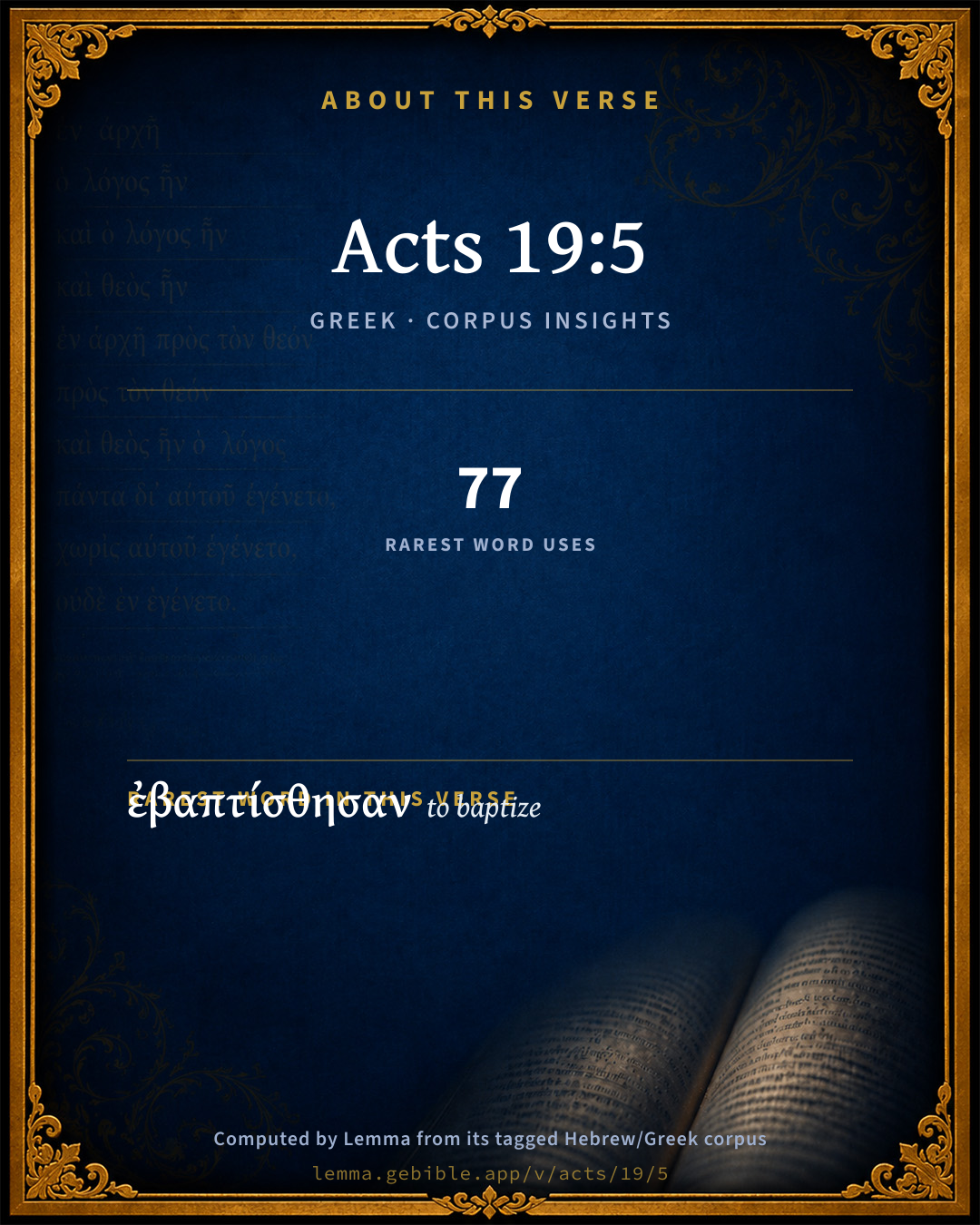
Acts 19:5

Greek (Tischendorf 8th ed.) Acts 19:5 appears in the Greek New Testament. The text above is from the Tischendorf 8th edition. Each word links to its Strong’s number and a concise gloss. Click any word for its full Thayer’s Greek Lexicon entry.

Download image
Cite this verse

Acts 19:5 (World English Bible). Public Domain. Lemma interlinear Bible study tool, https://lemma.gebible.app/v/acts/19/5.

Show BibTeX & RIS
BibTeX
RIS
English Translation
When they heard this, they were baptized in the name of the Lord Jesus.
World English Bible · Public Domain
Download a study sheet

One document with this verse’s original text, its word-by-word gloss line, the meaning frame, cross-references with their text, attributed commentary, and full source and license credits — printable, and it pastes into notes with its structure intact.

This verse Autodidact and up

Study sheet (.html) Plain text (.txt)

A passage Seminary Student

Up to 50 verses in one chapter. A passage sheet keeps up to 6 commentary sources and 12 cross-references per verse, in the order this page ranks them, and says so on the sheet whenever that leaves anything out. Ask for a single verse and you get the Autodidact verse sheet above.

Everything on this page stays free to read, with no account — the sheet is a download of what is already on screen, not access to it.

Want to remove ads? Support Godless Engineer
Compare translations 3

The same verse in 3 English versions, stacked beneath the original-language interlinear above. Click any original word for its lexicon entry.

Each is an independent rendering of the whole verse — the interlinear is not word-aligned to these translations.

Highlighted words mark where these versions differ — a whole-verse word diff, not a word-by-word alignment.

  • World English Bible Public Domain
    When they heard this, they were baptized in the name of the Lord Jesus.
  • King James Version Public Domain
    When they heard this, they were baptized in the name of the Lord Jesus.
  • unfoldingWord Literal Text CC BY-SA 4.0
    And having heard this, they were baptized in the name of the Lord Jesus.

unfoldingWord Literal Text — © unfoldingWord, licensed CC BY-SA 4.0. Word-aligned USFM3 via Door43 (git.door43.org/unfoldingWord/en_ult).

Versions to compare (up to 4)

3 of 4 selected

Show all 19 translations

Every available English version of this verse, each an independent rendering of the whole verse.

  • World English Bible Public Domain
    When they heard this, they were baptized in the name of the Lord Jesus.
  • Berean Standard Bible Public Domain
    On hearing this, they were baptized into the name of the Lord Jesus.
  • Majority Standard Bible Public Domain
    On hearing this, they were baptized into the name of the Lord Jesus.
  • King James Version Public Domain
    When they heard this, they were baptized in the name of the Lord Jesus.
  • American Standard Version (1901) Public Domain
    And when they heard this, they were baptized into the name of the Lord Jesus.
  • Revised Version (1885) Public Domain
    And when they heard this, they were baptized into the name of the Lord Jesus.
  • Geneva Bible (1599) Public Domain
    And when they heard it, they were baptized in the Name of the Lord Iesus.
  • Douay-Rheims (1899) Public Domain
    Having heard these things, they were baptized in the name of the Lord Jesus.
  • Young's Literal Translation Public Domain
    and they, having heard, were baptized -- to the name of the Lord Jesus,
  • Literal Standard Version CC BY-SA 4.0
    and they, having heard, were immersed into the Name of the Lord Jesus,
  • Unlocked Literal Bible CC BY-SA 4.0
    When the people heard this, they were baptized in the name of the Lord Jesus.
  • unfoldingWord Literal Text CC BY-SA 4.0
    And having heard this, they were baptized in the name of the Lord Jesus.
  • Darby Bible Public Domain
    And when they heard that, they were baptised to the name of the Lord Jesus.
  • World Messianic Bible Public Domain
    When they heard this, they were immersed in the name of the Lord Yeshua.
  • Webster's Bible Public Domain
    When they heard this, they were baptized into the name of the Lord Jesus.
  • Free Bible Version CC BY-SA 4.0
    When they heard this, they were baptized in the name of the Lord Jesus.
  • Bible in Basic English Public Domain
    And hearing this, they had baptism in the name of the Lord Jesus.
  • Text-Critical English NT CC BY 4.0
    On hearing this, they were baptized in the name of the Lord Jesus.
  • Tyndale New Testament (1534) Public Domain
    When they hearde that they were baptised in the name of the lorde Iesu.

Literal Standard Version (2020), Covenant Press — licensed CC BY-SA 4.0. Text via the HelloAO Bible API (eBible.org). Unlocked Literal Bible (unfoldingWord) — licensed CC BY-SA 4.0. Text via the HelloAO Bible API (eBible.org). unfoldingWord Literal Text — © unfoldingWord, licensed CC BY-SA 4.0. Word-aligned USFM3 via Door43 (git.door43.org/unfoldingWord/en_ult). Free Bible Version, Dr. Jonathan Gallagher — licensed CC BY-SA 4.0. Text via the HelloAO Bible API (eBible.org).

Word by word

More ways to search: Search by grammar → Find every occurrence → Compare this word →

Practice this passage: Drill this verse → Learn its vocabulary →

ἐβαπτίσθησαν
baptízō
G907
“to baptize”
Verb, Aorist, Passive, Indicative, 3rd person, Plural
Part of Speech
Verb
Tense
Aorist
Voice
Passive
Mood
Indicative
Person
3rd person
Number
Plural
Full Thayer's Definition

Origin: from a derivative of G911

TDNT: 09:49,9

1. to dip repeatedly, to immerse, to submerge (of vessels sunk) 2. to cleanse by dipping or submerging, to wash, to make clean with water, to wash one's self, bathe 3. to overwhelm Not to be confused with 911, bapto. The clearest example that showsthe meaning of baptizo is a text from the Greek poet and physicianNicander, who lived about 200 B.C. It is a recipe for making picklesand is helpful because it uses both words. Nicander says that inorder to make a pickle, the vegetable should first be 'dipped'(bapto) into boiling water and then 'baptised' (baptizo) in thevinegar solution. Both verbs concern the immersing of vegetables in asolution. But the first is temporary. The second, the act ofbaptising the vegetable, produces a permanent change. When used in the New Testament, this word more often refers to ourunion and identification with Christ than to our water baptism. e.g. Mark 16:16 . 'He that believes and is baptised shall be saved'.Christ is saying that mere intellectual assent is not enough. Theremust be a union with him, a real change, like the vegetable to thepickle! Bible Study Magazine, James Montgomery Boice, May 1989.
  1. ἀκούσαντες akoúō G191 “to hear” Verb, Aorist, Active, Participle, Nominative, Plural, Masculine
  2. δὲ dé G1161 “but” Conjunction
  3. εἰς eis G1519 “into” Preposition
  4. τὸ ho G3588 “the” Article, Accusative, Singular, Neuter
  5. ὄνομα ónoma G3686 “name” Noun, Accusative, Singular, Neuter
  6. τοῦ ho G3588 “the” Article, Genitive, Singular, Masculine
  7. κυρίου kýrios G2962 “Lord” Noun, Genitive, Singular, Masculine
  8. Ἰησοῦ Iēsoûs G2424 “Jesus” Noun, Genitive, Singular, Masculine

About this verse

These counts appear in no published source. They are computed here, from the morphology-tagged text and Lemma’s own curated glosses. What Lemma adds →

9
words
8
distinct lemmas
Acts
section

Repetition

A word recurs within this verse:

Cross-references

7

Topical passages linked to Acts 19:5 in the Treasury of Scripture Knowledge — connected by theme and wording, ordered by reader-vote popularity; previews shown in the World English Bible.

  • Acts 8:12 But when they believed Philip preaching good news concerning the Kingdom of God and the name of Jesus Christ, they were baptized, both men and women.
  • Acts 8:16 for as yet he had fallen on none of them. They had only been baptized in the name of Christ Jesus.
  • Acts 2:38 Peter said to them, "Repent, and be baptized, everyone of you, in the name of Jesus Christ for the forgiveness of sins, and you will receive the gift of the Holy Spirit.
  • Romans 6:3–4 Or don't you know that all we who were baptized into Christ Jesus were baptized into his death?
  • 1 Corinthians 10:2 and were all baptized into Moses in the cloud and in the sea;
  • Acts 10:48 He commanded them to be baptized in the name of Jesus Christ. Then they asked him to stay some days.
  • 1 Corinthians 1:13–15 Is Christ divided? Was Paul crucified for you? Or were you baptized into the name of Paul?

Cross-references courtesy of OpenBible.info (CC BY 4.0).

Commentary

Notes on Acts 19:5 from classic Christian and Jewish commentators (each source and its license shown beneath its notes). The classic Christian expositions comment on the surrounding passage and are grouped to its opening verse, so a note may address several verses; the Jewish commentaries on the Tanakh (Rashi and others) are per-verse, so they appear only where the commentator wrote on this verse.

Lemma curates 59 commentaries, every one of them public domain or Creative Commons licensed, each selected and text-cleaned for this edition rather than reprinted as found. About our sources →

Albert Barnes' Notes on the Bible

When they heard this - When they heard what Paul had said respecting the nature of John’s baptism.

They were baptized ... - As there is no other instance in the New Testament of any persons having been rebaptized, it has been made a question by some critics whether it was done here; and they have supposed that all this is the narrative of Luke respecting what took place under the ministry of John: to wit, that he told them to believe on Christ Jesus, and then baptized them in his name. But this is a most forced construction; and it is evident that these persons were rebaptized by the direction of Paul. For:

(1) This is the obvious interpretation of the passage - what would strike all persons as correct, unless there were some previous theory to support.

(2) It was not a matter of fact that John baptized in the name of Christ Jesus. His was the baptism of repentance; and there is not the slightest evidence that he ever used the name of Jesus in the form of baptism.

(3) If it be the sense of the passage that John baptized them in the name of Jesus, then this verse is a mere repetition of Acts . Act 19:4; a tautology of which the sacred writers would not be guilty.

(4) It is evident that the persons on whom Paul laid his hands Acts . Act 19:6, and those who were baptized, were the same. But these were the persons who heard Acts . Act 19:5 what was said. The narrative is continuous, all parts of it cohering together as relating to a transaction that occurred at the same time. If the obvious interpretation of the passage be the true one, it follows that the baptism of John was not strictly Christian baptism. It was the baptism of repentance; a baptism designed to prepare the way for the introduction of the kingdom of the Messiah. It will not follow, however, from this that Christian baptism is now ever to be repeated. For this there is no warrant in the New Testament. There is no command to repeat it, as in the case of the Lord’s Supper; and the nature and design of the ordinance evidently supposes that it is to be performed but once. The disciples of John were rebaptized, not because baptism is designed to be repeated, but because they never had been, in fact, baptized in the manner prescribed by the Lord Jesus.

In the name of the Lord Jesus - See the notes on Act 2:38.

Albert Barnes' Notes on the Bible (1834–1885) — public domain. Text from a community e-Sword/MySword module.

Bengel's Gnomon

Johann Albrecht Bengel

Act 19:5. Ἀκούσαντες, having heard) Luke mentions how the disciples at Ephesus obeyed Paul, receiving baptism in (into) the name of the Lord Jesus. For they had not known that they were bound by the baptism of repentance to faith in Jesus Christ: just as was the case with those who had slain Jesus, all of whom, therefore, Peter wished to “be baptized in the name of Jesus,” ch. Act 2:38, although very many of them had not been previously baptized by John: Mat 3:5-6. Apollos, on the other hand, who had received the baptism of John, accompanied with full instruction concerning Jesus Christ, was not re-baptized: ch. Act 18:25. Nor were the apostles re-baptized. For in reality the baptism which is mentioned in Matthew 3, 28 was one: otherwise there would not have been the beginning of the Gospel in John (Mar 1:1-3), and the Lord’s Supper, in Matthew 26, would be older than baptism, Matthew 28. Nor in this verse is he speaking of the people baptized by John; for it was not until his last days that John pointed to Jesus: ch. Act 13:25. Wherefore it cannot be said that he baptized them into the name of the Lord Jesus; unless you say that John baptized the people twice, first to repentance, then afterwards into the name of the Lord Jesus. Justus Jonas writes, “They were re-baptized, who had been baptized with the baptism of John, for this reason, because John was not the author of righteousness, or the giver of the Spirit, but only preached the Spirit, and grace, which was about to be conferred, a little afterwards, through Christ, who alone is the cause (source) and author of righteousness.”—ἐβαπτίσθησαν, were baptized) Paul laid his hands on them; he left the act of baptism to others.—[τοῦ Κυρίου Ἰησοῦ, of the Lord Jesus) In this way John at last utterly gave place to the Lord Jesus.—V. g.]

Bengel's Gnomon of the New Testament — English translation (T&T Clark, Edinburgh, 1860) — public domain. Text from a community e-Sword module.

Meyer's Critical & Exegetical Commentary

Heinrich August Wilhelm Meyer

Act_19:5. Εἰς τὸ ὄνομα τ. Κυρ. Ἰ.] on the name of the Lord Jesus, which they were to confess, namely, as that of the Messiah. Comp. on Mat_28:19.

These disciples of John thus received (whether from Paul himself, or from a subordinate assistant, the text leaves undetermined; but see for the latter view 1Co_1:17; comp. Act_10:48) Christian baptism, for it had appeared that they had not yet received it. The Anabaptists have from the first wrongly appealed to this passage; for it simply represents the non-sufficiency of Johns baptism, in point of fact, for Christianity, and that purely in respect of the twelve persons, but does not exhibit the insufficiency of the Christian baptism of infants. Many, moreover, of the orthodox (comp. Beza, Calixtus, Calovius, Suicer, Glass, Buddeus, Wolf, and several of the older commentators), in a controversial interest,both against the Roman Catholic doctrine of the distinction between the Johannean and the Christian baptism (Trident. Sess. vii. Song of Solomon 1), and also against the Anabaptists,have wrongly attached Act_19:5 to the address of the apostle: but after they had heard it they were baptized (by John), etc. But against this it may be urged, that John did not baptize in the name of Jesus, and that δέ, Act_19:5, stands in no logical connection at all with μέν, Act_19:4. On the other hand, Calvin and others have maintained, against the Anabaptists, that Act_19:5 is meant not of the baptism of water, but of the baptism of the Spirit, which Act_19:6 only more precisely explains; but this shift is just another, quite as utterly unexegetical, error of dogmatic presupposition. We may add, that it may not be inferred from our passage that the disciples of John who passed over to Christianity were uniformly rebaptized; for, in the case of the apostles who passed over from John to Jesus, this certainly did not take place (Joh_4:2); and even as regards Apollos, the common opinion that he was baptized by Aquila is purely arbitrary, as in Act_18:26 his instruction in Christianity, and not his baptism, is narrated. Indeed, in the whole of the N.T., except this passage, there is no example of the rebaptism of a disciple of John. Hence the baptism of the disciples of John who passed over to Christianity was not considered as absolutely necessary; but it did or did not take place according as in the different cases, and in proportion to the differences of individuals, the desire of the persons concerned and the opinion of the teachers on the matter determined. With those twelve, for example, Paul regarded it as conducive to his object and requisite that they should be baptized, in order to raise them to the elevation of Christian spiritual life; and therefore they were baptized (evidently according to their own wish and inclination, as is implied in ἀκούσαντες δὲ ἐβαπτ.), whilst Apollos, on the other hand, could dispense with rebaptism, seeing that he with his fervid spirit, following the references of John to Christ and the instruction of his teachers, penetrated without any new baptismal consecration into the pneumatic element of life. If, however, among the three thousand who were baptized at Pentecost (Act_2:38; Act_2:41) there were some of Johns disciples,which is probable,it was their desire to be baptized, and apostolic wisdom could not leave this unfulfilled. Accordingly, the opinion of Ziegler (theol. Abh. II. p. 162), that those twelve were rebaptized, because they had been baptized by some disciple of John not unto the ἐρχόμενος, but unto John himself, and thus had not received the true Johannean baptism, is to be rejected. They did not, in fact, answer, in Act_19:3, εἰς τὸν ʼΙωάννην!

Meyer — Critical and Exegetical Commentary on the New Testament — English translation by Peter Christie, edited by Frederick Crombie (T&T Clark, 1880) — public domain. Text from a community e-Sword module.

Expositor's Greek Testament

ed. W. Robertson Nicoll

Act 19:5 . ἀκούσαντες δὲ : neither grammatical nor in accordance with fact can these words be regarded (as by Beza and others) as part of St. Paul’s words, as if they meant, “and the people when they heard him,” i.e. , John.

The Expositor's Greek Testament, edited by W. Robertson Nicoll (1897–1910) — public domain. Text from a community e-Sword module.

Jamieson, Fausset & Brown

Robert Jamieson, A. R. Fausset & David Brown

When they heard this--not the mere words reported in Act 19:4, but the subject expounded according to the tenor of those words.

they were baptized--not however by Paul himself (Co1 1:14).

in the name of the Lord Jesus--into the whole fulness of the new economy, as now opened up to their believing minds.

Jamieson, Fausset & Brown — Commentary Critical and Explanatory on the Whole Bible (1871) — public domain (CC PDM 1.0). Text via the HelloAO Bible API.

Adam Clarke's Commentary

Verse 5. When they heard this, c.] As there is no evidence in the New Testament of persons being rebaptized, unless this be one, many criticisms have been hazarded to prove that these persons were not rebaptized. I see no need of this. To be a Christian, a man must be baptized in the Christian faith: these persons had not been baptized into that faith, and therefore were not Christians: they felt this, and were immediately baptized into the name of the Lord Jesus. This is a plain case but let one instance be produced of a person being rebaptized, who had before been baptized in the name of the holy Trinity, or even in the name of Jesus alone. In my view, it is an awful thing to iterate baptism when it had been before essentially performed: by "essentially performed," I mean, administered by sprinkling, washing, or plunging, by or in water, in the name of the Father, Son, and Spirit, being invoked at the time. Whoever has had this has the essence of baptism, as far as that can be conferred by man; and it matters not at what period of his life he has had it; it is a substantial baptism, and by it the person has been fully consecrated to the holy and blessed Trinity; and there should not be an iteration of this consecration on any account whatever. It is totally contrary to the canon law; it is contrary to the decisions of the best divines; it is contrary to the practice of the purest ages of the Church of God; it is contrary to the New Testament, and tends to bring this sacred ordinance into disrepute.

Adam Clarke's Commentary on the Bible (1810–1826) — public domain. Text from a community e-Sword/MySword module.

John Calvin's Commentaries

5. When they heard these things. Because the men of old had conceived an opinion that the baptism of John and of Christ were diverse, it was no inconvenient thing for them to be baptized again, who were only prepared with the baptism of John. But that that diversity was falsely and wickedly by them believed, it appeareth by this, in that it was a pledge and token of the same adoption, and of the same newness of life, which we have at this day in our baptism; and, therefore, we do not read that Christ did baptize those again who came from John unto him. Moreover, Christ received baptism in his own flesh, that he might couple himself with us by that visible sign, (Matthew 3:15) but if that reigned diversity be admitted, this singular benefit shall fall away and perish, that baptism is common to the Son of God and to us, or that we have all one baptism with him. But this opinion needeth no long refutation, because to the end they may persuade that these two baptisms be diverse, they must needs show first wherein the one differeth from the other; but a most excellent likelihood answereth on both parts, and also the agreement and conformity of the parts, which causeth us to confess that it is all one baptism.

Now the question is, whether it were lawful to repeat the same; and furious men in this our age; trusting to this testimony, went about to bring in baptizing again. Some take baptism for new institution or instruction, of whose mind I am not, because, as their exposition is too much racked, so it smelleth of a starting-hole .

Other some deny that baptism was repeated; because they were baptized amiss by some foolish enemy of John. But because their conjecture hath no color; yea, the words of Paul do rather import that they were the true and natural disciples of John, and Luke doth honorably call them disciples of Christ; I do not subscribe to this opinion, and yet deny that the baptism of water was repeated, because the words of Luke import no other thing, save only that they were baptized with the Spirit. First, it is no new thing for the name of baptism to be translated unto the gifts of the Spirit, as we saw in the first and in the eleventh chapters, (Acts 1:5, and Acts 11:6) where Luke said, that when Christ promised to his apostles to send the Spirit visible, he called it baptism.

Also, that when the Spirit came down upon Cornelius, Peter remembered the words of the Lord, “Ye shall be baptized with the Holy Ghost.” Again, we see that those visible gifts are spoken of by name in this place, and that the same are given with baptism. And whereas it followeth immediately, that when he had laid his hands upon them, the Spirit came, I take it to be added by way of interpretation; for it is a kind of speaking much used in the Scripture, first to set down a thing briefly, and afterwards to make it more plain. Therefore, that which by reason of brevity was somewhat obscure, doth Luke better express and lay more open, saying, that by laying on of hands the Spirit was given them. If any man object, that when baptism is put for the gifts of the Spirit, it is not taken simply, but having somewhat added to it. I answer, that Luke’s meaning doth sufficiently appear by the text; and again, that Luke doth allude unto the baptism whereof he spake. And surely if you understand it of the external sign, it shall be an absurd thing that it was given them without using any better doctrine. But and if you take it metaphorically for institution, the speech shall be as yet harsh; and the narration should not agree, that after they were taught the Holy Ghost came down upon them.

Furthermore, as I confess that this laying on of hands was a sacrament, so I say that those fell through ignorance who did continually imitate the same. For seeing that all men agree in this, that it was a grace which was to last only for a time, which was showed by that sign, it is a perverse and ridiculous thing to retain the sign since the truth is taken away. There is another respect of baptism and the supper, wherein the Lord doth testify that those gifts are laid open for us, which the Church shall enjoy even until the end of the world. Wherefore we must diligently and wisely distinguish perpetual sacraments from those which last only for a time, lest vain and frivolous visures [semblances] have a place among the sacraments. Whereas the men of old time did use laying on of hands, that they might confirm the profession of faith in those who were grown up, I do not mislike it; so that no man think that the grace of the Spirit is annexed to such a ceremony, as doth Jerome against the Luciferians.

But the Papists are worthy of no pardon, who being not content with the ancient rite, durst thrust in rotten and filthy anointing, that it might be not only a confirmation of baptism, but also a more worthy sacrament, whereby they imagine that the faithful are made perfect who were before only half perfect, — whereby those are armed against the battle, who before had their sins only forgiven them. For they have not been afraid to spew out these horrible blasphemies.

John Calvin's Commentaries (1540-1563) — public domain. Text from the Calvin Translation Society English edition (1840s-50s) via the Christian Classics Ethereal Library (ccel.org). Calvin's coverage is partial (roughly two-thirds of the Bible); uncommented books and verses are honest gaps, never fabricated. The 19th-century editor's footnotes and remarks are omitted so the notes are faithfully Calvin's own voice.

Ellicott's Commentary for English Readers

(5) They were baptized in the name of the Lord Jesus.—On the use of this formula in connection with the baptism of Jewish converts, see Notes on Act_2:38; Mat_28:19.

A Bible Commentary for English Readers, edited by Charles John Ellicott (1878–1897) — public domain. Text from a community e-Sword module.

The Cambridge Bible for Schools and Colleges

gen. ed. J. J. S. Perowne

5. And when they heard this] The A. V. omits the conjunction which stands in the Textus Receptus. What they heard was not the mere statement that Jesus was the Messiah; but all the arguments with which St Paul demonstrated that this was so, and proved that in Him the Scriptures were fulfilled. The conviction need not have been sudden, though its description is brief.

they were baptized into the name of the Lord Jesus] They followed the order appointed for admission to the privileges of the Christian covenant. No argument can be drawn from this verse for a repetition of baptism. These disciples had never received such a baptism as Christ ordained. John’s baptism was but a washing symbolical of the repentance which he preached; baptism into the name of Christ is the pledge of a covenant of salvation.

The Cambridge Bible for Schools and Colleges (gen. ed. J. J. S. Perowne; Cambridge University Press, 1878–1918) — public domain. Text from a community e-Sword module.

John Gill's Exposition

When they heard this,.... That is, the people to whom John preached, his hearers; when they heard of the Messiah, and that Jesus was he, and that it became them to believe in him:

they were baptized in the name of the Lord Jesus; not the disciples that Paul found at Ephesus, but the hearers of John; for these are the words of the Apostle Paul, giving an account of John's baptism, and of the success of his ministry, showing, that his baptism was administered in the name of the Lord Jesus; and not the words of Luke the Evangelist, recording what followed upon his account of John's baptism; for then he would have made mention of the apostle's name, as he does in the next verse; and have said, when they heard this account, they were baptized by Paul in the name of the Lord Jesus: the historian reports two things, first what Paul said, which lies in Act 19:4 then what he did, Act 19:6 where he repeats his name, as was necessary; as that he laid his hands upon them, which was all that was needful to their receiving the extraordinary gifts of the Holy Ghost, having been already baptized in the name of the Lord Jesus: which sense is the more confirmed by the particles and which answer to one another in verses 4 and 5, and show the words to be a continuation of the apostle's speech, and not the words of the historian, which begin in the next verse. Beza's ancient copy adds, "for the remission of sins".

John Gill's Exposition of the Whole Bible (1746–1763) — public domain (CC PDM 1.0). Text via the HelloAO Bible API.

Trapp's Complete Commentary

John Trapp

5 When they heard this, they were baptized in the name of the Lord Jesus.

Ver. 5. They were baptized] That is, say some, they were re-baptized, because baptized before in a wrong name. Therefore Paul first catechiseth them, Act 19:4. Others say that it was rather their renewing to their baptism than their baptism to them; and not that they took any other than that of John, but that they now began to entertain and apply it to the right intent. (Mr Lightfoot, Harm.)

John Trapp, A Commentary or Exposition upon All the Books of the Old and New Testament (1647–1656) — public domain. Text from a community e-Sword module.

Haydock's Catholic Bible Commentary

Baptized in the name of the Lord Jesus, so called to distinguish it from the baptism of John; and that of Christ was given in the name of the Father, and of the Son, and of the Holy Ghost, according to the command of Christ himself. [Matthew xxviii. 19.] (Witham)

George Leo Haydock (1774–1849), Haydock's Catholic Family Bible and Commentary, 1859 edition — public domain. Excludes Psalms (Douay-Rheims chapter numbering differs from Protestant) and Deuterocanonical books (Catholic canon only).

Matthew Poole's English Annotations

The disciples, or those that John preached to, (for these Ephesians were not amongst those few that Paul baptized, 1Co 1:14), who when they heard what the Baptist said in the foregoing verse, they were baptized; as in the same terms it is said, Act 2:37,

when they heard what St. Peter had said, they were pricked in their heart, & c., and were baptized. As for Paul’s imposing his hands upon them that are said here to be baptized, it might very well be, that the twelve disciples, Act 19:7, might have been baptized by John, and now receive the Holy Ghost in those extraordinary gifts by the laying on of the hands of St. Paul: for to what end should these disciples, who were baptized with St. John’s baptism, be again baptized by Paul? It is true, they had further manifestations of the mystery of the gospel brought unto them; but if men should be baptized for every degree of knowledge or grace which they do acquire, how many baptisms had they need to have, who ought daily to grow in grace and in knowledge! It is evident, that the apostles themselves were only baptized with the baptism of John, for there were none else to baptize them. And baptism being an ordinance for our regeneration and new birth, as we can be born but once in the flesh, we can be but once also born in the Spirit; and no more may Christians be baptized twice, than the Jews could be twice circumcised.

Matthew Poole's English Annotations on the Holy Bible (1683–1685) — public domain. Text from a community e-Sword/MySword module.

Whedon's Commentary on the Bible

Daniel D. Whedon

5. Were baptized—We have here an unquestionable proof of a rebaptism; namely, of a once baptized disciple of John now baptized into the faith of Jesus.

Daniel D. Whedon (gen. ed.), Commentary on the Old and New Testaments (1874–1909) — public domain. Text from a community e-Sword module.

The Pulpit Commentary

And when for when, A.V.; into for in, A.V. Into the Name of the Lord Jesus. (see Act_8:16) So too (mati) Act_10:48 of Cornelius and his company, "He commanded them to be baptized in the Name (ejn tw ojno) of Jesus Christ" (R.V.). The formula of baptism, as commanded by the Lord Jesus himself, was, "In or, "into" the Name (aijv to unoma) of the Father, and of the Son, and of the Holy Ghost". (Mat_28:20) But the candidate always first made a profession of his faith in Jesus Christ, as in the A.V. of Act_8:37; and the effect of baptism was an incorporation into Christ so as to partake of his death unto sin and his life unto righteousness. It was, therefore, a true and compendious description of baptism, to speak of it as a baptism in (or into) the Name of Jesus Christ. (See the Baptismal Service in the Book of Common Prayer.) There does not seem to be any difference of meaning between ejn tw ojnomati and eijv to onoma.

The Pulpit Commentary (1880–1919), ed. H.D.M. Spence-Jones & Joseph S. Exell — public domain. Text from a community e-Sword module.

John Wesley's Explanatory Notes

And hearing this, they were baptized - By some other. Paul only laid his hands upon them. They were baptized - They were baptized twice; but not with the same baptism. John did not administer that baptism which Christ afterward commanded, that is, in the name of the Father, Son, and Holy Ghost.

John Wesley, Explanatory Notes Upon the Whole Bible (1754–1765) — public domain. Text via the GEBible commentary corpus.

Godbey's Commentary on the New Testament

William B. Godbey

5. “And hearing, they were baptized in the name of the Lord Jesus.” Here you see baptism repeated in the case of these Ephesian converts. Water baptism is a Jewish institution, constant and exceedingly prevalent since the days of Moses, symbolizing the work of the Spirit, as the bloody sacrifices the work of Christ. A Jew had to be baptized with water every time he contracted ceremonial defilement before he was allowed to enter the tabernacle and enjoy its service. Doubtless many a Jew was baptized a thousand times in his life, these expurgatory catharisms being frequent as the bloody sacrifices. These Ephesian converts, Apollos and Paul were all Jews, accustomed from time immemorial to baptize freely and repeatedly pursuant to the Levitical ritual. Apollos had initiated them into the Johanic dispensation by water baptism, thinking it was still in vogue. Paul is preaching in the dispensation of the Holy Ghost, who is given by the ascended and glorified Messiah, whom it is pertinent that all publicly confess by baptism in His name.

William B. Godbey, Commentary on the New Testament (1896–1900) — public domain. Text from a community e-Sword module.

McGarvey & Pendleton's Commentaries

J. W. McGarvey

See notes on verse 1

J. W. McGarvey (with Philip Y. Pendleton), Commentaries on the New Testament (The Fourfold Gospel, 1914; Acts; and the epistles) — public domain. Text from a community e-Sword/MySword module.

The People's New Testament

B. W. Johnson

5. When they heard this. Paul's explanation of the difference between Christ's and John's baptism, to which we have only an allusion. The example of these men shows that if a baptism is imperfect, from an ignorance of Christ's will, it is not wrong to correct the defect by a more perfect obedience.

B. W. Johnson's The People's New Testament with Notes (1889–1891) — public domain. Electronic text from the Christian Classics Ethereal Library (CCEL) ThML edition.

unfoldingWord translationNotes

Door43 World Missions Community

Connecting Statement:

Paul continues staying in Ephesus.

When the people

Here "people" refers to the disciples in Ephesus who were talking with Paul. (See: Acts 19:1)

they were baptized

This can be stated in active form. AT: "they received baptism" (See: Active or Passive)

in the name of the Lord Jesus

Here "name" refers to Jesus' power and authority. AT: "as believers in the Lord Jesus" (See: Metonymy)

laid his hands on them

"placed his hands on them." He probably placed his hands on their shoulders or heads. AT: "placed his hands on their heads as he prayed"

they spoke in other languages and prophesied

Unlike in Acts 2:3-4, there are no details of who understood their messages.

In all they were about twelve men

This tells how many men were baptized. (See: Background Information)

twelve men

"12 men" (See: Numbers)

translationWords

baptize

name

lord

Jesus

Paul

Holy Spirit

prophet

unfoldingWord translationNotes — © Distant Shores Media and the Door43 World Missions Community, licensed CC BY-SA 4.0. Source: git.door43.org/Door43/en_tn.

Cambridge Greek Testament for Schools and Colleges

5. ἀκούσαντες δέ, and when they heard. What they heard was not the mere statement that Jesus was the Messiah; but all the arguments with which St Paul demonstrated that this was so, and proved that in Him the Scriptures were fulfilled. The conviction need not have been sudden, though its description is brief.

εἰς τὸ ὄνομα, into the name. Cf. Mat 28:19 and Act 2:38 note. These men followed the order appointed for admission to the privileges of the Christian covenant. No argument can be drawn from this verse for a repetition of baptism. These disciples had never received such a baptism as Christ ordained. John’s baptism was but a washing symbolical of the repentance which he preached; baptism into the name of Christ is the pledge of a covenant of salvation.

Cambridge Greek Testament for Schools and Colleges (Cambridge University Press, 1896; 21 vols, various authors incl. Carr, Maclear, Plummer, Farrar, Lumby, Moule, M. R. James, Simcox) — public domain. Text from a community e-Sword module.

Alford’s Greek Testament

Henry Alford

5.] Two singular perversions of this verse have occurred: (1) the Anabaptists use it to authorize the repetition of Christian baptism, whereas it is not Christian baptism which was repeated, seeing that John’s baptism was not such, but only the baptism which they now for the first time received; and (2) Beza, Calixtus, Calov., Suicer, Glass., Buddeus, Wolf, and al., wishing to wrest this weapon out of the hands of the Anabaptists, oddly enough suppose this verse to belong still to Paul’s discourse, and to mean, ‘and the people when they heard him (John), were baptized into the name of the Lord Jesus.’ This obviously is contrary to fact, historically: and would leave our present narrative in a singular state: for Paul, having treated their baptism as insufficient, would thus proceed on it to impose his hands, as if it were sufficient.

εἰς τὸ ὄν. τ. κυρ. Ἰησοῦ] Two questions arise here: (1) Was it the ordinary practice to rebaptize those who had been baptized either by John or by the disciples (Joh 4:1 f.) before baptism became, by the effusion of the Holy Spirit, λουτρὸν παλιγγενεσίας? This we cannot definitely answer. That it was sometimes done, this incident shews: but in all probability, in the cases of the majority of the original disciples, the greater baptism by the Holy Ghost and fire on the day of Pentecost superseded the outward form or sign. The Apostles themselves received only this baptism (besides probably that of John): and most likely the same was the case with the original believers. But of the three thousand who were added on the day of Pentecost, very many must have been already baptized by John; and all were rebaptized without enquiry. (2) What conclusion can we deduce from this verse respecting the use or otherwise of baptism in the name of the Father, and the Son, and the Holy Ghost, in the apostolic period? The only answer must be, that at that early time we have no indication of set formulæ in the administration of either sacrament. Such formulæ arose of necessity, when precision in formal statement of doctrine became an absolute necessity in the church: and the materials for them were found ready in the word of God, who has graciously provided for all necessities of His church in all time. But, in matter of fact, such a baptism as this was a baptism into the name of the Father, Son, and Holy Ghost. As Jews, these men were already servants of the living God—and by putting on the Son, they received in a new and more gracious sense the Father also. And in the sequel of their baptism, the imposition of hands, they sensibly became recipients of God the Holy Ghost. Where such manifestations were present, the form of words might be wanting; but with us, who have them not, it is necessary and imperative. Dean Howson regards (i. 517; ii. 13) St. Paul’s question in our ver. 3 as indicative that the name of the Holy Ghost was used in the baptismal formula. But the inference seems to me insecure.

Henry Alford, The Greek Testament (1849–1861) — public domain. Text from a community e-Sword module.

Lesson kit

Teaching starters — assembled from the data on this page, not authored interpretation. Every prompt links to the verse data it draws on. Edit before teaching.

Acts, in the Acts, opens this verse with 9 words (8 distinct Greek lemmas). Its most distinctive word is baptízō (“to baptize”). A historical commentator’s framing appears above. Read the whole chapter for the surrounding context.

Discussion questions

  1. How does “to baptize” (baptízō) shape what this verse is saying?
  2. Acts 8:12 shares this passage’s theme. How do the two illuminate each other?
  3. “the” occurs 2× in this one verse. What is the effect of the repetition?
  4. These translations render this verse differently. What is at stake in choosing one wording over another?
  5. Reading how Albert Barnes' Notes on the Bible and Bengel's Gnomon read this verse, where do the two commentators agree and where do they part?

Things to notice

  • These translations choose different wording for 2 words in this verse.
  • “the” occurs 2× in this single verse.
  • 8 distinct Greek lemmas span 9 words in this verse.

Reading settings

Reading text

Shown beneath each verse's original-language words.

Old Testament
Old Testament edition

Read the OT as the Masoretic Hebrew (MT) or the Greek Septuagint (LXX).

English shown for the Greek Septuagint (in the Hebrew ↔ Greek comparison).

Comparing translations? Open the Compare panel on any verse page to stack up to four side by side.