Acts 13:44

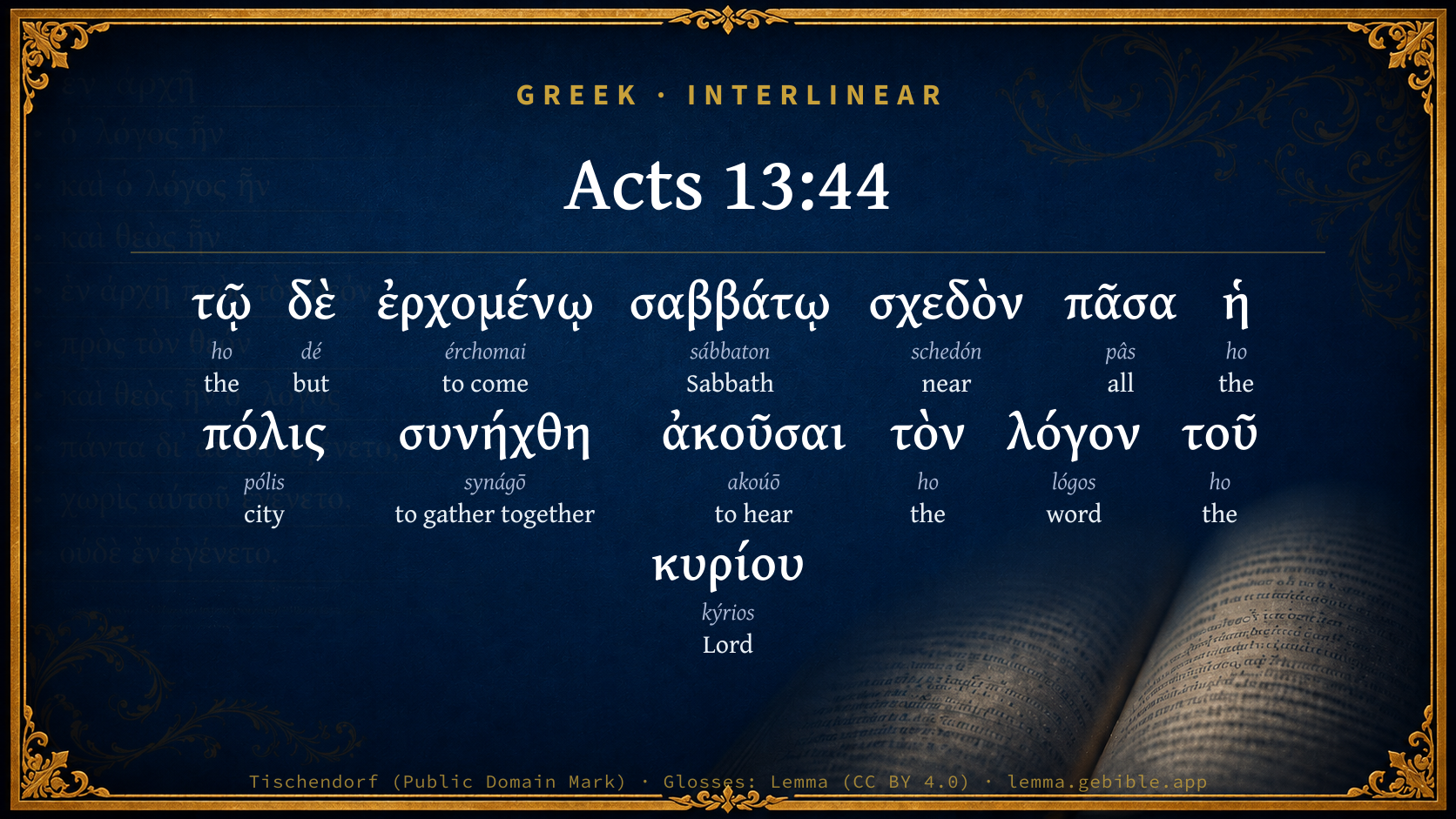
Greek (Tischendorf 8th ed.) Acts 13:44 appears in the Greek New Testament. The text above is from the Tischendorf 8th edition. Each word links to its Strong’s number and a concise gloss. Click any word for its full Thayer’s Greek Lexicon entry.
Download image
Cite this verse

Acts 13:44 (World English Bible). Public Domain. Lemma interlinear Bible study tool, https://lemma.gebible.app/v/acts/13/44.

Show BibTeX & RIS
BibTeX
RIS
English Translation
The next Sabbath almost the whole city was gathered together to hear the word of God.
World English Bible · Public Domain
Highlights
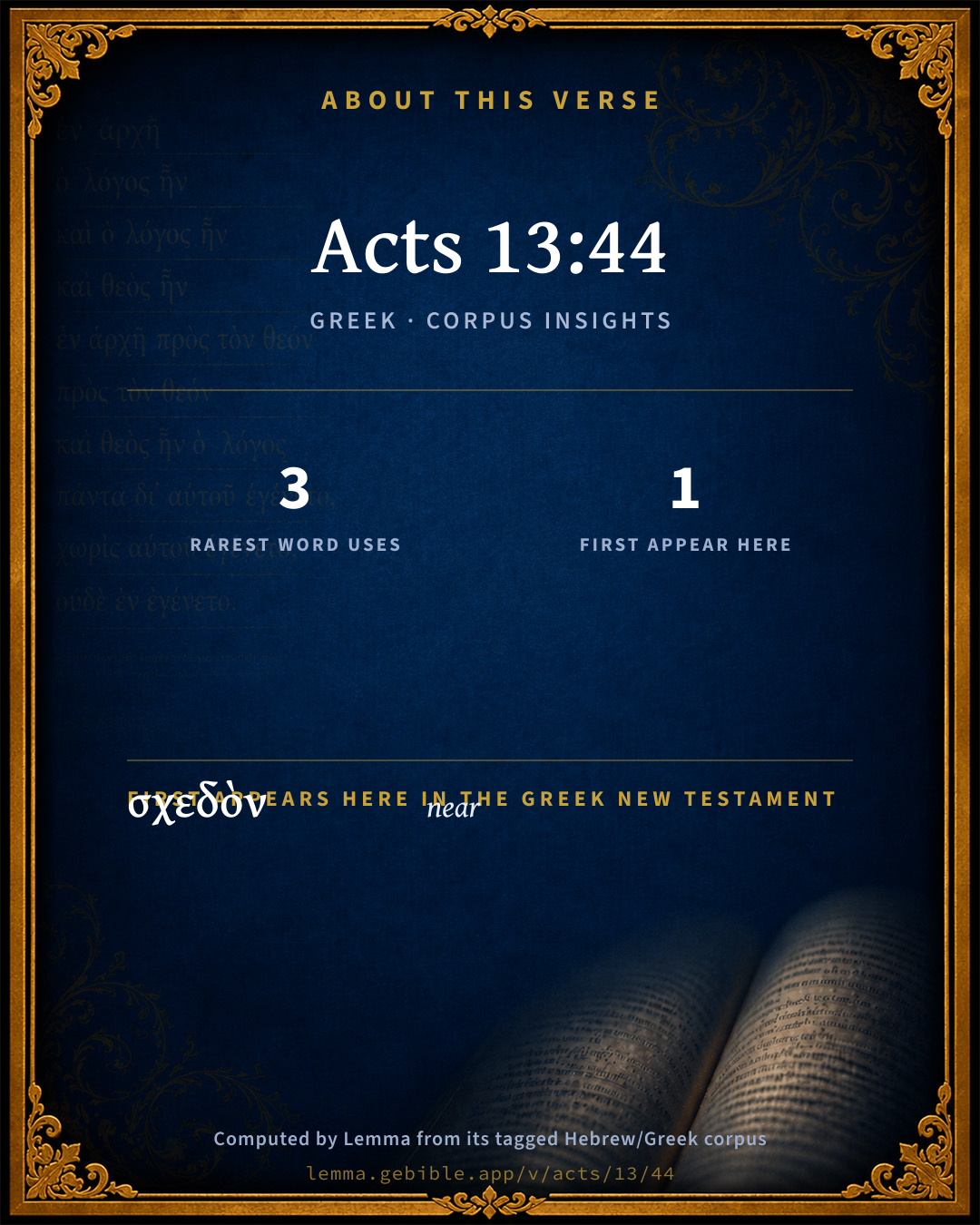
  • 1 first appearance in the Greek New Testament
Full analysis ↓
Download a study sheet

One document with this verse’s original text, its word-by-word gloss line, the meaning frame, cross-references with their text, attributed commentary, and full source and license credits — printable, and it pastes into notes with its structure intact.

This verse Autodidact and up

Study sheet (.html) Plain text (.txt)

A passage Seminary Student

Up to 50 verses in one chapter. A passage sheet keeps up to 6 commentary sources and 12 cross-references per verse, in the order this page ranks them, and says so on the sheet whenever that leaves anything out. Ask for a single verse and you get the Autodidact verse sheet above.

Everything on this page stays free to read, with no account — the sheet is a download of what is already on screen, not access to it.

Want to remove ads? Support Godless Engineer
Compare translations 3

The same verse in 3 English versions, stacked beneath the original-language interlinear above. Click any original word for its lexicon entry.

Each is an independent rendering of the whole verse — the interlinear is not word-aligned to these translations.

Highlighted words mark where these versions differ — a whole-verse word diff, not a word-by-word alignment.

  • World English Bible Public Domain
    The next Sabbath almost the whole city was gathered together to hear the word of God.
  • King James Version Public Domain
    And the next sabbath day came almost the whole city together to hear the word of God.
  • unfoldingWord Literal Text CC BY-SA 4.0
    And on the next Sabbath, almost the whole city was gathered together to hear the word of the Lord.

unfoldingWord Literal Text — © unfoldingWord, licensed CC BY-SA 4.0. Word-aligned USFM3 via Door43 (git.door43.org/unfoldingWord/en_ult).

Versions to compare (up to 4)

3 of 4 selected

Show all 19 translations

Every available English version of this verse, each an independent rendering of the whole verse.

  • World English Bible Public Domain
    The next Sabbath almost the whole city was gathered together to hear the word of God.
  • Berean Standard Bible Public Domain
    On the following Sabbath, nearly the whole city gathered to hear the word of the Lord.
  • Majority Standard Bible Public Domain
    On the following Sabbath, nearly the whole city gathered to hear the word of God.
  • King James Version Public Domain
    And the next sabbath day came almost the whole city together to hear the word of God.
  • American Standard Version (1901) Public Domain
    And the next sabbath almost the whole city was gathered together to hear the word of God.
  • Revised Version (1885) Public Domain
    And the next sabbath almost the whole city was gathered together to hear the word of God.
  • Geneva Bible (1599) Public Domain
    And ye next Sabbath day came almost the whole citie together, to heare the worde of God.
  • Douay-Rheims (1899) Public Domain
    But the next sabbath day, the whole city almost came together, to hear the word of God.
  • Young's Literal Translation Public Domain
    And on the coming sabbath, almost all the city was gathered together to hear the word of God,
  • Literal Standard Version CC BY-SA 4.0
    And on the coming Sabbath, almost all the city was gathered together to hear the word of God,
  • Unlocked Literal Bible CC BY-SA 4.0
    On the next Sabbath, almost the whole city was gathered together to hear the word of the Lord.
  • unfoldingWord Literal Text CC BY-SA 4.0
    And on the next Sabbath, almost the whole city was gathered together to hear the word of the Lord.
  • Darby Bible Public Domain
    And on the coming sabbath almost all the city was gathered together to hear the word of God.
  • World Messianic Bible Public Domain
    The next Sabbath, almost the whole city was gathered together to hear the word of God.
  • Webster's Bible Public Domain
    And the next sabbath came almost the whole city together to hear the word of God.
  • Free Bible Version CC BY-SA 4.0
    The following Sabbath almost the whole town turned out to hear the word of God.
  • Bible in Basic English Public Domain
    And on the Sabbath after, almost all the town came together to give hearing to the word of God.
  • Text-Critical English NT CC BY 4.0
    On the following Sabbath, nearly the entire city was gathered together to hear the word of God.
  • Tyndale New Testament (1534) Public Domain
    And the nexte Saboth daye came almoste the whole cite to gether to heare the worde of God.

Literal Standard Version (2020), Covenant Press — licensed CC BY-SA 4.0. Text via the HelloAO Bible API (eBible.org). Unlocked Literal Bible (unfoldingWord) — licensed CC BY-SA 4.0. Text via the HelloAO Bible API (eBible.org). unfoldingWord Literal Text — © unfoldingWord, licensed CC BY-SA 4.0. Word-aligned USFM3 via Door43 (git.door43.org/unfoldingWord/en_ult). Free Bible Version, Dr. Jonathan Gallagher — licensed CC BY-SA 4.0. Text via the HelloAO Bible API (eBible.org).

Word by word

More ways to search: Search by grammar → Find every occurrence → Compare this word →

Practice this passage: Drill this verse → Learn its vocabulary →

About this verse

These counts appear in no published source. They are computed here, from the morphology-tagged text and Lemma’s own curated glosses. What Lemma adds →

14
words
11
distinct lemmas
Acts
section

Notable vocabulary

The rarest word here is σχεδὸν near G4975 — appearing just 3 times in the whole Greek New Testament.

First appearance in Scripture

This word makes its first canonical appearance in the Greek New Testament here:

  • σχεδὸν near G4975

Shared distinctive vocabulary

σχεδὸν near G4975 occurs in 3 verses of the Greek New Testament. Also found in:

Repetition

A word recurs within this verse:

Cross-references

4

Topical passages linked to Acts 13:44 in the Treasury of Scripture Knowledge — connected by theme and wording, ordered by reader-vote popularity; previews shown in the World English Bible.

  • Genesis 49:10 The scepter will not depart from Judah, Nor the ruler's staff from between his feet, Until he comes to whom it belongs. To him will the obedience of the peoples be.
  • Psalms 110:3 Your people offer themselves willingly in the day of your power, in holy array. Out of the womb of the morning, you have the dew of your youth.
  • Isaiah 11:10 It shall happen in that day, that the root of Jesse, who stands for an ensign of the peoples, to him shall the nations seek; and his resting-place shall be glorious.
  • Isaiah 60:8 Who are these who fly as a cloud, and as the doves to their windows?

Cross-references courtesy of OpenBible.info (CC BY 4.0).

Where the printed editions differ

1 variant

Places in this verse where the major printed Greek editions disagree on the wording in a way that affects the translation — a comparison of editions, not a manuscript-by-manuscript collation. The editions are the modern critical texts (Nestlé-Aland 28/27, SBL, Westcott-Hort, Tregelles, Tyndale House) and the traditional texts behind the KJV (the Textus Receptus and the Byzantine/Majority text). It is not a claim about which reading is original.

  1. Different wording
    κυρίου.

    “of the Lord.”

    In NA28NA27TynSBLTreg Not in WHTRByz

    θεοῦ (theou) 'of God' occurs in traditional manuscripts (WH+TR+Byz) instead of κυρίου. (kuriou) 'of the Lord.' in older manuscripts (NA28+NA27+Tyn+SBL+Treg)

Textual data: Translators Amalgamated Greek New Testament (STEPBible TAGNT) · CC BY 4.0.

Commentary

Notes on Acts 13:44 from classic Christian and Jewish commentators (each source and its license shown beneath its notes). The classic Christian expositions comment on the surrounding passage and are grouped to its opening verse, so a note may address several verses; the Jewish commentaries on the Tanakh (Rashi and others) are per-verse, so they appear only where the commentator wrote on this verse.

Lemma curates 59 commentaries, every one of them public domain or Creative Commons licensed, each selected and text-cleaned for this edition rather than reprinted as found. About our sources →

Joseph Benson's Commentary

Act 13:44-45. And the next sabbath came almost the whole city together — Idolaters as well as proselytes; to hear the word of God — In consequence, it seems, of the report which the Gentiles had spread abroad of what had been delivered before, whereby an earnest desire had been awakened in many, of attending that repetition of their extraordinary message which the apostles had engaged themselves to make. But when the Jews — Of the more bigoted sort; saw the multitude — And considered what an encouragement it was to Paul to go on in his work; they were filled with envy — Greek, ζηλου, with zeal, namely, for the honour of their law and nation, which they foolishly imagined to be disgraced and injured by this new sect; and with indignation and envy at the regard which the inhabitants of Antioch showed to Paul’s doctrine, beyond what they had ever done to the Jewish religion; and spake against — Opposed; those things which were spoken by Paul, contradicting and blaspheming —

They contradicted Paul’s doctrine concerning the sufferings and death of the Messiah, and reviled him, or rather Jesus, calling him an impostor, because he had not been able, they said, to deliver himself from death, though he pretended to be the Christ.

Joseph Benson's Commentary on the Old and New Testaments (1811–1818) — public domain. Text from a community e-Sword module.

Whedon's Commentary on the Bible

Daniel D. Whedon

5. Second Sabbath at Pisidian Antioch—Jewish Unbelief and Gentile Faith, Act_13:44-52.

44. Almost the whole city—Antioch was that day, almost entire, within the synagogue. The apostles for one day had near a whole city for a congregation: for the report of the preceding Sabbath, with the intervening excitement, had aroused the inquiring population. Not wholly lost was the effect, for by Act_13:49 we learn that in consequence the word of the Lord was published throughout all the region. One of these noble apostles may have addressed the multitudes within the house; the other may at the same time, standing near the threshold, have harangued the multitudes in the front area.

Daniel D. Whedon (gen. ed.), Commentary on the Old and New Testaments (1874–1909) — public domain. Text from a community e-Sword module.

MacLaren's Expositions of Holy Scripture

Alexander MacLaren

Acts

JEWISH REJECTERS AND GENTILE RECEIVERS

Act 13:44 - Act 13:52 - Act 14:1 - Act 14:7.

In general outline, the course of events in the two great cities of Asia Minor, with which the present passage is concerned, was the same. It was only too faithful a forecast of what was to be Paul’s experience everywhere. The stages are: preaching in the synagogue, rejection there, appeal to the Gentiles, reception by them, a little nucleus of believers formed; disturbances fomented by the Jews, who swallow their hatred of Gentiles by reason of their greater hatred of the Apostles, and will riot with heathens, though they will not pray nor eat with them; and finally the Apostles’ departure to carry the gospel farther afield. This being the outline, we have mainly to consider any special features diversifying it in each case.

Their experience in Antioch was important, because it forced Paul and Barnabas to put into plain words, making very clear to themselves as well as to their hearers, the law of their future conduct. It is always a step in advance when circumstances oblige us to formularise our method of action. Words have a wonderful power in clearing up our own vision. Paul and Barnabas had known all along that they were sent to the Gentiles; but a conviction in the mind is one thing, and the same conviction driven in on us by facts is quite another. The discipline of Antioch crystallised floating intentions into a clear statement, which henceforth became the rule of Paul’s conduct. Well for us if we have open eyes to discern the meaning of difficulties, and promptitude and decision to fix and speak out plainly the course which they prescribe!

The miserable motives of the Jews’ antagonism are forcibly stated in Act 13:44 - Act 13:45. They did not ‘contradict and blaspheme,’ because they had taken a week to think over the preaching and had seen its falseness, but simply because, dog-in-the-manger like, they could not bear that ‘the whole city’ should be welcome to share the message. No doubt there was a crowd of ‘Gentile dogs’ thronging the approach to the synagogue; and one can almost see the scowling faces and hear the rustle of the robes drawn closer to avoid pollution. Who were these wandering strangers that they should gather such a crowd? And what had the uncircumcised rabble of Antioch to do with ‘the promises made to the fathers’? It is not the only time that religious men have taken offence at crowds gathering to hear God’s word. Let us take care that we do not repeat the sin. There are always some who-

‘Taking God’s word under wise protection,

Correct its tendency to diffusiveness.’

It needed some courage to front the wild excitement of such a mob, with calm, strong words likely to increase the rage.

‘Lo, we turn to the Gentiles.’ This is not to be regarded as announcing a general course of action, but simply as applying to the actual rejecters in Antioch. The necessity that the word should first be spoken to the Jews continued to be recognised, in each new sphere of work, by the Apostle; but wherever, as here, men turned from the message, the messengers turned from them without further waste of time. Paul put into words here the law for his whole career. The fit punishment of rejection is the withdrawal of the offer. There is something pathetic in the persistence with which, in place after place, Paul goes through the same sequence, his heart yearning over his brethren according to the flesh, and hoping on, after all repulses. It was far more than natural patriotism; it was an offshoot of Christ’s own patient love.

Note also the divine command. Paul bases his action on a prophecy as to the Messiah. But the relation on which prophecy insists between the personal servant of Jehovah and the collective Israel, is such that the great office of being the Light of the world devolves from Him on it and the true Israel is to be a light to the Gentiles. These very Jews in Antioch, lashing themselves into fury because Gentiles were to be offered a share in Israel’s blessings, ought to have been discharging this glorious function. Their failure showed that they were no parts of the real Israel. No doubt the two missionaries left the synagogue as they spoke, and, as the door swung behind them, it shut hope out and unbelief in. The air was fresh outside, and eager hearts welcomed the word. Very beautifully is the gladness of the Gentile hearers set in contrast with the temper of the Jews. It is strange news to heathen hearts that there is a God who loves them, and a divine Christ who has died for them. The experience of many a missionary follows Paul’s here.

‘As many as were ordained to eternal life believed.’ The din of many a theological battle has raged round these words, the writer of which would have probably needed a good deal of instruction before he could have been made to understand what the fighting was about. But it is to be noted that there is evidently intended a contrast between the envious Jews and the gladly receptive Gentiles, which is made more obvious by the repetition of the words ‘eternal life.’ It would seem much more relevant and accordant with the context to understand the word rendered ‘ordained’ as meaning ‘adapted’ or ‘fitted,’ than to find in it a reference to divine foreordination. Such a meaning is legitimate, and strongly suggested by the context. The reference then would be to the ‘frame of mind of the heathen, and not to the decrees of God.’

The only points needing notice in the further developments at Antioch are the agents employed by the Jews, the conduct of the Apostles, and the sweet little picture of the converts. As to the former, piously inclined women in a heathen city would be strongly attracted by Judaism and easily lend themselves to the impressions of their teachers. We know that many women of rank were at that period powerfully affected in this manner; and if a Rabbi could move a Gentile of influence through whispers to the Gentile’s wife, he would not be slow to do it. The ease with which the Jews stirred up tumults everywhere against the Apostle indicates their possession of great influence; and their willingness to be hand in glove with heathen for so laudable an object as crushing one of their own people who had become a heretic, measures the venom of their hate and the depth of their unscrupulousness.

The Apostles had not to fear violence, as their enemies were content with turning them out of Antioch and its neighbourhood; but they obeyed Christ’s command, shaking off the dust against them, in token of renouncing all connection. The significant act is a trace of early knowledge of Christ’s words, long before the date of our Gospels.

While the preachers had to leave the little flock in the midst of wolves, there was peace in the fold. Like the Ethiopian courtier when deprived of Philip, the new believers at Antioch found that the withdrawal of the earthly brought the heavenly Guide. ‘They were filled with joy.’ What! left ignorant, lonely, ringed about with enemies, how could they be glad? Because they were filled ‘with the Holy Ghost.’ Surely joy in such circumstances was no less supernatural a token of His presence than rushing wind or parting flames or lips opened to speak with tongues. God makes us lonely that He may Himself be our Companion.

It was a long journey to the great city of Iconium. According to some geographers, the way led over savage mountains; but the two brethren tramped along, with an unseen Third between them, and that Presence made the road light. They had little to cheer them in their prospects, if they looked with the eye of sense; but they were in good heart, and the remembrance of Antioch did not embitter or discourage them. Straight to the synagogue, as before, they went. It was their best introduction to the new field. There, if we take the plain words of Act 14:1, they found a new thing, ‘Greeks,’ heathens pure and simple, not Hellenists or Greek-speaking Jews, nor even proselytes, in the synagogue. This has seemed so singular that efforts have been made to impose another sense on the words, or to suppose that the notice of Greeks, as well as Jews, believing is loosely appended to the statement of the preaching in the synagogue, omitting notice of wider evangelising. But it is better to accept than to correct our narrative, as we know nothing of the circumstances that may have led to this presence of Greeks in the synagogue. Some modern setters of the Bible writers right would be all the better for remembering occasionally that improbable things have a strange knack of happening.

The usual results followed the preaching of the Gospel. The Jews were again the mischief-makers, and, with the astuteness of their race, pushed the Gentiles to the front, and this time tried a new piece of annoyance. ‘The brethren’ bore the brunt of the attack; that is, the converts, not Paul and Barnabas. It was a cunning move to drop suspicions into the minds of influential townsmen, and so to harass, not the two strangers, but their adherents. The calculation was that that would stop the progress of the heresy by making its adherents uncomfortable, and would also wound the teachers through their disciples.

But one small element had been left out of the calculation-the sort of men these teachers were; and another factor which had not hitherto appeared came into play, and upset the whole scheme. Paul and Barnabas knew when to retreat and when to stand their ground. This time they stood; and the opposition launched at their friends was the reason why they did so. ‘Long time therefore abode they.’ If their own safety had been in question, they might have fled; but they could not leave the men whose acceptance of their message had brought them into straits. But behind the two bold speakers stood ‘the Lord,’ Christ Himself, the true Worker. Men who live in Him are made bold by their communion with Him, and He witnesses for those who witness for Him.

Note the designation of the Gospel as ‘the word of His grace.’ It has for its great theme the condescending, giving love of Jesus. Its subject is grace; its origin is grace; its gift is grace. Observe, too, that the same connection between boldness of speech and signs and wonders is found in Act 4:29 - Act 4:30. Courageous speech for Christ is ever attended by tokens of His power, and the accompanying tokens of His power make the speech more courageous.

The normal course of events was pursued. Faithful preaching provoked hostility, which led to the alliance of discordant elements, fused for a moment by a common hatred-alas! that enmity to God’s truth should be often a more potent bond of union than love!-and then to a wise withdrawal from danger. Sometimes it is needful to fling away life for Jesus; but if it can be preserved without shirking duty, it is better to flee than to die. An unnecessary martyr is a suicide. The Christian readiness to be offered has nothing in common with fanatical carelessness of life, and still less with the morbid longing for martyrdom which disfigures some of the most pathetic pages of the Church’s history. Paul living to preach in the regions beyond was more useful than Paul dead in a street riot in Iconium. A heroic prudence should ever accompany a trustful daring, and both are best learned in communion with Jesus.

Alexander MacLaren, Expositions of Holy Scripture (1904–1910) — public domain. Text from a community e-Sword module.

Tyndale Open Study Notes

Tyndale Open Resources

13:44-49 The excitement caused by the apostles’ preaching led to a mass turnout on the following week. This response provoked the jealousy of some of the Jews (cp. 4:1-2; 5:17), whose ability to win converts to Judaism (13:43) was being dwarfed by Paul’s ministry. They verbally attacked Paul and his ministry (cp. 6:8-12; 18:6; 19:9; Matt 23:13). Paul met this hostility with a bold declaration that these Jews had had their opportunity to hear the word of God, and that since they had rejected it, the offer of salvation would now be given to the Gentiles (cp. Acts 10:34-35), in accord with the Lord’s command in Scripture. The local Gentiles welcomed the Good News and many responded to it, so the Lord’s message was carried throughout that region.

Tyndale Open Study Notes — © Tyndale Open Resources, licensed CC BY-SA 4.0. Text via the HelloAO Bible API.

Bengel's Gnomon

Johann Albrecht Bengel

Act 13:44. Ἐρχομένῳ, the following) the next. No other Sabbath had intervened between these two.

Bengel's Gnomon of the New Testament — English translation (T&T Clark, Edinburgh, 1860) — public domain. Text from a community e-Sword module.

Meyer's Critical & Exegetical Commentary

Heinrich August Wilhelm Meyer

Act_13:44-45. Τῷ δὲ ἐχομένῳ σαββ]. but on the following Sabbath. Comp. Act_20:15, Act_21:26; Luk_13:33; often also in classical writers. It is in itself, moreover, highly probable that the two apostles were not idle during the week, but continued their labours in private circles.

συνήχθη] As it was Sabbath (see also Act_13:42), this assembly, at which also the Gentiles of the city were present (σχεδὸν πᾶσα ἡ πόλις, and see Act_13:48), took place certainly in and near the synagogue, not, as Heinrichs supposes, ante diversorium apostolorum. The whole city = πάντες οἱ πολῖται; see Valckenaer, ad Phoen. 932.

τοὺς ὄχλους] which consisted in great part of Gentiles, whose admission to the preaching of the Messiah now stirred up the angry zeal (ζῆλος) of Israelitish pride (observe that here the Ἰουδαῖοι alone without the proselytes are named).

ἀντιλέγοντες is neither superfluous nor a Hebraism (Ewald, Lehrb. § 280b), but joined with καὶ βλασφημ., it specifies emphatically the mode of ἀντέλεγον, namely, its hostile and spiteful form: they contradicted, contradicting and at the same time blaspheming (the apostle and his doctrine). See Lobeck, Paralip. p. 532 f. Comp. Jdg_4:24.

Meyer — Critical and Exegetical Commentary on the New Testament — English translation by Peter Christie, edited by Frederick Crombie (T&T Clark, 1880) — public domain. Text from a community e-Sword module.

Expositor's Greek Testament

ed. W. Robertson Nicoll

Act 13:44 . ἐρχ ., see critical notes. σχεδὸν , cf. Act 19:26 , Heb 9:22 , each time before πᾶς , and in 2Ma 5:2 , 3Ma 5:14 ; 3Ma 5:45 . In classical use as in text, often with πᾶς . συνήχθη , i.e. , in the synagogue, not, as some have thought, before the lodging of the Apostles.

The Expositor's Greek Testament, edited by W. Robertson Nicoll (1897–1910) — public domain. Text from a community e-Sword module.

Jamieson, Fausset & Brown

Robert Jamieson, A. R. Fausset & David Brown

the next sabbath came almost the whole city together to hear the word of God--the intervening days having been spent in further inquiry and instruction, and the excitement reaching the Gentiles, who now for the first time crowded, along with the usual worshippers, into the synagogue.

Jamieson, Fausset & Brown — Commentary Critical and Explanatory on the Whole Bible (1871) — public domain (CC PDM 1.0). Text via the HelloAO Bible API.

Adam Clarke's Commentary

Verse 44. The next Sabbath day] The good news had spread far and wide, by means of the converted Jews and proselytes.

Almost the whole city] Jews, proselytes, and Gentiles, came together to hear τον λογον του θεου, this doctrine of God, this Divine teaching, by which so many of their kindred and acquaintance had become so wise and happy. It is not by public discourses merely that people are converted to God; but by the private teaching and godly conduct of those who have received the truth; for, as these are scattered throughout society, they are a leaven in every place.

Adam Clarke's Commentary on the Bible (1810–1826) — public domain. Text from a community e-Sword/MySword module.

John Calvin's Commentaries

44. And when the Sabbath came. The great assembly of the people doth prove that Paul and Barnabas loitered not between the Sabbaths, and they did not take pains with the Gentiles in vain; for the studies and desires of the people had been so prepared, that they all desired to know the whole matter more surely, which they did hope would be, if it should be discussed among the Jews. For we may guess that though they were allured with some sweet taste, yet were they not as yet thoroughly persuaded to receive the doctrine of the gospel without doubting, but that they came into the synagogue in a quandary, between hope and desire.

John Calvin's Commentaries (1540-1563) — public domain. Text from the Calvin Translation Society English edition (1840s-50s) via the Christian Classics Ethereal Library (ccel.org). Calvin's coverage is partial (roughly two-thirds of the Bible); uncommented books and verses are honest gaps, never fabricated. The 19th-century editor's footnotes and remarks are omitted so the notes are faithfully Calvin's own voice.

Ellicott's Commentary for English Readers

(44) The next sabbath day came almost the whole city together.—It is clear that the Jewish synagogue could not have held such a crowd, and we are led accordingly to the conclusion either that they thronged round portals and windows while the Apostles spoke within, or that the crowd gathered in some open space or piazza in which the synagogue was situated, and were addressed from its entrance. We are left to infer the nature of St. Paul’s discourse from what had preceded, and to assume that it was not recorded, either because St. Luke had notes of one discourse and not of the other, or because it went more or less over the same ground, and therefore did not seem to him to require recording.

A Bible Commentary for English Readers, edited by Charles John Ellicott (1878–1897) — public domain. Text from a community e-Sword module.

The Cambridge Bible for Schools and Colleges

gen. ed. J. J. S. Perowne

44. almost the whole city] Shewing that the Apostles must have been diligently labouring both among Jews and Heathen during the intervening days, and giving additional probability to the explanation suggested above on Act_13:42.

The Cambridge Bible for Schools and Colleges (gen. ed. J. J. S. Perowne; Cambridge University Press, 1878–1918) — public domain. Text from a community e-Sword module.

John Gill's Exposition

For so hath the Lord commanded us,.... For though Christ in his first commission restrained his disciples from going into the Gentiles, and preaching to them, yet when he enlarged their commission after his resurrection, he bid them go into all nations, and preach the Gospel to every creature; and told them, that they should be his witnesses to the uttermost part of the earth; see Mat 28:19 unless this should rather be thought to refer to what follows:

saying; or "as it is written", as the Syriac version supplies; or "because so saith the Scripture", as the Ethiopic version, namely in Isa 49:6.

I have set thee to be a light of the Gentiles; to enlighten the Gentiles that sit in darkness, by the preaching of the Gospel to them, and the Spirit of God attending it: this supposes the Gentiles to have been in darkness; as they were about divine things, before the times of the Gospel: they had no true knowledge of God himself; for though they knew there was a God, they did not know, at least but few of them, that there was but one God; and none of them knew anything of him as in Christ; they had not a revelation of his will, they were without the written law, and were strangers to the true manner of worshipping the divine Being; they knew nothing at all of the Messiah, and of his righteousness and salvation by him; nor of the Spirit of God, and the operations of his grace, nor of the resurrection of the dead, and were very ignorant of a future state: it was therefore an unspeakable mercy to them, that Christ was appointed to be a light to them; not in a way of nature, as he is that light which lightens every man that comes into the world; but in a way of grace, through the ministration of the Gospel, and by the special illuminations of the divine Spirit; whereby they see there is a righteous judge, and that there will be a righteous judgment; and that sin is exceeding sinful, and cannot be atoned for by them, and therefore they are in themselves miserable and undone; and they further see, that pardon and righteousness are only by Christ, and that salvation is alone in him. The words are spoken by God the Father to his Son, and express the eternal decree of God, and the designation of Christ to be the light of his people; the mission of him in time as the light of the world, and the exhibition of him in the Gospel, for the illumination of men by his Spirit and grace. In the Hebrew text it is, "I will give thee", &c. for all this springs from the free grace of God; Christ in all respects is the gift of God, as he is the head of the church, and the Saviour of the body, so as he is the light of men; and it is necessary that he should be light, in order to be salvation, as follows; for though men may go to hell in the dark, yet not to heaven; the way of the wicked is darkness, but the path of just is shining light: those whom God rives, he enlightens with the light of life:

that thou shouldest be for salvation to the ends of the earth; impetratively as the author of it, and applicatively by means of the Gospel, which publishes salvation by Christ; and is the power of God unto salvation, to Gentiles as well as Jews, even to all that believe, in what part of the world soever they live: thus what was decreed and resolved on by God the Father, and was declared by him to his Son, is applied to his ministers and ambassadors, who represented him; so that what they did, he may be said to do; and who by them was to go, and did go to the Gentiles, and enlighten them with the light of the Gospel, and became salvation to them; so that this prophecy is produced by the apostles, to vindicate their conduct, as well as to show the agreement between the command of Jesus Christ to his disciples, and the decree of God the Father; as also to illustrate and confirm the particular order, which the Apostle Paul had, to go to the Gentiles, and to which he may have a regard here; see Act 26:17. In the Hebrew text it is, "my salvation": provided, promised, and sent by God, the Saviour of his people.

John Gill's Exposition of the Whole Bible (1746–1763) — public domain (CC PDM 1.0). Text via the HelloAO Bible API.

Trapp's Complete Commentary

John Trapp

44 And the next sabbath day came almost the whole city together to hear the word of God.

Ver. 44. And the next sabbath day] The apostles had been busy with them on the foregoing week days, the better to prepare them to hear with profit on the sabbath, that queen of days, as the Hebrews call it.

John Trapp, A Commentary or Exposition upon All the Books of the Old and New Testament (1647–1656) — public domain. Text from a community e-Sword module.

Albert Barnes' Notes on the Bible

And the next sabbath-day - This was the regular day for worship, and it was natural that a greater multitude should convene on that day than on the other days of the week.

Came almost the whole city - Whether this was in the synagogue is not affirmed; but it is probable that that was the place where the multitude convened. The news of the presence of the apostles, and of their doctrines, had been circulated, doubtless, by the Gentiles who had heard them, and curiosity attracted the multitude to hear them. Compare the notes on Act 13:7.

Albert Barnes' Notes on the Bible (1834–1885) — public domain. Text from a community e-Sword/MySword module.

Haydock's Catholic Bible Commentary

The whole city. Not only Jews, but a great many Gentiles, which exasperated the envious Jews. (Witham)

George Leo Haydock (1774–1849), Haydock's Catholic Family Bible and Commentary, 1859 edition — public domain. Excludes Psalms (Douay-Rheims chapter numbering differs from Protestant) and Deuterocanonical books (Catholic canon only).

Matthew Poole's English Annotations

The citizens generally resorted thither.

To hear the word of God; some out of curiosity, some to cavil at it, though some also out of love to it; here was doubtless a mixed congregation.

Matthew Poole's English Annotations on the Holy Bible (1683–1685) — public domain. Text from a community e-Sword/MySword module.

The Pulpit Commentary

Sabbath for sabbath day, A.V.; almost the whole city was gathered for came almost the whole city, A.V. We may suppose that as many as could crowded into the synagogue, and that a multitude stood outside in the street.

Vers. 44-52. Jewish opposition overruled to the world"s good.

I THE TEST OF SINCERITY applied to the professedly zealous. The city stirred by those who "followed not with them." The true zeal is that which is actuated by the true charity, which "rejoices not in iniquity, but rejoices in truth.

II The best success is that which is obtained by simply FOLLOWING DIVINE DIRECTION. It was necessary" to encounter the prejudice of the Jews, but the work of the world"s evangelization was promoted by the causes which seemed to thwart it.

II THOSE THAT EXALT THEMSELVES ARE ABASED. To thrust opportunity away is to judge ourselves unworthy of eternal life. The facts will be condemnation, without human accusation.

IV THE UNIVERSALITY OF THE GOSPEL is its original charter of right to possession of all nations. The light was created before the sun, and the grace of God preceded the call of the Jews. The patriarchal religion testifies to the breadth of the message.

V PERSECUTION is the last resort of defeated opponents of truth. When arguments fail, try abuse. The old priestly spirit at work, "urging on devout women.

VI MOVEMENT is the law of life, If Antioch shuts its gates, Iconium opens a new sphere. The messengers must think first of the work last of themselves. Ohne Hast, ohne Rast. R.

The Pulpit Commentary (1880–1919), ed. H.D.M. Spence-Jones & Joseph S. Exell — public domain. Text from a community e-Sword module.

Kretzmann's Popular Commentary

Paul E. Kretzmann

Opposition on the part of the Jews:

v. 44. And the next Sabbath-day came almost the whole city together to hear the Word of God.

v. 45. But when the Jews saw the multitudes, they were filled with envy, and spake against those things which were spoken by Paul, contradicting and blaspheming.

v. 46. Then Paul and Barnabas waxed bold and said, It was necessary that the Word of God should first have been spoken to you; but seeing ye put it from you, and judge yourselves unworthy of everlasting life, lo, we turn to the Gentiles.

v. 47. For so hath the Lord commanded us, saying, I have set Thee to be a light of the Gentiles that Thou shouldest be for salvation unto the ends of the earth.

On the following Sabbath the fruit of Paul’s first sermon and of the labors of both missionaries during the week became apparent. Almost the whole city came together to hear the Word of the Lord, surely the largest assembly which the synagogue had ever seen. But when the Jews saw the multitudes that gathered for the purpose of hearing the Gospel, they were filled with unreasonable jealousy. They tried to persuade themselves that this demonstration amounted to a disparagement of the Law of Moses, and began to contradict the words of Paul and finally even to blaspheme Note: All willful contradiction of the Gospel and its glories is a blasphemy of Christ and His salvation, and if the name of Christ is Revelation led in addition, the transgression assumes a very severe aspect. But now Paul and Barnabas were filled with the courage to state their position fearlessly and plainly. They told the angry Jews that it was necessary for the Word of God to be preached to them first, for so the command of the Lord must be understood, Mar 16:15; Luk 24:47, and therefore they had observed the rule: Jews first. But since now they were deliberately thrusting the Gospel aside and repelling its blessings, and were thus judging themselves as not worthy of eternal life, the apostles no longer felt the slightest hesitation about turning to the heathen. For this course agreed exactly with the prophecy, which now assumed the force of a command, Isa 35:6: I have set, appointed, Thee as a light of the Gentiles, to be salvation, to bring redemption, to the end of the earth. Such had been the promise of God, in words addressed to the Messiah, in the Old Testament, and these words should find their fulfillment in the New Testament. Note: When a person has the opportunity of hearing the Gospel and accepting its saving message, and then deliberately thrusts it aside, he has no one but himself to blame for the resulting condemnation and damnation. "For since our nature is corrupt through sin, worthy and deserving of God’s wrath and of damnation, therefore God owes us neither Word, Spirit, nor grace, and when He gives it out of grace, we often thrust it aside, and make ourselves unworthy of everlasting life."

Paul E. Kretzmann, Popular Commentary of the Bible (1921–1924) — public domain. Text from a community e-Sword module.

Godbey's Commentary on the New Testament

William B. Godbey

44. The wonderful news of the first Sabbath received universal publicity and brought a great host to hear the apostles the next Sabbath; meanwhile they pressed the work, in every open door, through the week.

William B. Godbey, Commentary on the New Testament (1896–1900) — public domain. Text from a community e-Sword module.

McGarvey & Pendleton's Commentaries

J. W. McGarvey

44. So deep an interest kindled in the synagogue, and taking hold of Gentile minds, could not fail to spread widely through the city during the following week, and its progress was doubtless furthered by the most active private exertions of Paul and Barnabas. The result was seen in the next assemblage at the synagogue. (44) " On the next Sabbath almost the whole city were gathered together to hear the word of God. "

J. W. McGarvey (with Philip Y. Pendleton), Commentaries on the New Testament (The Fourfold Gospel, 1914; Acts; and the epistles) — public domain. Text from a community e-Sword/MySword module.

The People's New Testament

B. W. Johnson

44. The next sabbath came almost the whole city. The sermon of the Sabbath before, the labors of Paul and Barnabas during the week, and the talk aroused, filled the city with intense interest.

B. W. Johnson's The People's New Testament with Notes (1889–1891) — public domain. Electronic text from the Christian Classics Ethereal Library (CCEL) ThML edition.

unfoldingWord translationNotes

Door43 World Missions Community

General Information:

Here the word "him" refers to Paul.

almost the whole city

The "city" represents the people in the city. This phrase is used to show the great response to the Lord's word. AT: "almost all the people of the city" (See: Metonymy)

to hear the word of the Lord

It is implied that Paul and Barnabas were the ones who spoke the word of the Lord. AT: "to hear Paul and Barnabas speak about the Lord Jesus" (See: Assumed Knowledge and Implicit Information)

the Jews

Here "Jews" represents Jewish leaders. AT: "the Jewish leaders" (See: Synecdoche)

filled with jealousy

Here jealousy is spoken of as if it were something that could fill up a person. AT: "became very jealous" (See: Metaphor)

spoke against

"contradicted" or "opposed"

the things that were said by Paul

This can be stated in active form. AT: "the things that Paul said" (See: Active or Passive)

translationWords

Sabbath

word of God

lord

jealous

Paul

unfoldingWord translationNotes — © Distant Shores Media and the Door43 World Missions Community, licensed CC BY-SA 4.0. Source: git.door43.org/Door43/en_tn.

Cambridge Greek Testament for Schools and Colleges

44. κυρίου for θεοῦ with אAB. Vulg. ‘Dei.’

44. σχεδὸν πᾶσα ἡ πόλις, almost the whole city. Shewing that the Apostles must have been labouring diligently, both among Jews and heathen during the intervening days.

Cambridge Greek Testament for Schools and Colleges (Cambridge University Press, 1896; 21 vols, various authors incl. Carr, Maclear, Plummer, Farrar, Lumby, Moule, M. R. James, Simcox) — public domain. Text from a community e-Sword module.

Alford’s Greek Testament

Henry Alford

44.] Whether ἐρχ. or ἐχ. be read, the sense will be on the following sabbath-day: not, as Heinrichs, ‘on the following week-day.’

συνήχθη] ‘In the synagogue;’ it was the sight of the Gentile crowds in their house of prayer which stirred up the jealousy of the Jews.

Henry Alford, The Greek Testament (1849–1861) — public domain. Text from a community e-Sword module.

Lesson kit

Teaching starters — assembled from the data on this page, not authored interpretation. Every prompt links to the verse data it draws on. Edit before teaching.

Acts, in the Acts, opens this verse with 14 words (11 distinct Greek lemmas). Its most distinctive word is schedón (“near”). A historical commentator’s framing appears above. Read the whole chapter for the surrounding context.

Discussion questions

  1. The word schedón carries the sense “near.” How does it shape the verse?
  2. This is the first place “near” appears in Scripture (first appears here). What does its debut here establish?
  3. How does Acts 19:26, which shares the word «near», read alongside this verse?
  4. What does the repetition of “the” (4× in this one verse) do in this verse?
  5. These translations render this verse differently; the difference is in the English rendering, not the original. What questions does that raise?
  6. Compare how Joseph Benson's Commentary and Whedon's Commentary on the Bible read this verse. Where do they agree or differ?

Things to notice

  • 1 word makes its first canonical appearance in Scripture here.
  • These translations choose different wording for 5 words in this verse.
  • “the” occurs 4× in this single verse.
  • 11 distinct Greek lemmas span 14 words in this verse.

Reading settings

Reading text

Shown beneath each verse's original-language words.

Old Testament
Old Testament edition

Read the OT as the Masoretic Hebrew (MT) or the Greek Septuagint (LXX).

English shown for the Greek Septuagint (in the Hebrew ↔ Greek comparison).

Comparing translations? Open the Compare panel on any verse page to stack up to four side by side.