
1 John 2:24

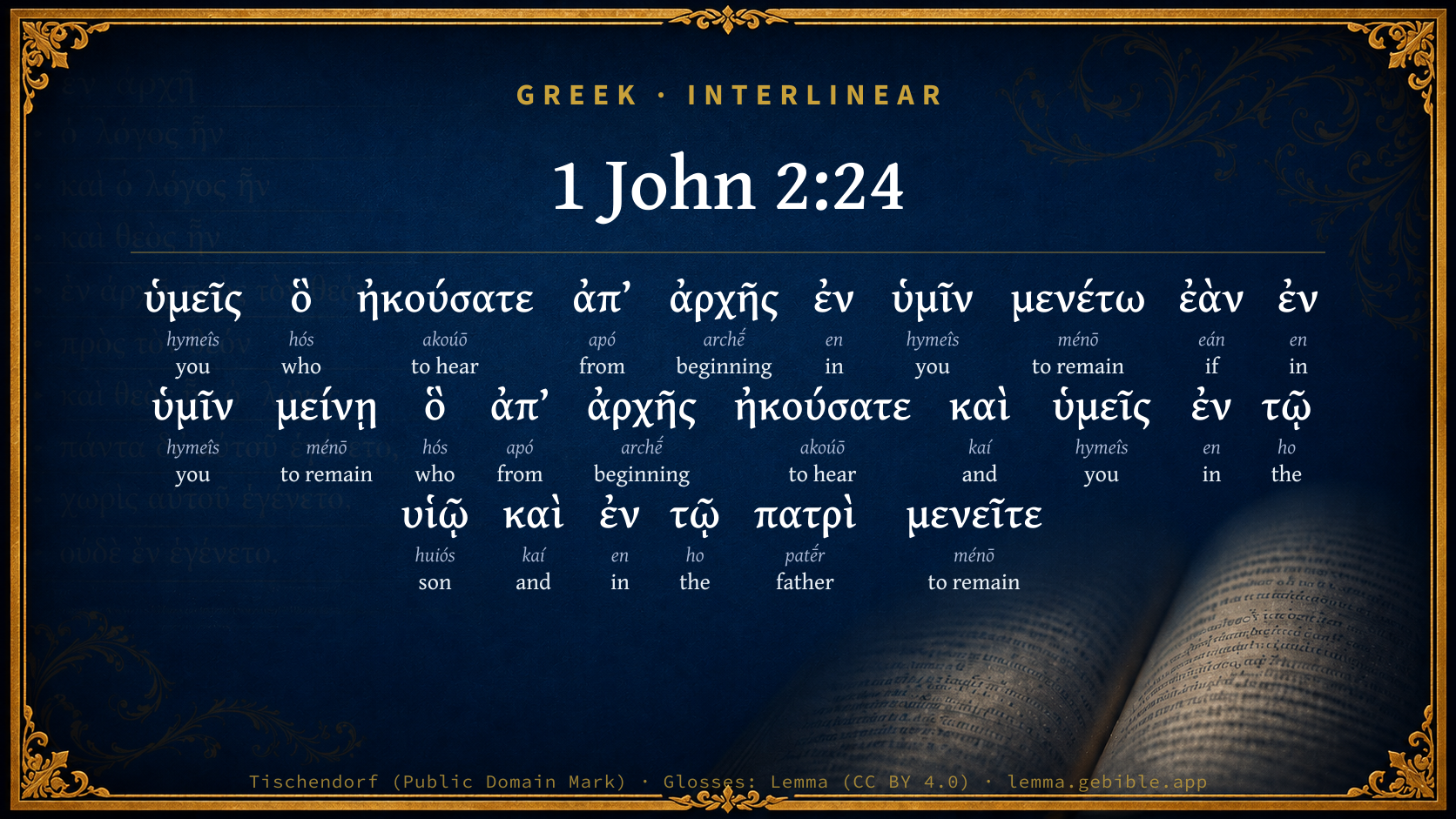
Greek (Tischendorf 8th ed.) 1 John 2:24 appears in the Greek New Testament. The text above is from the Tischendorf 8th edition. Each word links to its Strong’s number and a concise gloss. Click any word for its full Thayer’s Greek Lexicon entry.
Download image
Cite this verse

1 John 2:24 (World English Bible). Public Domain. Lemma interlinear Bible study tool, https://lemma.gebible.app/v/1-john/2/24.

Show BibTeX & RIS
BibTeX
RIS
English Translation
Therefore, as for you, let that remain in you which you heard from the beginning. If that which you heard from the beginning remains in you, you also will remain in the Son, and in the Father.
World English Bible · Public Domain
Download a study sheet

One document with this verse’s original text, its word-by-word gloss line, the meaning frame, cross-references with their text, attributed commentary, and full source and license credits — printable, and it pastes into notes with its structure intact.

This verse Autodidact and up

Study sheet (.html) Plain text (.txt)

A passage Seminary Student

Up to 50 verses in one chapter. A passage sheet keeps up to 6 commentary sources and 12 cross-references per verse, in the order this page ranks them, and says so on the sheet whenever that leaves anything out. Ask for a single verse and you get the Autodidact verse sheet above.

Everything on this page stays free to read, with no account — the sheet is a download of what is already on screen, not access to it.

Want to remove ads? Support Godless Engineer
Compare translations 3

The same verse in 3 English versions, stacked beneath the original-language interlinear above. Click any original word for its lexicon entry.

Each is an independent rendering of the whole verse — the interlinear is not word-aligned to these translations.

Highlighted words mark where these versions differ — a whole-verse word diff, not a word-by-word alignment.

  • World English Bible Public Domain
    Therefore, as for you, let that remain in you which you heard from the beginning. If that which you heard from the beginning remains in you, you also will remain in the Son, and in the Father.
  • King James Version Public Domain
    Let that therefore abide in you, which ye have heard from the beginning. If that which ye have heard from the beginning shall remain in you, ye also shall continue in the Son, and in the Father.
  • unfoldingWord Literal Text CC BY-SA 4.0
    You, let remain in you what you have heard from the beginning. If what you have heard from the beginning remains in you, you will also remain in the Son and in the Father.

unfoldingWord Literal Text — © unfoldingWord, licensed CC BY-SA 4.0. Word-aligned USFM3 via Door43 (git.door43.org/unfoldingWord/en_ult).

Versions to compare (up to 4)

3 of 4 selected

Show all 19 translations

Every available English version of this verse, each an independent rendering of the whole verse.

  • World English Bible Public Domain
    Therefore, as for you, let that remain in you which you heard from the beginning. If that which you heard from the beginning remains in you, you also will remain in the Son, and in the Father.
  • Berean Standard Bible Public Domain
    As for you, let what you have heard from the beginning remain in you. If it does, you will also remain in the Son and in the Father.
  • Majority Standard Bible Public Domain
    As for you, then, let what you have heard from the beginning remain in you. If it does, you will also remain in the Son and in the Father.
  • King James Version Public Domain
    Let that therefore abide in you, which ye have heard from the beginning. If that which ye have heard from the beginning shall remain in you, ye also shall continue in the Son, and in the Father.
  • American Standard Version (1901) Public Domain
    As for you, let that abide in you which ye heard from the beginning. If that which ye heard from the beginning abide in you, ye also shall abide in the Son, and in the Father.
  • Revised Version (1885) Public Domain
    As for you, let that abide in you which ye heard from the beginning. If that which ye heard from the beginning abide in you, ye also shall abide in the Son, and in the Father.
  • Geneva Bible (1599) Public Domain
    Let therefore abide in you that same which ye haue heard from the beginning. If that which ye haue heard from the beginning, shall remaine in you, ye also shall continue in the Sonne, and in the Father.
  • Douay-Rheims (1899) Public Domain
    As for you, let that which you have heard from the beginning, abide in you. If that abide in you, which you have heard from the beginning, you also shall abide in the Son, and in the Father.
  • Young's Literal Translation Public Domain
    Ye, then, that which ye heard from the beginning, in you let it remain; if in you may remain that which from the beginning ye did hear, ye also in the Son and in the Father shall remain,
  • Literal Standard Version CC BY-SA 4.0
    You, then, that which you heard from the beginning, let it remain in you; if that which you heard from the beginning may remain in you, you also will remain in the Son and in the Father,
  • Unlocked Literal Bible CC BY-SA 4.0
    As for you, let what you have heard from the beginning remain in you. If what you heard from the beginning remains in you, you will also remain in the Son and in the Father.
  • unfoldingWord Literal Text CC BY-SA 4.0
    You, let remain in you what you have heard from the beginning. If what you have heard from the beginning remains in you, you will also remain in the Son and in the Father.
  • Darby Bible Public Domain
    As for *you* let that which ye have heard from the beginning abide in you: if what ye have heard from the beginning abides in you, *ye* also shall abide in the Son and in the Father.
  • World Messianic Bible Public Domain
    Therefore, as for you, let that remain in you which you heard from the beginning. If that which you heard from the beginning remains in you, you also will remain in the Son, and in the Father.
  • Webster's Bible Public Domain
    Let that therefore abide in you, which ye have heard from the beginning. If that which ye have heard from the beginning shall remain in you, ye also shall continue in the Son, and in the Father.
  • Free Bible Version CC BY-SA 4.0
    As for you, make sure what you heard from the beginning continues to live in you. If what you heard from the beginning lives in you, you will also live in the Son and in the Father.
  • Bible in Basic English Public Domain
    But as for you, keep in your hearts the things which were made clear to you from the first. If you keep these things in your hearts you will be kept in the Father and the Son.
  • Text-Critical English NT CC BY 4.0
    Therefore let what you have heard from the beginning abide in you. If what you have heard from the beginning abides in you, then you will abide in the Son and in the Father.
  • Tyndale New Testament (1534) Public Domain
    Let therfore abyde in you that same which ye hearde from the begynnynge. Yf that which ye hearde from the begynnynge shall remayne in you ye also shall continewe in the sonne and in the father

Literal Standard Version (2020), Covenant Press — licensed CC BY-SA 4.0. Text via the HelloAO Bible API (eBible.org). Unlocked Literal Bible (unfoldingWord) — licensed CC BY-SA 4.0. Text via the HelloAO Bible API (eBible.org). unfoldingWord Literal Text — © unfoldingWord, licensed CC BY-SA 4.0. Word-aligned USFM3 via Door43 (git.door43.org/unfoldingWord/en_ult). Free Bible Version, Dr. Jonathan Gallagher — licensed CC BY-SA 4.0. Text via the HelloAO Bible API (eBible.org).

Word by word

More ways to search: Search by grammar → Find every occurrence → Compare this word →

Practice this passage: Drill this verse → Learn its vocabulary →

ἀρχῆς
archḗ
G746
“beginning”
Noun, Genitive, Singular, Feminine
Part of Speech
Noun
Case
Genitive
Number
Singular
Gender
Feminine
Full Thayer's Definition

Origin: from G756

TDNT: 08:59,8

1. beginning, origin 2. the person or thing that commences, the first person or thing in a series, the leader 3. that by which anything begins to be, the origin, the active cause 4. the extremity of a thing a. of the corners of a sail 5. the first place, principality, rule, magistracy a. of angels and demons
  1. ὑμεῖς hymeîs G5210 “you” Personal pronoun, 2nd person, Nominative, Plural
  2. ὃ hós G3739 “who” Relative pronoun, Accusative, Singular, Neuter
  3. ἠκούσατε akoúō G191 “to hear” Verb, Aorist, Active, Indicative, 2nd person, Plural
  4. ἀπ’ apó G575 “from” Preposition
  5. ἐν en G1722 “in” Preposition
  6. ὑμῖν hymeîs G5210 “you” Personal pronoun, 2nd person, Dative, Plural
  7. μενέτω ménō G3306 “to remain” Verb, Present, Active, Imperative, 3rd person, Singular
  8. ἐὰν eán G1437 “if” Conditional
  9. ἐν en G1722 “in” Preposition
  10. ὑμῖν hymeîs G5210 “you” Personal pronoun, 2nd person, Dative, Plural
  11. μείνῃ ménō G3306 “to remain” Verb, Aorist, Active, Subjunctive, 3rd person, Singular
  12. ὃ hós G3739 “who” Relative pronoun, Accusative, Singular, Neuter
  13. ἀπ’ apó G575 “from” Preposition
  14. ἀρχῆς archḗ G746 “beginning” Noun, Genitive, Singular, Feminine
  15. ἠκούσατε akoúō G191 “to hear” Verb, Aorist, Active, Indicative, 2nd person, Plural
  16. καὶ kaí G2532 “and” Conjunction
  17. ὑμεῖς hymeîs G5210 “you” Personal pronoun, 2nd person, Nominative, Plural
  18. ἐν en G1722 “in” Preposition
  19. τῷ ho G3588 “the” Article, Dative, Singular, Masculine
  20. υἱῷ huiós G5207 “son” Noun, Dative, Singular, Masculine
  21. καὶ kaí G2532 “and” Conjunction
  22. ἐν en G1722 “in” Preposition
  23. τῷ ho G3588 “the” Article, Dative, Singular, Masculine
  24. πατρὶ patḗr G3962 “father” Noun, Dative, Singular, Masculine
  25. μενεῖτε ménō G3306 “to remain” Verb, Future, Active, Indicative, 2nd person, Plural

About this verse

These counts appear in no published source. They are computed here, from the morphology-tagged text and Lemma’s own curated glosses. What Lemma adds →

26
words
12
distinct lemmas
General Epistles
section

Shared distinctive vocabulary

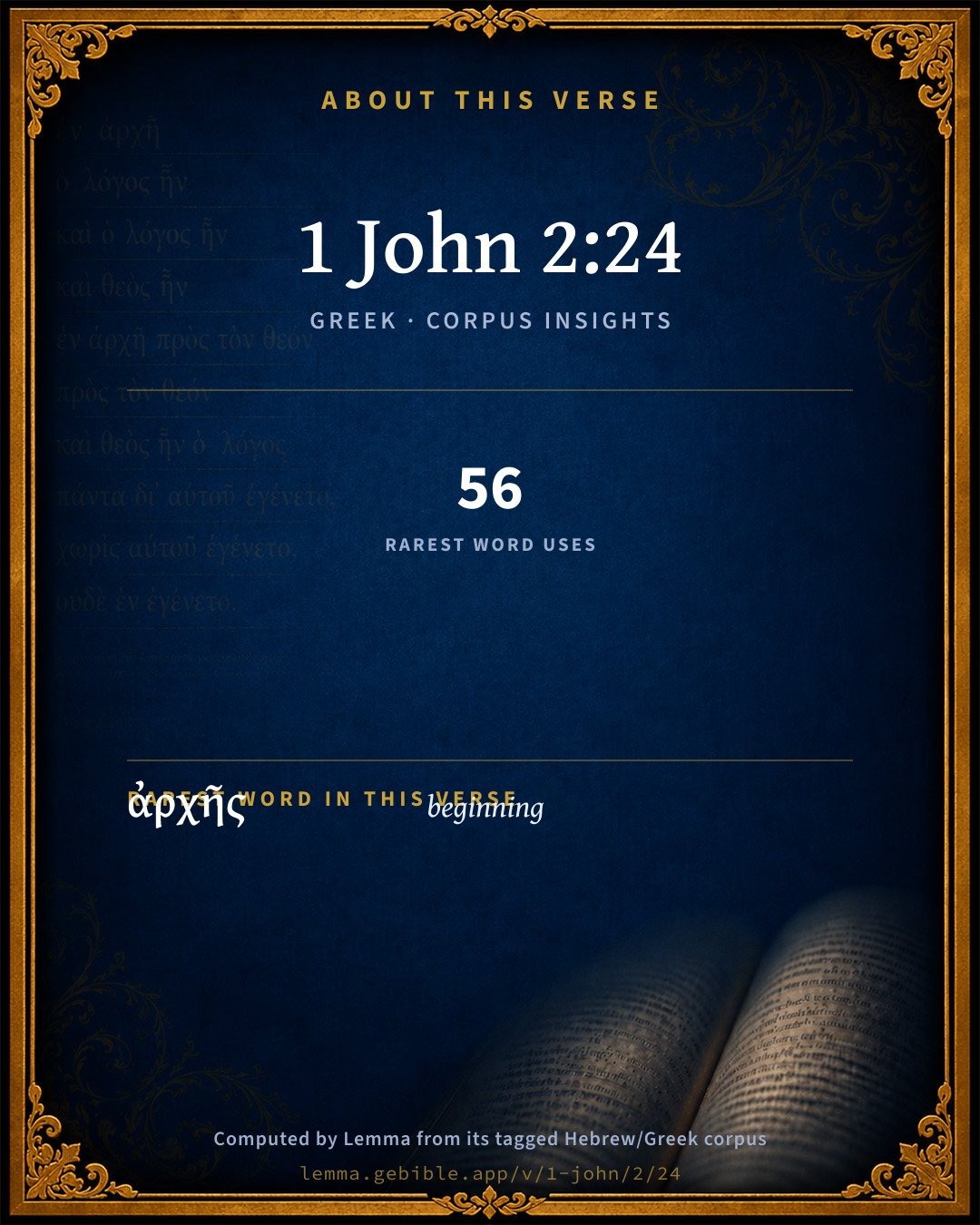
ἀρχῆς beginning G746 occurs in 55 verses of the Greek New Testament. Also found in:
Repetition

Words recur within this verse:

  • μενέτω to remain G3306 ×3
  • ἠκούσατε to hear G191 ×2
  • ἀρχῆς beginning G746 ×2
  • ὑμεῖς you G5210 ×4
  • ἐν in G1722 ×4
  • ὃ who G3739 ×2
  • ἀπ’ from G575 ×2
  • καὶ and G2532 ×2
  • τῷ the G3588 ×2

Cross-references

23

Topical passages linked to 1 John 2:24 in the Treasury of Scripture Knowledge — connected by theme and wording, ordered by reader-vote popularity; previews shown in the World English Bible.

  • John 14:23 Jesus answered him, "If a man loves me, he will keep my word. My Father will love him, and we will come to him, and make our home with him.
  • John 15:9–10 Even as the Father has loved me, I also have loved you. Remain in my love.
  • 1 John 4:13 By this we know that we remain in him and he in us, because he has given us of his Spirit.
  • 1 John 4:16 We know and have believed the love which God has for us. God is love, and he who remains in love remains in God, and God remains in him.
  • 2 John 1:5–6 Now I beg you, dear lady, not as though I wrote to you a new commandment, but that which we had from the beginning, that we love one another.
  • John 15:7 If you remain in me, and my words remain in you, you will ask whatever you desire, and it will be done for you.
  • 1 John 1:3 that which we have seen and heard we declare to you, that you also may have fellowship with us. Yes, and our fellowship is with the Father, and with his Son, Jesus Christ.
  • 1 John 2:7 Brothers, I write no new commandment to you, but an old commandment which you had from the beginning. The old commandment is the word which you heard from the beginning.
  • Revelation 3:3 Remember therefore how you have received and heard. Keep it, and repent. If therefore you won't watch, I will come as a thief, and you won't know what hour I will come upon you.
  • Psalms 119:11 I have hidden your word in my heart, That I might not sin against you.
  • John 17:21–24 that they may all be one; even as you, Father, are in me, and I in you, that they also may be one in us; that the world may believe that you sent me.
  • Colossians 3:16 Let the word of Christ dwell in you richly; in all wisdom teaching and admonishing one another with psalms, hymns, and spiritual songs, singing with grace in your heart to the Lord.
  • Revelation 3:11 I am coming quickly! Hold firmly that which you have, so that no one takes your crown.
  • Philippians 4:15 You yourselves also know, you Philippians, that in the beginning of the Gospel, when I departed from Macedonia, no assembly shared with me in the matter of giving and receiving but you only.
  • Hebrews 3:14 For we have become partakers of Christ, if we hold fast the beginning of our confidence firm to the end:
  • 1 John 1:7 But if we walk in the light, as he is in the light, we have fellowship with one another, and the blood of Jesus Christ, his Son, cleanses us from all sin.
  • Hebrews 2:1 Therefore we ought to pay greater attention to the things that were heard, lest perhaps we drift away.
  • 2 John 1:2 for the truth's sake, which remains in us, and it will be with us forever:
  • 3 John 1:3 For I rejoiced greatly, when brothers came and testified about your truth, even as you walk in truth.
  • Proverbs 23:23 Buy the truth, and don't sell it: Get wisdom, discipline, and understanding.
  • Luke 1:2 even as those who from the beginning were eyewitnesses and ministers of the word delivered them to us,
  • John 8:25 They said therefore to him, "Who are you?" Jesus said to them, "Just what I have been saying to you from the beginning.
  • Luke 9:44 "Let these words sink into your ears, for the Son of Man will be delivered up into the hands of men."

Cross-references courtesy of OpenBible.info (CC BY 4.0).

Where the printed editions differ

1 variant

Places in this verse where the major printed Greek editions disagree on the wording in a way that affects the translation — a comparison of editions, not a manuscript-by-manuscript collation. The editions are the modern critical texts (Nestlé-Aland 28/27, SBL, Westcott-Hort, Tregelles, Tyndale House) and the traditional texts behind the KJV (the Textus Receptus and the Byzantine/Majority text). It is not a claim about which reading is original.

  1. Extra text
    οὐν

    “therefore”

    In TRByz Not in NA28NA27TynSBLWHTreg

    οὐν (oun) 'therefore' is only in traditional manuscripts (TR+Byz)

Textual data: Translators Amalgamated Greek New Testament (STEPBible TAGNT) · CC BY 4.0.

Commentary

Notes on 1 John 2:24 from classic Christian and Jewish commentators (each source and its license shown beneath its notes). The classic Christian expositions comment on the surrounding passage and are grouped to its opening verse, so a note may address several verses; the Jewish commentaries on the Tanakh (Rashi and others) are per-verse, so they appear only where the commentator wrote on this verse.

Lemma curates 59 commentaries, every one of them public domain or Creative Commons licensed, each selected and text-cleaned for this edition rather than reprinted as found. About our sources →

The Biblical Illustrator

Joseph S. Exell

1Jn_2:24-25

If that which ye have heard from the beginning shall remain in you, ye also shall continue in the Son, and in the Father

The guileless spirit abiding through the Word in the Son and in the Father, so as to receive the promise of eternal life

I.

Let that therefore which ye have heard from the beginning abide in you. The phrase from the beginning must here refer to the first preaching of the gospel. Let all of Christ you have ever known, seen, heard, handled, tasted, abide in you. Let all you have learned of Christ--as being with the Father, from everlasting, in His bosom--as coming forth from the Father to reveal and reconcile--as purging your sin with blood, and bringing you to be all to the Father that He is Himself to the Father--let it all abide in you; always, everywhere.

II. So ye also shall abide in the Son and in the Father. First, Ye shall abide in the Son. What the Lord elsewhere enjoins as in itself a duty, Abide in Me (Joh_15:4), the apostle describes as the consequence of another duty being rightly discharged. We abide in the Son, as we may be said to abide in anyone when his words abide in us--or when that which we have heard of him, or from him, from the beginning, abides in us; when we understand and know him by what he says and what we hear; when what we thus understand and know of him takes hold of us, carries our conviction, commands our confidence and love, fastens and rivets itself in our mind and heart, and so abides in us. Thus we abide in the Son precisely as we abide in a friend whom we know, and trust, and love. Let us turn all that we learn into the materials of that personal communing of Him with us and us with Him, which is indeed the essence of our abiding in the Son. All the rather let us do so because, secondly, this abiding in the Son is abiding in the Father; for the Father and the Son are one. Into all that the Son is to the Father, in these and other similar views of His mediatorial character and ministry as the Son, we enter when we abide in the Son. And so we come to be to the Father all that the Son is to the Father. We abide in the Father as the Son abides in the Father. So we abide in the Son and in the Father. And still all this depends on our letting that which we have heard from the beginning abide in us. It depends on that faith which cometh by hearing, as hearing cometh by the Word of God.

III. Of all this the fruit is unto holiness, and the end everlasting life. For this is the promise that He hath promised us, even eternal life. The meaning here may be that the promise of eternal life is superadded to the privilege or condition of our abiding in the Son and in the Father, that it is something over and above that held out to us in prospect; or it may be that our abiding in the Son and in the Father is itself the very life eternal that is promised. The difference is not material; the two thoughts, or rather the two modifications of the same thought, run into one. (R. S. Candlish, D. D.)

Christian doctrine, duty, privilege, and hope

I. Christian doctrine. It is the doctrine of the Father and of the Son. Christianity, while it by no means robs the eternal Father of His honour, at the same time promulgates the Saviours declaration, that it is the pleasure of the Father that all men should do honour to the Son even as they do honour to the Father. It is a dispensation of which Christ is the head, is the chief subject, is the principal Person, to whom all eyes are to be directed; while all honour, and glory, and majesty, and worship, and thanksgiving are poured out upon the Father in all ages, at the foot of the mediatorial throne.

II. The duty and privilege of the Church. What is the duty? Let them abide in you. And what the privilege? If that which ye have heard from the beginning shall remain in you, ye also shall continue in the Son, and in the Father. Let it abide in you: but it must first obtain admission. Ah! and not only so, it must take its mighty grasp of the heart. And so it does wherever it comes in truth; it enters there to have its own way, first, to resist sin, then to imprison sin, and ultimately, by the grace of God, to cast it out.

III. The Christian hope. This is the promise, even eternal life. We are not content to live here always. No; we know there is a better land, a land of peace, of purity, and perfect bliss. (T. Mortimer, B. D.)

Vital godliness

There is a peculiar importance attached to these three little ins. There is a blessed union, a holy identity, an inseparable oneness between the persons and experience of real Christians and the persons and perfections of all the glorious Trinity in unity. Doctrinal godliness is union with Deity; experimental godliness is the enjoyment of Deity; practical godliness is the glorifying of Deity.

I. The antiquity of our religion. That which ye have heard from the beginning. What beginning? The beginning of the gospel? I grant that, if you wish; the beginning of the Christian dispensation. But go a little further back; the beginning of the prophetic vision--the beginning of the Mosaic economy--the beginning of the Abrahamic covenant--the beginning of the creation--go back as early as you will, and we will bear testimony that our faith is the faith of the ancients. If not, we will abandon it. Mark that beautiful account of the patriarchal faith recorded in the seventeenth of Genesis, and compare it with what is recorded by Paul in the Epistle to the Galatians, and the Epistle to the Romans and the Epistle to the Hebrews, and inquire whether they are not precisely the same faith, taught to both of them by the Holy Ghost. What was this ancient system? Our Lord tells us in plain terms, that Abraham rejoiced to see His day, and he saw it and was glad. Well, then, Abrahams religion, Abrahams faith, that which was from the beginning, simply consisted in seeing everything in Christ, beholding all he wanted in Christ, the Substitute, the Surety, the Daysman, the Sponsor of His whole Church. But we go further back than we have hitherto gone. Where then? say you? Up to the eternal councils of peace. I mean to.. say that all the religion worth having originated in heaven; it is the offspring of Deity. All that pertains to real godliness originates with God. Now here are certainties; here are securities. These are old-fashioned truths. Old-fashioned guineas, you know, are almost obsolete; but when we find them, we know they are valuable. Blessed be God, these truths are of sterling value and infinite importance; that which we have heard from the beginning our souls delight to dwell upon.

II. The living participation of this old-fashioned religion. If it shall remain in you. It must be in you in order to remain there. So that here is a religion put in a man, and of such a nature, and of such value, that it remains--abides, continues. What, then, is it? It is nothing less than a communication made from the throne of God, by the Holy Ghost, to the sinners heart. I should never be the better for what God my Father has given and God my Saviour has done, but for God the Holy Spirits communications to my soul. Every act of quickening is from His power; every whisper of love is by His voice. It is nothing less than the indwelling, the witnessing, the comforting, the instruction, the anointing of the Holy Ghost, resting upon the soul of man, that imparts one spiritual motion. I pass on to the term remain: If that which ye have heard from the beginning shall remain in you. The Spirit of truth, whom ye know; for He dwelleth with you, and shall be in you. The Father shall give you another Comforter, that He may abide with you forever. He never gives up His charge; He never forsakes His residence; He never abandons His work. It is a remaining religion. Now for the words--remain in you. Blessed be God, then there is no possibility of alteration. What is round about me, I cannot secure. But what is within me, secures me. It remains within: a vital principle, the life of God in the soul. It is Christ in you, the hope of glory; and the world and the devil must conquer Christ before they can turn Him out. Therefore He remains--remains in you.

III. Wherever this remaining, abiding, unconquerable, unchanging religion dwells in the soul, a lasting union between jehovah and that soul is demonstrated. Continue in the Son and in the Father! An inheritor of all the Sons merit and of all the Fathers love; an heir of God, a joint heir with Christ; interested in all that Christ did and suffered, and interested in all that paternal love planned, ordained, and predestinated. The warrior may boast of his fame, the statesmen may carry their projects, the merchants may secure their fortunes, the pleasure taker may revel in his wickedness, worldlings of all sorts may have their gods; but give me mine. An interest in all that covenant love has bestowed, and all that covenant blood has bought, and all that covenant grace can impart. But, say you, how am I to know this? I am to know it by something remaining in me; I am to know it by having a covenant gift; I am to know it by having an old-fashioned religion remaining in my soul that the devil and earth and sin cannot turn out. And, therefore, if thou hast the earnest, the pledge given by Jehovah, the Spirits work in thy soul, thou hast all that constitutes assurance of interest in the Son and in the Father. If children, then heirs; heirs of God, and joint heirs with Christ. (J. Irons.)

The Biblical Illustrator, edited by Joseph S. Exell (c. 1880s–1900s) — public domain. Text from a community e-Sword module.

Joseph Benson's Commentary

1Jn 2:24-25. Let that therefore abide in you — Namely, that doctrine concerning the Father and the Son; which ye have heard from the beginning — Of the preaching of the gospel: retain a firm belief of it, and let your minds be so impressed with a sense of its certain truth and infinite importance, that it may have the desired influence on your spirit and conduct. If that which ye have heard, &c., shall remain fixed and rooted in you — If you persevere in the faith of the gospel, and show that you do so by your life and conversation; ye also shall continue in the Son and in the Father — Genuine members of Christ’s mystical body, and consequently in the love of God, and in communion with him. And, to encourage you in this, remember the promise, that he, the Son, hath made to us, if we abide in him, even eternal life.

Joseph Benson's Commentary on the Old and New Testaments (1811–1818) — public domain. Text from a community e-Sword module.

The Preacher's Complete Homiletical Commentary

Joseph S. Exell (gen. ed.)

CRITICAL AND EXEGETICAL NOTES

1Jn_2:24.—Omit “therefore. “Which ye have heard.—Concerning Christ, and Christ’s truth, on the authority of His apostles. Remain … continue—In both cases prefer the word “abide.” Dr. Plummer paraphrases thus, “Let the truths which were first taught you have a home in your hearts: if these have a home in you, ye also shall have a home in the Son and in the Father.” Developments of the primary truths there must be, but all developments, adjustments, and adaptations must be in the strictest harmony with the primary truths.

1Jn_2:27. Any man teach you.—That is, any man who claims personal authority to teach, and does not speak by the inspiration of the Holy Ghost. Anointing.—Which implies and involves that the Spirit is in you, leading you into all truth. St. John seems to suggest that the Spirit dwelling in the disciple will always make him sensitive to the recognition of the Spirit in his teacher. As he has shown that the new Divine life will keep us from sin, so now he shows that it will keep us from error.

1Jn_2:28. Ashamed before Him.—Better, “shamed away from Him”; or, “shrink in shame from Him.”

1Jn_2:29. Ye know.—Better, “know ye.” Doeth righteousness.—Note the emphasis on doing: see chap. 1Jn_3:7. “A sober, righteous, and godly life is the fruit, and consequently the proof, of spiritual birth—the token by which the sons of God by adoption and grace are distinguished from other men.”

MAIN HOMILETICS OF THE PARAGRAPH.—1Jn_2:24-29

Persuasions to letting the Truth abide in us.—“Abiding” is one of St. John’s key-words. What had to be feared in the early Church has to be feared in every age of the Church. It is restlessness, that tends to shift men from their foundations. Nothing more effectually hinders Christian living than perpetual uncertainty about the grounds of our confidence and hope. Souls are like plants—they cannot thrive if their roots are continually being shaken. They grow in atmospheres of quietness and peace. They must abide as they have begun.

I. Abiding in Christ is holding fast the truth received concerning Him.—“That which ye have heard from the beginning.” Apostles, and all true teachers, never attempted to shift the foundations of primary truth concerning Christ which they had laid. They are willing enough to build on those foundations, but absolutely unwilling to alter the foundations. It would be useless and mischievous work for Englishmen now to try and alter Magna Charta, which is the basis of English liberty. “Holding fast the profession of our faith without wavering” is “abiding in Christ.” The primary truths about Christ concern His Divine-human person, and Divine-human mission: Son of God; Son of man; and God saving man.

II. Abiding in Christ is the guarantee of continuous spiritual life.—It brings the “eternal life.” That life can be ours only by vital union with Him. It is the communication of His own Divine life through the channels of our faith. Break the connection, and the life can but flag and fail. Our Lord Himself said, “Without Me ye can do nothing.”

III. Abiding in Christ is the work for us done by the Holy Spirit, who is with us.—This appears to be the idea St. John tries to express under the figure of the “anointing.” The believer is sealed by the anointing of the Spirit. That Spirit has, for His supreme mission in the believer, to keep him in vital relations with Christ—abiding in Christ.

SUGGESTIVE NOTES AND SERMON SKETCHES

1Jn_2:24. Jealousy concerning Primary Truths.—In our day it has been anxiously asked, “What is the minimum of evangelical truth which must be accepted to constitute a saving belief? “The answer is difficult, and will probably vary according to the religious school to which the answerer belongs. It is quite clear that there were some primary and essential truths to which apostles required full assent and absolute faithfulness; but they are much more simple truths than we usually admit, and they are sufficiently general to allow of various unfoldings and expressions. We may see how simple the truth required to be witnessed before baptism was in the case of Philip and the eunuch. If the words of Act_8:37, “I believe that Jesus Christ is the Son of God,” are a later addition to the text, they meet our case by representing the earliest tradition. The primary truth, of which we must be supremely jealous, and which constitutes the minimum of the Christian demand, is this—Jesus of Nazareth is the Christ of God, the Son of the Father, sent by Him to be the Saviour of the world from sin.

1Jn_2:25. The Promise of Eternal Life.—The term “eternal life” is a figurative one. Mere continuance is not the manifestly most desirable thing; and all time-measures are unsuitable to the after-life, “time” being strictly one of the present earthly conditions of thought. As a figure, the term “eternal” represents, in part, what we mean by “spiritual”; or perhaps it would be more precise to say that it stands for “the highest conceivable,” “the best that is attainable.” When applied to “life,” it suggests full, unhindered life in God, life unto God. From the point of view of the tripartite division of human nature into body, animal soul, and spirit, what is meant by “eternal life” can readily be apprehended. It is the Divine quickening, and consequently the holy activity, of the “spirit” which man really is. Much has been missed by the confounding of the “eternal life” with the “after-life.” It may be found in the after-spheres, but it may also be found in the present earthly spheres. A man may have the eternal life now. As soon as this is clearly seen, the figurative character of the word comes to view, and the impossibility of its being strictly descriptive is recognised. There are many passages in which the “time” idea is manifestly unsuitable; in them the idea of “quality” is prominent. As instances see Deu_33:27—“The eternal God is thy refuge”; where it is evidently intended to suggest high and inspiring estimates of God, as the infinitely trustworthy One. In Isa_60:15, the prophet, speaking in the name of God to Israel as a nation, says, “I will make of thee an eternal excellency.” Continuity of existence cannot be predicated of any nation. A supreme excellency is evidently meant. St. Paul, in Rom_1:20, refers to God’s “eternal power”; and in 2Co_4:17 he writes of an “exceeding and eternal weight of glory.” Save as a figurative expression, “an eternal weight” can have no intelligible meaning. The following suggestion deserves consideration: One of our common “notes of value” is the length of time that a thing will last. Ephemeral things are regarded as worthless; enduring things are estimated as valuable. The nettle is worthless; the oak is valuable. The gnat of a summer evening is worthless; the elephant of a century is valuable. The coal that burns through in an hour is worthless; the diamond that outlasts all the generations is valuable. God, then, would impress on us the very highest conceivable value, as attaching to His gift to us in Christ Jesus. So He meets us on our own level, fits His figure to our usual thoughts and estimates, bids us realise what must be the value of a thing which can not only outlast all generations, but even outlast all world-stories, and so apprehend the infinite value of that gift which He gives to us, even “eternal life.” The “eternal life” is the life which cannot be measured by years or days, but is the enjoyment of the blessedness of virtue. This is a present fact, begun as soon as the believer begins to be in Christ, growing more and more as he walks more and more closely with God, secured for ever when he enters his rest, and perfected in the glory of heaven. But this life, depending on knowledge of God, as begun here, does not lessen the reasonableness of its being perfected hereafter, any more than its future completion prevents its present beginning. F. D. Maurice took a firm stand in resisting the association of the idea of “duration” with the term “eternal.” A striking passage from his Theological Essays may be given: “The word ‘eternal,’ if what I have said be true, is a key-word of the New Testament. To draw our minds from the temporal, to fix them on the eternal, is the very aim of the Divine economy. How much ought we then to dread any confusion between thoughts which our Lord has taken such pains to keep distinct—which our consciences tell us ought to be kept distinct! How dangerous to introduce the notion of duration into a word from which He has deliberately excluded it!” And yet this is precisely what we are in the habit of doing, and it is this which causes such infinite perplexity in our minds. “Try to conceive,” the teachers say, “a thousand years. Multiply these by a thousand, by twenty thousand, by a hundred thousand, by a million. Still you are as far from eternity as ever.” “Certainly I am quite as far. Why then did you give me that sum to work out? What could be the use of it, except to bewilder me, except to make me disbelieve in eternity altogether? Do you not see that this course must be utterly wrong and mischievous? If eternity is the great reality of all, and not a portentous fiction, how dare you impress such a notion of fictitiousness on my mind as your process of illustration conveys?” “But is it not the only one?” “Quite the only one, so far as I see, if you will bring time into the question—if you will have years and centuries to prevent you from taking in the sublime truth, ‘This is life eternal—to know God.’ The eternal life is the perception of His love, the capacity of loving; no greater reward can be attained by any, no higher or greater security. The eternal punishment is the loss of that power of perceiving His love, the incapacity of loving; no greater damnation can befall any.” Bishop Weslcott, writing of the phrases used in St. John’s epistles, says: “In considering these phrases it is necessary to premise that in spiritual things we must guard against all conclusions which rest upon the notion of succession and duration. ‘Eternal life’ is that which St. Paul speaks of as ἡ ὄντως ζωή, ‘the life which is life indeed’ (1Ti_6:10), and ἡ ζωὴ τοῦ Θεοῦ, ‘the life of God’ (Eph_4:18). It is not an endless duration of being in time, but being of which time is not a measure. We have, indeed, no power to grasp the idea except through forms and images of sense. These must be used, but we must not transfer them as realities to another order. The life which lies in fellowship with God and Christ is spoken of as ‘eternal life,’ in order to distinguish it from the life of sense and time, under which true human life is veiled at present. Such a life of phenomena may be ‘death,’ but ‘eternal life’ is beyond the limitations of time; it belongs to the being of God.”—From “Handbook of Scientific and Literary Bible Difficulties”.

1Jn_2:26. False Teachings as Spiritual Seduction.—“Concerning them that seduce you.” The term which St. John uses brings out very prominently that the moral mischief of false teachings is of much more serious concern than the intellectual. We need not undervalue the importance of correct opinion on religious subjects. But as mere intellectual differences, keeping in the mental range, they are too often little more than logomachies. Every shape of opinion bears some direct relation to moral conduct, and every wrong setting of Christian truth has an evil influence on morals, and can be fairly judged in the light of that influence. Concerning all teaching submitted to us we can ask two questions:

1. Is it true? That question is often beyond all our power of solution.

2. Does it work out unto righteousness? That can always be answered.

CHAPTER 3

The Preacher's Complete Homiletical Commentary (gen. ed. Joseph S. Exell; Funk & Wagnalls, c. 1892) — public domain (pre-1929). A full-Bible homiletical/sermon-outline anthology covering 65 of 66 books (2 John is absent from the source module). Text from a community e-Sword module.

Tyndale Open Study Notes

Tyndale Open Resources

2:24-25 John instructs his readers to resist the lies of such antichrists and to remain faithful to the truth that he and the other apostles have proclaimed to them. If they would do this, then they would remain in fellowship with the Son and with the Father and have assurance of eternal life (John 3:15, 36; 6:40, 47, 57; 17:2-3).

Tyndale Open Study Notes — © Tyndale Open Resources, licensed CC BY-SA 4.0. Text via the HelloAO Bible API.

Bengel's Gnomon

Johann Albrecht Bengel

1Jn 2:24. Ὑμεῖς, you) There is an antithesis in the pronoun: therefore a transposition is used, as in 1Jn 2:27.—ὅ) that which, respecting the Father and the Son.—ἠκούσατε, ye have heard) This is to be pronounced with emphasis.—μενέτω, let it abide) He uses exhortation. Wherefore, if it abides, has this meaning; If you shall be of the character of those in whom it abides.—ὃ ἀπʼ ἀρχῆς, that which is from the beginning) Now this is to be pronounced with emphasis.—καὶ ὑμεῖς, ye also) in your turn. Thus, in you, in Him, 1Jn 2:27.

Bengel's Gnomon of the New Testament — English translation (T&T Clark, Edinburgh, 1860) — public domain. Text from a community e-Sword module.

Meyer's Critical & Exegetical Commentary

Heinrich August Wilhelm Meyer

1Jn_2:24-25. Exhortation to the faithful keeping of the gospel. 1Jn_2:24. ὑμεῖς] By the Recepta ὑμεῖς οὖν the correct relationship of this verse is taken away; it is not a conclusion from what immediately precedes (Düsterdieck, Braune), but with the emphasized ὑμεῖς it is put in contrast with what is said of the false teachers; Theophylact: ἐκεῖνοι μὲν οὖν οὕτως· ὑμεῖς δὲ ἅπερ ἠκούσατε ἀπʼ ἀρχῆς φυλάττετε παρʼ ἑαυτοῖς.

In regard to the construction: ὑμεῖς ὃ ἠκούσατε ἀπʼ ἀρχῆς, ἐν ὑμῖν μενέτω, Beza and Socinus, it is either an attraction (ὑμεῖς ὃ ἠκ. for ὃ ὑμεῖς ἠκούσ., so also Bengel: antitheton est in pronomine; ideo adhibetur trajectio; de Wette: ὑμεῖς is properly no doubt the subject of the relative clause placed first; Jachmann)[175] or an ellipsis (ὑμεῖς = quod ad vos attinet); Paulus and Ebrard regard ὑμεῖς as the pure vocative; but it is more correct to admit an anacolouthon which has its natural origin in this, that the apostles thought in opposition to the false teachers was first directed to his readers, but equally also to the word which they had heard from the beginning; accordingly the apostle begins with ὑμεῖς, but does not follow it up by μένετε ἐν or a similar expression, but by ὃ ἠκούσατε κ.τ.λ., as a new subject; comp. Winer, p. 506; VII. p. 534; Buttmann, p. 325. The same anacolouthon in 1Jn_2:27.[176] With Ὃ ἨΚΟΎΣΑΤΕ ἈΠʼ ἈΡΧῆς, comp. 1Jn_2:7; thereby, of course, the whole gospel is meant, but here specially the fundamental doctrine of it: that Jesus is the Christ.

ἘΝ ὙΜῖΝ] Theophylact interprets ἘΝ by ΠΑΡΆ; Luther: among; but the preposition must be retained in its proper meaning; for upon that it depends that what was heard abides in the soul as something that determines the life (Neander; comp. Joh_15:7), because only then does that take place which the apostle expresses in the sequel.

ΚΑῚ ὙΜΕῖς … ΜΕΝΕῖΤΕ] The ΚΑΊ before the concluding clause brings out more clearly its corresponding relationship to the preceding clause; here it is so much the more significant, as in both clauses the same verbal idea ΜΈΝΕΙΝ is used: If the Word remain in you, ye also will remain in the Son, etc.[177] That our remaining in the Son is the immediate result of the Word remaining in us, is explained by the fact that the words of Christ substantially contain nothing else than a self-revelation or explanation of His person and His appearing, and similarly the evangelical proclamation of the apostles is only the copy of this preaching of Christ Himself (Weiss). ἐν τῷ υἱῷ is put first, because fellowship with the Father is conditioned by fellowship with the Son.

[175] The idea of an attraction is erroneous, because ὑμεῖς, if attracted to the relative clause, would be too strongly emphasized in this position (Winer).

[176] Myrbergs reply, that ὑμεῖς is rather to be regarded as nominative absolute, is met by the fact that the use of the nominative absolute is precisely an anacolouthon.

[177] Düsterdieck: By καί before ὑμεῖς John specifies the promised consequence which will correspond to the condition which is stated, while at the same time he brings out the nice point which is contained, in the significant interchange of ἐν ὑμῖν μείνῃ and ὑμεῖς ἐν τῷ υἱῷ … μενεῖτε.

Meyer — Critical and Exegetical Commentary on the New Testament — English translation by Peter Christie, edited by Frederick Crombie (T&T Clark, 1880) — public domain. Text from a community e-Sword module.

Expositor's Greek Testament

ed. W. Robertson Nicoll

1Jn 2:24 . ἀπʼ ἀρχῆς , as in 1Jn 2:7 . The significant iteration of μένειν is lost in A.V. (“abide … remain … continue”). ἐν τῷ Υἱῷ καὶ ἐν τῷ Πατρί : observe the order. The Son is the manifestation of the Father; through Him we reach the Unseen Father ( cf. Joh 14:9 ).

The Expositor's Greek Testament, edited by W. Robertson Nicoll (1897–1910) — public domain. Text from a community e-Sword module.

Geneva Bible (1599)

Geneva Bible translators

The whole preaching of the Prophets and Apostles is contrary to that doctrine: Therefore it is utterly to be cast away and this wholly to be holden and kept, which leadeth us to seek eternal life in the free promise, that is to say, in Christ alone, who is given to us of the Father.

Geneva Bible (1599) marginal notes — public domain. Text via Bolls.life.

Jamieson, Fausset & Brown

Robert Jamieson, A. R. Fausset & David Brown

Let that--truth respecting the Father and the Son, regarded as a seed not merely dropped in, but having taken root (Jo1 3:9).

ye--in the Greek standing emphatically at the beginning of the sentence. YE, therefore, acknowledge the Son, and so shall ye have the Father also (Jo1 2:23).

from the beginning--from the time of your first hearing the Gospel.

remain--Translate as before, "abide."

ye also--in your turn, as distinguished from "that which ye have heard," the seed abiding in you. Compare Jo1 2:27, "the anointing abideth in you . . . ye shall abide in Him." Having taken into us the living seed of the truth concerning the Father and the Son, we become transformed into the likeness of Him whose seed we have taken into us.

Jamieson, Fausset & Brown — Commentary Critical and Explanatory on the Whole Bible (1871) — public domain (CC PDM 1.0). Text via the HelloAO Bible API.

Adam Clarke's Commentary

Verse 24. Let that therefore abide in you] Continue in the doctrines concerning the incarnation, passion, death, resurrection, ascension, and intercession of the Lord Jesus, which you have heard preached from the beginning by us his apostles.

Ye also shall continue in the Son, and in the Father.] Ye who are preachers shall not only be acknowledged as ministers of the Church of Christ, but be genuine children of God, by faith in the Son of his love; and ye all, thus continuing, shall have fellowship with the Father and with the Son.

Adam Clarke's Commentary on the Bible (1810–1826) — public domain. Text from a community e-Sword/MySword module.

John Calvin's Commentaries

24 Let that therefore abide in you He annexes an exhortation to the former doctrine; and that it might have more weight, he points out the fruit they would receive from obedience. He then exhorts them to perseverance in the faith, so that they might retain fixed in their hearts what they had learnt.

But when he says, from the beginning, he does not mean that antiquity alone was sufficient to prove any doctrine true; but as he has already shown that they had been rightly instructed in the pure gospel of Christ, he concludes that they ought of right to continue in it. And this order ought to be especially noticed; for were we unwilling to depart from that doctrine which we have once embraced, whatever it may be, this would not be perseverance, but perverse obstinacy. Hence, discrimination ought to be exercised, so that a reason for our faith may be made evident from God’s word: then let inflexible perseverance follow.

The Papists boast of “a beginning,” because they have imbibed their superstitions from childhood. Under this pretense they allow themselves obstinately to reject the plain truth. Such perverseness shews to us, that we ought always to begin with the certainty of truth.

In that which ye have heard Here is the fruit of perseverance, that they in whom God’s truth remains, remain in God. We hence learn what we are to seek in every truth pertaining to religion. He therefore makes the greatest proficiency, who makes such progress as wholly to cleave to God. But he in whom the Father dwells not through his Son, is altogether vain and empty, whatever knowledge he may possess. Moreover, this is the highest commendation of sound doctrine, that it unites us to God, and that in it is found whatever pertains to the real fruition of God.

John Calvin's Commentaries (1540-1563) — public domain. Text from the Calvin Translation Society English edition (1840s-50s) via the Christian Classics Ethereal Library (ccel.org). Calvin's coverage is partial (roughly two-thirds of the Bible); uncommented books and verses are honest gaps, never fabricated. The 19th-century editor's footnotes and remarks are omitted so the notes are faithfully Calvin's own voice.

The Cambridge Bible for Schools and Colleges

gen. ed. J. J. S. Perowne

24. Let that therefore abide in you] The ‘therefore’ is undoubtedly to be omitted: it is a mistaken insertion in many of those inferior MSS. which omit the second half of 1Jn_2:23. This verse begins with a very emphatic pronoun; As for you (in contrast to these antichristian liars), let that abide in you which ye heard from the beginning. The pronoun in the Greek is a nominativus pendens: comp. Joh_6:39; Joh_7:38; Joh_14:12; Joh_15:2; Joh_17:2; Rev_2:26; Rev_3:12; Rev_3:21. The verb is an aorist and should be retained as such, as in 1Jn_2:7 : it points to the definite period when they were first instructed in the faith. ‘Hold fast the Gospel which ye first heard, and reject the innovations of these false teachers’.

If that which ye have heard … shall remain in you, ye also shall continue] Better, as R. V., if that which ye heard … abide in you, ye also shall abide. Here the arbitrary distinctions introduced by the translators of 1611 reach a climax: the same Greek word (μένειν) is rendered in three different ways in the same verse. Elsewhere it is rendered in four other ways, making seven English words to one Greek: ‘dwell’ (Joh_1:39; Joh_6:56; Joh_14:10; Joh_14:17), ‘tarry’ (Joh_4:40, Joh_21:22-23), ‘endure’ (Joh_6:27), ‘be present’ (Joh_14:25). The translators in their Address to the Reader tell us that these changes were often made knowingly and sometimes of set purpose. They are generally regrettable, and here are doubly so: (1) an expression characteristic of S. John and of deep meaning is blurred, (2) the emphasis gained by iteration, which is also characteristic of S. John, is entirely lost. ‘Let the truths which were first taught you have a home in your hearts: if these have a home in you, ye also shall have a home in the Son and in the Father’.

The Cambridge Bible for Schools and Colleges (gen. ed. J. J. S. Perowne; Cambridge University Press, 1878–1918) — public domain. Text from a community e-Sword module.

John Gill's Exposition

Let that therefore abide in you,.... Meaning the word of God, 1Jo_2:14; the Gospel of Christ, which there was reason to believe had a place in their hearts, and which they had embraced and professed; and therefore the apostle exhorts them to perseverance in it; and particularly not to let go the doctrine concerning the Father and the Son, and this their relation to each other, which is the foundation of the doctrine of the Trinity, and of the distinct personality of Father, Son, and Spirit; the contrary to which leaves the three without either name, or distinction from each other: the arguments to enforce this exhortation follow,

which ye have heard from the beginning; they had heard it not externally only, but internally; they had hearkened to it, and from the heart obeyed it; they had mixed it with faith, and received the love of it; they had heard it from the apostles of Christ, who were eye and ear witnesses of the word; and this they had heard at the first preaching of the Gospel to them, at the first of their conversion: the apostles of Christ began their ministry with the sonship of Christ, and greatly insisted on it, in it, and required a profession of it before baptism, and which was made in order to it; and these believers had been baptized in the name of the Father, and of the Son, as standing in such a relation to each other; see Act_9:20; and therefore ought not to relinquish this truth, and receive a new and upstart notion: and for further encouragement to continue in it, it is added,

if that which ye have heard from the beginning shall remain in you,

ye also shall continue in the Son, and in the Father; as those that are once in either always will; what is here said is not either the cause or condition of men being in the Father, and in the Son, or of their continuance in them, but is descriptive of the persons that are in them, and is an open and manifest evidence of their being and continuance in them. Such are in union with Christ, and at times enjoy sensible communion with him, and shall never be finally and totally removed from it; they are in the love of Christ, from whence there is no separations, and in the arms and hands of Christ, out of which none can pluck them; and they abide by him in the exercise of faith and love, and cleave unto him with full purpose of heart, and will hold on and out, professing his name to the end: and they are, and abide in the love of God the Father, which is from everlasting to everlasting; and in the covenant of his grace, which is sure and inviolable; and in the participation of all the blessings and promises of it, among which, the following one, eternal life, is a principal one.

John Gill's Exposition of the Whole Bible (1746–1763) — public domain (CC PDM 1.0). Text via the HelloAO Bible API.

Trapp's Complete Commentary

John Trapp

24 Let that therefore abide in you, which ye have heard from the beginning. If that which ye have heard from the beginning shall remain in you, ye also shall continue in the Son, and in the Father.

Ver. 24. Let that therefore abide] Persevere and hold fast the faith of the gospel without wavering in it, Eph 4:14, or starting from it, 2Pe 2:20. Be as the centre, or as Mount Sion, stedfast and unmovable. Stand fast; for ye are sure to be shaken: the tree must be shaken, that rotten fruit may fall off.

John Trapp, A Commentary or Exposition upon All the Books of the Old and New Testament (1647–1656) — public domain. Text from a community e-Sword module.

Albert Barnes' Notes on the Bible

Let that therefore abide in you - Adhere steadfastly to it; let the truth obtain a permanent lodgement in the soul. In view of its great importance, and its influence on your happiness here and hereafter, let it never depart from you.

Which ye have heard from the beginning - That is, the same doctrines which you have always been taught respecting the Son of God and the way of salvation. See the notes at 1Jo 2:7.

Ye also shall continue in the Son, and in the Father - Truly united to the Son and to the Father; or having evidence of the favor and friendship of the Son and the Father.

Albert Barnes' Notes on the Bible (1834–1885) — public domain. Text from a community e-Sword/MySword module.

Haydock's Catholic Bible Commentary

Let that (faith) which you have heard from the beginning, abide in you: when you received the Christian faith, and were baptized in the name of the three divine Persons. The promise which was then made to you, was life everlasting. (Witham)

George Leo Haydock (1774–1849), Haydock's Catholic Family Bible and Commentary, 1859 edition — public domain. Excludes Psalms (Douay-Rheims chapter numbering differs from Protestant) and Deuterocanonical books (Catholic canon only).

Matthew Poole's English Annotations

He only exhorts them to persevere in that faith which they at first received, whereby their union with God in Christ would be preserved entire.

Matthew Poole's English Annotations on the Holy Bible (1683–1685) — public domain. Text from a community e-Sword/MySword module.

Whedon's Commentary on the Bible

Daniel D. Whedon

24. Let that—The sure apostolic tradition. Note on 1Jn_1:1. The true historic doctrine of the real, genuine Jesus Christ you have heard from us, the apostles, who were his chosen witnesses. You have that truth enriched by the chrism of the Holy One.

Let it… abide in you— Otherwise you will become antichrists, and abandon the apostolic body.

Heard from the beginning—It came from Christ himself; whereas the Nicolaitan dogma came from Simon Magus or from Nicholas the deacon.

Note on Act_6:5. If—Here is the dread alternative of perseverance or apostasy; which, your own free will must decide.

Daniel D. Whedon (gen. ed.), Commentary on the Old and New Testaments (1874–1909) — public domain. Text from a community e-Sword module.

The Pulpit Commentary

Vers. 24-28. Exhortation to abide in the truth and in God.

The oun of the T.R. must certainly be rejected. The uJmeiv placed first marks the antithesis, "as for you," as distinct from the antichrists. With singular caprice the Authorized Version renders St. John"s favourite verb, menein, in three different ways in this one verse "remain," "continue;" thereby losing the emphasis of the repetition: "Let the good seed abide in your hearts; not be snatched away by the evil one. Then not only will it abide, but ye also kai uJmeiv will abide in the Son, and therefore with the Father." From the beginning; when they first heard the gospel, as distinct from what they have since heard from false teachers.

Vers. 24, 28.

Duty annexed to privilege.

Connecting link: The apostle had just said that wherever the Christly chrism was bestowed, it would prove so effective a guard against antichrist that he who received it would abide in Christ, since, being taught of God, he would not be deceived by any pretences of antichrist, however plausible. He now guards that thought from abuse by balancing his statement concerning the believer"s privilege with another, which reminds him of his responsibility and duty, saying, "Let that therefore abide in you, which ye have heard from the beginning. And now, little children, abide in him; that when he shall be manifested, we may have freedom of speech, and not be ashamed before him at his coming." Hence our topic The duty of abiding in Christ. There are six or seven lines of thought which are here put before us.

I THE EXPECTATION OF THE BELIEVER IS THE SECOND COMING OF THE SON OF GOD. The Apostle John was not alone in the assertion of this. He joins, indeed, with the rest (cf. verse 28; chapter 3:2; Rev_1:7 Rev_22:20) Paul gives his testimony thereto (2Co_5:10; Php_1:6, 10; Col_3:4; 1Th 1:19, 20 3:13; 2Th_1:10 2Th_2:1; 2Ti_1:12 2Ti_4:8) Peter also. (1Pe_1:13 1Pe_5:4) There are in our day two widely divergent views as to the place the second coming of Christ holds in the Divine plan. But there is no difference among believers as to that coming being "the blessed hope," and as to its being the great event for which all should be "ready". (2Pe_3:12-14) This, this, is indeed the Christian"s greatest ambition, to be ready for that day. For

II AT HIS SECOND COMING THE LORD JESUS WILL BE MANIFESTED. The deep meaning of the Saviour"s "manifestation is concealed in the word "appear" (Authorized Version). The Revised Version brings it out to clear light. When he was on earth "a weary Man and full of woes" there was a veil over his true glory, through which only a few could see. When he comes a second time, he will be seen as he is, "in his glory" (Mat_25:1-46; chapter 3:2; 2Th_1:7-10; 1Ti_6:14, 1Ti_6:15; Heb_9:28)

III BEFORE HIM AN ACCOUNT WILL HAVE TO BE RENDERED. The word parjrJhsia is literally "liberty of speech to speak out all that we think." It denotes "the entire freedom with which we unburden, in the presence of an intimate friend, all which can weigh upon our heart." So Neander. But such a word thus used obviously suggests, as Westcott remarks, such passages as 2Co_5:10; Rom_14:10-12; and also, we would add,; Heb_4:13 (Greek) Heb_13:17 (see Romans Col_3:4; Luk_12:2; Mat_12:36)

IV THERE IS A SOLEMN ALTERNATIVE BEFORE EVERY MAN. Either "to have confidence" or "to be ashamed." In the former case, how blessed the freedom! In the latter, how dire the distress! The original reads not merely "ashamed before him," but "ashamed from him," as if conscious guilt would itself act as a repellent force to bar men from their Lord (see Mar_6:30 as illustrative of loving unburdening of the soul; Rev_1:7 as illustrating the reverse. Compare also 2Th_1:9 for a similar use of (ajpo). What if the Saviour"s word "depart" should be a terrified shrinking from the presence of the Lord? (cf. Gen_4:16 Gen_3:8) Who would not labour and strive and pray, that at his Saviour"s appearing he may be ready to meet him with a holy joy, and lovingly to unburden his whole soul, as one who, though indeed "looking for mercy," yet shrinks not back with shame?

V TO ENSURE THE RESULT WE MUST MOST DESIRE, WE MUST ABIDE IN CHRIST. There are two expressions in the text, "Let that Word abide in you, which ye have heard from the beginning." "Abide in him." Our Lord had joined these two together in the hearing of John, long years before. (Joh_15:7) The two go together. Faith receives the Word, and it lives in us. Faith clings to Christ, and we live in him. This, this is to be our daily life, and then, let the Lord come when he will, we shall not be ashamed. Note: It is not the imperfections of a loyal soul that will make him ashamed when Christ comes, but the faithlessness of an apostate soul who has to confront a deserted Lord!

VI To THE LIFE OF FAITHFUL ABIDING IN CHRIST WE ARE MOST TENDERLY URGED. "And now, little children," etc.

1. This is the gospel tone. (Rom_12:1) Sinai thunders. Calvary pleads.

2. This is the spirit in which the true ambassador for Christ must and will. (2Co_5:20)

3. This is the tone which tells most powerfully. The cords of love do morethan the whips of the taskmaster. God "draws" us with loving-kindness.

Let us, then, hear the voice of the Saviour tenderly calling, "Hold fast to me, whatever others do.

(1) Honour,

(2) gratitude,

(3) love,

(4) safety, all demand our lifelong Yea.

The Pulpit Commentary (1880–1919), ed. H.D.M. Spence-Jones & Joseph S. Exell — public domain. Text from a community e-Sword module.

John Wesley's Explanatory Notes

If that truth concerning the Father and the Son, which ye have heard from the beginning, abide fixed and rooted in you, ye also shall abide in that happy communion with the Son and the Father.

John Wesley, Explanatory Notes Upon the Whole Bible (1754–1765) — public domain. Text via the GEBible commentary corpus.

Burkitt's Expository Notes on the New Testament

William Burkitt

These words are an exhortation to hold fast, and not to forsake the doctrine of Christianity, which from the beginning they have received, and not to turn to novelties. Let that abide in you which ye have heard from the beginning; that is, from the first preaching of the gospel .

Note here, What is truth and true doctrine, namely, that which was delivered from the beginning. Truth is error’s elder, though error is not much truth’s younger.

Note, 2. By what means they received the evangelical doctrine, namely, by hearing let that which ye have heard abide in you, No sense more needful than that of hearing, for the benefit and advantage of man; both as he is by nature a reasonable creature, by converse a sociable creatue, and may be by grace a new creature; Faith cometh by hearing.

Note, 3. The duty required with reference to what they had heard; let that which ye have heard abide in you, namely, by a careful remembrance of it, and by resolute adherence to it. The sum of this exhortation is, that we retain and maintain the ancient catholic and apostolic faith; and verily when we consider how tenacious heretics are of their novel errors, it may bring a blush into our faces to consider how ready we are to be withdrawn from primitive truths.

Observe next, The motive with which our apostle doth enforce and back his exhortation If that which ye have heard remain in you, you shall continue in the Son, and in the Father; that is, in the love and favour of the Son, and of the Father, and in communion with both.

Quest. But why is the Son put before the Father here? Partly to insinuate, that the Son is no less in essencce and dignity than the Father, but equal in both; accordingly, the grace of our Lord Jesus Christ in the apostolical benediction, is mentioned before the love of God the Father: And partly, because no man cometh to, or continueth in the Father, but by the Son, He is the way, the truth, and the life.

The doctrine of the gospel comes from Christ; it leads to Christ, and by him unto the Father. If a man keep my word, we will make our abode with him. Joh 14:23

William Burkitt's Expository Notes on the New Testament (1700–1703) — public domain. Text from a community e-Sword module.

The People's New Testament

B. W. Johnson

24. Let that therefore abide in you. The truth concerning the Father and the Son which Anti-Christ denies. Ye shall continue. He who remains steadfast in this faith will continue in the Son, etc.

B. W. Johnson's The People's New Testament with Notes (1889–1891) — public domain. Electronic text from the Christian Classics Ethereal Library (CCEL) ThML edition.

unfoldingWord translationNotes

Door43 World Missions Community

Connecting Statement:

John reminds believers to continue in what they have first heard.

General Information:

Here the word "you" is plural and refers to the people to whom John wrote as well as all believers. The word "he" is emphatic and refers to Christ. (See: Forms of You)

As for you

This marks John's telling them how they should live as followers of Jesus instead of how those against Christ live.

let what you have heard from the beginning remain in you

"remember and believe what you have heard from the beginning." How they heard it, what they heard, and what "the beginning" means can be made explicit: AT: "continue to trust what we have taught you about Jesus just as you have trusted since you first became believers" (See: Assumed Knowledge and Implicit Information)

what you have heard from the beginning

"what we taught you about Jesus when you first became believers"

If what you heard from the beginning remains in you

The word "remains" is talking about relationship, not salvation. AT: "If you continue to trust what we first taught you"

also remain in the Son and in the Father

"also have a relationship with the Son and with the Father." See how this was translated in 1 John 2:5-6.

This is the promise he gave to us—eternal life.

"This is what he promised to give us—eternal life" or "He has promised to cause us to live forever"

life

The word "life" throughout this letter refers to more than physical life. It stands here for Jesus, the eternal life. See how you translated this in 1 John 1:1-2. (See: Metonymy)

those who would lead you astray

Here "lead you astray" is a metaphor for persuading someone to believe something that is not true. AT: "those who want to deceive you" or "those who want to make you believe lies about Jesus Christ" (See: Metaphor)

translationWords

eternity

unfoldingWord translationNotes — © Distant Shores Media and the Door43 World Missions Community, licensed CC BY-SA 4.0. Source: git.door43.org/Door43/en_tn.

Cambridge Greek Testament for Schools and Colleges

24. After the first ὑμεῖς omit οὖν with [510][511][512][513] and Versions against [514][515].

[510] 4th century. Discovered by Tischendorf in 1859 at the monastery of S. Catherine on Mount Sinai, and now at Petersburg. All three Epistles.

[511] 5th century. Brought by Cyril Lucar, Patriarch of Constantinople, from Alexandria, and afterwards presented by him to Charles I. in 1628. In the British Museum. All three Epistles.

[512] 4th century. Brought to Rome about 1460. It is entered in the earliest catalogue of the Vatican Library, 1475. All three Epistles.

[513] 5th century. A palimpsest: the original writing has been partially rubbed out and the works of Ephraem the Syrian have been written over it. In the National Library at Paris. Part of the First and Third Epistles; 1Jn 1:1 to 1Jn 4:2; 3Jn 1:3-14. Of the whole N.T. the only Books entirely missing are 2 John and 2 Thessalonians.

[514] 9th century. All three Epistles.

[515] 9th century. All three Epistles.

24. ὑμεῖς ὃ ἠκούσατε. The οὗν is an erroneous insertion in many of the inferior MSS. which omit the second half of 1Jn 2:23: it weakens the force of the charge. As for you (with great emphasis, in contrast to these antichristian liars), let that abide in you which ye heard from the beginning. For the nominativus pendens comp. Joh 6:39; Joh 7:38; Joh 14:12; Joh 15:2; Joh 17:2; Rev 2:26; Rev 3:12; Rev 3:21: Winer, 718. Ἠκούσατε should be rendered as an aorist: as in 1Jn 2:7 and 1Jn 3:11, it points to the definite time when they were instructed in the faith. ‘Hold fast what ye first heard, and reject these lying innovations’.

In this passage the arbitrary distinctions introduced by the translators of 1611 reach a climax. The same Greek word (μένειν) is translated in three different ways in one verse; ‘abide … remain … continue’. Elsewhere it is rendered in four other ways, making seven English words to one Greek; ‘dwell’ (Joh 1:39; Joh 6:56; Joh 14:10; Joh 14:17), ‘tarry’ (Joh 4:40; Joh 21:22-23), ‘endure’ (Joh 6:27), ‘be present’ (Joh 14:25). The translators in their Address to the Reader tell us that these changes were often made knowingly and sometimes of set purpose. See Trench On the A.V. of N.T. pp. 85–87. They are generally regretable, and here are doubly so: (1) an expression highly characteristic of S. John (Gospel, 1 and 2 Epp., Rev.) and of deep meaning is blurred, (2) the emphasis gained by iteration, which is also characteristic of S. John, is entirely lost. ‘Let the truths which were first taught you have a home in your hearts: if these have a home in you, ye also shall have a home in the Son and in the Father’. The Son is mentioned first because it is by abiding in Him that we abide in the Father. Bede quaintly suggests another reason: ne dicant Ariani, Filium minorem Patre propterea credendum, quia nunquam ante Patrem nominatus inveniatur. But there was ‘The grace of our Lord Jesus Christ &c.’ (2Co 13:14) to forbid so weak an argument.

Cambridge Greek Testament for Schools and Colleges (Cambridge University Press, 1896; 21 vols, various authors incl. Carr, Maclear, Plummer, Farrar, Lumby, Moule, M. R. James, Simcox) — public domain. Text from a community e-Sword module.

International Critical Commentary

24. ὑμεῖς] For the construction, cf. Joh 6:39, Joh 6:8:45, Joh 6:10:29, Joh 6:17:2, Joh 6:24. The ὑμεῖς is placed in emphatic contrast with the Antichrists whose true position has been made manifest. The readers only need to make sympathetic use of what they already possess. The truth which had always been theirs must be given full scope to abide and grow, and it will supply the answer to all new difficulties as they arise. It will enable them intuitively to reject all that is not on the line of true development.

ἀπʼ ἀρχῆς] Probably refers to the beginning of their life as Christians. It may, however, include what many of them had heard in the Jewish synagogue. The true message “began” with the beginning of the revelation contained in the Jewish scriptures.ἐὰν ἐν ὑμῖν κ.τ.λ.] The form of the sentence is characteristically Johannine. By repetition, stress is laid on the importance of the teaching. It is an indication of the value set upon his words by the authoritative teacher, who knows the vital import of his message for those to whom he delivers it in their present circumstances. And the changed position of ἀπʼ ἀρχῆς emphasizes the approved character of the message. It reaches back to the very beginning.

καὶ ὑμεῖς κ.τ.λ.] The apprehension of the truth leads to real communion with God through His Son. As truth is appropriated their fellowship with the Divine grows and becomes more real. It is obvious that to the writer μένειν means something more than “standing still.” It is the “abiding” of the son who grows up in the house.

υμεις 1o א A B C P 13 27. 29. 66**. 68. 69. 76. 81. 14lect 57lect ascr vg. syrp arm. Cyr.] + ουν K L al. pler. cat. Thphyl. Oec. Aug. It was natural that the frequent use of ουν in the Gospel should cause its occasional insertion by later scribes in the Epistle.

απαρχης 1o] om. Ic 208 (307).

εν (? 1o)] for και Ia 397f, 205 261 (96) O 46.

ηκουσατε] ακηκοατε א (et 2o): ηκουσαμεν Ib 62 (498).

εαν 1ο] pr. και Ic 551 (216): +δε K δ459 (195).

om. εν2o א*.

μεινη] μενη K 95. 105.

απ αρχης 2o] post ηκουσατε 2o א(akhkoate) vg. harl. sah. cop. syrsch.

εν 3o … πατρι] εν τω πατρι και εν τω υιω א 4. 5. 38. 68. 80. 98. 104 cscr hscr syrsch aeth. sahd.

om. εν 4o B vg. boh-cod. Aug. | πατρι] πνευματιIa δ505 (31).

International Critical Commentary — older volumes (1896–1929), various authors — public domain. Text from a community e-Sword module.

Vincent's Word Studies in the New Testament

Marvin R. Vincent

As for you [υμεις] . This is the rendering of the Rev. The force of the emphatic you at the beginning of the sentence is utterly lost in the A. V., which takes the pronoun simply as nominative to ye have heard. You is emphatic by way of contrast with the false teachers (ver. 22).

From the beginning. See on 1 1. Notice the change in the order of the repeated sentence, that which ye heard from the beginning : o hjkousate ajp' ajrchv, that which ye heard; the emphasis being on their reception of the message : o ajp ajrchv hjkousate, that which ye heard from the beginning; emphasizing the time of the reception as coincident

Marvin R. Vincent, Word Studies in the New Testament (1887–1900) — public domain. Text from a community e-Sword/MySword module.

Westcott on Hebrews & the Epistles of John

Brooke Foss Westcott

24. Ὑμεῖς... Ae for you... The pronoun stands at the head of the sentence in contrast with the false teachers of whom the Apostle has spoken (Ὁ. 22): comp. Matt. xiii. 18. For the irregular construction see ». 27; John Vi. 39; Vii. 38; xiv. 12 ; xv. 2; Luke xxi. 6, &c.

The construction is broken, because the thought of St John is turned from that which the disciples had to do to that which was done for them. ‘As for you, do you keep’ is changed to “As for you, let that abide in you.’ The final strength of the Christian lies not in his own effort, but in the Truth by which he is inspired. That is the power of life which he is charged

not to hinder. Comp. John xv.7. For the double divine fellowship, ‘God in us, we in God,’ see iv. 15 note.

ὃ ἠκούσατε..ἢ that which ye heard...(v. 7). The first simple message of the Gospel apprehended in its unity (ὅ not a; comp. John xiv. 23). This ‘ word’ taken into the heart becomes a power fashioning the whole man (John viii. 31 ἢ; xv. 7).

ἐν ὑμῖν μενέτω] let that...abide in you. The Gospel is described both as a medium in which the believer lives (John viii, 31), and as a quickening spirit which dwells in him (Col. iii. 16; 2 John 2).

ὃ ἠκ. an’ ἀρχῆς...ὃ an dpy. ἠκ....} The change of order marks a change of emphasis, In the first clause the stress lies on the fact that the readers had received a divine message . (ye heard): in the second, on the coincidence of that message in time with the origin of their faith (from the beginning). Comp. iii. 8 note.

καὶ ὑμεῖς... ye also...ie. ‘then ye on your side...’ not ‘ye as well as others...’ The presence of the divine life carries with it of necessity the possession of divine fellowship. Thus one fact is correlative to the other (comp. i. 3). This correlation is made clearer by the correspondence in the Comp. iii. 24.

For the use of καί to mark a corresponding issue, see iv. 11.

ἐν τῷ υἱῷ καὶ ἐν τ. 7.) The order, as contrasted with that in Ὁ. 22 (τ. π. καὶ τ. vi,), is significant. Here the thought is that of rising through the confession of the Son to the knowledge of the Father; there the thought is of the issue of denial culminating in the denial of the Father.

Brooke Foss Westcott (1825–1901), The Epistle to the Hebrews (1889) and The Epistles of St John (1883) — public domain (pre-1929). Text recovered from Internet Archive / Google Books OCR scans. Westcott’s Gospel of John commentary is not included (its OCR lost the chapter running-heads required for reliable verse-keying). Some Greek quoted in the Hebrews volume is imperfectly rendered by the OCR.

Lesson kit

Teaching starters — assembled from the data on this page, not authored interpretation. Every prompt links to the verse data it draws on. Edit before teaching.

1 John, in the General Epistles, opens this verse with 26 words (12 distinct Greek lemmas). Its most distinctive word is archḗ (“beginning”). A historical commentator’s framing appears above. Read the whole chapter for the surrounding context.

Discussion questions

  1. How does “beginning” (archḗ) shape what this verse is saying?
  2. Matthew 19:4 shares the word «beginning» with this verse. How do the two illuminate each other?
  3. “to remain” occurs 3× in this one verse. What is the effect of the repetition?
  4. The translations on this page render this verse differently — a whole-verse word diff, not a word-by-word alignment. What might account for the different wordings?
  5. Reading how The Biblical Illustrator and Joseph Benson's Commentary read this verse, where do the two commentators agree and where do they part?

Things to notice

  • These translations choose different wording for 9 words in this verse.
  • “to remain” occurs 3× in this single verse.
  • 12 distinct Greek lemmas span 26 words in this verse.

Reading settings

Reading text

Shown beneath each verse's original-language words.

Old Testament
Old Testament edition

Read the OT as the Masoretic Hebrew (MT) or the Greek Septuagint (LXX).

English shown for the Greek Septuagint (in the Hebrew ↔ Greek comparison).

Comparing translations? Open the Compare panel on any verse page to stack up to four side by side.