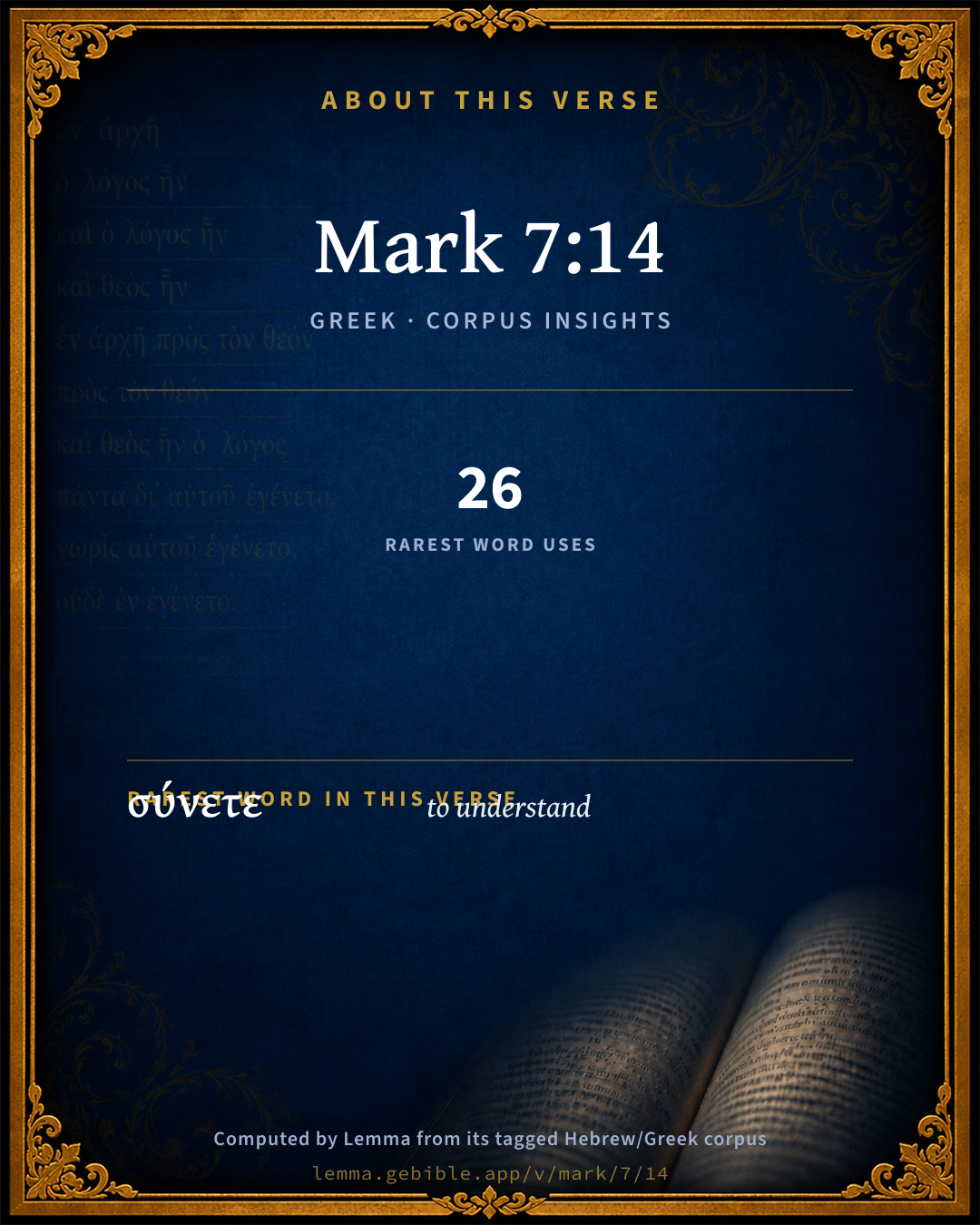
Mark 7:14

Greek (Tischendorf 8th ed.) Mark 7:14 appears in the Greek New Testament. The text above is from the Tischendorf 8th edition. Each word links to its Strong’s number and a concise gloss. Click any word for its full Thayer’s Greek Lexicon entry.
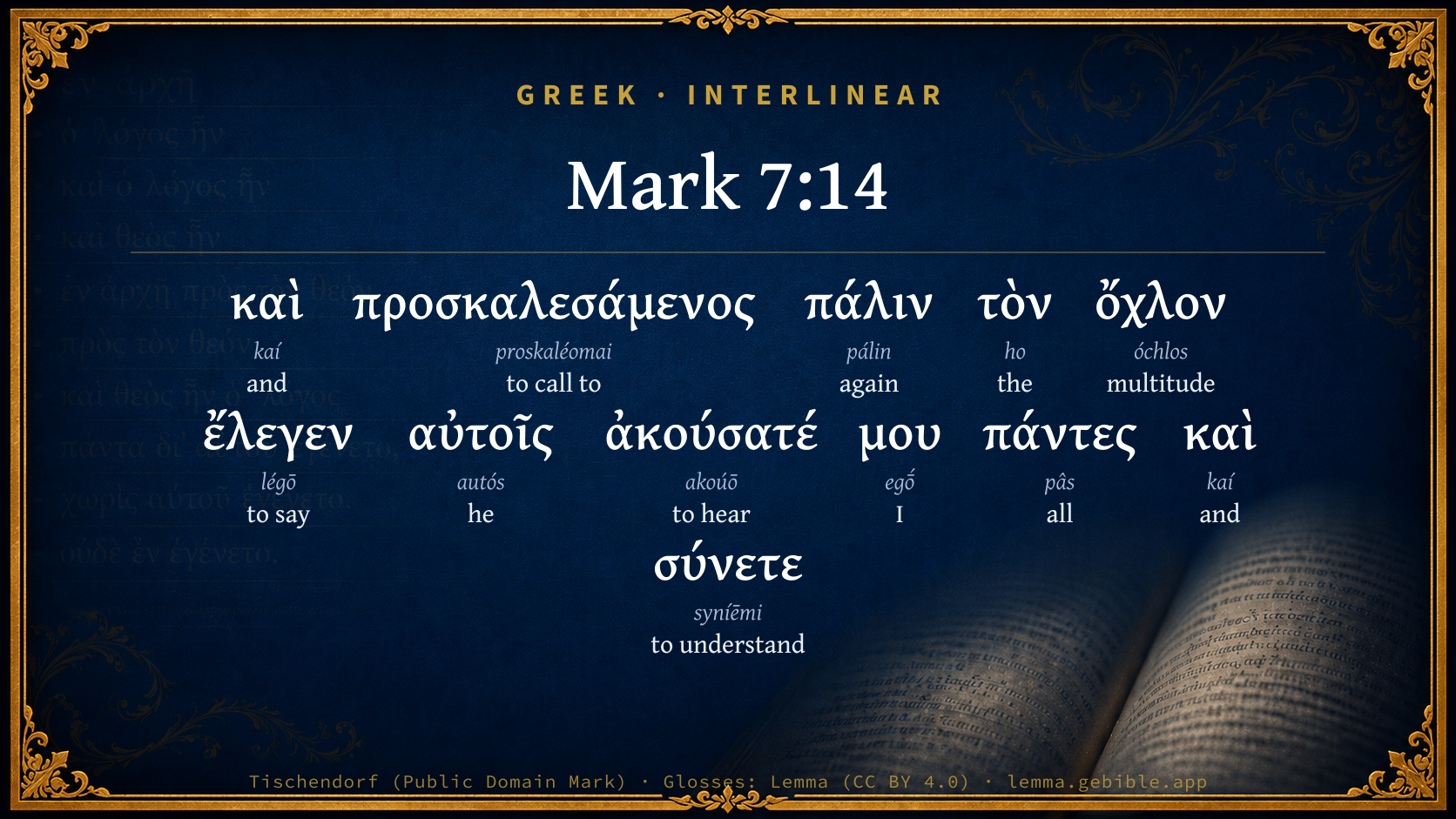
Download image
Cite this verse

Mark 7:14 (World English Bible). Public Domain. Lemma interlinear Bible study tool, https://lemma.gebible.app/v/mark/7/14.

Show BibTeX & RIS
BibTeX
RIS
English Translation
He called all the multitude to himself, and said to them, "Hear me, all of you, and understand.
World English Bible · Public Domain
Download a study sheet

One document with this verse’s original text, its word-by-word gloss line, the meaning frame, cross-references with their text, attributed commentary, and full source and license credits — printable, and it pastes into notes with its structure intact.

This verse Autodidact and up

Study sheet (.html) Plain text (.txt)

A passage Seminary Student

Up to 50 verses in one chapter. A passage sheet keeps up to 6 commentary sources and 12 cross-references per verse, in the order this page ranks them, and says so on the sheet whenever that leaves anything out. Ask for a single verse and you get the Autodidact verse sheet above.

Everything on this page stays free to read, with no account — the sheet is a download of what is already on screen, not access to it.

Want to remove ads? Support Godless Engineer
Compare translations 3

The same verse in 3 English versions, stacked beneath the original-language interlinear above. Click any original word for its lexicon entry.

Each is an independent rendering of the whole verse — the interlinear is not word-aligned to these translations.

Highlighted words mark where these versions differ — a whole-verse word diff, not a word-by-word alignment.

  • World English Bible Public Domain
    He called all the multitude to himself, and said to them, "Hear me, all of you, and understand.
  • King James Version Public Domain
    And when he had called all the people unto him, he said unto them, Hearken unto me every one of you, and understand:
  • unfoldingWord Literal Text CC BY-SA 4.0
    And having summoned the crowd again, he was saying to them, “Listen to me, all, and understand:

unfoldingWord Literal Text — © unfoldingWord, licensed CC BY-SA 4.0. Word-aligned USFM3 via Door43 (git.door43.org/unfoldingWord/en_ult).

Versions to compare (up to 4)

3 of 4 selected

Show all 19 translations

Every available English version of this verse, each an independent rendering of the whole verse.

  • World English Bible Public Domain
    He called all the multitude to himself, and said to them, "Hear me, all of you, and understand.
  • Berean Standard Bible Public Domain
    Once again Jesus called the crowd to Him and said, “All of you, listen to Me and understand:
  • Majority Standard Bible Public Domain
    Once again Jesus called the whole crowd to Him and said, “All of you, listen to Me and understand:
  • King James Version Public Domain
    And when he had called all the people unto him, he said unto them, Hearken unto me every one of you, and understand:
  • American Standard Version (1901) Public Domain
    And he called to him the multitude again, and said unto them, Hear me all of you, and understand:
  • Revised Version (1885) Public Domain
    And he called to him the multitude again, and said unto them, Hear me all of you, and understand:
  • Geneva Bible (1599) Public Domain
    Then he called the whole multitude vnto him, and sayd vnto them, Hearken you all vnto me, and vnderstand.
  • Douay-Rheims (1899) Public Domain
    And calling again the multitude unto him, he said to them: Hear ye me all, and understand.
  • Young's Literal Translation Public Domain
    And having called near all the multitude, he said to them, `Hearken to me, ye all, and understand;
  • Literal Standard Version CC BY-SA 4.0
    And having called near all the multitude, He said to them, “Listen to Me, you all, and understand;
  • Unlocked Literal Bible CC BY-SA 4.0
    He called the crowd again and said to them, “Listen to me, all of you, and understand.
  • unfoldingWord Literal Text CC BY-SA 4.0
    And having summoned the crowd again, he was saying to them, “Listen to me, all, and understand:
  • Darby Bible Public Domain
    And having called again the crowd, he said to them, Hear me, all [of you], and understand:
  • World Messianic Bible Public Domain
    He called all the multitude to himself and said to them, “Hear me, all of you, and understand.
  • Webster's Bible Public Domain
    And when he had called all the people to him, he said to them, Hearken to me every one of you, and understand.
  • Free Bible Version CC BY-SA 4.0
    Jesus called the crowd to him again and told them, “Please, everyone listen to me and understand.
  • Bible in Basic English Public Domain
    And turning to the people again, he said to them, Give ear to me all of you, and let my words be clear to you:
  • Text-Critical English NT CC BY 4.0
    Then Jesus called over the entire crowd and said to them, “Listen to me, all of you, and understand:
  • Tyndale New Testament (1534) Public Domain
    And he called all the people vnto him and sayde vnto them: Herken vnto me every one of you and vnderstonde.

Literal Standard Version (2020), Covenant Press — licensed CC BY-SA 4.0. Text via the HelloAO Bible API (eBible.org). Unlocked Literal Bible (unfoldingWord) — licensed CC BY-SA 4.0. Text via the HelloAO Bible API (eBible.org). unfoldingWord Literal Text — © unfoldingWord, licensed CC BY-SA 4.0. Word-aligned USFM3 via Door43 (git.door43.org/unfoldingWord/en_ult). Free Bible Version, Dr. Jonathan Gallagher — licensed CC BY-SA 4.0. Text via the HelloAO Bible API (eBible.org).

Word by word

More ways to search: Search by grammar → Find every occurrence → Compare this word →

Practice this passage: Drill this verse → Learn its vocabulary →

σύνετε
syníēmi
G4920
“to understand”
Verb, Aorist, Active, Imperative, 2nd person, Plural
Part of Speech
Verb
Tense
Aorist
Voice
Active
Mood
Imperative
Person
2nd person
Number
Plural
Full Thayer's Definition

Origin: from G4862 and hiemi (to send)

TDNT: 21:48,1

1. to set or bring together a. in a hostile sense, of combatants 2. to put (as it were) the perception with the thing perceived a. to set or join together in the mind 1. i.e. to understand: the man of understanding 2. idiom for: a good and upright man (having the knowledge of those things which pertain to salvation)
  1. καὶ kaí G2532 “and” Conjunction
  2. προσκαλεσάμενος proskaléomai G4341 “to call to” Verb, Aorist, Middle deponent, Participle, Nominative, Singular, Masculine
  3. πάλιν pálin G3825 “again” Adverb
  4. τὸν ho G3588 “the” Article, Accusative, Singular, Masculine
  5. ὄχλον óchlos G3793 “multitude” Noun, Accusative, Singular, Masculine
  6. ἔλεγεν légō G3004 “to say” Verb, Imperfect, Active, Indicative, 3rd person, Singular
  7. αὐτοῖς autós G846 “he” Personal pronoun, Dative, Plural, Masculine
  8. ἀκούσατέ akoúō G191 “to hear” Verb, Aorist, Active, Imperative, 2nd person, Plural
  9. μου egṓ G1473 “I” Personal pronoun, 1st person, Genitive, Singular
  10. πάντες pâs G3956 “all” Adjective, Nominative, Plural, Masculine
  11. καὶ kaí G2532 “and” Conjunction

About this verse

These counts appear in no published source. They are computed here, from the morphology-tagged text and Lemma’s own curated glosses. What Lemma adds →

12
words
11
distinct lemmas
Gospels
section

Shared distinctive vocabulary

σύνετε to understand G4920 occurs in 25 verses of the Greek New Testament. Also found in:

Repetition

A word recurs within this verse:

Cross-references

11

Topical passages linked to Mark 7:14 in the Treasury of Scripture Knowledge — connected by theme and wording, ordered by reader-vote popularity; previews shown in the World English Bible.

  • Matthew 15:10 He summoned the multitude, and said to them, "Hear, and understand.
  • Proverbs 8:5 You simple, understand prudence. You fools, be of an understanding heart.
  • Isaiah 6:9 He said, "Go, and tell this people, 'You hear indeed, But don't understand; And you see indeed, But don't perceive.'
  • Acts 8:30 Philip ran to him, and heard him reading Isaiah the prophet, and said, "Do you understand what you are reading?"
  • 1 Kings 18:21 Elijah came near to all the people, and said, "How long will you waver between the two sides? If Yahweh is God, follow him; but if Baal, then follow him." The people answered him not a word.
  • 1 Kings 22:28 Micaiah said, If you return at all in peace, Yahweh has not spoken by me. He said, Hear, you peoples, all of you.
  • Psalms 94:8 Consider, you senseless among the people; You fools, when will you be wise?
  • Luke 12:54–57 He said to the multitudes also, "When you see a cloud rising from the west, immediately you say, 'A shower is coming,' and so it happens.
  • Psalms 49:1–2 Hear this, all you peoples. Listen, all you inhabitants of the world,
  • Luke 12:1 Meanwhile, when a multitude of many thousands had gathered together, so much so that they trampled on each other, he began to tell his disciples first of all, "Beware of the yeast of the Pharisees, which is hypocrisy.
  • Luke 20:45–47 In the hearing of all the people, he said to his disciples,

Cross-references courtesy of OpenBible.info (CC BY 4.0).

Where the printed editions differ

1 variant

Places in this verse where the major printed Greek editions disagree on the wording in a way that affects the translation — a comparison of editions, not a manuscript-by-manuscript collation. The editions are the modern critical texts (Nestlé-Aland 28/27, SBL, Westcott-Hort, Tregelles, Tyndale House) and the traditional texts behind the KJV (the Textus Receptus and the Byzantine/Majority text). It is not a claim about which reading is original.

  1. Different wording
    πάλιν

    “again”

    In NA28NA27TynSBLWHTreg Not in TRByz

    πάντα (panta) 'all' occurs in traditional manuscripts (TR+Byz) instead of πάλιν (palin) 'again' in older manuscripts (NA28+NA27+Tyn+SBL+WH+Treg)

Textual data: Translators Amalgamated Greek New Testament (STEPBible TAGNT) · CC BY 4.0.

Commentary

Notes on Mark 7:14 from classic Christian and Jewish commentators (each source and its license shown beneath its notes). The classic Christian expositions comment on the surrounding passage and are grouped to its opening verse, so a note may address several verses; the Jewish commentaries on the Tanakh (Rashi and others) are per-verse, so they appear only where the commentator wrote on this verse.

Lemma curates 59 commentaries, every one of them public domain or Creative Commons licensed, each selected and text-cleaned for this edition rather than reprinted as found. About our sources →

Joseph Benson's Commentary

Mar 7:14-16. When he had called all the people unto him — See note on Mat 15:10-11. He said, Hearken unto me, every one of you — As if he had said, Hear how absurd the precepts are which the scribes inculcate upon you, and understand the true differences of things. These hypocrites, anxious about trifles, neglect the great duties of godliness and righteousness, which are of unchangeable obligation. They shudder with horror at hands unwashed, but are perfectly easy under the guilt of impure minds, although not that which goeth into the mouth defileth a man, in the sight of God, but that which cometh out of the mouth; because, in the sight of God, cleanness and uncleanness are qualities, not of the body, but of the mind, which can be polluted by nothing but sin. Our Lord did not at all mean to overthrow the distinction which the law had established between things clean and unclean, in the matter of man’s food. That distinction, like all the other emblematical institutions of Moses, was wisely appointed; being designed to teach the Israelites how carefully the familiar company and conversation of the wicked is to be avoided. He only affirmed, that in itself no kind of meat can defile the mind, which is the man, though by accident it may: as when a man eats what is pernicious to his health, or takes an improper quantity of food or liquor. And a Jew might have done it by presumptuously eating what was forbidden by the Mosaic law, which still continued in force: yet in all these instances, the pollution would arise from the wickedness of the heart, and be just proportionable to it, which is what our Lord here asserts.

Joseph Benson's Commentary on the Old and New Testaments (1811–1818) — public domain. Text from a community e-Sword module.

Godbey's Commentary on the New Testament

William B. Godbey

TRUE RELIGION — INTERNAL & SPIRITUAL

Mat 15:10-20; Mar 7:14-23. Matthew: “Calling the multitude to Him, He said to them, Hear and understand. Not that which cometh into the mouth defileth a man; but that which goeth out of a man, that defileth a man. Then His disciples, coming, said to Him, Do you know that the Pharisees, hearing the word, were offended? and He, responding, said, Every plant which My Heavenly Father did not plant, shall be rooted up.” The subject here is the Pharisaic traditions, and an infinite diversity of burdensome human rites, ceremonies, and institutions which had been foisted on the Jewish Church, covering up and literally hiding the heavenly superstructure, till the people, seeing nothing but humanism, were following the shadow, ignorant of the substance, led by the blind clergy in the way of death. All that was smashed up by the Roman armies, a few years subsequently to this awful prophecy, sweeping their institutions from the face of the earth, and annihilating the Jewish polity. A similar doom awaits the Pharisaical institutions of the Gentile Church, when the bloody revolutions of the Armageddon shall roll their desolating billows over the world, eliminating from the Church all her human inventions, and reducing her down to primitive simplicity and apostolic purity, unfurling the New Testament standard to all nations, and thus verifying the prophecy of Jesus, “Every plant which My Heavenly Father hath not planted, shall be rooted up.” We would better all take warning, and come up at once to the simplicity of Jesus and His apostles revealed in the New Testament. “Let them alone; they are blind leaders of the blind; and if the blind may lead the blind, both shall fall into the ditch.” We have no right to shove this back and leave it with the fallen Church, apostate membership, and godless clergy, of our Savior’s time. It is written for us. The unspiritual leaders all around us, stickleristic for their human institutions, and ignorant of God’s grand spiritual truth, are leading the multitudes to ruin. Jesus makes no mistake. Leaders and followers shall altogether fall into the ditch of irretrievable woe.

Mark: “And when He came from the multitudes into the house, His disciples asked Him concerning the parable.” As he was at Caperuaum, His home after His expulsion from Nazareth — and, having no house of His own, it is believed that Peter’s house was His home — it is more than likely that this in the house into which He entered. “And He says to them Are you truly yet without understanding? Do you not know that everything without, entering into the man, is not able to defile him? Because it does not go into his heart, but into his stomach; and goes out into the excrement, purifying all edibles;” i.e., in the gospel dispensation we have large liberties on the question of eating and drinking, as these edibles and potables do not go into the heart, but into the alimentary canal, portions being eliminated for the nutriment of the physical being, and the residue becoming soil, and perfectly purified by the chemical agencies brought into activity by earth, air, and water, so there is actually no ultimately surviving impurity. On this problem we are to walk in the light which God gives us, sedulously observing the laws of hygiene with reference to eating and drinking, as to time, quality, and quantity. We should all beware of side issues, calculated to absorb undue attention, and deflect us from the grand trunk-line of holiness to the Lord. In that department, fanaticism is prone to bivouac. “And He said, That which cometh out of the man defileth the man. For from within, out of the heart of the people, proceed evil reasonings, adulteries, fornications, murders, thefts, covetousness, wickedness, hypocrisy, lasciviousness, an evil eye, blasphemy, pride, folly. All these evils come out from within, and defile the man.” O what an appalling and horrific den of rattlesnakes, here catalogued by the Infallible, constituting the black cohort of inbred sin, occupying the heart of poor, fallen humanity, till extirpated, eradicated, washed away by the cleansing blood, consumed and annihilated by the refining fire of the Holy Ghost, poured down from heaven in Pentecostal floods and sanctifying baptism!

“Evil reasonings” are most adroitly manipulated by demons, who will crowd around you and argue you down, answering all of your objections to something, painted fair as Eden flowers, but black as the pit.

“Adulteries and fornications,” so nearly synonymous that Jesus, in view of their awful power over their wretched victims, here almost indulges in tautology by way of emphasizing this vice, which is, probably more than any other, productive of human ruin in time and in eternity.

“Wickedness” is a generic term, in the plural number, comprehending every vice conceivable, whether included in this catalogue or not.

“Deceitfulness” lies deep down in the subterranean jungles of the fallen spirit, cropping out in all phases of guile, craft, stratagem, trickery, chicanery, and hypocrisy, so utterly irreconcilable with that unsophisticated simplicity, innocence, and guilelessness characteristic of angels and redeemed spirits, and yet, by many pseudo-preachers and saints, winked at and apologized for as shrewdness in trade and business sagacity.

“Murders.” Do not forget, “He that hateth his brother is a murderer.” “Man looketh on the outside, but God looketh on the heart.” The spirit is the essence in the Divine estimation, God seeing the anger, wrath, malice, envy, jealousy, revenge, which are the spirit of murder, deep down in your heart, and consequently condemning you, as if you had imbued your hands in the blood of your neighbor.

“Thefts.” If you cheat a person out of a dollar, you are as really a thief in the sight of God as if you had gone at midnight and stolen a horse. The reason why Churches are dead is because they are so frequently ruled by criminals, who grieve the Holy Spirit away, the man who can steal most by cheating promoted to the highest office.

“Covetousness.” This is the fatal and magnitudinous sin of the day. It sent an apostle to hell, and almost ruined Jacob. It is the crying sin of the Church today, alone disqualifying her to girdle the world with missionaries, and envelop the nations with sunbursts of light and glory.

“Impurity.” O how black and how impudent this monster, intruding into homes, withering and blighting the fairest domestic flowers, blasting the dearest social bliss, turning communities into battle-fields and homes into hells!

“Pride.” John Wesley pronounced pride the great mother-sin, generating whole groups of vices and follies, which prove rattlesnakes in the bosom, and develop perdition in the home, superinducing ruined health, dissipated fortunes, and alienated friends.

“Folly.” This is a very comprehensive term, as it is the opposite of wisdom, which, in the Bible, means the grace of God that saves soul and body. As a rule, pride and folly are more prevalent with women, sending millions of the fairer sex to be brutalized by demons in the bottomless pit; while the dark, vulgar vices — e. g., murder, theft, robbery, and blasphemy roll their pestilential billows over men and boys, precipitating them into hell by millions before their time.

“Blasphemy.” This vice, to all human appearances, is the most unapologizable, as Satan bates his hook when he goes fishing for the participants of all other sins, while in case of blasphemy lie just drops down the naked hook, and, to the surprise of angels, disgust of good men, and the ridicule of devils, the poor dupe opens his mouth in blasphemy against the God who gives him breath, for which he couldn’t give an excuse nor a reason to save his life. N.B. All repetitions of God’s name are blasphemy, unless taken in prayer, supplication, adoration, praise, with due reverence and solemnity.

William B. Godbey, Commentary on the New Testament (1896–1900) — public domain. Text from a community e-Sword module.

The Expositor's Bible

Chapter 7

CHAPTER 7:14-23 (Mar_7:14-23)

THINGS WHICH DEFILE

"And He called to Him the multitude again, and said unto them, Hear Me all of you, and understand: there is nothing from without the man, that going into him can defile him: but the things which proceed out of the man are those that defile the man. And when He was entered into the house from the multitude, His disciples asked of Him the parable. And He saith unto them, Are ye so without understanding also? Perceive ye not, that whatsoever from without goeth into the man, it cannot defile him; because it goeth not into his heart, but into his belly, and goeth out into the draught? This He said, making all meats clean. And He said, That which proceedeth out of the man, that defileth the man. For from within, out of the heart of men, evil thoughts proceed, fornications, thefts, murders, adulteries, covetings, wickednesses, deceit, lasciviousness, an evil eye, railing, pride, foolishness: all these evil things proceed from within, and defile the man." Mar_7:14-23 (R.V.)

WHEN Jesus had exposed the hypocrisy of the Pharisees, He took a bold and significant step. Calling the multitude to Him, He publicly announced that no diet can really pollute the soul; only its own actions and desires can do that: not that which entereth into the man can defile him, but the things which proceed out of the man.

He does not as yet proclaim the abolition of the law, but He surely declares that it is only temporary, because it is conventional, not rooted in the eternal distinctions between right and wrong, but artificial. And He shows that its time is short indeed, by charging the multitude to understand how limited is its reach, how poor are its effects.

Such teaching, addressed with marked emphasis to the public, the masses, whom the Pharisees despised as ignorant of the law, and cursed, was a defiance indeed. And the natural consequence was an opposition so fierce that He was driven to betake Himself, for the only time, and like Elijah in his extremity, to a Gentile land. And yet there was abundant evidence in the Old Testament itself that the precepts of the law were not the life of souls. David ate the shewbread. The priests profaned the sabbath. Isaiah spiritualized fasting. Zechariah foretold the consecration of the Philistines. Whenever the spiritual energies of the ancient saints received a fresh access, they were seen to strive against and shake off some of the trammels of a literal and servile legalism. The doctrine of Jesus explained and justified what already was felt by the foremost spirits in Israel.

When they were alone, "the disciples asked of Him the parable," that is, in other words, the saying which they felt to be deeper than they understood, and full of far-reaching issues. But Jesus rebuked them for not understanding what uncleanness really meant. For Him, defilement was badness, a condition of the soul. And therefore meats could not defile a man, because they did not reach the heart, but only the bodily organs. In so doing, as St. Mark plainly adds, He made all meats clean, and thus pronounced the doom of Judaism, and the new dispensation of the Spirit. In truth, St. Paul did little more than expand this memorable saying. "Nothing that goeth into a man can defile him," here is the germ of all the decision about idol meats --"neither if one' eat is he the better, neither if he eat not is he the worse." "The things which proceed out of the man are those which defile the man," here is the germ of all the demonstration that love fulfills the law, and that our true need is to be renewed inwardly, so that we may bring forth fruit unto God.

But the true pollution of the man comes from within; and the life is stained because the heart is impure. For from within, out of the heart of men, evil thoughts proceed, like the uncharitable and bitter judgments of His accusers -- and thence come also the sensual indulgences which men ascribe to the flesh, but which depraved imaginations excite, and love of God and their neighbor would restrain -- and thence are the sins of violence which men excuse by pleading sudden provocation, whereas the spark led to a conflagration only because the heart was a dry fuel -- and thence, plainly enough, come deceit and railing, pride and folly.

It is a hard saying, but our conscience acknowledges the truth of it. We are not the toy of circumstances, but such as we have made ourselves; and our lives would have been pure if the stream had flowed from a pure fountain. However modern sentiment may rejoice in highly colored pictures of the noble profligate and his pure minded and elegant victim; of the brigand or the border ruffian full of kindness, with a heart as gentle as his hands are red; and however true we may feel it to be that the worst heart may never have betrayed itself by the worst actions, but many that are first shall be last, it still continues to be the fact, and undeniable when we do not sophisticate our judgment, that "all these evil things proceed from within."

It is also true that they "further defile the man." The corruption which already existed in the heart is made worse by passing into action; shame and fear are weakened; the will is confirmed in evil; a gap is opened or widened between the man who commits a new sin, and the virtue on which he has turned his back. Few, alas! are ignorant of the defiling power of a bad action, or even of a sinful thought deliberately harbored, and the harboring of which is really an action, a decision of the will.

This word which makes all meats clean, ought for ever to decide the question, what restrictions may be necessary for men who have depraved and debased their own appetites, until innocent indulgence does reach the heart and pervert it. Hand are foot are innocent, but men there are who cannot enter into life otherwise than halt or maimed. Also it leaves untouched the question, as long as such men exist, how far may I be privileged to share and so to lighten the burden imposed on them by past transgressions? It is surely a noble sign of religious life in our day, that many thousands can say, as the Apostle said, of innocent joys, "Have we not a right? . . . Nevertheless we did not use this right, but we bear all things, that we may cause no hindrance to the gospel of Christ."

Nevertheless the rule is absolute: "Whatsoever from without goeth into the man, it cannot defile him. And the Church of Christ is bound to maintain, uncompromised and absolute, the liberty of Christian souls.

Let us not fail to contrast such teaching as this of Jesus with that of our modern materialism.

"The value of meat and drink is perfectly transcendental," says one. "Man is what he eats," says another. But it is enough to make us tremble, to ask what will issue from such teachng if it ever grasps firmly the mind of a single generation. What will become of honesty, when the value of what may be had by theft is transcendental? How shall armies be persuaded to suffer hardness, and populations to famish within beleagured walls, when they learn that "man is what he eats," so that his very essence is visibly enfeebled, his personality starved out, as he grows pale and wasted underneath his country's flag? In vain shall such a generation strive to keep alive the flame of generous self-devotion. Self-devotion seemed to their fathers to be the noblest attainment; to them it can be only a worn-out form of speech to say that the soul can overcome the flesh. For to them the man is the flesh; he is the resultant of his nourishment; what enters into the mouth makes his character, for it makes him all.

There is that within us all which knows better; which sets against the aphorism, "Man is what he eats;" the text "As a man thinketh in his heart so is he;" which will always spurn the doctrine of the brute, when it is boldly confronted with the doctrine of the Crucified.

William Robertson Nicoll, ed., The Expositor's Bible (London: Hodder & Stoughton, 1887–1910) — public domain. 65 of 66 books (1 Corinthians is not separately keyed, as that volume carries no machine-parseable verse references); section-level commentary keyed to the opening verse. Introductory and overview sections not keyed to a specific passage are excluded.

Tyndale Open Study Notes

Tyndale Open Resources

7:14-23 Jesus’ second argument against the Pharisees was a proverb that Jesus told the crowd. Later, in the privacy of a home, Jesus explained it to his disciples (7:17-23). It concerns moral distinctions about eating. Eating affects the digestive system, but moral issues involve the heart. The heart is a metaphor for the seat of moral decision making. How a person eats (with clean or unclean hands) or what a person eats (clean or unclean food) affects only the digestive tract, so it has no bearing on the moral issues of the soul. To help his later readers understand the implications of Jesus’ teaching, Mark adds the interpretive comment By saying this, he declared that every kind of food is acceptable in God’s eyes. In the apostolic church, Peter and Paul were instrumental in bringing this implication to light (see Acts 10:1–11:18; Rom 14:14; 1 Cor 8:8; Gal 2:11-21).

Tyndale Open Study Notes — © Tyndale Open Resources, licensed CC BY-SA 4.0. Text via the HelloAO Bible API.

Bengel's Gnomon

Johann Albrecht Bengel

Mar 7:14. Ἀκούετε, hearken) An admonition salutary to all, in opposition to the prejudice which is most hostile to true Divine worship.

Bengel's Gnomon of the New Testament — English translation (T&T Clark, Edinburgh, 1860) — public domain. Text from a community e-Sword module.

Expositor's Greek Testament

ed. W. Robertson Nicoll

Mar 7:14-16 . The people taken into the discussion . προσκαλεσάμενος : the people must have retired a little into the background, out of respect for the Jerusalem magnates. ἀκούσατέ μου , etc., hear me all ye, and understand; a more pointed appeal than Mt.’s: hear and understand.

The Expositor's Greek Testament, edited by W. Robertson Nicoll (1897–1910) — public domain. Text from a community e-Sword module.

Adam Clarke's Commentary

Verse 14. When he had called all the people] But instead of παντα, all, παλιν, again, is the reading of BDL, later Syriac in the margin, Coptic, AEthiopic, Saxon, Vulgate, all the Itala but one. Mill and Griesbach approve of this reading.

Adam Clarke's Commentary on the Bible (1810–1826) — public domain. Text from a community e-Sword/MySword module.

The Cambridge Bible for Schools and Colleges

gen. ed. J. J. S. Perowne

14. all the people] Rather, when He had called the people again unto Him. As Wyclif has it in his Version, “and he eftsone clepinge to be cumpanye of peple.”

The Cambridge Bible for Schools and Colleges (gen. ed. J. J. S. Perowne; Cambridge University Press, 1878–1918) — public domain. Text from a community e-Sword module.

John Gill's Exposition

And when he, had called all the people unto him,.... The Vulgate Latin, and Ethiopic versions, instead of "all", read again, and so do some copies: having said what was sufficient to stop the mouths of the Scribes and Pharisees, about their unwarrantable traditions; he turns himself to the common people, who stood at some distance, because of these venerable doctors, and called to them to come nearer to him:

he said unto them, hearken to me every one of you, and understand; signifying, he had something of moment to say to them, which they would do well to attend unto, and what they should be desirous of understanding aright, it being what concerned every one of them; See Gill on Mat 15:10.

John Gill's Exposition of the Whole Bible (1746–1763) — public domain (CC PDM 1.0). Text via the HelloAO Bible API.

Trapp's Complete Commentary

John Trapp

14 And when he had called all the people unto him, he said unto them, Hearken unto me every one of you, and understand:

Ver. 14. Called all the people] For he saw there was no good to be done upon the Pharisees, and that he did but wash a tilestone, or a blackamoor; he turns him therefore to the common sort. Pearls must not be cast to pigs.

John Trapp, A Commentary or Exposition upon All the Books of the Old and New Testament (1647–1656) — public domain. Text from a community e-Sword module.

Matthew Poole's English Annotations

Our Saviour’s calling all the people unto him before he spake what next followeth, and his prefacing that discourse with, Hearken every one of you, and understand, lets us know that what he was about to say was a point of great moment, well worth their learning and observation.

Matthew Poole's English Annotations on the Holy Bible (1683–1685) — public domain. Text from a community e-Sword/MySword module.

The Pulpit Commentary

Vers. 14, 15. In the Authorized Version the beginning of this verse runs thus: "And when he had called all the people unto him, he said." But according to the best authorities, the adverb palin should be inserted, and the words will run as follows: And he called to him the multitude again. It is probable that he had waved them from him while he held this discourse with the scribes from Jerusalem. But now he calls the people near to him again, that all might hear that which concerned all alike. It is probable, indeed, that this discussion with the scribes may have taken place in the house, into which he again returned after having made this authoritative declaration to the multitude. The words are given with more emphasis here than as recorded by St. Matthew. Every one was solemnly invited to hearken and understand, while he announced a principle of the highest importance. Our Lord did not intend to disparage the difference between clean and unclean meats as it had been laid down in the Levitical Law. His object rather was to clear that teaching from the obscurities in which it had been involved by the scribes and Pharisees, who laid stress only on external acts. His object was to show that all impurity springs from the heart; and that, unless the heart is cleansed, all external washings are in vain. It is as though he said, "The scribes teach you that it is not lawful to eat with unwashen hands because unwashen hands make the food clean, and unclean food defiles the soul. But in this they err; because not that which enters from without into the mouth, but that which proceeds from within through the mouth, and so from the heart, if it be impure, this defiles the man;" as he more fully explains at ver. 21.

Vers. 14-23. The real and the imaginary defilement.

The question of "the Pharisees, and certain of the scribes which had come from Jerusalem," yet remains to be answered, Jesus having turned aside to weaken the force of "the tradition of men." The answer is given in the ears of "the multitude." It is simple. "There is nothing from without the man that can defile him:" defilement is of that which proceeds "from within out of the heart of man." The man"s heart is the fountain of evil; it is his heart, not his hands, that needs washing. No wonder that "the Pharisees were offended, when they heard this saying." Then, having "entered into the house from the multitude," the disciples "asked of him" what is to them as yet "the parable;" for so are they "without understanding also." In few words he distinguishes the true nature and source of defilement from the untrue, leaving for all time these lessons hidden in his words

I ALL POLLUTION IS MORAL POLLUTION. From this all mere ceremonial defilement must be distinguished. Such uncleanness is not moral impurity, nor is ceremonial correctness to be regarded as the testimony of moral purity. The stainless externalist may harbour within" all evil things." The perversion of a wise teaching on the necessity for personal cleanliness and of instructive ceremonials had led to the foolish supposition that a touch of the dead, or the diseased, or the decaying matter, conveyed moral impurity. This is once for all contradicted. Whatsoever is without the man" conveys not the defilement. It is a moral condition. The heart can defile all things. As that which is from without the man cannot defile, so let it be known "there is nothing from without the man that going into him can" cleanse "him.

II THE SOURCE OF ALL IMPURITY IS NOT IN GOD"S WORKS, BUT IN MAN"S HEART. "All these evil things proceed from within." Thus Jesus, with his just judgment, traces evil to its hidden source. The heart, not the flesh, is the seat of defilement. This is the fountain which can corrupt God"s good and pure gifts. How marked a contrast does he make between a possible ceremonial uncleanness a very trifle at most (as to moral uncleanness it is nil) and the greatness, the multiplicity, and the foulness of the "evil things which proceed from within"! Material things cannot in themselves convey moral impurity. Even the excess in the use of the food, which destroys life, comes from within. That the good things of God may be turned into occasions of evil all know, but it is only the heart that can so turn them. Whatsoever is "without the man cannot defile him, because it goeth merely into his body, not into his heart; "and the heart, not the body, is "the man," the true man, the very man.

III FROM THE THRALDOM OF A FALSE CEREMONIALISM CHRIST REDEEMS HIS DISCIPLES, "MAKING ALL MEATS CLEAN." How needful not only to say what is sin, but to say also what is not sin! From many a yoke which the fathers were not able to bear Christ sets his people free! From child"s play to serious work he calls them. From a mere adjustment of articles of dress and of furniture; from punctilios of ritual observance having in themselves no moral significance, and liable to withdraw men from great works and great truths, he turns them aside. He exposes the true evilness in the long catalogue of "evil things" of which the heart, not the flesh, is capable; and be, without many words of exhortation, directs men to seek the cleansing of their unholy hearts, that their lives, their whole man, may be clean also. G.

The Pulpit Commentary (1880–1919), ed. H.D.M. Spence-Jones & Joseph S. Exell — public domain. Text from a community e-Sword module.

Kretzmann's Popular Commentary

Paul E. Kretzmann

Christ’s Denunciation of the Pharisees.

Addressing the people:

v. 14. And when He had called all the people unto Him, He said unto them, Hearken unto Me, every one of you, and understand:

v. 15. There is nothing from without a man that, entering into him, can defile him; but the things which come out of him, those are they that defile the man.

v. 16. If any man have ears to hear, let him hear.

The question which had been broached by the Pharisees was by no means unimportant, if considered from the right angle and in the right connection. And Christ did not intend to be misunderstood by the people that had been interested witnesses of the encounter. Levitical impurity, ceremonial washings, they no longer have any value in the New Testament. But of far greater importance is spiritual impurity, whose nature a person should well understand, in order to strike at the root of the matter and stop the inclinations toward evil at the beginning. So Christ turns directly to the people; He calls the crowd to Him and addresses them all on this topic; He emphasizes the necessity of listening intently and intelligently, in order that they might understand. It is a sweeping statement: There is nothing outside of a person which may touch him or enter into him that can make him unclean, that will make him unfit for serving the Lord and taking part in His service. Christian worship and service is in no way dependent upon the outward appearance or habits of a person, whether he wears broadcloth or overalls, whether he washes his hands before meals or not, whether he eats certain foods or not. All these things are irrelevant and immaterial, so far as actual worshiping of the Lord is concerned. They may be watched for hygienic and sanitary reasons, just as we have good and laudable customs regarding our appearance at the house of God; but they do not concern the religion of a man, his relation to his God. But, Christ says, the things which come forth from the man, they are apt to make him unclean, they may disturb the confidence of the Lord in him, they may cause the relation between him and his God to be severed. It is an important point that the Lord here makes, and He wants to impress it upon His hearers.

Paul E. Kretzmann, Popular Commentary of the Bible (1921–1924) — public domain. Text from a community e-Sword module.

Burkitt's Expository Notes on the New Testament

William Burkitt

Our blessed Saviour, leaving the Pharisees with some dislike, applies himself to the multitude, and instructs them in a very necessary and useful doctrine, touching the original cause of all spiritual pollution and uncleanness; namely, The filthiness and impurity of man’s heart and nature. And that it is not the meat eaten with the mouth, but the wickedness of the heart, vented by the mouth, which pollutes a person in God’s account. The heart and soul of man alone is capable of sinful defilement. Nothing can defile a person in God’s account, but that which defileth the inward man.

Learn hence, 1. That the heart of man is the sink and seed-plot of all sin, the source and fountain of all pollution.

2. That all the impiety of the life proceeds from the impurity and filthiness of the heart. Men’s lives would not be so bad if their hearts were not worse. The disciples desiring the interpretation of the foregoing parable, our Saviour gives it them; but withal expostulates with them for not understanding a matter so obvious and plain, Are ye yet without understanding? As if he had said, "Have ye sat thus long under my ministerial teaching, and enjoyed the benefit of my conversation, and yet are no farther proficients in knowledge?" Plainly intimating, that Christ expects a proficiency in knowledge from us proportionable to the opportunities, and means of knowledge enjoyed by us. Having given them this rebuke, he next acquaints them with the sense and meaning of the parable; namely, That it is out of a wicked and sinful heart, that all sin and wickedness doth proceed. Tho’ the occasions of sin are from without, yet the source and original of it is from within. The heart of man is as a cage full of unclean birds: Hence proceeds evil thoughts, either against God or our neighbours. Adulteries, or all sins of the flesh. Murders; That is, all cruelty and hard dealing towards others. An evil eye; that is, an envious spirit, which frets and grieves at the happiness of others called an evil eye, because envy doth much shew and manifest itself in the outward countenance, and especially by the eyes.

From the whole, Note, That the best way to hinder the progress of sin in this life, is to mortify it in the heart, to crucify all inordinate motions, lusts, and corruptions, in their root; for the heart is the first seat and subject of sin, from whence it flows forth into the life and conversation.

William Burkitt's Expository Notes on the New Testament (1700–1703) — public domain. Text from a community e-Sword module.

unfoldingWord translationNotes

Door43 World Missions Community

Connecting Statement:

Jesus tells a parable to the crowd to help them understand what he has been saying to the scribes and Pharisees. (See: Parables)

He called

"Jesus called"

Listen to me, all of you, and understand

The words "Listen" and "understand" are related. Jesus uses them together to emphasize that his hearers should pay close attention to what he is saying. (See: Doublet)

understand

It may be helpful to state what Jesus is telling them to understand. AT: "try to understand what I am about to tell you" (See: Ellipsis)

nothing from outside of a person

Jesus is speaking about what a person eats. This is in contrast to "what come out of the person." AT: "nothing from outside a person that he can eat" (See: Assumed Knowledge and Implicit Information)

It is what comes out of the person

This refers to the things a person does or says. This is in contrast to "what is outside a person that enters into him." AT: "It is what comes out of a person that he says or does" (See: Assumed Knowledge and Implicit Information)

translationWords

understand

defile

unfoldingWord translationNotes — © Distant Shores Media and the Door43 World Missions Community, licensed CC BY-SA 4.0. Source: git.door43.org/Door43/en_tn.

Cambridge Greek Testament for Schools and Colleges

14–23. THE SOURCE OF REAL DEFILEMENT

Mat 15:10-20

14. πάλιν ([1429][1430][1431][1432][1433]) rather than πάντα. ([1434][1435][1436][1437]).

[1429] Codex Sinaiticus. 4th cent. Discovered by Tischendorf in 1859 at the Monastery of St Katharine on Mount Sinai. Now at St Petersburg. The whole Gospel, ending at Mar 16:8. Photographic facsimile, 1911.

[1430] Codex Vaticanus. 4th cent., but perhaps a little later than א. In the Vatican Library almost since its foundation by Pope Nicolas V., and one of its greatest treasures. The whole Gospel, ending at Mar 16:8. Photographic facsimile, 1889.

[1431] Codex Bezae. 6th cent. Has a Latin translation (d) side by side with the Greek text, and the two do not quite always agree. Presented by Beza to the University Library of Cambridge in 1581. Remarkable for its frequent divergences from other texts. Contains Mark, except Mar 16:15-20, which has been added by a later hand. Photographic facsimile, 1899.

[1432] Codex Regius. 8th cent. An important witness. At Paris. Contains Mar 1:1 to Mar 10:15; Mar 10:30 to Mar 15:1; Mar 15:20 to Mar 16:20, but the shorter ending is inserted between Mar 16:8 and Mar 16:9, showing that the scribe preferred it to the longer one.

[1433] Codex Sangallensis. 9th or 10th cent. Contains the Gospels nearly complete, with an interlinear Latin translation. The text of Mark is specially good, agreeing often with CL. At St Gall.

[1434] Codex Alexandrinus. 5th cent. Brought by Cyril Lucar, Patriarch of Constantinople, from Alexandria, and afterwards presented by him to King Charles I. in 1628. In the British Museum. The whole Gospel. Photographic facsimile, 1879.

[1435] Codex Monacensis. 10th cent. Contains Mar 6:47 to Mar 16:20. Many verses in 14, 15, 16 are defective.

[1436] Codex Oxoniensis. 9th cent. Contains Mark, except Mar 3:35 to Mar 6:20.

[1437] Codex Petropolitanus. 9th cent. Gospels almost complete. Mar 16:18-20 is in a later hand.

14. προσκαλεσάμενος πάλιν. We need not limit the πάλιν to the crowd at Gennesaret. He often invited people to come to Him, and here He does so again. Having answered the cavils of the Scribes, He now resumes the more profitable work of freeing the multitude from the unspiritual traditions of Pharisaism. οὐκ ἔτι τοῖς Φαρισαίοις διαλέγεται, ὡς ἀθεραπεύτοις (Theoph.). Mk (about 27 times) even more than Mt. (about 17) is fond of πάλιν. Lk. (Luke 3) seems to avoid it, often omitting it where Mk has it. For ἔλεγεν Mt. again has εἶπεν. Cf. Mar 7:27.

Cambridge Greek Testament for Schools and Colleges (Cambridge University Press, 1896; 21 vols, various authors incl. Carr, Maclear, Plummer, Farrar, Lumby, Moule, M. R. James, Simcox) — public domain. Text from a community e-Sword module.

Alford’s Greek Testament

Henry Alford

14.] Both Matt. and Mark notice that our Lord called the multitude to Him, when He uttered this speech. It was especially this, said in the hearing of both the Pharisees and them, that gave offence to the former.

Henry Alford, The Greek Testament (1849–1861) — public domain. Text from a community e-Sword module.

International Critical Commentary

14. προσκαλεσάμενος πάλιν τὸν ὄχλον—Having called up the crowd again. It seems that the previous conference has been held with the Scribes and, Pharisees alone. But Jesus wishes what he says now about the matter to be heard by the people. It is a matter, not of private conference or debate, but of the utmost importance for the popular understanding of true religion.

πάλιν, again, instead of πάντα, all, Tisch. Treg. WH. RV. א BDL Δ mss. Lat. Vet. Vulg. Memph. Harcl. marg.

Ἀκούσατέ μου πάντες κ. σύνετε—This is no formal introduction, but calls on his hearers to lend him not only their ears, but their understandings, in view of the special importance of what follows. He may well do so, since what he says abrogates the distinction between clean and unclean, which forms so essential a part not only of tradition, but also of the Levitical part of the Law itself.

ἀκούσατε, instead of ἀκούετε, Tisch. Treg. WH. BDHL. σύνετε,2 instead of συνίετε, Tisch. Treg. WH. BHL Δ 238.

Οὐδέν ἐστιν ἔξωθεν τοῦ ἀνθρώπου εἰσπορευόμενον εἰς αὐτόν, ὃ δύναται κοινῶσαι αὐτόν—There is nothing outside the man entering into him, which can defile him. The reason that Jesus gives for this statement shows that he meant to make the distinction between outward and inward in the sense of material and spiritual. The things from outside cannot defile, because they enter the belly, and not the heart, while those from within are evil thoughts of all kinds. This has nothing to do, therefore, with the question, whether, among spiritual things, it is only those from within the man himself that can hurt him. Inwardness in this sense belongs to things within the man himself and within others, and externality is to be taken in the same sense. ἀλλὰ τὰ ἐκ τοῦ ἀνθρώπου ἐκπορευόμενά ἐστι τὰ κοινοῦντα τὸν ἄνθρωπον—but the things coming out of the man are the things which defile the man. The repetition of the noun man, instead of using the pronoun, which here amounts to inelegance, is quite in Mk.’s manner.

ἐκ τοῦ ἀνθρώπου ἐκπορευόμενα, coming out from the man, instead of ἐκπορευόμενα ἀπʼ αὐτοῦ, coming out of him, Tisch. Treg. WH. RV. א BDL Δ 33, Latt. Memph. Omit ἐκεῖνα, those, Tisch. (Treg.) WH. א BL Δ 102, Memph.

Verse 16 is omitted by Tisch. WH. RV. (bracketed by Treg.) א BL Δ 28, 102, Memph.

International Critical Commentary — older volumes (1896–1929), various authors — public domain. Text from a community e-Sword module.

Lesson kit

Teaching starters — assembled from the data on this page, not authored interpretation. Every prompt links to the verse data it draws on. Edit before teaching.

Mark, in the Gospels, opens this verse with 12 words (11 distinct Greek lemmas). Its most distinctive word is syníēmi (“to understand”). A historical commentator’s framing appears above. Read the whole chapter for the surrounding context.

Discussion questions

  1. What does “to understand” (syníēmi) contribute to the verse as a whole?
  2. How does Matthew 13:13, which shares the word «to understand», read alongside this verse?
  3. What does the repetition of “and” (2× in this one verse) do in this verse?
  4. These translations render this verse differently. What is at stake in choosing one wording over another?
  5. Compare how Joseph Benson's Commentary and Godbey's Commentary on the New Testament read this verse. Where do they agree or differ?

Things to notice

Reading settings

Reading text

Shown beneath each verse's original-language words.

Old Testament
Old Testament edition

Read the OT as the Masoretic Hebrew (MT) or the Greek Septuagint (LXX).

English shown for the Greek Septuagint (in the Hebrew ↔ Greek comparison).

Comparing translations? Open the Compare panel on any verse page to stack up to four side by side.