
John 12:47

Greek (Tischendorf 8th ed.) John 12:47 appears in the Greek New Testament. The text above is from the Tischendorf 8th edition. Each word links to its Strong’s number and a concise gloss. Click any word for its full Thayer’s Greek Lexicon entry.
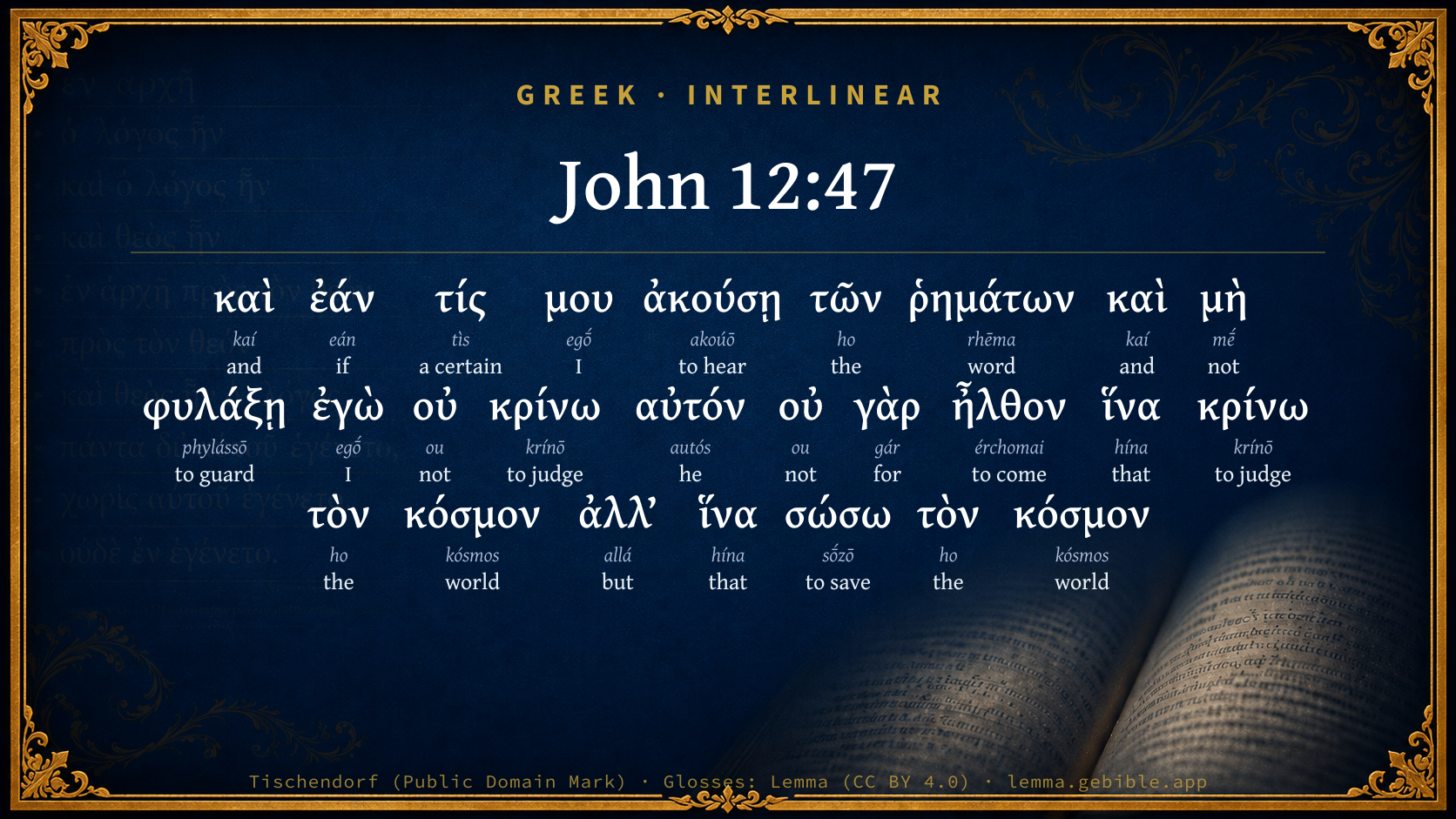
Download image
Cite this verse

John 12:47 (World English Bible). Public Domain. Lemma interlinear Bible study tool, https://lemma.gebible.app/v/john/12/47.

Show BibTeX & RIS
BibTeX
RIS
English Translation
If anyone listens to my sayings, and doesn't believe, I don't judge him. For I came not to judge the world, but to save the world.
World English Bible · Public Domain
Download a study sheet

One document with this verse’s original text, its word-by-word gloss line, the meaning frame, cross-references with their text, attributed commentary, and full source and license credits — printable, and it pastes into notes with its structure intact.

This verse Autodidact and up

Study sheet (.html) Plain text (.txt)

A passage Seminary Student

Up to 50 verses in one chapter. A passage sheet keeps up to 6 commentary sources and 12 cross-references per verse, in the order this page ranks them, and says so on the sheet whenever that leaves anything out. Ask for a single verse and you get the Autodidact verse sheet above.

Everything on this page stays free to read, with no account — the sheet is a download of what is already on screen, not access to it.

Want to remove ads? Support Godless Engineer
Compare translations 3

The same verse in 3 English versions, stacked beneath the original-language interlinear above. Click any original word for its lexicon entry.

Each is an independent rendering of the whole verse — the interlinear is not word-aligned to these translations.

Highlighted words mark where these versions differ — a whole-verse word diff, not a word-by-word alignment.

  • World English Bible Public Domain
    If anyone listens to my sayings, and doesn't believe, I don't judge him. For I came not to judge the world, but to save the world.
  • King James Version Public Domain
    And if any man hear my words, and believe not, I judge him not: for I came not to judge the world, but to save the world.
  • unfoldingWord Literal Text CC BY-SA 4.0
    And if anyone hears my words but does not keep, I do not judge him; for I have not come so that I might judge the world, but so that I might save the world.

unfoldingWord Literal Text — © unfoldingWord, licensed CC BY-SA 4.0. Word-aligned USFM3 via Door43 (git.door43.org/unfoldingWord/en_ult).

Versions to compare (up to 4)

3 of 4 selected

Show all 19 translations

Every available English version of this verse, each an independent rendering of the whole verse.

  • World English Bible Public Domain
    If anyone listens to my sayings, and doesn't believe, I don't judge him. For I came not to judge the world, but to save the world.
  • Berean Standard Bible Public Domain
    As for anyone who hears My words and does not keep them, I do not judge him. For I have not come to judge the world, but to save the world.
  • Majority Standard Bible Public Domain
    As for anyone who hears My words and does not believe, I do not judge him. For I have not come to judge the world, but to save the world.
  • King James Version Public Domain
    And if any man hear my words, and believe not, I judge him not: for I came not to judge the world, but to save the world.
  • American Standard Version (1901) Public Domain
    And if any man hear my sayings, and keep them not, I judge him not: for I came not to judge the world, but to save the world.
  • Revised Version (1885) Public Domain
    And if any man hear my sayings, and keep them not, I judge him not: for I came not to judge the world, but to save the world.
  • Geneva Bible (1599) Public Domain
    And if any man heare my wordes, and beleeue not, I iudge him not: for I came not to iudge the world, but to saue the world.
  • Douay-Rheims (1899) Public Domain
    And if any man hear my words, and keep them not, I do not judge him: for I came not to judge the world, but to save the world.
  • Young's Literal Translation Public Domain
    and if any one may hear my sayings, and not believe, I -- I do not judge him, for I came not that I might judge the world, but that I might save the world.
  • Literal Standard Version CC BY-SA 4.0
    and if anyone may hear My sayings, and not believe, I do not judge him, for I did not come that I might judge the world, but that I might save the world.
  • Unlocked Literal Bible CC BY-SA 4.0
    If anyone hears my words but does not keep them, I do not judge him; for I have not come to judge the world, but to save the world.
  • unfoldingWord Literal Text CC BY-SA 4.0
    And if anyone hears my words but does not keep, I do not judge him; for I have not come so that I might judge the world, but so that I might save the world.
  • Darby Bible Public Domain
    and if any one hear my words and do not keep [them], I judge him not, for I am not come that I might judge the world, but that I might save the world.
  • World Messianic Bible Public Domain
    If anyone listens to my sayings and doesn’t believe, I don’t judge him. For I came not to judge the world, but to save the world.
  • Webster's Bible Public Domain
    And if any man hear my words, and believe not, I judge him not: for I came not to judge the world, but to save the world.
  • Free Bible Version CC BY-SA 4.0
    I don't judge anyone who hears my words but doesn't do what I say. I came to save the world, not to judge it.
  • Bible in Basic English Public Domain
    And if any man gives ear to my words and does not keep them, I am not his judge: I did not come to be judge of the world but to give salvation to the world.
  • Text-Critical English NT CC BY 4.0
    If anyone hears my words and does not believe, I do not judge him; for I did not come to judge the world, but to save the world.
  • Tyndale New Testament (1534) Public Domain
    And yf eny man heare my wordes and beleve not I iudge him not. For I came not to iudge the worlde: but to save the worlde.

Literal Standard Version (2020), Covenant Press — licensed CC BY-SA 4.0. Text via the HelloAO Bible API (eBible.org). Unlocked Literal Bible (unfoldingWord) — licensed CC BY-SA 4.0. Text via the HelloAO Bible API (eBible.org). unfoldingWord Literal Text — © unfoldingWord, licensed CC BY-SA 4.0. Word-aligned USFM3 via Door43 (git.door43.org/unfoldingWord/en_ult). Free Bible Version, Dr. Jonathan Gallagher — licensed CC BY-SA 4.0. Text via the HelloAO Bible API (eBible.org).

Word by word

More ways to search: Search by grammar → Find every occurrence → Compare this word →

Practice this passage: Drill this verse → Learn its vocabulary →

φυλάξῃ
phylássō
G5442
“to guard”
Verb, Aorist, Active, Subjunctive, 3rd person, Singular
Part of Speech
Verb
Tense
Aorist
Voice
Active
Mood
Subjunctive
Person
3rd person
Number
Singular
Full Thayer's Definition

Origin: probably from G5443 through the idea of isolation

TDNT: 12:56,1

1. to guard a. to watch, keep watch b. to guard or watch, have an eye upon: lest he escape c. to guard a person (or thing) that he may remain safe 1. lest he suffer violence, be despoiled, etc. to protect 2. to protect one from a person or thing 3. to keep from being snatched away, preserve safe and unimpaired 4. to guard from being lost or perishing 5. to guard one's self from a thing d. to guard i.e. care for, take care not to violate 1. to observe 2. to observe for one's self something to escape a. to avoid, shun flee from b. to guard for one's self (i.e. for one's safety's sake) so as not to violate, i.e. to keep, observe (the precepts of the Mosaic law)
  1. καὶ kaí G2532 “and” Conjunction
  2. ἐάν eán G1437 “if” Conditional
  3. τίς tìs G5100 “a certain” Indefinite pronoun, Nominative, Singular, Masculine
  4. μου egṓ G1473 “I” Personal pronoun, 1st person, Genitive, Singular
  5. ἀκούσῃ akoúō G191 “to hear” Verb, Aorist, Active, Subjunctive, 3rd person, Singular
  6. τῶν ho G3588 “the” Article, Genitive, Plural, Neuter
  7. ῥημάτων rhēma G4487 “word” Noun, Genitive, Plural, Neuter
  8. καὶ kaí G2532 “and” Conjunction
  9. μὴ mḗ G3361 “not” Particle, Negative
  10. ἐγὼ egṓ G1473 “I” Personal pronoun, 1st person, Nominative, Singular
  11. οὐ ou G3756 “not” Particle, Negative
  12. κρίνω krínō G2919 “to judge” Verb, Present, Active, Indicative, 1st person, Singular
  13. αὐτόν autós G846 “he” Personal pronoun, Accusative, Singular, Masculine
  14. οὐ ou G3756 “not” Particle, Negative
  15. γὰρ gár G1063 “for” Conjunction
  16. ἦλθον érchomai G2064 “to come” Verb, Aorist, Active, Indicative, 1st person, Singular
  17. ἵνα hína G2443 “that” Conjunction
  18. κρίνω krínō G2919 “to judge” Verb, Present, Active, Subjunctive, 1st person, Singular
  19. τὸν ho G3588 “the” Article, Accusative, Singular, Masculine
  20. κόσμον kósmos G2889 “world” Noun, Accusative, Singular, Masculine
  21. ἀλλ’ allá G235 “but” Conjunction
  22. ἵνα hína G2443 “that” Conjunction
  23. σώσω sṓzō G4982 “to save” Verb, Aorist, Active, Subjunctive, 1st person, Singular
  24. τὸν ho G3588 “the” Article, Accusative, Singular, Masculine
  25. κόσμον kósmos G2889 “world” Noun, Accusative, Singular, Masculine

About this verse

These counts appear in no published source. They are computed here, from the morphology-tagged text and Lemma’s own curated glosses. What Lemma adds →

26
words
18
distinct lemmas
Gospels
section

Shared distinctive vocabulary

φυλάξῃ to guard G5442 occurs in 31 verses of the Greek New Testament. Also found in:
Repetition

Words recur within this verse:

Cross-references

11

Topical passages linked to John 12:47 in the Treasury of Scripture Knowledge — connected by theme and wording, ordered by reader-vote popularity; previews shown in the World English Bible.

  • John 3:17 For God didn't send his Son into the world to judge the world, but that the world should be saved through him.
  • John 8:15–16 You judge according to the flesh. I judge no one.
  • John 12:48 He who rejects me, and doesn't receive my sayings, has one who judges him. The word that I spoke, the same will judge him in the last day.
  • 1 Timothy 1:15–16 The saying is faithful and worthy of all acceptance, that Christ Jesus came into the world to save sinners; of whom I am chief.
  • 1 John 4:14 We have seen and testify that the Father has sent the Son as the Savior of the world.
  • Luke 19:10 For the Son of Man came to seek and to save that which was lost."
  • Matthew 20:28 even as the Son of Man came not to be served, but to serve, and to give his life as a ransom for many."
  • John 5:45 "Don't think that I will accuse you to the Father. There is one who accuses you, even Moses, on whom you have set your hope.
  • Matthew 18:10 See that you don't despise one of these little ones, for I tell you that in heaven their angels always see the face of my Father who is in heaven.
  • John 8:26 I have many things to speak and to judge concerning you. However he who sent me is true; and the things which I heard from him, these I say to the world."
  • 2 Peter 3:15 Regard the patience of our Lord as salvation; even as our beloved brother Paul also, according to the wisdom given to him, wrote to you;

Cross-references courtesy of OpenBible.info (CC BY 4.0).

Commentary

Notes on John 12:47 from classic Christian and Jewish commentators (each source and its license shown beneath its notes). The classic Christian expositions comment on the surrounding passage and are grouped to its opening verse, so a note may address several verses; the Jewish commentaries on the Tanakh (Rashi and others) are per-verse, so they appear only where the commentator wrote on this verse.

Lemma curates 59 commentaries, every one of them public domain or Creative Commons licensed, each selected and text-cleaned for this edition rather than reprinted as found. About our sources →

The Cambridge Bible for Schools and Colleges

gen. ed. J. J. S. Perowne

47. hear my words] ‘Hear’ is a neutral word, implying neither belief nor unbelief. Mat_7:24; Mat_7:26; Mar_4:15-16. For ‘words’ read sayings (see on Joh_5:47) both here and in Joh_12:48.

and believe not] The true reading is and keep them not, i.e. fulfil them (comp. Luk_11:28; Luk_18:21). One important MS. omits the ‘not,’ perhaps to avoid a supposed inconsistency between Joh_12:47 and Joh_12:48.

The Cambridge Bible for Schools and Colleges (gen. ed. J. J. S. Perowne; Cambridge University Press, 1878–1918) — public domain. Text from a community e-Sword module.

The Biblical Illustrator

Joseph S. Exell

Joh_12:47-48

If any man hear My words

I.

THE GREATEST SPIRITUAL PRIVILEGE THAT MAN CAN ENJOY. It is a priceless privilege to hear the words of any great sage, poet, moralist. But what are the best human words compared with those of Christ? They are spirit and life; more pure than crystal, more refreshing than the morning breeze, more quickening than the sunbeam, they are recreative forces. What have they accomplished ere now?

II. THE GREATEST CRIMINAL NEGLECT OF WHICH A MAN CAN BE GUILTY--and believe not, i.e. keep them not. Such is guilty of

1. The most egregious folly.

2. The most heinous ingratitude.

3. The most hardened impiety.

II. THE MOST TERRIBLE DOOM WHICH A MAN CAN APPREHEND. I judge him not. I as a Saviour have nothing more to do with him; I leave him to the retributive treatment of My Father. Mercy leaves him, and justice apprehends him. (D. Thomas, D. D.)

The words of Christ

I. AS LAWS TO BE OBEYED. Christs words are not like poetry for entertainment, or abstract science for speculative thought; they are laws to be kept; not so much a creed as a code. It is only as they are embodied in actual life that their mission is answered, that they are of any real or lasting service to man.

II. AS A MEANS OF SALVATION. Had Christ come to judge the world, His words would have breathed the indignation of insulted justice. But He came to save, and hence His words are full of all that can restore man to holiness and God. The salvation which Christ came to effect is restoration from spiritual ignorance to intelligence, from selfishness to benevolence, from bondage to freedom, from inward conflict to inner harmony, from social perniciousness to social utility. To this His signs and words are adapted. Save the world, not a class.

III. AS CRITERIA OF JUDGMENT (Joh_12:48). The man to whom Christ has spoken, and who rejects or nullifies His words, needs no other judge but His words. These words will judge him in his conscience and will condemn him for ingratitude, folly and rebellion. (D. Thomas, D. D.)

Christ is both able and willing to save the world

When the Duke of Argyle was taken in rebellion in Scotland, and brought before James II, the king said to him, You know that it is in my power to pardon you. It is reported that the prisoner answered, It may be in your power, but it is not in your nature--a speech which, whether true or not, cost him his life, He died like a stoic, executed at Temple Gate. But Christ has both the power and the disposition to pardon sinners. He that rejecteth me … hath one that judgeth Him.

The redemptive becoming retributive

I. CHRISTIANITY MAY BE REJECTED NOW. It is possible to accept Christs creed and to reject His authority.

II. THOSE WHO REJECT CHRISTIANITY NOW, MUST BOW TO ITS JUDICIAL FORCE HEREAFTER. The last day is the retributive period that awaits us all. Then the Word which has been trodden under foot will rise from the dust and take the throne.

1. There is nothing arbitrary in the decision or procedure of the last judgment. The glorious words of mercy which are rejected will spring from their graves, and conscience will invest them with judicial authority.

2. Man should be profoundly cautious as to how to treat the words of Christ now. His words are not sounds but things--terrible things. They must live forever in every soul into which they have fallen. Old sermons will be preached again by memory many ages on. How shall we escape. (D. Thomas, D. D.)

The word that I have spoken, the same shall Judge Him.

I. THERE IS A LAST DAY. The world shall not always roll on. God shall interpose at length. In one sense there is no last day either to righteous or wicked. But in reference to the existing order there is a winding up, a reckoning. Tomorrow shall then cease, and that word of mystery and procrastination and suspense be known no more.

II. THAT DAY SHALL BE ONE OF JUDGMENT. The long unsettled cases of earth shall be settled then. Times riddles shall be solved and its wrongs righted. The oppressed shall be vindicated and the evil-doer be put to shame. The judgment shall be just, undoing the evil and establishing the good.

III. CHRISTS WORD SHALL JUDGE US. Not that the word is to supersede the Judge, but it will form the ground of judgment. We can imagine in connection with that word such questions as these:

1. Did it reach you?

2. Did you listen to it, or spend your lives in listening to someone or thing else?

3. Did you treat it as a true word? Professing to receive it as true, did you treat it as untrue?

4. Did you treat it as Divine? by reverence and submission.

5. Did you accept it as suitable, as meeting your case? or did you reject it? By this word, then, let us judge ourselves now, that so we may not be condemned by it at the great day. (H. Bonar.)

The Biblical Illustrator, edited by Joseph S. Exell (c. 1880s–1900s) — public domain. Text from a community e-Sword module.

Bengel's Gnomon

Johann Albrecht Bengel

Joh 12:47. Ἐγὼ οὐ κρίνω, I judge him not) This is limited in a threefold way: (1) I, alone [not I alone, but also, etc.]; and (2) in the present, I do not judge [now; but hereafter I shall]; and (3) causally, it is not I who judge him, but he who does not believe, himself rushes into judgment by the fact of not believing in My word.—ἵνα κρίνω, ἵνα σώσω, that I may judge, that I may save) Words in the same tense. Observe: the unbeliever is a portion of that world, for the sake of saving which Christ came. This is clearly evident from the connection of the words.

Bengel's Gnomon of the New Testament — English translation (T&T Clark, Edinburgh, 1860) — public domain. Text from a community e-Sword module.

Meyer's Critical & Exegetical Commentary

Heinrich August Wilhelm Meyer

Joh_12:47-48. Comp. Joh_3:17-18, Joh_5:45 ff., Joh_8:15 ff.

If any one shall have heard the words from me, does not denote hearing in the sense of believing (Lücke), but a hearing which is in itself indifferent (Mat_7:26; Mar_4:15-16; Mar_13:20); and by the κ. μὴ φυλάξῃ which follows (see the critical notes), that very faith which follows hearing is denied. φυλάσσειν, namely, denotes not indeed the mere holding fast, guarding (Joh_12:25), but, as throughout, where doctrines, precepts, and the like are spoken of (see especially Luk_11:28; Luk_18:21; Rom_2:26), the keeping by actual fulfilment. But this takes place simply by faith, which Christ demands for His ῥήματα: with faith the φυλάσσειν comes into action (hence the Recepta κ. μὴ πιστεύσῃ is a correct gloss); the refusal of faith is the rejection of Christ (ἀθετεῖν, here only in John, but comp. Luk_10:16; 1Th_4:8), and non-adoption of His words, Joh_12:48, is the opposite of that φυλάσσειν so far as its essence is just the ὑπακοὴ τῆς πίστεως.

On ἀκούειν with a double genitive, as in Luk_6:47, Act_22:1, comp. Joh_18:37; and see Buttmann, N. T. Gr. p. 145 [E. T. p. 167].

ἐγὼ οὐ κρίνω αὐτόν] I, in my person, am not his judge, which is further meant generally, not exclusively, of the last judgment, but in a condemnatory sense, as opposed to σώζειν, as in Joh_3:17

Joh_12:48. ἔχει] Placed first with great emphasis: he has his judge; he stands already under his trial. But this judge, says Christ, is not Himself, as an individual personally considered in and by Himself, but His spoken word; this and nothing else will be (and therewith all the terror of the last decision breaks in upon the mind) the determining rule of the last judgment. It is Christ, indeed, who holds the judgment (Joh_5:22; Joh_5:27), but as the bearer and executor of His word, which constitutes the divine power of the judgment. Comp. Joh_7:51, where the law judges and takes cognisance. How decisively does the present passage declare against the attempt of Scholten, Hilgenfeld, Reuss, and others, to explain away the last judgment out of John! Comp. Joh_12:28-29; 1Jn_4:17.

Meyer — Critical and Exegetical Commentary on the New Testament — English translation by Peter Christie, edited by Frederick Crombie (T&T Clark, 1880) — public domain. Text from a community e-Sword module.

Expositor's Greek Testament

ed. W. Robertson Nicoll

Joh 12:47 . But “if any one should hear my words and not keep them I do not judge him, for I came not to judge,” etc. See Joh 3:17 .

The Expositor's Greek Testament, edited by W. Robertson Nicoll (1897–1910) — public domain. Text from a community e-Sword module.

Cambridge Greek Testament for Schools and Colleges

47. φυλάξῃ for πιστεύσῃ, on overwhelming authority.

47. ἀκούσῃ. In a neutral sense, implying neither belief nor unbelief (Mat 7:24; Mat 7:26; Mar 4:15-16). For ῥήματα see on Joh 3:34.

μὴ φυλάξῃ. Keep them not, i.e. fulfil them not (Luk 11:28; Luk 18:21). A few authorities omit μή, perhaps to avoid a supposed inconsistency between Joh 12:47-48.

Cambridge Greek Testament for Schools and Colleges (Cambridge University Press, 1896; 21 vols, various authors incl. Carr, Maclear, Plummer, Farrar, Lumby, Moule, M. R. James, Simcox) — public domain. Text from a community e-Sword module.

Godet's Commentaries

Frédéric Louis Godet

Vv. 47, 48. “And if any one hear my sayings and keep them not, I judge him not; for I came not to judge the world, but to save the world. 48. He that rejects me and receives not my sayings has already his judge; the word which I have spoken, this it is which will judge him at the last day.”

Woe to him who does not believe on Jesus and His word in which He manifests Himself and bears testimony of Himself! As His presence is the pure manifestation of God, His word is the perfect revelation of the thought of God. This will be the one touchstone of the judgment. The declaration of Joh 12:47 does not exclude the personal role of Jesus in this great act. It merely says that the sentence which He will pronounce at that time will be simply that which will follow from the position which the man has taken with regard to His word; it is the idea of Joh 3:18 (ἤδη κέκριται),Joh 5:24; Joh 8:15. The reading φυλάξῃ, keep, is to be preferred to the received reading πιστεύσῃ (and believe not); for the former term is less common than the latter; it applies not to the keeping in the conduct—with this meaning, Jesus employs the word τηρεῖν —but to inward appropriation and possession. The last words of Joh 12:47 reproduce the idea of iii 17; comp. Joh 9:39; Joh 9:41.

In Joh 12:48, where the rejection of Jesus is identified with that of His words, the express mention of the last dayis very remarkable. As Gess observes, “the moral judgment of humanity through the word is incessantly effected even now, according to the entire Gospel. And yet the notion of the last judgment is so indispensable in the thought of the evangelist, that he expresses it here as the limit without which the purely moral judgment would fail of its consummation” (II. p. 452). How is it that Reuss, Scholten, Hilgenfeld affirm that the final judgment is denied in our Gospel! And what is striking is that the evangelist mentions, in speaking thus, a fact which is not indicated in the saying of Jesus on which this is founded (Joh 3:17). The last two verses explain the reason why the position taken by man with regard to Jesus and His word has so decisive an importance. It is because He has nothing of His own mingled in His teaching, and that He has transmitted it, as to substance and form, exactly as He received it from the Father.

Frédéric Louis Godet — Commentaries on Luke, John, Romans, and 1 Corinthians — English translation (T&T Clark, Edinburgh, 1870s–1890s) — public domain. Text from a community e-Sword module.

Adam Clarke's Commentary

Verse 47. And believe not] και μη φυλαξη, And keep them not, is the reading of ABL, seven others; Syriac, Wheelock's Persian, two of the Arabic, Coptic, Sahidic, AEthiopic, Armenian, later Syriac, Vulgate, six of the Itala, and some of the fathers.

A man must hear the words of Christ in order to believe them; and he must believe, in order to keep them; and he must keep them in order to his salvation.

I judge him not] I need not do it: the words of Moses and the prophets judge and condemn him. See the notes on Joh 3:17; Joh 5:45.

Adam Clarke's Commentary on the Bible (1810–1826) — public domain. Text from a community e-Sword/MySword module.

John Calvin's Commentaries

47. If any man hear my words. After having spoken concerning his grace, and exhorted his disciples to steady faith, he now begins to strike the rebellious, though even here he mitigates the severity due to the wickedness of those who deliberately — as it were — reject God; for he delays to pronounce judgment on them, because, on the contrary, he has come for the salvation of all. In the first place, we ought to understand that he does not speak here of all unbelievers without distinction, but of those who, knowingly and willingly, reject the doctrine of the Gospel which has been exhibited to them. Why then does Christ not choose to condemn them? It is because he lays aside for a time the office of a judge, and offers salvation to all without reserve, and stretches out his arms to embrace all, that all may be the more encouraged to repent. And yet there is a circumstance of no small moment, by which he points out the aggravation of the crime, if they reject an invitation so kind and gracious, for it is as if he had said, “Lo, I am here to invite all, and, forgetting the character of a judge, I have this as my single object, to persuade all, and to rescue from destruction those who are already twice ruined.” No man, therefore, is condemned on account of having despised the Gospel, except he who, disdaining the lovely message of salvation, has chosen of his own accord to draw down destruction on himself.

The word judge, as is evident from the word save, which is contrasted with it, here signifies to condemn. Now this ought to be understood as referring to the office which properly and naturally belongs to Christ; for that unbelievers are not more severely condemned on account of the Gospel is accidental, and does not arise from its nature, as we have said on former occasions.

John Calvin's Commentaries (1540-1563) — public domain. Text from the Calvin Translation Society English edition (1840s-50s) via the Christian Classics Ethereal Library (ccel.org). Calvin's coverage is partial (roughly two-thirds of the Bible); uncommented books and verses are honest gaps, never fabricated. The 19th-century editor's footnotes and remarks are omitted so the notes are faithfully Calvin's own voice.

Ellicott's Commentary for English Readers

(47) And if any man hear my words, and believe not.—The better reading is, . . . and keep them not. (Comp., for the words “hear” and “keep,” Notes on Luk_11:28; Luk_18:21.) For the thought of the verse comp. in this Gospel, Notes on Joh_3:17 et seq.; 5:24, 45 et seq.; 8:15 ei seq.; and the apparently opposite assertion in Joh_9:39.

A Bible Commentary for English Readers, edited by Charles John Ellicott (1878–1897) — public domain. Text from a community e-Sword module.

John Gill's Exposition

For I have not spoken of myself,.... As man, or as separate from his Father; his doctrine was not human, but divine, and therefore a rejection of it cannot escape notice at the future judgment:

but the Father which sent me, he gave me a commandment what I should say, and what I should speak; Christ, as man, had his mission, and commission, and his instructions from his Father to preach the Gospel unto men; he was anointed for it by the Holy Ghost; he was enjoined the preaching of it by his Father, and the several doctrines he published were delivered him by him; see Joh 8:28.

John Gill's Exposition of the Whole Bible (1746–1763) — public domain (CC PDM 1.0). Text via the HelloAO Bible API.

Trapp's Complete Commentary

John Trapp

47 And if any man hear my words, and believe not, I judge him not: for I came not to judge the world, but to save the world.

Ver. 47. I judge him not] viz. While I am here on earth. I sustain another person now, that men may come apace to me without fear. Some ancient heretics held, that God in the time of the law was a severe judge; and now, in the days of the gospel, he was all made of mercy and mildness. But the apostle saith somewhat otherwise, Heb 2:1-3. God is more peremptory in his judgments now than ever of old. And, Joh 12:29, he telleth us that even our God also, as well as the God of the Jews, "is a consuming fire."

John Trapp, A Commentary or Exposition upon All the Books of the Old and New Testament (1647–1656) — public domain. Text from a community e-Sword module.

Albert Barnes' Notes on the Bible

I judge him not ... - Joh 8:15. It was not his present purpose to condemn men. He would come to condemn the guilty at a future time. At present he came to save them. Hence he did not now even pronounce decisively on the condition of those who rejected him, but still gave them an opportunity to be saved.

Albert Barnes' Notes on the Bible (1834–1885) — public domain. Text from a community e-Sword/MySword module.

Haydock's Catholic Bible Commentary

I do not judge him. To judge here, may signify to condemn. St. Augustine expounds it in this manner: I do not judge him at this my first coming. St. John Chrysostom says, it is not I only that judgeth him, but the works also that I do.

George Leo Haydock (1774–1849), Haydock's Catholic Family Bible and Commentary, 1859 edition — public domain. Excludes Psalms (Douay-Rheims chapter numbering differs from Protestant) and Deuterocanonical books (Catholic canon only).

Matthew Poole's English Annotations

I judge him not; I alone judge him not, or rather, it is not my present business to pronounce sentence of condemnation against him; I am now doing the work of a Redeemer and Saviour, not of a Judge: he is condemned already, Joh 3:18, and he hath another that accuseth and condemneth him; as the Jews had Moses, Joh 5:45, so he hath my Father as his Judge, and will have my word as his accuser (as in the next verse): I shall one day condemn him; but that is not my present business, that was not my errand in coming into the world. I came to offer the world the means, and to show them the way to salvation; if they do perish, their blood will be upon their own heads: it is not my business to condemn them.

Matthew Poole's English Annotations on the Holy Bible (1683–1685) — public domain. Text from a community e-Sword/MySword module.

Whedon's Commentary on the Bible

Daniel D. Whedon

47. I judge him not—Not as a simple human person am I his judge.

Daniel D. Whedon (gen. ed.), Commentary on the Old and New Testaments (1874–1909) — public domain. Text from a community e-Sword module.

The Pulpit Commentary

If any one shall have heard my sayings, and have (guarded) kept them not. Here our Lord passes from the effect of his earthly life, which is light, to that of the words (rhmata) by which the whole future of mankind will be affected, and one is reminded of the close of the sermon on the mount, where the condition of that man is portrayed who hears the logouv of Christ and doeth them net, whose destiny will be determined by the natural course of things. (see Mat_7:26, Mat_7:27) Keep (guard) them not. (see Mat_19:20) The "hearing" is clearly not identical with spiritual acceptance, but is restricted to the awful charge of responsibility that comes upon every man who simply hears, knows what Christ"s words are, and then keeps" them not so as to fulfill their intention. Christ says, I judge him not. I am not now pronouncing a sentence upon him; I am his Savior; but this is his condemnation, that he believes not, etc. (Joh_3:17-19) Our Lord claimed, in the sermon on the mount, to be the Executor of a judgment, and in Joh_5:22-29 he declared that he would be as Son of man, the final Adjudicator of doom on the disobedient, (cf. Mt 25) and in many places he made this thought even more solemn by speaking of himself on that occasion, not as the compassionate Savior, but the Administrator of an inviolable law, which cannot be swayed by immediate emotion, but will effectuate itself on eternal and unswerving principles. The Law accuses the old Law (Joh_5:45) but I judge him not; for I came (hlyon) not to judge, but to save the world, referring to the Incarnation in its purport and supreme motive.

The Pulpit Commentary (1880–1919), ed. H.D.M. Spence-Jones & Joseph S. Exell — public domain. Text from a community e-Sword module.

John Wesley's Explanatory Notes

I judge him not - Not now: for I am not come to judge the world. See, Christ came to save even them that finally perish! Even these are a part of that world, which he lived and died to save.

John Wesley, Explanatory Notes Upon the Whole Bible (1754–1765) — public domain. Text via the GEBible commentary corpus.

Scofield Reference Notes

C. I. Scofield

world kosmos = mankind. (See Scofield "Mat 4:8").

The Scofield Reference Bible (1917 edition), notes by C. I. Scofield — public domain. Text from a community e-Sword module.

The People's New Testament

B. W. Johnson

47, 48. I judge him not. He shall sit on the throne of judgment, not to condemn the world he came to save. The words he left in the world will decide the destiny of every man. All shall be “judged by the things written in the books” (Rev. 20:12).

B. W. Johnson's The People's New Testament with Notes (1889–1891) — public domain. Electronic text from the Christian Classics Ethereal Library (CCEL) ThML edition.

Alford’s Greek Testament

Henry Alford

47.] See ch. 3:17; 5:45; 8:15. The omission of μή (see var. readd.) appears to have been occasioned by a mistaken idea that vv. 48 and 47 were in contrast to one another.

Henry Alford, The Greek Testament (1849–1861) — public domain. Text from a community e-Sword module.

International Critical Commentary

47. ἐάν τίς μου ἀκόυσῃ τῶν ῥημάτων, sc. with appreciation and understanding of what they signify: if it were only the mere physical hearing that was meant, ἀκούειν would take the acc., and we should have τὰ ῥήματα. See on 3:8. It is only the man who is neglectful of Christ’s words, while understanding them all the time, that is here contemplated.

μὴ φυλάξῃ. So אABDLW, but rec. has πιστεύσῃ. DΘ omit μή before φυλάξῃ, the motive apparently being to place vv. 47 and 48 in sharp contrast. But v. 48 is, in fact, a reaffirmation of v. 47; the distinction suggested by Westcott, that v. 47 contemplates the listener who does not put into practice what he has heard, while v. 48 contemplates the man who defiantly does not listen at all, is over subtle.

φυλάττειν is used in Mar 10:20 of “keeping” the Ten Commandments; cf. Luk 11:28. In the Sermon on the Mount, the man “who hears these words and does them not” (Mat 7:26) is compared to one who builds on the sand. Of him Jesus says here ἐγὼ οὐ κρίνω αὐτόν (see note on 8:15); He came not to judge the world, but to save the world (see on 3:17). There is a sense in which “judgment” is inevitably the issue of His Advent (cf. 9:39), but it was not the main purpose of that Advent. See on 1:33.

The clause, “I came not to judge the world, but to save the world,” recalls an addition to the text at Luk 9:55. In that passage Jesus rebuked James and John, the true text, according to אABCL, being στραφεὶς δὲ ἐπετίμησεν αὐτοῖς. But a “Western and Syrian” addition (to use the nomenclature of Westcott-Hort) gives: “and said, Ye know not what spirit ye are of, for the Son of man came not to destroy men’s lives, but to save them.” If this Western text represents a true tradition (whether it be Lucan or not) of words addressed by Jesus to John the son of Zebedee, it is significant that similar words should be ascribed to Jesus in the “Gospel according to St. John.” If, however, the words ὁ γὰρ υἱὸς τοῦ ἀνθρώπου οὐκ ἦλθεν ψυχὰς ἀνθρώπων ἀπολέσαι, ἀλλὰ σῶσαι may be taken as Lucan, then we have here another point of contact between Lk. and Jn., where Jn. is seemingly correcting Lk. (see Introd., p. xcix). Cf. 20:5 for a similar instance.

International Critical Commentary — older volumes (1896–1929), various authors — public domain. Text from a community e-Sword module.

Vincent's Word Studies in the New Testament

Marvin R. Vincent

Believe not [μη πιστευση] . The best texts read fulaxh, keep (them).

Came [ηλθον] . The aorist tense, pointing to the purpose of the coming, as I am come (ver. 46) to the result. Compare Joh 8:14; Joh 9:39; Joh 10:10; Joh 12:27, 47; Joh 14:22. Both tenses are found in Joh 8:42; Joh 16:28.

Marvin R. Vincent, Word Studies in the New Testament (1887–1900) — public domain. Text from a community e-Sword/MySword module.

Lesson kit

Teaching starters — assembled from the data on this page, not authored interpretation. Every prompt links to the verse data it draws on. Edit before teaching.

John, in the Gospels, opens this verse with 26 words (18 distinct Greek lemmas). Its most distinctive word is phylássō (“to guard”). A historical commentator’s framing appears above. Read the whole chapter for the surrounding context.

Discussion questions

  1. The word phylássō carries the sense “to guard.” How does it shape the verse?
  2. How does Matthew 19:20, which shares the word «to guard», read alongside this verse?
  3. What does the repetition of “to judge” (2× in this one verse) do in this verse?
  4. These translations render this verse differently; the difference is in the English rendering, not the original. What questions does that raise?
  5. Compare how The Cambridge Bible for Schools and Colleges and The Biblical Illustrator read this verse. Where do they agree or differ?

Things to notice

  • These translations choose different wording for 18 words in this verse.
  • “to judge” occurs 2× in this single verse.
  • 18 distinct Greek lemmas span 26 words in this verse.

Reading settings

Reading text

Shown beneath each verse's original-language words.

Old Testament
Old Testament edition

Read the OT as the Masoretic Hebrew (MT) or the Greek Septuagint (LXX).

English shown for the Greek Septuagint (in the Hebrew ↔ Greek comparison).

Comparing translations? Open the Compare panel on any verse page to stack up to four side by side.