Revelation 2:7

Greek (Tischendorf 8th ed.) Revelation 2:7 appears in the Greek New Testament. The text above is from the Tischendorf 8th edition. Each word links to its Strong’s number and a concise gloss. Click any word for its full Thayer’s Greek Lexicon entry.
Download image
Cite this verse

Revelation 2:7 (World English Bible). Public Domain. Lemma interlinear Bible study tool, https://lemma.gebible.app/v/revelation/2/7.

Show BibTeX & RIS
BibTeX
RIS
English Translation
He who has an ear, let him hear what the Spirit says to the assemblies. To him who overcomes I will give to eat of the tree of life, which is in the Paradise of my God.
World English Bible · Public Domain
Download a study sheet

One document with this verse’s original text, its word-by-word gloss line, the meaning frame, cross-references with their text, attributed commentary, and full source and license credits — printable, and it pastes into notes with its structure intact.

This verse Autodidact and up

Study sheet (.html) Plain text (.txt)

A passage Seminary Student

Up to 50 verses in one chapter. A passage sheet keeps up to 6 commentary sources and 12 cross-references per verse, in the order this page ranks them, and says so on the sheet whenever that leaves anything out. Ask for a single verse and you get the Autodidact verse sheet above.

Everything on this page stays free to read, with no account — the sheet is a download of what is already on screen, not access to it.

Want to remove ads? Support Godless Engineer
Compare translations 3

The same verse in 3 English versions, stacked beneath the original-language interlinear above. Click any original word for its lexicon entry.

Each is an independent rendering of the whole verse — the interlinear is not word-aligned to these translations.

Highlighted words mark where these versions differ — a whole-verse word diff, not a word-by-word alignment.

  • World English Bible Public Domain
    He who has an ear, let him hear what the Spirit says to the assemblies. To him who overcomes I will give to eat of the tree of life, which is in the Paradise of my God.
  • King James Version Public Domain
    He that hath an ear, let him hear what the Spirit saith unto the churches; To him that overcometh will I give to eat of the tree of life, which is in the midst of the paradise of God.
  • unfoldingWord Literal Text CC BY-SA 4.0
    Let the one having an ear hear what the Spirit is saying to the churches. To the one conquering, I will grant to him to eat from the tree of life that is in the paradise of God.”’

unfoldingWord Literal Text — © unfoldingWord, licensed CC BY-SA 4.0. Word-aligned USFM3 via Door43 (git.door43.org/unfoldingWord/en_ult).

Versions to compare (up to 4)

3 of 4 selected

Show all 19 translations

Every available English version of this verse, each an independent rendering of the whole verse.

  • World English Bible Public Domain
    He who has an ear, let him hear what the Spirit says to the assemblies. To him who overcomes I will give to eat of the tree of life, which is in the Paradise of my God.
  • Berean Standard Bible Public Domain
    He who has an ear, let him hear what the Spirit says to the churches. To the one who overcomes, I will grant the right to eat from the tree of life in the Paradise of God.
  • Majority Standard Bible Public Domain
    He who has an ear, let him hear what the Spirit says to the churches. To the one who overcomes, I will grant the right to eat from the tree of life in the Paradise of God.
  • King James Version Public Domain
    He that hath an ear, let him hear what the Spirit saith unto the churches; To him that overcometh will I give to eat of the tree of life, which is in the midst of the paradise of God.
  • American Standard Version (1901) Public Domain
    He that hath an ear, let him hear what the Spirit saith to the churches. To him that overcometh, to him will I give to eat of the tree of life, which is in the Paradise of God.
  • Revised Version (1885) Public Domain
    He that hath an ear, let him hear what the Spirit saith to the churches. To him that overcometh, to him will I give to eat of the tree of life, which is in the Paradise of God.
  • Geneva Bible (1599) Public Domain
    Let him that hath an eare, heare, what the Spirite saith vnto the Churches, To him that ouercommeth, will I giue to eate of the tree of life which is in the middes of the Paradise of God.
  • Douay-Rheims (1899) Public Domain
    He, that hath an ear, let him hear what the Spirit saith to the churches: To him, that overcometh, I will give to eat of the tree of life, which is in the paradise of my God.
  • Young's Literal Translation Public Domain
    He who is having an ear -- let him hear what the Spirit saith to the assemblies: To him who is overcoming -- I will give to him to eat of the tree of life that is in the midst of the paradise of God.
  • Literal Standard Version CC BY-SA 4.0
    He who is having an ear—let him hear what the Spirit says to the assemblies: To him who is overcoming—I will give to him to eat of the Tree of Life that is in the midst of the paradise of God.
  • Unlocked Literal Bible CC BY-SA 4.0
    Let the one who has an ear listen to what the Spirit is saying to the churches. To the one who conquers I will give the right to eat from the tree of life, which is in the paradise of God.”'”
  • unfoldingWord Literal Text CC BY-SA 4.0
    Let the one having an ear hear what the Spirit is saying to the churches. To the one conquering, I will grant to him to eat from the tree of life that is in the paradise of God.”’
  • Darby Bible Public Domain
    He that has an ear, let him hear what the Spirit says to the assemblies. To him that overcomes, I will give to him to eat of the tree of life which is in the paradise of God.
  • World Messianic Bible Public Domain
    He who has an ear, let him hear what the Spirit says to the assemblies. To him who overcomes I will give to eat from the tree of life, which is in the Paradise of my God.
  • Webster's Bible Public Domain
    He that hath an ear, let him hear what the Spirit saith to the churches; To him that overcometh will I give to eat of the tree of life, which is in the midst of the paradise of God.
  • Free Bible Version CC BY-SA 4.0
    If you have ears, listen to what the Spirit is telling the churches. I will give to those who are victorious the privilege of eating from the tree of life, which stands in the Paradise of God.
  • Bible in Basic English Public Domain
    He who has ears, let him give ear to what the Spirit says to the churches. To him who overcomes I will give of the fruit of the tree of life, which is in the Paradise of God.
  • Text-Critical English NT CC BY 4.0
    He who has an ear, let him hear what the Spirit is saying to the churches. To him who overcomes I will give the right to eat of the tree of life, which is in the paradise of my God.’
  • Tyndale New Testament (1534) Public Domain
    Lett him that hath eares heare what the sprete sayth vnto the congregacions. To him that overcometh will I geve to eate of the tree of lyfe which is in the myddes of the paradice of god.

Literal Standard Version (2020), Covenant Press — licensed CC BY-SA 4.0. Text via the HelloAO Bible API (eBible.org). Unlocked Literal Bible (unfoldingWord) — licensed CC BY-SA 4.0. Text via the HelloAO Bible API (eBible.org). unfoldingWord Literal Text — © unfoldingWord, licensed CC BY-SA 4.0. Word-aligned USFM3 via Door43 (git.door43.org/unfoldingWord/en_ult). Free Bible Version, Dr. Jonathan Gallagher — licensed CC BY-SA 4.0. Text via the HelloAO Bible API (eBible.org).

Word by word

More ways to search: Search by grammar → Find every occurrence → Compare this word →

Practice this passage: Drill this verse → Learn its vocabulary →

παραδείσῳ
parádeisos
G3857
“garden”
Noun, Dative, Singular, Masculine
Part of Speech
Noun
Case
Dative
Number
Singular
Gender
Masculine
Full Thayer's Definition

Origin: of Oriental origin cf G6508

TDNT: 17:45,8

1. among the Persians a grand enclosure or preserve, hunting ground, park, shady and well watered, in which wild animals, were kept for the hunt; it was enclosed by walls and furnished with towers for the hunters 2. a garden, pleasure ground a. grove, park 3. the part of Hades which was thought by the later Jews to be the abode of the souls of pious until the resurrection: but some understand this to be a heavenly paradise 4. the upper regions of the heavens. According to the early church Fathers, the paradise in which our first parents dwelt before the fall still exists, neither on the earth or in the heavens, but above and beyond the world 5. heaven
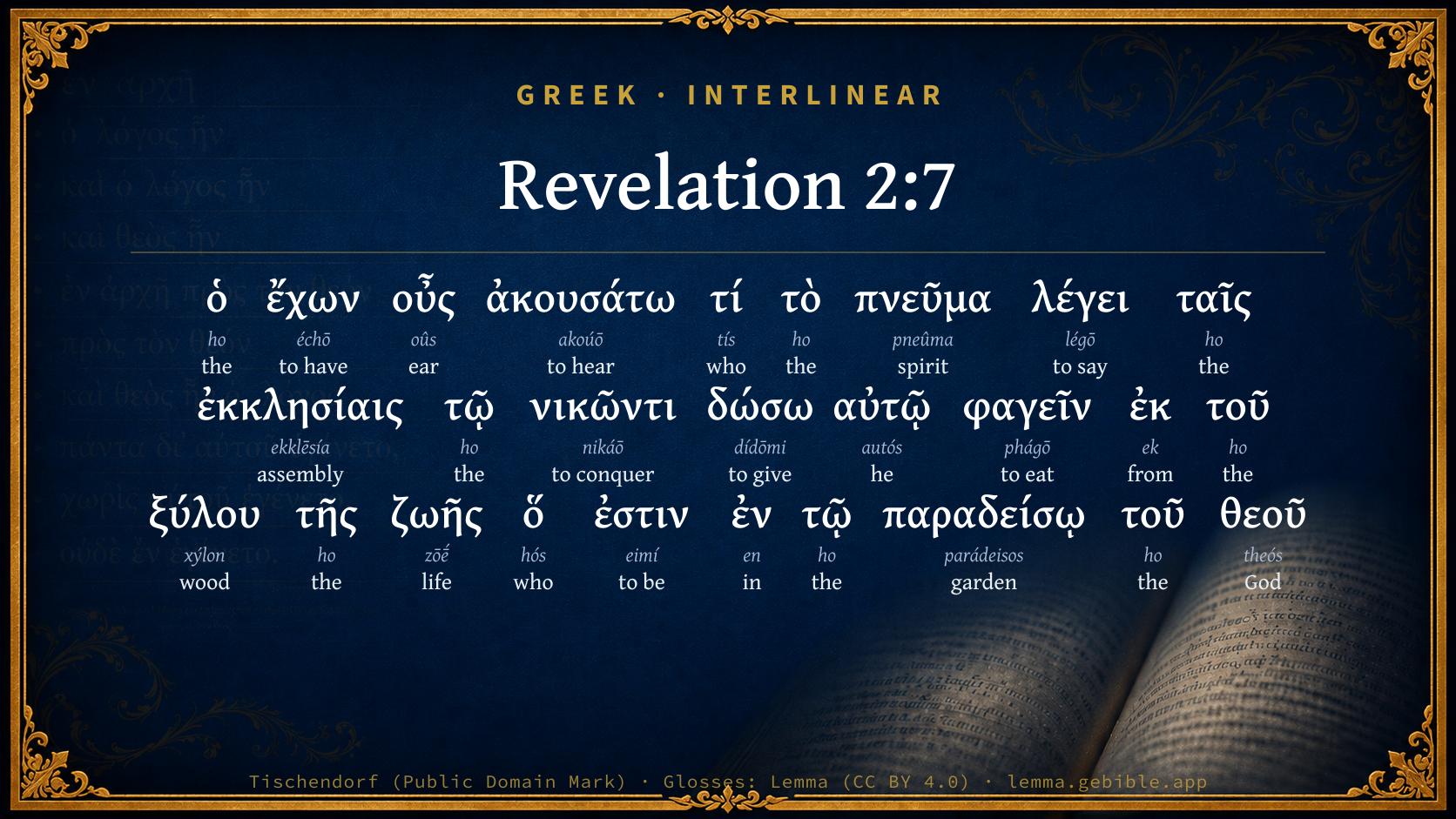
  1. ὁ ho G3588 “the” Article, Nominative, Singular, Masculine
  2. ἔχων échō G2192 “to have” Verb, Present, Active, Participle, Nominative, Singular, Masculine
  3. οὖς oûs G3775 “ear” Noun, Accusative, Singular, Neuter
  4. ἀκουσάτω akoúō G191 “to hear” Verb, Aorist, Active, Imperative, 3rd person, Singular
  5. τί tís G5101 “who” Interrogative pronoun, Accusative, Singular, Neuter
  6. τὸ ho G3588 “the” Article, Nominative, Singular, Neuter
  7. πνεῦμα pneûma G4151 “spirit” Noun, Nominative, Singular, Neuter
  8. λέγει légō G3004 “to say” Verb, Present, Active, Indicative, 3rd person, Singular
  9. ταῖς ho G3588 “the” Article, Dative, Plural, Feminine
  10. ἐκκλησίαις ekklēsía G1577 “assembly” Noun, Dative, Plural, Feminine
  11. τῷ ho G3588 “the” Article, Dative, Singular, Masculine
  12. νικῶντι nikáō G3528 “to conquer” Verb, Present, Active, Participle, Dative, Singular, Masculine
  13. δώσω dídōmi G1325 “to give” Verb, Future, Active, Indicative, 1st person, Singular
  14. αὐτῷ autós G846 “he” Personal pronoun, Dative, Singular, Masculine
  15. φαγεῖν phágō G5315 “to eat” Verb, Aorist, Active, Infinitive
  16. ἐκ ek G1537 “from” Preposition
  17. τοῦ ho G3588 “the” Article, Genitive, Singular, Neuter
  18. ξύλου xýlon G3586 “wood” Noun, Genitive, Singular, Neuter
  19. τῆς ho G3588 “the” Article, Genitive, Singular, Feminine
  20. ζωῆς zōḗ G2222 “life” Noun, Genitive, Singular, Feminine
  21. ὅ hós G3739 “who” Relative pronoun, Nominative, Singular, Neuter
  22. ἐστιν eimí G1510 “to be” Verb, Present, Active, Indicative, 3rd person, Singular
  23. ἐν en G1722 “in” Preposition
  24. τῷ ho G3588 “the” Article, Dative, Singular, Masculine
  25. τοῦ ho G3588 “the” Article, Genitive, Singular, Masculine
  26. θεοῦ theós G2316 “God” Noun, Genitive, Singular, Masculine

About this verse

These counts appear in no published source. They are computed here, from the morphology-tagged text and Lemma’s own curated glosses. What Lemma adds →

27
words
20
distinct lemmas
Revelation
section

Notable vocabulary

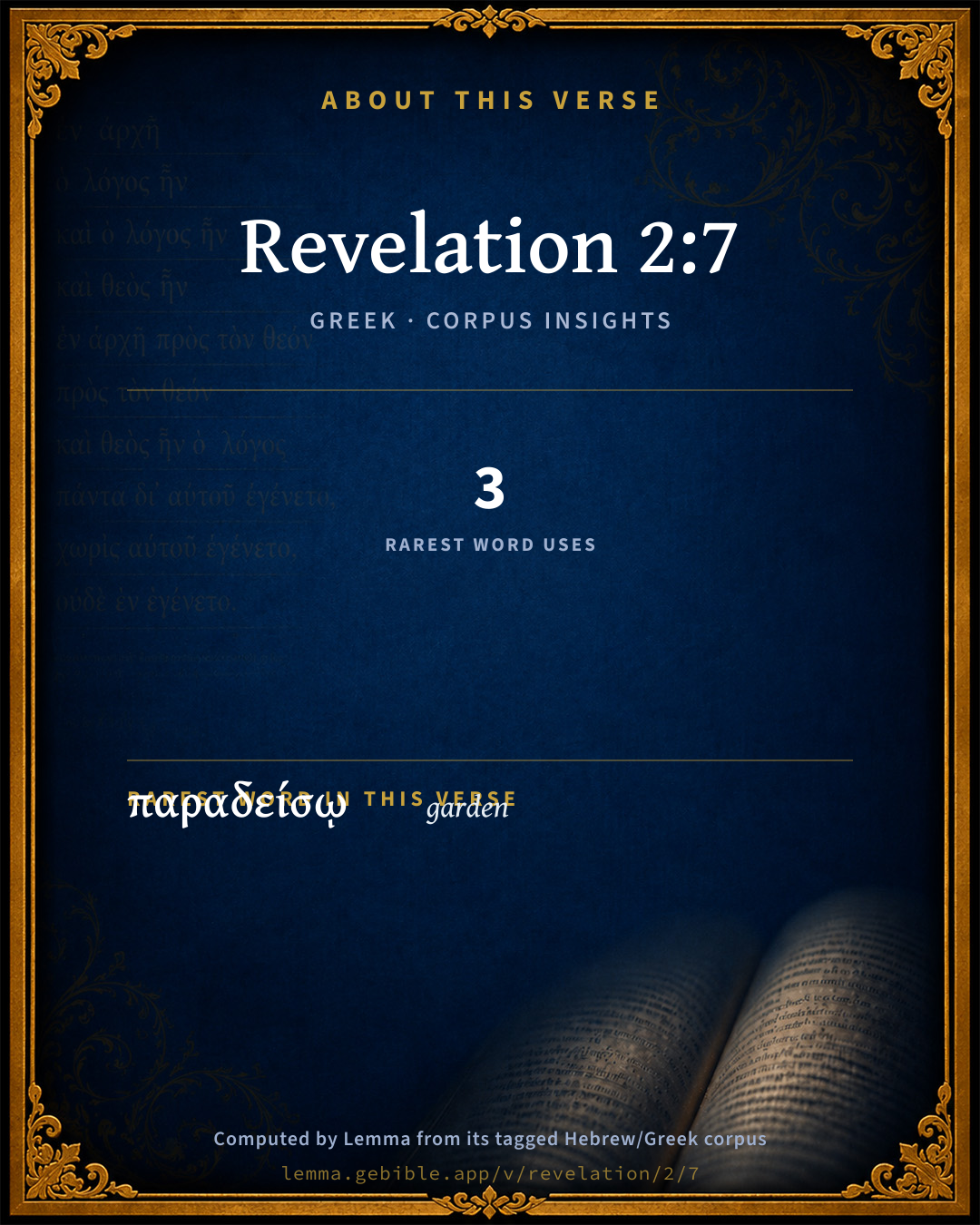
The rarest word here is παραδείσῳ garden G3857 — appearing just 3 times in the whole Greek New Testament.

Shared distinctive vocabulary

παραδείσῳ garden G3857 occurs in 3 verses of the Greek New Testament. Also found in:

Repetition

A word recurs within this verse:

Cross-references

32

Topical passages linked to Revelation 2:7 in the Treasury of Scripture Knowledge — connected by theme and wording, ordered by reader-vote popularity; previews shown in the World English Bible.

  • Revelation 2:17 He who has an ear, let him hear what the Spirit says to the assemblies. To him who overcomes, to him I will give of the hidden manna, and I will give him a white stone, and on the stone a new name written, which no one knows but he who receives it.
  • Revelation 2:11 He who has an ear, let him hear what the Spirit says to the assemblies. He who overcomes won't be harmed by the second death.
  • Matthew 11:15 He who has ears to hear, let him hear.
  • Matthew 13:43 Then the righteous will shine forth like the sun in the Kingdom of their Father. He who has ears to hear, let him hear.
  • Revelation 13:9 If anyone has an ear, let him hear.
  • Matthew 13:9 He who has ears to hear, let him hear."
  • Revelation 3:12–13 He who overcomes, I will make him a pillar in the temple of my God, and he will go out from there no more. I will write on him the name of my God, and the name of the city of my God, the new Jerusalem, which comes down out of heaven from my God, and my own new name.
  • Revelation 3:21–22 He who overcomes, I will give to him to sit down with me on my throne, as I also overcame, and sat down with my Father on his throne.
  • Revelation 2:26–29 He who overcomes, and he who keeps my works to the end, to him I will give authority over the nations.
  • Revelation 3:5–6 He who overcomes will be arrayed in white garments, and I will in no way blot his name out of the book of life, and I will confess his name before my Father, and before his angels.
  • Proverbs 11:30 The fruit of the righteous is a tree of life. He who is wise wins souls.
  • Genesis 2:9 Out of the ground Yahweh God made every tree to grow that is pleasant to the sight, and good for food; the tree of life also in the midst of the garden, and the tree of the knowledge of good and evil.
  • Luke 23:43 Jesus said to him, "Assuredly I tell you, today you will be with me in Paradise."
  • Revelation 22:14 Blessed are those who do his commandments, that they may have the right to the tree of life, and may enter in by the gates into the city.
  • Mark 7:15 There is nothing from outside of the man, that going into him can defile him; but the things which proceed out of the man are those that defile the man.
  • 1 John 5:4–5 For whatever is born of God overcomes the world. This is the victory that has overcome the world: your faith.
  • Revelation 21:7 He who overcomes, I will give him these things. I will be his God, and he will be my son.
  • 1 Corinthians 2:10 But to us, God revealed them through the Spirit. For the Spirit searches all things, yes, the deep things of God.
  • Revelation 22:17 The Spirit and the bride say, "Come!" He who hears, let him say, "Come!" He who is thirsty, let him come. He who desires, let him take the water of life freely.
  • John 16:33 I have told you these things, that in me you may have peace. In the world you have oppression; but cheer up! I have overcome the world."
  • Revelation 22:2 in the middle of its street. On this side of the river and on that was the tree of life, bearing twelve kinds of fruits, yielding its fruit every month. The leaves of the tree were for the healing of the nations.
  • Genesis 3:22–24 Yahweh God said, "Behold, the man has become like one of us, knowing good and evil. Now, lest he put forth his hand, and also take of the tree of life, and eat, and live forever..."
  • 1 Corinthians 12:4–12 Now there are various kinds of gifts, but the same Spirit.
  • Proverbs 13:12 Hope deferred makes the heart sick, But when longing is fulfilled, it is a tree of life.
  • Ezekiel 28:13 You were in Eden, the garden of God; every precious stone adorned you: ruby, topaz, emerald, chrysolite, onx, jasper, sapphire, turquoise, and beryl. Gold work of tambourines and of pipes was in you. In the day that you were created they were prepared.
  • Proverbs 15:4 A gentle tongue is a tree of life, But deceit in it crushes the spirit.
  • Ezekiel 31:8 The cedars in the garden of God could not hide it; the fir trees were not like its boughs, and the plane trees were not as its branches; nor was any tree in the garden of God like it in its beauty.
  • 2 Corinthians 12:4 how he was caught up into Paradise, and heard unspeakable words, which it is not lawful for a man to utter.
  • Revelation 12:10–11 I heard a loud voice in heaven, saying, "Now is come the salvation, the power, and the Kingdom of our God, and the authority of his Christ; for the accuser of our brothers has been thrown down, who accuses them before our God day and night.
  • Revelation 14:13 I heard the voice from heaven saying, "Write, 'Blessed are the dead who die in the Lord from now on.'" "Yes," says the Spirit, "that they may rest from their labors; for their works follow with them."
  • Revelation 15:2 I saw something like a sea of glass mixed with fire, and those who overcame the beast, his image, and the number of his name, standing on the sea of glass, having harps of God.
  • Proverbs 3:18 She is a tree of life to those who lay hold of her. Happy is everyone who retains her.

Cross-references courtesy of OpenBible.info (CC BY 4.0).

Where the printed editions differ

2 variants

Places in this verse where the major printed Greek editions disagree on the wording in a way that affects the translation — a comparison of editions, not a manuscript-by-manuscript collation. The editions are the modern critical texts (Nestlé-Aland 28/27, SBL, Westcott-Hort, Tregelles, Tyndale House) and the traditional texts behind the KJV (the Textus Receptus and the Byzantine/Majority text). It is not a claim about which reading is original.

  1. Extra text
    μέσῶ

    “midst”

    In TR Not in NA28NA27TynSBLWHTregByz

    μέσῶ (mesō) 'midst' is only in traditional manuscripts (TR)

  2. Extra text
    μου.

    “of mine.”

    In Byz Not in NA28NA27TynSBLWHTregTR

    μου.¶ (mou) 'of mine.' is only in a few manuscripts (Byz)

Textual data: Translators Amalgamated Greek New Testament (STEPBible TAGNT) · CC BY 4.0.

Commentary

Notes on Revelation 2:7 from classic Christian and Jewish commentators (each source and its license shown beneath its notes). The classic Christian expositions comment on the surrounding passage and are grouped to its opening verse, so a note may address several verses; the Jewish commentaries on the Tanakh (Rashi and others) are per-verse, so they appear only where the commentator wrote on this verse.

Lemma curates 59 commentaries, every one of them public domain or Creative Commons licensed, each selected and text-cleaned for this edition rather than reprinted as found. About our sources →

Joseph Benson's Commentary

Rev 2:7. He that hath an ear, let him hear — Every man, whoever can hear at all, ought carefully to hear this; what the Spirit saith — In these great and awful threatenings, and in these encouraging and precious promises; to the churches — And in them to all in a similar state, in every age and nation. To him that overcometh — His spiritual enemies, visible and invisible, that resists the devil, overcomes the world, crucifies the flesh, and conquers every besetting sin, and the fear of death; that goes on from faith to faith, and by faith to full victory over all opposing power; will I give to eat of the tree of life — This first thing promised in these letters is the last and highest in the accomplishment, Rev 22:2; Rev 22:14; Rev 22:19; which is in the midst of the paradise of God — Namely, the paradise above, and the fruit of which tree gives immortality; so that he who resides within its reach, is possessed of such felicities and delights as are far superior to those which Adam enjoyed in an earthly paradise, though in a state of uncorrupted and perfect innocence. The tree of life and water of life go together, Rev 22:1-2, both implying the living with God eternally. In these seven letters twelve promises are contained, which are an extract of all the promises of God. Some of them are expressly mentioned again in this book, as the hidden manna, the inscription of the name of the New Jerusalem, the sitting upon the throne. Some resemble what is afterward mentioned, as the hidden name, (Rev 19:12,) the ruling the nations, (Rev 19:15,) the morning star, Rev 22:16. And some are expressly mentioned, as the tree of life, (Rev 22:2,) freedom from the second death, (Rev 20:6,) the name in the book of life, (Rev 20:12; Rev 21:27,) the remaining in the temple of God, (Rev 7:15,) the inscription of the name of God and of the Lamb, Rev 14:1; Rev 22:4. In these promises, sometimes the enjoyment of the highest good, sometimes deliverance from the greatest evils, is intended. And each implies the other, so that where either part is expressed, the whole is to be understood. That part is expressed which has most resemblance to the virtues or works of him that was spoken to in the letter preceding.

Joseph Benson's Commentary on the Old and New Testaments (1811–1818) — public domain. Text from a community e-Sword module.

MacLaren's Expositions of Holy Scripture

Alexander MacLaren

Revelation

I. - THE VICTOR’S LIFE-FOOD

Rev 2:7

The sevenfold promises which conclude the seven letters to the Asiatic Churches, of which this is the first, are in substance one. We may, indeed, say that the inmost moaning of them all is the gift of Christ Himself. But the diamond flashes variously coloured lights according to the angle at which it is held, and breaks into red and green and white. The one great thought may be looked at from different points of view, and sparkle into diversely splendid rays. The reality is single and simple, but so great that our best way of approximating to the apprehension of that which we shall never comprehend till we possess it is to blend various conceptions and metaphors drawn from different sources,

I have a strong conviction that the Christianity of this day suffers, intellectually and practically, from its comparative neglect of the teaching of the New Testament as to the future life. We hear and think a great deal less about it than was once the case and we are thereby deprived of a strong motive for action, and a sure comfort in sorrow. Some of us may, perhaps, be disposed to look with a little sense of lofty pity at the simple people who let the hope of heaven spur, or restrain, or console. But if there is a future life at all, and if the characteristic of it which most concerns us is that it is the reaping, in consequences, of the acts of the present, surely it cannot be such superior wisdom, as it sometimes pretends to be, to ignore it altogether; and perhaps the simplicity of the said people is more in accordance with the highest reason than is our attitude.

Be that as it may, believing, as I do, that the hope of immortality is meant to fill a very large place in the Christian life, and fearing, as I do, that it actually does fill but a very small one with many of us, I have thought that it might do us all good to turn to this wealth of linked promises and to consider them in succession, so as to bring our hearts for a little while into contact with the motive for brave fighting which does occupy so large a space in the New Testament, however it may fail to do so in our lives.

I. I ask you to look first at the Gift.

Now, of course, I need scarcely remind you that this first promise, in the last book of Scripture, goes back to the beginning, to the old story in Genesis about Paradise and the Tree of Life. We may distinguish between the substance of the promise and the highly metaphorical form into which it is here cast. The substance of the promise is the communication of life; the form is a poetic and imaginative and pregnant allusion to the story on the earliest pages of Revelation.

Let me deal first with the substance. Now it seems to me that if we are to pare down this word ‘ life ‘ to its merely physical sense of continuous existence, this is not a promise that a man’s heart leaps up at the hearing of. To anybody that will honestly think, and try to realize, in the imperfect fashion in which alone it is possible for us to realize it, that notion of an absolutely interminable continuance of being, its awfulness is far more than its blessedness, and it overwhelms a man. It seems to me that the ‘crown of life,’ if life only means conscious existence, would be a crown of thorns indeed.

No, brethren, what our hearts crave, and what Christ’s heart gives, is not the mere bare, bald, continuance of conscious being. It is something far deeper than that. That is the substratum, of course; but it is only the substratum, and not until we let in upon this word, which is one of the key-words of Scripture, the full flood of light that comes to it from John’s Gospel, and its use on the Master’s lips there, do we begin to understand the meaning of this great promise. Just as we say of men who are sunk in gross animalism, or whose lives are devoted to trivial and transient aims, that theirs is not worth calling life, so we say that the only thing that deserves, and that in Scripture gets, the august name of ‘life,’ is a condition of existence in conscious union with, and possession of, God, who is manifested and communicated to mortals through Jesus Christ His Son. ‘In Him was life, and the life was manifested.’ Was that bare existence? And the life was not only manifested but communicated, and the essence of it is fellowship with God through Jesus Christ. The possession of ‘ the Spirit of life which was in Christ,’ and which in heaven will be perfectly communicated, will make men ‘free,’ as they never can be upon earth whilst implicated in the bodily life of this material world, ‘from the law of sin and death.’ The gift that Christ bestows on him that ‘overcometh’ is not only conscious existence, but existence derived from, and, so to speak, embraided with the life of God Himself, and therefore blessed.

For such a life, in union with God in Christ, is the only condition in which all a man’s capacities find their fitting objects, and all his activity finds its appropriate sphere, and in which, therefore, to live is to be blessed, because the heart is united with the source and fountain of all blessedness. Here is the deepest depth of that promise of future blessedness. It is not mainly because of any changes, glorious as these must necessarily be, which follow upon the dropping away of flesh, and the transportation into the light that is above, that heaven is a place of blessedness, but it is because the saints that are there are joined to God, and into their recipient hearts there pours for ever the fullness of the Divine life. That makes the glory and the blessedness.

But let us remember that all which can come hereafter of that full and perfect life is but the continuance, the development, the increase, of that which already is possessed. Here it falls in drops; there in floods. Here it is filtered; there poured. Here, the plant, taken from its native climate and soil, puts forth some pale blossoms, and grows but to a stunted height; there, set in their deep native soil, and shone upon by a more fervent sun, and watered by more abundant warm rains and dews, ‘they that ‘on earth’ were planted in the house of the Lord shall, transplanted, ‘flourish in the courts of our God.’ The life of the Christian soul on earth and of the Christian soul in heaven is continuous, and though there is a break to our consciousness looking from this side the break of death the reality is that without interruption, and without a turn, the road runs on in the same direction. We begin to live the life of heaven here, and they who can say, ‘I was dead in trespasses and sins, but the life which I live in the flesh I live by the faith of the Son of God,’ have already the germs of the furthest development in the heavens in their hearts.

Notice, for a moment, the form that this great promise assumes here. That is a very pregnant and significant reference to the Tree of Life in the paradise of God, The old story tells how the cherub with the flaming sword was set to guard the way to it. And that paradise upon earth faded and disappeared. But it reappears. ‘ Then comes a statelier Eden back to man,’ for Jesus Christ is the restorer of all lost blessings; and the Divine purpose and ideal has not faded away amidst the clouds of the stormy day of earth’s history, like the flush of morning from off the plains. Christ brings back the Eden, and quenches the flame of the fiery sword; and instead of the repellent cherub, there stands Himself with the merciful invitation upon His lips: ‘Come! Eat; and live for ever.’

There never was one lost good; what was shall live as before.

On the earth the broken arcs; in heaven the perfect round.’

Eden shall come back; and the paradise into which the victors go is richer and fuller, by all their conflict and their wounds, than ever could have been the simpler paradise of which souls innocent, because untried, could have been capable. So much for the gift of life.

II. Notice, secondly, the Giver.

This is a majestic utterance; worthy of coming from the majestic Figure portrayed in the first chapter of this book. In it Jesus Christ claims to be the Arbiter of men’s deserts and Giver of their rewards. That involves His judicial function, and therefore His Divine as well as human nature. I accept these words as truly His words. Of course, if you do not, my present remarks have no force for you; but if you do not, you ought to be very sure of your reasons for not doing so; and if you do, then I see not how any man who believes that Jesus Christ has said that He will give to all the multitude of faithful fighters, who have brought their shields out of the battle, and their swords undinted, the gift of life eternal, can be vindicated from the charge of taking too much upon him, except on the belief of His Divine nature.

But I observe, still further, that this great utterance of the Lord’s, paralleled in all the other six promises, in all of which He is represented as the bestower of the reward, whatever it may be, involves another thing, viz., the eternal continuance of Christ’s relation to men as the Revealer and Mediator of God. ‘I will give’ and that not only when the victor crosses the threshold and enters the Capitol of the heavens, but all through its ceaseless ages Christ is the Medium by which the Divine life passes into men. True, there is a sense in which He shall deliver up the kingdom to His Father, when the partial end of the present dispensation has come. But He is the Priest of mankind for ever; and for ever is His kingdom enduring. And through all the endless ages, which we have a right to hope we shall see, there will never come a point in which it will not remain as true as it is at this moment: ‘No man hath seen God at any time, nor can see Him; the only begotten Son, which is in the bosom of the Father, He hath declared Him.’ Christ is for ever the Giver of life in the heavens as on earth.

Another thing is involved which I think also is often lost sight of. The Bible does not know anything about what people call ‘natural immortality. ‘Life here is not given to the infant once for all, and then expended through the years, but it is continually being bestowed. My belief is that no worm that creeps, nor angel that soars, nor any of the beings between, is alive for one instant except for the continual communication from the fountain of life, of the life that they live. And still more certainly is it true about the. future, that there all the blessedness and the existence, which is the substratum and condition of the blessedness, are only ours because, wavelet by wavelet, throbbing out as from a central fountain, there flows into the Redeemed a life communicated by Christ Himself. If I might so say were that continual bestowment to cease, then heaven, like the vision of a fairy tale, would fade away; and there would be nothing left where the glory had shone. ‘I will give’ through eternity.

III. Lastly, note the Recipients.

‘To him that overcometh.’ Now I need not say, in more than a sentence, that it seems to me that the fair interpretation of this promise, as of all the other references in Scripture to the future life, is that the reward is immediately consequent upon the cessation of the struggle. ‘To depart ‘ is ‘to be with Christ,’ and to be with Christ, in regard of a spirit which has passed from the bodily environment, is to be conscious of His presence, and lapt in His robe, feeling the warmth and the pressure of His heart. So I believe that Scripture teaches us that at one moment there may be the clash of battle, and the whiz of the arrows round one’s head, and next moment there may be the laurel-crowned quiet of the victor.

But that does not enter so much into our consideration now. We have, rather, here to think of just this one thing, that the gift is given to the victor because only the victor is capable of receiving it; that future life, interpreted as I have ventured to interpret it in this sermon, is no arbitrary bestowment that could be dealt all round miscellaneously to everybody, if the Giver chose so to give. Here on earth many gifts are bestowed upon men, and are neglected by them, and wasted like water spilled upon the ground; but this elixir of life is not poured out so. It is only poured into vessels that can take it in and hold it.

Our present struggle is meant to make us capable of the heavenly life. And that is I was going to say the only, but at all events incomparably the chiefest, of the thoughts which make life not only worth living, but great and solemn. Go into a mill, and in a quiet room, often detached from the main building, you will find the engine working, and seeming to do nothing but go up and down. But there is a shaft which goes through the wall and takes the power to the looms.

We are working here, and we are making the cloth that we shall have to own and say, ‘Yes, it is my manufacture!’ when we get yonder. According to our life to-day will be our destiny in the great tomorrow. Life is given to the victor, because the victor only is capable of possessing it.

But the victor can only conquer in one way. ‘This,’ said John, when he was not an apocalyptic seer, but a Christian teacher to the Churches of Asia, ‘this is the victory that overcometh the world, even our faith.’ If we trust in Christ we shall get His power into our hearts, and if we get His power into our hearts, then ‘we shall be more than conquerors through Him that loved us.’ Christ gives life eternal, gives it here in germ and yonder in fullness. In its fullness only those who overcome are capable of receiving it. Those only who fight the good fight by His help overcome. Those only who trust in Him fight the good fight by His help. He gives to eat of the Tree of Life; He gives it to faith, but faith must be militant. He gives it to the conqueror, but the conqueror must win by faith in Him who overcame the world for us, who will help us to overcome the world by Him.

Help us, O our God, we beseech Thee; ‘teach our hands to war, and our fingers to fight.’ Give us grace to hold fast by the life which is in Jesus Christ; and living by Him the lives which we live in the flesh, may we be capable, by the discipline of earth’s sorrows, of that rest and fuller ‘life which remaineth for the people of God.’

Alexander MacLaren, Expositions of Holy Scripture (1904–1910) — public domain. Text from a community e-Sword module.

Tyndale Open Study Notes

Tyndale Open Resources

2:7 The reward for obedience is fruit from the tree of life—that is, eternal life (22:2; Gen 3:22).

Tyndale Open Study Notes — © Tyndale Open Resources, licensed CC BY-SA 4.0. Text via the HelloAO Bible API.

Bengel's Gnomon

Johann Albrecht Bengel

Rev 2:7. Οὖς) The singular is the more to be remarked, because the plural is more usual. Πίστις, ὦτα ψυχῆς, says Clement of Alexandria, Stromb. v. at the beginning; although in the Hebrew the [singular] ear is often used.—ταῖς ἐκκλησίαις) The Ablative case: as ch. Rev 22:16 [“saith to him by the churches:” not as Engl. “unto the churches”]. In like manner there is said, ταῖς προσευχαῖς, ch. Rev 8:3-4. Compare the passages which Heupel has collected in his Notes on Mar 5:2.—τῷ νικῶντι) The seven promises have a variety of construction.

I. Τῷ νικῶντι δώσω αὐτῷ, κ.τ.λ.

II. Ὁ νικῶν οὐ μὴ ἀδιχηθῇ, κ.τ.λ.

III. Τῷ νικῶντι δώσω αὐτῷ, κ.τ.λ.

IV. Καὶ ὁ νικῶν,—δώσω αὐτῷ, κ.τ.λ.

V. Ὁ νικῶν, οὗτος περιβαλεῖται, κ.τ.λ.

VI. Ὁ νικῶν, ποιήσω αὐτὸν, κ.τ.λ.

VII. Ὁ νικῶν, δώσω αὐτῷ, κ.τ.λ.

In the four latter, ὁ νικῶν is marked with greater emphasis, as though it had the distinctive Hebrew accent: in the three former, there is a closer connection between τῷ νικῶντι (to which ὁ νικῶν, without οὗτος, in the second is equivalent) and the following verb.—ἐκ τοῦ ξύλου τῆς ζωῆς, ὅ ἐστιν ἐν τῷ παραδείσῳ τοῦ Θεοῦ μου) The Septuagint, Gen 2:9, has τὸ ξύλον τῆς ζωῆς ἐν μέσῳ τοῦ παραδείσου· where comp. Gen 3:3. The ἐν μέσῳ is used with great propriety, because the rest of the trees were in the garden, but not in the midst of the garden. In this passage, according to the better copies,[30] the tree of life is simply said to be in the paradise of God: nor is mention made of any other tree, except the tree of life. The tree of life, indeed, is in the midst of the street of Jerusalem: ch. Rev 22:2. From that passage, or from Genesis, some have here written, ἐν μέσῳ τοῦ παραδείσου.

[30] ABCh Vulg. Syr. Cypr. read ἐν τῷ παραδείσῳ: but Rec. Text, without good authority, ἐν μέσῳ τοῦ παραδείσου.—E.

Bengel's Gnomon of the New Testament — English translation (T&T Clark, Edinburgh, 1860) — public domain. Text from a community e-Sword module.

Meyer's Critical & Exegetical Commentary

Heinrich August Wilhelm Meyer

Rev_2:7. ὁ ἕχων οὐς ἀκουσάτω, κ.τ.λ. Formula for exciting attention.[1000] The singular Οὐς by no means points, in distinction from the plural,[1001] to the spiritual sense of understanding,[1002] but designates with entire simplicity the organ of hearing without respect to its being double. In like manner, in Luk_11:34. The reference made in the summons is altogether general;[1003] even to those who still are outside the churches, belongs what is said to the churches, because the entire book of Revelation, no less than the seven epistles which form an entire part thereof, proclaims the coming of the Lord as something final to the whole world. John himself, as a true prophet, makes prominent the universal reference of his prophecy.[1004]

ΤῸ ΠΝΕῦΜΑ is neither this divine vision,[1005] nor Christ who has the Spirit,[1006] but the Holy Ghost,[1007] who inspires John, and thus makes him a prophet.[1008] The revelation of Christ[1009] can therefore be designated also as an address of the Spirit, because the Spirit is the Spirit of Christ,[1010] and speaks in Christs name.[1011] Yet this is conceivable only if we regard[1012] neither the seven epistles as merely a dictation of Christ, which John had only to write down, nor the entire book of Revelation as a mere report prepared by John of a series of pictures represented to him; but rather recognize the specific prophetic activity whereby he, as a man taught of Christ himself through his Spirit, thought and wrote not under a suppression, but a glorification, of his entire moral individuality.

The promise belongs, in its universality, to the victors; as the preceding summons to hear, to every one who has an ear. The hearer is through the prophecy to learn to be victor, and thus to be saved.[1013] νικῶν,[1014] as well as δίκαιος,[1015] is impossible. According to Rev_3:21[1016] and Rev_12:11,[1017] the νικᾶν at the close of all seven epistles[1018] designates nothing else than the faithful perseverance of believers, as maintained in the struggle with all godless and antichristian powers. So, also, the sacred reward of blessedness is promised the victor, who is represented in many forms, abiding faithful to him patiently and to the end, maintaining and adhering to the words and commands of the Lord, etc. Cf. especially the concluding promises of the epistles, with the descriptions in chs. 19, 21, 22

The δώσω αὐτῳ with the inf. φαγεὶν has a somewhat different meaning from when (as, e.g., Rev_2:17; Rev_2:28) a definite object follows: it means, I will grant him to eat;[1019] not, I will give him to eat.

The ξύλον τῆς ζωῆς, κ.τ.λ., is not the gospel whose fruit is blessedness,[1020] nor the Holy Ghost who assures of eternal life,[1021] nor Christ himself whose fruits are all spiritual blessings,[1022] and who in the holy supper gives his flesh to be eaten;[1023] but the antitype of the tree of life that was in the midst of the original earthly paradise,[1024] the tree of life which is to refresh the blessed citizens of the new Jerusalem.[1025] In accordance with Gen_2:3, as also this passage, the place of blessedness where the tree of life is to be found is called paradise.[1026] The addition ΤΟῦ ΘΕΟῦ ΜΟΥ is not without meaning, since God is the Lord of paradise, the one from whom the new Jerusalem descends, who will dwell with men, from whose throne and that of the Lamb proceeds life,[1027] upon communion with whom, therefore, the future blessedness and glory of believers depend. Besides, the mediatorship of Christ is intimated by Τ. Θ. ΜΟΥ, since Christ who himself rewards the victor (ΔΏΣΩ), and himself sits with God upon the throne, in whom is the source of life, nevertheless speaks of his God and the God of believers;[1028] both being in accordance with the indivisible fundamental view of the entire N. T., that Christ through his obedience is exalted, through his conflict has conquered, and through his sufferings has entered into the glory which was his own from eternity, and whereof he now makes his believers partakers, since he as Priest, King, and Victor makes them priests, kings, and victors.[1029] As to the Apocalyptic statement of the thought, Rev_2:7 b, cf. the Book of Enoch, xxxi. 15, xxiv. 111; Text. XII. Patr., p. 586; Schöttgen on this passage.

[1000] Grotius.

[1001] Cf. Rev_2:11; Rev_2:17; Rev_2:29; Rev_3:6; Rev_3:13; Rev_3:22; Rev_13:9.

[1002] Hengstenb.

[1003] Cf. Rev_22:17.

[1004] Cf. Rev_1:3.

[1005] Grot.

[1006] Eichh. Cf. also Heinr.

[1007] Cf. Rev_1:4.

[1008] Rev_1:10, Rev_19:10.

[1009] Rev_2:1-6. Cf., likewise, σώσω.

[1010] Rom_8:9-10.

[1011] Joh_16:13 sqq.

[1012] Cf. Intr., sec. 2.

[1013] Rev_1:3, Rev_22:14.

[1014] It should properly he explained, He who gains his case in court.

[1015] Eichh. Cf. also Heinr.

[1016] Where it is also absolutely said of Christ as the head of believers.

[1017] Where an object is mentioned, as in 1Jn_2:13; 1Jn_5:4-5; Joh_16:33.

[1018] Cf. Rev_21:7.

[1019] Cf. Rev_3:21; Joh_5:26. De Wette.

[1020] Aret.

[1021] Grot.

[1022] Calov., Ebrard. Cf. Victorin, Beda, Lyra.

[1023] Joh_6:54. Alcasar.

[1024] Cf. Gen_2:9, where the LXX., as frequently elsewhere, render עֵץ by ξιλον.

[1025] Rev_22:2; Rev_22:14; Rev_22:19. Beng., Ew., De Wette, Hengstenb.

[1026] Cf. Luk_23:43; 2Co_12:4.

[1027] Cf. Rev_21:2-3, Rev_22:1.

[1028] Joh_20:17.

[1029] Rev_1:6, Rev_3:21. Cf. Php_2:6 sqq.; Joh_17:24.

Meyer — Critical and Exegetical Commentary on the New Testament — English translation by Peter Christie, edited by Frederick Crombie (T&T Clark, 1880) — public domain. Text from a community e-Sword module.

Expositor's Greek Testament

ed. W. Robertson Nicoll

Rev 2:7 . A stringent demand for attention ( πίστις , ὦτα ψυχῆς : Clem. Alex.) to the utterances of prophets who were inspired by the Spirit (of prophecy, cf. on Rev 19:10 ). These as usual are ejaculatory, positive and brief ἐκκλ . scattered local communities, and not a Catholic organisation, being the conception of the Apocalypse, it is for use in their public worship that this book is written (Rev 1:3 ). It is a subordinate and literary question whether the seer means in such phrases as this to designate himself (Weinel, 84 f.) liturgically as the speaker, or whether (as the synoptic parallels suggest) they form an integral part of the whole menage. In any case the prophet represents himself simply as the medium for receiving and recording ( cf. Rev 1:19 ) these oracles of the Spirit ( cf. Rev 14:13 , Rev 19:9 , Rev 20:17). Unlike other writers such as Paul and the authors of Hebrew and 1 John, he occupies a passive rôle, throwing his personal rebuke and counsels into the form Thus saith the Spirit : but this really denotes the confidence felt by the prophet in his own inspiration and authority. The Spirit here, though less definitely than in Hermas, is identified with Jesus speaking through his prophets: it represents sudden counsels and semi-oracular utterances ( cf. on Rev 1:10 ), not a continuous power in the normal moral life of the saints in general. The seven promises denote security of immortal life (positively as here and Rev 2:28 or negatively as Rev 2:11 ), privilege (personal, Rev 2:17 , or official, Rev 2:27 ), honour (Rev 3:5 ; Rev 3:21 ), or increased intimacy (Rev 3:12 ). As usual, ( cf. 1Co 2:9 f.), the higher Christian γνῶσις is connected with eschatology.

Observe the singling out for encouragement and praise of each soldier in the host of the loyal. The effect resembles that produced by Pericles in his panegyric over the Athenians who had fallen in the Peloponnesian war: “together they gave up their lives, yet individually they won this deathless praise” (Thuc. ii. 43, 2). νικῶν (a quasi-perfect), in Herm. Mand. Rev 12:2 ; Rev 12:4 f., Rev 5:2 ; Rev 5:4 , Rev 6:2 ; Rev 6:4 (over sin and devil), might have its usual Johannine sense, the struggle being obedience in face of the seductions and hardships which beset people aiming to keep the divine commandments ( cf. on Joh 16:33 ). For a special application of the term, see Rev 15:2 . But behind the general usage lies the combination of “to be pure or just” and “to conquer or triumph” in the Hebrew ṣédeḳ and the Syriac zedhâ . Furthermore, νικῶν throughout is equivalent to the Egyptian eschatological term “victorious,” applied to those who passed successfully through life’s temptations and the judgment after death. Its generic sense is illustrated by 4 Ezra 7 :[128]: “here is the intent of the battle to be fought by man born upon earth: if he be overcome, he shall suffer as thou hast said; but if he conquer, he shall receive the thing of which I speak” ( i.e. , paradise and its glories). The Essenes according to Josephus ( Ant. xviii. 1, 5), held the soul was immortal, περιμάχητον ἡγούμενοι τοῦ δικαίου τὴν πρόσοδον eternal life the reward of an untiring, unsoiled fight against evil. The imagery of the metaphor is drawn from Jewish eschatology which anticipated the reversal of the doom incurred in Eden; cf. Test. Levi , 18, καὶ δώσει τοῖς ἁγίοις φαγεῖν ἐκ τοῦ ξύλου τῆς ζωῆς , also En. xxiv. 1 11, 25., xxxi. 1 3, etc., and (for Egyptian ideas) below on Rev 3:21 . The garden-park of God ( π . = a garden with fruit-trees, Wilcken’s Griech. Ostraka , i. 157) is one of the intermediate abodes, possibly (as in Slav. En. viii. 1, and Paul) the third heaven where the favoured saints live after death in seclusion and bliss, So Iren. ver 5. 1 (abode of translated) and ver 36, 1 2, where heaven is for the Christians of the hundredfold fruit, paradise for the sixty-fold, and the heavenly city for the thirty-fold (a very ancient Christian tradition). The tree of life blooms in most of the apocalypses ( cf. on Rev 22:2 ). Philo had already allegorised it into θεοσέβεια ὁ τῆς τελείας ἀρετῆς χαρακτήρ . But the allusion corresponds to the general eschatological principle (borrowed from Babylonia, where cosmological myths passed into eschatological) that the end was to be a transcendently fine renovation of the original state (Barn. vi. 8). μου a deliberate addition to the O.T. phrase; Christ’s relation to God guarantees his promise of such a privilege (Rev 3:12 ). God’s gift (Rom 6:23 ) is Christ’s gift. He is no fair promiser like Antigonus II., whom men dubbed δώσων for his large and unfulfilled undertakings (Plut. Coriol. xi.).

The Expositor's Greek Testament, edited by W. Robertson Nicoll (1897–1910) — public domain. Text from a community e-Sword module.

Vincent's Word Studies in the New Testament

Marvin R. Vincent

He that hath an ear, etc. Compare Mt 11:15; Mr 4:9. The phrase is not found in John's Gospel. It is used always of radical truths, great principles and promises.

To him that overcometh [τω νικωντι] A formula common to all these Epistles. The verb is used absolutely without any object expressed. It is characteristic of John, occurring once in the Gospel, six times in the First Epistle, sixteen times in Revelation, and elsewhere only Luk 11:22; Rom 3:4; Rom 12:21.

Will I give. This phrase has a place in every one of these Epistles. The verb is John's habitual word for the privileges and functions of the Son, whether as bestowed upon Him by the Father, or dispensed by Him. to His followers. See Joh 3:35; Joh 5:22, 27, 36; Joh 6:65; Joh 13:3; Joh 17:6. Compare Rev 2:23; Rev 3:8; Rev 6:4; Rev 11:3.

Of the tree [εκ ξυλου] . The preposition ejk out of occurs one hundred and twenty - seven times in Revelation, and its proper signification is almost universally out of; but this rendering in many of the passages would be so strange and unidiomatic, that the New Testament Revisers have felt themselves able to adopt it only forty - one times out of all that number, and employ of, from, by, with, on, at, because of, by reason of, from among. See, for instance, chapter Rev 2:7, 21, 22; Rev 6:4, 10; Rev 8:11; Rev 9:18; Rev 14:13; Rev 14:2; Rev 16:21. Compare Joh 3:31; Joh 4:13, Joh 6:13, 39, 51; Joh 8:23, 44; Joh 9:6; Joh 11:1; Joh 12:3, 27, 32; Joh 17:5.

Tree, lit., wood. See on Luk 23:31; 1Pe 3:24. Dean Plumptre notes the fact that, prominent as this symbol had been in the primeval history, it had remained unnoticed in the teaching where we should most have looked for its presence - in that of the Psalmist and Prophets of the Old Testament. Only in the Proverbs of Solomon had it been used, in a sense half allegorical and half mystical (Pro 3:18; Pro 13:12; Pro 11:30; Pro 14:4). The revival of the symbol in Apoc. is in accordance with the theme of the restitution of all things. "The tree which disappeared with the disappearance of the earthly Paradise, reappears with the reappearance of the heavenly." To eat of the tree of life expresses participation in the life eternal. The figure of the tree of life appears in all mythologies from India to Scandinavia. The Rabbins and Mohammedans called the vine the probation tree. The Zend Avesta has its tree of life called the Death - Destroyer. It grows by the waters of life, and the drinking of its sap confers immortality. The Hindu tree of life is pictured as growing out of a great seed in the midst of an expanse of water. It has three branches, each crowned with a sun, denoting the three powers of creation, preservation, and renovation after destruction. In another representation Budha sits in meditation under a tree with three branches, each branch having three stems. One of the Babylonian cylinders discovered by Layard, represents three priestesses gathering the fruit of what seems to be a palm - tree with three branches on each side. Athor, the Venus of the Egyptians, appears half - concealed in the branches of the sacred peach - tree, giving to the departed soul the fruit, and the drink of heaven from a vial from which the streams of life descend upon the spirit, a figure at the foot of the tree, like a hawk, with a human head and with hands outstretched.

In the Norse mythology a prominent figure is Igdrasil, the Ash - tree of Existence; its roots in the kingdom of Eels or Death, its trunk reaching to heaven, and its boughs spread over the whole universe. At its foot, in the kingdom of Death, sit three Nornas or Fates, the Past, the Present, and the Future, watering its roots from the sacred well. Compare chapter Rev 22:2, 14, 19. Virgil, addressing Dante at the completion of the ascent of the Purgatorial Mount, says :

"That apple sweet, which through so many branches The care of mortals goeth in pursuit of, Today shall put in peace thy hungerings." " Purgatorio, " 27, 115 - 117.

Paradise. See on Luk 23:43. Omit in the midst of. Paradeisov Paradise "passes through a series of meanings, each one higher than the last. From any garden of delight, which is its first meaning, it comes to be predominantly applied to the garden of Eden, then to the resting - place of separate souls in joy and felicity, and lastly to the very heaven itself; and we see eminently in it, what we see indeed in so many words, how revealed religion assumes them into her service, and makes them vehicles of far higher truth than any which they knew at first, transforming and transfiguring them, as in this case, from glory to glory" (Trench).

Marvin R. Vincent, Word Studies in the New Testament (1887–1900) — public domain. Text from a community e-Sword/MySword module.

Geneva Bible (1599)

Geneva Bible translators

The conclusion, containing a commandment of attention and a promise of everlasting life, shadowed out in a figure of which, Gen. 2:9.

Thus Christ speaketh as the Mediator.

That is, in Paradise after the manner of the Hebrew phrase.

Geneva Bible (1599) marginal notes — public domain. Text via Bolls.life.

Jamieson, Fausset & Brown

Robert Jamieson, A. R. Fausset & David Brown

He that hath an ear--This clause precedes the promise in the first three addresses, succeeds it in the last four. Thus the promises are enclosed on both sides with the precept urging the deepest attention as to the most momentous truths. Every man "hath an ear" naturally, but he alone will be able to hear spiritually to whom God has given "the hearing ear"; whose "ear God hath wakened" and "opened." Compare "Faith, the ears of the soul" [CLEMENT OF ALEXANDRIA].

the Spirit saith--What Christ saith, the Spirit saith; so one are the Second and Third Persons.

unto the churches--not merely to the particular, but to the universal Church.

overcometh--In John's Gospel (Joh 16:33) and First Epistle (Jo1 2:13-14; Jo1 5:4-5) an object follows, namely, "the world," "the wicked one." Here, where the final issue is spoken of, the conqueror is named absolutely. Paul uses a similar image (Co1 9:24-25; Ti2 2:5; but not the same as John's phrase, except Rom 12:21).

will I give--as the Judge. The tree of life in Paradise, lost by the fall, is restored by the Redeemer. Allusions to it occur in Pro 3:18; Pro 11:30; Pro 13:12; Pro 15:4, and prophetically, Rev 22:2, Rev 22:14; Eze 47:12; compare Joh 6:51. It is interesting to note how closely these introductory addresses are linked to the body of Revelation. Thus, the tree of life here, with Rev 22:1; deliverance from the second death (Rev 2:11), with Rev 20:14; Rev 21:8; the new name (Rev 2:17), with Rev 14:1; power over the nations, with Rev 20:4; the morning star (Rev 2:28), with Rev 22:16; the white raiment (Rev 3:5), with Rev 4:4; Rev 16:15; the name in the book of life (Rev 3:5), with Rev 13:8; Rev 20:15; the new Jerusalem and its citizenship (Rev 3:12), with Rev 21:10.

give . . . tree of life--The thing promised corresponds to the kind of faithfulness manifested. They who refrain from Nicolaitane indulgences (Rev 2:6) and idol-meats (Rev 2:14-15), shall eat of meat infinitely superior, namely, the fruit of the tree of life, and the hidden manna (Rev 2:17).

in the midst of the paradise--The oldest manuscripts omit "the midst of." In Gen 2:9 these words are appropriate, for there were other trees in the garden, but not in the midst of it. Here the tree of life is simply in the paradise, for no other tree is mentioned in it; in Rev 22:2 the tree of life is "in the midst of the street of Jerusalem"; from this the clause was inserted here. Paradise (a Persian, or else Semitic word), originally used of any garden of delight; then specially of Eden; then the temporary abode of separate souls in bliss; then "the Paradise of God," the third heaven, the immediate presence of God.

of God-- (Eze 28:13). One oldest manuscript, with Vulgate, Syriac, and Coptic, and CYPRIAN, read, "MY God," as in Rev 3:12. So Christ calls God, "My God and your God" (Joh 20:17; compare Eph 1:17). God is our God, in virtue of being peculiarly Christ's God. The main bliss of Paradise is that it is the Paradise of God; God Himself dwelling there (Rev 21:3).

Jamieson, Fausset & Brown — Commentary Critical and Explanatory on the Whole Bible (1871) — public domain (CC PDM 1.0). Text via the HelloAO Bible API.

Adam Clarke's Commentary

Verse 7. He that hath an ear] Let every intelligent person, and every Christian man, attend carefully to what the Holy Spirit, in this and the following epistles, says to the Churches. See Clarke on Mt 11:15, where the same form of speech occurs.

To him that overcometh] To him who continues steadfast in the faith, and uncorrupt in his life; who faithfully confesses Jesus, and neither imbibes the doctrines nor is led away by the error of the wicked; will I give to eat of the tree of life. As he who conquered his enemies had, generally, not only great honour, but also a reward; so here a great reward is promised τῳ νικωντι, to the conqueror: and as in the Grecian games, to which there may be an allusion, the conqueror was crowned with the leaves of some tree; here it is promised that they should eat of the fruit of the tree of life, which is in the midst of the paradise of God; that is, that they should have a happy and glorious immortality. There is also here an allusion to Ge 2:9, where it is said, God made the tree of life to grow out of the midst of the garden; and it is very likely that by eating the fruit of this tree the immortality of Adam was secured, and on this it was made dependent. When Adam transgressed, he was expelled from this garden, and no more permitted to eat of the tree of life; hence he became necessarily mortal. This tree, in all its sacramental effects, is secured and restored to man by the incarnation, death, and resurrection of Christ. The tree of life is frequently spoken of by the rabbins; and by it they generally mean the immortality of the soul, and a final state of blessedness. See many examples in Schoettgen. They talk also of a celestial and terrestrial paradise. The former, they say, "is for the reception of the souls of the just perfect; and differs as much from the earthly paradise as light from darkness."

Adam Clarke's Commentary on the Bible (1810–1826) — public domain. Text from a community e-Sword/MySword module.

Ellicott's Commentary for English Readers

(7) He that hath an ear . . .—Or. Let him that hath an ear, hear. These words—an echo from the Gospels—recur in all the seven epistles. In the first three, however, they are placed before the promise; in the remaining four they follow it. The heart which is hardened is the precursor of the ear that is deaf (Jer_6:10, and Joh_12:37-40). The “spiritual truth” needs a spiritual organ for its discernment. These are truths, then, only heard

“When the soul seeks to hear; when all is hushed,

And the heart listens.”—Coleridge, Reflection.

To him that overcometh (or, conquereth) will I give to eat of the tree of life, which is in the midst of the paradise of God.—The reference to conquering is a prominent feature of St. John’s other writings. The word—used but once in the three Gospels (Luk_11:22), and but once by St. Paul (Rom_12:21)—is found in Joh_16:33; 1Jn_2:13-14; 1Jn_5:4-5; and occurs in all these epistles to the churches. The promise of the tree of life is appropriate (1) to the virtue commended: those who had not indulged in the license of Nicolaitanes shall eat of the tree of life; (2) to the special weakness of the Ephesians: to those who had fallen, and lost the paradise of first loving communion and fellowship with God (comp. Gen_3:8, and 1Jn_1:3), is held out the promise of a restored paradise and participation in the tree of life. (Comp. Rev_22:2; Rev_22:14; Gen_3:22.) This boon of immortality is the gift of Christ—I will give. It is tasted in knowledge of God and of His Son (Joh_17:3); it is enjoyed in their presence (Rev_22:3-4).

A Bible Commentary for English Readers, edited by Charles John Ellicott (1878–1897) — public domain. Text from a community e-Sword module.

The Cambridge Bible for Schools and Colleges

gen. ed. J. J. S. Perowne

7. He that hath an ear] A repetition, with a merely verbal alteration, of one of our Lord’s characteristic phrases in His teaching while on earth: St Mat_11:15, &c.

what the Spirit saith] Speaking through the Risen Christ to John who was “in the Spirit.”

To him that overcometh] A promise thus expressed, and an invitation to attention like that preceding it, are found at the end of each of these seven Epistles—the invitation standing first in the three first, and the promise in the four last. From this change in the order, it appears that attention is invited, not to the final promise only, but to the whole Epistle to each Church, as the Spirit’s message.

the tree of life] Cf. Gen_2:9, as well as Rev_22:2; Rev_22:14; Rev_22:19. The Tree of Life appears, though not under that name, in Enoch xxiv., where we are told that there shall be no power to touch it until the period of the great judgement.

in the midst of the paradise] Read simply in the Paradise: the insertion is no doubt from Gen_2:9. “Paradise,” a Persian word adopted in both Greek and Hebrew, means simply a park or pleasure-ground, and hence is used in the LXX. (not the Hebrew) of the garden of Eden: in 2Co_12:4; Luk_23:43, we have it used of a region of the spiritual world, inhabited by the blessed dead. Whether the Paradise of God, where the Tree of Life is now, is identical either with the earthly Paradise where it grew of old, or with the New Jerusalem where it shall grow in the new earth under the new heaven, it would be rash to speculate.

of God] So “the garden of God” in Eze_28:13; Eze_31:8-9, and “the garden of the Lord” in Gen_13:10; Isa_51:3. Some read “of My God,” as in Rev_3:12, but on the whole the omission has more authority, and the exact O. T. phrase seems likelier.

The Cambridge Bible for Schools and Colleges (gen. ed. J. J. S. Perowne; Cambridge University Press, 1878–1918) — public domain. Text from a community e-Sword module.

John Gill's Exposition

He that hath an ear,.... Such who have new ears given them, as all have who are made new creatures; such who have their ears circumcised, and opened by the Spirit of God; who hear with understanding, affection, and faith; who try what they hear, and approve, embrace, and retain that which is good,

Let him hear what the Spirit saith unto the churches; let such hearken, and listen with attention to what is said by the Spirit, in what goes before, and follows after, in this epistle, designed for the use of all the churches; from whence it appears, that this epistle was endited by the Spirit of God, and is of divine inspiration; that it was not intended for the single use of the church at Ephesus, but of all the churches; and not of the seven churches only, though the Alexandrian copy reads, "to the seven churches": but of all the churches in that period of time, which the Ephesine church represents; and which may also be useful to the churches of Christ in all other ages and periods of time. And moreover, it may be concluded from hence, that there are in this epistle, and so in all the rest, for the same words are subjoined to them all, some things which are parabolical and prophetic, and not obvious to everyone's understanding and view; for a like expression is used by our Lord, when he had delivered anything in a parabolical way, or was obscure; see Mat 11:15.

To him that overcometh: the false apostles, false teachers, and their doctrines; coldness, lukewarmness, and remissness in love; the impure tenets and practices of the Nicolaitans:

will I give to eat of the tree of life; by which is meant Jesus Christ himself, in allusion to the tree of life in the garden of Eden; and is so called, because he is the author of life, natural, spiritual, and eternal; and because of his fruit, the blessings of life and grace, that are in him, of which believers may eat by faith, and which they find to be soul quickening, comforting, strengthening, and satisfying; and which are Christ's gift to them, even both the food they eat, and the faith by which they eat, are his gifts. So Christ, under the name of Wisdom, is called the Tree of life, in Pro 3:18; and this is a name which is sometimes given by the Jews to the Messiah (e):

which is in the midst of the paradise of God; as the tree of life was in the garden of Eden, Gen 2:9. The Vulgate Latin, Syriac, and Ethiopic versions read, "the paradise of my God"; the God of Christ, as well as of his people; and by which may be meant, either the church on earth, which is as a paradise, Sol 4:12; in the midst of which Christ is, affording his gracious presence, and reaching forth his grace, and the benefits of it, to his people; or heaven; see Gill on Co2 12:4, said to be of God, because it is of his preparing, and where he dwells, and in the midst of which Christ, the Tree of life, is; and this shows, that he is to be come at by faith, and his fruit to be eaten, and lived upon; and he is to be beheld and enjoyed by all his saints, as he is now, and will be more perfectly hereafter,

(e) Zohar in Gen. fol. 33. 3.

John Gill's Exposition of the Whole Bible (1746–1763) — public domain (CC PDM 1.0). Text via the HelloAO Bible API.

Trapp's Complete Commentary

John Trapp

7 He that hath an ear, let him hear what the Spirit saith unto the churches; To him that overcometh will I give to eat of the tree of life, which is in the midst of the paradise of God.

Ver. 7. Let him hear] Not with that gristle only that grows upon his head, but with the ear of his heart. Let him draw up the ear of his heart to the ear on his head, that one sound may pierce both. Or, Let him hear what, &c., that is, Let him hear for himself, hear and know that (each member for his own good) that was delivered to the whole Church.

To eat of the tree of life] This tree is Christ. The devil also (as he loves to be God’s ape) hath prompted Mahomet to promise to such as die in war for the Mahometan faith, delicious fare in Paradise, pleasant walks, and other sensual delights eternally to be enjoyed, notwithstanding any former sins.

John Trapp, A Commentary or Exposition upon All the Books of the Old and New Testament (1647–1656) — public domain. Text from a community e-Sword module.

Albert Barnes' Notes on the Bible

He that hath an ear, let him hear ... - This expression occurs at the close of each of the epistles addressed to the seven churches, and is substantially a mode of address often employed by the Saviour in his personal ministry, and quite characteristic of him. See Mat 11:15; Mar 4:23; Mar 7:16. It is a form of expression designed to arrest the attention, and to denote that what was said was of special importance.

What the Spirit saith unto the churches - Evidently what the Holy Spirit says - for he is regarded in the Scriptures as the Source of inspiration, and as appointed to disclose truth to man. The “Spirit” may be regarded either as speaking through the Saviour (compare Joh 3:34), or as imparted to John, through whom he addressed the churches. In either case it is the same Spirit of inspiration, and in either case there would be a claim that his voice should be heard. The language used here is of a general character - “He that hath an ear”; that is, what was spoken was worthy of the attention not only of the members of these churches, but of all others. The truths were of so general a character as to deserve the attention of mankind at large.

To him that overcometh - Greek, “To him that gains the victory, or is a conqueror” - τῷ νικῶντι tō nikōnti. This may refer to any victory of a moral character, and the expression used would be applicable to one who should triumph in any of these respects:

(a)Over his own easily-besetting sins;

(b)Over the world and its temptations;

(c)Over prevalent error;

(d)Over the ills and trials of life, so as, in all these respects, to show that his Christian principles are firm and unshaken.

Life, and the Christian life especially, may be regarded as a warfare. Thousands fall in the conflict with evil; but they who maintain a steady warfare, and who achieve a victory, shall be received as conquerors in the end.

Will I give to eat of the tree of life - As the reward of his victory. The meaning is, that he would admit him to heaven, represented as paradise, and permit him to enjoy its pleasures - represented by being permitted to partake of its fruits. The phrase “the tree of life” refers undoubtedly to the language used respecting the Garden of Eden, Gen 2:9; Gen 3:22 - where the “tree of life” is spoken of as what was adapted to make the life of man perpetual. Of the nature of that tree nothing is known, though it would seem probable that, like the tree of the knowledge of good and evil, it was a mere emblem of life - or a tree that was set before man in connection with the tree of the knowledge of good and evil, and that his destiny turned on the question whether he partook of the one or the other. That God should make the question of life or death depend on that, is no more absurd or improbable than that he should make it depend on what man does now - it being a matter of fact that life and death, happiness and misery, joy and sorrow, are often made to depend on things quite as arbitrary apparently, and quite as unimportant as an act of obedience or disobedience in partaking of the fruit of a designated tree.

Does it not appear probable that in Eden there were two trees designated to be of an emblematic character, of life and death, and that as man partook of the one or the other he would live or die? Of all the others he might freely partake without their affecting his condition; of one of these - the tree of life - he might have partaken before the fall, and lived forever. One was forbidden on pain of death. When the law forbidding that was violated, it was I still possible that he might partake of the other; but, since the sentence of death had been passed upon him, that would not now be proper, and he was driven from the garden, and the way was guarded by the flaming sword of the cherubim. The reference in the passage before us is to the celestial paradise - to heaven - spoken of under the beautiful image of a garden; meaning that the condition of man, in regard to life, will still be the same as if he had partaken of the tree of life in Eden. Compare the notes on Rev 22:2.

Which is in the midst of the paradise of God - Heaven, represented as paradise. To be permitted to eat of that tree, that is, of the fruit of that tree, is but another expression implying the promise of eternal life, and of being happy forever. The word “paradise” is of Oriental derivation, and is found in several of the Eastern languages. In the Sanskrit the word “paradesha” and “paradisha” is used to denote a land elevated and cultivated; in the Armenian the word “pardes” denotes a garden around the house planted with grass, herbs, trees for use and ornament; and in the Hebrew form פרדס pardēc, and Greek παράδεισος paradeisos, it is applied to the pleasure gardens and parks, with wild animals, around the country residences of the Persian monarchs and princes, Neh 2:8. Compare Ecc 2:5; Ca. Ecc 4:13; Xen. Cyro. i. 3, 14 (Robinson’s Lexicon). Here it is used to denote heaven - a world compared in beauty with a richly cultivated park or garden. Compare 2Co 12:4. The meaning of the Saviour is, that he would receive him that overcame to a world of happiness; that he would permit him to taste of the fruit that grows there, imparting immortal life, and to rest in an abode suited up in a manner that would contribute in every way to enjoyment. Man, when he fell, was not permitted to reach forth his hand and pluck of the fruit of the tree of life in the first Eden, as he might have done if he had not fallen; but he is now permitted to reach forth his hand and partake of the tree of life in the paradise above. He is thus restored to what he might have been if he had not transgressed by eating of the fruit of the tree of the knowledge of good and evil; and in the Paradise Regained, the blessings of the Paradise Lost will be more than recovered - for man may now live forever in a far higher and more blessed state than his would have been in Eden.

The Epistle to the Church at Smyrna

The contents of the epistle to the church at Smyrna are these:

(1) A statement, as in the address to the church at Ephesus, of some of the attributes of the Saviour, Rev 2:8. The attributes here referred to are, that he was “the first and the last,” that “he had been dead, but was alive” - attributes suited to impress the mind deeply with reverence for him who addressed them, and to comfort them in the trials which they endured.

(2) A statement Rev 2:9, as in the former epistle, that he well knew their works and all that pertained to them - their tribulation, their poverty, and the opposition which they met with from wicked people.

(3) An exhortation not to be afraid of any of those things that were to come upon them, for, although they were to be persecuted, and some of them were to be imprisoned, yet, if they were faithful, they should have a crown of life, Rev 2:10.

(4) A command to hear what the Spirit said to the churches, as containing matter of interest to all persons, with an assurance that any who would “overcome” in these trials would not be hurt by the second death, Rev 2:11. The language addressed to the church of Smyrna is throughout that of commiseration and comfort. There is no intimation that the Saviour disapproved of what they had done; there is no threat that he would remove the candle-stick out of its place. Smyrna was a celebrated commercial town of Ionia (Ptolem. v. 2), situated near the bottom of that gulf of the Aegean Sea which received its name from it (Mela, Rev 1:17, Rev 1:3), at the mouth of the small river Meles, 320 stadia, or about forty miles north of Ephesus (Strabo, 15, p. 632). It was a very ancient city; but having been destroyed by the Lydians, it lay waste four hundred years to the time of Alexander the Great, or, according to Strabo, to that of Antigonus. It was rebuilt at the distance of twenty stadia from the ancient city, and in the time of the first Roman emperor it was one of the most flourishing cities of Asia. It was destroyed by an earthquake, 177 a.d., but the emperor Marcus Aurelius caused it to be rebuilt with more than its former splendor.

It afterward, however, suffered greatly from earthquakes and conflagrations, and has declined from these causes, though, from its commercial advantages, it has always been a city of importance as the central emporium of the Levantine trade, and its relative rank among the cities of Asia Minor is probably greater than it formerly bore. The engraving in this vol. will give a representation of Smyrna. The Turks now call it Izmir. It is better built than Constantinople, and its population is computed at about 130,000, of which the Franks compose a greater proportion than in any other town in Turkey, and they are generally in good circumstances. Next to the Turks, the Greeks form the most numerous portion of the inhabitants, and they have a bishop and two churches. The unusually large portion of Christians in the city renders it especially unclean in the eyes of strict Moslems, and they call it Giaour Izmir, or the Infidel Smyrna. There are in it about 20,000 Greeks, 8,000 Armenians, 1,000 Europeans, and 9,000 Jews. It is now the seat of important missionary operations in the East, and much has been done there to spread the gospel in modern times.

Its history during the long tract of time since John wrote is not indeed minutely known, but there is no reason to suppose that the light of Christianity there has ever been wholly extinct. Polycarp suffered martyrdom there, and the place where he is supposed to have died is still shown. The Christians of Smyrna hold his memory in great veneration, and go annually on a visit to his supposed tomb, which is at a short distance from the place of his martyrdom. See the article “Smyrna” in Kitto’s Cyclopedia, and the authorities referred to there.

Albert Barnes' Notes on the Bible (1834–1885) — public domain. Text from a community e-Sword/MySword module.

Matthew Poole's English Annotations

He that hath an ear, let him hear; to whom God hath given an ability and power to understand what I say. It is a form of speech which Christ often used, when he would quicken up people’s attention, Mat 11:15; 13:9,43; Mr 4:9,23; 7:16; we shall find it again in these two chapters six times; from which some would conclude, that in these epistles there is something mysterious, parabolical, and prophetical, it being a form of speech prefixed to many parables.

What the Spirit saith; the Holy Spirit of God, from whose inspiration all Scripture is.

Unto the churches; not only at Ephesus, but elsewhere in Asia, or any other part of the world.

To him that overcometh; that is, a conqueror in fighting the good fight of faith, against the world, the flesh, and the devil.

Will I give to eat of the tree of life; I will give him a share in my merits, and eternal life; which blessed enjoyments are set out unto us under the notion of eating, Luk 12:37; 22:28, &c.; Joh 10:28.

This is the promise that he hath promised us, 1Jo 2:25. Heaven is expressed to us under this notion, with reference to the tree of life, mentioned Gen 2:9, which was in the old Paradise; for it is added,

which is in the midst of the paradise of God; or, which is the same, Christ himself is here intended, who is the free of life, mentioned Rev 22:2; and the happiness of heaven is thus expressed, 1Th 4:17, We shall be ever with the Lord. This is the sum of the epistle to the first mentioned church, by which those that judge these epistles prophetical, understand all the primitive churches during the apostles’ age, or the most of their ages, for John himself lived under the second persecution.

Matthew Poole's English Annotations on the Holy Bible (1683–1685) — public domain. Text from a community e-Sword/MySword module.

Whedon's Commentary on the Bible

Daniel D. Whedon

7. Hath an ear—This summons to every human ear to listen, preludes the glorious promise to the conqueror in the battle of faith through which Ephesus is struggling. Let every ear hear, for there can be no more thrilling announcement than this. It is seven times uttered; each utterance connected with the closing promise; the first thrice preceding the final promise, the other four times succeeding it, until in the last it gives a ringing close to the seven epistles.

The Spirit saith—For the utterance of the Son is with the concurrent inspiration of the Spirit.

Unto the Churches—For what he saith to one he saith for all; and what he saith for the Churches he saith for every individual ear in the Churches.

To him that overcometh—The seven promises are each made to the conqueror in the struggle, suggested by the characterization preceding. The Christian life is a battle, and the crown awaits the victor. Wordsworth attempts, with little success, to show that the seven promises succeed each other in ascending degrees. They are: 1. To eat of the tree of life in paradise. 2. Exemption from second death. 3. The secret white stone with the secret name. 4. Rule with Christ over the nations. 5. The white raiment, the name unblotted from the book of life, and confessed before God and angels. 6. To be a pillar in the temple of my God. 7. To be co-assessor on the throne.

Will I give the privilege to eat of… tree… paradise—This refers to Rev_22:2, which is not (as Wordsworth) in the spirit world, but in the paradise merged in the eternal heaven, and, therefore, is the highest final award. See notes on 1Th_4:17.

Daniel D. Whedon (gen. ed.), Commentary on the Old and New Testaments (1874–1909) — public domain. Text from a community e-Sword module.

The Pulpit Commentary

He that hath an ear, let him hear. These solemn conclusions of these epistles remind us of the conclusion of many of Christ"s parables. (Mat_11:15 Mat_13:9, 43 Mar_4:9, 23, 7:16 Luk_8:8 Luk_14:35; not in St. John"s Gospel, in which there are no parables) It is very noteworthy that, although the epistle is addressed in each case to a Church in the person of its angel, yet the concluding exhortation and promise are always addressed to the individual Christian. Each must hear for himself. His Church may perish, yet, if he overcomes, he shall live. His Church may be crowned with eternal life, yet, if he is overcome, he will lose the reward. What the Spirit saith to the Churches; not "what he saith to this Church." The contents of each epistle are for all; for each individual Christian and for the Church at large, as well as for the particular Church addressed in the epistle. The epistle in each case is not from John, who is only the instrument, but from the Son of God and from the Spirit of God. (Rev_1:4) In the first three epistles the exhortation to hearken precedes the promise to the victor; in the four last it follows the promise, and closes the epistle. Is this change of arrangement accidental or deliberate? There should be a full stop at "Churches." In the Authorized Version it looks as if "what the Spirit saith" were confined to the promise in the second half of the verse. This error was avoided by Tyndale and Cranmer. It comes from the Genevan and the Rhemish Versions. The verb to "overcome" or "conquer" (nikan) is strongly characteristic of St. John. It occurs seven times in the Gospel and the First Epistle, and sixteen times in the Revelation; elsewhere only in Luk_11:22 Rom_3:4 (quotation from Psa_51:6) and Rom_12:21; comp. especially Psa_21:7, where, as in these epistles, it is not stated what is to be overcome. We might render, "to the victor," or "to the conqueror." The expression, "tree of life," of course comes from Genesis; we have it again in Rev_22:2, Rev_22:14. It means the tree which gives life. So also "the water of life" (Rev_21:6) and "the bread of life". (Joh_6:35) In all these cases "life" is zwh , the vital principle which man shares with God, not biov , the life which he shares with his fellow men. The latter word occurs less than a dozen times in the New Testament; the former, which sums up the New Testament, occurs more than a hundred times. The Paradise of God. The word "Paradise" occurs only thrice in the New Testament. (Luk_23:43 2Co_12:4) It is of Persian origin, and signified a park or pleasure ground. In the New Testament it seems to mean the resting place of departed saints. There is strong evidence (B, versions, Cyprian, Origen) in favour of reading, "the Paradise of my God". (see notes on Rev_3:2, Rev_3:12) In considering this passage, Gen_3:22 should be carefully compared with Joh_6:51. "For him who conquers" the curse which barred Adam from the tree of life will be revoked by Christ.

The Pulpit Commentary (1880–1919), ed. H.D.M. Spence-Jones & Joseph S. Exell — public domain. Text from a community e-Sword module.

John Wesley's Explanatory Notes

He that hath an ear, let him hear - Every man, whoever can hear at all, ought carefully to hear this. What the Spirit saith - In these great and precious promises. To the churches - And in them to every one that overcometh; that goeth on from faith and by faith to full victory over the world, and the flesh, and the devil. In these seven letters twelve promises are contained, which are an extract of all the promises of God. Some of them are not expressly mentioned again in this book, as "the hidden manna," the inscription of "the name of the new Jerusalem," the "sitting upon the throne." Some resemble what is afterwards mentioned, as "the hidden name," chap. xix, 12; "the ruling the nations," chap. xix, 15; "the morning star," chap. xxii, 16. And some are expressly mentioned, as "the tree of life," chap. xxii, 2; freedom from "the second death," chap. xx, 6; the name in "the book of life," chap. xx, 12; xxi, 27; the remaining "in the temple of God," chap. vii, 15; the inscription of "the name of God and of the Lamb," chap. xiv, 1; xxii, 4. In these promises sometimes the enjoyment of the highest goods, sometimes deliverance from the greatest evils, is mentioned. And each implies the other, so that where either part is expressed, the whole is to be understood. That part is expressed which has most resemblance to the virtues or works of him that was spoken to in the letter preceding. To eat of the tree of life - The first thing promised in these letters is the last and highest in the accomplishment, chap. xxii, 2, 14, 19. The tree of life and the water of life go together, chap. xxii, 1, 2; both implying the living with God eternally. In the paradise of my God - The word paradise means a garden of pleasure. In the earthly paradise there was one tree of life: there are no other trees in the paradise of God.

John Wesley, Explanatory Notes Upon the Whole Bible (1754–1765) — public domain. Text via the GEBible commentary corpus.

Burkitt's Expository Notes on the New Testament

William Burkitt

That is, "Let all that hear and read these words unto the churches, which the Holy Spirit has uttered, consider them, and set their hearts to regard them as matters of great importance, and which nearly concern them."

Observe, That this form of speech, He that hath an ear to hear, let him hear, Christ often used at the end of his parables, when he would stir up the people to more than ordinary attention; and he uses it here in this and the next chapter, at the end of every one of these epistles to the several churches.

As if Christ had said, "Let all such as fall away from their holy profession for fear of persecution consider what they lose, even eternal life, which I only will give to such as persevere; for to him that overcometh trials and temptations, will I give a share of my merits, and thereby a title to eternal happiness, signified by the tree of life in paradise."

Note here, 1. It is not said, to him that striveth or resisteth will I give the crown of Life, but to him that overcometh. Lazy wishes are so far from saving men, that endeavours, yea, striving against temptation, without conquering and overcoming, will not save. It is not enough that we resist, but we must conquer; not sufficient that we strive, but we must overcome: To him that overcometh.

Note, 2. From the promise that Christ makes of eternal life, I will give, a clear argument for Christ’s being God, essentially God; how is it else that he assumes to himself a power of dispensing eternal life? I will give to eat of the tree of life.

William Burkitt's Expository Notes on the New Testament (1700–1703) — public domain. Text from a community e-Sword module.

Godbey's Commentary on the New Testament

William B. Godbey

7. Here is a divine invocation to hear what the Spirit says to the Churches. It sounds superfluous, because all have ears; but remember, the Bible is a spiritual book, and only apprehensible by spiritual people. The soul has eyes, ears, olfactories, tastes, and nerves. Though a dead man have all these senses, yet he can neither see, hear, smell, touch, nor feel, till the Holy Ghost raises him from the dead. The unregenerate world are spiritually dead, and utterly destitute of spiritual sensibility, till the resurrection power comes on them. You may read the Bible all your life, and die as ignorant as a Hottentot, if the Holy Ghost does not open your spiritual eyes. You may hear the most powerful preaching, and get nothing out of it, unless the Omnipotent Savior speaks the Ephthatha to your spiritual ears.

William B. Godbey, Commentary on the New Testament (1896–1900) — public domain. Text from a community e-Sword module.

The People's New Testament

B. W. Johnson

7. He that hath an ear. The call to solemn attention found at the close of each epistle. To him that overcometh. The Christian life is a battle and must also be a victory. The Greek word rendered “overcome,” is peculiar to John. It occurs once in his Gospel, six times in his epistles, and sixteen times in Revelation, but only “three” times in all the rest of the New Testament. To eat of the tree of life. The symbol of eternal life. The tree is seen in Eden (Gen. 2:9; 3:22), here, and in the New Jerusalem (Rev. 22:2). Paradise of God. Since the tree of life is found in both, Paradise and the New Jerusalem must mean the same. Paul uses the term as a synonym of the “Third Heaven,” or Heaven itself (2 Cor. 12:2–4).

The Church at Smyrna.

B. W. Johnson's The People's New Testament with Notes (1889–1891) — public domain. Electronic text from the Christian Classics Ethereal Library (CCEL) ThML edition.

Cambridge Greek Testament for Schools and Colleges

7. ὁ ἔχων οὖς ἀκουσάτω. A repetition, with a merely verbal alteration, of one of our Lord’s characteristic phrases in His teaching while on earth: St Mat 11:15, &c.

τί τὸ πνεῦμα λέγει. The Seer is in the Spirit and the Lord speaks to him, and through him to the Churches, by the Spirit; in the Gospel (Rev 14:18) the coming of the Comforter is the coming of Christ.

τῷ νικῶντι δώσω αὐτῷ. The redundant pronoun after a participle is probably to be explained on the analogy of the redundant pronoun after a relative, Rev 3:8, &c., which, though a natural colloquialism in Greek, or non-literary English, is probably due to the influence of Hebrew, where the relative is indeclinable and the pronoun therefore not superfluous. Cf. Language of the New Testament i. 59, ii. 84. A promise thus expressed, and an invitation to attention like that preceding it, are found at the end of each of these Seven Epistles—the invitation standing first in the first three, and the promise in the last four. From this change in the order, it appears that attention is invited, not to the final promise only, but to the whole Epistle to each Church, as the Spirit’s message.

ἐκ τοῦ ξύλου τῆς ζωῆς. Throughout the book the Seer speaks of the wood of life, though Rev 7:1; Rev 7:3, Rev 8:7, Rev 9:4 he uses δένδρον of earthly trees. Cf. Gen 2:9, as well as Rev 22:2; Rev 22:14; Rev 22:19. The Tree of Life appears, though not under that name, in Enoch xxiv, where we are told that there shall be no power to touch it until the period of the great judgement.

ἐν τῷ παραδείσῳ. The reading of Text. Rec[109], ἐν μέσῳ τοῦ παραδείσου, is no doubt from Gen 2:9. “Paradise,” a Persian word, adopted in both Greek and Hebrew, means simply a park or pleasure-ground, and hence is used in the LXX. (not the Hebrew) of the garden of Eden: in 2Co 12:4, Luk 23:43, we have it used of a region of the spiritual world, inhabited by the blessed dead. Whether the Paradise of God, where the Tree of Life is now, is identical either with the earthly Paradise where it grew of old, or with the New Jerusalem, where it shall grow in the new earth under the new heaven, it would be rash to speculate, though St Irenæus reports, v. 36, 1, upon the authority of the Elders, that Paradise will be a special degree of glory between the New Jerusalem and Heaven.

[109] Rec. Textus Receptus as printed by Scrivener.

τοῦ θεοῦ. So τοῦ παραδείσου τοῦ θεοῦ in Eze 28:13; Eze 31:8, ἐν τῷ παραδείσῳ τοῦ θεοῦ and τοῦ παραδείσου τῆς τρυφῆς τοῦ θεοῦ ib. 9, ὁ παράδεισος τοῦ θεοῦ in Gen 13:10; ὡς παράδεισον κυρίου Isa 51:3. Some read τοῦ θεοῦ μου as in Rev 3:12, but on the whole the omission has more authority, and the exact O.T. phrase seems likelier.

Cambridge Greek Testament for Schools and Colleges (Cambridge University Press, 1896; 21 vols, various authors incl. Carr, Maclear, Plummer, Farrar, Lumby, Moule, M. R. James, Simcox) — public domain. Text from a community e-Sword module.

Alford’s Greek Testament

Henry Alford

7.] Solemn conclusion of the Epistle. He that hath an ear (no fanciful distinction must be imagined between the singular, and the plural which is found in the Gospels (reff.): nor must we imagine with Hengst. that οὖς denotes the spiritual hearing or apprehension. We have precisely the same use of the sing. in Mat 10:27, ὃ εἰς τὸ οὖς ἀκούετε κηρύξατε ἐπὶ τῶν δωμάτων: where the distinction will hardly be maintained), let him hear what the Spirit (τὸ πνεῦμα, speaking in its fulness, through Him to whom it is given without measure, to John who was ἐν πνεύματι, in a state of spiritual ecstasy and receptivity: cf. Joh 16:13) saith to the churches (Ebrard well notices that not a colon, but a full stop must be put here, as indeed might be shewn from the way in which the proclamation is repeated in ver. 29 and in ch. 3:6, 13, 22. It directs attention, not to that which follows only, but to the whole contents of the seven Epistles). To him that conquereth (the verb is absolute, without any object expressed as in reff. John and 1 John. So of Christ Himself in ch. 3:21), I will give to him (the personal pronoun is repeated both idiomatically and for emphasis) to eat (i. e. I will permit him to eat: not in the ordinary sense of giving to eat: see ch. 3:21, δώσω αὐτῷ.… καθίσαι of (the fruit of) the tree (see ref. Gen., from which the words come: and to suit which apparently the words μέσῳ τοῦ have been substituted for τῷ) of life, which is in the paradise of (my) God (the way to which tree was closed up after man’s sin, Gen 3:24. The promise, and its expression, are in the closest connexion with our Lord’s discourse in Joh_6, as will be seen by comparing Gen 3:22, μή ποτε ἐκτείνῃ τὴν χεῖρα αὐτοῦ, καὶ λάβῃ ἀπὸ τοῦ ξύλου τῆς ζωῆς, καὶ φάγῃ, καὶ ζήσεται εἰς τὸν αἰῶνα,—with Joh 6:51, ἐάν τις φάγῃ ἐκ τούτου τοῦ ἄρτου, ζήσεται εἰς τὸν αἰῶνα. But we need not therefore say (as Ebrard: so also Calov.) that Christ is the tree of life here, nor confuse the figure by introducing one which in its character is distinct from it. Still less, as Grot., is the tree to be interpreted as being the Holy Spirit. See, for the imagery, ch. 22:2, 14, 19.

There is meaning in τοῦ θεοῦ (μου). The two former words as following παραδείσῳ, come from Eze 28:13, and set forth the holiness and glory of that paradise as consisting in God’s dwelling and delighting in it: and the adjunct μου (Joh 20:17), if read, connects this holiness and glory with Him who is ours, and who has every right to make the promise in virtue of his own peculiar part in God.

On the whole image and expression, see Schöttgen, h. 1., who adduces many parallels from the rabbinical writings).

Henry Alford, The Greek Testament (1849–1861) — public domain. Text from a community e-Sword module.

Lesson kit

Teaching starters — assembled from the data on this page, not authored interpretation. Every prompt links to the verse data it draws on. Edit before teaching.

Revelation, in the Revelation, opens this verse with 27 words (20 distinct Greek lemmas). Its most distinctive word is parádeisos (“garden”). A historical commentator’s framing appears above. Read the whole chapter for the surrounding context.

Discussion questions

  1. What does “garden” (parádeisos) contribute to the verse as a whole?
  2. Luke 23:43 shares the word «garden» with this verse. How do the two illuminate each other?
  3. “the” occurs 8× in this one verse. What is the effect of the repetition?
  4. These translations render this verse differently. What is at stake in choosing one wording over another?
  5. Reading how Joseph Benson's Commentary and MacLaren's Expositions of Holy Scripture read this verse, where do the two commentators agree and where do they part?

Things to notice

Reading settings

Reading text

Shown beneath each verse's original-language words.

Old Testament
Old Testament edition

Read the OT as the Masoretic Hebrew (MT) or the Greek Septuagint (LXX).

English shown for the Greek Septuagint (in the Hebrew ↔ Greek comparison).

Comparing translations? Open the Compare panel on any verse page to stack up to four side by side.