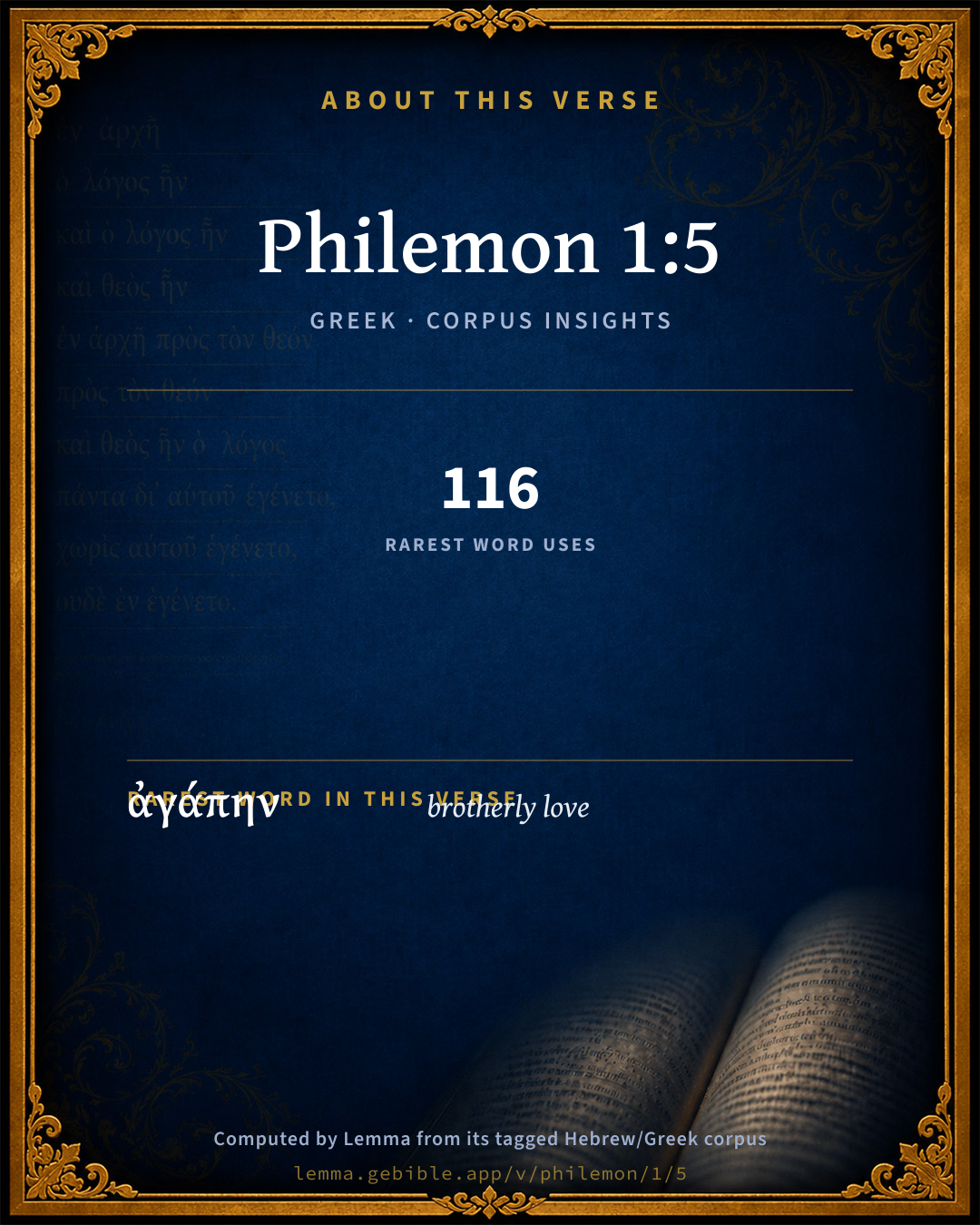
Philemon 1:5

Greek (Tischendorf 8th ed.) Philemon 1:5 appears in the Greek New Testament. The text above is from the Tischendorf 8th edition. Each word links to its Strong’s number and a concise gloss. Click any word for its full Thayer’s Greek Lexicon entry.

Download image
Cite this verse

Philemon 1:5 (World English Bible). Public Domain. Lemma interlinear Bible study tool, https://lemma.gebible.app/v/philemon/1/5.

Show BibTeX & RIS
BibTeX
RIS
English Translation
hearing of your love, and of the faith which you have toward the Lord Jesus, and toward all the saints;
World English Bible · Public Domain
Download a study sheet

One document with this verse’s original text, its word-by-word gloss line, the meaning frame, cross-references with their text, attributed commentary, and full source and license credits — printable, and it pastes into notes with its structure intact.

This verse Autodidact and up

Study sheet (.html) Plain text (.txt)

A passage Seminary Student

Up to 50 verses in one chapter. A passage sheet keeps up to 6 commentary sources and 12 cross-references per verse, in the order this page ranks them, and says so on the sheet whenever that leaves anything out. Ask for a single verse and you get the Autodidact verse sheet above.

Everything on this page stays free to read, with no account — the sheet is a download of what is already on screen, not access to it.

Want to remove ads? Support Godless Engineer
Compare translations 3

The same verse in 3 English versions, stacked beneath the original-language interlinear above. Click any original word for its lexicon entry.

Each is an independent rendering of the whole verse — the interlinear is not word-aligned to these translations.

Highlighted words mark where these versions differ — a whole-verse word diff, not a word-by-word alignment.

  • World English Bible Public Domain
    hearing of your love, and of the faith which you have toward the Lord Jesus, and toward all the saints;
  • King James Version Public Domain
    Hearing of thy love and faith, which thou hast toward the Lord Jesus, and toward all saints;
  • unfoldingWord Literal Text CC BY-SA 4.0
    hearing of your love and the faith that you have in the Lord Jesus and for all the saints,

unfoldingWord Literal Text — © unfoldingWord, licensed CC BY-SA 4.0. Word-aligned USFM3 via Door43 (git.door43.org/unfoldingWord/en_ult).

Versions to compare (up to 4)

3 of 4 selected

Show all 19 translations

Every available English version of this verse, each an independent rendering of the whole verse.

  • World English Bible Public Domain
    hearing of your love, and of the faith which you have toward the Lord Jesus, and toward all the saints;
  • Berean Standard Bible Public Domain
    because I hear about your faith in the Lord Jesus and your love for all the saints.
  • Majority Standard Bible Public Domain
    because I hear about your faith in the Lord Jesus and your love for all the saints.
  • King James Version Public Domain
    Hearing of thy love and faith, which thou hast toward the Lord Jesus, and toward all saints;
  • American Standard Version (1901) Public Domain
    hearing of thy love, and of the faith which thou hast toward the Lord Jesus, and toward all the saints;
  • Revised Version (1885) Public Domain
    hearing of thy love, and of the faith which thou hast toward the Lord Jesus, and toward all the saints;
  • Geneva Bible (1599) Public Domain
    (When I heare of thy loue and faith, which thou hast toward the Lord Iesus, and towarde all Saintes)
  • Douay-Rheims (1899) Public Domain
    Hearing of thy charity and faith, which thou hast in the Lord Jesus, and towards all the saints:
  • Young's Literal Translation Public Domain
    hearing of thy love and faith that thou hast unto the Lord Jesus and toward all the saints,
  • Literal Standard Version CC BY-SA 4.0
    hearing of your love and faith that you have to the Lord Jesus and toward all the holy ones,
  • Unlocked Literal Bible CC BY-SA 4.0
    I have heard of the love and the faith that you have in the Lord Jesus and for all the believers.
  • unfoldingWord Literal Text CC BY-SA 4.0
    hearing of your love and the faith that you have in the Lord Jesus and for all the saints,
  • Darby Bible Public Domain
    hearing of thy love and the faith which thou hast towards the Lord Jesus, and towards all the saints,
  • World Messianic Bible Public Domain
    hearing of your love and of the faith which you have toward the Lord Yeshua and toward all the holy ones,
  • Webster's Bible Public Domain
    Hearing of thy love and faith, which thou hast towards the Lord Jesus, and towards all saints;
  • Free Bible Version CC BY-SA 4.0
    because I hear of your trust in the Lord Jesus and your love for all believers.
  • Bible in Basic English Public Domain
    Hearing of the love and the faith which you have to the Lord Jesus and to all the saints;
  • Text-Critical English NT CC BY 4.0
    because I hear of yoʋr love for all the saints and the faith that yoʋ have toward the Lord Jesus.
  • Tyndale New Testament (1534) Public Domain
    when I heare of thy love and fayth which thou hast towarde the Lorde Iesu and towarde all saynctes:

Literal Standard Version (2020), Covenant Press — licensed CC BY-SA 4.0. Text via the HelloAO Bible API (eBible.org). Unlocked Literal Bible (unfoldingWord) — licensed CC BY-SA 4.0. Text via the HelloAO Bible API (eBible.org). unfoldingWord Literal Text — © unfoldingWord, licensed CC BY-SA 4.0. Word-aligned USFM3 via Door43 (git.door43.org/unfoldingWord/en_ult). Free Bible Version, Dr. Jonathan Gallagher — licensed CC BY-SA 4.0. Text via the HelloAO Bible API (eBible.org).

Word by word

More ways to search: Search by grammar → Find every occurrence → Compare this word →

Practice this passage: Drill this verse → Learn its vocabulary →

ἀγάπην
agápē
G26
“brotherly love”
Noun, Accusative, Singular, Feminine
Part of Speech
Noun
Case
Accusative
Number
Singular
Gender
Feminine
Full Thayer's Definition

Origin: from G25

TDNT: 01:21,5

1. brotherly love, affection, good will, love, benevolence 2. love feasts
  1. ἀκούων akoúō G191 “to hear” Verb, Present, Active, Participle, Nominative, Singular, Masculine
  2. σου sý G4771 “you” Personal pronoun, 2nd person, Genitive, Singular
  3. τὴν ho G3588 “the” Article, Accusative, Singular, Feminine
  4. καὶ kaí G2532 “and” Conjunction
  5. τὴν ho G3588 “the” Article, Accusative, Singular, Feminine
  6. πίστιν pístis G4102 “faith” Noun, Accusative, Singular, Feminine
  7. ἣν hós G3739 “who” Relative pronoun, Accusative, Singular, Feminine
  8. ἔχεις échō G2192 “to have” Verb, Present, Active, Indicative, 2nd person, Singular
  9. πρὸς prós G4314 “to” Preposition
  10. τὸν ho G3588 “the” Article, Accusative, Singular, Masculine
  11. κύριον kýrios G2962 “Lord” Noun, Accusative, Singular, Masculine
  12. Ἰησοῦν Iēsoûs G2424 “Jesus” Noun, Accusative, Singular, Masculine
  13. καὶ kaí G2532 “and” Conjunction
  14. εἰς eis G1519 “into” Preposition
  15. πάντας pâs G3956 “all” Adjective, Accusative, Plural, Masculine
  16. τοὺς ho G3588 “the” Article, Accusative, Plural, Masculine
  17. ἁγίους hágios G40 “saint” Adjective, Accusative, Plural, Masculine

About this verse

These counts appear in no published source. They are computed here, from the morphology-tagged text and Lemma’s own curated glosses. What Lemma adds →

18
words
14
distinct lemmas
Pauline Epistles
section

Repetition

Words recur within this verse:

Cross-references

11

Topical passages linked to Philemon 1:5 in the Treasury of Scripture Knowledge — connected by theme and wording, ordered by reader-vote popularity; previews shown in the World English Bible.

  • Colossians 1:4 having heard of your faith in Christ Jesus, and of the love which you have toward all the saints,
  • Ephesians 1:15 For this cause I also, having heard of the faith in the Lord Jesus which is among you, and the love which you have toward all the saints,
  • Psalms 16:3 As for the saints who are in the earth, They are the excellent ones in whom is all my delight.
  • 1 Corinthians 16:1 Now concerning the collection for the saints, as I commanded the assemblies of Galatia, you do likewise.
  • 1 John 5:1–2 Whoever believes that Jesus is the Christ is born of God. Whoever loves the father also loves the child who is born of him.
  • Romans 12:13 contributing to the needs of the saints; given to hospitality.
  • Romans 15:25–26 But now, I say, I am going to Jerusalem, serving the saints.
  • Galatians 5:6 For in Christ Jesus neither circumcision amounts to anything, nor uncircumcision, but faith working through love.
  • Philemon 1:7 For we have much joy and comfort in your love, because the hearts of the saints have been refreshed through you, brother.
  • 1 John 3:23 This is his commandment, that we should believe in the name of his Son, Jesus Christ, and love one another, even as he commanded.
  • Acts 9:39–41 Peter got up and went with them. When he had come, they brought him into the upper chamber. All the widows stood by him weeping, and showing the coats and garments which Dorcas had made while she was with them.

Cross-references courtesy of OpenBible.info (CC BY 4.0).

Commentary

Notes on Philemon 1:5 from classic Christian and Jewish commentators (each source and its license shown beneath its notes). The classic Christian expositions comment on the surrounding passage and are grouped to its opening verse, so a note may address several verses; the Jewish commentaries on the Tanakh (Rashi and others) are per-verse, so they appear only where the commentator wrote on this verse.

Lemma curates 59 commentaries, every one of them public domain or Creative Commons licensed, each selected and text-cleaned for this edition rather than reprinted as found. About our sources →

The Biblical Illustrator

Joseph S. Exell

Phm_1:5

Hearing of thy love and faith

A true human love

Some translators in ancient times, and many in later days, would at once accept M.

Renans version, as an equivalent, and, indeed, as a judicious correction--De ta foi au Seigneur, de ta charite pour tous les saints. Yet those who reverence Scripture may justly maintain that St. Pauls own arrangement of the words has a higher rhetoric, under the guidance of a better wisdom. Let us suppose a writer to have before him two propositions, one of which is of special importance for his immediate purpose. He might be able to bring out that purpose most effectively by beginning and ending his sentence with the motive to which he wished to give prominence. From this point of view, it is instructive to compare the two contemporary letters to the Ephesians and Colossians. In those more elaborate and dogmatic pieces the idea of faith is of principal significance, and in one or other of its aspects is the leading subject of consideration. But in the Epistle to Philemon the writers great object is to appeal to the principle of Christian humanity, to that true human love which flows from the constraining power of Divine love, believed in and accepted. Love toward the saints, and therefore to the brother for whom he pleaded, is consequently placed in the forefront. It is the first note of the whole strain. Let us conceive the epistle presented to Philemon, when the delegates first arrive, and the returned fugitive anxiously awaits his masters decision. The letter is received with reverential joy. Philemon listens, or reads, in breathless expectation, and the very first word which falls upon his ear, or meets his eye, after the salutation, is love. It has a force in this place which no other word could supply. St. Paul, therefore, places love first; but as he never can forget faith, and Christ as the central object of faith, he puts love first, the object of the love last, faith towards Christ in the middle between the extremes. (Bp. Wm. Alexander.)

Love first

Love is put before faith. The significance of this sequence comes out by contrast with similar expressions in Eph_1:15; Col_1:4. The reason for the change here is probably that Onesimus and Epaphras, from whom Paul would be likely to hear of Philemon, would enlarge upon his practical benevolence, and would naturally say less about the root than about the sweet and visible fruit. The arrangement then is an echo of the talks which had gladdened the apostle. Possibly, too, love is put first because the object of the whole letter is to secure its exercise towards the fugitive slave; and seeing that the apostle would listen with that purpose in view, each story which was told of Philemons kindness to others made the deeper impression on Paul. The order here is the order of analysis, digging down from manifestation to cause; the order in the parallel passages quoted is the order of production, ascending from root to flower. (A. Maclaren, D. D.)

Love and faith, the principal points of salvation

1. He reduceth the principal points of salvation to two heads--faith and love. In these standeth the happiness of the godly. By these, a Christian man perfected, for they are the chief graces of the Holy Ghost.

2. He beginneth with love, and placeth it before faith; deed is more precious, but it is inward and hidden in the heart, and in name and order goeth before love. But he first nameth love because it is better known to us, better seen of us, and is as the touchstone to try our faith. For though the cause be more worthy than the effect, yet the effect is more conspicuous and manifest. So faith, being the cause of works, is more excellent, and love as an effect is more evident.

3. We see, that albeit faith be set in the last place, for the reason rendered before, yet faith is first defined, and so the order somewhat inverted. Now, it is described and declared by his object, that it respecteth Christ Jesus. (W. Attersoll.)

Faith and love in the Christian life

This faith embodies the theoretic principles of Christian life, while this love for saints embodies these principles on their practical side. Like heart and lungs in the body, each has its own functions; and, though separate, the one never acts apart from the other--life being the combined play of both. Faith binds to all Christian verities, translating them into personal convictions; while love binds to all Christian motives, translating these into personal activities--love being well called the daughter of faith and the mother of virtue and good works. (A. H. Drysdale, M. A.)

Faith and love acceptable to God

I. The reasons follow to confirm this doctrine.

1. They give us good acceptance with God and man, because they are evident marks and notable testimonies of our election and perseverance, They are as two earmarks, to know and discern whose sheep we are.

2. God hath given praise and glory as an inseparable companion of godliness and goodness; and on the other side, He hath allotted shame to follow sin. He hath joined these together, to wit, glory with piety, and shame with iniquity. These draw together, as it were, in one yoke, so that one cannot be without the other. The apostle speaking of the ungodly, faith, their glory shall be to their shame. Seeing, therefore, the graces of Gods spirit are testimonies of election, and companions of praise and glory, we must from hence conclude that the good gifts of God that are found in us make us accepted of God and man.

II. The uses follow to be considered and learned of us.

1. Seeing faith in Christ, and love toward the saints give us a good report in the Church, and lay up a good foundation for us in heaven, we see that only godly men have a good name, and evil men shall leave the blots of an evil name behind them. The memorial of the just shall be blessed, but the name of the wicked shall rot. This overthroweth three sorts of men that offend, and esteem not of men according to their faith and profession.

(1) Such as slander the godly, and bring up an evil report of the faithful people of God, and seek to take away their good name from them, which is a jewel more precious than silver and gold. But we shall less esteem what they speak, if we consider who they are that speak. For the witness of an enemy is by no law to be taken, but always to be suspected.

(2) Such as magnify and advance the ungodly, give them the praise of the world, speak well of them, as of the only honest men that deserve to be commended. But so long as they live in sin, their own wickedness doth testify to their faces, and their ungodly hearts proclaim their own shame, and shall bring upon them utter confusion. Let this be written and engraven in our minds, that ungodliness will leave a reproach behind it.

(3) It convinceth such as are civil men, and can say they are not drunkards, they are not adulterers, they are not thieves, they lead an honest life, they pay all men their own. These men have a good liking of themselves, and are accounted the only men among others. But a man may do all this, and be a Pharisee, yea, no better in the sight of God than a Turk and Infidel. He may carry the countenance and have the report of such a liver, and yet smell strongly, and savour rankly in the nostrils of God, of ignorance, of unbelief, of pride, and of self-love. If we would deserve true praise indeed, we must not rest in these outward practices and in this moral civility, we must plant religion in our hearts, we must have a sound faith in Christ, we must know the doctrine of the gospel, we must worship God aright.

2. Seeing faith and love give us a good commendation and report, let us by these and such like graces of Gods Spirit, seek after a good name, let us not hunt after the praise of men, but that which is of God. The other is a blast of wind; this is certain and never fadeth. (A. H. Drysdale, M. A.)

Love and faith not separated

1. Seeing these two gifts are coupled together one with another, it followeth that they must never be separated in a Christian man. He that is joined with the head, must also be joined with the members; and he that hath his part in the communion of saints, hath his fellowship with Christ.

2. Seeing faith and love go together, and dwell together, we are put in mind of a notable duty, and are thereby directed to prove our faith by our love, and our love by our faith, and to make one of them serve to assure the other. The cause will prove the effect, and the effect will manifest the cause. We may prove fire by the heat, and the heat by the fire; a good tree by his fruit, and the fruit by his tree. (A. H. Drysdale, M. A.)

Thankful for the graces of others

I. See in Pauls example, what is the effect that the good report which the godly hear of their brethren, useth to work in their minds. Commonly men suck in their own praises with very greedy ears, but they cannot with patience endure the praises of others, thinking that the praises of others is a close kind of dispraising themselves, and that so much is taken from them as is given unto another. Hence it is that the speech of those that are much in the commendations of others is so troublesome to us, in that thereby we feel ourselves stirred up to wrath, fretting, envy, and such like distemper of corrupt affections. But it is far otherwise with the children of God, who have the circumcised ears of Paul, that not only with patience, but with great joy, can hear the commendations of their brethren, and upon the hearing of them break forth not into fretting and fuming, but into a holy lauding of the Name of the Lord.

II. Observe, that thanks are due to God, not only for those benefits which He bestoweth on us ourselves, but on our brethren also. And therefore if we pay him not this debt, he may justly charge us with ingratitude. For shall we confess it our duty to pray for our brethren, that they may be enriched with these graces; and shall we not think ourselves equally bound to give thanks to God, when He hath heard our prayers?

III. If in Pauls example others are bound to give thanks for our graces, then it is our part, who through Gods mercies are possessed of any of His graces so to use them that we may minister just cause to our brethren to give thanks for them.

IV. Paul saying that he heard of the faith and love of Philemon, plainly showeth, that there were some that related and reported them to him. By whose example we must learn to have a special respect of the good name of our brother, being always ready, as occasion shall serve, to speak of those good things that are in others.

V. Observe Gods providence, recompensing faith with fame and good name. When faith shall open our hearts and mouths to extol Gods name, God will open our brethrens, yea, sometimes our enemies mouths, to extol ours (Heb_11:13). By this (namely faith) our elders obtained a good report. This was the means whereby they became so famous. What marvel, then, if thou hast an ill name, when thou hast an ill conscience? Naughty faith and fame, cracked credit and conscience, commonly go together. (D. Dyke, D. D.)

Faith and love

By faith understand justifying faith, which only is able to bring forth true love, either to God or man. And by love, as the apostle showeth, not only love to God, but also to man. Here observe--

I. The distinction of these graces of faith and love. They are named distinctly as two virtues (1Co_13:13).

II. The conjunction of these two graces, for howsoever they are to be distinguished, yet not to be divided. Wheresoever true faith is, there necessarily love, both to God and our brethren, will follow. For though faith be alone in justification, yet not in the justified. As the eye, though alone in seeing, yet not in him that seeth, but joined with the ears, nose, and many other members of the body. Faith therefore is a fruitful mother of many daughters, and love is the firstborn of them. Faith, though it be in regard of God a beggar, always holding out the hand to receive, and crying, Give, give, yet in regard of those in whom it dwelleth, it is like a sovereign lord and king, and hath as a king his officers under him, and among the rest, love, his almoner, to distribute and disperse those treasures which itself hath received from the Lord.

1. Our love towards God proceedeth from faith, which, apprehending Gods love to us, enflameth our affections again with the love of God. The beams of Gods love lightning upon our hearts reflect back upon God Himself by the virtue of our faith. The love of Christ, saith the apostle--namely, being apprehended by our faith--constraineth us. An example whereof we have in Mary Magdalen, whose faith, believing that much was forgiven her, caused and constrained her to love much.

(1) This plainly convinceth the faith of many to be nothing but vain presumption, because their love to God is so lukewarm.

(2) But as this doctrine is terrible to the hypocrite, whom it unmasketh of his vain vizard of faith, so it is no less comfortable to the true Christian. For what dost thou feel thy soul panting in the earnestness of desire after God? Dost thou find thyself grieved when thou missest of thy desire? Doth thou find thy heart to arise when thou seest Gods Name dishonoured, etc.? Surely, these things as they are arguments of sincere love, so likewise of faith not feigned. If thou canst with David (Psa_18:1) say I love the Lord, thou mayest as truly use the words following, and say, The Lord is my Rock.

(3) This doctrine of love flowing from faith, confuteth those that teach, our election dependeth upon our foreseen obedience. By that which hath been delivered it appeareth that our love of God is caused and stirred up in us by His love, to us apprehended by our faith.

2. Our love of our brethren springeth likewise from faith, for the apostle speaketh here of both loves. This will appear, if either we consider those duties of love, which we owe generally to all, or in special to some.

(1) For the first this is a duty which we owe to all indifferently, to be ready to forgive one another, being offended. Now what is that which will make a revengeful nature yield to this, but faith, which, when once it hath apprehended Gods love, forthwith reasoneth, as the Master in the parable with His servant (Mat_19:1-30). The Lord hath freely forgiven me my whole debt, ought not I then to show the like compassion to my fellow servant? Therefore the Lord enjoining the duty of forgiveness; the apostles pray, Lord, increase our faith (Luk_17:4-5).

(2) Other duties there are which we owe specially to some.

(a) As first, to those that are yet unconverted, the desiring of, and by all means possible labouring after their conversion. Now, it is faith only which will make a man do this. For, when by faith we have felt the sweetness of Gods love ourselves, we cannot but call upon others, and with the prophet David invite them to the eating of the same dainties with ourselves (Psa_34:1-22.). Come, and see, and taste how good, etc.

(b) But yet a more special love, which therefore hath a special name of brotherly love, is due unto those which are already effectually called, and so made members of Christ. This love also cometh from faith, which, causing us to love God, must needs also force us to love all those in whom we shall see the very face and lively image of God Himself so clearly shining.

1. Uses: by this then once again we may try our faith. A working faith hath laborious love even to our brethren annexed (1Th_1:3). If then thou art of a hard nature, of a memory lastly retaining injuries of affections vindicative, which the Scripture calls feet swift to shed blood, this shows thou hast no part in the blood of Christ by faith. The like is to be thought of those which are moved with no compassion towards the soul of their brethren sitting in darkness and the shadow of death, but can suffer them to pine and perish away in their sins, and never reach forth the hand to pull them out of the ditch.

2. This doctrine serveth not only for the trial of our faith, but also of our love to our brethren. For as that faith, which is without this love, is an idle, and imaginary faith, so that love of our neighbour, which cometh not from faith, is blind and foolish, and in the end will prove a deceitful and unfaithful love. Natural men, that seem to love very dearly today, tomorrow are at deadly feud. The reason hereof is because their love comes not from faith.

3. It maybe asked, How could others declare to Paul the love and faith of Philemon, which are secret and hidden virtues, that be in the innermost corners of the heart, far from the sight of the eye? They saw not Philemons faith, but his outward works, and by them they judged, and so did Paul too of his faith, discerning the tree by the fruit. (D. Dyke, B. D.)

Toward the Lord Jesus--

Faith toward Christ

Sometimes faith is spoken of as in Christ, sometimes as unto or upon Him; here it is toward Him. The idea is that of aspiration and movement of yearning after an unattained good. And that is one part of the true office of faith. There is fruition and contact in it. We rest in Christ by faith. It incorporates us into His mystical body, and brings about a mutual indwelling. We lean on Christ by faith, and by it build the fabric of our loves, and repose the weight of our confidence upon Him, as on the sure foundation. We reach unto, and, in deepest truth, pass into Christ by faith. But there is also in faith an element of aspiration, as of the soaring eagle to the sun, or the climbing tendrils to the summit of the supporting stem. In Christ there is always something beyond, which discloses itself the more clearly, the fuller is our present possession of Him. Faith builds upon and rests in the Christ possessed and experienced, and just therefore will it, if it be true, yearn towards the Christ unpossessed. (A. Maclaren, D. D.)

Faith towards Christ

For faith is just like the coupling chain of a railway carriage--everything depends on where its fastenings are ultimately attached. The carriage moves only if its coupling chain communicate with the moving power. And faith saves only as it takes hold of the Saviour for itself, and terminates in Him as its object. This precious faith is a bond of attachment. It cannot be a single isolated act, but an abiding attitude of confidence towards the Lord Jesus. (A. H. Drysdale, M. A.)

Love to Christ

A gentleman when visiting in a hospital in London sat beside the cot of a little girl. Wishing to win her confidence, he said, My child, do you love your mother? With a very serious look she replied, Yes, I do indeed. But why do you answer so gravely; what is that you are thinking about, my dear? Then she replied with great earnestness, Because I can never love my mother anything as she loves me. Can any of you say of Jesus as the little girl said of her mother, Yes, I love Him indeed, but I can never love Him in any way as He loves me? Toward all saints--Clearly their relation to Jesus Christ puts all Christians into relation with one another. This was an astounding thought in Philemons days, when such high walls separated race from race, the slave from the free, woman from man; but the new faith leaped all barriers, and put a sense of brotherhood into every heart that learned Gods fatherhood in Jesus … The love which is here commended is not a mere feeling, nor does it go off in gushes, however fervid, of eloquent emotion. Clearly Philemon was a benefactor of the brotherhood, and his love did not spend only the paper money of words and promises to pay, but the solid coin of kindly deeds. Practical charity is plainly included in that love of which it had cheered Paul in his imprisonment to hear. Its mention, then, is one step nearer to the object of the letter. Paul conducts his siege of Philemons heart skilfully, and opens here a fresh parellel, and creeps a yard or two closer up. Surely you are not going to shut out one of your own household from that wide reaching kindness. So much is most delicately hinted, or rather left to Philemon to infer, by this recognition of his brotherly love. A hint lies in it that there may be a danger of cherishing a cheap and easy charity that reverses the law of gravity, and increases as the square of the distance, having tenderness and smiles for people and churches which are well out of our road, and frowns for some nearer home. (A. Maclaren, D. D.)

Love extending to the saints

Philemons love extended itself to the saints, as is here avouched of him; yet it was not cooped up within the pen of the saints: the saints must have the prime place in our love, but not the whole. Do good to all men, chiefly to them of the household of faith: chiefly, but not wholly. Aristotle gave an alms to an unworthy man: one reproved him for it. Says he, I gave it to the nature of the man, not to the man; the nature is Gods, and must be sustained: the vice is his own and the devils, and must be reformed. (W. Jones, D. D.)

The saintly household

1. This teacheth that there ought to be among all the faithful a communion of saints; they are as a family or household among themselves. They have a near fellowship, they are near brethren, they are fellow members of one body, they are knit together by one spirit, they are called under one hope, they are made Christs by one faith, they are made one by one baptism, they have one bread to feed upon, they have one cup to drink of, they have one table to meet at, they have one God that they worship, they have one salvation that they aim at (Eph_4:2-3). We are charged to have a care of all mankind, but as it is fit and convenient that they which are of the same family should be helpful one to another rather than to such as are of another family, which are not so nearly joined unto them (Php_2:1-2). The gifts of God to be imparted to our brethren are of two sorts. For as we consist of two parts, the soul and the body, so the gifts are of two kinds--spiritual graces, and temporal blessings. We must bestow upon them spiritual gifts, procuring their good by example, exhortation, comfort, prayer, reproof. Touching temporal blessings, we must be ready and content to bestow such goods as God hath bestowed upon us, for the good of our fellow members. If we have this worlds goods we must not hide our compassion from them, for then we cannot assure ourselves that the love of God dwelleth in us.

2. Seeing we are charged to provide for the godly poor, and not to see them want, it teacheth that we are all the Lords stewards, to dispense and dispose His blessings to others. For properly we are not lords, but tenants; not owners, but stewards; not possessors, but borrowers; and whatsoever we enjoy, it is not ours only, but ours and the poors--they have their share and portion with us. A Christian man, though he be the freest man upon the earth, yet he is a servant to all, especially to the Church of God. This condemneth--

(1) Such as seek for nothing but to settle themselves and maintain their own estates, to enrich themselves that they may live in ease and wealth, like the rich man mentioned in the gospel: these make no conscience of swearing, forswearing, lying, dissembling, oppressing, and such like unfruitful works of the flesh. These men may allege and plead for themselves what they will, but in truth they never yet knew what the communion of saints meaneth.

(2) It reproveth such a waste and consume the good creatures of God in riotousness, in drunkenness, and in all excess, and when they are in brotherly love and Christian compassion admonished, do answer, What have you to do with my spending? I spend nothing but mine own, I spend none of yours. Yes, thou spendest that which is thy wifes, thy childrens, thy familys, the poors, the Churchs, yea even that which is Gods, for which thou shalt give an account at the great and dreadful day of judgment.

(3) Seeing we are debtors to all men, but specially to the faithful, it reproveth such as show the chiefest fruit of their love and charity upon the ungodly and profane, whom it were many times more charity to see punished than relieved: and corrected than maintained. (W. Attersoll.)

Why believers are called saints

1. Because they are thereunto called and chosen in Christ, they are thereunto justified and redeemed by Christ. For we are chosen before the foundations of the world to be holy (Eph_1:4; 1Th_4:3; 1Th_4:7; Luk_1:68; Luk_1:74-75).

2. The servants of God must be saints, to the end there may be a conformity and likeness unto Him that hath had mercy upon us. It is requisite that there should be a resemblance between God and His people. God is holy, it is one of His names, He is called the Holy One; Christ is Holy, and He is called the Holy One of God; the Spirit is holy, and therefore is called the Holy Spirit. The Son beareth the image of His Father, and thereby is easily known whose Son He is. If we be the sons of God we must express His image in holiness and true righteousness (Lev_11:45; 1Pe_1:14-15).

3. The faithful are called by the name of saints, that there might be a difference between that which we have of ourselves, and that which we receive from God: between the old man and the new man; between our first birth and our second birth; between nature and grace. No man is a saint by nature, we have no holiness from ourselves, but we are strangers to it, and that is a stranger to us; nay, we are enemies to holiness who love nothing else but profaneness, and desire to be anything else than to be saints and holy. (W. Attersoll.)

Love of Christ a bond of brotherhood

An unknown man one day dropped dead in New York. He seemed to have been very poor, for in the pockets of his shabby clothes there was not a cent. His description was published in the newspapers, and among other details, mention was made of a tattoo mark on his right arm. It represents a tomb overhung by the branches of a weeping willow. Below was the inscription, In memory of my mother. Nothing was known of him; but one thing was clear--he had once had a mother whom he loved. The body was sent to a station house, and the next day would have been buried in Potters Field at the expense of the city, if a merchant had not interposed. He asked permission to pay the cost of a decent funeral in a cemetery for the man. He did not know him, but he, too, had lost his mother, and the memory of her had been enshrined in his heart for many years. He felt a brotherhood with the man whose love of his dead mother was displayed in the tattoo marks, and desired to do a brothers part to him. If every Christian felt that the love of Christ, common to him with other Christians, constituted a bond of brotherhood with its claims upon him, how much hardship and pain would be relieved!

Love to saints

The magnetised needle turns to the invisible North Pole whenever it turns to any visible object that lies due north of itself; and so, love to saints, as saints, is love to Christ Himself personally, because it is love to whatever of Christ is manifest in them. (A. H. Drysdale, M. A.)

The Biblical Illustrator, edited by Joseph S. Exell (c. 1880s–1900s) — public domain. Text from a community e-Sword module.

Tyndale Open Study Notes

Tyndale Open Resources

1:5 It is by faith in Christ that we are saved, and it is by love for fellow Christians that we live out our salvation.

Tyndale Open Study Notes — © Tyndale Open Resources, licensed CC BY-SA 4.0. Text via the HelloAO Bible API.

Bengel's Gnomon

Johann Albrecht Bengel

Phm 1:5. Ἀκούων, hearing) Paul had gained over Philemon, Phm 1:19, and here he praises his consistent character. From Onesimus himself he might hear of his love and faith.—ἀγάπην—πίστιν—πρὸς—Ἰησοῦν καὶ εἰς—ἁγίους, love—faith—to—Jesus and unto—saints) So Eph 1:15: but in this passage there is a Chiasmus in regard to Philemon. The first is connected with the fourth, the second with the third; but love is put in the first place, because it is to a specimen of love that he is exhorting Philemon, to whom the order of faith and love had been long known. Paul gives thanks to God for this blessed state of Philemon.

Bengel's Gnomon of the New Testament — English translation (T&T Clark, Edinburgh, 1860) — public domain. Text from a community e-Sword module.

Expositor's Greek Testament

ed. W. Robertson Nicoll

Phm 1:5 . ἀκούων : probably from Epaphras, see Col 1:7-8 ; Col 4:12 (Lightfoot). τὴν ἀγάπην …: i.e. , the faith which thou hast towards the Lord Jesus Christ, and the love which thou showest to all the saints. “The logical order,” says Lightfoot, “is violated, and the clauses are inverted in the second part of the sentence, thus producing an example of the figure called chiasm; see Gal 4:4-5 . This results here from the apostle’s setting down the thoughts in the sequence in which they occur to him, without paying regard to symmetrical arrangement. The first and prominent thought is Philemon’s love. This suggests the mention of his faith, as the source from which it springs. This again requires a reference to the object of faith. And then, at length, comes the deferred sequel to the first thought the range and comprehensiveness of his love.” πίστιν : not “faithfulness,” but “faith” (belief), cf. 1Co 13:13 , Gal 5:6 , 1Th 1:3 . πρὸς … εἰς : the difference in these propositions is noteworthy, πρὸς refers to the “faith” to Christ-ward ( cf. 1Th 1:8 ), εἰς to the love to the saints: both are developed in Phm 1:6-7 . τοὺς ἁγίους : St. Paul intends Onesimus to be thought of here. The original significance of the title ἅγιος , as applied to men, may be seen in such a phrase as, “Ye shall be holy, for I, the Lord your God, am holy” (Lev 19:2 ). To the Jew, like St. Paul, the corresponding root in Hebrew connoted the idea of something set apart, i.e. , consecrated to the service of God ( cf. e.g. , Exo 22:31 [29]). The ἁγίοι constituted originally the ἐκκλησία ; and just as, according to the meaning underlying the Hebrew equivalent of the word ἅγιος , separation for God’s service was the main conception, so, according to the root-meaning of ἐκκλησία , it connoted the idea of the body of those “called out,” and thus separated from the world.

The Expositor's Greek Testament, edited by W. Robertson Nicoll (1897–1910) — public domain. Text from a community e-Sword module.

Jamieson, Fausset & Brown

Robert Jamieson, A. R. Fausset & David Brown

Hearing--the ground of his thanksgiving. It is a delicate mark of authenticity, that he says "hearing" as to churches and persons whom he had not seen or then visited. Now Colosse, Philemon's place of residence, he had never yet seen. Yet Plm 1:19 here implies that Philemon was his convert. Philemon, doubtless, was converted at Ephesus, or in some other place where he met Paul.

love and faith--The theological order is first faith then love, the fruit of faith. But he purposely puts Philemon's love in the first place, as it is to an act of love that he is exhorting him.

toward . . . toward--different Greek words: "towards" . . . "unto." Towards implies simply direction; unto, to the advantage of.

Jamieson, Fausset & Brown — Commentary Critical and Explanatory on the Whole Bible (1871) — public domain (CC PDM 1.0). Text via the HelloAO Bible API.

Adam Clarke's Commentary

Verse 5. Hearing of thy love and faith] His faith in Christ Jesus, his love to the saints. Several excellent MSS. and some versions put faith before love, which makes a more natural reading. There is no figure of speech which would vindicate our saying faith in the saints; so that, if we do not allow of the arrangement in the MSS. referred to, we shall be obliged to have recourse to the transposition, because faith must refer to Jesus Christ, and love to the saints.

Adam Clarke's Commentary on the Bible (1810–1826) — public domain. Text from a community e-Sword/MySword module.

John Calvin's Commentaries

5. Hearing of thy love and faith. This praise, which he bestows on Philemon, includes briefly the whole perfection of a Christian man. It consists of two parts, faith in Christ, and love towards our neighbors; for to these all the actions and all the duties of our life relate. Faith is said to be in Christ, because to him it especially looks; in like manner as in no other way than through him alone can God the Father be known, and in no other than in Him can we find any of the blessings which faith seeks.

And towards all saints. He does not thus limit this love to the saints, as if there ought to be none towards others; for, since the doctrine of “love” is, that “we should not despise our flesh,” (Isaiah 58:7) and that we should honor the image of God which is engraven on our nature, undoubtedly it includes all mankind. But since they that are of the household of faith are united with us by a closer bond of relationship, and since God peculiarly recommends them to us, for this reason they justly hold the highest rank.

The arrangement of the passage is somewhat confused; but there is no obscurity in the meaning, except that it is doubtful whether the adverb always (in the 4th verse) is connected with the first clause, “I give thanks always to my God,” or with the second clause, “making mention of thee always in my prayers.” The meaning may be brought out in this manner, that, whenever the Apostle offered prayer for Philemon, he interwove thanksgiving with it; that is, because Philemon’s piety afforded ground of rejoicing; for we often pray for those in whom nothing is to be found but what gives occasion for grief and tears. Yet the second mode of pointing is generally preferred, that Paul “gives thanks for Philemon, and always makes mention of him in his prayers.” Let my readers be at full liberty to judge for themselves; but, for my own part, I think that the former meaning is more appropriate.

In the rest of the passage there is an inversion of the natural order; for, after having spoken of “love” and “faith,” he adds, “towards Christ and towards saints,” while, on the contrary, the contrast would demand that “Christ” should be put in the second part of the clause as the object to which our faith looks.

John Calvin's Commentaries (1540-1563) — public domain. Text from the Calvin Translation Society English edition (1840s-50s) via the Christian Classics Ethereal Library (ccel.org). Calvin's coverage is partial (roughly two-thirds of the Bible); uncommented books and verses are honest gaps, never fabricated. The 19th-century editor's footnotes and remarks are omitted so the notes are faithfully Calvin's own voice.

Ellicott's Commentary for English Readers

(5) Thy love and faith, which thou hast toward the Lord Jesus, and toward all saints.—This description of a faith directed not only to the Lord Jesus, but to all the saints, has perplexed commentators, and called out various explanations. (1) One is that “faith” here (as in Rom_3:3; Gal_5:22) is simply fidelity; but this can hardly be accepted as an explanation of so well-known and almost technical a phrase as “faith toward the Lord Jesus Christ.” (2) Another, noting the distinction in the original between the two prepositions here—the former (pros) signifying direction towards, and the latter (eis) actual contact with, its object—explains the phrase as signifying “the faith which has as its object the Lord Jesus Christ, but which shows itself practically towards all saints.” But this, even if the word “hast” will bear this gloss, seems too artificial for such a Letter as this. (3) The comparison with the contemporaneous Letter to the Colossians—where we read, “your faith in the Lord Jesus, and your love toward all the saints” (Col_1:4)—seems to clear up the matter. We have here an equivalent phrase, in which, however (by what the grammarians called chiasmus), the extremes and means correspond to each other. The idea which runs through the Letter is Philemon’s “love to the saints.” In writing of that love St. Paul cannot refrain from (4) referring it to its true origin—the faith towards the Lord Jesus Christ. Hence the broken phrase. The sense seems therefore to be that which in some MSS. has been brought out by a natural correction, “thy faith towards the Lord Jesus, and thy love to all the saints.”

A Bible Commentary for English Readers, edited by Charles John Ellicott (1878–1897) — public domain. Text from a community e-Sword module.

The Cambridge Bible for Schools and Colleges

gen. ed. J. J. S. Perowne

5. hearing] doubtless from Epaphras, perhaps with Onesimus’ confirmation from his point of view. The Greek implies a process of hearing; the subject was continually present in conversation.

love] See below Phm_1:7; Phm_1:9. The whole letter is from love to love.

faith] Some commentators (see Ellicott’s note, where the view is discussed and rejected) explain this as “fidelity” (as probably Gal_5:22 and certainly Tit_2:10). But that meaning is rare in St Paul, and needs strong evidence for adoption in any given case. The ruling meaning, “trust, reliance,” is quite in place here.

toward … toward] The “received” Greek text, retained here by Lightfoot, has two different prepositions, which we may render toward and unto respectively; “toward” the Object of faith, “unto” the objects of love.

toward the Lord … saints] R.V. (and so Alford) reads the whole passage; “thy love, and the faith which thou hast toward &c.,” making “the faith” only, not “thy love,” refer to both the Lord and the saints; (the man’s reliance on Christ coming out in a “work of faith,” called briefly “faith”—see Phm_1:6—towards the saints). But Lightfoot, we think rightly, distributes the references of love and faith, cross-wise, to the saints and the Lord respectively. Cp. for support Col_1:3-4, a passage written so nearly at the same time. No doubt the arrangement of the Greek, on this view, is peculiar. But in this domestic letter several natural liberties of language occur.

“All saints”:—read, all the saints, with whom Philemon had to do.—On the word “saints” see note on Col_1:2.

The Cambridge Bible for Schools and Colleges (gen. ed. J. J. S. Perowne; Cambridge University Press, 1878–1918) — public domain. Text from a community e-Sword module.

John Gill's Exposition

Hearing of thy love and faith,.... Those two spring from the free favour and love of God, and are the pure gifts of his grace; and therefore thanks are to be given for them to God; nor are they to be ascribed to the power and will of man; they are the fruits of the Spirit of God; and are the principal ingredients in sanctification, which is entirely his work; and they are in all regenerate persons; and are the evidences of regeneration; by which it is known that men are passed from death to life; and they always go together, and are inseparable from each other: there cannot be true faith where love is wanting, for faith works by love; and there cannot be real love, where there is not faith; they only love the saints aright, who love them in the faith, and because of it; and these graces are visible, and to be known by their fruits, whereby they come to be heard of, and talked of, as these in Philemon were. Faith in the heart is confessed by the mouth; and love, both to Christ and to his people, shows itself, as well as faith, in works of righteousness. Sometimes faith is put before love, it being a leading grace, and the great receiver of all the blessings of grace; and here love is placed before faith, because of its being more excellent on account of its continuance and duration; or there may be no design at all in it; but rather, as sometimes one, and sometimes another is mentioned first, it shows that they are upon an equal foot, and both have their proper place and usefulness; the objects of them follow:

which thou hast toward the Lord Jesus, and toward all saints; which are either to be considered as equally objects of the same grace, or as distinct ones; that is, either that Christ is the object both of faith and love, and the saints are the object both of faith and love; or else these graces are to be distinguished by their respective objects; as that faith is toward Christ, and love toward all the saints: that Christ is both the object of faith and love is certain; nor is there any difficulty to consider him as such; faith is equally to be exercised on him, as on God the Father; and he is indeed the immediate object of faith, and by whom men believe in God; and he is to be loved, and is loved by his people above all things, and at all times, and in sincerity: and that the saints are the objects of the love of all truly gracious souls, is a plain case; but the greater difficulty is, how they should be the objects of their faith; and yet there are instances of this, Exo 14:31 and indeed, true love believes all things, and hopes all things, Co1 13:7. But it seems better to divide these objects according to the different graces, and to consider faith as being towards our Lord Jesus; which is a looking towards Christ, a moving towards him, a laying hold upon him, and embracing him, a staying and leaning on him, a living upon him, and walking in him; and which in Philemon might be a strong one, as well as unfeigned, and operative: and love may be considered as being toward all saints; for though all men are, in a sense, to be loved, and kindness to be shown to them, and that even to enemies, yet more especially the saints; who are set apart by God the Father, whose sins are expiated by the blood of Christ, and who are internally sanctified by the Spirit, and are enabled to live soberly and righteously: and all of these are the objects of love, whether rich or poor, greater or lesser believers, of meaner or larger abilities; for they are all equally loved by God, redeemed by Christ, and regenerated by his Spirit; are justified by his righteousness, are all the children and heirs of God, and are called in one hope of their calling; and love to them should be unfeigned, fervent, active, and laborious, and as Christ has loved us; and such was Philemon's love, as well as it was universal and this distribution of these graces to their respective objects may be confirmed from a parallel place in Col 1:4 which epistle was written and sent at the same time with this.

John Gill's Exposition of the Whole Bible (1746–1763) — public domain (CC PDM 1.0). Text via the HelloAO Bible API.

Trapp's Complete Commentary

John Trapp

5 Hearing of thy love and faith, which thou hast toward the Lord Jesus, and toward all saints;

Ver. 5. Hearing of thy love and faith] Love is first mentioned, as more noticed. But faith is the mother grace, the womb wherein love and all the rest of that heavenly offspring are conceived.

John Trapp, A Commentary or Exposition upon All the Books of the Old and New Testament (1647–1656) — public domain. Text from a community e-Sword module.

Albert Barnes' Notes on the Bible

Hearing of thy love and faith - Either by Onesimus, who, after his conversion, would be disposed to state all that he knew that was favorable of Philemon, or hearing it by some other persons who had come from Colosse to Rome. The faith which is mentioned here refers to the Lord Jesus; the love, to the saints. The order in the Greek is indeed the same as in our version, but it is not unusual by synthesis, or uniting two or more things together, to arrange words in that manner. Thus Mat 12:22, “The blind and dumb both spake and saw;” that is, the blind saw, and the dumb spake. The meaning is, that he had strong faith in the Lord Jesus, and ardent love toward all who were Christians. See a similar declaration in Col 1:4.

Albert Barnes' Notes on the Bible (1834–1885) — public domain. Text from a community e-Sword/MySword module.

Haydock's Catholic Bible Commentary

Thy charity and faith....in the Lord Jesus,[1] and towards all the saints. In the Greek is towards Jesus Christ, and towards all the saints. By the saints he seems to mean, as elsewhere, all Christians; so that the sense may be, of thy faith towards Christ, and of thy charity towards all the saints or Christians. (Witham)

===============================

[BIBLIOGRAPHY]

Charitatem tuam et fidem, quam habes in Domino Jesu, et in omnes Sanctos; Greek: pros ton kurion Iesoun, kai eis pantas tous agious.

George Leo Haydock (1774–1849), Haydock's Catholic Family Bible and Commentary, 1859 edition — public domain. Excludes Psalms (Douay-Rheims chapter numbering differs from Protestant) and Deuterocanonical books (Catholic canon only).

Matthew Poole's English Annotations

Hearing of thy love; thy love to God and to the saints, Phm 1:7. The apostle putteth love here before faith, contrary to the true order of those spiritual habits, for love must be the fruit of faith,

which worketh by love, and to his own order in other places, 1Ti 2:7; 2Ti 1:13 possibly to show us that he spake of that love which is conjoined with faith, and of that faith which showeth its truth by love.

And faith; faith in Christ.

Which thou hast towards the Lord Jesus; that faith which thou hast in Christ, reposing thy confidence in him for salvation, and that love which worketh in thee towards Christ.

And toward all saints; and is seen in thy readiness to do good to all Christians, such especially as are saints indeed; because thy goodness extendeth not to God, thou showest it to the saints that are in the earth, and to the excellent, like David, Psa 16:2,3.

Matthew Poole's English Annotations on the Holy Bible (1683–1685) — public domain. Text from a community e-Sword/MySword module.

Whedon's Commentary on the Bible

Daniel D. Whedon

5. Hearing—This participle is, in the Greek, a continuous present; constantly hearing, and so moved to make mention of you in my prayers. Thanks for his convert’s present piety prompted prayer for his higher spiritual attainments. Philemon, he heard, manifested faith, not only toward the Lord Jesus, but he manifested his faith in Jesus toward all saints.

Daniel D. Whedon (gen. ed.), Commentary on the Old and New Testaments (1874–1909) — public domain. Text from a community e-Sword module.

The Pulpit Commentary

Hearing of thy love, and of the faith ... saints. He would hear of these instances of Philemon"s faith and love naturally through Epaphras (see on Ver. 2). Refer "faith" to "the Lord Jesus" and "love" to "all the saints" (a chiasmus, or cross-reference). Note that the phrase is pro (i.e. erga, towards) torion , but eiv (i.e. upon) tououv ; perhaps because Christ cannot now be reached by bodily efforts, but only aspired towards by the soul; while the poor can actually be reached and ministered unto. "Ye have the poor always with you, but me ye have not always". (Mat_26:11) All Christians are called "saints" in the Scriptures, as Eph_1:1, and invariably. What a reminder to them of their holy calling"! (2Ti_1:9) Meyer notes, however, that it is not uncommon with St. Paul to vary the preposition. (Rom_3:20 Gal_2:16)

Vers. 5, 6. Man glorifying God.

Man is created for God"s glory, and finds the highest end of his being, therefore, in glorifying him. Four ways may be distinguished in which he does this.

I THE WAY OF GOOD DEEDS DONE IN HIS STRENGTH, which cause others to glorify him. "Let your light so shine before men, that they may see your good works, and glorify your Father which is in heaven". (Mat_5:16) This is the mode referred to here: "That thy faith may become effectual by the acknowledging of every good thing which is in you." The mutual benevolence of Christians was thus to God"s glory, and tended to bring others into the fold.

II THE WAY OF WORSHIP an ancient, universal, and proper way. Acts of worship are directed to God. That they may be really to his glory, they must be for God; that is, he must be, not their object merely, but their end (Manton). As far as secondary motives prevail in our worship, so tar it is for those motives, and not purely to God"s glory. The sole element to be reckoned in worship is the earnestness, piety, and sincerity of the worshipper. God is no more glorified of necessity by great outward beauty and splendor; he is no less glorified by the barest simplicity, if the devotion be equal. The accessories of worship are for man"s help, and to assist man"s feeble and purblind view of eternal realities; and are not otherwise to God"s glory than as they are fit vehicles of man"s devotion.

III THE THIRD WAY OF OBEDIENCE. Man glorifies God when he becomes that which God intended him to be. He realizes by obedience the thought of God when he said, "Let us make man in our image." This was lost through the sin of Adam, and it is in process of restoration through the obedience of Christ, in individual Christians as they successively live upon the earth.

IV GOD IS BEST GLORIFIED, THEREFORE, BY THE OBEDIENCE OF THE SOUL AND LIFE. Hooker says, "Should you erect to him a temple more magnificent than Solomon"s, and load his altars with hecatombs of sacrifices, and make it perpetually ring with psalms and resounding choirs of hallelujahs, it would not be comparably so great an honor to him as to convert your own souls into living temples, and make them the habitations of his glory and perfection. For he values no sacrifices like that of an obedient will, delights in no choir like that of pure and heavenly affections, nor hath he in all his creation an ensign of honor so truly worthy of him as that of a Divine and God-like soul, a soul that reflects his image, and shines back his own glory upon him."

The Pulpit Commentary (1880–1919), ed. H.D.M. Spence-Jones & Joseph S. Exell — public domain. Text from a community e-Sword module.

John Wesley's Explanatory Notes

Hearing - Probably from Onesimus.

John Wesley, Explanatory Notes Upon the Whole Bible (1754–1765) — public domain. Text via the GEBible commentary corpus.

Burkitt's Expository Notes on the New Testament

William Burkitt

Our apostle having discovered to Philemon his fervent prayers for him, next makes mention of the excellent graces which were so orient and shining in him, namely, his faith and his love; his faith in Christ produced love to him and all his saints, not to a party of Christians only: Hearing of thy love and faith towards the Lord Jesus, and in him towards all the saints. The saints are to be loved next to Christ, and in and for Christ.

Observe next, St. Paul prays that Philemon’s faith and love might be made manifest to be effectual for producing all sorts of good fruits in him and by him: That the communication of thy faith may become effectual.

Observe lastly, the great joy and consolation which the apostle had in the operativeness of Philemon’s faith and love, whereby the bowels of the saints were greatly refreshed.

Learn hence, That administering to the necessities of the saints, and relieving the bowels of the distressed members of Jesus Christ, is a blessed evidence of the sincerity of our love to Christ and Christians.

There is a frozen charity and a lip-love found among many professors, whom Christ will disown at the great day; but such as by office of kindness, performed with a tender and pitiful heart, do refresh the bowels of the saints, Christ reckons it as done unto himself, whatever is done to those his suffering members, Mat 25:40 and God himself is thereby refreshed, An odour of sweet smell, and a sacrifice acceptable and pleasing to God. Php 4:18

Note lastly, What the condition of the holiest and best of God’s servants in the world has been, is, and may be; namely, such, that their bowels may stand in need of refreshing, whilst the wicked are fat, fresh, and flourishing; but blessed be God, if his children miss of refreshment from men, their time of refreshing will come from the presence of the Lord.

William Burkitt's Expository Notes on the New Testament (1700–1703) — public domain. Text from a community e-Sword module.

The People's New Testament

B. W. Johnson

5. Hearing of thy love and faith. The ground of his thankfulness is Philemon's godly life.

B. W. Johnson's The People's New Testament with Notes (1889–1891) — public domain. Electronic text from the Christian Classics Ethereal Library (CCEL) ThML edition.

Cambridge Greek Testament for Schools and Colleges

5. τὴν ἀγάπην καὶ τὴν πίστιν אACGKLP, etc. The order is changed by D, some cursives, Pesh. Arm. Ambrst. to avoid an exegetical difficulty (see Commentary).

εἰς τὸν κύρ. ACD*, appy Ambrst. τρὸς τ. κ. Text. Rec. with אDcGKLP, Syr.Harcl. Chr. appy Vulg.

5. ἀκούων, “hearing (as I do).” To be connected with εὐχαριστῶ; cf. Phm 1:7, where again the love shown by Philemon is the cause of the apostle’s joy. The present points to the continued information that the apostle has received, presumably through Epaphras (Col 1:7-8). That which Onesimus brought was hardly recent, and could only have represented the impressions of an outsider. Contrast the aorist ἀκούσαντες in Col 1:4, where the reference is primarily to the good news of the conversion of the Colossians, and ἀκούσας in Eph 1:15.

P. Ewald (p. 272 note) thinks the whole verse may be a postscript by the apostle, added perhaps between the lines of the original, as sometimes in the papyri. A copyist could hardly do otherwise than insert it in the text in the usual way.

σου τὴν ἀγάπην. ἀγ. here before πίστις (contrast Col 1:4; 1Th 1:3; 2Th 1:3), perhaps because St Paul is about to appeal to Philemon’s love.

καὶ τὴν πίστιν ἥν ἔχεις εἰς τὸν κύριον Ἰησοῦν καὶ εἰς πάντας τοὺς ἁγίους. See notes on Textual Criticism. This ambiguous sentence has been understood in various ways. It will be observed that the difficulty lies in the questions of the true antecedent of ην and of the meaning of πίστις.

(a) τὴν πίστιν may be still under the government of σοῦ (thus in effect placing a comma after πίστιν), and ἥν refers to both ἀγάπην and πίστιν, being in concord with the nearest substantive. In this case the two following clauses, by Chiasmus, refer cross-wise—faith towards the Lord Jesus, love towards all the saints. So Theodoret, Bengel, Lightfoot. The chief objection is that the ordinary reader would almost certainly have run on from πίστιν to ἥν (as in b and c) and only have discovered his mistake when near the end of the verse. If this interpretation is right, we may conjecture that its ambiguity became evident to either St Paul or the amanuensis of Col 1:4, and that it was altered on purpose to the clear expression there.

(b) τὴν πίστιν may be entirely separate from σοῦ, and ἥν refers to it alone. In this case faith is exerted towards both the Lord Jesus and all the saints. The force of the last clause would appear to lie in the value of trust on the part of Christian workers, particularly those who work among Jews or heathen, towards converts. The imperfections of these are often so manifest that it is only by faith, faith in Christ’s work upon them (i.e. faith in them as believers), that older Christians are led to show them such kindnesses as are here implied. The objection to this is that πίστις in the sense of “trust,” “confidence,” nowhere else has man for its object, except in the doubtful passage Eph 1:15, on which however see J. A. R. Eph. pp. 295 sq.

(c) With the same construction as in (b) to πίστιν may be given the meaning of faithfulness (e.g. Gal 5:22). The very serious objection is that nowhere has πίστις this meaning when followed by a phrase like εἰς τὸν κύριον Ἰησοῦν.

(d) P. Ewald (see especially Eph. p. 94) would give to πίστις here and Eph 1:15 both its possible meanings, viz. faith on the Lord Jesus and faithfulness to all the saints (Glaube und Treue).

On the whole (a) is the most probable interpretation.

εἰς τὸν κύρ. See notes on Textual Criticism. πρὸς is found so much more rarely with πίστις, πιστεύω, apparently only in 1Th 1:8 (cf. with πεποίθησις, 2Co 3:4), that if internal evidence alone be considered it is probably genuine here. “Of the two prepositions the former (προ—ς) signifies direction ‘forward to,’ ‘towards’; the latter (ἐν—ς) arrival and so contact ‘in-to,’ ‘unto.’ … Where a distinction is necessary there is a propriety in using πρός of the faith which aspires towards Christ, and εἰς of the love which is exerted upon men” (Lightfoot). In any case the difference of prepositions would tend to give some indication of the fact (apparently) that the first clause refers to πίστις and the second to ἀγάπη.

πάντας τοὺς ἁγίους, Col 1:2; Col 1:4, notes.

Cambridge Greek Testament for Schools and Colleges (Cambridge University Press, 1896; 21 vols, various authors incl. Carr, Maclear, Plummer, Farrar, Lumby, Moule, M. R. James, Simcox) — public domain. Text from a community e-Sword module.

Alford’s Greek Testament

Henry Alford

5.] It is far better (with Thdrt., Grot., De W., all.) to take ἀγάπη and πίστις as to be distributed between εἰς τὸν κύριον Ἰησοῦν and εἰς πάντας τοὺς ἁγίους, than, with Meyer, to insist on the ἥν as a bar to this, and interpret πίστις in the wider sense (?) of ‘fidelity,’ or with Ellic. to split up πίστις into spiritual faith towards the Lord, and practical faith towards the saints. ἥν is naturally in concord with the nearest subst. The πρός of the rec. has perhaps been a correction for reverence sake. εἰς is ‘towards,’ but more as contributing to—‘towards the behoof of:’ whereas πρός is simple direction: cf. ver. 6.

Henry Alford, The Greek Testament (1849–1861) — public domain. Text from a community e-Sword module.

International Critical Commentary

5. ἀκούων: ‘because I hear,’ through Epaphras (Col 1:7, Col 1:8, Col 1:4:12), or possibly from Onesimus himself.

Ἀκούων indicates the cause of εὐχαριστῶ; not the motive of the intercession, as De W., which would leave εὐχ. without a cause assigned for it; while the ‘mention’ of Philemon did not require that a motive should be assigned.

σου τὴν ἀγάπην καὶ τὴν πίστιν ἣν ἔχεις πρὸς τὸν κύριον Ἰησοῦν καὶ εἰς πάντας τοὺς ἁγίους: ‘thy love and faith which thou hast towards the Lord Jesus and to all the saints.’

εις τ. κυρ. εις παντ. ACD*, 17, 137, WH.

προς τ. κυρ. א DFGKLP, Syr.P, Tisch., R.T., Weiss.

Love and faith are both exercised towards the Lord Jesus, and by a hasty and compressed construction, due to the momentum of the previous part of the clause, the saints also are made the objects of both love and faith, instead of his writing, ‘the love and the faith which thou hast towards the Lord Jesus, and the love which thou hast to all the saints.’ (Comp. Col 1:4.) Faith works by love, and love exercised towards the saints is a work of faith. In the next clause he speaks of a ‘communication’ of faith to others. Lumby very aptly says: “The love was displayed towards the Christian congregation, the faith towards the Lord Jesus Christ; but they are so knit together where they truly exist that St. Paul speaks of them both as exhibited alike towards Christ and towards his people.”

A parallel is furnished by Eph 1:15, if ἀγάπην is omitted from the text with AB, WH., R.T. Tisch. retains. See WH., ad loc., Gk. Test., “Notes on Select Readings.” (Comp. Tit 3:15.) Mey., Win. (l. 2), Beet, render πίστιν ‘fidelity’ or ‘faithfulness,’ a sense which is found in N.T. though rarely (see Rom 3:3; 1Ti 5:12; Tit 2:10), and which is habitual in LXX. (See Lightf. Comm. on Gal. p. 152, and Hatch, Essays in Bib. Gk. p. 83 ff.). But (1) πίστις with ἀγάπη never occurs in this sense in N.T. (See 1Co 13:13; Gal 5:6; 1Th 1:3, 1Th 1:5:8; 1Ti 1:14, 1Ti 1:6:11; 2Ti 2:22.) This is not affected by the fact that ἀγάπην here precedes πίστιν. (See Eph 6:23.) Gal 5:22 and 1Ti 4:12 are not in point. In those passages the words occur in enumerations; and in Gal 5:22 ἀγάπη is entirely detached from πίστις. (2) Ἔχειν πίστιν in N.T. never means ‘to have fidelity.’ The phrase occurs eleven times, and always means ‘to have faith.’ A very common explanation is by the rhetorical chiasmus or cross-reference, by which ἀγάπην is referred to τοὺς ἁγίους, and πίστιν to Κυρ. Ἰης. But the examples of chiasmus commonly cited, even from the class., illustrate mainly the mere arrangement of the words, as where the adjective and the noun are in inverse order in two successive clauses. (See Jelf, Gram. 904, 3; Farrar, on the rhetoric of St. Paul, Life and Work, i. 626.) Besides, the ἣν ἔχεις connects πίστιν with the entire clause τρὸς τ. κυρ. … ἁγίους. The position of σου indicates that it belongs to both ἀγάπ. and πίς. Comp. the different arrangement in Col 1:4.

πρὸς τὸν κύριον: Πρὸς nowhere else with πίστις as directed at Christ. Of faith ‘towards’ God, 1Th 1:8. Comp. πεποίθησιν πρὸς τὸν θεὸν (2Co 3:4). Ἀγάπη commonly with εἰς in Paul. (See Rom 5:8; 2Co 2:8; Col 1:4; 1Th 3:12; 2Th 1:3; but comp. 2Co 8:7; 1Co 16:24.) The use of different prepositions is not to be accounted for on the ground of Paul’s fondness for varying the prepositions without designing to express a different relation (Mey.). Paul does, indeed, often use different prepositions in one clause and with reference to one subject in order to define the conception more accurately (Rom 3:30, Rom 3:11:36; Gal 1:1, Gal 1:2:16; Col 1:14); but it is too much to say that no different relation is intended.

See Holtzn. Pastoralbr. p. 101; Winer, xlvii.; Deissmann, Die neutest. Formel ‘in Christo Jesu, ’ pp. 5, 6.

Bearing in mind that τὴν ἀγάπ. and τὴν πίστ. are so closely related in this passage (see above, and Oltr. ad loc.), πρὸς may be taken in the sense indicated in the notes on Php 2:30, Php 4:6, as expressing, not the mere direction of faith and love towards Christ (Lightf., Ellic., Alf.), but the relation of loving and believing intercourse with him; while εἰς indicates the direct practical bearing of faith and love on the Christian brethren.

πρὸς in class. occurs frequently of all sorts of personal intercourse. (See Hom. Od. xiv. 331, xix. 288; Thucyd. ii. 59, iv. 15, vii. 82; Hdt. i. 61.) It occurs with φιλία, εὔνοια, ἀπιστία, and with πίστις in the sense of ‘a pledge’ (Thucyd. iv. 51; Xen. Cyr. iii. 1, 39).

International Critical Commentary — older volumes (1896–1929), various authors — public domain. Text from a community e-Sword module.

Lightfoot's Colossians and Philemon

J. B. Lightfoot

5. ἀκούων] This information would probably come from Epaphras (Col. i. 7, 8, iv. 12) rather than from Onesimus. The participle is connected more directly with εὐχαριστῶ than with the intervening words, and explains the grounds of the Apostle’s thanksgiving.

τὴν ἀγάπην κ.τ.λ.] i.e. ‘the faith which thou hast towards the Lord Jesus Christ and the love which thou showest to all the saints.’ The logical order is violated, and the clauses are inverted in the second part of the sentence, thus producing an example of the figure called chiasm; see Gal. iv. 4, 5. This results here from the Apostle’s setting down the thoughts in the sequence in which they occur to him, without paying regard to symmetrical arrangement. The first and prominent thought is Philemon’s love. This suggests the mention of his faith, as the source from which it springs. This again requires a reference to the object of faith. And then at length comes the deferred sequel to the first thought—the range and comprehensiveness of his love. The transition from the object of faith to the object of love is more easy, because the love is represented as springing from the faith. Some copies transpose the order, reading τὴν πίστιν καὶ τὴν ἀγάπην—an obvious emendation. Others would obviate the difficulty by giving to πίστιν the meaning ‘fidelity, stedfastness’: Winer § 1. p. 511 sq. Thus they are enabled to refer both words, πίστιν καὶ ἀγάπην, equally to both the clauses which follow. But, though this is a legitimate sense of πίστις in St Paul (see Galatians, p. 155), yet in immediate connexion with ἣν ἔχεις πρὸς τὸν Κύριον Ἰησοῦν, it is hardly possible that the word can have any other than its proper theological meaning. See the opening of the contemporary epistle, Col. i. 4.

J. B. Lightfoot, St Paul's Epistles to the Colossians and Philemon: a revised text with introductions, notes and dissertations (London: Macmillan, 1875) — public domain. Electronic text from Project Gutenberg (ebook #50857). Covers Colossians and Philemon only (the verse-by-verse notes; introductions and dissertations are omitted); Lightfoot's companion Galatians and Philippians volumes are not included, as the available public-domain scans carry garbled Greek that cannot be faithfully reproduced.

Lesson kit

Teaching starters — assembled from the data on this page, not authored interpretation. Every prompt links to the verse data it draws on. Edit before teaching.

Philemon, in the Pauline Epistles, opens this verse with 18 words (14 distinct Greek lemmas). Its most distinctive word is agápē (“brotherly love”). A historical commentator’s framing appears above. Read the whole chapter for the surrounding context.

Discussion questions

  1. How does “brotherly love” (agápē) shape what this verse is saying?
  2. Colossians 1:4 shares this passage’s theme. How do the two illuminate each other?
  3. “the” occurs 4× in this one verse. What is the effect of the repetition?
  4. These translations render this verse differently. What is at stake in choosing one wording over another?
  5. Reading how The Biblical Illustrator and Tyndale Open Study Notes read this verse, where do the two commentators agree and where do they part?

Things to notice

Reading settings

Reading text

Shown beneath each verse's original-language words.

Old Testament
Old Testament edition

Read the OT as the Masoretic Hebrew (MT) or the Greek Septuagint (LXX).

English shown for the Greek Septuagint (in the Hebrew ↔ Greek comparison).

Comparing translations? Open the Compare panel on any verse page to stack up to four side by side.