
Hebrews 3:16

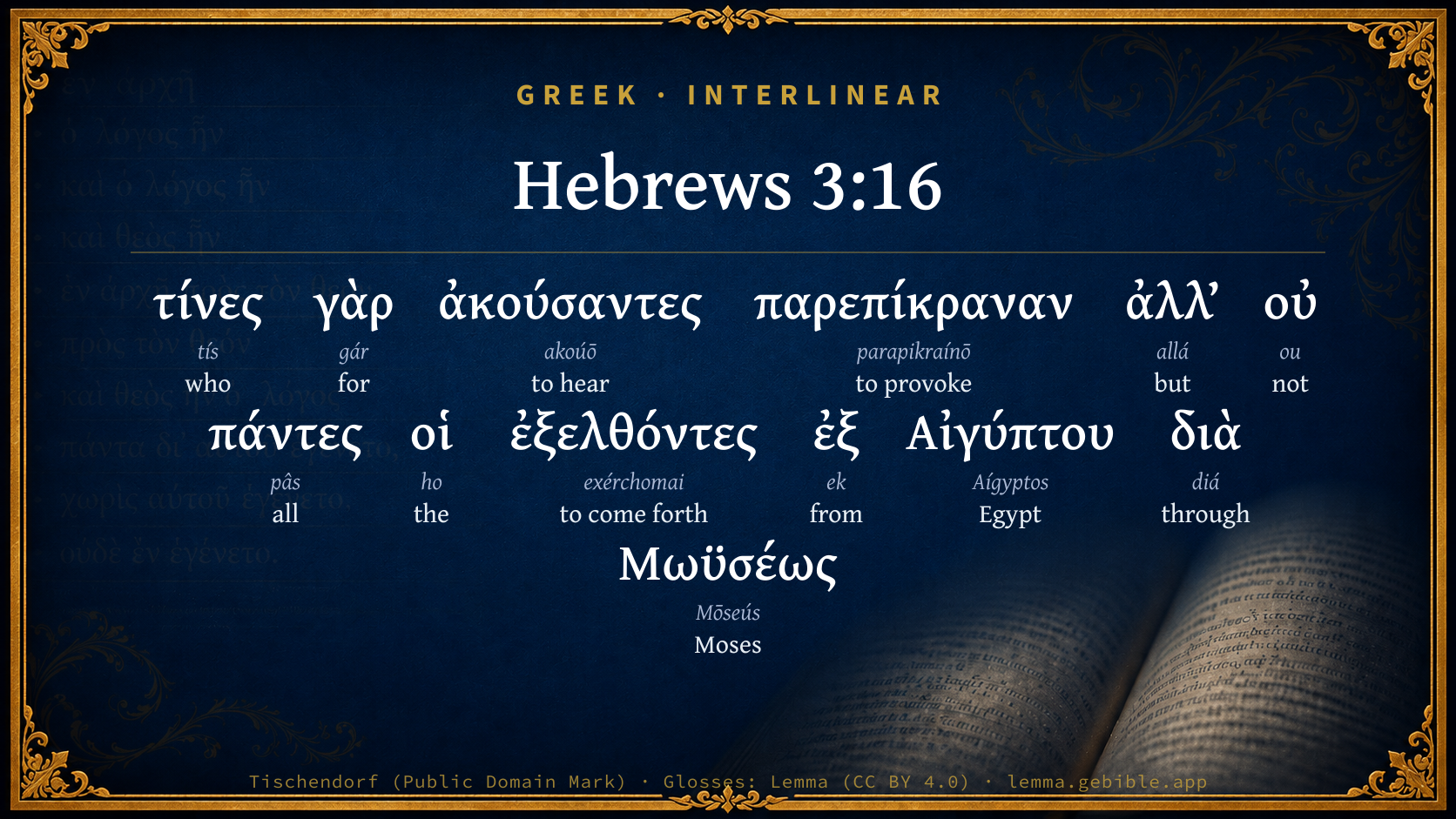
Greek (Tischendorf 8th ed.) Hebrews 3:16 appears in the Greek New Testament. The text above is from the Tischendorf 8th edition. Each word links to its Strong’s number and a concise gloss. Click any word for its full Thayer’s Greek Lexicon entry.
Download image
Cite this verse

Hebrews 3:16 (World English Bible). Public Domain. Lemma interlinear Bible study tool, https://lemma.gebible.app/v/hebrews/3/16.

Show BibTeX & RIS
BibTeX
RIS
English Translation
For who, when they heard, rebelled? No, didn't all those who came out of Egypt by Moses?
World English Bible · Public Domain
Highlights
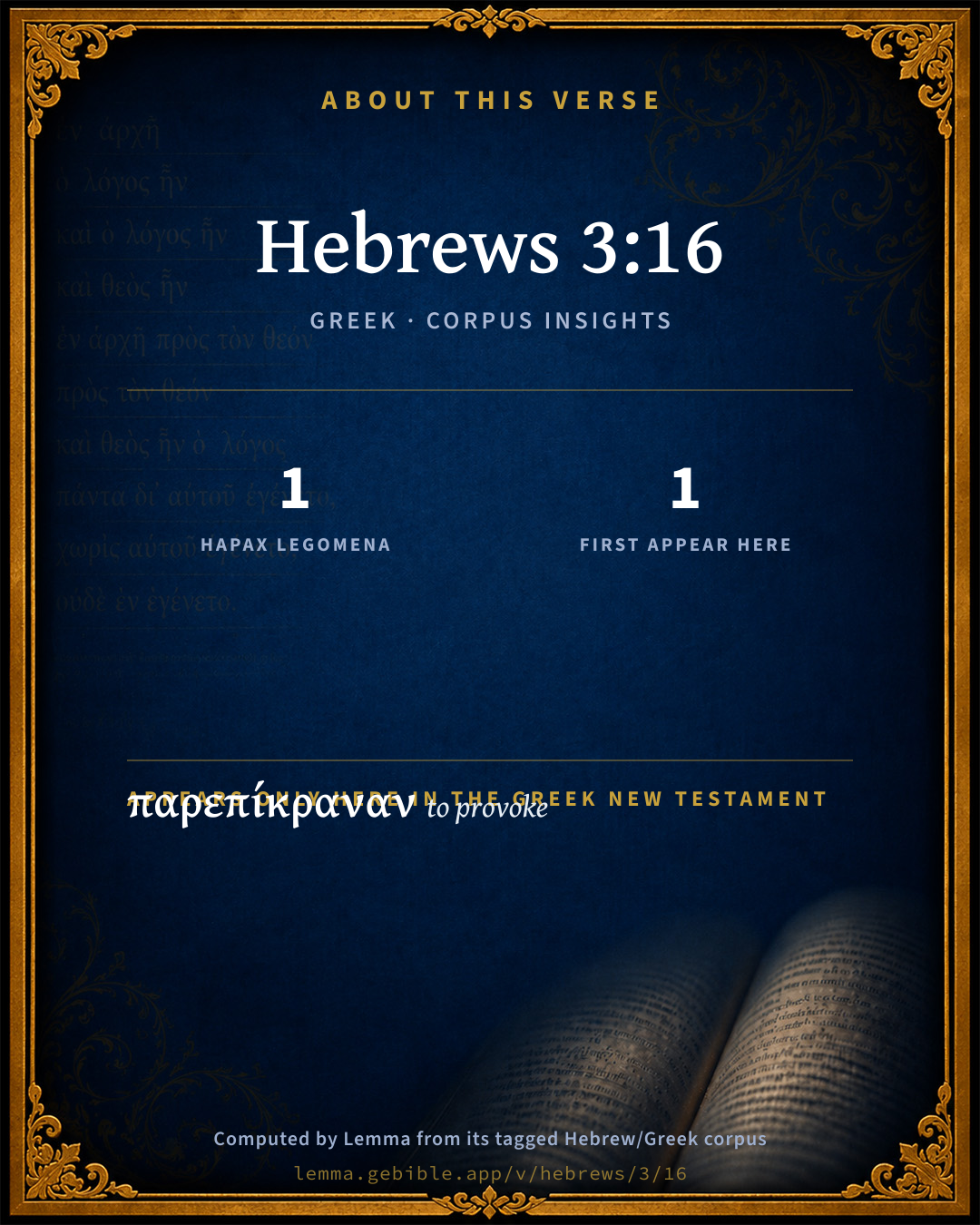
  • 1 hapax legomenon — only here in the Greek New Testament
  • 1 first appearance in the Greek New Testament
Full analysis ↓
Download a study sheet

One document with this verse’s original text, its word-by-word gloss line, the meaning frame, cross-references with their text, attributed commentary, and full source and license credits — printable, and it pastes into notes with its structure intact.

This verse Autodidact and up

Study sheet (.html) Plain text (.txt)

A passage Seminary Student

Up to 50 verses in one chapter. A passage sheet keeps up to 6 commentary sources and 12 cross-references per verse, in the order this page ranks them, and says so on the sheet whenever that leaves anything out. Ask for a single verse and you get the Autodidact verse sheet above.

Everything on this page stays free to read, with no account — the sheet is a download of what is already on screen, not access to it.

Want to remove ads? Support Godless Engineer
Compare translations 3

The same verse in 3 English versions, stacked beneath the original-language interlinear above. Click any original word for its lexicon entry.

Each is an independent rendering of the whole verse — the interlinear is not word-aligned to these translations.

Highlighted words mark where these versions differ — a whole-verse word diff, not a word-by-word alignment.

  • World English Bible Public Domain
    For who, when they heard, rebelled? No, didn't all those who came out of Egypt by Moses?
  • King James Version Public Domain
    For some, when they had heard, did provoke: howbeit not all that came out of Egypt by Moses.
  • unfoldingWord Literal Text CC BY-SA 4.0
    For which ones, having heard, provoked? not all the ones having come out from Egypt through Moses?

unfoldingWord Literal Text — © unfoldingWord, licensed CC BY-SA 4.0. Word-aligned USFM3 via Door43 (git.door43.org/unfoldingWord/en_ult).

Versions to compare (up to 4)

3 of 4 selected

Show all 19 translations

Every available English version of this verse, each an independent rendering of the whole verse.

  • World English Bible Public Domain
    For who, when they heard, rebelled? No, didn't all those who came out of Egypt by Moses?
  • Berean Standard Bible Public Domain
    For who were the ones who heard and rebelled? Were they not all those Moses led out of Egypt?
  • Majority Standard Bible Public Domain
    For some heard and rebelled, but not all those Moses led out of Egypt.
  • King James Version Public Domain
    For some, when they had heard, did provoke: howbeit not all that came out of Egypt by Moses.
  • American Standard Version (1901) Public Domain
    For who, when they heard, did provoke? nay, did not all they that came out of Egypt by Moses?
  • Revised Version (1885) Public Domain
    For who, when they heard, did provoke? nay, did not all they that came out of Egypt by Moses?
  • Geneva Bible (1599) Public Domain
    For some when they heard, prouoked him to anger: howbeit, not all that came out of Egypt by Moses.
  • Douay-Rheims (1899) Public Domain
    For some who heard did provoke: but not all that came out of Egypt by Moses.
  • Young's Literal Translation Public Domain
    for certain having heard did provoke, but not all who did come out of Egypt through Moses;
  • Literal Standard Version CC BY-SA 4.0
    For who [were those], having heard, [that] provoked, but not all those having come out of Egypt through Moses?
  • Unlocked Literal Bible CC BY-SA 4.0
    Who was it who heard God and rebelled? Was it not all those who came out of Egypt through Moses?
  • unfoldingWord Literal Text CC BY-SA 4.0
    For which ones, having heard, provoked? not all the ones having come out from Egypt through Moses?
  • Darby Bible Public Domain
    (for who was it, who, having heard, provoked? but [was it] not all who came out of Egypt by Moses?
  • World Messianic Bible Public Domain
    For who, when they heard, rebelled? Wasn’t it all those who came out of Egypt led by Moses?
  • Webster's Bible Public Domain
    For some, when they had heard, did provoke: yet, not all that came out of Egypt by Moses.
  • Free Bible Version CC BY-SA 4.0
    Who was it that rebelled against God, even though they heard what he said? Wasn't it all those who were led out of Egypt by Moses?
  • Bible in Basic English Public Domain
    Who made him angry when his voice came to them? was it not all those who came out of Egypt with Moses?
  • Text-Critical English NT CC BY 4.0
    For some did rebel when they heard God's voice, but not all whom Moses led out of Egypt.
  • Tyndale New Testament (1534) Public Domain
    For some when they hearde rebelled: howbe it not all that came out of Egypt vnder Moses.

Literal Standard Version (2020), Covenant Press — licensed CC BY-SA 4.0. Text via the HelloAO Bible API (eBible.org). Unlocked Literal Bible (unfoldingWord) — licensed CC BY-SA 4.0. Text via the HelloAO Bible API (eBible.org). unfoldingWord Literal Text — © unfoldingWord, licensed CC BY-SA 4.0. Word-aligned USFM3 via Door43 (git.door43.org/unfoldingWord/en_ult). Free Bible Version, Dr. Jonathan Gallagher — licensed CC BY-SA 4.0. Text via the HelloAO Bible API (eBible.org).

Word by word

More ways to search: Search by grammar → Find every occurrence → Compare this word →

Practice this passage: Drill this verse → Learn its vocabulary →

παρεπίκραναν
parapikraínō
G3893
“to provoke”
Verb, Aorist, Active, Indicative, 3rd person, Plural
Part of Speech
Verb
Tense
Aorist
Voice
Active
Mood
Indicative
Person
3rd person
Number
Plural
Full Thayer's Definition

Origin: from G3844 and G4087

TDNT: 08:05,8

1. to provoke, exasperate 2. to rouse to indignation
  1. τίνες tís G5101 “who” Interrogative pronoun, Nominative, Plural, Masculine
  2. γὰρ gár G1063 “for” Conjunction
  3. ἀκούσαντες akoúō G191 “to hear” Verb, Aorist, Active, Participle, Nominative, Plural, Masculine
  4. ἀλλ’ allá G235 “but” Conjunction
  5. οὐ ou G3756 “not” Particle, Negative
  6. πάντες pâs G3956 “all” Adjective, Nominative, Plural, Masculine
  7. οἱ ho G3588 “the” Article, Nominative, Plural, Masculine
  8. ἐξελθόντες exérchomai G1831 “to come forth” Verb, Aorist, Active, Participle, Nominative, Plural, Masculine
  9. ἐξ ek G1537 “from” Preposition
  10. Αἰγύπτου Aígyptos G125 “Egypt” Noun, Genitive, Singular, Feminine
  11. διὰ diá G1223 “through” Preposition
  12. Μωϋσέως Mōseús G3475 “Moses” Noun, Genitive, Singular, Masculine

About this verse

These counts appear in no published source. They are computed here, from the morphology-tagged text and Lemma’s own curated glosses. What Lemma adds →

13
words
13
distinct lemmas
General Epistles
section

Notable vocabulary

1 hapax legomenon — a word that appears only here in the entire Greek New Testament:

  • παρεπίκραναν to provoke G3893

First appearance in Scripture

This word makes its first canonical appearance in the Greek New Testament here:

  • παρεπίκραναν to provoke G3893

Shared distinctive vocabulary

Αἰγύπτου Egypt G125 occurs in 23 verses of the Greek New Testament. Also found in:
Cross-references

12

Topical passages linked to Hebrews 3:16 in the Treasury of Scripture Knowledge — connected by theme and wording, ordered by reader-vote popularity; previews shown in the World English Bible.

  • Numbers 14:2 All the children of Israel murmured against Moses and against Aaron: and the whole congregation said to them, Would that we had died in the land of Egypt! or would that we had died in this wilderness!
  • Numbers 14:30 surely you shall not come into the land, concerning which I swore that I would make you dwell therein, save Caleb the son of Jephunneh, and Joshua the son of Nun.
  • Numbers 26:65 For Yahweh had said of them, They shall surely die in the wilderness. There was not left a man of them, save Caleb the son of Jephunneh, and Joshua the son of Nun.
  • Deuteronomy 1:38 Joshua the son of Nun, who stands before you, he shall go in there: encourage you him; for he shall cause Israel to inherit it.
  • Psalms 78:17 Yet they still went on to sin against him, To rebel against the Most High in the desert.
  • Numbers 14:4 They said one to another, Let us make a captain, and let us return into Egypt.
  • Numbers 14:24 but my servant Caleb, because he had another spirit with him, and has followed me fully, him will I bring into the land into which he went; and his seed shall possess it.
  • Numbers 14:38 But Joshua the son of Nun, and Caleb the son of Jephunneh, remained alive of those men who went to spy out the land.
  • Deuteronomy 1:35–36 Surely there shall not one of these men of this evil generation see the good land, which I swore to give to your fathers,
  • Romans 11:4–5 But how does God answer him? "I have reserved for myself seven thousand men, who have not bowed the knee to Baal."
  • Hebrews 3:9–10 Where your fathers tested me by proving me, And saw my works for forty years.
  • Joshua 14:7–11 Forty years old was I when Moses the servant of Yahweh sent me from Kadesh-barnea to spy out the land; and I brought him word again as it was in my heart.

Cross-references courtesy of OpenBible.info (CC BY 4.0).

Commentary

Notes on Hebrews 3:16 from classic Christian and Jewish commentators (each source and its license shown beneath its notes). The classic Christian expositions comment on the surrounding passage and are grouped to its opening verse, so a note may address several verses; the Jewish commentaries on the Tanakh (Rashi and others) are per-verse, so they appear only where the commentator wrote on this verse.

Lemma curates 59 commentaries, every one of them public domain or Creative Commons licensed, each selected and text-cleaned for this edition rather than reprinted as found. About our sources →

Jamieson, Fausset & Brown

Robert Jamieson, A. R. Fausset & David Brown

For some--rather interrogatively, "For WHO was it that, when they had heard (referring to 'if ye will hear,' Heb 3:15), did provoke (God)?" The "For" implies, Ye need to take heed against unbelief: for, was it not because of unbelief that all our fathers were excluded (Eze 2:3)? "Some," and "not all," would be a faint way of putting his argument, when his object is to show the universality of the evil. Not merely some, but all the Israelites, for the solitary exceptions, Joshua and Caleb, are hardly to be taken into account in so general a statement. So Heb 3:17-18, are interrogative: (1) the beginning of the provocation, soon after the departure from Egypt, is marked in Heb 3:16; (2) the forty years of it in the wilderness, Heb 3:17; (3) the denial of entrance into the land of rest, Heb 3:18. Compare Note, see on Co1 10:5, "with the majority of them God was displeased."

howbeit--"Nay (why need I put the question?), was it not all that came out of Egypt?" (Exo 17:1-2).

by Moses--by the instrumentality of Moses as their leader.

Jamieson, Fausset & Brown — Commentary Critical and Explanatory on the Whole Bible (1871) — public domain (CC PDM 1.0). Text via the HelloAO Bible API.

The Biblical Illustrator

Joseph S. Exell

Heb_3:16

Borne, when they had heard, did provoke

Some but not all bad

I.

MANY HEAR THE WORD OR VOICE OF GOD TO NO ADVANTAGE, BUT ONLY TO AGGRAVATE THEIR SIN. Their hearing renders their sin provoking unto God, and destructive to their own souls. It is, I confess, a great privilege for men to have the Word preached unto them, and to hear it (Psa_147:19-20). But privileges are as men use them. In themselves, they are of worth, and to be prized. But unto us, they are as they are used. Hence the gospel comes unto some a savour of death unto death (2Co_2:16). Yea, Christ Himself, in His whole ministry was a stone of stumbling, and a rock of offence to both the houses of Israel, a gin and a snare to the inhabitants of Jerusalem (Isa_8:14; Luk_2:34). And the enjoyment of any part of the means of grace is but a trial.

II. IN THE MOST GENERAL AND VISIBLE APOSTASIES OF THE CHURCH, GOD STILL RESERVES A REMNANT UNTO HIMSELF TO BEAR WITNESS UNTO:HIM AND FOR HIM, BY THEIR FAITH AND OBEDIENCE. This He hath done, and this He will do.

1. To maintain His own kingdom in the world.

2. Should all faith utterly fail in the earth, should all professors provoke God and apostatise from Him, all gracious intercourse between the Holy Spirit and mankind in the world would be at an end.

3. Goal will do this for the work that He hath for some of His in all ages and seasons to do in the world. And this is great and various. He will have some always to conflict with His adversaries and overcome them, and therein give testimony to the power of His grace and truth.

4. God will always have a testimony given to His goodness, grace, and mercy.

5. God will always have a revenue of especial glory out of the world, in and by His worship.

III. GOD LAYS A FEW, OFT-TIMES A VERY FEW, OF HIS SECRET ONES IN THE BALANCE AGAINST THE GREATEST MULTITUDE OF REBELS AND TRANSGRESSORS. They are His portion, His inheritance, His jewels, dear to Him as the apple of His eye, and deservedly preferred unto the greatest heap of chaff and rubbish. (John Owen, D. D.)

The Biblical Illustrator, edited by Joseph S. Exell (c. 1880s–1900s) — public domain. Text from a community e-Sword module.

Joseph Benson's Commentary

Heb 3:16. For some, &c. — As if he had said, You have need to attend; be watchful and circumspect. For some — Yea, many; when they had heard — The voice of God in giving the law, and the various instructions which God granted them in the wilderness; did provoke — Literally, bitterly provoke, that is, God, whose voice they heard. By this consideration the apostle enforces his exhortation; when the people, says he, of old heard the voice of God in that dispensation of his law and grace which was suited to their condition, some of them provoked God; and whereas those also may do so who hear his voice in the dispensation of the gospel, it concerns all that hear it to take care that they be not disobedient; for, under every dispensation, dreadful is the consequence of abused mercy. Howbeit, not all that came out of Egypt — In the preceding discourse the apostle had expressed the sin and punishment of the people indefinitely, so as to appear at first view to include the whole generation in the wilderness; but here he makes an exception, which may refer to three sorts of persons. First, Those who were under twenty years of age in the second year after their coming out of Egypt, and who were not numbered in the wilderness of Sinai. See Num 1:1; Num 1:3. For of those that were then numbered, there was not a man left save Caleb and Joshua, but they all died, because of their provocation. Secondly, the tribe of Levi; for the threatening and oath of God was only against them that were numbered, and Moses was expressly commanded not to number the Levites; although it is much to be feared that the generality of this tribe also provoked and fell. Thirdly, Caleb and Joshua are excepted; and indeed seem here to be principally intended. Now the apostle thus expresses the limitation of his former general assertion, that he might enforce his exhortation by the example of them who believed and obeyed the voice of God, and therefore entered into his rest; as well as of those who provoked, and therefore were prohibited from entering it. So that he draws his argument not only from the severity of God, which at the first view seems to be only set forth, but also from his implied faithfulness and mercy.

Joseph Benson's Commentary on the Old and New Testaments (1811–1818) — public domain. Text from a community e-Sword module.

Whedon's Commentary on the Bible

Daniel D. Whedon

16. Some—It is a query (depending on the Greek accent upon the Greek word for some) whether this verse is affirmation or question. If it be an affirmation, the meaning then is, some provoked, but not all. But the provokers, in fact, were all with an exceptional two—Caleb and Joshua, Nor does the train of thought require a depreciation of the practically all into a some. On the contrary, the force of our author’s strain of warning here is increased rather by emphasizing the all, and overlooking the exceptions. The obvious interpretation, therefore, is to bring the verse into interrogative form, in accordance with the series of five interrogations, of which this verse contains two. Read thus: For who, when they heard, did provoke? Was it not all that came out of Egypt by Moses? The for, then, refers to the danger implied in the if of Heb_3:14; the danger of failing, as the mass of Israel did, of attaining rest in Christ. The for, therefore, introduces the whole drift of the following interrogations.

The series of questions argues that it was the provokers, the all, who sinned, and who believed not, that were the subjects of God’s grief, of his destructive judgment, and his menacing oath. The whole history shows, then, that perdition arises from unbelief as concludingly asserted in Heb_3:19.

c. Was it not the unbelievers who failed of that rest? Then let us fear, Heb_3:16 to Heb_4:2.

This paragraph is a series of questions impressing upon the Hebrews the fact that the underlying cause of Israel’s destruction in the wilderness was one—unbelief. Heb_3:19. This furnishes basis for an inferential exhortation against apostasy by this same unbelief, commencing with the therefore of Heb_4:1, and extending to Heb_4:16.

Daniel D. Whedon (gen. ed.), Commentary on the Old and New Testaments (1874–1909) — public domain. Text from a community e-Sword module.

Tyndale Open Study Notes

Tyndale Open Resources

3:16-19 These verses contain a rapid-fire series of questions and answers, a common rhetorical technique. The three questions follow the progression of ideas found in Ps 95:8-11: The people of Israel rebelled against God, God was angry, and God took an oath that they would never enter his rest. The answers are taken from other Old Testament passages that focus on the Israelites’ rebellion in the wilderness (Num 14; Deut 9; Ps 106). The author drives home the terrible cost of disobedience to God.

Tyndale Open Study Notes — © Tyndale Open Resources, licensed CC BY-SA 4.0. Text via the HelloAO Bible API.

Bengel's Gnomon

Johann Albrecht Bengel

Heb 3:16. Τίνες, who) Many write τινὲς, some; but the argument of the apostle is thus rendered somewhat feeble: τινὲς, ἀλλʼ οὐ πάντες, some, but not all, is rather a general expression concerning the Provocation, ch. Heb 4:6; Exo 17:2. Τίνες is plainly interrogative, as ch. Heb 1:5; Heb 1:13, and at the same time a very weighty Anaphora,[26] τίνες, τίσι, τίσι Heb 3:16-18; and there are brought under our notice in these three verses, 1. The beginning of the Provocation, soon after the departure from Egypt; 2. The forty troublesome years in the wilderness; 3. The refusal of the entrance into the land of rest. Ἀλλʼ οὐ is used, Heb 3:16, as εἰ μὴ, Heb 3:18; for neither is properly interrogative, but both stand under the interrogative word, τίνες. That the power of the particle may be more clearly seen, suppose some one to say, ἦσαν ἄνθρωποι παραπικραίνοντες, ἀλλʼ οὐχ οὗτοι οἱ ἐξελθόντες, There were men who provoked, but not those that went out. The apostle denies that, and therefore says, τίνες ἦσαν, ἀλλʼ οὐχ οὖτοι; who were they, but these?—i.e. these were the very persons. There are similar particles in Luke, τίς, ἀλλʼ οὐχὶ, Luk 17:7-8; and in Paul, τίς, ἢ οὐχὶ καὶ, κ.τ.λ., 1Th 2:19. Πάντες, in this passage, is none else but, merely those, a meaning of the word πᾶς which Raphelius, at Jas 1:17, beautifully explains, ex Ariano. Germ.: Diejenige, die eine Erbitterung angerichtet haben, wer waren sie? es warenlauter solche Leute, die von Egypten ausgegangen waren durch Mosen. These are not in this passage said to have been led out, but to have come out. They had already the pledge of Divine assistance, and had followed the Divine guidance; but their future progress did not correspond to that excellent beginning (comp. Heb 3:14). Chrysostom evidently reads τίνες: τίνων μἐμνηταί φησι σκληρυνθέντων; who, says he, have been mentioned as being hardened; where σκληρυθέντες (comp. Heb 3:15) are the same as παραπικράναντες.—ἀκούσαντες, after having heard) Heb 3:15.—παρεπίκραναν, provoked) the Lord, namely, by chiding with Moses, Exo 17:2.—διὰ Μωϋσέως, by Moses) whose words, when they heard them, they should have obeyed.

[26] The frequent repetition of the same word in beginnings.—ED.

Bengel's Gnomon of the New Testament — English translation (T&T Clark, Edinburgh, 1860) — public domain. Text from a community e-Sword module.

Expositor's Greek Testament

ed. W. Robertson Nicoll

Heb 3:16 . τίνες γὰρ ἀκούσαντες παρεπίκραναν : “For who were they who after hearing provoked?” He proceeds further to enforce his warning that confidence begun is not enough, by showing that they who provoked God and fell in the wilderness had begun a life of faith and begun it well. For the answer to his question is “Nay did not all who came out of Egypt with Moses?” They were not exceptional sinners who fell away, but all who came out of Egypt, the whole mass of the gloriously rescued people whose faith had carried them through between the threatening walls of water and over whom Miriam sang her triumphal ode. ἀλλά adds force to the answer, as if it were said, It is asked who provoked, as though it were some only, but was it not all? πάντες , for it is needless excepting Joshua and Caleb.

The Expositor's Greek Testament, edited by W. Robertson Nicoll (1897–1910) — public domain. Text from a community e-Sword module.

Adam Clarke's Commentary

Verse 16. For some, when they had heard, did provoke] There is a various reading here, which consists merely in the different placing of an accent, and yet gives the whole passage a different turn: - τινες, from τις, who, if read with the accent on the epsilon, τινες, is the plural indefinite, and signifies some, as in our translation; if read with the accent on the iota, τινες, it has an interrogative meaning; and, according to this, the whole clause, τίνες γαρ ακουσαντες παρεπικραναν: But who were those hearers who did bitterly provoke? αλλ' ου παντες οἱ εξελθοντες εξ Αιγυπτου δια Μωσεως; Were they not all they who came out of the land of Egypt by Moses? Or, the whole clause may be read with one interrogation: But who were those hearers that did bitterly provoke, but all those who came out of Egypt by Moses? This mode of reading is followed by some editions, and by Chrysostom and Theodoret, and by several learned moderns. It is more likely that this is the true reading, as all that follows to the end of the 18th verse is a series of interrogations.

Should it be said that all did not provoke, for Joshua and Caleb are expressly excepted; I answer, that the term all may be with great propriety used, when out of many hundreds of thousands only two persons were found who continued faithful. To these also we may add the priests and the whole tribe of Levi, who, it is very likely, did not provoke; for, as Dr. Macknight very properly remarks, they were not of the number of those who were to fight their way into Canaan, being entirely devoted to the service of the sanctuary. See Nu 1:3; Nu 1:45, and Nu 1:49. And therefore what remained of them after forty years, no doubt, entered Canaan; for it appears from Nu 34:17, and Jos 24:33, that Eleazar, the son of Aaron, was one of those who did take possession of Canaan. Should it be still said our version appears to be most proper, because all did not provoke; it may be answered, that the common reading, τινες, some, is too contracted in its meaning to comprehend the hundreds of thousands who did rebel.

Adam Clarke's Commentary on the Bible (1810–1826) — public domain. Text from a community e-Sword/MySword module.

John Calvin's Commentaries

16 For some, when they had heard, etc. David spoke of the fathers as though that whole generation were unbelieving; but it appears that some who truly feared God mingled with the wicked. The apostle mentions this to modify what had been more severely said by David, in order that we may know that the word is preached to all for this end, that all may obey it with one consent, and that the whole people were justly condemned for unbelief, when the body was torn and mutilated by the defection of the greatest part.

But by saying that some provoked, while yet they were by far the greatest part, this object was not only to avoid giving offense, but also to encourage the Jews to imitate those who believed; as though he had said, “As God forbids you to follow the unbelief of the fathers, so he sets before you other fathers whose faith is to be your example”. Thus is mitigated what otherwise might have appeared too hard; that is, had they been commanded wholly to dissent from their fathers. To come out by Moses, means by the hand of Moses, for he was the minister of their deliverance. But there is an implied comparison between the benefit which God had bestowed on them by Moses, and the participation of Christ previously mentioned.

John Calvin's Commentaries (1540-1563) — public domain. Text from the Calvin Translation Society English edition (1840s-50s) via the Christian Classics Ethereal Library (ccel.org). Calvin's coverage is partial (roughly two-thirds of the Bible); uncommented books and verses are honest gaps, never fabricated. The 19th-century editor's footnotes and remarks are omitted so the notes are faithfully Calvin's own voice.

Ellicott's Commentary for English Readers

(16) For.—The connecting link is the thought of “the provocation.” A slight change in the accentuation of the first Greek word effects a complete change in the sense: For who when they had heard did provoke? Nay, was it not all that came out of Egypt through Moses? Those who were disobedient were the people whom God, through Moses, had but now delivered from bondage! The two exceptions (Num_14:30) are left out of account in the presence of the multitude of rebels. There can be little doubt that the above translation (now generally received) presents the true meaning of the verse. It will be remembered that the oldest MSS. give no evidence on such points as accentuation, and therefore leave our judgment free. In modern times Bengel was the first to point out the true form of the Greek word; but one of the ancient versions (the Peschito-Syriac), and at least three of the Greek Fathers, are found to give the same interpretation. It will be seen at once that, with this arrangement of the words, the present verse is similar in structure to the two following.

A Bible Commentary for English Readers, edited by Charles John Ellicott (1878–1897) — public domain. Text from a community e-Sword module.

The Cambridge Bible for Schools and Colleges

gen. ed. J. J. S. Perowne

16. some, when they had heard, did provoke] Rattier, “Who (τίνες) when they heard, embittered (Him)”? This is the reading of the Peshito. It would have been absurd to use the word “some” of 600,000 with only two exceptions, Num_14:38; Jos_14:8-9.

howbeit not all] Rather, “Nay! was it not all?” (i.e. all except Caleb and Joshua). It is true that the rendering is not free from difficulty, since there seems to be no exact parallel to this use of ἀλλ' οὐ. But it involves less harshness than the other.

The Cambridge Bible for Schools and Colleges (gen. ed. J. J. S. Perowne; Cambridge University Press, 1878–1918) — public domain. Text from a community e-Sword module.

John Gill's Exposition

But with whom was he grieved forty years?.... As is said in Psa 95:10; see Gill on Heb 3:10,

was it not with them that had sinned; not merely by committing personal iniquities, and particular provocations, which all men are guilty of, but by committing public sins; they sinned as a body of men; they joined together in the commission of sin; every sin is grieving to God, because it is contrary to his nature, is an act of enmity to him, is a transgression of his righteous law, and a contempt of his authority; but especially public sins, or the sins of a multitude, and when they are persisted in, which was the case of the Israelites; they sinned against him during the forty years they were in the wilderness; and so long was he grieved with them: the Alexandrian copy reads, "with them that believed not"; which points out the particular sin these men were guilty of, and which was so grieving to God, and suits well with the apostle's design:

whose carcasses fell in the wilderness? and so never entered into the land of Canaan. They died in the wilderness; and they did not die common and natural deaths, at least not all of them; their deaths were by way of punishment; in a way of wrath; in a judicial way: the Syriac version renders it, "their bones fell in the wilderness"; they lay scattered and unburied, and exposed to view, as an example of divine vengeance, see Num 14:29.

John Gill's Exposition of the Whole Bible (1746–1763) — public domain (CC PDM 1.0). Text via the HelloAO Bible API.

Trapp's Complete Commentary

John Trapp

16 For some, when they had heard, did provoke: howbeit not all that came out of Egypt by Moses.

Ver. 16. Howbeit not all] Yet all fell in the wilderness save Joshua and Caleb. Good men are oft wrapped up in a common calamity. The righteous perisheth, Isa 57:1, so the world thinketh; "But whether they live, they live unto the Lord, or whether they die, they die unto the Lord," Rom 14:8. The good grain is cut down together with the tares, but to another and to a better purpose.

John Trapp, A Commentary or Exposition upon All the Books of the Old and New Testament (1647–1656) — public domain. Text from a community e-Sword module.

Albert Barnes' Notes on the Bible

For some - Some of the Hebrews who came out of Egypt. The truth was that a large proportion of them rebelled against God, and provoked him to indignation. It is somewhat remarkable that though “all” the Hebrews seem to have joined in the provocation - except a very small number - Paul should have used language which would seem to imply that the number which rebelled was comparatively small. Another version, therefore, has been given to this passage by some of the most eminent critics, consisting merely in a change in the punctuation, by which a different view is given of the whole sentence. According to this, it would be a question, and would mean, “But who were they who when they had heard did provoke? Were they not all indeed who came out of Egypt under Moses? And with whom was He angry for 40 years? Was it not with those who sinned, whose carcasses fell in the wilderness?” This version was adopted by Chrysostom, Theodoret, and others of the Fathers; and is adopted by Rosenmuller, Clarke, Stuart, Pyle, and some others. In favor of it, it may be alleged:

(1)That the Greek will bear it, all the change required being in the punctuation;

(2)That it avoids the difficulty which exists in the other interpretation of supposing the apostle to imply that but few of them rebelled, when the truth was that it was nearly all;

(3)It thus accords with the remainder of the exhortation, which consists in a series of questions; and,

(4)It agrees with the scope and design of the whole.

The object was not to state that it was not all who came out of Egypt that rebelled, or that the number was small, but that the great body of them rebelled and fell in the wilderness, and that Christians should be admonished by their example. These reasons seem to be so strong as to make it probable that this is the true construction, and the sense then will be, “For who were they that having heard did provoke? Were they not all who came out of Egypt under Moses?”

When they had heard - Had heard God speaking to them, and giving them his commands.

Did provoke - Provoked him to anger; or their conduct was such as was suited to produce indignation; see the note on Heb 3:8.

Howbeit - Αλλά Alla. “But.” This particle “in a series of questions, and standing at the head of a question, means “but, further.” It serves to connect, and give intensity to the interrogation” - Stuart. Paul means to ask with emphasis whether the great mass of those who came out of Egypt did not apostatize? At the same time he means to intimate that there is no security that they who have witnessed - remarkable manifestations of the greatness of God, and who have partaken of extraordinary mercies, will not apostatize and perish. As the Hebrews, who heard God speak from Mount Sinai, revolted and perished, so it is possible that they who witness the mercies of God in redemption, may be in danger of abusing all those mercies, and of perishing. By the example, therefore, of the disobedient Israelites, he would admonish professed Christians of their danger.

Not all ... - According to the interpretation proposed above, “Were they not all who came out of Egypt?” Or “did not all who came out of Egypt?” The word “all” here is not to be taken in the strict sense, It is often used to denote the great body; a large proportion; or vast multitudes. Thus, it is used in Mat 3:5, “Then went out to him Jerusalem, and all Judea, and all the region round about Jordan.” So in Joh 3:26, “The same baptizeth, and all people came to him.” So Phi 2:21, “For all seek their own;” 2Co 3:2, “Ye are our epistle, known and read of all men.” “In fact” there were two exceptions - and but two - of the adults who came out of Egypt - Caleb and Joshua; Num 14:30. All the others complained against the Lord, and were prohibited from entering the promised land. Of the great multitudes who came out of Egypt, and who murmured, the exception was so small that the apostle had no scruple in saying in general that they were all rebellious.

Albert Barnes' Notes on the Bible (1834–1885) — public domain. Text from a community e-Sword/MySword module.

Haydock's Catholic Bible Commentary

Let us not flatter ourselves with having quitted Egypt by our baptism, unless we also quit that opposition, and that disobedience of our heart to the laws and maxims of the gospel. The Israelites, under the guidance of Moses, left Egypt for the promised land, and after travelling in the desert for the space of two years, found themselves on the confines of that so much desired country; but the possession of it was denied them, and they were left to perish in the desert, because they distrusted God’s promises, and were incredulous to his word. All that happened to this chosen people, says St. Paul, was a figure of what was to happen to us. Here then we may read our destiny, if, like them, we prove ungrateful to God.

George Leo Haydock (1774–1849), Haydock's Catholic Family Bible and Commentary, 1859 edition — public domain. Excludes Psalms (Douay-Rheims chapter numbering differs from Protestant) and Deuterocanonical books (Catholic canon only).

Matthew Poole's English Annotations

For some, when they had heard, did provoke: this is a rational enforcement of the former duty pressed; it being as possible for them to provoke Christ as others, they should look to it, and not harden their hearts; for the greater some, the most of the congregation of Israel, imbittered God’s Spirit by their unbelief and hardness of heart; though Christ spake to them from heaven, as never was before done, and daily by Moses they were hearing counsels by which they might live, yet provoked they him, and would not believe.

Howbeit not all that came out of Egypt by Moses: this rightly interprets the psalmist, and sets a better example of their fathers for them to follow. Let Caleb and Joshua, believers, and obedient to God, be your patterns to imitate. He aggravates the disobedience of the one, and the obedience of the other. They all had equally a clear exemption and deliverance from the place of bondage, and that by Moses, by whom God wrought such miracles as might command faith from any; yet these some, by murmuring and striving with the Redeemer, provoked him: how great is their sin! How suitable and pleasing the obedience of the others to him!

Matthew Poole's English Annotations on the Holy Bible (1683–1685) — public domain. Text from a community e-Sword/MySword module.

The Pulpit Commentary

Vers. 16-19. For who, when they heard, provoked? Nay, did net all those who came out of Egypt by Moses. That both these clauses are interrogative, and not as taken in the A.V, is now the prevalent view. The reasons for thus understanding them are

(1) The analogy of the two following verses, both of which are interrogative, and in the first of which a question is similarly answered by putting another; and

(2) The sense required. If the clauses were assertions, they could only be meant to express that the provocation was not universal, inasmuch as Joshua and Caleb (and it might be some few others) remained faithful. But to say this is unnecessary and irrelevant to the argument, the drift of which is to warn by "the example of unbelief;" and could tinev ("some") possibly be used to denote the whole congregation with the exception of so few? It is to be observed, too, that the all ou at the beginning of the second clause is a proper Greek expression (equivalent to "nay") in the case of one question being answered by another. (of Luk_17:7, Luk_17:8) This verse, then (gar retaining its usual sense of "for"), begins a proof, put in the form of a series of questions, of the preceding implied proposition, viz. that the retention of Christian privilege is dependent on perseverance, and that the privilege may be forfeited. In order to show this fully, the history of Numbers 14., referred to in the warning of the psalm, is examined in connection with the successive expressions of the warning; and it thus appears that all who came out of Egypt by Moses (the small exception of the faithful spies being disregarded) provoked God, and so forfeited their privilege, and that the cause of their failure was sin, disobedience, and, at the root of all, unbelief. The conclusion is obvious that, as their example is held out in the psalm as a warning to us, we may, all or any of us, similarly forfeit our higher calling. That the psalm is a warning to us, the rest it points to being the rest won for us by Christ, is more fully shown in the following chapter. We observe how the leading words in Psalm 95 are taken in succession in the three successive verses parapikrasmov in ver. 16, proswcyisa in ver. 17, wmosa in ver. 18 and how answers to the three questions suggested by these words are found in Numbers 14 to the first, in vers. 2, 10, etc., all the children of Israel," "all the congregation;" to the second, in vers. 29-34, with citation of the words used; to the third, in vers. 21-24. It is to be observed, further, that it is not simply apistia , but its exhibition in actual sin and disobedience (toiv amarthsasi toiv apeiyhsasi), that is spoken of as calling forth the Divine wrath and the Divine oath. The second of the above words implies more titan "believed not" (as in the A.V); apeiyein differs from apistein in implying disobedience or contumacy. And this view of the case of the Israelites agrees entirely with the historical record, where an actual rebellion is spoken of a refusal to go on with the work they had been called to. It suits also the application to the case of the Hebrew Christians, among whom (as has been said) it was not only wavering of faith, but, as its consequence, remissness in moral duty and in the facing of trial, of which the writer of the Epistle had perceived symptoms, and on the ground of which he warns them to take heed lest growing indifference should be hardened into apostasy. But in both instances, as faith is the root of all virtue, so want of it was the cause, and again the growing result, of moral decadence. And so the argument is summed up in the concluding verse, And we see that they could not enter in because of unbelief.

Ver. 19. The dread disability.

"So we see that they could not enter in because of unbelief." Our text

I REFUTES SEVERAL ASSIGNED REASONS FOR MAN"S FAILURE TO ATTAIN SALVATION.

If any one does not enter the spiritual rest which God has graciously provided for man, it is:

1. Not by reason of anything in the purposes or predestinations of God.

His purposes are the purposes of a Being of perfect righteousness, and of infinite wisdom and love. He could not ordain an evil thing, or have any intentions which are inimical to the well-being of his creatures; for he is God the Supremely Good. (cf. Eze_33:11 1Ti_2:4-6)

2. Not by reason of any deficiency in God"s redemptive provisions. These are abundant, inexhaustible, and entirely free. The atonement of Jesus Christ, which is perfectly adapted to reconcile man to God, is as efficacious for a million hearts as it is for one. (cf. Isa_55:1, Isa_55:2, Isa_55:6, 7 Mat_22:1-10 Luk 14:16-23Jo Luk_3:14-17 Rev_22:17)

3. Not by reason of any inability to accept God"s redemptive provisions.

The condition upon which salvation is appropriated by man is sincere and hearty faith in the Lord Jesus Christ. Every sane man can comply with this condition if he will.

4. Not by reason of any deficiency of evidence for the essential truths of Christianity. The Christian religion is founded upon facts, which are as well attested as any facts of history.

II AFFIRMS THE TRUE REASON FOR MAN"S FAILURE TO ATTAIN SALVATION. "They were not able to enter in because of unbelief." This unbelief is not intellectual or theoretical, but practical, and resulting in disobedience. The unbelief of the Israelites here spoken of totally unfitted them for entering the promised land. (see Num_14:1-4, Num_14:22, Num_14:23, Num 14:26-25) Their unbelief had stripped them of hope and of courage, and reduced them to humiliating despondency and cowardice. No one can enter upon any worthy inheritance without the exercise of faith. For the discovery of new countries, for the exploration of unknown lands, for the carrying out of great reformations or ameliorations, for the perfecting of beneficent inventions, for the accomplishment of every worthy and noble enterprise, the possession and exercise of faith is indispensable. The attainment of salvation is impossible apart from faith. Unbelief it is which excludes men from the true rest of the soul. They are "not able to enter in because of unbelief." This is the dread disability, the unwillingness to heartily and practically believe in Jesus Christ. "Ye will not come to me, that ye may have life." If any man is not saved, he alone is to blame. He is diseased, yet he turns aside from the remedy. He is condemned, yet he refuses to accept the offered pardon. He is self-destroyed. W.J.

The Pulpit Commentary (1880–1919), ed. H.D.M. Spence-Jones & Joseph S. Exell — public domain. Text from a community e-Sword module.

John Wesley's Explanatory Notes

Were they not all that came out of Egypt - An awful consideration! The whole elect people of God (a very few excepted) provoked God presently after their great deliverance, continued to grieve his Spirit for forty years, and perished in their sin!

John Wesley, Explanatory Notes Upon the Whole Bible (1754–1765) — public domain. Text via the GEBible commentary corpus.

The People's New Testament

B. W. Johnson

16. For some, when they had heard, did provoke. Some in the wilderness heard God, but refused to listen, and did not provoke him. Howbeit not all. There were a few exceptions; Joshua and Caleb, Eliezer, and perhaps some more of the Levites.

B. W. Johnson's The People's New Testament with Notes (1889–1891) — public domain. Electronic text from the Christian Classics Ethereal Library (CCEL) ThML edition.

unfoldingWord translationNotes

Door43 World Missions Community

General Information:

The word "they" refers to the disobedient Israelites, and "we" refers to the author and readers. (See: Inclusive "We")

Who was it who heard God and rebelled? Was it not all those who came out of Egypt through Moses?

The author uses questions to teach his readers. These two questions can be joined as one statement, if needed. AT: "All those who came out of Egypt with Moses heard God, yet they still rebelled." (See: Rhetorical Question)

With whom was he angry for forty years? Was it not with those who sinned, whose dead bodies fell in the wilderness?

The author uses questions to teach his readers. These two questions can be joined as one statement, if needed. AT: "For forty years, God was angry with those who sinned, and he let them die in the wilderness." (See: Rhetorical Question)

forty years

"40 years" (See: Numbers)

To whom did he swear that they would not enter his rest, if it was not to those who disobeyed him?

The author uses this question to teach his readers. AT: "And it was to those who disobeyed that he swore they would not enter his rest." (See: Rhetorical Question)

they would not enter his rest

The peace and security provided by God are spoken of as if they were rest that he can give, and as if they were a place to which people could go. AT: "they would not enter the place of rest" or "they would not experience his blessings of rest" (See: Metaphor)

because of unbelief

The abstract noun "unbelief" can be translated with a verbal phrase. AT: "because they did not believe him" (See: Abstract Nouns)

translationWords

God

rebel

Egypt

Moses

anger

year

sin

desert

oath

rest

disobey

believe

unfoldingWord translationNotes — © Distant Shores Media and the Door43 World Missions Community, licensed CC BY-SA 4.0. Source: git.door43.org/Door43/en_tn.

Cambridge Greek Testament for Schools and Colleges

16. τίνες; Who? The rec. has τινές with LM. See the note.

16. τίνες γὰρ ἀκούσαντες παρεπίκραναν; “For who (τίνες) when they heard, embittered (Him)?” This (τίνες;) is the reading of the Peshito. It would have been absurd to use the word τινές, “some,” of 600,000 with only two exceptions, Num 14:38; Jos 14:8-9.

ἀλλʼ οὐ πάντες; “Nay, did not (practically) all?” (i.e. all except Caleb and Joshua). It is true that the rendering is not free from difficulty, since there seems to be no exact parallel to this use of ἀλλʼ οὐ. But it involves less harshness than the other.

Cambridge Greek Testament for Schools and Colleges (Cambridge University Press, 1896; 21 vols, various authors incl. Carr, Maclear, Plummer, Farrar, Lumby, Moule, M. R. James, Simcox) — public domain. Text from a community e-Sword module.

Alford’s Greek Testament

Henry Alford

16.] For (on our understanding of the connexion of ἐν τῷ λέγεσθαι (see above) this γάρ is not the elliptic γάρ so often accompanying an interrogation, as on Bleek’s rendering, but the ordinary γάρ, rendering a reason. ‘You need indeed to be careful against unbelief:—for on account of this very unbelief all our fathers were excluded’) who, when they had heard (in immediate reference to ἐὰν ἀκούσητε above), provoked (scil. God: see reff. and Eze 20:13 A)? nay, was it not (this ἀλλά, in a question which itself answers a question, is elliptical, and may be explained in two ways: 1. ‘was it not, not a few but’.…: 2. by regarding the ἀλλά as expressing a negation of the uncertainty implied in the question—a ground why the question should not have been asked at all. And this is by far the better account: cf. ref. Luke: τίς δὲ … ἐξ ὑμῶν.… ὃς ἐρεῖ … ἀλλʼ οὐχὶ ἐρεῖ; q. d. ‘what need to ask such a question?’ Xen. Cyr. ii. 2. 21, καὶ τί δεῖ.… ἐμβαλεῖν λόγον περὶ τούτου, ἀλλʼ οὐχὶ προειπεῖν ὅτι οὕτω ποιήσεις; Aristid. Panath. i. p. 169, ἆρʼ ἴσον τὸ κεφάλαιον, ἢ μικρὸν τὸ διάφορον; ἀλλʼ οὐ πᾶν τοὐναντίον;) all who (Bengel and several others would take πάντες οἱ to signify “meri,” “only those who,” a meaning which it cannot by any possibility bear. As above noticed, the exceptions are put out of sight, and that which was true of almost all, asserted generally) came out from Egypt by means of Moses (the construction is somewhat unusual. We should expect with διὰ a passive participle, like ἐξαχθέντες. Lünemann refers to διʼ ὧν ἐπιστεύσατε 1Co 3:5)? and (we cannot otherwise express in English this δέ, which simply brings out the very slight contrast of a second and new particular. It is “but” in the E. V.: but that is because they take ver. 16 in the manner above rejected, as an assertion) with whom was He offended forty years (see on vv. 9, 10 for the verb προσώχθισεν, and the consonance, in the connexion of τεσς. ἔτη with it, with that in the Psalm, which was there departed from)? Was it not with those who sinned (some, as Bengel, Griesbach, Lachmann, Knapp, Vater, set the interrogation here, and take ὧν τὰ κῶλα κ.τ.λ. as an affirmative sentence. But it seems unnatural to insert an affirmative clause in the midst of a series of interrogatories, and therefore better to keep the interrogation for the end of the sentence, including that clause in it), whose carcases (κῶλα any members of the body, but especially the legs: taken also for the legs and arms, i. e. limbs: see example in Wetst. from Galen. The LXX, see reff., use it for פְּגָרִים, corpses: but probably with the meaning that their bodies should fall and perish limb from limb in the wilderness: so Beza: “Hoc vocabulo significatur, illos non tam sic ferente mortalitate vel quovis morbo, sed tabescentibus sensim corporibus in deserto veluti concidisse”) fell in the wilderness (cf. 1Co 10:5, κατεστρώθησαν γὰρ ἐν τῇ ἐρήμῳ. The words here are exactly those of Num 14:29. Again, we must remember, in explaining these words, that the Writer is not bearing in mind at this moment the exceptions, but speaking generally. So Calvin: “Quæritur, an Moses et Aaron ac similes in hoc numero comprehendantur. Respondeo, apostolum de universo magis corpore quam de singulis membris loqui”)? And to whom (not “concerning whom,” as Syr., al.: the dative after verbs of swearing or asserting is common, as expressing those towards whom the act is directed. So that it is not a dativus incommodi, as Lünemann) sware He that they should not enter into His rest (the construction here is somewhat anomalous with regard to the subject of the verb εἰσελεύσεσθαι. Ordinarily, the subject of the verb of swearing is identical with that of the verb expressing the act to which he binds himself. So in Xen. Hel. iii. 4. 6, Τισσαφέρνης μὲν ὤμοσε τοῖς πεμφθεῖσι πρὸς αὐτὸν.… ἢ μὴν πράξειν ἀδόλως τὴν εἰρήνην· ἐκεῖνοι δὲ ἀντώμοσαν.… τισσαφέρνει, ἢ μήν, ταῦτα πράττοντος αὐτοῦ, ἐμπεδώσειν τὰς σπονδάς. See other examples in Bleek. But here the persons to whom the oath is directed, are the subject of the future εἰσελεύσεσθαι. We seem to want either a τό before μὴ εἰσελεύς., or an αὐτούς after it. The latter construction is found in ref. Tobit, ὀμώμοκε Ῥαγουήλ, μὴ ἐξελθεῖν με), except to those who disobeyed (not, as vulg., “increduli fuerunt:” E. V., “believed not:” and so Luther, Estius, Calov., al.: this was a fact, and was indeed the root of their ἀπείθεια: but ἀπειθής, ἀπειθεῖν, are most commonly used of practical unbelief, i. e. disobedience: even in the passages in the Acts (reff.), where the meaning approximates the nearest to unbelief, it is best understood of ‘contumacia.’ Ref. Deut. seems decisive of the meaning here: see also Deu 9:7, Deu 9:23, Deu 9:24: Jos 1:18 al.)?

Henry Alford, The Greek Testament (1849–1861) — public domain. Text from a community e-Sword module.

Vincent's Word Studies in the New Testament

Marvin R. Vincent

For some, when they had heard, did provoke [τινες γαρ ακουσαντες παρεπικραναν] . Rend. who, when they heard, did provoke ? The interrogative tinev calls special attention to those who provoked God. The writer would say, " My warning against apostasy is not superfluous or irrelevant : for, consider : who were they that provoked God ? They were those who had fairly begun their journey to Canaan, as you have begun your Christian course. They provoked God, so may you. Howbeit not all [αλλ ου παντες] . Wrong. The interrogation should be continued. Who were they? But [αλλ] why do I ask? Were they not all who came out of Egypt by Moses ? They were so numerous that they practically constituted the whole generation of the exodus. So far from its being true that a good ending necessarily follows a good beginning, a whole generation of God 's chosen people failed to reach the Land of Promise because they provoked God.

Marvin R. Vincent, Word Studies in the New Testament (1887–1900) — public domain. Text from a community e-Sword/MySword module.

Westcott on Hebrews & the Epistles of John

Brooke Foss Westcott

16. rivers ydp...] Tho warning is necessary. Christians have need of anxious care. For who wore they who so provoked God in old times f Even those whom He had already brought from bondage.

τίνες... ἀλλ᾽ ov πάντες... For who...? Nay, did not...? Vulg. Quidam cum (τινὲς ydp)...zed non universi... For some when they had heard did provoke (A.V.). This rendering is quite alien from the context. The vast mass who came out of Egypt could not be described as ‘some.’ On the other hand the interrogative completely corresponds with the two intorrogatives which follow (τίνες... τίσιν ...tiow...); and the three questions point to the three stages of the divine displeasure. Nor does tho faith of Joshua and Calob invalidate tho genoral statement.

παρεπίκραναν] Tho verb occurs here only in N.T., but it is not anfroquont in Lxx. and Philo. It is usod gencrally with ace. of object: Ps. Ixxvii. (Ixxviii.) 17 παρεπίκραναν τὸν ὕψιστον, but also

ἀλλ᾽ ov...) Nay, such a question cannot be asked as if the answer were doubtful: was tf not...7

For the use of ἀλλά compare Lk. John xii. 27.

οἱ ἐξελθόντες] The word marks the act of the people, the manifestation of faith on thoir part, as well as the act of Moses, They ‘came out’ and not only ‘were led out’ (Acts vii. 36 ἐξή-

yayer; c. viii. 9).

διὰ Μωυσέως] The fact that Moses had been the instrument of their deliverance should have kept them from ‘ chiding with him’ (Bx. xvii. 2).

17. The unbelief of the people shewed itself in open sin from first to last (9. 8).

τίσιν δὲ προσ. And with whom...? In this place the writer gives the connexion of τεσσ. ὅτη which is found in the Hebrew. From the beginning of the wanderings to the end (Ex. xvii. 7; Num. xx. 13), the people sinned in like ways. In this verse and in the next (ἀπειθήσασιν) the reference is not to the general character of the people, but to the critical acts which revealed it

ἁμαρτήσασιν] This is the only form of the aor. partic. in N.T. In the moods the form of ἥμαρτον is always used excopt Matt. xviii. 15 || Lk. xvii.

ra κῶλα] The word is borrowed from the Lxx. (Num. xiv. 29).

It seems best to take tho clause ὧν .οὐὐρήμῳ, a8 & subsidiary clement in the description and not as an independent statement.

Brooke Foss Westcott (1825–1901), The Epistle to the Hebrews (1889) and The Epistles of St John (1883) — public domain (pre-1929). Text recovered from Internet Archive / Google Books OCR scans. Westcott’s Gospel of John commentary is not included (its OCR lost the chapter running-heads required for reliable verse-keying). Some Greek quoted in the Hebrews volume is imperfectly rendered by the OCR.

Lesson kit

Teaching starters — assembled from the data on this page, not authored interpretation. Every prompt links to the verse data it draws on. Edit before teaching.

Hebrews, in the General Epistles, opens this verse with 13 words (13 distinct Greek lemmas). Its most distinctive word is parapikraínō (“to provoke”). A historical commentator’s framing appears above. Read the whole chapter for the surrounding context.

Discussion questions

  1. How does “to provoke” (parapikraínō) shape what this verse is saying?
  2. This verse holds 1 word here found nowhere else in the Greek New Testament. What might the rare word draw attention to?
  3. The word “to provoke” first appears here in Scripture. What is being introduced at this debut?
  4. Matthew 2:13 shares the word «Egypt» with this verse. How do the two illuminate each other?
  5. The translations on this page render this verse differently — a whole-verse word diff, not a word-by-word alignment. What might account for the different wordings?
  6. Reading how Jamieson, Fausset & Brown and The Biblical Illustrator read this verse, where do the two commentators agree and where do they part?

Things to notice

  • 1 word in this verse appears nowhere else in the Greek New Testament.
  • 1 word makes its first canonical appearance in Scripture here.
  • These translations choose different wording for 16 words in this verse.
  • 13 distinct Greek lemmas span 13 words in this verse.

Reading settings

Reading text

Shown beneath each verse's original-language words.

Old Testament
Old Testament edition

Read the OT as the Masoretic Hebrew (MT) or the Greek Septuagint (LXX).

English shown for the Greek Septuagint (in the Hebrew ↔ Greek comparison).

Comparing translations? Open the Compare panel on any verse page to stack up to four side by side.