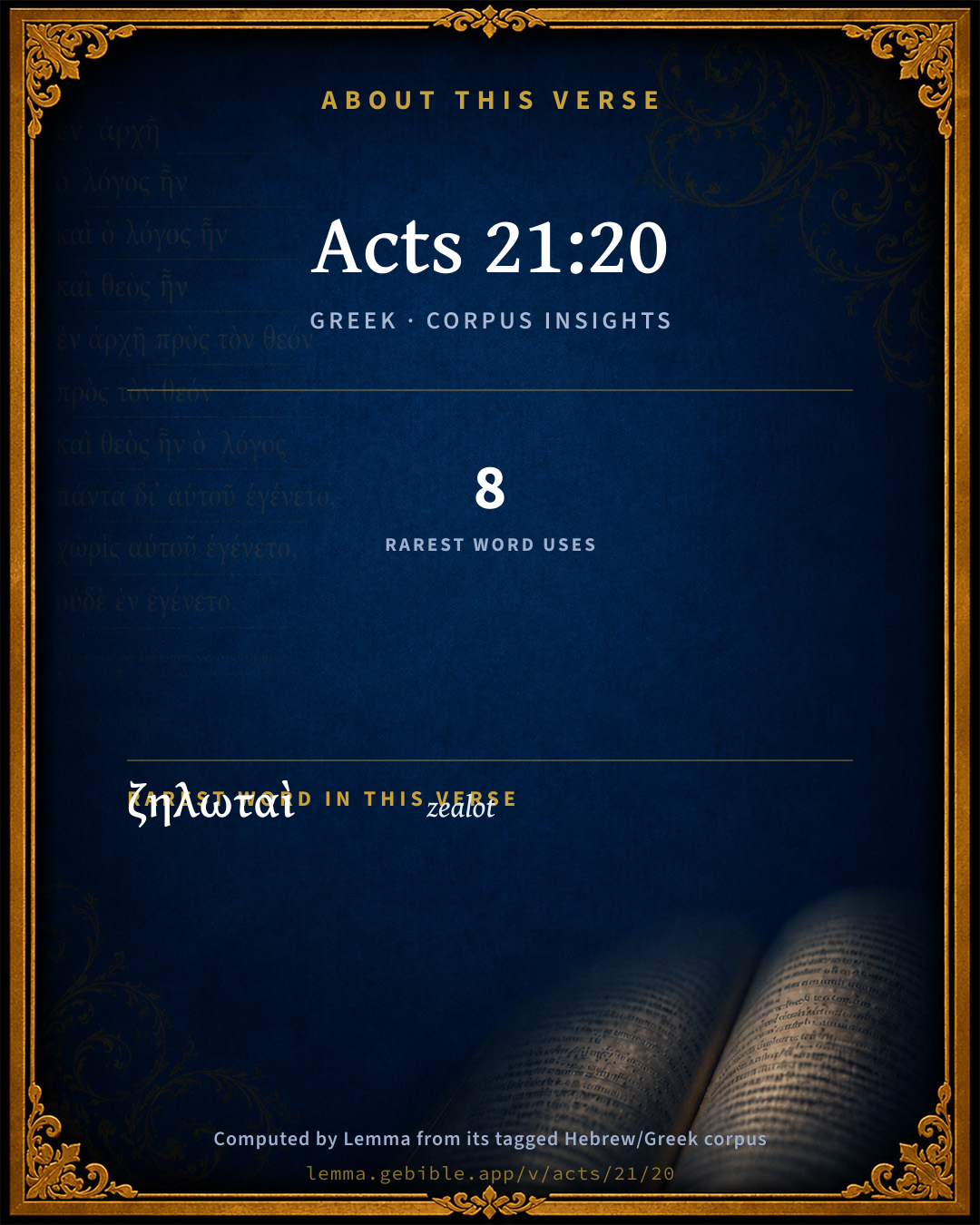
Acts 21:20

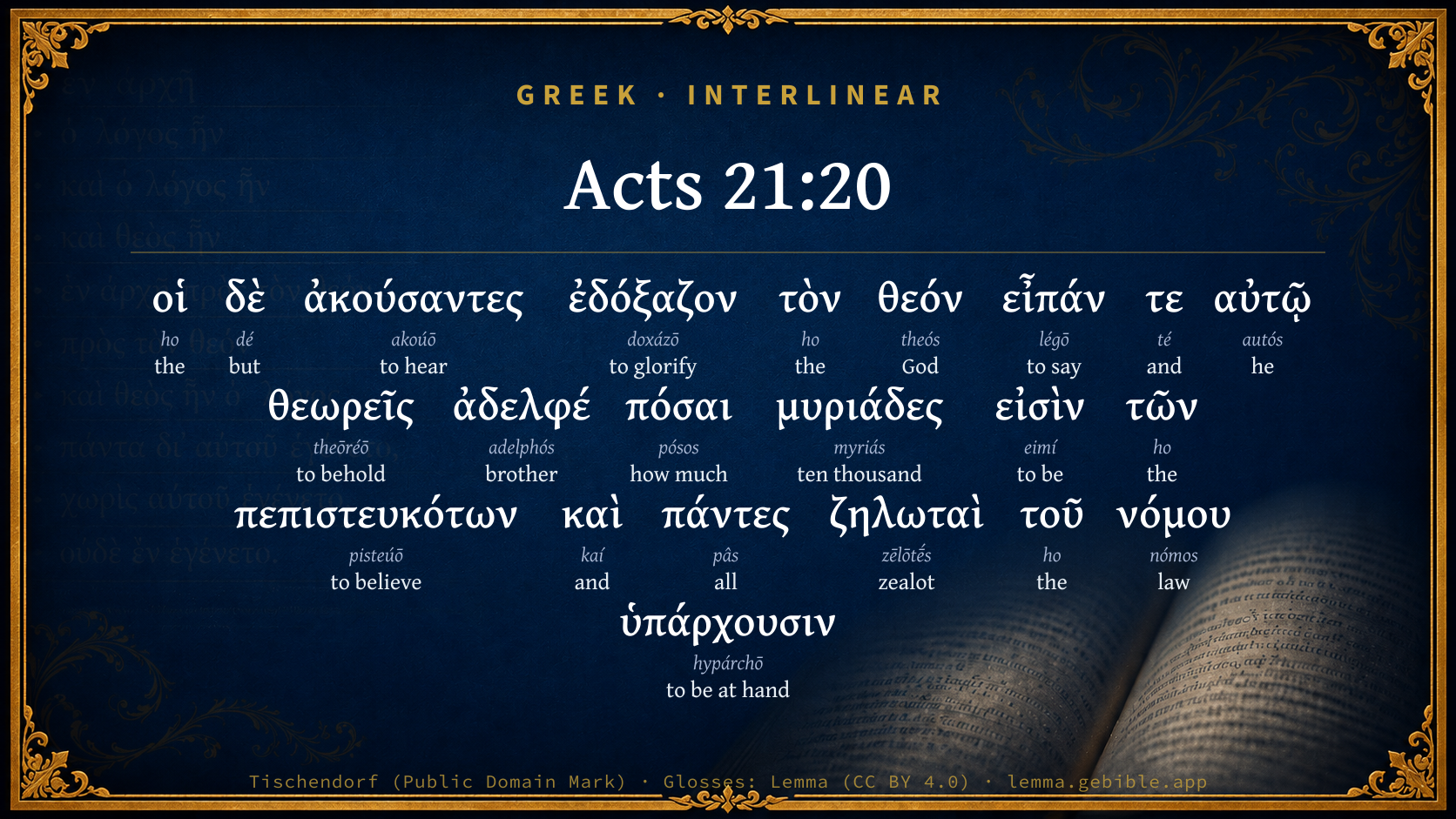
Greek (Tischendorf 8th ed.) Acts 21:20 appears in the Greek New Testament. The text above is from the Tischendorf 8th edition. Each word links to its Strong’s number and a concise gloss. Click any word for its full Thayer’s Greek Lexicon entry.
Download image
Cite this verse

Acts 21:20 (World English Bible). Public Domain. Lemma interlinear Bible study tool, https://lemma.gebible.app/v/acts/21/20.

Show BibTeX & RIS
BibTeX
RIS
English Translation
They, when they heard it, glorified God. They said to him, "You see, brother, how many thousands there are among the Jews of those who have believed, and they are all zealous for the law.
World English Bible · Public Domain
Download a study sheet

One document with this verse’s original text, its word-by-word gloss line, the meaning frame, cross-references with their text, attributed commentary, and full source and license credits — printable, and it pastes into notes with its structure intact.

This verse Autodidact and up

Study sheet (.html) Plain text (.txt)

A passage Seminary Student

Up to 50 verses in one chapter. A passage sheet keeps up to 6 commentary sources and 12 cross-references per verse, in the order this page ranks them, and says so on the sheet whenever that leaves anything out. Ask for a single verse and you get the Autodidact verse sheet above.

Everything on this page stays free to read, with no account — the sheet is a download of what is already on screen, not access to it.

Want to remove ads? Support Godless Engineer
Compare translations 3

The same verse in 3 English versions, stacked beneath the original-language interlinear above. Click any original word for its lexicon entry.

Each is an independent rendering of the whole verse — the interlinear is not word-aligned to these translations.

Highlighted words mark where these versions differ — a whole-verse word diff, not a word-by-word alignment.

  • World English Bible Public Domain
    They, when they heard it, glorified God. They said to him, "You see, brother, how many thousands there are among the Jews of those who have believed, and they are all zealous for the law.
  • King James Version Public Domain
    And when they heard it, they glorified the Lord, and said unto him, Thou seest, brother, how many thousands of Jews there are which believe; and they are all zealous of the law:
  • unfoldingWord Literal Text CC BY-SA 4.0
    And having heard it, they were glorifying God, and they said to him, “You see, brother, how many myriads of those having believed there are among the Jews, and they are all zealous for the law.

unfoldingWord Literal Text — © unfoldingWord, licensed CC BY-SA 4.0. Word-aligned USFM3 via Door43 (git.door43.org/unfoldingWord/en_ult).

Versions to compare (up to 4)

3 of 4 selected

Show all 19 translations

Every available English version of this verse, each an independent rendering of the whole verse.

  • World English Bible Public Domain
    They, when they heard it, glorified God. They said to him, "You see, brother, how many thousands there are among the Jews of those who have believed, and they are all zealous for the law.
  • Berean Standard Bible Public Domain
    When they heard this, they glorified God. Then they said to Paul, “You see, brother, how many thousands of Jews have believed, and all of them are zealous for the law.
  • Majority Standard Bible Public Domain
    When they heard this, they glorified the Lord. Then they said to Paul, “You see, brother, how many thousands of Jews have believed, and all of them are zealous for the law.
  • King James Version Public Domain
    And when they heard it, they glorified the Lord, and said unto him, Thou seest, brother, how many thousands of Jews there are which believe; and they are all zealous of the law:
  • American Standard Version (1901) Public Domain
    And they, when they heard it, glorified God; and they said unto him, Thou seest, brother, how many thousands there are among the Jews of them that have believed; and they are all zealous for the law:
  • Revised Version (1885) Public Domain
    And they, when they heard it, glorified God; and they said unto him, Thou seest, brother, how many thousands there are among the Jews of them which have believed; and they are all zealous for the law:
  • Geneva Bible (1599) Public Domain
    So when they heard it, they glorified God, and sayd vnto him, Thou seest, brother, how many thousand Iewes there are which beleeue, and they are all zealous of the Law:
  • Douay-Rheims (1899) Public Domain
    But they hearing it, glorified God, and said to him: Thou seest, brother, how many thousands there are among the Jews that have believed: and they are all zealous for the law.
  • Young's Literal Translation Public Domain
    and they having heard, were glorifying the Lord. They said also to him, `Thou seest, brother, how many myriads there are of Jews who have believed, and all are zealous of the law,
  • Literal Standard Version CC BY-SA 4.0
    and they having heard, were glorifying the LORD. They also said to him, “You see, brother, how many myriads there are of Jews who have believed, and all are zealous of the Law,
  • Unlocked Literal Bible CC BY-SA 4.0
    When they heard it, they praised God, and they said to him, “You see, brother, how many thousands have believed among the Jews. They are all determined to keep the law.
  • unfoldingWord Literal Text CC BY-SA 4.0
    And having heard it, they were glorifying God, and they said to him, “You see, brother, how many myriads of those having believed there are among the Jews, and they are all zealous for the law.
  • Darby Bible Public Domain
    And they having heard [it] glorified God, and said to him, Thou seest, brother, how many myriads there are of the Jews who have believed, and all are zealous of the law.
  • World Messianic Bible Public Domain
    They, when they heard it, glorified God. They said to him, “You see, brother, how many thousands there are among the Judeans of those who have believed, and they are all zealous for the Torah.
  • Webster's Bible Public Domain
    And when they heard it, they glorified the Lord, and said to him, Thou seest, brother, how many thousands of Jews there are who believe; and they are all zealous of the law:
  • Free Bible Version CC BY-SA 4.0
    When they heard what had happened they praised God and told Paul, “Brother, you can see how many thousands of Jews have come to trust in the Lord, and they all keep the Law very carefully.
  • Bible in Basic English Public Domain
    And hearing it, they gave praise to God; and they said to him, You see, brother, what thousands there are among the Jews, who have the faith; and they all have a great respect for the law:
  • Text-Critical English NT CC BY 4.0
    When they heard this, they began glorifying the Lord. Then they said to him, “Yoʋ see, brother, how many thousands of Jews there are who have become believers, and they are all zealous for the law.
  • Tyndale New Testament (1534) Public Domain
    And when they hearde it they glorified the Lorde and sayde vnto him: thou seist brother how many thousande Iewes ther are which beleve and they are all zelous over the lawe.

Literal Standard Version (2020), Covenant Press — licensed CC BY-SA 4.0. Text via the HelloAO Bible API (eBible.org). Unlocked Literal Bible (unfoldingWord) — licensed CC BY-SA 4.0. Text via the HelloAO Bible API (eBible.org). unfoldingWord Literal Text — © unfoldingWord, licensed CC BY-SA 4.0. Word-aligned USFM3 via Door43 (git.door43.org/unfoldingWord/en_ult). Free Bible Version, Dr. Jonathan Gallagher — licensed CC BY-SA 4.0. Text via the HelloAO Bible API (eBible.org).

Word by word

More ways to search: Search by grammar → Find every occurrence → Compare this word →

Practice this passage: Drill this verse → Learn its vocabulary →

ζηλωταὶ
zēlōtḗs
G2207
“zealot”
Noun, Nominative, Plural, Masculine
Part of Speech
Noun
Case
Nominative
Number
Plural
Gender
Masculine
Full Thayer's Definition

Origin: from G2206

TDNT: 16:42,3

1. one burning with zeal, a zealot 2. used of God as jealous of any rival and sternly vindicating his control 3. most eagerly desirous of, zealous for, a thing a. to acquire a thing, (zealous of) b. to defend and uphold a thing, vehemently contending for a thing
  1. οἱ ho G3588 “the” Article, Nominative, Plural, Masculine
  2. δὲ dé G1161 “but” Conjunction
  3. ἀκούσαντες akoúō G191 “to hear” Verb, Aorist, Active, Participle, Nominative, Plural, Masculine
  4. ἐδόξαζον doxázō G1392 “to glorify” Verb, Imperfect, Active, Indicative, 3rd person, Plural
  5. τὸν ho G3588 “the” Article, Accusative, Singular, Masculine
  6. θεόν theós G2316 “God” Noun, Accusative, Singular, Masculine
  7. εἶπάν légō G3004 “to say” Verb, Aorist, Active, Indicative, 3rd person, Plural
  8. τε té G5037 “and” Particle
  9. αὐτῷ autós G846 “he” Personal pronoun, Dative, Singular, Masculine
  10. θεωρεῖς theōréō G2334 “to behold” Verb, Present, Active, Indicative, 2nd person, Singular
  11. ἀδελφέ adelphós G80 “brother” Noun, Vocative, Singular, Masculine
  12. πόσαι pósos G4214 “how much” Correlative/interrogative pronoun, Nominative, Plural, Feminine
  13. μυριάδες myriás G3461 “ten thousand” Adjective, Nominative, Plural, Feminine
  14. εἰσὶν eimí G1510 “to be” Verb, Present, Active, Indicative, 3rd person, Plural
  15. τῶν ho G3588 “the” Article, Genitive, Plural, Masculine
  16. πεπιστευκότων pisteúō G4100 “to believe” Verb, Perfect, Active, Participle, Genitive, Plural, Masculine
  17. καὶ kaí G2532 “and” Conjunction
  18. πάντες pâs G3956 “all” Adjective, Nominative, Plural, Masculine
  19. τοῦ ho G3588 “the” Article, Genitive, Singular, Masculine
  20. νόμου nómos G3551 “law” Noun, Genitive, Singular, Masculine
  21. ὑπάρχουσιν hypárchō G5225 “to be at hand” Verb, Present, Active, Indicative, 3rd person, Plural

About this verse

These counts appear in no published source. They are computed here, from the morphology-tagged text and Lemma’s own curated glosses. What Lemma adds →

22
words
19
distinct lemmas
Acts
section

Notable vocabulary

The rarest word here is ζηλωταὶ zealot G2207 — appearing just 8 times in the whole Greek New Testament.

Shared distinctive vocabulary

ζηλωταὶ zealot G2207 occurs in 8 verses of the Greek New Testament. Also found in:

Repetition

A word recurs within this verse:

Cross-references

27

Topical passages linked to Acts 21:20 in the Treasury of Scripture Knowledge — connected by theme and wording, ordered by reader-vote popularity; previews shown in the World English Bible.

  • Romans 10:2 For I testify about them that they have a zeal for God, but not according to knowledge.
  • Galatians 1:14 I advanced in the Jews' religion beyond many of my own age among my countrymen, being more exceedingly zealous for the traditions of my fathers.
  • Acts 22:3 "I am indeed a Jew, born in Tarsus of Cilicia, but brought up in this city at the feet of Gamaliel, instructed according to the strict manner of the law of our fathers, being zealous for God, even as you all are this day.
  • Acts 11:18 When they heard these things, they held their peace, and glorified God, saying, "Then God has also granted to the Gentiles repentance to life!"
  • Acts 15:1 Some men came down from Judea and taught the brothers, "Unless you are circumcised after the custom of Moses, you can't be saved."
  • Acts 15:5 But some of the sect of the Pharisees who believed rose up, saying, "It is necessary to circumcise them, and to charge them to keep the law of Moses."
  • Psalms 22:23 You who fear Yahweh, praise him! All you descendants of Jacob, glorify him! Stand in awe of him, all you descendants of Israel!
  • Psalms 22:27 All the ends of the earth shall remember and turn to Yahweh. All the relatives of the nations shall worship before you.
  • Psalms 72:17–19 His name endures forever. His name continues as long as the sun. Men shall be blessed by him. All nations will call him blessed.
  • Psalms 98:1–3 Sing to Yahweh a new song, For he has done marvelous things! His right hand, and his holy arm, have worked salvation for him.
  • Isaiah 55:10–13 For as the rain comes down and the snow from the sky, and doesn't return there, but waters the earth, and makes it bring forth and bud, and gives seed to the sower and bread to the eater;
  • Isaiah 66:9–14 Shall I bring to the birth, and not cause to bring forth? says Yahweh: shall I who cause to bring forth shut [the womb]? says your God.
  • Matthew 13:31–33 He set another parable before them, saying, "The Kingdom of Heaven is like a grain of mustard seed, which a man took, and sowed in his field;
  • Luke 12:1 Meanwhile, when a multitude of many thousands had gathered together, so much so that they trampled on each other, he began to tell his disciples first of all, "Beware of the yeast of the Pharisees, which is hypocrisy.
  • Luke 15:3–10 He told them this parable.
  • Luke 15:32 But it was appropriate to celebrate and be glad, for this, your brother, was dead, and is alive again. He was lost, and is found.'"
  • John 12:24 Most assuredly I tell you, unless a grain of wheat falls into the earth and dies, it remains by itself alone. But if it dies, it bears much fruit.
  • Acts 2:41 Then those who gladly received his word were baptized. There were added that day about three thousand souls.
  • Acts 4:4 But many of those who heard the word believed, and the number of the men came to be about five thousand.
  • Acts 4:21 When they had further threatened them, they let them go, finding no way to punish them, because of the people; for everyone glorified God for that which was done.
  • Acts 6:7 The word of God increased and the number of the disciples multiplied in Jerusalem exceedingly. A great company of the priests were obedient to the faith.
  • Acts 15:24 Because we have heard that some who went out from us have troubled you with words, unsettling your souls, saying, 'You must be circumcised and keep the law,' to whom we gave no commandment;
  • Romans 15:6–7 that with one accord you may with one mouth glorify the God and Father of our Lord Jesus Christ.
  • Romans 15:9–13 and that the Gentiles might glorify God for his mercy. As it is written, "Therefore will I give praise to you among the Gentiles, And sing to your name."
  • 2 Thessalonians 1:10 when he comes to be glorified in his saints, and to be admired among all those who have believed (because our testimony to you was believed) in that day.
  • Revelation 19:6–7 I heard something like the voice of a great multitude, and like the voice of many waters, and like the voice of mighty thunders, saying, "Hallelujah! For the Lord our God, the Almighty, reigns!
  • Galatians 1:24 And they glorified God in me.

Cross-references courtesy of OpenBible.info (CC BY 4.0).

Where the printed editions differ

2 variants

Places in this verse where the major printed Greek editions disagree on the wording in a way that affects the translation — a comparison of editions, not a manuscript-by-manuscript collation. The editions are the modern critical texts (Nestlé-Aland 28/27, SBL, Westcott-Hort, Tregelles, Tyndale House) and the traditional texts behind the KJV (the Textus Receptus and the Byzantine/Majority text). It is not a claim about which reading is original.

  1. Different wording
    θεόν,

    “God,”

    In NA28NA27TynSBLWHTreg Not in TRByz

    κύριον (kurion) 'Lord' occurs in traditional manuscripts (TR+Byz) instead of θεόν, (theon) 'God,' in older manuscripts (NA28+NA27+Tyn+SBL+WH+Treg)

  2. Extra text
    ἐν τοῖς

    “among the”

    In NA28NA27TynSBLWHTreg Not in TRByz

    ἐν τοῖς (en tois) 'among the' is only in older manuscripts (NA28+NA27+Tyn+SBL+WH+Treg)

Textual data: Translators Amalgamated Greek New Testament (STEPBible TAGNT) · CC BY 4.0.

Commentary

Notes on Acts 21:20 from classic Christian and Jewish commentators (each source and its license shown beneath its notes). The classic Christian expositions comment on the surrounding passage and are grouped to its opening verse, so a note may address several verses; the Jewish commentaries on the Tanakh (Rashi and others) are per-verse, so they appear only where the commentator wrote on this verse.

Lemma curates 59 commentaries, every one of them public domain or Creative Commons licensed, each selected and text-cleaned for this edition rather than reprinted as found. About our sources →

Joseph Benson's Commentary

Act 21:20-21. When they heard it, they glorified the Lord — The Lord Christ, for this wonderful demonstration of his presence and grace, with his servant; and said, Thou seest, brother, how many thousands of Jews there are which believe — Many of these, doubtless, had come from different parts of the country, and some, probably, from remote provinces to Jerusalem, on occasion of this feast. Well might our Lord compare his religion to a grain of mustard-seed, seeing it had spread so extensively in so short a time. Its beginning was small, the instruments employed in propagating it apparently mean, the prejudices and obstinacy of the Jews very great, and yet, in about twenty-eight or thirty years after the ascension, the number of those who had embraced it, and were at one time in the same city, is stated at many thousands, or rather myriads, (μυριαδες,) or ten thousands. And they are all zealous for the law — For the whole Mosaic dispensation, as supposing it to be of perpetual obligation on all the Jewish nation, without excepting those that had embraced Christianity. And they are informed of thee — Through the prejudice and falsehood of thine enemies; that thou teachest all the Jews to forsake Moses, &c. — This, it appears, was a false charge brought against Paul. We have no proof that he taught the Jews to forbear circumcising their children, or to forsake the law of Moses. On the contrary, it seems, knowing that law to be the civil or political law of Judea, he always enjoined them to comply with its institutions, as the means of preserving their political rites and privileges, till Jerusalem should be destroyed, (which he foresaw it would be,) and their commonwealth dissolved; even as he enjoined the converted Gentiles to obey the good laws of the countries where they resided. What he really taught concerning the law of Moses was, that neither Jew nor Gentile could be saved by its institutions, which was the doctrine likewise of James, and of the elders, and of all the more intelligent members of the church at Jerusalem; as is implied in what James says, Act 21:25; as touching the Gentiles which believe, we have concluded that they observe no such thing. For if the Gentiles did not need to observe the law of Moses, obedience thereto could not be necessary to the salvation of any person whatever.

Joseph Benson's Commentary on the Old and New Testaments (1811–1818) — public domain. Text from a community e-Sword module.

Tyndale Open Study Notes

Tyndale Open Resources

21:20-25 The Jerusalem church leaders urged Paul to strengthen his credibility by demonstrating that he was not teaching Jews to turn their backs on the laws of Moses. At the same time, no attempt was made to force Jewish rules on Gentile converts—those terms had been set previously (15:22-29) and were simply to be honored.

Tyndale Open Study Notes — © Tyndale Open Resources, licensed CC BY-SA 4.0. Text via the HelloAO Bible API.

Bengel's Gnomon

Johann Albrecht Bengel

Act 21:20. Πόσαι μυριάδες) how many myriads) Comp. Jer 3:14, etc. Among all those by degrees circumcision expired; and of these, without doubt, a great part was mixed up with the Gentiles who believed. Wherefore the seed of Abraham has not perished in so great numbers as you would suppose, during the lapse of so many ages[viz. the centuries of the Jews’ unbelief since their rejection of Jesus when He was on earth].

Bengel's Gnomon of the New Testament — English translation (T&T Clark, Edinburgh, 1860) — public domain. Text from a community e-Sword module.

Meyer's Critical & Exegetical Commentary

Heinrich August Wilhelm Meyer

Act_21:20-21. The body of presbyterscertainly headed by its apostolic (Gal_1:19) chief James as spokesmanrecognises with thanksgiving to God the merits of Paul in the conversion of the Gentiles, but then represents to him at once also his critical position toward the Palestinian Jewish-Christians, among whom the opinion had spread that he taught all the Jews living in the διασπορά among the Gentiles, when preaching his gospel to them, apostasy from the law of Moses. This opinion was, according to the principles expressed by Paul in his Epistles (see especially Rom., Gal., and 1 Cor.), and according to his wisdom in teaching generally, certainly erroneous; but amidst the tenacious overvaluing of Mosaism on the part of the Judaists, ever fomented by the anti-Pauline party, it arose very naturally from the doctrine firmly and boldly defended by Paul, that the attainment of the Messianic salvation was not conditioned by circumcision and the works of the law, but purely by faith in Christ. What he had taught by way of denying and guarding against the value put on Mosaism (so as to secure the necessity of faith), was by the zealous Judaists taken up and interpreted as a hostile attack, as a direct summons to apostasy from the Mosaic precepts and institutions. See Ewald, p. 563 ff., on these relations, and on the greatness of the apostle, who notwithstanding, and in clear consciousness of the extreme dangers which threatened him, does not sever the bond with the apostolic mother-church, but presents himself to it, and now again presents himself precisely amidst this confluence of the multitude to the feast, like Christ on His last entrance to Jerusalem.

θεωρεῖς] is not, with Olshausen, to be referred to the number of the presbyters present, who might represent, as it were, the number of believers: for only the presbyters of Jerusalem were assembled with James (Act_21:18), but to the Judaean Christians themselves (Christians of the Jewish land), the view of whose many myriads might present itself to Paul at Jerusalem in the great multitude of those who were there, especially at the time of the feast.

ποσαι μυριάδες] a hyperbolical expression[122] of a very great indefinable number (comp. Luk_12:1), the mention of which was to make the apostle the more inclined to the proposal about to be made; hence we are not, with Baur (I. p. 230, ed. 2), to understand orthodox Jews as such (believing or unbelieving). The words, according to the correct reading (see the critical remarks), import: how many myriads among the Jews there are of those who are believing, i.e. to how many myriads those who have become believers among the Jews amount.

ζηλωταὶ τ. νόμου] zealous observers and champions of the Mosaic law. Comp. Gal_1:14.

κατηχήθησαν] they have been instructed (Luk_1:4; Act_18:25; Rom_2:18; 1Co_14:19; Gal_6:6; Lucian, Asin. 48) by Judaistic anti-Pauline teachers. Actual instruction (comp. Chrysostom), not generally audierunt (Vulg.), nor bare suspicion (Zeller), is expressed.

μὴ περιτέμνειν αὐτοὺς κ.τ.λ.]

[123] according to the notion of commanding, which is implied in λέγων; see on Act_15:24.

τοῖς ἔθεσι] observing the Mosaic customs. Comp. τὸν νόμου φυλάσσων, Act_21:23. The dative is as in Act_9:31.

The antagonism of Judaism to Paul is in this passage so strongly and clearly displayed, that the author, if his book were actually the treatise with a set purpose, which it has been represented as being, would, in quite an incomprehensible manner, have fallen out of his part. In the case of such a cunning inventor of history as the author, according to Baur and Zeller, appears to be, the power of historical truth was not so great as to extort against his will (Baur) such a testimony at variance with his design.

[122] But yet, comp. with Act_1:15, Act_2:41, Act_4:4, Gal_1:22, an evidence of the great progress which Christianity had thus made in Palestine with the lapse of time.

[123] The Jewish-Christians zealous for the law must thus have continued to circumcise the children that came to be born to them.

Meyer — Critical and Exegetical Commentary on the New Testament — English translation by Peter Christie, edited by Frederick Crombie (T&T Clark, 1880) — public domain. Text from a community e-Sword module.

Expositor's Greek Testament

ed. W. Robertson Nicoll

Act 21:20 . ἐδόξ .: “recte imperf. quia finis verbo εἶπαν indicatur,” Blass. θεωρεῖς : the word seems to imply that Paul had already become cognisant of the fact by his own observations in his ministerial work. ἀδελφέ : St. Paul is recognised as an ἀδελφός not only by St. James but by the assembled elders (see also Weiss, in loco ). Ἰουδ ., see critical note. μυριάδες , cf. Luk 12:1 , of a large but indefinite number ( cf. 1Co 4:15 ), referring to the number of believers not only in Jerusalem but in Judæa present in large numbers for the Feast. The word cannot refer to Jewish Christians in a wider sense, as Overbeck took it, because they would not need to be informed of Paul’s teaching relative to the Mosaic law. ζηλωταὶ τοῦ ν ., cf. Gal 1:14 , Tit 2:14 , 1Pe 3:13 (Mal 4:2Mal 4:2 , we have the same phrase, cf. 4Ma 18:12 ). The extreme party of the Pharisees prided themselves on the title “zealots of the law, zealots of God”; it was a title which St. Paul himself had claimed, Lightfoot, Gal 1:14 .

The Expositor's Greek Testament, edited by W. Robertson Nicoll (1897–1910) — public domain. Text from a community e-Sword module.

Geneva Bible (1599)

Geneva Bible translators

In things indifferent (of which sort were not the traditions of the Pharisees, but the ceremonies of the Law, until such time as Christian liberty was more fully revealed to the Jews) charity willeth us to conform or apply ourselves willingly so far as we may, to our brethren which do not stubbornly, and maliciously, resist the truth, but are not thoroughly instructed especially if the question be of a whole multitude.

Geneva Bible (1599) marginal notes — public domain. Text via Bolls.life.

Jamieson, Fausset & Brown

Robert Jamieson, A. R. Fausset & David Brown

they glorified the Lord, &c.--constrained to justify his course, notwithstanding the Jewish complexion of the Christianity of Jerusalem.

Jamieson, Fausset & Brown — Commentary Critical and Explanatory on the Whole Bible (1871) — public domain (CC PDM 1.0). Text via the HelloAO Bible API.

Adam Clarke's Commentary

Verse 20. How many thousands] ποσαι μυριαδες; How many myriads, how many times 10,000. This intimates that there had been a most extraordinary and rapid work even among the Jews; but what is here spoken is not to be confined to the Jews of Jerusalem, but to all that had come from different parts of the land to be present at this pentecost.

They are all zealous of the law] The Jewish economy was not yet destroyed; nor had God as yet signified that the whole of its observances were done away. He continued to tolerate that dispensation, which was to be in a certain measure in force till the destruction of Jerusalem; and from that period it was impossible for them to observe their own ritual. Thus God abolished the Mosaic dispensation, by rendering, in the course of his providence, the observance of it impossible.

Adam Clarke's Commentary on the Bible (1810–1826) — public domain. Text from a community e-Sword/MySword module.

Ellicott's Commentary for English Readers

(20) They glorified the Lord.—The better MSS. give, “they glorified God.” The tense implies continued action, and although its meaning would be satisfied by assuming mere ejaculations of wonder and praise, it is, at least, not improbable that there was a more formal thanksgiving.

How many thousands of Jews there are which believe.—Literally, how many myriads—i.e., tens of thousands. The numbers seem large if we think of the population of Jerusalem only, but the crowds that came from all quarters to the Feast of Pentecost (see Note on Act_2:1) would fully justify the statement. The speaker here is obviously St. James, as the president of the assembly. There is no trace of the presence of any of the Apostles.

They are all zealous of the law.—Better, the word being a substantive and not an adjective, zealots for the law. The term was an almost technical one for the most rigid class of Pharisees. (See Note on Simon the Canaanite, Mat_10:4.) So St. Paul describes himself as in this sense a “zealot” (Act_22:3; Gal_1:14).

A Bible Commentary for English Readers, edited by Charles John Ellicott (1878–1897) — public domain. Text from a community e-Sword module.

The Cambridge Bible for Schools and Colleges

gen. ed. J. J. S. Perowne

20. And when they heard it, they glorified the Lord] The oldest MSS. read God. They took up the strain of thanksgiving which had run through all the Apostle’s story.

and said unto him] Their anxiety makes itself apparent at once, and we come here face to face with what must have been one of the greatest difficulties for the early Christians. Before Jerusalem was destroyed there must ever have been at that centre a party zealous for the law, with whom labour among the Gentiles would find small favour.

Thou seest, brother] The verb is not the ordinary one for to see. It implies that there had been an opportunity for the Apostle to behold some Christian gathering. At this feast the Christians would have as much interest in a commemorative assembly as the Jews.

how many thousands] The Greek is “myriads,” but the word is used indefinitely, like our “thousand,” to signify a large number.

of Jews there are which believe] The most authoritative Greek text is rendered by the Rev. Ver. “there are among the Jews of them which have believed.” These were persons who, as was not unnatural, accepted Christianity as the supplement of Judaism, but made no break with their old faith, of the observances of which their life-long training had made them tenacious. To such men, as Christianity rested on the Old Testament Scripture, there would seem little need to make a rent between their old life and the new.

and they are all zealous of (for) the law] i.e. rigorous maintainers of all the ceremonial of the Mosaic code. The word is the same as the name of the sect, Zealots.

The Cambridge Bible for Schools and Colleges (gen. ed. J. J. S. Perowne; Cambridge University Press, 1878–1918) — public domain. Text from a community e-Sword module.

John Gill's Exposition

And when they heard it,.... The narrative of the wonderful spread of the Gospel among the Gentiles, and the numerous conversions of them:

they glorified the Lord; or "God", as the Alexandrian copy, the Vulgate Latin, and Ethiopic versions read; as Paul ascribed all to God, so they give the glory of it to him, and in this they were both agreed:

and said unto him; perhaps James in the name of them all, and as their mouth:

thou seest, brother; for so he was to James, both as a believer, and a minister of the word, and as an apostle:

how many thousands of Jews there are which believe; there were many thousands converted at Jerusalem upon the first preaching of the Gospel, after Christ's ascension; see Act 2:41 and the number might be much increased since; though it may be, that reference is had not only to the number of the members of the church at Jerusalem, but to all the believing Jews in Judea, who were now come up to Jerusalem, to keep the feast of Pentecost; since it is in the Greek, "how many myriads there are", and one myriad contains ten thousand:

and they are all zealous of the law; of the law of Moses, of the ceremonial law, as Paul might see by their being at Jerusalem, to keep this feast; for though they believed in Jesus of Nazareth as the true Messiah, yet they had not light enough to see, that he was the sum and substance of all the ceremonies of the law, and that they all ended in him; and therefore were zealous in the observance of them, and could not bear to hear of their abrogation.

John Gill's Exposition of the Whole Bible (1746–1763) — public domain (CC PDM 1.0). Text via the HelloAO Bible API.

Trapp's Complete Commentary

John Trapp

20 And when they heard it, they glorified the Lord, and said unto him, Thou seest, brother, how many thousands of Jews there are which believe; and they are all zealous of the law:

Ver. 20. Many thousands] Therefore not to be slighted.

John Trapp, A Commentary or Exposition upon All the Books of the Old and New Testament (1647–1656) — public domain. Text from a community e-Sword module.

Albert Barnes' Notes on the Bible

They glorified the Lord - They gave praise to the Lord for what he had done. They saw new proofs of his goodness and mercy, and they rendered him thanks for all that had been accomplished. There was no jealousy that it had been done by the instrumentality of Paul. True piety will rejoice in the spread of the gospel, and in the conversion of sinners, by whatever instrumentality it may be effected.

Thou seest, brother - The language of tenderness in this address, recognizing Paul as a fellow-laborer and fellow-Christian, implies a wish that Paul would do all that could be done to avoid giving offence, and to conciliate the favor of his countrymen.

How many thousands - The number of converts at this time must have been very great. Twenty-five years before this, 3,000 had been converted at one time Acts 2, and afterward the number had swelled to some more thousands, Act 4:4. The assertion that there were then “many thousands,” implies that the work so signally begun on the day of Pentecost in Jerusalem had not ceased, and that many more had been converted to the Christian faith.

Which believe - Who are Christians. They are spoken of as believers, or as having faith in Christ, in contradistinction from those who rejected him, and whose characteristic trait it was that they were unbelievers.

And they are all zealous of the law - They still observe the Law of Moses. The reference here is to the law respecting circumcision, sacrifices, distinctions of meats and days, festivals, etc. It may seem remarkable that they should still continue to observe those rites, since it was the manifest design of Christianity to abolish them. But we are to remember:

(1) That those rites had been appointed by God, and that they were trained to their observance.

(2) That the apostles conformed to them while they remained at Jerusalem, and did not deem it best to set themselves violently against them, Act 3:1; Luk 24:53.

(3) That the question about their observance had never been agitated at Jerusalem. It was only among the Gentile converts that the question had risen, and there it must arise, for if they were to be observed, they must have been imposed upon them by authority.

(4) The decision of the council Acts 15 related only to the Gentile converts. It did not touch the question whether those rites were to be observed by the Jewish converts.

(5) It was to be presumed that as the Christian religion became better understood - that as its large, free, and catholic nature became more and more developed, the special institutions of Moses would be laid aside of course, without agitation and without tumult. Had the question been agitated at Jerusalem, it would have excited tenfold opposition to Christianity, and would have rent the Christian church into factions, and greatly retarded the advance of the Christian doctrine. We are to remember also:

(6) That, in the arrangement of Divine Providence, the time was drawing near which was to destroy the temple, the city, and the nation, which was to put an end to sacrifices, and effectually to close forever the observance of the Mosaic rites. As this destruction was so near, and as it would be so effectual an argument against the observance of the Mosaic rites, the Great Head of the church did not suffer the question of their obligation to be needlessly agitated among the disciples at Jerusalem.

Albert Barnes' Notes on the Bible (1834–1885) — public domain. Text from a community e-Sword/MySword module.

Haydock's Catholic Bible Commentary

How many thousands. In the Greek, how many ten thousands. (Witham)

George Leo Haydock (1774–1849), Haydock's Catholic Family Bible and Commentary, 1859 edition — public domain. Excludes Psalms (Douay-Rheims chapter numbering differs from Protestant) and Deuterocanonical books (Catholic canon only).

Matthew Poole's English Annotations

Glorified the Lord; acknowledging all in that great work of the conversion of the Gentiles to have been from God; and that Paul that had planted, and Apollos that had watered, were nothing, 1Co 3:6,7.

Thousands of Jews; tens of thousands, as the word does usually signify; a definite for an indefinite number, signifying very many: and considering out of what small beginnings, and by what despicable means, and all within the space of about five and twenty years, this grain of mustard seed had spread itself; and add to this, that they were Jews, that obstinate and prejudiced generation, who are here spoken of, and they were then so many, so wonderfully many, who believed.

All zealous of the law, of ceremonies, and concerning forbidden meats, &c. For the decree of the apostles, Act 15:29, concerning these things, did only respect such as were converted from paganism to the faith of Christ; and the Jews that were converted before the dispersion by Adrian, the Roman emperor, many years after this time, did not thoroughly understand their freedom from that law, but were under the burden of it, as appears by several ecclesiastical writers.

Matthew Poole's English Annotations on the Holy Bible (1683–1685) — public domain. Text from a community e-Sword/MySword module.

Whedon's Commentary on the Bible

Daniel D. Whedon

20. Glorified the Lord—With James and the eldership the question is clear and settled. How can they presume to set a repressing foot upon this magnificent outspread of Christianity over the Gentile world?

How many thousands—It was Pentecost, a Christian as well as a Jewish anniversary, and the assembled Christian attendants from Judea, Galilee, and Samaria were doubtless present. The Greek word for thousands is in the original myriads or tens of thousands. Yet its ordinary use is that of an indefinite, but large number. The word is so used in 1Co_4:15; 1Co_14:19. (See note on Luk_12:1.)

Zealous—Greek, zealots. A word at that day appplied to the most fanatical section of Jews, whose rebellion brought about the destruction of Jerusalem. It is here applied to the ultra Jewish Christians, and, perhaps, somewhat disapprovingly. James and the elders fully recognised Paul. But the less informed masses suspected him, and we are now to have a final proposition for conciliating them.

Daniel D. Whedon (gen. ed.), Commentary on the Old and New Testaments (1874–1909) — public domain. Text from a community e-Sword module.

The Pulpit Commentary

They, when they heard it for when they heard it, they, A.V.; God for the Lord, A.V. and T.R.; they said for said, A.V.; there are among the Jews of them which have believed for of Jews there are which believe, A.V. and T.R.; for the Law for of the Law, A.V. They glorified God. There is not the slightest symptom on the part of James and the elders of unfriendliness towards St. Paul, or jealousy or opposition to his work among the Gentiles. (comp. Gal_2:7-9) The appellation brother is another indication of friendly feeling. Thousands (Greek muriadev, tens of thousands). These need not be deemed to be all Jerusalem Jews; if applied to the Church at Jerusalem only, such a word would be probably a gross exaggeration; but there were great numbers of Jews of the dispersion assembled at Jerusalem for Pentecost probably all the Christian Jews of Judaea, and many from Syria, Galatia, Pontus, and the various countries enumerated in Act_2:9-11. So that there might be several myriads of converted Jews altogether. All zealous for the Law. This is a remarkable testimony to the unanimity of the Christian Jews in their attachment to the Law of Moses, and throws light upon the Epistle to the Galatians and many other passages in St. Paul"s Epistles. It explains the great difficulty experienced in the early Church in dealing with converts from Judaism. Zealous (zhlwtai). So the fierce sect of Zealots were called at the time of the Jewish wars (see Josephus, "Bell. Jud:," 4:6:1, and elsewhere).

Vers. 20-39. The pastor and elders of the Church not infallible.

There may be considered to be some uncertainty as to the exact merits of the remarkable case which the history reproduces in this passage, but without rendering any verdict, pronouncing any opinion, or even offering any suggestion. In the room that is accordingly allowed for option, it is believed that the following positions, as they are certainly maintainable in themselves, are also to be impressed on us by the present history:

I THE ADVICE OF THE BEST-INTENTIONED POLICY, ON THE LIPS OF THE LEADERS OF A CHRISTIAN CHURCH, IS DISTANT FROM THE ADVICE OF CLEAR CHRISTIAN PRINCIPLE AND TRUTH, AS THE POLES ARE DISTANT FROM ONE ANOTHER. There was not a little in the exact tone of those who urged on Paul a certain course (ver. 20) and in the exact time which they used for pressing their suit, which invests it with suspicion, and which may very possibly have done so with Paul.

II THE PRESSURE OF THE ADVICE OF MANY, AND THOSE MANY THE KNOWN LEADERS OF THE CHURCH, WILL NOT ABSOLVE THE INDIVIDUAL CONSCIENCE OR JUDGMENT. It is quite possible that the present was an occasion which Paul would have described as one of those when he would make himself all things to all men. It is also quite possible that this was a right occasion of observing that practice. And lastly, for that very reason the more, it may seem quite possible, that Paul"s judgment was in no degree hoodwinked, nor his conscience eclipsed, when he yielded to the advice urged upon him. As no whisper of censure seems breathed upon him, the providence of God, nay, the Spirit himself, may have been his Guide now, to the end that facts should teach those who were responsible for the advice, while Paul would feel, ay, genuinely feel, that the compensation that was given to him for his sufferings consisted in the audience of Jew and Gentile of all sorts, of Roman governors and officers and soldiers, which he had in consequence the opportunity of addressing (ver. 39). If Paul were mistaken and at fault now, he reaps his punishment, though still he rescues some advantage out of all for Christ and the gospel. And he is taught that not even the kindness of his heart and willingness "to be persuaded" by the skilful representations in affection"s hour of others, can be a substitute for the individual, steady, regulated judgment and conscience of the Christian. If he were not mistaken, the same lesson is taught, though by a very different route. He himself held and acted upon the conviction that his individual judgment, under the guidance of the Divine Spirit, should have its way that judgment going to this that, though himself suffered, the leaders of the Church and "many thousands of zealots of the Law" should be effectually taught.

III THE DIVINE PURPOSE AND WORK THROUGH ALL ERROR OF HUMAN JUDGMENT, THROUGH ALL UNCERTAINTY OF FIDELITY, EVEN IN HUMAN CONSCIENCES, TRIUMPH AND VINDICATE THEIR OWN RIGHTS.

1. The intended short way out of an apprehended difficulty and danger, suggested with coaxing tones and words (ver. 20, "Thou seest, brother "), proves a very long and painful way. Who can tell what must have been the excited apprehensions of James and the elders as the riot went on, nor stopped in a sense, till Paul set off for Rome itself?

2. For Paul, whose is both the active work and the keen suffering, "the beginning of the end" dates from this very Church meeting at Jerusalem. The road is opened to Rome and to Caesar and to "the palace and all other places" left for Paul"s ministry. And the goal of his career comes into sight for the racer of keen vision as well as of keen energy. So the gospel gains fresh wings, and that grace of God which lovingly overrules where perhaps it was not allowed to rule, is made known to vaster numbers, and amongst them to some whom it might not have reached in any other way. B.

Vers. 20-25. The perils of over-caution.

For the details of these verses, reference must be made to the exegetical portion of this Commentary. We should fully understand:

1. The intense enmity of the Judaizing party against St. Paul.

2. The opportunity of increasing that enmity found in the fact that many of St. Paul"s enemies from Asia and Europe were present in Jerusalem at this time, attending the feast.

3. The difficulty of the Christian leaders, who had not openly broken with rabbinical Mosaism, and consequently found St. Paul"s presence in the city a source of extreme anxiety. They could not openly condemn him; and indeed this they were not prepared to do. They could not openly approve him, for this would be sure to rouse dissension, and it would certainly put St. Paul"s life in peril.

4. The spirit and temper of the apostle himself, who was rather bold than cautious, and had on several important occasions, (as e.g, Act_19:30, Act_19:31) to be actually held back from courses of action that were hardly prudent. The leaders of the Church at Jerusalem tried to master the difficulties of the position by compromise, which is usually a sign of conscious weakness, and often rather makes than settles the difficulty with which it deals. "The heads of the Church in Jerusalem dreaded nothing but an uproar, if St. Paul"s presence in the city should become known. In order, therefore, to appease the multitude, they proposed to the apostle to observe the sacred usages publicly in the temple, with four men who were paying their vows, and to present an offering for himself a proposal which he willingly adopted. But although the concession of the apostles to the weak brethren proceeded from a good intention, yet it turned out disastrously. The furious enemies of St. Paul were "only the more exasperated by it" (Olshausen). It was a case of "over-caution," and it well illustrates the weakness and the peril that usually lie in over-cautious schemes.

I THE PLACE FOR COMPROMISE. Which is the practical expression of extreme caution, and the constant resort of cautious dispositions. It is useful:

1. When the matter in dispute cannot have a full and final adjustment.

2. When such serious interests are at stake that it is important not to keep open the dispute.

3. When both parties have a measure of right on their sides, and the claim of each must be moderated to admit the right of the others.

4. When the intense feeling of the disputants prevents the acceptance of any positive settlement. These may be illustrated both from worldly and from Christian spheres.

II THE PERILS OF COMPROMISE. They arise from the fact that, as a rule,

1. Compromise settles nothing, but really leaves the old difficulty to find a new expression.

2. It keeps in relation parties who would be much better apart.

3. It gives those who are in the wrong, an impression of weakness in those who suggest the compromise, and so encourages them in the wrong and leads them to take advantage of the weakness; as is illustrated in the case before us of the Judaizing party.

III THE PRACTICAL IMPORTANCE OF TAKING A FIRM STAND UPON WHAT IS RIGHT. Nothing disarms opposition as this does, and nothing settles disputes as a fine and wise decision. If the apostolic council had simply and firmly accepted St. Paul, given their public testimony to their confidence in him, and explained the relation in which the Gentile Churches and their teacher stood to the Jewish Churches and their teachers, mistakes would have been corrected, opposition would have been checked, and St. Paul"s enemies would have failed to make a party. All the calamities that followed, though foreordained of God, are, on their human side, traceable to the over-caution and weak compromise of the Jerusalem apostles. Learn the value of prudence and caution in the practical concerns of life, but learn also the perils of the exaggeration of caution, and the adoption of compromises when we have before us questions of right and wrong. Right is right, and we must stand to it whatever may be the peril. R.T.

The Pulpit Commentary (1880–1919), ed. H.D.M. Spence-Jones & Joseph S. Exell — public domain. Text from a community e-Sword module.

John Wesley's Explanatory Notes

They are all zealous for the law - For the whole Mosaic dispensation. How astonishing is this! Did none of the apostles, beside St. Paul, know that this dispensation was now abolished? And if they did both know and testify this, how came their hearers not to believe them?

John Wesley, Explanatory Notes Upon the Whole Bible (1754–1765) — public domain. Text via the GEBible commentary corpus.

Kretzmann's Popular Commentary

Paul E. Kretzmann

A case of Jewish prejudice:

v. 20. And when they heard it, they glorified the Lord and said unto him, Thou seest, brother, how many thousands of Jews there are which believe; and they are all zealous of the Law;

v. 21. and they are informed of thee that thou teachest all the Jews which are among the Gentiles to forsake Moses, saying that they ought not to circumcise their children, neither to walk after the customs.

v. 22. What is it therefore? The multitude must needs come together; for they will hear that thou art come.

v. 23. Do therefore this that we say to thee: We have four men which have a vow on them;

v. 24. them take, and purify thyself with them, and be at charges with them that they may shave their heads; and all may know that those things whereof they were informed concerning thee are nothing, but that thou thyself also walkest orderly and keepest the Law.

v. 25. As touching the Gentiles which believe, we have written and concluded that they observe no such thing, save only that they keep themselves from things offered to idols, and from blood, and from strangled, and from fornication.

The rank and file of the congregation in Jerusalem was still strongly impregnated with Jewish prejudices, and even the elders, including James, had not reached that clearness of distinction between Christian liberty and Jewish customs which was necessary for a full appreciation of the New Testament blessings. The conference of elders responded to Paul’s report with praises to God, expressing their full accord with his manner of working. but incidentally they had a little matter which they believed of sufficient importance to bring to his attention. As they put it, Paul himself must have seen, especially in Jerusalem, that there were thousands of Jews that were believers, that had truly accepted Jesus as the promised Messiah. At the same time, however, they had remained and were ardent upholders of the Law, believing that the keeping of all the precepts and traditions was necessary and even essential. These Jews had heard the report, had received the information concerning Paul, that he taught apostasy from Moses, not in general, but to all the Jews that lived in the Diaspora, among the Gentiles abroad. This general charge was specified in two instances, namely, that Paul had taught them not to practice the rite of circumcision, and that he similarly prevailed upon them not to walk after the customs, the observances which had become obligatory by tradition and usage. As a matter of fact, these charges were not true. Paul had not taught the Jews not to circumcise their children, but had himself circumcised Timothy, a half-Jew, on account of the latter’s probable work among Jews. Paul had not taught them to forsake the customs of their fathers; for he himself, about a year before, had written to the Corinthians that he had been a Jew to the Jews, 1Co 9:20-21. He never lost sight of the distinction between that which we are at liberty to do for the sake of others, and that which we are under Obligation to do in order to obey God. And this distinction had been brought out in his efforts to convince the Jews that the ancient rites were no longer binding on their consciences. The elders of Jerusalem may have been more or less aware of all this, but they were afraid that the Jewish Christians, who had not yet reached the state of knowledge for the proper understanding of the difference between the Old and the New Testament, would continue in their offense. In casting around for something that might be done under the circumstances, they felt that a meeting of the entire congregation would become absolutely necessary, for the news of Paul’s arrival had spread throughout the city by this time. To avoid any unpleasantness, therefore, they made a suggestion to Paul as to what he might do to remove all false impressions and to meet the weak brethren at least halfway. They had in the congregation four men that were under a Nazirite vow, Num 6:2-12, which lay upon them as an unfulfilled obligation. "This necessitated their purification, which required seven days for its completion, the shaving of their heads at the altar, the sacrifice of a sin-offering and a burnt offering for each of them, and the loss of the time passed under the vow. Paul’s part with them was, first, to be at charges for them, meaning that he paid part of or all the expenses of the victims which they had to offer; and secondly, to go into the Temple and notify the priests when their days of purification would be fulfilled, so that a priest might be prepared to sacrifice their offerings. The last they could not do themselves, because the Law shut them out of the Jewish court during their uncleanness; but as Paul was unclean, not from contact with a dead body, but from some of the many other causes mentioned in the Law, he could purify himself in a single day by washing his clothes and bathing his flesh and remaining unclean until evening, Lev 15:1-30. " This act of Paul would give them all to understand that the matters which had been reported concerning him were without foundation, and that he so comported himself as to keep the Law. And so far as the Gentile Christians were concerned, the elders of Jerusalem reassured Paul, by reminding him of their resolution passed in his presence, that they were not obliged to keep the Jewish ceremonial law, but that they should beware of eating the flesh of idol sacrifices, and blood, and the meat of strangled animals, and that they must avoid fornication, sexual vice. From this description it appears that the members of the congregation in Jerusalem were still ardent upholders of the Mosaic ceremonial law, that they continued to circumcise their children, that they regarded the purifications of the church law, though they in some cases involved the offering of sacrifices, as binding even upon the Christians of Jewish extraction, but that they imposed none of these observances upon the Gentile brethren, believing the resolution of the former conference to cover their case completely. As long as mere weakness or lack of spiritual knowledge may be assumed, such behavior may be tolerated, but as soon as matters that are in themselves indifferent are urged as laws of God, the liberty of the Gospel must be insisted upon.

Paul E. Kretzmann, Popular Commentary of the Bible (1921–1924) — public domain. Text from a community e-Sword module.

Godbey's Commentary on the New Testament

William B. Godbey

NON-ESSENTIALITY OF ECCLESIASTICAL ORDINANCES

20. “And hearing, they continued to glorify God and said to him, You see, brother, how many myriads there are among the Jews of those having believed, and all these are zealots of the law.” From this verse we are assured that the Christian Jews punctiliously kept the law of Moses, circumcising their children, offering animal sacrifices and performing many other ordinances peculiar to the Levitical ritual. It took the Roman armies, A. D. 73, who captured the city and destroyed the temple, a million of people, selling a million more into slavery and thus bringing an end to the Jewish dispensation, to stop the Christian Jews from their pertinacious observance of the Mosaic institution, thus precipitating them, pursuant to the warning of Jesus, to fly away from Jerusalem in order to save their lives. Then they gave up the Mosaic ritual, which they had carried fifteen hundred years, while the apostles and elders decreed perfect relief to all the Gentiles from all the rites and ceremonies of the Mosiac law, requiring of them nothing but entire sanctification, experimental and practical; they at the same time allowed the Jews perfect liberty to keep the law of Moses. Now remember that these Jews and Gentiles were precisely equal and perfectly free in the very same organizations of the gospel church, the one to observe the vast and operose ritual of Moses, a hundred times more burdensome than Baptist immersion and foot-washing, at the same time extending to the Gentiles perfect spiritual freedom to omit all ecclesiastical ceremonies and go ahead with a purely spiritual worship. Why was this? The unity of God’s people focalizes in the baptism of the Holy Ghost, which brings all into one body (1Co 12:13). When you have this, you are saved to the uttermost. Hence it makes no difference whether you practice any, few or many church rites. It is perfectly consistent for the sanctified Quaker, utterly unencumbered by carnal ordinances, and the trine- immersion, foot-washing, kissing, sanctified Dunker to worship together in very same church in perfect harmony and Christian fellowship. The division of God’s people over non-essentials is a trick of the devil to get their eye off the Savior so he can side-track them into hell. If Jesus does not baptize you with the Holy Ghost and fire, your religion will all prove a failure and break down this side of heaven. When you have the Savior’s baptism with the Holy Ghost and fire, then you enjoy perfect freedom of conscience relative to church rites and ceremonies, as here you see the very same apostles who laid no obstruction on the observance of the vast and burdensome rites and ceremonies of Judaism on the part of the Christian Jews, magnanimously relieved the Gentiles of the entire curriculum, only requiring of them the spirituality and the essence, which is likewise indispensable to Jew and Gentile.

William B. Godbey, Commentary on the New Testament (1896–1900) — public domain. Text from a community e-Sword module.

McGarvey & Pendleton's Commentaries

J. W. McGarvey

See notes on verse 18

J. W. McGarvey (with Philip Y. Pendleton), Commentaries on the New Testament (The Fourfold Gospel, 1914; Acts; and the epistles) — public domain. Text from a community e-Sword/MySword module.

unfoldingWord translationNotes

Door43 World Missions Community

Connecting Statement:

The elders in Jerusalem begin their response to Paul.

General Information:

Here the word "they" refers to James and the elders.

General Information:

The word "him" refers to Paul.

General Information:

The word "They" refers to Jewish believers who wanted all believing Jews to keep the Jewish laws and customs.

General Information:

The words "them" and "their" refers to Jewish people who believe in Christ.

brother

Here "brother" means "fellow believer."

They have been told about you ... not to follow the old customs

Apparently here there are some Jews that are distorting what Paul is teaching. He does not discourage the Jews from obeying the Law of Moses. His message is that circumcision and the other customs are not necessary for Jesus to save them. You can make explicit that the leaders of the Jewish believers in Jerusalem knew that Paul was teaching God's true message. (See: Assumed Knowledge and Implicit Information)

They have been told

This can be stated in active form. AT: "People have told the Jewish believers" (See: Active or Passive)

to abandon Moses

Here "Moses" stands for the law of Moses. AT: "to stop obeying the laws that Moses gave us" (See: Metonymy)

not to follow the old customs

To obey the old customs is spoken of as if the customs were leading them and the people follow behind. AT: "not to obey the old customs" or "not to practice the old customs" (See: Metaphor)

the old customs

"the customs that Jews normally do"

translationWords

praise

God

brother

believe

Jew

law

Gentile

Moses

circumcise

unfoldingWord translationNotes — © Distant Shores Media and the Door43 World Missions Community, licensed CC BY-SA 4.0. Source: git.door43.org/Door43/en_tn.

Cambridge Greek Testament for Schools and Colleges

20. θεόν for κύριον with אABCEL. Vulg. ‘Deum.’

ἐν τοῖς Ἰουδαίοις with אBCE. Vulg. ‘in Judæis.’

20. ἐδόξαζον τὸν θεόν, they glorified God. They took up the strain of thanksgiving which had run through all the Apostle’s story. Nothing could show more clearly than such a result how little of himself, and how much of God, there had been in St Paul’s narrative.

εἶπάν τε αὐτῷ, and they said unto him. Their anxiety makes itself apparent at once, and we come here face to face with what must have been one of the greatest difficulties for the early Christians. Before Jerusalem was destroyed there must ever have been at that centre a party zealous for the Law, with whom labour among the Gentiles would find small favour.

θεωρεῖς, ἁδελφέ, thou seest, brother. The use of θεωρέω seems to imply that there had already been some opportunity for the Apostle to behold and estimate the character of a Christian gathering in Jerusalem. At this feast of Pentecost the Christians would have as much interest in a commemorative assembly as the Jews.

πόσαι μυριάδες, how many thousands. Literally ‘myriads.’ But the word is used indefinitely of a large number, just like our ‘thousand.’

εἰσὶν ἐν τοῖς Ἰουφαίοις τῶν πεπιστευκότων, there are among the Jews of them which have believed. These were persons who, as was not unlikely to be often the case, accepted Christianity as the supplement of Judaism, but made no break with their old faith, of the observances of which their life-long training had made them tenacious. To such men, as Christianity rested on the Old Testament Scripture, there would seem little need to make a rent between their old life and the new.

καὶ πάντες ζηλωταὶ τοῦ νόμου ὑπάρχουσιν, and they are all zealous for the Law, i.e. rigorous maintainers of all the ceremonial of the Mosaic code. Ζηλωταί was the name of a most rigid sect among the Jews, begun in the times of the Maccabees. It is used in a bad sense, ‘Teaching of the Twelve Apostles’ § 3.

Cambridge Greek Testament for Schools and Colleges (Cambridge University Press, 1896; 21 vols, various authors incl. Carr, Maclear, Plummer, Farrar, Lumby, Moule, M. R. James, Simcox) — public domain. Text from a community e-Sword module.

Alford’s Greek Testament

Henry Alford

20.] While they praised God for, and fully recognized, the work wrought by him among the Gentiles, they found it requisite to advise him respecting the suspicion under which he laboured among the believing Jews. They,—led, naturally perhaps, but incorrectly (see 1Co 7:18), by some passages of Paul’s life (and of his already written Epistles?), in which he had depreciated legal observances in comparison with faith in Christ, and spoken strongly against their adoption by Gentile converts,—apprehended that he advised on the part of the Hellenistic believers, an entire apostasy from Moses and the ordinances of the law.

θεωρεῖς] This can hardly be a reference (as Olsh.) to the elders present, as representatives of the μυριάδες of believing Jews; for only those of Jerusalem were there:—but refers to Paul’s own experience, and knowledge of the vast numbers of the Jews who believed at Jerusalem, and elsewhere in Judæa.

πόσαι μυριάδες is perhaps not to be strictly taken: see reff. Baur suspects, on account of this expression, that the words τῶν πεπιστ. are spurious; but quite without reason. Eusebius quotes from Hegesippus (H. E. ii. 23), πολλῶν καὶ τῶν ἀρχόντων πιστευόντων ἦν θόρυβος τῶν Ἰουδαίων καὶ γραμματέων καὶ Φαρισαίων λεγόντων ὅτι κινδυνεύει πᾶς ὁ λαὸς Ἰησοῦν τὸν χριστὸν προσδοκᾷν. On the other hand, Origen (tom. i. in Joann. § 2, vol. iv. p. 3) says, that probably the whole number of believing Jews at no time had amounted to 144,000. On εἰσὶν … ὑπάρχουσι, see note, ch. 16:20, 21.

Henry Alford, The Greek Testament (1849–1861) — public domain. Text from a community e-Sword module.

Lesson kit

Teaching starters — assembled from the data on this page, not authored interpretation. Every prompt links to the verse data it draws on. Edit before teaching.

Acts, in the Acts, opens this verse with 22 words (19 distinct Greek lemmas). Its most distinctive word is zēlōtḗs (“zealot”). A historical commentator’s framing appears above. Read the whole chapter for the surrounding context.

Discussion questions

  1. How does “zealot” (zēlōtḗs) shape what this verse is saying?
  2. Luke 6:15 shares the word «zealot» with this verse. How do the two illuminate each other?
  3. “the” occurs 4× in this one verse. What is the effect of the repetition?
  4. These translations render this verse differently; the difference is in the English rendering, not the original. What questions does that raise?
  5. Reading how Joseph Benson's Commentary and Tyndale Open Study Notes read this verse, where do the two commentators agree and where do they part?

Things to notice

Reading settings

Reading text

Shown beneath each verse's original-language words.

Old Testament
Old Testament edition

Read the OT as the Masoretic Hebrew (MT) or the Greek Septuagint (LXX).

English shown for the Greek Septuagint (in the Hebrew ↔ Greek comparison).

Comparing translations? Open the Compare panel on any verse page to stack up to four side by side.