Acts 13:16

Greek (Tischendorf 8th ed.) Acts 13:16 appears in the Greek New Testament. The text above is from the Tischendorf 8th edition. Each word links to its Strong’s number and a concise gloss. Click any word for its full Thayer’s Greek Lexicon entry.
Download image
Cite this verse

Acts 13:16 (World English Bible). Public Domain. Lemma interlinear Bible study tool, https://lemma.gebible.app/v/acts/13/16.

Show BibTeX & RIS
BibTeX
RIS
English Translation
Paul stood up, and beckoning with his hand said, "Men of Israel, and you who fear God, listen.
World English Bible · Public Domain
Download a study sheet

One document with this verse’s original text, its word-by-word gloss line, the meaning frame, cross-references with their text, attributed commentary, and full source and license credits — printable, and it pastes into notes with its structure intact.

This verse Autodidact and up

Study sheet (.html) Plain text (.txt)

A passage Seminary Student

Up to 50 verses in one chapter. A passage sheet keeps up to 6 commentary sources and 12 cross-references per verse, in the order this page ranks them, and says so on the sheet whenever that leaves anything out. Ask for a single verse and you get the Autodidact verse sheet above.

Everything on this page stays free to read, with no account — the sheet is a download of what is already on screen, not access to it.

Want to remove ads? Support Godless Engineer
Compare translations 3

The same verse in 3 English versions, stacked beneath the original-language interlinear above. Click any original word for its lexicon entry.

Each is an independent rendering of the whole verse — the interlinear is not word-aligned to these translations.

Highlighted words mark where these versions differ — a whole-verse word diff, not a word-by-word alignment.

  • World English Bible Public Domain
    Paul stood up, and beckoning with his hand said, "Men of Israel, and you who fear God, listen.
  • King James Version Public Domain
    Then Paul stood up, and beckoning with his hand said, Men of Israel, and ye that fear God, give audience.
  • unfoldingWord Literal Text CC BY-SA 4.0
    So Paul, arising and motioning with hand, said, “Men, Israelites and ones fearing God, listen.

unfoldingWord Literal Text — © unfoldingWord, licensed CC BY-SA 4.0. Word-aligned USFM3 via Door43 (git.door43.org/unfoldingWord/en_ult).

Versions to compare (up to 4)

3 of 4 selected

Show all 19 translations

Every available English version of this verse, each an independent rendering of the whole verse.

  • World English Bible Public Domain
    Paul stood up, and beckoning with his hand said, "Men of Israel, and you who fear God, listen.
  • Berean Standard Bible Public Domain
    Paul stood up, motioned with his hand, and began to speak: “Men of Israel and you Gentiles who fear God, listen to me!
  • Majority Standard Bible Public Domain
    Paul stood up, motioned with his hand, and began to speak: “Men of Israel and you Gentiles who fear God, listen to me!
  • King James Version Public Domain
    Then Paul stood up, and beckoning with his hand said, Men of Israel, and ye that fear God, give audience.
  • American Standard Version (1901) Public Domain
    And Paul stood up, and beckoning with the hand said, Men of Israel, and ye that fear God, hearken:
  • Revised Version (1885) Public Domain
    And Paul stood up, and beckoning with the hand said, Men of Israel, and ye that fear God, hearken.
  • Geneva Bible (1599) Public Domain
    Then Paul stoode vp and beckened with the hand, and sayde, Men of Israel, and yee that feare God, hearken.
  • Douay-Rheims (1899) Public Domain
    Then Paul rising up, and with his hand bespeaking silence, said: Ye men of Israel, and you that fear God, give ear.
  • Young's Literal Translation Public Domain
    And Paul having risen, and having beckoned with the hand, said, `Men, Israelites, and those fearing God, hearken:
  • Literal Standard Version CC BY-SA 4.0
    And Paul having risen, and having beckoned with the hand, said, “Men, Israelites, and those fearing God, listen:
  • Unlocked Literal Bible CC BY-SA 4.0
    So Paul stood up and motioned with his hand; he said, “Men of Israel and you who honor God, listen.
  • unfoldingWord Literal Text CC BY-SA 4.0
    So Paul, arising and motioning with hand, said, “Men, Israelites and ones fearing God, listen.
  • Darby Bible Public Domain
    And Paul, rising up and making a sign with the hand, said, Israelites, and ye that fear God, hearken.
  • World Messianic Bible Public Domain
    Paul stood up, and gesturing with his hand said, “Men of Israel, and you who fear God, listen.
  • Webster's Bible Public Domain
    Then Paul stood up, and beckoning with his hand, said, Men of Israel, and ye that fear God, give audience.
  • Free Bible Version CC BY-SA 4.0
    Paul stood up, motioned with his hand to get their attention, and began speaking. “Men of Israel, and all of you who have reverence for God, listen to me.
  • Bible in Basic English Public Domain
    And Paul, getting up and making a sign with his hand, said, Men of Israel, and you who have the fear of God, give ear.
  • Text-Critical English NT CC BY 4.0
    Standing up, Paul motioned with his hand and said, “Men of Israel, and you who fear God, listen.
  • Tyndale New Testament (1534) Public Domain
    Then Paul stode vp and beckened with the honde and sayde: Men of Israel and ye that feare God geve audiece.

Literal Standard Version (2020), Covenant Press — licensed CC BY-SA 4.0. Text via the HelloAO Bible API (eBible.org). Unlocked Literal Bible (unfoldingWord) — licensed CC BY-SA 4.0. Text via the HelloAO Bible API (eBible.org). unfoldingWord Literal Text — © unfoldingWord, licensed CC BY-SA 4.0. Word-aligned USFM3 via Door43 (git.door43.org/unfoldingWord/en_ult). Free Bible Version, Dr. Jonathan Gallagher — licensed CC BY-SA 4.0. Text via the HelloAO Bible API (eBible.org).

Word by word

More ways to search: Search by grammar → Find every occurrence → Compare this word →

Practice this passage: Drill this verse → Learn its vocabulary →

κατασείσας
kataseíō
G2678
“to shake down”
Verb, Aorist, Active, Participle, Nominative, Singular, Masculine
Part of Speech
Verb
Tense
Aorist
Voice
Active
Mood
Participle
Case
Nominative
Number
Singular
Gender
Masculine
Full Thayer's Definition

Origin: from G2596 and G4579

TDNT: None

1. to shake down, throw down 2. to shake a. to make a sign, to signal with the hand to one
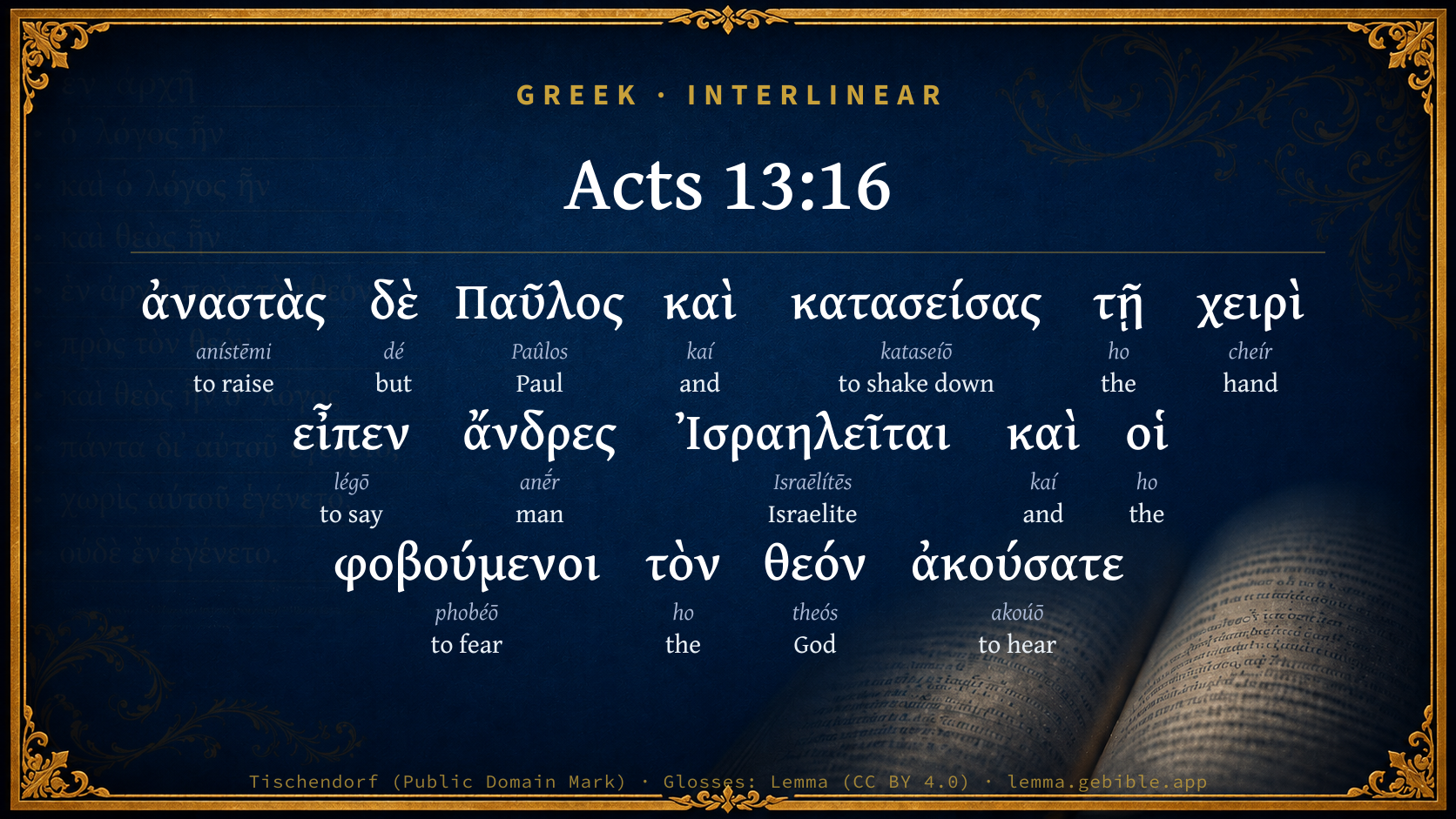
  1. ἀναστὰς anístēmi G450 “to raise” Verb, Aorist, Active, Participle, Nominative, Singular, Masculine
  2. δὲ dé G1161 “but” Conjunction
  3. Παῦλος Paûlos G3972 “Paul” Noun, Nominative, Singular, Masculine
  4. καὶ kaí G2532 “and” Conjunction
  5. τῇ ho G3588 “the” Article, Dative, Singular, Feminine
  6. χειρὶ cheír G5495 “hand” Noun, Dative, Singular, Feminine
  7. εἶπεν légō G3004 “to say” Verb, Aorist, Active, Indicative, 3rd person, Singular
  8. ἄνδρες anḗr G435 “man” Noun, Vocative, Plural, Masculine
  9. Ἰσραηλεῖται Israēlítēs G2475 “Israelite” Noun, Vocative, Plural, Masculine
  10. καὶ kaí G2532 “and” Conjunction
  11. οἱ ho G3588 “the” Article, Nominative, Plural, Masculine
  12. φοβούμενοι phobéō G5399 “to fear” Verb, Present, Middle or Passive deponent, Participle, Nominative, Plural, Masculine
  13. τὸν ho G3588 “the” Article, Accusative, Singular, Masculine
  14. θεόν theós G2316 “God” Noun, Accusative, Singular, Masculine
  15. ἀκούσατε akoúō G191 “to hear” Verb, Aorist, Active, Imperative, 2nd person, Plural

About this verse

These counts appear in no published source. They are computed here, from the morphology-tagged text and Lemma’s own curated glosses. What Lemma adds →

16
words
13
distinct lemmas
Acts
section

Notable vocabulary

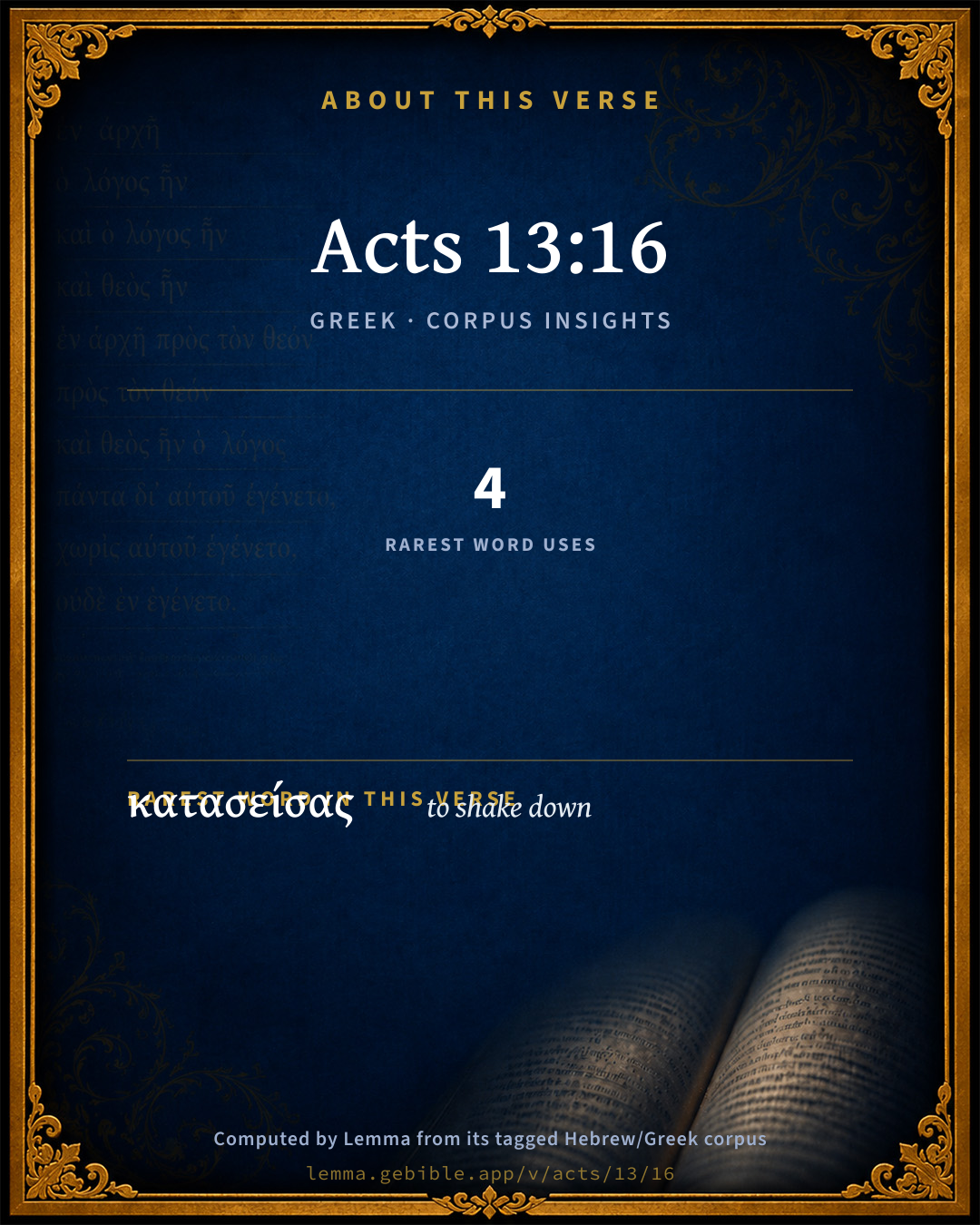
The rarest word here is κατασείσας to shake down G2678 — appearing just 4 times in the whole Greek New Testament.

Shared distinctive vocabulary

κατασείσας to shake down G2678 occurs in 4 verses of the Greek New Testament. Also found in:

Repetition

Words recur within this verse:

Cross-references

27

Topical passages linked to Acts 13:16 in the Treasury of Scripture Knowledge — connected by theme and wording, ordered by reader-vote popularity; previews shown in the World English Bible.

  • Acts 12:17 But he, beckoning to them with his hand to be silent, declared to them how the Lord had brought him out of the prison. He said, "Tell these things to James, and to the brothers." Then he departed, and went to another place.
  • Acts 10:2 a devout man, and one who feared God with all his house, who gave gifts for the needy generously to the people, and always prayed to God.
  • Acts 13:26 Brothers, children of the stock of Abraham, and those among you who fear God, the word of this salvation is sent out to you.
  • Deuteronomy 32:46–47 He said to them, Set your heart to all the words which I testify to you this day, which you shall command your children to observe to do, [even] all the words of this law.
  • 1 Kings 8:40 that they may fear you all the days that they live in the land which you gave to our fathers.
  • Psalms 49:1–3 Hear this, all you peoples. Listen, all you inhabitants of the world,
  • Psalms 67:7 God will bless us. All the ends of the earth shall fear him.
  • Psalms 78:1–2 Hear my law, my people. Turn your ears to the words of my mouth.
  • Psalms 85:9 Surely his salvation is near those who fear him, That glory may dwell in our land.
  • Psalms 135:20 House of Levi, praise Yahweh! You who fear Yahweh, praise Yahweh!
  • Micah 3:8–9 But as for me, I am full of power by the Spirit of Yahweh, And of judgment, and of might, To declare to Jacob his disobedience, And to Israel his sin.
  • Matthew 11:15 He who has ears to hear, let him hear.
  • Luke 1:50 His mercy is for generations of generations on those who fear him.
  • Acts 2:14 But Peter, standing up with the eleven, lifted up his voice, and spoke out to them, "You men of Judea, and all you who dwell at Jerusalem, let this be known to you, and listen to my words.
  • Acts 2:22 "Men of Israel, hear these words! Jesus of Nazareth, a man approved by God to you by mighty works and wonders and signs which God did by him in the midst of you, even as you yourselves know,
  • Acts 3:12 When Peter saw it, he responded to the people, "You men of Israel, why do you marvel at this man? Why do you fasten your eyes on us, as though by our own power or godliness we had made him walk?
  • Acts 10:35 but in every nation he who fears him and works righteousness is acceptable to him.
  • Acts 13:42–43 So when the Jews went out of the synagogue, the Gentiles begged that these words might be preached to them the next Sabbath.
  • Acts 13:46 Paul and Barnabas spoke out boldly, and said, "It was necessary that God's word should be spoken to you first. Since indeed you thrust it from you, and judge yourselves unworthy of eternal life, behold, we turn to the Gentiles.
  • Acts 19:33 They brought Alexander out of the multitude, the Jews putting him forward. Alexander beckoned with his hand, and would have made a defense to the people.
  • Acts 21:40–22:1 When he had given him permission, Paul, standing on the stairs, beckoned with his hand to the people. When there was a great silence, he spoke to them in the Hebrew language, saying,
  • Acts 22:22 They listened to him until he said that; then they lifted up their voice, and said, "Rid the earth of this fellow, for he isn't fit to live!"
  • Revelation 2:7 He who has an ear, let him hear what the Spirit says to the assemblies. To him who overcomes I will give to eat of the tree of life, which is in the Paradise of my God.
  • Revelation 2:11 He who has an ear, let him hear what the Spirit says to the assemblies. He who overcomes won't be harmed by the second death.
  • Revelation 2:17 He who has an ear, let him hear what the Spirit says to the assemblies. To him who overcomes, to him I will give of the hidden manna, and I will give him a white stone, and on the stone a new name written, which no one knows but he who receives it.
  • Revelation 2:29 He who has an ear, let him hear what the Spirit says to the assemblies.
  • Luke 23:40 But the other answered, and rebuking him said, "Don't you even fear God, seeing you are under the same condemnation?

Cross-references courtesy of OpenBible.info (CC BY 4.0).

Commentary

Notes on Acts 13:16 from classic Christian and Jewish commentators (each source and its license shown beneath its notes). The classic Christian expositions comment on the surrounding passage and are grouped to its opening verse, so a note may address several verses; the Jewish commentaries on the Tanakh (Rashi and others) are per-verse, so they appear only where the commentator wrote on this verse.

Lemma curates 59 commentaries, every one of them public domain or Creative Commons licensed, each selected and text-cleaned for this edition rather than reprinted as found. About our sources →

Joseph Benson's Commentary

Act 13:16. Then Paul stood up, and beckoning with, or waving, his hand — To render the audience more attentive; said, Men of Israel, and ye that fear God — Whether proselytes or heathen; give audience — This expression, Ye that fear God, seems best to suit those who, by embracing the Jewish religion, had entered into covenant with the true God, yet so as also to include any others in whom a filial reverence for the Divine Being was a governing principle. The discourse which the apostle now delivered, seems to have been chiefly intended to illustrate the divine economy, in opening the gospel gradually, and preparing the Jews, by temporal mercies, for others of a more important nature. He had thus a good opportunity of showing his acquaintance with their Scriptures, (which they esteemed the highest part of literature,) and thereby of better engaging their attention. His sermon, which seems to be given us at large, is particularly worthy of our consideration, as being an example of his manner of preaching in all the synagogues, and of the arguments which he used for convincing the Jews and proselytes that Jesus was the Messiah, or Christ, foretold by David, in the second Psalm. See on Act 17:2, &c.

Joseph Benson's Commentary on the Old and New Testaments (1811–1818) — public domain. Text from a community e-Sword module.

Whedon's Commentary on the Bible

Daniel D. Whedon

3. Paul’s Missionary Argument at Pisidian Antioch, Act_13:16-41.

Luke here at length furnishes a first specimen of Paul’s preaching, enabling us to judge by what methods Paul proclaimed to these provincial Jews that their long expected Messiah had come, and that upon him they must rely for eternal salvation.

1. In 16-23 he gives a preparatory rehearsal of the main points of Israel’s Old Testament history from Abraham to David, as the Messiah’s progenitor. This furnishes the historic grounding for Jesus. 2. In 24, 25 he grounds the same Jesus upon John the Baptist. 3. We have, 26-31, the Jesus-history given, presenting him as rejected indeed by Jerusalem, but predicted by the prophets, and, when slain by Pilate, raised from the dead by God, as attested by chosen witnesses. Thus the Jesus-history is embedded in the Israel-history. 4. Glad tidings, therefore, (32-37,) does the orator bring, that God’s Messianic promise is fulfilled, as prophesied of old, in the birth of God’s Son, and in his miraculous resurrection as the Holy One above all corruption. 5. A proclamation (38-41) of the joyful conclusion, an era of sin forgiven with a power unknown heretofore to Moses’ law: yet with the sad finale of perdition to all rejecters. Thus we have the skilful Christian argument by which the crucified Jesus is installed and incorporated into the divine history of Israel as her true Messiah, and her only Redeemer from sin and perdition.

1. Jesus grounded in Old Testament history, Act_13:16-23.

16. Paul stood up—The first presentation of Paul, the Christian orator.

Beckoning with his hand—Waving down his hand, as if solemnly invoking their attention. It expresses in majestic action what give audience does in majestic words.

Ye that fear God—That is, Gentiles who conscientiously adore the only true God. He thus addresses both classes of men, the men of Israel and the Gentile proselytes, and all conscientious believers in monotheism.

Give audience—Thrice does he, in the train of this address, make a similar solemn invitation, namely, besides this at Act_13:26; Act_13:38. To such history as follows the Israelite never tired of listening, being their old ancestral story. To it the Gentile proselyte ever listened, as revealing a scene of novelty and wonder.

Daniel D. Whedon (gen. ed.), Commentary on the Old and New Testaments (1874–1909) — public domain. Text from a community e-Sword module.

Tyndale Open Study Notes

Tyndale Open Resources

13:16-41 Paul accepted the invitation, motioned to quiet his audience (cp. 19:33; 21:40), and launched into a straightforward proclamation of the Good News. This is Paul’s first great speech in Acts, and it provides a model of his preaching to a Jewish audience (see 22:1-21).

Tyndale Open Study Notes — © Tyndale Open Resources, licensed CC BY-SA 4.0. Text via the HelloAO Bible API.

Bengel's Gnomon

Johann Albrecht Bengel

Act 13:16. Κατασείσας, having made a motion with his hand) lest even his first words should not be heard.—ἄνδρες, men) The appellation recurs in Act 13:26; Act 13:38.—καἰ οἱ φοβούμενοι τὸν Θεὸν, ye who fear God) These were proselytes, not to the exclusion of the Gentiles: comp. Act 13:17; Act 13:26; Act 13:43; Act 14:1.

Bengel's Gnomon of the New Testament — English translation (T&T Clark, Edinburgh, 1860) — public domain. Text from a community e-Sword module.

Meyer's Critical & Exegetical Commentary

Heinrich August Wilhelm Meyer

Act_13:16. Κατασ. τῇ χειρί] See on Act_12:17.

οἱ φοβούμ. τ. Θεόν] is here, as the distinction from Ἰσραηλῖται requires, the formal designation of the proselytes of the gate, who, without becoming actual Ἰσραηλῖται by circumcision, were yet worshippers of Jehovah, and attenders at the synagogues (where they had their particular seats). Comp. Act_13:43; Act_13:49; Act_17:4; Act_17:17; Act_16:14; Act_18:7. Against the unfavourable judgment, which the following speech has met with from Schneckenburger, Baur, and Zeller,namely, that it is only an echo of the speeches of Peter and Stephen, a free production of the narrator,we may urge as a circumstance particularly to be observed, that this speech is directed to those who were still non-believers (not, like the Epistles of the apostle, to Christians), and accordingly does not find in the Epistles any exactly corresponding standard with which to compare it; that, further, nothing un-Pauline occurs either in its contents or form,on the contrary, the Pauline fundamental dogma of justification (Act_13:38 ff. do not contain a mere timid allusion to it, as Zeller thinks, p. 327) forms its important concluding main point;[8] and the Pauline delicacy, prudence, and wisdom of teaching are displayed in its entire plan and execution; that, in particular, the historical introduction, although it may not have originated without some influence from Stephens speech, and the latter may have, by the editing, been rendered still more similar, yet presents nothing which could not have been spoken by Paul, as the speech of Stephen was known to the apostle and must have made an indelible impression on him; and that the use of Psalms 16 (comp. Act_2:25 ff.), as a witness for the resurrection of Jesus, was as natural to Paul as it was to Peter, as, indeed, to Paul also Christ rose κατὰ τὰς γραφάς (1Co_15:4). The reasons, therefore, adduced against its originality in the main are not sufficient, although, especially amidst our ignorance of the document from which the speech thus edited is taken, a more complete assertion of an originality, which is at all events only indirect, cannot be made good.[9]

[8] In opposition to Baurs opinion (I. p. 117, ed. 2), that the author, after he had long enough made the Apostle Paul speak in a Petrine manner, felt that he must now add something specifically Pauline!

[9] Comp. the thoughtful judgment of Weiss, bibl. Theol. p. 220.

Meyer — Critical and Exegetical Commentary on the New Testament — English translation by Peter Christie, edited by Frederick Crombie (T&T Clark, 1880) — public domain. Text from a community e-Sword module.

Expositor's Greek Testament

ed. W. Robertson Nicoll

Act 13:16 . κατασείσας , see above on Act 12:17 , and cf. Act 19:33 , Act 21:40 (Act 26:1 ), “made a gesture with his hand,” a gesture common to orators, “nam hoc gestu olim verba facturi pro contione silentium exigebant,” and here a graphic touch quite characteristic of Acts. The speech which follows may well have remained in the memory, or possibly may have found a place in the manuscript diary of one of Paul’s hearers (Ramsay, St. Paul , p. 100), or St. Paul may himself have furnished St. Luke with an outline of it, for the main sections, as Ewald suggested, may have formed part of the Apostle’s regular mode of addressing similar audiences; and if not St. Paul himself, yet one of those who are described as οἱ περὶ Παῦλον , Act 13:13 (Zöckler), may have supplied the information. On the other hand it is maintained that the speech in its present form is a free composition of the author of Acts, since it is so similar to the early addresses of St. Peter, or to the defence made by St. Stephen, and that St. Luke wished to illustrate St. Paul’s method of proclaiming the Messianic salvation to Jews. But considering the audience and the occasion, it is difficult to see how St. Paul could have avoided touching upon points similar to those which had claimed the attention of a St. Peter or a St. Stephen: “non poterat multum differre vel a Petri orationibus, vel a defensione Stephani … hæc igitur non magis in Paulum cadunt quam in quemvis novae salutis praeconem” (Blass), while at the same time it is quite possible to press this similarity too far and to ignore the points which are confessedly characteristic of St. Paul, cf., e.g. , Act 13:38-39 (Bethge, Die Paulinischen Reden der Apostelgeschichte , pp. 19 22; Zöckler, Apostelgeschichte , pp. 244, 245; Lechler, Das Apostolische Zeitalter , p. 272; Hilgenfeld, Zeitschrift für wissenschaft. Theol. , i., p. 46 (1896)); see further, Farrar, St. Paul , i., p. 369, note, and Alford references for the several Pauline expressions, and the remarkable list of parallels drawn out recently by Ramsay between the speech at Pisidian Antioch and the thoughts and phrases of the Epistle to the Galatians, Expositor , December, 1898 (see below on pp. 295, 297); also Nösgen’s list of Pauline expressions, Apostelgeschichte , p. 53, in this and in other speeches in Acts. ἄνδρες Ἰ ., cf. Act 2:22 , Act 3:12 , Act 5:35 , a mode of address fitly chosen as in harmony with the references to the history of Israel which were to follow. οἱ φ . Θεόν , cf. Act 10:2 , Act 13:43 ; Act 13:50 , Act 16:14 , etc.

The Expositor's Greek Testament, edited by W. Robertson Nicoll (1897–1910) — public domain. Text from a community e-Sword module.

Geneva Bible (1599)

Geneva Bible translators

God bestowed many peculiar benefits upon his chosen Israel, but this especially, that he promised them the everlasting redeemer.

Geneva Bible (1599) marginal notes — public domain. Text via Bolls.life.

Adam Clarke's Commentary

Verse 16. Men of Israel] Ye that are Jews by birth; and ye that fear God-ye that are proselytes to the Jewish religion. In this discourse Paul proves that Jesus Christ is the Messiah, sent from God, not only for the salvation of the Jews, but of the whole human race. And this he does, not with the rhetorician's arts, but in a plain, simple detail of the history of Christ, and the most remarkable transactions of the people of God, which referred to his manifestation in the flesh. Rosenmuller.

Adam Clarke's Commentary on the Bible (1810–1826) — public domain. Text from a community e-Sword/MySword module.

John Calvin's Commentaries

16. We must note the state of this sermon, lest we think that he uttered words in vain. Paul seemeth, indeed, to begin even at the very first beginning, but he speaketh nothing but that which is most convenient for the present purpose. His purpose is to bring the Jews unto the faith of Christ; and that he may the better do this, it is needful to declare that they excel other nations in this one thing, because the Savior was promised them, whose kingdom is their principal and only felicity. This is, therefore, Paul’s beginning, that whereas they were chosen in times past to be the peculiar people of God; whereas they had so many benefits bestowed upon them from time to time, though they showed themselves most unworthy, this did depend upon the promise of the Messiah, and did tend to that end, that God might govern them by the hand of the Messiah; and that therefore they have nothing whereof they may boast, unless they be gathered under their Head; yea, that unless they receive him when he is offered, the covenant of life which God had made with their fathers shall be void, and the adoption shall be frustrate. This is the drift of the first part of the sermon: that this is the principal point of the law and the foundation of God’s covenant, that they have Christ for their Captain and Governor, that he may restore all things among them; that without him religion cannot stand, and that they shall be most miserable without him. Thence Paul passeth unto another member, that Jesus, whom he preacheth, is Christ indeed, through whom salvation is offered to the people; also he declareth the means of the redemption purchased by him. Furthermore, he intreateth of his power and office, that they may know what good things they ought to hope for at his hands. The conclusion containeth a chiding; for he threateneth to them horrible judgment, if they refuse the author of salvation, who offereth himself, even of his own accord, whom earnestly to desire the law and prophets provoke. This is, in a manner, the sum; now let us discuss every point by itself.

Men and brethren. Because Paul knew that there were many bastardly sons of Abraham, or such as were grown out of kind, he calleth the Jews to whom he speaketh by a double name. First, he calleth them brethren, having respect unto common kindred, notwithstanding he showeth therewithal that they shall be true Israelites if they fear God, and that even then they are likewise true hearers, because “the fear of the Lord is the beginning of wisdom.” In like sort he maketh the faithful attentive, and purchaseth audience among them, as if he should say, Seeing many boast that they are sons of Abraham, who were unworthy of such honor, show yourselves to be no bastardly seed. Let us learn by this that it is not a fault common to one age only, that good and sincere worshippers being mixed with hypocrites, have the name of the Church common among them. But we must have a great care hereof, that we be indeed that which we are called; which thing the true fear of Almighty God will bring to pass, and not the external profession alone.

John Calvin's Commentaries (1540-1563) — public domain. Text from the Calvin Translation Society English edition (1840s-50s) via the Christian Classics Ethereal Library (ccel.org). Calvin's coverage is partial (roughly two-thirds of the Bible); uncommented books and verses are honest gaps, never fabricated. The 19th-century editor's footnotes and remarks are omitted so the notes are faithfully Calvin's own voice.

Ellicott's Commentary for English Readers

(16) Beckoning with his hand.—The gesture was rather that of one who waves his hand to command silence and attention than what we commonly describe as beckoning. (Comp. Act_12:17.) The graphic touch of description would seem to indicate, as does the full report of the speech, that they came in the first instance from one who had been present. A like touch is found again in connection with St. Paul in Act_21:40. It was, probably, like the “fixing of the eye,” in Act_13:9, just one of the personal characteristics on which the painter-historian loved to dwell. We may assume, as almost certain, that throughout this journey St. Paul used Greek as the common medium of intercourse. The verbal coincidences in Act_13:17-18, already referred to in the Note on Act_13:15, make it, in this instance, absolutely certain.

Men of Israel, and ye that fear God.—The latter phrase denotes, as in Act_10:2; Act_10:22, those who, though in the synagogue, were of heathen origin, and had not become proselytes in the full sense of the term, but were known as the so-called “proselytes of the gate.”

Give audience.—Literally, hear ye. The English phrase may be noted as an example of the use of the word “audience,” which has since been applied to the persons who hear, in the old abstract sense of the act of hearing.

A Bible Commentary for English Readers, edited by Charles John Ellicott (1878–1897) — public domain. Text from a community e-Sword module.

The Cambridge Bible for Schools and Colleges

gen. ed. J. J. S. Perowne

16–41. Paul’s speech at Antioch

16. beckoning with his hand] Cp. Act_12:17, where it is explained that the gesture is to procure silence.

Men of Israel, and ye that fear God] The audience consisted of born Jews and proselytes as well as perhaps some Gentiles. See Act_13:42-43. When the audience and the subject and the end aimed at are so entirely in accord on all three occasions we cannot be surprised that the address of St Paul at Antioch partakes largely of the character and also of the language of those of St Peter at Pentecost and St Stephen in his defence. St Paul had heard the last of these, and the vision on the way to Damascus had taught him to speak with boldness on the truth of the resurrection.

The Cambridge Bible for Schools and Colleges (gen. ed. J. J. S. Perowne; Cambridge University Press, 1878–1918) — public domain. Text from a community e-Sword module.

John Gill's Exposition

Then Paul stood up,.... Not so much that he might be heard; or merely out of reverence and respect to the rulers, and the people; but to show that he accepted the invitation; as also in order to take his proper place in the synagogue, and sit down and teach, as was their custom:

and beckoning with his hand; to the people to be silent, and attend to what he had to say:

said, men of Israel; by whom are meant the proper Jews, the natural descendants of Jacob, whose name was Israel; this was accounted a very honourable character, and was a common form of address; see Act 2:22

and ye that fear God; not as distinguishing some among the Israelites from the rest, as if there were some of them that did not fear God; for by these are meant, not Jews by birth, but proselytes, devout and religious men from among the Gentiles; who were proselyted to the Jewish religion, and attended with them in their synagogues on religious worship; and that there were such in this synagogue, is certain from Act 13:43 and we find that sometimes the Jews distinguish the proselytes from the Israelites by this very character (s): it is said, Psa 128:1

"blessed is everyone that feareth the Lord, that walketh in his ways; he does not say blessed are the Israelites, blessed are the priests, blessed are the Levites, but blessed is everyone that feareth the Lord; "these are the proselytes, for they fear the Lord"--of what proselyte is it "said blessed?" of the proselyte who is a proselyte of righteousness, and not of the Cuthites, of whom it is written, Kg2 17:33 but of a proselyte who fears the Lord, and walks in his ways;''

so Psa 22:23 are interpreted by many Jewish writers (t). Now to both these sort of persons, both to the proper Jews, and to the proselytes of righteousness, the apostle addresses himself, and desires they would give audience to what he had to say; which is as follows.

(s) Bemidbar Rabba, sect. 8. fol. 190. 4. (t) Midrash Tillim, Jarchi, & Aben Ezra, in loc.

John Gill's Exposition of the Whole Bible (1746–1763) — public domain (CC PDM 1.0). Text via the HelloAO Bible API.

Trapp's Complete Commentary

John Trapp

16 Then Paul stood up, and beckoning with his hand said, Men of Israel, and ye that fear God, give audience.

Ver. 16. And ye that fear God] This is the proper character of an Israelite indeed.

John Trapp, A Commentary or Exposition upon All the Books of the Old and New Testament (1647–1656) — public domain. Text from a community e-Sword module.

Albert Barnes' Notes on the Bible

Men of Israel - Jews. The design of this discourse of Paul was to introduce to them the doctrine that Jesus was the Messiah. To do this, he evinced his usual wisdom and address. To have commenced at once on this would have probably excited their prejudice and rage. He therefore pursued a train of argument which showed that he was a firm believer in the Scriptures; that he was acquainted with the history and promises of the Old Testament; and that he was not disposed to call in question the doctrines of their fathers. The passage which had been read had probably given occasion for him to pursue this train of thought. By going over, in a summary way, their history, and recounting the former dealings of God with them, he showed them that he believed the Scriptures; that a promise had been given of a Messiah; and that he had actually come according to the promise.

Ye that fear God - Probably proselytes of the gate, who had not yet been circumcised, but who had renounced idolatry, and were accustomed to worship with them in their synagogues.

Give audience - Hear.

Albert Barnes' Notes on the Bible (1834–1885) — public domain. Text from a community e-Sword/MySword module.

Matthew Poole's English Annotations

Beckoning with his hand, to procure silence and attention, as Act 12:17.

And ye that fear God; besides the native Jews, the proselytes, and such out of all nations who left the idolatry of the Gentiles, and served the only true God, met together in the worship of God; these were the σεβομενοι, spoken of Act 17:4. It shows also what they are to do that would hear the word of the Lord with profit; viz. to attend unto it in the fear of his name.

Matthew Poole's English Annotations on the Holy Bible (1683–1685) — public domain. Text from a community e-Sword/MySword module.

The Pulpit Commentary

And for then, A.V.; the for Ms, A.V.; hearken for give audience, A.V. Beckoning with the hand. (see Act_12:17, note) Ye that fear God; addressed to the devout heathen who attended the synagogue service. (see Act_10:2, note, and 22; ver. 43 of this chapter; Act_15:21 Act_16:14 Act_17:4, 17 18:7)

Vers. 16-41. The New Testament in the Old.

The expositions of the Scriptures of the Old Testament by the writers and speakers of the New Testament are worthy of our deepest attention, Not only do they draw out from those Scriptures particular instruction which of ourselves we should never, perhaps, have found there, but they supply us with irrefragable proofs of the unity of purpose which ordained the long sequence of events themselves, through many centuries, and also ordained that a faithful record of them should be preserved in the sacred archives of the Jewish people. There is probably no evidence of more overwhelming power of conviction, when once it is grasped, that the Scriptures are from God, and that they are a revelation of the very mind of God, than that which is supplied by the continuity of events whose historical truth rests upon a solid basis, and whose meaning and purpose receive their only and full explanation in another set of events whose basis of historical evidence is no less firm and solid than the former. This double testimony to the truth of the gospel, supplied by the direct evidence of those who went in and out with the Lord Jesus, on the one hand, and by the prophetic preparation for those events, and the significant types of them, exhibited centuries before, on the other hand, together form a moral demonstration which, when apprehended, is simply irresistible. It is this which gives such force to those apostolic and other sermons which are recorded in this Book of the Acts. In this sermon of St. Paul"s we have the election of Israel to be the people of God, their redemption from Egyptian bondage, their planting in the land of Canaan according to God"s promise, first held up to view. Could any one deny the truth of those events? Were not the Jewish people still in actual possession of the land of Canaan? Living in the midst of heathens, were they not, and were not they alone, worshippers of the true and living God? Did they not possess the sacred oracles? And if they went back century by century, did they not come to the time when the seven nations of Canaan possessed the land, and when their fathers dis possessed them of it? If they went further back still, was there not the Egyptian bondage described in their ancient records, living in their traditions and sacred songs, engraved in the monuments and annals of Egypt? Yes; God had dealt with them as he had dealt with no other people. They were the children of miracle, the heirs of Divine promises, the depositaries of a Divine plan, the ordained instruments of a great and eternal purpose. Every page of their history proved it, as that history was slowly unfolded in the course of successive ages. And the purpose itself was partially revealed from time to time. Let them bethink themselves of David and his throne; his humble origin, and his exalted power; the hand which raised him, the promises which surrounded him, the expectations which clung to his name. Did he not live in the hearts and hopes of the people through ages of oppression and wrong? Did not his name still glow on the page of prophecy, as the heir of mercy, as the future prince of Israel, as the founder of Israel"s glory? What did all these things mean? What was the hidden truth that swelled and was ready to burst under all these images? What was the womb of time so big with in the days which had come upon them? There was an answer, and one only answer, to these questions. The history of their fathers was explained by one and only one fact, and that was the birth of Jesus Christ, of the seed of Abraham and of the lineage of David, to be the Savior of Israel, and not of Israel only, but also of the whole world. And he Paul was there to tell them of Jesus Christ: how he was born in the city of David; how John the Baptist bore witness of him; how in him was fulfilled all that was written in the Law of Moses and in the prophets, and in the Psalms, concerning the Christ that should come. Let them turn to those prophets and to those Psalms, and see what was there written concerning the sufferings of Christ and the glory that should follow. It had all been fulfilled. The Man of sorrows had been despised and rejected; his hands and his feet had been pierced on the tree; they had parted his raiment among them and cast lots upon his vesture; he had gone to the grave and to hell; he had risen again and seen no corruption; his old companions had seen him many days after his resurrection; they had eaten and drunk with him, and in their sight he had gone up to heaven. What further proof could they have that he was very Christ, the promised Savior, the Son of David, of whose kingdom there should be no cud? Let them believe in him, and he would justify them from all their sins. Let them not by their unbelief bring upon themselves the curse denounced by the prophet upon the despisers of God"s Word. Thus it was that the fulfillment in the New Testament of all the types and promises of the Old was as the seal of God to the truth of both. The testimony of nearly two thousand years, in which words, deeds, persons, things, events, pointed with steady consistency to one Person that should come, was all concentrated upon Jesus Christ, who did come in the fullness of time. And the 1850 years which have elapsed since Jesus rose again have added their testimony, too, to all that went before. So that our age will be altogether without excuse if, shutting its eyes to the light of truth, it rejects the Son of God and misses the great salvation which he has brought to our sinful and fallen world.

Vers. 16-43. Paul"s sermon in the synagogue at Antioch.

I The MAIN PURPOSE of it to prove the Messiahship of Jesus, and therefore to proclaim the gate of life open. History of Divine grace pointing to clay of salvation. The course of thought in Paul"s own mind, which led him to faith.

II The MAIN STRENGTH of the argument the facts of the Savior"s death and. resurrection. Paul could speak with special emphasis, though prudently avoided bringing in at this point his own conversion.

III The SPIRITUAL APPEAL twofold.

1. You need this salvation; for the Law of Moses will not justify you.

2. How can you escape if you neglect it? resist not the Holy Ghost.

IV The MARKED EFFECT of sincerity and earnestness.

1. Inquiry. It is much to break through stolid indifference.

2. Devout attention led to faith. Many followed them; that is, declared themselves convinced. Fruit gathered even among the Jews. R.

The Pulpit Commentary (1880–1919), ed. H.D.M. Spence-Jones & Joseph S. Exell — public domain. Text from a community e-Sword module.

John Wesley's Explanatory Notes

Ye that fear God - Whether proselytes or heathens.

John Wesley, Explanatory Notes Upon the Whole Bible (1754–1765) — public domain. Text via the GEBible commentary corpus.

Kretzmann's Popular Commentary

Paul E. Kretzmann

Paul begins his discourse:

v. 16. Then Paul stood up, and beckoning with his hand, said, Men of Israel, and ye that fear God, give audience.

v. 17. the God of this people of Israel chose our fathers, and exalted the people when they dwelt as strangers in the land of Egypt, and with an high arm brought He them out of it.

v. 18. And about the time of forty years suffered He their manners in the wilderness.

v. 19. And when He had destroyed seven nations in the land of Chanaan, He divided their land to them by lot.

v. 20. And after that He gave unto them judges about the space of four hundred and fifty years, until Samuel, the prophet.

v. 21. And afterward they desired a king; and God gave unto them Saul, the son of Cis, a man of the tribe of Benjamin, by the space of forty years.

v. 22. And when He had removed him, he raised up unto them David to be their king, to whom also He gave testimony and said, I have found David, the son of Jesse, a man after Mine own heart, which shall fulfill all My will.

Whether the invitation came to Paul with or without his seeking, he at once made use of it. Arising and holding out his hand in a gesture inviting attention, he addressed his hearers as men of Israel and those that feared God. The many references to the history of the children of Israel, which are found also in the sermons of Peter, but especially in that of Stephen, would interest not only the Jews, but prove highly instructive to the proselytes and strangers present as well. There is a certain amount of appeal to the national pride of the people, for it was the God of this nation of Israel that chose their fathers as His own from among all nations of the world. By His blessing they increased not only in numbers, but in strength and power as well, while they were strangers in the land of Egypt. With uplifted arm, then, by the application of His almighty strength, He led them forth from the land of Egypt For forty years, out in the wilderness, He surrounded and bore them with solicitous care in spite of all their ingratitude. In the land of Canaan, to which the Lord brought the children of Israel, He destroyed utterly seven heathen nations before them, the Girgashites, the Amorites, the Hittites, the Perizzites, the Canaanites, the Hivites, and the Jebusites, Exo 23:23; Jos 3:10, dividing the land to the conquerors by lot. A space of some four hundred and fifty years, counting from the arrival of the people in Canaan to the final subjugation of the heathen nations at the time of David, was needed to carry out this command of the Lord. The last and most renowned of the judges was Samuel, the prophet. When Samuel had grown old, the people demanded of him a king, and God gave them Saul, the son of Kis, who reigned for forty years. But Saul did not bring his people the promised salvation, it being necessary for God to remove or depose him from the throne, 1Sa 15:16; Dan 2:21. But after Saul’s removal the throne was given to David, whom God raised up from the lowly in the land, and of whom He bears witness that He found David, the son of Jesse, to be a man according to His own heart, willing and able to perform all His will. In ascribing these words to God, Paul bears witness to the inspiration of the Old Testament, for his words, instead of being a quotation of one single passage, are a compilation from several verses, Psa 89:20 and 1Sa 13:14. The testimony of the Old Testament, in all its parts, is true, since the Lord spoke through His servants.

Paul E. Kretzmann, Popular Commentary of the Bible (1921–1924) — public domain. Text from a community e-Sword module.

Burkitt's Expository Notes on the New Testament

William Burkitt

This latter part of the chapter containeth an historical and practical sermon, preached by St. Paul at the request of the rulers of the synagogue.

Where observe, 1. His prologue or preface, in which he craves their careful attention: withal intimating, that none of them would attend but only such as truly feared God; Men of Israel, and ye that fear God, give audience. That is the proper character of a right attentive hearer.

Observe, 2. The narrative which the apostle gives of the many divine favours, benefits, and blessings, which the Lord bestowed of old upon Israel his people; namely, his free election and chusing them before all nations; his wonderful deliverance of them out of Egypt; his great indulgence towards them for forty years in the wilderness, as a mother bears with a child’s forwardness and stubbornness; and his constituting a form of government for them under the judges first, and king afterwards, particularly Saul and David; who is described first by his conformity to the nature of God; he was a man after his own heart.

Secondly, By his conformity to the will of God; He shall fulfill all my will.

Having thus ended the historical part, he next begins the practial part of his discourse; and lays down this grand proposition, That Jesus is the Christ and Saviour of the world.

This assertion he defends and proves, 1. From his stock and family according to the flesh, foretold by God.

2. From the testimony of John the Baptist his forerunner, Of David’s seed hath God, according to his promise, raised unto Israel a Saviour, when John had first preached the baptism of repentance. After this he makes a close application of the whole to them: Men and brethren, to you is the word of this salvation sent.

Learn thence, That the gospel is the doctrine or word of salvation sent by God unto a lost world. The gospel is a message of glad tidings; the glad tidings which the gospel brings, is salvation: and the way and manner how the gospel brings salvation , is threefold;

1. By way of patefaction and discovery; the gospel makes a discovery of salvation exclusively to any other way; no angel in heaven could have discovered it, if God had not first declared it in and by the gospel.

2. By way of tender and offer: Oh this joyful message of salvation is sent to every man’s door! free grace falls upon its knees, and begs of every sinner to accept it.

3. By way of efficacy and power. The gospel brings with it a convincing and converting power, to put men into a state of salvation; and hath also an establishing and confirming power, to preserve them in that estate.

Blessed be God, that to us, even to every one of us, is the word of this salvation sent. What monsters then are they who are enemies to the preaching of the gospel? they are enemies to our salvation: The only way to heaven is by Christ, the only way to Christ is by faith, and the only way to faith is by the word. It cometh by hearing.

William Burkitt's Expository Notes on the New Testament (1700–1703) — public domain. Text from a community e-Sword module.

McGarvey & Pendleton's Commentaries

J. W. McGarvey

16. To this invitation Paul responded, by immediately arising and addressing the audience. It need not be supposed, in order to account for the leadership which he now assumes, that he had laid formal claim to superiority over Barnabas; for when two men, of generous spirit, are co-operating together under trying circumstances, he who possesses the greater courage and promptness will eventually assume the foremost position, even without a special agreement to that effect. Such was the constant danger and embarrassment of the two missionaries, that the question was, who is willing to go forward, rather than, who has the right to be heard first. Paul's manner, in arising to open the gospel message among these strangers, was bold and commanding. It is thus described by Luke: (16) " Then Paul stood up, and beckoning with his hand, said, Men of Israel, and ye who fear God, give audience. " This gesture, described as beckoning with the hand, was characteristic of Paul's manner, as well shall have occasion to observe frequently hereafter, and was well calculated to arrest the attention of an audience. It is the manner of one who knows what he is about to say, and feels confident of its importance.

Besides the Jewish audience present, Paul addressed a number of Gentiles, such as were in the habit of attending Jewish worship in almost every Gentile city, and many of whom, like Cornelius, had learned to worship the true God. He distinguishes the two classes, by addressing the former as "Men of Israel," and the latter, as "Ye who fear God."

J. W. McGarvey (with Philip Y. Pendleton), Commentaries on the New Testament (The Fourfold Gospel, 1914; Acts; and the epistles) — public domain. Text from a community e-Sword/MySword module.

The People's New Testament

B. W. Johnson

16. Then Paul stood up. Invited to speak by the usual courtesy extended to visiting brethren, he arose, according to the Greek custom. In Judea speakers sat. Among the Greeks they stood. The address that follows, the first reported address of Paul, is worthy of special study especially as an example of the character of his preaching in the synagogue. It begins with a short recapitulation of the glorious history of Israel, a theme always apt to secure the favor of a Jewish audience, and when he has ascended to David, the hero king and the pride of every Jew, he passes from him to the promised Son of David, and thus preaches Christ. Had he begun at once with the latter, the great object of his discourse, he would have aroused prejudice and perhaps closed their ears. It will be observed here before a Jewish audience, as well as at Athens before a heathen audience, he first secured a common ground with his hearers, and upon it founded his argument for the gospel. Men of Israel, and ye that fear God. There were two classes present, Jews and “the devout Greeks.” The latter had given up heathenism, had learned to “fear God,” and were anxious to learn more about him; hence were wont to attend the synagogue.

B. W. Johnson's The People's New Testament with Notes (1889–1891) — public domain. Electronic text from the Christian Classics Ethereal Library (CCEL) ThML edition.

unfoldingWord translationNotes

Door43 World Missions Community

Connecting Statement:

Paul begins his speech to those in the synagogue in Pisidian Antioch. He begins by talking about things that happened in Israel's history.

General Information:

The first word "he" refers to Paul. The second word "he" refers to God.

General Information:

Here the word "our" refers to Paul and his fellow Jews. (See: Inclusive "We")

General Information:

The words "they" and "them" refer to the Israelites.

motioned with his hand

This could refer to moving his hands as a signal that he was ready to speak. AT: "moved his hands to show that he was about to speak" (See: Symbolic Action)

you who honor God

This refers to Gentiles who had converted to Judaism. "you who are not Israelites but who worship God"

God, listen

"God, listen to me" or "God, listen to what I am about to say"

The God of this people Israel

"The God the people of Israel worship"

our fathers

"our ancestors"

made the people numerous

"caused them to become very numerous"

with an uplifted arm

This refers to God's mighty power. AT: "with great power" (See: Metonymy)

out of it

"out from the land of Egypt"

he put up with them

This means "he tolerated them." Some versions have have a different word that means "he took care of them." AT: "God endured their disobedience" or "God took care of them"

translationWords

Israel

honor

God

ancestor

Egypt

desert

unfoldingWord translationNotes — © Distant Shores Media and the Door43 World Missions Community, licensed CC BY-SA 4.0. Source: git.door43.org/Door43/en_tn.

Cambridge Greek Testament for Schools and Colleges

16–41. PAUL’S SPEECH AT ANTIOCH

16. κατασείσας τῇ χειρί, beckoning with his hand. Cf. Act 12:17, where it is explained that the gesture was for the purpose of procuring silence.

ἄνδρες Ἰσραηλῖται καὶ οἱ φοβούμενοι τὸν θεόν, men of Israel and ye that fear God. The audience consisted of born Jews and proselytes as well as perhaps some Gentiles. (See Act 13:42-43.) When the audience and the subject and the end aimed at were so entirely in accord on all three occasions we cannot be surprised that the address of St Paul at Antioch partakes largely of the character, and also of the language, of those of St Peter at Pentecost and St Stephen in his defence. St Paul had heard the last of these, and the vision on the way to Damascus had taught him to speak with boldness on the truth of the Resurrection.

Cambridge Greek Testament for Schools and Colleges (Cambridge University Press, 1896; 21 vols, various authors incl. Carr, Maclear, Plummer, Farrar, Lumby, Moule, M. R. James, Simcox) — public domain. Text from a community e-Sword module.

Alford’s Greek Testament

Henry Alford

16. κατασείσας τ. χειρί] As was his practice; see ch. 21:40. See also ἐκτείνας τὴν χεῖρα, ch. 26:1.

On the character, &c. of Paul’s speeches reported in the Acts, see Prolegg. § i. 13; ii. 17.

The contents of this speech (vv. 16-41) may be thus arranged: I. Recapitulation of God’s ancient deliverances of His people and mercies towards them, ending with His crowning mercy, the sending of the Deliverer and promised Son of David (vv. 16-25). II. The history of the rejection of Jesus by the Jews, and of God’s fulfilment of His promise by raising Him from the dead (vv. 26-37). III. The personal application of this to all present,—the announcement to them of justification by faith in Jesus, and solemn warning against the rejection of Him (vv. 38-41). It is in the last degree unsafe to argue, as Wordsworth has done, that, because Strabo asserts the language of the Pisidians to have been neither Greek nor Lydian, St. Paul must have spoken to them by virtue of his miraculous gift of tongues. To the question put by Wordsw., “In what language did St. Paul preach in Pisidia?” we may reply, seeing that he preached in the synagogue after the reading of the law and prophets, “In the same language as that in which the law and prophets had just been read.”

οἱ φοβ. τ. θ.] The (uncircumcised) proselytes of the gate; not excluding even such pious Gentiles, not proselytes in any sense, who might be present. The speech, from the beginning and throughout, is universal in its application, embracing Jews and Gentiles.

Henry Alford, The Greek Testament (1849–1861) — public domain. Text from a community e-Sword module.

Vincent's Word Studies in the New Testament

Marvin R. Vincent

Beckoning. See on ch. Act 12:17.

Men of Israel. See on ch. Act 3:12.

Marvin R. Vincent, Word Studies in the New Testament (1887–1900) — public domain. Text from a community e-Sword/MySword module.

Lesson kit

Teaching starters — assembled from the data on this page, not authored interpretation. Every prompt links to the verse data it draws on. Edit before teaching.

Acts, in the Acts, opens this verse with 16 words (13 distinct Greek lemmas). Its most distinctive word is kataseíō (“to shake down”). A historical commentator’s framing appears above. Read the whole chapter for the surrounding context.

Discussion questions

  1. What does “to shake down” (kataseíō) contribute to the verse as a whole?
  2. Acts 12:17 shares the word «to shake down» with this verse. How do the two illuminate each other?
  3. “the” occurs 3× in this one verse. What is the effect of the repetition?
  4. The translations on this page render this verse differently — a whole-verse word diff, not a word-by-word alignment. What might account for the different wordings?
  5. Reading how Joseph Benson's Commentary and Whedon's Commentary on the Bible read this verse, where do the two commentators agree and where do they part?

Things to notice

Reading settings

Reading text

Shown beneath each verse's original-language words.

Old Testament
Old Testament edition

Read the OT as the Masoretic Hebrew (MT) or the Greek Septuagint (LXX).

English shown for the Greek Septuagint (in the Hebrew ↔ Greek comparison).

Comparing translations? Open the Compare panel on any verse page to stack up to four side by side.