Ephesians 1:13

Greek (Tischendorf 8th ed.) Ephesians 1:13 appears in the Greek New Testament. The text above is from the Tischendorf 8th edition. Each word links to its Strong’s number and a concise gloss. Click any word for its full Thayer’s Greek Lexicon entry.
Download image
Cite this verse

Ephesians 1:13 (World English Bible). Public Domain. Lemma interlinear Bible study tool, https://lemma.gebible.app/v/ephesians/1/13.

Show BibTeX & RIS
BibTeX
RIS
English Translation
in whom you also, having heard the word of the truth, the Gospel of your salvation,--in whom, having also believed, you were sealed with the Holy Spirit of promise,
World English Bible · Public Domain
Download a study sheet

One document with this verse’s original text, its word-by-word gloss line, the meaning frame, cross-references with their text, attributed commentary, and full source and license credits — printable, and it pastes into notes with its structure intact.

This verse Autodidact and up

Study sheet (.html) Plain text (.txt)

A passage Seminary Student

Up to 50 verses in one chapter. A passage sheet keeps up to 6 commentary sources and 12 cross-references per verse, in the order this page ranks them, and says so on the sheet whenever that leaves anything out. Ask for a single verse and you get the Autodidact verse sheet above.

Everything on this page stays free to read, with no account — the sheet is a download of what is already on screen, not access to it.

Want to remove ads? Support Godless Engineer
Compare translations 3

The same verse in 3 English versions, stacked beneath the original-language interlinear above. Click any original word for its lexicon entry.

Each is an independent rendering of the whole verse — the interlinear is not word-aligned to these translations.

Highlighted words mark where these versions differ — a whole-verse word diff, not a word-by-word alignment.

  • World English Bible Public Domain
    in whom you also, having heard the word of the truth, the Gospel of your salvation,--in whom, having also believed, you were sealed with the Holy Spirit of promise,
  • King James Version Public Domain
    In whom ye also trusted, after that ye heard the word of truth, the gospel of your salvation: in whom also after that ye believed, ye were sealed with that holy Spirit of promise,
  • unfoldingWord Literal Text CC BY-SA 4.0
    In him, you also, having heard the word of truth, the gospel of your salvation, and having believed in him, were sealed with the promised Holy Spirit,

unfoldingWord Literal Text — © unfoldingWord, licensed CC BY-SA 4.0. Word-aligned USFM3 via Door43 (git.door43.org/unfoldingWord/en_ult).

Versions to compare (up to 4)

3 of 4 selected

Show all 19 translations

Every available English version of this verse, each an independent rendering of the whole verse.

  • World English Bible Public Domain
    in whom you also, having heard the word of the truth, the Gospel of your salvation,--in whom, having also believed, you were sealed with the Holy Spirit of promise,
  • Berean Standard Bible Public Domain
    And in Him, having heard and believed the word of truth—the gospel of your salvation—you were sealed with the promised Holy Spirit,
  • Majority Standard Bible Public Domain
    And in Him you also—having heard the word of truth, the gospel of your salvation—believed and were sealed with the promised Holy Spirit,
  • King James Version Public Domain
    In whom ye also trusted, after that ye heard the word of truth, the gospel of your salvation: in whom also after that ye believed, ye were sealed with that holy Spirit of promise,
  • American Standard Version (1901) Public Domain
    in whom ye also, having heard the word of the truth, the gospel of your salvation,-- in whom, having also believed, ye were sealed with the Holy Spirit of promise,
  • Revised Version (1885) Public Domain
    in whom ye also, having heard the word of the truth, the gospel of your salvation,—in whom, having also believed, ye were sealed with the Holy Spirit of promise,
  • Geneva Bible (1599) Public Domain
    In whom also ye haue trusted, after that ye heard the worde of trueth, euen the Gospel of your saluation, wherein also after that ye beleeued, ye were sealed with the holy Spirite of promise,
  • Douay-Rheims (1899) Public Domain
    In whom you also, after you had heard the word of truth, (the gospel of your salvation;) in whom also believing, you were signed with the holy Spirit of promise,
  • Young's Literal Translation Public Domain
    in whom ye also, having heard the word of the truth -- the good news of your salvation -- in whom also having believed, ye were sealed with the Holy Spirit of the promise,
  • Literal Standard Version CC BY-SA 4.0
    in whom you also, having heard the word of the truth—the good news of your salvation—in whom also having believed, you were sealed with the Holy Spirit of the promise,
  • Unlocked Literal Bible CC BY-SA 4.0
    In Christ, you also, when you had heard the word of truth, the gospel of your salvation, you believed in him and were sealed with the promised Holy Spirit,
  • unfoldingWord Literal Text CC BY-SA 4.0
    In him, you also, having heard the word of truth, the gospel of your salvation, and having believed in him, were sealed with the promised Holy Spirit,
  • Darby Bible Public Domain
    in whom *ye* also [have trusted], having heard the word of the truth, the glad tidings of your salvation; in whom also, having believed, ye have been sealed with the Holy Spirit of promise,
  • World Messianic Bible Public Domain
    In him you also, having heard the word of the truth, the Good News of your salvation—in whom, having also believed, you were sealed with the promised Holy Spirit,
  • Webster's Bible Public Domain
    In whom ye also trusted, after ye heard the word of truth, the gospel of your salvation: in whom also after ye believed, ye were sealed with that holy Spirit of promise,
  • Free Bible Version CC BY-SA 4.0
    In him—you too have heard the word of truth, the good news of your salvation. In him—because you trusted in him you were stamped with the seal of the Holy Spirit's promise,
  • Bible in Basic English Public Domain
    In whom you, having been given the true word, the good news of your salvation, and through your faith in him, were given the sign of the Holy Spirit of hope,
  • Text-Critical English NT CC BY 4.0
    And when you heard the word of the truth, the gospel of your salvation, and believed in Christ, you were also sealed with the promised Holy Spirit,
  • Tyndale New Testament (1534) Public Domain
    In whom also ye (after that ye hearde the worde of trueth I meane the gospell of youre saluacion wherin ye beleved) were sealed with the holy sprete of promes

Literal Standard Version (2020), Covenant Press — licensed CC BY-SA 4.0. Text via the HelloAO Bible API (eBible.org). Unlocked Literal Bible (unfoldingWord) — licensed CC BY-SA 4.0. Text via the HelloAO Bible API (eBible.org). unfoldingWord Literal Text — © unfoldingWord, licensed CC BY-SA 4.0. Word-aligned USFM3 via Door43 (git.door43.org/unfoldingWord/en_ult). Free Bible Version, Dr. Jonathan Gallagher — licensed CC BY-SA 4.0. Text via the HelloAO Bible API (eBible.org).

Word by word

More ways to search: Search by grammar → Find every occurrence → Compare this word →

Practice this passage: Drill this verse → Learn its vocabulary →

ἐσφραγίσθητε
sphragízō
G4972
“to seal”
Verb, Aorist, Passive, Indicative, 2nd person, Plural
Part of Speech
Verb
Tense
Aorist
Voice
Passive
Mood
Indicative
Person
2nd person
Number
Plural
Full Thayer's Definition

Origin: from G4973

TDNT: 22:39,1

1. to set a seal upon, mark with a seal, to seal a. for security: from Satan b. since things sealed up are concealed (as the contents of a letter), to hide, keep in silence, keep secret c. in order to mark a person or a thing 1. to set a mark upon by the impress of a seal or a stamp 2. angels are said to be sealed by God d. in order to prove, confirm, or attest a thing 1. to confirm authenticate, place beyond doubt 1d e. of a written document 1d f. to prove one's testimony to a person that he is what he professes to be
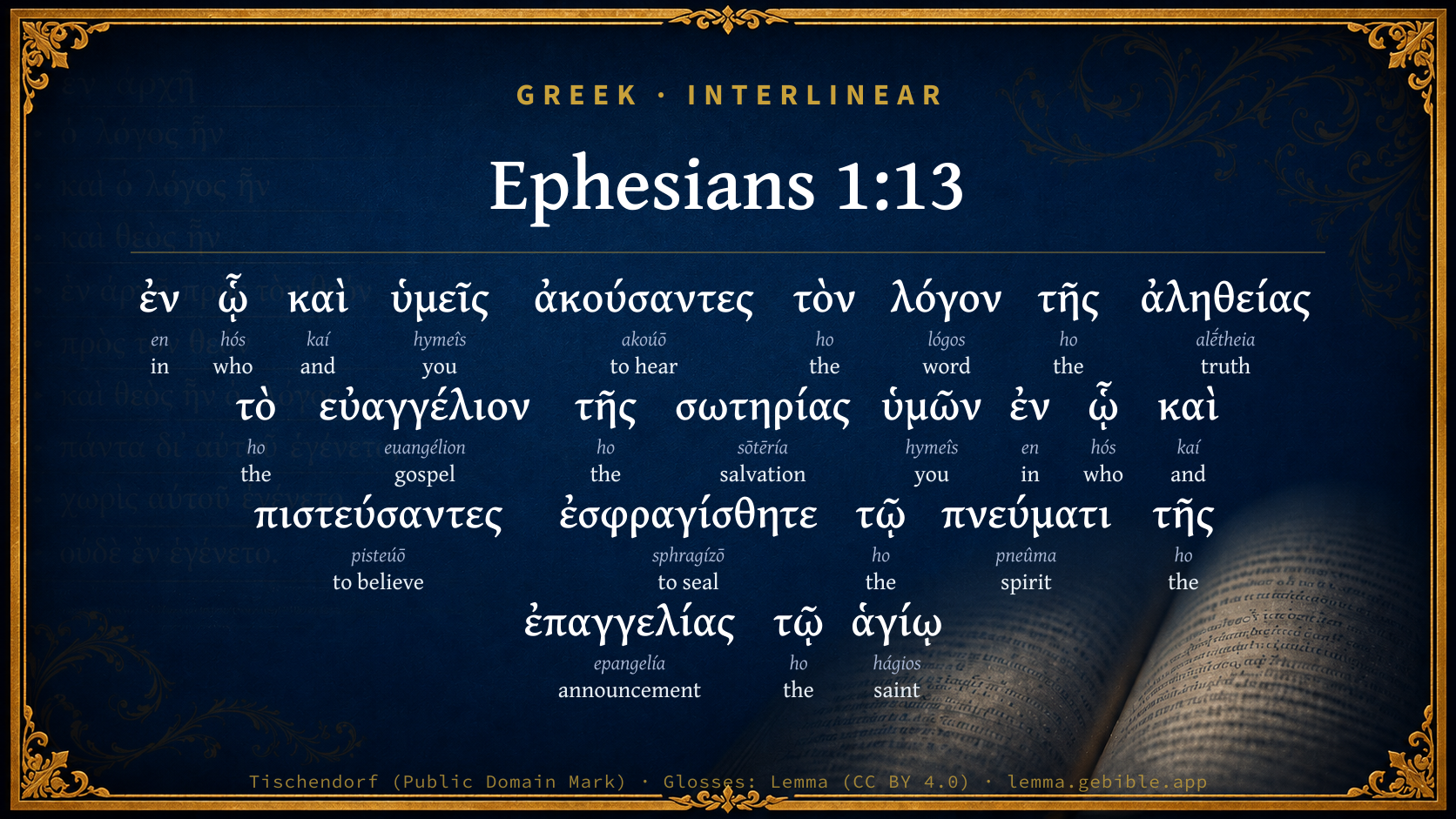
  1. ἐν en G1722 “in” Preposition
  2. ᾧ hós G3739 “who” Relative pronoun, Dative, Singular, Masculine
  3. καὶ kaí G2532 “and” Conjunction
  4. ὑμεῖς hymeîs G5210 “you” Personal pronoun, 2nd person, Nominative, Plural
  5. ἀκούσαντες akoúō G191 “to hear” Verb, Aorist, Active, Participle, Nominative, Plural, Masculine
  6. τὸν ho G3588 “the” Article, Accusative, Singular, Masculine
  7. λόγον lógos G3056 “word” Noun, Accusative, Singular, Masculine
  8. τῆς ho G3588 “the” Article, Genitive, Singular, Feminine
  9. ἀληθείας alḗtheia G225 “truth” Noun, Genitive, Singular, Feminine
  10. τὸ ho G3588 “the” Article, Accusative, Singular, Neuter
  11. εὐαγγέλιον euangélion G2098 “gospel” Noun, Accusative, Singular, Neuter
  12. τῆς ho G3588 “the” Article, Genitive, Singular, Feminine
  13. σωτηρίας sōtēría G4991 “salvation” Noun, Genitive, Singular, Feminine
  14. ὑμῶν hymeîs G5210 “you” Personal pronoun, 2nd person, Genitive, Plural
  15. ἐν en G1722 “in” Preposition
  16. ᾧ hós G3739 “who” Relative pronoun, Dative, Singular, Masculine
  17. καὶ kaí G2532 “and” Conjunction
  18. πιστεύσαντες pisteúō G4100 “to believe” Verb, Aorist, Active, Participle, Nominative, Plural, Masculine
  19. τῷ ho G3588 “the” Article, Dative, Singular, Neuter
  20. πνεύματι pneûma G4151 “spirit” Noun, Dative, Singular, Neuter
  21. τῆς ho G3588 “the” Article, Genitive, Singular, Feminine
  22. ἐπαγγελίας epangelía G1860 “announcement” Noun, Genitive, Singular, Feminine
  23. τῷ ho G3588 “the” Article, Dative, Singular, Neuter
  24. ἁγίῳ hágios G40 “saint” Adjective, Dative, Singular, Neuter

About this verse

These counts appear in no published source. They are computed here, from the morphology-tagged text and Lemma’s own curated glosses. What Lemma adds →

25
words
15
distinct lemmas
Pauline Epistles
section

Notable vocabulary

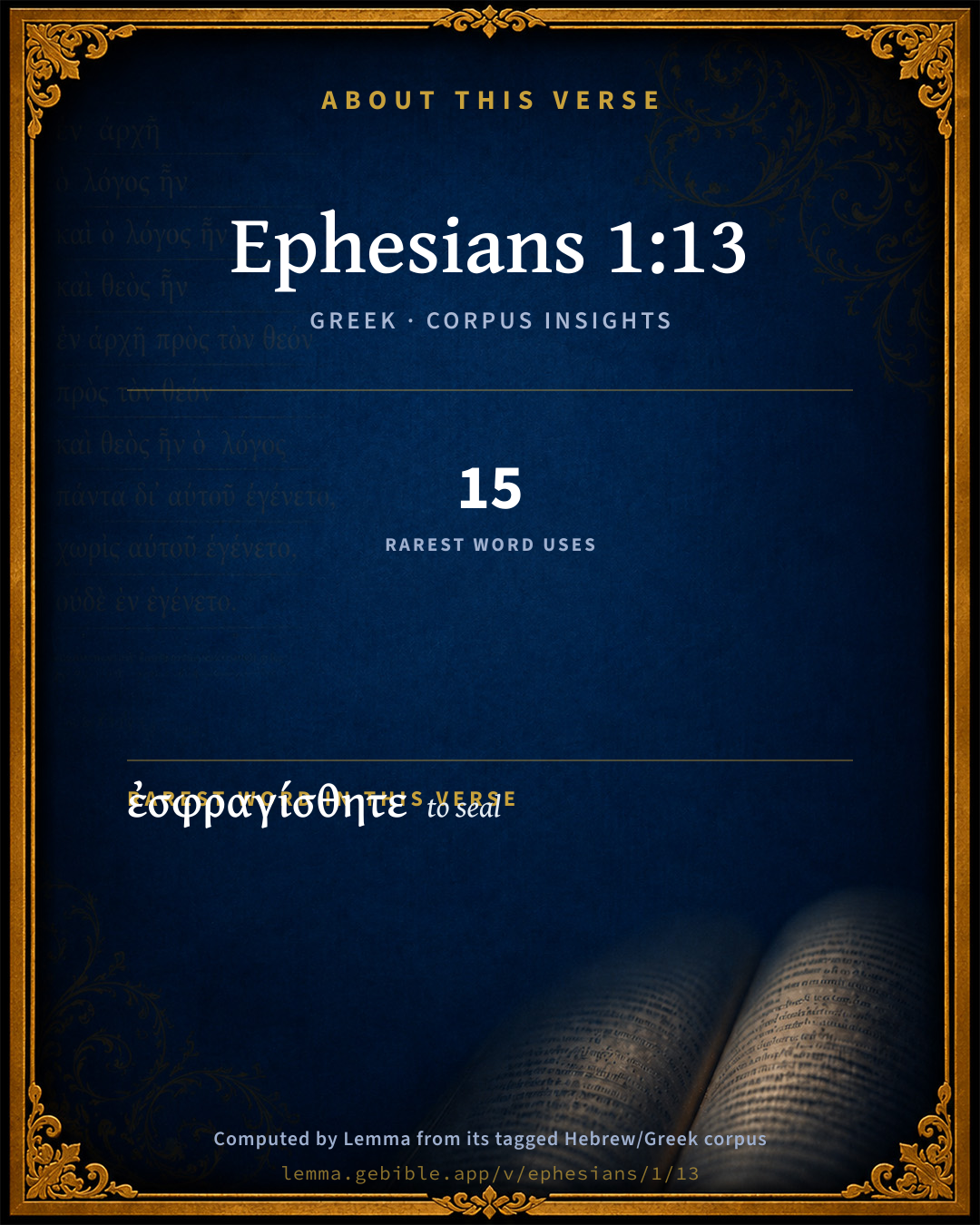
The rarest word here is ἐσφραγίσθητε to seal G4972 — appearing just 15 times in the whole Greek New Testament.

Shared distinctive vocabulary

ἐσφραγίσθητε to seal G4972 occurs in 14 verses of the Greek New Testament. Also found in:

Repetition

Words recur within this verse:

Cross-references

36

Topical passages linked to Ephesians 1:13 in the Treasury of Scripture Knowledge — connected by theme and wording, ordered by reader-vote popularity; previews shown in the World English Bible.

  • 2 Corinthians 1:22 who also sealed us, and gave us the down payment of the Spirit in our hearts.
  • Ephesians 4:30 Don't grieve the Holy Spirit of God, in whom you were sealed for the day of redemption.
  • 2 Timothy 2:19 However God's firm foundation stands, having this seal, "The Lord knows those who are his," and, "Let every one who names the name of the Lord depart from unrighteousness."
  • 1 Thessalonians 2:13 For this cause we also thank God without ceasing, that, when you received from us the word of the message of God, you accepted it not as the word of men, but, as it is in truth, the word of God, which also works in you who believe.
  • Galatians 3:14 that the blessing of Abraham might come on the Gentiles through Christ Jesus; that we might receive the promise of the Spirit through faith.
  • Romans 4:11 He received the sign of circumcision, a seal of the righteousness of the faith which he had while he was in uncircumcision, that he might be the father of all those who believe, though they be in uncircumcision, that righteousness might also be accounted to them.
  • Romans 1:16 For I am not ashamed of the Gospel of Christ, for it is the power of God for salvation for everyone who believes; for the Jew first, and also for the Greek.
  • Titus 2:11 For the grace of God has appeared, bringing salvation to all men,
  • Acts 2:33 Being therefore exalted by the right hand of God, and having received from the Father the promise of the Holy Spirit, he has poured out this, which you now see and hear.
  • Joel 2:28 "It will happen afterward, that I will pour out my Spirit on all flesh; And your sons and your daughters will prophesy. Your old men will dream dreams. Your young men will see visions.
  • John 14:16–17 I will pray to the Father, and he will give you another Counselor, that he may be with you forever,--
  • Colossians 1:4–6 having heard of your faith in Christ Jesus, and of the love which you have toward all the saints,
  • Colossians 1:21–23 You, being in past times alienated and enemies in your mind in your evil works,
  • John 1:17 For the law was given through Moses. Grace and truth came through Jesus Christ.
  • 1 Peter 2:10 who in time past were no people, but now are God's people, who had not obtained mercy, but now have obtained mercy.
  • Luke 24:49 Behold, I send forth the promise of my Father on you. But wait in the city of Jerusalem until you are clothed with power from on high."
  • John 14:26 But the Counselor, the Holy Spirit, whom the Father will send in my name, he will teach you all things, and will remind you of all that I said to you.
  • Psalms 119:43 Don't snatch the word of truth out of my mouth, For I put my hope in your ordinances.
  • John 15:26 "When the Counselor has come, whom I will send to you from the Father, the Spirit of truth, who proceeds from the Father, he will testify about me.
  • Romans 6:17 But thanks be to God, that, whereas you were bondservants of sin, you became obedient from the heart to that form of teaching whereunto you were delivered.
  • Romans 10:14–17 How then will they call on him in whom they have not believed? How will they believe in him whom they have not heard? How will they hear without a preacher?
  • Luke 11:13 If you then, being evil, know how to give good gifts to your children, how much more will your heavenly Father give the Holy Spirit to those who ask him?"
  • John 6:27 Don't work for the food which perishes, but for the food which remains to eternal life, which the Son of Man will give to you. For God the Father has sealed him."
  • Acts 1:4 Being assembled together with them, he charged them, "Don't depart from Jerusalem, but wait for the promise of the Father, which you heard from me.
  • Acts 2:16–22 But this is what has been spoken through the prophet Joel:
  • Mark 16:15–16 He said to them, "Go into all the world, and preach the Gospel to the whole creation.
  • Acts 13:26 Brothers, children of the stock of Abraham, and those among you who fear God, the word of this salvation is sent out to you.
  • Ephesians 2:11–12 Therefore remember that once you, the Gentiles in the flesh, who are called "uncircumcision" by that which is called "circumcision," (in the flesh, made by hands);
  • Revelation 7:2 I saw another angel ascend from the sunrise, having the seal of the living God. He cried with a loud voice to the four angels to whom it was given to harm the earth and the sea,
  • John 16:7–15 Nevertheless I tell you the truth: It is to your advantage that I go away, for if I don't go away, the Counselor won't come to you. But if I go, I will send him to you.
  • 2 Timothy 2:15 Give diligence to present yourself approved by God, a workman who doesn't need to be ashamed, properly handling the Word of Truth.
  • James 1:18 Of his own will he brought us forth by the word of truth, that we should be a kind of first fruits of his creatures.
  • 2 Corinthians 6:7 in the word of truth, in the power of God; by the armor of righteousness on the right hand and on the left,
  • Ephesians 4:21 if indeed you heard him, and were taught in him, even as truth is in Jesus:
  • 2 Timothy 3:15 From infancy, you have known the sacred writings which are able to make you wise for salvation through faith, which is in Christ Jesus.
  • Hebrews 2:3 how will we escape if we neglect so great a salvation-- which at the first having been spoken through the Lord, was confirmed to us by those who heard;

Cross-references courtesy of OpenBible.info (CC BY 4.0).

Commentary

Notes on Ephesians 1:13 from classic Christian and Jewish commentators (each source and its license shown beneath its notes). The classic Christian expositions comment on the surrounding passage and are grouped to its opening verse, so a note may address several verses; the Jewish commentaries on the Tanakh (Rashi and others) are per-verse, so they appear only where the commentator wrote on this verse.

Lemma curates 59 commentaries, every one of them public domain or Creative Commons licensed, each selected and text-cleaned for this edition rather than reprinted as found. About our sources →

Albert Barnes' Notes on the Bible

In whom ye also trusted - This stands in contrast with those who had “first” embraced the gospel.

Heard the word of truth - The gospel; called the “word” or message of truth, the word of God, etc. See Rom 10:17. The phrase “the word of truth” means “the true word or message.” It was a message unmixed with Jewish traditions or Gentile philosophy.

The gospel of your salvation - The gospel bringing salvation to you.

In whom also - In the Lord Jesus. A little different translation of this verse will convey more clearly its meaning. “In whom also, ye, having heard the word of truth, (the gospel of your salvation,) in whom having also believed, ye were sealed,” etc. The sealing was the result of believing, and that was the result of hearing the gospel; compare Rom 10:14-15.

Ye were sealed - On the meaning of the word “seal,” see the notes at Joh 3:33; Joh 6:27, note. On the phrase “ye were sealed,” see the notes on 2Co 1:22.

With that Holy Spirit of promise - With the Holy Spirit that was promised; see Joh 16:7-11, Joh 16:13; Joh 15:26; Joh 14:16-17. It is not improbable, I think, that the apostle here refers particularly to the occurrence of which we have a record in Act 19:1-6. Paul, it is there said, having passed through the upper provinces of Asia Minor, came to Ephesus. He found certain persons who were the disciples of John, and he asked them if they had received the Holy Spirit since they “believed,” Eph 1:2. They replied that they had not heard whether there was any Holy Spirit, and that they had been baptized unto John’s baptism. Paul taught them the true nature of the baptism of John; explained to them the Christian system; and they were baptized in the name of the Lord Jesus, and “the Holy Spirit came upon them, and they spake with tongues, and prophesied.” They were thus sealed by the Holy Spirit of promise, “after they had believed” Eph 1:13; they had the full evidence of the favor of God in the descent of the promised Holy Spirit, and in his miraculous influences. If this be the true interpretation, it constitutes a striking coincidence between the Epistle and the Acts , of such a nature as constitute the arguments in Paley’s “Horae Paulinae” (though he has not referred to this), which shows that the Epistle was not forged. The circumstance is such that it would not have been alluded to in this manner by one who should forge the Epistle; and the mention of it in the Epistle is so slight, that no one, from the account there, would think of forging the account in the Acts . The coincidence is just such as would occur on the supposition that the transaction actually occurred, and that both the Acts and the Epistle are genuine. At the same time, there is a sealing of the Holy Spirit which is common to all Christians; see the notes referred to on 2Co 1:22.

Albert Barnes' Notes on the Bible (1834–1885) — public domain. Text from a community e-Sword/MySword module.

The Biblical Illustrator

Joseph S. Exell

Eph_1:13

In whom ye also trusted, after that ye heard the word of truth, the gospel of your salvation: in whom also after that ye believed, ye were sealed with that Holy Spirit of promise.

The functions of the Word and the Spirit

1. God, by the hearing of His word, makes us partakers in His Spirit (Joh_6:45; Eph_4:21; Col_1:6). As the ground cannot be quickened with fruits till it receive seed and the clews from heaven, no more can our soul be quickened with the spirit and fruits of the Spirit, till by hearing it has taken in this seed immortal, and drunk in this heavenly shower of Gods Word. It is not every hearing which is accompanied with the Spirit, but hearing with the heart, so as the heart is affected to do what it hears.

(1) Where there is much hearing, yet the Word is not there heard as it should be. Some are viler after hearing than before. With much hearing they have become past hearing. As those who dwell near the continual roaring of mighty waters become deaf through constantly hearing such a great noise, so there are many who have so long had the Word of God in their ears, that they cannot discern anything in it, no matter what is spoken.

(2) This must teach us to attend on hearing. Wouldst thou keep the Spirit from being quenched? Despise not prophecy, i.e., hearing the Scriptures opened to thy use. Even as the conduit pipes carry the water hither and thither, so does the Word convey the graces of the Spirit into our hearts.

2. The word of the gospel is that which, being heard, brings us the quickening Spirit. Hence the ministry of the gospel is called the ministry of the Spirit.

3. All Gods promises made in Christ are true and faithful.

(1) Let us not give God the lie by our deeds. He that believeth not, maketh God a liar.

(2) Let this strengthen our faith toward the promises of God.

4. It is not enough to hear, but we must believe before we can partake of the good Spirit of Christ.

(1) Let us labour to be one with Him by faith.

(2) Let us take care that our faith is active and productive of holiness. Otherwise it is worthless.

5. The faithful are, as it were by seal, confirmed touching their salvation and full redemption (Eph_4:30; 2Co_1:22). As God sealed His Christ, as the Person in whom He would be glorious by working our redemption, so He seals us who are believers, for persons who shall have redemption by Him. Even as persons contracting do mutually seal and deliver each of them their deeds in several: so between God and the believer; the believer does by faith set to his seal, as it were, that God is true in that which He promises (Joh_3:33), and God seals unto the believer that he shall be infallibly brought to the salvation he has believed.

(1) A seal sometimes makes secret the thing sealed. So the graces of the Spirit make believers unknown to the world.

(2) A seal distinguishes. Believers are set apart from the world.

(3) A seal authenticates.

6. The Holy Spirit, and the graces of the Spirit, are the seal assuring our redemption.

7. The Holy Spirit, not only as a seal, but as earnest money, confirms to us our inheritance. It is not with the Spirit and His gifts as with the sun and its light--the body of the sun being in the heavens, while the light is with us here on earth; but we are to conceive the Spirit Himself dwelling in this sanctuary of grace which He has Himself erected in our souls. Even as men assure others that they will pay them the whole sum due for this or that, by giving an earnest; so God makes us, as it were, part payment, that we may be persuaded of His gracious purpose of bringing us to our heavenly inheritance.

(1) An earnest is part of the whole.

(2) An earnest is but little compared to the whole.

(3) An earnest assures him who receives of the good intention of him with whom he contracts. (Paul Bayne.)

The Spirits application of the promises to the believers heart

The sealing of the Spirit is evidently a distinct act from faith, and the sealing of the Holy Spirit appears to be a metaphorical expression to denote that the same Divine Agent who had implanted in their souls a principle of faith, and brought this principle into exercise, had likewise produced in their minds an assurance of their interest in the premises of the gospel, and in the blessings of salvation by a Redeemer. Preliminary observations.

(1) There is such a Being as the Holy Spirit (Gen_6:3; Pro_1:23; Luk_11:13; Joh_7:37-40; Rom_8:16; Rom_8:26; Eph_4:30).

(2) The Holy Spirit is a Divine Person.

(3) This Divine Spirit is the subject of many revealed and precious promises.

(4) A true and saving faith in Christ is the special gift of the Divine Spirit--a principle produced by His gracious operations on the heart, and ordinarily effected by means of a preached gospel.

(5) It is the peculiar office of the Holy Spirit to carry on and complete the work of sanctification in those who believe, and to comfort their minds by a sweet and spiritual application of the promises of grace in Christ Jesus to their souls.

(6) It is a matter of unspeakable importance to know and believe, on substantial evidence, that we are the subjects of the Spirits sanctifying and comforting influences. We inquire, then, How may we know this?

1. Our characters must answer to the characters of those who have a right to claim an interest in the promises. They only who are brought to believe truly in Christ are sealed with the Holy Spirit of promise.

2. We must be led to see our need of His assistance.

3. Our state must be that of those for whom the promises are designed. Sorrow for sin, fear of God, etc. (Psa_31:19; Psa_27:14; Psa_18:30; Psa_37:40; Psa_32:10; Psa_112:7). If God be not the object of our reverence, confidence, and love, these promises do not belong to us.

4. In the application of a promise of Scripture to the heart, the Holy Spirit impresses the mind with a conviction that the promise is true, and gives the soul a persuasion on scriptural grounds, that God is both able and willing to perform it.

5. We may know that a promise of Scripture is applied to the mind by the Holy Spirit, when, upon a strict and impartial examination, we are directed to conclude that we are possessed of those several qualifications and graces of the Christian life which are inseparably connected with a right application of the promises to the heart (see Gal_5:22-23). These graces are not the causes, but the necessary evidences of an interest in the promises.

6. There is ground to believe that we are interested in the promises, when our general conduct, both personally and relatively, answers to the rules and obligations prescribed in the Word of God (Heb_12:14).

Inferences:

1. Let us rejoice in the promises of revelation, and bless God for them.

2. Let us examine, strictly and closely, the foundation of our title to the promises.

3. Let those who have felt and enjoyed the application of the promises to their souls remember their obligations to sovereign mercy. (The Pulpit.)

How Divine grace is manifested

Let us observe how the operations of Divine grace are manifested in those who are the objects of it--that is, how those who are the objects of Divine grace are to be known.

I. The power of Divine grace was proved in their attention to the word preached by the apostle.

II. Faith in the Gospel of Christ, and trust in the Lord Jesus, is the manifestation of the power of Divine grace.

III. The power of Divine grace, and their election to their inheritance, were manifested by the operations and influences of the Holy Spirit upon them. (R. J. McGhee, M. A.)

Truth and trust

I. The Gospel which the Ephesians heard is designated--

1. The word of truth, because in itself emphatically and entirely true. History, not romance. Christs miracles were real events, manifesting the divinity of His person and mission; His doctrines, precepts, promises, threatenings, are the truthful declarations of the God of truth.

(1) Evidential proof, from the testimony of the Church, etc.

(2) Moral proof, from the witness of heart and conscience. The gospel, in some mysterious manner, is its own sufficient witness, and convinces the conscience of every man who prayerfully peruses it, that it is not a fable, but the word of truth. A most merciful provision of Almighty God! A man goes as a missionary among far off barbarians; how is he to convince these that the gospel he is gone to preach is not false, but true? How can the man do it? He has not the power to heal the sick, as the first evangelists and preachers of Christs gospel had; he has not power to hush the elements, to expel devils, or to raise the dead, and, by such means, win the confidence and faith of his barbarous congregations. Nor would it be of any use for him to point out to such barbarians the evidences of Christianity arising from miracles and from history; such things are above their comprehension. Yet, despite all this, the man succeeds, and everywhere multitudes voluntarily renounce their idols and embrace Christianity--the gospel carrying kith it its own credentials, and commending itself to every mans conscience in the sight of God.

(3) Divine truth, taught by God Himself, and which none but God could teach, and the very truth which meets mans needs, is found in the gospel. The gospel is a sun of Gods own kindling, and the more you look at it the more you are dazzled by its unearthly splendour and Divine magnificence. Its truths are too big to be the inventions of the human intellect. It is a sun which knows no eclipse and no change.

2. The gospel of salvation.

(1) Salvation is its great theme.

(2) Salvation is the end at which it aims.

II. The faith and the trust which the Ephesians exercised on hearing the Gospel.

1. Historical belief in the Messiah-ship of Jesus of Nazareth.

2. Heartfelt trust and hope in His sacrificial sufferings and death, for present and personal salvation. Having believed Him to be what He said He was, they were emboldened to trust that He would do what He had promised. (Luke Tyerman.)

Difference between belief and trust

Imagine a storm at sea. There is a ship tossed as the merest plaything on the maddened waves, while the tempest round about roars like a black spirit from the vast abyss, and the sky overhead is bent down with the rumbling vengeance of rolling thunder. The sails of the ship shiver; the planks give way; the men on board are pale with terror, for they are all conscious that they are in the utmost danger of being drowned. Their hearts beat; their bosoms heave; their lips quiver; their eyes stare. They think as they best can of their beloved friends, far, far away; and then they look at the foaming, boiling, billowy sea which is likely to become their grave; and for awhile all is deep, and dead, and significant, and solemn silence. At length silence can endure no longer; and now, mingling with the howling and raging of the storm, you hear cries and groans and prayers, such as none but persons who are conscious that they are perishing can utter. In this fearful crisis a boat appears, and approaching them it offers to rescue them, and promises to ensure their safety. How is the offer treated? One group of the drowning men believe that the boat is not a pirate, but a friend--that its pretensions are sincere, and that its flag is genuine; but they still stand and fear and hesitate. One says that the boat is for the better class of passengers, not for a poor, miserable, degraded wretch like him. Another is free from all fear such as that, and yet he hesitates to step into the boat. Why? He looks at the dashing waves; and he listens to the howling winds, and he thinks of the distance between him and the nearest shore; and, all things being thus considered, he fears that the boat is not strong enough to outride the storm; and hence, despite warning words and inviting looks, the poor timorous man in question, as well as the self-deprecating one already mentioned, neglects to rush into the boat, and so is lost. Here you have a representation of an immensely numerous class of persons in the Christian Church--persons who believe in Christ, and yet for various reasons fail to trust in Christ. How many believe in Christ as a Saviour, but dare not trust in Christ as their Saviour! They believe He waits to save others, but they dare not trust that He will save them. How many others, again, there are who, whilst they believe that Christ loved them and gave Himself for them, dare not trust in the simple means which Christ has prescribed (or sinners being saved! They dare not. Looking, on the one hand, at the badness of their hearts, and the guiltiness of their lives, and then, on the other hand, looking at the simple and easy method of salvation which Christ propounds, they dare not trust in its sufficiency. They fear the thing is too simple to be right, and they say they dare not trust for the welfare of their souls, in time and in eternity, merely on the merits of another. This may be quite sufficient, but they are afraid it may be otherwise. There they are, believing Christ, but not trusting Christ; and for want of trust they perish. (Luke Tyerman.)

Union of faith and trust

Another class on the foundering ship see the lightnings flash, and hear the thunders roll; they see the ocean tossed in tempest, and think of their distance from the nearest haven. Their plight is perilous--terrifically perilous; but the boat approaches, and is close at hand, They read the inscription on its flag; they listen to the invitations, and to the pledges of its commander; they count the cost; they know that the case is desperate. Anyhow, they feel their case cannot be worse than it is; and so, amid the tattering of sails and the splintering of masts, and forked lightnings and thunders terrible, amid howling winds and dashing waves, amid hearings and rockings and creakings and crackings, the poor perishing wretches make a rush, and, with a desperate leap, they trust themselves to the lifeboat which offers them assistance. Such were the Christian converts at Ephesus. They believed in Christ; i.e., they believed that He was no adventurer, but, in reality, what He professed to be:; but in addition to that historical faith in Christ there was also trust in Christ. They not only believed Him to be a Saviour, but trusted in Him as their Saviour--even theirs. Renouncing trust in everything else, they trusted in Christ, in His merits alone, for acceptance with God, and for the gift of eternal life in Him. Damned or saved, cursed or blessed, sink or swim, they made the venture, and put their whole trust for personal and for endless salvation in the merits and mediation of this Divine Redeemer. And with what result? In this lifeboat of salvation, launched by the illimitable benevolence of God, crimsoned all over with the blood of the Paschal Lamb, and bearing a banner emblazoned with the Cross, they found all they needed. The wind was sometimes boisterous; the sea was sometimes rough; ever and anon the waves dashed the rocks, lashed the cliffs, and seemed to splash the very skies; but in the midst of all the violence the boat is borne without a shrunken plank, or a tattered sail, or a splintered mast. (Luke Tyerman.)

The Ephesians faith

I. The object of their faith.

1. The word of truth. It contains all that truth which concerns our present duty and our future glory.

2. The gospel of our salvation, It discovers to us our ruined, helpless condition; the mercy of God to give us salvation; the way in which it is procured for us; the terms on which we may become interested in it; the evidences by which our title to it must be ascertained; and the glory and happiness which it comprehends.

II. The forwardness, and yet reasonableness, of their faith. They trusted in Christ after they heard the word of truth. They acted as honest and rational men: they did not trust before they heard it, nor refuse to trust after they heard it.

III. The happy consequence of their faith.

1. The sealing of the Spirit.

2. The earnest of the Spirit.

(1) The virtues of the Christian temper, which are called the fruit of the Spirit, are to believers an earnest of their inheritance, because they are, in part, a fulfilment of the promise, which conveys the inheritance.

(2) The graces of the Spirit are an earnest of the inheritance, as they are preparatives for it.

(3) The sealing and sanctifying influence of the Spirit is especially called an earnest of the inheritance, because it is a part of the inheritance given beforehand. Concluding reflections:

1. Our subject teaches us that all the operations of the Divine Spirit on the minds of men are of a holy nature and tendency.

2. Our subject strongly encourages humble souls to apply to God for the needful influences of His grace.

3. It appears that we can have no conclusive evidence of a title to heaven, without the experience of a holy temper.

4. We see that Christians are under indispensable obligations to universal holiness. (J. Lathrop, D. D.)

The effect of hearing the gospel

I. We are to consider the interesting light in which the gospel is represented in the text.

1. It is described as the word of truth. And it is thus designated, because it is not the word of man, but in truth the Word of God.

2. It is the gospel of your salvation. The best explanation of the word gospel, perhaps, is that given by the angel to the shepherds, when he announced to them the birth of the Saviour in these words, Behold, I bring you good tidings of great joy, etc.

(1) It is the gospel of our salvation, in the first place, because it acquaints us with our need of salvation. It does not take for granted that all is well with us. It does not flatter our pride, by giving us a lofty description of the dignity of human nature, or by furnishing us with a favourable account of our spiritual condition, Like a faithful friend, it lays before us a true, though a painful statement of our case. Like a skilful physician, it probes our wound to the bottom.

(2) But while it thus acquaints us with our disease, it does not leave us in the dark as to a remedy--a suitable and efficacious remedy. It does not, like the priest and the Levite in the parable, leave us to perish unpitied by the wayside. Like the good Samaritan, it has compassion on us, and binds up our wounds, pouring in oil and wine. It reveals to us a new and living way, opened by the obedience and death of Gods incarnate Son, through which we may not only escape the dreadful consequences of our sins, but secure to ourselves the possession of a glorious and eternal inheritance.

3. Moreover, the gospel, when accompanied with the influence of the Holy Spirit, is itself the power of God unto salvation to every one that believeth.

II. The biassed effect which the hearing of this gospel is stated to have had on the Ephesians. In whom, that is, in Christ, ye also trusted, after that ye heard the word of truth, the gospel of your salvation. Christ is the sum and substance of the gospel. All the rays of its Divine light meet in Him as in their common centre. But it may be asked, What is meant by trusting in Christ?--or, What does the expression imply?

1. It implies that we have faith in His power or ability to save; faith in the all-cleansing virtue of His blood, in the perfection of His righteousness, in the prevailing efficacy of His intercession, in the all-sufficiency of His grace, in the everlasting strength of His arm, in His providential care and protection. Such a faith as this, it is plain, is absolutely necessary in order to our having anything like trust or confidence in Him. We must be fully persuaded that He can help us.

2. That trusting in Christ implies that we have faith in His mercy and grace, no less than faith in His power. It is not a persuasion of ability alone that can inspire confidence in the applicant for Divine aid. He must be equally convinced that sympathy and benevolence are connected with it; in other words, he must believe that there is in Christ a disposition to exert His almighty power for his relief.

3. Trust in Christ implies a simplicity of dependence upon Him for salvation.

4. Trust in the Lord, when steadfast and immovable, such as we may suppose that of the Ephesians to have been, implies a lively hope and expectation of receiving from Him all things that appertain unto life and godliness. A child, while he is conscious of being under the care and protection of a kind and affectionate father, fears nothing; but looks up to him with confidence for a due supply of all his wants. That parental love, tenderness, and care, of which he has constantly received the most pleasing and substantial proofs, leave him no room to doubt his fathers disposition to succour and provide for him, but beget and cherish in his bosom the most lively hopes and expectations. Similar, then, are the feelings which those who trust in Christ manifest towards Him. (D. Rees.)

The biography of trust

Trust in Christ is the fruit of faith in Him. We cannot believe Gods record concerning Christ without trusting in Him; and faith, which is the root of trust, cometh by hearing the word of the truth of the gospel. The word heard produces faith, and the Holy Ghost is the seal of the word believed. Trust in Jesus Christ regards Him from our standpoint as He is revealed to us in the word of the truth of the gospel. But the gospel reveals him to us from Gods standpoint as all in all, made of God unto us wisdom, righteousness, sanctification, and redemption. There is nothing that God sees to be good for us that we may not have by trusting in Christ. He that trusteth in the Lord, mercy shall compass him about. Imagine being in the centre of the circle of mercies!--mercy above, mercy beneath, mercy around us. All Gods fulness is laid up for us in Jesus Christ, and abounds to us in superabounding mercies. Jesus Christ was the promise of the Old Testament to be believed. The Holy Ghost is the promise of the New Testament, and is from Christ to us who believe the seal of our union with Him. In whom ye also trusted. There are three truths here stated, and referring in common to both those who first trusted in Christ and ye also.

1. In whom ye also trusted, after that ye heard the word of truth.

2. In whom also we have obtained an inheritance (verse 11).

3. In whom also after that ye believed, ye were sealed with that Holy Spirit of promise, which is the earnest of our inheritance. We both have trusted. We have both obtained an inheritance. We have both been sealed. Chosen! in Him before the foundation of the world. Blessed! adopted! accepted! redeemed! forgiven!--and sealed for all these in Him! (M. Rainsford, B. A.)

The inheritance and the seal

I. The apostle here shows how or by what means the inheritance is obtained, i.e., how anyone comes actually to have a right and interest in it. When speaking of his own interest in the inheritance, the apostles mind was occupied with a sense of that sovereign good pleasure of God, which is the foundation of all grace and mercy, and he seized on the opportunity of rendering praise to that original cause of his salvation. And so he might have spoken with regard to the Ephesians, for they likewise had been predestinated unto the adoption of children. But he rather refers in their case to the means by which that had been brought about under God. These are first, the word of truth, the gospel of salvation; second, the hearing that word; and third, the believing in Christ through the word. The first may be called the outward means, viz., the word read but especially preached; the second the inward means, hearing, i.e., the inward passage of the word through the sense of hearing and the intellect; and the third, the inner or inmost means, viz., faith, which is a thing of the heart or soul within. This accords with the statement made elsewhere, Faith cometh by hearing, and hearing by the Word of God. Here is a threefold cord not easily broken, by which man, in a way suitable to his nature, is drawn effectually heavenward from the horrible pit and the miry clay, into which all have plunged by sin.

1. The outward means, the word of truth--the gospel of salvation. The latter of these clauses explains the former. The word of truth is the gospel of salvation.

2. The necessity of hearing the word of truth, the gospel of salvation. This is the means by which the saving truth of God reaches the conscience and the heart.

3. It had become effectual to the Ephesians, who, after they had heard, says the apostle, believed in Christ. The truth had penetrated into their hearts, and there produced all those effects which at last resulted in a living faith or trust in the Saviour. How the word of truth, the gospel of salvation, had operated, what process it had followed, what advancing states of mind, conscience, and feeling it had given rise to in the inner chamber of the soul, the apostle does not delay to specify. Certain convictions would be produced--convictions of ignorance, of depravity, of guilt. New light broke into the mind on spiritual and heavenly things, setting before them in clear manifestation Gods blessed and holy nature, His righteous law, His inflexible justice, whilst heaven and hell were disclosed to view. The terrible dominion of Satan, and their own bondage under him to sin, were revealed. Then the Deliverer, the Son of the Mighty One, was preached to them, nigh to justify, able to save to the uttermost. Seeing and believing all this, their hearts were at length moved in willing obedience to the gospel of their salvation. They submitted to the righteousness of God in Christ, and cast their own to the winds.

II. What are some of the present advantages possessed by those who have obtained that inheritance, and who are the heirs of eternal life?

1. Believers are sealed and made safe by the Holy Spirit. It is commonly understood that a seal put upon a letter or document secures it against detriment from any unfavourable quarter. The breaking of a seal would bring down the strong penalty of the law on the offender. The seal of the sovereign is the highest guarantee that can be afforded for the validity of any right, title, or possession which a subject can enjoy.

2. Believers are evidenced of the Holy Spirit as sealing them. (W. Alves, M. A.)

The gospel of salvation

Salvation in its proper sense means deliverance from something that is feared or suffered. For though salvation is sometimes taken to denote the happiness of heaven, yet still even then it directs our attention to those miseries out of which it is necessary that we be rescued before heaven can either be attained or enjoyed. That we may understand, therefore, the full import of this term, salvation, so frequently used and so vaguely apprehended, we must look to the situation in which we stand as sinners. We must look to it in its every aspect and in all its extent. We cannot at present do more than take a rapid sketch of those particular and specific benefits which are denoted by the term salvation in reference to the evils from which it delivers.

1. It implies deliverance from ignorance--not from ignorance of human science or of worldly objects, with which however the gospel that reveals it does not forbid us to make ourselves acquainted, and upon which it throws a sanctifying light--but from ignorance of God, the first and the last, the greatest and the wisest, the holiest and the best of beings; the maker of all things; the centre of all perfection; the fountain of all happiness.

2. The salvation here spoken of implies deliverance from guilt.

3. The salvation we have been considering implies deliverance from the power of sin. We are naturally the slaves of this power. Sin reigns in us, as the descendants of apostate Adam. We cannot throw off its yoke by any virtue or efforts of our own. And so long as it maintains its ascendency, we are degraded, and polluted, and miserable. But provision is made in the gospel for our emancipation.

4. The salvation of the gospel implies deliverance from the ills and calamities of life. It does not imply this literally. For under the dispensation of the gospel there is, strictly speaking, no exemption from bodily disease, from outward misfortune, or from the thousand distresses that humanity is heir to. But Christ has given such views of the providence of God, He has brought life and immortality so clearly to light, and has so modified and subdued the operations of sin, which is the immediate or the ultimate cause of all our sufferings, that these are no longer real evils to them that believe.

5. The salvation here mentioned implies deliverance from the power and the fear of death.

6. And then, while the salvation revealed in the gospel implies our deliverance from all these evils, it also implies our admission into the heavenly state. It is in order to bring us there at last that all the other benefits we have been speaking of were conferred upon us. We were delivered from ignorance that we might know what heaven is--that we might be made acquainted with the way that leads to it--that we might be aware of the preparation necessary for dwelling in it. We were delivered from the sentence of condemnation that our forfeiture of heaven might be annulled, and that God might justly and consistently introduce us into its recompense and its glory. We were delivered from the power of sin that, by the removal of moral depravity, and the renewal of Gods image on the soul, and the cultivation of holy habits, we might be qualified for the exercises and the joys of heaven, which are all most pure and immaculate. We were delivered from the ills and calamities of life as to all their evil influence, that they might be made instrumental in purifying our character, that they might be prevented from discouraging us in our progress towards heaven, and that they might enhance our blessedness there, by the greatness of our transition from trouble and sorrow to rest and joy. And we were delivered from the power and the fear of death that soul and body, united as constituent parts of the same redeemed child of God, might become, in heaven, joint partakers of that felicity for which they had acquired a joint title, and for which they made a joint preparation, upon earth; and that, regarding death as a messenger of peace rather than as the king of terrors, the prospect of his coming to summon us away might comfort us in the midst of those distresses, while it stimulated us to the discharge of those duties by which our meetness for glory would be hastened and matured. (Andrew Thomson, D. D.)

Trusting brings salvation

Well, says one, then if God commands me to trust Christ, though I certainly have no reason why I should, then Ill do it. Ah! soul, do it then. Can you do it? Can you trust him now? Is it a full trust? Are you leaning on your feelings? Give them up. Are you depending a little on what you mean to do? Give that up. Do you trust Him wholly? Can you say, His blessed wounds, His flowing blood, His perfect righteousness, on these I rest. I do trust Him, wholly? Are you half afraid to say you do? Do you think it is such a bold thing? Do it then; do a bold thing for once I Say, Lord, Ill trust Thee, and if Thou cast me away, Ill still trust Thee; I bless Thee that Thou canst save me, and that Thou wilt save me. Can you say that? I say, have you believed in Him? You are saved, then; you are not in a salvable state, but you are saved; not partly, but wholly saved; not some of your sins blotted out, but all; behold the whole list, and it is written at the bottom of them all--The blood of Jesus Christ cleanseth us from all sin. (C. H. Spurgeon.)

The way of salvation

They

(1) heard;

(2) believed;

(3) were sealed.

Faith is our seal. Assurance is Gods seal. God honours our sealing to His truth by His sealing by His Spirit. There must be the bargain before the earnest. (Trapp.)

Ye were sealed with that Holy Spirit of promise.

The sealing of the Spirit

There are many who have believed in the Lord Jesus Christ, who are extremely anxious to obtain some token for good, some witness from God which shall render them quite sure that they are saved. They feel that these matters are too important to be left at all uncertain; and they, therefore, pine for some sure witness or seal.

I. First, let us speak of the position of this sealing. That sealing we can have, God does bestow it; but let us notice very carefully, lest we make a mistake, where that sealing comes in.

1. It does not come before believing. According to the text it is after that ye believed, ye were sealed. Now, there are hundreds of persons who are craving for something to see or to feel before they will believe in Jesus Christ; this is wickedness, and the result of an unbelief which is most offensive in the sight of God. If not a miracle, perhaps you demand a dream, or a strange feeling, or a mysterious operation; at any rate, if you do not see some sign and wonder, you declare that you will not believe.

2. Note, also, that this sealing does not necessarily come at once with faith. It grows out of faith, and comes after that ye believed. We are not in every case sealed at the moment when we first trust in Jesus. Whether you feel that you are justified or not is not the point, you are to accept Gods word, which assures you that every one that believeth is justified: you are bound to believe the testimony of God apart from the supporting evidence of inward experience. The foundation of our hope is laid in Christ from first to last, and if we rest there we are saved. The seal does not always come with faith, but it follows after.

3. Note, also, as to the position of its sealing, that, while it is not the first, it is not the last thing in the Divine life. It comes after believing, but when you obtain it there is something yet to follow. Perhaps you have had the notion that if you could once be told from the mouth of God Himself that you were saved, you would then lie down and cease from lifes struggle. It is clear, therefore, that such an assurance would be an evil thing for you, for a Christian is never more out of place than when he dreams that he has ceased from conflict. Here we must labour, watch, run, fight, wrestle, agonise; all our forces, strengthened by the Eternal Spirit, must be expended in this high enterprise, striving to enter in at the strait gate: when we have obtained the sealing our warfare is not ended, we have only then received a foretaste of the victory, for which we must still fight on. This is the true position of the sealing. It stands between the grace which enables us to believe, and the glory which is our promised inheritance.

II. We will notice, secondly, what are the benefits of this sealing, and while we are so doing, we shall be compelled to state what we think that sealing is, though that is to be the subject of the third head. No, brethren, the Holy Spirit does not make the promises sure, they are sure of themselves; God that cannot lie has uttered them, and therefore they cannot fail. Nor, my brethren, does the Holy Spirit make sure our interest in those promises; that interest in the promises was sure in the Divine decree, or ever the earth was, and is a matter of fact which cannot be changed. The promises are already sure to all the seed. The Holy Spirit makes us sure that the word is true and that we are concerned in it; but the promise was sure beforehand, and our interest in that promise was sure, too, from the moment in which it was bestowed upon us by the sovereign act of God. To understand our text, you must notice that it is bounded by two words, In whom, which two words are twice given in this verse. In whom, after that ye believed, ye were sealed. What is meant by In whom? The words signify In Christ. It is in Christ that the people of God are sealed. We must therefore understand this sealing as it would relate to Christ, since so far, and so far only, can it relate to us. Was our Lord sealed? Turn to Joh_6:27, and there you have this exhortation: Labour not for the meat which perisheth, but for that meat which endureth unto everlasting life, which the Son of Man shall give unto you: for Him hath God the Father sealed. There is the clue to our text. Him hath God the Father sealed: for since our sealing is in Him, it must be the same sealing.

1. Notice, then, first, that the ever-blessed Son was sealed on the Fathers part by Gods giving a testimony to Him that He was indeed His own Son, and the sent one of the Lord. As when a king issues a proclamation, he sets his seal manual to it to say, This is mine; so when the Father sent His Son into the world, He gave Him this testimony, This is My beloved Son, in whom I am well pleased. He said this in words, but how did He give a perpetual testimony by a seal, which should be with Him throughout life? It was by anointing Him with the Holy Spirit. The seal that Jesus was the Messiah was that the Spirit of God rested upon Him without measure. Hence we read expressions like these: He was justified in the Spirit, He was declared to be the Son of God with power, according to the Spirit of holiness, by the resurrection from the dead. It is the Spirit that beareth witness, because the Spirit is truth. Now, the Spirit of God, wherever it abides upon a man, is the mark that that man is accepted of God. We say not that where the Spirit merely strives at intervals there is any seal of Divine favour, but where He abides it is assuredly so. The very fact that we possess the Spirit of God is Gods testimony and seal in us that we are His, and that as He has sent His Son into the world, even so does He send us into the world.

2. To our Lord Jesus Christ the Holy Spirit was a seal for His own encouragement. Our Lord condescended to restrain the power of His own Godhead, and as a servant He depended upon the Father for support. When He began His ministry He encouraged Himself thus--The Spirit of the Lord is upon Me, because He has sent Me to bind up the broken hearted. He found His stimulus of service, He found the authorization of His service, He found His comfort and strength for service, in the fact that God had given Him the Holy Spirit. This was His joy.

3. An evidence to others.

4. A witness to the world. Christ spake with authority. Men knew not what Spirit He was of, but they knew they hated it, and straightway they began to oppose Hind. Those who have the same seal must expect the same treatment. Never in this world did the Spirit of promise appear without opposition from the spirit of bondage.

5. For perseverance to the end.

III. Consider the sealing itself. The very fact that the Spirit of God works in you to will and to do according to Gods good pleasure, is your seal; you do not require anything beyond. I do not say that any one operation of the Holy Spirit is to be regarded as the seal, but the whole of them together, as they prove His being within us, make up that seal. It is better, however, to keep to the doctrine that the Spirit of God in the believer is Himself the seal. Now let us look at what the context tells us about this.

1. If you read on, the apostle tells us that wisdom and revelation in the knowledge of God are part of the seal. See, then, if ye have believed in Jesus Christ the Spirit of God comes upon you, and He gives you wisdom and revelation. Doctrines in the Word which you never understood before become clear to you the eyes of your understanding being enlightened; the blessings promised are more distinctly discerned, and you see the hope of your calling, and the riches of the glory of the Lords inheritance in the saints. The deeper truths, which at first quite staggered and puzzled you, gradually open up to you, and you see and appreciate them,.

2. Following on to the next chapter you will see that the Spirit of God works in every man who possesses Him life, and that life becomes another form of the seal. You hath He quickened who were dead in trespasses and sin. That life is of a new kind, and has a renewing power, so that men forsake the course of this world, and no longer fulfil the desires of the flesh and of the mind. This new life they trace to God, who is rich in mercy, who in His great love wherewith He loved them, even when they were dead in sins, hath quickened them together with Christ.

3. Go on a little further, and you will notice upon the seal a further mark--fellowship (Eph_2:12-14). Those who have believed in Jesus Christ are led by the Spirit of God to love their fellow Christians, and thus we know that we have passed from death unto life, because we love the brethren.

4. Even more striking is that which follows, namely, that we have fellowship with God. The apostle speaks of us as reconciled unto God by the Cross, by which the enmity is slain, and he says of our Lord, Through Him we both have access by one Spirit unto the Father. I am following the course of the chapter. When you and I feel that we commune with God, that there is no quarrel between Him and us, that He is loved of us as we are loved of Him, that we can draw near to Him in prayer and speak to Him, that He hears us and deigns to grant us gracious answers of peace, these are blessed seals of salvation.

5. The apostle next puts in up building (Eph_2:20-21). Are you not conscious, believers, that you are being built up unto a divinely glorious form, after a high and noble model?

6. Last of all, the second chapter finishes up by saying, In whom ye also are builded together for an habitation of God through the Spirit, and this seems to me to gather up all that I have said before. The indwelling of the Spirit in the saints, in the whole of them united, and in each one in particular, is a choice seal. (C. H. Spurgeon.)

The great Christian gift

This sacred presence of the Holy Spirit of God in our hearts, with its three great effects--

(1) of making us Gods beloved and accepted children,

(2) of joining us invisibly in a close and mystical union with Christ and His Church, and--

(3) of giving us a gift of new, sacred, spiritual life or vitality, is in its own nature everlasting. Having received it, we are in privilege, and should be, and may be, in fact, eternally possessed of it. The gift cannot wear out, nor can God cease to love His own children. There is no mortality or decay to which the gift is subject, for the gift is the seed of eternal life, by the presence of the eternal Spirit. And God loveth His own children, the accepted members of His Beloved, with an everlasting love. Nor can the gift be rendered frustrate by any direct malice or attack, or craft or subtlety of devil or man working against it; sin only, unrepented, can grieve, or wound, or quench the Holy Spirit, so as to make that cease, and come to an end, which is in itself, and in the design and desire of God, everlasting. But it is of the essence of this sacred gift to be capable of degrees. We received it as infants in such measure and degree as infants are capable of; we received the germ, the principle of Divine life. As the natural life in infants is a tender and precarious gift, hitherto capable of none of the greater exercises of older and more confirmed strength, needing tender and watchful care of nurse and mother, and slowly learning the natural lessons of strength and energy which the full estate of manhood is designed to enjoy and use, such in its tenderness, and need of tender care, is the spiritual life in infants. It is as the early spring and budding of vegetable life, when first the hair-like root is protruded from the bursting seed, and the soft colour and tender substance of the germinating plant give but faint promise of the rugged strength of the full grown oak. For infants indeed it is enough. Dying in their infancy, before actual sin, they are, as the Church teaches from Holy Scripture, undoubtedly saved. They pass pure and spotless to Gods sacred presence, there to enjoy forever such degrees of bliss as suit their infant but perfected souls. But for those who are spared to the prayers and love of parents, and grow on through the opening years of childhood, passing by imperceptible degrees into the time when they can choose and determine, yield or resist, obey or disobey, the measures of infantine grace will no more suffice, than the early gift of animal or vegetable life would suffice to keep up the strength or growth of animal or plant without its regular and necessary aliment. They need the constant food of prayers, the training of Christian discipline, the habit of yielding up their will, the habit of unquestioning obedience, the unhesitating spirit of dutifulness, the gradual growth of affectionate and trusting love, the temper of industrious and rejoicing duty. These will bring them safely, by Gods blessing, to their next stage. By such culture the Holy Spirit who is within them will be cherished, and His gifts not checked. (Bishop Moberly.)

The seal of God

I. What does the sealing mean? Clearly it is a figurative expression. To be sealed by God implies that we are His and loved by Him--that we are in that sense distinguished from the world at large--that His love is free, unmerited, simply a gift of His affection--that it secures us, and keeps us safe forever; and it is in this way that the believer looks up and perceives his blessed state in the sight of God.

II. How long is this sealing to endure? It is not to last forever; but until the redemption of the purchased possession.

III. Who are the parties that are thus sealed? The redeemed from among men. Unconverted, ungodly, and worldly men have no part in this. (H. M. Villiers, M. A.)

The Spirits seal

What is this seal? It is a signet, or a signet ring, used by kings and others, for various important ends, some of which we shall now mention.

1. The seal was attached to letters to give them the royal authority; and so the Church is the epistle of Christ, known and read by all men (2Co_3:3). The gifts and Daces of the Holy Spirit are the seal of God upon this epistle of His mercy, where the nations of the world and the angels of heaven may read His manifold wisdom (Eph_3:10).

2. The seal is used to secure the possession of property (Rom_15:28), and to show that it belongs to a particular master and no other. It has His seal. Jesus Christ has purchased His people with His own precious blood, and the sealing of the Spirit is the mark that they belong to Him.

3. As the seal is the conclusion of the letter or the agreement, so it signifies often the last, the end, the perfection; thus the Moslems call Mohammed the seal of the prophets, viz., the last and most glorious of them. In this respect also the sealing of the Spirit is full of meaning. He is the last of the heavenly witnesses, and to blaspheme Him is certain destruction. (W. Graham, D. D.)

Sealed

We have been already told we were chosen! blessed! adopted! accepted! redeemed! forgiven! and made an heritage! in Christ. Now, in addition to all, this great fact is added: In whom also after that ye believed, ye were sealed with that Holy Spirit of promise. This is the consummation of our Divine security. The shepherds of earthly flocks seal them separately with their own name, for distinction and identification. Their seal is a dead thing, but it marks the owners property. God seals his flock individually for His own possession by a living seal--the Holy Ghost. The metaphor here employed alludes to the ordinary use of a seal amongst men.

1. A seal is affixed to valuable property for its protection, identification, and security. It does not make the property precious, or give it value; but because it is valuable the owner seals it for its protection. Because we are valuable to God, the Holy Ghost seals us. We are His jewels: united to Christ, members of His body, and therefore the Holy Ghost seals us.

2. A seal is affixed to a mans act and deed, to make it irreversible.

3. A seal affixed is a public attestation and token of the sealers promise, purpose, and undertaking. When the believer is sealed with the Holy Spirit, this is Gods public assertion before earth and heaven that His act and will and deed is the salvation of His redeemed.

4. A seal imparts its own image and likeness to that which is sealed. That which is born of the Spirit is spirit. A new understanding, a new will, new affections, a new creation--a divine nature! Gods Spirit seals Christ into the soul!

5. A seal establishes a matter. See 2Co_1:21 (where this is defined): Now He which stablisheth us with you in Christ, and hath anointed us, is God: who hath also sealed us, and given the earnest of the Spirit in our hearts.

6. Probably there may be an allusion to Act_19:1-16. Formerly such signs followed; but now we live by faith, not by sight. If it be asked, How, then, can I know if I am sealed? By the actings and operations of the Holy Ghost! After that ye heard the gospel of your salvation, ye also trusted, and after that ye believed ye were sealed. Have we heard the gospel? Not only with the outward ear, but also with the heart, the inward ear. If this is so indeed, then give the Holy Ghost the credit: He it is who alone has opened your eyes. In Christ a man is called into a new position in the world, a witness for Christ; he is made a new creature in Christ, and the Holy Ghost imparts a new nature, and stamps the impress of Gods likeness upon the character, to fit him for the new position he is to occupy. All believers are thus sealed, and equally so. They are equally united to Christ, and equally indwelt by the Holy Ghost. Why, then, are some Christians so much less holy, happy, assured, than others? The answer is suggested in the text: Grieve not the Holy Spirit of God, whereby ye are sealed unto the day of redemption. Alas! we grieve the Holy Spirit. There is no question as to His sealing us; but can a man who grieves Him in his daily walk and conversation be as happy, holy, assured as the man who lives to Serve Him? (M. Rainsford, B. A.)

The sealing of the Spirit

Whoever longs for a feeling of security--whoever sighs for a fuller certainty of Gods love--to that man it will be a pleasant thought that one of the offices of the Holy Spirit is to seal. And it will make it the more happy for every Christian to receive this seal, if he recollect, for a moment, that his Master Himself had it--for Christ testified it, concerning His own person and His own work--Him hath God the Father sealed--which word, sealed, we are to understand to refer, first, to His baptism, when the water, and the voice, and the dove, all designated His grace and mission; next, to His miracles--those witnesses of His power and His truth--but still more to His own infinite perfections, and His spotless reflection of the Fathers character--through all which Christ was stamped, for His vast enterprise. Though we can only have in small measure, what He had without measure, still the very same sealing; in baptism--grace--good works--and Gods own likeness. Now, in this sealing, the first, and I might say only, requisite--for God will take care of the rest--is to have a soft and an impressible heart. And, thank God, the Sealer is the Softener--for He prepares His own work! Why, the great end, brethren, of half which happens to you in life--inwardly and outwardly--is to turn the iron of nature into the wax of grace. Here is the ecstasy of childhood--here is the immense importance of yielding to early drawings. Who can tell the hardening influence, day by day, upon the man, who is daily leading a worldly life? Who can tell the callousness, which one allowed sin is always depositing upon a mans life? And what is the consequence? There is an end to sealing. The heart cannot take an impression. It is when one is able to say, My heart is like melted wax, that the sealing begins. The handle of the seal may be what God pleases. It may be a promise--it may be a word--it may be the Bible--it may be a sacrament--it might be my preaching at this moment. But the actual seal is beautifully described by St. Paul to Timothy. It has two sides. The one is Gods own electing love; the other is personal holiness. What stamps any man a child of God? First, Gods free choice and favour. What next? The sanctifying of the Holy Ghost--in him and on him. And thus God puts the two together, and sums it up--Nevertheless the foundation of God standeth sure, having this seal, The Lord knoweth them that are His. And, Let every one that nameth the name of Christ, depart from iniquity. This, then, is the seal--exactly what you would have expected it to be--His own sovereignty, side by side with His own image. Now, the effect of this sealing of the Spirit will be threefold. First, in its very nature it unites; and to be fastened, indissolubly fastened, to Christ--we in Him, and He in us; we in Him for our justification, and He in us for our sanctification--is exactly the first thing a poor sinner needs. This fastening the soul to Christ, the Spirit does. And He does it thus: He brings us near; first, Christ to us, and then us to Christ; He makes Him attractive, pleasant, precious, necessary, to a mans soul: and then the mans soul confiding, communing, all-abandoning to Christ. Then He draws the two closer ant closer, till He rivets, with thousands of acts of love downwards, and thousands of little thoughts of gratitude upwards--passing and repassing--till He binds all--with His own Omniscience and with His own Omnipotence--and the seal is made. Secondly, it is a mans credential, that he has the Lord authorizing him and empowering him. It is a mans credential to himself. Is there the conscience within a man which will tell him when he is a Christian? Will there be a voice, and may a man believe that voice? Assuredly. How could it be otherwise? Can the great Presence of God be in a man and not speak? It tells a man; and, while it is telling him, it awakens a voice within the man, to repeat it to himself. The Spirit itself also beareth witness with our spirits--the voice of the echo--that we are the children of God. But not to ourselves only. Do not you know, brethren, that every one--who is a believer--is an epistle, to be known and read of all men? and that God has sent you out, like a letter; and that the letter is directed to the whole world--that the whole world may read you. And the world will read you. Whatever else the world may choose to read, or not read, they will read you. And to this very end the Spirit has sealed you, and set you apart by the sealing--that all men may read Christ in you; and that you, having His name and His likeness, may go, accredited, to all men, and that you may carry Him--His love--His work--His glory--into every society wherever you go. Therefore go--go, as a man who has a royal mark--go, as a man who is made for one purpose--go, as a man who has authority given him to speak! And thirdly, the seal is for safe keeping and holy preservation. (J. Vaughan, M. A.)

The true position of assurance

Many sincerely seeking souls are in great trouble because they have not yet attained to an assurance of their interest in Christ Jesus; they dare not take any comfort from their faith because they suppose that it has not attained to a sufficient strength. Their mistake seems to me to be this--they look for ripe fruit upon a tree in spring, and because that season yields nothing but blossoms, they conclude the tree to be barren. They go to the head of a river--they find it a little rippling brook, and because it will not float a Great Eastern, they conclude that it will never reach the sea, and that, in fact, it is not a true part of the river at all. They look upon themselves as being little children, and such they are; but because they cannot speak plainly on account of having been so newly born, they therefore conclude that they are not the children of God at all. They put the last things first. They make comforts essentials. There are three steps by which the hallowed elevation is reached. The first is hearing--they heard first the preaching of the Word; the second is believing; and then, thirdly, after that ye believed, ye were sealed with the Holy Spirit of promise.

I. To begin then, faith cometh by hearing. The preaching of the gospel is Gods soul-saving ordinance. It hath pleased God by the foolishness of preaching to save them that believe. In every age God raiseth up men who faithfully proclaim His Word, and, as one departs, another arrives. Elijah ascends to glory, but his mantle falls upon Elisha. Paul dies not until Timothy is in the field. The true preacher has a claim upon mens attention. If God has sent him, men should receive him. The hearing of the gospel involves the hearer in responsibility.

II. After hearing came belief. We know that believing does not always follow hearing immediately. There is a case told of Mr. Flavel having preached a sermon which was blessed to a man, I think eighty-five years afterwards, so that the seed may lay long buried in dust; yet, had not that man heard that sermon, speaking after the manner of men, he had not received the quickening Word. You may have heard the gospel long in vain, and it should be to you a source of very serious inquiry if you have done so. Faith will yet, we trust, come while you are hearing.

1. This belief, you observe, is called trusting. Kindly look at the verse: In whom ye also trusted. The translators have borrowed that word trusted, very properly, from the twelfth verse. Do not, because you see it in italics, think that is not properly there. It is not in the original, but being in the twelfth verse it is very rightly understood here. Believing then is trusting. If you want it summed up in the shortest word, it is just this--trusting Christ. A message comes to me upon good authority--I believe it; believing it, I necessarily trust it. My receiving of the message is so far good, but the essential act, the act essential to salvation, is the trusting--the trusting Christ. The process of faith may be thus illustrated. You knew a friend of yours to be perfectly reliable--you are in debt. He tells you that if you will trust him to pay the debt, he will give you on the spot a receipt for it. Now, you look at him, you consider his ability to pay it, you consider the probability that he means what he is saying. Having once made up your mind that he is truthful, you could not then say, I cannot believe you. If you once know that person to be truthful, I utterly deny that you can hold any argument about your power to believe him. So, if Jesus Christ declares that He came into the world to save sinners, and, if He tells me, as He does tell me, that whosoever believeth in Him shall not perish, but have eternal life--if I am already enabled by Gods Spirit to believe in the perfect truthfulness of Christ, I should be lying unto my own soul if I said I had not power to believe in Him. Understand, power to believe in Christ is the gift of the Holy Spirit. But the Holy Spirit has given that power to all men who know the perfect truthfulness of Christ.

2. Observe this, further, that faith is due to Christ. The faithful and true Witness demands of me that I should believe what He says. Not trust Gods own Son, the Mighty God, the Redeemer of men! It is due to Him that thou shouldst with thy whole heart lean upon Him, and give Him all thy confidence.

3. This faith is essential to salvation. Assurance is not essential, but no man can be saved unless he trusteth in the Lord Jesus Christ. You may get to heaven with a thousand doubts and fears; you may get to heaven without some of those graces of the Spirit which are the ornaments of the believers neck, but you cannot get there without the life-giving grace of faith.

4. Remark, again, this faith is not required in any particular degree. In order to salvation, it is not declared in Scripture that you are to believe to a certain strength, but if you have faith as a grain of mustard seed--if that be a mountain-moving faith, surely it shall be a soul-saving faith. Faith is not to be estimated by its quantity but by its quality.

5. Observe, further, that this faith is very variable, but it is not perishable. Faith may go to an ebb, as the tide does, but it will come to a flood again. When faith is at its flood, the man is not therefore the more saved; and when faith is at its ebb, the man is not therefore the less saved; for, after all, salvation does not lie in faith, but in Christ; and faith is but the connecting link between the soul and Christ. Faith may take Christ up in its arms, like Simeon, and it is true faith; but, on the other hand, faith may only venture to touch the hem of Jesus garment, and that faith makes men whole.

III. The Holy Spirits sealing.

1. This sealing is evidently distinct from faith--after that ye believed, ye were sealed. Believing, then, is not this sealing; and assurance, although it be akin to believing, is not believing. There is a distinction between the two things. I want you to notice the distinction. In faith the mind is active. The text uses verbs which imply action: ye trusted, ye believed; but when it comes to sealing it uses quite another verb: ye were sealed. I am active in believing--I am passive when the Holy Spirit seals me. The witness of the Spirit is a something which I receive, but faith is a something which I exercise as well as receive. In faith my mind does something, in being sealed my faith receives something. If I may say so, faith writes out the document, there she labours, but the Holy Spirit stamps the seal Himself, and there is no hand wanted there except His own. He stamps His own impression to make the document valid.

2. It is clear from the context that assurance follows faith--after that ye believed. The apostle does not say how soon. Brookes gives the case of a Mr. Frogmorton, who was one of the most valuable ministers of his day, but was thirty-seven years without any assurance of his interest with Christ; he did trust Christ, but his ministry was always a gloomy one, for he could not read his title clear to mansions in the skies. He went to the house of a dear friend, Mr. Dodd, to die, and just before he died, the light of heaven streamed in--he not only expressed his full assurance of faith, but triumphed so gloriously, that he was the wonder of all round about him. He also tells us of one Mr. Glover, who had been for years without assurance of his interest in Christ; but when he came to the fire to be burnt, just as he saw the stake, he cried, He is come! He is come! and instead of being heavy of heart as he had been in prison, he went to the stake with a light step. Three martyrs were once chained to the stake, two of them rejoicing; but one was observed to slip from under the chains for a moment, and prostrate himself upon the faggots and wrestle with God, and then coming back to the stake, he said, The Lord has manifested Himself to me at the last, and now I shall burn bravely. So, indeed, he did, bearing his witness for his Lord and Master. Assurance, then, is not to be looked for before faith. You might as well look for the pinnacle before the foundation; for the cream before the milk; for the apples before you plant the tree; for the harvest before you sow the seed. Assurance follows faith.

3. Assurance is to be found where faith was found. In whom ye also trusted--as I get my faith out of Christ, so I must get my assurance out of Christ.

4. This assurance, like faith, is the work of the Spirit of God. Ye were sealed with the Holy Spirit of promise. He does this in various ways. Sometimes we get the seal of the Spirit through experience. We know that God is true because we have proved Him. Sometimes this comes through the hearing of the Word--as we listen our faith is confirmed. But there is doubtless besides this, a special and supernatural work of the Holy Spirit, whereby men are assured that they are born of God. (C. H. Spurgeon.)

Believers are sealed

Call it sealing, or what you will, it is a fact that believers in Christ, of every age, have enjoyed an inward, filial assurance, of which we certainly hear nothing from the mere students of nature. It is well known, moreover, that the more sharply the believers confidence has been tried, the more steadfast and triumphant it has become. How is it to be accounted for, that nature does not seal her disciples in the same way? They do not possess the restful certitude, and the joyous hope, of believers. Why do they not? Let others answer this question as they may, we answer, The Holy Spirit will not testify that nature has The Word of Truth, namely, The Gospel of our Salvation; nor will He assure the disciples of nature that they are the children and heirs of God. The testimony of Jesus is the Spirit of prophecy. When He, the Spirit of Truth is come … He shall glorify Me. Hereby know ye the Spirit of God--every spirit that confesseth that Jesus Christ is come in the flesh is of God: and every spirit that confesseth not that Jesus Christ is come in the flesh is not of God … Hereby know we the Spirit of Truth and the spirit of error. We are in Him that is true, even in His Son Jesus Christ. This is the true God and eternal life. Believers, then, are sealed with the Holy Spirit, for no other reason, than that they are in the Truth. Temporal nature is a division,--only a part of that which is perfect. Christ is unity. The men who believe in the results of scientific observation, rather than in the Gospel of our Salvation, will discover some day that they, and the Truth, are on opposite sides. They are the disciples of natures facts, but at variance with truth in its eternal form. Moreover, as the only enduring and all-controlling Power must be Gods truth, they will, sooner or later, find it to be a very unhappy thing, to stand opposed to the supreme governing Power of the universe and eternity. (John Pulsford.)

Relation to God experienced

It was in the course of studies in the Campo Santo of Pisa, in 1845, assisted by daily reading of the Bible, that Mr. Ruskin came into vital knowledge of the relations that might truly exist between God and His creatures. On his journey homewards he became ill, and the thought of the pain which his death might occasion to his father and mother preyed upon his mind. He thereupon fell gradually into the temper, and more or less tacit offering, of very real prayer, Through two long days, and what I knew of the nights, he continued in this mental attitude of earnest prayer. What followed is the memorable experience of which we have spoken. On the third day, as I was about coming in sight of Paris, what people who are in the habit of praying know as the consciousness of answer came to me; and a certainty that the illness, which had all this while increased, it anything, would be taken away. Certainty in mind, which remained unshaken, through unabated discomfort of body, for another night and day, and then the evil symptoms vanished in an hour or two, on the road beyond Paris; and I found myself in the inn at Beauvais entirely well, with a thrill of conscious happiness altogether new to me. The happy sense of direct relation with heaven experienced by Mr. Ruskin was not permanent. Little by little, and for little, yet it seemed invincible, causes, he says, it passed away from me. But he chronicles its departure as the gravest of all his losses, and evinces no doubt that it was a reality while it lasted. The same state of mind has, he remarks, been known evidently to multitudes of human souls of all faiths, and in all lands. Often it was, he has no doubt, a dream; but often, also, he conceives it to have been demonstrably a reality. If it has been a reality, in the innumerable multitude of cases in which it has been experienced, from that of Abraham to that of Bishop Hannington, then the fact of intercourse between God and man is scientifically verified.

Testimony of experience

From curiosity, a lawyer entered a meeting for the relation of Christian experience, and took notes. But so impressed was he that at the close he arose and said, My friends, I hold in my hands the testimony of no less than sixty persons who have spoken here this morning, who all testify with one consent that there is a Divine reality in religion; they having experienced its power in their own hearts. Many of these persons I know. Their word would be received in any court of justice. Lie they would not, I know; and mistaken they cannot all be. I have hitherto been sceptical in relation to these matters. I now tell you that I am fully convinced of the truth, and that I intend to lead a new life. Will you pray for me? (Dr. Haven.)

Assurance; or, the Spirits sealing

I. The subject of assurance, which is and can be no other than a soul that hath closed with Christ by faith. Reflex acts necessarily presuppose direct ones.

II. The nature of assurance. He calls it sealing--an apt metaphor to express the nature of it; for assurance, like a seal, both confirms, declares, and distinguishes; it confirms the grant of God, declares the purpose of God, and distinguishes the person so privileged from other men.

III. The author of assurance, which is the Spirit. He is the keeper of the great seal of heaven; and tis His office to confirm and seal the believers right and interest in Christ in heaven (Rom_8:16).

IV. Lastly, the quality of this spirit of assurance, or the sealing Spirit. He seals in the quality of an Holy Spirit, and of the Spirit of promise. As an Holy Spirit, relating to His previous sanctifying work upon the sealed soul; as the Spirit of promise, respecting the medium or instrument made use of by Him in His sealing work; for He seals by opening and applying the promises to believers from the Spirits order. (J. Flavel.)

The double seal

The sealing of the Spirit is, His giving a sure and certain testimony to the reality of that work of grace He hath wrought in our souls, and to our interest in Christ and the promises, thereby satisfying our fears and doubts about our estate and condition. Every matter of weight and concernment is to be proved by two sufficient witnesses (Deu_19:15). Our sincerity and interest in Christ are matters of the deepest concernment to us in all the world, and therefore need a further witness to confirm and clear them than that of our own spirits (Rom_8:16). Three things concur to the Spirits sealing work. He sanctifies the soul; He irradiates and clears that work of sanctification; He enables it thereby to apply promises. The first is His material or objective seal; the latter His formal sealing. None but the Spirit of God can clear and confirm our title to Christ, for He only searcheth the deep things of God (1Co_2:10); and it is His office (Rom_8:16) to witness with our spirits. This seal or witness of the Spirit must needs be true and certain, because omniscience and truth are His essential properties. He is Omniscient (1Co_2:10), and therefore cannot be deceived Himself. He is the Spirit of truth (Joh_14:17), and therefore cannot deceive us; so that His testimony is more infallible and satisfactory than a voice from heaven (2Pe_1:19). If an angel should appear, and tell us Christ had said to him, Go and tell such a man that I love him, that I shed My blood for him, and will save him, it could never give that repose and satisfaction to the mind as the internal witness or seal of the Spirit doth; for that may be a delusion, but this cannot. The witness of our own heart may amount to a strong probability, but the witness of the Spirit is demonstration (Joh_4:24). So that as it is the design and work of Satan to cast in doubts and fears into gracious hearts, to perplex and entangle them, so, oppositely, it is the work of the Spirit to clear and settle the sanctified soul, and fill it with peace and joy in believing (Joh_16:7; Rom_14:17). In sealing He both attests the doctrine or object of faith, and the infused habit or grace of faith. Of the former He saith, This is My word, of the latter, this is My work; and His seal or testimony is evermore agreeable to the written word (Isa_8:20). So that what He speaks in our hearts, and what He saith in the Scripture, are evermore concordant and harmonious testimonies. To conclude: In sealing the believer He doth not make use of an audible voice, nor the ministry of angels, nor immediate and extraordinary revelations, but He makes use of His own graces implanted in our hearts, and His own promises written in the Scriptures; and in this method He usually brings the doubting, trembling heart of a believer to rest and comfort. (J. Flavel.)

The sealing of the Spirit

How sweet it is. This is the manna in the golden pot; the white stone, the wine of paradise which cheers the heart. How comfortable is Gods smile! the sun is more refreshing when it shines out than when it is hid in a cloud; it is a prelibation and a foretaste of glory, it puts a man in heaven before his time; none can know how delicious and ravishing it is but such as have felt it; as none can know how sweet honey is, but those who have tasted it. (T. Watson.)

The Biblical Illustrator, edited by Joseph S. Exell (c. 1880s–1900s) — public domain. Text from a community e-Sword module.

Joseph Benson's Commentary

Eph 1:13-14. In whom ye, Gentiles, also trusted — Believed and hoped for eternal life; after ye heard the word of truth — The word which reveals and attests most important truth, the faithful saying, (1Ti 1:15,) that Jesus of Nazareth is the true Messiah, the Son of God, who came into the world to save sinners; the gospel of your salvation — Which brings the good tidings of salvation to you as well as others: or, which God has made the means of your salvation; in whom after ye believed — Or rather, as πιστευσαντες signifies, having believed; ye were sealed — Probably immediately after believing; with that Holy Spirit of promise — Holy both in his nature and in his operations, and promised to all true believers, to all the children of God. Of the seal and earnest of this Spirit, see the note on 2Co 1:22, where the apostles are said to have been sealed by the Spirit, and to have the earnest thereof in their hearts. As applied to them, the expressions undoubtedly signified their having received the extraordinary gifts, as well as the sanctifying graces of the Spirit. But here being applied to all the Gentile believers, but few of whom certainly were endowed with these extraordinary gifts, the words can only mean those ordinary influences of the Spirit, whereby they were assured of their adoption and regeneration, were stamped with the image of God, and thereby constituted heirs of the heavenly inheritance, and prepared for the enjoyment of it. This sealing of the Spirit produces, in every man that possesses it, a new nature, whereby he is marked, or declared to be, the son of God; a mark which, as Macknight observes, is to him a stronger evidence of his title to eternal life, than if he possessed the miraculous gifts. See on Mat 7:22; 1Co 13:2. How earnest then ought we to be in our endeavours to obtain this important blessing! See also Eph 4:30, where believers are said to be sealed with the Holy Spirit to the day of redemption. When this sealing of the Spirit is enjoyed in the most perfect manner, it seems to imply, 1st, A full impression of the image of God on a man’s soul; 2d, A full assurance of his receiving all the promises, whether relating to time or eternity. Which is the earnest —

Both a pledge and a foretaste; of our inheritance, in heaven, until the redemption of the purchased possession — Till the church, which he has purchased with his own blood, shall be fully delivered from all sin and sorrow, and advanced to everlasting glory. As the redemption here spoken of includes the redemption of the bodies of Christ’s purchased people from death, by the resurrection, (Rom 8:23,) the earnest of the Spirit, which is to remain in the church, that is, in the hearts of its true members, till that glorious event is accomplished, must be principally those ordinary influences of the Spirit, which produce in believers that holiness which is necessary to fit them for heaven, and that happiness which is an anticipation thereof.

Joseph Benson's Commentary on the Old and New Testaments (1811–1818) — public domain. Text from a community e-Sword module.

Whedon's Commentary on the Bible

Daniel D. Whedon

4. Into which predestination ye Ephesians have entered by faith, Eph_1:13-14.

13. Ye—From the we of the general elect St. Paul now makes transition to the ye of the Ephesian elect, (which ye is mostly maintained through the epistle,) tracing the brief history of their hearing the gospel, believing, and being sealed over by the Spirit, to the final restitution of Eph_1:10. As founder of the Ephesian Church, St. Paul’s memory naturally recurs to the blessed process in which, by faith, they came into the glorious scheme of the divine election. He begins at these three verses the history of the inclusion of the Ephesians into the predestination unto the inheritance, but suspends it through Eph_1:16-23, and then he resumes it at Eph_2:1. That is, he veers from completing that history here, because at Eph_1:16-19 his mind is carried away by the thought of his prayer for their realizing their lot in Christ’s headship; and then, at Eph_1:20-23, his mind is borne upward by the thought of the glory of that headship. When these two successive raptures have passed, Paul resumes, in Eph_2:1, the thread of history commenced at Eph_1:13-15. Overlooking these two parenthetic digressions, the reader should tie this verse fast to Eph_2:1, as forming one narrative.

In whom ye—Ephesians, parallel to in whom… we, Eph_1:11. We understand the two whoms of the present verse to be parallels, and the whole verse to be one sentence: In whom also ye, having heard, in whom also having believed: ye were sealed, etc. Faith came upon hearing; actual election came upon faith; and then sealing came upon their election. The first in whom, referring to Christ, implies that it is in him, as Lord and embodiment of the gospel, that men hear the gospel.

Sealed—As heirs of your inheritance. In ordinary cases it is the title-deed that is sealed; but the regenerate nature, wrought by the Spirit, is the true title-deed of the elect.

Holy Spirit—The impressive Greek phrase is, the Spirit of promise, the Holy. Why called the Spirit of promise? Meyer replies: “The term promise is a qualifying characteristic of the Holy Spirit, for it is promised in the Old Testament. Joe_2:28-29; Zec_12:10; Isa_44:3; Eze_36:26, and onward; Eze_39:29; compare Gal_3:14.” And so the body of commentators. All this is good, and prepares us for the true point; but the point itself, as we are obliged to understand it, they fail to give. He is the Spirit of promise, not as promised, but as promising. He is the Spirit of promise because, being to us who are sealed an earnest, he promises to us our inheritance; that same inheritance which we have obtained in Eph_1:11, (where see note,) identical with the gather together of Eph_1:10, procured by the redemption both in Eph_1:14 and Eph_1:7, which are, in fact, identical. It is to this inheritance (identical with the gather together of Eph_1:10) that the predestination, not only of Eph_1:11 but of Eph_1:5, is made, and into that predestination the ye of Eph_1:13 entered by the faith named in Eph_1:15.

Daniel D. Whedon (gen. ed.), Commentary on the Old and New Testaments (1874–1909) — public domain. Text from a community e-Sword module.

Tyndale Open Study Notes

Tyndale Open Resources

1:13 he identified you as his own (or he put his seal on you): Just as a seal signifies authentic ownership, the Holy Spirit in a believer’s life signifies God’s ownership (4:30; 2 Cor 1:22).

Tyndale Open Study Notes — © Tyndale Open Resources, licensed CC BY-SA 4.0. Text via the HelloAO Bible API.

Bengel's Gnomon

Johann Albrecht Bengel

Eph 1:13. Ὧ, in Whom) To be referred to in Christ, Eph 1:12, or to in Him, Eph 1:10.—ἀκούσαντες, having heard) The sense is suspended,[13] till the participle having believed [“after that ye believed”], which is correlative to having heard, be added.—τῆς ἀληθείας, of the truth) Hence it is called the hearing of faith. The mention of truth occurs again, ch. Eph 4:15; Eph 4:21; Eph 4:24-25; Eph 5:9; Eph 6:14.—ἐν ᾧ καὶ, in whom also) In whom, after the intervening clause, is here taken up again; comp. in Himself, Eph 1:10, note.—ἐσφραγίσθητε—ὄς ἐστιν ἀῤῥαβὼν, you were sealed—who is the earnest) 2Co 1:22, note.—τῷ Πνεύματι τῆς ἐπαγγελίας τῷ ἁγίῳ, with the Holy Spirit of promise) The Holy Spirit was promised by the word; therefore when the Holy Spirit was given, those who believed the word were sealed; and those who have the Holy Spirit, know that every promise will be fulfilled to them.

[13] Ἐν ᾧ, at the beginning of the ver., is not, as Engl. Vers. takes it, governed by ἠλπίκατε, ye trusted, understood from the previous ver., but by πιστεύσαντες below.—ED.

Bengel's Gnomon of the New Testament — English translation (T&T Clark, Edinburgh, 1860) — public domain. Text from a community e-Sword module.

Meyer's Critical & Exegetical Commentary

Heinrich August Wilhelm Meyer

Eph_1:13, so that ἐν ᾧ καὶ ὑμεῖς leads over to the second constituent element (you Gentile-Christians).

As regards the construction, it is regarded by Wolf, Bengel, Morus, and others (comp. already Jerome), including Rückert, Matthies, Holzhausen, de Wette, Bleek, Bisping, as anacoluthic; the ἐν ᾧ of the second half of the verse is held to resume the first. Incorrectly, since in the resumption καὶ ὑμεῖς would have been essential. As Paul has written the passage (καὶ πιστεύσ.), there is added to what has previously been affirmed of the ὑμεῖς (ἀκούσαντες), a new affirmation; hence ἐν ᾧ κ. πιστ. κ.τ.λ. is the continuation, not the resumption of the discourse. The verb after ἐν ᾧ καὶ ὑμεῖς is therefore to be supplied; not, however, ἠλπίκατε (Erasmus in his version, Beza, Castalio, Calvin, Estius, and others), since in fact the preceding προηλπικόταςwhich, besides, was only an appositional constituent element of the discoursewould yield προηλπίκατε, which is inapplicable to the Gentile-Christians; nor yet ἐκληρώθητε (Erasmus, Paraphr.; Piscator, Zanchius, Cornelius a Lapide, Boyd, Vorstius, Zachariae, Koppe, and others, including Meier, Harless, Olshausen), since ἐκληρώθημεν, Eph_1:11, already embraced the Jewish and Gentile Christians, and with εἰς τὸ εἶναι ἡμᾶς κ.τ.λ. a new portion of the development sets in. The right course is merely to supply mentally the substantive verb, in accordance with the current expression ἐν Χριστῷ εἶναι, to belong to Christ as the element of life, in which one exists. Hence: in whom also ye are. Thus Paul paves the way for his transition to the Gentile-Christians, in order, after first specifying how it was that they had become such (Eph_1:13-14), finally to assert of them also the εἰς ἔπαινον τῆς δόξης αὐτοῦ (Eph_1:14).

ἀκούσαντες τὸν λόγ. τῆς ἀληθ.] after ye have heard the word (the preaching) of the truth; for after this hearing there set in with them the ἐν Χριστῷ εἶναι. The truth κατʼ ἐξοχήν is the contents of the λόγος. But a contrast to the types and shadows of the O. T. (Chrysostom), or to heathen error (Cornelius a Lapide, Baumgarten; Grotius thinks of both), is not implied in the context. Comp. Col_1:5; 2Ti_2:15.

τὸ εὐαγγ. τ. σωτηρ. ὑμ.] descriptive apposition to λόγος τῆς ἀληθ. The genitive here also denotes the contents; that which is made known in the gospel is the Messianic salvation. Harless takes both genitives as genitives appositionis, inasmuch as the gospel is the truth and the σωτηρία. The gospel, however, is not the salvation, but an exertion of the power of God, which leads to salvation (Rom_1:16; 1Co_1:18); the analogous combinations, too, of τὸ εὐαγγ. with a genit. abstract., as τὸ εὐαγγ. τῆς χάριτος τ. Θεοῦ (Act_20:24), τῆς εἰρήνης (Eph_6:15), τῆς βασιλείας, are opposed to the assumption of a genit. apposit. Comp. on Mar_1:1. Finally, the context also, by ἀκούσαντες and πιστεύσαντες, points not to what the doctrine is, but to what it proclaims. Comp. Rom_10:14.

ἐν ᾧ καὶ πιστεύσαντες κ.τ.λ.] A further stage of the setting forth how they became what they were, in order to reach its goal εἰς ἔπαινον τῆς δόξης αὐτοῦ, Eph_1:14. Precisely with regard to the Gentile-Christians, who had previously been aloof from all theocratic connection (no προηλπικότες ἐν τῷ Χριστῷ), the apostle feels himself impelled not to be content with the simple in whom also ye are, after ye have heard the gospel, but specially to bring into relief the sealing of the Holy Spirit.

ἐν ᾧ] is referred not merely by those who regard it as resumptive (see above), but also by many others with Luther (including Harless, Meier, Olshausen, Baumgarten-Crusius, Schenkel), to Christ; but why should we pass over the nearest antecedent? The καί finds its reference, agreeably to the context, in the accession of the faith to the hearing (Rom_10:14; 1Co_15:1). Hence ἐν ᾧ is to be referred, with Castalio, Calvin, Beza, Erasmus Schmid, and others (comp. Erasmus, Paraphr.), to τὸ εὐαγγέλιον, and to be joined, with Castalio, to πιστεύσαντες, not to ἐσφραγίσθ. (as usually), according to which πιστεύσ. would be superfluous,[105] and the periodic flow of the discourse would be injuriously affected. Hence: in which ye having become believers, were sealed through the Holy Spirit. As to πιστεύειν ἐν (Mar_1:15), see on Gal_3:26.

πιστεύσαντες] is not to be taken, with Harless, as contemporaneous with ἐσφραγ. (see on Eph_1:5; Eph_1:9); but it contains that which was prior to the σφραγίζεσθαι. The order of conversion was: hearing, faith, baptism, reception of the Spirit. See Act_2:37; Act_8:12; Act_8:17; Act_19:5-6; Rom_6:3-4; Tit_3:5 f.; Gal_3:2; Gal_4:6. Certainly even the becoming a believer is not the work of human self-determination (see Act_16:14; Php_1:29; Rom_12:3 relates to the measure of faith of the baptized); yet this divine operation is only preparatory, and the effusion of the Spirit, properly so called, ensued only after baptism:[106] hence water and Spirit (Joh_3:5).

ἐσφαγίσθητε] were sealed, i.e. confirmed, namely, as κληρονόμοι of the Messianic kingdom. See what follows. Comp. Eph_4:30, and see on 2Co_1:22; Joh_3:33. This sealing is the indubitable guarantee of the future Messianic salvation received in ones own consciousness (Rom_8:16) through the Holy Spirit, not the attestation before others (ὥστε εἶναι δῆλον, ὅτι Θεοῦ ἔστε λάχος κ. κλῆρος, Theophylact; comp. Chrysostom, Cornelius a Lapide, Flatt, Holzhausen, and others). An allusion has been arbitrarily found in ἐσφραγ. to circumcision (Rom_4:11), or to the στίγματα of heathen ceremonies (Grotius assumes both: non extra signati estis in cute, quomodo Judaei circumcisi et Graecorum idolorum punctis notati), nay, even to the σφραγίς Dianae, with which those initiated into her mysteries were marked (Amelius; comp. note on Gal_6:17).

τῷ πνεύματι τῆς ἐπαγγελ.] Dativus instrumentalis, and τῆς ἐπαγγ. is genitivus qualitatis, denoting the promise as characteristic of the Holy Spirit, for He is, in fact, the Spirit promised in the O. T. (Act_2:16 ff.; Joe_3:1-5; Zec_12:10; Isa_32:15; Isa_44:3; Eze_36:26 f., Eze_39:29. Comp. Luk_24:49; Act_1:4; Gal_3:14). Others (Calvin, Beza, Castalio, Piscator; and as early as Chrysostom and Theophylact, alongside of the former correct view): the Spirit, who confirms the promise (of salvation). But how wholly imported, since in πνεῦμα itself there is implied nothing at all of the notion of confirmation! No, the Old Testament promise belonged to the Spirit; He is specifically the Spirit of promise, and by that very fact He became for the recipients the sealing of Messianic blessedness.

τῷ ἁγίῳ] is not added accidentally, nor yet because the sanctificatio of the Spirit would be the confirmatory element (Pelagius, Lombard), for in τῷ ἁγίῳ there is implied the quality, not the effect of the Spirit; but Paul desires to bring out very emphatically and solemnly that, by which the σφραγίζεσθαι has been accomplished; hence he says, with corresponding pathos: τῷ πνεύματι τῆς ἐπαγγελίας τῷ ἁγίῳ. We may add that we are not to think, with Grotius, Estius, and others, of the miraculous gifts of the Spirit, since, in fact, the ὑμεῖς generally are the σφραγισθέντες, but rather of the outpouring of the Spirit, which all experienced after their baptism (Act_2:38; Gal_3:2 ff.). See also Eph_1:14.

According to Schwegler in Zellers Jahrb. 1844, p. 383, the πνεῦμα τῆς ἐπαγγελ. is to be held as pointing to the later period, to which the doctrine of the Paraclete in the (not genuine) Gospel of John belongs. But comp. Gal_3:14.

[105] If ἐν ᾧ belongs to ἐσφραγ., we must, in the event of ᾧ applying to the Gospel, explain: by means of which ye also, after ye became believers (or ye, after ye also became believers), were sealed. Comp. Beza. But if ᾧ is to apply to Christ, the sense would be: in whom (being) ye also, after ye became believers (or: ye, after ye also became believers), were sealed. How utterly superfluous πιστεύσαντες is in either case, will be at once felt. Harless regards ἐν ᾧ as more precisely defined by τῷ πνεύματι, inasmuch as the Spirit of God is also the Spirit of Christ (Rom_8:9; 2Co_3:17; Gal_4:6). But even thus πιστεύσαντες: remains unnecessary, since ἐν ᾧ surely expresses the already existing spiritual union with Christ.

[106] As to the single instance of the effusion of the Spirit before baptism, see on Act_10:44.

Meyer — Critical and Exegetical Commentary on the New Testament — English translation by Peter Christie, edited by Frederick Crombie (T&T Clark, 1880) — public domain. Text from a community e-Sword module.

Expositor's Greek Testament

ed. W. Robertson Nicoll

Eph 1:13 . ἐν ᾧ καὶ ὑμεῖς : in whom ye also . The reading ἡμεῖς appears in certain manuscripts of importance ( [68] [69] [70] [71] 3 , e, f, g , etc.); but the weight of documenttary authority is greatly on the side of ὑμεῖς . Taking, therefore, the καὶ ὑμεῖς , as contrasted with the previous ἡμᾶς , to refer to the readers of the Epistle as Gentiles in distinction from the writer and those whom he couples with himself as having formerly been Jews , we have in this verse and the following a paragraph which gives first a description of the evangelical standing and experience of Gentile Christians such as these Ephesians were, and then a statement of the fact that, in their case as in that of the others, God’s ultimate end in His gracious dealing with them was the praise of His glory. The opening clause, however, presents some difficulty. The sentence is left with something unexpressed, or its form is disturbed. How is it to be construed? It is natural to think first of explaining it by supplying some verb for the ὑμεῖς , and as the substantive verb is often left to be understood, some introduce ἐστέ here = “in whom ye also are,” “in whom ye also have a part” (Mey., Alf.). But the great Pauline formula ἐν Χριστῷ εἶναι can scarcely be dealt with thus, the εἶναι in it has too profound a sense to allow of its being dropped and left to be understood as is possible with the ordinary substantive verb. Others, therefore, look to the immediately preceding προηλπικότας for the word that is to be supplied (Erasm. Calv., Beza, Est., etc.; and so AV “in whom ye also trusted ”). But to make this applicable to Gentile believers requires us (unless the Second Advent is supposed to be the object of the hope) to supply only ἠλπίκατε not προηλπίκατε , and to give the verb the modified sense of trusting or believing . Much more may be said in favour of supplying the definite verb ἐκληρώθημεν which rules the larger sentence (Erasm. in his Paraphrase , Cornel, a Lap., Harl., Olsh., etc.) = “in whom ye also were made God’s κλῆρος , or possession”. The comparative distance of the ἐν ᾧ καὶ ὑμεῖς from ἐκληρώθητε is no serious objection, especially in view of the fact that it is the definite verb, and not a qualifying participle, that is in view. There remains, however, yet another method of explanation, viz. , to regard the sentence as an interrupted construction, in which the expression of the main thought, that of the ἐσφραγίσθητε , is delayed by other preliminary ideas, the second ἐν ᾦ being a resumption and continuation of the first (Theod. Mops., Jer., Beng., De Wette, Rück., Bleek, Bisp., Ell., Humphrey, Abb., Von Sod., Haupt). This solution of the difficulty appears on the whole to be the best, and it has been preferred by the majority of interpreters. It seems to be favoured by the Syr., Copt. and Eth. Versions, and is adopted by the RV “in whom ye also, having heard the word of the truth, the gospel of your salvation in whom, having also believed, ye were sealed”. The interruption of the regular construction in the statement of the fact of their having been “sealed” appears to be caused by the introduction of the idea of the primary Christian requirement of faith after the mention of the hearing . It is objected that the distance between the one ἐν ᾧ and the other is much less than is usual in such cases, and that in a resumption we should expect not ἐν ᾧ καί , but ἐν ᾧ καὶ ὑμεῖς . But anacoloutha are quite in Paul’s way, and they are not all of one type or one extension ( cf. Win.-Moul., p. 704), and the καί ( minus the ὑμεῖς ) is appropriate as giving an ascensive force to the πιστεύσαντες . This view of the construction has the advantage also of enabling us to retain substantially the same sense for the ἐν ᾧ in these three occurrences (Eph 1:11 ; Eph 1:13 ), and it makes the defining participles ἀκούσαντες (with its clause) and πιστεύσαντες important preparations for the statement of privilege in the ἐσφραγίσθητε , each contributing something proper in its own place to the order of ideas. Hence both the first ἐν ᾧ and the second are to be connected with the ἐσφραγίσηθητε = “in whom, on hearing and believing, ye were sealed”; it being in Christ , in virtue of our union with Him, that we receive the gift of the Spirit. ἀκούσαντες : having heard (or, on hearing ). This comes in its proper order, the first in the series of things, preparing the way for the sealing of the Spirit. In the narratives of cases of reception into the Christian Church in the Book of Acts we discover this order of grace: hearing, repentance, baptism, the gift of the Holy Ghost (Act 2:37-38 ), or hearing, faith, baptism, the gift of the Holy Ghost (Act 8:6 ; Act 8:12 ; Act 8:17 ). Yet this is not an invariable order. Sometimes only hearing, baptism, and the gift of the Holy Ghost (Act 19:5-6 ) are mentioned; and in such instances as those of Paul (Act 9:17 ) and the men of Cæsarea (Act 10:44-47 ), the gift of the Holy Ghost appears to have preceded the administration of baptism. On the importance of hearing , that is, access to the preached word, cf. Rom 10:13-17 , where the πιστεύειν is declared to come by the ἀκούειν . τὸν λόγον τῆς ἀληθείας : the word of the truth . The λόγος here is evidently the word of preaching, and it is said to be “of the truth,” not with any particular reference, as Meyer justly observes, to the OT word as one that dealt with types and shadows rather than realities (Chrys.), or to the word of heathenism as the word of error (Corn. a Lap., etc.), but in the sense in which our Lord Himself spoke of the truth and the word (Joh 17:17 ; cf. Col 1:5 ; 2Ti 2:15 ; Jas 2:17 ). The gen. is not that of apposition (Harl.), but the gen. objecti , “the word concerning the truth;” or, as Ell. suggests, the gen. of ethical substance or ethical content , “the word of which the truth is the very essence, or content”. τὸ εὐαγγέλιον τῆς σωτηρίας ὑμῶν : the gospel of your salvation . Further definition of “the word of the truth”. The preached word which has the truth for its essential content is that which brought you the good tidings of salvation. Here, again, the gen. is not that of appos. or identity (Harl., etc.), but most probably that of content or subject matter (Mey., Ell., etc.). Elsewhere we have the εὐαγγέλιον defined as that of the Kingdom (Mat 9:35 ), of God (Rom 1:1 ), of the Kingdom of God (Mar 1:14 ), of Christ, Jesus Christ, His Son , etc. (Rom 1:1 ; Rom 1:9 ; Rom 1:16 ; Mar 1:1 ), of peace (Eph 6:15 ), of the grace of God (Act 20:24 ), of the glory of the blessed God (1Ti 1:11 ), of the glory of Christ (2Co 4:4 ). Nowhere in the NT is the word εὐαγγέλιον used so frequently and in such a variety of applications as in the Pauline Epistles. It is never used in Luke’s Gospel, in John’s Gospel or Epistles, in Hebrews, or in James; in Matthew’s Gospel it occurs four times, in Mark eight times, in Acts twice, in Peter once, and in the Apocalypse once. The noun σωτηρία , which has so large a place in the rest of the Pauline writings, is of rare occurrence in these Epistles of the Captivity. It is found thrice in the Epistle to the Philippians, but only once in this profound Epistle to the Ephesians (in Eph 6:17 we have the other form τὸ σωτήριον ), and not even once in the sister Epistle to the Colossians. ἐν ᾧ : in whom, I say . With the former ἐν ᾧ the writer turned from the case of those like himself who, having been Jews, had been made God’s κλῆρος in Christ, to that of Gentiles like these Ephesians who also had been made partakers of God’s grace in Christ, though in a different way, not as having had the hope of the Jews in a promised Messiah, but simply as having heard the word of Christian preaching. The particular gift of grace which it was in his mind to state as bestowed on these Gentile Christians was the sealing of the Spirit. With this second ἐν ᾧ , “ in whom, I say,” he takes up the statement which had been interrupted by the mention of the way in which they had come to receive the grace, and brings it (with a further reference to the antecedents to the sealing) to its intended conclusion. This ἐν ᾧ , therefore, is not to be dealt with differently from the former and made to relate to the εὐαγγέλιον , as if = “in which Gospel having also believed, ye were sealed” (Mey.). It simply continues the idea of the previous ἐν ᾧ , expressing the fact that the grace which came to the Gentile who heard the word of preaching, like the grace which came to the Jew who had the Messianic hope, was bestowed “in Christ,” and had its ground in Him. καὶ πιστεύσαντες : having also believed . The καί belongs not to an implied ὑμεῖς but to the πιστεύσαντες . It is the ascensive καί , adding to the first condition of hearing the second and higher of believing . The object of the πιστεύσαντες is the previous λόγον τῆς ἀληθείας , “having also believed that word of preaching;” not the ᾧ , “believing also in whom” (Calv., Bez., Mey.). In Biblical Greek the phrase πιστεύειν ἔν τινι is of very rare occurrence, especially in the sense of believing or confiding in a person (Psa 78:22 ; Jer 12:6 ). In Mar 1:1 it has τὸ εὐαγγέλιον as the object. In Joh 3:15 both the reading and the connection are uncertain; in Joh 16:30 the idea is “by this”. The πιστεύσαντες here expresses something prior to the fact conveyed by the definite verb, not contemporaneous with it (Harl.). The sealing was in Christ ( ἐν ᾧ ), and it followed on their πίστις . ἐσφραγίσθητε : ye were sealed . The verb σφραγίζειν (= חָתַס ) in the NT expresses several distinct ideas, e.g., confirming or authenticating (Joh 3:32 ; Joh 6:27 ; cf. σφραγίς in Rom 4:11 ; 1Co 9:2 ); securing (Mat 27:66 ; Rev 20:3 ); keeping secret (Rev 10:4 ; Rev 22:10 ; cf. σφραγίς in Rev 5:1-2 ; Rev 5:5 ; Rev 5:9 ; Rev 6:1 ; Rev 8:1 , etc.); marking as one’s possession or as destined for something (Rev 8:3-8 ; cf. σφραγίς in 2Ti 3:4 ; Rev 9:4 ). Here and in Eph 4:30 the idea seems to be either that of authenticating or certifying them to be of God’s heritage, or that of marking them as such. The two ideas are near akin. The latter will be more applicable, if (with Theophyl., Chrys., Cornel. a Lap., Alf., etc.) we take the attestation to be the objective attestation to others, the evidence to our fellows that we are the chosen of God; the former, if (with Mey., Ell., etc.) we take it to be the attestation to our own consciousness. This hope or assurance which is given to ourselves seems rather in view here ( cf. Rom 8:16 ). There is no reason to suppose that there is any allusion here to any peculiar use of the seal whether in Jewish custom or in heathen religious service. Nor is the rite of Baptism specially referred to. In ecclesiastical Greek, indeed, baptism came to be denoted by the term σφραγίς ; but there is no instance of that in the NT. The terms σφραγίς , σφραγίζειν , are used in the Pauline Epistles of circumcision (Rom 4:11 ), of the contribution from Macedonia and Achaia (Rom 15:28 ), of the Corinthians as the witnesses to Paul’s apostleship (1Co 9:2 ), of the inward certification of believers (2Co 1:22 ; Eph 1:13 ; Eph 4:30 ), and of the destination or ownership of the Church or congregation of believers (2Ti 2:19 ). τῶ Πνεύματι τῆς ἐπαγγελίας τῷ ἁγίῳ : with the Holy Spirit of promise . The Spirit is that by which ( instrumental dative) the sealing is effected; and that Spirit is called the Spirit of promise , not in the active sense of bringing or confirming the promise (Calv., Bez., etc.), but in the passive sense of having been announced by the promise, or being the object or content of the promise in the OT. The τῷ ἁγίῳ , thrown emphatically to the end of the clause, designates the Spirit solemnly in respect of the essential personal quality of holiness. Taken together with the general tenor of the paragraph and with the fact that in the ὑμεῖς Gentile Christians as a whole are addressed, and not any select number or class, it is clear that what is in view here is not the extraordinary or miraculous gifts of the Spirit, but that bestowal of the Spirit in which all believers shared, which was the subject of the great OT prophecies (Joe 3:1-5 ; Isa 32:15 ; Isa 44:3 ; Eze 36:26 ; Eze 39:29 ; Zec 12:10 ), and of which a new heart, a new spirit, was to be the result.

[68] Codex Alexandrinus (sæc. v.), at the British Museum, published in photographic facsimile by Sir E. M. Thompson (1879).

[69] Codex Mosquensis (sæc. ix.), edited by Matthæi in 1782.

[70] Codex Angelicus (sæc. ix.), at Rome, collated by Tischendorf and others.

[71] Codex Sinaiticus (sæc. iv.), now at St. Petersburg, published in facsimile type by its discoverer, Tischendorf, in 1862.

The Expositor's Greek Testament, edited by W. Robertson Nicoll (1897–1910) — public domain. Text from a community e-Sword module.

Hodge's Commentary on Romans, Ephesians & First Corinthians

Charles Hodge

Eph_1:13

The apostle having in Eph_1:10 declared that the purpose of God is to bring all the subjects of redemption into one harmonious body, says in Eph_1:11 that this purpose is realized in the conversion of the Jewish Christians, and he here adds that another class, viz. the Gentile Christians, to whom his epistle is specially addressed, are comprehended in the same purpose. The first clause, ἐν ᾧ καὶ ὑμεῖς, κτλ., is elliptical. In whom ye also, after that ye heard, etc. There are therefore several modes of construction possible.

1. Our translators borrow the verb ἠλπίκατε from the immediately preceding clause. We, who first trusted in Christ, in whom ye also trusted. But the preceding clause is merely subordinate and explanatory, and does not express the main idea of the context. This construction also overlooks the obvious antithesis between the we of the 11th verse and the you of this clause.

2. Others supply simply the verb are. In whom you also are. This is better, but it is liable to the latter objection just mentioned.

3. Others make you the nominative to the verb were sealed in the following clause. In whom you also (having heard, etc.) were sealed. But this requires the clauses to be broken by a parenthesis. It supposes also the contraction to be irregular, for the words in whom also are repeated before the verb ye were sealed. The passage according to this construction would read, In whom ye also, in whom also ye were sealed. Besides, the sealing is not the first benefit the Gentile Christians received. They were first brought into union with Christ and made partakers of his inheritance and then sealed.

4. It is therefore more consistent not only with the drift of the whole passage, and with the relation between this verse and Eph_1:11, but also with the construction of this and the following verse to supply the word ἐκληρώθητε, have obtained an inheritance. Every thing is thus natural. In Eph_1:11, the apostle says, In whom we have obtained an inheritance; and here, In whom ye also have obtained an inheritance. Both Jews and Gentiles are by the mediation of Christ, and in union with him, brought to be partakers of the benefits of that plan of mercy which God had purposed in himself, and which he has now revealed for the salvation of men.

The clause that follows expresses the means by which the Gentile Christians were brought to be partakers of this inheritance. In whom ye also have obtained an inheritance. ἀκούσαντες τὸν τῆς, ἀληθείας, τὸ ευαγγελιον τῆς σωτηρίας ὑμῶν, having heard the word of truth, the gospel of your salvation. The latter of these expressions is explanatory of the former. By the word of truth, is to be understood, the Gospel. The word of truth does not mean simply true doctrine; but that word which is truth, or in which divine or saving truth is. Col_1:5; 2Co_6:7. The gospel of your salvation, is the gospel concerning your salvation; or rather, the gospel which saves you. It is that gospel which is, as is said in Rom_1:16, the power of God unto salvation. As it was by hearing this gospel the Gentiles in the days of the apostle were brought to be partakers of the inheritance of God, so it is by the same means men are to be saved now and in all coming ages until the consummation It is by the word of truth, and not truth in general, but by that truth which constitutes the glad news of salvation.

In whom also, after that ye believed, ye were sealed. This is more than a translation, it is an exposition of the original, ἐν ᾧ καὶ πιστεύσαντες ἐσφραγίσθητε. There are three interpretations of this clause possible, of which our translators have chosen the best. The relative (ἐν ᾧ) may be referred to the word gospel. In which having believed; or it may be referred to Christ and connected with the following participle, In whom having believed; or it may be taken as in our version, by itself, In whom. i.e, united to whom, after that ye believed, ye were sealed. This is to be preferred not only because the other construction is unusual (i.e. it is rare that πιστεύειν is followed by ἐν), but because the words, in whom, occur so frequently in the context in the same sense with that here given to them. In Christ, the Gentile Christians had obtained an inheritance, and in him also, they were sealed after having believed. Whatever is meant by sealing, it is something which follows faith.

There are several purposes for which a seal is used.

1. To authenticate or confirm as genuine and true.

2. To mark as ones property.

3. To render secure.

In all these senses believers are sealed. They are authenticated as the true children of God; they have the witness within themselves, 1Jo_5:10; Rom_8:16; Rom_5:5. They are thus assured of their reconciliation and acceptance. They are moreover marked as belonging to God, Rev_7:3; that is, they are indicated to others, by the seal impressed upon them, as his chosen ones. And thirdly, they are sealed unto salvation; i.e. they are rendered certain of being saved. The sealing of God secures their safety. Thus believers are said Eph_4:30, to be sealed unto the day of redemption; and in 2Co_1:21, the apostle says: Now he which establisheth us with you in Christ, and hath anointed us, is God; who also hath sealed us, and given us the earnest of the Spirit in our hearts. The sealing then of which this passage speaks answers all these ends. It assures of the favor of God; it indicates those who belong to him; and it renders their salvation certain.

This sealing is by the Holy Spirit of promise. That is, by the Spirit who was promised; or who comes in virtue of the promise. This promise was given frequently through the ancient prophets, who predicted that when the Messiah came and in virtue of his mediation, God would pour his Spirit on all flesh. Christ when on earth frequently repeated this promise; assuring his disciples that when he had gone to the Father, he would send them the Comforter, even the Spirit of truth, to abide with them forever. After his resurrection he commanded the apostles to abide in Jerusalem until they had received the promise of the Father, Act_1:4; meaning thereby the gift of the Holy Ghost. In Gal_3:14, it is said to be the end for which Christ redeemed us from the curse of the law, that we should receive the promise of the Spirit. This then is the great gift which Christ secures for his people; the indwelling of the Holy Spirit, as the source of truth, holiness, consolation, and eternal life.

Charles Hodge — Commentary on Romans (1835), First Corinthians (1857), and Ephesians (1856) — public domain. Text from a community e-Sword module.

Geneva Bible (1599)

Geneva Bible translators

With that Spirit, which bringeth not the Law, but the promise of free adoption.

Now he maketh the Ephesians (or rather all the Gentiles) equal to the Jews, because that notwithstanding they came last, yet being called by the same Gospel, they embraced it by faith, and were sealed up with the same spirit, which is the pledge of election, until the inheritance itself be seen, that in them also also the glory of God might shine forth, and be manifested.

That word which is truth indeed, because it cometh from God.

This is a borrowed kind of speech taken of a seal, which being put to anything, maketh a difference between those things that are authentical, and others that are not.

Geneva Bible (1599) marginal notes — public domain. Text via Bolls.life.

Jamieson, Fausset & Brown

Robert Jamieson, A. R. Fausset & David Brown

In whom ye also--Ye Gentiles. Supply as English Version, "trusted," from Eph 1:12; or "are." The priority of us Jews does not exclude you Gentiles from sharing in Christ (compare Act 13:46).

the word of truth--the instrument of sanctification, and of the new birth (Joh 17:17; Ti2 2:15; Jam 1:18). Compare Col 1:5, where also, as here, it is connected with "hope." Also Eph 4:21.

sealed--as God's confirmed children, by the Holy Spirit as the seal (Act 19:1-6; Rom 8:16, Rom 8:23; Jo1 3:24; see on Co2 1:22). A seal impressed on a document gives undoubted validity to the contract in it (Joh 3:33; Joh 6:27; compare Co2 3:3). So the sense of "the love of God shed abroad in the heart by the Holy Ghost" (Rom 5:5), and the sense of adoption given through the Spirit at regeneration (Rom 8:15-16), assure believers of God's good will to them. The Spirit, like a seal, impresses on the soul at regeneration the image of our Father. The "sealing" by the Holy Spirit is spoken of as past once for all. The witnessing to our hearts that we are the children of God, and heirs (Eph 1:11), is the Spirit's present testimony, the "earnest of the (coming) inheritance" (Rom 8:16-18).

that Holy Spirit of promise--rather, as the Greek, "The Spirit of promise, even the Holy Spirit": The Spirit promised both in the Old and New Testaments (Joe 2:28; Zac 12:10; Joh 7:38-39). "The word" promised the Holy Spirit. Those who "believed the word of truth" were sealed by the Spirit accordingly.

Jamieson, Fausset & Brown — Commentary Critical and Explanatory on the Whole Bible (1871) — public domain (CC PDM 1.0). Text via the HelloAO Bible API.

Adam Clarke's Commentary

Verse 13. In whom ye also trusted] Ye Gentiles, having heard from us the word, τονλογον, the doctrine, of the truth, which is the Gospel, or glad tidings, of your salvation, have believed, as we Jews have done, and received similar blessings to those with which God has favoured us.

In whom also, εν ω, through whom, Christ Jesus, after that ye had believed, viz. that he was the only Saviour, and that through his blood redemption might be obtained, ye were sealed with that holy Spirit of promise; that is, The Holy Spirit, which is promised to them who believe on Christ Jesus, was given to you, and thus you were ascertained to be the children of God, for God has no child who is not a partaker of the Holy Ghost, and he who has this Spirit has God's seal that he belongs to the heavenly family. It was customary among all nations, when a person purchased goods of any kind, to mark with his seal that which he had bought, in order that he might know it, and be able to claim it if mixed with the goods of others; to this custom the apostle may here allude but it was also customary to set a seal upon what was dedicated to God, or what was to be offered to him in sacrifice. See this proved in the note on "Joh 6:27". The Jews themselves speak of the seal of God, which they term emeth, truth, and which they consider as a representation of the unoriginated and endless perfections of God. As the apostle is here speaking of the doctrine of truth, which came by the Holy Spirit, and is sealed on the souls of believers by this Spirit, he may have in view the Jewish notion, which is at once both correct and elevated. This Spirit of truth, Joh 14:17, who leads into all truth, Joh 16:13, and teaches all things, Joh 14:26, makes the impression of his own eternal purity and truth in the souls of them who believe, and thus they bear the seal of God Almighty. And they who in the day of judgment are found to bear this seal-TRUTH; truth in the inward parts, having truly repented, truly believed, and having been in consequence truly justified, and truly sanctified; and having walked in truth and sincerity towards God and man; these are sealed to the day of redemption; for, having this seal, they are seen to have a right to eternal life.

Adam Clarke's Commentary on the Bible (1810–1826) — public domain. Text from a community e-Sword/MySword module.

John Calvin's Commentaries

13. In whom ye also. He associates the Ephesians with himself, and with the rest of those who were the first fruits; for he says that they, in like manner, trusted in Christ. His object is, to shew that both had the same faith; and therefore we must supply the word trusted from the twelfth verse. He afterwards states that they were brought to that hope by the preaching of the gospel.

Two epithets are here applied to the gospel, — the word of truth, and the gospel of your salvation. Both deserve our careful attention. Nothing is more earnestly attempted by Satan than to lead us either to doubt or to despise the gospel. Paul therefore furnishes us with two shields, by which we may repel both temptations. In opposition to every doubt, let us learn to bring forward this testimony, that the gospel is not only certain truth, which cannot deceive, but is, by way of eminence, (κατ ᾿ ἐξοχὴν,) the word of truth, as if, strictly speaking, there were no truth but itself. If the temptation be to contempt or dislike of the gospel, let us remember that its power and efficacy have been manifested in bringing to us salvation. The apostle had formerly declared that

“it is the power of God to salvation to every one that believeth,” (Romans 1:16;)

but here he expresses more, for he reminds the Ephesians that, having been made partakers of salvation, they had learned this by their own experience. Unhappy they who weary themselves, as the world generally does, in wandering through many winding paths, neglecting the gospel, and pleasing themselves with wild romances, —

“ever learning and never able to come to the knowledge of the truth,” (2 Timothy 3:7)

or to find life! But happy they who have embraced the gospel, and whose attachment to it is steadfast; for this, beyond all doubt, is truth and life.

In whom also, after that ye believed. Having maintained that the gospel is certain, he now comes to the proof. And what higher surety can be found than the Holy Spirit? “Having denominated the gospel the word of truth, I will not prove it by the authority of men; for you have the testimony of the Spirit of God himself, who seals the truth of it in your hearts.” This elegant comparison is taken from Seals, which among men have the effect of removing doubt. Seals give validity both to charters and to testaments; anciently, they were the principal means by which the writer of a letter could be known; and, in short, a seal distinguishes what is true and certain, from what is false and spurious. This office the apostle ascribes to the Holy Spirit, not only here, but in another part of this Epistle, (Ephesians 4:30,) and in the Second Epistle to the Corinthians, (2 Corinthians 1:22.) Our minds never become so firmly established in the truth of God as to resist all the temptations of Satan, until we have been confirmed in it by the Holy Spirit. The true conviction which believers have of the word of God, of their own salvation, and of religion in general, does not spring from the judgment of the flesh, or from human and philosophical arguments, but from the sealing of the Spirit, who imparts to their consciences such certainty as to remove all doubt. The foundation of faith would be frail and unsteady, if it rested on human wisdom; and therefore, as preaching is the instrument of faith, so the Holy Spirit makes preaching efficacious.

But is it not the faith itself which is here said to be sealed by the Holy Spirit? If so, faith goes before the sealing. I answer, there are two operations of the Spirit in faith, corresponding to the two parts of which faith consists, as it enlightens, and as it establishes the mind. The commencement of faith is knowledge: the completion of it is a firm and steady conviction, which admits of no opposing doubt. Both, I have said, are the work of the Spirit. No wonder, then, if Paul should declare that the Ephesians, who received by faith the truth of the gospel, were confirmed in that faith by the seal of the Holy Spirit.

With that Holy Spirit of promise. This title is derived from the effect produced; for to him we owe it that the promise of salvation is not made to us in vain. As God promises in his word, “that he will be to us a Father,” (2 Corinthians 6:18,) so he gives to us the evidence of having adopted us by the Holy Spirit.

John Calvin's Commentaries (1540-1563) — public domain. Text from the Calvin Translation Society English edition (1840s-50s) via the Christian Classics Ethereal Library (ccel.org). Calvin's coverage is partial (roughly two-thirds of the Bible); uncommented books and verses are honest gaps, never fabricated. The 19th-century editor's footnotes and remarks are omitted so the notes are faithfully Calvin's own voice.

Ellicott's Commentary for English Readers

(13) In whom ye also trusted . . . in whom also after that ye believed, ye were sealed.—The insertion of the word “trusted” (suggested by the word “trusted” in the previous verse) is probably erroneous, nor is it easy to find any good substitute for it. It is far better to refer the whole to the one verb, “ye were sealed.” The irregularity of construction (arising from the addition to “hearing” of its proper accessory of “faith,” Rom_10:17) will surprise no one who studies St. Paul’s Epistles, and especially these Epistles of his Captivity, remembering that they were dictated, and in all probability read over again to the Apostle for addition or correction.

After that ye heard the word of truth, the gospel of your salvation.—There is a contrast hero between the Jewish believers, looking on in hope and gladly embracing its fulfilment, and the Gentiles, who had no such hope, and who therefore waited “for the word of the truth” (the full truth, not veiled in type or symbol), the glad tidings of a present salvation. The greater emphasis laid on the latter process seems intended to impress on the Gentiles a sense of the simpler and fuller means by which they were led to Christ.

After that ye believed, ye were sealed with that holy Spirit of promise.—The order is to be noted, and compared with the experience of the Day of Pentecost (Act_2:38). First, the light of the gospel shines before men; next, by faith they open their eyes to see it; then they are sealed by a special gift of the Holy Spirit. Such faith is, of course, the gift of God by the Spirit; but our Lord teaches us (Joh_16:8-13) to distinguish between the pleading of the Holy Spirit with “the world” “to convince of sin, because they believe not in Christ,” and the special gift of His presence in the Church and the believing soul “to guide unto all the truth.” This fuller presence is the seal of the new covenant.

Ye were sealed with that holy Spirit of promise.—This word “sealed” is found in exactly the same connection in 2Co_1:22. The original idea of this sealing (which, it should be observed, is not of documents, but of men) is best seen in the “sealing of the servants of God in their foreheads,” in Rev_7:3-8. In that passage, and in the passage of Ezekiel which it recalls (Eze_9:4), the sealing is simply an outward badge, to be at once a pledge and means of safety amidst the destruction coming on the earth. In like sense, circumcision appears to be called “a seal” of previously existing righteousness of faith, in Rom_4:11; and the conversion of the Corinthians “a seal” of St. Paul’s apostleship, in 1Co_9:2. (Comp. also Joh_3:33; Rom_15:28; 2Ti_2:19.) But the word is used in a deeper sense whenever it is connected with the gift of the Holy Spirit. Then it corresponds to the “circumcision not made with hands” (Rom_2:29; Col_2:11); it has the character of a sacrament, and is not a mere badge, but a true means of grace. In this connection we read first of our Lord, “Him God the Father sealed” (Joh_6:27), with a clear reference to the outpouring of the Holy Spirit at His baptism (comp. Joh_1:33; Joh_5:37; Joh_10:33); next of His people (as here, in Eph_4:30, and in 2Co_1:22) as being, like Himself, baptised with the Holy Ghost. In this passage the very title given to the Spirit is significant. He is called (in the curious order of the original) “the Spirit of the Promise, the Holy One.” “The promise” is clearly the promise in the Old Testament (as in Jer_31:31-34; Joe_2:28-32) of the outpouring of the Spirit on all God’s people in “the latter days.” The emphatic position of the epithet “Holy One” seems to point to the effect of His indwelling in the actual sanctification of the soul thus sealed. From this passage was probably derived the ecclesiastical application of the name “seal” to the sacrament of baptism, which is undoubtedly made the seal of conversion in Act_2:38.

A Bible Commentary for English Readers, edited by Charles John Ellicott (1878–1897) — public domain. Text from a community e-Sword module.

The Cambridge Bible for Schools and Colleges

gen. ed. J. J. S. Perowne

13. In whom ye also trusted] Here then (see last note) the thought moves from the general case of Christians to the particular case of the Ephesian Christians; “we” includes “you.” The verb “trusted” is supplied by A. V. In R. V. we have:—“In Whom ye also, having heard the word of the truth, the gospel of your salvation—in Whom, having also believed, ye were sealed.” Here the second “in Whom” is treated as the resumption and repetition of the first, and the verb “ye were sealed” is connected with both. But a simpler explanation than either is possible;—“In Whom [are] ye also, having heard, &c.” And this adapts itself well to the repeated “in Whom”; as if to say, “In Whom you enjoy acceptance, attained by your reception of the message of salvation; in Whom further you experienced the special ‘seal’ of the Spirit”—as an additional aspect of the privilege of union with Christ. But the grammatical difficulty does not affect the main import of the verse.

after that ye heard] Better, on hearing; without the strong suggestion of sequence of time given by A. V. On the all-importance of “hearing,” in order to salvation, cp. Rom_10:14. The hearing may of course be literally with the ear, or not; but it must be the reception ab extra of a message, no mere result of thought or aspiration.

of truth] Better, perhaps, of the truth; the Eternal Verity of Christ. So often in N. T. “truth” is truth not in general but in special; spiritual truth, Christian truth (cp. Joh_16:13, where lit. “He shall guide you into all the truth”); a thing in harmony, of course, with all truth, scientific or other, but capable of being quite separately studied.

salvation] The one place in the Epistle where the Gr. noun occurs; another noun being used Eph_6:17; which see. On the threefold aspect of “salvation” in Scripture see on Eph_2:5.

In whom also, &c.] Better, In Whom moreover, on believing, ye were sealed, &c. The Gr. does not forbid the rendering, “on believing in Whom;” but this demands an unusual construction.—The Christian is here viewed as “sealed in Christ;” that is, as receiving a Divine attestation of his union with his Lord.

“On believing”:—better than “after believing,” because the Gr. does not emphasize sequence. It rather combines into one idea the facts of the faith and the seal. In experience, the latter might markedly follow the former; but not necessarily in the Divine ideal.

sealed] So again Eph_4:30; and cp. 2Co_1:22. The idea of the phrase is a double one; attestation of reality (cp. Joh_3:33; Rom_4:11; 1Co_9:2), and claim of property (cp. Rom_15:28). “The Spirit” was at once the proof of the presence of Divine faith in the recipient, and the mark of Divine ownership over him. The latter view is the leading one in Eph_4:30. In the Fathers, the word “seal” is a frequent equivalent for Baptism; one explanation (given by Gregory of Nazianzus, cent. 4) being that Baptism was the “badge of lordship;” the mark of the Lord’s ownership. In the N. T. however the reference is plainly to something usually subsequent to Baptism, and we turn for illustration to the Acts. There we find many cases in which baptized converts receive supernatural powers, visible (Act_8:18) in their effects; which gifts in 1Co_12:14 are treated as things preeminently (in a certain sense) spiritual, the work of the Spirit. We find as a fact that these powers were conferred not in the ordinary ministry of the Church but in special connexion with the Apostles; at least, no clear case is to the contrary. So it is in Samaria (Act_8:14-18); at Cæsarea (Act_10:44-46); at Ephesus (Act_19:5-6). We do not find e.g. Philip the Evangelist (Acts 8) conveying these gifts. Ananias (Act_9:17) apparently does so to Saul at Damascus; but the circumstances in that case are unique. As a fact, the possession of Spiritual Gifts, in this sense, became early rare; a phenomenon falling in with this limitation of conveyance. And in one remarkable passage (1Co_13:8) we have inspired intimation that they were meant to cease. On these manifestations it will be here enough to remark that it is impossible in all details to lay down a precise theory, for instance as to the demarcation of the “gifts” from the “ordinary” graces of faith, hope and love, things equally due, in their regenerate exercise, to Divine agency; while on the other hand we soon, in observation, practically reach a point where the “gifts” and the “graces” (to use convenient though inexact terms) diverge. The connexion is always close, for both are effects of the same Power; the difference is real, for the “gifts” are limited by many circumstances, and are rather means to ends than ends, while the “graces” are universal and essential in the regenerate character, and in fact constitute that character, and are thus true ends. Cp. especially 1Co_12:31; 1Co_13:1-2; 1Co_14:22.

that holy Spirit of promise] Lit. the Spirit of the promise, the Holy One; the Personal Paraclete, the great burthen of the promises of the Son (Luk_11:13; Joh_7:39; Joh_14:16; Joh_14:26; Joh_15:26, &c.), and of the Father (Luk_24:49; Act_1:4-5).

The Cambridge Bible for Schools and Colleges (gen. ed. J. J. S. Perowne; Cambridge University Press, 1878–1918) — public domain. Text from a community e-Sword module.

John Gill's Exposition

In whom ye also trusted,.... The Gentile believers, the Ephesians, whom the apostle now particularly addresses; and who participated of the same grace and privileges with the believing Jews; the promise belonged to all that God called, whether afar off or nigh; and the same common salvation was sent to one as to another; and the same faith was wrought in one as in the other; and they were interested in the same Christ, and were heirs of the same inheritance; the Alexandrian copy reads "we":

after that ye heard the word of truth; the Gospel; and which is so called, on account of its divine original, coming from the God of truth, who cannot lie; and because of the concern which Christ has in it, who is truth itself, and was the author, subject, and preacher of it, and who confirmed it by his miracles, and his death; and on account of the Spirit of God, the dictator of it, and who leads into all truths, and owns and blesses them for conversion and comfort; and because it contains nothing but truth, and particularly that eminent one, salvation alone by Christ, for the chief of sinners; and in contradistinction from the law, which was typical and shadowy; , "the word of truth", is a phrase used by the Jews (e), for sublime and heavenly doctrine: now, by the hearing of this, faith came; and this the Ephesians heard, not only externally, but internally; so as to understand, approve, and believe it, and to put it in practice: and which is also called

the Gospel of your salvation: because it is a declaration and publication of salvation by Christ; and gives an account of the author of salvation, of his ability and willingness to save, and of the nature of this salvation, and describes the persons who shall be saved; and because it is the means of salvation, when attended with the Spirit and power of God; and the instrument, in God's hand, of showing to souls their special and particular interest in salvation:

in whom also after that ye believed; which may refer either to the Gospel of salvation, in which they believed upon hearing it; or rather to Christ, the Saviour revealed, in whom they believed to the saving of their souls: and this shows, that the sealing work of the Spirit after mentioned, and with which this stands in connection, is a distinct thing from faith, or indeed any other work of the Spirit; as illumination, regeneration, sanctification, &c. it is what follows believing, and is a work that passes upon the soul after it; and so is something over and above, and more than faith, at least than first believing: and from hence it also appears, that there may be true faith, where this is not as yet; and that none but believers in Christ enjoy the following privilege:

ye were sealed with that Holy Spirit of promise. This cannot have respect to the Father's sealing his people in election, with the seal of his foreknowledge, Ti2 2:19 for that is before faith, and is within himself, and not on them, and is distinct from the Spirit's work; and for the same reasons it cannot design the Son's affection to them, setting them as a seal on his arm and heart, Sol 8:6, or his asserting his property in them, and the security and protection of them, Sol 4:12, nor the Spirit's finishing and completing his own work of grace upon the soul, in which sense the word is used, Rom 15:28 for this as yet was not done upon these believing Ephesians; nor the confirming the Gospel, and the saints in it, by the extraordinary effusion of the Spirit on the day of Pentecost, or by his extraordinary works which attended the ministry of the word, to the establishing of it, and the faith of men in it; since these were not common to believers, nor did they continue; whereas the believing Ephesians, in common, were sealed; and the Spirit of God continues still as a sealer of his people, and as an earnest and pledge of their inheritance until the day of redemption; but it is to be understood of the confirming, certifying, and assuring the saints, as to their interest in the favour of God, and in the blessings of grace, of every kind, and their right and title to the heavenly glory; See Gill on Co2 1:22, and the seal of these things is not circumcision, nor baptism, nor the Lord's supper, nor even the graces of the Spirit; but the Spirit himself, who witnesses to the spirits of believers the truth of these things, and that as a "spirit of promise": so called, both because he is the Spirit promised, as the Syriac and Ethiopic versions render it, whom the Father and Christ had promised, and who was sent by them; and because he usually seals, or certifies believers of the truth of the above things, by opening and applying a word of promise to them: and which he does also, as the "Holy" Spirit; for this sealing work of his leaves a greater impress of holiness upon the soul, and engages more to acts of holiness; wherefore the doctrine of assurance is no licentious doctrine; no persons are so holy as those who are truly possessed of that grace; and as for such who pretend unto it, and live in sin, it is a certain thing that they in reality know nothing of it.

(e) Zohar in Numb. fol. 76. 3.

John Gill's Exposition of the Whole Bible (1746–1763) — public domain (CC PDM 1.0). Text via the HelloAO Bible API.

Trapp's Complete Commentary

John Trapp

13 In whom ye also trusted, after that ye heard the word of truth, the gospel of your salvation: in whom also after that ye believed, ye were sealed with that holy Spirit of promise,

Ver. 13. After that ye believed] They, 1. Heard. 2. Believed. 3. Were sealed, i.e. full assured. Assurance is God’s seal; faith is our seal God honours our sealing to his truth by his sealing by his Spirit. We yield first the consent and assent of faith, and then God puts his seal to the contract. There must be the bargain before the earnest.

John Trapp, A Commentary or Exposition upon All the Books of the Old and New Testament (1647–1656) — public domain. Text from a community e-Sword module.

Haydock's Catholic Bible Commentary

In whom you....were sealed, &c. Having been regenerated in baptism, you have received the Holy Spirit and the supernatural gifts which he communicates, by which he has, as it were, impressed upon you the seal of your sanctification and the pledge of your salvation. It is not an external impression, such as that by which soldiers are marked by their sovereigns, nor circumcision, as of old, but it is a mark within you --- the grace with which you are filled --- which shews itself outwardly by miraculous effects, &c. (Calmet) --- Some refer these words, in whom you were sealed, to the sacrament of baptism; others to confirmation: both, with the sacrament of holy orders, confer a character, or mark, of which St. Paul seems to speak whenever he speaks of God sealing us.

George Leo Haydock (1774–1849), Haydock's Catholic Family Bible and Commentary, 1859 edition — public domain. Excludes Psalms (Douay-Rheims chapter numbering differs from Protestant) and Deuterocanonical books (Catholic canon only).

Matthew Poole's English Annotations

In whom ye also; here is a defect of the verb in the Greek, which may be supplied either from Eph 1:11, which seems to be the principal verb in the sentence, and then it must be read: In whom ye also have obtained an inheritance; or from Eph 1:12, trusted, which is the nearest verb; so our translation:

In whom ye also trusted; but neither way makes any difference in the scope of the words.

Ye; ye Ephesians and other Gentiles.

The word of truth; the gospel, so called, either:

1. By a usual Hebraism, from the true word; or:

2. By way of eminency, as containing the most excellent and necessary of all truths, the doctrine of righteousness and life by Jesus Christ; or:

3. With respect to the law and its shadows, the truth and substance of which is held forth in the gospel.

The gospel of your salvation: both in respect of the matter contained in it, the doctrine of salvation, and in respect of its efficiency, as being the means whereby God works faith, and brings to salvation, Rom 1:12; Heb 2:3.

In whom also after that ye believed; in whom either is to be referred to believers; q.d. After ye believed in Christ: or to sealing; and then it shows by virtue of whom this benefit of sealing is bestowed, viz. by virtue of Christ.

Ye were sealed with that holy Spirit; ye were secured and ascertained of your right to the inheritance; which we may understand to be done either by the Spirit’s impressing upon the soul the image of God in the work of regeneration, or (because that cannot so well be understood to be after believing) rather by his testimony in men’s own consciences afterward; whether immediate, by an overpowering light shining into the soul, and filling it with assurance of its interest in Christ and heaven; or mediate, enabling a man to discern that image of God in his soul, by which the Spirit bears witness to his interest in the inheritance, and assures him of it: see Eph 4:30; Rom 8:1;6 Gal 4:6.

Of promise; because the Spirit’s coming was before promised, or because he verifies and confirms the promises in and to the hearts of believers.

Matthew Poole's English Annotations on the Holy Bible (1683–1685) — public domain. Text from a community e-Sword/MySword module.

The Pulpit Commentary

In whom are ye also, having heard the word of the truth, the good news of your salvation. A.V has "in whom ye also trusted," or hoped, supplying a verb from prohlpikotav in ver. 13, but without the prefix. This seems hardly natural, because the prefix pro is characteristic and emphatic in ver. 12. It is a much less strain to supply simply ejste, the important point being that you are now in him in Christ. This expression, "in Christ," is one of the hinges of the Epistle; it occurs times almost without number, denoting the intimate vital union through faith between Christ and his people, as of the members to the head, in virtue of which they not only get the benefit of his atonement, but share his vital influences, live by faith on the Son of God. Having heard and received the truth as it is in Jesus, the glad tidings of salvation through a crucified Jesus, they became one with him, just as freely as did the believing Jews, and to the same blessed effects. More than thatin whom also having believed, ye were sealed with the Holy Spirit of the promise; thus receiving a new ground for thankfulness, a new proof of the riches of the grace of God. Many explain this seal of baptism, which undoubtedly seals Christ and all his blessings to believers. But though the seal of the Holy Spirit may have been given in and with baptism, it is not identical with baptism. The impression of it is partly within believers and partly without. Within, it is the felt result of the working of the Holy Spirit the feeling of satisfaction and delight in the work and person of Christ, of love, confidence, and joy flowing out toward God, and the desire and endeavor in all things to be conformed to his will. Without, it is the fruit of the Spirit, the new man, created in righteousness and holiness after the image of Christ. Within, the Spirit bears witness with their spirits; without, the transformed life corroborates the inward witness, and gives it to the world. The first is never complete without the second, nor the second without the first. The spiritual history of believers is thus presented:

(1) hearing the truth;

(2) believing;

(3) being sealed.

The Spirit is called the Spirit of the promise, because he is often promised in the Old Testament (Isa_32:15; Eze_36:20; Joe_3:1, etc.)

Vers. 13, 14.

The seal of the Spirit and the earnest of the inheritance.

I THE SPIRIT IS HIMSELF THE SEAL BY WHICH BELIEVERS ARE KNOWN AS GOD"S.

1. In his inward operations on their hearts.

1. Revealing to them the all-sufficiency of the Savior.

2. Enabling them to close most heartily with his offers.

3. Satisfying them with Christ and his blessings.

4. Drawing out their hearts in love, trust, and cheerful obedience.

5. Conforming their wills and affections to the will of God.

1. In the outward effects of his working.

1. Generally, in their contrast to their former life.

2. In their renewal in knowledge, righteousness, and holiness.

3. In their specific points of resemblance to Christ.

4. In their active interest in Christ"s work and kingdom.

5. In their visible ripening for heaven.

II THE SPIRIT IS ALSO THE EARNEST OF THE INHERITANCE. Heaven a condition more than a locality. Heaven is brought to men before they are brought to heaven. Renewal of soul is the beginning of heaven. It is thus the firstfruits of their inheritance. It is the pledge and assurance of "more to follow." Apart from this there is no heaven. "Except a man be born again, he cannot see the kingdom of God.

The means of salvation.

Word of truth, the gospel of your salvation." This double title is significant because the faith which cometh by hearing has a relation at once to the understanding and to the will. The Word of truth is to satisfy the understanding; the gospel of salvation is to satisfy the will, which embraces Christ as he is freely offered in the gospel. It is the "Word of truth not cunningly devised fables or illusory dreams of men; for it comes from the God of truth, it has Christ the Truth for its substance, and the Spirit of truth applies it by imparting a true spiritual discernment of its meaning. It is "the gospel of your salvation;" for it is "the power of God to salvation to every one that believeth". (Rom_1:16) Therefore we ought all "to take heed what we hear, (Mar_4:24) and to ponder one of the signs of a godly character, "He that is of God heareth God"s words". (Joh_8:47)

I THE SCRIPTURES ARE NECESSARY TO OUR BELIEVING. "Faith cometh by hearing, and hearing by the Word of God". (Rom_10:17) "Receive with meekness the engrafted Word, which is able to save your souls". (Jam_1:21) Not but that in some extra- ordinary cases God seems to have converted men without the agency of preaching or of the written Word Divine mercy suddenly coming into contact with men that were not seeking for it, and found in quarters where it might least be expected. It is very doubtful, however, whether in cases of this sort, the Word of God, once learned but long forgotten, may not have been revived by the Spirit of God as the means of salvation. The Scriptures "make wise unto salvation", (2Ti_3:15) and souls need to be nourished up with the words of faith and good doctrine, even with the wholesome words of our Lord Jesus Christ. The parable of the sower shows the uses of the seed. (Mt 13)

II THE SPIRIT OF GOD IS NECESSARY TO THE DUE RECEPTION OF THE WORD. Thus the Word of God is called the sword of the Spirit (Eph_6:17; Heb_4:12) which he holds in his hand as an instrument of power. We are "born again, not of corruptible seed, but of incorruptible, by the Word of God". (1Pe_1:23) The influence of the Holy Spirit is uniformly distinguished from that of the truth itself; because it is necessary to the reception of the truth. (1Co_2:12-15) It is true that faith cometh by hearing, but there is a hearing which brings no faith; therefore the Spirit is needed to give effect to the truth. "Open thou mine eyes, that I may see wondrous things out of thy Law." Men see by the light, yet the eyes of the blind are not opened by the light. The Spirit must give efficacy to the Word, that it may save the soul.

III WE OUGHT TO STUDY THE SCRIPTURES IN A RIGHT SPIRIT.

1. Reverently, because they are the Word of God, and not the word of man.

2. Meekly, (Jam_1:21) with a humble and submissive temper.

3. In faith; (Heb_4:2) for else the study were utterly unprofitable.

4. Prayerfully; (Psa_10:17) for the Lord will thus prepare the heart.

5. Practically, (Mat_7:24, Mat_7:25) that our life may be a comment upon the Word. T.C.

Faith in Christ.

whom having believed." Faith is a God-given reliance on an all-sufficient Mediator.

I IT IS MORE THAN A MERE BELIEF or THE TRUTH " it is an act of the will; it is trust in a Person. It has been strongly urged in our day that faith is simply the belief in God"s testimony that Christ has died for us. "It is simply believing that Christ died for me." There are two statements here: Christ is the Savior of sinners; he has saved me. The first is true, whether I believe in him or not; the second only becomes true on my believing. Faith is not believing that I am saved; it is believing in order to be saved. The grant of salvation is absolute or it is not. If not, the grant does not make the pardon mine before I believe; if it is absolute, it makes the pardon mine before I believe; so I am justified before faith and therefore without faith. On this theory of faith, faith is utterly impossible; for the soul would require to accept the proposition, "I am saved," in order to be saved. A man may firmly credit the testimony of God, and yet doubt whether he is himself a believer, though he is convinced that Christ will save all true believers. The position of some is practically this: "I believe that I am a believer." If this is true faith, we cannot deceive ourselves; for the more firmly a man believes he is a believer, the stronger must his faith be. But nothing but a theory of universal salvation could warrant a sinner, while be is still a sinner, to believe that Christ died for him and will assuredly save him. The apostle said to the Galatians, "Let no man deceive himself;" but on this principle there is no need for any warnings against self-deception.

II FAITH IS TRUST IN A PERSON. It thus becomes the instrument of our justification. It is the receptive organ or the hand by which the graciously provided ransom is received by the sinner; or, it is the bond which attaches him to Christ. When the object of faith is stated in Scripture, it is presented in connection with certain significant forms of grammatical construction. We are said to believe in or upon Jesus Christ. This form occurs fifty times in the New Testament, and the object is always a Person, and not a statement to be believed. If faith, indeed, is not taken to include trust, we have not a single exhortation in the whole New Testament to trust in the Lord like what occurs so often in the Old Testament; and if faith does not include trust, where is the evidence that the Old Testament saints had faith at all, apart from the Epistle to the Hebrews; (Heb 11) for in the Old Testament they are not said to believe, but always to trust in the Lord?

III FAITH IS THE SUSTAINING PRINCIPLE OF OUR CHRISTIAN LIFE. It is not the mere roof-principle; it is the continuing principle of it; for the apostle says, "The life which I now live in the flesh I live by the faith of the Son of God". (Gal_2:20) He who believes receives the saving blessings which Christ"s death procured. Faith apprehends Christ under three gracious aspects: "Christ for us," for our justification; "Christ in us," for our sanctification; "Christ with us," for comfort and confidence. These are not three separate blessings, any one of which we may have without the others, but three parts of the Christian"s privilege, bound up together in the same bundle of life, and given upon our believing. There is a mysticism which speaks of Christ in his people which fails to realize Christ for his people; but our fellowship of life with Christ is not redemption, but as the Bible everywhere represents it, as the result, reward, and fruit of the ransom offered by our Divine Redeemer. T.C.

Vers. 13, 14.

The sealing of the Holy Spirit.

whom, having believed, ye were scaled." It is spoken of as a past process, but, though dating from a certain specific point of time, it is continuous in its operation.

I THE NATURE OF THE SEALING. It is something different from faith, as the scaling of a letter is different from the writing of it. In the order of nature there must be a difference; in the order of time, the faith and the sealing may be contemporaneous. The sealing implies the direct contact of the seal with the thing sealed, and an impression made by it. It has both an objective and a subjective meaning. It is objective so far as it is for identification. "The foundation of God standeth sure, having this seal, The Lord knoweth them that are his"; (2Ti_2:19) for the Lord sets his mark upon believers to keep them safe for himself; and it is also for security, for "we are sealed unto the day of redemption", (Eph_4:30) that is, to be preserved unto that day, the sealed ones of the Revelation being expressly sealed for safety. (Rev_7:3) Then it is subjective as it involves the assurance of faith, saints being thus assured of their interest in the favor of God and in the blessings of his kingdom. "Faith is the hand that takes hold of Christ; assurance is the ring which God puts on faith"s finger." Believers as sealed by the Spirit have the witness within themselves that they are children of God. (1Jn_5:10; Rev_5:5 Rev_8:1-8)

II THE SEALER. This is God, not the Holy Spirit; for it is said, "Now he which stablisheth us with you in Christ, and hath anointed us, is God, who hath also sealed us, and given the earnest of the Spirit in our hearts". (2Co_1:21, 2Co_1:22) The Holy Spirit is not the Sealer, but the Seal.

III THE PERSON" INTO WHOM BELIEVERS ARE SEALED JESUS CHRIST. "In whom ye were sealed." The sealing has direct relation to our union with Christ, as the passage implies; but the apostle also says, "He which stablisheth us with you in rather, "into" Christ is God ... who hath also sealed us". (2Co_1:22) Jesus said," At that day ye shall know that I am in my Father, and ye in me, and I in you." Thus all the three witnesses in heaven, as well as the three witnesses on earth, concur in the testimony to our interest in the blessings of salvation. Our sealing is indeed in virtue of the sealing of Christ himself; for "him hath God the Father sealed". (Joh_6:2)

IV THE SEAL IS NOT BAPTISM, OR THE LORD"S SUPPER, OR EXTRAORDINARY GIFTS, BUT THE HOLY SPIRIT HIMSELF. "Grieve not the Holy Spirit of God, in whom ye were sealed till the day of redemption", (Eph_4:30) as marking the element or sphere of the sealing. God stamps the image of his Spirit upon the Christian soul; and all that is involved in the Spirit"s operation love, joy, peace, long-suffering, gentleness, goodness, faith, meekness, temperance (Gal_5:22) is worked into man"s spirit; for "we all, with open face beholding as in a glass the glory of the Lord, are changed into the same image from glory to glory, as from the Spirit of the Lord", (2Co_3:18) that is, as reflecting his image.

V THE SEALED ARE BELIEVERS. It is not truths, or promises, or experiences, that are sealed upon the heart; it is believers themselves who are sealed. A hard, cold, lifeless heart cannot receive the seal. The believing heart must be melted by the love shed abroad by the Holy Ghost, just as wax is melted to receive the device carved on the seal, before it can be in a state receptive enough for taking the impress, that is, the witness of Divine favor and security.

VI THE INDELIBILITY OF THE SEAL. This seems implied in the very nature of the term employed, "ye were sealed in the past tense. "Whatever bears God"s image will be safely carried home to his bosom." The seal that may be broken is no security. "Ye were sealed till the day of redemption till no day short of that; but it is a sealing that implies a perseverance in holiness. It is this security that supplies the strongest argument why we should not grieve the Spirit. The apostle does not suggest the fear of the Spirit"s withdrawal, but rather the ingratitude of believers who could grieve One who had done so much for them. T.C.

The prayers of an apostle.

In other Epistles the apostle introduces his expression of thanksgiving at the beginning, but here he brings it into the very heart of a doctrinal statement, enumerating in successive steps the immense blessings of salvation.

I IT IS THE INSTINCT OF. A HOLY HEART TO PRAY FOR THE SPIRITUAL WELL-BEING OF OTHERS. "It is an angel"s grace to rejoice over the conversion of sinners." But Paul had the care of all the Churches daily upon his heart; they all had a place in his supplications, as well as individual Christians among them; and he "ceased not" to pray for them till he had received an answer to his prayers. He must have spent a large portion of his busy life in prayer. How could he find time to remember all the Churches in his supplications? A godly pastor in America was in the habit of isolating a day now and then for prayer for the whole world. When asked how he could find matter for a whole day"s supplication, he answered, "I spread out a map of the world before me; and as I know something of the religious condition of all the countries on the map, I cannot be at a loss for matter." What a large heart was that of the apostle, that could bear all the Churches up to the throne of God in earnest and affectionate entreaty!

II THE GROUND OF HIS THANKSGIVING faith and love" of the Ephesian Christians. These two graces, like the two great commands of the Law, sum up in a sense all the graces of the Spirit. "Faith and love are the two arms and the two eyes without which Christ can be neither seen nor embraced." They have their origin in the grace of Christ, which "was exceeding abundant in faith and love"; (1Ti_1:14) faith holding the first place, because "faith in the Lord Jesus Christ" is the first principle of Christian life, because it worketh by love, because love springs out of (1Ti_1:5) not love to God, but love to the saints, which is implied in this higher love; for "he that loveth not his brother whom he hath seen, how can he love God whom he hath not seen?". (1Jn_5:20) It was a catholic love all saints," with all their differences of character, habit, and life. The apostle was thankful for the exhibition of these two graces at Ephesus, not only because he had been the instrument of their conversion, but because they marked the interest of his disciples in the blessings of salvation. He was delighted, besides, to find them persevering in grace: "Now I live if ye stand fast in the Lord." The spiritual friendships of the apostle were marked by great intensity of interest and feeling.

III THESE PRAYERS OF AN APOSTLE WOULD BE EFFECTUAL IN" BRINGING DOWN BLESSING UPON THE EPHESIAN SAINTS. "The effectual fervent prayer of a righteous man availeth much. T.C.

Vers. 13, 14.

Sealed.

I THE ASSURANCE THAT CHRISTIANS ARE SEALED.

1. They are owned by God. The Lord knoweth them that are his." God is said to keep a book of remembrance, so that they who fear him shall be remembered in the day when he makes up his jewels. (Mal_3:16, Mal_3:17)

2. They are to be known by men. A seal is conspicuous. It is intended to be seen and understood. There are signs in the life by which the inward spiritual religion may be detected. If we know how to read the seal, we shall be able to discover whether or no it is on ourselves. Yet it is possible to be a true servant of Christ, and yet to be sadly doubtful as to one"s own condition, not because we have not the sea, but because we are too blinded with fears to read it, or because we are looking for a different kind of seal.

3. They are preserved by God. The seal is a security. All the authority of its owner accompanies it. Christians being once owned will never be deserted by God.

II THE CONDITION ON WHICH CHRISTIANS ARE SEALED. This is faith. As a preliminary, the gospel must be beard. But all who hear are not sealed. We must, individually and voluntarily, yield submission to the truth we have received. Two motives for faith may be gathered from the words of St. Paul, viz.:

1. The claims of truth. It is "the Word of the truth" that we have heard. Truth is royal and authoritative, and rightly demands obedience.

2. Our own salvation. This "Word of the truth" is also "the gospel of your salvation." Our highest interest lies in our accepting the gospel and giving our faith to it.

III THE METHOD BY WHICH CHRISTIANS ARE SEALED. It is "with the Holy Spirit of promise." The early Christians were endued with the Holy Spirit after they had given their faith to Christ. None but those who were thus "believers" received it. The gift was, therefore, a sign of true faith. We do not have it in the same form as a gift of tongues, of healing, etc. But we receive it in spiritual graces. Christians are still endued by the Holy Spirit, and, as a consequence, realize their sonship to God, (Rom_8:16, Rom_8:17) and enjoy communion with God. (Rom_8:26, Rom_8:27) The reality of these things and of the spiritual gifts from which they flow is proved by the resulting fruits of the Spirit. (Gal_5:22, Gal_5:23)

IV THE PURPOSE FOR WHICH CHRISTIANS ARE SEALED. They are sealed by a Spirit of promise. The blessings assured by the Divine recognition are as yet chiefly future. We are heirs, not owners; or, regarding it from another point of view, God has paid the ransom for his own possession, but the redemption of it is not yet fully accomplished. Yet he has so far claimed it as to set his seal upon it. Christians bear the mark of God"s ownership, though they are not wholly recovered to him. Their present condition is an assurance of final recovery. It is an earnest of redemption. Enough grace is already given to result in some measure of redemption. If we have not this foretaste of heaven, these first droppings of the showers of blessings, we have no right to expect more. But if we have, the beginning points on to the fulfillment, when God will be glorified in our perfect redemption. W.F.A.

The Pulpit Commentary (1880–1919), ed. H.D.M. Spence-Jones & Joseph S. Exell — public domain. Text from a community e-Sword module.

John Wesley's Explanatory Notes

In whom ye - Gentiles. Likewise believed, after ye had heard the gospel - Which God made the means of your salvation; in whom after ye had believed - Probably some time after their first believing. Ye were sealed by that Holy Spirit of promise - Holy both in his nature and in his operations, and promised to all the children of God. The sealing seems to imply,

1. A full impression of the image of God on their souls.

2. A full assurance of receiving all the promises, whether relating to time or eternity.

John Wesley, Explanatory Notes Upon the Whole Bible (1754–1765) — public domain. Text via the GEBible commentary corpus.

Scofield Reference Notes

C. I. Scofield

sealed

The Holy Spirit is Himself the seal. In the symbolism of Scripture a seal signifies:

(1) A finished transaction Jer 32:9; Jer 32:10; Joh 17:4; Joh 19:30.

(2) Ownership Jer 32:11; Jer 32:12; 2Ti 2:19

(3) Security Est 8:8; Dan 6:17; Eph 4:30

The Scofield Reference Bible (1917 edition), notes by C. I. Scofield — public domain. Text from a community e-Sword module.

Burkitt's Expository Notes on the New Testament

William Burkitt

Here the apostle recounts the favours and privileges which the Gentiles, as well as the Jews, upon their believing in Christ were admitted to the participation of; he assures them, that in and through Christ they had obtained a right to this heavenly inheritance also, as well as the Jews, having been brought to trust and believe in him, by hearing the word of truth, the doctrine of the gospel, preached to them.

And next, that they were sealed for the children of God, by the sanctifying Spirit promised to the sons of God, which produced a real renovating change in their hearts and lives, and so was a pledge and earnest of, as well as made them meet and fit for, the heavenly inheritance; the full enjoyment of which is not to be expected till the last day, when (and not before) all believers shall receive complete redemption, and their bodies being raised, shall be reunited to their souls, and both rendered perfectly and everlastingly happy. The end of God, in all this dispensation of grace and mercy to the Gentiles, being the same with that before mentioned to the Jews; namely, the praise of his own glorious grace.

Here observe, 1. That both the Gentiles and Jews are saved by the same faith and trust in Christ; In whom ye also trusted; as they have the same common inheritance, so have they the same common affiance and faith in Christ.

Observe 2. That the faith of the Gentiles came by hearing of the word: In whom ye also trusted, after ye heard the word, &c. that is, presently after they heard they believed and obeyed;Ye obeyed from the very first day that we preached the gospel. Col 1:6

What a shame and reproach is this to those amongst us, who have heard the gospel preached all their days, yet never did believe or obey the gospel!

Observe, 3. A double encomium which the apostle gives the gospel by which these Gentile Ephesians were converted; he calls it,

l. The word of truth; that is, a word of the most eminent and excellent truth. There is no truth that ever God swore to but the truth of the gospel. The law is truth as well as the gospel, but the law was made without an oath; had it been made with an oath, it had never been recalled; the gospel is sealed with an oath, and therefore shall never be reversed.

2. He calls it the gospel of salvation, and the gospel of their (the Ephesians’) salvation. It is called a gospel of salvation, because the matter of it is salvation, because the offer of it is salvation, and it declares the only way and means by which lost sinners may obtain salvation. And the gospel of their salvation, because God had by his Holy Spirit made the preaching of this gospel effectual for their conversion and salvation.

Observe, 4. The privilege which the Ephesian Gentiles obtained, after they had by faith consented to this gospel of salvation; and that was their sealing: After ye believed, ye were sealed with that Holy Spirit of promise.

Where note, That the privilege of sealing always follows the duty of believing, never goes before it. Sealing doth imply that precious and excellent esteem which they have with God. Nothing but what is precious is sealed by us. Who seals up dung and pebbles in a bag? Believers are God’s jewels, his treasure, therefore sealed. Sealing also is for safety and security, for discrimination, and for confirmation. The Holy Spirit, by sanctifying of us, doth discriminate and distinguish us from the rest of the world, doth secure and preserve us from the fatal danger of a ruinous apostasy, and doth also confirm our hopes of the glorious inheritance.

Observe, 5. That the Holy Spirit is given to believers in the nature of an earnest; sanctifying grace, wrought in the heart here, is a sure earnest of glory hereafter; which is the earnest of our inheritance. An earnest binds the bargain, and is a part of the bargain, if it be but a shilling given as an earnest, it secures a contract for a thousand pounds. Believers are to consider and look upon grace, not barely as grace but as an earnest of glory.

O, be thankful to God for his sanctifying Spirit, not only as subduing thy corruptions, but as a pledge and earnest of a glorious inheritance. It is a great comfort to find grace in the soul, as sanctifying, as quickening, and renewing; but a greater matter of rejoicing to find it also there as witnessing, as sealing and confirming, as a part of our inheritance in glory, and as a pledge and earnest of the whole.

Observe, 6. That the Holy Spirit of God is God. To sanctify, to seal, to confirm our hearts, are divine operations: he that doth these, must be a divine Person. True; how the Spirit of God is God, and how he proceedeth from the Father and Son, cannot be comprehended by our reason and shallow understandings. No wonder that the doctrine of the Trinity is inexplicible, seeing the nature of God is incomprehensible; our faith, then, must assent to what our reason cannot comprehend, otherwise we can never be Christians.

Observe lastly, That heaven is here called a possession, and a purchased possession, that is, by the blood of Christ. A king’s ransom we account a vast sum; O, what will our ransom by the blood of the Son of God come to! Grace is purchased, and glory is purchased, both by the blood of Christ. Lord! what will that glory come to! In eternity we shall admire it, but never fully comprehend it.

William Burkitt's Expository Notes on the New Testament (1700–1703) — public domain. Text from a community e-Sword module.

Godbey's Commentary on the New Testament

William B. Godbey

ARGUMENT 3

THE LETTER SEALED

13. “In which you also, having heard the Word of truth, the gospel of your salvation, in whom also having believed, you were sealed with the Holy Spirit of promise.” Paul (2Co 3:3) tells us that we are God’s letters,

“written not with ink, but with the Spirit of the living God.” Hence, we see that regeneration transforms us into God’s letters, to be read by this wicked world, who will not read the Bible. Hence God’s plan is to save the world through his saints. When a letter is written, the seeing becomes indispensable, in order to secure the contents against theft, as Satan is a great rogue, and is certain to steal out the letter and the money. Hence, you see by these beautiful similes that regeneration writes the letter, and sanctification seals it. When the letter is written, and sent out into this thievish world unsealed, it will not long retain its contents. Some thieving demon will surely spoliate it soon or late, leaving nothing but the old, empty envelope.

The ordinary Church member of the present day has nothing but an old, dirty envelope, carrying it round, a laughing-stock for devils, tickled over his silly delusion, thinking he has a letter of introduction to heaven, when he has nothing but an old, empty envelope. Now, reader, be sure that the Holy Ghost writes you a good letter in regeneration, and then seals it in sanctification.

William B. Godbey, Commentary on the New Testament (1896–1900) — public domain. Text from a community e-Sword module.

The People's New Testament

B. W. Johnson

13, 14. In whom ye also trusted. The “we” of verse 12 refers to Jewish believers; the “ye,” to Gentile believers, like most of the Ephesians, who also trusted, after that they heard, etc. They not only hoped, but believed. That is, they became believers, by trusting obedience; then they were sealed with that Holy Spirit of promise. After they were converted, the Holy Spirit was bestowed upon them. It was a “promise” (Acts 1:4). The seal was attached to a letter or legal document to authenticate it to the world. The Holy Spirit, the Spirit of adoption, was God's authentication to the world that the converts to Christ were accepted as his children. The presence of the new Spirit was shown by a new life exhibiting the fruits of the Spirit (Gal. 5:22).

B. W. Johnson's The People's New Testament with Notes (1889–1891) — public domain. Electronic text from the Christian Classics Ethereal Library (CCEL) ThML edition.

unfoldingWord translationNotes

Door43 World Missions Community

General Information:

Paul has been speaking in the previous two verses about himself and the other Jewish believers, but now he begins speaking about the Ephesian believers.

the word of truth

Possible meanings are 1) "the message about the truth" or 2) "the true message."

were sealed with the promised Holy Spirit

Wax was placed on a letter and stamped with a symbol representing the person who wrote the letter. Paul uses this custom as a picture to show how God has used the Holy Spirit to assure us that we belong to him. AT: "God has sealed you with the Holy Spirit that he promised" (See: Metaphor and Active or Passive)

the guarantee of our inheritance

Receiving what God has promised is spoken of as though one inherits property or wealth from a family member. AT: "the guarantee that we will receive what God has promised" (See: Metaphor)

translationWords

in Christ

Christ

word of God

good news

save

believe

Holy Spirit

inherit

unfoldingWord translationNotes — © Distant Shores Media and the Door43 World Missions Community, licensed CC BY-SA 4.0. Source: git.door43.org/Door43/en_tn.

Cambridge Greek Testament for Schools and Colleges

13. ἐν ᾦ καὶ ὑμεῖς ἀκούσαντες … ἐν ᾧ καὶ πιστεύσαντες ἐσφραγίσθητε. St Paul marks three distinct stages by which the Gentiles passed into their assured position in Christ, hearing, believing, and being sealed. But these stages, though distinct, are organically connected, and the whole process is conceived as taking place ‘in Him.’ This is most easily seen in connexion with the ‘sealing’ which, as in the case of Our Lord at His Baptism (Joh 6:27), and of the disciples on the Day of Pentecost (Act 11:17), and of the household of Cornelius (Act 10:44; Act 15:8), was at once the Divine attestation of a spiritual fact already revealed and appropriated and the means by which the recipient was empowered to live up to the truth he had heard and believed.

ἀκούσαντες κ.τ.λ. ‘Hearing,’ according to Rom 10:14-17, necessarily precedes ‘believing.’ It means giving heed to a message coming from Christ.

τὸν λόγον τῆς ἀληθείας, τὸ εὐαγγέλιον τῆς σωτηρίας ὑμῶν. The message is defined from two points of view. It is (1) a declaration of eternal reality, of the truth, cf. Eph 4:24. The truth is the opposite of ἡ πλάνη Eph 4:14, ἡ ἀπάτη Eph 4:22, τὸ ψεῦδος Eph 4:25. The word reveals the true relation in which men stand to one another and to God in Christ. The phrase is found in 2Ti 2:15, and in a fuller form ὁ λόγος τῆς ἀληθείας τοῦ εὐαγγελίου in Col 1:5; cf. 2Co 6:7. This view of the Gospel is characteristic of St John. See esp. Joh 1:17, Joh 18:37. It has also (2) consequences directly affecting the Gentiles. It is ‘the Gospel of their salvation.’

τῆς σωτηρίας ὑμῶν. Cf. 1Pe 1:10 with Hort’s notes. The salvation expressly included the heathen in its scope; cf. also Eph 2:5.

ἐν ᾧ καὶ πιστεύσαντες. ‘Hearing’ in itself is a sign of grace, but only as the prelude to ‘believing’; cf. Luk 8:12; Luk 8:14-15; Act 15:7.

ἐσφραγίσθητε τῷ πνεύματι τῆς ἐπαγγελίας τῷ ἁγίῳ. In O.T. the Spirit of God came on men who had a special work for God to do as Judges (Jdg 3:10, &c.), Kings (1Sa 16:13) or Prophets (Num 11:29). And as the thought of the Messianic age grew in the minds of the later prophets a promise was given not only that the Spirit should rest on the Messiah (Isa 11:2) and on the Servant of the Lord (Isa 42:1; Isa 61:1), but also on the whole people of God (Joe 2:28; Isa 44:3; Eze 36:27). In the Gospels the fulfilment of the first part of this promise was the sign by which the Baptist was to recognize ‘the Mightier than he’ who (Joh 1:33) would be able to baptize others with the same Holy Spirit that had come to rest upon Himself. And our Lord before His Ascension declared that the time for this Baptism was at hand (Luk 24:49; Act 1:8; cf. Joh 14:26). The fulfilment of the promise began on the day of Pentecost, and was accompanied by extraordinary signs, esp. speaking with tongues (Act 2:33). Similar signs attended the outpouring of the Spirit on a new class of hearers or in a new region, e.g. Act 8:15 ff; Act 10:47; Act 19:2. These manifestations of miraculous power were, as St Paul points out in 1 Cor., only part and not the deepest or most abiding effect of the gift of the Spirit. But they were regarded, taken in conjunction with the deeper evidence of spiritual conversions (1Th 1:9), as tokens of the Divine approval of the different stages in the missionary activity of the Apostles. See esp. Act 11:17; Act 14:27; Act 15:12; Gal 2:8; Gal 3:5; 1Th 1:5; 2Co 12:12. So the gift of the Spirit to his converts became for St Paul ‘a seal’ of his own apostleship (1Co 9:2) and an assurance of their election (1Th 1:4 f.). It was natural therefore to regard the gift of the Spirit as a seal set by God on the Gentiles to mark them out as belonging to and kept by Him. The figure occurs in Eph 4:30 and 2Co 1:12. See Additional Note on σφραγίς.

τῷ πνεύματι τῆς ἐπαγγελίας τῷ ἁγίῳ. Cf. Rom 9:8, τὰ τέκνα τῆς ἐπαγγελίας. The genitive is virtually a genitive of apposition. All the blessings, the inheritance, &c., promised by God to His people are included in the gift of the Spirit. No translation can give the full effect of the phrase. It includes, but is not satisfied by, ‘The promised Spirit.’ ἐπαγγελία, cf. Eph 2:12, Eph 3:6, is curiously rare in LXX., there being no distinctive word in Hebrew to express the thought. In Psalms 55(56):9 and Amo 9:6 it appears as a paraphrase or mistranslation. 2Ma 2:18 καθὼς ἐπηγγείλατο διὰ τοῦ νόμου, seems the only instance of the use of the root to express a Divine promise. The thought is common in Deuteronomic passages and in reference to the promise made to David. In the Gospels it occurs only in a word of the Lord in Luk 24:49, ‘The promise of the Father,’ cf. Act 1:4, repeated by St Peter at Pentecost, Act 2:33. In all these cases it refers directly to the Holy Spirit. St Stephen uses it Act 7:17 of the promised land, and it is common in St Paul, both in his speeches and in his letters, of the hope of Israel. It occurs 14 times in this sense in Hebrews. It is used in 2 Pet. of the παρουσία.

Cambridge Greek Testament for Schools and Colleges (Cambridge University Press, 1896; 21 vols, various authors incl. Carr, Maclear, Plummer, Farrar, Lumby, Moule, M. R. James, Simcox) — public domain. Text from a community e-Sword module.

Alford’s Greek Testament

Henry Alford

13.] What is the construction? Have we but one sentence, ἐν ᾧ … ἐσφραγίσθητε, the two participial clauses being parallel, and both belonging to the verb? so the ff., Beng., De W., Ellic., (by whom the view is well defended and explained,) &c. But this seems to me impossible, from the arrangement. It would require the omission of the second ἐν ᾧ, or the placing of the καὶ ὑμεῖς after ἀκούσαντες. As the sentence now stands, the second ἐν ᾧ καί must begin a new sentence, and surely cannot be the mere rhetorical repetition of the first. This being so, we must understand some verb to complete ἐν ᾧ καὶ ὑμεῖς. Nothing can be more usual or more simple than to supply ἐστέ: nothing commoner than ἐν χριστῷ εἶναι: nothing better suited to the context than, after putting forward the Jewish believers, to turn to the Gentiles, ‘Ye also have your part in Christ—our prominence does not exclude you.’ Some supply ἠλπίκατε (Erasm.-ver., Calv., Est., al.), some ἐκληρώθητε (Erasm.-par., Harl., Olsh., al.); but the other is far simpler; and I cannot see how it deserves the charge which Ellicott brings against it, of being “a statement singularly frigid and out of harmony with the linked and ever-rising character of the context.” It is quite accounted for as above, as forming a link in the context, whose character is well thus described. In whom are ye also (ye Gentile believers) since ye heard (from the time when.… Their hearing was the terminus a quo) the word of the truth (the word whose character and contents are the truth of God: “quasi extra ipsum nulla esset proprie Veritas,” Calv.: see reff. This word is the instrument of the new birth, Jas 1:18. See Col 1:5, and, above all, Joh 17:17), (viz.) the Gospel of your salvation (the Gospel whose contents, whose good tidings are your salvation: not a genitive of apposition, as Harl.,—cf. the expressions εὐαγγ. τῆς χάριτος τ. θεοῦ, Act 20:24,—τῆς εἰρήνης, ch. 6:15,—τ. βασιλείας, Mat 9:35,—Ἰησοῦ χριστοῦ, Mar 1:1); in whom (belongs to Christ, as the former ἐν ᾧ—not to λόγον nor to εὐαγγέλιον,—nor is ἐν ᾧ to be taken with πιστεύσαντες, see below: but with ἐσφραγίσθητε—in whom ye not only are, but were sealed. The ἐν ᾧ καὶ … ἐσφραγίσθητε answers exactly to ἐν ᾧ καὶ ἐκληρώθημεν above; πιστεύσαντες not being by this construction rendered superfluous (Mey.); see below) also (belongs to πιστεύσαντες ἐσφραγίσθητε, not to either word alone) on your believing (terminus a quo, as ἀκούσαντες above. Not to be taken with ἐν ᾧ (as = εἰς ὅν, an usage unknown to St. Paul), for see Act 19:2, εἰ πνεῦμα ἅγ. ἐλάβετε πιστεύσαντες;—‘did ye receive the Holy Ghost when ye believed?’—and Rom 13:11, νῦν … ἐγγύτερον ἡμῶν ἡ σωτηρία ἢ ὅτε ἐπιστεύσαμεν: see also 1Co 3:5; 1Co 15:2, 1Co 15:11; Heb 4:3. This use of the aorist marks the time when the act of belief first took place—and it must naturally therefore stand absolutely) ye were sealed (the fact followed on baptism, which was administered on belief in Christ. See the key-passage, Act 19:1-6.

πιστεύσαντες is, and is not, contemporaneous with ἐσφραγίσθητε: it is not, inasmuch as in strict accuracy, faith preceded baptism, and baptism preceded the gift of the Spirit: but it is, inasmuch as on looking back over a man’s course, the period of the commencement of his faith includes all its accidents and accompaniments. See Ellic.’s note. The figure of sealing is so simple and obvious, that it is perhaps mere antiquarian pedantry, with Schöttgen, Grot., and Wetst., to seek for an explanation of it in Gentile practices of branding with the names of their deities, or even in circumcision itself. The sealing was objective, making manifest to others (ὥστε εἶναι δῆλον, ὅτι θεοῦ ἐστε λάχος κ. κλῆρος, Thl.; so Chr., al.): see Joh 3:33; Rev 7:3,—but also subjective, an approval and substantiation of their faith (τὴν βεβαίωσιν ἐδέξασθε, Theod. Mops.), see Rom 8:16; 2Co 1:22; 1Jn 3:24 b) by the spirit of the promise (i.e. who was ἡ ἐπαγγελία τοῦ πατρός, Luk 24:49; Act 1:4; Gal 3:14, Gal 3:22; and I therefore insert the article. This, and not the other alternative, that the Spirit confirms God’s promises to us, is the true rendering: He was the promise of the O. T. as well as of the N. T.: as Chr.: δύο εἰσὶν ἐπαγγελίαι, μία μὲν διὰ τῶν προφητῶν, ἑτέρα δὲ ἀπὸ τοῦ υἱοῦ. To unite together both alternatives as Stier does, weakens the force of the reference of ἐπαγγελίας back to God, so necessary to the context. The fact, that the Spirit is to us the Spirit of promise, is abundantly expressed in the following clause), the Holy One (I have preferred giving the ἁγίῳ separately, feeling with Meyer that there is an emphatic pathos in it which should not he lost in the usual prefix, ‘the Holy Spirit.’ The Spirit with whom He sealed you is even His own Holy Spirit—what grace, and mercy, and love, is here!) which (if the ὅς of the rec. be retained, it is not for a moment to be referred to Christ,—nor to be insisted on as agreeing with the understood gender of the personal πνεῦμα,—but as so very often, a relative agreeing in gender with the subject (ἀῤῥαβών) of the relative clause: see ch. 3:18 reff. and many more examples in Brüder) is the (not ‘an’) earnest (“the word signifies the first instalment paid as a pledge that the rest will follow. It is used by the Greek orators, and by the earlier Latin writers, especially Plautus and Terence. A. Gellius [xvii. 2] speaks of it as a word considered in his time [a.d. 120-50] to be vulgar, and superseded by ‘arra,’ which is the substitute for it in later Latinity. It is remarkable that the same word עֵרָבוֹן is used in the same sense in Hebrew, Gen 38:17, Gen 38:18, from עֵרַב to mix or exchange, and thence to pledge, as Jer 30:21; Neh 5:3. It was therefore probably derived by the Greeks from the language of Phenician traders, as tariff, cargo, are derived, in the English and other modern languages, from Spanish traders.” Stanley, on 2Co 1:22. And so here-the Spirit is the ἀπαρχή, Rom 8:23,—the μέρος τοῦ παντός, as Chrys., or πρόδομα, as Hesych.: the pledge and assurer to us of τὰ ὑπὸ τοῦ θεοῦ χαρισθέντα ἡμῖν, 1Co 2:12, which eye hath not seen, &c.) of our inheritance (here the first person comes in again, and not without reason. The inheritance (see above on ἐκληρώθημεν, which involved the converse idea) belongs to both Jew and Gentile—to all who are the children of Abraham by faith, Gal 3:28, Gal 3:29), for (‘in order to,’—not ‘until,’ as E. V.; nor in ch. 4:30: nor does εἰς belong to ὅ ἐστιν …, but to ἐσφραγίσθητε. These two final clauses express the great purpose of all—not any mere intermediate matter—nor can the Holy Spirit be said to be any such intermediate gift) the full redemption (ἀπολ. is often used by the Apostle in this sense, e.g. ch. 4:30; Rom 8:23, of the full and exhaustive accomplishment of that which the word imports) of His purchased possession (the sense of περιποίησις has been much disputed, and many ungrammatical and illogical renderings of the words given. A full discussion may be seen in Harless’s note. The senses to be avoided are (1) the nonsensical antiptosis, that ἀπολ. τ. περιπ. = περιποίησιν τῆς ἀπολυτρώσεως: (2) the equally absurd hendiadys, taking τ. περιποιήσεως for τὴν περιποιηθεῖσαν, which fits neither the true sense of εἰς, nor the context: (3) the taking περιποιήσεως as active in meaning—‘redemptio qua contingat certa vitæ possession Bucer. But this it could not convey to the Apostle’s readers, unless constructed with some substantive to indicate such a meaning, as in 1Th 5:9, where see note. A variety of this is proposed by Grot.—‘rescuing,’ i.e. salvation—and defended by Heb 10:39, where περιποίησις ψυχῆς is opposed to ἀπώλεια. But besides that there the genitive ψυχῆς fixes the meaning,—the article τῆς here, in my view, is an insuperable objection. (4) the taking περιπ, in a passive sense, as res acquisita—making it therefore = κληρονομία, and giving to ἀπολύτρωσις the sense of entire bestowal, which it cannot have. It remains then, that we seek some technical meaning of περιποίησις, since the obvious etymological ones fail. And such a meaning is found by considering its uses in the O. T. It, and its cognate word περίειμι, are found applied to the people of God, in the sense of a people whom he preserves for Himself as His possession. So Exo 19:5, ἔσεσθέ μοι λαὸς περιούσιος ἀπὸ πάντων τῶν ἐθνῶν, Deu 7:6; Deu 14:2; Deu 26:18;—Ps. 134:4, τὸν Ἰακὼβ ἐξελέξατο ἑαυτῷ ὁ κύριος, Ἰσραὴλ εἰς περιουσιασμὸν ἑαυτῷ—Isa 43:21, λαόν μου ὃν περιεποιησάμην τὰς ἀρετάς μου διηγεῖσθαι,—Mal 3:17, ἔσονταί μοι, λέγει κύριος παντοκρ., εἰς ἡμέραν, ἣν ἐγὼ ποιῶ, εἰς περιποίησιν, κ. αἱρετιῶ αὐτοὺς … κ.τ.λ. In ref. 2 Chron. we have the wider meaning of a remnant generally. The above sense as applied to the people of the Lord, was adopted by the N. T. writers: e.g. St. Paul, Act 20:28, τὴν ἐκκλησίαν τ. θεοῦ, ἣν περιεποιήσατο διὰ τ. αἵματος τ. ἰδίου,—St. Peter, 1Pe 2:9, ὑμεῖς … λαὸς εἰς περιποίησιν. And such seems to be the meaning here: though no other case can be alleged in which the word stands so absolutely. We must suppose, that it would explain itself to the readers, from their familiarity with O. T. expressions, or with the Apostle’s own use of it. This view is taken by the Syr., Œc., Erasm., Calv., Grot., and most Commentators, also by De Wette, Harless, Olsh., Meyer, Stier, Ellic. Stier endeavours, as so often, to unite the meanings regarding God, and ourselves,—for that we in being God’s possession, reserved for survivorship to others, do, in the root of the word, thus survive, are thus saved: and undoubtedly this is so, but is not the leading idea) for the praise of His glory (as before, ver. 6: but as Stier well remarks, χάριτος does not appear here, grace having done its work. αὐτοῦ is the Father: cf. ver. 17, ὁ πατὴρ τῆς δόξης. This, the thorough and final redemption of the Church which He hath acquired to Himself, is the greatest triumph of His glory: as Grot. well says, ‘Plus aliquanto est in voce περιποιήσεως quam in voce κλήρου quam antea habuimus. κλῆρος, sors, jus proprium perpetuumque significat: περιποίησις, acquisitio, et hoc, et modum acquirendi gravem et laboriosum. Solemus autem plurimi ea facere quæ magno nobis constant’). See the typico-historical connexion of this wonderful passage with the patriarchal, legal, and prophetic periods, unfolded in Stier, i. pp. 129-136. I would not be understood to subscribe to all there advanced: but though his parallelism sometimes borders on the fanciful, the connexion is too striking to be altogether set aside by the real student of Scripture.

(B) vv.

Henry Alford, The Greek Testament (1849–1861) — public domain. Text from a community e-Sword module.

Vincent's Word Studies in the New Testament

Marvin R. Vincent

Ye also trusted. Gentile Christians. Trusted, which is not in the Greek, is unnecessary. The pronoun ye is nominative to were sealed. In whom. Resuming the in whom at the beginning of the verse, and repeated on account of the length of the clause.

Ye were sealed [εσφραγισθητε] . See on Joh 3:33; Rev 22:10. Sealed with the assurance of the Holy Spirit. Rom 8:16; 2Co 1:22; 2Ti 2:19.

Spirit of promise. Strictly, the promise. Denoting the promise as characteristic of the Holy Spirit : the Spirit which was announced by promise. See Act 2:16 sqq.; Joe 2:28; Zec 12:10; Isa 32:15; Isa 44:3; Joh 7:39; Act 1:4 - 8; Gal 3:14.

Marvin R. Vincent, Word Studies in the New Testament (1887–1900) — public domain. Text from a community e-Sword/MySword module.

Lesson kit

Teaching starters — assembled from the data on this page, not authored interpretation. Every prompt links to the verse data it draws on. Edit before teaching.

Ephesians, in the Pauline Epistles, opens this verse with 25 words (15 distinct Greek lemmas). Its most distinctive word is sphragízō (“to seal”). A historical commentator’s framing appears above. Read the whole chapter for the surrounding context.

Discussion questions

  1. The word sphragízō carries the sense “to seal.” How does it shape the verse?
  2. How does Matthew 27:66, which shares the word «to seal», read alongside this verse?
  3. What does the repetition of “the” (7× in this one verse) do in this verse?
  4. These translations render this verse differently. What is at stake in choosing one wording over another?
  5. Compare how Albert Barnes' Notes on the Bible and The Biblical Illustrator read this verse. Where do they agree or differ?

Things to notice

Reading settings

Reading text

Shown beneath each verse's original-language words.

Old Testament
Old Testament edition

Read the OT as the Masoretic Hebrew (MT) or the Greek Septuagint (LXX).

English shown for the Greek Septuagint (in the Hebrew ↔ Greek comparison).

Comparing translations? Open the Compare panel on any verse page to stack up to four side by side.