Ephesians 4:21

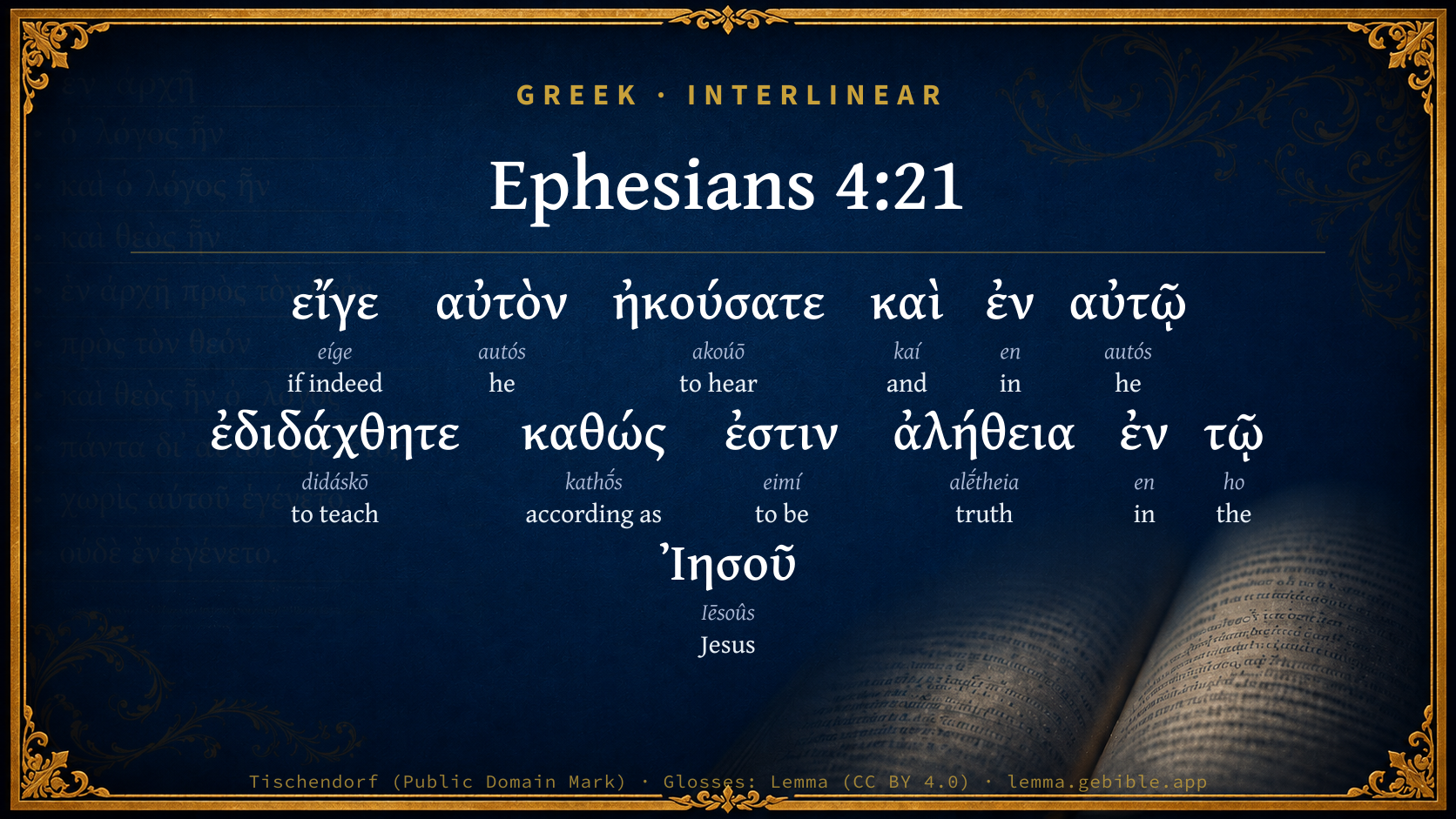
Greek (Tischendorf 8th ed.) Ephesians 4:21 appears in the Greek New Testament. The text above is from the Tischendorf 8th edition. Each word links to its Strong’s number and a concise gloss. Click any word for its full Thayer’s Greek Lexicon entry.
Download image
Cite this verse

Ephesians 4:21 (World English Bible). Public Domain. Lemma interlinear Bible study tool, https://lemma.gebible.app/v/ephesians/4/21.

Show BibTeX & RIS
BibTeX
RIS
English Translation
if indeed you heard him, and were taught in him, even as truth is in Jesus:
World English Bible · Public Domain
Download a study sheet

One document with this verse’s original text, its word-by-word gloss line, the meaning frame, cross-references with their text, attributed commentary, and full source and license credits — printable, and it pastes into notes with its structure intact.

This verse Autodidact and up

Study sheet (.html) Plain text (.txt)

A passage Seminary Student

Up to 50 verses in one chapter. A passage sheet keeps up to 6 commentary sources and 12 cross-references per verse, in the order this page ranks them, and says so on the sheet whenever that leaves anything out. Ask for a single verse and you get the Autodidact verse sheet above.

Everything on this page stays free to read, with no account — the sheet is a download of what is already on screen, not access to it.

Want to remove ads? Support Godless Engineer
Compare translations 3

The same verse in 3 English versions, stacked beneath the original-language interlinear above. Click any original word for its lexicon entry.

Each is an independent rendering of the whole verse — the interlinear is not word-aligned to these translations.

Highlighted words mark where these versions differ — a whole-verse word diff, not a word-by-word alignment.

  • World English Bible Public Domain
    if indeed you heard him, and were taught in him, even as truth is in Jesus:
  • King James Version Public Domain
    If so be that ye have heard him, and have been taught by him, as the truth is in Jesus:
  • unfoldingWord Literal Text CC BY-SA 4.0
    if indeed you have heard about him and were taught in him, as the truth is in Jesus.

unfoldingWord Literal Text — © unfoldingWord, licensed CC BY-SA 4.0. Word-aligned USFM3 via Door43 (git.door43.org/unfoldingWord/en_ult).

Versions to compare (up to 4)

3 of 4 selected

Show all 19 translations

Every available English version of this verse, each an independent rendering of the whole verse.

  • World English Bible Public Domain
    if indeed you heard him, and were taught in him, even as truth is in Jesus:
  • Berean Standard Bible Public Domain
    Surely you heard of Him and were taught in Him—in keeping with the truth that is in Jesus—
  • Majority Standard Bible Public Domain
    Surely you heard of Him and were taught in Him—in keeping with the truth that is in Jesus—
  • King James Version Public Domain
    If so be that ye have heard him, and have been taught by him, as the truth is in Jesus:
  • American Standard Version (1901) Public Domain
    if so be that ye heard him, and were taught in him, even as truth is in Jesus:
  • Revised Version (1885) Public Domain
    if so be that ye heard him, and were taught in him, even as truth is in Jesus:
  • Geneva Bible (1599) Public Domain
    If so be yee haue heard him, and haue bene taught by him, as the trueth is in Iesus,
  • Douay-Rheims (1899) Public Domain
    If so be that you have heard him, and have been taught in him, as the truth is in Jesus:
  • Young's Literal Translation Public Domain
    if so be ye did hear him, and in him were taught, as truth is in Jesus;
  • Literal Standard Version CC BY-SA 4.0
    if [it] so be [that] you heard Him, and were taught in Him, as truth is in Jesus;
  • Unlocked Literal Bible CC BY-SA 4.0
    I assume that you have heard about him, and that you were taught in him, as the truth is in Jesus.
  • unfoldingWord Literal Text CC BY-SA 4.0
    if indeed you have heard about him and were taught in him, as the truth is in Jesus.
  • Darby Bible Public Domain
    if ye have heard him and been instructed in him according as [the] truth is in Jesus;
  • World Messianic Bible Public Domain
    if indeed you heard him and were taught in him, even as truth is in Yeshua:
  • Webster's Bible Public Domain
    If indeed ye have heard him, and have been taught by him, as the truth is in Jesus:
  • Free Bible Version CC BY-SA 4.0
    Didn't you hear about him? Weren't you taught concerning him? Didn't you learn the truth as it is in Jesus?
  • Bible in Basic English Public Domain
    If in fact you gave ear to him, and were given teaching in him, even as what is true is made clear in Jesus:
  • Text-Critical English NT CC BY 4.0
    Surely you have heard about him and were taught in him, just as the truth is in Jesus,
  • Tyndale New Testament (1534) Public Domain
    if so be ye have hearde of him and are taught in him even as the trueth is in Iesu.

Literal Standard Version (2020), Covenant Press — licensed CC BY-SA 4.0. Text via the HelloAO Bible API (eBible.org). Unlocked Literal Bible (unfoldingWord) — licensed CC BY-SA 4.0. Text via the HelloAO Bible API (eBible.org). unfoldingWord Literal Text — © unfoldingWord, licensed CC BY-SA 4.0. Word-aligned USFM3 via Door43 (git.door43.org/unfoldingWord/en_ult). Free Bible Version, Dr. Jonathan Gallagher — licensed CC BY-SA 4.0. Text via the HelloAO Bible API (eBible.org).

Word by word

More ways to search: Search by grammar → Find every occurrence → Compare this word →

Practice this passage: Drill this verse → Learn its vocabulary →

About this verse

These counts appear in no published source. They are computed here, from the morphology-tagged text and Lemma’s own curated glosses. What Lemma adds →

13
words
11
distinct lemmas
Pauline Epistles
section

Notable vocabulary

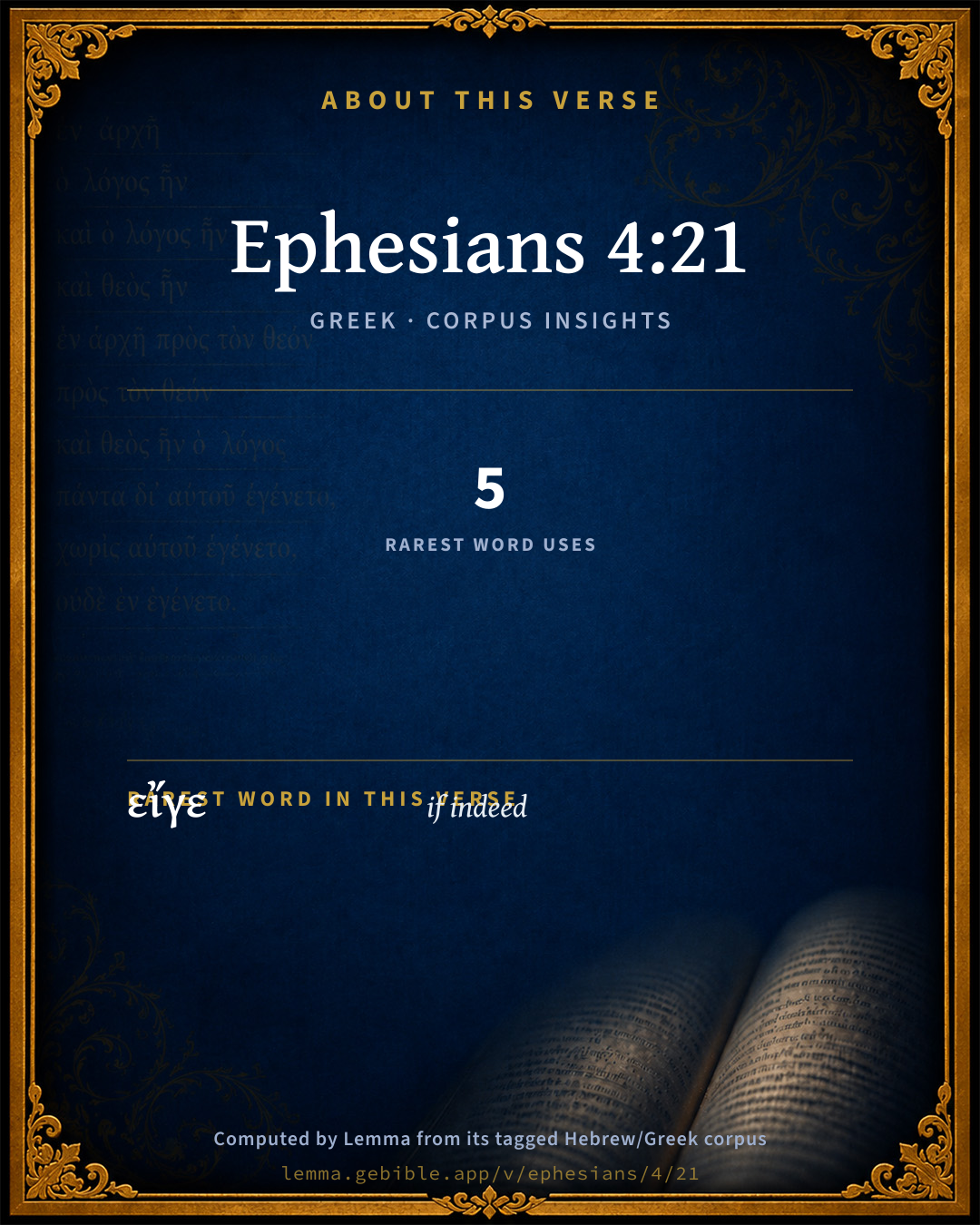
The rarest word here is εἴγε if indeed G1489 — appearing just 5 times in the whole Greek New Testament.

Shared distinctive vocabulary

εἴγε if indeed G1489 occurs in 5 verses of the Greek New Testament. Also found in:

Repetition

Words recur within this verse:

  • αὐτὸν he G846 ×2
  • ἐν in G1722 ×2

Cross-references

16

Topical passages linked to Ephesians 4:21 in the Treasury of Scripture Knowledge — connected by theme and wording, ordered by reader-vote popularity; previews shown in the World English Bible.

  • 1 John 5:20 We know that the Son of God has come, and has given us an understanding, that we know him who is true, and we are in him who is true, in his Son Jesus Christ. This is the true God, and eternal life.
  • Ephesians 1:13 in whom you also, having heard the word of the truth, the Gospel of your salvation,--in whom, having also believed, you were sealed with the Holy Spirit of promise,
  • Hebrews 3:7–8 Therefore, even as the Holy Spirit says, "Today if you will hear his voice,
  • 1 John 5:10–12 He who believes in the Son of God has the testimony in himself. He who doesn't believe God has made him a liar, because he has not believed in the testimony that God has given concerning his Son.
  • John 14:17 the Spirit of truth, whom the world can't receive; for it doesn't see him, neither knows him. You know him, for he lives with you, and will be in you.
  • Colossians 2:7 rooted and built up in him, and established in the faith, even as you were taught, abounding in it in thanksgiving.
  • John 10:27 My sheep hear my voice, and I know them, and they follow me.
  • Psalms 85:10–11 Mercy and truth meet together. Righteousness and peace have kissed each other.
  • Matthew 17:5 While he was still speaking, behold, a bright cloud overshadowed them. Behold, a voice came out of the cloud, saying, "This is my beloved Son, in whom I am well pleased. Listen to him."
  • Luke 10:16 Whoever listens to you listens to me, and whoever rejects you rejects me. Whoever rejects me rejects him who sent me."
  • John 1:17 For the law was given through Moses. Grace and truth came through Jesus Christ.
  • John 14:6 Jesus said to him, "I am the way, the truth, and the life. No one comes to the Father, except through me.
  • 2 Corinthians 1:20 For however many are the promises of God, in him is the "Yes." Therefore also through him is the "Amen," to the glory of God through us.
  • 2 Corinthians 11:10 As the truth of Christ is in me, no one will stop me from this boasting in the regions of Achaia.
  • Psalms 45:4 In your majesty ride on victoriously on behalf of truth, humility, and righteousness. Let your right hand display awesome deeds.
  • Acts 3:22–23 For Moses indeed said to the fathers, 'The Lord God will raise up a prophet for you from among your brothers, like me. You shall listen to him in all things whatever he says to you.

Cross-references courtesy of OpenBible.info (CC BY 4.0).

Commentary

Notes on Ephesians 4:21 from classic Christian and Jewish commentators (each source and its license shown beneath its notes). The classic Christian expositions comment on the surrounding passage and are grouped to its opening verse, so a note may address several verses; the Jewish commentaries on the Tanakh (Rashi and others) are per-verse, so they appear only where the commentator wrote on this verse.

Lemma curates 59 commentaries, every one of them public domain or Creative Commons licensed, each selected and text-cleaned for this edition rather than reprinted as found. About our sources →

Bengel's Gnomon

Johann Albrecht Bengel

Eph 4:21. Εἶγε, if so be that [or rather as the Indic, follows, Since, seeing that ye have heard]) The particle does not diminish, but increases the strength of the admonition.—αὐτὸν, Him) This word, and in [Engl. Vers. by] Him, which presently occurs, are brought in here from the following clause: as you, Gal 4:11. To hear Christ has a fuller meaning than to hear of Christ.—ἠκούσατε, ye have heard) Even the first hearing about Christ takes away sins.—ἐν αὐτῷ, in Him) i.e. in His name, as to what concerns Him.—ἐδιδάχθητε, ye have been taught) you have received the doctrine. The consequent of hearing and of being taught is to learn [ἐμάθετε, Eph 4:20].—καθὼς, even as) i.e. so as: comp. καθὼς, in such a way as, 1Co 8:2, so, as the truth is really in Jesus. The antithesis is according to, Eph 4:22 [your former conversation—according to the deceitful lusts].—ἀλήθεια, the truth) This is opposed to heathen vanity in general, Eph 4:17; and is resumed Eph 4:24, that it may receive a fuller discussion. Truth, viz. the true knowledge of the true God.—ἐν τῷ Ἰησοῦ, in Jesus) Those who believe in Jesus, speak the truth, 1Jn 2:8.

Bengel's Gnomon of the New Testament — English translation (T&T Clark, Edinburgh, 1860) — public domain. Text from a community e-Sword module.

Meyer's Critical & Exegetical Commentary

Heinrich August Wilhelm Meyer

Eph_4:21. Εἴγε] tum certe si, as to which, however, there is no doubt (for Paul himself had preached to them Christ, and instructed them in Christ), introduces, as in Eph_3:2, in a delicate way the confirmation of the οὐχ οὕτως ἐμάθετε τὸν Χριστόν: assuming, at least, that ye have heard him and have received instruction in him, as it is truth in Jesus, that ye lay aside, etc., that is: if, namely, the preaching, in which ye became aware of Christ, and the instruction, which was imparted to you as Christians, have been in accordance with the fact that true fellowship with Christ consists in your laying aside, etc.

αὐτὸν ἠκούσατε] to be explained after the analogy of the ἐμάθετε τὸν Χριστόν, Eph_4:20; but αὐτόν, like ἐν αὐτῷ subsequently, is prefixed with emphasis.

ἐν αὐτῷ] is neither ab eo (Castalio, Gataker, Flatt), nor de eo (Piscator), nor per eum (Beza), nor illius nomine, quod ad illum attinet (Bengel); but it is to be explained from the conception ἐν Χριστῷ εἶναι: in Him, in the fellowship of Christ, that is, as Christians. Observe the progress of the discourse, which passes over from the first proclamation of the gospel (αὐτὸν ἠκούσατε) to the further instruction which they have thereupon received as already converted to Christ (ἐν αὐτῷ ἐδιδαχθ.)two elements, which were previously comprehended in ἐμάθετε τὸν Χριστόν.

καθώς] in the manner how, introduces the mode of the having heard and having been instructed, so that this ἠκούσατε καὶ ἐδιδάχθητε καθὼς κ.τ.λ. corresponds to the previous οὐχ οὕτως ἐμάθετε τὸν Χριστόν, affirmatively stating what οὐχ οὕτως had indicated negatively.

ἐστιν ἀλήθεια ἐν τῷ Ἰησοῦ] Truth it is in Jesus, that ye lay aside, etc., in so far as without this laying aside of your old man there would be no true, but only an apparent fellowship with Jesus.

ἐν τῷ Ἰησοῦ] Paul passes from the official name Χριστός to the personal name Ἰησοῦς, because he, after having previously recalled the preaching made to the Ephesians and instruction concerning the Messiah, now brings into prominence the moral character of this preaching and instruction, and the moral life of true Christianity is contained in believing fellowship with the historical person of the Messiah, with Jesus (comp. 2Co_4:10 ff.: for Christi ideam perfectissime et fulgidissime explevit Jesus, Bengel), whose death has procured for believers their justification, and by virtue of their fellowship with Him the new life (Rom_6:2-3), so that to be ἐν τῷ Ἰησοῦ with a retention of the old man, would be a contradictio in adjectowould be untruth, and not ἀλήθεια ἐν τῷ Ἰησοῦ. We may add that this transition, unforced also at Eph_1:15, from Χριστός to Ἰησοῦς was not necessary; for, had Paul again written ἐν τῷ Χριστῷ, there would therewith, as before, have been presented to the moral consciousness just the historical Christ Jesus. Comp. Gal_5:24; Col_3:10 f. The accusative with the infinitive ἀποθέσθαι ὑμᾶς depends on ἐστιν ἀλήθεια ἐν τῷ Ἰησοῦ, so that it appears as subject of the sentence (Kühner, II. p. 347 f.). Usually ἀποθέσθαι ὑμᾶς is made to depend on ἐδιδάχθητε, in which case καθώς ἐστιν ἀλήθεια ἐν τῷ Ἰησοῦ is very differently explained. Either it is regarded as a parenthesis (Beza, Er. Schmid, Michaelis), as by Rückert, who takes καθώς augmentatively, so that the sense is: If ye are rightly instructed concerning Christ, ye have not so learned Him, for that would be false; with Him (there where Christ is, lives and rules) there is, in fact, only truth (moral, religious truth) to be met with. Or καθώς ἐστιν κ.τ.λ. is attached to ἐδιδάχθητε, and then ἀποθέσθαι ὑμᾶς is taken as epexegesis of καθώς ἐστιν κ.τ.λ., in which case ἀλήθεια in turn is differently explained.[236] Or the connection is so conceived of, that a οὕτως is supplied before ἈΠΟΘΈΣΘΑΙ, in which case Jesus appears as model.[237] So also Harless (followed by Olshausen), who, taking ἀλήθεια as moral truth (holiness), justifies ὑμᾶς from the comparison of Jesus with the readers (as truth is in Jesus, so to lay aside on your part), in which case Ἰησοῦ, not Χριστῷ, is held to be used, because the man Jesus is set forth as pattern. Matthies likewise makes ἀποθέσθαι, depend on ἐδιδάχθητε, but annexes καθώς κ.τ.λ. as more precise definition to ἐν αὐτῷ: in Him, as or in as far as the truth is in Jesus, as He is the truth. So Castalio appears already to have taken it. But all these explanations break down in presence of the ὑμᾶς, which, if ἀποθέσθαι ὑμᾶς belonged to ἐδιδάχθητε, would be quite inappropriate. In particular, it may be further urged (a) in opposition to Rückert, that according to his explanation the parenthesis καθώς ἐστιν ἀλήθεια ἐν τῷ Ἰησοῦ must logically have had its place already after τὸν Χριστόν; (b) in opposition to Harless, that the alleged comparison of Jesus with the readers is at variance with the order of the words, since Paul must have written: καθὼς ἐν τῷ Ἰησοῦ ἀλήθειά ἐστιν, ὑμᾶς ἀποθέσθαι; (c) in opposition to Matthies, that καθὼς κ.τ.λ. does not stand beside ἐν αὐτῷ, and that ἀλήθεια must have had the article. De Wette explains it to this effect: In Jesus there is (as inherent quality, comp. Joh_8:44) truth (especially in a practical respect), consequently there is implied in the instructions concerning Him the principle and the necessity of moral change. But even thus we may expect, instead of ἀποθ. ὑμᾶς, merely the simple ἀποθέσθαι. Others have attached ἀποθέσθαι ὑμᾶς to Eph_4:17, as continuation of the μηκέτι ὑμᾶς περιπατεῖν κ.τ.λ. (Cornelius a Lapide, Bengel, Zachariae; not Wetstein, who at Eph_4:22 merely says respicit comma 17), in which case καθώς ἐστιν ἀλήθ. ἐν τῷ Ἰησοῦ is likewise differently understood.[238] But after the new commencement of the discourse ὙΜΕῖς ΔῈ ΟὐΧ ΟὝΤΩς, Eph_4:21, this is simply arbitrary and forced. Credner takes a peculiar view (Einl. II. p. 398 f.): Ye have not thus learned to know the Messiah, provided that ye (as I am warranted in presupposing, for it is only to such that I write) have heard Him and have been instructed in Him, as He as truth (truly, really) is in Jesus. Thus Paul is held to distinguish his readers from such Gentiles as, won over to faith in the near advent of the worlds Redeemer, had reckoned themselves as Christians, but without believing in Jesus as that Redeemer. But of such Gentiles there is not found any trace in the N.T. (the disciples of John, Act_19:1 ff., are as such to be reckoned among the Jews); besides, there would lack any attachment for the following ἀποθέσθαι ὑμᾶς, and in using ἈΛΉΘΕΙΑ (instead of ἘΝ ἈΛΗΘ. or ἈΛΗΘῶς) Paul would have expressed himself as enigmatically as possible. Lastly, Hofmann (Schriftbew. II. 2, p. 291), without reason, wishes to attach ἐν τῷ Ἰησοῦ not to ΚΑΘΏς ἘΣΤΙΝ ἈΛΉΘ., but to what follows; the in itself quite general ΚΑΘΏς ἘΣΤΙΝ ἈΛΉΘΕΙΑ stood in need of being characterized definitely as Christian, not the ἈΠΟΘΈΣΘΑΙ Κ.Τ.Λ., as to which it was already implied in the nature of the case and was self-evident.

[236] Camerarius, Raphel, Wolf: edocti estis … quae sit vera disciplina Christi, nimirum ut deponatis. Comp. Piscator: quaenam sit vera ratio vivendi in Jesu tanquam in capite … nempe deponere. Grotius: si ita edocti estis evangelium, quomodo illud revera se habet; so also Calixtus, Koppe, Rosenmüller, Morus, and others.

[237] Jerome led the way with this explanation: quomodo est veritas in Jesu, sic erit et in vobis qui didicistis Christum. Subsequently it was followed by Erasmus, Estius (sicut in Christo Jesu nulla est ignorantia, nullus error, nihil injustum, sed pura veritas et justitia, sic et vos, etc.), and others, including Storr, Flatt (as He Himself is holy), Holzhausen, Meier (ἀλήθεια is Christian virtue, that ye, as truth in Jesus is, should lay aside).

[238] Bengel: ita uti veritas (vera agnitio Dei veri) reapse est in Jesu; qui credunt in Jesum, verant. Zachariae: For in what Jesus teaches to us is alone to be found the truth by the heathen … despised. Both thus explain it, as if ἀλήθ. had the article.

Meyer — Critical and Exegetical Commentary on the New Testament — English translation by Peter Christie, edited by Frederick Crombie (T&T Clark, 1880) — public domain. Text from a community e-Sword module.

Expositor's Greek Testament

ed. W. Robertson Nicoll

Eph 4:21 . εἴγε αὐτὸν ἠκούσατε : if indeed ye heard Him . On εἴγε , = “if so be that,” “if as I assume it to be the case,” see in Eph 3:2 above. In the form of a delicate supposition it takes it as certain that they did hear. The αὐτὸν ἠκούσατε is to be understood as the ἐμάθετε τὸν Χριστόν . The pronoun is placed for emphasis before its verb. The point, therefore, is this “if, as I take it to be the fact, it was He, the Christ, that was the subject and the sum of the preaching which you heard then”. καὶ ἐν αὐτῷ ἐδιδάχθητε : and in Him were instructed . ἐν αὐτῷ is not to be reduced to “ by Him” (Arm.; also AV “taught by Him”), or “about Him,” or “in His name” (Beng.), but has its proper sense of “ in Him”. The underlying idea is that of union with Christ. The ἐδιδάχθητε , therefore, refers probably to instructions subsequent to those which were given them at their first hearing ( ἠκούσατε ). It was in fellowship with Christ that they received these instructions. καθώς ἐστιν ἀλήθεια ἐν τῷ Ἰησοῦ : even as truth is in Jesus . WH give καθώς ἐστιν ἀληθείᾳ , ἐν τῷ Ἰησοῦ as a marginal reading. The meaning of the clause is much disputed. That it expresses in some way the manner or standard of the instructions ( ἐδιδάχθητε ) is clear from the καθώς . But what the point and connection of the clause are it is by no means easy to determine. Wicl. gives “as is truth in Jesus”; AV and other old English Versions, “as the truth is in Jesus,” as if it were ἡ ἀλήθεια . Some dispose of it as a parenthesis (Bez., Rück., etc.), as if = “if ye were so instructed about Christ, that would be false” (as in Him there is only truth, moral and religious truth). Others (Grot., etc.) make it = “as it really is,” i.e. , “if ye were instructed in the Gospel as it really is in Jesus”; or (Jer., Erasm., Est., etc.) they supply a οὕτως to the ἀποθέσθαι and understand the καθὼς clause to refer to Jesus as the Pattern of moral truth or holiness. Jerome’s explanation, e.g. , is this quomodo est veritas in Jesu sic erit et in vobis qui didicistis Christum . Somewhat similarly others, connecting it with ἀποθέσθαι , take it to mean that as moral truth is in Jesus, so they on their part are to lay aside the old man (Harl., Olsh., etc.). Or, connecting it with ἐδιδάχθητε , they understand the point to be that they were instructed in a way implying a moral change, as in Jesus there is truth and, therefore, holiness (so de Wette substantially). Meyer makes the ἀποθέσθαι dependent on the καθὼς clause, so that the sense becomes this “truth it is in Jesus that ye put off the old man”; and Abbott appealing to the use of ἀλήθεια in Eph 4:24 and in Joh 3:21 , makes it = “as it is true teaching in Jesus that ye should put off,” etc. All these interpretations involve dubious constructions or impose unjustifiable senses on the ἀλήθεια . Feeling this others have adopted the bolder expedient of making Χριστός the subject of ἐστιν , the sense then becoming “as He (Christ) is truth in Jesus” (Cred., Von Soden). A better turn is given to this by WH, who would read ἀληθείᾳ and so get the sense “as He (Christ) is in Jesus in truth”. In support of this it is urged that the αὐτόν , ἐν αὐτῷ show that Christ , the Messiah , is the leading subject. But this construction means that it was not enough to be instructed in a Messiah; that they had also to recognise that Messiah in the historical Jesus, and that in Him they would see the life which signified for them a putting off of the old man. There is no indication, however, in the context or in any word of Paul’s belonging to this period of a form of false Christian teaching which distinguished between Christ and Jesus , or of Gentiles professing to believe in a Messiah but not in Jesus as that Messiah. It only remains, therefore, to fall back on the interpretation “if ye were instructed according to that which is truth in Jesus”. The clause will then describe the nature or manner of the instruction, as the following clause expresses its substance. In form or character the instruction was in accordance with what was true, with what was true in Jesus , that is to say, with truth as seen embodied in Him ( cf. Alf., Ell.). And instruction of that kind meant that they should put off the old man.

The Expositor's Greek Testament, edited by W. Robertson Nicoll (1897–1910) — public domain. Text from a community e-Sword module.

Hodge's Commentary on Romans, Ephesians & First Corinthians

Charles Hodge

Eph_4:21

If so be ye have heard him. To hear him does not mean to hear about him. This the apostle in writing to Christians could not express in a hypothetical form. He knew that the Ephesian Christians had heard about Christ. To hear, in this connection, implies intelligence and obedience, as in the frequently occurring phrase, He that hath ears to hear, let him hear; and Today if ye will hear his voice, etc., and in a multitude of other cases. To hear the voice of God or of Christ, therefore, is not merely to perceive with the outward ear but to receive with the understanding and the heart. The particle εἴγε, if indeed, does not express doubt; but if, as I take for granted. The apostle assumes that they were obedient to the truth. Ye have not so learned Christ as to allow of your living as do the Gentiles, if, as I take for granted, you have really heard his voice and have been taught by him. Ἐν αὐτῷ, however, does not properly mean by him, but in communion with him. ye have been taught in him, inasmuch as truth is in Jesus, to put off the old man. The knowledge of Christ, hearing him, union with him, his inward teaching, are necessarily connected with the mortification of sin.

The clause καθώς ἐστιν ἀλήθεια ἐν τῷ Ἰησοῦ, rendered in our version as the truth is in Jesus, is variously explained. The interpretation intimated above supposes καθώς to have its frequent causal sense; since, inasmuch as; and truth to mean moral truth, or excellence. This sense it very often has. It frequently means true religion, and is used antithetically to unrighteousness, as in Rom_2:8. The principle here involved is, that knowledge of God is inconsistent with a life of sin, because knowledge implies love, and God is holy. To know him, therefore, is to love holiness. The apostles argument is: If you know Christ you will forsake sin, because he is holy truth, i.e. moral excellence is in him. If you have been taught any thing in virtue of your communion with him, you have been taught to put off the old man.

Another interpretation supposes καθώς to mean as, expressing the manner. If ye have been taught as the truth is in Jesus, i.e. correctly taught. But this requires the article even in English the truth, meaning the definite system of truth which Jesus taught. In the Greek, however, the article necessary to give color to this interpretation is wanting. Besides, the expression the truth is in Jesus is obscure and unscriptural, if truth be taken to mean true doctrine. And more than this, this interpretation supposes there may be a true and false teaching by, or in communion with, Christ. This cannot be. The apostles hypothesis is, not whether Christ has taught them correctly, but whether he has taught them at all.

A third interpretation makes the following infinitive the subject of the sentence; Truth in Jesus is, to put off the old man. The meaning of the whole passage would then be, If you know Christ ye cannot live as the heathen, for truth in Jesus is to put away sin, i.e. true fellowship with Christ is to put off, etc. But this violates the natural construction of the passage, according to which the infinitive ἀποθέσθαι depends on ἐδιδάχθητε, Ye have been taught to put off, etc. And the expression, It is truth in Jesus to put away sin is in itself awkward and obscure. The first mentioned interpretation, therefore, is on the whole to be preferred.

Charles Hodge — Commentary on Romans (1835), First Corinthians (1857), and Ephesians (1856) — public domain. Text from a community e-Sword module.

Geneva Bible (1599)

Geneva Bible translators

As they have learned which acknowledge Christ indeed, and in good earnest.

Geneva Bible (1599) marginal notes — public domain. Text via Bolls.life.

Jamieson, Fausset & Brown

Robert Jamieson, A. R. Fausset & David Brown

If so be that--not implying doubt; assuming what I have no reason to doubt, that

heard him--The "Him" is emphatic: "heard Himself," not merely heard about Him.

taught by him--Greek, "taught IN HIM," that is, being in vital union with Him (Rom 16:7).

as the truth is in Jesus--Translate in connection with "taught"; "And in Him have been taught, according as is truth in Jesus." There is no article in the Greek. "Truth" is therefore used in the most comprehensive sense, truth in its essence, and highest perfection, in Jesus; "if according as it is thus in Him, ye have been so taught in Him"; in contrast to "the vanity of mind of the Gentiles" (Eph 4:17; compare Joh 1:14, Joh 1:17; Joh 18:37). Contrast Joh 8:44.

Jamieson, Fausset & Brown — Commentary Critical and Explanatory on the Whole Bible (1871) — public domain (CC PDM 1.0). Text via the HelloAO Bible API.

Adam Clarke's Commentary

Verse 21. If so be that ye have heard him] ειγε, Seeing that, since indeed, ye have heard us proclaim his eternal truth; we have delivered it to you as we received it from Jesus.

Adam Clarke's Commentary on the Bible (1810–1826) — public domain. Text from a community e-Sword/MySword module.

John Calvin's Commentaries

21. If ye have heard him. To excite their attention and earnestness the more, he not only tells them that they had heard Christ, but employs a still stronger expression, ye have been taught in him, as if he had said, that this doctrine had not been slightly pointed out, but faithfully delivered and explained.

As the truth is in Jesus. This contains a reproof of that superficial knowledge of the gospel, by which many are elated, who are wholly unacquainted with newness of life. They think that they are exceedingly wise, but the apostle pronounces it to be a false and mistaken opinion. There is a twofold knowledge of Christ, — one, which is true and genuine, — and another, which is counterfeit and spurious. Not that, strictly speaking, there are two kinds; but most men falsely imagine that they know Christ, while they know nothing but what is carnal. In another Epistle he says,

“If any man be in Christ, let him be a new creature.” (2 Corinthians 5:17.)

So here he affirms that any knowledge of Christ, which is not accompanied by mortification of the flesh, is not true and sincere.

John Calvin's Commentaries (1540-1563) — public domain. Text from the Calvin Translation Society English edition (1840s-50s) via the Christian Classics Ethereal Library (ccel.org). Calvin's coverage is partial (roughly two-thirds of the Bible); uncommented books and verses are honest gaps, never fabricated. The 19th-century editor's footnotes and remarks are omitted so the notes are faithfully Calvin's own voice.

Ellicott's Commentary for English Readers

(21) If so be that.—The word is the same which is used in Eph_3:2, Col_1:23, indicating no real doubt, but only that rhetorical doubt which is strong affirmation.

Ye have heard him . . .—The true rendering here is, ye heard Him, and were taught in Him. St. Paul begins with the first means of knowledge, the “hearing” His voice, directly or through His ministers; and then proceeds to describe the fuller and more systematic process of “being taught,” not “by Him” (as in our version), but “in Him,” that is, in that unity with Him which embraces both teachers and taught as with an atmosphere of His presence.

As the truth is in Jesus.—Here by the name “Jesus,” the personal and proper name of the Lord, St. Paul leads us on from the conception of “learning the Christ,” to understand the method of that learning, in the knowledge of the “truth” in the person of Jesus Himself, who declares Himself to be the Truth (Joh_14:6). By a loving study and knowledge of His person, as set forth to us in the gospel, and brought home to us by His grace, rather than by abstract musing on the office and attributes of “the Christ,” we come to learn the Christ also. The use of the simple name Jesus, so common in the Gospels, is rare indeed in the Epistles, where we constantly find the fuller description “Jesus Christ,” “the Lord Jesus,” “Jesus the Son of God.” Wherever it occurs, it will be found to be distinctive or emphatic. This distinctiveness is most strikingly evident in Rom_8:11 : “If the Spirit of Him who raised up Jesus from the dead dwell in you, He that raised up [the] Christ from the dead shall also quicken your mortal bodies.” The “raising up of Jesus,” is the historical resurrection of Jesus of Nazareth; the “raising up the Christ” points to the mysterious effect of that resurrection on those for whom He is the Mediator. Of the few other passages in which the simple name occurs, some (as Rom_3:26; 2Co_4:10-11; 1Th_1:10; Heb_10:10) are mere reiterations of the name occurring above with the due title of honour; others are quasi-recitals of a creed declaring the historic Jesus (1Co_12:3; 1Th_4:14; comp. 2Co_11:4). In the Epistle to the Hebrews, where, in accordance with one main purpose of the Epistle, this usage is least rare (see Heb_2:9; Heb_6:20; Heb_7:22; Heb_12:2; Heb_12:24; Heb_13:12), it will be found that in all cases, either special stress is laid on the lowly and suffering humanity of the Lord, or the historic facts of His ministry on earth are referred to. The modern familiarity of use of the simple name “Jesus” has little authority in apostolic usage.

A Bible Commentary for English Readers, edited by Charles John Ellicott (1878–1897) — public domain. Text from a community e-Sword module.

The Cambridge Bible for Schools and Colleges

gen. ed. J. J. S. Perowne

21. if so be] The Gr. interrogative (used also above, Eph_3:2) does not imply any doubt, necessarily, but calls the reader to verify the statement.

have heard him, &c.] Better, as “Him” is emphatic by position, If it was He whom ye heard. The Gr. construction leads us to explain this not of listening to the Lord so much as of hearing about Him, or rather, of hearing “Him” as Truth rather than Teacher. “Christ” had been the Message they had received.—He does indeed, by His Word and Spirit, personally continue the “teaching” which in His earthly ministry He began (Act_1:1); but that is not the point of the present words.

have been taught by him] Better, if it was in Him that ye were taught. The instruction was “in Christ,” if the teacher’s limit and rule was the truth of His Person and Work, and if those who received it were, by living spiritual union, “in Him,” and so capable of “spiritual discernment” (1Co_2:14). This clause defines and explains the previous clause.

as the truth is in Jesus] Better, even as in Jesus truth is. See last note, on the relation of spiritual “in-ness” to the standard and reception of spiritual truth. The emphasis here is as if to say, “If you were taught, as I say, in Him; in the lines of eternal fact and spiritual reality which do so truly meet in Him.”—The question arises, why does the Lord’s designation change from “Christ,” Eph_4:20, to “Jesus” here? Probably to mark the fact that the prophesied Christ is the historical Jesus.

The Cambridge Bible for Schools and Colleges (gen. ed. J. J. S. Perowne; Cambridge University Press, 1878–1918) — public domain. Text from a community e-Sword module.

John Gill's Exposition

That ye put off concerning the former conversation, the old man,.... Which is the corruption of nature; why this is called a man, and an old man; see Gill on Rom 6:6, the putting him off, is not a removing him from the saints, nor a destroying him in them, nor a changing his nature; for he remains, and remains alive, and is the same old man he ever was, in regenerate persons; but it is a putting him off from his seat, and a putting him down from his government; a showing no regard to his rule and dominion, to his laws and lusts, making no provision for his support; and particularly, not squaring the life and conversation according to his dictates and directions; and therefore it is called a putting him off, concerning the former conversation: the change lies not, in the old man, who can never be altered, but in the conversation; he is not in the same power, but he retains the same sinful nature; he is put off, but he is not put out; and though he does not reign, he rages, and often threatens to get the ascendant: these words stand either in connection with Eph 4:17 and so are a continuation and an explanation of that exhortation; or else they point out what regenerate souls are taught by Christ to do, to quit the former conversation, to hate the garment spotted with the flesh, and to put it off; for the allusion is to the putting off of filthy garments, as the works of the flesh may be truly called, which flow from the vitiosity of nature, the old man:

which is corrupt according to the deceitful lusts; the old man, or the vitiosity of nature, has its lusts; and these are deceitful; they promise pleasure and profit, but yield neither in the issue; they promise liberty, and bring into bondage; they promise secrecy and impunity, but expose to shame, and render liable to punishment; they sometimes put on a religious face, and so deceive, and fill men with pride and conceit, who think themselves to be something, when they are nothing: and through these the old man is corrupt; by these the corruption of nature is discovered; and the corruption that is in the world is produced hereby; and these make a man deserving of, and liable to the pit of corruption; and this is a good reason, why this corrupt old man, with respect to the life and conversation, should be put off.

John Gill's Exposition of the Whole Bible (1746–1763) — public domain (CC PDM 1.0). Text via the HelloAO Bible API.

Trapp's Complete Commentary

John Trapp

21 If so be that ye have heard him, and have been taught by him, as the truth is in Jesus:

Ver. 21. Ye have heard him, &c.] When Christ speaks once, we must hear him twice, as David did, Psa 62:11, to wit, by an after deliberate meditation; for otherwise we learn nothing.

John Trapp, A Commentary or Exposition upon All the Books of the Old and New Testament (1647–1656) — public domain. Text from a community e-Sword module.

Albert Barnes' Notes on the Bible

If so be that ye have heard him - If you have listened attentively to his instructions, and learned the true nature of his religion. There may be a slight and delicate doubt implied here whether they had attentively listened to his instructions. Doddridge, however, renders it, “Seeing ye have heard him;” compare notes on Eph 3:2.

And have been taught by him - By his Spirit, or by the ministers whom he had appointed.

As the truth is in Jesus - If you have learned the true nature of his religion as he himself taught it. What the truth was which the Lord Jesus taught, or what his principles implied, the apostle proceeds to state in the following verses.

Albert Barnes' Notes on the Bible (1834–1885) — public domain. Text from a community e-Sword/MySword module.

Matthew Poole's English Annotations

If so be that ye have heard him; either heard Christ speaking to you in the gospel, Heb 12:25, and then the sense will be the same as in the following clause; or heard him preached to you, and then it may refer to the outward hearing of the word.

And have been taught by him; or taught in him; in or by, as Col 1:16; Heb 1:2; and then this relates to the power of the word, and the impression made by it upon the heart: q.d. If ye have not only heard of him by the hearing of the ear, but have been effectually taught by the Spirit to know him, and receive his doctrine, Isa 54:13; Joh 6:45.

As the truth is in Jesus; as it really is, and hath been taught by Christ himself, both in his doctrine and example, viz. what is the true way of a Christian’s living; as in the following verses: see Joh 17:17; Tit 1:1.

Matthew Poole's English Annotations on the Holy Bible (1683–1685) — public domain. Text from a community e-Sword/MySword module.

Whedon's Commentary on the Bible

Daniel D. Whedon

21. Heard him—Preaching to you through his apostles. For the gospel is his living voice. As the truth is embodied in Jesus—What that truth is we are told in the next paragraph. It is the truth of the renewal from the old depravities to the new purities.

Daniel D. Whedon (gen. ed.), Commentary on the Old and New Testaments (1874–1909) — public domain. Text from a community e-Sword module.

The Pulpit Commentary

If so be that ye heard him. A word of caution. We are not to assume too readily that we are in a right relation to Christ. We must look within and make sure of that. To hear him, here, is to hear him as his sheep hear his voice and follow him, recognizing the voice of the Shepherd, a voice to be implicitly obeyed. And were taught in him, as truth is in Jesus. The peculiar force of this clause is the double ejn, not given in the first clause in A.V., thereby obscuring the sense, which is, that all teaching and all truth acquires a different hue and a different character when there is a personal relation to Jesus. Truth apart from the person of Christ has little power; abstract doctrines have little influence; the very atonement may be a barren dogma. But the atonement taught "in Jesus," in connection with the living, loving, dying, risen Savior tells; the blood of redemption in connection with the Son of God incarnate thus loving us, and meekly, patiently suffering the agonies of the cross in our room, is not only a power, but the greatest moral power that can move the heart.

As the truth is in Jesus.

These words describe the method, not the substance, of Christian teaching; the latter is adverted to in the next verse. The historical name, "Jesus," instead of the more common official name, "Christ," indicates that this teaching is given through the life of our Lord on earth. We come to the knowledge of truth by hearing him, by being taught of him, by seeing it as it is in him.

I THE KNOWLEDGE OF TRUTH IS OF SUPREME IMPORTANCE TO US. The means is proportioned to the end. If the life of Christ is necessary for the revelation of truth, the truth thus revealed must be of first moment. Emotion without truth is vapid sentiment; and action without truth can have no moral character, and is as likely to be hurtful as useful. It is a blind man"s groping. We can dispense with a superfluity of dogma. We have too many words about truth. But truth itself, the living spiritual reality, is the very breath of our souls. To know ourselves and our vocation, to know God, his love and his will, to know the spiritual order of things as far as it touches our own lives and conduct, is of vital interest.

II TRUTH IS REVEALED IN CHRIST. Truth is written on the great book of creation, but in obscure hieroglyphics, for nature is an inarticulate prophet. Truth has also come through the inspiration of thought and conscience in poets and seers. But then it is always in words; and words make it but a clumsy garment hiding its finer beauty and, at best, speaking at second hand. In Christ we see truth intelligible, powerful, touching. It is revealed in his very self and in his words and deeds as they are the outcome and signs of his character and nature. Christ is the truth. He has but to be and to be seen and heard for truth to be revealed.

III THIS REVELATION OF TRUTH IN CHRIST IS OF A DISTINCTIVE CHARACTER.

1. It is human. Truth is seen in Jesus just because he is a real and perfect Man. As man is made in the image of God, the very being of a perfect man must be a manifestation of Divine thoughts.

(1) Therefore any dogmas that are contrary to humanity are false.

(2) Therefore, also, we need not fear truth. She has a human countenance.

1. It is living. Truth in words is cold and dead, though it may be clear and beautiful. Truth in Jesus is alive, revealing itself in action, putting teeth energy, responding to our sympathy.

2. It is spiritual. Truth of religion and of conduct is what we see in Jesus, not reminiscences of secular history nor anticipations of material science. The highest truth concerns God and the soul, duty and the unseen world. 4. It is beautiful. Christ"s glory was full of grace and truth. In his face truth has no terrors, but the most winning attractions and the most moving loveliness.

IV SUCH A PRESENTATION OF TRUTH CALLS FORTH DUTIES ON OUR PART.

1. We have to learn Christ." That is the one lesson for our souls. We may learn all systems of theology and yet know nothing of the highest truth, if we do not know Christ. They who sit at the feet of Jesus drink from the deepest fountains. As Christ is best described to us in the four Gospels, these Gospels are the chief source of Christian knowledge. Yet inasmuch as the apostles interpret the mind of Christ, we may learn Christ from the whole of the New Testament But we must also come to a personal communion with Christ in order to know him aright.

2. We have to Trove how we have learned Christ by our conduct. This knowledge is to shape our actions. Fidelity, purity, and charity of life must make men see what truth we have found in Jesus. W.F.A.

The Pulpit Commentary (1880–1919), ed. H.D.M. Spence-Jones & Joseph S. Exell — public domain. Text from a community e-Sword module.

John Wesley's Explanatory Notes

Seeing ye have heard him - Teaching you inwardly by his Spirit. As the truth is in Jesus - According to his own gospel.

John Wesley, Explanatory Notes Upon the Whole Bible (1754–1765) — public domain. Text via the GEBible commentary corpus.

The People's New Testament

B. W. Johnson

21. If so be that ye have heard him. This does not express a doubt that they had heard and been taught by Christ. The idea is: If ye have heard, etc., as I know you have, you have been taught the truth in Jesus, that

(verse 22) ye put off concerning the former manner of life the old man and his deeds. “The old man” is the old sinful life, in contrast with “the new man,” or new life in Christ.

B. W. Johnson's The People's New Testament with Notes (1889–1891) — public domain. Electronic text from the Christian Classics Ethereal Library (CCEL) ThML edition.

Cambridge Greek Testament for Schools and Colleges

21. εἴ γε. Cf. on Eph 3:2 not implying doubt.

αὐτὸν ἠκούσατε. ‘If He was the subject of the message that ye heard.’ If St Paul had thought of Him as the speaker he would (as in Rom 10:14) have used the gen.

καὶ ἐν αὐτῷ ἐδιδάχθητε. Cf. on Eph 1:13. ἐν αὐτῷ, in realized union with Him. Our use of ‘in’ as defining a subject of instruction may mislead us here. There seems no instance of such a use of ἐν. Even in Col 1:28 διδ … ἐν πάσῃ σοφίᾳ, the ἐν is probably instrumental.

καθὼς ἔστιν ἀλήθεια ἐν τῷ Ἰησοῦ. ‘As there is truthfulness in Jesus.’ The clause is difficult. It is important in interpreting it to bear in mind in the first place that it is a parenthesis. The infinitives ἀποθέσθαι and ἀνανεοῦσθαι that follow depend on ἐδιδάχθητε. It is therefore, to say the least, unlikely that the clause contains a statement on an important Christological problem. An allusion to the perfect embodiment of the Christ in the humanity of Jesus might have been in place in controversy with Cerinthus, but it seems to belong to a region of thought remote from the present context. We need not therefore consider farther the possibility of reading (with Hort) ἀληθείᾳ for ἀλήθεια. In the second place, it is impossible to dissociate the use of ἀλήθεια here from the use of ἀληθεύειν in Eph 4:15, and of τῆς ἀληθείας in Eph 4:24. As the contrast with ἡ πλάνη (Eph 4:14), ἡ ἀπάτη (Eph 4:22) and τὸ ψεῦδος (Eph 4:25) shows, ἀλήθεια has throughout the passage a vital and moral even more than an ‘intellectual’ content. It might be rendered on the one side ‘reality,’ on the other ‘truthfulness.’ As a personal characteristic it implies a perfect response on our part to the facts of the position in which we find ourselves, i.e. to the relationships by which we are surrounded, facts and relationships to which our natural selfishness makes us continually untrue. It is at once to guide and to stimulate the effort, that such truthfulness will require of us, that St Paul reminds us of the abiding presence of just this quality in the humanity of our Lord.

ἐν τῷ Ἰησοῦ. The use of the name Jesus by itself is rare in St Paul. It is used here because the reference is to a personal quality possessed by Him, and not in the first instance by us in virtue of our union with Him. There seems to be only one instance (Rev 1:9) where ἐν Ἰησοῦ stands in this latter sense as the equivalent of the Pauline ἐν Χριστῷ or ἐν Κυρίῳ. There is an instructive contrast with many points of contact with St Paul’s language here, in Joh 8:44. Notice esp. τὰς ἐπιθυμίας τοῦ πατρὸς ὑμῶν—ὅτι οὐκ ἔστιν ἀλήθεια ἐν αὐτῷ—ὅταν λαλῇ τὸ ψεῦδος. The interpretation given above is on the lines suggested by Origen’s comment. J.T.[126]

[127] vol. III. p. 418. ὥς ἐστιν ἀλήθεια ἐν τῷ Ἰησοῦ οὕτως ἔσται καὶ ἐν ὑμῖν μαθοῦσι τὸν Χριστὸν καὶ αὐτὸν ἀκούσασι καὶ ἐν αὐτῷ διδαχθεῖσιν, ἀποθεμένοις τε κατὰ τὴν προτέραν ἀναστροφὴν τὸν παλαιὸν ἄνθρωπον κ.τ.λ. Compare also Whitaker.

[126] Journal of Theological Studies.

[127] Journal of Theological Studies.

Cambridge Greek Testament for Schools and Colleges (Cambridge University Press, 1896; 21 vols, various authors incl. Carr, Maclear, Plummer, Farrar, Lumby, Moule, M. R. James, Simcox) — public domain. Text from a community e-Sword module.

International Critical Commentary

21. εἴγε, “tum certe si,” see on 3:2. Here also the conjunction is unfavourable to the view that St. Paul is addressing those whom he had himself instructed. αὐτόν with emphasis placed first, “if Him, indeed, ye heard.” ἐν αὐτῷ, not “by Him,” as AV., a construction not admissible with a personal author, nor “illius nomine, quod ad illum attinet” (Bengel). But as those who believe are said to be ἐν Χριστῷ, so here they are said to have been taught in Him, i.e. as in fellowship with Him. There is a progress, as Meyer observes, from the first announcement of the gospel (ἠκούσατε) to the further instruction which then as converts they would have received (ἐν αὐτῷ ἐδιδ.), both being included in ἐμάθετε τὸν Χριστόν. Joh 10:27 is not parallel, since ἀκούειν in the sense “hearken to” would take the genitive.

Καθώς ἐστιν ἀλήθεια ἐν τῷ Ἰησοῦ. The AV. “as the truth is in Jesus” is incompatible with the absence of the article, but admits of being understood in the true sense of the Greek, which is not the case with the form in which the words are so often quoted, “the truth as it is in Jesus,” which would be τὴν ἀλήθειαν καθώς ἐστιν, κ.τ.λ. Nor do the words mean, as Jerome interprets: “quomodo est veritas in Jesu, sic erit in vobis qui didicistis Christum,”—an interpretation which is followed by Estius and many others, and which makes Jesus be set forth as the pattern of truth, i.e. holiness. In addition to the difficulty of so understanding ἀλήθεια, this supposes ὑμᾶς to be emphatic, which its position forbids; the antithesis would also require that ἐν τῷ Ιησοῦ should come after καθώς. Moreover, any interpretation which makes ἀποθέσθαι depend on ἐδιδάχθητε is open to the objection that in that case ὑμᾶς is superfluous. Ellicott, who adopts this construction, suggests that ὑμᾶς is introduced to mark their contrast, not only with other Gentiles, but with their own former state as implied in τὴν προτέραν ἀναστροφήν. But it is not clear how ὑμᾶς can mark such a contrast. Nor is ἐδιδ. suitable to ἀνανεοῦσθαι. It seems better to take ἀποθέσθαι ὑμᾶς as the subject of the clause, ἀλήθεια being understood in the sense “true teaching,” opposed to ἀπάτη. Compare the use of ἀλήθεια in Joh 3:21, “he that doeth the truth,” and here, ver. 24. The sense will then be, “as is right teaching in Jesus: that ye put off.” The change from Χριστόν to Ἰησοῦ is appropriate. Their introduction to Christianity or to the πολίτεια of Israel instructed them in the hope centred in the Messiah as a Redeemer. But when obedience to the practical teaching of a historical person is referred to, the historical name is used.

A very different view of the construction is taken by Credner, v. Soden, and Westcott and Hort mg., viz. that Χριστός is the subject of ἐστιν, in which case ἀλήθεια may be either nom. (Credner, Soden) or dative (WH. mg.). Soden remarks that considering the emphatic repetition of αὐτόν, ἐν αὐτῷ, which takes up τὸν Χρ. from the clause with οὕτως, the subject of this clause can only be Christ, viz. “as He is truth in Jesus,” so that the thought is that they must not only believe in a Christ, but recognise Him in Jesus; and if they are to live in truth in Christ, they must live in Jesus. The thought is parallel to Heb 13:18. The dative ἀληθείᾳ, as in WH. mg., seems preferable, “have been taught in Him, as He is in truth, in Jesus.” On ἀληθείᾳ in this sense, comp. Php 1:18, εἴτε προφάσει εἴτε ἀληθείᾳ.

International Critical Commentary — older volumes (1896–1929), various authors — public domain. Text from a community e-Sword module.

Vincent's Word Studies in the New Testament

Marvin R. Vincent

If so be that ye heard Him [ει γε αυτον ηκουσατε] . The indicative mood implies the truth of the supposition : if ye heard as ye did. Him is emphatic. If it was Him that ye heard. Compare Joh 10:27.

By Him [εν αυτω] . Rev., correctly, in Him. In fellowship with. As the truth is in Jesus [καθως εστιν αληθεια εν τω ιησου] . As corresponds with not so. Ye did not in such a manner learn Christ if ye were taught in such a manner as is truth, etc. Render, as Rev., as truth is in Jesus. Schaff paraphrases : "If you were taught so that what you received is true as embodied in the personal Savior." " Taught in the lines of eternal fact and spiritual reality which meet in him " [μουλε] . Jesus is used rather than Christ : the historical rather than the official name. The life of Christianity consists in believing fellowship with the historic Jesus, who is the Christ of prophecy.

Marvin R. Vincent, Word Studies in the New Testament (1887–1900) — public domain. Text from a community e-Sword/MySword module.

Lesson kit

Teaching starters — assembled from the data on this page, not authored interpretation. Every prompt links to the verse data it draws on. Edit before teaching.

Ephesians, in the Pauline Epistles, opens this verse with 13 words (11 distinct Greek lemmas). Its most distinctive word is eíge (“if indeed”). A historical commentator’s framing appears above. Read the whole chapter for the surrounding context.

Discussion questions

  1. The word eíge carries the sense “if indeed.” How does it shape the verse?
  2. How does 2 Corinthians 5:3, which shares the word «if indeed», read alongside this verse?
  3. What does the repetition of “he” (2× in this one verse) do in this verse?
  4. These translations render this verse differently. What is at stake in choosing one wording over another?
  5. Compare how Bengel's Gnomon and Meyer's Critical & Exegetical Commentary read this verse. Where do they agree or differ?

Things to notice

Reading settings

Reading text

Shown beneath each verse's original-language words.

Old Testament
Old Testament edition

Read the OT as the Masoretic Hebrew (MT) or the Greek Septuagint (LXX).

English shown for the Greek Septuagint (in the Hebrew ↔ Greek comparison).

Comparing translations? Open the Compare panel on any verse page to stack up to four side by side.