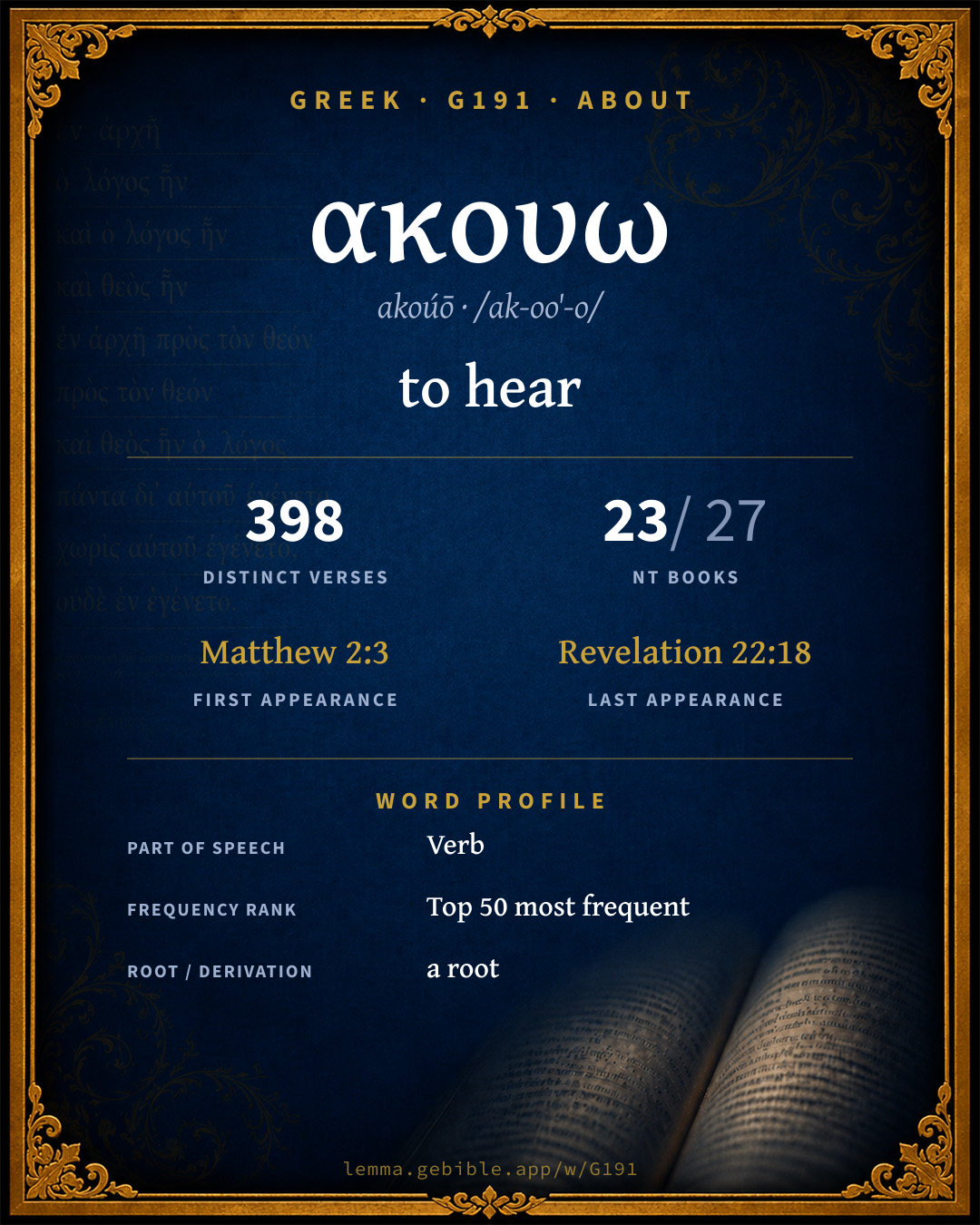
ἀκούω
to hear
‘to hear’ is one of 8 main senses fuller range ↓
Full lexicon entry — Thayer's Greek Lexicon
From Thayer's Greek Lexicon
Where this word appears
See every Aorist-tense verb in the Greek New Testament →
Grammar key — what these labels mean
Part of speech
- Verb
- An action or state-of-being word.
Tense
- Aorist
- Action viewed as a simple whole, without regard to duration — often past (perfective aspect).
- Present
- Ongoing or general action in present time (imperfective aspect).
- Imperfect
- Continuous or repeated action in past time (“was writing”).
- Perfect
- A completed past action with continuing present results.
- Future
- Action expected in future time.
Voice
- Active
- The subject performs the action.
- Passive
- The subject receives the action.
- Middle deponent
- Middle in form but active in meaning.
Mood
- Participle
- A verbal adjective (“writing,” “having written”).
- Indicative
- States a fact or asks a factual question (the mood of reality).
- Infinitive
- A verbal noun (“to write”), unmarked for person or number.
- Imperative
- Expresses a command or request.
- Subjunctive
- Expresses probability, purpose, or possibility (the mood of contingency).
Case
- Nominative
- The case of the subject (and the predicate nominative).
- Accusative
- The case of the direct object and of extent.
- Genitive
- The case of source, possession, or “of” — answers “whose / from what.”
- Dative
- The case of the indirect object, means, or location — “to / for / with / in.”
Person
- 1st person
- The speaker (“I / we”).
- 2nd person
- The one addressed (“you”).
- 3rd person
- The one spoken about (“he / she / it / they”).
Gender
- Masculine
- Grammatically masculine.
- Feminine
- Grammatically feminine.
- Neuter
- Grammatically neuter.
Number
- Plural
- More than one.
- Singular
- One.
10 distinct verses where G191 appears in the Perfect tense, across 4 books. Filtered view — show all forms. Click any verse to open its interlinear word-by-word view. Verse text shown in the World English Bible for context — . Each verse’s Greek form is shown with its reference; the English is not keyword-highlighted, since the data carries no word-level English alignment. Use “Compare translations” on any verse to read it across multiple English versions. This concordance covers the Greek New Testament; Septuagint (Greek Old Testament) occurrences of this word are not indexed here.
John 3 verses
- John 4:42 ἀκηκόαμεν perf act ind 1pl attic They said to the woman, "Now we believe, not because of your speaking; for we have heard for ourselves, and know that this is indeed the Christ, the Savior of the world."
- John 5:37 ἀκηκόατε perf act ind 2pl attic The Father himself, who sent me, has testified about me. You have neither heard his voice at any time, nor seen his form.
- John 18:21 ἀκηκοότας perf act ptcp acc pl masc attic Why do you ask me? Ask those who have heard me what I said to them. Behold, these know the things which I said."
Acts 2 verses
- Acts 6:11 ἀκηκόαμεν perf act ind 1pl attic Then they secretly induced men to say, "We have heard him speak blasphemous words against Moses and God."
- Acts 6:14 ἀκηκόαμεν perf act ind 1pl attic For we have heard him say that this Jesus of Nazareth will destroy this place, and will change the customs which Moses delivered to us."
Romans 1 verse
1 John 4 verses
- 1 John 1:1 ἀκηκόαμεν perf act ind 1pl attic That which was from the beginning, that which we have heard, that which we have seen with our eyes, that which we saw, and our hands touched, concerning the Word of life
- 1 John 1:3 ἀκηκόαμεν perf act ind 1pl attic that which we have seen and heard we declare to you, that you also may have fellowship with us. Yes, and our fellowship is with the Father, and with his Son, Jesus Christ.
- 1 John 1:5 ἀκηκόαμεν perf act ind 1pl attic This is the message which we have heard from him and announce to you, that God is light, and in him is no darkness at all.
- 1 John 4:3 ἀκηκόατε perf act ind 2pl attic and every spirit who doesn't confess that Jesus Christ has come in the flesh is not of God, and this is the spirit of the antichrist, of whom you have heard that it comes. Now it is in the world already.
About this entry
At a glance — auto-summarized from this page’s data, not written by a person. Every figure links to its source below. This summary describes the numbers; it doesn’t interpret them.
At its core, ακουω (akoúō) means “to hear.” Translators differ — “heard” in the King James Version, then “having heard” (unfoldingWord Literal Text), as the renderings breakdown shows. It turns up in 398 verses across 23 books, a common footprint. It first appears in Matthew 2:3. Ranging over 8 senses, it is not a single-sense word. Each statement above links to its evidence; the full detail follows below.
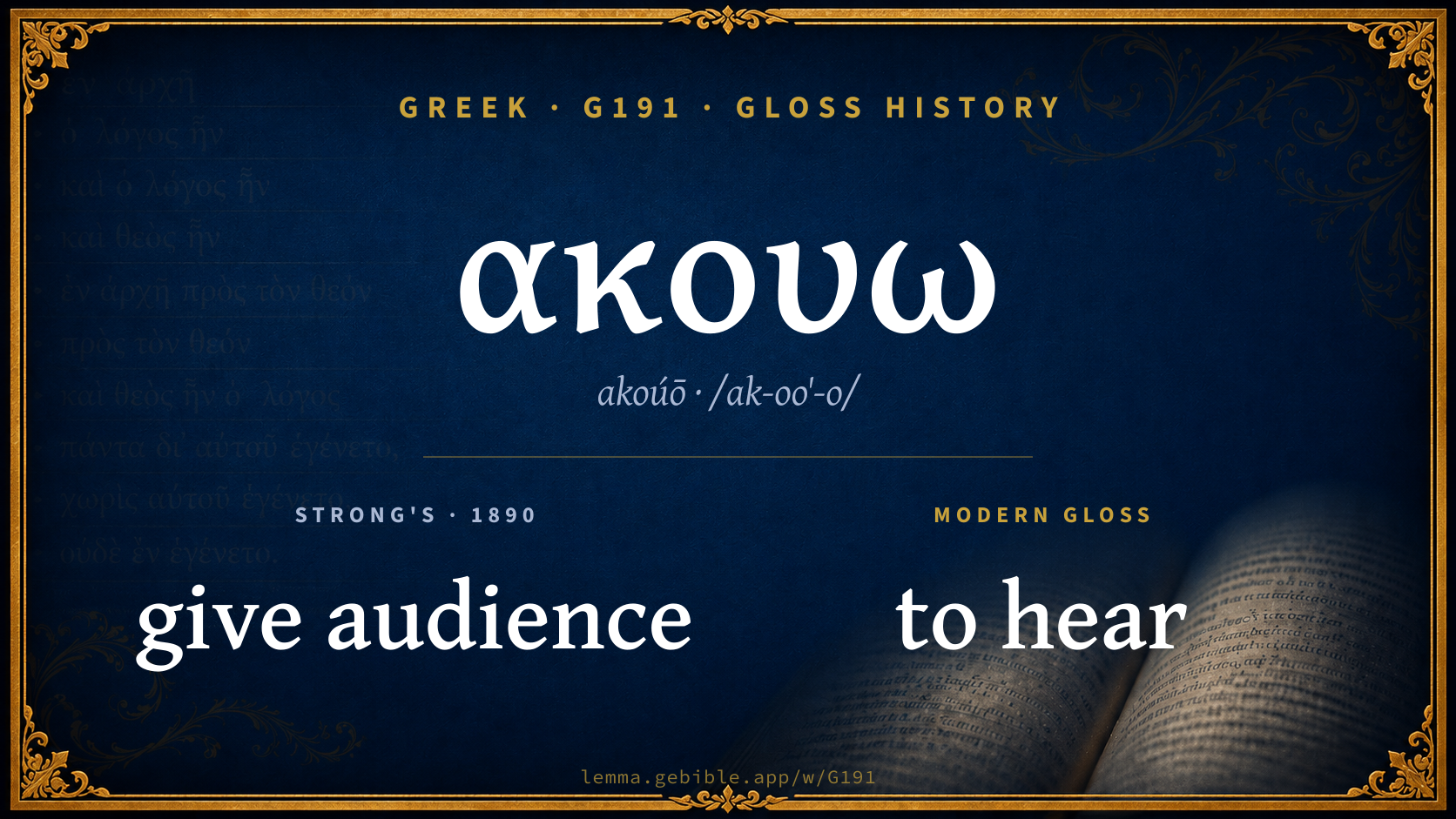
Gloss history
Strong's 1890 vs modern scholarship
About this word
Strong's G191 catalogs a Greek word from the Greek New Testament.
These counts are not copied from any lexicon or concordance. They are computed here, from the morphology-tagged Greek New Testament. What Lemma adds →
- 398
- distinct verses
- The word appears in 398 distinct verses.
- 23 / 27
- NT books
- The word appears in 23 of 27 New Testament books.
- #44
- by frequency
- Top 50 most frequent Greek words (rank 44 of 5,347 Greek words by occurrence).
View all 398 occurrences in the concordance →
By section of the New Testament
By traditional corpus
Conventional, traditional groupings — biblical authorship is debated, so this is a traditional corpus grouping, not an authorship claim. Some books belong to more than one corpus (Luke is in both the Gospels and the Lukan corpus, and so on), so these shares overlap and need not total 100%. Each figure is a share of the word’s 398 distinct verses.
- Gospels 211 verses · 53%
- Lukan (Luke–Acts) 144 verses · 36%
- Johannine 111 verses · 28%
- Revelation 43 verses · 11%
- Pauline corpus 33 verses · 8%
- General (Catholic) Epistles 18 verses · 5%
- Hebrews 8 verses · 2%
How translations render this word
Counts come from each version’s own published word-to-Strong’s tagging or interlinear alignment — an approximate guide to how each version renders this word, not a word-level alignment the data otherwise carries. Because each total is that version’s own tagged count, the per-version totals vary from one another and need not match the appearance or distinct-verse counts above. These counts may also differ from a printed concordance because Lemma counts each distinctly tagged rendering and does not collapse phrase taggings into a single head-word total. This is a fixed set of word-tagged versions (KJV, ASV, BSB, ULT) and does not change with the reading translation you choose elsewhere. Each version’s license is shown beside its name below (and on Sources).
- King James Version: Heard 95×, Hear 72×, I heard 25×
- American Standard Version: Heard 91×, Hear 68×, They heard 30×
- Berean Standard Bible: Heard 80×, Hear 46×, I heard 27×
- unfoldingWord Literal Text: Having heard 62×, Hear 57×, Heard 38×
King James Version Public Domain
Renders G191 across 453 tagged occurrences — most commonly:
Plus other, less common renderings. Plus 58 renderings that appear only once — usually multi-word phrases or single function words the recovered tagging swept in, not distinct renderings. Not rendered by a distinct English word in 1 further occurrence.
American Standard Version Public Domain
Renders G191 across 460 tagged occurrences — most commonly:
Plus other, less common renderings. Plus 70 renderings that appear only once — usually multi-word phrases or single function words the recovered tagging swept in, not distinct renderings.
Berean Standard Bible Public Domain
Renders G191 across 422 tagged occurrences — most commonly:
Plus other, less common renderings. Plus 82 renderings that appear only once — usually multi-word phrases or single function words the recovered tagging swept in, not distinct renderings. Not rendered by a distinct English word in 5 further occurrences.
unfoldingWord Literal Text CC BY-SA 4.0
Renders G191 across 490 tagged occurrences — most commonly:
Plus other, less common renderings. Plus 64 renderings that appear only once — usually multi-word phrases or single function words the recovered tagging swept in, not distinct renderings.
8 senses in Thayer's, in lexicon order
The 8 senses Thayer's distinguishes for this word, in lexicon order (not ranked by frequency or importance). The full entry — with sub-senses — is in the Lexicon Entry tab.
- to be endowed with the faculty of hearing, not deaf
- to attend to, consider what is or has been said
- to understand, perceive the sense of what is said
- to perceive by the ear what is announced in one's presence
- to get by hearing learn
- a thing comes to one's ears, to find out, learn
- to give ear to a teaching or a teacher
- to comprehend, to understand
Word origin
Origin: a root
A primary verb; to hear (in various senses): - give (in the) audience (of) come (to the ears) ([shall]) hear (-er -ken) be noised be reported understand.
— Strong’s Exhaustive Concordance (1890), public domain.
Forms in the corpus
The 68 distinct written forms G191 takes in the Greek New Testament, most frequent first — each parse links to that tense’s occurrences in the concordance.
The 60 most common forms are shown; 8 rarer forms follow in the full concordance.
Same root — word family
Other Thayer's entries built from the same root as G191, grouped by Strong’s listed origin. These share a root / origin per the lexicon — not necessarily a shared meaning. Each links to that word’s own entry.
Derived from this word
Compare all same-root words → They share a root, not necessarily a meaning.
Septuagint usage
The same Greek word ακουω appears 854 times in the Greek Old Testament (Septuagint), across 798 verses in 37 books.
- 854
- LXX occurrences
- Tagged occurrences of this Greek word in the Septuagint.
- 798
- verses
- Distinct Septuagint verses containing this word.
- 37 / 39
- OT books
- The word appears in 37 of the 39 Old Testament books.
Sample Septuagint occurrences
- Genesis 3:8 ἀκούω
- Exodus 2:15 ἀκούω
- Leviticus 5:1 ἀκούω
- Numbers 7:89 ἀκούω
- Deuteronomy 1:17 ἀκούω
- Joshua 1:17 ἀκούω
- Judges 3:4 ἀκούω
- Ruth 1:6 ἀκούω
- 1 Samuel 1:13 ἀκούω
- 2 Samuel 3:28 ἀκούω
- 1 Kings 1:11 ἀκούω
- 2 Kings 3:21 ἀκούω
Septuagint occurrences (same lexeme)
Every verse where the same Strong’s number (G191) appears in the Greek Septuagint — showing the first 50 of 798. Verse text shown in the World English Bible for context; the Greek form is the matched word — the English is not keyword-highlighted.
- Genesis 3:8 ἀκούω They heard the voice of Yahweh God walking in the garden in the cool of the day, and the man and his wife hid themselves from the presence of Yahweh God among the trees of the garden.
- Genesis 3:10 ἀκούω The man said, "I heard your voice in the garden, and I was afraid, because I was naked; and I hid myself."
- Genesis 3:17 ἀκούω To Adam he said, "Because you have listened to your wife's voice, and have eaten of the tree, of which I commanded you, saying, 'You shall not eat of it,' cursed is the ground for your sake. In toil you will eat of it all the days of your life.
- Genesis 4:23 ἀκούω Lamech said to his wives, "Adah and Zillah, Hear my voice, You wives of Lamech, listen to my speech, For I have slain a man for wounding me, A young man for bruising me.
- Genesis 11:7 ἀκούω Come, let's go down, and there confuse their language, that they may not understand one another's speech."
- Genesis 14:14 ἀκούω When Abram heard that his relative was taken captive, he led forth his trained men, born in his house, three hundred and eighteen, and pursued as far as Dan.
- Genesis 18:10 ἀκούω He said, "I will certainly return to you when the season comes round. Behold, Sarah your wife will have a son." Sarah heard in the tent door, which was behind him.
- Genesis 21:6 ἀκούω Sarah said, "God has made me laugh. Everyone who hears will laugh with me."
- Genesis 21:12 ἀκούω God said to Abraham, "Don't let it be grievous in your sight because of the boy, and because of your handmaid. In all that Sarah says to you, listen to her voice. For from Isaac will your seed be called.
- Genesis 21:26 ἀκούω Abimelech said, "I don't know who has done this thing. Neither did you tell me, neither did I hear of it, until today."
- Genesis 23:6 ἀκούω "Hear us, my lord. You are a prince of God among us. In the choice of our tombs bury your dead. None of us will withhold from you his tomb, but that you may bury your dead."
- Genesis 23:8 ἀκούω He talked with them, saying, "If it be your mind that I should bury my dead out of my sight, hear me, and entreat for me to Ephron the son of Zohar,
- Genesis 23:10 ἀκούω Now Ephron was sitting in the midst of the children of Heth. Ephron the Hittite answered Abraham in the hearing of the children of Heth, even of all who went in at the gate of his city, saying,
- Genesis 23:11 ἀκούω "No, my lord, hear me. I give you the field, and I give you the cave that is in it. In the presence of the children of my people I give it to you. Bury your dead."
- Genesis 23:13 ἀκούω He spoke to Ephron in the audience of the people of the land, saying, "But if you will, please hear me. I will give the price of the field. Take it from me, and I will bury my dead there."
- Genesis 23:15 ἀκούω "My lord, listen to me. What is a piece of land worth four hundred shekels of silver between me and you? Therefore bury your dead."
- Genesis 23:16 ἀκούω Abraham listened to Ephron. Abraham weighed to Ephron the silver which he had named in the audience of the children of Heth, four hundred shekels of silver, according to the current merchants' standard.
- Genesis 24:30 ἀκούω It happened, when he saw the ring, and the bracelets on his sister's hands, and when he heard the words of Rebekah his sister, saying, "This is what the man said to me," that he came to the man. Behold, he was standing by the camels at the spring.
- Genesis 24:52 ἀκούω It happened that when Abraham's servant heard their words, he bowed himself down to the earth to Yahweh.
- Genesis 27:5 ἀκούω Rebekah heard when Isaac spoke to Esau his son. Esau went to the field to hunt for venison, and to bring it.
- Genesis 27:6 ἀκούω Rebekah spoke to Jacob her son, saying, "Behold, I heard your father speak to Esau your brother, saying,
- Genesis 27:8 ἀκούω Now therefore, my son, obey my voice according to that which I command you.
- Genesis 27:34 ἀκούω When Esau heard the words of his father, he cried with an exceeding great and bitter cry, and said to his father, "Bless me, even me also, my father."
- Genesis 27:43 ἀκούω Now therefore, my son, obey my voice. Arise, flee to Laban, my brother, in Haran.
- Genesis 28:7 ἀκούω and that Jacob obeyed his father and his mother, and was gone to Paddan Aram.
- Genesis 29:13 ἀκούω It happened, when Laban heard the news of Jacob, his sister's son, that he ran to meet Jacob, and embraced him, and kissed him, and brought him to his house. Jacob told Laban all these things.
- Genesis 29:33 ἀκούω She conceived again, and bare a son, and said, "Because Yahweh has heard that I am hated, he has therefore given me this son also." She named him Simeon.
- Genesis 31:1 ἀκούω He heard the words of Laban's sons, saying, "Jacob has taken away all that was our father's. From that which was our father's, has he gotten all this wealth."
- Genesis 34:5 ἀκούω Now Jacob heard that he had defiled Dinah, his daughter; and his sons were with his cattle in the field. Jacob held his peace until they came.
- Genesis 34:7 ἀκούω The sons of Jacob came in from the field when they heard it. The men were grieved, and they were very angry, because he had done folly in Israel in lying with Jacob's daughter; which thing ought not to be done.
- Genesis 35:22 ἀκούω It happened, while Israel lived in that land, that Reuben went and lay with Bilhah, his father's concubine, and Israel heard of it. Now the sons of Jacob were twelve.
- Genesis 37:6 ἀκούω He said to them, "Please hear this dream which I have dreamed:
- Genesis 37:17 ἀκούω The man said, "They have left here, for I heard them say, 'Let us go to Dothan.'" Joseph went after his brothers, and found them in Dothan.
- Genesis 37:21 ἀκούω Reuben heard it, and delivered him out of their hand, and said, "Let's not take his life."
- Genesis 37:27 ἀκούω Come, and let's sell him to the Ishmaelites, and not let our hand be on him; for he is our brother, our flesh." His brothers listened to him.
- Genesis 39:15 ἀκούω It happened, when he heard that I lifted up my voice and cried, that he left his garment by me, and ran outside."
- Genesis 39:18 ἀκούω and it happened, as I lifted up my voice and cried, that he left his garment by me, and ran outside."
- Genesis 39:19 ἀκούω It happened, when his master heard the words of his wife, which she spoke to him, saying, "This is what your servant did to me," that his wrath was kindled.
- Genesis 41:15 ἀκούω Pharaoh said to Joseph, "I have dreamed a dream, and there is no one who can interpret it. I have heard it said of you, that when you hear a dream you can interpret it."
- Genesis 42:2 ἀκούω He said, "Behold, I have heard that there is grain in Egypt. Go down there, and buy for us from there, so that we may live, and not die."
- Genesis 42:23 ἀκούω They didn't know that Joseph understood them; for there was an interpreter between them.
- Genesis 43:25 ἀκούω They made ready the present for Joseph's coming at noon, for they heard that they should eat bread there.
- Genesis 45:2 ἀκούω He wept aloud. The Egyptians heard, and the house of Pharaoh heard.
- Genesis 47:5 ἀκούω Pharaoh spoke to Joseph, saying, "Your father and your brothers have come to you.
- Genesis 49:2 ἀκούω Assemble yourselves, and hear, you sons of Jacob; Listen to Israel, your father.
- Exodus 2:15 ἀκούω Now when Pharaoh heard this thing, he sought to kill Moses. But Moses fled from the face of Pharaoh, and lived in the land of Midian, and he sat down by a well.
- Exodus 3:7 ἀκούω Yahweh said, "I have surely seen the affliction of my people who are in Egypt, and have heard their cry because of their taskmasters, for I know their sorrows.
- Exodus 15:14 ἀκούω The peoples have heard. They tremble. Pangs have taken hold on the inhabitants of Philistia.
- Exodus 15:26 ἀκούω and he said, "If you will diligently listen to the voice of Yahweh your God, and will do that which is right in his eyes, and will pay attention to his commandments, and keep all his statutes, I will put none of the diseases on you, which I have put on the Egyptians; for I am Yahweh who heals you."
- Exodus 18:1 ἀκούω Now Jethro, the priest of Midian, Moses' father-in-law, heard of all that God had done for Moses, and for Israel his people, how that Yahweh had brought Israel out of Egypt.
These are occurrences of the same Greek lexeme (G191) in the Septuagint — not a translation of any one Hebrew word. The store carries no word-level Hebrew↔Greek alignment, so no Hebrew original is asserted here. Counts come from the recovered LXX Strong's tagging — high-frequency vocabulary is well covered, while rare or late forms may be untagged — so they reflect tagged occurrences and may slightly undercount.