

Ephesians 4:29
Greek (Tischendorf 8th ed.) Ephesians 4:29 appears in the Greek New Testament. The text above is from the Tischendorf 8th edition. Each word links to its Strong’s number and a concise gloss. Click any word for its full Thayer’s Greek Lexicon entry.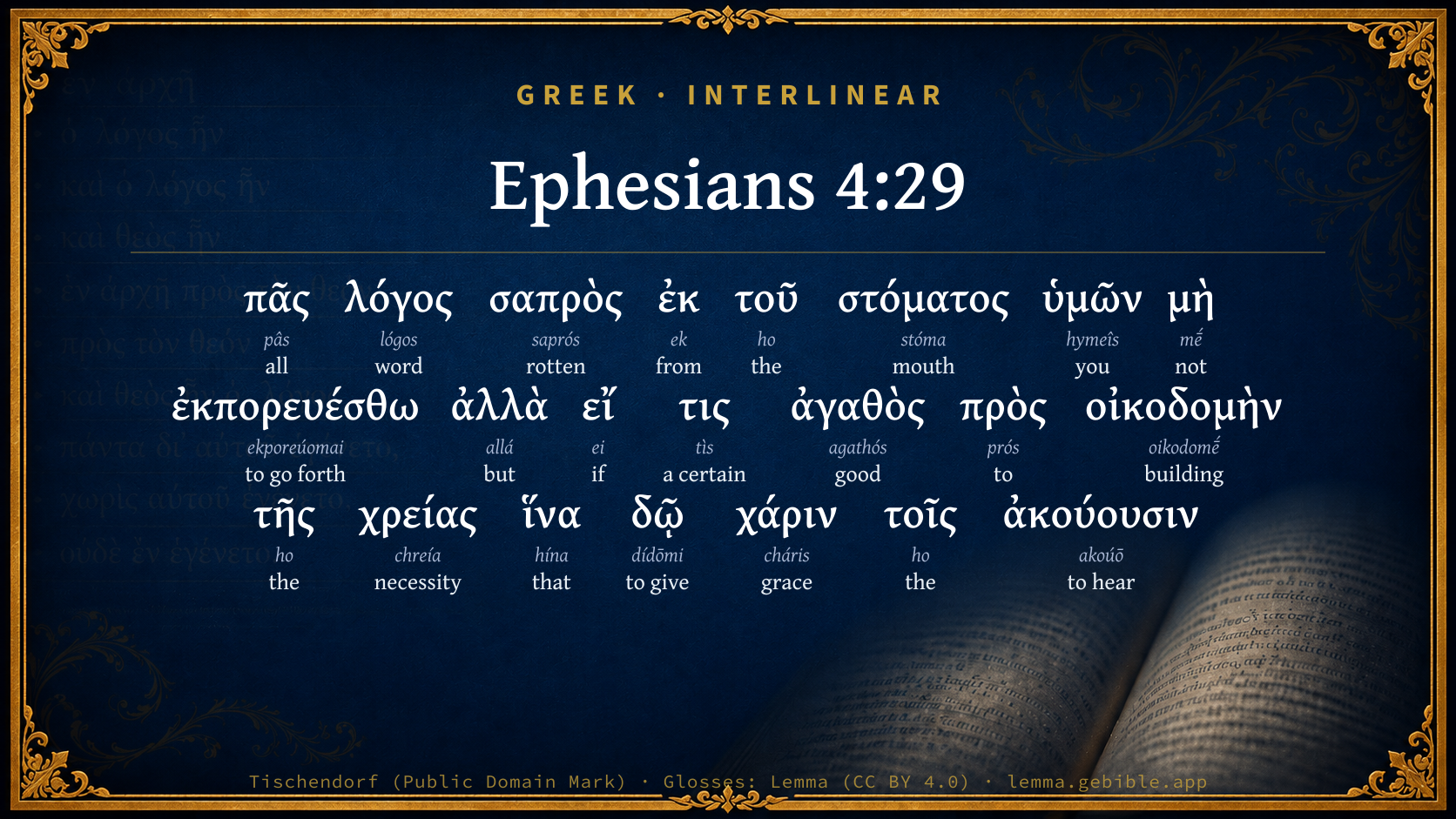
Let no corrupt speech proceed out of your mouth, but such as is good for building up as the need may be, that it may give grace to those who hear.
Download a study sheet
One document with this verse’s original text, its word-by-word gloss line, the meaning frame, cross-references with their text, attributed commentary, and full source and license credits — printable, and it pastes into notes with its structure intact.
This verse Autodidact and up
A passage Seminary Student
Up to 50 verses in one chapter. A passage sheet keeps up to 6 commentary sources and 12 cross-references per verse, in the order this page ranks them, and says so on the sheet whenever that leaves anything out. Ask for a single verse and you get the Autodidact verse sheet above.
Everything on this page stays free to read, with no account — the sheet is a download of what is already on screen, not access to it.
Compare translations 3
The same verse in 3 English versions, stacked beneath the original-language interlinear above. Click any original word for its lexicon entry.
Each is an independent rendering of the whole verse — the interlinear is not word-aligned to these translations.
Highlighted words mark where these versions differ — a whole-verse word diff, not a word-by-word alignment.
-
World English Bible Public Domain
Let no corrupt speech proceed out of your mouth, but such as is good for building up as the need may be, that it may give grace to those who hear.
-
King James Version Public Domain
Let no corrupt communication proceed out of your mouth, but that which is good to the use of edifying, that it may minister grace unto the hearers.
-
unfoldingWord Literal Text CC BY-SA 4.0
Do not let any corrupt talk come out from your mouth, but whatever good for building up of the need, so that it might give grace to the hearers,
unfoldingWord Literal Text — © unfoldingWord, licensed CC BY-SA 4.0. Word-aligned USFM3 via Door43 (git.door43.org/unfoldingWord/en_ult).
Show all 19 translations
Every available English version of this verse, each an independent rendering of the whole verse.
-
World English Bible Public Domain
Let no corrupt speech proceed out of your mouth, but such as is good for building up as the need may be, that it may give grace to those who hear.
-
Berean Standard Bible Public Domain
Let no unwholesome talk come out of your mouths, but only what is helpful for building up the one in need and bringing grace to those who listen.
-
Majority Standard Bible Public Domain
Let no unwholesome talk come out of your mouths, but only what is helpful for building up the one in need and bringing grace to those who listen.
-
King James Version Public Domain
Let no corrupt communication proceed out of your mouth, but that which is good to the use of edifying, that it may minister grace unto the hearers.
-
American Standard Version (1901) Public Domain
Let no corrupt speech proceed out of your mouth, but such as is good for edifying as the need may be, that it may give grace to them that hear.
-
Revised Version (1885) Public Domain
Let no corrupt speech proceed out of your mouth, but such as is good for edifying as the need may be, that it may give grace to them that hear.
-
Geneva Bible (1599) Public Domain
Let no corrupt comunication proceed out of your mouths: but that which is good, to ye vse of edifying, that it may minister grace vnto the hearers.
-
Douay-Rheims (1899) Public Domain
Let no evil speech proceed from your mouth; but that which is good, to the edification of faith, that it may administer grace to the hearers.
-
Young's Literal Translation Public Domain
Let no corrupt word out of your mouth go forth, but what is good unto the needful building up, that it may give grace to the hearers;
-
Literal Standard Version CC BY-SA 4.0
Let no corrupt word go forth out of your mouth, but what is good to the necessary building up, that it may give grace to the hearers;
-
Unlocked Literal Bible CC BY-SA 4.0
Do not let any filthy talk come out of your mouth. Use only words that are helpful for building others up, according to their needs, that your words would be helpful to those who hear you.
-
unfoldingWord Literal Text CC BY-SA 4.0
Do not let any corrupt talk come out from your mouth, but whatever good for building up of the need, so that it might give grace to the hearers,
-
Darby Bible Public Domain
Let no corrupt word go out of your mouth, but if [there be] any good one for needful edification, that it may give grace to those that hear [it].
-
World Messianic Bible Public Domain
Let no corrupt speech proceed out of your mouth, but only what is good for building others up as the need may be, that it may give grace to those who hear.
-
Webster's Bible Public Domain
Let no corrupt communication proceed out of your mouth, but that which is good to the use of edifying, that it may minister grace to the hearers.
-
Free Bible Version CC BY-SA 4.0
Don't use bad language. Speak words that will encourage people as necessary, so that those who listen will be helped.
-
Bible in Basic English Public Domain
Let no evil talk come out of your mouth, but only what is good for giving necessary teaching, and for grace to those who give ear.
-
Text-Critical English NT CC BY 4.0
Let no foul word come out of your mouth, but only what is good for edification, as fits the occasion, that it may give grace to those who hear.
-
Tyndale New Testament (1534) Public Domain
Let no filthy communicacion procede out of youre mouthes: but that whych is good to edefye with all when nede ys: that it maye have faveour with the hearers.
Literal Standard Version (2020), Covenant Press — licensed CC BY-SA 4.0. Text via the HelloAO Bible API (eBible.org). Unlocked Literal Bible (unfoldingWord) — licensed CC BY-SA 4.0. Text via the HelloAO Bible API (eBible.org). unfoldingWord Literal Text — © unfoldingWord, licensed CC BY-SA 4.0. Word-aligned USFM3 via Door43 (git.door43.org/unfoldingWord/en_ult). Free Bible Version, Dr. Jonathan Gallagher — licensed CC BY-SA 4.0. Text via the HelloAO Bible API (eBible.org).
Word by word
More ways to search: Search by grammar → Find every occurrence → Compare this word →
Practice this passage: Drill this verse → Learn its vocabulary →
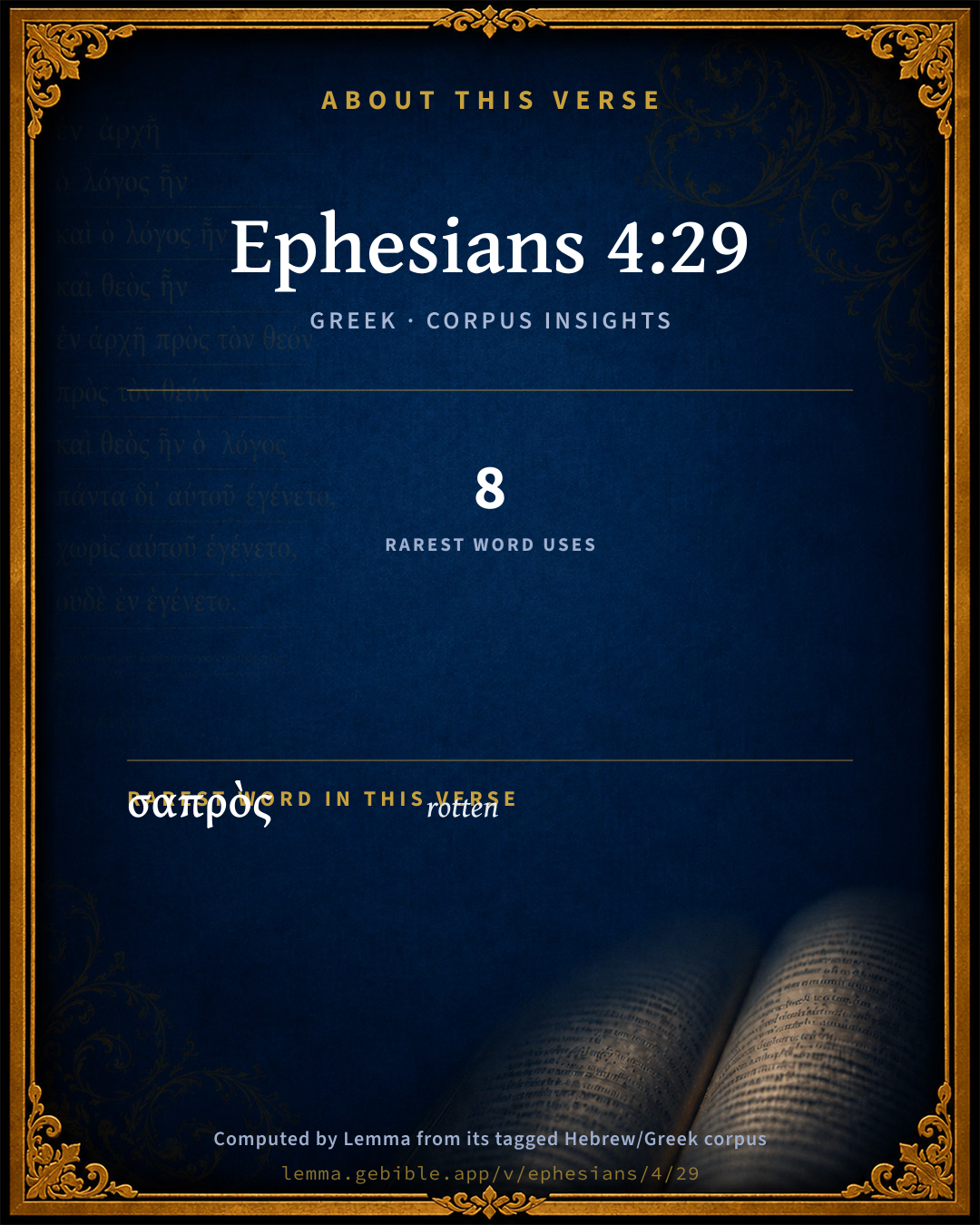
- Appears 8× in the Greek New Testament
- First appears at Matthew 7:17
- Part of Speech
- Adjective
- Case
- Nominative
- Number
- Singular
- Gender
- Masculine
Full Thayer's Definition
- πᾶς pâs G3956 “all” Adjective, Nominative, Singular, Masculine
- λόγος lógos G3056 “word” Noun, Nominative, Singular, Masculine
- σαπρὸς saprós G4550 “rotten” Adjective, Nominative, Singular, Masculine
- ἐκ ek G1537 “from” Preposition
- τοῦ ho G3588 “the” Article, Genitive, Singular, Neuter
- στόματος stóma G4750 “mouth” Noun, Genitive, Singular, Neuter
- ὑμῶν hymeîs G5210 “you” Personal pronoun, 2nd person, Genitive, Plural
- μὴ mḗ G3361 “not” Particle, Negative
- ἐκπορευέσθω ekporeúomai G1607 “to go forth” Verb, Present, Middle or Passive deponent, Imperative, 3rd person, Singular
- ἀλλὰ allá G235 “but” Conjunction
- εἴ ei G1487 “if” Conditional
- τις tìs G5100 “a certain” Indefinite pronoun, Nominative, Singular, Masculine
- ἀγαθὸς agathós G18 “good” Adjective, Nominative, Singular, Masculine
- πρὸς prós G4314 “to” Preposition
- οἰκοδομὴν oikodomḗ G3619 “building” Noun, Accusative, Singular, Feminine
- τῆς ho G3588 “the” Article, Genitive, Singular, Feminine
- χρείας chreía G5532 “necessity” Noun, Genitive, Singular, Feminine
- ἵνα hína G2443 “that” Conjunction
- δῷ dídōmi G1325 “to give” Verb, Aorist, Active, Subjunctive, 3rd person, Singular
- χάριν cháris G5485 “grace” Noun, Accusative, Singular, Feminine
- τοῖς ho G3588 “the” Article, Dative, Plural, Masculine
- ἀκούουσιν akoúō G191 “to hear” Verb, Present, Active, Participle, Dative, Plural, Masculine
About this verse
These counts appear in no published source. They are computed here, from the morphology-tagged text and Lemma’s own curated glosses. What Lemma adds →
- 22
- words
- 20
- distinct lemmas
- Pauline Epistles
- section
Cross-references
38Topical passages linked to Ephesians 4:29 in the Treasury of Scripture Knowledge — connected by theme and wording, ordered by reader-vote popularity; previews shown in the World English Bible.
- Colossians 4:6 Let your speech always be with grace, seasoned with salt, that you may know how you ought to answer each one.
- 1 Thessalonians 5:11 Therefore exhort one another, and build each other up, even as you also do.
- Ecclesiastes 10:12 The words of a wise man's mouth are gracious; but a fool is swallowed by his own lips.
- Proverbs 15:7 The lips of the wise spread knowledge; Not so with the heart of fools.
- Colossians 3:8–9 but now you also put them all away: anger, wrath, malice, slander, and shameful speaking out of your mouth.
- Matthew 12:34–37 You offspring of vipers, how can you, being evil, speak good things? For out of the abundance of the heart, the mouth speaks.
- Proverbs 25:11–12 A word fitly spoken Is like apples of gold in settings of silver.
- Psalms 37:30–31 The mouth of the righteous talks of wisdom. His tongue speaks justice.
- James 3:2–8 For in many things we all stumble. If anyone doesn't stumble in word, the same is a perfect man, able to bridle the whole body also.
- Proverbs 15:2–4 The tongue of the wise commends knowledge, But the mouth of fools gush out folly.
- Colossians 3:16–17 Let the word of Christ dwell in you richly; in all wisdom teaching and admonishing one another with psalms, hymns, and spiritual songs, singing with grace in your heart to the Lord.
- Ephesians 5:3–4 But sexual immorality, and all uncleanness, or covetousness, let it not even be mentioned among you, as becomes saints;
- Matthew 5:16 Even so, let your light shine before men; that they may see your good works, and glorify your Father who is in heaven.
- Proverbs 12:13 An evil man is trapped by sinfulness of lips, But the righteous shall come out of trouble.
- Proverbs 16:21 The wise in heart shall be called prudent. Pleasantness of the lips promotes instruction.
- Isaiah 50:4 The Lord Yahweh has given me the tongue of those who are taught, that I may know how to sustain with words him who is weary: he wakens morning by morning, he wakens my ear to hear as those who are taught.
- Proverbs 10:31–32 The mouth of the righteous brings forth wisdom, But the perverse tongue will be cut off.
- Luke 4:22 All testified about him, and wondered at the gracious words which proceeded out of his mouth, and they said, "Isn't this Joseph's son?"
- Proverbs 15:23 Joy comes to a man with the reply of his mouth. How good is a word at the right time!
- 1 Peter 2:12 having good behavior among the nations, so in that which they speak against you as evil-doers, they may by your good works, which they see, glorify God in the day of visitation.
- Psalms 52:2 Your tongue plots destruction, Like a sharp razor, working deceitfully.
- Deuteronomy 6:6–9 These words, which I command you this day, shall be on your heart;
- Psalms 5:9 For there is no faithfulness in their mouth. Their heart is destruction. Their throat is an open tomb. They flatter with their tongue.
- Romans 3:13–14 "Their throat is an open tomb. With their tongues they have used deceit." "The poison of vipers is under their lips;"
- 1 Corinthians 15:32–33 If I fought with animals at Ephesus for human purposes, what does it profit me? If the dead are not raised, then "let us eat and drink, for tomorrow we die."
- 1 Peter 3:1 In like manner, wives, be in subjection to your own husbands; so that, even if any don't obey the Word, they may be won by the behavior of their wives without a word;
- Psalms 71:17–18 God, you have taught me from my youth. Until now, I have declared your wondrous works.
- Malachi 3:16–18 Then those who feared Yahweh spoke one with another; and Yahweh listened, and heard, and a book of memory was written before him, for those who feared Yahweh, and who honored his name.
- Ephesians 4:12 for the perfecting of the saints, to the work of serving, to the building up of the body of Christ;
- Ephesians 4:16 from whom all the body, being fitted and knit together through that which every joint supplies, according to the working in measure of each individual part, makes the body increase to the building up of itself in love.
- Psalms 73:7–9 Their eyes bulge with fat. Their minds pass the limits of conceit.
- Psalms 45:2 You are the most excellent of the sons of men. Grace has anointed your lips, Therefore God has blessed you forever.
- Psalms 71:24 My tongue will also talk about your righteousness all day long, For they are disappointed, and they are confounded, who want to harm me.
- Jude 1:13–16 wild waves of the sea, foaming out their own shame; wandering stars, for whom the blackness of darkness has been reserved forever.
- 1 Corinthians 14:19 However in the assembly I would rather speak five words with my understanding, that I might instruct others also, than ten thousand words in another language.
- Revelation 13:5–6 A mouth speaking great things and blasphemy was given to him. Authority to make war for forty-two months was given to him.
- Psalms 78:4–5 We will not hide them from their children, Telling to the generation to come the praises of Yahweh, His strength, and his wondrous works that he has done.
- 2 Peter 2:18 For, uttering great swelling words of emptiness, they entice in the lusts of the flesh, by licentiousness, those who are indeed escaping from those who live in error;
Cross-references courtesy of OpenBible.info (CC BY 4.0).
Lesson kit
Teaching starters — assembled from the data on this page, not authored interpretation. Every prompt links to the verse data it draws on. Edit before teaching.
Ephesians, in the Pauline Epistles, opens this verse with 22 words (20 distinct Greek lemmas). Its most distinctive word is saprós (“rotten”). A historical commentator’s framing appears above. Read the whole chapter for the surrounding context.
Discussion questions
- How does “rotten” (saprós) shape what this verse is saying?
- How does Matthew 7:17, which shares the word «rotten», read alongside this verse?
- What does the repetition of “the” (3× in this one verse) do in this verse?
- The translations on this page render this verse differently — a whole-verse word diff, not a word-by-word alignment. What might account for the different wordings?
- Compare how The Biblical Illustrator and Joseph Benson's Commentary read this verse. Where do they agree or differ?
Things to notice
- These translations choose different wording for 22 words in this verse.
- “the” occurs 3× in this single verse.
- 20 distinct Greek lemmas span 22 words in this verse.
Commentary
Notes on Ephesians 4:29 from classic Christian and Jewish commentators (each source and its license shown beneath its notes). The classic Christian expositions comment on the surrounding passage and are grouped to its opening verse, so a note may address several verses; the Jewish commentaries on the Tanakh (Rashi and others) are per-verse, so they appear only where the commentator wrote on this verse.
Lemma curates 59 commentaries, every one of them public domain or Creative Commons licensed, each selected and text-cleaned for this edition rather than reprinted as found. About our sources →
The Biblical Illustrator
Joseph S. Exell
The Biblical Illustrator, edited by Joseph S. Exell (c. 1880s–1900s) — public domain. Text from a community e-Sword module.
Joseph Benson's Commentary
Joseph Benson's Commentary on the Old and New Testaments (1811–1818) — public domain. Text from a community e-Sword module.
Tyndale Open Study Notes
Tyndale Open Resources
Tyndale Open Study Notes — © Tyndale Open Resources, licensed CC BY-SA 4.0. Text via the HelloAO Bible API.
Bengel's Gnomon
Johann Albrecht Bengel
Bengel's Gnomon of the New Testament — English translation (T&T Clark, Edinburgh, 1860) — public domain. Text from a community e-Sword module.
Meyer's Critical & Exegetical Commentary
Heinrich August Wilhelm Meyer
Meyer — Critical and Exegetical Commentary on the New Testament — English translation by Peter Christie, edited by Frederick Crombie (T&T Clark, 1880) — public domain. Text from a community e-Sword module.
Expositor's Greek Testament
ed. W. Robertson Nicoll
The Expositor's Greek Testament, edited by W. Robertson Nicoll (1897–1910) — public domain. Text from a community e-Sword module.
Hodge's Commentary on Romans, Ephesians & First Corinthians
Charles Hodge
Charles Hodge — Commentary on Romans (1835), First Corinthians (1857), and Ephesians (1856) — public domain. Text from a community e-Sword module.
Geneva Bible (1599)
Geneva Bible translators
Geneva Bible (1599) marginal notes — public domain. Text via Bolls.life.
Jamieson, Fausset & Brown
Robert Jamieson, A. R. Fausset & David Brown
Jamieson, Fausset & Brown — Commentary Critical and Explanatory on the Whole Bible (1871) — public domain (CC PDM 1.0). Text via the HelloAO Bible API.
Adam Clarke's Commentary
Adam Clarke's Commentary on the Bible (1810–1826) — public domain. Text from a community e-Sword/MySword module.
John Calvin's Commentaries
John Calvin's Commentaries (1540-1563) — public domain. Text from the Calvin Translation Society English edition (1840s-50s) via the Christian Classics Ethereal Library (ccel.org). Calvin's coverage is partial (roughly two-thirds of the Bible); uncommented books and verses are honest gaps, never fabricated. The 19th-century editor's footnotes and remarks are omitted so the notes are faithfully Calvin's own voice.
Ellicott's Commentary for English Readers
A Bible Commentary for English Readers, edited by Charles John Ellicott (1878–1897) — public domain. Text from a community e-Sword module.
The Cambridge Bible for Schools and Colleges
gen. ed. J. J. S. Perowne
The Cambridge Bible for Schools and Colleges (gen. ed. J. J. S. Perowne; Cambridge University Press, 1878–1918) — public domain. Text from a community e-Sword module.
John Gill's Exposition
John Gill's Exposition of the Whole Bible (1746–1763) — public domain (CC PDM 1.0). Text via the HelloAO Bible API.
Trapp's Complete Commentary
John Trapp
John Trapp, A Commentary or Exposition upon All the Books of the Old and New Testament (1647–1656) — public domain. Text from a community e-Sword module.
Albert Barnes' Notes on the Bible
Albert Barnes' Notes on the Bible (1834–1885) — public domain. Text from a community e-Sword/MySword module.
Haydock's Catholic Bible Commentary
George Leo Haydock (1774–1849), Haydock's Catholic Family Bible and Commentary, 1859 edition — public domain. Excludes Psalms (Douay-Rheims chapter numbering differs from Protestant) and Deuterocanonical books (Catholic canon only).
Matthew Poole's English Annotations
Matthew Poole's English Annotations on the Holy Bible (1683–1685) — public domain. Text from a community e-Sword/MySword module.
Whedon's Commentary on the Bible
Daniel D. Whedon
Daniel D. Whedon (gen. ed.), Commentary on the Old and New Testaments (1874–1909) — public domain. Text from a community e-Sword module.
The Pulpit Commentary
The Pulpit Commentary (1880–1919), ed. H.D.M. Spence-Jones & Joseph S. Exell — public domain. Text from a community e-Sword module.
John Wesley's Explanatory Notes
John Wesley, Explanatory Notes Upon the Whole Bible (1754–1765) — public domain. Text via the GEBible commentary corpus.
Scofield Reference Notes
C. I. Scofield
The Scofield Reference Bible (1917 edition), notes by C. I. Scofield — public domain. Text from a community e-Sword module.
Kretzmann's Popular Commentary
Paul E. Kretzmann
Paul E. Kretzmann, Popular Commentary of the Bible (1921–1924) — public domain. Text from a community e-Sword module.
Burkitt's Expository Notes on the New Testament
William Burkitt
William Burkitt's Expository Notes on the New Testament (1700–1703) — public domain. Text from a community e-Sword module.
The People's New Testament
B. W. Johnson
B. W. Johnson's The People's New Testament with Notes (1889–1891) — public domain. Electronic text from the Christian Classics Ethereal Library (CCEL) ThML edition.
Cambridge Greek Testament for Schools and Colleges
Cambridge Greek Testament for Schools and Colleges (Cambridge University Press, 1896; 21 vols, various authors incl. Carr, Maclear, Plummer, Farrar, Lumby, Moule, M. R. James, Simcox) — public domain. Text from a community e-Sword module.
Alford’s Greek Testament
Henry Alford
Henry Alford, The Greek Testament (1849–1861) — public domain. Text from a community e-Sword module.
International Critical Commentary
International Critical Commentary — older volumes (1896–1929), various authors — public domain. Text from a community e-Sword module.
Vincent's Word Studies in the New Testament
Marvin R. Vincent
Marvin R. Vincent, Word Studies in the New Testament (1887–1900) — public domain. Text from a community e-Sword/MySword module.