Revelation 18:4

Greek (Tischendorf 8th ed.) Revelation 18:4 appears in the Greek New Testament. The text above is from the Tischendorf 8th edition. Each word links to its Strong’s number and a concise gloss. Click any word for its full Thayer’s Greek Lexicon entry.
Download image
Cite this verse

Revelation 18:4 (World English Bible). Public Domain. Lemma interlinear Bible study tool, https://lemma.gebible.app/v/revelation/18/4.

Show BibTeX & RIS
BibTeX
RIS
English Translation
I heard another voice from heaven, saying, "Come out of her, my people, that you have no participation in her sins, and that you don't receive of her plagues,
World English Bible · Public Domain
Download a study sheet

One document with this verse’s original text, its word-by-word gloss line, the meaning frame, cross-references with their text, attributed commentary, and full source and license credits — printable, and it pastes into notes with its structure intact.

This verse Autodidact and up

Study sheet (.html) Plain text (.txt)

A passage Seminary Student

Up to 50 verses in one chapter. A passage sheet keeps up to 6 commentary sources and 12 cross-references per verse, in the order this page ranks them, and says so on the sheet whenever that leaves anything out. Ask for a single verse and you get the Autodidact verse sheet above.

Everything on this page stays free to read, with no account — the sheet is a download of what is already on screen, not access to it.

Want to remove ads? Support Godless Engineer
Compare translations 3

The same verse in 3 English versions, stacked beneath the original-language interlinear above. Click any original word for its lexicon entry.

Each is an independent rendering of the whole verse — the interlinear is not word-aligned to these translations.

Highlighted words mark where these versions differ — a whole-verse word diff, not a word-by-word alignment.

  • World English Bible Public Domain
    I heard another voice from heaven, saying, "Come out of her, my people, that you have no participation in her sins, and that you don't receive of her plagues,
  • King James Version Public Domain
    And I heard another voice from heaven, saying, Come out of her, my people, that ye be not partakers of her sins, and that ye receive not of her plagues.
  • unfoldingWord Literal Text CC BY-SA 4.0
    And I heard another voice from heaven saying, “Come out from her, my people, so that you might not share in her sins and so that you might not receive from her plagues.

unfoldingWord Literal Text — © unfoldingWord, licensed CC BY-SA 4.0. Word-aligned USFM3 via Door43 (git.door43.org/unfoldingWord/en_ult).

Versions to compare (up to 4)

3 of 4 selected

Show all 19 translations

Every available English version of this verse, each an independent rendering of the whole verse.

  • World English Bible Public Domain
    I heard another voice from heaven, saying, "Come out of her, my people, that you have no participation in her sins, and that you don't receive of her plagues,
  • Berean Standard Bible Public Domain
    Then I heard another voice from heaven say: “Come out of her, My people, so that you will not share in her sins or contract any of her plagues.
  • Majority Standard Bible Public Domain
    Then I heard another voice from heaven say: “Come out of her, My people, so that you will not share in her sins or contract any of her plagues.
  • King James Version Public Domain
    And I heard another voice from heaven, saying, Come out of her, my people, that ye be not partakers of her sins, and that ye receive not of her plagues.
  • American Standard Version (1901) Public Domain
    And I heard another voice from heaven, saying, Come forth, my people, out of her, that ye have no fellowship with her sins, and that ye receive not of her plagues:
  • Revised Version (1885) Public Domain
    And I heard another voice from heaven, saying, Come forth, my people, out of her, that ye have no fellowship with her sins, and that ye receive not of her plagues:
  • Geneva Bible (1599) Public Domain
    And I heard another voyce from heauen say, Goe out of her, my people, that ye be not partakers of her sinnes, and that ye receiue not of her plagues.
  • Douay-Rheims (1899) Public Domain
    And I heard another voice from heaven, saying: Go out from her, my people; that you be not partakers of her sins, and that you receive not of her plagues.
  • Young's Literal Translation Public Domain
    And I heard another voice out of the heaven, saying, `Come forth out of her, My people, that ye may not partake with her sins, and that ye may not receive of her plagues,
  • Literal Standard Version CC BY-SA 4.0
    And I heard another voice out of Heaven, saying, “Come forth out of her, My people, that you may not partake with her sins, and that you may not receive of her plagues,
  • Unlocked Literal Bible CC BY-SA 4.0
    Then I heard another voice from heaven say, “Come out from her, my people, so that you will not share in her sins, and so that you will not receive any of her plagues.
  • unfoldingWord Literal Text CC BY-SA 4.0
    And I heard another voice from heaven saying, “Come out from her, my people, so that you might not share in her sins and so that you might not receive from her plagues.
  • Darby Bible Public Domain
    And I heard another voice out of the heaven saying, Come out of her, my people, that ye have not fellowship in her sins, and that ye do not receive of her plagues:
  • World Messianic Bible Public Domain
    I heard another voice from heaven, saying, “Come out of her, my people, that you have no participation in her sins, and that you don’t receive of her plagues,
  • Webster's Bible Public Domain
    And I heard another voice from heaven, saying, Come out of her, my people, that ye be not partakers of her sins, and that ye receive not of her plagues.
  • Free Bible Version CC BY-SA 4.0
    Then I heard another voice from heaven calling out, “My people, come out of her, so that you don't participate in her sinful ways, and so that you don't experience her plagues.
  • Bible in Basic English Public Domain
    And another voice from heaven came to my ears, saying, Come out of her, my people, so that you may have no part in her sins and in her punishments.
  • Text-Critical English NT CC BY 4.0
    Then I heard another voice from heaven say, “Come out of her, my people, so that you do not participate in her sins, and so that you do not receive any of her plagues;
  • Tyndale New Testament (1534) Public Domain
    And I herde another voyce from heven saye: come a waye from her my people that ye be not parttakers in her synnes that ye receave not of her plages.

Literal Standard Version (2020), Covenant Press — licensed CC BY-SA 4.0. Text via the HelloAO Bible API (eBible.org). Unlocked Literal Bible (unfoldingWord) — licensed CC BY-SA 4.0. Text via the HelloAO Bible API (eBible.org). unfoldingWord Literal Text — © unfoldingWord, licensed CC BY-SA 4.0. Word-aligned USFM3 via Door43 (git.door43.org/unfoldingWord/en_ult). Free Bible Version, Dr. Jonathan Gallagher — licensed CC BY-SA 4.0. Text via the HelloAO Bible API (eBible.org).

Word by word

More ways to search: Search by grammar → Find every occurrence → Compare this word →

Practice this passage: Drill this verse → Learn its vocabulary →

συνκοινωνήσητε
synkoinōnéō
G4790
“to share together”
Verb, Aorist, Active, Subjunctive, 2nd person, Plural
Part of Speech
Verb
Tense
Aorist
Voice
Active
Mood
Subjunctive
Person
2nd person
Number
Plural
Full Thayer's Definition

Origin: from G4862 and G2841

TDNT: 16:17,4

1. to become a partaker together with others, or to have fellowship with a thing
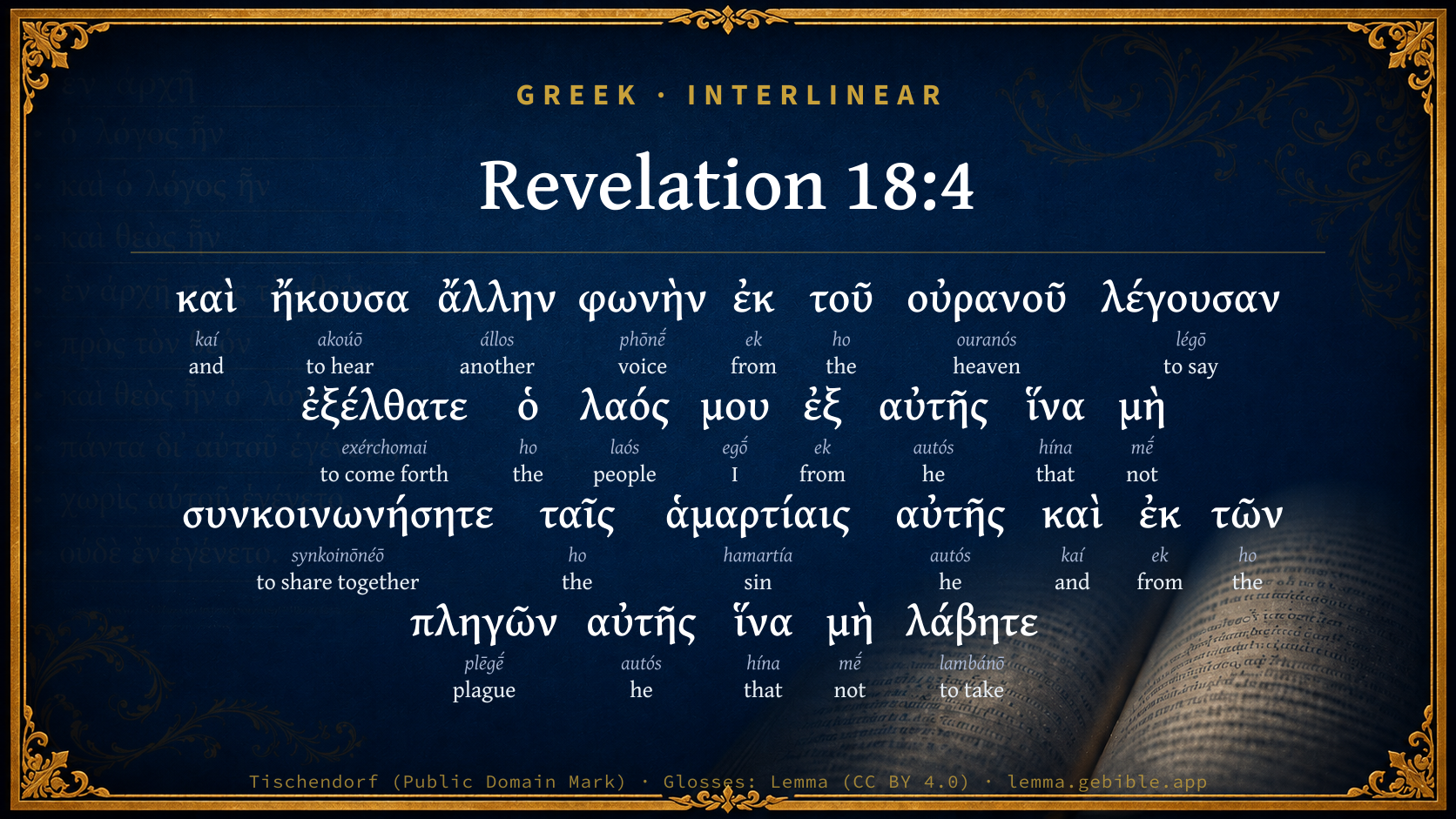
  1. καὶ kaí G2532 “and” Conjunction
  2. ἤκουσα akoúō G191 “to hear” Verb, Aorist, Active, Indicative, 1st person, Singular
  3. ἄλλην állos G243 “another” Adjective, Accusative, Singular, Feminine
  4. φωνὴν phōnḗ G5456 “voice” Noun, Accusative, Singular, Feminine
  5. ἐκ ek G1537 “from” Preposition
  6. τοῦ ho G3588 “the” Article, Genitive, Singular, Masculine
  7. οὐρανοῦ ouranós G3772 “heaven” Noun, Genitive, Singular, Masculine
  8. λέγουσαν légō G3004 “to say” Verb, Present, Active, Participle, Accusative, Singular, Feminine
  9. ἐξέλθατε exérchomai G1831 “to come forth” Verb, Aorist, Active, Imperative, 2nd person, Plural
  10. ὁ ho G3588 “the” Article, Nominative, Singular, Masculine
  11. λαός laós G2992 “people” Noun, Nominative, Singular, Masculine
  12. μου egṓ G1473 “I” Personal pronoun, 1st person, Genitive, Singular
  13. ἐξ ek G1537 “from” Preposition
  14. αὐτῆς autós G846 “he” Personal pronoun, Genitive, Singular, Feminine
  15. ἵνα hína G2443 “that” Conjunction
  16. μὴ mḗ G3361 “not” Particle, Negative
  17. ταῖς ho G3588 “the” Article, Dative, Plural, Feminine
  18. ἁμαρτίαις hamartía G266 “sin” Noun, Dative, Plural, Feminine
  19. αὐτῆς autós G846 “he” Personal pronoun, Genitive, Singular, Feminine
  20. καὶ kaí G2532 “and” Conjunction
  21. ἐκ ek G1537 “from” Preposition
  22. τῶν ho G3588 “the” Article, Genitive, Plural, Feminine
  23. πληγῶν plēgḗ G4127 “plague” Noun, Genitive, Plural, Feminine
  24. αὐτῆς autós G846 “he” Personal pronoun, Genitive, Singular, Feminine
  25. ἵνα hína G2443 “that” Conjunction
  26. μὴ mḗ G3361 “not” Particle, Negative
  27. λάβητε lambánō G2983 “to take” Verb, Aorist, Active, Subjunctive, 2nd person, Plural

About this verse

These counts appear in no published source. They are computed here, from the morphology-tagged text and Lemma’s own curated glosses. What Lemma adds →

28
words
18
distinct lemmas
Revelation
section

Notable vocabulary

The rarest word here is συνκοινωνήσητε to share together G4790 — appearing just 3 times in the whole Greek New Testament.

Shared distinctive vocabulary

συνκοινωνήσητε to share together G4790 occurs in 3 verses of the Greek New Testament. Also found in:

Repetition

Words recur within this verse:

Cross-references

14

Topical passages linked to Revelation 18:4 in the Treasury of Scripture Knowledge — connected by theme and wording, ordered by reader-vote popularity; previews shown in the World English Bible.

  • Isaiah 52:11 Depart you, depart you, go you out from there, touch no unclean thing; go you out of the midst of her; cleanse yourselves, you who bear the vessels of Yahweh.
  • 2 Corinthians 6:17 Therefore, "'Come out from among them, And be separate,' says the Lord, 'Touch no unclean thing. I will receive you.
  • Jeremiah 51:6 Flee out of the midst of Babylon, and save every man his life; don't be cut off in her iniquity: for it is the time of Yahweh's vengeance; he will render to her a recompense.
  • Jeremiah 51:45 My people, go you out of the midst of her, and save yourselves every man from the fierce anger of Yahweh.
  • Jeremiah 50:8 Flee out of the midst of Babylon, and go forth out of the land of the Chaldeans, and be as the male goats before the flocks.
  • Isaiah 48:20 Go you forth from Babylon, flee you from the Chaldeans; with a voice of singing declare you, tell this, utter it even to the end of the earth: say you, Yahweh has redeemed his servant Jacob.
  • 1 Timothy 5:22 Lay hands hastily on no one, neither be a participant in other men's sins. Keep yourself pure.
  • Genesis 19:12–13 The men said to Lot, "Do you have anybody else here? Sons-in-law, your sons, your daughters, and whoever you have in the city, bring them out of the place:
  • Psalms 50:18 When you saw a thief, you consented with him, And have participated with adulterers.
  • 2 John 1:11 for he who welcomes him participates in his evil works.
  • Numbers 16:26–27 He spoke to the congregation, saying, Depart, I pray you, from the tents of these wicked men, and touch nothing of theirs, lest you be consumed in all their sins.
  • Jeremiah 51:50 You who have escaped the sword, go you, don't stand still; remember Yahweh from afar, and let Jerusalem come into your mind.
  • Matthew 24:15–16 "When, therefore, you see the abomination of desolation, which was spoken of through Daniel the prophet, standing in the holy place (let the reader understand),
  • Matthew 23:30 and say, 'If we had lived in the days of our fathers, we wouldn't have been partakers with them in the blood of the prophets.'

Cross-references courtesy of OpenBible.info (CC BY 4.0).

Commentary

Notes on Revelation 18:4 from classic Christian and Jewish commentators (each source and its license shown beneath its notes). The classic Christian expositions comment on the surrounding passage and are grouped to its opening verse, so a note may address several verses; the Jewish commentaries on the Tanakh (Rashi and others) are per-verse, so they appear only where the commentator wrote on this verse.

Lemma curates 59 commentaries, every one of them public domain or Creative Commons licensed, each selected and text-cleaned for this edition rather than reprinted as found. About our sources →

Joseph Benson's Commentary

Rev 18:4-6. And I heard another voice from heaven — Probably the voice of Christ, graciously warning his people of their danger of being infected by the prevailing corruptions of the mystical Babylon, and, in consequence thereof, of being involved in her ruin; saying, Come out of her, my people — Immediately forsake the communion of so corrupt a church; that ye be not partakers of her sins — Which you surely will be if you do not separate yourselves from her; and that ye receive not of her plagues — That ye share not in that guilt which would render you liable to all the plagues and judgments with which she shall assuredly be punished. But, as Bishop Newton observes, “was there any such necessity of forsaking the Church of Rome in the days of Alaric or Totilas, before she had degenerated again into idolatry? Or, what were then her notorious crimes, deserving of such exemplary punishment, unless Rome Christian was to suffer for the sins of Rome pagan?” What a remarkable providence it was that this book of the Revelation was printed in the midst of Spain, in the Great Polyglot Bible, before the Reformation! Else how much easier had it been for the Papists to reject the whole book, than it is to evade these striking parts of it! For her sins have reached unto heaven — When sins are ripe for judgment, they are said to reach unto heaven, or to come up before the face of Jehovah. So the angels speak who were sent to punish the sins of Sodom, Gen 19:13, We will destroy this place, because the cry of them is waxed great before the face of the Lord. Thus God said to Jonah, Cry against Nineveh, for their wickedness is come up before me: and St. James uses a like expression concerning oppressors, The cries of them which have reaped have entered into the ears of the Lord of Sabaoth. It seems to be an elegant allusion to the methods of justice in human courts, when criminals are actually prosecuted, and their crimes are brought to light before the court of judgment. Reward her — God speaks to the executioners of his vengeance; even as she hath rewarded — Others, in particular the saints of God; and double unto her double — This, according to the Hebrew idiom, implies only a full retaliation; according to her works — The injuries and evils with which she has oppressed the faithful servants of God. In the cup which she hath filled, fill to her double — Let her suffer whatever the laws of justice have made the punishment of such great offences. By the laws of the Jewish government some offences were punished by retaliation, or by inflicting on the offender that evil which he had injuriously done to his neighbour. It was therefore enacted by the Jewish law, that life should be given for life, eye for eye, tooth for tooth, hand for hand, foot for foot, Exo 21:23, &c. In other cases of damage it was enacted that the offender should pay double damages. Thus, in the case of theft, the law required the thief to restore double, (Exo 22:4,) it being just that the thief should suffer for his offence, as well as make full restitution for the damage he had done. In allusion to these laws of the Jewish government, divine justice is represented as punishing Rome for her idolatry and persecution, by inflicting upon her, as an offender, such pains and penalties as the laws of equity direct, where injuries are so highly criminal.

Joseph Benson's Commentary on the Old and New Testaments (1811–1818) — public domain. Text from a community e-Sword module.

Whedon's Commentary on the Bible

Daniel D. Whedon

b. Celestial rehearsal of the ancient menacing predictions, as having been now fulfilled in Babylon’s downfall, Rev_18:4-8.

Voice from heaven—We might conceive this voice to come from an impersonation of ancient prophecy. We might suppose it an expression from the body of the old prophets in heaven.

Come out of her—Quoted from Jer_51:45.

My people—Commentators, not realizing the dramatic nature of this interlude, are puzzled to know who utters this my. Stuart says, it is “the Saviour.” Alford says, it is “an angel speaking in the name of God.” But what authority for attributing the voice to “an angel?” Very plainly it is a celestial quotation from the old prophet who spoke the words of Jehovah.

Her plagues—Alluding, of course, as also Rev_18:8, to the seven last plagues of chap. 16, which have passed. For even those who deny the literal totality of the ruin in Rev_16:19-21, admit the priority of the plagues to the song of this chapter.

Daniel D. Whedon (gen. ed.), Commentary on the Old and New Testaments (1874–1909) — public domain. Text from a community e-Sword module.

Tyndale Open Study Notes

Tyndale Open Resources

18:4-8 This second poetic response (see study note on 18:1-24) is a warning from heaven to flee the doomed city.

18:4 Do not take part in her sins: Association with the evil city could lead to being identified with it in punishment and even involved with it in its sins (see Gen 13:8-13; 19:1-29; cp. Jer 51:6, 45).

Tyndale Open Study Notes — © Tyndale Open Resources, licensed CC BY-SA 4.0. Text via the HelloAO Bible API.

Meyer's Critical & Exegetical Commentary

Heinrich August Wilhelm Meyer

Rev_18:4-20. Another voice from heavenscarcely that of God or Christ,[3928] because the discourse extending until Rev_18:20, and even presenting from Rev_18:9 the grievance of another, is not appropriate to the mouth of God or Christ, but of an angel, who[3929] speaks in the name of Godfirst of all commands those who belong to the people of God to leave the city given over to destruction: ἴνα μὴ συγκοινωνήσατε, κ.τ.λ.[3930] The ἀμαρτίαις αὐτῆς[3931] is not to be taken by metonymy for the punishments of sin;[3932] but the idea is,[3933] that fellowship in the sins of the city, which indeed is not a fellowship of guilt, yet will be a fellowship of punishments (κ. ἐκ τ. πληγῶν, κ.τ.λ.). [See Note LXXXII., p. 449.] For the idea that Gods believers, whether under compulsion,[3934] or in consequence of an increased temptation,[3935] could actually share in the sins of the great city, is here scarcely justified, since the judgment unmistakably befalls them. Believers would share in the destruction occurring because of the sins of the city, which now (Rev_18:5) have reached the highest limit: ὅτι ἐκολλήθησαν, κ.τ.λ., i.e., the sinsnot the cry thereofhave accumulated to so monstrous a degree that they reach even to heaven.[3936] On the expression κολλᾶσθαι

ἄχρι τ. οὐρ., literally belong even to heaven, cf. Bar_1:20,[3937] Psa_63:9,[3938] and similar examples in Biel, Thes.

ἐμνημόνευσεν, cf. Rev_16:9.

[3928] Beng., Hengstenb.

[3929] Rev_11:3.

[3930] Cf. Jer_51:6; Jer_51:9; Jer_51:45.

[3931] Cf. Rev_18:5, αἱ άμαρτ. and τ. ἀδικήμ. αύτ.

[3932] Beng., De Wette.

[3933] Cf. Gen_19:15. Hengstenb.

[3934] Ew. ii.

[3935] Luthardt.

[3936] Cf. Eze_9:6. Beng.

[3937] ἐκολλήθη είς ἡμᾶς τὰ κακὰ.

[3938] ἐκολλ. ἡ ψυχή μου ὁπίσω σου.

NOTES BY THE AMERICAN EDITOR

LXXXII. Rev_18:4. συνκοινωνήσατε ταῖς ἀμαρτίαις

Participation both in the sins, i.e., in the guilt, and in the punishment, is, however, expressly mentioned. As Ebrard and Hengstenberg note, there is an explicit antithesis between ταῖς ἁμαρτίαις and τῶν πληγῶν. Besides, where there is no guilt, there is no real punishment, except in that one case of the vicarious suffering of Him who assumed our guilt. The chastisements of the believer are not punishments, but blessings. Lange is therefore right when he takes exception to our authors interpretation, and adds: A guiltless participation in punishment would certainly be akin to propitiatory suffering. Fellowship with the sinner, however, on an equal moral footing, without the re-action of discipline, chastisement, excommunication, is fellowship in his guilt. Hence the πληγαί are not simply strokes: they are deserved strokes. See Joshua 7; Num_16:21-24.

Meyer — Critical and Exegetical Commentary on the New Testament — English translation by Peter Christie, edited by Frederick Crombie (T&T Clark, 1880) — public domain. Text from a community e-Sword module.

Expositor's Greek Testament

ed. W. Robertson Nicoll

Rev 18:4-8 . A song of exulting in heaven, addressed first to the faithful (Rev 18:4 ) and then (Rev 18:6 ) to the enemies who execute God’s vengeance.

Rev 18:4 . ἐξέλθατε ( cf. Apoc. Bar 2:1 ), which in the source referred to the Jewish community at Rome, is an artistic detail, retained like several in ch. 21, although the historical meaning and application was lost in the new situation. Cf. the opening of Newman’s essay on The Benedictine Centuries .

The Expositor's Greek Testament, edited by W. Robertson Nicoll (1897–1910) — public domain. Text from a community e-Sword module.

Geneva Bible (1599)

Geneva Bible translators

Of his commandment there are two causes to avoid the contagion of sin, and to shun the participation of those punishments that belong thereunto.

The second prediction, which is of the circumstances of the ruin of Babylon: of these there are two kinds: one going before it: as that beforehand the godly are delivered unto the ninth verse: the other following upon her ruin, namely the lamentation of the wicked and rejoicing of the godly, unto the twentieth verse.

Two circumstances going before the ruin, are commanded in this place: one is, that the godly depart out of Babylon: as I mentioned, chapter 12, to have been done in time past, before the destruction of Jerusalem: this charge is given here, and in the next verse. The other is, that every one of them occupy themselves in their own place, in executing the judgment of God, as it was commanded the Levites of old, Exod. 32:27, and that they sanctify their hands unto the Lord, verses 6, 7, 8.

Geneva Bible (1599) marginal notes — public domain. Text via Bolls.life.

Jamieson, Fausset & Brown

Robert Jamieson, A. R. Fausset & David Brown

Come out of her, my people--quoted from Jer 50:8; Jer 51:6, Jer 51:45. Even in the Romish Church God has a people: but they are in great danger; their only safety is in coming out of her at once. So also in every apostate or world-conforming church there are some of God's invisible and true Church, who, if they would be safe, must come out. Especially at the eve of God's judgment on apostate Christendom: as Lot was warned to come out of Sodom just before its destruction, and Israel to come from about the tents of Dathan and Abiram. So the first Christians came out of Jerusalem when the apostate Jewish Church was judged. "State and Church are precious gifts of God. But the State being desecrated to a different end from what God designed it, namely. to govern for, and as under, God, becomes beast-like; the Church apostatizing becomes the harlot. The true woman is the kernel: beast and harlot are the shell: whenever the kernel is mature, the shell is thrown away" [AUBERLEN]. "The harlot is not Rome alone (though she is pre-eminently so), but every Church that has not Christ's mind and spirit. False Christendom, divided into very many sects, is truly Babylon, that is, confusion. However, in all Christendom the true Jesus-congregation, the woman clothed with the sun, lives and is hidden. Corrupt, lifeless Christendom is the harlot, whose great aim is the pleasure of the flesh, and which is governed by the spirit of nature and the world" [HAHN in AUBERLEN]. The first justification of the woman is in her being called out of Babylon the harlot, as the culminating stage of the latter's sin, when judgment is about to fall: for apostate Christendom, Babylon, is not to be converted, but to be destroyed. Secondly, she has to pass through an ordeal of persecution from the beast, which purifies and prepares her for the transfiguration glory at Christ's coming (Rev 20:4; Luk 21:28).

be not partakers--Greek, "have no fellowship with her sins."

that ye receive not of her plagues--as Lot's wife, by lingering too near the polluted and doomed city.

Jamieson, Fausset & Brown — Commentary Critical and Explanatory on the Whole Bible (1871) — public domain (CC PDM 1.0). Text via the HelloAO Bible API.

Adam Clarke's Commentary

Verse 4. Come out of her, my people] These words appear to be taken from Isa 48:20; Jer 1:8; Jer 51:6; Jer 51:45. The poet Mantuanus expresses this thought well:-

Vivere qui sancte cupitis, discelite; Romae

Omnia quum liceant, non licet esse bonum.

"Ye who desire to live a godly life, depart; for, although all things are lawful at Rome, yet to be godly is unlawful.

Adam Clarke's Commentary on the Bible (1810–1826) — public domain. Text from a community e-Sword/MySword module.

Ellicott's Commentary for English Readers

(4) Voice from heaven . . .—Read, Voice out of heaven, saying, Come forth out of her, my people, that ye partake not in her sins, and that of her plagues ye receive not. The voice is not said to be that of another angel. It is not necessary to say whose voice it is; that it is a voice of divine love giving warning is enough. The coming forth is not to be understood of a bodily exodus from Rome. It is rather the warning which is so needful in every corrupt state of society, to have no fellowship with the unfruitful works of darkness; to practise that separation from the spirit of the world which is essential lest we should be entangled in the meshes of its sinful habits. This duty of separation may sometimes lead to a literal exodus, and even under the pressure of overwhelming necessity to secession from a world-corrupted church; but the jeopardy lies in attachment to the world-spirit (1Jn_2:15). The parallel warnings in Jer_51:6; Jer_51:45, and Zec_2:6-7, should be read; but the story of Lot in Sodom best illustrates the spirit of the passage (Genesis 19), for it is participation in sin which is to be primarily guarded against.

(4-20) The voice out of heaven warns the faithful to leave her, and describes her fall.

A Bible Commentary for English Readers, edited by Charles John Ellicott (1878–1897) — public domain. Text from a community e-Sword module.

The Cambridge Bible for Schools and Colleges

gen. ed. J. J. S. Perowne

4. Come out of her] Isa_48:2; Isa_52:11; Jer_50:8; Jer_51:6; Jer_51:9; Jer_51:45, all referring to the flight of Israel from the literal Babylon. This passage is nearest to the last of those cited: but in the second there is also the suggestion, that the Lord’s people must depart to secure their purity, as well as that they will depart to secure their liberty. They are, however, presumably dwellers at Babylon as captives, not as citizens: it can hardly be meant that any of them really belong to Babylon, or are loth to quit her (like Lot in Sodom) till the very eve of her fall.

The Cambridge Bible for Schools and Colleges (gen. ed. J. J. S. Perowne; Cambridge University Press, 1878–1918) — public domain. Text from a community e-Sword module.

John Gill's Exposition

And I heard another voice from heaven,.... Either of another, or of the same angel, or rather of God, or Christ himself, since the persons addressed are called his people:

saying, come out of her, my people; meaning either his elect ones, till now uncalled, being such whom God had chosen for his people, and were so by virtue of the covenant of grace, were given to Christ as his people, and were redeemed by him, though, till this call, in an unconverted state; or else such who had been secretly called by the grace of God, but had not made a public profession of the Gospel, nor bore an open testimony against the Romish idolatry; for as the Lord had a righteous Lot in Sodom, and saints where Satan's seat was, Rome Pagan, so he will have a people in Rome Papal, at the time when its destruction draws near; and these wilt be called out, not only in a spiritual sense, to quit the communion of the church, to forsake its idolatries, and not touch the unclean thing, separate themselves from her, and bear a testimony against her doctrines and worship, but in a literal sense, locally; they shall be bid to come out of her, as Lot was ordered to go out of Sodom before its burning, and the people of the Jews out of Babylon before the taking of it, Jer 50:8 to which reference is here had: and as the Christians were called out of Jerusalem before the destruction of it: this shows the particular knowledge the Lord has of his people, be they where they will, and the gracious care he takes of them, that they perish not with others; and that it is his will they should be a separate people from the rest of the world; and this call of his sufficiently justifies the Protestants in their separation from the church of Rome, and every separation from any apostate church;

that ye be not partakers of her sins: by conniving at them, or committing the same; and all such are partakers of them, and have fellowship with these unfruitful works of darkness, that are in the communion of that church; and those that dwell at Rome are in great danger of being so, and cannot well avoid it: yea, even those that only go to see it, and stay but for a time in it, and that not only through the strength and influence of example, but through the force of power and authority:

and that ye receive not of her plagues; or punishments; the seven last plagues, which belong to her, the vials of which will be poured out upon one or other of the antichristian states, and the fifth particularly will fall upon Rome, the seat of the beast, and is what is here referred to.

John Gill's Exposition of the Whole Bible (1746–1763) — public domain (CC PDM 1.0). Text via the HelloAO Bible API.

Trapp's Complete Commentary

John Trapp

4 And I heard another voice from heaven, saying, Come out of her, my people, that ye be not partakers of her sins, and that ye receive not of her plagues.

Ver. 4. Another voice] This was Christ’s voice, whether mediate or immediate it appears not. See Jer 51:45.

My people] A people Christ had, and still hath, where Antichrist most prevaileth. There are thought to be no less than 20,000 Protestants in Seville itself, a chief city of Spain. Even in Italy there are full 4000 professed Protestants; but their paucity and obscurity (saith Sir Edw. Sands) shall enclose them in a cipher.

Partakers of her sins] Esto procul Roma qui cupis esse pius. Roma, vale, vidi, satis est vidisse, &c. John Knox refused the bishopric offered him by King Edward VI, as having aliquid commune cum Antichristo, something in common with the Antichrist. Adam Damlip, martyr, had been a great Papist, and chaplain to Fisher, bishop of Rochester; after whose death he travelled to Rome, where he thought to have found all godliness and sincere religion. In the end he found there, as he said, such blaspheming of God, contempt of true religion, looseness of life, and abundance of all abominations, that he abhorred any longer there to abide; although he was greatly requested by Cardinal Pole there to continue, and to read three lectures a week in his house; for the which he offered him great entertainment. (Acts and Mon.) The like is recorded of Mr Rough, martyr, that being before Bonner, he affirmed that he had been twice at Rome, and there had seen plainly with his eyes that the pope was the very Antichrist; for there he saw him carried on men’s shoulders, and the falsely named sacrament borne before him; yet was there more reverence given to him than to that which they counted their God. Mr Ascham (schoolmaster to Queen Elizabeth) was wont to thank God that he was but nine days in Italy, wherein he saw in that one city of Venice more liberty to sin, than in London he ever heard of in nine years. (Mr Fuller’s Holy State, f. 159.)

And that ye receive not of her plagues] Muscult ruinis imminentibus proemigrant, et aranei cum telis primi cadunt, saith Pliny: Mice will haste out of a house that is ready to drop on their heads, and spiders with their webs will fall before the house falleth. Cerinthus the heretic coming into the bath where St John was washing, the apostle εξηλατο του βαλανειου, sprang or leapt out of the bath, saith Eusebius (lib. iv. 14); as fearing, lest being found in his company he should partake of his plagues. It is dangerous conversing with wicked men, 1. For infection of sin; 2. For infliction of punishment. Ambrose, closing up the story of Ahab and Jezebel’s fearful end, fitly saith thus: Fuge ergo, dives, huiusmodi exitum, sed fugies huiusmodi exitum, si fugeris huiusmodi flagitium: Flee therefore, O rich man, such an end as Ahab had, by shunning such evils as Ahab did. (Amb. de Nab. Jezreel, c. xi.)

John Trapp, A Commentary or Exposition upon All the Books of the Old and New Testament (1647–1656) — public domain. Text from a community e-Sword module.

Albert Barnes' Notes on the Bible

And I heard another voice from heaven - He does not say whether this was the voice of an angel, but the idea seems rather to be that it is the voice of God.

Come out of her, my people - The reasons for this, as immediately stated, are two:

(a)That they might not participate in her sins; and,

(b)That they might not be involved in the ruin that would come upon her.

The language seems to be derived from such passages in the Old Testament as the following: “Go ye forth of Babylon, flee ye from the Chaldeans, with a voice of singing,” Isa 48:20. “Flee out of the midst of Babylon, and deliver every man his soul; be not cut off in her iniquity,” Jer 51:6. “My people, go ye out of the midst of her, and deliver ye every man his soul from the fierce anger of the Lord,” Jer 51:45. Compare Jer 50:8.

That ye be not partakers of her sins - For the meaning of this expression, see the notes on 1Ti 5:22. It is implied here that by remaining in Babylon they would lend their sanction to its sins by their presence, and would, in all probability, become contaminated by the influence around them. This is an universal truth in regard to iniquity, and hence it is the duty of those who would be pure to come out from the world, and to separate themselves from all the associations of evil.

And that ye receive not of her plagues - Of the punishment that was to come upon her - as they must certainly do if they remained in her. The judgment of God that was to come upon the guilty city would make no discrimination among those who were found there; and if they would escape these woes they must make their escape from her. As applicable to papal Rome, in view of her impending ruin, this means:

(a)That there might be found in her some who were the true people of God;

(b)That it was their duty to separate wholly from her - a command that will not only justify the Reformation, but which would have made a longer continuance in communion with the papacy, when her wickedness was fully seen, an act of guilt before God;

(c)That they who remain in such a communion cannot but be regarded as partaking of her sin; and,

(d)That if they remain, they must expect to be involved in the calamities that will come upon her. There never was any duty plainer than that of withdrawing from papal Rome; there never has been any act attended with more happy consequences than that by which the Protestant world separated itself forever from the sins and the plagues of the papacy.

Albert Barnes' Notes on the Bible (1834–1885) — public domain. Text from a community e-Sword/MySword module.

Haydock's Catholic Bible Commentary

Go out from her, my people. The people of God, the Christians, are all here told to leave the falling city, lest they be partakers of her sins, and receive of her plagues. At the time of Alaric’s sacking Rome, many fled away to St. Jerome, who was then in Judea; others fled into other parts, as many holy fathers testify. St. Jerome says, (Ep. vii) that St. Paula and several illustrious Christian families had left Rome as if by particular inspiration, and retired into Judea. The holy pope Innocent was drawn by a particular providence out of the city, as Lot out of Sodom, that he might not see the ruin of a guilty people, says Orosius, lib. 7. chap. xxxix. We read likewise that Melania, as if she foresaw the approaching catastrophe, had prevailed upon many Christians to retire with her from a city doomed to destruction. (Histor. Laus. chap. cxviii.) In fine, we all know that when the storm broke out, the Christians took refuge and were saved in the Churches of St. Peter and St. Paul, which Alaric had allowed to be places of safety. (Haydock)

George Leo Haydock (1774–1849), Haydock's Catholic Family Bible and Commentary, 1859 edition — public domain. Excludes Psalms (Douay-Rheims chapter numbering differs from Protestant) and Deuterocanonical books (Catholic canon only).

Matthew Poole's English Annotations

And heard another voice from heaven, saying: a command from God.

Come out of her, my people: they are the words of God by his prophet, Jer 50:8; 51:6, calling to his people, that the years of their captivity being now expired, and they having a liberty to go back to Jerusalem, they would not linger longer in Babylon, nor partake

of her sins; for God was about to destroy that place; and if they were found in it, they would be in danger of being destroyed with it, especially if they were found partakers of its sins. But they are also a general warning to all to take heed of any fellowship with idolaters; and so the apostle applieth part of these words, 2Co 6:17. Here they are applied to mystical Babylon, which is Rome antichristian. God calls to all that either love him, or their own souls, to forsake the commmion of it; for while they continue in it, they must partake of its sins, worshipping the beast, by paying, at his command, a Divine homage to saints and angels, to the virgin Mary, to images and statues, nay, to a piece of baker’s bread; and doing so, they will be involved in her

plagues. This text looks terribly upon those who apostatize to that idolatry; and instead of coming out, (in obedience to the command of God), being come out, go in again, and that not by compulsion, but out of choice, and voluntarily.

Matthew Poole's English Annotations on the Holy Bible (1683–1685) — public domain. Text from a community e-Sword/MySword module.

The Pulpit Commentary

And I heard another voice from heaven, saying. Probably the voice of another angel in succession to the one mentioned in ver. 1. Another angel takes up the theme, because the message is now directly addressed to Christians. Come out of her, my people, that ye be not partakers of her sins, and that ye receive not of her plagues. The angel says, "my people," because he is representing God. These words, resembling Isa_48:20 Isa 52 Isa 50 Jer_1:8; and especially Jer_51:6, (cf. also ver. 8) 45, recall also the warning of our Lord in Mat_24:16. (cf. also Gen_19:22, "I cannot do anything till thou be come thither Since the harlot, who is identical with Babylon, is representative of the faithless part of the Church of God, these words form a direct warning to Christians. The departure which is commanded is not necessarily a literal, visible one; but the command implies a dissociation from, and condemnation of, the works of Babylon. Lot"s wife literally departed from Sodom, but was overtaken with punishment, because her heart was not dissevered from the wickedness of the city.

The fall of Babylon.

"Come out of her, my people." This is not the sole similar warning which Scripture contains. Cf. the warning to Lot to come out of Sodom; the warning to Israel to come away from the tents of Korah, Dathan, etc.; the warning to God"s people (Jer_51:45) to come away from Babylon, the old literal Babylon: "My people, go ye out of her, and deliver ye every man his soul." And now we have the same warning concerning the Babylon told of in this chapter. Inquire, therefore

I WHAT CITY OR COMMUNITY IS MEANT? And we reply:

1. Not ancient Babylon. For we have here not history, but prophecy, Nor did the ancient Babylon answer in all respects to the description here given. It was never a mercantile city.

2. Nor, exclusively, the Rome of St. John"s day. For, again, the resemblance is lacking in many important particulars, though unquestionably present in others. And although there was a destruction of Rome, more than one such, during the awful days of Nero and the wild anarchy of his immediate successors and, no doubt, these facts formed the groundwork of the description here given still, what happened then does by no means fill up the language used here. And the large space given to the mercantile and maritime greatness of this city has never been applicable to Rome.

3. Nor the Rome destroyed by the Goths. When she fell she had long ceased to be "drunk with the blood of God"s saints." Nor was she then the great city of the world. Constantinople had taken that place.

4. Nor papal Rome. She oftentimes in her history presents a hideous resemblance to the city told of here. This feature and that are frightfully like. But nothing but the blindest bigotry can assert that St. John would have drawn the picture he has if papal Rome had been in his mind.

5. Nor is it London; though, if there be any city in the world that answers to the Babylon of St. John, London is, far and away, that city. For where, more than in London, will you find a city that doth more glorify itself (ver. 7); or spends more in wanton luxury; or that is more self confident, thinking, if not saying, "I am a queen, and am no widow, and shall see no sorrow"? Or where is there a city that has wider connections with the whole world, so that all the merchants of the earth look to her; for she it is who more than any other is the buyer of their goods? And what city has a vaster multitude of bodies and souls (ver. 13) given up and enslaved to minister to her luxury, her lust, her wealth? Is she not "clothed in fine linen, and purple, and scarlet, and decked with gold, and precious stones, and pearls," because she is possessed of "so great riches"? And see the forest of masts in her river and docks; and the throng of shipmasters and sailors and them that trade by sea. And if "the beast" meant, as it did, the ungodly world spirit, embodied now here, now there, but which always and everywhere, though in varied form, "makes war with the Lamb," and is essentially antichristian, if such beast sustained the Babylon of this chapter, what else sustains the metropolis of our land? But though all this may well cause much searching of heart to ourselves, we do not for a moment think that Babylon is London. No; that Babylon is:

6. Every nation, city, community, or person who shall become in God"s sight what Babylon, was. Be like Babylon, and you are Babylon. Her doom is yours, and her final fate yours also. For the law of God is, "Wheresoever the carcase is, there will the vultures," etc. (Mat_24:28) For this is

II THE LAW THAT THEY EXEMPLIFY. Our Lord had been telling of Divine judgments coming, and his disciples had wanted to know to whom he referred, and when, and where. And our Lord"s answer is the declaration of this law. And, like so many of our Lord"s sayings, it is vividly symbolic in form. It appeals to the imagination and uses it that the mind may be more impressed. Often had his hearers seen such incident as that told of in this law. "For in the lands of the East, when a wild beast falls in the desert, or a beast of burden on the highway, there is for a time no stir in the heavens. But far above human ken the vulture is floating, poised on his wings and looking downward. His eye soon detects the motionless thing, for he hunts by an eyesight unequalled in power among all living things, and like a stone he drops through miles of air. Others floating in the same upper region see their brother"s descent, and know its meaning. One dark speck after another grows swiftly upon the horizon, and in a few moments fifty vultures are around the carrion. Now, this illustrates, and with astonishing point and sharpness, the suddenness, the usefulness, and the necessity, of judgment. There is no delay if utter corruption has set in. Inevitable, swift, unerring, as the vultures" descent on the carcase, is the judgment coming of the Son of man to corrupt communities and to corrupt men" (S. Brooke). Given the body, the bird will not be far off. The city told of here was such a carcase, and the vulture swoop is what the chapter describes. And there have been, are, and will be, many fulfilments of this law. Sodom and Gomorrah; the Canaanites; the first fall of Jerusalem; Babylon; Persia; Jerusalem"s second and last fall; Rome by the Goths; papal Rome at the Reformation; the French Revolution; etc.; all these and many others reveal the working of the same law. But no doubt Rome was most of all in St. John"s mind, and of her fall his thoughts were full. "Rome shall perish write that word In the blood that she hath spilt; Perish, hopeless and abhorred, Deep in ruin as in guilt.

And it is as true of individuals as of communities. See that blear-eyed, ragged, shivering, and every way disreputable looking wretch, that is reeling out of the ginshop, and as he staggers along poisoning the air with his foul breath and yet fouler words what a wreck the man is! Health gone and character; home, and friends, and livelihood, and all that made life worth having; and life itself going likewise. The vultures of judgment have plucked him well nigh bare, and they are at their deadly work still. Go into the wards of hospitals, the cells of prisons, the asylums for lunatics, in convict yards, or mounting the steps of the scaffold on which they are to die, in all such places you may see wretched men and women in whom is fulfilled the law, of the operation of which this chapter tells. Note, therefore

III THE NATURE AND NECESSITY OF THE "COMING OUT" HERE COMMANDED. And:

1. As to the first of these, how may we come out, etc.?

(1) Sometimes we must literally do this. As Lot from Sodom; as the Christians from Jerusalem; as Paul did from the synagogues. But very often we cannot leave where we are. Then we must obey this word by seeing to it

(2) "that we be not partakers of her sins." Come out professedly and avowedly in confession of Christ. Come out from the company, the pleasures, the habits, of the ungodly place in which your lot may be cast. And especially

(3) come out unto Christ. (cf. Heb_13:13, "Let us go forth therefore unto him Consecration to him will be a real obedience to this word.

2. And this is needful. How little we fear the judgments of God on sin! We do not see the vultures, and therefore think the carcase will be let alone. If it be some present, seen, peril that, threatens the lives of men, how eager then are we to warn and save! A short while ago the Marjelen See, that is formed by the melting of one part of the great Aletsch Glacier, suddenly burst through its icy barriers. The whole volume of waters began pouring down beneath the glacier, along the rapid descent of its sloping floor, towards the edge of the gorge over which they would plunge in leap after leap down to the Rhone valley far beneath. A village lies at the foot of the gorge where the glacier stream pours itself into the Rhone. That village was now in awful peril. The people who lived near the See telegraphed instantly for the hotel hard by had a telegraph station to the village the tidings of what had occurred, that they might, if possible, escape. Happily the Rhone was very low and shallow at the time, and so the immense rush of waters that suddenly poured in was able to get away without much damage accruing to the people on its banks. That peril was believed in, and endeavour made to save those exposed to it. But the judgment of God against sinful nations and people who realizes or fully believes that? Who flees from the wrath to come? And yet, if there be one atom of truth in God"s Word, and in all history, that wrath will come on every sinful soul. God give us to really believe this! S.C.

The Pulpit Commentary (1880–1919), ed. H.D.M. Spence-Jones & Joseph S. Exell — public domain. Text from a community e-Sword module.

John Wesley's Explanatory Notes

And I heard another voice - Of Christ, whose people, secretly scattered even there, are warned of her approaching destruction. That ye be not partakers of her sins - That is, of the fruits of them. What a remarkable providence it was that the Revelation was printed in the midst of Spain, in the great Polyglot Bible, before the Reformation! Else how much easier had it been for the Papists to reject the whole book, than it is to evade these striking parts of it.

John Wesley, Explanatory Notes Upon the Whole Bible (1754–1765) — public domain. Text via the GEBible commentary corpus.

Scofield Reference Notes

C. I. Scofield

sins

Sin. (See Scofield "Rom 3:23").

The Scofield Reference Bible (1917 edition), notes by C. I. Scofield — public domain. Text from a community e-Sword module.

Kretzmann's Popular Commentary

Paul E. Kretzmann

The warning voice from heaven:

v. 4. And I heard another voice from heaven saying, Come out of her, My people, that ye be not partakers of her sins, and that ye receive not of her plagues.

v. 5. For her sins have reached unto heaven, and God hath remembered her iniquities.

v. 6. Reward her even as she rewarded you, and double unto her double according to her works; in the cup which she hath filled, fill to her double.

v. 7. How much she hath glorified herself and lived deliciously, so much torment and sorrow give her; for she saith in her heart, I sit a queen, and am no widow, and shall see no sorrow.

v. 8. Therefore shall her plagues come in one day, death and mourning and famine; and she shall be utterly burned with fire; for strong is the Lord God, who judgeth her.

This passage is strongly reminiscent of the so-called psalms of vengeance, where the wrath of God is poured out upon His enemies in fearful measure. The voice of the Lord follows the voice of the angel: And I heard another voice out of heaven saying, Come out from her, My people, lest ye become guilty of her sins, and lest ye receive of her plagues; for her sins are heaped up unto heaven, and the Lord has called to remembrance her misdeeds. Reward her as she rewarded you, and make the retribution double, twofold, according to her works; in the cup which she has mixed mix to her double. This is a terrifying arraignment, the proper understanding of which ought to open the eyes of many people. Rome has added sin upon sin, in a heap which now reaches to heaven; she has become guilty of so many deeds of unrighteousness that it is impossible for the Lord to ignore the situation. His warning call, therefore, goes out to all such as may be outwardly affiliated with this Church, but do not realize the depth of depravity which their organization represents, that they should leave her organization; for to remain in their connection with her will expose them to the same punishment as will strike her, since their association with her will make them guilty of her sins. God will judge and punish her with a fearful double punishment; and woe to all that are found in her company! The Lord wants no false sympathy with the Church of Anti-Christ, such as many are inclined to give in our days; He wants the testimony against the great harlot to double in force, in order that men everywhere may realize what the cup of abominations in her hand really is, namely, the sum total of all the idolatrous practices that have ever been invented against the holiness of the Lord.

This is brought out also in the next verses: As she glorified herself and lived a wanton life, to that extent give to her torment and Borrow; for in her heart she says, I sit a queen and am no widow and know no sorrow. For this reason her plagues shall come in one day, death and sorrow and famine, and she will be burned with fire; for strong is the Lord God that judges her. Here it appears that the punishment, although carried out, to some extent, by men as God’s instruments, is all divine, and includes no personal revenge on the part of men. There is not a suspicion of repentance in the great harlot; she still vaunts herself, she continues her luxurious, wanton life, her show of pomp and power is as great as ever. Her boast is even today that she is the queen of the world, and that she, the Church of Rome, is the only saving Church. Her very existence is a blasphemy of Jesus Christ, for she is the Church of Anti-Christ. But the day and hour of her final judgment is even now fixed in the counsel of the Lord; on one day, the day of God’s vengeance, all the plagues will strike her, death, sorrow, famine, and fire; the mighty power of the Lord will be revealed in His judgment.

Paul E. Kretzmann, Popular Commentary of the Bible (1921–1924) — public domain. Text from a community e-Sword module.

Burkitt's Expository Notes on the New Testament

William Burkitt

Observe here, An admonition given, and a double reason assigned for that admonition.

1. The admonition itself; Come out of her my people, that is, come out of mystical Babylon, have no communion with that idolatrous church; abstain from all communicating with her in her sins, as ever you would approve yourselves to be my faithful people.

Here note, it is not so much a local departure, as a moral separation, that is here intended; not so much from Babylon’s local bounds, as from her abominable errors, superstitions, and idolatries.

Learn hence, 1. That God has, and ever had, a people, even in Babylon.

Learn, 2. That it is a special duty which God requires of his people, to depart from mystical Babylon, especially when her downfall is approaching.

3. That such a departure from Babylon is no schismatical separation; it is not a departure from the true church, but the true church’s separation from an idolatrous communion; and that by the express and positive command of God himself, Come out of her my people an allusion to the charge given with respect to Babylon of old, We would have healed Babylon, but she would not be healed; forsake her. Jer 51:6; Jer 51:9.

Observe, 2. A double reason assigned for this admonition.

1. Because we are in danger of being partakers of her sins, namely, by incurring the guilt of her sins, and by contracting the spot and filth of her sins.

2. There is a danger also of being made partakers of her plagues: there is no safety in being near those who are under the curse of God; participation in sin will certainly cause a participation in judgment.

How dreadful is this text to such as continue in, or apostatize unto, Babylon’s idolatry and communion!

William Burkitt's Expository Notes on the New Testament (1700–1703) — public domain. Text from a community e-Sword module.

The People's New Testament

B. W. Johnson

4–8. Come out of her, my people. This invitation is given to the people of God yet in captivity, lest by remaining they should be involved in her destruction. As God once had a captive people in the old Mesopotamian Babylon, so he has a people in the spiritual Babylon. Ever since the Reformation began his voice has called on them to come out of her. Nor can it be doubted that he has many true and earnest worshipers still who have found enough of Christ in the mazes of the Papacy to have given him their hearts. The condemnation of the great spiritual despotism is not a declaration that all whom she has enslaved are the children of the devil.

B. W. Johnson's The People's New Testament with Notes (1889–1891) — public domain. Electronic text from the Christian Classics Ethereal Library (CCEL) ThML edition.

unfoldingWord translationNotes

Door43 World Missions Community

Connecting Statement:

Another voice from heaven begins to speak.

General Information:

The pronouns "she" and "her" refer to the city of Babylon, which is spoken of as if it were a prostitute. (See: Personification)

another voice

The word "voice" refers to the speaker, which is probably either Jesus or the Father. AT: "someone else" (See: Metonymy)

Her sins have piled up as high as heaven

The voice speaks of Babylon's sins as if they were objects that could form a pile. AT: "Her sins are so many they are like a pile that reaches heaven" (See: Metaphor)

has remembered

"has thought of" or "has started to pay attention to." This does not mean that God remembered something he had forgotten. See how you translated "called to mind" in Revelation 16:19.

Pay her back as she has paid others back

The voice speaks of punishment as if it were payment. AT: "Punish her as she has punished others" (See: Metaphor)

repay her double

The voice speaks of punishment as if it were payment. AT: "punish her twice as much" (See: Metaphor)

in the cup she mixed, mix double the amount for her

The voice speaks of causing others to suffer as preparing strong wine for them to drink. AT: "prepare for her the wine of suffering that is twice as strong as what she made for others" or "make her suffer twice as much as she made others suffer" (See: Metaphor)

mix double the amount

Possible meanings are 1) "prepare twice the amount" or 2) "make it twice as strong"

translationWords

voice

heaven

people of God

sin

receive

plague

God

evil

unfoldingWord translationNotes — © Distant Shores Media and the Door43 World Missions Community, licensed CC BY-SA 4.0. Source: git.door43.org/Door43/en_tn.

Cambridge Greek Testament for Schools and Colleges

4–8. HER PRIDE AND SUDDEN FALL

4. ἐξέλθατε. Lach[635] reads ἐξέλθε with B2C Cyp[636] Primas[637]

[635] Lachmann’s larger edition.

[636] St Cyprian as quoted by Haussleiter.

[637] Primasius, edited by Haussleiter.

λάβητε. An[638]

[639]. βλάβητε, Tyc[640] laedamini. Cyp[641] Primas[642] perstringaris.

[638] Andreas’ Augsburg MS. 12th century.

[639] Andreas’ Augsburg MS. 12th century.

[640] Tyconius.

[641] St Cyprian as quoted by Haussleiter.

[642] Primasius, edited by Haussleiter.

4. ἐξέλθατε. Isa 48:20; Isa 52:11; Jer 50:8; Jer 51:6; Jer 51:9; Jer 51:45; all referring to the flight of Israel from the literal Babylon. This passage is nearest to the last of those cited: but in the second there is also the suggestion, that the Lord’s people must depart to secure their purity, as well as that they will depart to secure their liberty. They are, however, presumably dwellers at Babylon as captives, not as citizens: it can hardly be meant that any of them really belong to Babylon, or are loth to quit her (like Lot in Sodom) till the very eve of her fall.

ἵνα μὴ συνκ.… ἵνα μὴ λάβητε. The second ἵνα is strangely placed, whether we consider what is usual in ordinary Greek or in the style of this writer, who here aims at and attains a symmetrical chiasmus where the two middle clauses correspond to each other, and the last corresponds with the first.

Cambridge Greek Testament for Schools and Colleges (Cambridge University Press, 1896; 21 vols, various authors incl. Carr, Maclear, Plummer, Farrar, Lumby, Moule, M. R. James, Simcox) — public domain. Text from a community e-Sword module.

Alford’s Greek Testament

Henry Alford

4-20.] Warning to God’s people to leave her, on account of the greatness of her crimes and coming judgments (4-8); lamentations over her on the part of those who were enriched by her (9-20). And I heard another voice out of heaven (not that of the Father nor of Christ, for in such a case, as has been well observed, the long poetical lamentation would be hardly according to prophetic decorum; but that of an angel speaking in the name of God, as we have μου ch. 11:3 also) saying, Come out of her, my people (in reff. Isa., the circumstances differed, in that being a joyful exodus, this a cautionary one: and thus the warning is brought nearer to that one which our Lord commands in Mat 24:16, and the cognate warnings in the O. T., viz. that of Lot to come out of Sodom, Gen 19:15-22, when her destruction impended, and that of the people of Israel to get them up from the tents of Dathan and Abiram, Num 16:23-26. In reff. Jer., we have the same circumstance of Babylon’s impending destruction combined with the warning: and from those places probably, especially Jer 51:45, the words here are taken. The inference has been justly made from them (Elliott iv. p, 40), that there shall be, even to the last, saints of God in the midst of Rome: and that there will be danger of their being, through a lingering fondness for her, partakers in her coming judgments), that ye partake not in her sins, and that ye receive not of her plagues (the fear, in case of God’s servants remaining in her, would be twofold: 1) lest by over-persuasion or guilty conformity they should become accomplices in any of her crimes: 2) lest by being in and of her, they should, though the former may not have been the case (and even more if it have), share in her punishment. It was through lingering fondness that Lot’s wife became a sharer in the destruction of Sodom): because her sins (not as De W. the cry of her sins: but the idea is of a heap: see below) have reached (κολλᾶσθαι is put here after the analogy of the Heb. דָּבַק, which, see Gesen. Lex. p. 312, is used for assecutus est, proxime accessit ad, Gen 19:19; Jer 42:16, al. Gesenius compares hærere in terga hostium, Liv. 1:14; in tergis, Tacit. hist. iv. 19; Curt. iv. 15. Bengel gives it well, accumulata pervenerunt) as far as heaven, and God hath remembered her iniquities. Repay to her (the words are now addressed to the executioners of judgment) as she also repaid (cf. ref. Jer., καθὼς ἐποίησε, ποιήσατε αὐτῇ. The latter ἀπέδωκεν is used, not in its strict propriety, but as corresponding to the other. Hers was a giving, this is a giving back: we have exactly the same construction, which was probably in mind here, used also of Babylon, in ref. Ps., μακάριος ὃς ἀνταποδώσει σοι τὸ ἀνταπόδομά σου, ὃ ἀνταπέδωκας ἡμῖν), and double [the] double according to her works (so in reff. Isa. and Jer.). In the cup (see above, ch. 17:4, also 14:8, and our ver. 3) which she mixed, mix for her double (see ch. 14:10: a double portion of the deadly wine of God’s wrath): in proportion as (lit., in as many things as) she glorified her (self: possibly ruled into this form αὐτήν by the continual recurrence of the various cases of αὐτή in the context), and luxuriated (see above, ver. 3, and ref. 1 Tim. note), so much torment and grief give to her. Because in her heart she saith (that) I sit a queen (see ref. Isa., from which the sense and even the single words come, being there also said of Babylon. Similarly also Eze 27:1 ff., of Tyre), and am not a widow (ref. as above), and shall never see sorrow (= οὐδὲ γνώσομαι ὀρφανίαν, Isa. l. c). For this cause in one day shall come her plagues, death and mourning and famine (from Isa 47:9, where however we have ἀτεκνία καὶ χηρεία. The judgments here are more fearful: death, for her scorn of the prospect of widowhood; mourning, for her inordinate revelling; famine, for her abundance): and with fire shall she be burnt (the punishment of the fornicatress; see ch. 17:16 note. Whether this is to be understood of the literal destruction of the city of Rome by fire, Elliott iv. 43, is surely doubtful, considering the mystical character of the whole prophecy): because strong is [the Lord] God who hath judged her (a warrant for the severity of the judgment which shall befall her).

Henry Alford, The Greek Testament (1849–1861) — public domain. Text from a community e-Sword module.

Vincent's Word Studies in the New Testament

Marvin R. Vincent

Come out of her. Compare Jer 51:6, 45; Isa 48:20; Isa 52:11; Num 16:26.

Have fellowship with [συγκοινωνησητε] . This compound verb is not of frequent occurrence in the New Testament. It is found only in Eph 5:11, Phi 4:14, and here. On the kindred noun sugkoinwnov companion, see on ch. Rev 1:9.

Marvin R. Vincent, Word Studies in the New Testament (1887–1900) — public domain. Text from a community e-Sword/MySword module.

Lesson kit

Teaching starters — assembled from the data on this page, not authored interpretation. Every prompt links to the verse data it draws on. Edit before teaching.

Revelation, in the Revelation, opens this verse with 28 words (18 distinct Greek lemmas). Its most distinctive word is synkoinōnéō (“to share together”). A historical commentator’s framing appears above. Read the whole chapter for the surrounding context.

Discussion questions

  1. What does “to share together” (synkoinōnéō) contribute to the verse as a whole?
  2. Ephesians 5:11 shares the word «to share together» with this verse. How do the two illuminate each other?
  3. “the” occurs 4× in this one verse. What is the effect of the repetition?
  4. These translations render this verse differently; the difference is in the English rendering, not the original. What questions does that raise?
  5. Reading how Joseph Benson's Commentary and Whedon's Commentary on the Bible read this verse, where do the two commentators agree and where do they part?

Things to notice

Reading settings

Reading text

Shown beneath each verse's original-language words.

Old Testament
Old Testament edition

Read the OT as the Masoretic Hebrew (MT) or the Greek Septuagint (LXX).

English shown for the Greek Septuagint (in the Hebrew ↔ Greek comparison).

Comparing translations? Open the Compare panel on any verse page to stack up to four side by side.