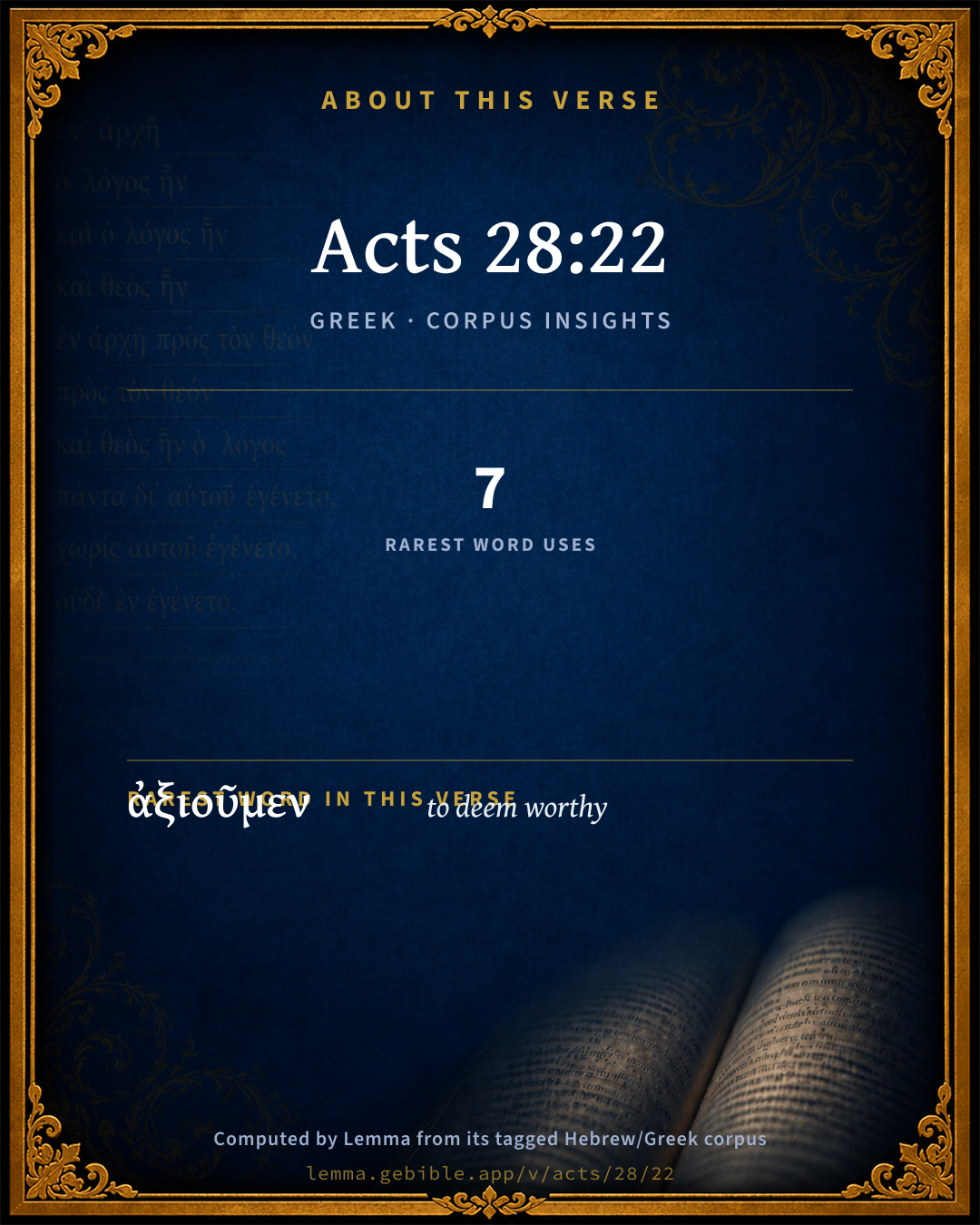
Acts 28:22

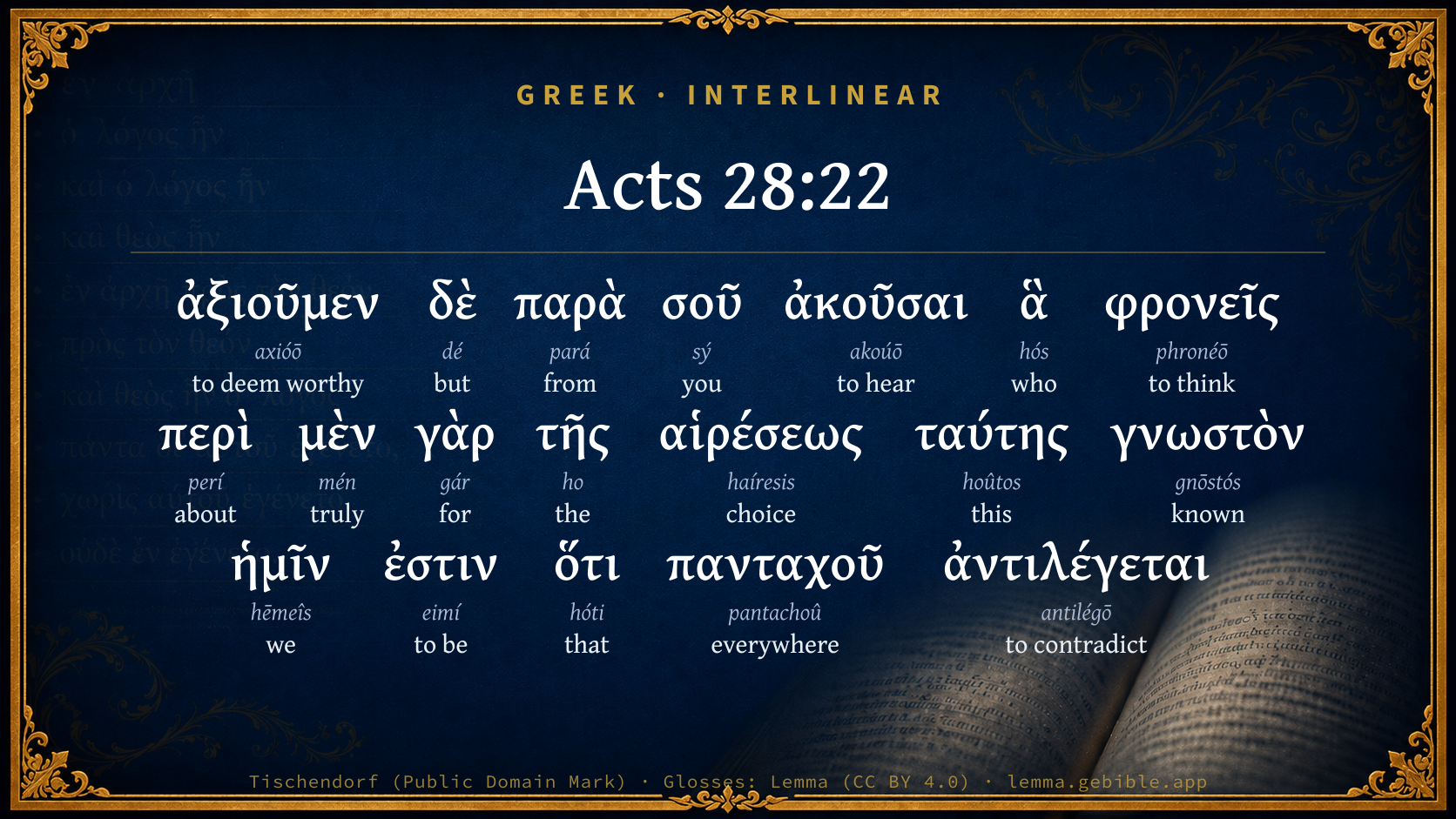
Greek (Tischendorf 8th ed.) Acts 28:22 appears in the Greek New Testament. The text above is from the Tischendorf 8th edition. Each word links to its Strong’s number and a concise gloss. Click any word for its full Thayer’s Greek Lexicon entry.
Download image
Cite this verse

Acts 28:22 (World English Bible). Public Domain. Lemma interlinear Bible study tool, https://lemma.gebible.app/v/acts/28/22.

Show BibTeX & RIS
BibTeX
RIS
English Translation
But we desire to hear from you what you think. For, as concerning this sect, it is known to us that everywhere it is spoken against."
World English Bible · Public Domain
Download a study sheet

One document with this verse’s original text, its word-by-word gloss line, the meaning frame, cross-references with their text, attributed commentary, and full source and license credits — printable, and it pastes into notes with its structure intact.

This verse Autodidact and up

Study sheet (.html) Plain text (.txt)

A passage Seminary Student

Up to 50 verses in one chapter. A passage sheet keeps up to 6 commentary sources and 12 cross-references per verse, in the order this page ranks them, and says so on the sheet whenever that leaves anything out. Ask for a single verse and you get the Autodidact verse sheet above.

Everything on this page stays free to read, with no account — the sheet is a download of what is already on screen, not access to it.

Want to remove ads? Support Godless Engineer
Compare translations 3

The same verse in 3 English versions, stacked beneath the original-language interlinear above. Click any original word for its lexicon entry.

Each is an independent rendering of the whole verse — the interlinear is not word-aligned to these translations.

Highlighted words mark where these versions differ — a whole-verse word diff, not a word-by-word alignment.

  • World English Bible Public Domain
    But we desire to hear from you what you think. For, as concerning this sect, it is known to us that everywhere it is spoken against."
  • King James Version Public Domain
    But we desire to hear of thee what thou thinkest: for as concerning this sect, we know that every where it is spoken against.
  • unfoldingWord Literal Text CC BY-SA 4.0
    But we value to hear from you what you think, for concerning this sect, it is known to us that it is spoken against everywhere.”

unfoldingWord Literal Text — © unfoldingWord, licensed CC BY-SA 4.0. Word-aligned USFM3 via Door43 (git.door43.org/unfoldingWord/en_ult).

Versions to compare (up to 4)

3 of 4 selected

Show all 19 translations

Every available English version of this verse, each an independent rendering of the whole verse.

  • World English Bible Public Domain
    But we desire to hear from you what you think. For, as concerning this sect, it is known to us that everywhere it is spoken against."
  • Berean Standard Bible Public Domain
    But we consider your views worth hearing, because we know that people everywhere are speaking against this sect.”
  • Majority Standard Bible Public Domain
    But we consider your views worth hearing, because we know that people everywhere are speaking against this sect.”
  • King James Version Public Domain
    But we desire to hear of thee what thou thinkest: for as concerning this sect, we know that every where it is spoken against.
  • American Standard Version (1901) Public Domain
    But we desire to hear of thee what thou thinkest: for as concerning this sect, it is known to us that everywhere it is spoken against.
  • Revised Version (1885) Public Domain
    But we desire to hear of thee what thou thinkest: for as concerning this sect, it is known to us that everywhere it is spoken against.
  • Geneva Bible (1599) Public Domain
    But we will heare of thee what thou thinkest: for as concerning this sect, we knowe that euery where it is spoken against.
  • Douay-Rheims (1899) Public Domain
    But we desire to hear of thee what thou thinkest; for as concerning this sect, we know that it is every where contradicted.
  • Young's Literal Translation Public Domain
    and we think it good from thee to hear what thou dost think, for, indeed, concerning this sect it is known to us that everywhere it is spoken against;'
  • Literal Standard Version CC BY-SA 4.0
    and we think it good from you to hear what you think, for indeed, concerning this sect it is known to us that it is spoken against everywhere”;
  • Unlocked Literal Bible CC BY-SA 4.0
    But we want to hear from you what you think about this sect, because it is known by us that it is spoken against everywhere.”
  • unfoldingWord Literal Text CC BY-SA 4.0
    But we value to hear from you what you think, for concerning this sect, it is known to us that it is spoken against everywhere.”
  • Darby Bible Public Domain
    But we beg to hear of thee what thou thinkest, for as concerning this sect it is known to us that it is everywhere spoken against.
  • World Messianic Bible Public Domain
    But we desire to hear from you what you think. For, as concerning this sect, it is known to us that everywhere it is spoken against.”
  • Webster's Bible Public Domain
    But we desire to hear from thee, what thou thinkest: for as concerning this sect, we know that every where it is spoken against.
  • Free Bible Version CC BY-SA 4.0
    “But we do want to hear from you what you believe—especially regarding this sect, which we know is condemned everywhere.”
  • Bible in Basic English Public Domain
    But we have a desire to give hearing to your opinion: for as to this form of religion, we have knowledge that in all places it is attacked.
  • Text-Critical English NT CC BY 4.0
    But we think it would be best to hear what yoʋr views are, for concerning this sect, we know that everywhere it is spoken against.”
  • Tyndale New Testament (1534) Public Domain
    But we will heare of the what thou thynkest. For we have hearde of this secte that every wheare it is spoken agaynst.

Literal Standard Version (2020), Covenant Press — licensed CC BY-SA 4.0. Text via the HelloAO Bible API (eBible.org). Unlocked Literal Bible (unfoldingWord) — licensed CC BY-SA 4.0. Text via the HelloAO Bible API (eBible.org). unfoldingWord Literal Text — © unfoldingWord, licensed CC BY-SA 4.0. Word-aligned USFM3 via Door43 (git.door43.org/unfoldingWord/en_ult). Free Bible Version, Dr. Jonathan Gallagher — licensed CC BY-SA 4.0. Text via the HelloAO Bible API (eBible.org).

Word by word

More ways to search: Search by grammar → Find every occurrence → Compare this word →

Practice this passage: Drill this verse → Learn its vocabulary →

ἀξιοῦμεν
axióō
G515
“to deem worthy”
Verb, Present, Active, Indicative, 1st person, Plural
Part of Speech
Verb
Tense
Present
Voice
Active
Mood
Indicative
Person
1st person
Number
Plural
Full Thayer's Definition

Origin: from G514

TDNT: 07:20,6

1. to think meet, fit, right 2. to judge worthy, deem, deserving
  1. δὲ dé G1161 “but” Conjunction
  2. παρὰ pará G3844 “from” Preposition
  3. σοῦ sý G4771 “you” Personal pronoun, 2nd person, Genitive, Singular
  4. ἀκοῦσαι akoúō G191 “to hear” Verb, Aorist, Active, Infinitive
  5. ἃ hós G3739 “who” Relative pronoun, Accusative, Plural, Neuter
  6. φρονεῖς phronéō G5426 “to think” Verb, Present, Active, Indicative, 2nd person, Singular
  7. περὶ perí G4012 “about” Preposition
  8. μὲν mén G3303 “truly” Particle
  9. γὰρ gár G1063 “for” Conjunction
  10. τῆς ho G3588 “the” Article, Genitive, Singular, Feminine
  11. αἱρέσεως haíresis G139 “choice” Noun, Genitive, Singular, Feminine
  12. ταύτης hoûtos G3778 “this” Demonstrative pronoun, Genitive, Singular, Feminine
  13. γνωστὸν gnōstós G1110 “known” Adjective, Nominative, Singular, Neuter
  14. ἡμῖν hēmeîs G2249 “we” Personal pronoun, 1st person, Dative, Plural
  15. ἐστιν eimí G1510 “to be” Verb, Present, Active, Indicative, 3rd person, Singular
  16. ὅτι hóti G3754 “that” Conjunction
  17. πανταχοῦ pantachoû G3837 “everywhere” Adverb
  18. ἀντιλέγεται antilégō G483 “to contradict” Verb, Present, Passive, Indicative, 3rd person, Singular

About this verse

These counts appear in no published source. They are computed here, from the morphology-tagged text and Lemma’s own curated glosses. What Lemma adds →

19
words
19
distinct lemmas
Acts
section

Notable vocabulary

The rarest word here is ἀξιοῦμεν to deem worthy G515 — appearing just 7 times in the whole Greek New Testament.

Shared distinctive vocabulary

ἀξιοῦμεν to deem worthy G515 occurs in 7 verses of the Greek New Testament. Also found in:

Cross-references

12

Topical passages linked to Acts 28:22 in the Treasury of Scripture Knowledge — connected by theme and wording, ordered by reader-vote popularity; previews shown in the World English Bible.

  • Acts 24:14 But this I confess to you, that after the Way, which they call a sect, so I serve the God of our fathers, believing all things which are according to the law, and which are written in the prophets;
  • 1 Peter 2:12 having good behavior among the nations, so in that which they speak against you as evil-doers, they may by your good works, which they see, glorify God in the day of visitation.
  • 1 Peter 3:16 having a good conscience; that, while you are spoken against as evildoers, they may be disappointed who curse your good manner of life in Christ.
  • Acts 16:20–21 When they had brought them to the magistrates, they said, "These men, being Jews, are agitating our city,
  • Acts 17:6–7 When they didn't find them, they dragged Jason and certain brothers before the rulers of the city, crying, "These who have turned the world upside down have come here also,
  • Acts 24:5–6 For we have found this man to be a plague, an instigator of insurrections among all the Jews throughout the world, and a ringleader of the sect of the Nazarenes.
  • 1 Peter 4:14–16 If you are insulted for the name of Christ, blessed are you; because the Spirit of glory and of God rests on you. On their part he is blasphemed, but on your part he is glorified.
  • Luke 2:34 and Simeon blessed them, and said to Mary, his mother, "Behold, this child is set for the falling and the rising of many in Israel, and for a sign which is spoken against.
  • Acts 5:17 But the high priest rose up, and all those who were with him (which is the sect of the Sadducees), and they were filled with jealousy,
  • Acts 15:5 But some of the sect of the Pharisees who believed rose up, saying, "It is necessary to circumcise them, and to charge them to keep the law of Moses."
  • Acts 26:5 having known me from the first, if they are willing to testify, that after the strictest sect of our religion I lived a Pharisee.
  • 1 Corinthians 11:19 For there also must be factions among you, that those who are approved may be revealed among you.

Cross-references courtesy of OpenBible.info (CC BY 4.0).

Commentary

Notes on Acts 28:22 from classic Christian and Jewish commentators (each source and its license shown beneath its notes). The classic Christian expositions comment on the surrounding passage and are grouped to its opening verse, so a note may address several verses; the Jewish commentaries on the Tanakh (Rashi and others) are per-verse, so they appear only where the commentator wrote on this verse.

Lemma curates 59 commentaries, every one of them public domain or Creative Commons licensed, each selected and text-cleaned for this edition rather than reprinted as found. About our sources →

Bengel's Gnomon

Johann Albrecht Bengel

Act 28:22. Γιωστὸν, it is known to us) Paul retorts the expression on them, in Act 28:28, “Be it known to you.”—πανταχοῦ ἀντιλέγεται, it is everywhere spoken against) This is the indication of a good cause, rather than of a bad one.

Bengel's Gnomon of the New Testament — English translation (T&T Clark, Edinburgh, 1860) — public domain. Text from a community e-Sword module.

Meyer's Critical & Exegetical Commentary

Heinrich August Wilhelm Meyer

Act_28:22. Ἀξιοῦμεν δέ] But we judge (so as, in such lack of information from other quarters, to be better instructed concerning the circumstances in which thou art placed) it right (Act_15:38)as a claim which, as matters stand, is no more than right and properto learn from thee (παρὰ σοῦ has emphasis), etc.

ἃ φρονεῖς] i.e. what principles and views thou pursuest.

περὶ μὲν γὰρ τῆς αἱρέσ. ταύτ.] for of this party certainly. As to αἱρέσ., see on Act_14:14. ταύτης has its reference in the more precise expressions, with which Paul must be presumed to have accompanied his ἕνεκεν γὰρ τῆς ἐλπίδος τ. Ἰσραήλ. In the μέν without δέ the tacit contrast is to be mentally supplied: Although thou thyself art unknown to us. Comp. on Act_27:21; also Buttmann, neut. Gr. p. 313 [E. T. 365]. The γάρ grounds the ἀξιοῦμεν κ.τ.λ. on the (apparently) impartial interest of obtaining more particular information.

At first view, it must appear strange that these Jewish πρῶτοι in Rome betray so little acquaintance, or none at all, with the great Christian church at Rome, which consisted, at any rate in part, of Jewish Christians. This difficulty is not solved by the arbitrary (comp. also on Act_28:21) assumption that, after the return of the Jews expelled by Claudius, the Jews and Christians kept aloof from each other and thus gradually lost acquaintance with one another (Olshausen; comp. also Kling in the Stud. u. Krit. 1837, p. 302 ff.); nor yet by the circumstances of such a great city as Rome, amidst which the existence of the Christian community might well have escaped the knowledge of the rich worldly Jews (Neander),which, considering the relationship of Judaism and Christianity, would a priori be very improbable. It is rather to be explained, like the expression in Act_28:21, from a cautious sort of official reserve in their demeanour, not exactly hypocritical (Tholuck) or intimidated by the Claudian measures (Philippi, comp. Ewald), but in which withal the Jewish contempt for Christianity generally is apparent. The representation here given, according to which those Jews simply avoid any sort of expression compromising them, is by no means to be used, with Baur and Zeller, against the historical truth of the occurrence. Its historical character, on the contrary, gains support from the Epistle to the Romans itself, which shows no trace that in Rome Christianity had been in conflict with the Jews (see Rom. Introd. § 3). and therefore de Wette is wrong in his remark that, if Luke had only added καὶ παρʼ ἡμῖν to πανταχοῦ, there would have been no ground of offence.

Meyer — Critical and Exegetical Commentary on the New Testament — English translation by Peter Christie, edited by Frederick Crombie (T&T Clark, 1880) — public domain. Text from a community e-Sword module.

Expositor's Greek Testament

ed. W. Robertson Nicoll

Act 28:22 . ἀξιοῦμεν δὲ : “but we think good,” cf. Act 15:38 . They acknowledge that no report had reached them to invalidate the statements which Paul had just made as to the causes of his imprisonment, but ( δέ ) they would hear not from others, but from himself ( παρὰ σοῦ ). ἃ φρονεῖς : evidently no reference to any special view of Christianity as characterising St. Paul’s own teaching, but a reference to his claim to be imprisoned for the hope of Israel. αἱρ … Christianity was for them only a sect, and therefore they could not understand the Apostle’s identification of it with the Jewish national hope. See note on Act 28:17 . γνωστόν … ἡμῖν : if the view is correct that the edict of Claudius, see chap. Act 18:2 , was occasioned by the early preaching of Christianity in Rome, it is possible that the dislocation of the Jewish community then caused may help at all events to explain why the Christian Church in Rome did not grow out of the Jewish synagogue in the capital to the same context as elsewhere, see Sanday and Headlam, Romans , pp. 21, 22. It may no doubt be urged that the Christian Church in Rome was not entirely a heathen-Christian Church, and that, as the names in Rom 16 indicate, it contained a Jewish element. But it is quite conceivable that in the capital, with its two million inhabitants, the Jews, who had only recently returned to the city, should know nothing beyond what is here indicated in such general terms of a poor and obscure sect who dwelt no longer in the Jewish quarter. It is also worthy of consideration that the Jews of Rome, whilst not guilty of any untruth in what they had just said as to their knowledge of the Christian sect, may have expressed themselves in this guarded manner from political reasons. If St. Paul’s statement in Act 28:18 as to the favourable bearing of the Roman authorities towards him was true, it was but natural that the Jews should wish to refrain from hasty or hostile action towards a prisoner who was evidently treated with consideration in his bonds; they would rather act thus than revive an old quarrel which might again lead to their own political insecurity, see especially Lightfoot, Philippians , pp. 15, 16; Felten, in loco ; and, further, Rendall, p. 352. Nothing said by the Jews contradicts the existence of a Christian community in Rome, nor is it said that they wished to learn the Christian tenets from Paul, as if they knew nothing of them from their own knowledge, or as if they knew nothing of the causes of the opposition to the Christian faith; motives of curiosity and of policy might well have prompted a desire to hear Paul speak for himself, and with such motives there was apparently mingled a tone of contempt for a sect of which they might fairly say, from the experience of their countrymen, and from their own experience in Rome, πανταχοῦ ἀντιλέγεται : ἀντιλ . Lucan-Pauline; only once elsewhere; cf. Joh 19:12 . See [434] text above.

[434] R(omana), in Blass, a first rough copy of St. Luke.

The Expositor's Greek Testament, edited by W. Robertson Nicoll (1897–1910) — public domain. Text from a community e-Sword module.

Jamieson, Fausset & Brown

Robert Jamieson, A. R. Fausset & David Brown

we desire--"deem it proper"

to hear of thee what thou thinkest--what are thy sentiments, views, &c. The apparent freedom from prejudice here expressed may have arisen from a prudent desire to avoid endangering a repetition of those dissensions about Christianity to which, probably, SUETONIUS alludes, and which had led to the expulsion of the Jews under Claudius [HUMPHRY]. See on Act 18:2.

Jamieson, Fausset & Brown — Commentary Critical and Explanatory on the Whole Bible (1871) — public domain (CC PDM 1.0). Text via the HelloAO Bible API.

Adam Clarke's Commentary

Verse 22. For as concerning this sect] See Clarke on Ac 24:14. A saying of Justin Martyr casts some light on this saying of the Jews: he asserts that the Jews not only cursed them in their synagogues, but they sent out chosen men from Jerusalem, to acquaint the world, and particularly the Jews everywhere, that the Christians were an atheistical and wicked sect, which should be, detested and abhorred by all mankind. Justin Martyr, Dial. p. 234.

Adam Clarke's Commentary on the Bible (1810–1826) — public domain. Text from a community e-Sword/MySword module.

Ellicott's Commentary for English Readers

(22) We desire . . . as concerning this sect . . .—Better, we request of thee. The term is that which had been used by Tertullus when he spoke of the “sect of the Nazarenes” (Act_24:5). The speakers had clearly heard enough of the prisoner to identify him with that sect, but they treat him personally with respect, probably due in part to the favour which the authorities had shown him, and wish for an authoritative exposition of his views. The Christians of Rome had obviously, even if they were Jews, withdrawn from the Jewish quarter, and the residents in that quarter knew of them only by reports. What was the nature of those reports we can only conjecture. They were, as the speakers say, “everywhere spoken against.” The darker calumnies which were propagated afterwards—stories of Thyestean (i.e., cannibal) banquets and licentious orgies—may possibly have been even then whispered from ear to ear. In any case the Christians of the empire would be known as abandoning circumcision and other Jewish ordinances, leading a separate life, holding meetings which were more or less secret, worshipping One who had been crucified as a malefactor. They were already, as Tacitus describes them, speaking of their sufferings under Nero, known as holding an exitiabilis superstitio (“a detestable superstition”), guilty of atrocia et pudenda, odio humani generis convicti (“atrocious and shameful crimes, convicted by the hatred of mankind”) (Ann. xv. 44), or as Suetonius writes (Nero, c. 16), as a genus hominum superstitionis novœ et maleficœ (“a race of men holding a new and criminal superstition”). It is conceivable, looking to the early date at which such rumours were current, that even then there may have been caricatures like that which was found among the graffiti of the Palace of the Cæsars (now in the Collegio Romano), representing Alexamenos, a Christian convert, worshipping his god, in the form of a crucified human figure with an ass’s head. Tertullian (A.D. 160-240) mentions such caricatures as current in his time (Apol. c. 16), and the story that the Jews worshipped an ass’s head, which we know to have been accepted at this very time (Jos. cont. Apion. ii. 7; Tacit Hist. v. 4), would naturally be transferred to the Christians, who were regarded as a sect of Jews. In Tertullian’s time Asinarii (“ass-worshippers”) was a common term of abuse for them.

A Bible Commentary for English Readers, edited by Charles John Ellicott (1878–1897) — public domain. Text from a community e-Sword module.

The Cambridge Bible for Schools and Colleges

gen. ed. J. J. S. Perowne

22. But we desire to hear of thee] He was a Jew, one of their own nation, and was likely to be able to put his belief before them in its true light. They professed to be open to reason, but this may have been only because they knew not what else to do.

concerning this sect] It is clear from this expression that they had learnt from St Paul’s speech, though St Luke does not record the words, that he was an adherent of Jesus of Nazareth, and held that in Him “the hope of Israel” had been fulfilled.

we know] [R. V. “it is known to us”]. The change has the merit of being very literal. Other merit it would be hard to find in it.

every where it is spoken against] They were doubtless aware of many of the attacks which had been made by their countrymen on the Christians both in the cities of Asia and Europe, and would have heard them spoken of as the men who were turning the world upside down. The result of the conference was that a day was fixed, on which the Apostle should set forth to them his opinions, so that, as they had no other means for deciding on their course of action, they might discover for themselves what would be the best course to take.

The Cambridge Bible for Schools and Colleges (gen. ed. J. J. S. Perowne; Cambridge University Press, 1878–1918) — public domain. Text from a community e-Sword module.

John Gill's Exposition

But we desire to hear of thee what thou thinkest,.... What was his opinion and judgment, concerning the Messiah, whether he was come or not, and whether Jesus of Nazareth was he; and concerning other principles relating to him, embraced by the Christians; and what he had to say for the clearing up, proving, and confirming his sentiments about these things:

for as concerning this sect; or heresy, meaning the Christian religion: in saying so, they reproached it; for the Gospel, or Christian religion, is not an human device, the choice and option of man's free will, and what he pleases himself with, as an opinion and invention of his own, or of other men, as "heresy" signifies; but it is of God, and by revelation of Jesus Christ, and is a doctrine of the highest wisdom: nor does it deny or take away any fundamental article of true religion; either natural, as known by the Gentiles, or as revealed, with which the Jews were made acquainted, under the former dispensation; but establishes every such article, as the unity of the divine Being; the worship of the one only and true God of Israel, in a spiritual manner; the doctrine of the Messiah, his person, office, and grace; the resurrection of the dead, and eternal judgment; and therefore could not be chargeable with heresy: nor was it set up for any worldly gain, or popular applause, which are the things that authors and abettors of heresy have in view; nor was it designed to divide and separate persons from the true church of God, but to bring them to it, and unite them together in it; see Act 24:14.

We know that everywhere it is spoken against; this they knew, both by letters they received, and by persons who came from different parts of the world; and which was fact, and was no other than what was foretold concerning Christ, that he should be a sign that should be spoken against, Luk 2:34; and which the apostle found true of the Gospel preached by him, both among Jews and Greeks; it being to the one a stumblingblock, and to the other foolishness, Co1 1:23, and especially it was contradicted and blasphemed everywhere by the Jews; these in all places opposed themselves to it, and spoke evil of it, and of its preachers and professors: Christ, the author, sum, and subject of the Christian religion, was spoken against in his person; his deity and divine sonship were denied, as they still are; and his offices, as prophet, priest, and King; yea, his actions, even his works of mercy to the bodies of men, by healing their diseases, his conversing with sinners for the good of their souls, the several miracles he wrought, and the whole series of his life and conversation, were blasphemed and evil spoken of: the doctrines of the Gospel in general were contradicted, as they now are by many, as absurd and irrational, and as tending to licentiousness; and in particular those which respect the Father of Christ, as being the Father of Christ, his everlasting love to the elect in him, and his distinguishing grace in the choice of them; and those which relate to Christ, as that he is truly God, and the Son of God, and to his sacrifice, satisfaction, and imputed righteousness; and also which concern the Spirit of God, as his deity and personality, and his operations on the souls of men; and such as relate to a future state, the resurrection of all the dead, and judgment to come: likewise the ordinances of the Christian religion, baptism and the Lord's supper, were despised and spoken against, and the professors of it treated as fools and wicked men; the reasons of all this are, because the Christian religion, and the doctrines of it, are not of men, are contrary to the lusts of men, and particularly to the pride of men; they subject them to reproach and persecution, and gather men out from among them.

John Gill's Exposition of the Whole Bible (1746–1763) — public domain (CC PDM 1.0). Text via the HelloAO Bible API.

Trapp's Complete Commentary

John Trapp

22 But we desire to hear of thee what thou thinkest: for as concerning this sect, we know that every where it is spoken against.

Ver. 22. Everywhere it is spoken against] Nomen in Christianis damnabatur, non crimen, saith Tertullian. When Attalus the martyr was put to death at Lyons, a table was set up over his head with this inscription, Hic est Attalus Christianus, This is Attalus the Christian; that was all they had to charge him with. So when Polycarp was martyred, all the crime objected against him was that he confessed himself to be a Christian. Nero made this cruel edict, Whosoever confessed himself to be a Christian, let him be presently put to death without any more ado, as a convicted enemy of mankind. {a}

{a} Sine ulteriore sui defensione capite plectitur.

John Trapp, A Commentary or Exposition upon All the Books of the Old and New Testament (1647–1656) — public domain. Text from a community e-Sword module.

Albert Barnes' Notes on the Bible

What thou thinkest - What your belief is; or what are the doctrines of Christians respecting the Messiah.

This sect - The sect of Christians.

Spoken against - Particularly by Jews. This was the case then, and, to a great extent, is the case still. It has been the common lot of the followers of Christ to be spoken “against.” Compare Act 24:5.

Albert Barnes' Notes on the Bible (1834–1885) — public domain. Text from a community e-Sword/MySword module.

Haydock's Catholic Bible Commentary

It is every where gainsayed. Here we observe one of the characters of the true religion. It is contradicted and spoken against. As singular as this may appear, it is however true. Jesus, the author of that religion, had foretold it should be so. If the world hateth me, it will hate you also. The situation of the Catholic religion in this country [the United Kingdom], at present, is something similar to what is related here of Christianity: and those who have the candour to inquire seriously into its merits, have generally the reward of being convinced and of believing in it. Christianity, like some plants, grows the better for being trodden upon. (Haydock)

George Leo Haydock (1774–1849), Haydock's Catholic Family Bible and Commentary, 1859 edition — public domain. Excludes Psalms (Douay-Rheims chapter numbering differs from Protestant) and Deuterocanonical books (Catholic canon only).

Matthew Poole's English Annotations

Sect, or heresy, for so they called the Christian religion, Act 24:5,14.

Every where it is spoken against; of all conditions of men, governors and people, and in all places; as, Luk 2:34, Christ is said to be a sign that shall be spoken against.

Matthew Poole's English Annotations on the Holy Bible (1683–1685) — public domain. Text from a community e-Sword/MySword module.

Whedon's Commentary on the Bible

Daniel D. Whedon

22. Spoken against—Elsewhere and here at Rome. Frankly, then, though they will listen, their prepossessions are against the argument.

The hatred and calumny now poured upon Christians, by which Nero was emboldened to perpetrate his cruel persecutions, arose from various causes. As a sort of Jewish sect, they inherited in the first place all the odium of Jews. As abhorring the gods of paganism, they were stigmatized as “atheists.” As standing aloof from unholy amusements, they were held as unsocial and haters of the human race. As refusing to swear by the name of the emperor and sacrifice to his image, they were held as disloyal. As looking to a future, and perhaps near, conflagration of the world, they might plausibly be accused as incendiaries. And as being alleged to assemble by night to partake the mystical body and blood of Christ, they were even slandered as nightly cannibals! It is said by Justin Martyr that, previous to this period, the Jewish hierarchy had sent delegations into all parts of the civilized world denouncing the whole Christian body. In such a storm was rocked the cradle of the Christian Church.

Daniel D. Whedon (gen. ed.), Commentary on the Old and New Testaments (1874–1909) — public domain. Text from a community e-Sword module.

John Wesley's Explanatory Notes

This sect we know is everywhere spoken against - This is no proof at all of a bad cause, but a very probable mark of a good one.

John Wesley, Explanatory Notes Upon the Whole Bible (1754–1765) — public domain. Text via the GEBible commentary corpus.

Godbey's Commentary on the New Testament

William B. Godbey

22. “We desire to hear from thee the things which thou thinkest; for concerning this heresy it is known to us that it is everywhere spoken against.” The Greek word here translated “sect” in E. V. is heresy, which means separation, and truly applied to the followers of Jesus, because in so doing they necessarily became separate from the rank and file of the church, who rejected Him. The Holy Ghost is the Spirit, Revelator, and Successor of our ascended Jesus, who promised to “be with us always, even unto the end of the age” (Mat 28:20). The holiness people are simply the followers of the Holy Ghost, the Substitute of Jesus in His dispensation. In following Him we become spiritually separated from the fallen, worldly churches, and consequently heretics from their standpoint. Here you see the primitive Christian Church was denominated “heresy” by the Jews. In a similar manner, the true people of God in all ages have been anathematized and persecuted as heretics, because we can not be true to God without so separating ourselves experimentally and practically from the apostate ecclesiasticisms as to become heretics in their estimation.

William B. Godbey, Commentary on the New Testament (1896–1900) — public domain. Text from a community e-Sword module.

McGarvey & Pendleton's Commentaries

J. W. McGarvey

See notes on verse 22

J. W. McGarvey (with Philip Y. Pendleton), Commentaries on the New Testament (The Fourfold Gospel, 1914; Acts; and the epistles) — public domain. Text from a community e-Sword/MySword module.

Cambridge Greek Testament for Schools and Colleges

22. ἀξιοῦμεν δὲ παρὰ σοῦ ἀκοῦσαι, but we desire to hear of thee. He was a Jew, one of their own nation, and was likely to be able to put his belief before them in its true light. They professed to be open to reason, but this may have been only because they knew not what else to do.

περὶ μὲν γὰρ τῆς αἱρέσεως ταύτης, for as concerning this sect. It is dear from this expression that they had learnt from St Paul’s speech, though St Luke does not record the words, that he was an adherent of Jesus of Nazareth, and held that in Him ‘the hope of Israel’ had been fulfilled.

γνωστὸν ἡμῖν ἐστίν, we know. Literally ‘it is known to us.’ Perhaps the speakers intended by this circumlocution to distinguish what they knew by report from a personal knowledge.

ὅτι πανταχοῦ ἀντιλέγεται, that everywhere it is spoken against. They were doubtless aware of many of the attacks which had been made by their countrymen on the Christians both in the cities of Asia and Europe, and would have heard them spoken of as the men who were turning the world upside down. The result of the conference was that a day was fixed, on which the Apostle should set forth to them his opinions, so that, as they had no other means for deciding on their course of action, they might discover for themselves what would be the best course to take.

Cambridge Greek Testament for Schools and Colleges (Cambridge University Press, 1896; 21 vols, various authors incl. Carr, Maclear, Plummer, Farrar, Lumby, Moule, M. R. James, Simcox) — public domain. Text from a community e-Sword module.

Alford’s Greek Testament

Henry Alford

22.] The δέ and μέν are inverted: “μέν si dicitur non sequente δέ, aut intelligi potest δέ, aut omittitur illa pars orationis in qua sequi debebat δέ, quæ aliquando præcedit.” Herm. ad Viger., p. 839. It precedes, because it connects with the foregoing.

ἀξ. παρὰ σοῦ, we beg of thee: see reff.

τῆς αἱρ. ταύτ.] To which they perhaps inferred that Paul belonged, from ver. 20: or they might have heard thus much generally respecting him by rumour, though they had received no special message.

Their short notice of Christianity is perhaps the result of caution, seeing as they did the favour shewn by the authorities towards Paul (see Hackett, p. 392): or perhaps of dissimulation.

Many Commentators have noticed the omission of all mention of the Christian Church at Rome, and of Paul’s connexion with or work among them. And some recently in Germany (e.g. Bauer) have called in question the credibility of the Acts on this account. But without any reason: for the work of the Apostle among churches already founded is not the subject of our history, and is seldom related by Luke, without a special reason. Of the three years at Ephesus (ch. 20:31),—the year and a half (ch. 18:11), and three months (ch. 20:3) at Corinth, we know from the narrative nothing that took place among the Christians themselves. Besides, one great object of this history is to shew forth Paul as working out the Lord’s implied command (ch. 1:8), to preach the Gospel ‘to the Jew first, and also to the Gentile,’ and, having every where done this, it is but natural that he should open his commission in Rome by assembling and speaking to the Jews.

Henry Alford, The Greek Testament (1849–1861) — public domain. Text from a community e-Sword module.

Vincent's Word Studies in the New Testament

Marvin R. Vincent

We desire [αξιουμεν] . Rather, we think it fitting. Compare ch. 14 38. Sect. See on heresies, 2Pe 2:1.

Marvin R. Vincent, Word Studies in the New Testament (1887–1900) — public domain. Text from a community e-Sword/MySword module.

Lesson kit

Teaching starters — assembled from the data on this page, not authored interpretation. Every prompt links to the verse data it draws on. Edit before teaching.

Acts, in the Acts, opens this verse with 19 words (19 distinct Greek lemmas). Its most distinctive word is axióō (“to deem worthy”). A historical commentator’s framing appears above. Read the whole chapter for the surrounding context.

Discussion questions

  1. What does “to deem worthy” (axióō) contribute to the verse as a whole?
  2. How does Luke 7:7, which shares the word «to deem worthy», read alongside this verse?
  3. These translations render this verse differently. What is at stake in choosing one wording over another?
  4. Compare how Bengel's Gnomon and Meyer's Critical & Exegetical Commentary read this verse. Where do they agree or differ?

Things to notice

Reading settings

Reading text

Shown beneath each verse's original-language words.

Old Testament
Old Testament edition

Read the OT as the Masoretic Hebrew (MT) or the Greek Septuagint (LXX).

English shown for the Greek Septuagint (in the Hebrew ↔ Greek comparison).

Comparing translations? Open the Compare panel on any verse page to stack up to four side by side.