Romans 15:21

Greek (Tischendorf 8th ed.) Romans 15:21 appears in the Greek New Testament. The text above is from the Tischendorf 8th edition. Each word links to its Strong’s number and a concise gloss. Click any word for its full Thayer’s Greek Lexicon entry.
Download image
Cite this verse

Romans 15:21 (World English Bible). Public Domain. Lemma interlinear Bible study tool, https://lemma.gebible.app/v/romans/15/21.

Show BibTeX & RIS
BibTeX
RIS
English Translation
But, as it is written, "They will see, to whom no news of him came. They who haven't heard will understand."
World English Bible · Public Domain
Download a study sheet

One document with this verse’s original text, its word-by-word gloss line, the meaning frame, cross-references with their text, attributed commentary, and full source and license credits — printable, and it pastes into notes with its structure intact.

This verse Autodidact and up

Study sheet (.html) Plain text (.txt)

A passage Seminary Student

Up to 50 verses in one chapter. A passage sheet keeps up to 6 commentary sources and 12 cross-references per verse, in the order this page ranks them, and says so on the sheet whenever that leaves anything out. Ask for a single verse and you get the Autodidact verse sheet above.

Everything on this page stays free to read, with no account — the sheet is a download of what is already on screen, not access to it.

Want to remove ads? Support Godless Engineer
Compare translations 3

The same verse in 3 English versions, stacked beneath the original-language interlinear above. Click any original word for its lexicon entry.

Each is an independent rendering of the whole verse — the interlinear is not word-aligned to these translations.

Highlighted words mark where these versions differ — a whole-verse word diff, not a word-by-word alignment.

  • World English Bible Public Domain
    But, as it is written, "They will see, to whom no news of him came. They who haven't heard will understand."
  • King James Version Public Domain
    But as it is written, To whom he was not spoken of, they shall see: and they that have not heard shall understand.
  • unfoldingWord Literal Text CC BY-SA 4.0
    But just as it is written: “Those to whom it was not reported concerning him will see, and those who have not heard will understand.” ts\*

unfoldingWord Literal Text — © unfoldingWord, licensed CC BY-SA 4.0. Word-aligned USFM3 via Door43 (git.door43.org/unfoldingWord/en_ult).

Versions to compare (up to 4)

3 of 4 selected

Show all 19 translations

Every available English version of this verse, each an independent rendering of the whole verse.

  • World English Bible Public Domain
    But, as it is written, "They will see, to whom no news of him came. They who haven't heard will understand."
  • Berean Standard Bible Public Domain
    Rather, as it is written: “Those who were not told about Him will see, and those who have not heard will understand.”
  • Majority Standard Bible Public Domain
    Rather, as it is written: “Those who were not told about Him will see, and those who have not heard will understand.”
  • King James Version Public Domain
    But as it is written, To whom he was not spoken of, they shall see: and they that have not heard shall understand.
  • American Standard Version (1901) Public Domain
    but, as it is written, They shall see, to whom no tidings of him came, And they who have not heard shall understand.
  • Revised Version (1885) Public Domain
    but, as it is written, They shall see, to whom no tidings of him came, And they who have not heard shall understand.
  • Geneva Bible (1599) Public Domain
    But as it is written, To whome hee was not spoken of, they shall see him, and they that heard not, shall vnderstand him.
  • Douay-Rheims (1899) Public Domain
    But as it is written: They to whom he was not spoken of, shall see, and they that have not heard shall understand.
  • Young's Literal Translation Public Domain
    but according as it hath been written, `To whom it was not told concerning him, they shall see; and they who have not heard, shall understand.'
  • Literal Standard Version CC BY-SA 4.0
    but according as it has been written: “To whom it was not told concerning Him, they will see; and they who have not heard, will understand.”
  • Unlocked Literal Bible CC BY-SA 4.0
    It is as it is written: “Those to whom no tidings of him came will see him, and those who have not heard will understand.”
  • unfoldingWord Literal Text CC BY-SA 4.0
    But just as it is written: “Those to whom it was not reported concerning him will see, and those who have not heard will understand.” ts\*
  • Darby Bible Public Domain
    but according as it is written, To whom there was nothing told concerning him, they shall see; and they that have not heard shall understand.
  • World Messianic Bible Public Domain
    But, as it is written, “They will see, to whom no news of him came. They who haven’t heard will understand.”
  • Webster's Bible Public Domain
    But as it is written, They shall see to whom he was not spoken of: and they that have not heard shall understand.
  • Free Bible Version CC BY-SA 4.0
    As Scripture says, “Those who haven't been told the good news will discover him, and those who haven't heard will understand.”
  • Bible in Basic English Public Domain
    But as it is said in the holy Writings, They will see, to whom the news of him had not been given, and those to whose ears it had not come will have knowledge.
  • Text-Critical English NT CC BY 4.0
    but as it is written, “Those who were not told about him will see, and those who have not heard will understand.”
  • Tyndale New Testament (1534) Public Domain
    but as it is written: To whom he was not spoken of they shall se: and they that hearde not shall vnderstonde.

Literal Standard Version (2020), Covenant Press — licensed CC BY-SA 4.0. Text via the HelloAO Bible API (eBible.org). Unlocked Literal Bible (unfoldingWord) — licensed CC BY-SA 4.0. Text via the HelloAO Bible API (eBible.org). unfoldingWord Literal Text — © unfoldingWord, licensed CC BY-SA 4.0. Word-aligned USFM3 via Door43 (git.door43.org/unfoldingWord/en_ult). Free Bible Version, Dr. Jonathan Gallagher — licensed CC BY-SA 4.0. Text via the HelloAO Bible API (eBible.org).

Word by word

More ways to search: Search by grammar → Find every occurrence → Compare this word →

Practice this passage: Drill this verse → Learn its vocabulary →

ἀνηγγέλη
anangéllō
G312
“to announce”
Verb, Aorist, Passive, Indicative, 3rd person, Singular
Part of Speech
Verb
Tense
Aorist
Voice
Passive
Mood
Indicative
Person
3rd person
Number
Singular
Full Thayer's Definition

Origin: from G303 and the base of G32

TDNT: 02:01,1

1. to announce, make known 2. to report, bring back tidings, rehearse
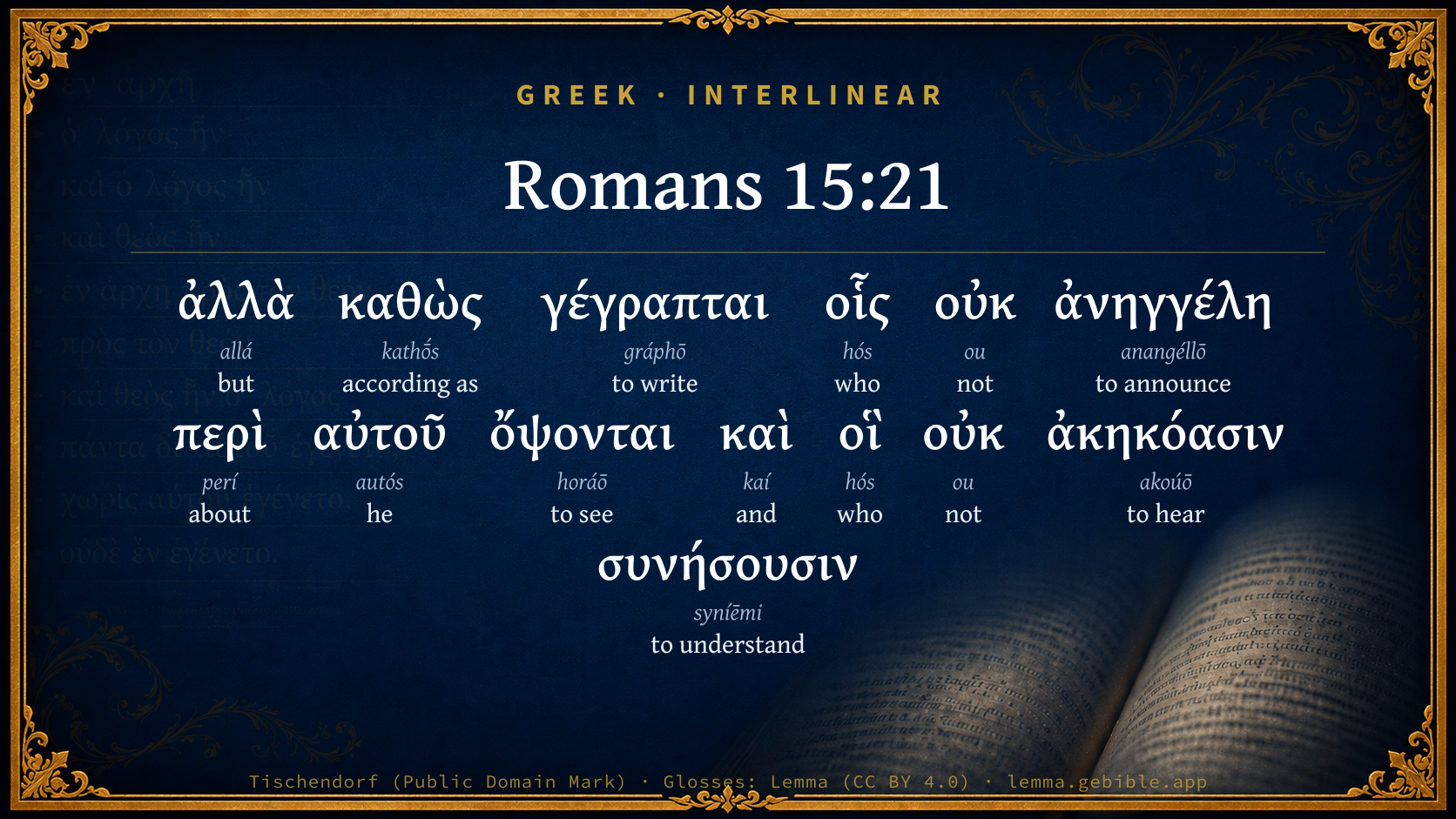
  1. ἀλλὰ allá G235 “but” Conjunction
  2. καθὼς kathṓs G2531 “according as” Adverb
  3. γέγραπται gráphō G1125 “to write” Verb, Perfect, Passive, Indicative, 3rd person, Singular
  4. οἷς hós G3739 “who” Relative pronoun, Dative, Plural, Masculine
  5. οὐκ ou G3756 “not” Particle, Negative
  6. περὶ perí G4012 “about” Preposition
  7. αὐτοῦ autós G846 “he” Personal pronoun, Genitive, Singular, Masculine
  8. ὄψονται horáō G3708 “to see” Verb, Future, Middle deponent, Indicative, 3rd person, Plural
  9. καὶ kaí G2532 “and” Conjunction
  10. οἳ hós G3739 “who” Relative pronoun, Nominative, Plural, Masculine
  11. οὐκ ou G3756 “not” Particle, Negative
  12. ἀκηκόασιν akoúō G191 “to hear” Verb, Perfect, Active, Indicative, 3rd person, Plural, Attic form
  13. συνήσουσιν syníēmi G4920 “to understand” Verb, Future, Middle deponent, Indicative, 3rd person, Plural

About this verse

These counts appear in no published source. They are computed here, from the morphology-tagged text and Lemma’s own curated glosses. What Lemma adds →

14
words
12
distinct lemmas
Pauline Epistles
section

Notable vocabulary

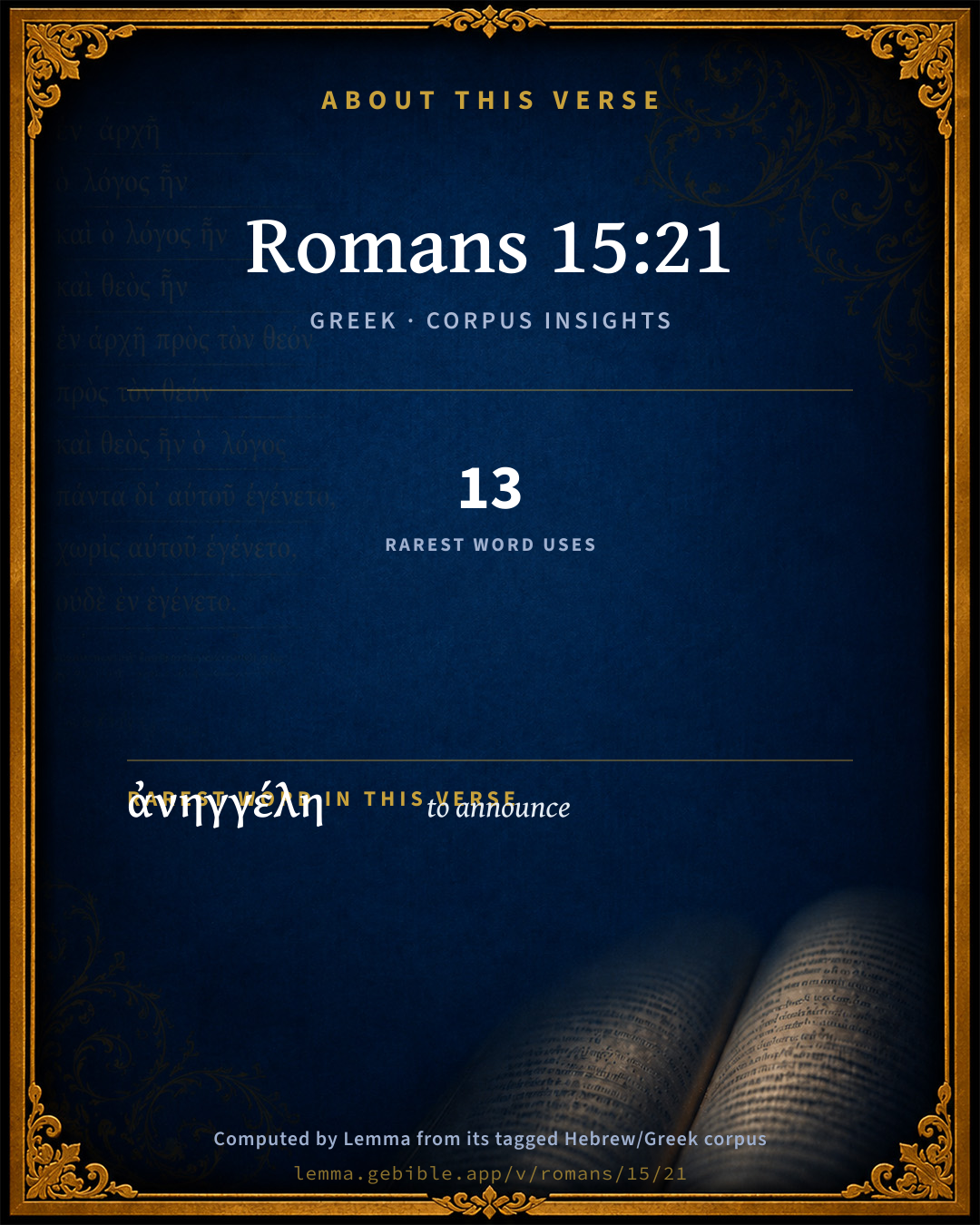
The rarest word here is ἀνηγγέλη to announce G312 — appearing just 13 times in the whole Greek New Testament.

Shared distinctive vocabulary

ἀνηγγέλη to announce G312 occurs in 13 verses of the Greek New Testament. Also found in:

Repetition

Words recur within this verse:

Cross-references

2

Topical passages linked to Romans 15:21 in the Treasury of Scripture Knowledge — connected by theme and wording, ordered by reader-vote popularity; previews shown in the World English Bible.

  • Isaiah 52:15 so shall he sprinkle many nations; kings shall shut their mouths at him: for that which had not been told them shall they see; and that which they had not heard shall they understand.
  • Isaiah 65:1 I am inquired of by those who didn't ask; I am found by those who didn't seek me: I said, See me, see me, to a nation that was not called by my name.

Cross-references courtesy of OpenBible.info (CC BY 4.0).

Commentary

Notes on Romans 15:21 from classic Christian and Jewish commentators (each source and its license shown beneath its notes). The classic Christian expositions comment on the surrounding passage and are grouped to its opening verse, so a note may address several verses; the Jewish commentaries on the Tanakh (Rashi and others) are per-verse, so they appear only where the commentator wrote on this verse.

Lemma curates 59 commentaries, every one of them public domain or Creative Commons licensed, each selected and text-cleaned for this edition rather than reprinted as found. About our sources →

The Biblical Illustrator

Joseph S. Exell

Rom_15:21

But as It is written, To whom He was not spoken of, they shall see.

Prophecy and the means of its fulfilment

This ambition of the apostle was the means of fulfilling a prophecy with respect to the spread of the gospel in heathen countries. Thus it is that God fulfils His predictions and His purposes. He gives His people an earnest desire to be the means of accomplishing them at the moment when He designs their accomplishment. It will be thus that the gospel will at last be effectually carried to every country under heaven. It is thus that modern missionaries have, in some measure, carried the gospel to the heathen, and although the slothfulness of the people of God in former ages is not without blame, it is because the time to fulfil Gods predictions to the nations was not come that a like ambition to that of Paul was not found more generally to animate Christians. Whenever the Lord has work to do, He raises up men with a heart to perform it. This, however, is no excuse at any particular time for indifference or want of effort to spread the gospel. (R. Haldane.)

Missionary toil

I. Its difficulties.

1. Untried ground.

2. A foundation must be laid.

3. Particular obstacles removed, etc.

II. Its encouragements.

1. The nature of the gospel.

2. Its actual successes.

3. The faithful promise of God. (J. Lyth, D.D.)

Missions

I. The object of missionary zeal. To speak of Christ, and to make Christ known. If a heathen could say, I am a man, and nothing human is foreign to me, how much more should our hearts burn, when we are told that the knowledge of Christ is at present limited to one-third of the human race! Surely this is an object sufficient to justify missionary efforts.

II. The character of missionary labours. To go forth and to preach the gospel of Christ. Leaving it to Mahomet to draw the sword and enforce obedience, for the weapons of our warfare are not carnal, our appeal is not to secular authority, for the religion of Christ made its way against that authority.

III. The promises of missionary success. We can appeal to It is written, and I should like to know what nineteen centuries have done to invalidate Pauls testimony.

IV. The extent of missionary claims. If Jesus looked beyond His conflicts and trials, and saw of the travail of His soul, can we be indifferent to that on which His heart was set now He is in heaven? If He anticipated much as the reward of His labours, can we be satisfied that He should receive but little? Did He say, I, if I be lifted up, will draw all men unto Me? Shall not we aim to lift Him up by the preaching of the gospel, and say to perishing men, Behold the Lamb of God, who taketh away the sins of the world? (R. C. Dillon, D.D.)

The claims of missions

1. There are millions still who have not heard the gospel.

2. The gospel is not only adapted to their case, but intended for them.

3. The obligation rests on us to send it.

4. The successful result is certain--predicted--exemplified. (J. Lyth, D.D.)

The Biblical Illustrator, edited by Joseph S. Exell (c. 1880s–1900s) — public domain. Text from a community e-Sword module.

Bengel's Gnomon

Johann Albrecht Bengel

Rom 15:21. Οἷς—συνήσουσι) Isa 52:15. So plainly the LXX.

Bengel's Gnomon of the New Testament — English translation (T&T Clark, Edinburgh, 1860) — public domain. Text from a community e-Sword module.

Expositor's Greek Testament

ed. W. Robertson Nicoll

Rom 15:21 . ἀλλὰ καθὼς γέγραπται : Paul’s actual procedure corresponded with, and indeed led to the fulfilment of, a famous O.T. prophecy. Isa 52:11 exactly as in LXX. It is absurd to argue with Fritzsche that Paul found a prediction of his own personal ministry (and of the principles on which he discharged it), in Isaiah, and equally beside the mark to argue that his use of the passage is “quite in accordance with the spirit of the original”. The LXX is quite different from the Hebrew, and Paul quotes it because he liked to be able to express his own opinion or practice in Scripture language. It seemed to him to get a Divine confirmation in this way; but an examination of various passages shows that he cared very little for the original meaning or application.

The Expositor's Greek Testament, edited by W. Robertson Nicoll (1897–1910) — public domain. Text from a community e-Sword module.

Hodge's Commentary on Romans, Ephesians & First Corinthians

Charles Hodge

Rom_15:20, Rom_15:21

In further confirmation of this point, Paul states that he had not acted the part of a pastor merely, but of an apostle, or founder of the church, disseminating the gospel where it was before unknown, so that the evidence of his apostleship might be undeniable; compare 1Co_9:2; If I be not an apostle unto others, yet doubtless I am to you; for the seal of my apostleship are ye in the Lord; and 2Co_3:2, 2Co_3:3. Yea, so have I strived to preach the gospel, not where Christ was named, lest I should build on another mans foundation; that is, I have been desirous of not preaching where Christ was before known, but in such a way as to accomplish the prediction that those who had not heard should understand. Φιλοτιμεῖσθαι, so to prosecute an object as to place ones honor in it. The motive which influenced him in taking this course was lest he should build upon another mans foundation. This may mean either lest I should appropriate to myself the result of other mens labors; or, lest I should act the part not of an apostle, (to which I was called), but of a simple pastor.

Rom_15:21

But, as it is written, To whom he has not spoken of, they shall see; and they that have not heard shall understand. That is, I acted in the spirit of the prediction, that Christ should be preached where He had not been known. It had been foretold in Isa_52:15, that Christ should be preached to the Gentiles, and to those who had never heard of His name; it was in accordance with this prediction that Paul acted. There is, however, no objection to considering this passage as merely an expression, in borrowed language, of the apostles own ideas; the meaning then is, I endeavored to preach the gospel not where Christ was named, but to cause those to see to whom he had not been announced, and those to understand who had not heard. This is in accordance with the apostles manner of using the language of the Old Testament; see Rom_10:15, Rom_10:18. But as, in this case, the passage cited is clearly a prediction, the first method of explanation should probably be preferred. A result of this method of interweaving passages from the Old Testament, is often, as in this case and Rom_10:3, a want of grammatical coherence between the different members of the sentence; see 1Co_2:9.

Charles Hodge — Commentary on Romans (1835), First Corinthians (1857), and Ephesians (1856) — public domain. Text from a community e-Sword module.

Adam Clarke's Commentary

Verse 21. But as it is written] These words, quoted from Isa 52:15, the apostle applies to his own conduct; not that the words themselves predicted what Paul had done, but that he endeavoured to fulfil such a declaration by his manner of preaching the Gospel to the heathen.

Adam Clarke's Commentary on the Bible (1810–1826) — public domain. Text from a community e-Sword/MySword module.

John Calvin's Commentaries

21. But as it is written, etc. He confirms by the testimony of Isaiah what he had said of the evidence of his apostleship; for in Isaiah 52:15, speaking of the kingdom of Messiah, among other things he predicts, that the knowledge of Christ would be spread among the Gentiles throughout the whole world, that his name would be declared to those by whom it had not been heard of before. It was meet that this should be done by the Apostles, to whom the command was specifically given. Hence the apostleship of Paul was made evident from this circumstance, — that this prophecy was fulfilled in him.

It is absurd for any one to attempt to apply what is here said to the pastoral office; for we know that in Churches rightly formed, where the truth of the gospel has been already received, Christ’s name must be constantly preached. Paul then was a preacher of Christ, yet unknown to foreign nations, for this end, — that after his departure the same doctrine should be daily proclaimed in every place by the mouth of the pastors; for it is certain that the Prophet speaks of the commencement of the kingdom of Christ.

John Calvin's Commentaries (1540-1563) — public domain. Text from the Calvin Translation Society English edition (1840s-50s) via the Christian Classics Ethereal Library (ccel.org). Calvin's coverage is partial (roughly two-thirds of the Bible); uncommented books and verses are honest gaps, never fabricated. The 19th-century editor's footnotes and remarks are omitted so the notes are faithfully Calvin's own voice.

Ellicott's Commentary for English Readers

(21) To whom . . .—From the LXX. of Isa_52:15. The original has reference to the servant of Jehovah, first suffering and then glorified, so that kings should be dumb with astonishment at the change. Here it is applied to the evangelisation of distant heathen nations.

A Bible Commentary for English Readers, edited by Charles John Ellicott (1878–1897) — public domain. Text from a community e-Sword module.

The Cambridge Bible for Schools and Colleges

gen. ed. J. J. S. Perowne

21. but as it is written, &c.] There is, obviously, an ellipsis. Q. d., “I have made it my principle to preach, not where Christ was named, but where that prediction would be verified—‘To whom He was not spoken of, &c.’ ” The quotation is from Isa_52:15, verbatim with LXX., which paraphrases the Heb. The whole passage refers to the great Servant of the Lord, and to the effects of His work, and of the “report” of Him, on “nations” and “kings.”

The Cambridge Bible for Schools and Colleges (gen. ed. J. J. S. Perowne; Cambridge University Press, 1878–1918) — public domain. Text from a community e-Sword module.

John Gill's Exposition

For which cause also,.... By reason of being employed for so many years, in preaching the Gospel from Jerusalem, round about to Illyricum; taking so large a compass to minister in, and striving to introduce, propagate, and spread the Gospel, where Christ was never named before:

I have been much hindered from coming to you; or he had been often, and by many ways, and upon many accounts, hindered from coming to them; the frequent calls to different and distant places, and the great work of preaching the Gospel in those dark parts of the world, and settling churches there, which was upon his hands, prevented his giving them a visit at Rome, which he much and often desired: as in the preceding verses the apostle excuses his freedom of writing to this church, so here his long delay of coming to them, assigning the reason of it.

John Gill's Exposition of the Whole Bible (1746–1763) — public domain (CC PDM 1.0). Text via the HelloAO Bible API.

Trapp's Complete Commentary

John Trapp

21 But as it is written, To whom he was not spoken of, they shall see: and they that have not heard shall understand.

Ver. 21. But as it is written, ] In obedience to this divine oracle, the apostle preached to those that had not heard, yet neglected not those that had.

John Trapp, A Commentary or Exposition upon All the Books of the Old and New Testament (1647–1656) — public domain. Text from a community e-Sword module.

Albert Barnes' Notes on the Bible

But as it is written - Isa 52:15. This is not literally quoted, but the sense is retained. The design of quoting it is to justify the principle on which the apostle acted. It was revealed that the gospel should be preached to the Gentiles; and he regarded it as a high honor to be the instrument of carrying this prediction into effect.

Albert Barnes' Notes on the Bible (1834–1885) — public domain. Text from a community e-Sword/MySword module.

Whedon's Commentary on the Bible

Daniel D. Whedon

21. Written—(Isa_52:15.) The whole chapter describes the Messiah, and the passage quoted describes the preaching of his name to new regions.

To whom—The sense will be clearer if those is placed before to whom.

They that have not heard—A sublime surprise at the strange announcements of the blessed Gospel shall come upon the Gentiles. It was the gladness and glory of the apostle to be the announcer and surpriser.

Daniel D. Whedon (gen. ed.), Commentary on the Old and New Testaments (1874–1909) — public domain. Text from a community e-Sword module.

The Pulpit Commentary

Vers. 21-24. But as it is written, To whom he was not spoken of, they shall see: and they that have not heard shall understand. (cf. Isa_52:15, as in the LXX The passage is Messianic; but St. Paul need be understood to be quoting it as predictive or directive of the rule he follows. Enough if it expresses his meaning well) For which cause also I have been much hindered (or, was for the most part, or many times hindered) from coming to you. The hindrance had been, mainly at least, as is evident from Dw (ver. 22), the obligation he was under of completing his ministry in the first place in other quarters. (see on Rom_1:13) But now having no longer place in these regions (i.e., according to the context, there being no additional sphere for my activity there. He had now planted the gospel in all the principal centres, leaving disciples and converts, and probably an ordained ministry, to carry on the work and extend it in the regions round. In this his proper apostolic work consisted; (1Co_1:14-17) and having a great desire these many years to come unto you; whensoever I take my journey into Spain, I will come to you: for I hope to see you on my journey, and to be brought on my way thitherward by you, if first I be somewhat filled with your company. The sense of this verse is no way affected by the omission of "I will come unto you," which authorities are against retaining. If "for," after this omission, be retained, the sentence is incomplete, as St. Paul"s sometimes are. The omission of "for" (for which there is some little authority) leaves the sentence improved. The apostle"s selection of Spain as his next intended sphere of labour might be due to the notoriety of that Roman province, and the facility of communication with it by sea. His omission of Italy, except for a passing visit, is accounted for by his principle, already enunciated, of not building on other men"s foundation, there being already a flourishing Church at any rate at Rome. He hoped, as appears from this verse, that some of the members of it might join him in his mission to Spain. For the word propemfyhnai would imply their going all the way in the ease of a sea-voyage. For the use of the word, cf. Act_15:3 Act_20:38 Act_21:5 1Co_16:6 2Co_1:16. Observe the characteristic courtesy of the concluding clause, which is literally, "should I be first in part" (i.e. not as much as I should wish, but to such extent as my short stay with you will allow) "filled with you," i.e. enjoy you.

The Pulpit Commentary (1880–1919), ed. H.D.M. Spence-Jones & Joseph S. Exell — public domain. Text from a community e-Sword module.

John Wesley's Explanatory Notes

Isaiah lii, 15.

John Wesley, Explanatory Notes Upon the Whole Bible (1754–1765) — public domain. Text via the GEBible commentary corpus.

Godbey's Commentary on the New Testament

William B. Godbey

21. “But as has been written: Unto those to whom it was not proclaimed they shall seek concerning him, and those who have not heard shall understand.” Paul’s locomotive power and availability in an age unequipped with public conveyances, was not only paradoxical but miraculous; beginning at Jerusalem and traversing all those great countries, Syria and Asia Minor, crossing the Aegean Sea and penetrating to the Illyric Gulf on the extreme northern border of Macedonia, down south into Achaia and far west into Rome. He was no superficial preacher, but everywhere courageously showed up the great Bible truth of Christian perfection, as he here affirms. How wonderfully courageous to spend all his life in the forlorn capacity of a pioneer, hewing his way through difficulties to ordinary minds literally insurmountable, heroically refusing to build on another man’s foundation, but constantly passing the track of his predecessors, into the “regions beyond.” The Christian Alliance is now doing wonders among the heathen on the same Pauline plan, refusing to halt on the track of their predecessors, but carrying the message of salvation to the regions beyond.

William B. Godbey, Commentary on the New Testament (1896–1900) — public domain. Text from a community e-Sword module.

McGarvey & Pendleton's Commentaries

J. W. McGarvey

but [on the contrary, I preach as following the program outlined by the prophet], as it is written [ Isa_52:15 ], They shall see, to whom no tidings of him came, And they who have not heard shall understand . [This verse, which speaks of the original enlightening of the Gentiles, might well appeal to the one commissioned to be their apostle, inciting him to be ever the first to rush to their relief.]

J. W. McGarvey (with Philip Y. Pendleton), Commentaries on the New Testament (The Fourfold Gospel, 1914; Acts; and the epistles) — public domain. Text from a community e-Sword/MySword module.

The People's New Testament

B. W. Johnson

21. But as it is written. In Isaiah 52:15. The passage declares that God's name shall be carried where it was unknown; hence, Paul's course was in harmony with the will of God.

B. W. Johnson's The People's New Testament with Notes (1889–1891) — public domain. Electronic text from the Christian Classics Ethereal Library (CCEL) ThML edition.

Cambridge Greek Testament for Schools and Colleges

21. καθὼς γέγρ. Isa 52:15.

Cambridge Greek Testament for Schools and Colleges (Cambridge University Press, 1896; 21 vols, various authors incl. Carr, Maclear, Plummer, Farrar, Lumby, Moule, M. R. James, Simcox) — public domain. Text from a community e-Sword module.

International Critical Commentary

21. ἀλλὰ καθὼς γέγραπται. St. Paul describes the aim of his mission (the limitations of which he has just mentioned) in words chosen from the O. T. The quotation which follows is taken verbally from the LXX of Isa 52:15, which differs but not essentially from the Hebrew. The Prophet describes the astonishment of the nations and kings at the suffering of the servant of Jehovah. ‘That which hath not been told them they shall see.’ The LXX translates this ‘those to whom it was not told shall see,’ and St. Paul taking these words applies them (quite in accordance with the spirit of the original) to the extension of the knowledge of the true Servant of Jehovah to places where his name has not been mentioned.

Verses 19-21, or rather a portion of them (ὥστε με … ἀλλά), are still objected to by commentators (as by Lipsius) who recognize the futility of the objections to the chapter as a whole. In a former case (11:8-10) the clumsiness of an excision suggested by Lipsius was noticed and here he has not been any happier. He omits ver. 20, but keeps the quotation in ver. 21, yet this quotation is clearly suggested by the preceding words οὐχ ὅπου ὠνομάσθη Χριστός. It would be strange if an interpolator were to make the sequence of thought more coherent.

The general objections to the passage seem to be—

(1) It is argued that St. Paul had never preached in Jerusalem, nor would have been likely to mention that place as the starting-point of his mission; that these words therefore are a ‘concession made to the Jewish Christians,’ and hence that the chapter is a result of the same conciliation tendency which produced the Acts. Most readers would probably be satisfied with being reminded that according to the Acts St. Paul had preached in Jerusalem (Act 9:28, Act 9:29). But it may be also pointed out that St. Paul is merely using the expression geographically to define out the limits within which he had preached the Gospel; while he elsewhere (Rom 11:26) speaks of Sion as the centre from which the Gospel has gone forth.

(2) It is asserted that St. Paul had never preached in Illyricum. There is some inconsistency in first objecting to the language of this passage because it agrees with that of the Acts, and then criticizing it because it contains some statement not supported by the same book. But the reference to Illyricum has been explained above. The passages of the Acts quoted clearly leave room for St. Paul having preached in districts inhabited by Illyrians. He would have done so if he had gone along the Egnatian way. But the words do not necessarily mean that he had been in Illyria, and it is quite possible to explain them in the sense that he had preached as far as that province and no further. In no case do they contain any statement inconsistent with the genuineness of the passage.

(3) It is objected that St. Paul could in no sense use such a phrase as πεπληρωκέναι τὸ εὐαγγέλιον. But by this expression he does not mean that he had preached in every town or village, but only that everywhere there were centres from which Christianity could spread. His conception of the duties of an Apostle was that he should found churches and leave to others to build on the foundation thus laid (1Co 3:7, 1Co 3:10). As a matter of fact within the limits laid down Christianity had been very widely preached. There were churches throughout all Cilicia (Act 15:41), Galatia, and Phrygia (Gal 1:1; Act 18:23). The three years’ residence in Ephesus implied that that city was the centre of missionary activity extending throughout all the province of Asia (Act 19:10) even to places not visited by St. Paul himself (Col 2:1). Thessalonica was early a centre of Christian propaganda (1Th 1:7, 1Th 1:8; 1Th 4:10), and later St. Paul again spent some time there (Act 20:2). The Second Epistle to the Corinthians contains in the greeting the words σὺν τοῖς ἁγίοις πᾶσι τοῖς οὖσιν ἐν ὅλῃ τῇ Ἀχαίᾳ, showing that the long residence at Corinth had again produced a wide extension of the Gospel. As far as the Adriatic coast St. Paul might well have considered that he had fulfilled his mission of preaching the Gospel, and the great Egnatian road he had followed would lead him straight to Rome.

(4) A difficulty is found in the words ‘that I may not build on another man’s foundation.’ It is said that St. Paul has just expressed his desire to go to Rome, that in fact he expresses this desire constantly (1:5, 13; 12:3; 15:15), but that here he states that he does not wish to build on another man’s foundation; how then it is asked could he wish to go to Rome where there was already a church? But there is no evidence that Christianity had been officially or systematically preached there (Act 28:22), and only a small community was in existence, which had grown up chiefly as composed of settlers from other places. Moreover, St. Paul specially says that it is for the sake of mutual grace and encouragement that he wishes to go there; he implies that he does not wish to stay long, but desires to press on further westward (ver. 24).

THE APOSTLE’S PLANS

15:22-33. I have been these many times hindered from coming to you, although I have long eagerly desired it. Now I hope I may accomplish my wish in the course of a journey to Spain. But not immediately. I must first take to Jerusalem the contributions sent thither by Macedonia and Achaia—a generous gift, and yet but a just recompense for the spiritual blessings the Gentile Churches have received from the Jews. When this mission is accomplished I hope I may come to you on my way to Spain (vv. 22-29).

Meantime I earnestly ask your prayers for my own personal safety and that the gifts I bear may be received by the Church. I shall then, if God will, come to you with a light heart, and be refreshed by your company. May the God of peace make His peace to light upon you (vv. 30-33).

International Critical Commentary — older volumes (1896–1929), various authors — public domain. Text from a community e-Sword module.

Lesson kit

Teaching starters — assembled from the data on this page, not authored interpretation. Every prompt links to the verse data it draws on. Edit before teaching.

Romans, in the Pauline Epistles, opens this verse with 14 words (12 distinct Greek lemmas). Its most distinctive word is anangéllō (“to announce”). A historical commentator’s framing appears above. Read the whole chapter for the surrounding context.

Discussion questions

  1. How does “to announce” (anangéllō) shape what this verse is saying?
  2. How does John 4:25, which shares the word «to announce», read alongside this verse?
  3. What does the repetition of “who” (2× in this one verse) do in this verse?
  4. These translations render this verse differently; the difference is in the English rendering, not the original. What questions does that raise?
  5. Compare how The Biblical Illustrator and Bengel's Gnomon read this verse. Where do they agree or differ?

Things to notice

Reading settings

Reading text

Shown beneath each verse's original-language words.

Old Testament
Old Testament edition

Read the OT as the Masoretic Hebrew (MT) or the Greek Septuagint (LXX).

English shown for the Greek Septuagint (in the Hebrew ↔ Greek comparison).

Comparing translations? Open the Compare panel on any verse page to stack up to four side by side.