
Philippians 1:30

Greek (Tischendorf 8th ed.) Philippians 1:30 appears in the Greek New Testament. The text above is from the Tischendorf 8th edition. Each word links to its Strong’s number and a concise gloss. Click any word for its full Thayer’s Greek Lexicon entry.
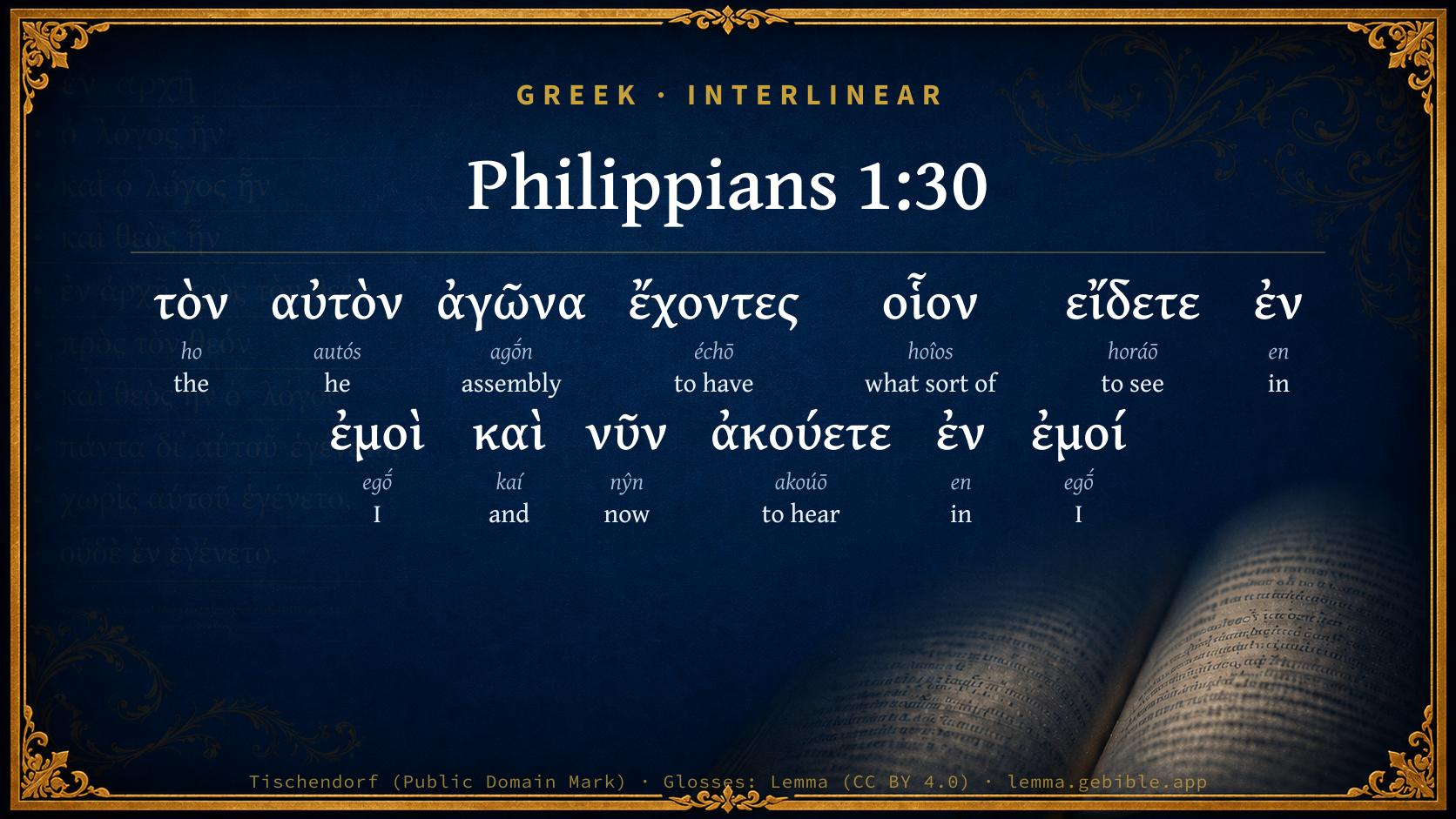
Download image
Cite this verse

Philippians 1:30 (World English Bible). Public Domain. Lemma interlinear Bible study tool, https://lemma.gebible.app/v/philippians/1/30.

Show BibTeX & RIS
BibTeX
RIS
English Translation
having the same conflict which you saw in me, and now hear is in me.
World English Bible · Public Domain
Highlights
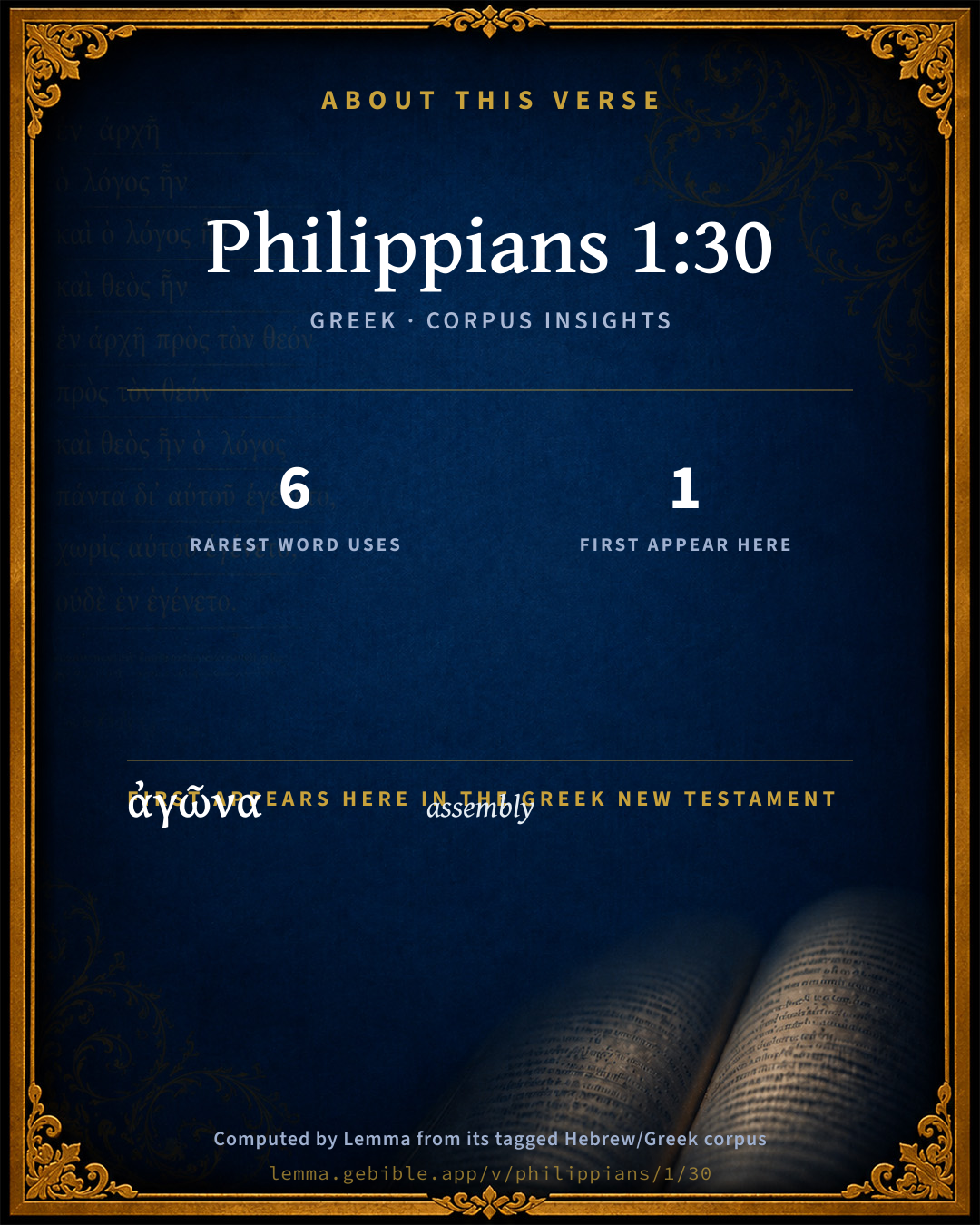
  • 1 first appearance in the Greek New Testament
Full analysis ↓
Download a study sheet

One document with this verse’s original text, its word-by-word gloss line, the meaning frame, cross-references with their text, attributed commentary, and full source and license credits — printable, and it pastes into notes with its structure intact.

This verse Autodidact and up

Study sheet (.html) Plain text (.txt)

A passage Seminary Student

Up to 50 verses in one chapter. A passage sheet keeps up to 6 commentary sources and 12 cross-references per verse, in the order this page ranks them, and says so on the sheet whenever that leaves anything out. Ask for a single verse and you get the Autodidact verse sheet above.

Everything on this page stays free to read, with no account — the sheet is a download of what is already on screen, not access to it.

Want to remove ads? Support Godless Engineer
Compare translations 3

The same verse in 3 English versions, stacked beneath the original-language interlinear above. Click any original word for its lexicon entry.

Each is an independent rendering of the whole verse — the interlinear is not word-aligned to these translations.

Highlighted words mark where these versions differ — a whole-verse word diff, not a word-by-word alignment.

  • World English Bible Public Domain
    having the same conflict which you saw in me, and now hear is in me.
  • King James Version Public Domain
    Having the same conflict which ye saw in me, and now hear to be in me.
  • unfoldingWord Literal Text CC BY-SA 4.0
    having the same struggle which you saw in me, and now you hear in me.

unfoldingWord Literal Text — © unfoldingWord, licensed CC BY-SA 4.0. Word-aligned USFM3 via Door43 (git.door43.org/unfoldingWord/en_ult).

Versions to compare (up to 4)

3 of 4 selected

Show all 19 translations

Every available English version of this verse, each an independent rendering of the whole verse.

  • World English Bible Public Domain
    having the same conflict which you saw in me, and now hear is in me.
  • Berean Standard Bible Public Domain
    since you are encountering the same struggle you saw I had, and now hear that I still have.
  • Majority Standard Bible Public Domain
    since you are encountering the same struggle you saw I had, and now hear that I still have.
  • King James Version Public Domain
    Having the same conflict which ye saw in me, and now hear to be in me.
  • American Standard Version (1901) Public Domain
    having the same conflict which ye saw in me, and now hear to be in me.
  • Revised Version (1885) Public Domain
    having the same conflict which ye saw in me, and now hear to be in me.
  • Geneva Bible (1599) Public Domain
    Hauing the same fight, which ye sawe in me, and nowe heare to be in me.
  • Douay-Rheims (1899) Public Domain
    Having the same conflict as that which you have seen in me, and now have heard of me.
  • Young's Literal Translation Public Domain
    the same conflict having, such as ye saw in me, and now hear of in me.
  • Literal Standard Version CC BY-SA 4.0
    having the same conflict, such as you saw in me, and now hear of in me.
  • Unlocked Literal Bible CC BY-SA 4.0
    having the same conflict which you saw in me, and now you hear in me.
  • unfoldingWord Literal Text CC BY-SA 4.0
    having the same struggle which you saw in me, and now you hear in me.
  • Darby Bible Public Domain
    having the same conflict which ye have seen in me, and now hear of in me.
  • World Messianic Bible Public Domain
    having the same conflict which you saw in me and now hear is in me.
  • Webster's Bible Public Domain
    Having the same conflict which ye saw in me, and now hear to be in me.
  • Free Bible Version CC BY-SA 4.0
    You're experiencing the same struggle you saw me having—a struggle I still have, as you now know.
  • Bible in Basic English Public Domain
    Fighting the same fight which you saw in me, and now have word of in me.
  • Text-Critical English NT CC BY 4.0
    since you are experiencing the same conflict that you saw I had and now hear that I still have.
  • Tyndale New Testament (1534) Public Domain
    and have even the same fight which ye sawe me have and now heare of me.

Literal Standard Version (2020), Covenant Press — licensed CC BY-SA 4.0. Text via the HelloAO Bible API (eBible.org). Unlocked Literal Bible (unfoldingWord) — licensed CC BY-SA 4.0. Text via the HelloAO Bible API (eBible.org). unfoldingWord Literal Text — © unfoldingWord, licensed CC BY-SA 4.0. Word-aligned USFM3 via Door43 (git.door43.org/unfoldingWord/en_ult). Free Bible Version, Dr. Jonathan Gallagher — licensed CC BY-SA 4.0. Text via the HelloAO Bible API (eBible.org).

Word by word

More ways to search: Search by grammar → Find every occurrence → Compare this word →

Practice this passage: Drill this verse → Learn its vocabulary →

ἀγῶνα
agṓn
G73
“assembly”
Noun, Accusative, Singular, Masculine
Part of Speech
Noun
Case
Accusative
Number
Singular
Gender
Masculine
Full Thayer's Definition

Origin: from G71

TDNT: 03:15,2

1. an assembly, a. a place of assembly: especially an assembly met to see games b. the place of contest, the arena or stadium 2. the assembly of the Greeks at their national games a. hence the contest for a prize at their games b. generally, any struggle or contest c. a battle d. an action at law, trial
  1. τὸν ho G3588 “the” Article, Accusative, Singular, Masculine
  2. αὐτὸν autós G846 “he” Personal pronoun, Accusative, Singular, Masculine
  3. ἔχοντες échō G2192 “to have” Verb, Present, Active, Participle, Nominative, Plural, Masculine
  4. οἷον hoîos G3634 “what sort of” Correlative pronoun, Accusative, Singular, Masculine
  5. εἴδετε horáō G3708 “to see” Verb, Aorist, Active, Indicative, 2nd person, Plural
  6. ἐν en G1722 “in” Preposition
  7. ἐμοὶ egṓ G1473 “I” Personal pronoun, 1st person, Dative, Singular
  8. καὶ kaí G2532 “and” Conjunction
  9. νῦν nŷn G3568 “now” Adverb
  10. ἀκούετε akoúō G191 “to hear” Verb, Present, Active, Indicative, 2nd person, Plural
  11. ἐν en G1722 “in” Preposition
  12. ἐμοί egṓ G1473 “I” Personal pronoun, 1st person, Dative, Singular

About this verse

These counts appear in no published source. They are computed here, from the morphology-tagged text and Lemma’s own curated glosses. What Lemma adds →

13
words
11
distinct lemmas
Pauline Epistles
section

Notable vocabulary

The rarest word here is ἀγῶνα assembly G73 — appearing just 6 times in the whole Greek New Testament.

First appearance in Scripture

This word makes its first canonical appearance in the Greek New Testament here:

  • ἀγῶνα assembly G73

Shared distinctive vocabulary

ἀγῶνα assembly G73 occurs in 6 verses of the Greek New Testament. Also found in:
Repetition

Words recur within this verse:

Cross-references

17

Topical passages linked to Philippians 1:30 in the Treasury of Scripture Knowledge — connected by theme and wording, ordered by reader-vote popularity; previews shown in the World English Bible.

  • 1 Thessalonians 2:2 but having suffered before and been shamefully treated, as you know, at Philippi, we grew bold in our God to tell you the Gospel of God in much conflict.
  • Acts 16:19–40 But when her masters saw that the hope of their gain was gone, they seized Paul and Silas, and dragged them into the marketplace before the rulers.
  • 2 Timothy 4:7 I have fought the good fight. I have finished the course. I have kept the faith.
  • Romans 8:35–37 Who shall separate us from the love of Christ? Could oppression, or anguish, or persecution, or famine, or nakedness, or peril, or sword?
  • John 16:33 I have told you these things, that in me you may have peace. In the world you have oppression; but cheer up! I have overcome the world."
  • 2 Timothy 2:10–12 Therefore I endure all things for the chosen ones' sake, that they also may obtain the salvation which is in Christ Jesus with eternal glory.
  • Hebrews 12:4 You have not yet resisted to blood, striving against sin;
  • Ephesians 6:11–18 Put on the whole armor of God, that you may be able to stand against the wiles of the devil.
  • 1 Timothy 6:12 Fight the good fight of faith. Lay hold of the eternal life to which you were called, and you confessed the good confession in the sight of many witnesses.
  • Hebrews 10:32–33 But remember the former days, in which, after you were enlightened, you endured a great struggle with sufferings;
  • Revelation 2:10–11 Don't be afraid of the things which you are about to suffer. Behold, the devil is about to throw some of you into prison, that you may be tested; and you will have oppression for ten days. Be faithful to death, and I will give you the crown of life.
  • Revelation 12:11 They overcame him because of the Lamb's blood, and because of the word of their testimony. They didn't love their life, even to death.
  • 1 Corinthians 4:9–14 For, I think that God has displayed us, the apostles, last of all, like men sentenced to death. For we are made a spectacle to the world, both to angels and men.
  • 1 Corinthians 15:30–32 Why do we also stand in jeopardy every hour?
  • Colossians 1:29–2:1 for which I also labor, striving according to his working, which works in me mightily.
  • 1 Thessalonians 2:14–15 For you, brothers, became imitators of the assemblies of God which are in Judea in Christ Jesus; for you also suffered the same things from your own countrymen, even as they did from the Jews;
  • 1 Thessalonians 3:2–4 and sent Timothy, our brother and God's servant in the Gospel of Christ, to establish you, and to comfort you concerning your faith;

Cross-references courtesy of OpenBible.info (CC BY 4.0).

Commentary

Notes on Philippians 1:30 from classic Christian and Jewish commentators (each source and its license shown beneath its notes). The classic Christian expositions comment on the surrounding passage and are grouped to its opening verse, so a note may address several verses; the Jewish commentaries on the Tanakh (Rashi and others) are per-verse, so they appear only where the commentator wrote on this verse.

Lemma curates 59 commentaries, every one of them public domain or Creative Commons licensed, each selected and text-cleaned for this edition rather than reprinted as found. About our sources →

Tyndale Open Study Notes

Tyndale Open Resources

1:30 We are in this struggle together: Both Paul and the Philippians faced strong opposition—Paul was in prison, and the Philippians were being persecuted. • You have seen my struggle in the past: See Acts 16:11-40; cp. 1 Thes 2:2.

Tyndale Open Study Notes — © Tyndale Open Resources, licensed CC BY-SA 4.0. Text via the HelloAO Bible API.

Bengel's Gnomon

Johann Albrecht Bengel

Php 1:30. Ἐχοντες, having) construed with ye stand fast, in nothing terrified, Php 1:27-28.—εἴδετε, you have seen) Act 16:12; Act 16:19-20.—ἐν ἐμοὶ, in me) who am not terrified.

—————

Bengel's Gnomon of the New Testament — English translation (T&T Clark, Edinburgh, 1860) — public domain. Text from a community e-Sword module.

Meyer's Critical & Exegetical Commentary

Heinrich August Wilhelm Meyer

Php_1:30. So that ye have the same conflict, etc., serves to characterize the ὑμῖν ἐχαρ. τὸ ὑπὲρ Χ. πάσχειν just asserted; and Pauls intention in thus speaking, is to bring home to them the high dignity and distinction of suffering for Christ, which is involved in the consciousness of fellowship in conflict with the apostle. It is impossible, in accordance with the true explanation of what goes before (see on Php_1:29), to find in τὸν αὐτόν, that they have themselves sought their conflict of suffering as little as the apostle had sought his, but, on the contrary, have received it as a gift of grace from God (Hofmann). The participle might have been put by Paul in the nominative (instead of the dative), because ὑμεῖς was floating before his mind as the logical subject of the preceding clause. Comp. on Eph_3:18; Eph_4:2; 2Co_1:7; Col_2:2; Col_3:16; Php_3:19; Kühner, II. 2, p. 661 f. There is therefore neither a logical nor a grammatical reason, with Bengel, Michaelis, Lachmann, Ewald (comp. also Buttmann, Neut. Gr. p. 256 [E. T. 299]), to treat ἥτις … πάσχειν as a parenthesis,a construction which would be only an injurious interruption to the flow of the discourse.

τὸν αὐτόν] namely, in respect of the object; it is the conflict for Christ (Php_1:29) and His gospel (Php_1:7).

οἷον εἴδετε κ.τ.λ.] as ye have seen it in my person (viz. whilst I was still with you in Philippi; see scenes of this conflict in Act_16:16 ff.; comp. 1Th_2:2), and now (from my epistle which is read out to you) ye hear in my person. Paul, in his epistle, speaks to the Philippians as if they were listening to him in person; thus they hear in him his conflict, which is made known to them in the statements of the apostle. This explanation is all the less unfitting, as Hofmann terms it (comparing the ἐν ἡμῖν in 1Co_4:6), since Paul must necessarily have assumed that the statements in the epistle regarding his sufferings would not fail to receive more detailed description in Philippi on the part of Epaphroditus. The rendering de me for the second ἐν ἐμοί, adopted by Peschito, Vulgate, Erasmus, Beza, Calvin, Grotius, and others, including Flatt, is erroneous.

Meyer — Critical and Exegetical Commentary on the New Testament — English translation by Peter Christie, edited by Frederick Crombie (T&T Clark, 1880) — public domain. Text from a community e-Sword module.

Expositor's Greek Testament

ed. W. Robertson Nicoll

Phi 1:30 . ἀγῶνα . For the fact, see Act 16:19 ff. and cf. 1Th 2:2 . The metaphor has been prepared for by στήκετε and συναθλοῦντες . Cf. Epictet., iv., 4, 32 (quoted by Hatch, Hibb. Lects. , p. 156), “Life is in reality an Olympic festival: we are God’s athletes to whom He has given an opportunity of showing of what stuff we are made”. ἀγών was constantly used in later Greek of an inward struggle. See some striking exx. from Plutarch in Holden’s note on Timoleon , xxvii., § 5. ἔχοντες . A broken construction. It ought strictly to be dative agreeing with ὑμῖν . It can scarcely be taken as parallel with συναθλ . and πτυρ . εἴδετε . See reff. above. ἀκούετε . His Roman trial.

The Expositor's Greek Testament, edited by W. Robertson Nicoll (1897–1910) — public domain. Text from a community e-Sword module.

Cambridge Greek Testament for Schools and Colleges

30. τὸν αὐτὸν ἀγῶνα ἔχοντες. The participle, with its nominative, is out of construction with the ὑμῖν of Php 1:29, and in construction with the πτυρόμενοι of Php 1:28. So that, grammatically, the words from ἥτις ἐστὶν to πάσχειν must be reckoned parenthetical. But the thought of Php 1:29 glides into that of Php 1:30 supra grammaticam.

ἀγῶνα. The word (originally meaning a gathering (ἄγω), as at the Greek sports) slightly suggests the athletic arena, and thus echoes συναθλοῦντες above (Php 1:27). It recurs Col 2:1; 1Th 2:2; 1Ti 6:12; 2Ti 4:7; Heb 12:1. The word ἀγωνία is used of our blessed Lord’s great “Wrestling” in the Garden, Luk 22:44. The ἀγών here obviously is the strife of faith and patience against persecuting violence.

ἀγῶνα ἔχοντες. For the phrase see Col 2:1, ἡλίκον ἀγὼνα ἔχω ὑπὲρ ὑμῶν. The verb in such a connexion comes nearly to mean “feeling,” “experiencing.” Cp. 2Co 1:9, ἐν ἑαυτοῖς κατάκριμα τοῦ θανάτου ἐσχήκαμεν for a somewhat similar use of ἔχειν.

εἴδετε. In the streets and court-house at Philippi, Acts 16.

ἀκούετε. In the Roman prison. He appeals to them with the magic power of a leader in suffering.

Cambridge Greek Testament for Schools and Colleges (Cambridge University Press, 1896; 21 vols, various authors incl. Carr, Maclear, Plummer, Farrar, Lumby, Moule, M. R. James, Simcox) — public domain. Text from a community e-Sword module.

Geneva Bible (1599)

Geneva Bible translators

Now he showeth for what purpose he made mention of his afflictions.

Geneva Bible (1599) marginal notes — public domain. Text via Bolls.life.

Jamieson, Fausset & Brown

Robert Jamieson, A. R. Fausset & David Brown

ye saw in me-- (Act 16:12, Act 16:19, &c.; Th1 2:2). I am "in nothing terrified by mine adversaries" (Phi 1:29), so ought not ye. The words here, "ye saw . . . and . . . hear," answer to "I come and see you, or else . . . hear" (Phi 1:27).

Next: Philippians Chapter 2

Jamieson, Fausset & Brown — Commentary Critical and Explanatory on the Whole Bible (1871) — public domain (CC PDM 1.0). Text via the HelloAO Bible API.

Adam Clarke's Commentary

Verse 30. Having the same conflict] When Paul preached the Gospel at Philippi he was grievously persecuted, as we learn from Ac 16:19-40, being stripped, scourged, thrown into prison, even into the dungeon, and his feet made fast in the stocks. This was the conflict they had seen in him; and now they heard that he had been sent prisoner to Rome as an evil doer, and that he was at present in bonds, and shortly to be tried for his life before the Roman emperor to whom he had been obliged to appeal.

1. IT was no small encouragement to these persons,

(1.) That whatever sufferings they met with they were supported under them.

(2.) That they suffered in the same cause in which their illustrious apostle was suffering.

(3.) That they suffered, not because they had done any evil, or could be accused of any, but because they believed in the Son of God, who died for them and for all mankind.

(4.) That all these sufferings were sanctified to their eternal good.

2. And God is able to make the same grace abound towards us in like circumstances; it is for this purpose that such consolatory portions are left on record. He who is persecuted or afflicted for Christ's sake, is most eminently honoured by his Creator.

Adam Clarke's Commentary on the Bible (1810–1826) — public domain. Text from a community e-Sword/MySword module.

John Calvin's Commentaries

30 Having the same conflict. He confirms, also, by his own example what he had said, and this adds no little authority to his doctrine. By the same means, too, he shews them, that there is no reason why they should feel troubled on account of his bonds, when they behold the issue of the conflict.

John Calvin's Commentaries (1540-1563) — public domain. Text from the Calvin Translation Society English edition (1840s-50s) via the Christian Classics Ethereal Library (ccel.org). Calvin's coverage is partial (roughly two-thirds of the Bible); uncommented books and verses are honest gaps, never fabricated. The 19th-century editor's footnotes and remarks are omitted so the notes are faithfully Calvin's own voice.

Ellicott's Commentary for English Readers

(30) Having the same conflict, which ye saw in me.—The allusion is, of course, to the lawless scourging and imprisonment of Act_16:22-24. How deeply this outrage impressed itself on the Apostle’s own mind we see, both by his conduct to the magistrates at the moment, and also by the allusion in 1Th_2:2, to the time, when “we had suffered before and were shamefully entreated, as ye know, at Philippi.” Here he uses the remembrance to suggest to the Philippians that their struggle was only the same which he had borne, and borne successfully. Similarly in 2Ti_3:10 (going back on the eve of death to the very beginning of his ministry to the Gentiles) he reminds Timothy of the persecutions “at Antioch, at Iconium, at Lystra—what persecutions I endured, but out of them all the Lord delivered me.”

A Bible Commentary for English Readers, edited by Charles John Ellicott (1878–1897) — public domain. Text from a community e-Sword module.

The Cambridge Bible for Schools and Colleges

gen. ed. J. J. S. Perowne

30. Having &c.] The Greek construction, if strictly taken, points back to the first clause of Php_1:28, and leaves the intermediate words as a parenthesis. But it is much likelier that the construction here is free, and that this verse accordingly carries out the last words of Php_1:29 into detail.

conflict] Greek agôn, a word suggestive of the athletic arena rather than the battle-field. See above on “striving together,” Php_1:27. It recurs Col_2:1 (perhaps for the “wrestlings” of prayer); 1Th_2:2; 1Ti_6:12; 2Ti_4:7; Heb_12:1. Our blessed Lord’s great “Wrestling” in Gethsemane, His sacred “Agony,” is called by the kindred word agônia, Luk_22:44.

ye saw] in the streets and in the court-house at Philippi; Acts 16. One of the probable recipients of this letter, the Jailer, had not only “seen” but inflicted other sufferings in the dungeon.

The Cambridge Bible for Schools and Colleges (gen. ed. J. J. S. Perowne; Cambridge University Press, 1878–1918) — public domain. Text from a community e-Sword module.

John Gill's Exposition

Having the same conflict,.... For it seems that the Philippians were now under persecution for the Gospel of Christ; but this was no new or strange thing; it was the same the apostle was under formerly, and at that time:

which ye saw in me, and now hear to be in me; when he and Silas were at Philippi, and first preached the Gospel there, they were exceedingly ill used, and shamefully entreated; they were dragged to the market place, or court, were beaten and scourged, and put into the inner prison, and their feet made fast in the stocks, Act 16:19; of all this the Philippians were eyewitnesses, and to which he here refers when he says, which ye saw in me; and now he was a prisoner at Rome, as they had heard, hence he says, "and now hear to be in me"; for they had sent Epaphroditus to him with a present, as a token of their love to him, and to support him under his affliction; and which he mentions, in order to animate them to bear their sufferings patiently for Christ's sake, since the same were accomplished in him, as well as in the rest of their brethren and fellow Christians in the world.

Next: Philippians Chapter 2

John Gill's Exposition of the Whole Bible (1746–1763) — public domain (CC PDM 1.0). Text via the HelloAO Bible API.

Trapp's Complete Commentary

John Trapp

30 Having the same conflict which ye saw in me, and now hear to be in me.

Ver. 30. Which ye saw in me] Act 16:19; Act 16:23-24, &c. {See Trapp on "Act 16:19"} {See Trapp on "Act 16:23"} {See Trapp on "Act 16:24"}

John Trapp, A Commentary or Exposition upon All the Books of the Old and New Testament (1647–1656) — public domain. Text from a community e-Sword module.

Albert Barnes' Notes on the Bible

Having the same conflict - The same agony - ἀγῶνα agōna - the same strife with bitter foes, and the same struggle in the warfare.

Which ye saw in me - When I was in Philippi, opposed by the multitude, and thrown into prison; Acts 16.

And now hear to be in me - In Rome. He was a prisoner there, was surrounded by enemies, and was about to be tried for his life. He says that they ought to rejoice if they were called to pass through the same trials.

In this chapter we have a beautiful illustration of the true spirit of a Christian in circumstances exceedingly trying. The apostle was in a situation where religion would show itself, if there were any in the heart; and where, if there was none, the bad passions of our nature would be developed. He was a prisoner. He had been unjustly accused. He was about to be put on trial for his life, and it was wholly uncertain what the result would be. He was surrounded with enemies, and there were not a few false friends and rivals who took advantage of his imprisonment to diminish his influence and to extend their own. He was, perhaps, about to die; and at any rate, was in such circumstances as to be under a necessity of looking death in the face.

In this situation he exhibited some of the tenderest and purest feelings that ever exist in the heart of man - the genuine fruit of pure religion. He remembered them with affectionate and constant interest in his prayers. He gave thanks for all that God had done for them. Looking upon his own condition, he said that the trials which had happened to him, great as they were, had been overruled to the furtherance of the gospel. The gospel had become known even in the imperial palace. And though it had been preached by some with no good will toward him, and with much error, yet he cherished no hard feeling; he sought for no revenge; he rejoiced that in any way, and from any motives, the great truth had been made known that a Saviour died. Looking forward to the possibility that his trial before the emperor might terminate in his death, he calmly anticipated such a result, and looked at it with composure.

He says that in reference to the great purpose of his life, it would make no difference whether he lived or died, for he was assured that Christ would be honored, whatever was the result. To him personally it would be gain to die; and, as an individual, he longed for the hour when he might be with Christ. This feeling is religion, and this is produced only by the hope of eternal life through the Redeemer. An impenitent sinner never expressed such feelings as these; nor does any other form of religion but Christianity enable a man to look upon death in this manner. It is not often that a man is even willing to die - and then this state of mind is produced, not by the hope of heaven, but by disgust at the world; by disappointed ambition; by painful sickness, when the sufferer feels that any change would be for the better. But Paul had none of these feelings. His desire to depart was not produced by a hatred of life; nor by the greatness of his sufferings; nor by disgust at the world.

It was the noble, elevated, and pure wish to be with Christ - to see him whom he supremely loved, whom he had so long and so faithfully served, and with whom he was to dwell forever. To that world where Christ dwelt be would gladly rise; and the only reason why he could be content to remain here was, that he might be a little longer useful to his fellow human beings. Such is the elevated nature of Christian feeling. But, alas, how few attain to it; and even among Christians, how few are they that can habitually feel and realize that it would be gain for them to die! How few can say with sincerity that they desire to depart and to be with Christ! How rarely does even the Christian reach that state of mind, and gain that view of heaven, that, standing amidst his comforts here, and looking on his family, and friends, and property, he can say from the depths of his soul, that he feels it would be gain for him to go to heaven! Yet such deadness to the world may be produced - as it was in the case of Paul; such deadness to the world should exist in the heart of every sincere Christian. Where it does exist, death loses its terror, and the heir of life can look calmly on the bed where he will lie down to die; can think calmly of the moment when he will give the parting hand to wife and child, and press them to his bosom for the last time, and imprint on them the last kiss; can look peacefully on the spot where he will moulder back to dust, and in view of all can triumphantly say, “Come, Lord Jesus, come quickly.”

Albert Barnes' Notes on the Bible (1834–1885) — public domain. Text from a community e-Sword/MySword module.

Matthew Poole's English Annotations

And be heartened to partake with him in the like trials he sustained when amongst them, Act 16:19-24, and which he now was enduring at Rome, Phi 1:13; an example of suffering unto them, if they would but await the blessed issue of his agony.

Matthew Poole's English Annotations on the Holy Bible (1683–1685) — public domain. Text from a community e-Sword/MySword module.

Whedon's Commentary on the Bible

Daniel D. Whedon

30. The same conflict—The old persecution continued.

Saw… hear— They knew of the arrest, the scourging, the prison, and the stocks, as Paul had endured them at Philippi, and they had heard of his situation at Rome. Their long struggle was like his own, and was to be heroically endured unto the end.

Daniel D. Whedon (gen. ed.), Commentary on the Old and New Testaments (1874–1909) — public domain. Text from a community e-Sword module.

The Pulpit Commentary

Having the same conflict which ye saw in me, and now hear to be in me. These words are best taken with Ver. 27, vers. 28 and 29 being parenthetical. The apostle returns to the military or gladiatorial metaphor of a contest, agwn . He had himself been persecuted at Philippi; (Act_16:1 2Th_2:2) now the Philippians heard of his Roman imprisonment, and were themselves suffering similar persecutions.

The Pulpit Commentary (1880–1919), ed. H.D.M. Spence-Jones & Joseph S. Exell — public domain. Text from a community e-Sword module.

John Wesley's Explanatory Notes

Having the same kind of conflict with your adversaries, which ye saw in me - When I was with you, Acts xvi, 12, 19, &c.

John Wesley, Explanatory Notes Upon the Whole Bible (1754–1765) — public domain. Text via the GEBible commentary corpus.

Burkitt's Expository Notes on the New Testament

William Burkitt

Here is the last argument made use of by the apostle to encourage them unto patient suffering for the gospel of Christ, as it would render them comfortable to Christ their head, so to him their apostle, who suffered many hard things when he was at Philippi, as they had seen, and stood ready to suffer, not only bonds, but death itself, now he was at Rome, which they heard of: Having the same conflict which you saw in me, and now hear to be in me.

Here observe, 1. The title given by St. Paul to his sufferings for the gospel; he calls them a conflict.

Learn, That Christian courage under sufferings cannot be kept up without a mighty conflict; we must conflict with our enemies, with the rage of persecutors; we must conflict with ourselves, and with our own spirits, to keep them from fainting under persecution; and we must even conflict with God himself, wrestle with him, by prayers, for extraordinary measures of strength to support us under sufferings, and to enable us to glorify God in and by them: well might the apostle then call his sufferings a conflict.

Observe, 2. St. Paul encourages the Philippians to conflict with sufferings, from his own example before them: Having the same conflict which you saw in me.

Learn, That the prudent and patient sufferings of the ministers of Christ for the truth of the gospel are, and ought to be, a powerful encouragement to all their people to conflict with the like difficulties and trials for the testimony of Christ: the Captain goes first, leads the van, his ministers follow, and their people bring up the rear; and, having suffered together, they shall also be glorified together; a suffering head, and suffering members, shall never be separated.

William Burkitt's Expository Notes on the New Testament (1700–1703) — public domain. Text from a community e-Sword module.

The People's New Testament

B. W. Johnson

30. Having the same conflict which ye saw in me. You saw when I was at Philippi what I had to endure (Acts 16:19); you hear that I am now a prisoner threatened with death. You must expect similar conflicts and meet them with fortitude.

B. W. Johnson's The People's New Testament with Notes (1889–1891) — public domain. Electronic text from the Christian Classics Ethereal Library (CCEL) ThML edition.

Alford’s Greek Testament

Henry Alford

30.] having (the nominative instead of the dative, the subjective ὑμεῖς being before the Apostle’s mind: so Eph 4:2,—Thuc. iii. 36, ἔδοξεν αὐτοῖς … ἐπικαλοῦντες: ib. vi. 24, καὶ ἔρως ἐνέπεσε πᾶσιν … εὐέλπιδες ὄντες: Sallust, Jug. 112, ‘populo Romano melius visum … rati:’ see other examples in Kühner, ii. p. 377. This is far better than with Lachm., al., to parenthesize ἥτις … πάσχειν, which unnecessarily breaks the flow of the sentence) the same conflict (one in its nature and object) as ye saw (viz. when I was with you, Act 16:16 ff.) in me (in my case as its example), and now hear of in me (ἐν ἐμοί, as before, not ‘de me.’ He means, by report of others, and by this Epistle).

Henry Alford, The Greek Testament (1849–1861) — public domain. Text from a community e-Sword module.

International Critical Commentary

30. ἔχοντες: ‘you having,’ or ‘so that you have.’ Characterising ὅτι ὑμῖν ἐχαρ … πάσχειν by the concrete case of their share in his own conflict. The participle agrees with ὑμεῖς, the logical subject of the entire clause. (Comp. similar construction in Eph 3:17, Eph 3:4:2; 2Co 1:7; Col 2:2.) Not with στήκετε (vs. 27), making ἥτις … πάσχειν a parenthesis, which would be clumsy.

ἀγῶνα: ‘conflict.’ (Comp. συναθλοῦντες [vs. 27] and Col 2:1; 1Th 2:2; 1Ti 6:12; Heb 12:1.) The word applied originally to a contest in the arena, but used also of any struggle, outward or inward. For the latter see Col 2:1, and comp. Col 4:12. The reference here is to his experience in his first visit to Philippi, and to his latest experience in Rome. Their conflict is the same (τὸν αὐτὸν). They too have suffered persecutions, and for the same reason, and from the same adversaries.

εἴδετε: ‘ye saw,’ when I was with you at Philippi (Act 16:19; 1Th 2:2). They saw him scourged and imprisoned.

νῦν ἀκούετε: ‘you now hear,’ as you read this letter, and listen to the account of Epaphroditus.

ἐν ἐμοί: in my person.

EXCURSUS

BISHOPS AND DEACONS (Php 1:1)

It is evident that these words are related to the large and complicated question of primitive church polity. Do they denote official titles, or do they merely designate functions? What is their relation to the πρεσβύτεροι of the Acts and Pastoral Epistles? Were the offices of bishop and presbyter originally the same, and the names synonymous; or, was there an original distinction? Were the ἐπίσκοποι the direct successors of the apostles, distinct from the πρεσβύτεροι and higher; or, was the episcopate a development from the presbyterate, formed by gradual elevation, and, finally, appropriating to itself the title which was originally common to both, so that the New Testament knows only two orders —presbyters and deacons? What light is thrown on the question by the use of the terms here?

To deal adequately with these questions, and with the voluminous discussion which they have called out, is manifestly impossible within the limits of an excursus, and the result of the most elaborate discussion cannot be decisive, owing to the imperfection of the sources at our disposal.

The theory of the original identity of bishops and presbyters has been a subject of controversy from a very early date. It was opposed to the Roman theory that bishops were the only successors of the apostles, and had from the beginning the divine commission to rule the church. This latter theory was issued as a dogma by the Council of Trent, and the opposite view was declared heretical. The Roman dogma was rejected by the Calvinists and Lutherans. About the middle of the seventeenth century the battle over this question raged between the Anglican church on the one hand, and the English Puritans and the French Reformers on the other. Dissatisfaction with the Roman view developed as the discussion gradually shifted from a dogmatic to a historical basis. The present century has been prolific in attempts to solve the problem. Passing by those of Baur, Kist, Rothe, and Ritschl, the three most significant discussions from 1868 to 1883 were those of Lightfoot in his essay on “The Christian Ministry” in his Commentary on Philippians; Hatch, in the Bampton Lectures for 1880 (The Organisation of the Early Christian Church), and Harnack’s translation and development of Hatch’s work (E. Hatch: Die Gesellschaftsverfassung der christlichen Kirchen im Alterthum, übers. von A. Harnack, 1883). Harnack’s views were further expounded in his Lehre der zwölf Apostel, 1884; his Review of Loening’s Gemeindeverfassung in Th. Lz., 1889, No. 17; in Gebhardt and Harnack’s Texte und Untersuchungen, Bd. ii. Heft 1, 5, and in his Dogmengeschichte.

Among the most important of the later discussions are: Lechler, Das apostolische und das nachapostolische Zeitalter, 3 Aufl., 1885; Kühl, Die Gemeindeverfassung in der Pastoralbriefen, 1885; E. Loening, Die Gemeindeverfassung des Urchristenthums, 1889; F. Loofs, Die urchristliche Gemeindeverfassung, Stud. u. Krit., 1890, Heft 4; Weizsäcker, Das apostolische Zeitalter der christlichen Kirche, 2 Aufl., 1892; Rud. Sohm, Kirchenrecht, Bd. 1., 1892; Jean Réville, Les Origines de l’ Épiscopat, 1894. Harnack is reviewed by Professor Sanday in The Expositor, 3d ser. vol. v. This and the succeeding volume contain an interesting group of papers by J. Rendel Harris, J. Macpherson, C. Gore, W. Milligan, G. Salmon, G. A. Simcox, and Professor Harnack.

The Pauline epistles, omitting for the present the Pastorals, exhibit church polity in a rudimentary and fluid state in which official designations are not sharply defined, and the offices themselves have not taken permanent and definite shape. The forms of polity are simple, founded upon local conditions, and not uniform over the entire area of the church. The official designations, so far as they have arisen, are the natural and familiar expressions of particular functions. The terms often overlap or are confused, and a term in use in one part of the church does not appear in another part. An apostle, a bishop, a teacher, a deacon, are alike “servants.” An overseer will be likely to be a presbyter, chosen on account of his age and experience. The overseers may be called προϊστάμενοι, ἡγούμενοι, or κυβερνήσεις. The assistants of an overseer may be known as διάκονοι or ἀντιλήμψεις.

In short, we find within this circle an entire lack of uniformity in the terms applied to church officials, and a marked vagueness in their use. The terms do not wholly explain themselves. Most of them are capable of a functional meaning; and in most, if not all, cases of their occurrence, they may be explained as indicating the peculiar function of an official instead of his official title. This is the case in Act 20:28, which is so often cited as decisive of the original identity of presbyter and bishop. Ἐπίσκοπος occurs but once in these epistles (Php 1:1); διάκονος but once in an official sense (Php 1:1); προϊστάμενοι in Rom 12:8; 1Th 5:12, both times functionally. In 1Co 12:28, we have, besides apostles, prophets, and teachers, δυνάμεις, ἀντιλήμψεις, and κυβερνήσεις, which are abstract terms. Ἐπίσκοπος, διάκονος, προϊστάμενος, however they may be explained in any particular case, denote functions. Ἐπίσκοπος is an overseer; διάκονος a servant; προϊστάμενος one who stands in front. Διακονία is applied to religious and churchly ministries of all kinds. In Eph 4:11, Eph 4:12, Paul says that Christ gave apostles, prophets, evangelists, pastors, and teachers to the work of διακονία for the perfecting of the saints. Paul and Apollos, Timothy and the secular ruler, are alike διάκονοι (1Co 3:5; 1Th 3:2; Rom 13:4).

This unsettled state of the nomenclature corresponds with the fact that the primitive church was not a homogeneous body throughout Christendom. While the Jewish-Christian church assumed the connection of all local congregations with the mother-church at Jerusalem, there was no similar bond among the Gentile churches. Paul’s ideal was one body—the church, as the body of Christ, embracing all Christians of every nationality and social condition. He aspired to found a world-wide society, united neither by national tradition nor by common rites, but by a common faith and a common inspiration (1Co 10:16, 1Co 10:12:27; Rom 12:5; Eph 2:14-22). He speaks of “the church of God” (1Co 10:32), and of “the church” (1Co 12:28). He labored to hold the provincial churches together by his letters and messengers (1Co 16:19; 2Co 1:1). The boldness of his ideal, and his profound faith in the truth which he proclaimed, are all the more striking when the heterogeneous character of his churches is considered. (See a fine passage in Réville, Les Origines de l’ Épiscopat, p. 115.) But the Gentile churches were united mainly through their relation to him, and all the churches were not within the sphere of his personal authority and work. Hence a collective Christendom was, as Holtzmann observes, “a genuine, ideal whole, identical with the body of the Lord, but not an actual fact” (Pastoralbriefe, p. 193). The primitive Pauline church consisted of a number of little fraternities, composed largely of the poor and of the lower orders of society, holding their meetings in the private houses of some of their members.

These communities were self-governing. The recognition of those who ministered to the congregations depended on the free choice of their members. At Corinth the household of Stephanas is commended by Paul to the church as being the earliest converts in Achaia, and as having voluntarily assumed the work of ministry to the saints (1Co 16:15, 1Co 16:16). They were not regularly appointed to office. The church is exhorted to render obedience to them, and also to every one who shall coöperate with them in their ministry. (See Pfleiderer, Paulinismus, 2 Aufl. p. 244.) Phœbe is not a deaconess, but a servant of the congregation, a patroness (προστάτις) of Paul and of others (Rom 16:1, Rom 16:2). The congregation exercises discipline and gives judgment (1Co 5:3-5; 2Co 2:6, 2Co 2:7, 2Co 2:7:11, 2Co 2:12; Gal 6:1). In 1Co 6:1, Paul recommends to the church to settle their differences by arbitration. The alternative is litigation before heathen tribunals. There is, in short, no hint of any one ecclesiastical office endowed with independent authority. “Paul,” to quote the words of Réville (p. 99), “is a sower of ideas, not a methodical administrator; a despiser of ecclesiastical forms and of ritualism; a mighty idealist filled with Christian enthusiasm, and who knew no other church government than that of Christ himself inspiring his disciples with the knowledge of what they ought to say and do.”

It is thus evident that within the circle of the generally acknowledged Pauline epistles there is no trace of formally constituted church officers, except, apparently, in the Philippian epistle where bishops and deacons are addressed. Of this presently. Certain functions, however, are distinctly recognised by Paul as of divine institution in the church; and to these, necessarily, pertained a degree of prominence and influence in the congregation.

The measure of this prominence and influence cannot be discussed here. Harnack (on Loening, Th. Lz., 1889) thinks that the pneumatic functions carried with them a “despotic” authority. (See Loening, Gemeindeverfassung, ch. ii.; Loofs, Stud. u. Krit., 1890, p. 622.)

Apostles, prophets, and teachers are declared by Paul to have been set by God in the church, and to these are added δυνάμεις, ἰάματα, ἀντιλήμψεις, κυβερνήσεις, γένη γλωσσῶν (1Co 12:28; comp. Eph 4:11, Eph 4:12; and see Réville, p. 124 f.).

I do not agree with Réville that the προϊστάμενοι of 1Th 5:12 (comp. Rom 12:8) are to be regarded as charismatically endowed.

These do not represent offices resting on the appointment of the church. Their warrant is a special divine endowment or χάρισμα. Apostles, prophets, teachers, do not signify three official grades in the church. The same man could be both a prophet and a teacher. Whatever authority they possessed depended upon the church’s conviction that their charisma was of divine origin.

In Paul’s two lists in 1 Cor. and Eph. of those who have been divinely commissioned in the church, neither ἐπίσκοποι, πρεσβύτεροι, nor διάκονοι appear. Nor do they appear anywhere in the acknowledged epistles of Paul with the exception of the greeting to the bishops and deacons in the Philippian letter. But in the Ignatian epistles (100-118 a.d.) we find a clear recognition of three orders of ministry,—bishops, presbyters, and deacons,— without which it is asserted that a church is not duly constituted (Trall. iii.). This ministry is the centre of church order. The bishop is distinguished from the presbyter as representing a higher order. He is to be regarded as the Lord himself (Eph. vi.); to be obeyed as Christ and as God (Trall. ii.; Mag. iii.). Nothing is to be done without his consent (Polyc. iv.). He is to be followed as Jesus followed the Father (Smyr. viii.). The presbyters are to preside after the likeness of the council of the apostles (Mag. vi.). Obedience is to be rendered to them as to the apostles of Jesus Christ (Trall. ii.). The deacons are to be respected as Jesus Christ (Trall. iii.). In short, we have in these epistles the strongly marked beginnings of the monarchical episcopacy.

See Lightf. Ignatius, vol. i. p. 389 ff.

Somewhat earlier, in the Epistle of Clement to the Corinthians (about 96 a.d.), we find a greater variety of names applied to church functionaries. Besides ἐπίσκοποι, πρεσβύτεροι, and διάκονοι, occur the titles ἡγούμενοι, προηγούμενοι, πρεσβύτεροι καθεσταμένοι, and ἐλλόγιμοι ἄνδρες. But it is also distinctly asserted (xlii. xliv.) that the apostles appointed bishops and deacons to succeed them because they knew through Christ that strife would arise over the name of the bishop’s office (ἐπισκοπὴ). It is to be noticed that presbyters are not mentioned.

Assuming the Philippian letter to have been written in 61 or 62 a.d., we have less than forty years to the time of Clement’s epistle, and less than sixty to the time of the Ignatian letters. A great development has taken place in those years from the rudimentary conditions of church polity which we have been considering. This change did not come at a leap. Its elements must have been long in solution in the fluid and more democratic polity of the earlier time. The important and difficult question is the process by which the earlier and crude forms of polity developed into that system which is more than foreshadowed in Clement, sharply defined in Ignatius, and an accepted fact in Irenæus, Tertullian, and Cyprian.

Here a difficulty arises as to our sources. Ἐπίσκοποι and διάκονοι appear in Phil.; ἐπίσκοποι, πρεσβύτεροι, and διάκονοι in the Pastoral Epistles; ἐπίσκοποι and πρεσβύτεροι in the Acts and 1 Pet.; πρεσβύτεροι in Jas., 1 Pet., 2 and 3 Jn., and the Apocalypse. Harnack places the Pastorals in the middle of the second century; Holtzmann, in its former half. The modern radical criticism of the Acts pushes its date forward into the second century (so Harnack) besides impugning its reliability on various grounds.

See Weizsäcker, Apost. ZA. 84ff., 167 ff., 199 ff.; J. Jüngst, Die Quellen der Apostelgeschichte, 1895; C. Clemen, Die Chronologie der paulinischen Briefe, 1893.

The point to be observed is, that if the later date of the Pastorals be accepted, they must be held to represent an advanced stage in the development toward the episcopal polity. Only let it be noted that Harnack’s date brings us within the circle of the Ignatian polity, and warrants us in expecting a far more precise use of terms in the three epistles than we actually find. There is a great distance between the episcopate of the Pastorals and that of the Ignatian epistles. (See Réville, p. 304.)

If, on the other hand, the Pastorals be accepted as late products of Paul’s hand, and the Acts as composed within the first century, we have in these, along with the Epistle to the Philippians and the Catholic epistles, traces of the transition from the looser to the better defined polity. We have evidence of the existence of πρεσβύτεροι and ἐπίσκοποι in the church contemporary with Paul, without our being compelled to admit either that the ἐπίσκοπος was a regularly ordained ecclesiastical officer, or that πρεσβύτεροι and ἐπίσκοποι are synonymous. We have simply what we have reason to expect; namely, that the three titles, ἐπίσκοποι, πρεσβύτεροι, and διάκονοι, fall within the period of unsettled polity and loose nomenclature. The fact that all these names may represent functions without designating official titles accords with this view. The process of crystallisation is going on. These different designations emerge here and there in the church as local developments, just as the terms προϊστάμενοι and ἡγούμενοι. It may be admitted that one term might, on occasion, have been loosely used for another; but the recognised and habitual identification of ἐπίσκοποι and πρεσβύτεροι is precluded by the very assumption that these functions had assumed the character of regularly constituted church offices or orders of the ministry. If such had been the case, such looseness and confusion in the use of the names of formally appointed and recognised church officers is inconceivable. I think that the indications of the nature of church polity furnished by the Pastorals are far fewer and less definite than is often assumed, and much too scanty to warrant the positive inferences based upon them as to the later date and the non-Pauline authorship of the letters. Harnack’s admission that older documents have been used in the composition of the Pastorals is an important concession, which makes against the theory of their testimony to a later stage of ecclesiastical polity.

According to our view of the case, therefore, the mention of bishops and deacons in the Philippian letter furnishes no exception to the statement that, within the circle of the acknowledged Pauline letters, there is no evidence of regularly constituted church officers representing distinct orders in the ministry. While the greeting to bishops and deacons is unique, it does not imply a polity differing substantially from that exhibited in 1 Cor. and 1 Thess. It will be observed that the greeting is first to the church, and that the letter is addressed to the whole church. The special mention of the bishops and deacons by way of appendage is explained by the fact that the letter was called out by the pecuniary contribution of the Philippian church to Paul, of the collection and sending of which these functionaries would naturally have charge. It will also be noticed that the address assumes several ἐπίσκοποι, showing that the right of administration is possessed by no single one.

At the same time, I think it must be granted with Harnack (Expositor, 3d ser. vol. v. p. 330) that while there cannot yet be any reference to an ecclesiastical authority over the church, the greeting of the Philippian letter implies a development of polity, in that the ministry has become divided into a higher and a lower ministry, and that its functionaries have obtained special designations, so that the name διάκονος has received a narrower signification, and designates a lower grade of ministry. The church at Philippi, at the time when Paul wrote this letter, had been in existence for ten years, and was the oldest Pauline church in Europe. It would not have been strange if its polity had become somewhat matured and more sharply defined, especially since it had suffered less distraction than other churches from conflicts with the Jews.

The Didache or Teaching of the Twelve Apostles is most important in its bearing on this subject. This brief church manual or directory, composed, probably in Syria, about 100 a.d., is a valuable contribution to the literature of the period between the destruction of Jerusalem (a.d. 70) and the middle of the second century, the least-known period of church history. Its special value consists in marking the transition-period from the apostolic to the later church polity, in which the spiritual functions pass over from the apostles, prophets, and teachers to the local officers —the bishops and deacons. On the one side it is linked with the apostolic polity. The principal offices are still the charismatic offices. The apostle, who is to be received as the Lord (xi. 4), is a travelling missionary, and is not to remain for more than two days in a place (xi. 5). The prophet speaks by divine inspiration, and is not to be tried or proved, as if for appointment to his office (xi. 7). The prophets are the chief priests (xiii. 3). Comp. the emphasis on prophecy in 1Co 12:28, 1Co 14:1-37. Presbyters are not mentioned, though it does not follow from this that they did not exist in some of the Syro-Palestinian churches. (See Réville, p. 259.) But bishops and deacons are distinctly recognised. They are local officers. They are elected to office (xv. 1), and on occasion they are to perform the ministry of the prophets and teachers (xv. 1); that is to say, the distinctively spiritual functions of the prophets may be discharged by them when the prophet is not present (xiii.).

The testimony of the Didache, therefore, does not bear out the original prominence which is claimed for the bishop. He is a secondary officer. He falls into the background behind the apostles, prophets, and teachers. The testimony, further, goes to show that spiritual functions did not originally attach to the offices of bishop and deacon. The evidence prior to the Didache that bishops or presbyters exercised such functions is very slight. The principal point insisted on is the laying on of hands (1Ti 4:14 [see especially Loening, p. 75 ff.]) and the allusions to the gift of teaching or preaching as a qualification of presbyters or bishops (1Ti 3:2, 1Ti 3:5:17; Tit 1:9). As to ordination, it will be observed that the charisma described as imparted to Timothy is given through the medium of prophecy (διὰ προφητείας). As to teaching or preaching, 1Ti 5:17 shows that even if this function was occasionally exercised by presbyters or bishops, it did not pertain to the office as such. “The elders who rule well” are to be accounted worthy of double honor, especially those who labor in word and teaching, which clearly implies that there were elders who did not labor in word and teaching.

In the Didache the spiritual functions belong, as in 1 Cor., to the prophets and teachers. The prophet is to discharge them when he is present. The prophet alone is allowed the free use of extemporary prayer (x. 7). In other respects the teacher is on the same footing with him. In the absence of the prophet or teacher, his ministry may be assumed by the bishops and deacons (xiii. xv. 1.). In other words, the evidence of the Didache is to the effect that, as the special supernatural endowments subside, as the visits of the prophets become less frequent, the ministrations of worship devolve more and more upon the subordinate and local officers.

This view is carried out by Harnack in his discussion of the Apostolical Ordinances or Canons (Tt. u. Unt. ii. 5). One portion of this formed a considerable part of the Didache. Two more parts, dating from forty to eighty years later than the Didache, mention the church officers in the following order: bishop, presbyter, reader, deacon. The bishop is the shepherd of the flock. The presbyters, two in number, form the council of the bishop, oversee church discipline, and take part with the bishop in the celebration of the Eucharist. The deacon has charge of the church charities, and keeps an eye upon disorderly members. The reader discharges the duties of an evangelist. He is a preacher or expounder, succeeding the evangelist, who belonged originally to the class of charismatically endowed teachers (comp. Eph 4:11); thus showing how formally appointed officials gradually succeeded to the functions of those who were supernaturally endowed by the Spirit.

The office of the ἐπίσκοπος thus acquired a different character when it assumed the teaching function. This does not yet appear in Clement. The function is described as λειτουργεῖν and προσφέρειν τὰ δῶρα (xliv.), yet the position is different from that of the Pauline period. With the passing away of the apostles, the authority of the bishop has increased. Its recognition no longer depends so exclusively on the approval of the members. Clement proclaims the apostolic origin and authority of the office, and at least suggests its life-long tenure (xliv.), a theory, as Harnack justly says, which has the appearance of being devised to meet an emergency; while some remnant of the earlier democratic sentiment is apparent in the ejection of the church authorities which was the occasion of Clement’s letter.

The bishop’s office, therefore, was originally not spiritual but administrative. He had a local function in a particular community. The question as to the precise nature and range of this function cannot be answered decisively; but some modern critics have, I think, narrowed it too much. Hatch, following in the track of Renan, Foucart, Lüders, Heinrici, and Weingarten, derives the term ἐπίσκοπος from the financial officers in the heathen municipalities or in the confraternities or guilds which were so common in the Roman Empire (see note on τῇ κατʼ οἶκον σου ἐκκλησίᾳ [Phm 1:2]), and regards the original ἐπίσκοπος as simply a financial officer.

Sanday justly remarks that the evidence, on this theory, is rather better for ἐπιμελητής than for ἐπίσκοπος (Expositor, 3d ser. v. p. 98). See also on this point, Reéville, Les Origines de l’ Épiscopat, p. 153 f. The subject of the relations of the Christian official nomenclature to that of the heathen guilds is ably discussed by Loening, Gemeindeverfassung, pp. 12, 20, 64. See also Sohm, Kirchenrecht, p. 87, and Salmon, Expositor, 3d ser. 6. p. 18 ff.

In favor of this view it is also urged that the earliest authorities concur in demanding that bishops should be free from covetousness. Thus the Didache requires that bishops and deacons shall be ἀφιλαργύρους (15:1). So in 1Ti 3:3, a bishop must be ἀφιλάργυρος, and a deacon (vs. 8) μὴ αἰσχροκερδὴς. It is also claimed that Tit 1:7 is to the same effect, the bishop being described as θεοῦ οἰκονόμος. It is assumed, in short, that such expressions were determined by the special temptations which attached to the financial function of the bishop.

It seems to me quite possible to lay undue stress upon these indications. Without denying that the episcopal function included, and was possibly largely concerned with the financial interests of the church, it could not have been confined to these. It must have extended to the social relations of the community, to inspection of the performance of social duties, to guardianship of those rules and traditions which were the charter of the infant organisation, and to representation of the community in its relations with other Christian churches or with the outside world. It can hardly be supposed that, in associations distinctively moral and religious, one who bore the title of overseer should have been concerned only with the material side of church life. (See Réville, p. 306 ff.).

Sohm, whose Kirchenrecht is among the very latest and strongest contributions to this discussion, holds that, though the original character of the bishop’s office was administrative, the teaching function attached itself naturally to his duty of receiving and administering the offerings of the congregation presented at the celebration of the Eucharist. He claims that the episcopal office grew, primarily, out of this celebration, and that the bishop’s distribution of the offerings to the poor involved a cure of souls and the consequent necessity of teaching. See also Réville, pp. 178, 309.

But though it cannot be shown that the Christian title ἐπίσκοπος was formally imitated from the Pagan official, we are not thereby compelled to deny entirely the influence of the Pagan nomenclature in determining it. No doubt its adoption came about, in both cases, in the same natural way; that is to say, just as senatus, and γερουσία, and πρεσβύτερος passed into official designations through the natural association of authority with age, so ἐπίσκοπος would be almost inevitably the designation of an overseer. The term was not furnished by the gospel tradition; it did not come from the Jewish synagogue, and it does not appear in Paul’s lists of those whom God has set in the church. The process of natural selection, however, would be helped by the familiar employment of the title in the clubs or guilds to designate functions analogous to those of the ecclesiastical administrator. (See the interesting remarks of Réville, p. 160 f.) The title can hardly, I think, be traced to the Old Testament. The usage there is predominantly functional. There are but two passages in the LXX where ἐπίσκοπος has any connection with religious worship (Num 4:16; Num_2 K. 11:18). It is applied to God (Job 20:29), as it is applied to Christ in the New Testament (1Pe 2:25). It is used of officers in the army, and of overseers of workmen. The prevailing meaning of ἐπισκοπὴ is “visitation,” for punishment, inquisition, or numbering. In any case, little light can be thrown on the question by the derivation of the word, until we clearly understand the functions of the Christian officials.

Into the complicated question of the origin of the presbyterate it is not necessary to enter. It may be remarked that modern critical opinion has largely abandoned the view maintained by Rothe, Baur, Lightfoot, Hatch, and others, that the original Christian church polity was an imitation of that of the synagogue. This is largely due to the investigations of Schürer into the Jewish church constitution.

See Geschichte des jüdischen Volkes im Zeitalter Jesu Christi, 2 Aufl. Bd. ii., 1866, Eng. trans., 2d divis. vol. ii. p. 56 ff.; Die Gemeindeverfassung der juden in Rom in der Kaiserzeit, 1879.

The secular and religious authorities of the Jewish communities, at least in purely Jewish localities, are shown by Schürer to have been the same (comp. Hatch, Lect. iii.),—a fact which is against the probability that the polity was directly transferred to the body of Christian believers. The prerogatives of the Jewish elders have nothing corresponding with them in extent in the Christian community. Functions which emerge later in the Jewish-Christian communities of Palestine do not exist in the first Palestinian-Christian society. At the most, as Weizsäcker observes, it could only be a question of borrowing a current name. The use of συναγωγὴ for a Christian assembly occurs but once in the New Testament, and that by James, whose strong Jewish affinities are familiar. The regular designation of the Christian assembly was ἐκκλησία. The Christian society regarded itself as the inaugurator, not of a new worship, not of an ecclesiastical organisation, but of a new society representing the beginnings of the kingdom of God on earth, the institutions of which would soon be definitely and permanently established by the return of the Son of Man in his glory. Such a society would not be satisfied with forming a separate synagogue merely, nor would the mere reading and exposition of the law and the prophets interpret their fresh Christian sentiment.

See Holtzmann, Pastoralbriefe, p. 217.

However they originated, in the Acts and the Pastoral Epistles presbyters appear as a factor of church government, forming a collective body in the congregation. Whatever may have been their original functions, in these documents the office of teaching pertains to both them and the bishops. (See 1Ti 3:2, 1Ti 3:5:17; Tit 1:9.) It is at this point that the tendency to confound and identify the two distinct offices reveals itself. It would be strange if the two were synonymous, and that two names should be given to the same functions. Yet Hatch (Lect. ii. p. 39, note) declares that this identity is so well established that it has been practically removed from the list of disputed questions. Such certainly is not the testimony of later critical discussion in which this question bears a prominent part. The reasons which make against the identity, moreover, are not trifling. Act 20:17, Act 20:28, which is so often urged as conclusive, proves absolutely nothing, or rather favors the opposite conclusion. Either it may be said that the word ἐπισκόπους is not titular, but expresses function, describing the body of presbyters generally as “overseers” of the flock of God; or that the ἐπίσκοποι regarded as officers are represented as belonging to the class of presbyters and appointed from their number, which does not imply the identification of the official titles.

Bishops and deacons are habitually associated, while no mention of presbyters occurs along with them. It is a begging of the question to affirm that presbyters are not mentioned because they are identical with bishops. It cannot be proved for instance that there were not presbyters at Philippi when Paul wrote to that church; and the probability is that if they had held a rank identical with that of the bishops or equal with it, notice of them would not have been omitted.

Turning to the Pastoral Epistles, in 1Ti 3:1-13, we find the qualifications of bishops and deacons described, with no mention of presbyters. These are referred to in 1Ti 5:17-19, but in an entirely different connection,—as worthy of a double maintenance, and not to be accused except on the testimony of two or three witnesses. In the Epistle of Clement (xlii.) the apostles are declared to have appointed bishops and deacons, not presbyters. Passing on to a later date (140?), the Shepherd of Hermas distinguishes bishops and deacons from presbyters (3 Vis. v. 1; Sim. ix. 27, 2. Comp. 2 Vis. iv. 2 f; 3 Vis. i. 8, ix. 7; Mand. xi. 12).

The testimony of Clement’s letter to the Corinthians is of special importance. It was written on behalf of the Roman church, rebuking the church at Corinth for ejecting its rulers from office. (See Lightf. Clem. i. p. 82.) The passages in point are in chs. i., iii., xxi., xlii., xliv., xlvii., liv., lvii.

At first sight it appears as if Clement uses ἐπίσκοπος and πρεσβύτερος as synonymous terms (see especially xliv., liv., lvii.); but in chs. i., xxi. the ἡγούμενοι and προηγούμενοι, by whom the bishops are meant, are placed side by side with πρεσβύτεροι as distinct, πρεσβύτεροι in both cases being contrasted with the young. In short, a more careful examination of the epistle goes to show that if the bishops are apparently designated as presbyters, it is because they have been chosen from the body of presbyters, and have retained that name even when they have ceased to hold office. For this reason the deceased bishops are called presbyters (xliv.). As the presbyters are not designated by Clement among those appointed by the apostles as their successors, it appears that “presbyter” signifies, not an office, but a class or estate. The presbyters are church members of long standing, who have approved themselves by their good works and pure character. The leaders

of the church are to be sought among these; but “the aged” as such are not described as office-bearers regularly appointed, but merely as a body of persons distinguished by ripe wisdom and approved character. Thus the exhortation “Submit yourselves to the presbyters” (lvii.) tallies with the same expression in 1Pe 5:5, where the younger are bidden to be subject unto the elder. “The office-bearers belong to the πρεσβύτεροι, but the πρεσβύτεροι as such are not office-bearers. The bishops are reckoned as πρεσβύτεροι, not because the presbyter as such is a bishop, but because the bishop as such is a presbyter” (Sohm). The “appointed presbyters” (πρεσβύτεροι καθεσταμένοι [liv.]) are not the πρεσβύτεροι collectively, but a smaller circle within the πρεσβύτεροι. It is the bishops who are appointed (xlii., xliv.), and who count with the “aged” from whose ranks they proceed. They are summoned to a specific official activity as ἐπίσκοποι.

A linguistic usage of the second century which appears in Irenæus goes to confirm this view,—the use of πρεσβύτερος to denote the authorities for the tradition, the survivors of the preceding generation (Iren. Haer. ii. 22, 5, iv. 27, 1, 2, 30, 14, 32, 1, v. 5, 1, 33, 3, 36, 1). (See Weizs., Ap. ZA. p. 618.) The bishops would therefore be called πρεσβύτεροι (Haer. iii. 2, 1, 3, 1), in so far as they successively vouched for the tradition, and thus reached back into the preceding age.

The qualifications which distinguish a presbyter are indicated at the close of Clement’s epistle in the description of the three commissioners from the Roman church who are the bearers of the letter. They are “old, members of the Roman church from youth, distinguished by their blameless life, believing, and sober” (lxiii.). No official title is given them.

To the same effect is the testimony of the Pastoral Epistles. 1Ti_3. treats of the officers of the church, but only of bishops and deacons, concluding with the statement that this is the direction concerning the ordering of the church as the house of God (vs. 14, 15). The offices are exhausted in the description of bishops and deacons. Nothing is said of presbyters until ch. 5., where Timothy’s relations to individual members of the church are prescribed (5:1); and in Tit 2:2 ff. these church members are classified as old men (πρεσβύτας), old women, younger men, and servants. Similarly, in 1Pe 5:1, the apostle describes himself as a “fellow-elder” (συνπρεσβύτερος); and the church is divided into elders who feed the flock of God, and the younger (νεώτεροι) who are to be subject to the elders. In 1Ti 5:17 mention is made of “elders who rule well” (οἱ καλῶς προεστῶτες πρεσβύτεροι). Assuming that elders had an official position identical with that of bishops, a distinction between two classes of bishops would be implied,—those who rule well and those who do not. Whereas the distinction is obviously between old and honored church members collectively considered, forming the presbyterial body, and certain of their number who are worthy to be appointed as overseers. All of the presbyters do not fulfil equally well the duty of ruling. All are not alike worthy to be chosen as overseers. Only those are to be accounted worthy of double honor who have approved themselves as presbyters to be worthy of the position of ἐπίσκοποι. The following statement in vs. 19 refers to the rights of the presbyters generally. The presbyters as such are not invested with office. There is no formal act which constitutes an elder or a well-ruling elder. The bishops are reckoned among the elders, but the elders as such are not officers.

Thus are explained the allusions to “appointed” elders. Titus (Tit 1:5) is enjoined to appoint elders in the Cretan churches, men who shall be blameless, husbands of one wife, having believing children who are free from scandal. Then follows, “For the bishop (τὸν ἐπίσκοπον) must be blameless,” etc. The qualifications of the elders are thus fixed by those of the bishop; and the injunction is to appoint elders to the position of overseers, for the overseers must have the qualifications of approved presbyters. Similarly the ordination of presbyters, in Act 14:23, is to be understood as setting apart elders to the position of superintendents.

The ecclesiastical eldership is, therefore, not identical with the episcopate, though in the unsettled state of ecclesiastical nomenclature, the names might, on occasion, be interchanged, and though, in the later stage of ecclesiastical development, the assumption of the teaching function by both classes, through the gradual subsidence of charismatic endowments, tends to confuse them. The presbyterate denotes an honorable and influential estate in the church on the ground of age, duration of church membership, and approved character. Only bishops are “appointed.” There is no appointment to the presbyterate.

The special office of deacon occurs in the Pastorals, and nowhere else in the writings attributed to Paul; for the deacons in Php 1:1 do not stand for an ecclesiastical office, although, as has been already observed, they mark an advance towards it. They appear as regular church officers in Clement and in the Didache, and Clement asserts their apostolic appointment. The testimony does not bear out the older view of the origin of the diaconate in the appointment of the seven (Act 6:1-6). The terms διάκονος and διακονία are common expressions of service, either to Christ or to others. Paul habitually uses them in this way, applying them to his own ministry and to that of his associates. Διακονία is applied to the service of the apostles (Act 1:25, Act 6:4), and διάκονοι is used of the ministers of Satan in 2Co 11:15. The appointment of the seven grew out of a special emergency, and was made for a particular service; and the resemblances are not close between the duties and qualifications of deacons as detailed in 1 Tim. and those of the seven. The word διάκονος does not occur at all in the Acts; and when Paul and Barnabas brought the contribution for the poor saints to Jerusalem, they handed it over to the elders.

Our evidence on this question is, at best, incomplete. Loening does not put the case too strongly when he describes the sources from which alone our knowledge can be drawn as lückenhaft. Such as the evidence is, however, it seems to be fatal alike to the Roman and to the Presbyterian theory of an apostolic norm of church polity. There can be no doubt that discussions of this subject have too often been unduly influenced by ecclesiastical preconceptions, and conclusions reached in which the wish was father to the thought. To be able successfully to vindicate for any system of ecclesiastical polity an apostolic origin and sanction is to put into the hands of its representatives a tremendous lever. Investigation of this subject, if it is to lead to the truth, must be conducted on purely historical grounds apart from all dogmatic or ecclesiastical prepossessions. In the conduct of such investigations we shall do well to heed the caution conveyed in the words of Réville. “The prolonged and minute analysis of the smallest texts, in which one thinks to find an echo of the first Christian ecclesiastical organisation, tends to a forcing of the meaning and to an exaggeration of the value of each trace that we discover; because we cannot be satisfied without reconstructing a complete organism, in which all the parts are logically related and mutually adjusted like the wheels of a perfect machine. Not only is the mechanism not complete, but, properly speaking, there is yet no regular mechanism. The organisation of these humble communities which were still unnoticed by the great world, or noticed only to be despised, was not the result of sage legislative labor. … The functions, the dignities, the spiritual magistracies of primitive Christianity emerge little by little by organic growth” (Les Origines de l’Episcopat, p. 330).

The forms of church polity were gradual evolutions from primitive, simple, crude modes of organisation shaped by existing conditions. Official titles were naturally suggested by official functions. The church was not one body, but only an aggregate of local communities; and the features of organisation and government in any single community and the official titles which their administrators bore were not the same in other communities. Nothing is clearer than the absence of any uniform system of ecclesiastical nomenclature in the church of the Pauline period. We see at first a loose, democratic organisation, in which leadership depends upon spiritual endowment and its recognition by the spiritual community. The early enthusiasm gradually passes away. The apostle, prophet, and teacher recede, formal election takes the place of general recognition of the gifts of prophecy or tongues; the spiritual functions pass from the charismatic leaders to the administrative functionaries; gradually the official polity crystallises as the church grows stronger and its intercourse with the outside world and among its several branches extends. The tendency observable in the history of all organisations towards the concentration of authority in fewer hands develops; and by the time the first half of the second century is reached, the episcopal polity has defined itself in the Ignatian letters, and the tide is setting towards the monarchical episcopacy.

Note on πραιτωρίῳ (1:13)

It is impossible to determine with certainty the place of Paul’s confinement in Rome. The explanations of πραιτώριον (prætorium) are the following:

The prætorian camp at the Porta Viminalis (Kl., Lips., Mey., Weiss, Hack.).

The whole prætorian camp whether within or without the city (Ellic.).

The prætorian barracks attached to the Neronian palace (Alf., Con. H., Weizs. [Ap. Zeit.], O. Holtzmann [Neutestamentliche Zeitgeschichte], Merivale [Hist.Rom. under the Emp.]).

The prætorian guard (Lightf., Lewin, De W., Beet, Mangold [Bleek’s Einl.]).

I do not think that Lightf.’s note (Comm. p. 99) has ever been successfully answered or his conclusion shaken. He has shown that there is no sufficient authority for applying the term ‘prætorium’ to the imperial residence on the Palatine; and his view on this point is confirmed by Mommsen (Römisches Staatsrecht, 3 Aufl. ii. p. 807). After stating that the word was used to denote the headquarters of the emperor, Mommsen goes on to argue against Hirschfeld’s assertion that the imperial palace itself was regarded as a camp. “Against this,” he says, “are both tradition and theory. When the emperor was absent from Rome he was ‘in praetorio,’ and so Juvenal (iv. 34) rightly calls Domitian’s Albanum a camp. But the palace in the city is never called so; for such a designation would be against the existence of the Augustan principate, and Augustus’ tendency to conceal military domination.”

Livy, xxvi. 15, xxx. 5; Tac. Hist.i.20, ii. 11, iv. 46; Suet. Nero, 9; Pliny, N. H. xxv. 2, 6, with the testimony furnished by inscriptions, are decisive for the use of ‘prætorium’ to denote the prætorian guard.

So Marquardt (Römische Staatsverwaltung, ii. pp. 460, 464), and Mommsen (Röm. Staatsr. ii. 865, 3 Aufl.), who says of the prætorian troops: “Their collective designation was praetorium, as appears in the expressions praefectus in praetorio, mittere ex praetorio, decedere in praetorio. The name of the emperor was not usually added, though Vespasian speaks of the soldiers who have served in praetorio meo (Corp. 1. Lat. p. 583).”

Professor Ramsay (St. Paul, the Traveller and the Roman Citizen, p. 357) says that ‘prætorium’ means “the whole body of persons connected with the sitting in judgment—the supreme imperial court; doubtless in this case the prefect or both prefects of the prætorian guard, representing the emperor in his capacity as the fountain of justice, together with the assessors and high officers of the court.” For this explanation he cites the authority of Mommsen, but without giving any references. I must confess that this definition of ‘prætorium’ is new to me, and I am unable to reconcile it with Mommsen’s statements. Mommsen says (Röm. Staatsr. 2. p. 959) that the first emperors, for the most part, personally conducted the imperial court. On p. 972 he says: “From the penal sentences of the provincial governors, the appeal, about the middle of the third century, lay to the prætorian prefects; and, as accused persons from the provinces, sent to Rome for judgment, were, in the earlier period, committed to the prætorian prefects as guards (here he cites the case of St. Paul), so, in the third century, the judgment of such persons passed over to them.”

The unquestionable fact that ‘prætorium’ was used to denote the prætorian guard makes it unnecessary to assume that the apostle in this passage refers to any place, and furnishes a simple explanation and one entirely consistent with the narrative in Act_28. Paul was permitted to reside in his private lodging under the custody of a prætorian soldier. As the soldiers would naturally relieve each other in this duty, it would not be very long before Paul could say, as he does here, that the entire body of the prætorians had become aware that the imprisonment was for Christ’s sake. This explanation, moreover, agrees with καὶ τοῖς λοιποῖς πᾶσιν, which, on the other interpretations, is exceedingly awkward.

LXX Septuagint Version.

B Cod. Vaticanus: 4th century. Vatican Library. Contains both epistles entire. Correctors: B2, nearly the same date; B3, 10th or 11th century.

D Cod. Claromontanus: 6th century. Græco-Latin. National Library, Paris. Contains both epistles entire. Corrector: Db, close of 6th century.

K Cod. Mosquensis: 9th century. Moscow. Contains both epistles entire.

Weiss Der Philipperbrief ausgesetzt und die Geschichte seiner Auslegung kritisch dargestellt. 1859. A most thorough piece of work. It leaves no point untouched, and treats every point with ample learning, conscientious pains taking, independence, and positiveness. It is valuable in studying the history of the exegesis.

אԠCod. Sinaiticus: 4th century. Discovered by Tischendorf in the convent of St. Catherine on Mt. Sinai, in 1859. Now at St. Petersburg. Contains both epistles complete. Correctors: אa, nearly contemporary; אb, 6th century; אc, beginning of 7th century, treated by two correctors,—אca אcb.

A Cod. Alexandrinus: 5th century. British Museum. Contains both epistles entire.

L Cod. Angelicus: 9th century. Angelican Library of Augustinian monks at Rome. Wanting from ἐξουσίαν (Heb 13:10) to the end of Philemon.

P Cod. Porphyrianus: beginning of 9th century. Palimpsest. St. Petersburg. Both epistles entire, but many words illegible.

Vulg. Vulgate.

Syr. Peshitto and Harclean versions.

Cop. Coptic, Memphitic, or Bohairic.

Basm. Bashmuric.

F Cod. Augiensis: 9th century. Græco-Latin. Library of Trinity College, Cambridge. Philippians entire; Philemon wanting in the Greek from πεποιθὼς (vs. 21) to the end.

G

Cod. Boernerianus: 9th century. Græco-Latin. Dresden. Wanting Greek and Latin, Phm 1:21-25.

An asterisk added to the title of a MS., as D*, signifies a correction made by the original scribe.

Kl. Klöpper.

Lips. Lipsius.

Weizs. Weizsäcker.

Lightf. Lightfoot.

Ellic. Ellicott.

A.V. Authorized Version.

Comp. Compare.

WH. Westcott and Hort: The New Testament in the Original Greek.

37 Library of Town Council of Leicester: 15th century. Both epistles entire. See Miller’s Scrivener, vol. i. 202.

Tisch. Tischendorf: Novum Testamentum Graece. Editio Octava Critica Major.

Mey. Meyer.

Win. Winer: Grammar of N. T. Greek. 8th ed. of Eng. Transl. by Moulton. Grammatik des neutestamentlichen Sprachidioms, 8 Aufl., von P. W. Schmiedel. 1 Theil, 1894.

Const. Construe.

De W. De Wette.

Alf. Alford.

Dw. Dwight.

Ead. Eadie.

R.V. Revised Version of 1881.

Thay. Thayer: Greek-English Lexicon of the N. T.

Soph. Sophocles.

Eur. Euripides.

Beng. Bengel.

Ril. Rilliet.

Hack. Hackett.

TR Textus Receptus.

Plut. Plutarch.

Jos. Josephus.

Wetst. Wetstein.

Hom. Homer.

Aristoph. Aristophanes.

Xen. Xenophon.

Sap. Wisdom of Solomon.

Ign. Ignatius.

Thdrt. Theodoret.

Calv. Calvin.

W. St. Vincent: Word Studies in the N. T.

Œc. Œcumenius.

Theoph. Theophylact.

Grot. Grotius.

Lum. Lumby.

Nedr. Neander.

Pfl. Pfleiderer.

Syr. Harclean.

= Equivalent to.

Sah. Sahidic.

Hdt. Herodotus.

Crem. Cremer: Biblico-Theological Lexicon of N. T. Greek.

Jer. Jerome.

C Cod. Ephraem: 5th century. Palimpsest. National Library, Paris. Very defective. Wanting from τοῦτο οὖν (Eph 4:17) to καὶ τί αἱρήσομαι (Php 1:22), and from μειν (Βενιαμειν) (Php 3:5) to the end. Correctors: C2, 6th century; C3, 9th century.

17 National Library, Paris: 9th or 10th century. Both epistles entire.

31 British Museum: 11th century. Both epistles entire.

47 Bodleian Library: 11th century. Both epistles entire.

67 Vienna: 11th century. Both epistles entire.

Goth. Gothic.

Arm. Armenian.

Æth. Ethiopic.

Clem. Rom. Clement of Rome.

Polyc. Polycarp.

Erasm. Erasmus.

Th. Lz. Theologische Literaturzeitung.

Stud. u. Krit. Studien und Kritiken.

Weizs. Weizsäcker.

Kl. Klöpper.

Lips. Lipsius.

Mey. Meyer.

Weiss Der Philipperbrief ausgesetzt und die Geschichte seiner Auslegung kritisch dargestellt. 1859. A most thorough piece of work. It leaves no point untouched, and treats every point with ample learning, conscientious pains taking, independence, and positiveness. It is valuable in studying the history of the exegesis.

Hack. Hackett.

Ellic. Ellicott.

Alf. Alford.

Con. H. Conybeare and Howson.

Lightf. Lightfoot.

De W. De Wette.

Tac. Tacitus.

Suet. Suetonius.

International Critical Commentary — older volumes (1896–1929), various authors — public domain. Text from a community e-Sword module.

Vincent's Word Studies in the New Testament

Marvin R. Vincent

Conflict [αγωνα] . An athletic contest. See on striving, Col 1:29, and compare striving together, ver. 27.

Ye saw. In his sufferings at Philippi, Acts 16, see 1Th 2:2. Hear. Concerning my imprisonment.

Marvin R. Vincent, Word Studies in the New Testament (1887–1900) — public domain. Text from a community e-Sword/MySword module.

Lesson kit

Teaching starters — assembled from the data on this page, not authored interpretation. Every prompt links to the verse data it draws on. Edit before teaching.

Philippians, in the Pauline Epistles, opens this verse with 13 words (11 distinct Greek lemmas). Its most distinctive word is agṓn (“assembly”). A historical commentator’s framing appears above. Read the whole chapter for the surrounding context.

Discussion questions

  1. What does “assembly” (agṓn) contribute to the verse as a whole?
  2. This is the first place “assembly” appears in Scripture (first appears here). What does its debut here establish?
  3. How does Colossians 2:1, which shares the word «assembly», read alongside this verse?
  4. What does the repetition of “in” (2× in this one verse) do in this verse?
  5. These translations render this verse differently. What is at stake in choosing one wording over another?
  6. Compare how Tyndale Open Study Notes and Bengel's Gnomon read this verse. Where do they agree or differ?

Things to notice

  • 1 word makes its first canonical appearance in Scripture here.
  • These translations choose different wording for 3 words in this verse.
  • “in” occurs 2× in this single verse.
  • 11 distinct Greek lemmas span 13 words in this verse.

Reading settings

Reading text

Shown beneath each verse's original-language words.

Old Testament
Old Testament edition

Read the OT as the Masoretic Hebrew (MT) or the Greek Septuagint (LXX).

English shown for the Greek Septuagint (in the Hebrew ↔ Greek comparison).

Comparing translations? Open the Compare panel on any verse page to stack up to four side by side.