

Acts 19:26
Greek (Tischendorf 8th ed.) Acts 19:26 appears in the Greek New Testament. The text above is from the Tischendorf 8th edition. Each word links to its Strong’s number and a concise gloss. Click any word for its full Thayer’s Greek Lexicon entry.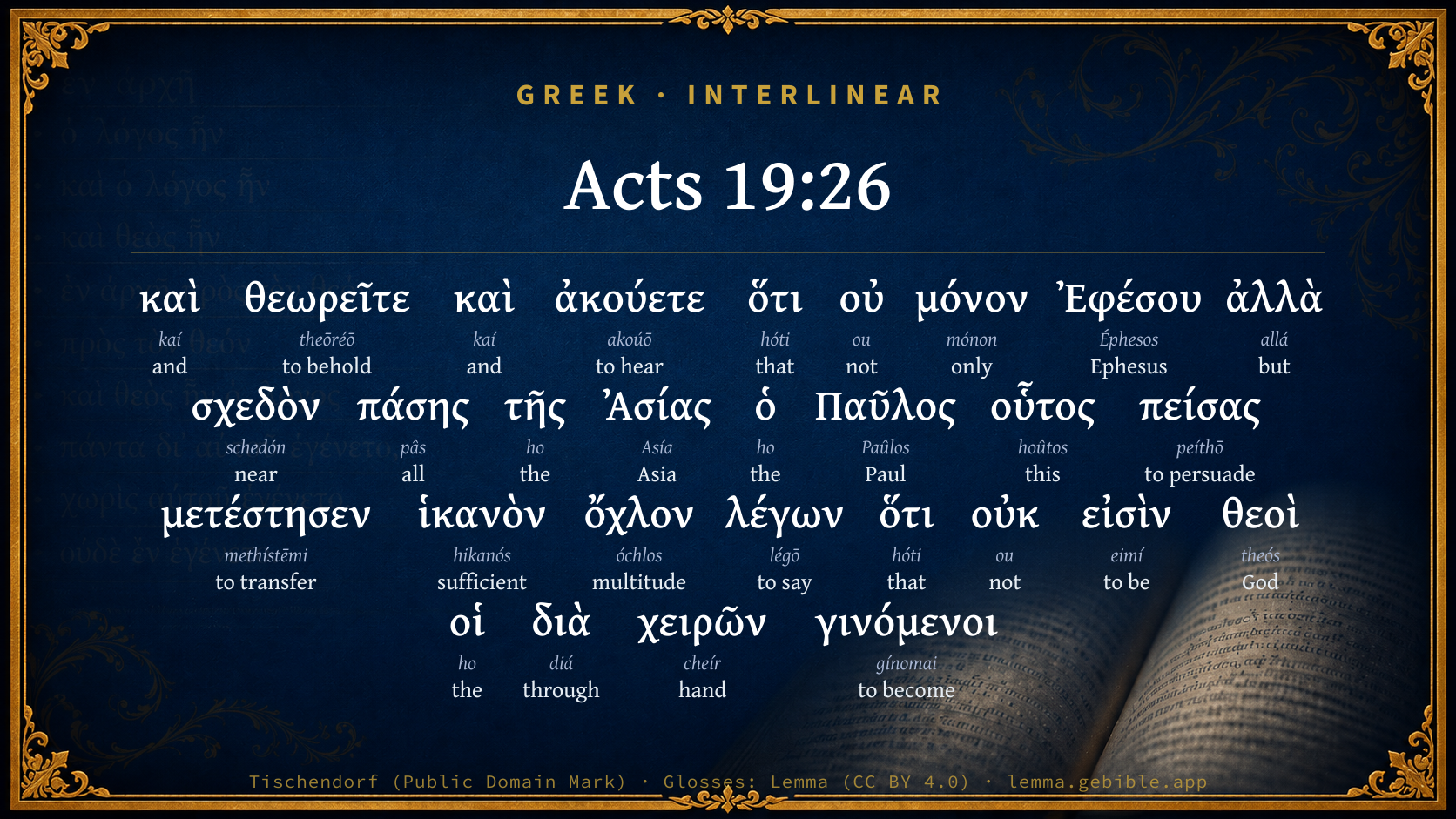
You see and hear, that not at Ephesus alone, but almost throughout all Asia, this Paul has persuaded and turned away many people, saying that they are no gods, that are made with hands.
Download a study sheet
One document with this verse’s original text, its word-by-word gloss line, the meaning frame, cross-references with their text, attributed commentary, and full source and license credits — printable, and it pastes into notes with its structure intact.
This verse Autodidact and up
A passage Seminary Student
Up to 50 verses in one chapter. A passage sheet keeps up to 6 commentary sources and 12 cross-references per verse, in the order this page ranks them, and says so on the sheet whenever that leaves anything out. Ask for a single verse and you get the Autodidact verse sheet above.
Everything on this page stays free to read, with no account — the sheet is a download of what is already on screen, not access to it.
Compare translations 3
The same verse in 3 English versions, stacked beneath the original-language interlinear above. Click any original word for its lexicon entry.
Each is an independent rendering of the whole verse — the interlinear is not word-aligned to these translations.
Highlighted words mark where these versions differ — a whole-verse word diff, not a word-by-word alignment.
-
World English Bible Public Domain
You see and hear, that not at Ephesus alone, but almost throughout all Asia, this Paul has persuaded and turned away many people, saying that they are no gods, that are made with hands.
-
King James Version Public Domain
Moreover ye see and hear, that not alone at Ephesus, but almost throughout all Asia, this Paul hath persuaded and turned away much people, saying that they be no gods, which are made with hands:
-
unfoldingWord Literal Text CC BY-SA 4.0
And you see and hear that not only in Ephesus but in almost all of Asia this Paul, having persuaded, has removed a considerable crowd, saying that the things coming into being through hands are not gods.
unfoldingWord Literal Text — © unfoldingWord, licensed CC BY-SA 4.0. Word-aligned USFM3 via Door43 (git.door43.org/unfoldingWord/en_ult).
Show all 19 translations
Every available English version of this verse, each an independent rendering of the whole verse.
-
World English Bible Public Domain
You see and hear, that not at Ephesus alone, but almost throughout all Asia, this Paul has persuaded and turned away many people, saying that they are no gods, that are made with hands.
-
Berean Standard Bible Public Domain
And you can see and hear that not only in Ephesus, but in nearly the whole province of Asia, Paul has persuaded a great number of people to turn away. He says that man-made gods are no gods at all.
-
Majority Standard Bible Public Domain
And you can see and hear that not only in Ephesus, but in nearly the whole province of Asia, this Paul has persuaded a great number of people to turn away. He says that man-made gods are no gods at all.
-
King James Version Public Domain
Moreover ye see and hear, that not alone at Ephesus, but almost throughout all Asia, this Paul hath persuaded and turned away much people, saying that they be no gods, which are made with hands:
-
American Standard Version (1901) Public Domain
And ye see and hear, that not alone at Ephesus, but almost throughout all Asia, this Paul hath persuaded and turned away much people, saying that they are no gods, that are made with hands:
-
Revised Version (1885) Public Domain
And ye see and hear, that not alone at Ephesus, but almost throughout all Asia, this Paul hath persuaded and turned away much people, saying that they be no gods, which are made with hands:
-
Geneva Bible (1599) Public Domain
Moreouer ye see and heare, that not alone at Ephesus, but almost throughout all Asia this Paul hath perswaded, and turned away much people, saying, That they be not gods which are made with handes.
-
Douay-Rheims (1899) Public Domain
And you see and hear, that this Paul by persuasion hath drawn away a great multitude, not only of Ephesus, but almost of all Asia, saying: They are not gods which are made by hands.
-
Young's Literal Translation Public Domain
and ye see and hear, that not only at Ephesus, but almost in all Asia, this Paul, having persuaded, did turn away a great multitude, saying, that they are not gods who are made by hands;
-
Literal Standard Version CC BY-SA 4.0
and you see and hear, that not only at Ephesus, but almost in all Asia, this Paul, having persuaded, turned away a great multitude, saying that they who are made by hands are not gods;
-
Unlocked Literal Bible CC BY-SA 4.0
You see and hear that, not only at Ephesus, but almost throughout all Asia, this Paul has persuaded and turned away many people. He is saying that there are no gods that are made with hands.
-
unfoldingWord Literal Text CC BY-SA 4.0
And you see and hear that not only in Ephesus but in almost all of Asia this Paul, having persuaded, has removed a considerable crowd, saying that the things coming into being through hands are not gods.
-
Darby Bible Public Domain
and ye see and hear that this Paul has persuaded and turned away a great crowd, not only of Ephesus, but almost of all Asia, saying that they are no gods which are made with hands.
-
World Messianic Bible Public Domain
You see and hear that not at Ephesus alone, but almost throughout all Asia, this Paul has persuaded and turned away many people, saying that they are no gods that are made with hands.
-
Webster's Bible Public Domain
Moreover, ye see and hear, that not alone at Ephesus, but almost throughout all Asia, this Paul hath persuaded and turned away many people, saying, that they are no gods which are made with hands.
-
Free Bible Version CC BY-SA 4.0
As you're no doubt aware from what you've seen and heard—not just here in Ephesus, but throughout almost the whole of Asia—this man Paul has convinced and misled many people, telling them that there are no such things as gods made by human hands.
-
Bible in Basic English Public Domain
And you see, for it has come to your ears, that not only at Ephesus, but almost all through Asia, this Paul has been teaching numbers of people and turning them away, saying that those are not gods who are made by men's hands:
-
Text-Critical English NT CC BY 4.0
You also see and hear that, not only in Ephesus, but in nearly all of Asia, this man Paul has persuaded and drawn away a considerable crowd, saying that gods made by hands are not gods at all.
-
Tyndale New Testament (1534) Public Domain
Moreover ye se and heare that not alone at Ephesus but almost thorowe oute all Asia this Paul hath persuaded and turned awaye moche people saying that they be not goddes which are made with hondes.
Literal Standard Version (2020), Covenant Press — licensed CC BY-SA 4.0. Text via the HelloAO Bible API (eBible.org). Unlocked Literal Bible (unfoldingWord) — licensed CC BY-SA 4.0. Text via the HelloAO Bible API (eBible.org). unfoldingWord Literal Text — © unfoldingWord, licensed CC BY-SA 4.0. Word-aligned USFM3 via Door43 (git.door43.org/unfoldingWord/en_ult). Free Bible Version, Dr. Jonathan Gallagher — licensed CC BY-SA 4.0. Text via the HelloAO Bible API (eBible.org).
Word by word
More ways to search: Search by grammar → Find every occurrence → Compare this word →
Practice this passage: Drill this verse → Learn its vocabulary →
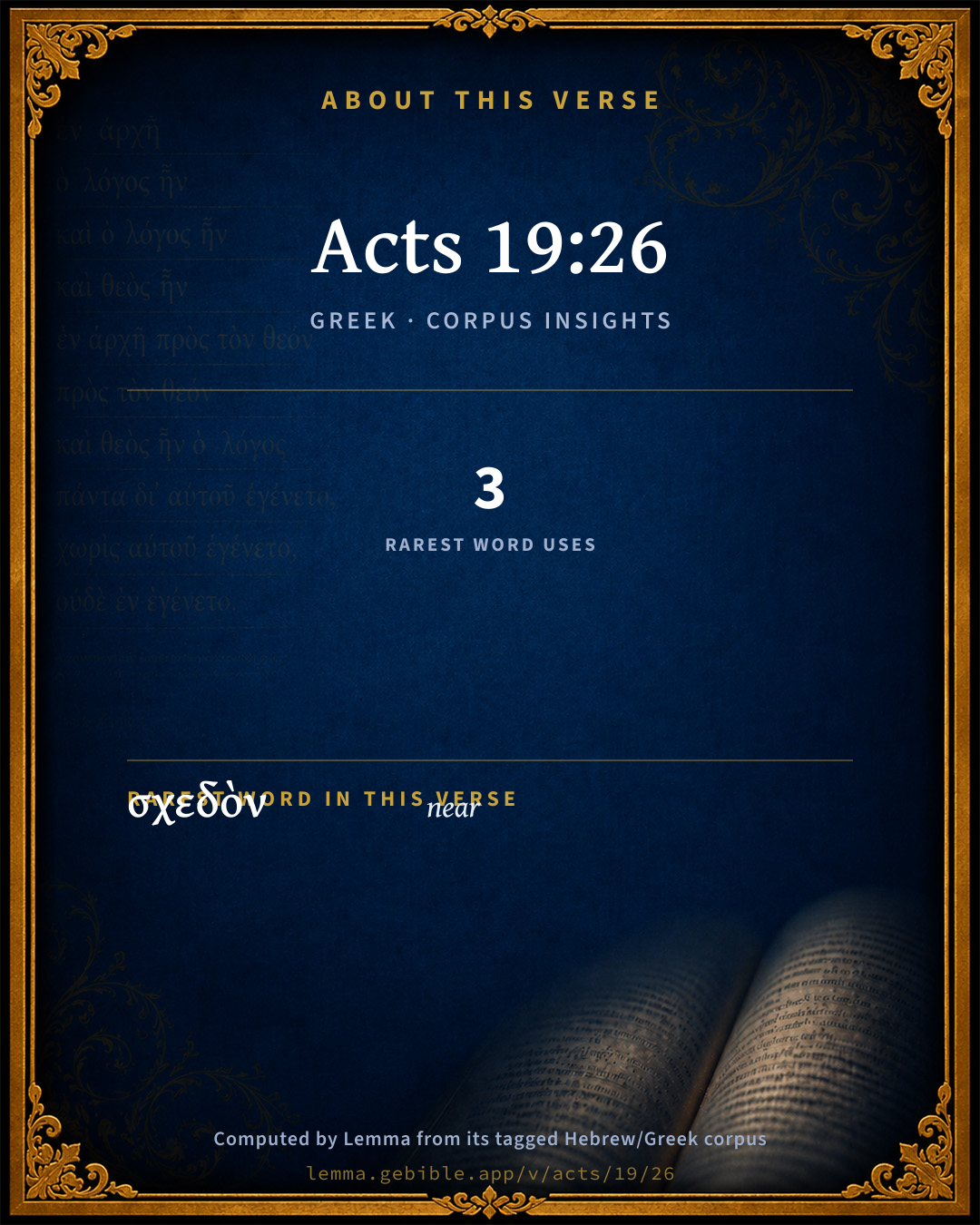
- Appears 3× in the Greek New Testament
- First appears at Acts 13:44
- Part of Speech
- Adverb
Full Thayer's Definition
- καὶ kaí G2532 “and” Conjunction
- θεωρεῖτε theōréō G2334 “to behold” Verb, Present, Active, Indicative, 2nd person, Plural
- καὶ kaí G2532 “and” Conjunction
- ἀκούετε akoúō G191 “to hear” Verb, Present, Active, Indicative, 2nd person, Plural
- ὅτι hóti G3754 “that” Conjunction
- οὐ ou G3756 “not” Particle, Negative
- μόνον mónon G3440 “only” Adverb
- Ἐφέσου Éphesos G2181 “Ephesus” Noun, Genitive, Singular, Feminine
- ἀλλὰ allá G235 “but” Conjunction
- σχεδὸν schedón G4975 “near” Adverb
- πάσης pâs G3956 “all” Adjective, Genitive, Singular, Feminine
- τῆς ho G3588 “the” Article, Genitive, Singular, Feminine
- Ἀσίας Asía G773 “Asia” Noun, Genitive, Singular, Feminine
- ὁ ho G3588 “the” Article, Nominative, Singular, Masculine
- Παῦλος Paûlos G3972 “Paul” Noun, Nominative, Singular, Masculine
- οὗτος hoûtos G3778 “this” Demonstrative pronoun, Nominative, Singular, Masculine
- πείσας peíthō G3982 “to persuade” Verb, Aorist, Active, Participle, Nominative, Singular, Masculine
- μετέστησεν methístēmi G3179 “to transfer” Verb, Aorist, Active, Indicative, 3rd person, Singular
- ἱκανὸν hikanós G2425 “sufficient” Adjective, Accusative, Singular, Masculine
- ὄχλον óchlos G3793 “multitude” Noun, Accusative, Singular, Masculine
- λέγων légō G3004 “to say” Verb, Present, Active, Participle, Nominative, Singular, Masculine
- ὅτι hóti G3754 “that” Conjunction
- οὐκ ou G3756 “not” Particle, Negative
- εἰσὶν eimí G1510 “to be” Verb, Present, Active, Indicative, 3rd person, Plural
- θεοὶ theós G2316 “God” Noun, Nominative, Plural, Masculine
- οἱ ho G3588 “the” Article, Nominative, Plural, Masculine
- διὰ diá G1223 “through” Preposition
- χειρῶν cheír G5495 “hand” Noun, Genitive, Plural, Feminine
- γινόμενοι gínomai G1096 “to become” Verb, Present, Middle or Passive deponent, Participle, Nominative, Plural, Masculine
About this verse
These counts appear in no published source. They are computed here, from the morphology-tagged text and Lemma’s own curated glosses. What Lemma adds →
- 29
- words
- 24
- distinct lemmas
- Acts
- section
Cross-references
21Topical passages linked to Acts 19:26 in the Treasury of Scripture Knowledge — connected by theme and wording, ordered by reader-vote popularity; previews shown in the World English Bible.
- Acts 17:29 Being then the offspring of God, we ought not to think that the Divine Nature is like gold, or silver, or stone, engraved by art and design of man.
- 1 Corinthians 8:4 Therefore concerning the eating of things sacrificed to idols, we know that no idol is anything in the world, and that there is no other God but one.
- Isaiah 44:10–20 Who has fashioned a god, or molten an image that is profitable for nothing?
- Deuteronomy 4:28 There you shall serve gods, the work of men's hands, wood and stone, which neither see, nor hear, nor eat, nor smell.
- Acts 14:15 "Men, why are you doing these things? We also are men of like passions with you, and bring you good news, that you should turn from these vain things to the living God, who made the sky and the earth and the sea, and all that is in them;
- Acts 19:10 This continued for two years, so that all those who lived in Asia heard the word of the Lord Jesus, both Jews and Greeks.
- Revelation 9:20 The rest of mankind, who were not killed with these plagues, didn't repent of the works of their hands, that they wouldn't worship demons, and the idols of gold, and of silver, and of brass, and of stone, and of wood; which can neither see, nor hear, nor walk.
- Jeremiah 10:11 Thus shall you say to them, The gods that have not made the heavens and the earth, these shall perish from the earth, and from under the heavens.
- Jeremiah 10:14–15 Every man is become brutish [and is] without knowledge; every goldsmith is disappointed by his engraved image; for his molten image is falsehood, and there is no breath in them.
- 1 Corinthians 10:19–20 What am I saying then? That a thing sacrificed to idols is anything, or that an idol is anything?
- 1 Corinthians 12:2 You know that when you were heathen, you were led away to those mute idols, however you might be led.
- 1 Corinthians 16:8–9 But I will stay at Ephesus until Pentecost,
- Galatians 4:8 However at that time, not knowing God, you were in bondage to those who by nature are not gods.
- 1 Thessalonians 1:9 For they themselves report concerning us what kind of a reception we had from you; and how you turned to God from idols, to serve a living and true God,
- Psalms 115:4–8 Their idols are silver and gold, The work of men's hands.
- Psalms 135:15–18 The idols of the nations are silver and gold, The work of men's hands.
- Isaiah 46:5–8 To whom will you liken me, and make me equal, and compare me, that we may be like?
- Jeremiah 10:3–6 For the customs of the peoples are vanity; for one cuts a tree out of the forest, the work of the hands of the workman with the axe.
- Hosea 8:6 For this is even from Israel! The workman made it, and it is no God; Indeed, the calf of Samaria shall be broken in pieces.
- Acts 18:19 He came to Ephesus, and he left them there; but he himself entered into the synagogue, and reasoned with the Jews.
- Acts 19:18–20 Many also of those who had believed came, confessing, and declaring their deeds.
Cross-references courtesy of OpenBible.info (CC BY 4.0).
Lesson kit
Teaching starters — assembled from the data on this page, not authored interpretation. Every prompt links to the verse data it draws on. Edit before teaching.
Acts, in the Acts, opens this verse with 29 words (24 distinct Greek lemmas). Its most distinctive word is schedón (“near”). A historical commentator’s framing appears above. Read the whole chapter for the surrounding context.
Discussion questions
- What does “near” (schedón) contribute to the verse as a whole?
- How does Acts 13:44, which shares the word «near», read alongside this verse?
- What does the repetition of “the” (3× in this one verse) do in this verse?
- The translations on this page render this verse differently — a whole-verse word diff, not a word-by-word alignment. What might account for the different wordings?
- Compare how Bengel's Gnomon and Expositor's Greek Testament read this verse. Where do they agree or differ?
Things to notice
- These translations choose different wording for 22 words in this verse.
- “the” occurs 3× in this single verse.
- 24 distinct Greek lemmas span 29 words in this verse.
Commentary
Notes on Acts 19:26 from classic Christian and Jewish commentators (each source and its license shown beneath its notes). The classic Christian expositions comment on the surrounding passage and are grouped to its opening verse, so a note may address several verses; the Jewish commentaries on the Tanakh (Rashi and others) are per-verse, so they appear only where the commentator wrote on this verse.
Lemma curates 59 commentaries, every one of them public domain or Creative Commons licensed, each selected and text-cleaned for this edition rather than reprinted as found. About our sources →
Bengel's Gnomon
Johann Albrecht Bengel
Bengel's Gnomon of the New Testament — English translation (T&T Clark, Edinburgh, 1860) — public domain. Text from a community e-Sword module.
Expositor's Greek Testament
ed. W. Robertson Nicoll
The Expositor's Greek Testament, edited by W. Robertson Nicoll (1897–1910) — public domain. Text from a community e-Sword module.
Jamieson, Fausset & Brown
Robert Jamieson, A. R. Fausset & David Brown
Jamieson, Fausset & Brown — Commentary Critical and Explanatory on the Whole Bible (1871) — public domain (CC PDM 1.0). Text via the HelloAO Bible API.
Adam Clarke's Commentary
Adam Clarke's Commentary on the Bible (1810–1826) — public domain. Text from a community e-Sword/MySword module.
Ellicott's Commentary for English Readers
A Bible Commentary for English Readers, edited by Charles John Ellicott (1878–1897) — public domain. Text from a community e-Sword module.
The Cambridge Bible for Schools and Colleges
gen. ed. J. J. S. Perowne
The Cambridge Bible for Schools and Colleges (gen. ed. J. J. S. Perowne; Cambridge University Press, 1878–1918) — public domain. Text from a community e-Sword module.
John Gill's Exposition
John Gill's Exposition of the Whole Bible (1746–1763) — public domain (CC PDM 1.0). Text via the HelloAO Bible API.
Trapp's Complete Commentary
John Trapp
John Trapp, A Commentary or Exposition upon All the Books of the Old and New Testament (1647–1656) — public domain. Text from a community e-Sword module.
Albert Barnes' Notes on the Bible
Albert Barnes' Notes on the Bible (1834–1885) — public domain. Text from a community e-Sword/MySword module.
Matthew Poole's English Annotations
Matthew Poole's English Annotations on the Holy Bible (1683–1685) — public domain. Text from a community e-Sword/MySword module.
Whedon's Commentary on the Bible
Daniel D. Whedon
Daniel D. Whedon (gen. ed.), Commentary on the Old and New Testaments (1874–1909) — public domain. Text from a community e-Sword module.
The Pulpit Commentary
The Pulpit Commentary (1880–1919), ed. H.D.M. Spence-Jones & Joseph S. Exell — public domain. Text from a community e-Sword module.
John Wesley's Explanatory Notes
John Wesley, Explanatory Notes Upon the Whole Bible (1754–1765) — public domain. Text via the GEBible commentary corpus.
McGarvey & Pendleton's Commentaries
J. W. McGarvey
J. W. McGarvey (with Philip Y. Pendleton), Commentaries on the New Testament (The Fourfold Gospel, 1914; Acts; and the epistles) — public domain. Text from a community e-Sword/MySword module.
unfoldingWord translationNotes
Door43 World Missions Community
unfoldingWord translationNotes — © Distant Shores Media and the Door43 World Missions Community, licensed CC BY-SA 4.0. Source: git.door43.org/Door43/en_tn.
Cambridge Greek Testament for Schools and Colleges
Cambridge Greek Testament for Schools and Colleges (Cambridge University Press, 1896; 21 vols, various authors incl. Carr, Maclear, Plummer, Farrar, Lumby, Moule, M. R. James, Simcox) — public domain. Text from a community e-Sword module.
Alford’s Greek Testament
Henry Alford
Henry Alford, The Greek Testament (1849–1861) — public domain. Text from a community e-Sword module.