Revelation 16:7

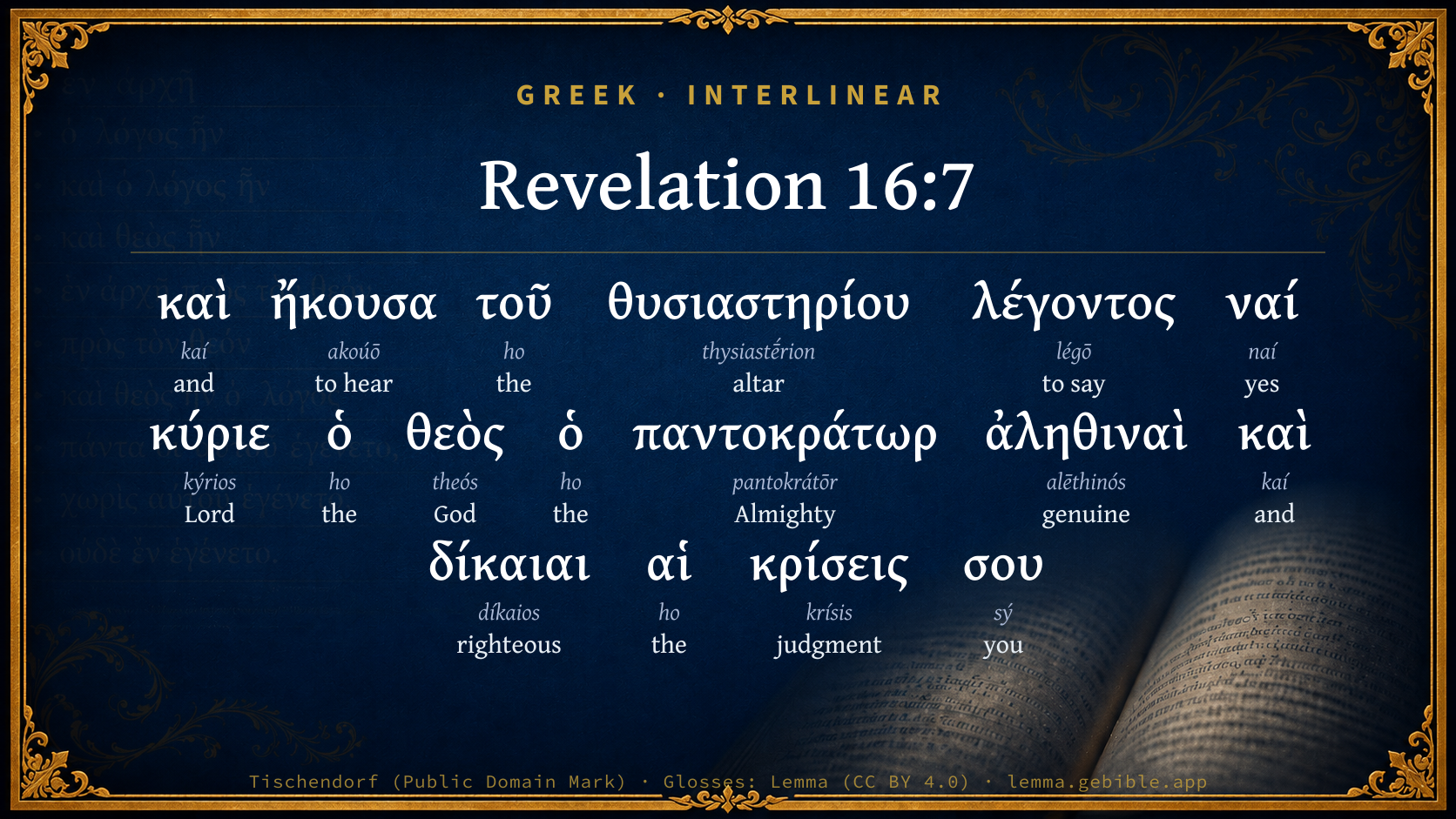
Greek (Tischendorf 8th ed.) Revelation 16:7 appears in the Greek New Testament. The text above is from the Tischendorf 8th edition. Each word links to its Strong’s number and a concise gloss. Click any word for its full Thayer’s Greek Lexicon entry.
Download image
Cite this verse

Revelation 16:7 (World English Bible). Public Domain. Lemma interlinear Bible study tool, https://lemma.gebible.app/v/revelation/16/7.

Show BibTeX & RIS
BibTeX
RIS
English Translation
I heard the altar saying, "Yes, Lord God, the Almighty, true and righteous are your judgments."
World English Bible · Public Domain
Download a study sheet

One document with this verse’s original text, its word-by-word gloss line, the meaning frame, cross-references with their text, attributed commentary, and full source and license credits — printable, and it pastes into notes with its structure intact.

This verse Autodidact and up

Study sheet (.html) Plain text (.txt)

A passage Seminary Student

Up to 50 verses in one chapter. A passage sheet keeps up to 6 commentary sources and 12 cross-references per verse, in the order this page ranks them, and says so on the sheet whenever that leaves anything out. Ask for a single verse and you get the Autodidact verse sheet above.

Everything on this page stays free to read, with no account — the sheet is a download of what is already on screen, not access to it.

Want to remove ads? Support Godless Engineer
Compare translations 3

The same verse in 3 English versions, stacked beneath the original-language interlinear above. Click any original word for its lexicon entry.

Each is an independent rendering of the whole verse — the interlinear is not word-aligned to these translations.

Highlighted words mark where these versions differ — a whole-verse word diff, not a word-by-word alignment.

  • World English Bible Public Domain
    I heard the altar saying, "Yes, Lord God, the Almighty, true and righteous are your judgments."
  • King James Version Public Domain
    And I heard another out of the altar say, Even so, Lord God Almighty, true and righteous are thy judgments.
  • unfoldingWord Literal Text CC BY-SA 4.0
    And I heard the altar saying, “Yes, Lord God, Ruler of All, your judgments true and righteous.”

unfoldingWord Literal Text — © unfoldingWord, licensed CC BY-SA 4.0. Word-aligned USFM3 via Door43 (git.door43.org/unfoldingWord/en_ult).

Versions to compare (up to 4)

3 of 4 selected

Show all 19 translations

Every available English version of this verse, each an independent rendering of the whole verse.

  • World English Bible Public Domain
    I heard the altar saying, "Yes, Lord God, the Almighty, true and righteous are your judgments."
  • Berean Standard Bible Public Domain
    And I heard the altar reply: “Yes, Lord God Almighty, true and just are Your judgments.”
  • Majority Standard Bible Public Domain
    And I heard the altar reply: “Yes, Lord God Almighty, true and just are Your judgments.”
  • King James Version Public Domain
    And I heard another out of the altar say, Even so, Lord God Almighty, true and righteous are thy judgments.
  • American Standard Version (1901) Public Domain
    And I heard the altar saying, Yea, O Lord God, the Almighty, true and righteous are thy judgments.
  • Revised Version (1885) Public Domain
    And I heard the altar saying, Yea, O Lord God, the Almighty, true and righteous are thy judgments.
  • Geneva Bible (1599) Public Domain
    And I heard another out of the Sanctuarie say, Euen so, Lord God almightie, true and righteous are thy iudgements.
  • Douay-Rheims (1899) Public Domain
    And I heard another, from the altar, saying: Yea, O Lord God Almighty, true and just are thy judgments.
  • Young's Literal Translation Public Domain
    and I heard another out of the altar, saying, `Yes, Lord God, the Almighty, true and righteous `are' Thy judgments.'
  • Literal Standard Version CC BY-SA 4.0
    and I heard another out of the altar, saying, “Yes, LORD God, the Almighty, true and righteous [are] Your judgments.”
  • Unlocked Literal Bible CC BY-SA 4.0
    I heard the altar reply, “Yes, Lord God Almighty, your judgments are true and righteous.”
  • unfoldingWord Literal Text CC BY-SA 4.0
    And I heard the altar saying, “Yes, Lord God, Ruler of All, your judgments true and righteous.”
  • Darby Bible Public Domain
    And I heard the altar saying, Yea, Lord God Almighty, true and righteous [are] thy judgments.
  • World Messianic Bible Public Domain
    I heard the altar saying, “Yes, Lord God, the Almighty, true and righteous are your judgments.”
  • Webster's Bible Public Domain
    And I heard another from the altar say, Even so, Lord God Almighty, true and righteous are thy judgments.
  • Free Bible Version CC BY-SA 4.0
    I heard a voice from the altar saying, “Yes, Lord God, the All-powerful One, your judgments are right and true!”
  • Bible in Basic English Public Domain
    And a voice came from the altar, saying, Even so, O Lord God, Ruler of all, true and full of righteousness is your judging.
  • Text-Critical English NT CC BY 4.0
    And I heard the altar say, “Yes, Lord God, the Almighty, true and just are yoʋr judgments.”
  • Tyndale New Testament (1534) Public Domain
    And I herde another out of the aultre saye: even soo lorde god almyghty true and righteous are thy iudgementes.

Literal Standard Version (2020), Covenant Press — licensed CC BY-SA 4.0. Text via the HelloAO Bible API (eBible.org). Unlocked Literal Bible (unfoldingWord) — licensed CC BY-SA 4.0. Text via the HelloAO Bible API (eBible.org). unfoldingWord Literal Text — © unfoldingWord, licensed CC BY-SA 4.0. Word-aligned USFM3 via Door43 (git.door43.org/unfoldingWord/en_ult). Free Bible Version, Dr. Jonathan Gallagher — licensed CC BY-SA 4.0. Text via the HelloAO Bible API (eBible.org).

Word by word

More ways to search: Search by grammar → Find every occurrence → Compare this word →

Practice this passage: Drill this verse → Learn its vocabulary →

παντοκράτωρ
pantokrátōr
G3841
“Almighty”
Noun, Nominative, Singular, Masculine
Part of Speech
Noun
Case
Nominative
Number
Singular
Gender
Masculine
Full Thayer's Definition

Origin: from G3956 and G2904

TDNT: 18:14,5

1. he who holds sway over all things 2. the ruler of all 3. almighty: God
  1. καὶ kaí G2532 “and” Conjunction
  2. ἤκουσα akoúō G191 “to hear” Verb, Aorist, Active, Indicative, 1st person, Singular
  3. τοῦ ho G3588 “the” Article, Genitive, Singular, Neuter
  4. θυσιαστηρίου thysiastḗrion G2379 “altar” Noun, Genitive, Singular, Neuter
  5. λέγοντος légō G3004 “to say” Verb, Present, Active, Participle, Genitive, Singular, Masculine
  6. ναί naí G3483 “yes” Particle
  7. κύριε kýrios G2962 “Lord” Noun, Vocative, Singular, Masculine
  8. ὁ ho G3588 “the” Article, Nominative, Singular, Masculine
  9. θεὸς theós G2316 “God” Noun, Nominative, Singular, Masculine
  10. ὁ ho G3588 “the” Article, Nominative, Singular, Masculine
  11. ἀληθιναὶ alēthinós G228 “genuine” Adjective, Nominative, Plural, Feminine
  12. καὶ kaí G2532 “and” Conjunction
  13. δίκαιαι díkaios G1342 “righteous” Adjective, Nominative, Plural, Feminine
  14. αἱ ho G3588 “the” Article, Nominative, Plural, Feminine
  15. κρίσεις krísis G2920 “judgment” Noun, Nominative, Plural, Feminine
  16. σου sý G4771 “you” Personal pronoun, 2nd person, Genitive, Singular

About this verse

These counts appear in no published source. They are computed here, from the morphology-tagged text and Lemma’s own curated glosses. What Lemma adds →

17
words
13
distinct lemmas
Revelation
section

Notable vocabulary

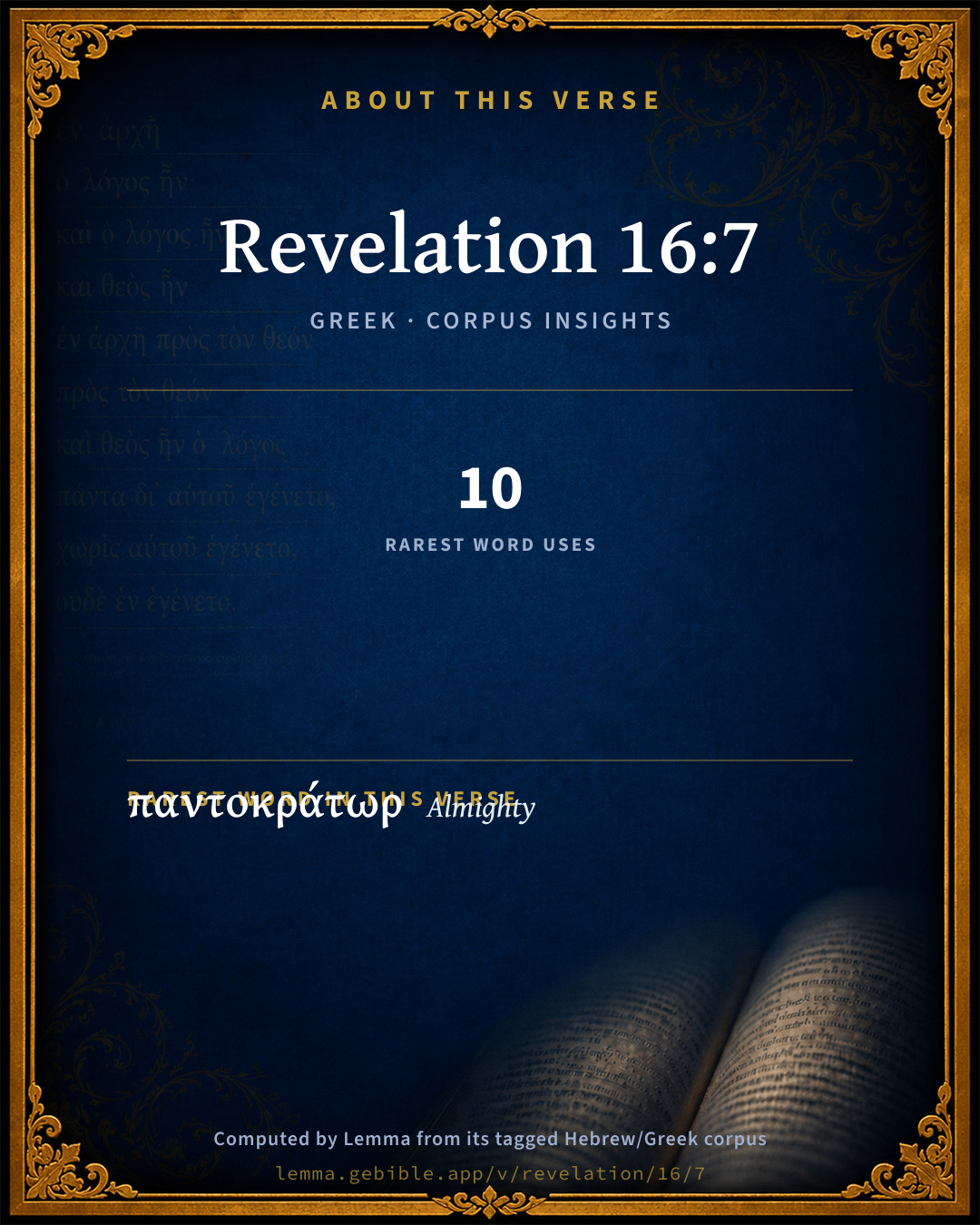
The rarest word here is παντοκράτωρ Almighty G3841 — appearing just 10 times in the whole Greek New Testament.

Shared distinctive vocabulary

παντοκράτωρ Almighty G3841 occurs in 10 verses of the Greek New Testament. Also found in:

Repetition

Words recur within this verse:

Cross-references

10

Topical passages linked to Revelation 16:7 in the Treasury of Scripture Knowledge — connected by theme and wording, ordered by reader-vote popularity; previews shown in the World English Bible.

  • Revelation 19:2 for true and righteous are his judgments. For he has judged the great prostitute, who corrupted the earth with her sexual immorality, and he has avenged the blood of his servants at her hand."
  • Revelation 6:9 When he opened the fifth seal, I saw underneath the altar the souls of those who had been killed for the Word of God, and for the testimony of the Lamb which they had.
  • Revelation 15:3–4 They sang the song of Moses, the servant of God, and the song of the Lamb, saying, "Great and marvelous are your works, Lord God, the Almighty; Righteous and true are your ways, you King of the nations.
  • Isaiah 6:6 Then one of the seraphim flew to me, having a live coal in his hand, which he had taken with the tongs from off the altar.
  • Revelation 8:3–5 Another angel came and stood over the altar, having a golden censer. Much incense was given to him, that he should add it to the prayers of all the saints on the golden altar which was before the throne.
  • Revelation 14:18 Another angel came out from the altar, he who has power over fire, and he called with a great voice to him who had the sharp sickle, saying, "Send forth your sharp sickle, and gather the clusters of the vine of the earth, for the earth's grapes are fully ripe!"
  • Ezekiel 10:2 He spoke to the man clothed in linen, and said, Go in between the whirling [wheels], even under the cherub, and fill both your hands with coals of fire from between the cherubim, and scatter them over the city. He went in as I watched.
  • Ezekiel 10:7 The cherub stretched forth his hand from between the cherubim to the fire that was between the cherubim, and took [of it], and put it into the hands of him who was clothed in linen, who took it and went out.
  • Revelation 13:10 If anyone has captivity, he will go. If anyone is with the sword, he must be killed. Here is the endurance and the faith of the saints.
  • Revelation 14:10 he also will drink of the wine of the wrath of God, which is prepared unmixed in the cup of his anger. He will be tormented with fire and sulfur in the presence of the holy angels, and in the presence of the Lamb.

Cross-references courtesy of OpenBible.info (CC BY 4.0).

Where the printed editions differ

1 variant

Places in this verse where the major printed Greek editions disagree on the wording in a way that affects the translation — a comparison of editions, not a manuscript-by-manuscript collation. The editions are the modern critical texts (Nestlé-Aland 28/27, SBL, Westcott-Hort, Tregelles, Tyndale House) and the traditional texts behind the KJV (the Textus Receptus and the Byzantine/Majority text). It is not a claim about which reading is original.

  1. Extra text
    ἄλλου ἐκ

    “other from”

    In TR Not in NA28NA27TynSBLWHTregByz

    ἄλλου ἐκ (allou ek) 'other from' is only in traditional manuscripts (TR)

Textual data: Translators Amalgamated Greek New Testament (STEPBible TAGNT) · CC BY 4.0.

Commentary

Notes on Revelation 16:7 from classic Christian and Jewish commentators (each source and its license shown beneath its notes). The classic Christian expositions comment on the surrounding passage and are grouped to its opening verse, so a note may address several verses; the Jewish commentaries on the Tanakh (Rashi and others) are per-verse, so they appear only where the commentator wrote on this verse.

Lemma curates 59 commentaries, every one of them public domain or Creative Commons licensed, each selected and text-cleaned for this edition rather than reprinted as found. About our sources →

Albert Barnes' Notes on the Bible

And I heard another - Evidently another angel, though this is not specified.

Out of the altar - Either the angel of the altar - that is, who presided over the altar (Prof. Stuart), or an angel whose voice seemed to come from the altar. The sense is essentially the same. The writer seemed to hear a voice coming from the altar responding to what had just been said in regard to the judgment of God, or to his righteousness in bringing the judgment upon people, Rev 16:5. This was evidently the voice of someone who was interested in what was occurring, or to whom these things particularly pertained; that is, one who was particularly connected with the martyrs referred to, whose blood was now, as it were, to be avenged. We are naturally reminded by this of the martyr-scene in Rev 6:9-11, in the opening of the fifth seal, though it cannot be supposed that the same events are referred to. There “the souls of those that had been slain for the word of God” are represented as being “under the altar,” and as crying to God to “avenge their blood on them who dwelt on the earth.” Here a voice is heard with reference to martyrs, as of one interested in them, ascribing praise to God for having brought a righteous judgment on those who had shed the blood of the saints. They are both, for similar reasons, connected with the “altar,” and the voice is heard proceeding from the same source. In regard to the meaning of the word “altar” here, and the reason why the martyrs are represented in connection with it, see the notes on Rev 6:9.

True and righteous are thy judgments - Responding to what is said in Rev 16:5. That is, God is “true” or faithful to his promises made to his people, and “righteous” in the judgments which he has now inflicted. These judgments had come upon those who had shed the blood of the martyrs, and they were just.

In regard to the application of this there are several things to be said. The following points are clear:

That this judgment would “succeed” the first-mentioned, and apparently at a period not remote. It would occur in a region where there had been much persecution. It would be in a country of streams, and rivers, and fountains. It would be a just retribution for the bloody persecutions which had occurred there.

The question now is, where we shall find the fulfillment of this, assuming that the explanation of the pouring out of the first vial is correct. And here, I think, there can be no mistake in applying it to the events bearing on the papacy, and the papal powers, which followed the French revolution. The next material event, after that revolution, was the invasion of Italy, where Napoleon began his career of victories, and where he first acquired his fame. At this stage of my examination of this passage, I looked into Alison’s History of Europe to see what events, in fact, followed the scenes of confusion, crime, blood, atheism, and pollution in the French revolution, and I found that the next chapters in these eventful scenes, were such as would be well represented by the vial poured upon the rivers and fountains, and by their being turned into blood.

The detail would be too long for my limits, and I can state merely a summary of a few of the chapters in that history. Chapter xix contains the “History of the French Republic from the fall of Robespierre to the establishment of the Directory” - comprising properly the closing scenes of “the Reign of Terror.” Chapter xx contains an account of the campaign in Italy in 1796, embracing, as stated in the summing up of contents in this chapter, the “Battles of Montenotte, Millesimo, Dego; the passage of the bridge of Lodi, and fall of Milan; the siege of Mantua, and the battle of Castiglione; the battles of Caldero and Arcola; and the battles of Rivoli and Mantua.” This is followed (chapter xxiii) with an account of the campaign of 1797, which closed with the fall of Venice; and this is followed (chapter xxvi.) with an account of the invasion of Switzerland, etc. It is unnecessary to dwell on the details of the wars which followed the French revolution on the Rhine, the Po, and the Alpine streams of Piedmont and Lombardy. The slightest acquaintance with that history will show the propriety of the following remarks:

(a) These wars occurred in regions under the influence of the papacy, for these were all papal states and territories.

(b) These scenes followed closely on the French revolution, and grew out of it as a natural consequence, and would be properly represented as a second “vial” poured out immediately after the first.

(c) The country is such as here supposed - “of rivers and fountains” - for, being mostly a mountainous region, it abounds with springs, and fountains, and streams. Indeed, on the supposition that this is the land referred to, a more appropriate description could not have been given of it than is found in this passage. One has only to look upon a map of Northern Italy to see that there is no other portion of the world which would more naturally be suggested when speaking of a country abounding in “rivers and fountains of water.” The admirable map of this region prefixed to the volume, for which I am indebted to the work of Dr. Alexander Keith, on the Signs of the Times, will clearly illustrate this passage, and the corresponding passage in chapter viii., x., xi.,. Let anyone look at the Po and its tributaries on the map, and then read with attention the twentieth chapter of Alison’s History of Europe (vol. i. pp. 391-424), and he will be struck with the appropriateness of the description, on the supposition that this portion of the book of Revelation was designed to refer to these scenes; for he cannot but see that the battles there described were fought in a country in every way corresponding with the statement here.

(d) This country corresponds with the description here given in another respect. In Rev 16:5-6 there is a tribute of praise rendered to God, in view of these judgments, because he was righteous in bringing them upon a land where the blood of saints and prophets had been shed - a land of martyrs. Now this is applicable to the circumstances supposed, not only in the sense that Italy in general had been the land where the blood of martyrs had been shed - the land of Roman persecution, alike under paganism and the papacy - but true in a more definite sense, from the fact that this was the very region where the persecutions against the Waldenses and the Albigenses had been carried on - the valleys of Piedmont. In the times of papal persecution these valleys had been made to flow with the blood of the saints; and it seemed, at least, to be a righteous retribution that these desolations of war, these conflagrations, and these scenes of carnage, should occur in that very land, and that the very fountains and streams which had before been turned into blood, by the slaughter of the friends of the Saviour, should now be reddened with the blood of men slain in battle. This is, perhaps, what John saw in vision: a land where persecution had raged, and the blood of the holy had flowed freely, and then the same land brought under the awful judgments of God, and the fountains and streams reddened with the blood of the slain. There was a propriety, therefore, that a voice should be heard ascribing righteousness to God for avenging the blood of the saints Rev 16:5-6, and that another voice should be heard from the “altar” of the martyrs Rev 16:7 responding and saying, “Even so, Lord God Almighty, true and righteous are thy judgments.”

(e) It may be added, to show the propriety of this, that this was one of the series of events which will be found in the end to have contributed to the overthrow of the papal power; for a blow was struck, in the French invasion of Italy, from which Rome has never recovered, and sentiments were diffused as the result in favor of liberty which it has been difficult ever since to suppress, and which are destined yet to burst out in favor of freedom, and to be one of the means of the final destruction of the power. Compare Alison’s History of Europe, vol. 1, p. 403.

Albert Barnes' Notes on the Bible (1834–1885) — public domain. Text from a community e-Sword/MySword module.

Tyndale Open Study Notes

Tyndale Open Resources

16:7 I heard a voice from the altar: The antiphonal response to the angel’s proclamation (16:5-6) affirms God’s authority and justice. This doxology in the midst of judgment reminds persecuted Christians that God truly cares about his suffering servants and fulfills his own purpose in everything.

Tyndale Open Study Notes — © Tyndale Open Resources, licensed CC BY-SA 4.0. Text via the HelloAO Bible API.

Bengel's Gnomon

Johann Albrecht Bengel

Rev 16:7. Ἤκουσα τοῦ θυσιαστηρίου λέγοντος, I heard the altar saying) John heard the altar, where the cry arises and vengeance descends, or those who served at it, here not seen by John, so that the altar itself appeared to speak. Compare the phraseology, ch. Rev 1:12, Rev 9:13, Rev 11:1. Such is the expression, χρόνος ἐστὶν ὁ λαλῶν, Job 32:7.

Bengel's Gnomon of the New Testament — English translation (T&T Clark, Edinburgh, 1860) — public domain. Text from a community e-Sword module.

Geneva Bible (1599)

Geneva Bible translators

A confirmation of the praise before going, out of the sanctuary of God, whether immediately by Christ, or by some of his Angels, for Christ also is called another Angel, Rev. 3:8; 7:2; 12:1.

Geneva Bible (1599) marginal notes — public domain. Text via Bolls.life.

Jamieson, Fausset & Brown

Robert Jamieson, A. R. Fausset & David Brown

another out of--omitted in A, C, Syriac, and Coptic. Translate then, "I heard the altar [personified] saying." On it the prayers of saints are presented before God: beneath it are the souls of the martyrs crying for vengeance on the foes of God.

Jamieson, Fausset & Brown — Commentary Critical and Explanatory on the Whole Bible (1871) — public domain (CC PDM 1.0). Text via the HelloAO Bible API.

Ellicott's Commentary for English Readers

(7) And I heard . . .—Translate, And I heard (not “another out of the altar,” but) the altar saying, Even so, Lord God the Almighty, true and righteous are Thy judgments. The altar beneath which the souls of the martyrs cried, and on which the prayers of saints were offered, is represented as confirming the testimony to the just dealings of God.

A Bible Commentary for English Readers, edited by Charles John Ellicott (1878–1897) — public domain. Text from a community e-Sword module.

The Cambridge Bible for Schools and Colleges

gen. ed. J. J. S. Perowne

7. another out of] Should be omitted: St John “heard the Altar” itself “say” what follows. Why the unusual image should be used of the Altar speaking, instead of a voice only coming from it (cf. Rev_9:13), we cannot say: but perhaps Rev_6:9 sqq. suggests why the Altar utters its Amen to God’s vengeance on the persecutors.

Even so] Yea, as in Rev_1:7, &c.

The Cambridge Bible for Schools and Colleges (gen. ed. J. J. S. Perowne; Cambridge University Press, 1878–1918) — public domain. Text from a community e-Sword module.

John Gill's Exposition

And the fourth angel poured out his vial upon the sun,.... Not literally; and so designs not a violent heat, which shall go before, and be a preparation for the burning of the world; nor any sore famine arising from it, which would be common to all, good and bad; but mystically: some understand this of Christ, the sun of righteousness, not of any wrath that shall be poured forth on him again, being now justified in the Spirit; but either of that clear shining of Christ in the ministry of the word, in those times this vial refers to; when Zion's light will be come, and the light of the sun will be seven fold, and Christ alone will be exalted; which clear ministration of Christ, though it will not savingly enlighten, yet will convict and confound the antichristian party; they will be scorched with the beams of heat and light, which will dart from hence; these will torture them, and fill them with envy, rage, and malice, because they will not be able to obscure this light, or stop the progress of it; they themselves will be so enlightened by it, as to see and know the truth of Christ's person, and offices, and grace, and yet will sin against it, and so be guilty of blasphemy against the Spirit of God, a sin which will greatly prevail among them; and they will, like the clay, be the more hardened by this light and heat, and will not repent of their sins and errors, nor confess them, nor own the light and conviction they have received: or else of the wrath of Christ, which he will be moved by this angel to stir up against the antichristian party, and which they will be sensible of, and be fearfully looking for. Others, and which comes much to the same sense, understand this of the Scriptures, the fountain of spiritual light, and of the clear interpretation of them in those times; when the watchmen shall see eye to eye, and when the day shall declare and make manifest every man's work, and the fire reveal and try it; and the same effects upon the antichristian party shall follow as before: but I rather think this refers to some part of the antichristian state, as in the other vials, or to something belonging to it; some have thought that the house of Austria, the chief family in the empire, or the king of Spain, or the emperor, who were both formerly of that house, or Germany itself, is meant; but the empire, as we have seen, seems to be designed by the earth in the first vial; wherefore, rather as the smiting of the third part of the sun, moon, and stars, under the fourth trumpet, signifies the utter extirpation of the Roman emperor, and all other Roman magistrates, who were the sun, moon, and stars in that empire; so this vial upon the sun refers to the pope, and his creatures, the cardinals, &c. who is the sun in the antichristian kingdom; and this angel may design the kings of the earth, who will be stirred up against him, by whom he and his dependents will suffer sorely, if not destroyed.

And power was given unto him to scorch men with fire; which may either respect the burning of Rome, and the adjacent parts; or rather the filling of the antichristian party with rage and malice, at the destruction of the pope, and his creatures; for these men are the same with those in Rev 16:2.

John Gill's Exposition of the Whole Bible (1746–1763) — public domain (CC PDM 1.0). Text via the HelloAO Bible API.

Trapp's Complete Commentary

John Trapp

7 And I heard another out of the altar say, Even so, Lord God Almighty, true and righteous are thy judgments.

Ver. 7. And I heard another] That in the mouth of two witnesses this truth might be established. Let God be justified, and every mouth stopped.

Out of the altar] Under which lie the souls of those that were slain for the testimony of Jesus, Rev 6:9. {See Trapp on "Rev 16:6"}

John Trapp, A Commentary or Exposition upon All the Books of the Old and New Testament (1647–1656) — public domain. Text from a community e-Sword module.

Matthew Poole's English Annotations

Others also, either members of the church triumphant or militant, or both, shall in that day give glory to God, as a God of power, able to do such things; of righteousness, thus giving these bloody men their due; and of truth, thus fulfilling both his promises to his people and his threatenings against his enemies. But it is easier to determine who shall thus rejoice, than the time when this joy shall be. This certainly is God’s work, but in fieri, now doing, but not yet done.

Matthew Poole's English Annotations on the Holy Bible (1683–1685) — public domain. Text from a community e-Sword/MySword module.

Whedon's Commentary on the Bible

Daniel D. Whedon

7. To the angel of the waters now there comes a response from the altar. Really, the words another out of are not in the Greek; and Alford truly says, that the “simplest understanding is,” that it is the altar itself that speaks and is heard. The altar is cognizant of blood. The “souls” of the martyrs who were as sacrificed victims are under the altar.

Daniel D. Whedon (gen. ed.), Commentary on the Old and New Testaments (1874–1909) — public domain. Text from a community e-Sword module.

The Pulpit Commentary

And! heard another out of the altar say. Omit "another out of." The altar is connected

(1) with the martyred saints; (Rev_6:9, 10 8:3)

(2) with the judgments that fall on the earth in vengeance for the blood of the saints; (Rev_8:5 Rev_9:13 Rev_14:18) hence the appropriateness of this voice from the altar, which acquiesces in the judgments inflicted. The altar is here personified, and speaks concurring in the justice of those judgments sent on account of the saints who are represented by it. Some writers, however, understand "the angel of the altar," which is similar to the reading of the Authorized Version. Even so, Lord God Almighty, true and righteous are thy judgments; Yea, O Lord God, the Almighty (Revised Version). Reaffirming what has been declared by the angel of the waters (ver. 5), and expressing concurrence therein. (On "true" (alhyinai), see on Rev_3:17) Compare the expression in ver. 5. There God is declared righteous because he has thus judged; here the judgments are righteous because they. are his. Both phrases are equally true, giving the same truth from different standpoints. The same verdict is endorsed by the heavenly multitude in Rev_19:2, when they celebrate the downfall of Babylon; another proof of the identity of the world which is here the object of the vial judgments and the Babylon, which is afterwards described, and whose doom is pronounced.

The Pulpit Commentary (1880–1919), ed. H.D.M. Spence-Jones & Joseph S. Exell — public domain. Text from a community e-Sword module.

John Wesley's Explanatory Notes

Yea - Answering the angel of the waters, and affirming of God's judgments in general, what he had said of one particular judgment.

John Wesley, Explanatory Notes Upon the Whole Bible (1754–1765) — public domain. Text via the GEBible commentary corpus.

Cambridge Greek Testament for Schools and Colleges

7. τοῦ θυσι. B2 1 read ἐκ τοῦ θ., 36 φωνὴν ἐκ τοῦ θ. Primas[551] has aliam vocem dicentem, am[552] alterum dicens, a mistake for (?) altare dicens. Vg[553] has alterum ab altari dicentem which explains Text. Rec[554] ἄλλου έκ τοῦ θυ.

[551] Primasius, edited by Haussleiter.

[552] Codex Amiatinus 6th century in Laurentian Library at Florence.

[553] Vulgate.

[554] Rec. Textus Receptus as printed by Scrivener.

7. τοῦ θυσιαστηρίου. There is no angel (Rev 15:8) to speak from the altar, as perhaps in Rev 9:13 (cf. Rev 14:18): the altar itself can bear witness (Rev 6:9) to the righteous blood shed upon earth, and so say Amen to God’s vengeance against the persecutors.

Ναί. Rev 1:7, Rev 14:13.

Cambridge Greek Testament for Schools and Colleges (Cambridge University Press, 1896; 21 vols, various authors incl. Carr, Maclear, Plummer, Farrar, Lumby, Moule, M. R. James, Simcox) — public domain. Text from a community e-Sword module.

Vincent's Word Studies in the New Testament

Marvin R. Vincent

Another out of the altar. Omit another out of, and read, as Rev., I heard the altar. The altar personified. Compare ch. 6 9, where the souls of the martyrs are seen under the altar and cry how long.

Almighty. Add the article : the Almighty.

Marvin R. Vincent, Word Studies in the New Testament (1887–1900) — public domain. Text from a community e-Sword/MySword module.

Lesson kit

Teaching starters — assembled from the data on this page, not authored interpretation. Every prompt links to the verse data it draws on. Edit before teaching.

Revelation, in the Revelation, opens this verse with 17 words (13 distinct Greek lemmas). Its most distinctive word is pantokrátōr (“Almighty”). A historical commentator’s framing appears above. Read the whole chapter for the surrounding context.

Discussion questions

  1. How does “Almighty” (pantokrátōr) shape what this verse is saying?
  2. How does 2 Corinthians 6:18, which shares the word «Almighty», read alongside this verse?
  3. What does the repetition of “the” (4× in this one verse) do in this verse?
  4. The translations on this page render this verse differently — a whole-verse word diff, not a word-by-word alignment. What might account for the different wordings?
  5. Compare how Albert Barnes' Notes on the Bible and Tyndale Open Study Notes read this verse. Where do they agree or differ?

Things to notice

Reading settings

Reading text

Shown beneath each verse's original-language words.

Old Testament
Old Testament edition

Read the OT as the Masoretic Hebrew (MT) or the Greek Septuagint (LXX).

English shown for the Greek Septuagint (in the Hebrew ↔ Greek comparison).

Comparing translations? Open the Compare panel on any verse page to stack up to four side by side.