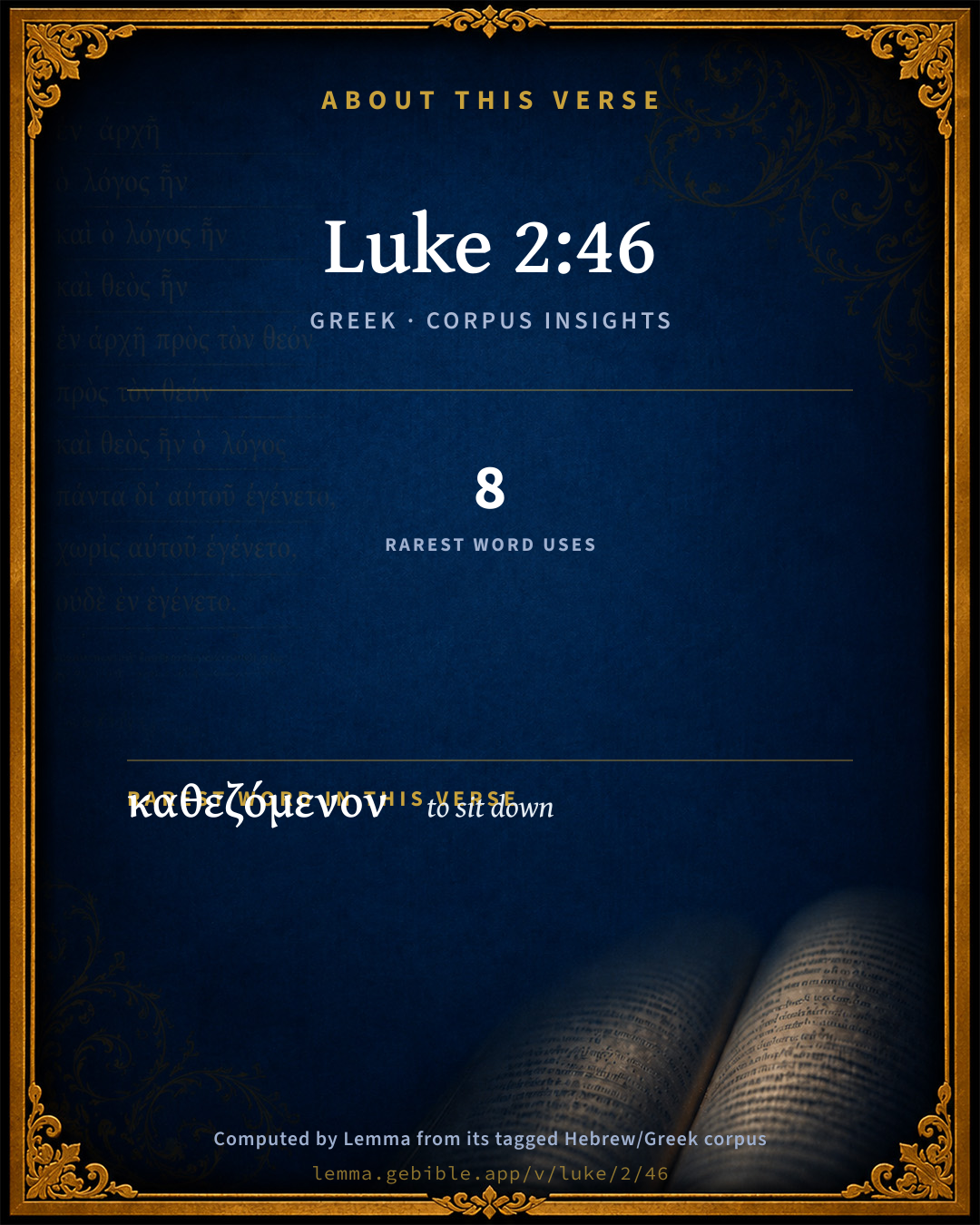
Luke 2:46

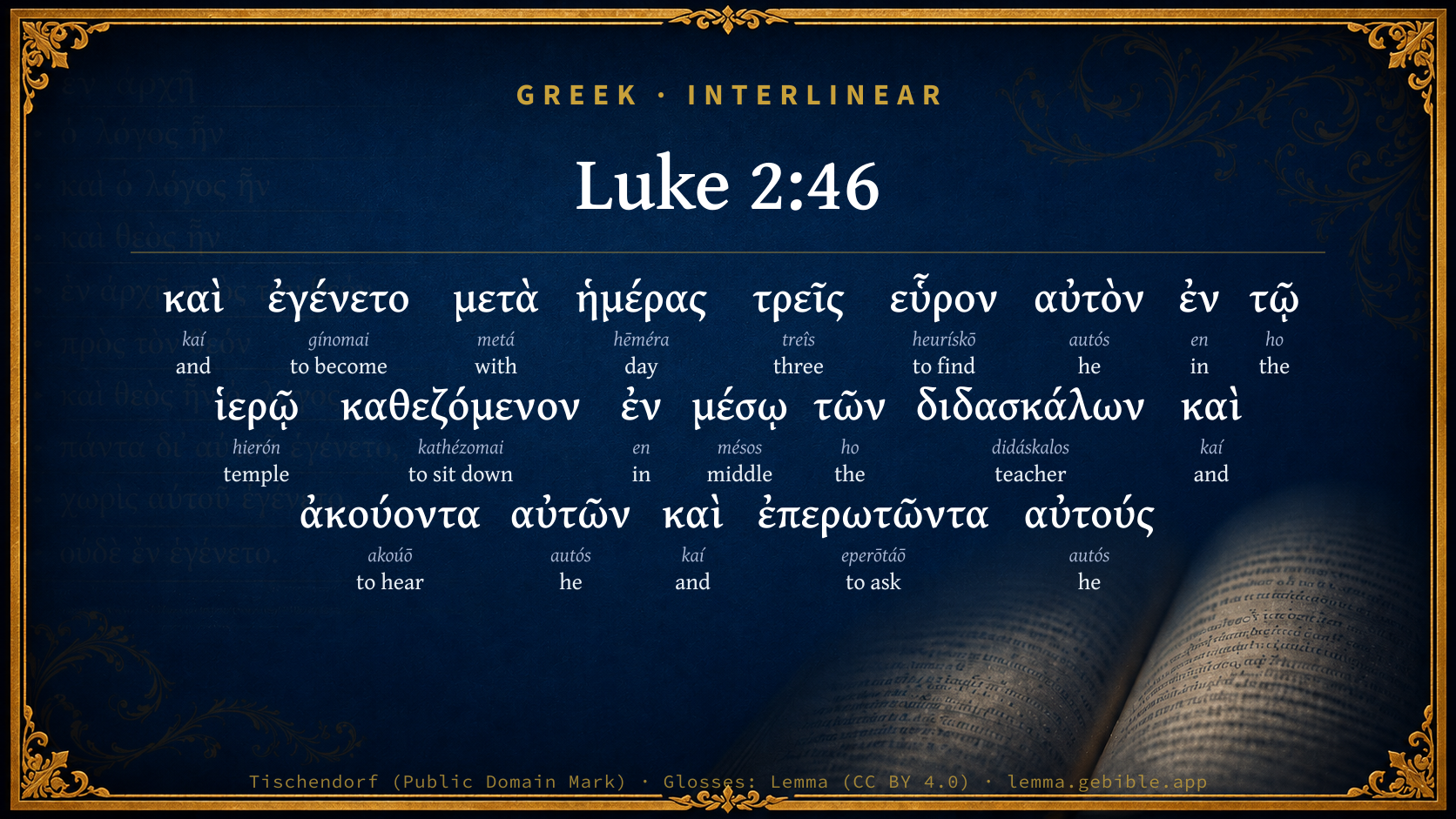
Greek (Tischendorf 8th ed.) Luke 2:46 appears in the Greek New Testament. The text above is from the Tischendorf 8th edition. Each word links to its Strong’s number and a concise gloss. Click any word for its full Thayer’s Greek Lexicon entry.
Download image
Cite this verse

Luke 2:46 (World English Bible). Public Domain. Lemma interlinear Bible study tool, https://lemma.gebible.app/v/luke/2/46.

Show BibTeX & RIS
BibTeX
RIS
English Translation
It happened after three days they found him in the temple, sitting in the midst of the teachers, both listening to them, and asking them questions.
World English Bible · Public Domain
Download a study sheet

One document with this verse’s original text, its word-by-word gloss line, the meaning frame, cross-references with their text, attributed commentary, and full source and license credits — printable, and it pastes into notes with its structure intact.

This verse Autodidact and up

Study sheet (.html) Plain text (.txt)

A passage Seminary Student

Up to 50 verses in one chapter. A passage sheet keeps up to 6 commentary sources and 12 cross-references per verse, in the order this page ranks them, and says so on the sheet whenever that leaves anything out. Ask for a single verse and you get the Autodidact verse sheet above.

Everything on this page stays free to read, with no account — the sheet is a download of what is already on screen, not access to it.

Want to remove ads? Support Godless Engineer
Compare translations 3

The same verse in 3 English versions, stacked beneath the original-language interlinear above. Click any original word for its lexicon entry.

Each is an independent rendering of the whole verse — the interlinear is not word-aligned to these translations.

Highlighted words mark where these versions differ — a whole-verse word diff, not a word-by-word alignment.

  • World English Bible Public Domain
    It happened after three days they found him in the temple, sitting in the midst of the teachers, both listening to them, and asking them questions.
  • King James Version Public Domain
    And it came to pass, that after three days they found him in the temple, sitting in the midst of the doctors, both hearing them, and asking them questions.
  • unfoldingWord Literal Text CC BY-SA 4.0
    And it happened that, after three days, they found him in the temple, sitting in the midst of the teachers and listening to them and asking them questions.

unfoldingWord Literal Text — © unfoldingWord, licensed CC BY-SA 4.0. Word-aligned USFM3 via Door43 (git.door43.org/unfoldingWord/en_ult).

Versions to compare (up to 4)

3 of 4 selected

Show all 19 translations

Every available English version of this verse, each an independent rendering of the whole verse.

  • World English Bible Public Domain
    It happened after three days they found him in the temple, sitting in the midst of the teachers, both listening to them, and asking them questions.
  • Berean Standard Bible Public Domain
    Finally, after three days they found Him in the temple courts, sitting among the teachers, listening to them and asking them questions.
  • Majority Standard Bible Public Domain
    Finally, after three days they found Him in the temple courts, sitting among the teachers, listening to them and asking them questions.
  • King James Version Public Domain
    And it came to pass, that after three days they found him in the temple, sitting in the midst of the doctors, both hearing them, and asking them questions.
  • American Standard Version (1901) Public Domain
    And it came to pass, after three days they found him in the temple, sitting in the midst of the teachers, both hearing them, and asking them questions:
  • Revised Version (1885) Public Domain
    And it came to pass, after three days they found him in the temple, sitting in the midst of the doctors, both hearing them, and asking them questions:
  • Geneva Bible (1599) Public Domain
    And it came to passe three dayes after, that they found him in the Temple, sitting in the mids of the doctours, both hearing them, and asking them questions:
  • Douay-Rheims (1899) Public Domain
    And it came to pass, that, after three days, they found him in the temple, sitting in the midst of the doctors, hearing them, and asking them questions.
  • Young's Literal Translation Public Domain
    And it came to pass, after three days, they found him in the temple, sitting in the midst of the teachers, both hearing them and questioning them,
  • Literal Standard Version CC BY-SA 4.0
    And it came to pass, after three days they found Him in the temple, sitting in the midst of the teachers, both hearing them and questioning them,
  • Unlocked Literal Bible CC BY-SA 4.0
    It came about that after three days, they found him in the temple, sitting in the middle of the teachers, listening to them and asking them questions.
  • unfoldingWord Literal Text CC BY-SA 4.0
    And it happened that, after three days, they found him in the temple, sitting in the midst of the teachers and listening to them and asking them questions.
  • Darby Bible Public Domain
    And it came to pass, after three days they found him in the temple, sitting in the midst of the teachers and hearing them and asking them questions.
  • World Messianic Bible Public Domain
    After three days they found him in the temple, sitting in the middle of the teachers, both listening to them and asking them questions.
  • Webster's Bible Public Domain
    And it came to pass, that after three days they found him in the temple, sitting in the midst of the doctors, both hearing them, and asking them questions.
  • Free Bible Version CC BY-SA 4.0
    It was three days before they found him in the Temple. He was sitting among the religious teachers, listening to them and asking them questions.
  • Bible in Basic English Public Domain
    And after three days they came across him in the Temple, seated among the wise men, giving ear to their words and putting questions to them.
  • Text-Critical English NT CC BY 4.0
    After three days, they found him in the temple courts, sitting among the teachers, listening to them and asking them questions.
  • Tyndale New Testament (1534) Public Domain
    And it fortuned after.iii. dayes that they founde him in the temple sittinge in the middes of the doctours both hearynge them and posinge them.

Literal Standard Version (2020), Covenant Press — licensed CC BY-SA 4.0. Text via the HelloAO Bible API (eBible.org). Unlocked Literal Bible (unfoldingWord) — licensed CC BY-SA 4.0. Text via the HelloAO Bible API (eBible.org). unfoldingWord Literal Text — © unfoldingWord, licensed CC BY-SA 4.0. Word-aligned USFM3 via Door43 (git.door43.org/unfoldingWord/en_ult). Free Bible Version, Dr. Jonathan Gallagher — licensed CC BY-SA 4.0. Text via the HelloAO Bible API (eBible.org).

Word by word

More ways to search: Search by grammar → Find every occurrence → Compare this word →

Practice this passage: Drill this verse → Learn its vocabulary →

καθεζόμενον
kathézomai
G2516
“to sit down”
Verb, Present, Middle or Passive deponent, Participle, Accusative, Singular, Masculine
Part of Speech
Verb
Tense
Present
Voice
Middle or Passive deponent
Mood
Participle
Case
Accusative
Number
Singular
Gender
Masculine
Full Thayer's Definition

Origin: from G2596 and the base of G1476

TDNT: 10:20,4

1. to sit down, seat one's self, sit
  1. καὶ kaí G2532 “and” Conjunction
  2. ἐγένετο gínomai G1096 “to become” Verb, Aorist, Middle deponent, Indicative, 3rd person, Singular
  3. μετὰ metá G3326 “with” Preposition
  4. ἡμέρας hēméra G2250 “day” Noun, Accusative, Plural, Feminine
  5. τρεῖς treîs G5140 “three” Adjective, Accusative, Plural, Feminine
  6. εὗρον heurískō G2147 “to find” Verb, Aorist, Active, Indicative, 3rd person, Plural
  7. αὐτὸν autós G846 “he” Personal pronoun, Accusative, Singular, Masculine
  8. ἐν en G1722 “in” Preposition
  9. τῷ ho G3588 “the” Article, Dative, Singular, Neuter
  10. ἱερῷ hierón G2411 “temple” Noun, Dative, Singular, Neuter
  11. ἐν en G1722 “in” Preposition
  12. μέσῳ mésos G3319 “middle” Adjective, Dative, Singular, Neuter
  13. τῶν ho G3588 “the” Article, Genitive, Plural, Masculine
  14. διδασκάλων didáskalos G1320 “teacher” Noun, Genitive, Plural, Masculine
  15. καὶ kaí G2532 “and” Conjunction
  16. ἀκούοντα akoúō G191 “to hear” Verb, Present, Active, Participle, Accusative, Singular, Masculine
  17. αὐτῶν autós G846 “he” Personal pronoun, Genitive, Plural, Masculine
  18. καὶ kaí G2532 “and” Conjunction
  19. ἐπερωτῶντα eperōtáō G1905 “to ask” Verb, Present, Active, Participle, Accusative, Singular, Masculine
  20. αὐτούς autós G846 “he” Personal pronoun, Accusative, Plural, Masculine

About this verse

These counts appear in no published source. They are computed here, from the morphology-tagged text and Lemma’s own curated glosses. What Lemma adds →

21
words
15
distinct lemmas
Gospels
section

Notable vocabulary

The rarest word here is καθεζόμενον to sit down G2516 — appearing just 8 times in the whole Greek New Testament.

Shared distinctive vocabulary

καθεζόμενον to sit down G2516 occurs in 8 verses of the Greek New Testament. Also found in:

Repetition

Words recur within this verse:

Cross-references

10

Topical passages linked to Luke 2:46 in the Treasury of Scripture Knowledge — connected by theme and wording, ordered by reader-vote popularity; previews shown in the World English Bible.

  • Isaiah 49:1–2 Listen, isles, to me; and listen, you peoples, from far: Yahweh has called me from the womb; from the bowels of my mother has he made mention of my name:
  • Luke 5:17 It happened on one of those days, that he was teaching; and there were Pharisees and teachers of the law sitting by, who had come out of every village of Galilee, Judea, and Jerusalem. The power of the Lord was with him to heal them.
  • Isaiah 50:4 The Lord Yahweh has given me the tongue of those who are taught, that I may know how to sustain with words him who is weary: he wakens morning by morning, he wakens my ear to hear as those who are taught.
  • Acts 5:34 But one stood up in the council, a Pharisee named Gamaliel, a teacher of the law, honored by all the people, and commanded to put the apostles out for a little while.
  • Matthew 12:40 For as Jonah was three days and three nights in the belly of the whale, so will the Son of Man be three days and three nights in the heart of the earth.
  • Matthew 27:63–64 saying, "Sir, we remember what that deceiver said while he was still alive: 'After three days I will rise again.'
  • 1 Kings 12:5 He said to them, Depart yet for three days, then come again to me. The people departed.
  • 1 Kings 12:12 So Jeroboam and all the people came to Rehoboam the third day, as the king bade, saying, Come to me again the third day.
  • Matthew 16:21 From that time, Jesus began to show his disciples that he must go to Jerusalem and suffer many things from the elders, chief priests, and scribes, and be killed, and the third day be raised up.
  • Luke 2:44–45 but supposing him to be in the company, they went a day's journey, and they looked for him among their relatives and acquaintances.

Cross-references courtesy of OpenBible.info (CC BY 4.0).

Commentary

Notes on Luke 2:46 from classic Christian and Jewish commentators (each source and its license shown beneath its notes). The classic Christian expositions comment on the surrounding passage and are grouped to its opening verse, so a note may address several verses; the Jewish commentaries on the Tanakh (Rashi and others) are per-verse, so they appear only where the commentator wrote on this verse.

Lemma curates 59 commentaries, every one of them public domain or Creative Commons licensed, each selected and text-cleaned for this edition rather than reprinted as found. About our sources →

The Biblical Illustrator

Joseph S. Exell

Luk_2:46

After three days they found Him in the Temple

The finding of Jesus in the Temple

I.

A lesson to boys and young men--THE MANLINESS OF OBEDIENCE AND SUBJECTION TO A MOTHER.

II. Teachers may learn THE BEST METHOD OF ACQUIRING KNOWLEDGE, by asking and answering questions.

III. Mothers are by this incident reminded that THEIR CHILDREN HAVE OTHER INTERESTS THAN THOSE OF THIS WORLD.

IV. A lesson for all: JESUS, LOST IN THE BUSTLE AND EXCITEMENT OF THE CROWD, IS ALWAYS TO BE FOUND AGAIN IN THE TEMPLE. (D. Longwill.)

The Saviour lost and found

Jesus Christ is only lost by sin; when lost, He must be found by repentance and grace.

I. WE MUST KNOW OF OUR LOSS We often lose Him, at first, without knowing it, just as His parents did; we, like them, sooner or later find out our loss.

1. We must know of our loss if we would seek to regain it; we should not seek Jesus Christ if we did not know that we had lost Him. The beginning of salvation is the knowledge of sin. He who does not know that he sins, is not willing to suffer correction.

2. We must know of our loss, or we can never render God fitting honour and glory for our recovery from it.

II. OUR WAY MUST BE BETRODDEN. We must look back, by examination of conscience, over that past life during which we have lived without Jesus Christ.

1. Sweep all sin away by our detestation of it (Luk_15:8).

2. Cover all our defilements in the robe of grace, that we may be meet for Jesus Christ (Son_3:2).

III. THE LOSS MUST BE MOURNED FOR. Contrition follows examination.

1. Undo, as far as possible, the dishonour done to God.

2. Punish sin in ourselves. The heart being the fount of sin, we afflict it with sorrow and remorse.

IV. WE RETAIN OUR RECOVERED TREASURE.

1. NO gain to have found Jesus Christ with sorrow and hurt, if He be lost again.

2. A second time we may not be able to find Him. (M. Faber.)

Jesus at home in the Temple

It is easy to understand that the Temple must have had a wonderful attraction for Him, so that He found it very difficult to tear Himself away from it. Our Lord, having now ceased to be an infant, and become a child, was fully conscious who He was. He was now able to look back to His former state of existence, when He lay in His Fathers bosom from all eternity, and was worshipped as a Person in the blessed Trinity by the holy angels. As His faculties opened, it would dawn upon His memory what He had been. Now, therefore, mark the effect upon Him, when He sees for the first time the services of the Temple. The Temple was a little figure or model of heaven; the Temple music of the praises of God continually sung in heaven; the Temple services of the pure and holy worship which the angels continually offer in heaven Heb_8:5). When He saw the Temple services for the first time, they struck a chord in His memory, which vibrated sweetly and solemnly. The priests and Levites, offering their sacrifices and their incense, and singing their psalms, reminded Him of the blessed angels paying their homage to God and chanting His praises in heaven. He had never been the like upon earth before; and it is quite probable that, in a world of sin and sorrow, the blessed Jesus (even as a child) felt out of place, and away from His true home. Can you not imagine a person who had passed his early childhood in a southern clime, where there were birds of rich plumage, lovely stars at night, being suddenly banished to the North Pole, where his eye rests upon nothing but ice and snow, and all the beauties of nature seem to be locked up by a perpetual winter? Suddenly a bunch of bright flowers, or a bird of beautiful plumage, is brought to him as a gift from the south. It reminds him of his native country, and brings back in a moment the flowers, birds, and landscapes of that happy land. Something of this sort may have been our blessed Lords memories, on seeing in early childhood the services of the Temple. He would feel that the Temple gave a true idea of His Fathers house in heaven--was His Fathers house on earth. Now a Father house is a home; and what dutiful child is there who does not love home; who is not drawn towards home, when away from it; who does not feel it to be a place of shelter, security, happiness, and peace, and cling to it accordingly? (Dean Goulburn.)

Christ engaged in Bible study

Jesus was not satisfied with worship alone, nor yet with passive hearing of Bible expositions. He wanted a share in Bible study. He had questions to ask of the teachers, and He was willing to be questioned. Although He was the Son of God, He felt the need of Bible study; and, feeling that need, He went into the Bible school, where the need could be met. If there is a man nowadays who thinks that he doesnt need Bible study, or that it is beneath his dignity to be in the Bible school, he either seems to suppose that he knows more than Jesus knew, or he seems to count it hardly safe to be on the same plane with the Son of God. Yet there are men and women who put a high value on worship, and none at all--for themselves--on social Bible study. They are regularly at the preaching services, but never in the Sunday School. Poor, needy, conceited creatures! (H. C. Trumbull.)

The power of simplicity

One striking feature in the life of Christ upon the earth is the unexpected places where we find Him. His advent was a surprise in its humbleness. Reason would never have deigned to stoop to a manger for a Messiah. Philosophy would scarcely have dreamed of pointing out the Christ of God with plane and hammer at the carpenters bench. Faith itself was surprised to discover Him as a lad among the bearded doctors of Israel. But there He is. The great-browed scholars of the Temple do not in the least suspect the character of the wonderful Child standing in their midst. They debate with Him and are puzzled at His arguments. Their ritualism will not hold together before that young and radiant face. How little the Masters realize that from those tender lips, pronouncing such sublimely simple things, shall fall words of fire which shall utterly consume all their traditions! That gentle youth, astray from His mother, by His quiet life, and innocent language, shall ere long expose and overthrow the last vestige of pretentions and priestly religion, and establish a living religion, vital with an energy which shall conquer death and the grave. The Rabbins have handled the parchment so long and mumbled the letter so much, that they cannot understand the gospel of the Child. How often does Christ stand among the learned systems and schemes of this world, unknown and unsuspected, because so simple and unobtrusive! (Alexander Clark.)

Christ in the Temple school

It was not in the more sacred parts of the Temple, nor in the Holy Place, nor even in the Court of the Altar of Burnt-offering, that our Lord was found. There were chambers in the precincts of the Temple, which were used sometimes for the meetings of the Sanhedrim, sometimes as schools where the doctors might teach. This last was a very proper arrangement: for the training of young persons in Gods Jaw is a work of piety most acceptable to God, and may be fitly carried on in the house of prayer. Perhaps our Lord, during the eight days of His parents stay at Jerusalem, may have been attracted by the schools in the Temple, and have liked to linger there and to hear what was going on. And so His parents may have thought of seeking Him in these schools, feeling that, if in Jerusalem at all, He was sure to be there. Let us observe that what drew Him to the Temple was not only the beautiful and solemn worship which went on in it, but the teaching which was given there. He loved not only prayer and praise, but learning also. Oh, that there were more children like Him! while there are some who like the Church service well enough, if it is conducted with stateliness and music, how very few are there who show a desire for religious instruction, who take great pleasure in their preparation for confirmation, and listen to sermons eagerly, trying to get what good they can out of them. (Dean Goulburn.)

The spirit and method in which to learn

The young should be eager to learn, as Christ was in His boyhood.

1. He showed a thirst for the knowledge of Gods law, when but twelve years old; and how are we to judge of what is wrong in us, but by taking Him as our model, and asking what there is in us, which does not watch with His example? As a ruler applied to a line which we have drawn with our hand, shows that it is not straight, so our Lords example, applied to any particular piece of human conduct, shows at once how far it is from being what it ought to be.

2. Our Lord submitted to learn of the appointed teachers of His nation. It is not surely very much that He should require of us submission to all in authority over us.

3. We see also that quite the best way of learning is for the pupil to ask questions of the teacher. Only let them be thoughtful questions. Nothing will more open the mind of the taught than the explanation of a difficulty which has been raised in the mind by something the teacher has said. Very often the question will be useful to the teacher as well, leading him into some new and interesting train of thought upon an old and well-worn subject. Questions force people to think. (Dean Goulburn.)

Answers

I. Christ gives a clear answer about the spiritual world.

II. Another cry of the soul is answered by Jesus when He tells us, that God is the heavenly Father of mankind.

III. The Lord Jesus answered another question of humanity by showing that our heavenly Father knows the secret inner life of every man.

IV. Jesus answers the cry of the soul by telling us, that our Fathers business is the highest work of humanity. (W. Birch.)

The Biblical Illustrator, edited by Joseph S. Exell (c. 1880s–1900s) — public domain. Text from a community e-Sword module.

Tyndale Open Study Notes

Tyndale Open Resources

2:46 The three days probably included one day traveling from Jerusalem, one day traveling back, and one day searching. • in the Temple: He was in the Temple compound, not the sanctuary. • listening to them and asking questions: Jesus was in the role of a student. In rabbinic instruction, a teacher responded to a student’s question with a series of counter-questions. Jesus’ insightful questions and answers amazed the teachers.

Tyndale Open Study Notes — © Tyndale Open Resources, licensed CC BY-SA 4.0. Text via the HelloAO Bible API.

Bengel's Gnomon

Johann Albrecht Bengel

Luk 2:46. Τρεῖς, three) A mystical number. It was the same number of days that, whilst lying dead, He was regarded by His disciples as lost; ch. Luk 24:21. See Ord. Temp., p. 234.—ἐν τῷ ἱερῷ, in the temple) in the outer courts of the temple.—καθεζόμενον ἐν μέσῳ, sitting in the midst) for the sake of dignity, and not in the fashion of one who was learning, or of one who was teaching, but of one holding a conference with others: comp. Luk 2:47.—ἐπερωτῶντα, asking questions) He was proposing the questions, and solving them in His answers: Luk 2:47.

Bengel's Gnomon of the New Testament — English translation (T&T Clark, Edinburgh, 1860) — public domain. Text from a community e-Sword module.

Expositor's Greek Testament

ed. W. Robertson Nicoll

Luk 2:46 . ἡμέρας τρεῖς , three days, measured from the time they had last seen Him, not implying three days’ search in Jerusalem. The place where they had lodged and the temple would be among the first places visited in the search. ἐν τῷ ἱερῷ : probably in a chamber in the temple court used for teaching and kindred purposes. Some think it was in a synagogue beside the temple.

Luk 2:46 . καθεζόμενον , sitting; therefore, it has been inferred, as a teacher, not as a scholar, among ( ἐν μέσῳ ) the doctors, for scholars stood, teachers only sitting. An unwelcome conclusion, to which, happily, we are not shut up by the evidence, the posture-rule on which it rests being more than doubtful ( vide Vitringa, Synag. , p. 167). ἐπερωτῶντα : nothing unusual, and nothing unbecoming a thoughtful boy.

The Expositor's Greek Testament, edited by W. Robertson Nicoll (1897–1910) — public domain. Text from a community e-Sword module.

Godet's Commentaries

Frédéric Louis Godet

2. The meeting: Luk 2:46-50.

As it is improbable that they had sought for Jesus for two or three days without going to the temple, the three days must certainly date from the time of separation. The first was occupied with the journey, the second with the return, and the third with the meeting.

Lightfoot, following the Talmud, mentions three synagogues within the temple enclosure: one at the gate of the court of the Gentiles; another at the entrance of the court of the Israelites; a third in the famous peristyle lischchat hagasith, in the S.E. part of the inner court. It was there that the Rabbins explained the law. Desire for instruction led Jesus thither. The following narrative in no way attributes to Him the part of a doctor. In order to find support for this sense in opposition to the text, some critics have alleged the detail: seated in the midst of the doctors. The disciples, it is said, listened around. This opinion has been refuted by Vitringa; and Paul’s expression (Act 22:3), seated at the feet of Gamaliel, would be sufficient to prove the contrary. Nevertheless the expression, seated in the midst of the doctors, proves no doubt that the child was for the time occupying a place of honour. As the Rabbinical method of teaching was by questions,—by proposing, for example, a problem taken from the law,—both master and disciples had an opportunity of showing their sagacity. Jesus had given some remarkable answer, or put some original question; and, as is the case when a particularly intelligent pupil presents himself, He had attracted for the moment all the interest of His teachers. There is nothing in the narrative, when rightly understood, that savours in the least of an apotheosis of Jesus. The expressions, hearing them, and asking them questions, bear in a precisely opposite direction. Josephus, in his autobiography (c. i.), mentions a very similar fact respecting his own youth. When he was only fourteen years of age, the priests and eminent men of Jerusalem came to question him on the explanation of the law. The apocryphal writings make Jesus on this occasion a professor possessing omniscience. There we have the legend grafted on the fact so simply related by the evangelist. Σύνεσις, understanding, is the personal quality of which the answers, ἀποκρίσεις, are the manifestations.

The surprise of His parents proves that Jesus habitually observed a humble reserve.

There is a slight tone of reproach in the words of Mary. She probably wished to justify herself for the apparent negligence of which she was guilty. Criticism is surprised at the uneasiness expressed by Mary; did she not know who this child was? Criticism reasons as if the human heart worked according to logic.

To the indirect reproach of Mary, Jesus replies in such words as she had never heard from Him before: Wherefore did ye seek me? He does not mean, “You could very well leave me at Jerusalem.” The literal translation is: “What is it, that you sought me?” And the implied answer is: “To seek for me thus was an inadvertence on your part. It should have occurred to you at once that you would find me here.” The sequel explains why.

The phrase τί ὅτι is found in Act 5:9. Οὐκ ἤδειτε, did ye not know? not, do ye not know? The expression τὰ τοῦ πατρός μου may, according to Greek usage, have either a local meaning, the house of, or a moral, the affairs of. The former sense is required by the idea of seeking; and if, nevertheless, we are disposed to adopt the latter as wider, the first must be included in it. “Where my Father’s affairs are carried on, there you are sure to find me.”

The expression my Father is dictated to the child by the situation: a child is to be found at his father’s. We may add that He could not, without impropriety, have said God’s, instead of my Father’s; for this would have been to exhibit in a pretentious and affected way the entirely religious character of His ordinary thoughts, and to put Himself forward as a little saint. Lastly, does not this expression contain a delicate but decisive reply to Mary’s words, Thy father and I? Any allusion to the Trinitarian relation must, of course, be excluded from the meaning of this saying. But, on the other hand, can the simple notion of moral paternity suffice to express its meaning? Had not Jesus, during those days of isolation, by meditating anew upon the intimacy of His moral relations with God, been brought to regard Him as the sole author of His existence? And was not this the cause of the kind of shudder which He felt at hearing from Mary’s lips the word Thy father, to which He immediately replies with a certain ardour of expression, my Father?

That Mary and Joseph should not have been able to understand this speech appears inexplicable to certain critics,—to Meyer, for instance, and to Strauss, who infers from this detail that the whole story is untrue. But this word, my Father, was the first revelation of a relation which surpassed all that Judaism had realized; and the expression, “to be about the business” of this Father, expressed the ideal of a completely filial life, of an existence entirely devoted to God and divine things, which perhaps at this very time had just arisen in the mind of Jesus, and which we could no more understand than Mary and Joseph, if the life of Jesus had never come before us. It was only by the light Mary received afterwards from the ministry of her Son, that she could say what is here expressed: that she did not understand this saying at the time.

Does not the original source of this narrative discover itself in this remark? From whom else could it emanate, but from Mary herself?

Frédéric Louis Godet — Commentaries on Luke, John, Romans, and 1 Corinthians — English translation (T&T Clark, Edinburgh, 1870s–1890s) — public domain. Text from a community e-Sword module.

Jamieson, Fausset & Brown

Robert Jamieson, A. R. Fausset & David Brown

hearing . . . asking--The method of question and answer was the customary form of rabbinical teaching; teacher and learner becoming by turns questioner and answerer, as may be seen from their extant works. This would give full scope for all that "astonished them in His understanding and answers." Not that He assumed the office of teaching--"His hour" for that "was not yet come," and His equipment for that was not complete; for He had yet to "increase in wisdom" as well as "stature" (Luk 2:52). In fact, the beauty of Christ's example lies very much in His never at one stage of His life anticipating the duties of another. All would be in the style and manner of a learner, "opening His mouth and panting." "His soul breaking for the longing that it had unto God's judgments at all times" (Psa 119:20), and now more than ever before, when finding Himself for the first time in His Father's house. Still there would be in His questions far more than in their answers; and if we may take the frivolous interrogatories with which they afterwards plied Him, about the woman that had seven husbands and such like, as a specimen of their present drivelling questions, perhaps we shall not greatly err, if we suppose that "the questions" which He now "asked them" in return were just the germs of those pregnant questions with which He astonished and silenced them in after years: "What think ye of Christ? Whose Son is He? If David call Him Lord, how is He then his Son?" "Which is the first and great commandment?" "Who is my neighbour?"

Jamieson, Fausset & Brown — Commentary Critical and Explanatory on the Whole Bible (1871) — public domain (CC PDM 1.0). Text via the HelloAO Bible API.

Adam Clarke's Commentary

Verse 46. Sitting in the midst of the doctors] The rabbins, who were explaining the law and the ceremonies of the Jewish religion to their disciples.

Asking them questions.] Not as a scholar asks his teacher, to be informed; but as a teacher, who proposes questions to his scholars in order to take an occasion to instruct them.

In the time of Josephus, the Jewish teachers were either very ignorant or very humble: for he tells us that, "when he was about fourteen years of age, the chief priests, and the principal men of the city, were constantly coming to him to be more accurately instructed in matters relative to the law." See his Life, sect. ii. If this were true, it is no wonder to find them now listening, with the deepest attention, to such teaching as they never before heard.

Adam Clarke's Commentary on the Bible (1810–1826) — public domain. Text from a community e-Sword/MySword module.

Ellicott's Commentary for English Readers

(46) Sitting in the midst of the doctors.—A chamber of the Temple was set apart as a kind of open free school. The “doctors” or teachers—famous “doctors of the Law” (Act_5:34)—sat “in Moses’ seat;” the older students on a low bench; the younger on the ground, literally “at the feet” of their instructor. The relation between master and scholar was often one of affectionate reverence and sympathy, and was expressed by one of the famous scribes in a saying worth remembering, “I have learnt much from the Rabbis, my teachers; I have learnt more from the Rabbis, my colleagues; but from my scholars I have learnt most of all.” It is interesting to think that among the doctors then present may have been the venerable Hillel, then verging upon his hundredth year; his son and successor, Simeon; his grandson, the then youthful Gamaliel; Jonathan, the writer of the Chaldee Targum or Paraphrase of the Sacred Books; and Shammai, the rival of Hillel, who “bound” where the latter “loosed.”

Both hearing them, and asking them questions.—The method of teaching was, we see, essentially and reciprocally catechetical. The kind of questions current in the schools would include such as, What is the great commandment of the Law? What may or may not be done on the Sabbath? How is such a precept to be paraphrased; what is its true meaning? As the Targum of Jonathan included the books of Joshua, Judges 1 and 2 Samuel, 1 and 2 Kings, Isaiah, Jeremiah, Ezekiel, and the twelve Minor Prophets, the questions may probably have turned also on the meaning of prophecies, the expectations of the Christ, and the like. The legends of the Apocryphal Gospels make the wisdom of the child Jesus take a wide range over astronomy and other sciences.

A Bible Commentary for English Readers, edited by Charles John Ellicott (1878–1897) — public domain. Text from a community e-Sword module.

The Cambridge Bible for Schools and Colleges

gen. ed. J. J. S. Perowne

46. after three days] This, in the Jewish idiom, probably means ‘on the third day.’ One day was occupied by the journey to Beeroth; on the second, they sought him in the caravans and at Jerusalem; the next day they found him in the Temple. The unsettled state of the country would add to their alarm.

in the temple] Probably in one of the numerous chambers which ran round the Court, and abutted on the actual building.

sitting] Doubtless at the feet of the Rabbis, as was the custom of Jewish boys when sitting began to be permitted.

in the midst of the doctors] Rather, teachers. The most eminent Rabbis of this period—some of whom may have been present—were Hillel, his rival Shammai, and his son Rabban Shimeon, Babha ben Butah, Nicodemus, Jochanan ben Zakkai, &c.

hearing them, and asking them questions] Obviously with all modest humility. The Apocryphal Gospels characteristically degrade this scene, and represent the boy Christ as behaving with a forwardness which most flagrantly contradicts the whole tenor of the narrative, and would have been specially displeasing to Jewish elders (Pirke Abhôth, V. 12. 15).

The Cambridge Bible for Schools and Colleges (gen. ed. J. J. S. Perowne; Cambridge University Press, 1878–1918) — public domain. Text from a community e-Sword module.

John Gill's Exposition

And all that heard him were astonished,.... All in the sanhedrim, both the doctors, and their disciples, were amazed,

at his understanding; in the knowledge of the law, and of the Scriptures:

and his answers; which he returned to the questions the doctor's put to him, which were made with so much wisdom and judgment, that it was surprising in one of his years.

John Gill's Exposition of the Whole Bible (1746–1763) — public domain (CC PDM 1.0). Text via the HelloAO Bible API.

Trapp's Complete Commentary

John Trapp

46 And it came to pass, that after three days they found him in the temple, sitting in the midst of the doctors, both hearing them, and asking them questions.

Ver. 46. Sitting in the midst of the doctors] Christus prius sedet in medio doctorum (ut recte distin. 36, Gratian) quam publice coepit munus Mediatoris obire.

Hearing them, and posing them] In this very year the temple was profaned, even at the passover. For the priests having opened the temple doors by night, as the manner was, found a great company of dead men’s bones in the morning thrown here and there through the whole house. This, saith Josephus, was thought to have been done by the Samaritans, in spite of the Jews. But others think God had a special hand in it, to signify that the temple services were shortly to die and determine, now that the Lord of heaven and earth had taught therein with his own lively voice.

John Trapp, A Commentary or Exposition upon All the Books of the Old and New Testament (1647–1656) — public domain. Text from a community e-Sword module.

Albert Barnes' Notes on the Bible

After three days - This means, probably, “on the third day” after they had left Jerusalem - that is, the first day they went toward Galilee, on the second they returned to Jerusalem, and on the third they found him. Compare Mat 27:63; Mar 8:31.

In the temple - In the “court” of the temple, for Jesus, not being a Levitical priest, could not enter into the temple itself. See Mat 21:12.

In the midst of the doctors - The “teachers,” the “rabbis,” who were the instructors of the people in matters of religion.

Asking them questions - Proposing questions to them respecting the law and the prophets. There is no reason to suppose that this was for the purpose of perplexing or confounding them. The questions were doubtless proposed in a respectful manner, and the answers listened to with proper deference to their age and rank. Jesus was a child, and religion does not teach a child to be rude or uncivil, even though he may really know much more than more aged persons. Religion teaches all, and especially the young, to treat others with respect, to show them the honor that is due, to venerate age, and to speak kindly to all, 1Pe 2:17; 1Pe 3:8, 1Pe 3:9; Exo 20:12; Mat 23:3; Rom 13:7.

Albert Barnes' Notes on the Bible (1834–1885) — public domain. Text from a community e-Sword/MySword module.

Whedon's Commentary on the Bible

Daniel D. Whedon

46. After three days—One day spent in going homeward, one in returning, and the third on which he was found. The parents with their son doubtless rejoined their caravan.

In the temple—Where he was yet to dispute with the national doctors in a different style. The last time he had been in the temple was at his circumcision, when holy Simeon blessed him. Jesus was not in the temple building proper, but in some one of the apartments in the enclosure.

Probably it was in one of the porticoes of the court of the women, where the schools of the Rabbis were held. But Lightfoot thinks it may have been even in the Sanhedrim.

Sitting—The sceptical claim that pupils always stood to receive the lessons of the doctors is not well established. Paul sat at the feet of Gamaliel, (Act_22:3.) But in fact Jesus was not a pupil but an auditor.

Sitting in the midst of the doctors—Cavillers have here raised many minute objections. An effort, say they, is made by Luke to make the boy Jesus a monstrous prodigy. He sits as chief doctor in the midst of a circle of listening rabbies, who are amazed at his miraculous teachings. All this is futile. The so-called Apocryphal Gospels are indeed guilty of the puerile folly of making Jesus a monstrosity of boyish doctorship. The Jewish doctors admit that they promoted R. Eleazar Ben Azariah to the presidency of the Sanhedrim at sixteen. And the historian Josephus shows a similar vanity in regard to his own precocious knowledge of law. “In my education, I attained to a great reputation for learning, appearing to excel in memory and understanding. Yet being a boy of about fourteen years, I was eulogized for my love of learning, and the chief priests and the first men of the city always collected to learn from me something more accurate about points of law.” The modest statement of Luke is in striking contrast with the exaggerations alike of the Apocryphals, the doctors, and the historian, yet gives us a most interesting and natural view of his pure but eminent development. No position of superiority or even equality to the rabbies, is intimated; and yet surely to no young Samuel or Moses would so deep a reverence be due even from hoary rank and learning as to this young Messiah.

The seats of the doctors were raised fronting the rest of the assembly and in the Sanhedrim at any rate, formed a semicircle, so that the half-surrounded Jesus could easily be in their midst. Of the doctors— Διδασκαλοι, didaskaloi, Greek for teachers. The root of this Greek word δαχ, dach, is the same as the Latin root doc, and the same as the Saxon teach. Hence διδασκαλος, doctor, and teacher, are the same word in different forms. Some of the greatest doctors of Jewish history lived about this period. The great Hillel, the restorer of ancient rabbinical lore, “a second Ezra,” whose scholars were thousands, died this very year. His successor, Simeon, first received the title of rabban, and was followed in line by Rabban Gamaliel, Paul’s tutor, and by others who were named among the greatest of Jewish geniuses and holy men.

Hearing them and asking questions—But it is not said teaching or disputing. He sat not as a doctor, but as an inquirer among the doctors. The method of instruction among the Jewish doctors was very conversational and catechetical; teacher and pupil indulging in both interrogation and reply.

Daniel D. Whedon (gen. ed.), Commentary on the Old and New Testaments (1874–1909) — public domain. Text from a community e-Sword module.

The Pulpit Commentary

And it came to pass, that after three days they found him in the temple. According to the common way of reckoning among the Hebrews, this expression, "after three days," probably means "on the third day." One day was consumed in the usual short pilgrim-journey. His absence at first would excite no attention; on the second, as they missed him still, they sought him in the various pilgrim-companies; and on the day following they found him in the temple courts, with the doctors of the Law.

Sitting in the midst of the doctors, both hearing them, and asking them questions. In the temple enclosure, says the Talmud, there were three synagogues one at the gate of the court of the Gentiles, another at the entrance of the court of the Israelites, a third in the south-east part of the inner court: it was in these that the rabbis expounded the Law. Among the famous doctors, or rabbis, then living and teaching in Jerusalem, were the famous Hillel, then very aged, verging, we are told, on his hundredth year; his almost equally illustrious rival, Shammai; Gamaliel, the master of Saul of Tarsus; Jonathan, the compiler of the Chaldee Paraphrase of the sacred books; Simeon, the son and successor of Hillel; Nicodemus, who, some years afterwards, came to Jesus by night, and, when the end was come, reverently assisted in laying the King"s Son with all honor in his tomb in Joseph of Arimathaea"s garden. We may, with great probability, assume that amongst those "doctors" whom the Boy questioned at that Passover Feast, some if not all of these well-known men were sitting. The apocryphal Gospels, as usual, profess to give us details where the true story is reverently silent. The "Gospel of Thomas" (second century), for instance, tells us that Jesus, when on the road to Nazareth, returned of his own accord to Jerusalem, and amazed the rabbis of the temple by his solution of the hardest and most difficult questions of the Law and the prophets. In an Arabic Gospel of somewhat later date than that of Thomas, we find the Boy even teaching the astronomers the secrets of their own difficult study. Probably Stier"s simple words approach the nearest to the truth here, when he suggests that his questions were "the pure questions of innocence and of truth, which keenly and deeply penetrated into the confused errors of the rabbinical teaching."

The Pulpit Commentary (1880–1919), ed. H.D.M. Spence-Jones & Joseph S. Exell — public domain. Text from a community e-Sword module.

John Wesley's Explanatory Notes

After three days - The first day was spent in their journey, the second, in their return to Jerusalem: and the third, in searching for him there: they found him in the temple - In an apartment of it: sitting in the midst of the doctors - Not one word is said of his disputing with them, but only of his asking and answering questions, which was a very usual thing in these assemblies, and indeed the very end of them. And if he was, with others, at the feet of these teachers (where learners generally sat) he might be said to be in the midst of them, as they sat on benches of a semicircular form, raised above their hearers and disciples.

John Wesley, Explanatory Notes Upon the Whole Bible (1754–1765) — public domain. Text via the GEBible commentary corpus.

Kretzmann's Popular Commentary

Paul E. Kretzmann

His Father’s business:

v. 46 And it came to pass that after three days they found Him in the Temple, sitting in the midst of the doctors, both hearing them and asking them questions.

v. 47. And all that heard Him were astonished at His understanding and answers.

v. 48. And when they saw Him, they were amazed. And His mother said unto Him, Son, why hast Thou thus dealt with us? Behold, Thy father and I have sought Thee sorrowing.

v. 49. And He said unto them, How is it that ye sought Me? Wist ye not that I must be about My Father’s business?

v. 50. And they understood not the saying which He spake unto them.

The three days’ search with its attendant anxiety may well have aroused the thought in Mary’s heart that the prophecy of Simeon was even now being fulfilled. But at last Mary and Joseph found Jesus, after assiduously searching over the whole city, in the Temple, sitting in the midst of the learned teachers, in the hall where the school-classes of the children of the Law, the great high school, assembled for advanced instruction to learn to keep the commandments. There He was sitting, outwardly in the role of a pupil, but in reality in earnest conference, in which He assumed almost a teacher’s functions. He was giving due attention to the explanations of the doctors, but He was also putting searching questions, to the amazement of all those that were present to hear Him. His understanding, His ability to penetrate a given matter, and the answers which He gave, were of a kind to provoke astonishment. Here was something of the rare insight and the ease of presentation which in later years delighted His audiences. But Mary and Joseph were disturbed on account of the apparent audacity of the boy, which seemed to them like forwardness. And Mary, still full of the excitement of the search and with her mother’s heart yearning toward her Son, reproachfully asked why He had dealt with them thus, not realizing that the fault was not His, but theirs. Note: The tactful way in which Mary refers to Joseph is an indisputable proof of the wisdom with which she brought up her Child; a lesson for many modern parents. They had sought Him with anxious solicitude. But Jesus does not accept the reproof. Not reproachfully, but with all the sincerity and boldness of holy childhood, He asks her why they had sought in that manner. He gives them an inkling of the purpose of His life. They should know that He must be about His Father’s business. This is the obligation of His life: the things of His Father He must be engaged in, be concerned about. The Temple was the place where the service of His Father was supposed to be most perfect, where the Word of grace was supposed to be taught. "Wherefore the Temple was also called His sanctuary and sacred dwelling, since there He, through His Word, showed His presence and permitted Himself to be heard. Thus Christ is about His Father’s business when He speaks to us through His Word and through it brings us to the Father. " This answer of Jesus, with its implication of divine sonship, was beyond the understanding even of Mary, who had remembered all the sayings concerning her Son.

Paul E. Kretzmann, Popular Commentary of the Bible (1921–1924) — public domain. Text from a community e-Sword module.

Burkitt's Expository Notes on the New Testament

William Burkitt

Observe here, 1. The place where the child Jesus is found, In the temple: where could there be a more likely place to find the Son of God, than in the house of his Father? No wonder that his parents found him there; but that they went not first to seek him there.

Observe, 2. At twelve years old our Saviour disputes in the temple with the doctors of the law: never had those great rabbies heard the voice of such a tutor. Thus, in our Saviour’s non-age, he gives us a proof of his proficiency; even as the spring shows us what we may hope for of the tree in summer.

Our Saviour discovered his accomplishments by degrees: had his perfections appeared all at once, they had rather dazzled, than delighted, the eyes of the beholders; even as the sun would confound all eyes, should it appear at its first rising in its full strength. Christ could now have taught all those great rabbies the deep mysteries of God; but being not yet called by his Father to be a public teacher, he contents himself to hear with diligence, and to ask with modesty.

Learn hence, that parts and abilities for the ministerial function are not sufficient to warrant our undertaking of it without a regular call. Christ himself would not run, no not on his heavenly Father’s errand, before he was sent, much less should we.

William Burkitt's Expository Notes on the New Testament (1700–1703) — public domain. Text from a community e-Sword module.

The People's New Testament

B. W. Johnson

46. In the temple. Probably in one of the porches of the court of the women, where the schools of the rabbis were held, and the law regularly expounded. In the midst of the doctors. The learned rabbins. Some of the greatest doctors of Jewish history lived about this period—Hillel, Rabbi Simeon and Gamaliel. Asking them questions. It was the custom in Jewish rabbinical schools for scholars to ask questions.

B. W. Johnson's The People's New Testament with Notes (1889–1891) — public domain. Electronic text from the Christian Classics Ethereal Library (CCEL) ThML edition.

Cambridge Greek Testament for Schools and Colleges

46. μετὰ ἡμέρας τρεῖς. This, in the Jewish idiom, probably means ‘on the third day.’ One day was occupied by the journey to Beeroth; on the second, they sought Him in the caravans and at Jerusalem; the next day they found Him in the Temple. The unsettled state of the country would add to their alarm.

ἐν τῷ ἱερῷ. Probably in one of the numerous chambers which ran round the Court, and abutted on the actual building; or in one of the three Temple-synagogues of which the Talmud speaks.

καθεζόμενον. Doubtless at the feet of the Rabbis, as was the custom of Jewish boys when sitting began to be permitted.

ἐν μέσῳ τῶν διδασκάλων, ‘in the midst of the teachers.’ The most eminent Rabbis of this period—some of whom may have been present as youths, and some as aged men—were Hillel, his rival Shammai, and his son Rabban Shimeon, Bava ben Butah, Nicodemus, Jochanan ben Zakkai.

ἀκούοντα αὐτῶν καὶ ἐπερωτῶντα αὐτούς. Obviously with all modest humility. The Apocryphal Gospels characteristically degrade this scene, and represent the boy Christ as behaving with a forwardness which most flagrantly contradicts the whole tenor of the narrative, and would have been specially displeasing to Jewish elders (Pirke Avôth, v. 12. 15). Such inventions, which are only too common in all commentators, from the days of the Fathers downward, spring from an irreverent reverence which has its real root in Apollinarianism.

Cambridge Greek Testament for Schools and Colleges (Cambridge University Press, 1896; 21 vols, various authors incl. Carr, Maclear, Plummer, Farrar, Lumby, Moule, M. R. James, Simcox) — public domain. Text from a community e-Sword module.

Alford’s Greek Testament

Henry Alford

46.] Some (Grot., Kuin.) interpret the three days, of their one day’s journey out, one back, and one in Jerusalem: but they were more likely three days spent in search in Jerusalem (De Wette); or, at all events, reckoned from their discovery of His not being with them (Meyer).

ἐν τῷ ἱερῷ] In one of the rooms attached to the temple, where the Rabbis taught their schools. A tradition mentioned by Lightfoot, that till the death of Gamaliel the scholars stood in these schools, appears to be false, as Kuinoel has shewn.

No stress must be laid on ἐν μέσῳ; it is only among Nor must it be supposed from ἐπερωτ. that our Lord was acting the part of a master. It was the custom in the Jewish schools for the scholars to ask questions of their teachers; and a great part of the Rabbinical books consists of the answers of the Rabbis to such questions.

Henry Alford, The Greek Testament (1849–1861) — public domain. Text from a community e-Sword module.

International Critical Commentary

46. ἡμέρας τρεῖς. These are reckoned in three ways. (1) One day out, at the end of which the Child is missed; one day back; and on the third the finding. This is probably correct. (2) One day’s search on the journey back; one day’s search in Jerusalem; and on the third the finding. (3) Two days’ search in Jerusalem, and then the finding. This is improbable. Jerusalem was not a large place, and less than a day would probably suffice. We may understand that on all three days Jesus was in the temple with the doctors. Godet conjectures that He there had an experience similar to that of Jacob at Bethel (Gen 28:10-22): “God became more intimately His God, His Father.” There is no evidence.

ἐν τῷ ἱερῷ. Not in a synagogue, if there was one in the temple enclosure, but probably on the terrace, where members of the Sanhedrin gave public instruction on sabbaths and festivals. If this is correct, His parents had left on the third day, and the Passover was still going on. If all had been over, this public teaching would have ceased.

καθεζόμενον. As a learner, not as a teacher. St. Paul sat “at the feet of Gamaliel” (Act 22:3). Jesus probably sat on the ground, while the Rabbis sat on benches or stood.—ἐν μέσῳ. see on 8:7. Not dignitatis causâ (Beng.) or as doctor doctorum (Calov.), but because there were teachers on each side, possibly in a semicircle. The point is that He was not hidden, but where He could easily be found. For a list of distinguished persons who may have been present, see Farrar, L. of Christ, 1. ch. 6., from Sepp, Leben Jesu, i. § 17. Of biblical personages, Symeon, Gamaliel, Annas, Caiaphas, Nicodemus, and Joseph of Arimathea are possibilities.

ἀκούοντα αὐτῶν καὶ ἐπεωτῶντα αὐτούς. Note that the hearing is placed first, indicating that He was there as a learner; and it was as such that He questioned them. It was the usual mode of instruction that the pupil should ask as well as answer questions. A holy thirst for knowledge, especially of sacred things, would prompt His inquiries. The Arabic Gospel of the Infancy represents Him as instructing them in the statutes of the Law and the mysteries of the Prophets, as well as in astronomy, medicine, physics, and metaphysics (l.-lii.). See on 3:10.

International Critical Commentary — older volumes (1896–1929), various authors — public domain. Text from a community e-Sword module.

Vincent's Word Studies in the New Testament

Marvin R. Vincent

After three days. From the time of separation.

In the temple. "We read in the Talmud that the members of the Temple - Sanhedrin, who, on ordinary days, sat as a court of appeal from the close of the morning to the time of the evening sacrifice, were wont, upon Sabbaths and feast days, to come out upon the terrace of the temple, and there to teach. In such popular instruction the utmost latitude of questioning would be given. It is in this audience, which sat upon the ground, surrounding and mingling with the doctors, and hence during, not after, the feast, that we must seek the child Jesus" (Edersheim, "Life and Times," etc., 1 247). From this, Edersheim argues that the parents set out for home before the close of the feast.

Sitting. Not occupying a teacher 's place, but sitting in the circle among the doctors and their hearers. See above. Compare Act 22:3.

Marvin R. Vincent, Word Studies in the New Testament (1887–1900) — public domain. Text from a community e-Sword/MySword module.

Lesson kit

Teaching starters — assembled from the data on this page, not authored interpretation. Every prompt links to the verse data it draws on. Edit before teaching.

Luke, in the Gospels, opens this verse with 21 words (15 distinct Greek lemmas). Its most distinctive word is kathézomai (“to sit down”). A historical commentator’s framing appears above. Read the whole chapter for the surrounding context.

Discussion questions

  1. How does “to sit down” (kathézomai) shape what this verse is saying?
  2. How does Matthew 26:55, which shares the word «to sit down», read alongside this verse?
  3. What does the repetition of “and” (3× in this one verse) do in this verse?
  4. The translations on this page render this verse differently — a whole-verse word diff, not a word-by-word alignment. What might account for the different wordings?
  5. Compare how The Biblical Illustrator and Tyndale Open Study Notes read this verse. Where do they agree or differ?

Things to notice

Reading settings

Reading text

Shown beneath each verse's original-language words.

Old Testament
Old Testament edition

Read the OT as the Masoretic Hebrew (MT) or the Greek Septuagint (LXX).

English shown for the Greek Septuagint (in the Hebrew ↔ Greek comparison).

Comparing translations? Open the Compare panel on any verse page to stack up to four side by side.