
Acts 26:29

Greek (Tischendorf 8th ed.) Acts 26:29 appears in the Greek New Testament. The text above is from the Tischendorf 8th edition. Each word links to its Strong’s number and a concise gloss. Click any word for its full Thayer’s Greek Lexicon entry.
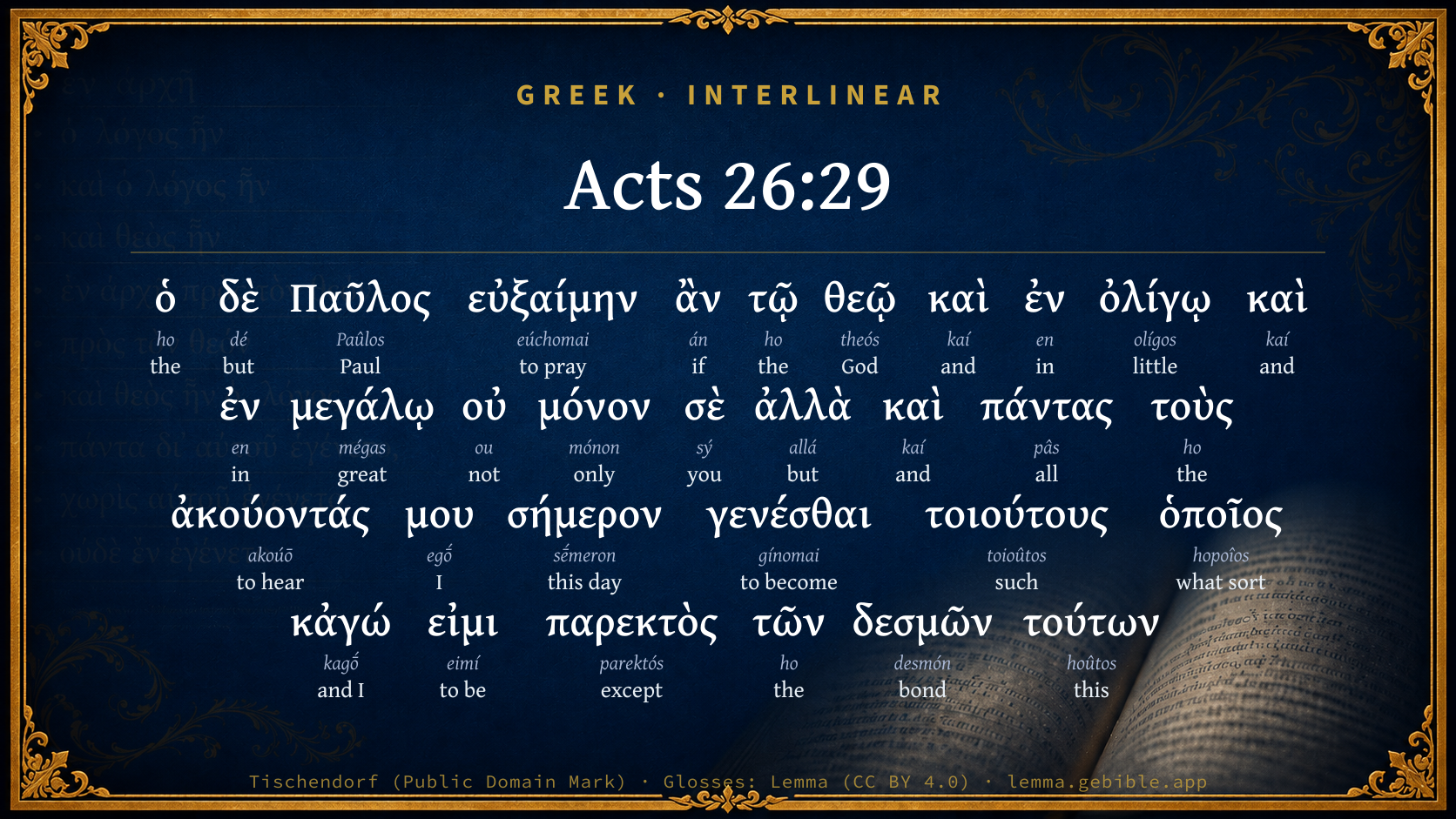
Download image
Cite this verse

Acts 26:29 (World English Bible). Public Domain. Lemma interlinear Bible study tool, https://lemma.gebible.app/v/acts/26/29.

Show BibTeX & RIS
BibTeX
RIS
English Translation
Paul said, "I pray to God, that whether with little or with much, not only you, but also all that hear me this day, might become such as I am, except for these bonds."
World English Bible · Public Domain
Highlights
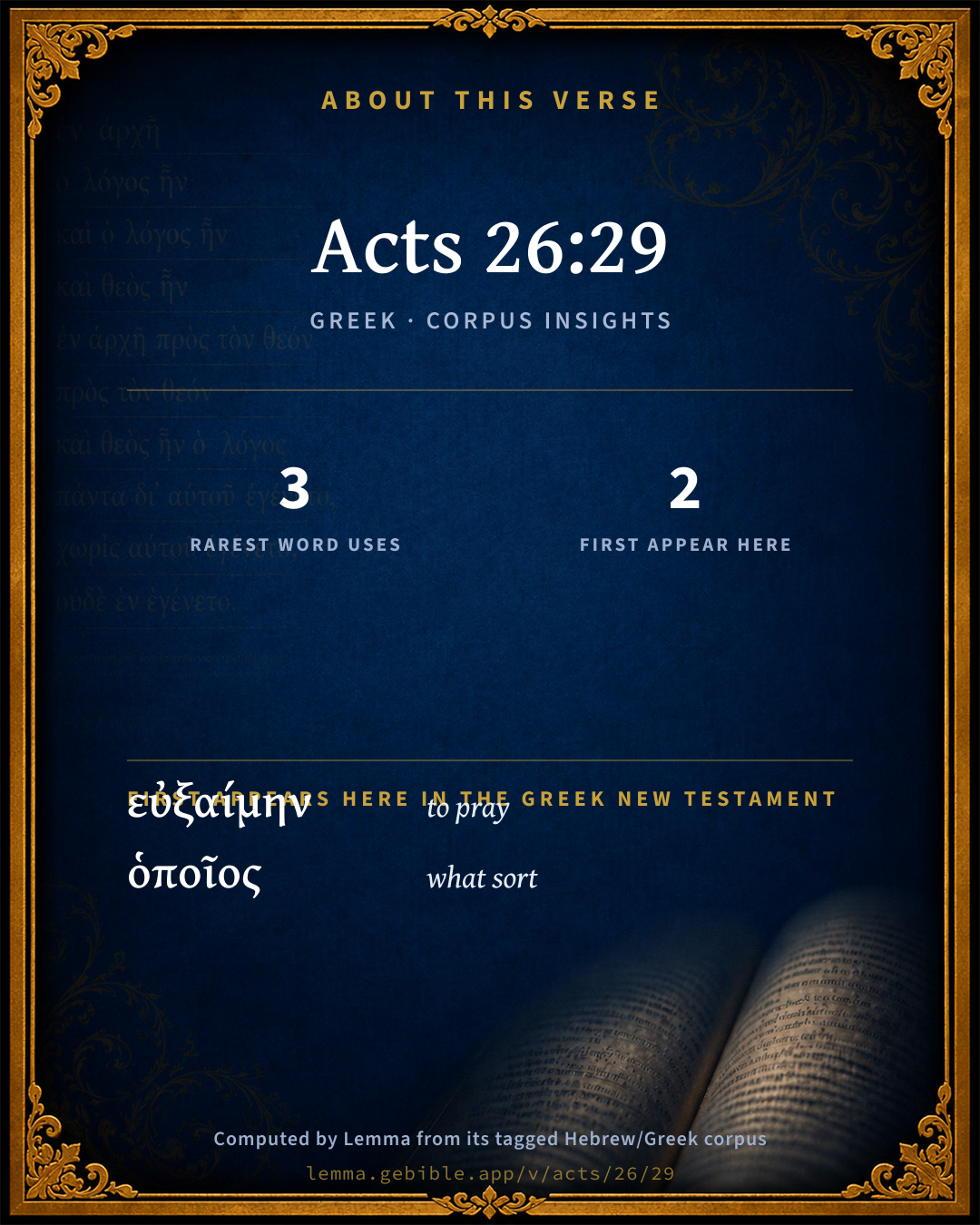
  • 2 first appearances in the Greek New Testament
Full analysis ↓
Download a study sheet

One document with this verse’s original text, its word-by-word gloss line, the meaning frame, cross-references with their text, attributed commentary, and full source and license credits — printable, and it pastes into notes with its structure intact.

This verse Autodidact and up

Study sheet (.html) Plain text (.txt)

A passage Seminary Student

Up to 50 verses in one chapter. A passage sheet keeps up to 6 commentary sources and 12 cross-references per verse, in the order this page ranks them, and says so on the sheet whenever that leaves anything out. Ask for a single verse and you get the Autodidact verse sheet above.

Everything on this page stays free to read, with no account — the sheet is a download of what is already on screen, not access to it.

Want to remove ads? Support Godless Engineer
Compare translations 3

The same verse in 3 English versions, stacked beneath the original-language interlinear above. Click any original word for its lexicon entry.

Each is an independent rendering of the whole verse — the interlinear is not word-aligned to these translations.

Highlighted words mark where these versions differ — a whole-verse word diff, not a word-by-word alignment.

  • World English Bible Public Domain
    Paul said, "I pray to God, that whether with little or with much, not only you, but also all that hear me this day, might become such as I am, except for these bonds."
  • King James Version Public Domain
    And Paul said, I would to God, that not only thou, but also all that hear me this day, were both almost, and altogether such as I am, except these bonds.
  • unfoldingWord Literal Text CC BY-SA 4.0
    But Paul replied, “I would wish to God, either in little or in much, that not only you but also all the ones hearing me today would become such as I also am—without these chains.”

unfoldingWord Literal Text — © unfoldingWord, licensed CC BY-SA 4.0. Word-aligned USFM3 via Door43 (git.door43.org/unfoldingWord/en_ult).

Versions to compare (up to 4)

3 of 4 selected

Show all 19 translations

Every available English version of this verse, each an independent rendering of the whole verse.

  • World English Bible Public Domain
    Paul said, "I pray to God, that whether with little or with much, not only you, but also all that hear me this day, might become such as I am, except for these bonds."
  • Berean Standard Bible Public Domain
    “Short time or long,” Paul replied, “I wish to God that not only you but all who hear me this day may become what I am, except for these chains.”
  • Majority Standard Bible Public Domain
    “Short time or long,” Paul replied, “I wish to God that not only you but all who hear me this day may become what I am, except for these chains.”
  • King James Version Public Domain
    And Paul said, I would to God, that not only thou, but also all that hear me this day, were both almost, and altogether such as I am, except these bonds.
  • American Standard Version (1901) Public Domain
    And Paul `said', I would to God, that whether with little or with much, not thou only, but also all that hear me this day, might become such as I am, except these bonds.
  • Revised Version (1885) Public Domain
    And Paul said, I would to God, that whether with little or with much, not thou only, but also all that hear me this day, might become such as I am, except these bonds.
  • Geneva Bible (1599) Public Domain
    Then Paul sayd, I would to God that not onely thou, but also all that heare me to day, were both almost, and altogether such as I am, except these bonds.
  • Douay-Rheims (1899) Public Domain
    And Paul said: I would to God, that both in a little and in much, not only thou, but also all that hear me, this day, should become such as I also am, except these bands.
  • Young's Literal Translation Public Domain
    and Paul said, `I would have wished to God, both in a little, and in much, not only thee, but also all those hearing me to-day, to become such as I also am -- except these bonds.'
  • Literal Standard Version CC BY-SA 4.0
    And Paul said, “I would have wished to God, both in a little, and in much, not only you, but also all those hearing me today, to become such as I also am—except these bonds.”
  • Unlocked Literal Bible CC BY-SA 4.0
    Paul said, “I pray to God, that whether in a short or long time, not you only, but also all that hear me today, would be like me, but without these prison chains.”
  • unfoldingWord Literal Text CC BY-SA 4.0
    But Paul replied, “I would wish to God, either in little or in much, that not only you but also all the ones hearing me today would become such as I also am—without these chains.”
  • Darby Bible Public Domain
    And Paul [said], I would to God, both in little and in much, that not only thou, but all who have heard me this day, should become such as *I* also am, except these bonds.
  • World Messianic Bible Public Domain
    Paul said, “I pray to God, that whether with little or with much, not only you, but also all that hear me today, might become such as I am, except for these bonds.”
  • Webster's Bible Public Domain
    And Paul said, I would to God, that not only thou, but also all that hear me this day, were both almost, and altogether such as I am, except these bonds.
  • Free Bible Version CC BY-SA 4.0
    “Whether it takes a short time or a long time doesn't matter,” Paul answered. “But my prayer to God is that not just you, but everybody listening to me today would become like me—except for these chains!”
  • Bible in Basic English Public Domain
    And Paul said, It is my prayer to God that, in little or great measure, not only you, but all those hearing me today might be even as I am, but for these chains.
  • Text-Critical English NT CC BY 4.0
    Paul said, “Whether quickly or not, I pray to God that not only yoʋ but also all who are listening to me today would become as I am, except for these chains.”
  • Tyndale New Testament (1534) Public Domain
    And Paul sayd: I wolde to God that not only thou: but also all that heare me to daye were not sumwhat only but altogeder soche as I am except these bondes.

Literal Standard Version (2020), Covenant Press — licensed CC BY-SA 4.0. Text via the HelloAO Bible API (eBible.org). Unlocked Literal Bible (unfoldingWord) — licensed CC BY-SA 4.0. Text via the HelloAO Bible API (eBible.org). unfoldingWord Literal Text — © unfoldingWord, licensed CC BY-SA 4.0. Word-aligned USFM3 via Door43 (git.door43.org/unfoldingWord/en_ult). Free Bible Version, Dr. Jonathan Gallagher — licensed CC BY-SA 4.0. Text via the HelloAO Bible API (eBible.org).

Word by word

More ways to search: Search by grammar → Find every occurrence → Compare this word →

Practice this passage: Drill this verse → Learn its vocabulary →

παρεκτὸς
parektós
G3924
“except”
Adverb
Part of Speech
Adverb
Full Thayer's Definition

Origin: from G3844 and G1622

TDNT: None

1. except, with the exception of (a thing) 2. besides
  1. ὁ ho G3588 “the” Article, Nominative, Singular, Masculine
  2. δὲ dé G1161 “but” Conjunction
  3. Παῦλος Paûlos G3972 “Paul” Noun, Nominative, Singular, Masculine
  4. εὐξαίμην eúchomai G2172 “to pray” Verb, Aorist, Middle deponent, Optative, 1st person, Singular
  5. ἂν án G302 “if” Particle
  6. τῷ ho G3588 “the” Article, Dative, Singular, Masculine
  7. θεῷ theós G2316 “God” Noun, Dative, Singular, Masculine
  8. καὶ kaí G2532 “and” Conjunction
  9. ἐν en G1722 “in” Preposition
  10. ὀλίγῳ olígos G3641 “little” Adjective, Dative, Singular, Neuter
  11. καὶ kaí G2532 “and” Conjunction
  12. ἐν en G1722 “in” Preposition
  13. μεγάλῳ mégas G3173 “great” Adjective, Dative, Singular, Masculine
  14. οὐ ou G3756 “not” Particle, Negative
  15. μόνον mónon G3440 “only” Adverb
  16. σὲ sý G4771 “you” Personal pronoun, 2nd person, Accusative, Singular
  17. ἀλλὰ allá G235 “but” Conjunction
  18. καὶ kaí G2532 “and” Conjunction
  19. πάντας pâs G3956 “all” Adjective, Accusative, Plural, Masculine
  20. τοὺς ho G3588 “the” Article, Accusative, Plural, Masculine
  21. ἀκούοντάς akoúō G191 “to hear” Verb, Present, Active, Participle, Accusative, Plural, Masculine
  22. μου egṓ G1473 “I” Personal pronoun, 1st person, Genitive, Singular
  23. σήμερον sḗmeron G4594 “this day” Adverb
  24. γενέσθαι gínomai G1096 “to become” Verb, Aorist, Middle deponent, Infinitive
  25. τοιούτους toioûtos G5108 “such” Demonstrative pronoun, Accusative, Plural, Masculine
  26. ὁποῖος hopoîos G3697 “what sort” Adjective, Nominative, Singular, Neuter
  27. κἀγώ kagṓ G2504 “and I” Personal pronoun, 1st person, Nominative, Singular, Aramaic form
  28. εἰμι eimí G1510 “to be” Verb, Present, Active, Indicative, 1st person, Singular
  29. τῶν ho G3588 “the” Article, Genitive, Plural, Neuter
  30. δεσμῶν desmón G1199 “bond” Noun, Genitive, Plural, Neuter
  31. τούτων hoûtos G3778 “this” Demonstrative pronoun, Genitive, Plural, Neuter

About this verse

These counts appear in no published source. They are computed here, from the morphology-tagged text and Lemma’s own curated glosses. What Lemma adds →

32
words
26
distinct lemmas
Acts
section

Notable vocabulary

The rarest word here is παρεκτὸς except G3924 — appearing just 3 times in the whole Greek New Testament.

First appearance in Scripture

These words make their first canonical appearance in the Greek New Testament here:

  • εὐξαίμην to pray G2172
  • ὁποῖος what sort G3697

Shared distinctive vocabulary

παρεκτὸς except G3924 occurs in 3 verses of the Greek New Testament. Also found in:
Repetition

Words recur within this verse:

Cross-references

17

Topical passages linked to Acts 26:29 in the Treasury of Scripture Knowledge — connected by theme and wording, ordered by reader-vote popularity; previews shown in the World English Bible.

  • Ephesians 6:20 for which I am an ambassador in chains; that in it I may speak boldly, as I ought to speak.
  • Acts 21:33 Then the commanding officer came near, arrested him, commanded him to be bound with two chains, and inquired who he was and what he had done.
  • Romans 10:1 Brothers, my heart's desire and my prayer to God is for Israel, that they may be saved.
  • Colossians 1:28 whom we proclaim, admonishing every man and teaching every man in all wisdom, that we may present every man perfect in Christ Jesus;
  • Exodus 16:3 and the children of Israel said to them, "We wish that we had died by the hand of Yahweh in the land of Egypt, when we sat by the flesh-pots, when we ate our fill of bread, for you have brought us out into this wilderness, to kill this whole assembly with hunger."
  • Numbers 11:29 Moses said to him, Are you jealous for my sake? would that all Yahweh's people were prophets, that Yahweh would put his Spirit on them!
  • 2 Samuel 18:33 The king was much moved, and went up to the chamber over the gate, and wept: and as he went, thus he said, my son Absalom, my son, my son Absalom! would I had died for you, Absalom, my son, my son!
  • 2 Kings 5:3 She said to her mistress, Would that my lord were with the prophet who is in Samaria! then would he recover him of his leprosy.
  • Jeremiah 13:17 But if you will not hear it, my soul shall weep in secret for [your] pride; and my eye shall weep sore, and run down with tears, because Yahweh's flock is taken captive.
  • Luke 19:41–42 When he drew near, he saw the city and wept over it,
  • John 5:34 But the testimony which I receive is not from man. However, I say these things that you may be saved.
  • Acts 12:6 The same night when Herod was about to bring him out, Peter was sleeping between two soldiers, bound with two chains. Guards in front of the door kept the prison.
  • Acts 25:14 As he stayed there many days, Festus laid Paul's case before the king, saying, "There is a certain man left a prisoner by Felix;
  • Romans 9:1–3 I tell the truth in Christ. I am not lying, my conscience testifying with me in the Holy Spirit,
  • 1 Corinthians 4:8 You are already filled. You have already become rich. You have come to reign without us. Yes, and I wish that you did reign, that we also might reign with you.
  • 1 Corinthians 7:7 Yet I wish that all men were like me. However each man has his own gift from God, one of this kind, and another of that kind.
  • 2 Corinthians 11:1 I wish that you would bear with me in a little foolishness, but indeed you do bear with me.

Cross-references courtesy of OpenBible.info (CC BY 4.0).

Commentary

Notes on Acts 26:29 from classic Christian and Jewish commentators (each source and its license shown beneath its notes). The classic Christian expositions comment on the surrounding passage and are grouped to its opening verse, so a note may address several verses; the Jewish commentaries on the Tanakh (Rashi and others) are per-verse, so they appear only where the commentator wrote on this verse.

Lemma curates 59 commentaries, every one of them public domain or Creative Commons licensed, each selected and text-cleaned for this edition rather than reprinted as found. About our sources →

Ellicott's Commentary for English Readers

(29) I would to God that not only thou . . .—It is clear that here also the English “almost” must be abandoned, and that we must take the words in a little or in a great (measure), or, with little labour and with great, as corresponding with what Agrippa had just said. Grammatically the words admit of three possible paraphrases, each of which has found advocates. We may suppose St. Paul to say—(1) “I would pray to God, not as you put it, lightly, but as fully as I can . . . .;” or (2) “I would pray to God that, whether persuaded with little evidence or much . . . .;” or (3) “I would pray to God that, both in a little measure and in a great. . . .” The first two of these explanations are open to the objection that they substitute a disjunctive alternative for the natural rendering of the two copulative conjunctions. The last has the advantage of so far taking the words in their natural construction; but, on the other hand, it takes the special phrase, “in a little,” in a sense different from that in which we have seen reason to believe that Agrippa had used it. It is, however, perfectly conceivable that, for the purpose of emphasising the strong desire of his heart, St. Paul may have caught up the half-sarcastic phrase, and used it as with a new meaning.

The MSS. present two readings, in a little and in a great, and in a little and in much; but this scarcely affects the interpretation of the passage.

Except these bonds.—The words show, as has been pointed out in the Note on Act_26:29, that the prisoner was brought into court chained, after the Roman fashion, to the soldier or soldiers who kept guard over him. We cannot read the words without feeling their almost plaintive pathos. “Such as he”—pardoned, at peace with God and man, with a hope stretching beyond the grave, and an actual present participation in the powers of the eternal world—this is what he was desiring for them. If that could be effected, he would be content to remain in his bonds, and to leave them upon their thrones.

A Bible Commentary for English Readers, edited by Charles John Ellicott (1878–1897) — public domain. Text from a community e-Sword module.

The Biblical Illustrator

Joseph S. Exell

Act_26:29

And Paul said, I would to God that not only thou … were both almost and altogether such as I am, except these bonds.

Pauls prayer before Agrippa

I. His decision intimated in the words--such as I am. What, then, was Paul? A Christian.

1. What is included in this? Not knowledge merely, nor a plausible profession, but living faith, holy love, and spiritual operative life.

2. It avails not what you are, unless you be Christians--were you ever so rich, highly respected in society, or beloved by your friends, an affectionate obedience of Jesus Christ.

3. It is not in the power of man to bring you to this, for it was not in the power of Paul effectually to persuade Agrippa.

II. His enjoyment. This is evident.

1. He was satisfied with the choice he had made. He had no misgiving that in embracing Christianity he had done foolishly.

2. He was happy--much more happy in his fetters than all the splendid audience which he addressed. A man is happy not according to his rank, but the state of his heart. Joseph, calumniated and imprisoned, was not anxious in the least; for the Lord was with him, and showed him mercy. Daniel and his three friends were perfectly composed; for their confidence was in God, and their salvation was from Him.

III. His benevolence.

1. The goodwill of this apostle first regarded Agrippa, but it did not rest with him: it was diffusive, it spread through the whole company. In one respect, it is true, he desired no resemblance: except these bonds. It is well to judge of the religion of Jesus Christ by its effects.

2. Observe how the benevolence of Paul was expressed; not by mere words, the impulse of momentary feeling: the text is a prayer. From this learn, that no place is unsuitable for prayer, no time is unseasonable for the exercise. Benevolent wishes should be matured into prayers, and ought to be expressed by pleading with God. But prayer was not all. The apostle spent his life in active kindness, and he, who thus prayed for Agrippa and the court of Festus, was ready in every way to prove the benevolence which he expressed. And with our prayers let us unite exertion, or what evidence have we of their sincerity?

Conclusion:

1. How wide the difference between the spirit of Christianity and the spirit of the world!

2. How striking the contrast between the reality of the gospel and the pretensions of infidelity!

3. How highly desirable is proficiency in religion, in opposition to a languid and wavering profession of it! (T. Kidd.)

The philanthropy of the Apostle Paul

I. Pauls character. In his reply we have the words, Such as I am. What, then, was he when he stood face to face with Agrippa? Paul was a Christian--a Christian in the highest, deepest, broadest meaning of the term--a loyal, loving disciple of the Lord Jesus Christ. Such was his character when he stood face to face with Agrippa.

II. Pauls circumstances. In his reply we have the words, except these bonds.

III. Pauls wish. I would to God, etc. This was not the false wish of a proud, self-righteous Pharisee, but the true wish of a real Christian philanthropist. He wished that Agrippa resembled him in character, but not in circumstances. From this wish we infer--

1. That Paul never regretted becoming a Christian. When he stood before Agrippa he was an old man; he had been a disciple of Christ for very many years; a death of martyrdom was before him; and yet, withal, he would not have exchanged positions with Agrippa.

2. That what Paul was it was possible for Agrippa to become. (J. F. Smythe.)

A preachers best wish for a king

It is not always easy, by the mere sense of hearing, to decide whether the report of artillery indicates a shotted gun or a complimentary salute. Even so, you are often at a loss to decide whether certain men speak in earnest or jest. The words of Agrippa have suffered from a like uncertainty. Was he in earnest or ironical? The common view is that, so far as a Herod could be earnest, Herod Agrippa was on that day. But whatever was the depth or shallowness of his utterance, it did not satisfy St. Paul. He knew that it was not enough for the foundering ship to have almost reached her port; that it did not save the man slayer to have almost gained the gate of the city of refuge before the avenging kinsman overtook him. Observe--

I. How perfectly certain Paul was that he was a Christian. Agrippa had professed to be almost persuaded. The apostle says, I would to God that thou wert both almost and altogether--what? Such as I am. Could anything show more clearly that St. Paul had not the shadow of a doubt that he was a Christian? This is not so with many Christians. Even when others behold the evidence in their daily walk, they themselves can only say that they hope. They are following on in the path to peace as nearly as they can find it, but whether it ends in assured glory, they can only know when the gates of the celestial city have closed behind them. It was not so when Christianity was young. This doubt and uncertainty is like our gorgeous churches, where the poor have no place; like our fashionable preachers, who glorify human nature instead of Christ; like our fashionable congregations, where dress and display attract the eye: it belongs to modern, not to ancient Christianity. Then men knew whom they had believed. Look at this confidence as displayed by St. Paul. He did not wish that they were what he hoped he might be, not what he desired to be, not what he thought he was. He wants them to be what he then and there is sure that he himself is--a Christian. Is such a certainty something which God only permitted the primitive believers to realise? Or, is it a privilege which all may know in personal experience? The whole question hangs on the character of Christ. You may be perfectly confident if Jesus is one who does not break His word. Such a confidence is exceedingly desirable. I do not see how St. Paul could have been so eager, unless he had the clearest convictions that he was himself saved. Moses could not have said to his brother-in-law, Come thou with us and we will do thee good, if he had possessed no certain confidence that he and the people were on their way to Canaan. So does assurance of faith make working Christians.

II. What a grand thing Paul evidently esteemed it to be a Christian! There are some men who undervalue their blessings. St. Paul was not one of that class. It was a cause of thanksgiving that by the grace of God he was what he was. Who were they that heard him?

1. In that assembly were men of wealth. And yet this poor prisoner cries out, I would to God that all that hear me, were both almost and altogether what I am. To him Christianity was worth more than the riches of a Roman procurator.

2. There were men among those who heard him that day who had a home. And he who stood at that tribunal like his Master, had not where to lay his head. He wrote, We have no certain dwelling place. Yet it was this homeless man who cried out, I would to God, etc. His Christianity was to him worth more than even a home.

3. Above all these were men of high rank and social position. And here was a man whose rank was to be counted as the offscouring of all things, who yet cried out in such an august assembly, I would to God, etc. Such was St. Pauls estimate of the worth of his Christianity. He could do without a home; he could dispense with the wealth of Festus; he could live without the crown of Agrippa, but he could not do without Christ, to him the hope of glory. Today does he regret his estimate of his heritage? Today the wealth of Gods glory is his. Today the home of Gods saints is his portion. Today he reigns as king, a crown of glory on his brow. (Bp. Cheney.)

.

The Biblical Illustrator, edited by Joseph S. Exell (c. 1880s–1900s) — public domain. Text from a community e-Sword module.

Tyndale Open Study Notes

Tyndale Open Resources

26:29 Paul’s bold answer shows his quickness in repartee. He challenges Agrippa and his whole audience about the value of knowing Christ and making a personal commitment to him.

Tyndale Open Study Notes — © Tyndale Open Resources, licensed CC BY-SA 4.0. Text via the HelloAO Bible API.

Bengel's Gnomon

Johann Albrecht Bengel

Act 26:29. Εὐξαίμην ἂν τῷ Θεῷ, I would wish before GOD) Agrippa speaks of it as a thing at his own pleasure, as if he could at will admit human persuasion, such as he ascribed to Paul: Paul courteously corrects this error; for it is the gift and work of GOD.—καὶ ἐν ὀλίγῳ καὶ ἐν πολλῷ, both almost and altogether) Paul retorts the expression almost upon the king; and by a kind of parody adds, and altogether: both of which designate (imply) both the time and the easiness of the thing: Those things which are easy, are for the most part quickly done; those things which are difficult, are slowly done. The ἐν πολλῷ [implying slowness and difficulty in the accomplishment] appertains to Festus, and other hearers like Festus, whom he invites to faith: the ἐν ὀλίγῳ (in a little, easily, quickly, almost), or both expressions, apply to Agrippa.—οὐ μόνον σὲ, not only thou) Paul intimates that he is ready, not only to bestow (devote) τὸ ὄλιγον, that which is little and easy, the labour of speaking, but also that which is much and hard, τὸ πολὺ, viz. great labour, endurance, and life itself.—πάντας, all) It is the part of modesty, that Paul does not name and address all these; yet he looks at them and marks them.—σήμερον, this day) This is construed by most interpreters with the preceding participle; by Chrysostom and others, with the subsequent verb. And, indeed, it has remarkable force with the verb.—γένεσθαι, might become) The word of Agrippa (“to become a Christian”) is repeated. The antithesis is εἰμι, I am, presently.—τοιούτους, such) Christians, not merely by profession, but in reality. An elegant periphrasis.—κἀγὼ, even I myself) Paul speaks from a sense of his own blessedness, with the widest (most comprehensive) love. Comp. 1Co 7:7.—παρεκτὸς, with the exception of) A most sweet ἐπιθεραπεία (after-correction.—See Append.) and exception.

Bengel's Gnomon of the New Testament — English translation (T&T Clark, Edinburgh, 1860) — public domain. Text from a community e-Sword module.

Meyer's Critical & Exegetical Commentary

Heinrich August Wilhelm Meyer

Act_26:29. In the full consciousness of his apostolic dignity, Paul now upholds the cause of the despised Χριστιανὸν γενέσθαι as that which he would entreat from God for the king and all his present hearers, and which was thus more glorious than all the glory of the world.

εὐξαίμην ἂν τῷ Θεῷ] I would indeed (in case of the state of the matter admitting it) pray to God. See on this use of the optative with ἄν, Fritzsche, Conject. I. p. 34 f.; Bernhardy, p. 410; Krüger, § 54, 3. 6. Εὔχεσθαι; with the dative, to pray to any one, only here in the N.T., but very frequently in classical writers.

In what follows σήμερον belongs to τ. ἀκούοντάς μ., not to γενέσθαι (Chrysostom), as is to be inferred from ἐν μεγάλῳ.

καὶ ἐν ὀλίγῳ καὶ ἐν μεγάλῳ οὐ μόνον σὲ κ.τ.λ.] that as well by little as by great,whether in the case of one, little (see on Act_26:28), and in the case of another, much (κόπος κ. πόνος ἐν τῇ διδασκαλίᾳ, Oecumenius, reading ἐν πολλῷ), may be employed as a means for the purpose,[164]not merely thou, but also all … were such also as I am (Christians). On κἀγώ, comp. 1Co_7:7; Baeumlein, Partik. p. 153.

παρεκτὸς τῶν δεσμῶν τούτων] The chains which had bound him in prison, and were again to bind him (comp. on Act_24:23; Act_24:27, Act_28:30), chaining him, namely, after the manner of the custodia militaris to the soldiers who watched him, he bore now hanging down freely on his arm. Comp. Justin. xiv. 4, 1. The παρεκτὸς κ.τ.λ., although to the apostle his chains were an honour (Eph_3:1; Eph_4:1; Phm_1:1. Comp. Php_2:17 f.), is suavissima ἐπιθεραπεία et exceptio (Bengel), in the spirit of love.

[164] The interpreters who take ἐν ὀλίγῳ as brevi tempore (see on ver. 28) here translate (according to the reading πολλῷ): be it for short or for long (de Wette). Those who take ἐν ὀλίγῳ as propemodum, translate: non propemodum tantum, sed plane (Grotius). With our view of ἐν ὀλίγῳ, the reading ἐν πολλῷ makes no difference of meaning from ἐν μεγάλῳ. Ewald, likewise following the reading ἐν μεγ., takes ἐν also here consistently in the sense of value: by little and by much, that is, by all I wish, etc.

Meyer — Critical and Exegetical Commentary on the New Testament — English translation by Peter Christie, edited by Frederick Crombie (T&T Clark, 1880) — public domain. Text from a community e-Sword module.

Expositor's Greek Testament

ed. W. Robertson Nicoll

Act 26:29 . εὐξαίμην ἄν : on the optative with ἄν , Burton, p. 80, Blass, Gram. , p. 202, Viteau, Le Grec du N.T. , p. 40 (1893); with dative only here in N.T. καὶ ἐν ὀλ . καὶ ἐν μεγ .: “whether with little or with much,” R.V. See critical note and Act 26:28 , i.e. , with little or much trouble, and cost. σήμερον : to be joined not with γενέσθαι (as Chrysostom, Bengel), but With τοὺς ἀκούοντάς μου . οὐ μόνον , Burton, pp. 183, 184, μὴ μόνον with infinitive only in Gal 4:18 . τοιούτους ὁποῖος κἀγώ εἰμι , he does not repeat the word “Christian,” which perhaps he would not recognise (Blass): “tales qualis ego sum, sive Chr. appellare vis, sive alio vel contemptiore nomine”. γενέσθαι … εἰμι : “might become such as I am,” R.V., thus giving the difference between γέν . and εἰμι ; by whatever name he might be called, the Apostle knew what he actually was (1Co 9:9 ). παρεκτὸς τῶν δεσμῶν τούτων ; not figurative but literal; although the plural may be used rhetorically (Weiss), cf. Tac., Ann. , iv., 28. παρεκτὸς : Mat 5:32 ; Mat 19:9 (see W.H [405] ) (2Co 11:28 , adv [406] ), Didaché , vi., 1, Test. , xii., Patr., Zab. , 1; “suavissima ἐπιθεραπεία et exceptio,” Bengel. Faith and Hope of these the Apostle had spoken, and his closing words reveal a Love which sought not its own, was not easily provoked, and took no account of evil: “totum responsum et urbanissimum et Christiano nomine dignissimum,” Blass.

[405] Westcott and Hort’s The New Testament in Greek: Critical Text and Notes.

[406] adverb

The Expositor's Greek Testament, edited by W. Robertson Nicoll (1897–1910) — public domain. Text from a community e-Sword module.

Geneva Bible (1599)

Geneva Bible translators

I would to God that not only almost, but thoroughly and altogether both thou and all that hear me this day, might be made as I am, my bonds only except.

Geneva Bible (1599) marginal notes — public domain. Text via Bolls.life.

Jamieson, Fausset & Brown

Robert Jamieson, A. R. Fausset & David Brown

I would to God, &c.--What unequalled magnanimity does this speech breathe! Only his Master ever towered above this.

not only . . . almost . . . but altogether--or, "whether soon or late," or "with little or much difficulty."

except these bonds--doubtless holding up his two chained hands (see on Act 12:6): which in closing such a noble utterance must have had an electrical effect.

Jamieson, Fausset & Brown — Commentary Critical and Explanatory on the Whole Bible (1871) — public domain (CC PDM 1.0). Text via the HelloAO Bible API.

Adam Clarke's Commentary

Verse 29. I would to God, c.] Ευξαιμην αν τῳ Θεῳ, και εν ολιγῳ και εν πολλῳ - So fully am I persuaded of the infinite excellence of Christianity, and so truly happy am I in possession of it, that I most ardently wish that not only thou, but this whole council, were not only almost, but altogether, such as I am, these CHAINS excepted. Thus, while his heart glows with affection for their best interests, he wishes that they might enjoy all his blessings, if possible, without being obliged to bear any cross on the account. His holding up his chain, which was probably now detached from the soldier's arm, and wrapped about his own, must have made a powerful impression on the minds of his audience. Indeed, it appears they could bear the scene no longer the king was overwhelmed, and rose up instantly, and so did the rest of the council, and went immediately aside; and, after a very short conference among themselves, they unanimously pronounced him innocent; and his last word, των δεσμων, BONDS! and the action with which it was accompanied, had made such a deep impression upon their hearts that they conclude their judgment with that very identical word δεσμων. Would to God, says the apostle, that all who hear me this day were altogether such as as I am, except these BONDS! The whole council say-This man hath done nothing worthy of death nor of BONDS! δεσμων, BONDS, is echoed by them from the last words of the apostle; as we may plainly perceive that, seeing such an innocent and eminent man suffering such indignity had made a deep impression upon their hearts. Alas! why should such a man be in B-O-N-D-S!

Adam Clarke's Commentary on the Bible (1810–1826) — public domain. Text from a community e-Sword/MySword module.

The Cambridge Bible for Schools and Colleges

gen. ed. J. J. S. Perowne

29. both almost, and altogether] The literal rendering of the Greek is given by the Rev. Ver. “whether with little or with much,” and it is difficult to see how the sense of the A. V. can be extracted from the words. The Apostle takes up the jeer of the king in a serious tone, and replies: “I may have seemed to use little persuasion, and suddenly to have jumped at the conclusion that you accept the teaching of the prophets as I myself receive it; but whether it need little or much persuasion, or little or much time, my prayer to God is, for you and for all who listen to me that they may become such as I am, save as to my bonds.”

were … such as I am] Better with Rev. Ver. “might become such as I am.” Paul avoids the word “Christian,” which for himself he might willingly have accepted (cp. 1Pe_4:16), but which was used by the king in a mocking sense, and therefore would not have made his wish seem an acceptable one. You may call me “Christian” in mockery, my joy and hope and faith in Christ are such, that I know no better prayer for any than to wish you all the like blessings.

except these bonds] From this it is clear, in spite of the leniency with which Paul had been at first treated by Felix, that either because his case was deemed more serious in consequence of his being left in prison so long, or because he was just now before the court as a prisoner, the Apostle had been put in chains.

The Cambridge Bible for Schools and Colleges (gen. ed. J. J. S. Perowne; Cambridge University Press, 1878–1918) — public domain. Text from a community e-Sword module.

John Gill's Exposition

And when he had thus spoken,.... These words are omitted in the Alexandrian copy, the Vulgate Latin, Syriac, and Ethiopic versions:

the king rose up; from the judgment seat; that is, King Agrippa:

and the governor; the Roman governor, Festus:

and Bernice: the sister of King Agrippa:

and they that sat with them; either in council, or to hear; the chief captains, and principal inhabitants of Caesarea.

John Gill's Exposition of the Whole Bible (1746–1763) — public domain (CC PDM 1.0). Text via the HelloAO Bible API.

Trapp's Complete Commentary

John Trapp

29 And Paul said, I would to God, that not only thou, but also all that hear me this day, were both almost, and altogether such as I am, except these bonds.

Ver. 29. I would that all] Charity is no churl; there is no envy in spiritual things, because they may be divided in solidum: one may have as much as another, and all alike. Self-love writes, as that emperor did, τα εις εμαυτον, For mine own use only. It makes men like those envious Athenians, who sacrificed for none but themselves and their neighbours of Chios. But true Christian love wisheth well to the community. "I would to God" (said Mr Dad) "I were the worst minister in England" (and England had but a few better), not wishing himself worse than he was, but other men better.

John Trapp, A Commentary or Exposition upon All the Books of the Old and New Testament (1647–1656) — public domain. Text from a community e-Sword module.

Albert Barnes' Notes on the Bible

I would to God - I pray to God; I earnestly desire it of God. This shows:

(1) Paul’s intense desire that Agrippa, and all who heard him, might be saved.

(2) His steady and constant belief that none but God could incline people to become altogether Christians. Paul knew well that there was nothing that would overcome the reluctance of the human heart to be an entire Christian but the grace and mercy of God. He had addressed to his hearers the convincing arguments of religion, and he now breathed forth his earnest prayer to God that those arguments might be effectual. So prays every faithful minister of the cross.

All that hear me - Festus, and the military and civil officers who had been assembled to hear his defense, Act 25:23.

Were both almost, and altogether ... - Paul had no higher wish for them than that they might have the faith and consolations which he himself enjoyed. He had so firm a conviction of the truth of Christianity, and had experienced so much of its supports amidst his persecutions and trials, that his highest desire for them was that they might experience the same inexpressibly pure and holy consolations. He well knew that there was neither happiness nor safety in being almost a Christian; and he desired, therefore, that they would give themselves, as he had done, entirely and altogether to the service of the Lord Jesus Christ.

Except these bonds - These chains. This is an exceedingly happy and touching appeal. Probably Paul, when he said this, lifted up his arm with the chain attached to it. His wish was that in all respects they might partake of the effects of the gospel, except those chains. Those he did not wish them to bear. The persecutions, the unjust trials, and the imprisonments which he had been called to suffer in the cause, he did not desire them to endure. True Christians wish others to partake of the full blessings of religion. The trials which they themselves experienced from without in unjust persecutions, ridicule, and slander, they do not wish them to endure. The trials which they themselves experience from an evil heart, from corrupt passions, and from temptations, they do not wish others to experience. But even with these, religion confers infinitely more pure joy than the world can give; and even though others should be called to experience severe trials for their religion, still Christians wish that all should partake of the pure consolations which Christianity alone can furnish in this world and the world to come. Compare Mar 10:30.

Albert Barnes' Notes on the Bible (1834–1885) — public domain. Text from a community e-Sword/MySword module.

Haydock's Catholic Bible Commentary

Except these chains. That is, I heartily wish all men in the same condition as myself, not only to be prisoners as I am, but to be Christians, as I am. (Witham)

George Leo Haydock (1774–1849), Haydock's Catholic Family Bible and Commentary, 1859 edition — public domain. Excludes Psalms (Douay-Rheims chapter numbering differs from Protestant) and Deuterocanonical books (Catholic canon only).

Matthew Poole's English Annotations

Paul, knowing how little it would avail any to be almost a Christian, wisheth their perfection in that profession, that they might not, with the Laodiceans, be neither hot nor cold, Rev 3:16; nor, with the Israelites, halt between God and Baal, 1Ki 18:21.

Except these bonds: some think that by bonds St. Paul means only his guard wherewith he was surrounded; but it is certain that St. Paul was bound, in the most literal sense, with chains, as Act 24:27; and he wishes his auditors all the good that was in him, and to be freed from all the evils that were upon him.

Matthew Poole's English Annotations on the Holy Bible (1683–1685) — public domain. Text from a community e-Sword/MySword module.

Whedon's Commentary on the Bible

Daniel D. Whedon

29. Not only thou, but all—Were not only in little, but in much such as I am. Such is the literal Greek. But the true Greek text is not εν πολλω, in much, but in μεγαλω, in great. Paul’s meaning then is, I wish you were a Christian not merely in a little degree, but in a great—entirely.

Except these bonds—How delicate a reproof of the men who were consciously holding him bound with undeserved chains. Dr. Hackett quotes a very appropriate passage from Tacitus concerning a Roman named Vibius Serenus, who was prosecuted before the Senate by his son. “The indicted father and his indicting son were brought into the Senate. Recently recalled from exile, and bound with a chain, while his son was making the plea, the father, with undaunted spirit, turning toward his son, shook his chain and invoked the vengeance of the gods.” Thus terminates this rare encounter. The prisoner was master of the field, and of the king. The latter made a quiet retreat.

Daniel D. Whedon (gen. ed.), Commentary on the Old and New Testaments (1874–1909) — public domain. Text from a community e-Sword module.

The Pulpit Commentary

Whether with little or with much for both almost, and altogether, A.V.; might become for were, A.V. (the order of the words is also changed). I would to God; literally, I would pray to God. It is not very different from the hujcomhn of Rom_9:3. All acknowledge the extreme beauty and taste of this reply, combining the firmness of the martyr with the courtesy of the gentleman. "Loquitur Paulus ex sensu suae beatitudinis, cum amore latissimo" (Bengel)

Both almost, and altogether.

By comparing the translation of ver. 28 in the Revised Version, it will be seen that the traditional associations of the words cannot be maintained, and that Agrippa had other thoughts than those which are usually supposed. But it is certain that St. Paul made use of Agrippa"s words to point a persuasion, and recognized the possibility of the state which may be described as "almost a Christian." And so we are still justified in basing a homily on the condition of the "almost persuaded" upon this passage. The subject may be pleasantly introduced by a description of the pompous scene. Agrippa prided himself upon his semi-royalty, and so Festus arranged for as much of state grandeur as possible. St. Paul was brought chained to his soldier-guard, and spoke with but one hand free. His fervor and eloquence moved Agrippa more than he cared to admit even to himself. He dreaded any further pressure, and therefore tried to turn aside the apostle"s pleadings with the lightness of a laugh. St. Paul was too much in earnest to take the king other than seriously, and so he responds with the passion and persuasion of our text. He turns the king"s words into a plea against continuing any longer in an unsaying relation to Christianity. And still we find, in regard to vital personal religion, that very many come up, as it were, to the door, but do not enter in. There are amongst us many very many who are only almost Christians.

I WHO AMONG US MAY WE THINK OF AS ONLY ALMOST CHRISTIANS?

1. The child of pious parents, surrounded by gracious influences, led to the house of God, the child of many prayers, growing up to manhood or womanhood, yet not wholly Christ"s today.

2. The regular attendant at Christian services; often moved to tears, and, it may be, to some passing resolves; but emotions pass, decision is delayed, and they are only almost Christians yet.

3. There may even be aged people trembling down to life"s close, who, having put off religious decision again and again, seem now unable to make the effort, and are in peril of dying only almost Christians.

4. There are parents who have converted children, but are themselves the old side of the border-laud, yet in "trespasses and sins.

5. There are those who have been aroused to religious anxiety, but whose experience, varying for years, has never yet risen to full surrender. Each of these classes may be described with precise adaptation to the congregation addressed.

II WHAT REASONS CAN BE FOUND FOR SO MANY REMAINING ONLY ALMOST CHRISTIANS? In the case of Agrippa the message seemed novel and strange, and there seemed excuse for requiring time to think it over. In our case the message may seem old and familiar, and it may have lost its awakening and persuading power. Sometimes the hindrance is:

1. intellectual. It may be sonic perplexity or difficulty in relation to Christian doctrine. Or it may be the influence of the intellectual tone of the society in which a man mingles.

2. Or the hindrance may be lack of sufficient motive: especially an inadequate impression of the evil and peril of sin. To use a figure, the boat lies rocking just outside the harbor bar, and there is not wave enough to lift it over. Therefore must the true preacher find motive and persuasion, urging, in Christ"s stead, "Be ye reconciled unto God.

3. But the chief hindrances are moral. It was Agrippa"s self-indulgent and immoral life which really turned the shafts aside. The pride of self stands in our way. Decision for Christ involves surrender a giving up of that "self-reliance" which is so dear to flesh and blood. Illustrate from the story of the young rich ruler; and recall our Lord"s teachings about the "strait gate and the narrow way." This may be the reason why we are not "altogether" Christians. There is a cable holding under the water somewhere, and the ship cannot float out free into the ocean of God. Illustrate some cables. The last to yield is usually feeling; we wait for feeling, and, waiting, let the golden hours of opportunity slip by.

III WHAT REALLY IS IT TO BE ONLY ALMOST PERSUADED? See it in the estimate we form of Agrippa"s character. He is utterly weak and ignoble. We admire the confessor and the martyr; we scorn the hesitating and indecisive such as Reuben, "unstable as water." The people at Athens very properly ordained that every one should be fined who would take neither side in politics. It is a condition which dishonors God more than open rebellion, because it assumes that there really are some considerations to be set against his claims, some reasons why we should not love and serve him. And such indecision effectually shuts us out from the benefits of the gospel provision. The "almost Christian" has

(1) no sense of pardoned sin;

(2) no joy of peace with God;

(3) no strength from the consciously present Savior;

(4) no title to the everlasting heritage.

Impress that in religious matters there really is no borderland. Illustrate by the story of the wreck of the Royal Charter. The fore part ledged on a rock, the back part, flapped by the waves, broke away and sank in deep water with all that were in it. Just at the moment of parting a young man stood on the hinder part, and made a leap for dear life. He was saved, for he could decide and act. Then plead, as St. Paul pleaded, that, whether by little persuasion or by much, men would end their state of indecision, and become altogether Christ"s. R.T.

The Pulpit Commentary (1880–1919), ed. H.D.M. Spence-Jones & Joseph S. Exell — public domain. Text from a community e-Sword module.

John Wesley's Explanatory Notes

I would to God - Agrippa had spoke of being a Christian, as a thing wholly in his own power. Paul gently corrects this mistake; intimating, it is the gift and the work of God; that all that hear me - It was modesty in St. Paul, not to apply directly to them all; yet he looks upon them and observes them; were such as I am - Christians indeed; full of righteousness, peace, and joy in the Holy Ghost. He speaks from a full sense of his own happiness, and an overflowing love to all.

John Wesley, Explanatory Notes Upon the Whole Bible (1754–1765) — public domain. Text via the GEBible commentary corpus.

MacLaren's Expositions of Holy Scripture

Alexander MacLaren

Acts

‘BEFORE GOVERNORS AND KINGS’

Act 26:19 - Act 26:32.

Festus was no model of a righteous judge, but he had got hold of the truth as to Paul, and saw that what he contemptuously called ‘certain questions of their own superstition,’ and especially his assertion of the Resurrection, were the real crimes of the Apostle in Jewish eyes. But the fatal wish to curry favour warped his course, and led him to propose a removal of the ‘venue’ to Jerusalem. Paul knew that to return thither would seal his death-warrant, and was therefore driven to appeal to Rome.

That took the case out of Festus’s jurisdiction. So that the hearing before Agrippa was an entertainment, got up for the king’s diversion, when other amusements had been exhausted, rather than a regular judicial proceeding. Paul was examined ‘to make a Roman holiday.’ Festus’s speech {Act 25:24 - Act 25:27} tries to put on a colour of desire to ascertain more clearly the charges, but that is a very thin pretext. Agrippa had said that he would like ‘to hear the man,’ and so the performance was got up ‘by request.’ Not a very sympathetic audience fronted Paul that day. A king and his sister, a Roman governor, and all the elite of Caesarean society, ready to take their cue from the faces of these three, did not daunt Paul. The man who had seen Jesus on the Damascus road could face ‘small and great.’

The portion of his address included in the passage touches substantially the same points as did his previous ‘apologies.’ We may note how strongly he puts the force that impelled him on his course, and lays bare the secret of his life. ‘I was not disobedient to the heavenly vision’; then the possibility of disobedience was open after he had heard Christ ask, ‘Why persecutest thou Me?’ and had received commands from His mouth. Then, too, the essential character of the charge against him was that, instead of kicking against the owner’s goad, he had bowed his neck to his yoke, and that his obstinate will had melted. Then, too, the ‘light above the brightness of the sun’ still shone round him, and his whole life was one long act of obedience.

We note also how he sums up his work in Act 26:20, representing his mission to the Gentiles as but the last term in a continuous widening of his field, from Damascus to Jerusalem, from Jerusalem to Judaea {a phase of his activity not otherwise known to us, and for which, with our present records, it is difficult to find a place}, from Judaea to the Gentiles. Step by step he had been led afield, and at each step the ‘heavenly vision’ had shone before him.

How superbly, too, Paul overleaps the distinction of Jew and Gentile, which disappeared to him in the unity of the broad message, which was the same to every man. Repentance, turning to God, works worthy of repentance, are as needful for Jew as for Gentile, and as open to Gentile as to Jew. What but universal can such a message be? To limit it would be to mutilate it.

We note, too, the calmness with which he lays his finger on the real cause of Jewish hate, which Festus had already found out. He does not condescend to rebut the charge of treason, which he had already repelled, and which nobody in his audience believed. He is neither afraid nor angry, as he quietly points to the deadly malice which had no ground but his message.

We further note the triumphant confidence in God and assurance of His help in all the past, so that, like some strong tower after the most crashing blows of the battering-ram, he still ‘stands.’ ‘His steps had wellnigh slipped,’ when foe after foe stormed against him, but ‘Thy mercy, O Lord, held me up.’

Finally, Paul gathers himself together, to leave as his last word the mighty sentence in which he condenses his whole teaching, in its aspect of witness-bearing, in its universal destination and identity to the poorest and to loftily placed men and women, such as sat languidly looking at him now, in its perfect concord with the earlier revelation, and in its threefold contents, that it was the message of the Christ who suffered, who rose from the dead, who was the Light of the world. Surely the promise was fulfilled to him, and it was ‘given him in that hour what he should speak.’

The rustle in the crowd was scarcely over, when the strong masterful voice of the governor rasped out the coarse taunt, which, according to one reading, was made coarser {and more lifelike} by repetition, ‘Thou art mad, Paul; thou art mad.’ So did a hard ‘practical man’ think of that strain of lofty conviction, and of that story of the appearance of the Christ. To be in earnest about wealth or power or science or pleasure is not madness, so the world thinks; but to be in earnest about religion, one’s own soul, or other people’s, is. Which was the saner, Paul, who ‘counted all things but dung that he might win Christ,’ or Festus, who counted keeping his governorship, and making all that he could out of it, the one thing worth living for? Who is the madman, he who looks up and sees Jesus, and bows before Him for lifelong service, or he who looks up and says, ‘I see nothing up there; I keep my eyes on the main chance down here’? It would be a saner and a happier world if there were more of us mad after Paul’s fashion.

Paul’s unruffled calm and dignity brushed aside the rude exclamation with a simple affirmation that his words were true in themselves, and spoken by one who had full command over his faculties; and then he turned away from Festus, who understood nothing, to Agrippa, who, at any rate, did understand a little. Indeed, Festus has to take the second place throughout, and it may have been the ignoring of him that nettled him. For all his courtesy to Agrippa, he knew that the latter was but a vassal king, and may have chafed at Paul’s addressing him exclusively.

The Apostle has finished his defence, and now he towers above the petty dignitaries before him, and goes straight at the conscience of the king. Festus had dismissed the Resurrection of ‘one Jesus’ as unimportant: Paul asserted it, the Jews denied it. It was not worth while to ask which was right. The man was dead, that was agreed. If Paul said He was alive after death, that was only another proof of madness, and a Roman governor had more weighty things to occupy him than investigating such obscure and absurd trifles. But Agrippa, though not himself a Jew, knew enough of the history of the last twenty years to have heard about the Resurrection and the rise of the Church. No doubt he would have been ready to admit his knowledge, but Paul shows a disposition to come to closer quarters by his swift thrust, ‘Believest thou the prophets?’ and the confident answer which the questioner gives.

What was the Apostle bringing these two things-the publicity given to the facts of Christ’s life, and the belief in the prophets- together for? Obviously, if Agrippa said Yes, then the next question would be, ‘Believest thou the Christ, whose life and death and resurrection thou knowest, and who has fulfilled the prophets thereby?’ That would have been a hard question for the king to answer. His conscience begins to be uncomfortable, and his dignity is wounded by this extremely rude person, who ventures to talk to him as if he were a mere common man. He has no better answer ready than a sarcasm; not a very forcible one, betraying, however, his penetration into, and his dislike of, and his embarrassment at, Paul’s drift. His ironical words are no confession of being ‘almost persuaded,’ but a taunt. ‘And do you really suppose that it is so easy a matter to turn me-the great Me, a Herod, a king,’ and he might have added, a sensual bad man, ‘into a Christian?’

Paul met the sarcastic jest with deep earnestness, which must have hushed the audience of sycophants ready to laugh with the king, and evidently touched him and Festus. His whole soul ran over in yearning desire for the salvation of them all. He took no notice of the gibe in the word Christian, nor of the levity of Agrippa. He showed that purest love fills his heart, that he has found the treasure which enriches the poorest and adds blessedness to the highest. So peaceful and blessed is he, a prisoner, that he can wish nothing better for any than to be like him in his faith. He hints his willingness to take any pains and undergo any troubles for such an end; and, with almost a smile, he looks at his chains, and adds, ‘except these bonds.’

Did Festus wince a little at the mention of these, which ought not to have been on his wrists? At all events, the entertainment had taken rather too serious a turn for the taste of any of the three,-Festus, Agrippa, or Bernice. If this strange man was going to shake their consciences in that fashion, it was high time to end what was, after all, as far as the rendering of justice was concerned, something like a farce.

So with a rustle, and amid the obeisances of the courtiers, the three rose, and, followed by the principal people, went through the form of deliberation. There was only one conclusion to be come to. He was perfectly innocent. So Agrippa solemnly pronounced, what had been known before, that he had done nothing worthy of death or bonds, though he had ‘these bonds’ on his arms; and salved the injustice of keeping an innocent man in custody by throwing all the blame on Paul himself for appealing to Csesar. But the person to blame was Festus, who had forced Paul to appeal in order to save his life.

Alexander MacLaren, Expositions of Holy Scripture (1904–1910) — public domain. Text from a community e-Sword module.

Scofield Reference Notes

C. I. Scofield

both

Lit. both in a little and in much.

The Scofield Reference Bible (1917 edition), notes by C. I. Scofield — public domain. Text from a community e-Sword module.

Godbey's Commentary on the New Testament

William B. Godbey

29. “I would to God that not only you but all those who hear me this day, both with little and much persuasion, were such as I am except these bonds.” He prayed for their greatest possible good, that they might have the great salvation which he enjoyed, with none of his temporal afflictions.

This verse is Paul’s benediction on the adjourning multitude, as King Agrippa had wound up the meeting by his positive negative answer to Paul’s mighty appeals to accept Jesus as the Christ.

William B. Godbey, Commentary on the New Testament (1896–1900) — public domain. Text from a community e-Sword module.

McGarvey & Pendleton's Commentaries

J. W. McGarvey

29. Paul's reply, for propriety of wording and magnanimity of sentiment, is not excelled in all the records of extemporaneous response: (29) " And Paul said, I could pray to God, that not only you, but all who hear me this day, were both almost and altogether such as I am, except these bonds. " It was not till he came to express a good wish for his hearers and his jailers, a wish for that blessedness which he himself enjoyed, that he seemed to think again of himself, and remember that he was in chains.

J. W. McGarvey (with Philip Y. Pendleton), Commentaries on the New Testament (The Fourfold Gospel, 1914; Acts; and the epistles) — public domain. Text from a community e-Sword/MySword module.

Cambridge Greek Testament for Schools and Colleges

29. εῖπεν omitted with אAB. Not represented in Vulg.

μεγάλψ for πολλῷ with אAB. Vulg. ‘magno.’

29. καὶ ἐν ὀλίγῳ καὶ ἐν μεγάλῳ, whether with little or with much. The Apostle takes up the jeer of the king in a serious tone, and replies: ‘I may have seemed to use little persuasion, and suddenly to have jumped at the conclusion that you accept the teaching of the prophets as I myself receive it; but whether it need little or much persuasion, or little or much time, my prayer to God is, for you and for all who listen to me, that they may become such as I am, save as to my bonds.’

γενέσθαι τοιούτους ὁποῖος κἀγώ εἰμι, might become such as I am. The Apostle does not use the word ‘Christian,’ which for himself he might willingly have accepted (cf. 1Pe 4:16), but which was used by the king in a mocking sense, and therefore would not have made his wish seem an acceptable one. You may call me ‘Christian’ in mockery, my joy and hope and faith in Christ are such, that I know no better prayer for any than to wish you all the like blessings.

παρεκτὸς τῶν δεσμῶν τούτων, except these bonds. From this it is clear, in spite of the leniency with which Paul had been at first treated by Felix, that either because his case was deemed more serious in consequence of his being left in prison so long, or because he was just now before the court as a prisoner, the Apostle had been put in chains.

For παρεκτός, which is a rarely found preposition, cf. Mat 5:32. Also ‘Test. XII. Patr.’ Zab. 1, παρεκτὸς ἐννοίας. See also ‘Teaching of the Twelve Apostles,’ 6.

Cambridge Greek Testament for Schools and Colleges (Cambridge University Press, 1896; 21 vols, various authors incl. Carr, Maclear, Plummer, Farrar, Lumby, Moule, M. R. James, Simcox) — public domain. Text from a community e-Sword module.

Alford’s Greek Testament

Henry Alford

29.] I could wish to God, that whether with ease or with difficulty (on my part), not only thou, but all who hear me today, might become such as I am, except only these bonds. He understands ἐν ὀλίγῳ just as Agrippa had used it, easily, ‘with little trouble,’ ‘with slight exertion:’ and contrasts with it ἐν μεγάλῳ (πολλῷ has been an alteration to suit the imagined supplement χρόνῳ), with difficulty, ‘with great trouble,’ ‘with much labour.’ Those interpreters who understand χρόνῳ above, render this ‘seu tempore exiguo opus fuerit, seu multo’ (Schött.); those who take ἐν ὀλ. for ‘almost,’ ‘non propemodum tantum, sed plane’ (Grot.): ‘not only almost, but altogether,’ E. V. In εὔχεσθαι θεῷ the dative implies the direction of the wish or request to God: so Æsch. Agam. 852, θεοῖσι πρῶτα δεξιώσομαι: Il. γ. 318, θεοῖσι δὲ χεῖρας ἀνέσχον, and freq. See examples in Bernhardy, Syntax, p. 86.

δεσμῶν] He shews the chain, which being in ‘custodia militaris,’ he bore on his arm, to connect him with the soldier who had charge of him. [This exception may be regarded as a proof of the perfect courtesy of the great Apostle.]

Henry Alford, The Greek Testament (1849–1861) — public domain. Text from a community e-Sword module.

Vincent's Word Studies in the New Testament

Marvin R. Vincent

Almost and altogether [εν ολιγω και εν μεγαλω] . 30 Lit., in little and in great; i e., with little or with great pains.

Were [γενεσθαι] . Better, as Rev., might become. Agrippa 's word, "to become a Christian," is repeated.

Except these bonds. An exquisite touch of Christian courtesy.

Marvin R. Vincent, Word Studies in the New Testament (1887–1900) — public domain. Text from a community e-Sword/MySword module.

Lesson kit

Teaching starters — assembled from the data on this page, not authored interpretation. Every prompt links to the verse data it draws on. Edit before teaching.

Acts, in the Acts, opens this verse with 32 words (26 distinct Greek lemmas). Its most distinctive word is parektós (“except”). A historical commentator’s framing appears above. Read the whole chapter for the surrounding context.

Discussion questions

  1. The word parektós carries the sense “except.” How does it shape the verse?
  2. 2 words here appear for the first time in Scripture. What is being introduced at this debut?
  3. Matthew 5:32 shares the word «except» with this verse. How do the two illuminate each other?
  4. “the” occurs 4× in this one verse. What is the effect of the repetition?
  5. The translations on this page render this verse differently — a whole-verse word diff, not a word-by-word alignment. What might account for the different wordings?
  6. Reading how Ellicott's Commentary for English Readers and The Biblical Illustrator read this verse, where do the two commentators agree and where do they part?

Things to notice

  • 2 words make their first canonical appearance in Scripture here.
  • These translations choose different wording for 25 words in this verse.
  • “the” occurs 4× in this single verse.
  • 26 distinct Greek lemmas span 32 words in this verse.

Reading settings

Reading text

Shown beneath each verse's original-language words.

Old Testament
Old Testament edition

Read the OT as the Masoretic Hebrew (MT) or the Greek Septuagint (LXX).

English shown for the Greek Septuagint (in the Hebrew ↔ Greek comparison).

Comparing translations? Open the Compare panel on any verse page to stack up to four side by side.