
Genesis 37:6

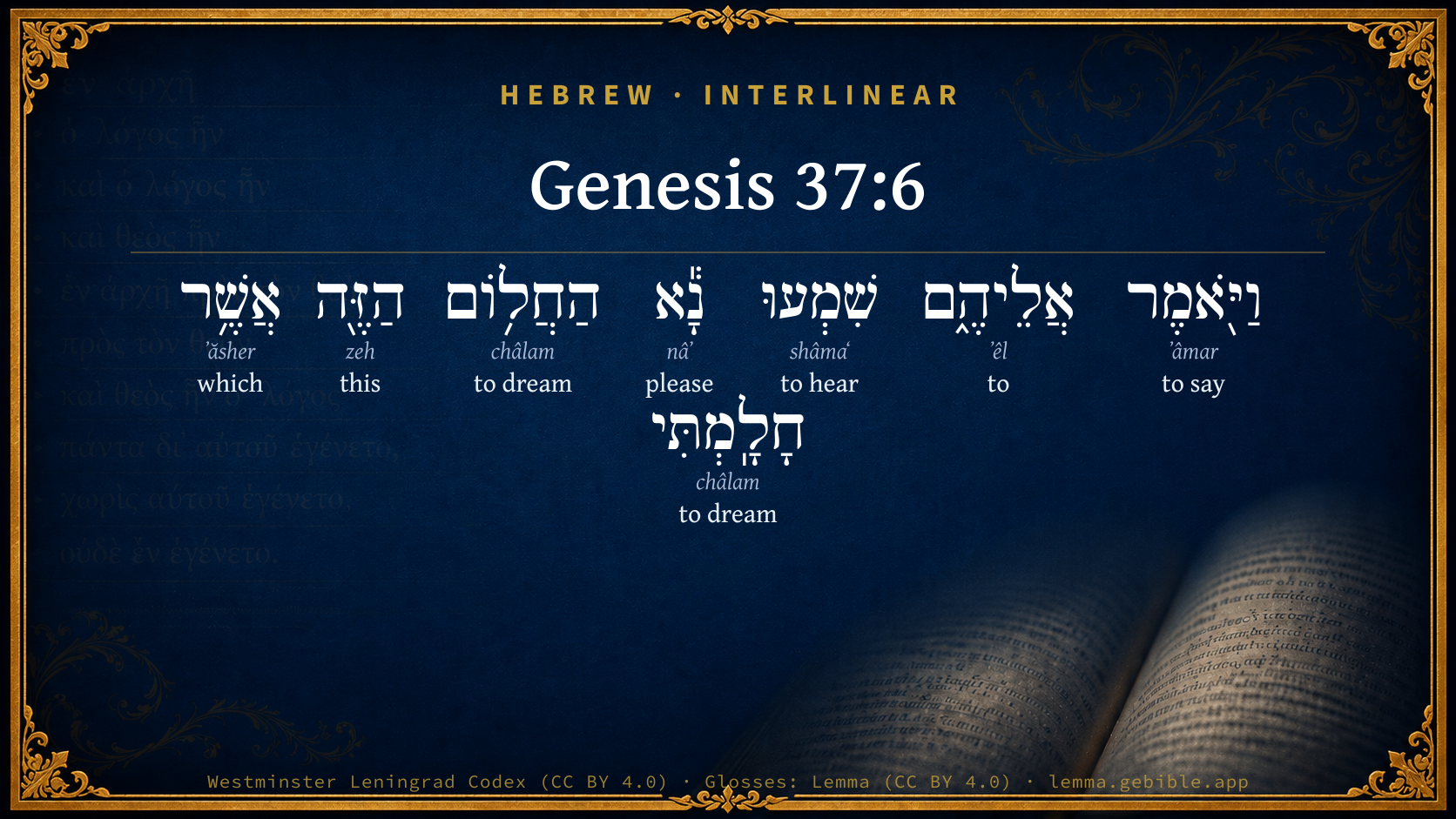
Hebrew (Westminster Leningrad Codex) Genesis 37:6 appears in the Hebrew Old Testament. The text above is from the Westminster Leningrad Codex. Each word links to its Strong’s number, a concise gloss, and parsing drawn from the Open Scriptures Hebrew Bible morphology. Click any word for its full Brown-Driver-Briggs (BDB) entry.
Download image
Cite this verse

Genesis 37:6 (World English Bible). Public Domain. Lemma interlinear Bible study tool, https://lemma.gebible.app/v/genesis/37/6.

Show BibTeX & RIS
BibTeX
RIS
English Translation
He said to them, "Please hear this dream which I have dreamed:
World English Bible · Public Domain
Download a study sheet

One document with this verse’s original text, its word-by-word gloss line, the meaning frame, cross-references with their text, attributed commentary, and full source and license credits — printable, and it pastes into notes with its structure intact.

This verse Autodidact and up

Study sheet (.html) Plain text (.txt)

A passage Seminary Student

Up to 50 verses in one chapter. A passage sheet keeps up to 6 commentary sources and 12 cross-references per verse, in the order this page ranks them, and says so on the sheet whenever that leaves anything out. Ask for a single verse and you get the Autodidact verse sheet above.

Everything on this page stays free to read, with no account — the sheet is a download of what is already on screen, not access to it.

Want to remove ads? Support Godless Engineer
Compare translations 3

The same verse in 3 English versions, stacked beneath the original-language interlinear above. Click any original word for its lexicon entry.

Each is an independent rendering of the whole verse — the interlinear is not word-aligned to these translations.

Highlighted words mark where these versions differ — a whole-verse word diff, not a word-by-word alignment.

  • World English Bible Public Domain
    He said to them, "Please hear this dream which I have dreamed:
  • King James Version Public Domain
    And he said unto them, Hear, I pray you, this dream which I have dreamed:
  • unfoldingWord Literal Text CC BY-SA 4.0
    And he said to them, “Please hear this dream that I dreamed:

unfoldingWord Literal Text — © unfoldingWord, licensed CC BY-SA 4.0. Word-aligned USFM3 via Door43 (git.door43.org/unfoldingWord/en_ult).

Versions to compare (up to 4)

3 of 4 selected

Show all 18 translations

Every available English version of this verse, each an independent rendering of the whole verse.

  • World English Bible Public Domain
    He said to them, "Please hear this dream which I have dreamed:
  • Berean Standard Bible Public Domain
    He said to them, “Listen to this dream I had:
  • Majority Standard Bible Public Domain
    He said to them, “Listen to this dream I had:
  • King James Version Public Domain
    And he said unto them, Hear, I pray you, this dream which I have dreamed:
  • American Standard Version (1901) Public Domain
    And he said unto them, Hear, I pray you, this dream which I have dreamed:
  • Revised Version (1885) Public Domain
    And he said unto them, Hear, I pray you, this dream which I have dreamed:
  • Geneva Bible (1599) Public Domain
    For he saide vnto them, Heare, I pray you, this dreame which I haue dreamed.
  • Douay-Rheims (1899) Public Domain
    And he said to them: Hear my dream which I dreamed.
  • Young's Literal Translation Public Domain
    And he saith unto them, `Hear ye, I pray you, this dream which I have dreamed:
  • Literal Standard Version CC BY-SA 4.0
    And he says to them, “Please hear this dream which I have dreamed:
  • Unlocked Literal Bible CC BY-SA 4.0
    He said to them, “Please listen to this dream which I dreamed.
  • unfoldingWord Literal Text CC BY-SA 4.0
    And he said to them, “Please hear this dream that I dreamed:
  • Darby Bible Public Domain
    And he said to them, Hear, I pray you, this dream, which I have dreamt:
  • World Messianic Bible Public Domain
    He said to them, “Please hear this dream which I have dreamed:
  • Webster's Bible Public Domain
    And he said to them, Hear, I pray you, this dream which I have dreamed:
  • Free Bible Version CC BY-SA 4.0
    “Listen to this dream I had,” he told them.
  • Bible in Basic English Public Domain
    And he said to them, Let me give you the story of my dream.
  • JPS Tanakh (1917) Public Domain
    And he said unto them: 'Hear, I pray you, this dream which I have dreamed:

Literal Standard Version (2020), Covenant Press — licensed CC BY-SA 4.0. Text via the HelloAO Bible API (eBible.org). Unlocked Literal Bible (unfoldingWord) — licensed CC BY-SA 4.0. Text via the HelloAO Bible API (eBible.org). unfoldingWord Literal Text — © unfoldingWord, licensed CC BY-SA 4.0. Word-aligned USFM3 via Door43 (git.door43.org/unfoldingWord/en_ult). Free Bible Version, Dr. Jonathan Gallagher — licensed CC BY-SA 4.0. Text via the HelloAO Bible API (eBible.org).

Word by word

More ways to search: Search by grammar → Find every occurrence → Compare this word →

Practice this passage: Drill this verse → Learn its vocabulary →

הַחֲל֥וֹם
châlam
H2492
“the · dream”
Particle, Definite Article + Noun, Common, Masculine, Singular, Absolute
Part of Speech
Particle + Noun
Type
Common
Gender
Masculine
Number
Singular
State
Absolute
Full BDB Definition

Origin: a primitive root

TWOT: 662 , 663

to dream - (Qal) - to dream (ordinary) - to dream (prophetic) - to dream (of false prophets) - (Hiphil) to dream - to be healthy, be strong - (Qal) to be healthy - (Hiphil) to restore to health
  1. וַיֹּ֖אמֶר ʼâmar H559 “and · to say” Conjunction + Verb, Qal, Sequential Imperfect, 3rd Person, Masculine, Singular
  2. אֲלֵיהֶ֑ם ʼêl H413 “to · them” Preposition + Suffix, Personal, 3rd Person, Masculine, Plural
  3. שִׁמְעוּ shâmaʻ H8085 “hear” Verb, Qal, Imperative, 2nd Person, Masculine, Plural
  4. נָ֕א nâʼ H4994 “please” Particle, Exhortation
  5. הַזֶּ֖ה zeh H2088 “the · this” Particle, Definite Article + Pronoun, Demonstrative, Masculine, Singular
  6. אֲשֶׁ֥ר ʼăsher H834 “which” Particle, Relative
  7. חָלָֽמְתִּי châlam H2492 “to dream” Verb, Qal, Perfect, 1st Person, Common, Singular

About this verse

These counts appear in no published source. They are computed here, from the morphology-tagged text and Lemma’s own curated glosses. What Lemma adds →

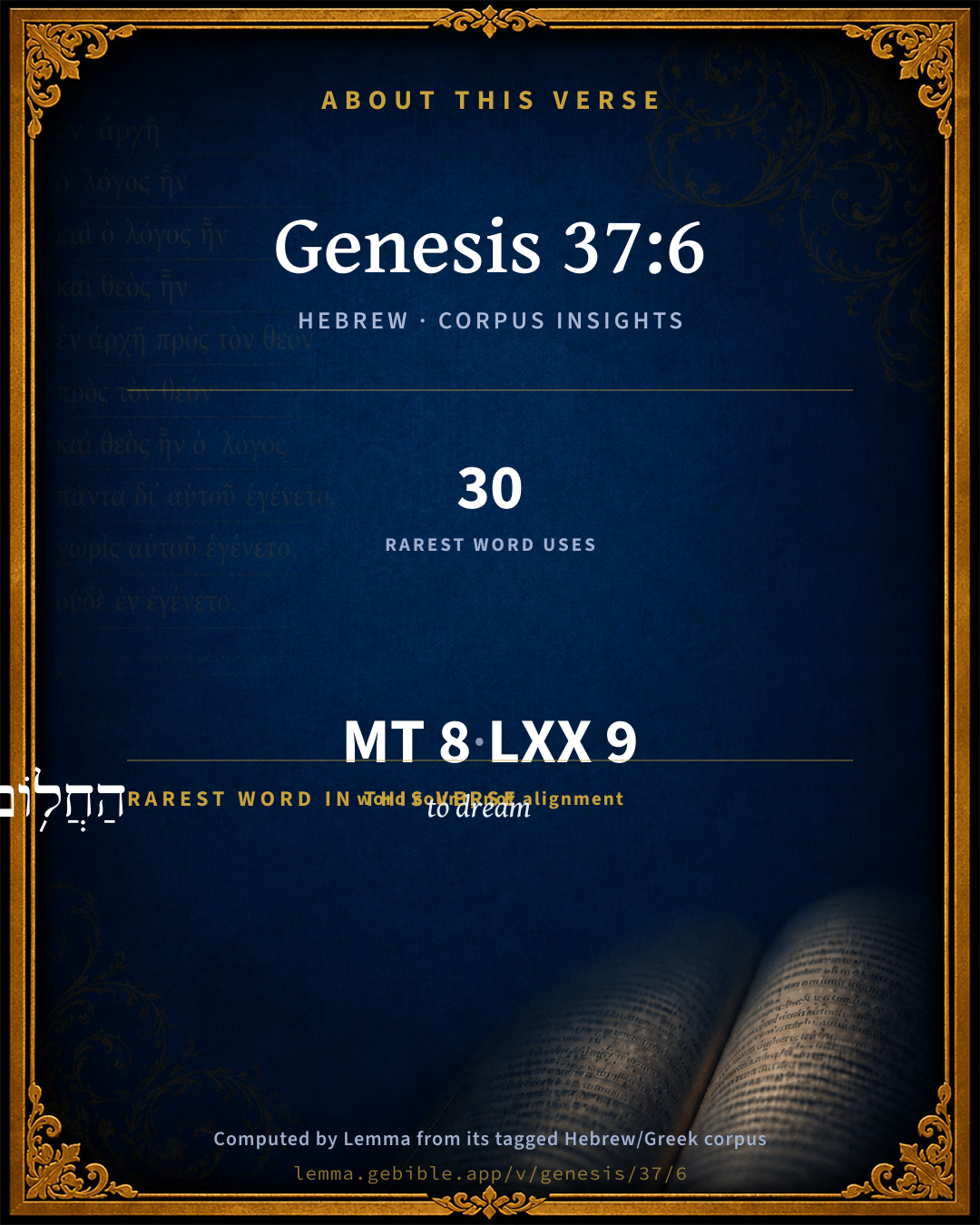
8
words
7
distinct lemmas
Pentateuch
section

Shared distinctive vocabulary

הַחֲל֥וֹם to dream H2492 occurs in 25 verses of the Hebrew Bible. Also found in:

Grammatical profile

  • 3 verbs
  • 1 noun
  • 1 pronoun
  • 1 preposition
  • 2 particles

Verb forms

  • וַיֹּ֖אמֶר Qal · Sequential Imperfect
  • שִׁמְעוּ Qal · Imperative
  • חָלָֽמְתִּי Qal · Perfect

Repetition

A word recurs within this verse — often emphatic in Hebrew:

  • הַחֲל֥וֹם to dream H2492 ×2

Hebrew & Septuagint length

In English translation the verse runs 12 words from the Hebrew and 12 from the Septuagint (LXX English) — the same length.

A rough comparison of the two English renderings, which tokenize alike — not a word-level alignment.

Word counts can differ between the Hebrew and the Greek without any difference in meaning — e.g. the Hebrew direct-object marker אֵת has no separate Greek word, and Greek often adds the article ὁ.

In the original languages it is 8 Hebrew tokens and 9 Greek tokens — but the two are counted differently (Hebrew bundles its prefixes and suffixes into one token; the Greek is in lemma form), so that isn’t a like-for-like length.

Cross-references

1

Topical passages linked to Genesis 37:6 in the Treasury of Scripture Knowledge — connected by theme and wording, ordered by reader-vote popularity; previews shown in the World English Bible.

  • Genesis 44:18 Then Judah came near to him, and said, "Oh, my lord, please let your servant speak a word in my lord's ears, and don't let your anger burn against your servant; for you are even as Pharaoh.

Cross-references courtesy of OpenBible.info (CC BY 4.0).

Hebrew and Greek witnesses Masoretic Hebrew ↔ Greek Septuagint

The same verse in the two great witnesses to the Old Testament, shown verse-for-verse.

These are two independent witnesses, not word-aligned to each other, and the Septuagint is shown in lemma (dictionary) form.

Hebrew Genesis 37:6 Masoretic · Westminster Leningrad Codex

וַיֹּ֖אמֶר אֲלֵיהֶ֑ם שִׁמְעוּ נָ֕א הַחֲל֥וֹם הַזֶּ֖ה אֲשֶׁ֥ר חָלָֽמְתִּי

He said to them, "Please hear this dream which I have dreamed:

World English Bible · Public Domain

Greek LXX Genesis 37:6 Septuagint · lemma form

καί εἶπον αὐτός ἀκούω ὁ ἐνύπνιον οὗτος ὅς ἐνὑπνιάζω

And he said to them, Hear this dream which I have dreamed.

LXX2012 (modern English Septuagint) · Public Domain

Hebrew: Westminster Leningrad Codex (CC BY 4.0). Greek: Septuagint (public domain); English from LXX2012 (modern English Septuagint) (Public Domain). How the Septuagint differs from the Hebrew →

Targum (Aramaic paraphrase)

2

The Targum is the ancient Jewish Aramaic paraphrase of the Hebrew Scriptures — an interpretive translation, not the Hebrew text itself. Onkelos (literal) and Pseudo-Jonathan (expansive) render the Torah, and Jonathan the Prophets. Coverage is partial: where no permissively-licensed English translation exists for a verse, only the Aramaic is shown. This is verse-level text, not a word-by-word alignment to the Hebrew.

  1. Targum Onkelos Torah (Genesis–Deuteronomy)
    וַאֲמַר לְהוֹן שְׁמָעוּ כְעַן חֶלְמָא הָדֵין דִּי חֲלֵימִית

    (no public-domain English translation for this verse)

    Targum Onkelos — Aramaic: “Onkelos Genesis” (public domain); “Onkelos Exodus” (public domain); “Onkelos Leviticus” (public domain); “Onkelos Numbers” (public domain); “Onkelos Deuteronomy” (public domain). English: “Sefaria Community Translation” (CC0 1.0 (public-domain dedication)); “J.W. Etheridge. The Targums of Onkelos and Jonathan Ben Uzziel on the Pentateuch. London: Longmans, Green, 1862” (public domain). Text via Sefaria.

  2. Targum Pseudo-Jonathan Torah (Genesis–Deuteronomy)
    וַאֲמַר לְהוֹן שִׁמְעוּ כְּדוֹן חֶלְמָא הָדֵין דִי חֲלֵימִית

    And he said to them, Hear now this dream which I have dreamed.

    Targum Pseudo-Jonathan — Aramaic: “Targum Jonathan on Genesis” (public domain); “Targum Jonathan on Exodus” (public domain); “Targum Jonathan on Leviticus” (public domain); “Targum Jonathan on Numbers” (public domain); “Targum Jonathan on Deuteronomy” (public domain). English: “The Targum of Jonathan ben Uzziel, trans. J. W. Etheridge, London, 1862” (public domain). Text via Sefaria.

Commentary

Notes on Genesis 37:6 from classic Christian and Jewish commentators (each source and its license shown beneath its notes). The classic Christian expositions comment on the surrounding passage and are grouped to its opening verse, so a note may address several verses; the Jewish commentaries on the Tanakh (Rashi and others) are per-verse, so they appear only where the commentator wrote on this verse.

Lemma curates 59 commentaries, every one of them public domain or Creative Commons licensed, each selected and text-cleaned for this edition rather than reprinted as found. About our sources →

Trapp's Complete Commentary

John Trapp

Gen 37:6 And he said unto them, Hear, I pray you, this dream which I have dreamed:

Ver. 6. Hear, I pray you, this dream.] Thus he bespeaketh them, not out of a vain glorious boasting, but out of youthful simplicity, and because himself wondered at it. God also had a holy hand in it.

John Trapp, A Commentary or Exposition upon All the Books of the Old and New Testament (1647–1656) — public domain. Text from a community e-Sword module.

John Calvin's Commentaries

6. And Joseph dreamed a dream. Moses having stated what were the first seeds of this enmity, now ascends higher, and shows that Joseph had been elected, by the wonderful purpose of God, to great things; that this had been declared to him in a dream; and that, therefore, the hatred of his brethren broke forth into madness. God, however, revealed in dreams what he would do, that afterwards it might be known that nothing had happened fortuitously: but that what had been fixed by a celestial decree, was at length, in its proper time, carried forward through circuitous windings to its completion. It had been predicted to Abraham that his seed should be wanderers from the land of Canaan. In order, then, that Jacob might pass over into Egypt, this method was divinely appointed; namely, that Joseph, being president over Egypt in a time of famine, might bring his father thither with his whole family, and supply them with food. Now, from the facts first related, no one could have conjectured such a result. The sons of Jacob conspire to put the very person to death, without whom they cannot be preserved; yea, he who was ordained to be the minister of salvation to them, is thrown into a well, and with difficulty rescued from the jaws of death. Driven about by various misfortunes, he seems to be an alien from his father’s house. Afterwards, he is cast into prison, as into another sepulcher, where, for a long time, he languishes. Nothing, therefore, was less probable than that the family of Jacob should be preserved by his means, when he was cut off from it, and carried far away, and not even reckoned among the living. Nor did any hope of his liberation remain, especially from the time in which he was neglected by the chief butler; but being condemned to perpetual imprisonment, he was left there to rot. God, however, by such complicated methods, accomplishes what he had purposed. Wherefore, in this history, we have not only a most beautiful example of Divine Providence, but also two other points are added especially worthy of notice: first, that the Lord performs his work by wonderful and unusual modes; and, secondly, that he brings forth the salvation of his Church, not from magnificent splendor, but from death and the grave. Besides, in the person of Joseph, a lively image of Christ is presented, as will more fully appear from the context. But since these subjects will be often repeated, let us follow the thread of Moses’ discourse. God, of his mere grace, conferred peculiar honor on the boy, who was the last but one among twelve, in giving him the priority among his brethren. For, by what merit or virtue shall we say that he attained the lordship over his brethren? Afterwards he seemed, indeed, to acquire this by his own great beneficence: but from the dream we learn, that it was the free gift of God, which in no way depended upon Joseph’s beneficence. Rather, he was ordained to be chief, by the mere good pleasure of God, in order that he might show kindness to his brethren. Now, since the Lord was, at that time, wont to reveal his secrets by two methods — by visions and by dreams — one of these kinds is here noted. For no doubt Joseph had often dreamed in the common manner: but Moses shows that a dream was now divinely sent to him, which might have the force and weight of an oracle. We know that dreams are often produced by our daily thoughts: sometimes they are indications of an unhealthy state of the body: but whenever God intends to make known his counsel by dreams, he engraves on them certain marks, which distinguish them from passing and frivolous imaginations, in order that their credibility and authority may stand firm. Thus Joseph, being certainly persuaded that he had not been deluded by an empty spectra, fearlessly announced his dream as a celestial oracle. Now, although the dominion is promised to him under a rural symbol, it is one which does not seem suitable for instruction to the sons of Jacob; for we know that they were herdsman, not ploughmen. Since they had no harvest which they could gather in, it seems hardly congruous that homage should be paid to his sheaf: But perhaps God designedly chose this similitude, to show that this prophecy was not founded upon the present fortunes of Joseph, and that the material of his dominion would not consist in those things which were at hand, but that it should be a future benefit, the cause of which was to be sought for elsewhere than at home.

John Calvin's Commentaries (1540-1563) — public domain. Text from the Calvin Translation Society English edition (1840s-50s) via the Christian Classics Ethereal Library (ccel.org). Calvin's coverage is partial (roughly two-thirds of the Bible); uncommented books and verses are honest gaps, never fabricated. The 19th-century editor's footnotes and remarks are omitted so the notes are faithfully Calvin's own voice.

John Gill's Exposition

And he said unto them, hear, I pray you, this dream which I have dreamed. Hear now, so the Targums of Onkelos and Jonathan, immediately, directly, lest he should forget it, having perhaps dreamt it the night before; though our version expresses more modesty and submission. The dream follows:

And he said unto them, hear, I pray you, this dream which I have dreamed. Hear now, so the Targums of Onkelos and Jonathan, immediately, directly, lest he should forget it, having perhaps dreamt it the night before; though our version expresses more modesty and submission. The dream follows:

Genesis 37:7

gen 37:7

gen 37:7

gen 37:7For, behold, we were binding sheaves in the field,.... So it was represented in his mind in a dream, as if it was harvest time, and he and his brethren were at work together in the field binding up sheaves of corn that were reaped, in order to be carried home:

and, lo, my sheaf arose, and stood upright; it seemed to him, that after he had bound and laid it on the ground, that it rose up of itself, and stood erect:

and, behold, your sheaves stood round about, and made obeisance to my sheaf; the sheaves which his brethren bound up, they also stood upright, and all around his sheaf, and bowed unto it; so it appeared to him in his dream. This was a fit emblem of their coming to him into Egypt for corn, and bowing to him, when their sheaves were empty, and his was full. In an ancient book of the Jews (h) Joseph's sheaf is interpreted of the Messiah, whom they call the son of Ephraim. Joseph no doubt was a type of the true Messiah, and in this of his exaltation and glory, and of that honour given him by all his saints who come to him, and receive from him all the supplies of grace.

(h) Raya Mehimna in Zohar in Gen. fol. 87. 2.

John Gill's Exposition of the Whole Bible (1746–1763) — public domain (CC PDM 1.0). Text via the HelloAO Bible API.

The Pulpit Commentary

And he said unto them, Hear, I pray you, this dream which I have dreamed. Though Joseph did not certainly know that his dream was supernatural, he may have thought that it was, the more so as dreams were in those times commonly regarded as mediums of Divine communication; and in this case it was clearly his duty to impart it to the household, and all the more that the subject of it seemed to be for them a matter of peculiar importance. In the absence of information to the contrary, we are warranted in believing that there was nothing either sinful or offensive in Joseph s spirit or manner in making known his dreams. That which appears to have excited the hostility of his brethren was not the mode of their communication, but the character of their contents.

The Pulpit Commentary (1880–1919), ed. H.D.M. Spence-Jones & Joseph S. Exell — public domain. Text from a community e-Sword module.

Lesson kit

Teaching starters — assembled from the data on this page, not authored interpretation. Every prompt links to the verse data it draws on. Edit before teaching.

Genesis, in the Pentateuch, opens this verse with 8 words (7 distinct Hebrew lemmas). Its most distinctive word is châlam (“to dream”). A historical commentator’s framing appears above. Read the whole chapter for the surrounding context.

Discussion questions

  1. What does “to dream” (châlam) contribute to the verse as a whole?
  2. Genesis 28:12 shares the word «to dream» with this verse. How do the two illuminate each other?
  3. “to dream” occurs 2× in this one verse. What is the effect of the repetition?
  4. These translations render this verse differently. What is at stake in choosing one wording over another?
  5. The verb «וַיֹּ֖אמֶר» is Qal Sequential Imperfect. How does its form color the action?
  6. Reading how Trapp's Complete Commentary and John Calvin's Commentaries read this verse, where do the two commentators agree and where do they part?

Things to notice

Reading settings

Reading text

Shown beneath each verse's original-language words.

Old Testament
Old Testament edition

Read the OT as the Masoretic Hebrew (MT) or the Greek Septuagint (LXX).

English shown for the Greek Septuagint (in the Hebrew ↔ Greek comparison).

Comparing translations? Open the Compare panel on any verse page to stack up to four side by side.