Revelation 2:17

Greek (Tischendorf 8th ed.) Revelation 2:17 appears in the Greek New Testament. The text above is from the Tischendorf 8th edition. Each word links to its Strong’s number and a concise gloss. Click any word for its full Thayer’s Greek Lexicon entry.
Download image
Cite this verse

Revelation 2:17 (World English Bible). Public Domain. Lemma interlinear Bible study tool, https://lemma.gebible.app/v/revelation/2/17.

Show BibTeX & RIS
BibTeX
RIS
English Translation
He who has an ear, let him hear what the Spirit says to the assemblies. To him who overcomes, to him I will give of the hidden manna, and I will give him a white stone, and on the stone a new name written, which no one knows but he who receives it.
World English Bible · Public Domain
Download a study sheet

One document with this verse’s original text, its word-by-word gloss line, the meaning frame, cross-references with their text, attributed commentary, and full source and license credits — printable, and it pastes into notes with its structure intact.

This verse Autodidact and up

Study sheet (.html) Plain text (.txt)

A passage Seminary Student

Up to 50 verses in one chapter. A passage sheet keeps up to 6 commentary sources and 12 cross-references per verse, in the order this page ranks them, and says so on the sheet whenever that leaves anything out. Ask for a single verse and you get the Autodidact verse sheet above.

Everything on this page stays free to read, with no account — the sheet is a download of what is already on screen, not access to it.

Want to remove ads? Support Godless Engineer
Compare translations 3

The same verse in 3 English versions, stacked beneath the original-language interlinear above. Click any original word for its lexicon entry.

Each is an independent rendering of the whole verse — the interlinear is not word-aligned to these translations.

Highlighted words mark where these versions differ — a whole-verse word diff, not a word-by-word alignment.

  • World English Bible Public Domain
    He who has an ear, let him hear what the Spirit says to the assemblies. To him who overcomes, to him I will give of the hidden manna, and I will give him a white stone, and on the stone a new name written, which no one knows but he who receives it.
  • King James Version Public Domain
    He that hath an ear, let him hear what the Spirit saith unto the churches; To him that overcometh will I give to eat of the hidden manna, and will give him a white stone, and in the stone a new name written, which no man knoweth saving he that receiveth it.
  • unfoldingWord Literal Text CC BY-SA 4.0
    Let the one having an ear hear what the Spirit is saying to the churches. To the one conquering, I will give to him of the hidden manna, and I will give to him a white stone and on the stone a new name written that no one knows except the one receiving it.”’

unfoldingWord Literal Text — © unfoldingWord, licensed CC BY-SA 4.0. Word-aligned USFM3 via Door43 (git.door43.org/unfoldingWord/en_ult).

Versions to compare (up to 4)

3 of 4 selected

Show all 19 translations

Every available English version of this verse, each an independent rendering of the whole verse.

  • World English Bible Public Domain
    He who has an ear, let him hear what the Spirit says to the assemblies. To him who overcomes, to him I will give of the hidden manna, and I will give him a white stone, and on the stone a new name written, which no one knows but he who receives it.
  • Berean Standard Bible Public Domain
    He who has an ear, let him hear what the Spirit says to the churches. To the one who overcomes, I will give the hidden manna. I will also give him a white stone inscribed with a new name, known only to the one who receives it.
  • Majority Standard Bible Public Domain
    He who has an ear, let him hear what the Spirit says to the churches. To the one who overcomes, I will give the hidden manna. I will also give him a white stone inscribed with a new name, known only to the one who receives it.
  • King James Version Public Domain
    He that hath an ear, let him hear what the Spirit saith unto the churches; To him that overcometh will I give to eat of the hidden manna, and will give him a white stone, and in the stone a new name written, which no man knoweth saving he that receiveth it.
  • American Standard Version (1901) Public Domain
    He that hath an ear, let him hear what the Spirit saith to the churches. To him that overcometh, to him will I give of the hidden manna, and I will give him a white stone, and upon the stone a new name written, which no one knoweth but he that receiveth it.
  • Revised Version (1885) Public Domain
    He that hath an ear, let him hear what the Spirit saith to the churches. To him that overcometh, to him will I give of the hidden manna, and I will give him a white stone, and upon the stone a new name written, which no one knoweth but he that receiveth it.
  • Geneva Bible (1599) Public Domain
    Let him that hath an eare, heare what the Spirite saith vnto the Churches. To him that ouercommeth, will I giue to eate of the Manna that is hid, and will giue him a white stone, and in the stone a newe name written, which no man knoweth sauing he that receiueth it.
  • Douay-Rheims (1899) Public Domain
    He, that hath an ear, let him hear what the Spirit saith to the churches: To him that overcometh, I will give the hidden manna, and will give him a white counter, and in the counter, a new name written, which no man knoweth, but he that receiveth it.
  • Young's Literal Translation Public Domain
    He who is having an ear -- let him hear what the Spirit saith to the assemblies: To him who is overcoming, I will give to him to eat from the hidden manna, and will give to him a white stone, and upon the stone a new name written, that no one knew except him who is receiving `it'.
  • Literal Standard Version CC BY-SA 4.0
    He who is having an ear—let him hear what the Spirit says to the assemblies: To him who is overcoming, I will give to him to eat from the hidden manna, and will give to him a white stone, and on the stone a new name written, that no one knew except him who is receiving [it].
  • Unlocked Literal Bible CC BY-SA 4.0
    Let the one who has an ear listen to what the Spirit is saying to the churches. To the one who conquers, I will give some of the hidden manna, and I will give a white stone with a new name written on the stone, a name which no one knows but the one who receives it.”'”
  • unfoldingWord Literal Text CC BY-SA 4.0
    Let the one having an ear hear what the Spirit is saying to the churches. To the one conquering, I will give to him of the hidden manna, and I will give to him a white stone and on the stone a new name written that no one knows except the one receiving it.”’
  • Darby Bible Public Domain
    He that has an ear, let him hear what the Spirit says to the assemblies. To him that overcomes, to him will I give of the hidden manna; and I will give to him a white stone, and on the stone a new name written, which no one knows but he that receives [it].
  • World Messianic Bible Public Domain
    He who has an ear, let him hear what the Spirit says to the assemblies. To him who overcomes, to him I will give of the hidden manna, and I will give him a white stone, and on the stone a new name written which no one knows but he who receives it.
  • Webster's Bible Public Domain
    He that hath an ear, let him hear what the Spirit saith to the churches; To him that overcometh will I give to eat of the hidden manna, and will give him a white stone, and on the stone a new name written, which no man knoweth, he excepted, that receiveth it.
  • Free Bible Version CC BY-SA 4.0
    If you have ears, listen to what the Spirit is telling the churches. I will give the hidden manna to those who are victorious. I will give them a white stone with a new name written on it that nobody knows except those who receive it.
  • Bible in Basic English Public Domain
    He who has ears, let him give ear to what the Spirit says to the churches. To him who overcomes I will give of the secret manna, and I will give him a white stone, and on the stone a new name, of which no one has knowledge but he to whom it is given.
  • Text-Critical English NT CC BY 4.0
    He who has an ear, let him hear what the Spirit is saying to the churches. To him who overcomes I will give some of the hidden manna. I will also give him a white stone, and on the stone will be written a new name that no one knows except the one who receives it.’
  • Tyndale New Testament (1534) Public Domain
    Lett him that hath eares heare what the sprete sayth vnto the congregacions: To him that overcommeth will I geve to eate manna that is hyd and will geve him a whyte stone and in the stone a newe name wrytten which no man knoweth savinge he that receaveth it.

Literal Standard Version (2020), Covenant Press — licensed CC BY-SA 4.0. Text via the HelloAO Bible API (eBible.org). Unlocked Literal Bible (unfoldingWord) — licensed CC BY-SA 4.0. Text via the HelloAO Bible API (eBible.org). unfoldingWord Literal Text — © unfoldingWord, licensed CC BY-SA 4.0. Word-aligned USFM3 via Door43 (git.door43.org/unfoldingWord/en_ult). Free Bible Version, Dr. Jonathan Gallagher — licensed CC BY-SA 4.0. Text via the HelloAO Bible API (eBible.org).

Word by word

More ways to search: Search by grammar → Find every occurrence → Compare this word →

Practice this passage: Drill this verse → Learn its vocabulary →

ψῆφον
psēphos
G5586
“pebble”
Noun, Accusative, Singular, Feminine
Part of Speech
Noun
Case
Accusative
Number
Singular
Gender
Feminine
Full Thayer's Definition

Origin: from the same as G5584

TDNT: 19:04,1

1. a small worn smooth stone, a pebble a. in the ancient courts of justice the accused were condemned by black pebbles and the acquitted by white 2. a vote (on account of the use of pebbles in voting)
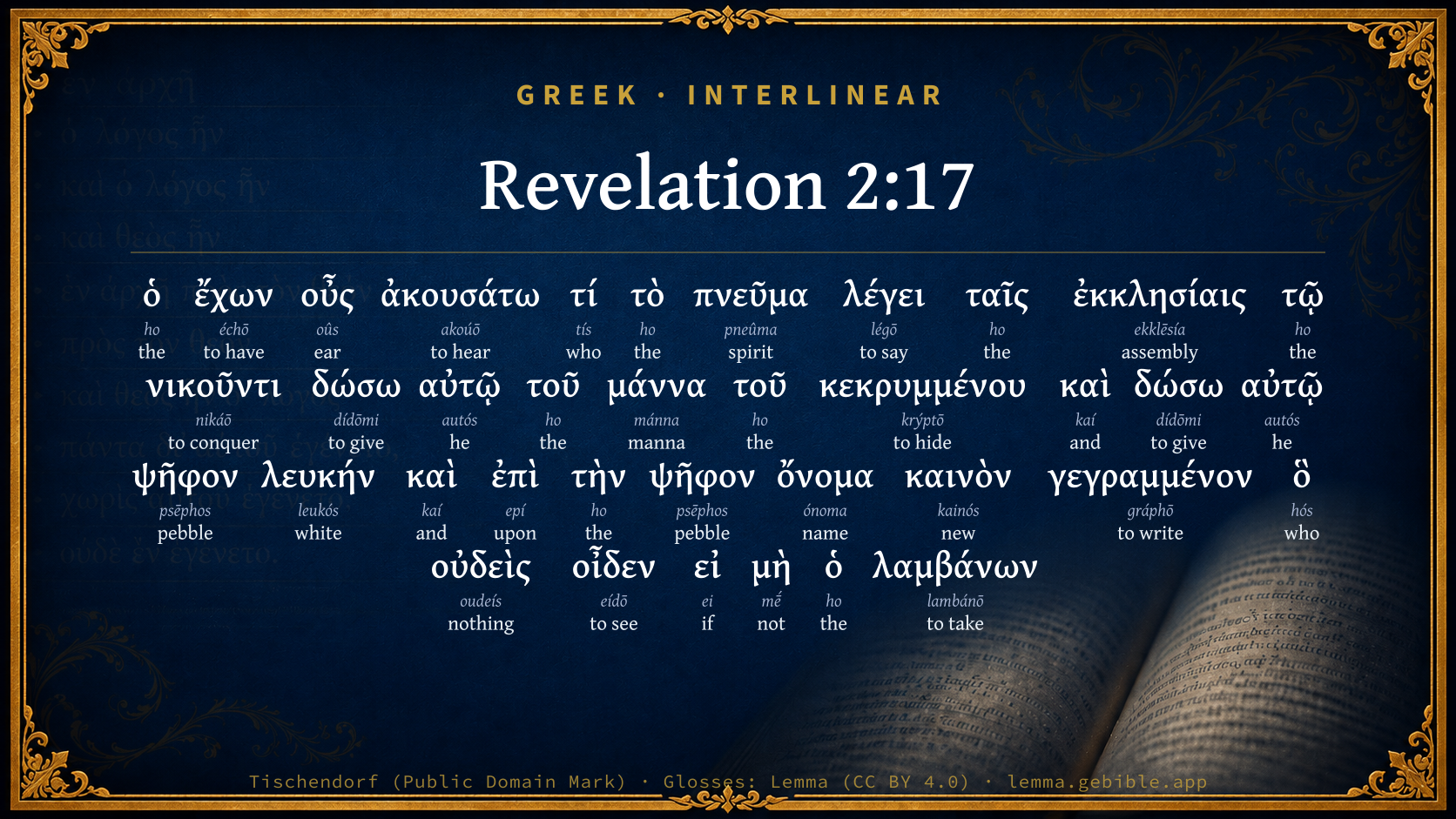
  1. ὁ ho G3588 “the” Article, Nominative, Singular, Masculine
  2. ἔχων échō G2192 “to have” Verb, Present, Active, Participle, Nominative, Singular, Masculine
  3. οὖς oûs G3775 “ear” Noun, Accusative, Singular, Neuter
  4. ἀκουσάτω akoúō G191 “to hear” Verb, Aorist, Active, Imperative, 3rd person, Singular
  5. τί tís G5101 “who” Interrogative pronoun, Accusative, Singular, Neuter
  6. τὸ ho G3588 “the” Article, Nominative, Singular, Neuter
  7. πνεῦμα pneûma G4151 “spirit” Noun, Nominative, Singular, Neuter
  8. λέγει légō G3004 “to say” Verb, Present, Active, Indicative, 3rd person, Singular
  9. ταῖς ho G3588 “the” Article, Dative, Plural, Feminine
  10. ἐκκλησίαις ekklēsía G1577 “assembly” Noun, Dative, Plural, Feminine
  11. τῷ ho G3588 “the” Article, Dative, Singular, Masculine
  12. νικοῦντι nikáō G3528 “to conquer” Verb, Present, Active, Participle, Dative, Singular, Masculine
  13. δώσω dídōmi G1325 “to give” Verb, Future, Active, Indicative, 1st person, Singular
  14. αὐτῷ autós G846 “he” Personal pronoun, Dative, Singular, Masculine
  15. τοῦ ho G3588 “the” Article, Genitive, Singular, Neuter
  16. μάννα mánna G3131 “manna” Hebrew transliteration
  17. τοῦ ho G3588 “the” Article, Genitive, Singular, Neuter
  18. κεκρυμμένου krýptō G2928 “to hide” Verb, Perfect, Passive, Participle, Genitive, Singular, Neuter
  19. καὶ kaí G2532 “and” Conjunction
  20. δώσω dídōmi G1325 “to give” Verb, Future, Active, Indicative, 1st person, Singular
  21. αὐτῷ autós G846 “he” Personal pronoun, Dative, Singular, Masculine
  22. λευκήν leukós G3022 “white” Adjective, Accusative, Singular, Feminine
  23. καὶ kaí G2532 “and” Conjunction
  24. ἐπὶ epí G1909 “upon” Preposition
  25. τὴν ho G3588 “the” Article, Accusative, Singular, Feminine
  26. ψῆφον psēphos G5586 “pebble” Noun, Accusative, Singular, Feminine
  27. ὄνομα ónoma G3686 “name” Noun, Nominative, Singular, Neuter
  28. καινὸν kainós G2537 “new” Adjective, Nominative, Singular, Neuter
  29. γεγραμμένον gráphō G1125 “to write” Verb, Perfect, Passive, Participle, Nominative, Singular, Neuter
  30. ὃ hós G3739 “who” Relative pronoun, Accusative, Singular, Neuter
  31. οὐδεὶς oudeís G3762 “nothing” Adjective, Nominative, Singular, Masculine, Negative
  32. οἶδεν eídō G1492 “to see” Verb, Perfect, Active, Indicative, 3rd person, Singular
  33. εἰ ei G1487 “if” Conditional
  34. μὴ mḗ G3361 “not” Particle, Negative
  35. ὁ ho G3588 “the” Article, Nominative, Singular, Masculine
  36. λαμβάνων lambánō G2983 “to take” Verb, Present, Active, Participle, Nominative, Singular, Masculine

About this verse

These counts appear in no published source. They are computed here, from the morphology-tagged text and Lemma’s own curated glosses. What Lemma adds →

37
words
26
distinct lemmas
Revelation
section

Notable vocabulary

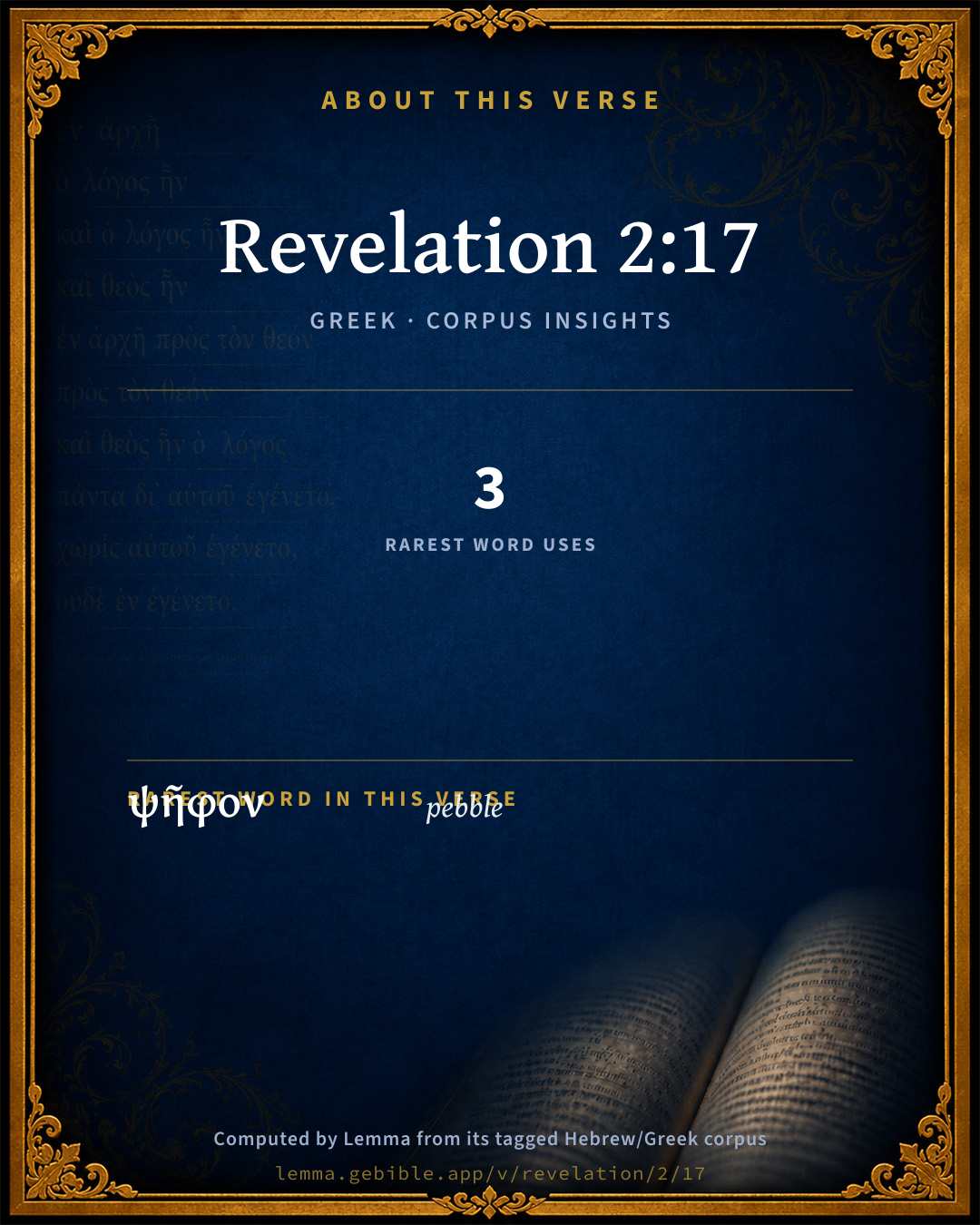
The rarest word here is ψῆφον pebble G5586 — appearing just 3 times in the whole Greek New Testament.

Shared distinctive vocabulary

ψῆφον pebble G5586 occurs in 2 verses of the Greek New Testament. Also found in:

Repetition

Words recur within this verse:

  • δώσω to give G1325 ×2
  • ψῆφον pebble G5586 ×2
  • ὁ the G3588 ×8
  • αὐτῷ he G846 ×2
  • καὶ and G2532 ×2

Cross-references

20

Topical passages linked to Revelation 2:17 in the Treasury of Scripture Knowledge — connected by theme and wording, ordered by reader-vote popularity; previews shown in the World English Bible.

  • Isaiah 62:2 The nations shall see your righteousness, and all kings your glory, and you shall be called by a new name, which the mouth of Yahweh shall name.
  • Isaiah 65:15 You shall leave your name for a curse to my chosen; and the Lord Yahweh will kill you; and he will call his servants by another name:
  • Revelation 19:12–13 His eyes are a flame of fire, and on his head are many crowns. He has names written and a name written which no one knows but he himself.
  • Revelation 2:7 He who has an ear, let him hear what the Spirit says to the assemblies. To him who overcomes I will give to eat of the tree of life, which is in the Paradise of my God.
  • Revelation 3:12–13 He who overcomes, I will make him a pillar in the temple of my God, and he will go out from there no more. I will write on him the name of my God, and the name of the city of my God, the new Jerusalem, which comes down out of heaven from my God, and my own new name.
  • Revelation 2:11 He who has an ear, let him hear what the Spirit says to the assemblies. He who overcomes won't be harmed by the second death.
  • John 6:48–58 I am the bread of life.
  • Psalms 36:8 They shall be abundantly satisfied with the abundance of your house. You will make them drink of the river of your pleasures.
  • Proverbs 3:32 For the perverse is an abomination to Yahweh, But his friendship is with the upright.
  • Colossians 3:3 For you died, and your life is hidden with Christ in God.
  • Psalms 25:14 The friendship of Yahweh is with those who fear him. He will show them his covenant.
  • Matthew 13:11 He answered them, "To you it is given to know the mysteries of the Kingdom of Heaven, but it is not given to them.
  • 1 Corinthians 2:14 Now the natural man doesn't receive the things of God's Spirit, for they are foolishness to him, and he can't know them, because they are spiritually discerned.
  • Isaiah 65:13 Therefore thus says the Lord Yahweh, Behold, my servants shall eat, but you shall be hungry; behold, my servants shall drink, but you shall be thirsty; behold, my servants shall rejoice, but you shall be disappointed;
  • John 4:32 But he said to them, "I have food to eat that you don't know about."
  • Revelation 3:6 He who has an ear, let him hear what the Spirit says to the assemblies.
  • Revelation 3:22 He who has an ear, let him hear what the Spirit says to the assemblies."
  • Revelation 14:3 They sing a new song before the throne, and before the four living creatures and the elders. No one could learn the song except the one hundred forty-four thousand, those who had been redeemed out of the earth.
  • Proverbs 14:10 The heart knows its own bitterness and joy; He will not share these with a stranger.
  • Isaiah 56:4 For thus says Yahweh of the eunuchs who keep my Sabbaths, and choose the things that please me, and hold fast my covenant:

Cross-references courtesy of OpenBible.info (CC BY 4.0).

Where the printed editions differ

2 variants

Places in this verse where the major printed Greek editions disagree on the wording in a way that affects the translation — a comparison of editions, not a manuscript-by-manuscript collation. The editions are the modern critical texts (Nestlé-Aland 28/27, SBL, Westcott-Hort, Tregelles, Tyndale House) and the traditional texts behind the KJV (the Textus Receptus and the Byzantine/Majority text). It is not a claim about which reading is original.

  1. Extra text
    φαγεῖν

    “to eat”

    In TRByz Not in NA28NA27TynSBLWHTreg
  2. Extra text
    ἀπὸ

    “from”

    In TR Not in NA28NA27TynSBLWHTregByz

    φαγεῖν ἀπὸ (phagein apo) 'to eat from' is only in traditional manuscripts (TR)

Textual data: Translators Amalgamated Greek New Testament (STEPBible TAGNT) · CC BY 4.0.

Commentary

Notes on Revelation 2:17 from classic Christian and Jewish commentators (each source and its license shown beneath its notes). The classic Christian expositions comment on the surrounding passage and are grouped to its opening verse, so a note may address several verses; the Jewish commentaries on the Tanakh (Rashi and others) are per-verse, so they appear only where the commentator wrote on this verse.

Lemma curates 59 commentaries, every one of them public domain or Creative Commons licensed, each selected and text-cleaned for this edition rather than reprinted as found. About our sources →

MacLaren's Expositions of Holy Scripture

Alexander MacLaren

Revelation

III. - THE VICTOR’S LIFE-SECRET

Rev 2:17.

The Church at Pergamos, to which this promise is addressed, had a sharper struggle than fell to the lot of the two Churches whose epistles precede this. It was set ‘where Satan’s seat is.’ Pergamos was a special centre of heathen worship, and already the blood of a faithful martyr had been shed in it. The severer the struggle, the nobler the reward. Consequently the promise given to this militant Church surpasses, in some respects, those held out to the former two. They were substantially promised that life eternal, which indeed includes everything; but here some of the blessed contents of that life are expanded and emphasized.

There is a threefold promise given: ‘the hidden manna,’ ‘the white stone,’ a ‘new name’ written. The first and the last of these are evidently the most important. They need little explanation; of the central one ‘the white stone,’ a bewildering variety of interpretations - none of them, as it seems to me, satisfactory - have been suggested. Possibly there may be an allusion to the ancient custom of dropping the votes of the judges into an urn - a white pebble meaning innocence and acquittal; black meaning guilty - just as we, under somewhat similar circumstances, talk about ‘blackballing.’ But the objection to that interpretation lies in the fact that the ‘white stone’ of our text is given to the person concerned, and not deposited elsewhere. There may be an allusion to a practice, which antiquarians have hunted out, of conferring upon the victors in the games a little tile with a name inscribed upon it, which gave admission to the public festivals. But all the explanations are so doubtful that one hesitates to accept any of them. There remains one other alternative, which seems to me to be suggested by the very language of the text, viz., that the ‘white stone’ is here named - with possibly some subsidiary thought of innocence and purity - merely as the vehicle for the name. And so I dismiss it from further consideration, and concentrate our thoughts on the remaining two promises.

I. We have the victor’s food, the manna.

That seems, at first sight, a somewhat infelicitous symbol, because manna was wilderness food. But that characteristic is not to be taken into account. Manna, though it fell in the wilderness, came from heaven, and it is the heavenly food that is suggested by the symbol. When the warrior passes from the fight into the city, the food which came down from heaven will be given to him in fullness. It is a beautiful thought that as soon as the man, ‘spent with changing blows,’ and weary with conflict, enters the land of peace, there is a table spread for him; not, as before, in the presence of his enemies,’ but in the presence of the companions of his repose. One moment hears the din of the battlefield, the next moment feels the refreshment of the heavenly manna.

But now there can be little need for dealing, by way of exposition, with this symbol. Let us rather try to lay it upon our hearts.

Now the first thing that it plainly suggests to us is the absolute satisfaction of all the hunger of the heart. It is possible, and for those that overcome it will one day be actual experience, that a man shall have everything that he wishes the moment that he wishes it. Here we have to suppress desires, sometimes because they are illegitimate and wrong, sometimes because circumstances sternly forbid their indulgence. There, to desire will be to have, and partly by the rectifying of the appetite, partly by the fullness of the supply, there will be no painful sense of vacuity, and no clamoring of the unsubdued heart for good that is beyond its reach. They - and you and I may be amongst them, and so we may say ‘we’ - ‘shall hunger no more, neither thirst any more.’ Oh, brethren! to us who are driven into activity by desires, half of which go to water and are never fulfilled - to us who know what it is to try to tame down the hungering, yelping wishes and longings of our souls - to us who have so often spent our ‘money for that which is not bread, and our labour for that which satisfieth not,’ it ought to be a Gospel: ‘I will give him to eat of the hidden manna.’ Is it such to you? Do you believe it possible, and are you addressing yourselves to make the fulfilment of it actual in your case?

Then there is the other plain thing suggested here, that that satisfaction does not dull the edge of appetite or desire. Bodily hunger is fed, is replete, wants nothing more until the lapse of time and digestion have intervened. But it is not so with the loftiest satisfactions. There are some select, noble, blessed desires even here, concerning which we know that the more we have, the more we hunger with a hunger which has no pain in it, but is only the greatened capacity for greater enjoyment. You that know what happy love is know what that means - a satisfaction which never approaches satiety, a hunger which has in it no gnawing. And in the loftiest and most perfect of all realms, that co-existence of perfect fruition and perfect desire will be still more wondrously and blessedly manifest. At each moment the more we have, the wider will our hearts be expanded by possession, and the wider they are expanded the more will they be capable of receiving, and the more they are capable of receiving the more deep and full and blessed and all covering will be the inrush of the river of the water of life. Satisfaction without satiety, food which leaves him blessedly appetized for larger bestowments, belong to the victor.

Another thing to be noticed here is what we have already had occasion to point out in the previous promises: I will give him.’ Do you remember our Lord’s own wonderful words: ‘Blessed are those servants, whom the Lord when He cometh shall find watching: verily I say unto you, that He shall gird Himself, and shall come forth and serve them’? The victor is seated at the board, and the Prince, as in some earthly banquet to a victorious army. Himself moves up and down amongst the tables, and supplies the wants of the guests. There was an old Jewish tradition, which perhaps may have influenced the form of this promise, to the effect that the Messiah, when He came, would bring again to the people the gift of the manna, and men should once more eat angels’ food. Whether there is any allusion to that poetic fancy or no in the words of my text, the reality infinitely transcends it. Christ Himself bestows upon His servants the sustenance of their spirits in the realm above. But there is more than that. Christ is not only the Giver, but He is Himself the Food. I believe that the deepest meaning of this sevenfold cluster of jewels, the promises to these seven Churches, is in each case Christ. He is the Tree of Life; He is the Crown of Life, He is - as well as gives - ‘the hidden manna.’ You will remember how He Himself gives us this interpretation when, in answer to the Jewish taunt, ‘Our fathers did eat manna in the wilderness. What dost Thou work?’ He said, ‘I am that Bread of God that came down from heaven.’

So, then, once more, we come back to the all-important teaching that, whatever be the glories of the perfected flower and fruit in heaven, the germ and root of it is already here. The man who lives upon the Christ by faith, love, obedience, imitation, communion, aspiration, here on earth, has already the earnest of that feast. No doubt there will be aspects and sweetnesses and savours and sustenance in the heavenly form of our possession of, and living on, Him, which we here on earth know nothing about. But no doubt also the beginning and positive degree of all these sweetnesses and savours and sustenances yet to be revealed is found in the experience of the man who has listened to the cry of that loving voice, ‘Eat, and your souls shall live’; and has taken Jesus Christ Himself, the living Person, to be not only the source but the nourishment of his spiritual life.

So, brethren, it is of no use to pretend to ourselves that we should like - as they put it in bald, popular language - to ‘go to heaven,’ unless we are using and relishing that of heaven which is here to-day. If you do not like the earthly form of feeding upon Jesus Christ, which is trusting Him, giving your heart to Him, obeying Him, thinking about Him, treading in His footsteps, you would not like, you would like less, the heavenly form of that feeding upon Him. If you would rather have the strong-smelling garlic and the savory leeks - to say nothing about the swine’s trough and the husks - than ‘this light bread,’ the ‘angels’ food,’ which your palates cannot stand and your stomachs cannot digest, you could not swallow it if it were put into your lips when you get beyond the grave; and you would not like it if you could. Christ forces this manna into no man’s mouth; but Christ gives it to all who desire it and are fit for it. As is the man’s appetite, so is the man’s food; and so is the life that results there from.

II. Note the victor’s new name.

I have often had occasion to point out to you that Scripture attaches, in accordance with Eastern habit, large importance to names, which are intended to be significant of character, or circumstances, or parental hopes or desires. So that, both in reference to God and man, names come to be the condensed expression of the character and the personality. When we read, ‘I will give him a stone, on which there is a new name written,’ we infer that the main suggestion made in that promise is of a change in the self, something new in the personality and the character. I need not dwell upon this, for we have no material by which to expand into detail the greatness of the promise. I would only remind you of how we are taught to believe that the dropping away of the corporeal and removal from this present scene carries with it, in the case of those who have here on earth begun to walk with Christ, and to become citizens of the spiritual realm, changes great, ineffable, and all tending in the one direction of making the servants more fully like their Lord. What new capacities may be evolved by the mere fact of losing the limitations of the bodily frame; what new points of contact with a new universe; what new analogues of what we here call our senses and means of perception of the external world may be the accompaniments of the disembarrassment from ‘the earthly house of this tabernacle,’ we dare not dream. We could not, if we were told, rightly understand. But, surely, if the tenant is taken from a clay hut and set in a royal house, eternal, not made with hands, its windows must be wider and more transparent, and there must be an inrush of wondrously more brilliant light into the chambers.

But whatsoever be these changes, they are changes that repose upon that which has been in the past. And so the second thought that is suggested by this new name is that these changes are the direct results of the victor’s course. Both in old times and in the peerage of England you will find names of conquerors, by land or by water, who carry in their designations and transmit to their descendants the memorial of their victories in their very titles. In like manner as a Scipio was called Africanus, as a Jervis became Lord St. Vincent, so the victor’s ‘new name’ is the concentration and memorial of the victor’s conquest. And what we have wrought and fought here on earth we carry with us, as the basis of the changes from glory to glory which shall come in the heavens. ‘They rest from their labors; their works do follow them,’ and, gathering behind the laurelled victor, attend him as he ascends the hill of the Lord.

But once more we come to the thought that whatever there may be of change in the future, the main direction of the character remains, and the consolidated issues of the transient deeds of earth remain, and the victor’s name is the summing up of the victor’s life.

But, further, Christ gives the name. He changed the names of His disciples. Simon He called Cephas, James and John He called ‘Sons of Thunder.’ The act claimed authority, and designated a new relation to Him. Both these ideas are conveyed in the promise: ‘I will give him ... a new name written.’ Only, brethren, remember that the transformation keeps true to the line of direction begun here, and the process of change has to be commenced on earth. They who win the new name of heaven are they of whom it would be truly said, while they bore the old name of earth, ‘If any man be in Christ he is a new creature.’

‘Old things are passed away; behold, all things are become new.’

III. Lastly, note the mystery of both the food and the name.

‘I will give him the hidden manna ... a new name . . . which no man knoweth saving he that receiveth it.’ Now we all know that the manna was laid up in the Ark, beneath the Shekinah, within the curtain of the holiest place. And, besides that, there was a Jewish tradition that the Ark and its contents, which disappeared after the fall of Jerusalem and the destruction of the first Temple, had been buried by the prophet Jeremiah, and lay hidden away somewhere on the sacred soil, until the Messiah should return. There may be an allusion to that here, but it is not necessary to suppose it. The pot of manna lay in the Ark of the Covenant, of which we hear in another part of the symbolism in this book, within the veil in the holiest of all. And Christ gives the victor to partake of that sacred and secret food. The name which is given ‘no man knoweth saving he that receiveth it.’ Both symbols point to the one thought, the impossibility of knowing until we possess and experience.

That impossibility besets all the noblest, highest, purest, divinest emotions and possessions of earth. Poets have sung of love and sorrow from the beginning of time; but men must love to know what love means. Every woman has heard about the sweetness of maternity, but not till the happy mother holds her infant to her breast does she understand it. And so we may talk till Doomsday, and yet it would remain true that we must eat the manna, and look upon the white stone for ourselves, before we can adequately comprehend.

Since, then, experience alone admits to the knowledge, how vulgar, how futile, how absolutely destructive of the very purpose which they are intended to subserve are all the attempts of men to forecast that ineffable glory. It is too great to be understood. The mountains that ring us round keep the secret well of the fair lands beyond. There are questions that bleeding hearts sometimes ask, questions which prurient curiosity more often ask, and which foolish people today are taking illegitimate means of solving, about that future life, which are all left - though some of them might conceivably have been answered - in silence. Enough for us to listen to the voice that says,

‘In My Father’s house are many mansions ‘- room for you and me - ‘if it were not so I would have told you.’ For the silence is eloquent. The curtain is the picture. The impossibility of telling is the token of the greatness of the thing to be told. Hope needs but little yarn to weave her web with. I believe that the dimness is part of the power of that heavenly prospect. Let us be reticent before it. Let us remember that, though our knowledge is small and our eyes dim, Christ knows all, and we shall be with Him; and so say, with no sense of pained ignorance or unsatisfied curiosity,

‘It doth not yet appear what we shall be, but we know that when He shall appear we shall be like Him, for we shall see Him as He is.’ Cannot our hearts add, ‘It is enough for the servant that he be as his master ‘?

An old commentator on this verse says, ‘Wouldst thou know what manner of new name thou shalt bear? Overcome. It is vain for thee to ask beforehand. Hereafter thou shalt soon see it written on the white stone.’

Help us, O Lord, to fight the good fight of faith, in the sure confidence that Thou wilt receive us, and refresh us, and renew us.

Alexander MacLaren, Expositions of Holy Scripture (1904–1910) — public domain. Text from a community e-Sword module.

Tyndale Open Study Notes

Tyndale Open Resources

2:17 Those who remain faithful to Christ will receive manna, nourishment from heaven (see Exod 16:11-36). • hidden away in heaven: During the Exodus, a jar of manna was placed in the Ark of the Covenant (Exod 16:33-36). Jewish tradition said that at the coming of the Messiah, the Ark would reappear and manna would be eaten at the messianic banquet. Jesus is the bread from heaven and the bread of life (John 6:32-35; cp. Exod 16:4-21). • A white stone was often given to victors in athletic competitions, and it was common for special banquets or festivities to use a white stone for admission. It therefore suggests acceptance and victory. • The new name probably refers to the recipient’s transformed nature in Christ (see Gen 17:5; 32:28; John 1:42).

Tyndale Open Study Notes — © Tyndale Open Resources, licensed CC BY-SA 4.0. Text via the HelloAO Bible API.

Bengel's Gnomon

Johann Albrecht Bengel

Rev 2:17. Ψῆφον λευκὴν, καὶ ἐπί τὴν ψῆφον ὄνομα καινὸν γεγραμμένον) The ancients used to write many things on stones (see Not. on Gregory of Neocæsarea, Paneg. p. 139), and especially votes. Sam. Petit, var. lect. c. 8, shows that the white stone was a ticket for receiving food (σιτήσεως), and he compares that with this passage. But in this place, the white stone and the new name is a reward by itself, and therefore it is placed after the hidden manna.

Bengel's Gnomon of the New Testament — English translation (T&T Clark, Edinburgh, 1860) — public domain. Text from a community e-Sword module.

Meyer's Critical & Exegetical Commentary

Heinrich August Wilhelm Meyer

Rev_2:17. δώσω αὐτῷ τοῦ μάννα. The partitive gen.[1177] has its correct meaning no less than the immediately succeeding accus.[1178]

The general sense of the promise is not to fail because of the parallel ideas at the close of all seven epistles.[1179] The expressions are, at all events, as Areth. remarks on ΨΗΦ. ΛΕΥΚ., a ΠΑΡΟΙΜΊΑ ἘΠῚ ΤῶΝ ΕὐΔΑΙΜΌΝΩς

ΖΏΝΤΩΝ (a maxim concerning those living happily), a description of future eternal blessedness and glory. This is misapplied by those who understand the manna as directly referring to the Lords Supper,[1180] or to the spiritual quickening and consolation imparted to believers even during their conflict in and with the world,[1181] or as the figure of divine grace in general which becomes manifest in justification (ΨΗΦ. ΛΕΥΚ.) and the offering of sonship (ὌΝ. ΚΑΙΝ).[1182] In the latter explanation, apart from the misunderstanding of the idea Ὁ ΝΙΚῶΝ, the groundless assertion is made, that ἘΠῖ is equivalent to ΣΎΝ.[1183] The more specific explanation of details has occasioned much difficulty. Utterly inapplicable to the hidden manna is the allusion[1184] to the Jewish opinion, that, before the destruction of the temple by Nebuchadnezzar, the prophet Jeremiah or the king Josiah had rescued and concealed the ark of the covenant, together with the holy relics contained therein, and that the Messiah at his appearance will again bring them to light.[1185] Incorrect, too, is the view that Christ himself is the hidden manna.[1186] Christ gives it. Incorrect is the view of Grot.: τ. κεκρυμμ. is equivalent to ΤΟῦ ΝΟΗΤΟῦ (the intellectual), and designates the more exact knowledge not only of Gods commands, but also of his dispensations. But rather,[1187] as the victor has approved himself especially in resisting the temptation to eat of what is sacrificed to idols, so he receives a corresponding reward when the Lord offers him heavenly, divine food, viz., manna, the bread of heaven,[1188]such fruit as, like the fruit of the tree of life, Rev_2:7, will nourish the heavenly, blessed life. This manna is hidden, because it will be manifest only in future glory when it will be enjoyed; as, in a similar way, is said immediately afterwards of the new name.[1189]

ΨῆΦΟΝ ΛΕΥΚῊΝ, Κ.Τ.Λ. Without any foundation is the explanation of N. de Lyra,[1190] according to which the white stone signifies the body decorated with the endowment of brilliancy, and the new name written thereon; then every one manifestly and bodily blessed with the endowments of a glorious body, will be enrolled in the city of the celestials. In connection with the mention of the manna, the explanation of the white stone has been sought in the Jewish fable, that, besides the manna, precious stones and pearls were found in the wilderness;[1191] or the decoration of the high priest at the time of the giving of the manna has been recalled, as he bore upon twelve precious stones (which, however, were not called ΨῆΦΟς)[1192] the names of the tribes of Israel, so that here is indicated the priestly dignity of the complete victors.[1193] Others, likewise, in a certain connection with the mention of heavenly food, have combined the heathen custom, according to which the conquerors in the games were led to festive banquets, and otherwise rewarded with gifts of many kinds. Thus Vitruv.[1194] reports: To the noble athletes who conquered in the Olympian, Pythian, Nemean, and Isthmian games, the ancestors of the Greeks appointed honors so great that not only standing in the assembly with palm and garland they receive praise, but also when they return to their states in victory, they are in triumph drawn within the walls in a four-yoked chariot, and enjoy for their whole life, from the republic, a fixed income. The Roman emperors[1195] also established such public games, from which the victors were led (ἐισήλασαν) in triumph to their native city, and then received the deferred rewards. Titus was accustomed even to throw into the arena small wooden balls, on which were written orders for food, clothing, money, etc.; then the contestants received what the order proffered them stated.[1196] According to this, the white stone is explained as the order for the heavenly reward,[1197] as the ticket to the heavenly banquet.[1198] Others, leaving out of consideration any connection between the manna and the white stone, recall the use of the lot among the Jews,[1199] as well as among the Greeks and Romans, who were accustomed to ballot with small white stones or beans, called ψῆφος, upon which names were written;[1200] still others compare it with the classical usage of rendering a favorable judgment in trials by means of white stones, and thus find in this passage a representation of Christs judgment preserving from condemnation, and introducing to blessedness by the sentence of justification.[1201] Many expositors, again, have combined several of these references, viz., that of election (ἐκλογή) and justification.[1202] But against all such definite antiquarian references is the decisive circumstance that the presentation of our passage truly agrees with not one of them. Hengstenb. is correct in saying,[1203] that the point coming here into consideration is only the fact that in antiquity many things were written on a small stone. Besides, the white color of the stone given the victor, which in itself represents the glory of the victory,[1204] and the purity of the blessed in heaven,[1205] retains its full significance. But what properly gives the white stone its worth is the inscription which it bears: Christ gives the victor a new name, written upon the stone,a name which no one knows except he who receives it. That the new name written upon the stone can in no way be the name of God,[1206] is proved partly from the type of the ancient prophetic promise of a new name,[1207] partly by the analogy of Rev_19:12, where what is said is concerning the proper name of Christ, and partly also from the rule given in the limitation ὃ οῦδεὶς, κ.τ.λ. The idea in Rev_3:12, Rev_14:1, is of an entirely different nature. The opinion of Eichhorn also is to be rejected; viz., that the stone bore the inscription ὁ ἅγιος τῷ θεῷ καὶ τῷ αρνιῷ, which is called new in opposition to the ancient Jewish faith in God without the Lamb. But to the norms given above, corresponds the view advanced by most expositors, according to which the declaration refers to the proper name of the victor.[1208] The name is new, because it designates the new glory of believers, i.e., that which is manifested only in the future life;[1209] and only he having received the same knows it, because, as is the case likewise already in this life, the knowledge of the blessedness of eternal life is disclosed only in personal experience. But how that new name will sound, cannot be in any way answered according to this text. The answer given by most, that it is son of God, or elect, is applicable only as therein the general contents of the Christian hope are expressed.[1210] [See Note XXXIII., p. 156.]

[1177] Cf. Act_27:30.

[1178] Cf. Winer, pp. 186, 539.

[1179] Cf. especially Rev_2:7.

[1180] Tichon., Beda.

[1181] C. a Lap., Boss.

[1182] Wolf. after J. H. Majus.

[1183] Wolf. Cf. also Luther: A good testimony, and with the testimony.

[1184] Wetst., Heinr., Ew.

[1185] Cf. 2Ma_2:1 sq. Abarbanel on 1Sa_4:4 : This is the ark which Josiah hid before the devastation of our temple; and this ark, at a future time, when our Messiah comes, will be manifested.

[1186] John 6; Primas, N. de Lyra, Vitr. See on Rev_2:7.

[1187] Cf. Bengel, De Wette, Hengstenb., Ebrard.

[1188] Psa_78:49; Psa_105:40.

[1189] Cf. also 1Co_2:7 sqq.

[1190] Cf. already Beda.

[1191] Joma viii.: Precious stones and pearls fell together with the manna upon the Israelites. In Wetst.

[1192] Exo_28:17; Exo_39:10.

[1193] Cf. Ew., Züll., Ebrard, Klief.

[1194] L., ix., Praef.

[1195] Cf., e.g., in reference to Trajan, Plin., L., x. Ep. 119, 120.

[1196] Xiphilin, Epit. Dion., p. 228: σφαιρία γὰρ ξύλινα μικρὰ ἄνωθεν εἰς τὸ θέατρον ἐῤῥίπτει, σύμβολον ἔχοντα, τὸ μὲν ἐδωδίμου τινὸς, κ.τ.λ.

ἅ ἁρπασαντάς τινας ἔδει πρὸς τοὺς δωτῆρας αὐτῶν ἀπενεγκεῖν καὶ λαβεῖν τὸ ἐπιγεραμμένον. Cf., in general, K. F. Hermann, d. Gottesdienstl. Alterth. d. Griechen, § 50; Not. 30 sqq. p. 254 sqq.

[1197] Areth., Grot., Hammond, Eichh.

[1198] Heinr., Ew. ii.: Tessera hospitalitatis (token of hospitality).

[1199] Schöttgen: I believe that allusion is made to the lot which was to be cast by the priests who wished to offer sacrifice. According to Tamid., fol. Rev_16:1 : The prefect of the temple came at the hour of cock-crowing, and the priests open. Then he says to them: Let him who has been washed come and draw lots; he whom the lot touches is worthy of sacrificing.

[1200] Eisner.

[1201] Victorin., Erasmus, Zeger, C. a Lap., Aretius, Calov., Vitr., Wolf, etc.

[1202] De Wette, Stern. Cf. also Beng.

[1203] Cf. already Beng.

[1204] Rev_6:2.

[1205] Rev_4:4.

[1206] Ewald.

[1207] Isa_62:2; Isa_65:15.

[1208] Beda, Ribera, C. a Lap., L. Cappellus, Grot., Coccej., Vitr., Wolf, Bengel, De Wette, Hengstenb., Ebrard, etc.

[1209] 1Jn_3:2; 1Co_13:9 sqq.

[1210] Rom_8:17; 1Jn_3:2.

NOTES BY THE AMERICAN EDITOR

XXXIII. Rev_2:17. μάννα. ψῆφον λευκὴν

Trench: The words, the hidden manna, imply, that, however hidden now, its meaning shall not remain hidden evermore; and the best commentary on them is to be found at 1Co_2:9; 1Jn_3:2. The seeing Christ as he is, of the latter passage, and, through this beatific vision, being made like to him, is identical with this eating of the hidden manna, which shall, as it were, be then brought forth from the sanctuary, the holy of holies, of Gods immediate presence, where it was withdrawn from sight so long that all may partake of it; the glory of Christ, now shrouded and concealed, being then revealed to his people. Following Züllig, he has an elaborate argument to prove that there is a reference in the white stone to the Urim and Thummim, on the ground that ψῆφος, in later Greek, means a precious stone, and λευκὸς indicates the purest glistering white of the diamond; both the manna and the white stone representing high-priestly privileges, which the Lord should at length impart to all his people, kings and priests unto God. This is refuted by Plumptre in Smiths Bible Dictionary, article Urim and Thummim; and in his commentary, where he adopts Ewalds view, who sees in the stone or ψῆφος of the promise, the tessera hospitalis, by which, in virtue of forms or characters inscribed upon it, he who possessed it could claim from the friend who gave it, at any distance of time, a frank and hearty welcome. What I would suggest as an addition to this rises out of the probability, almost certainty, that some such tessera or ticketa stone with the name of the guest written on itwas given to those who were invited to partake, within the precincts of the temple, of the feast that consisted wholly, or in part, of the meat that had been offered as a sacrifice. On this view, the second part of the promise is brought in harmony with the first, and is made more directly appropriate: he who had the courage to refuse that tessera to the feast that defiled should receive another that would admit him to the supper of the Great King. On the last clause, Plumptre: The inner truth that lies below the outward imagery would seem to be, that the conqueror, when received at the heavenly feast, should find upon the stone, or tessera, that gave him the right of entrance, a new name, the token of a character transformed and perfected,a name, the full significance of which should be known only to him who was conscious of the transformation, just as, in the experiences of our human life, the heart knoweth his own bitterness, and the stranger doth not intermeddle with his joy (Pro_14:10).

Meyer — Critical and Exegetical Commentary on the New Testament — English translation by Peter Christie, edited by Frederick Crombie (T&T Clark, 1880) — public domain. Text from a community e-Sword module.

Expositor's Greek Testament

ed. W. Robertson Nicoll

Rev 2:17 . The reward for those who deny themselves pagan pleasures in this world is (as in Rev 2:26 ) participation in the privileges ( Pereq Meir 5), reserved for God’s people in the latter days (here = a victor’s banquet, Gen 14:18 ), not as hitherto (Rev 2:7 ; Rev 2:11 ) simply participation in eternal life. The imagery is again rabbinic (Mal 2:4-6Mal 2:4-6 , Apoc. Bar. vi. 7 9). Previous to the destruction of Jerusalem, Isaiah or the prophet Jeremiah was supposed to have hidden the ark of the covenant ( cf. on Rev 11:19 ) with its sacred contents, including the pot of manna. At the appearance of the messiah, this was to be once more disclosed ( cf. Mechilta on Exo 16:25 , etc.). It is significant how the writer as usual claims for his messiah, Jesus, the cherished privileges and rights to which contemporary Judaism clung as its monopoly, and further how he assumes that all the past glories of O.T. religion upon earth as well as all the coming bliss, which in one sense meant the transcendent restoration of these glories were secured in heaven for the followers of Jesus alone (Rev 7:17 , Rev 21:2 , etc.). See Apoc. Bar. xxix. 8, where “the treasury of manna will again descend from on high,” at the messianic period, that the saints may eat of it; the Fourth Gospel, on the other hand, follows Philo ( quis rer. div. 39, leg. allegor . iii. 59, 61, etc.) in using manna as a type of the soul’s nourishment in the present age. There does not seem to be any allusion to the rabbinical legend underlying Sap. xvi. 20. The strange association of manna and white stones, though possibly a reminiscence of the rabbinic notion preserved in Joma 8 (cadebant Israelitis una cum manna lapides pretiosi), cannot be explained apart from the popular superstitions regarding amulets which colour the metaphor. White stones represented variously to the ancient mind acquittal, admission to a feast (tessera hospitalis), good fortune, and the like. But the point here is their connexion with the new name. This alludes to the mysterious power attached in the ancient mind to amulets, stones ( cf. E.J. i. 546 550, where vignettes are given; also Dieterich’s Mithras-Liturgie , 31 f.) marked with secret and divine names (Jeremias, 79 80, Pfleid. Early Christ. Conc, of Christ , 112 f.), the possession of which was supposed to enable the bearer to pass closed gates, foil evil spirits, and enter the presence of the deity. If the new name ( cf. Heitmüller’s Im Namen Jesu , 128 f.), is thus regarded as that of Jesus the irresistible, invincible name above every name the promise then offers safe entrance through all perils into the inner bliss and feast of God; the true Christian has a charmed life. But when the new name is taken to apply to the individual, as seems more likely here, another line of interpretation is required, and the origin of the phrase (though tinged still with this amulet-conception of a stone, the more potent as it was hidden somewhere on the person, cf. Pro 17:8 , etc.), is best approached from a passage like Epict.Rev 1:19 , where the philosopher is trying to dissuade a man from undertaking the duties of priesthood in the Imperial cultus at Nikopolis. What good will it do him after death, to have his name used to mark his year of office in public documents? “My name will remain,” replies the man. “Write it on a stone and it will remain,” is the retort of Epictetus plainly a colloquial expression for permanence. This would fit in with the Apocalyptic saying excellently (see Schol. on Pind. Olymp. vii. 159). Still more apposite, however, is an ancient ceremony of initiation (as among the aborigines of New South Wales: Trumbull, Blood-Covenant , 1887, pp. 335 337), by which each person, on the close of his novitiate, received a new name from the tribe and at the same time a white stone or quartz crystal. The latter was considered to be a divine gift, and was held specially sacred, never to be surrendered or even shown. These boons formed part of the religious covenant which marked the entrance of a man into the closest relation with the deity of his tribe and also into the full enjoyment of manhood’s privileges. Hence, if we suppose some such popular rite behind the language here, the idea is apt: the victor’s reward is the enjoyment of mature and intimate life with his God (so Victor.). For the symbolism of a name as evidence of personal identity (and inferentially of a new name as proof of a renovated, enduring nature), see E.B.D. 75: “May my name be given to me in the Great House, and may I remember my name in the House of Fire.… If any god whatsoever should advance to me, let me be able to proclaim his name forthwith” (the latter clause illustrating Rev 3:12 ). The significance attached by the Egyptian religion especially to the reu or name was due to the belief that its loss meant the extinction of a man’s existence. The idea in the prophet’s mind is little more than that developed, e.g. , in Mrs. Browning’s sonnet, “Comfort”: “Speak low to me, my Saviour, low and sweet, From out the hallelujahs sweet and low, Lest I should fear and fall, and miss Thee,” etc. As the succeeding chapters are full of the state and splendour of heaven, with royal majesty predominating, the prophet finds place here for the more intimate and individual aspect of the future life, depicting God in touch with the single soul ( cf. Rev 14:1 ). In addition to this, he conveys the idea that outside the Christian experience no one can really know what God is or what He gives; the redeemed and victorious alone can understand what it means to belong to God and to be rewarded by him. Wünsch has recently pointed out ( Excav. in Palestine , 1898 1900, p. 186) that, as in Egypt the sacred paper ( χὰρτης ἱερατικὸς ) was used for solemn appeals to the gods ( Brit. Mus. Papyri , xlvi. 308), “in like manner, doubtless, in Palestine, limestone had some superstitious significance, but of what special kind we do not know. Perhaps it is in this connexion that in Rev 2:17 “he that overcometh” is to receive “a white stone” inscribed with a “new” spell, evidently as an “amulet”. There may also be a further local allusion to the ψῆφοι and names which were supposed to be received by votaries of Asclepius as they lay in a trance or dream (Aristides, i. 352, 520). For the initiation-custom, cf. Spence and Gillen’s Native Tribes of Central Australia , pp. 139 140, where the secret, individual name is described as given only to those who are “capable of self-restraint” and above levity of conduct. Clem. Alex. ( Strom , i. 23) preserves a Jewish tradition that Moses got three names Joachim, Moses, and Melchi ( i.e. , king), the last-mentioned ἐν οὐρανῷ μετὰ τὴν ἀνάληψιν , ὡς φασὶν οἱ μύσται .

The Expositor's Greek Testament, edited by W. Robertson Nicoll (1897–1910) — public domain. Text from a community e-Sword module.

Geneva Bible (1599)

Geneva Bible translators

The conclusion, standing of exhortation as before, and of promise.

The bread of life, invisible, spiritual, and heavenly, which is kept secretly with God, from before all eternity.

Which is a sign and witness of forgiveness and remission of sins, of righteousness and true holiness, and of purity uncorrupted, after that the old man is killed.

A sign and testimony of newness of life in righteousness and true holiness, by putting on the new man, whom none doth inwardly know, save the spirit of man which is in himself, the praise whereof is not of man, but of God, Rom. 2:28.

He alludeth to that sermon which we read of John 6, and to the place we find, Ps. 105:40.

Aretas writeth, that such a stone was wont to be given to wrestlers at games, or else that such stones did in old times witness the quitting of a man.

Geneva Bible (1599) marginal notes — public domain. Text via Bolls.life.

Jamieson, Fausset & Brown

Robert Jamieson, A. R. Fausset & David Brown

to eat--omitted in the three oldest manuscripts.

the hidden manna--the heavenly food of Israel, in contrast to the idol-meats (Rev 2:14). A pot of manna was laid up in the holy place "before the testimony." The allusion is here to this: probably also to the Lord's discourse (Joh 6:31-35). Translate, "the manna which is hidden." As the manna hidden in the sanctuary was by divine power preserved from corruption, so Christ in His incorruptible body has passed into the heavens, and is hidden there until the time of His appearing. Christ Himself is the manna "hidden" from the world, but revealed to the believer, so that he has already a foretaste of His preciousness. Compare as to Christ's own hidden food on earth, Joh 4:32, Joh 4:34, and Job 23:12. The full manifestation shall be at His coming. Believers are now hidden, even as their meat is hidden. As the manna in the sanctuary, unlike the other manna, was incorruptible, so the spiritual feast offered to all who reject the world's dainties for Christ is everlasting: an incorruptible body and life for ever in Christ at the resurrection.

white stone . . . new name . . . no man knoweth saving he--TRENCH'S explanation seems best. White is the color and livery of heaven. "New" implies something altogether renewed and heavenly. The white stone is a glistening diamond, the Urim borne by the high priest within the choschen or breastplate of judgment, with the twelve tribes' names on the twelve precious stones, next the heart. The word Urim means "light," answering to the color white. None but the high priest knew the name written upon it, probably the incommunicable name of God, "Jehovah." The high priest consulted it in some divinely appointed way to get direction from God when needful. The "new name" is Christ's (compare Rev 3:12, "I will write upon him My new name"): some new revelation of Himself which shall hereafter be imparted to His people, and which they alone are capable of receiving. The connection with the "hidden manna" will thus be clear, as none save the high priest had access to the "manna hidden" in the sanctuary. Believers, as spiritual priests unto God, shall enjoy the heavenly antitypes to the hidden manna and the Urim stone. What they had peculiarly to contend against at Pergamos was the temptation to idol-meats, and fornication, put in their way by Balaamites. As Phinehas was rewarded with "an everlasting priesthood" for his zeal against these very sins to which the Old Testament Balaam seduced Israel; so the heavenly high priesthood is the reward promised here to those zealous against the New Testament Balaamites tempting Christ's people to the same sins.

receiveth it--namely, "the stone"; not "the new name"; see above. The "name that no man knew but Christ Himself," He shall hereafter reveal to His people.

Jamieson, Fausset & Brown — Commentary Critical and Explanatory on the Whole Bible (1871) — public domain (CC PDM 1.0). Text via the HelloAO Bible API.

Adam Clarke's Commentary

Verse 17. The hidden manna] It was a constant tradition of the Jews that the ark of the covenant, the tables of stone, Aaron's rod, the holy anointing oil, and the pot of manna, were hidden by King Josiah when Jerusalem was taken by the Chaldeans; and that these shall all be restored in the days of the Messiah. This manna was hidden, but Christ promises to give it to him that is conqueror. Jesus is the ark, the oil, the rod, the testimony, and the manna. He who is partaker of his grace has all those things in their spiritual meaning and perfection.

And will give him a white stone] I. It is supposed that by the white stone is meant pardon or acquittance, and the evidence of it; and that there is an allusion here to the custom observed by judges in ancient times, who were accustomed to give their suffrages by white and black pebbles; those who gave the former were for absolving the culprit, those who gave the latter were for his condemnation. This is mentioned by Ovid, Metam. lib. xv., ver. 41:

Mos erat antiquus, niveis atrisque lapillis,

His damnare reos, illis absolvere culpa.

Nunc quoque sic lata est sententia tristis.

"A custom was of old, and still remains,

Which life or death by suffrages ordains:

White stones and black within an urn are cast,

The first absolve, but fate is in the last."

DRYDEN.

II. Others suppose there is an allusion here to conquerors in the public games, who were not only conducted with great pomp into the city to which they belonged, but had a white stone given to them, with their name inscribed on it; which badge entitled them, during their whole life, to be maintained at the public expense. See Pind., Olymp. vii. 159, and the Scholia there; and see the collections in Wetstein, and Rosenmuller's note. These were called tesserae among the Romans, and of these there were several kinds.

1. Tesserae conviviales, which answered exactly to our cards of invitation, or tickets of admission to a public feast or banquet; when the person invited produced his tessera he was admitted. The mention of the hidden manna here may seem to intimate that there is a reference to these convivial tesserae, whether given to the victor in the public games, entitling him to be fed at the public expense, or to a particular friend, inviting him to a family meal or to a public banquet.

2. There were tesserae inscribed with different kinds of things, such as provisions, garments, gold or silver vessels, horses, mares, slaves, c. These were sometimes thrown by the Roman emperors among the crowd in the theatres, and he that could snatched one and on producing it he received that, the name of which was inscribed on it. But from Dio Cassius it appears that those tesserae were small wooden balls, whereas the tesserae in general were square, whence they had their name, as having four sides, angles, or corners. Illi τεσσαρην, vel τεσσαραν vocabant figuram quamvis quadratam, quae quatuor angulos haberet; and these were made of stone, marble, bone, or ivory, lead, brass, or other metal. See Pitiscus.

3. Tesserae frumentariae, or tickets to receive grain in the public distributions of corn; the name of the person who was to receive, and the quantum of grain; being both inscribed on this badge or ticket. Those who did not need this public provision for themselves were permitted to sell their ticket, and the bearer was entitled to the quantum of grain mentioned on it.

4. But the most remarkable of these instruments were the tesserae hospitales, which were given as badges of friendship and alliance, and on which some device was engraved, as a testimony that a contract of friendship had been made between the parties. A small oblong square piece of wood, bone, stone, or ivory, was taken and divided into two equal parts, on which each of the parties wrote his own name, and then interchanged it with the other. This was carefully preserved, and handed down even to posterity in the same family; and by producing this when they travelled, it gave a mutual claim to the bearers of kind reception and hospitable entertainment at each other's houses.

It is to this custom that Plautus refers in his POENULUS, act. v., scen. 2, ver. 80, in the interview between Agorastocles, and his unknown uncle Hanno.

HANNO.-O mi popularis, salve!

AGORASTOCLES.-Et tu edepol, quisquis es.

Et si quid opus est, quaeso, die atque impera,

Popularitatis caussa.

HAN.-Habeo gratiam.

Verum ego hic hospitium habeo: Antidamae filium

Quaero; commonstra, si novisti, Agorastoclem.

Ecquem adolescentem tu hic novisti Agorastoclem?

AGOR.-Siquidem tu Antidamarchi quaeris adoptatitium,

Ego sum ipsus, quem tu quaeris.

HAN.---Hem! quid ego audio?

AGOR.-Antidamae gnatum me esse.

HAN.-----si ita est, tesseram

Conferre si vis hospitalem, eccam adtuli.

AGOR.-Agedum huc ostende; est par probe: nam habeo domi.

HAN.-O mi hospes, salve multum! nam mihi tuus pater,

Pater tuus ergo, hospes Antidamas fuit.

Haec mihi hospitalis tessera cum illo fuit.

AGOR.-Ergo hic apud me hospitium tibi praebebitur.

Nam haud repudio hospitium, neque Carthaginem:

Inde sum oriundus.

HAN.--- Di dent tibi omnes quae velis.

HANNO.-Hail, my countryman!

AGORASTOCLES.-I hail thee also, in the name of Pollux, whosoever thou art. And if thou have need of any thing, speak, I beseech thee; and thou shalt obtain what thou askest, for civility's sake.

HANNO.-I thank thee, but I have a lodging here; I seek the son of Antidamas. Tell me if thou knowest Agorastocles. Dost thou know in this place the young Agorastocles?

AGORASTOCLES.-If thou seek the adopted son of Antidamarchus, I am the person whom thou seekest.

HANNO.-Ha! What do I hear?

AGORASTOCLES.-Thou hearest that I am the son of Antidamas.

HANNO.-If it be so, compare, if thou pleasest, the hospitable tessera; here it is, I have brought it with me.

AGORASTOCLES.-Come then, reach it hither: it is the exact counterpart; I have the other at home.

HANNO.-O my friend, I am very glad to see thee, for thy father was my friend; therefore Antidamas thy father was my guest. I divided this hospitable tessera with him.

AGORASTOCLES.-Therefore, a lodging shall be provided for thee with me; I reverence hospitality, and I love Carthage, where I was born.

HANNO.-May all the gods grant thee whatsoever thou wishest!

The tessera taken in this sense, seems to have been a kind of tally; and the two parts were compared together to ascertain the truth. Now it is very probable that St. John may allude to this; for on this mode of interpretation every part of the verse is consistent. 1. The word ψηφος does not necessarily signify a stone of any kind, but a suffrage, sentence, decisive vote; and in this place seems answerable to the tessera. The tessera which Hanno had, he tells us in his Punic language, was inscribed with the image or name of his god. "Sigillum hospitii mei est tabula sculpta, conjus sculptura est Deus meus. This is the interpretation of the Punic words at the beginning of the above 5th act of the Poenulus, as given by Bochart. 2. The person who held it had a right to entertainment in the house of him who originally gave it; for it was in reference to this that the friendly contract was made. 3. The names of the contracting persons, or some device, were written on the tessera, which commemorated the friendly contract; and as the parts were interchanged, none could know that name or device, or the reason of the contract, but he who received it. 4. This, when produced, gave the bearer a right to the offices of hospitality; he was accommodated with food, lodging, c., as far as these were necessary and to this the eating of the hidden manna may refer.

But what does this mean in the language of Christ? 1. That the person is taken into an intimate state of friendship with him. 2. That this contract is witnessed to the party by some especial token, sign, or seal, to which he may have recourse to support his claim, and identify his person. This is probably what is elsewhere called the earnest of the Spirit; See Clarke on Eph 1:14, and the places there referred to. He then who has received and retains the witness of the Spirit that he is adopted into the heavenly family, may humbly claim, in virtue of it, his support of the bread and water of life; the hidden manna-every grace of the Spirit of God; and the tree of life-immortality, or the final glorification of his body and soul throughout eternity. 3. By this state of grace into which he is brought he acquires a new name, the name of child of God; the earnest of the Spirit, the tessera, which he has received, shows him this new name. 4. And this name of child of God no man can know or understand, but he who has received the tessera or Divine witness. 5. As his Friend and Redeemer may be found everywhere, because he fills the heavens and the earth, everywhere he may, on retaining this tessera, claim direction, succour, support, grace, and glory; and therefore the privileges of him who overcometh are the greatest and most glorious that can be imagined.

For a farther account of the tessera of the ancients, as well as for engravings of several, see Graevii Thesaur.; Pitisci Lexic.; and Poleni Supplement; and the authors to whom these writers refer.

Adam Clarke's Commentary on the Bible (1810–1826) — public domain. Text from a community e-Sword/MySword module.

Ellicott's Commentary for English Readers

(17) To him that overcometh.—The promise should run thus:—To him that conquereth will I give of the hidden manna, and I will give him a white stone, and upon the stone a new name graven, which no man knoweth, but he who receiveth it. On this promise we may notice (1) that it is appropriate: those who refused to indulge the fleshly appetite are promised gratifications far higher, and hidden from the gaze of sense; (2) the allusions are not all easy to understand. That to the manna is indeed obvious. Israel ate manna in the wilderness, and died; the Father gives the true bread from heaven that a man may eat thereof and not die. The Son is that Bread of Life. He that eateth Him, even he shall live by Him (Joh_6:35; Joh_6:48; Joh_6:57)—live, even though like Antipas he die; for a man’s life consists not in the abundance of things which he possesses, but in the moral qualities which go to make up his character; and spiritual gifts are the food of these moral qualities, and these gifts are through Christ. But the promise is of hidden manna. Is the allusion to the pot of manna which had been laid up in the ark? There is no doubt that the Jews long cherished the belief that the ark and sacred treasures of the Temple had not perished. There was a fondly-held tradition that they had been buried by Jeremiah in a safe and secret spot on “the mountain where Moses climbed and saw the heritage of God, until the time that God shall gather His people again together, and show them His mercy” (2Ma_2:4; 2Ma_2:7). This “hidden manna,” so longed for by an afflicted race, may have suggested the use of the word “hidden”; but the sacred writer would become anxious to bring out the spiritual truth that the fountains of Christian life are hidden (Col_3:3), the world knoweth us not. Like the fire in the Interpreter’s house, men may try to quench it, but a hidden hand pours in secretly the food of the fuel. More difficult is the meaning of the white stone, graven with the new name. Some see in it an allusion to the Urim and Thummim; and therefore take it to indicate the “priestly dignity of the victorious Christian.” In favour of this, it may be noted that it gives unity to the blessing. Manna and the precious stones worn by the high-priest are both wilderness and Jewish illustrations. Against it, however, must be set the fact that the word here rendered “stone” is never so applied, a different word being used both in the LXX. and in this book to denote a precious stone. Another suggestion, which is, perhaps, less encumbered with difficulty, is that the reference is to the stone or pebble of friendship, called tessera hospitalis, graven with some legend or device; and which gave to its possessor a claim of hospitality from him who gave it. Some such tickets admitted those invited into the heathen temples on festival days, when the meat which had been offered as a sacrifice formed part of the feast. The stone is called white; but the word does not imply that it is a stone of white colour, but that it is shining, glistering white. On the stone is graven a new name. The giving of new names is not uncommon in the Bible: for example, Abraham, Israel, Boanerges, Peter. The new name expressed the step which had been taken into a higher, truer life, and the change of heart and the elevation of character consequent upon it. Such are known in the world by their daily life, their business, their character; they are known above by the place they hold, and the work (the real character of which is quite unknown to the world) they are doing in the great war against evil. No man knoweth the characteristics of the growth of the character, the spiritual conflict in which the work is done, and the features of that change which has been, and is being wrought, except he who experiences the love, the grace, and the tribulation by which his spirit-life has grown.

A Bible Commentary for English Readers, edited by Charles John Ellicott (1878–1897) — public domain. Text from a community e-Sword module.

The Cambridge Bible for Schools and Colleges

gen. ed. J. J. S. Perowne

17. give to eat] He shall receive the Bread of God (St Joh_6:32 sqq.) instead of communicating at the table of devils (1Co_10:21).

the hidden manna] The reference is to the pot of manna kept in the Tabernacle, in or before the Ark (Exo_16:34; Heb_9:4), and therefore “hidden” in the unapproachable Sanctuary. The Jews appear to have cherished an opinion that the Ark of the Covenant, and other sacred objects which were wanting in the Second Temple, had not perished with the First, but were concealed before its destruction (see e.g. 2Ma_1:19 sqq., 2Ma_2:4 sqq.), and were preserved somewhere in earth or heaven, to be revealed in the days of the Messiah. But we are not to understand that this Book sanctions the first part of this belief, when Rev_21:22 contradicts the second: passages like Rev_11:19 do not imply that the earthly Temple or its contents have been removed to Heaven, but that, whether the earthly Temple stands or falls, there remains in Heaven the archetype from which it was copied, according to the revelations made to Moses and (through David) to Solomon. See Exo_25:40; Exo_26:30; 1Ch_28:12; Heb_8:5; Heb_9:23 sq.

a white stone, and in the stone a new name written] Whatever be the precise meaning of this figure, the white stone and the new name are closely connected. This excludes the notion that the white stone is given as a token of acquittal because judges who voted to acquit the prisoner dropped a white stone, sometimes called the pebble of victory, into the urn, though the stone is white because that was the colour of innocence, of joy, of victory. The white stone is a gift in itself, not merely a vehicle of the new name, which it would be if the new name were the new name of Christ Himself, Rev_3:12 (which may be identical with His hidden Name, Rev_19:12), though this too is written upon those who overcome, as the Father’s Name is written on the hundred and forty and four thousand. The stone and the name are the separate possession of each to whom they are given. Most likely both are a token entitling the bearer to some further benefit. It is no objection to this that we do not find the technical Greek word for such tokens, for the ‘token’ might be described without being named. The Greeks had feasts to which every feaster brought a token as a pledge that he would pay his share of the cost. Such a token might also prove his right to join the company. If so, it may be meant that when they who are worthy are called to the Marriage Supper each is called by the new name which he only knows, as each hears and enters, the White stone with the new name is his passport at the door. This would require us to believe that the hidden manna is given to strengthen the elect on the way (1Ki_19:8; Joh_4:32). Possibly again the token gives the right to enter through the gates into the city (Rev_22:14)—for the angels at the gates may suffer none to pass who cannot name themselves by the new name and shew the white stone. It appears from Aristophanes (Av. 1199–1224) that foreigners (at least in time of war) had no right to be at large in a strange city without some token from its authorities. The parallel though suggestive is too remote in place and time to be convincing. The contemporary parallels of tickets for stated doles or occasional largesses are not exact. These which might be thrown to be scrambled for were marked with the amount of the gifts they represented, not with the owner’s name. If the word used of a ‘stone’ could mean a gem as “Victorinus” supposes, the key to the passage might lie in Wetstein’s quotation from Joma 8 about the rain of pearls and precious stones which fell with the manna. The first readers of the Apocalypse had not to reflect with Bengel that they would know the meaning of the white stone and the new name if and when they overcame. Its symbolical language was plain at the time to those who had ears to hear. Perhaps the new and hidden name is a pledge that no enemy can have power upon him who receives it, for exorcists were supposed to have power over spirits good and evil by knowing their names, and this was only an instance of a widespread feeling which it is said led Cæsar to put a man to death for divulging the sacred secret name of Rome, which was Valentia. It is possible that some kindred mystery may attach to the names, Il. I. 403, XX. 74, which differ in the language of gods and men.

The Cambridge Bible for Schools and Colleges (gen. ed. J. J. S. Perowne; Cambridge University Press, 1878–1918) — public domain. Text from a community e-Sword module.

John Gill's Exposition

He that hath an ear, let him hear,.... See Gill on Rev 2:7.

To him that overcometh; the Balaamites and Nicolaitans, and do not give in to the doctrines and practices of the one, or of the other, whatever persecution and trouble he meets with, and endures on that account:

will I give to eat of the hidden manna; in opposition to eating things sacrificed to idols, refused by him. The allusion is to the manna which the Israelites ate of in the wilderness, which may be called "hidden": either because they knew not what it was, when they first saw it; or because it was laid up in a golden pot, and put in the most holy place, where it was secret, and none but the high priest could see it, and who entered there but once a year: or rather, because it was at first, hidden under the dew; for according to the account the Jews give of it, a dew first fell upon the ground, then the manna upon that, and then another dew upon the manna; so that there was a dew under it, and a dew over it; insomuch that it was as if it was laid up, they say, in a box or chests (l); and they supposed the manna had respect to things future (m) and do expect it in the times of the Messiah. They say (n), as the first, so the last Redeemer will cause manna to descend from heaven; and the clouds are by them reckoned the mills which will grind manna for the righteous in the world to come (o): yea, they speak (p) of , "hidden manna", as the food of the righteous, the very phrase here used. Now this being the food of the children of Israel in the wilderness, is very fitly mentioned here; since the church, in this period of time, in which antichrist arose, was obliged to flee into the wilderness, and there abide during his reign, and where she is nourished with this hidden manna; by which may be meant the Gospel, which is soul quickening, comforting, strengthening, and satisfying food, by which the saints are nourished up unto everlasting life, and which is hid to the world, which the men of it know nothing of; and especially Jesus Christ, the sum and substance of it, may be meant, and that secret spiritual consolation enjoyed in communion with him, and by eating him, or feeding by faith upon him; in what respects Christ may be compared to manna; see Gill on Joh 6:32. And he may be said to be "hidden", because he is unknown to men, until revealed; and is wholly hidden from carnal and unregenerate men, and is enjoyed only by believers; and it may denote the private way, in which the true church of Christ had communion with him in his word and ordinances in the wilderness, and during the dark times of Popery. Philo the Jew (q) often interprets the manna by the "Logos", the Word of God, the most ancient Word of God,

And will give him a white stone. The phrase, "to add a white stone", with the Latins, is used to give one's approbation of anything; and could it be applied here, might signify the approbation Christ gives of his church and people here, amidst the testimonies they bear, and the persecutions they endure for his name's sake, and that which he will give of them before his Father, angels, and men, at the last day: white stones were used on various accounts. The Grecians used them to mark good or lucky days with them, as they called them; and could the allusion be thought to be to this custom, the sense would be, that Christ promises, to his people that overcome, happy days, after the times of Popish darkness and persecution were over: white stones were also given to the conquerors in the Olympic games, with their names upon them, and the value of the prize they won; and, here applied, may respect the crown of life and glory given to them who are more than conquerors through Christ, with their right and title to it, and the excellency of it. The Romans in judgment used to give their suffrages for condemnation by casting black stones into the urn, and for absolution white stones; to which Ovid has respect, when he says (r),

"Mos erat antiquis, niveis atrisque lapillis, His damnare reos, illis absolvere culpa.

And this is thought by many to be referred to here, and may denote, that though the pure members of Christ, and who abhorred and protested against the abominations of the church of Rome, were charged with heresy and schism, and what not, yet Christ would absolve them, and justify them from all those charges. But rather the allusion is to a custom among the Jews, who used to examine the priests and Levites before they went to their service, or to the sanhedrim, to judge and pass sentence, whether their ways and works were right; and if they were as they should be, they gave them , "the stone of the sanctuary": if not, they might not enter on business, as it is said; "and of Levi he said, thy Urim and thy Thummim be with thy Holy One", Deu 33:8 (s). Now on the Urim and Thummim, the stones in the high priest's breastplate, were engraven the names of the children of Israel; and, as the Jews say, the name Jehovah, to which reference may be had in the following clause; and may denote that the church, though in the wilderness, is regarded by Christ, is bore upon his heart and cared for by him; and also its spotless purity in him, and justification by him,

And in the stone a new name written, which no man knoweth, saving he that receiveth it; by this name may be meant, either the name of "Jehovah" our righteousness, which is the name both of Christ, and of his church, Jer 23:6, or the name of a child of God, sometimes called a new name; see Isa 56:5; and so designs the blessing of adoption; this may be said to be a new name, because renewed, manifested to, and put upon the people of God, when they are made new creatures, though provided in predestination, and in the covenant of grace from eternity; and because a renowned and excellent one, better than that of the sons and daughters of the greatest prince on earth; and because a wonderful one, being an instance of amazing love and grace; and is what "no man knoweth", but the receiver of it; the Father of these adopted ones is unknown to natural men; and so is Christ, through whom this blessing is bestowed; and the Spirit of God also, who witnesses to it; and the persons that enjoy it, and the blessing itself, and the inheritance to which they are adopted: and this new name being on the white stone, may show that the blessings of justification and adoption, though they are two distinct ones, yet they are inseparable: they go together, and both give a right to the heavenly inheritance; and they are also, as well as the hidden manna, gifts of free grace, and not owing to the works and merit of men, and are given by Christ, and in and through him. At Rome, some white stones have been dug up, some lesser, some greater, with names and letters, and other engravings upon them, which Pignorius (t) has given the figures of; and to such some have thought the allusion here is, and may serve to illustrate this passage. The Ethiopic version, instead of a "white stone", reads, a "famous book",

(l) T. Bab. Yoma, fol. 75. 2. Jarchi in Exod. xvi. 13, 14. Mitzvot Tora, pr. affirm. 30. (m) Tzeror Hammor, fol. 38. 4. (n) Midrash Shirhashirim, fol. 11. 2. Midrash Ruth, fol. 33. 2. & Midrash Kohelet, fol. 63. 2. Pesikta in Yalkut Simeoni, par. 2. fol. 75. 4. (o) Raya Mehimna in Zohar in Numb. fol. 96. 2. Yalkut Simeoni, par. 2. fol. 68. 4. (p) Zohar in Numb. fol. 88. 1. (q) Alleg. l. 2. p. 93. Quod det. potior. p. 176. Quis rer. divin. Haeres. p. 491, 492. & Leg. Alleg. l. 3. p. 1103. (r) Metamorphos. l. 15. fol. 1. (s) Zohar in Lev. fol. 8. 1. (t) De Servis, p. 342.

John Gill's Exposition of the Whole Bible (1746–1763) — public domain (CC PDM 1.0). Text via the HelloAO Bible API.

Trapp's Complete Commentary

John Trapp

17 He that hath an ear, let him hear what the Spirit saith unto the churches; To him that overcometh will I give to eat of the hidden manna, and will give him a white stone, and in the stone a new name written, which no man knoweth saving he that receiveth it.

Ver. 17. Of the hidden manna] That is, of Christ, whom none of the princes of this world knew; but God hath revealed him to his hidden ones by the Spirit, 1Co 2:8; 1Co 2:10 cf. Psa 83:3, and given them to taste of that heavenly gift.

A white stone] In token of absolution. With this white stone may the saints comfort themselves against all the black coals wherewith the world seeks to besmear them. If Libanius could say, βασιλειου με επαινεσαντος κατα παντων εχω τα νικητηρια (In epist, ad Basil.), Let Basil praise me, and I shall sing away all care, whoever reproaeheth me; may not we much more say so of Christ? "It is he that justifieth us; who shall condemn us?" Rom 8:34.

A new name] Better than that of sons and daughters, Isa 56:5. The assurance whereof is (saith Father Latimer) the deserts of the feast of a good conscience, which is inconceivable and full of glory.

John Trapp, A Commentary or Exposition upon All the Books of the Old and New Testament (1647–1656) — public domain. Text from a community e-Sword module.

Albert Barnes' Notes on the Bible

He that hath an ear ... - notes on Rev 2:7.

To him that overcometh - notes on Rev 2:7.

Will I give to eat of the hidden manna - The true spiritual food; the food that nourishes the soul. The idea is, that the souls of those who “overcame,” or who gained the victory in their conflict with sin, and in the persecutions and trials of the world, would be permitted to partake of that spiritual food which is laid up for the people of God, and by which they will be nourished forever. The Hebrews were supported by manna in the desert Exo. 16:16-35; a pot of that manna was laid up in the most holy place, to be preserved as a memorial Exo 16:32-34; it is called “angels’ food” Psa 78:25, and “corn of heaven” Psa 78:24; and it would seem to have been emblematical of that spiritual food by which the people of God are to be fed from heaven, in their journey through this world. By the word “hidden,” there would seem to be an allusion to what was laid up in the pot before the ark of the testimony, and the blessing which is promised here is that they would be nourished as if they were sustained by that manna thus laid up before the ark: by food from the immediate presence of God. The language thus explained would mean that they who overcome will be nourished through this life as if by that “hidden manna”; that is, that they will be supplied all along through the “wilderness of this world” by that food from the immediate presence of God which their souls require.

As the parallel places in the epistles to the churches, however, refer rather to the heavenly world, and to the rewards which they who are victors shall have there, it seems probable that this has immediate reference to that world also, and that the meaning is, that, as the most holy place was a type of heaven, they will be admitted into the immediate presence of God, and nourished forever by the food of heaven - what the angels have; what the soul will need to sustain it there. Even in this world their souls may be nourished with this “hidden manna”; in heaven it will be their constant food forever.

And will give him a white stone - There has been a great variety of opinion in regard to the meaning of this expression, and almost no two expositors agree. Illustrations of its meaning have been sought from Grecian, Hebrew, and Roman customs, but none of these have removed all difficulty from the expression. The general sense of the language seems plain, even though the allusion on which it is founded is obscure, or even unknown. It is, that the Saviour would give him who overcame a token of his favor which would have some word or name inscribed on it, and which would be of use to him alone, or intelligible to him only: that is, some secret token which would make him sure of the favor of his Redeemer, and which would be unknown to other people. The idea here would find a correspondence in the evidences of his favor granted to the soul of the Christian himself; in the pledge of heaven thus made to him, and which he would understand, but which no one else would understand,

The things, then, which we are to look for in the explanation of the emblem are two - what would thus be a token of his favor, and what would explain the fact that it would be intelligible to no one else. The question is, whether there is any known thing pertaining to ancient customs which would convey those ideas. The word rendered “stone” - ψῆφον psēphon - means, properly, a small stone, as worn smooth by water - a gravel-stone, a pebble; then any polished stone, the stone of a gem, or ring (Robinson’s Lexicon). Such a stone was used among the Greeks for various purposes, and the word came to have a signification corresponding to these uses. The following uses are enumerated by Dr. Robinson, Lexicon: the “stones,” or “counters” for reckoning; “dice,” “lots,” used in a kind of magic; a vote, spoken of the black and white stones or pebbles anciently used in voting - that is, the white for approval, and the black for condemning.

In regard to the use of the word here, some have supposed that the reference is to a custom of the Roman emperors, who, in the games and spectacles which they gave to the people in imitation of the Greeks, are said to have thrown among the populace dice or tokens inscribed with the words, “Frumentum, vestes,” etc.; that is, “Corn, clothing,” etc.; and whosoever obtained one of these received from the emperor whatever was marked upon it. Others suppose that allusion is made to the mode of casting lots, in which sometimes dice or tokens were used with names inscribed on them, and the lot fell to him whose name first came out. The “white stone” was a symbol of good fortune and prosperity; and it is a remarkable circumstance that, among the Greeks, persons of distinguished virtue were said to receive a ψῆφον psēphon, “stone,” from the gods, that is, as an approving testimonial of their virtue.

See Robinson’s Lexicon, and the authorities there referred to; Wetstein, New Testament, in loco, and Stuart, in leto. Prof. Stuart supposes that the allusion is to the fact that Christians are said to be kings and priests to God, and that as the Jewish high priest had a mitre or turban, on the front of which was a plate of gold inscribed “Holiness to the Lord,” so they who were kings and priests under the Christian dispensation would have that by which they would be known, but that, instead of a plate of gold, they would have a pellucid stone, on which the name of the Saviour would be engraved as a token of his favor. It is possible, in regard to the explanation of this phrase, that there has been too much effort to find all the circumstances alluded to in some ancient custom. Some well-understood fact or custom may have suggested the general thought, and then the filling up may have been applicable to this case alone. It is quite clear, I think, that none of the customs to which it has been supposed there is reference correspond fully with what is stated here, and that though there may have been a general allusion of that kind, yet something of the particularity in the circumstances may be regarded as unique to this alone. In accordance with this view, perhaps the following points will embody all that need be said:

(1) A white stone was regarded as a token of favor, prosperity, or success everywhere - whether considered as a vote, or as given to a victor, etc. As such, it would denote that the Christian to whom it is said to be given would meet with the favor of the Redeemer, and would have a token of his approval.

(2) The name written on this stone would be designed also as a token or pledge of his favor - as a name engraved on a signet or seal would be a pledge to him who received it of friendship. It would be not merely a white stone - emblematic of favor and approval - but it would be so marked as to indicate its origin, with the name of the giver on it. This would appropriately denote, when explained, that the victor Christian would receive a token of the Redeemer’s favor, as if his name were engraven on a stone, and given to him as a pledge of his friendship; that is, that he would be as certain of his favor as if he had such a stone. In other words, the victor would be assured from the Redeemer, who distributes rewards, that his welfare would be secure.

(3) This would be to him as if he should receive a stone so marked that its letters were invisible to all others, but apparent to him who received it. It is not needful to suppose that in the Olympic games, or in the prizes distributed by Roman emperors, or in any other custom, such a case had actually occurred, but it is conceivable that a name might be so engraved - with characters so small, or in letters so unknown to all others or with marks so unintelligible to others - that no other one into whose hands it might fall would understand it. The meaning then probably is, that to the true Christian - the victor over sin - there is given some pledge of the divine favor which has to him all the effect of assurance, and which others do not perceive or understand. This consists of favors shown directly to the soul - the evidence of pardoned sin; joy in the Holy Spirit; peace with God; clear views of the Saviour; the possession of a spirit which is properly that of Christ, and which is the gift of God to the soul. The true Christian understands this; the world perceives it not. The Christian receives it as a pledge of the divine favor, and as an evidence that he will be saved; to the world, that on which he relies seems to be enthusiasm, fanaticism, or delusion. The Christian bears it about with him as he would a precious stone given to him by his Redeemer, and on which the name of his Redeemer is engraved, as a pledge that he is accepted of God, and that the rewards of heaven shall be his; the world does not understand it, or attaches no value to it.

And in the stone a new name written - A name indicating a new relation, new hopes and triumphs. Probably the name here referred to is the name of the Redeemer, or the name Christian, or some such appellation. It would be some name which he would understand and appreciate, and which would be a pledge of acceptance.

Which no man knoweth, ... - That is, no one would understand its import, as no one but the Christian estimates the value of that on which he relics as the pledge of his Redeemer’s love.

The Epistle to the Church at Thyatira

The contents of this epistle Rev 2:18-29 are as follows:

(1) A reference, as is usual in these epistles, to some attribute of the Saviour which demanded their particular attention, or which was especially appropriate to the nature of the message which he was about to send to them, Rev 2:18. The attributes which he fixes on here are, that his eyes are like a flame of fire - as if they would pierce and penetrate to the recesses of the heart; and that his feet are like fine brass - perhaps indicative of majesty as he moved among the churches.

(2) A statement, in the usual form, that he was entirely acquainted with the church, and that therefore the judgment which he was about to pronounce was founded on a thorough knowledge of what the church was; and a general commendation of them for their charity, service, faith, and patience, Rev 2:19.

(3) A severe reproof of the church, notwithstanding, for their tolerating a teacher of dangerous doctrine, whom he calls Jezebel, with the assurance that she and her children should not go unpunished, Rev 2:20-23.

(4) An assurance to all the rest in Thyatira that no other calamity or burden would come upon the church than what was inevitable in delivering it from the dangerous influence of these doctrines, and a solemn charge to them to hold fast all the truth which they had until he should come, Rev 2:24-25.(5) A promise, as usual, to those who should overcome, or who should be victorious, Rev 2:26-29. They would have power over the nations; they would be associated with the Redeemer in ruling them; they would have the morning star.

(6) A call, as usual, on all who had ears to hear, to attend to what the Spirit said to the churches.

Thyatira was a city of Asia Minor, on the northern border of Lydia, and commonly reckoned as belonging to Lydia. It was about twenty-seven miles from Sardis; about a day’s journey from Pergamos, and about the same distance from the seacoast. Its modern name is Ak-hissar, or the white castle. According to Pliny, it was known in earlier times by the name of Pelopia (Hist. Nat. v. 29). Strabo (xiii. p. 928) says that it was a Macedonian colony. The Roman road from Pergames to Sardis passed through it. It was noted for the art of dyeing Act 16:14, and Luke’s account in the Acts has been confirmed by the discovery of an inscription in honor of Antonius Claudius Alphenus, which concludes with the words οἱ βαφεῖς hoi bafeis - the dyers.

Pliny Fisk, the American missionary, who visited the city, thus describes it: “Thyatira is situated near a small river, a branch of the Caicus, in the center of an extensive plain. At the distance of three or four miles it is almost completely surrounded by mountains. The houses are low; many of them made of mud or earth. Excepting the motsellim’s palace, there is scarcely a decent house in the place. The streets are narrow and dirty, and everything indicates poverty and degradation. We had a letter of introduction to Economo, the bishop’s procurator, and a principal man among the Greeks of this town ... He says the Turks have destroyed all remnants of the ancient church; and even the place where it stood is now unknown. At present there are in the town one thousand houses, for which taxes are paid to the government” (Memoir of P. Fisk; Boston, Mass., 1828).

The following description, by Mr. Schneider, missionary of the American Board, will give a correct view of Thyatira, as it existed in 1848: “From Magnesia we proceeded to Thyatira, the site of one of the Apocalyptic churches, now called Ak-hissar. The population consists of about 700 Mussulman houses, 250 Greek houses, and 50 Armenian houses (circa 1850’s). The town is located in a plain of considerable size, and is hardly visible on being approached, by reason of the profusion of foliage. The plain itself is bounded on all sides by mountains, and cotton and a kind of reddish root (madder), used for dyeing red, are raised abundantly. I observed that this root is extensively cultivated in all that region, and forms an important article of export to England, where it is used for dyeing purposes. In Act 16:14 we read of Lydia, a seller of purple, of the city of Thyatira. May not this root be the very article with which her purple was colored, which she was selling at Philippi, when the Lord opened her heart to attend to the things spoken by Paul? It seems to me probable. But, if it was so, this art of coloring appears to have been lost, for I could not find that it is now at all practiced in that place or that region.

“The Christian traveler and missionary naturally looks for something interesting in a place where once existed a true church of Christ. But, alas! how sadly is he disappointed! The place presents an appearance in nothing different from other Turkish towns. Everything wears a Mussulman aspect. The houses, streets, dress, occupation, and language of the inhabitants all indicate a predominating Turkish influence. Christianity exists there in name, but it is the bare name. Its spirit has long since fled. The Greeks, especially, seem to be especially superstitious. I visited their church, and found it full of pictures and other marks of degenerate Christianity. A long string of these images, extending from one side of the church to the other, was suspended so low as to permit the worshipper to approach and kiss them; and so frequently had this adoration been bestowed on them, that all appeared soiled from the frequent contact of the lips. Over the entrance of the church I observed a representation of a grave old man, with a silvery beard, surrounded by angels. Suspecting the object designed to be shadowed forth, I inquired of a lad standing by what that figure meant. He instantly replied, ‘It is God.’ I observed two similar representations of the Deity in the interior of the church. The churchyard is used as a burying-place; but only those whose friends are able to pay for the privilege of entombing their dead can enjoy it. Candles are lighted at the heads of the graves in the night, and incense is often burned. When the process of decay has proceeded so far as to leave nothing but the bones, these are taken up and thrown into a sealed vault, over which a chapel is suited up, in which mass is said over these relics of the dead for the benefit of their souls! A feeling of abhorrence came over me as I stood in the place where such abominations are committed.

“The Armenians are far less superstitious. Comparatively only a few pictures are to be seen in their church, and three or four individuals are more or less enlightened, and in an inquiring state of mind. We had a long interview with one of them, the teacher, and left some books with him. I am not without hopes that a little gospel leaven has been deposited here, the effects of which will appear at some future day” (Miss. Herald, Feb. 1848). The engraving in this volume will give a representation of this city as it now exists.

Albert Barnes' Notes on the Bible (1834–1885) — public domain. Text from a community e-Sword/MySword module.

Haydock's Catholic Bible Commentary

===============================

[BIBLIOGRAPHY]

Calculum candidum, Greek: psephon leuken. See Acts xxvi. 10.

George Leo Haydock (1774–1849), Haydock's Catholic Family Bible and Commentary, 1859 edition — public domain. Excludes Psalms (Douay-Rheims chapter numbering differs from Protestant) and Deuterocanonical books (Catholic canon only).

Matthew Poole's English Annotations

He that hath an ear, let him hear what the Spirit saith unto the churches; To him that overcometh: see the annotations on Rev 2:7.

Will I give to eat of the hidden manna; here is a manifest allusion to that bread from heaven, with which God fed his people in the wilderness, called angels’ food, Psa 78:25. The story of it we have, Exo 16:31,32; a pot of which God ordained to be kept in the ark, for a memorial of God’s mercy, Heb 9:4. It was a type of Christ, who was the true bread that came down from heaven, Joh 6:32,33. It here signifies Christ himself, with all the influences of his grace, whether for strength or comfort. As a feast was wont to follow a victory; so Christ promiseth to those that fought, and overcame in the spiritual fight, to feast them with himself and the influences of his Spirit.

And will give him a white stone: the use of stones anciently was so various, that it hath given a great liberty to interpreters to vary in their senses of the white stone here mentioned. They made use of them (as we since of counters) to count; they used them also in judgments, acquitting persons by white stones, on which their names were written, as they condemned others by black stones; they also used them in giving suffrages in elections, &c.; they also used them to mark happy or lucky days, and they used other stones to mark such days as they counted unlucky; and finally, they used them as rewards to those who conquered in their games. Hence interpreters vary in their opinions, whether this be a general promise of a reward, or a more particular promise of pardon and absolution; or, of the assurance of their election to life. It seems most properly to be interpreted of pardon, or the notification of pardon of sins, or more generally of a reward. By the new name, which no man knoweth saving he that receiveth it, the same thing seemeth to be signified, the Spirit witnessing with their spirits that they are the children of God. They say, that in those white stones (used in absolutions of persons, or in giving suffrages) the name of the person absolved or chosen was wont to be written, and none knew it but those that had it, unless they imparted it, to which custom this allusion is.

Those that make this church typical, say it typified the churches of the gospel during the times of popery, to the end of the persecutions of the Waldenses and Albigenses, when about one hundred thousand of them were destroyed by eight thousand papists; or, the time when antichrist first sat in the temple of God, as Rev 13:1-18, and the woman fled into the wilderness, Rev 12:1-17.

Matthew Poole's English Annotations on the Holy Bible (1683–1685) — public domain. Text from a community e-Sword/MySword module.

Whedon's Commentary on the Bible

Daniel D. Whedon

17. Hidden manna—For him who spurns the meat of idol sacrifices there is reserved a divine food, the hidden manna. Not merely secret, but hidden, laid up and deposited away from human gaze. So God commanded Moses, Exo_16:32-34, to deposit a memorial manna, “and lay it up before the Lord to be kept for your generations.” According to Heb_9:4, the manna was deposited in a pot enclosed in the ark of the covenant, within the holy of holies. Our Saviour denominates himself the “bread,” figured by the manna, (Joh_6:48-50,) of which our sacramental bread is the symbol. But the depositing the memorial manna by Moses in the holy of holies, (the symbol of the highest heavens,) figures Christ in his ascended and resurrected state. Heb_9:24. It is our risen Lord, then, who is our hidden manna, our immortalizing food. Parallel to this is the fruit of the tree of life, the aliment of a heavenly immortality, whose vitality and vitalizing power are derived from Christ. See note on Revelation 22.

A white stone—Of all interpretations of this image, that of Trench is both most beautiful and most satisfactory. The white stone is the oracular urim, (it was probably a diamond,) in the breast-plate of the High-priest, bearing the incommunicable name. And as every glorified Christian becomes a high-priest, so to every one is given the diamond urim. This stone, as white, represents the purity of heaven. Nay more, it is not merely the pale dim white, (Latin, albus,) but the lustrous, radiating white, (Latin, candidus,) of which the diamond gives a sample, and so symbolizes even the glory of heaven. So, white are the hairs of the Son of God, Rev_1:14; and white raiment, Rev_3:5; white robes, Rev_7:9; a white cloud Rev_14:14; white horses, Rev_19:8; Rev_19:14; great white throne, Rev_20:1.

The Greek word for stone here, ψηφος, meaning a pebble or smooth sea-worn stone, was used before the invention of the paper ballot for the decision of alternative questions, as the election of a candidate to office, or the acquittal of an accused person; which was by a “white stone” in opposition to a black. Hence it was used in some kinds of divination to decide a future event, which may have suggested its use here for the urim, by which the will of Jehovah was ascertained; though Trench does not notice that point. The use of the word to designate so precious a stone as the diamond, is, perhaps, sustained by the fact, that in later Greek it is used by Callimachus to denote the gem of a finger-ring.

How far it is made sure that the urim was a diamond is not so clear. The breastplate of the high priest (see note, Mat_26:3) was studded with twelve precious stones, on which were inscribed the names of the twelve tribes. The urim was, very probably, an additional stone, most precious of all, and so a diamond, or at least some stone of high value and radiant clearness. Its highest value, however, was, that it was officially borne upon the heart of the high priest in his highest functions, and that it was a medium of communion with Jehovah. The white stone bestowed upon the apocalyptic conqueror, that is, upon every triumphant Christian, is token that he is high priest, and his intercommunion with God is glorious. And all this is confirmed by the remarkable fact that both the hidden manna and the white stone of the urim being in the holy of holies, were accessible to the high priest alone.

If we reject this identification of the white stone as too ingenious, or for other reasons, we may fall back upon Hengstenberg’s view, that the white stone is merely the appropriate basis or surface for bearing the gracious inscription of the divine witness of our sonship of God. And we may also add the view of Grotius and others, that the white stone is an entrance-ticket into the gates of heaven, with God’s own signature upon it.

He that receiveth it—It means the stone, and not the name; the name is not that of the receiver, but that of the divine donor. And nothing can be wiser than Bengel’s reply to him that asks, What is that name? “Wouldst thou know what sort of a name thou wouldst receive? Overcome! Otherwise, thou askest vainly. But overcoming thou wilt soon read that name upon the white stone.” That name is not a word, but a power.

Daniel D. Whedon (gen. ed.), Commentary on the Old and New Testaments (1874–1909) — public domain. Text from a community e-Sword module.

The Pulpit Commentary

He that hath an ear (see notes on ver. 7). To him that overcometh. Again it is made clear that the individual can free himself from the corruption and condemnation of his Church. He may live in the very abode of Satan, and within hearing of damnable doctrines; yet if he overcomes the wiles of Satan, and listens to the Spirit rather than to the seducers, "he shall eat of the hidden manna which restores the spirit that the flesh pots of Egypt have weakened. He shall have the white stone of absolution, the true spiritual emancipation, which the Balaamite and Nicolaitan emancipation has counterfeited" (F.D. Maurice). "The manna, the hidden manna" (see notes on ver. 13), is differently explained: by the repetition of the article, the epithet "hidden" is made very distinct. There is probably some allusion to the manna stored up in the ark in the holy of holies, (Exo_16:33) and also to the true Bread from heaven, whose presence is now hidden from us; or the reference may be to the loss of the ark, with its contents, when Nebuchadnezzar took Jerusalem. (RAPC 2Est 10:22) There was a tradition that Jeremiah had hidden the manna, and that it would be brought to light again in the Messianic kingdom. A share in those things which eye saw not, and ear heard not, and to the heart of man never occurred, (1Co_2:9) will be granted to the conqueror a foretaste of them here, and a full participation hereafter. (comp. Rev_22:4 and 1Jn_3:2) "To eat" (fagein) is an insertion into the true text borrowed from ver. 7. I will give him a white stone, and upon the stone (epi th) a new name written. "White" and "new," as Trench points out, are keywords in the Apocalypse; and it is natural that they should be so. White is "the livery of heaven," where white robes, white clouds, white horses, and white thrones abound. (Rev_1:14 Rev_3:4, Rev_3:5, 18 4:4 6:2, 11 7:9, 13 14:14 19:11, 14 20:11) And "new" is almost as frequent as "white" in the book which tells of a new heaven and a new earth, in which is the new Jerusalem; where the inhabitants have a new name, and sing a new song, and where all things are made new. (Rev_3:12 Rev_5:9 Rev_14:3 Rev_21:1, Rev_21:2, Rev_21:5) But in spite of the familiarity and appropriateness of the two epithets, "white" and "new," a sure interpretation of the white stone with the new name upon it cannot be found. Trench"s dictum, that "this book moves exclusively within the circle of sacred, that is, of Jewish imagery and symbols," and that an allusion to heathen or profane customs is inadmissible, is arbitrary and cannot be proved. As already shown, there may be references to the rites of Dionysus, to the games, and to the crown placed on the corpse of a victor. Here there may be an allusion to the white pebble of acquittal used in courts of justice, or to the lot used in elections; and the word qhfov favours these views. Or again, the reference may be to the tossers, or ticket, which the victor in the games received to admit him to the tables where he was fed at the public expense. Among Jewish symbols a reference to the "stone with seven eyes" (Zec_3:9) seems to be quite out of place. Nevertheless, Trench"s explanation of the "white stone" as an allusion to the Urim and Thummim, which the high priest wore behind the square breastplate of judgment has much that is very attractive. This precious thing may well have been a diamond, for there was no diamond among the twelve stones of the breastplate. On each of these stones was written the name of a tribe; but what was written on the Urim none but the high priest knew. The usual supposition is that it was the sacred Tetragrammaton the ineffable name of God. All this seems to fit in singularly well with the present passage. But if this explanation is to hold, he that receiveth it" must mean he that receiveth the white stone, rather than he that receiveth the new name. The "new name" is not a fresh name for himself, (Isa_62:2 Isa_65:15) but a fresh revelation of God"s Name and nature, which only those who have received it can comprehend. (comp. Rev_14:1 Rev_19:12) A variety of other explanations will be found in the "Speaker"s Commentary," Smith"s "Dictionary of the Bible," art. "Stones," in Alford, and elsewhere. Whatever the allusion maybe, the general sense is clear. He that overcometh shall be admitted to the heavenly holy of holies, and to a glory and knowledge incomprehensible to those who have not experienced it. (1Co_2:9) He shall be made a priest unto God.

The Pulpit Commentary (1880–1919), ed. H.D.M. Spence-Jones & Joseph S. Exell — public domain. Text from a community e-Sword module.

John Wesley's Explanatory Notes

To him that overcometh - And eateth not of those sacrifices. Will I give of the hidden manna - Described, John vi. The new name answers to this: it is now "hid with Christ in God." The Jewish manna was kept in the ancient ark of the covenant. The heavenly ark of the covenant appears under the trumpet of the seventh angel, chap. xi, 19, where also the hidden manna is mentioned again. It seems properly to mean, the full, glorious, everlasting fruition of God. And I will give him a white stone - The ancients, on many occasions, gave their votes in judgment by small stones; by black, they condemned; by white ones they acquitted. Sometimes also they wrote on small smooth stones. Here may be an allusion to both. And a new name - So Jacob, after his victory, gained the new name of Israel. Wouldest thou know what thy new name will be? The way to this is plain, - overcome. Till then all thy inquiries are vain. Thou wilt then read it on the white stone.

John Wesley, Explanatory Notes Upon the Whole Bible (1754–1765) — public domain. Text via the GEBible commentary corpus.

Scofield Reference Notes

C. I. Scofield

a white stone

Signifies approval.

The Scofield Reference Bible (1917 edition), notes by C. I. Scofield — public domain. Text from a community e-Sword module.

The People's New Testament

B. W. Johnson

17. I will give to eat of the hidden manna. The bread of life, the bread from heaven. The living bread is Jesus Christ, unseen in the earth and hence called hidden. Will give him a white stone. Among the Greeks a white stone was a symbol of acquittal, as a black stone was of guilt. The white stone implies justification, innocence and victory. A new name written. All conjectures concerning this new name are idle. It is only given to those who have finally overcome and cannot be known to us here, but implies their new relation to God and the Lamb in their triumphant state.

The Church in Thyatira.

B. W. Johnson's The People's New Testament with Notes (1889–1891) — public domain. Electronic text from the Christian Classics Ethereal Library (CCEL) ThML edition.

Cambridge Greek Testament for Schools and Colleges

17. τοῦ μάννα. א reads ἐκ τοῦ μάννα; Primas[99] de manna; P 1 Text. Rec[100] prefix φαγεῖν ἀπὸ; P substitutes ξύλου (cf. sup. 7) for μάννα.

[99] Primasius, edited by Haussleiter.

[100] Rec. Textus Receptus as printed by Scrivener.

17. τῷ νικοῦντι. This form, which Westcott and Hort refuse to accept, might arise either from νικέω or from an old custom of misspelling or mispronunciation which need not have extended beyond the participle.

δώσω αὐτῷ. For the superfluous pronoun see Rev 2:7 n. The conqueror shall receive the bread of God (St Joh 6:32 sqq.), instead of communicating at the table of devils (1Co 10:21).

τοῦ μάννα τοῦ κεκρυμμένου. This genitive after δώσω is the only example in the New Testament of a common Greek idiom, cf. Winer Moulton, p. 247, III. § XXX. 7 b. The reference is to the pot of manna kept in the Tabernacle, in or before the Ark (Exo 16:34; Heb 9:4), and therefore “hidden” in the unapproachable Sanctuary. The Jews appear to have cherished an opinion that the Ark of the Covenant, and other sacred objects which were wanting in the Second Temple, had not perished with the First, but were concealed before its destruction (see e.g. 2Ma 1:19 sqq., 2Ma 2:4 sqq.), and were preserved somewhere in earth or heaven, to be revealed in the days of the Messiah. But we are not to understand that this book sanctions the first part of this belief, when Rev 21:22 contradicts the second: passages like Rev 11:19 do not imply that the earthly Temple or its contents have been removed to Heaven, but that, whether the earthly Temple stands or falls, there remains in Heaven the archetype from which it was copied, according to the revelations made to Moses and (through David) to Solomon. See Exo 25:40; Exo 26:30; 1Ch 28:12; Heb 8:5; Heb 9:23 sq.

ψῆφον λενκήν, καὶ ἐπὶ τὴν ψῆφον ὄνομα καινὸν γεγραμμένον. Whatever be the precise meaning of this figure, the white stone and the name are closely connected. This excludes the notion that the white stone is given as a token of acquittal because judges who voted to acquit the prisoner dropped a white stone, sometimes called the pebble of victory, into the urn; though the stone is white because that was the colour of innocence, of joy, of victory. The white stone is a gift in itself, not merely a vehicle of the new name, which it would be if the new name were the new name of Christ Himself, Rev 3:12 (which may be identical with His hidden Name, Rev 19:12), though this too is written upon those who overcome, as the Father’s Name is written on the hundred and forty and four thousand. The stone and the name are the separate possession of each to whom they are given. Most likely both are a token entitling the bearer to some further benefit. It is no objection to this that we do not find the technical Greek word for such tokens, for the “token” might be described without being named. The Greeks had feasts to which every feaster brought a token as a pledge that he would pay his share of the cost. Such a token might also prove his right to join the company. If so, it may be meant that when they who are worthy are called to the Marriage Supper each is called by the new name which he only knows; as each hears and enters, the white stone with the new name is his passport at the door. This would require us to believe that the hidden manna is given to strengthen the elect on the way (1Ki 19:8; Joh 4:32). Possibly again the token gives the right to enter through the gates into the city (Rev 22:14): in this case the angels at the gates may suffer none to pass who cannot name themselves by the new name and shew the white stone. It appears from Aristophanes (Av. 1199–1224) that foreigners (at least in time of war) had no right to be at large in a strange city without some token from its authorities. The parallel though suggestive is too remote in place and time to be convincing. The contemporary parallels of tickets for stated doles or occasional largesses are not exact. These, which might be thrown to be scrambled for, were marked with the amount of the gifts they represented, not with the owner’s name. If the word used of a “stone” could mean a gem as Victorinus supposes, the key to the passage might lie in Wetstein’s quotation from Joma 8 about the rain of pearls and precious stones which fell with the manna. The first readers of the Apocalypse had not to reflect with Bengel that they would know the meaning of the white stone and the new name if and when they overcame. Its symbolical language was plain at the time to those who had ears to hear. Perhaps the new and hidden name is a pledge that no enemy can have power upon him who receives it, for exorcists were supposed to have power over spirits good and evil by knowing their names, and this was only an instance of a widespread feeling which it is said led Cæsar to put a man to death for divulging the sacred secret name of Rome, which was Valentia. It is possible that some kindred mystery may attach to the names, Hom. Il. i. 403, xx. 74, which differ in the language of gods and men.

Cambridge Greek Testament for Schools and Colleges (Cambridge University Press, 1896; 21 vols, various authors incl. Carr, Maclear, Plummer, Farrar, Lumby, Moule, M. R. James, Simcox) — public domain. Text from a community e-Sword module.

Alford’s Greek Testament

Henry Alford

17.] Conclusion. For the former clause see on ver. 7. We may notice that in these three first Epistles, the proclamation precedes the promise to him that conquereth: in the four last, it follows the promise. To him that conquereth I will give to him (see above on ver. 7) of the manna which is hidden (on the partitive gen. see ref., and Winer, edn. 6, § 30. 7, b. In this manna, there is unmistakably an allusion to the proper and heavenly food of the children of Israel, as contrasted with the unhallowed idolofferings; but beyond that, there is an allusion again (see above on ver. 7) to our Lord’s discourse in Joh_6, where He describes Himself as the true bread from heaven: not that we need here, any more than in ver. 7 (see note there), confuse the present figure by literally pressing the symbolism of that chapter. Christ’s gifts may all be summed up in the gift of Himself: on the other hand, He may describe any of the manifold proprieties of his own Person and office as His gift. This manna is κεκρυμμένον, in allusion partly perhaps to the fact of the pot of manna laid up in the ark in the holy of holies (Exo 16:33: cf. our ch. 11:19: not to the Jewish fable, “Hæc est arca quam … Josias abscondit ante vastationem templi nostri, et hæc area futuro tempore, adveniente Messia nostra … manifestabitur.” Abarbanel on 1Sa 4:4, cited by Düsterd.), but principally to the fact that our spiritual life, with its springs and nourishments, κέκρυπται σὺν τῷ χριστῷ ἐν τῷ θεῷ, Col 3:3. See also Psa 78:24; Psa 105:40. The distinction between κεκρυμμένον, reconditum, and κρυπτόν, occultum, pressed here by Trench after Cocceius, does not appear to be warranted, further than that the participle represents more the objective fact, while the verbal adjective sets forth the subjective quality), and I will give to him a white stone (see, below), and on the stone (the prep. of motion betokens the act of inscribing) a new name written, which none knoweth except he that receiveth it (the views concerning this stone have been very various. Bede interprets it “corpus nunc baptismo candidatum, tunc incorruptionis gloria refulgens.” And similarly Lyra, “corpus dote charitatis decoratum, quod dicitur calculus sive lapillus, quia est extractum de terra, sicut et lapis,” adding, “nomen novum, quia tunc quilibet beatus manifeste et corporaliter per dotes corporis gloriosi erit ascriptus civitati cœlestium.” But both these are surely out of the question. Some have connected this with the mention of the manna, and cited (as Wetst., who gives it merely among others and expresses no opinion) the Rabbinical tradition, Joma 8, “cadebant Israelitis una cum manna lapides pretiosi et margaritæ.” Others again think of the precious stones bearing the names of the twelve tribes on the breastplate of the High-priest, the order for which was contemporary with the giving of the manna, Exo 28:17; Exo 39:10, and regard this as indicating the priestly dignity of the victorious Christian. So Ewald, Züllig, Ebrard: the last remarks, that as the hidden manna was the reward for abstaining from idol-meat, so this for abstinence from fornication. But, as Düsterd. observes, these are never called ψῆφοι. Again some, as Arethas, Grot., Hamm., Eichhorn, Heinr., have reminded us of the Gentile custom of presenting the victors at the games with a ψῆφος or ticket which entitled them to nourishment at the public expense, and to admission to royal festivals. Titus, they quote from Xiphilinus, Epit. Dion. p. 228, used to cast small pieces of wood (σφαίρια ξύλινα μικρά) down into the arena, σύμβολον ἔχοντα, τὰ μὲν ἐδωδίμου τινός, κ.τ.λ., which whoever got was to bring καὶ λαβεῖν τὸ ἐπιγεγραμμένον. Hence they regard the white stone as the ticket of admission to the heavenly feast. But it may be replied, 1) the feast is mentioned separately under the name of the hidden manna: and 2) the description of the writing on the stone, which follows, will not suit this view. Again, others, regarding the connexion of the white stone with the manna, refer to the use of the lot cast among the priests, which should offer the sacrifice (so Schöttg., quoting the Rabbis): or to the writing a name, at election by ballot, on a stone or a bean (so Elsner, and perhaps Victorinus, who says, “gemma alba, adoptio in filium Dei”): or to the “mos erat antiquis niveis atrisque lapillis, His damnare reos, illis absolvere culpa,” Ov. Met. xv. 41. So Erasm., Zeger, a-Lap., Aretius, Calov., Vitr., Wolf, al. Some expositors combine two or more of these expositions: as De Wette, understanding it as typical of justification and election; Bengel; Stern, who also notices the white stone as the mark of felicity, “Hunc, Macrine, diem numera meliore lapillo, Qui tibi labentes apponit candidus annos,” Pers. Sat. ii., and “O diem lætum notandumque mihi candidissimo calculo,” Plin. Ep. vi. 11. 3. But, as Düsterd. well observes, it is against all these interpretations, that no one of them fits the conditions of this description. Each one halts in the explanation either of the stone itself, or of that which is written on it. Least of all, perhaps, does the last apply: the verdict of acquittal would be a strange reward indeed to one who has fought and overcome in the strength of an acquittal long ago obtained, ὁ κύριος ἐχαρίσατο ὑμῖν Col 3:13. The most probable view is that which Bengel gives a hint of (“scribebant veteres multa in lapillis”), and which Hengst. (“Das hier in Betrachtkommende Moment ist allein das, dass man im Alterthume manches auf kleine Steine schrieb”) and Düsterd. hold, that the figure is derived from the practice of using small stones, inscribed with writing, for various purposes, and that, further than this, the imagery belongs to the occasion itself only. Taking it thus, the colour is that of victory, see ch. 3:4; 6:2; 4:4; 19:14. The name inscribed yet remains for consideration. It is in this, as it would be in every case, the inscription which gives the stone its real value, being, as it is, a token of reward and approval from the Son of God. But what name is this? not what name in each case, for an answer to this question is precluded by the very terms, ὃ οὐδεὶς οἶδεν, κ.τ.λ.: but of what kind? Is it the name of Christ Himself, or of God in Christ? This supposition is precluded also by the game terms: for any mysterious name of God or of Christ would either be hidden from all (so ch. 19:12, ἔχων … ὄνομα γεγραμμένον ὃ οὐδεὶς οἶδεν εἰ μὴ αὐτός), or known to all who were similarly victorious through grace. These very terms seem to require that it should be the recipient’s own name, a new name however; a revelation of his everlasting title, as a son of God, to glory in Christ, but consisting of, and revealed in, those personal marks and signs of God’s peculiar adoption of himself, which he and none else is acquainted with. “If the heart knoweth its own bitterness, and a stranger intermeddleth not with its joy” (Pro 14:10), then the deep secret dealings of God with each of us during those times, by which our sonship is assured and our spiritual strife carried onward to victory, can, when revealed to us in the other blessed state, be known thoroughly to ourselves only. Bengel beautifully says, “Mochtest Du wissen, was Du fur einen neuen Namen bekommen wirst? Uberwinde! Borher fragst Du vergeblich: und hernach wirst Du ihn bald auf dem weissen Stein geschrieben lesen.” Trench, in loc., after Züllig, suggests that the white, or glistering stone, may be the Urim, in which the most precious stone of all was covered by the twelve on which the names of the tribes were engraved; the writing on which no one knew. The suggestion is one well worth consideration).

Henry Alford, The Greek Testament (1849–1861) — public domain. Text from a community e-Sword module.

Vincent's Word Studies in the New Testament

Marvin R. Vincent

To eat. Omit.

Of the hidden manna [του μαννα του κεκρυμμενου] . The allusion may be partly to the pot of manna which was laid up in the ark in the sanctuary. See Exo 16:32 - 34; compare Heb 9:4. That the imagery of the ark was familiar to John appears from chapter Rev 11:19. This allusion however is indirect, for the manna laid up in the ark was not for food, but was a memorial of food once enjoyed. Two ideas seem to be combined in the figure :

1. Christ as the bread from heaven, the nourishment of the life of believers, the true manna, of which those who eat shall never die (Joh 6:31 - 43; 48 - 51); hidden, in that He is withdrawn from sight, and the Christian 's life is hid with Him in God (Col 3:3). 2. The satisfaction of the believer 's desire when Christ shall be revealed. The hidden manna shall not remain for ever hidden. We shall see Christ as He is, and be like Him (1Jo 3:2). Christ gives the manna in giving Himself "The seeing of Christ as He is, and, through this beatific vision, being made like to Him, is identical with the eating of the hidden manna, which shall, as it were, be then brought forth from the sanctuary, the holy of holies of God 's immediate presence where it was withdrawn from sight so long, that all may partake of it; the glory of Christ, now shrouded and concealed, being then revealed to His people" (Trench).

This is one of numerous illustrations of the dependence of Revelation upon Old Testament history and prophecy. "To such an extent is this the case," says Professor Milligan, "that it may be doubted whether it contains a single figure not drawn from the Old Testament, or a single complete sentence not more or less built up of materials brought from the same source." See, for instance, Balaam (ii. 14); Jezebel (ii. 20); Michael (xii. 7, compare Dan 10:13; Dan 12:1); Abaddon (Rev 9:11); Jerusalem, Mt. Zion, Babylon, the Euphrates, Sodom, Egypt (Rev 21:2; 14. : 1; Rev 16:19; Rev 9:14; Rev 11:8); Gog and Magog (Rev 20:8, compare Eze 38:39.). Similarly, the tree of life, the sceptre of iron, the potter 's vessels, the morning - star (ii. 7, 17, 27, 28). Heaven is described under the figure of the tabernacle in the wilderness (Rev 11:1, 19; Rev 6:9; Rev 8:3; Rev 11:19; Rev 4:6). The song of the redeemed is the song of Moses (xv. 3). The plagues of Egypt appear in the blood, fire, thunder, darkness and locusts (chapter 8). " The great earthquake of chapter 6. is taken from Haggai; the sun becoming black as sackcloth of hair and the moon becoming blood (chapter 8) from Joel : the stars of h

Marvin R. Vincent, Word Studies in the New Testament (1887–1900) — public domain. Text from a community e-Sword/MySword module.

Lesson kit

Teaching starters — assembled from the data on this page, not authored interpretation. Every prompt links to the verse data it draws on. Edit before teaching.

Revelation, in the Revelation, opens this verse with 37 words (26 distinct Greek lemmas). Its most distinctive word is psēphos (“pebble”). A historical commentator’s framing appears above. Read the whole chapter for the surrounding context.

Discussion questions

  1. How does “pebble” (psēphos) shape what this verse is saying?
  2. How does Acts 26:10, which shares the word «pebble», read alongside this verse?
  3. What does the repetition of “to give” (2× in this one verse) do in this verse?
  4. These translations render this verse differently. What is at stake in choosing one wording over another?
  5. Compare how MacLaren's Expositions of Holy Scripture and Tyndale Open Study Notes read this verse. Where do they agree or differ?

Things to notice

Reading settings

Reading text

Shown beneath each verse's original-language words.

Old Testament
Old Testament edition

Read the OT as the Masoretic Hebrew (MT) or the Greek Septuagint (LXX).

English shown for the Greek Septuagint (in the Hebrew ↔ Greek comparison).

Comparing translations? Open the Compare panel on any verse page to stack up to four side by side.