
Revelation 13:9

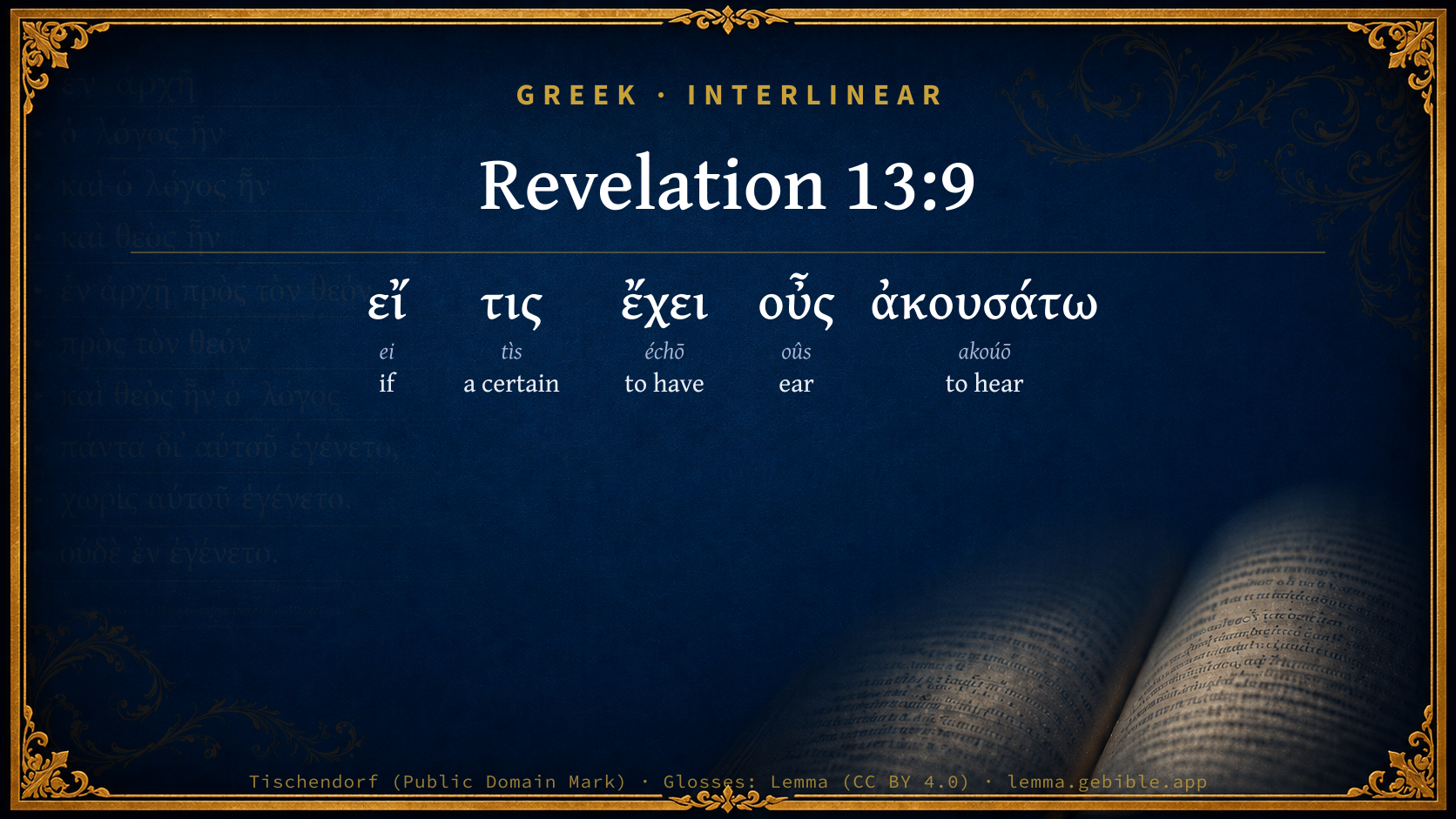
Greek (Tischendorf 8th ed.) Revelation 13:9 appears in the Greek New Testament. The text above is from the Tischendorf 8th edition. Each word links to its Strong’s number and a concise gloss. Click any word for its full Thayer’s Greek Lexicon entry.
Download image
Cite this verse

Revelation 13:9 (World English Bible). Public Domain. Lemma interlinear Bible study tool, https://lemma.gebible.app/v/revelation/13/9.

Show BibTeX & RIS
BibTeX
RIS
English Translation
If anyone has an ear, let him hear.
World English Bible · Public Domain
Download a study sheet

One document with this verse’s original text, its word-by-word gloss line, the meaning frame, cross-references with their text, attributed commentary, and full source and license credits — printable, and it pastes into notes with its structure intact.

This verse Autodidact and up

Study sheet (.html) Plain text (.txt)

A passage Seminary Student

Up to 50 verses in one chapter. A passage sheet keeps up to 6 commentary sources and 12 cross-references per verse, in the order this page ranks them, and says so on the sheet whenever that leaves anything out. Ask for a single verse and you get the Autodidact verse sheet above.

Everything on this page stays free to read, with no account — the sheet is a download of what is already on screen, not access to it.

Want to remove ads? Support Godless Engineer
Compare translations 3

The same verse in 3 English versions, stacked beneath the original-language interlinear above. Click any original word for its lexicon entry.

Each is an independent rendering of the whole verse — the interlinear is not word-aligned to these translations.

Highlighted words mark where these versions differ — a whole-verse word diff, not a word-by-word alignment.

  • World English Bible Public Domain
    If anyone has an ear, let him hear.
  • King James Version Public Domain
    If any man have an ear, let him hear.
  • unfoldingWord Literal Text CC BY-SA 4.0
    If anyone has an ear, let him hear.

unfoldingWord Literal Text — © unfoldingWord, licensed CC BY-SA 4.0. Word-aligned USFM3 via Door43 (git.door43.org/unfoldingWord/en_ult).

Versions to compare (up to 4)

3 of 4 selected

Show all 19 translations

Every available English version of this verse, each an independent rendering of the whole verse.

  • World English Bible Public Domain
    If anyone has an ear, let him hear.
  • Berean Standard Bible Public Domain
    He who has an ear, let him hear:
  • Majority Standard Bible Public Domain
    He who has an ear, let him hear:
  • King James Version Public Domain
    If any man have an ear, let him hear.
  • American Standard Version (1901) Public Domain
    If any man hath an ear, let him hear.
  • Revised Version (1885) Public Domain
    If any man hath an ear, let him hear.
  • Geneva Bible (1599) Public Domain
    If any man haue an eare, let him heare.
  • Douay-Rheims (1899) Public Domain
    If any man have an ear, let him hear.
  • Young's Literal Translation Public Domain
    if any one hath an ear -- let him hear:
  • Literal Standard Version CC BY-SA 4.0
    if anyone has an ear—let him hear:
  • Unlocked Literal Bible CC BY-SA 4.0
    If anyone has an ear, let him listen.
  • unfoldingWord Literal Text CC BY-SA 4.0
    If anyone has an ear, let him hear.
  • Darby Bible Public Domain
    If any one has an ear, let him hear.
  • World Messianic Bible Public Domain
    If anyone has an ear, let him hear.
  • Webster's Bible Public Domain
    If any man hath an ear, let him hear.
  • Free Bible Version CC BY-SA 4.0
    If you have ears, listen!
  • Bible in Basic English Public Domain
    If any man has ears, let him give ear.
  • Text-Critical English NT CC BY 4.0
    If anyone has an ear, let him hear:
  • Tyndale New Testament (1534) Public Domain
    Yf eny man have an eare lett him heare.

Literal Standard Version (2020), Covenant Press — licensed CC BY-SA 4.0. Text via the HelloAO Bible API (eBible.org). Unlocked Literal Bible (unfoldingWord) — licensed CC BY-SA 4.0. Text via the HelloAO Bible API (eBible.org). unfoldingWord Literal Text — © unfoldingWord, licensed CC BY-SA 4.0. Word-aligned USFM3 via Door43 (git.door43.org/unfoldingWord/en_ult). Free Bible Version, Dr. Jonathan Gallagher — licensed CC BY-SA 4.0. Text via the HelloAO Bible API (eBible.org).

Word by word

More ways to search: Search by grammar → Find every occurrence → Compare this word →

Practice this passage: Drill this verse → Learn its vocabulary →

About this verse

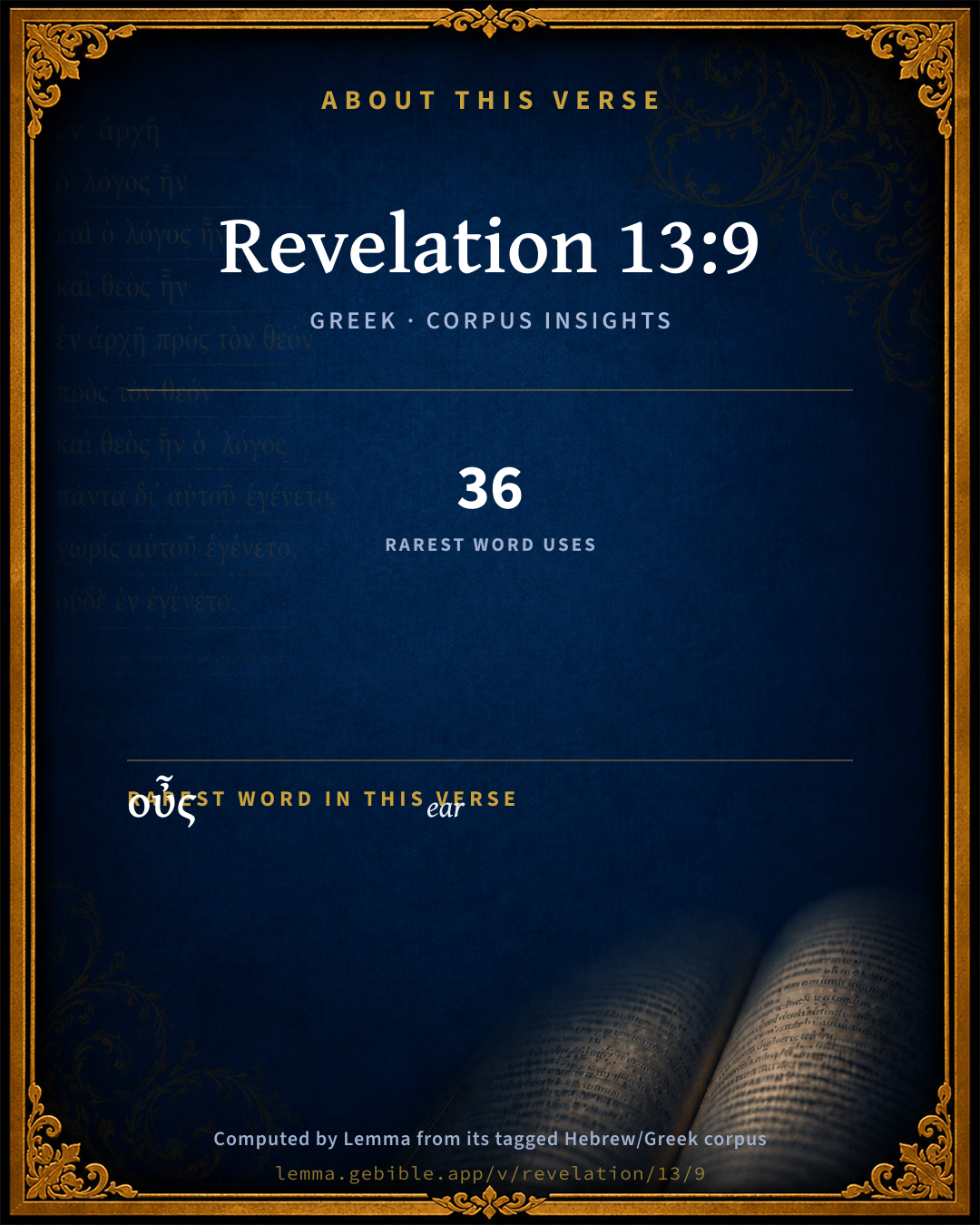
These counts appear in no published source. They are computed here, from the morphology-tagged text and Lemma’s own curated glosses. What Lemma adds →

5
words
5
distinct lemmas
Revelation
section

Shared distinctive vocabulary

οὖς ear G3775 occurs in 34 verses of the Greek New Testament. Also found in:
Cross-references

4

Topical passages linked to Revelation 13:9 in the Treasury of Scripture Knowledge — connected by theme and wording, ordered by reader-vote popularity; previews shown in the World English Bible.

  • Revelation 2:7 He who has an ear, let him hear what the Spirit says to the assemblies. To him who overcomes I will give to eat of the tree of life, which is in the Paradise of my God.
  • Revelation 2:17 He who has an ear, let him hear what the Spirit says to the assemblies. To him who overcomes, to him I will give of the hidden manna, and I will give him a white stone, and on the stone a new name written, which no one knows but he who receives it.
  • Revelation 2:11 He who has an ear, let him hear what the Spirit says to the assemblies. He who overcomes won't be harmed by the second death.
  • Revelation 2:29 He who has an ear, let him hear what the Spirit says to the assemblies.

Cross-references courtesy of OpenBible.info (CC BY 4.0).

Commentary

Notes on Revelation 13:9 from classic Christian and Jewish commentators (each source and its license shown beneath its notes). The classic Christian expositions comment on the surrounding passage and are grouped to its opening verse, so a note may address several verses; the Jewish commentaries on the Tanakh (Rashi and others) are per-verse, so they appear only where the commentator wrote on this verse.

Lemma curates 59 commentaries, every one of them public domain or Creative Commons licensed, each selected and text-cleaned for this edition rather than reprinted as found. About our sources →

Joseph Benson's Commentary

Rev 13:9-10. If any man have an ear, let him hear — It was customary with our Saviour, when he would have his auditors to pay a particular attention to what he had been saying, to add, He who hath ears to hear, let him hear. St. John repeats the same admonition at the end of each of the seven epistles to the seven churches of Asia, and here in the conclusion of his description of the beast, If any man have an ear, let him hear: and certainly the description of the beast is deserving of the highest attention upon many accounts, and particularly because the right interpretation of this book turns upon it, as one of its main hinges. It is added, by way of consolation to the church, that these enemies of God and of Christ, represented under the character of the beast, shall suffer the law of retaliation, and be as remarkably punished and tormented themselves, as they punished and tormented others, Rev 13:10. He who leadeth into captivity, shall go into captivity; he who killeth with the sword, must be killed with the sword — Such a promise might administer some comfort; and indeed it would be wanted, for the patience and the faith of the saints would be tried to the utmost during the reign of the beast. Here is the patience and the faith of the saints — Of all the trials and persecutions of the church this would be the most severe, and exceed those of the primitive times, both in degree and in duration.

Joseph Benson's Commentary on the Old and New Testaments (1811–1818) — public domain. Text from a community e-Sword module.

Tyndale Open Study Notes

Tyndale Open Resources

13:9-10 The scene (13:1-10) ends with a dramatic conclusion patterned on Jer 15:2; 43:11. Anyone with ears to hear must pay attention, because judgment is coming (cp. Rev 2:7, 11, 17).

Tyndale Open Study Notes — © Tyndale Open Resources, licensed CC BY-SA 4.0. Text via the HelloAO Bible API.

Meyer's Critical & Exegetical Commentary

Heinrich August Wilhelm Meyer

Rev_13:9-10. This consolatory assurance is expressly urged as one extremely important.[3333]

ΕἼ ΤΙς ΕἸς ΑἸΧΜΑΛΩΣΊΑΝ, ΕἸς ΑἸΧΜΑΛΩΣΊΑΝ. The jus talionis is exercised by the righteous judgment of God.[3334] The brevity of the elliptical expression corresponds very well with the immutability of the strict sentence, in case the second ΕἸς ΑἸΧΜΑΛΩΣΊΑΝ stands without further definition.[3335]

On the two kinds of persecution, cf. Rev_2:10; Rev_2:13, Rev_6:10, Rev_11:7. Volkm. regards the threat of the sword as directed against Nero. But how is it conceivable if Rev_13:3 refers, according to Volkmars interpretation, to Nero?

ὠδε ἐστι ἡ ὑπομονή, κ.τ.λ. The formula ὦδε ἐστιν is in itself so indefinite that it can express both gradations of the idea: Here must the patience, the wisdom,[3336] of believers be displayed,[3337] and Here patience is present, here lies its foundation and source. In this passage, and Rev_14:12, the latter idea results from the connection; by the ὠδε, κ.τ.λ., an allusion is made to what has just been said, Rev_13:10, yea already in Rev_13:8; viz., to that in which the patience of the saints consists, who by their faith lay hold of that divine consolation. Otherwise, Rev_13:18; Rev_17:9.

[3333] Rev_13:9. Cf. Rev_2:7; Rev_2:11.

[3334] Cf. Rev_18:6, Rev_19:2.

[3335] ὑπάγει, Rev_17:8. See Critical Notes.

[3336] Rev_13:18; Rev_17:9.

[3337] De Wette, Hengstenb.

NOTES BY THE AMERICAN EDITOR

LXXII. Rev_13:8. ἀπὸ κατβαολῆς κόσμου

In favor of the translation in our A. V., is the distance of this clause from the γέγραπται. 1Pe_1:19-20, Joh_17:24, are sometimes cited as supporting slain from the foundation; but the shade of meaning there expressed is different. Rev_17:8 seems to be decisive in favor of the construction advocated by Düsterdieck; and it has, on the basis of this passage, been adopted by the American section of the committee on the R. V.

Meyer — Critical and Exegetical Commentary on the New Testament — English translation by Peter Christie, edited by Frederick Crombie (T&T Clark, 1880) — public domain. Text from a community e-Sword module.

Expositor's Greek Testament

ed. W. Robertson Nicoll

Rev 13:9 . The prophet’s nota bene introduces (Rev 13:10 ) what is either ( a ) a demand for patience and non-resistance, or ( b ) an encouragement to it. ( a ) “Be patient. If captivity is your destiny from God, accept it. If any one is (destined) for captivity, to captivity he goes (in God’s order, ὑπάγει in a future sense). Show your patient faith in God by abstaining from the use of force” ( cf. Mat 26:52 ). This interpretation (rejecting συνάγει or ἀπάγει in 10 a ) is preferable to ( b ) that which reads (or even understands; with B. Weiss) συνάγει , ἀπάγει , or ὑπάγει (so some cursives and versions) in 10 a , and thus finds in the words a promise of requital rather than an appeal for endurance. The fate inflicted on Christians will recoil on their persecutors ( cf. Rev 14:12 ). Imprisonment or captivity and death were the normal fates of the age for criminals who refused to invoke the emperor’s genius ( cf. Jos. Bell . iii. 10. 10, vi. 8. 2, Philo: de Flacc. 11, leg. ad Gaium , 32). A variation of this meaning would be: use force, and you (Christians) will suffer for it. The whole stanza is written for saints who, like Sigurd, are not born for blenching. ὧδε κ . τ . λ . Josephus ( Bell . iii. 5. 8, etc.) had just given, from prudential motives, a similar warning to Jews against participating in any anti-Roman movement. It was always hard to disabuse the Oriental mind of the idea that religious faith must be bound up with fate and fighting. cf. Introd. § 6.

The Expositor's Greek Testament, edited by W. Robertson Nicoll (1897–1910) — public domain. Text from a community e-Sword module.

Geneva Bible (1599)

Geneva Bible translators

The conclusion of this speech of the first beast, consisting of two parts, An exhortation to attentive audience in this verse: and a foretelling, which partly containeth threatenings against the wicked, and partly comforts for those which in patience and faith shalt wait for that glorious coming of our Lord and Savior Christ, the tenth verse.

Geneva Bible (1599) marginal notes — public domain. Text via Bolls.life.

Jamieson, Fausset & Brown

Robert Jamieson, A. R. Fausset & David Brown

A general exhortation. Christ's own words of monition calling solemn attention.

Jamieson, Fausset & Brown — Commentary Critical and Explanatory on the Whole Bible (1871) — public domain (CC PDM 1.0). Text via the HelloAO Bible API.

Adam Clarke's Commentary

Verse 9. If any man have an ear, let him hear.] These words are evidently introduced to impress the reader with the awfulness of what has just been spoken-all shall worship him whose names are not written in the book of life, as well as to fix his attention upon the following words:-

Adam Clarke's Commentary on the Bible (1810–1826) — public domain. Text from a community e-Sword/MySword module.

Ellicott's Commentary for English Readers

(9) This verse—an echo of his Master’s words from the lips of the beloved disciple—calls marked attention to the warning words of the next verse.

A Bible Commentary for English Readers, edited by Charles John Ellicott (1878–1897) — public domain. Text from a community e-Sword module.

The Cambridge Bible for Schools and Colleges

gen. ed. J. J. S. Perowne

9. If any man &c.] See on Rev_2:7.

The Cambridge Bible for Schools and Colleges (gen. ed. J. J. S. Perowne; Cambridge University Press, 1878–1918) — public domain. Text from a community e-Sword module.

John Gill's Exposition

If any man have an ear, let him hear. And diligently attend to this mystical description of antichrist, as being matter of some difficulty to understand, as well as of great moment and importance, and seriously consider it, that he may know him, and his followers, and avoid them; See Gill on Rev 1:7.

.

Revelation 13:10

rev 13:10

rev 13:10

rev 13:10He that leadeth into captivity shall go into captivity,.... As the devil, by whom men are led captive at his will, and the Romish antichrist, who leads multitudes of souls to hell; these shall be taken and cast into the lake which burns with fire and brimstone. The Jews (g) have a saying, that

"captivity comes into the world for idolatry, uncleanness, and murder;''

which three things are notorious in the Romish antichrist: and in the same treatise they say (h), that the sword, the next judgment mentioned, comes into the world for delay of justice, and the perversion of it.

He that killeth with the sword must be killed with the sword; the design of the phrase is to show, that there will be a just retaliation made to the antichristian beast, for all his cruelty to the saints, and the murders of them; and that because he has shed much blood of the saints, blood shall be given him to drink, and he shall be used in like manner he has used others; see Gen 9:6 Mat 26:52.

Here is the patience and the faith of the saints; meaning either that hereby, through the cruelties and barbarities of the Romish antichrist, the patience and faith of the saints are tried; and that they have great need of them, and of the exercise of them, under such usages; and that these being tried, and continue, will receive much commendation, honour, and praise; or else the sense is, that it requires both faith and patience in the saints, to believe that antichrist will be thus destroyed, and to wait quietly till the time comes. The Arabic version reads, "here is the patience and prayers of the saints": who cry, how long will it be ere our blood is avenged? and have need of patience to rest a while, till their prayers are answered.

(g) Pirke Abot, c. 5. sect. 9. (h) Ib. sect. 8.

John Gill's Exposition of the Whole Bible (1746–1763) — public domain (CC PDM 1.0). Text via the HelloAO Bible API.

Trapp's Complete Commentary

John Trapp

9 If any man have an ear, let him hear.

Ver. 9. If any man have an ear] q.d. Let all that have souls to save, beware of this beast; for is it nothing to lose an immortal soul? to purchase an everliving death? Purus putus Papista non potest servari. Confer Rev 19:21. It is confessed by all, that a learned English apostate Papist cannot be saved.

John Trapp, A Commentary or Exposition upon All the Books of the Old and New Testament (1647–1656) — public domain. Text from a community e-Sword module.

Albert Barnes' Notes on the Bible

If any man have an ear, let him hear - See the notes on Rev 2:7. The idea here is, that what was here said respecting the “beast” was worthy of special attention, as it pertained to most important events in the history of the church.

Albert Barnes' Notes on the Bible (1834–1885) — public domain. Text from a community e-Sword/MySword module.

Matthew Poole's English Annotations

Either, let him hear what hath been already said, and take heed that he be not one of those that worship the beast; or, let him hear what followeth concerning the ruin of antichrist and his adherents: but from the usage of this phrase in other scriptures, where it is oft made use of to stir up attention to some remarkable thing, it seemeth rather to be applied to what went before. The phrase also further lets us know, that (comparatively) the number of those who should refuse to worship the beast would be very small, as indeed it proved.

Matthew Poole's English Annotations on the Holy Bible (1683–1685) — public domain. Text from a community e-Sword/MySword module.

Whedon's Commentary on the Bible

Daniel D. Whedon

9. Have an ear—John here repeats the solemn injunction usual with our Lord when some momentous point was uttered. This predominance and cruelty of antichrist was of immense moment. Its importance is immense to us at this hour, for even now the beast is practising and purposing and hoping for a full verification of his claim to universal subjection.

Daniel D. Whedon (gen. ed.), Commentary on the Old and New Testaments (1874–1909) — public domain. Text from a community e-Sword module.

The Pulpit Commentary

If any man have an ear, let him hear. This verse draws attention to the solemn declaration which follows in the succeeding verse. (cf. Rev_2:7 Rev_3:6; also Mat_11:15, etc.)

The Pulpit Commentary (1880–1919), ed. H.D.M. Spence-Jones & Joseph S. Exell — public domain. Text from a community e-Sword module.

John Wesley's Explanatory Notes

If any one have an ear, let him hear - It was said before, "He that hath an ear, let him hear." This expression, if any, seems to imply, that scarce will any that hath an ear be found. Let him hear - With all attention the following warning, and the whole description of the beast,

John Wesley, Explanatory Notes Upon the Whole Bible (1754–1765) — public domain. Text via the GEBible commentary corpus.

Burkitt's Expository Notes on the New Testament

William Burkitt

Observe here, 1. That this acclamation, If any man have an ear, let him hear, is added in scripture when something went before, which required a very diligent attention and close application of mind: If any man have an ear, that is, a spiritual understanding to discern the meaning of what has been foretold, let him ponder and consider what is here revealed concerning this beast, and take heed that he be not found amongst the number of the worshippers of it.

Observe, 2. The consolation here given to the saints, from the consideration of God’s just retribution to his and their enemies, He that leadeth into captivity, shall go into captivity; that is, the beast, who has brought many of the saints into captivity, shall himself at length be taken captive, and thrown into that lake of fire and brimstone, spoken of Rev 19:20. With what measure antichrist metes to others, it shall be measured to him again: God has as many ways to hurt his church’s enemies, as they have to hurt his people; if they lead into captivity, so can he; if they kill with the sword, so will he.

Observe, 3. The end and design of God in suffering antichrist’s rage to break forth against the church: it is for the trial of his church’s faith and patience, Here is the patience and faith of the saints.

Where note, 1. That none can stand under, or bear up under, sufferings like saints.

2. That under great sufferings, saints themselves will have great occasion for the exercise of faith and patience.

3. That the faith and patience of the saints will be made very conspicuous by great and sharp sufferings.

4. That faith and patience must accompany each other in suffering times. Patience is the soul’s shoulder, to bear what is afflictive at present; faith is the Christian’s eye, to discover a glorious deliverance to come: where no patience is, it is a token of no faith; and where no faith is, there will appear great impatience. Behold then the faith and patience of the saints.

William Burkitt's Expository Notes on the New Testament (1700–1703) — public domain. Text from a community e-Sword module.

The People's New Testament

B. W. Johnson

9. If any man have an ear, let him hear. Let him give heed. The words to be heeded are in verse 10.

B. W. Johnson's The People's New Testament with Notes (1889–1891) — public domain. Electronic text from the Christian Classics Ethereal Library (CCEL) ThML edition.

unfoldingWord translationNotes

Door43 World Missions Community

General Information:

These verses are a break from John's account of his vision. Here he give a warning to the people reading his account.

If anyone has an ear

Being willing to listen is spoken of as having an ear. See how you translated a similar phrase in Revelation 2:7. AT: "Let the one who is willing to listen, listen" or "If you are willing, listen" (See: Metaphor)

If anyone is to be taken

This expression means that someone has decided who should be taken. If needed, translators may state clearly who decided it. AT: "If God has decided that someone should be taken" or "If it is God's will that someone should be taken" (See: Assumed Knowledge and Implicit Information)

If anyone is to be taken into captivity

This can be stated in active form. The noun "captivity" can be stated with the verb "capture." AT: "If it is God's will for the enemy to capture a certain person" (See: Active or Passive and Abstract Nouns)

into captivity he will go

The noun "captivity" can be stated with the verb "capture." AT: "he will be captured" or "the enemy will capture him" (See: Abstract Nouns)

If anyone is to be killed with the sword

This can be stated in active form. AT: "If it is God's will for the enemy to kill a certain person with a sword" (See: Active or Passive)

with the sword

The sword represents war. AT: "in war" (See: Metonymy)

he will be killed

This can be stated in active form. AT: "the enemy will kill him" (See: Active or Passive)

Here is a call for the patient endurance and faith of the saints

"God's holy people must endure patiently and be faithful"

translationWords

captive

sword

call

patient

endure

faith

saint

unfoldingWord translationNotes — © Distant Shores Media and the Door43 World Missions Community, licensed CC BY-SA 4.0. Source: git.door43.org/Door43/en_tn.

Cambridge Greek Testament for Schools and Colleges

9. εἴ τις κ.τ.λ. See on Rev 2:7.

Cambridge Greek Testament for Schools and Colleges (Cambridge University Press, 1896; 21 vols, various authors incl. Carr, Maclear, Plummer, Farrar, Lumby, Moule, M. R. James, Simcox) — public domain. Text from a community e-Sword module.

Lesson kit

Teaching starters — assembled from the data on this page, not authored interpretation. Every prompt links to the verse data it draws on. Edit before teaching.

Revelation, in the Revelation, opens this verse with 5 words (5 distinct Greek lemmas). Its most distinctive word is oûs (“ear”). A historical commentator’s framing appears above. Read the whole chapter for the surrounding context.

Discussion questions

  1. How does “ear” (oûs) shape what this verse is saying?
  2. Matthew 10:27 shares the word «ear» with this verse. How do the two illuminate each other?
  3. These translations render this verse differently; the difference is in the English rendering, not the original. What questions does that raise?
  4. Reading how Joseph Benson's Commentary and Tyndale Open Study Notes read this verse, where do the two commentators agree and where do they part?

Things to notice

Reading settings

Reading text

Shown beneath each verse's original-language words.

Old Testament
Old Testament edition

Read the OT as the Masoretic Hebrew (MT) or the Greek Septuagint (LXX).

English shown for the Greek Septuagint (in the Hebrew ↔ Greek comparison).

Comparing translations? Open the Compare panel on any verse page to stack up to four side by side.