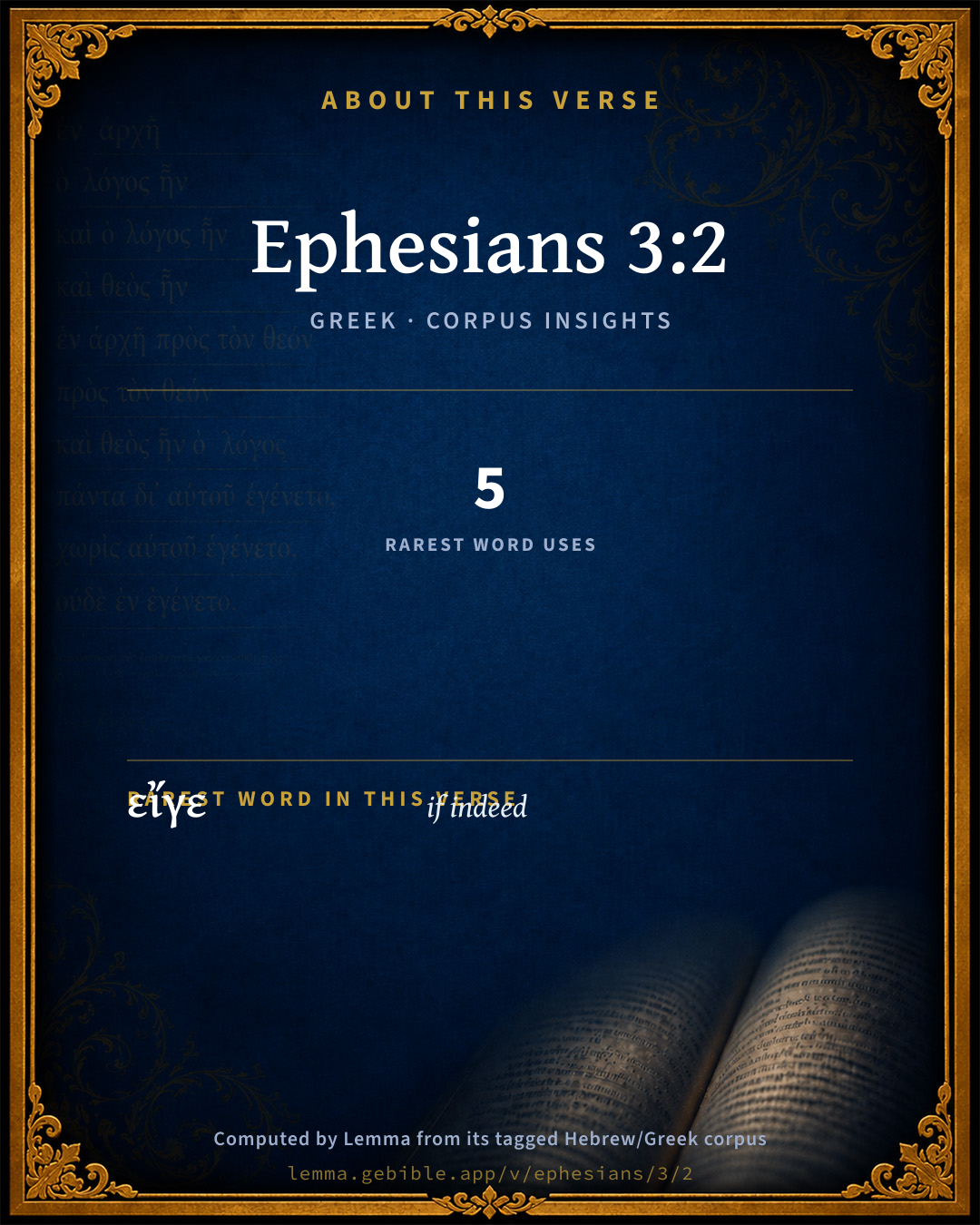
Ephesians 3:2

Greek (Tischendorf 8th ed.) Ephesians 3:2 appears in the Greek New Testament. The text above is from the Tischendorf 8th edition. Each word links to its Strong’s number and a concise gloss. Click any word for its full Thayer’s Greek Lexicon entry.
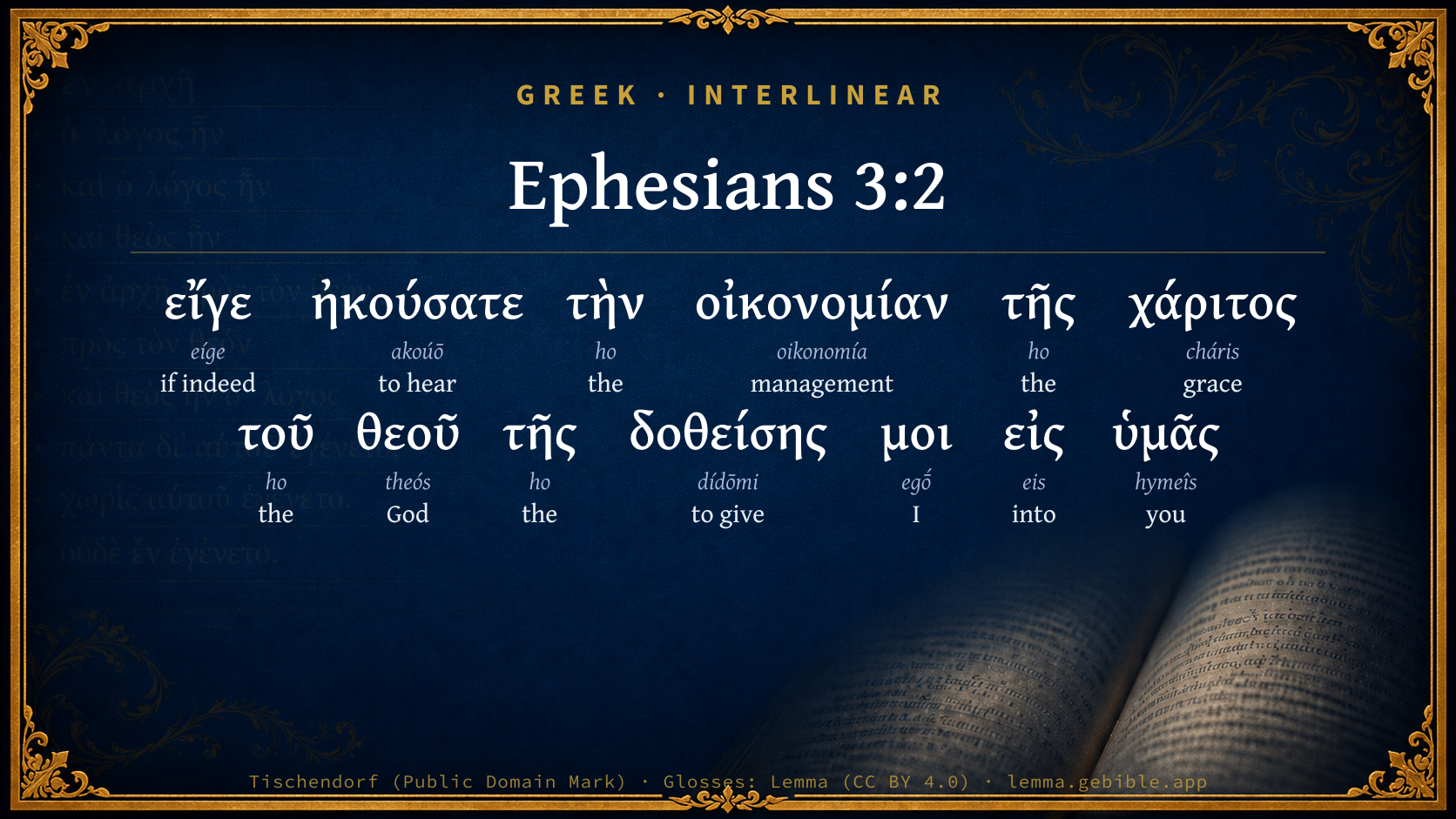
Download image
Cite this verse

Ephesians 3:2 (World English Bible). Public Domain. Lemma interlinear Bible study tool, https://lemma.gebible.app/v/ephesians/3/2.

Show BibTeX & RIS
BibTeX
RIS
English Translation
if it is so that you have heard of the administration of that grace of God which was given me toward you;
World English Bible · Public Domain
Download a study sheet

One document with this verse’s original text, its word-by-word gloss line, the meaning frame, cross-references with their text, attributed commentary, and full source and license credits — printable, and it pastes into notes with its structure intact.

This verse Autodidact and up

Study sheet (.html) Plain text (.txt)

A passage Seminary Student

Up to 50 verses in one chapter. A passage sheet keeps up to 6 commentary sources and 12 cross-references per verse, in the order this page ranks them, and says so on the sheet whenever that leaves anything out. Ask for a single verse and you get the Autodidact verse sheet above.

Everything on this page stays free to read, with no account — the sheet is a download of what is already on screen, not access to it.

Want to remove ads? Support Godless Engineer
Compare translations 3

The same verse in 3 English versions, stacked beneath the original-language interlinear above. Click any original word for its lexicon entry.

Each is an independent rendering of the whole verse — the interlinear is not word-aligned to these translations.

Highlighted words mark where these versions differ — a whole-verse word diff, not a word-by-word alignment.

  • World English Bible Public Domain
    if it is so that you have heard of the administration of that grace of God which was given me toward you;
  • King James Version Public Domain
    If ye have heard of the dispensation of the grace of God which is given me to you-ward:
  • unfoldingWord Literal Text CC BY-SA 4.0
    if indeed you have heard of the stewardship of the grace of God that was given to me for you,

unfoldingWord Literal Text — © unfoldingWord, licensed CC BY-SA 4.0. Word-aligned USFM3 via Door43 (git.door43.org/unfoldingWord/en_ult).

Versions to compare (up to 4)

3 of 4 selected

Show all 19 translations

Every available English version of this verse, each an independent rendering of the whole verse.

  • World English Bible Public Domain
    if it is so that you have heard of the administration of that grace of God which was given me toward you;
  • Berean Standard Bible Public Domain
    Surely you have heard about the stewardship of God’s grace that was given to me for you,
  • Majority Standard Bible Public Domain
    Surely you have heard about the stewardship of God’s grace that was given to me for you,
  • King James Version Public Domain
    If ye have heard of the dispensation of the grace of God which is given me to you-ward:
  • American Standard Version (1901) Public Domain
    if so be that ye have heard of the dispensation of that grace of God which was given me to you-ward;
  • Revised Version (1885) Public Domain
    if so be that ye have heard of the dispensation of that grace of God which was given me to you-ward;
  • Geneva Bible (1599) Public Domain
    If ye haue heard of the dispensation of the grace of God, which is giuen me to you warde,
  • Douay-Rheims (1899) Public Domain
    If yet you have heard of the dispensation of the grace of God which is given me towards you:
  • Young's Literal Translation Public Domain
    if, indeed, ye did hear of the dispensation of the grace of God that was given to me in regard to you,
  • Literal Standard Version CC BY-SA 4.0
    if, indeed, you heard of the dispensation of the grace of God that was given to me in regard to you,
  • Unlocked Literal Bible CC BY-SA 4.0
    I assume that you have heard of the stewardship of the grace of God that was given to me for you.
  • unfoldingWord Literal Text CC BY-SA 4.0
    if indeed you have heard of the stewardship of the grace of God that was given to me for you,
  • Darby Bible Public Domain
    (if indeed ye have heard of the administration of the grace of God which has been given to me towards you,
  • World Messianic Bible Public Domain
    if it is so that you have heard of the administration of that grace of God which was given me toward you,
  • Webster's Bible Public Domain
    If ye have heard of the dispensation of the grace of God which is given me on your account.
  • Free Bible Version CC BY-SA 4.0
    (well, I'm assuming you've heard that God gave me the specific responsibility of sharing God's grace with you),
  • Bible in Basic English Public Domain
    If that ordering of the grace of God has come to your knowledge, which was given to me for you,
  • Text-Critical English NT CC BY 4.0
    Surely you have heard of the stewardship of God's grace that was given to me for you,
  • Tyndale New Testament (1534) Public Domain
    Yf ye have hearde of the ministracion of the grace of god which is geven me to you warde.

Literal Standard Version (2020), Covenant Press — licensed CC BY-SA 4.0. Text via the HelloAO Bible API (eBible.org). Unlocked Literal Bible (unfoldingWord) — licensed CC BY-SA 4.0. Text via the HelloAO Bible API (eBible.org). unfoldingWord Literal Text — © unfoldingWord, licensed CC BY-SA 4.0. Word-aligned USFM3 via Door43 (git.door43.org/unfoldingWord/en_ult). Free Bible Version, Dr. Jonathan Gallagher — licensed CC BY-SA 4.0. Text via the HelloAO Bible API (eBible.org).

Word by word

More ways to search: Search by grammar → Find every occurrence → Compare this word →

Practice this passage: Drill this verse → Learn its vocabulary →

About this verse

These counts appear in no published source. They are computed here, from the morphology-tagged text and Lemma’s own curated glosses. What Lemma adds →

13
words
10
distinct lemmas
Pauline Epistles
section

Notable vocabulary

The rarest word here is εἴγε if indeed G1489 — appearing just 5 times in the whole Greek New Testament.

Shared distinctive vocabulary

εἴγε if indeed G1489 occurs in 5 verses of the Greek New Testament. Also found in:

Repetition

A word recurs within this verse:

Cross-references

25

Topical passages linked to Ephesians 3:2 in the Treasury of Scripture Knowledge — connected by theme and wording, ordered by reader-vote popularity; previews shown in the World English Bible.

  • 1 Timothy 1:11 according to the Gospel of the glory of the blessed God, which was committed to my trust.
  • Colossians 1:25–27 of which I was made a servant, according to the stewardship of God which was given me toward you, to fulfill the word of God,
  • Romans 1:5 through whom we received grace and apostleship, for obedience of faith among all the nations, for his name's sake;
  • Galatians 1:15–16 But when it was the good pleasure of God, who separated me from my mother's womb, and called me through his grace,
  • 2 Timothy 1:11 For this, I was appointed as a preacher, an apostle, and a teacher of the Gentiles.
  • Ephesians 4:7 But to each one of us was the grace given according to the measure of the gift of Christ.
  • 1 Corinthians 4:1 So let a man think of us as Christ's servants, and stewards of God's mysteries.
  • 1 Corinthians 9:17–22 For if I do this of my own will, I have a reward. But if not of my own will, I have a stewardship entrusted to me.
  • Galatians 1:13 For you have heard of my way of living in time past in the Jews' religion, how that beyond measure I persecuted the assembly of God, and ravaged it.
  • Ephesians 1:10 to an administration of the fullness of the times, to sum up all things in Christ, the things in the heavens, and the things on the earth, in him;
  • Acts 9:15 But the Lord said to him, "Go your way, for he is my chosen vessel to bear my name before the nations and kings, and the children of Israel.
  • Acts 13:2 As they served the Lord and fasted, the Holy Spirit said, "Separate Barnabas and Saul for me, for the work to which I have called them."
  • Acts 13:46 Paul and Barnabas spoke out boldly, and said, "It was necessary that God's word should be spoken to you first. Since indeed you thrust it from you, and judge yourselves unworthy of eternal life, behold, we turn to the Gentiles.
  • Acts 22:21 "He said to me, 'Depart, for I will send you out far from here to the Gentiles.'"
  • Acts 26:17–18 delivering you from the people, and from the Gentiles, to whom I send you,
  • Romans 15:15–16 But I write the more boldly to you in part, as reminding you, because of the grace that was given to me by God,
  • Romans 11:13 For I speak to you who are Gentiles. Since then as I am an apostle to Gentiles, I glorify my ministry;
  • Romans 12:3 For I say, through the grace that was given me, to every man who is among you, not to think of himself more highly than he ought to think; but to think reasonably, as God has apportioned to each person a measure of faith.
  • Galatians 2:8–9 (for he who appointed Peter to the apostleship of the circumcision appointed me also to the Gentiles);
  • Ephesians 3:8 To me, the very least of all saints, was this grace given, to preach to the Gentiles the unsearchable riches of Christ,
  • Ephesians 4:21 if indeed you heard him, and were taught in him, even as truth is in Jesus:
  • Colossians 1:4 having heard of your faith in Christ Jesus, and of the love which you have toward all the saints,
  • 1 Timothy 1:4 neither to pay attention to myths and endless genealogies, which cause disputes, rather than God's stewardship, which is in faith--
  • 1 Timothy 2:7 to which I was appointed a preacher and an apostle (I am telling the truth in Christ, not lying), a teacher of the Gentiles in faith and truth.
  • Colossians 1:6 which has come to you; even as it is in all the world and is bearing fruit and growing, as it does in you also, since the day you heard and knew the grace of God in truth;

Cross-references courtesy of OpenBible.info (CC BY 4.0).

Commentary

Notes on Ephesians 3:2 from classic Christian and Jewish commentators (each source and its license shown beneath its notes). The classic Christian expositions comment on the surrounding passage and are grouped to its opening verse, so a note may address several verses; the Jewish commentaries on the Tanakh (Rashi and others) are per-verse, so they appear only where the commentator wrote on this verse.

Lemma curates 59 commentaries, every one of them public domain or Creative Commons licensed, each selected and text-cleaned for this edition rather than reprinted as found. About our sources →

Albert Barnes' Notes on the Bible

If ye have heard - Εἴ-γε Ei-ge “If at least, if indeed, if so be, spoken of what is taken for granted.” “Robinson;” compare 2Co 5:3; Gal 3:4; Eph 4:21; Col 1:23, for the use of the particle. The particle here is not designed to express a doubt whether they had heard of it or not, for he takes it for granted that they had. Doddridge renders it, “since I well know you have heard,” etc. He had informed them of his being called to be the minister to the Gentiles Eph 3:3, but still there was a possibility that they had not received the letter containing the information, and he goes, therefore, into another statement on the subject, that they might fully comprehend it. Hence, this long parenthetical sentence - one of the longest that occurs in the writings of Paul, and expressed under the impulse of a mind full of the subject; so full, as we would say, that he did not know what to say first.

Hence, it is exceedingly difficult to understand the exact state of mind in which he was. It seems to me that the whole of this long statement grew out of the incidental mention Eph 3:1 of the fact that he was a prisoner for the Gentiles. Instantly he seems to have reflected that they would be grieved at the intelligence that he was suffering on their account. He goes, therefore, into this long account, to show them how it happened; that it was by the appointment of God; that it was in the evolving of a great and glorious mystery; that it was in a cause adapted to promote, in an eminent degree, the glory of God; that it was according to an eternal purpose; and he, therefore Eph 3:13, says, that he desires that they would not “faint” or be unduly distressed on account of his sufferings for them, since his sufferings were designed to promote their “glory.” He was comforted in the belief that he was making known the glorious and eternal plan of God, and in the belief that it was for the welfare of mankind; and he, therefore, entreated them also not to be troubled inordinately at his sufferings.

The dispensation - Greek “economy;” rendered “stewardship,” Luk 16:2-4; and “dispensation,” Eph 1:10; Eph 3:2; Col 1:25; see the notes at Eph 1:10. It means here that this arrangement was made that he should be the apostle to the Gentiles. In the assignment of the different parts of the work of preaching the gospel, the office had been committed to him of making it known to the pagan.

Of the grace of God - In the arrangements of his grace.

Which is given me to you-ward - Toward you who are Gentiles. Not to the Ephesians particularly, but to the nations at large; see the notes at Gal 2:7.

Albert Barnes' Notes on the Bible (1834–1885) — public domain. Text from a community e-Sword/MySword module.

The Biblical Illustrator

Joseph S. Exell

Eph_3:2

If ye have heard of the dispensation of the grace of God which is given me to you-ward.

Gods dispensation of grace

The ministerial calling is termed grace, because the designing to it is of grace, and the faculty qualifying us for it is from the free favour of God.

1. This assures ministers that their sufferings are for the good of the people, if they know they have a calling from God.

2. God distributes callings for the good of His Church.

3. As God gives ministers their calling, so also their people toward whom He will bless their labours. Every minister must be

(1) Separated.

(2) Authorized.

(3) Have his pastoral charge assigned him.

When the Lord lights candles, He finds candlesticks on which to set them, and when He gives a calling, He gives a people amongst whom this function should be exercised.

4. People are specially to depend on their own pastor. (Paul Bayne.)

The dispensation of grace

If here might very well be read since, as in Col_1:23; Gal_3:4; 2Co_5:2, where the thing spoken of is not doubtful, but taken for granted. The connection is this: You know then, dear brethren, that I am the Lords prisoner for your sake, since, or forasmuch as, you know the cause of it in my miraculous conversion, and my being called to the apostolic office. For your sakes, too, I have received this grace of God, that I should be the econome or steward of the heavenly house. Here it is the grace; in Col_1:25 it is the dispensation which is given, and the meaning is nearly the same. The office and the qualification are both from God. What is this economy or dispensation? It is the law of the house, the principle and mode of housekeeping--the Haushaltung Gottes, according to the Germans. The idea is beautiful. The house, the household, the father, the family, are the holiest things on the earth. There all sorts of varieties and diversities meet in unity, rule, and obedience, rewards and punishments, hopes and fears. There are varieties of ages, sexes, characters, conditions, temperaments, etc., and the scheme of disciplining and ruling the whole is economy, the house law or dispensation, and the person to whom this is committed is the economist of the house, as Joseph was (Gen_39:4), or the heir, as Eliezer (Gen_15:2; Gen_24:2). (W. Graham, D. D.)

The Biblical Illustrator, edited by Joseph S. Exell (c. 1880s–1900s) — public domain. Text from a community e-Sword module.

Scofield Reference Notes

C. I. Scofield

grace

Grace (imparted). Eph 3:2-8; Eph 4:7; Eph 4:29; Rom 6:1; 2Pe 3:18.

The Scofield Reference Bible (1917 edition), notes by C. I. Scofield — public domain. Text from a community e-Sword module.

Tyndale Open Study Notes

Tyndale Open Resources

3:2-13 Paul interrupts his thought in 3:1 to discuss his own role in God’s plan. When Paul was first converted, he was given the special responsibility of extending God’s grace to the Gentiles (see Acts 9:15-16; 22:14-15, 21; 26:17-18; Rom 1:5; 11:13-14; 15:15-18; Gal 1:15-16; 2:7-9; Col 1:25-27; 1 Tim 2:7; 2 Tim 4:17).

Tyndale Open Study Notes — © Tyndale Open Resources, licensed CC BY-SA 4.0. Text via the HelloAO Bible API.

Bengel's Gnomon

Johann Albrecht Bengel

Eph 3:2. Εἴγε ἠκούσατε, since[39] indeed ye have heard) The things which they had heard concerning Paul (comp. note on Eph 1:1[40]) were a testimony that he, Eph 3:1, spoke the truth concerning himself.

[39] Or if: but the Indic. favours since.—ED.

[40] Viz. They bad heard of his bonds, and of his being persecuted by the Jews for his preaching to the Gentiles. This hearing was not restricted to the Ephesians; but applies to all, to whom, in the different churches, this encyclical letter was to be carried by Tychicus.—ED.

Bengel's Gnomon of the New Testament — English translation (T&T Clark, Edinburgh, 1860) — public domain. Text from a community e-Sword module.

Meyer's Critical & Exegetical Commentary

Heinrich August Wilhelm Meyer

Eph_3:2. Confirmation of that which has just been said, ὑπὲρ ὑμῶν τῶν ἐθνῶν, by the recalling of what the readers have heard concerning his vocation. For you, the Gentiles, I say, upon the presupposition that, etc. This presupposition he expresses by εἴγε, i.e. turn certe si (Klotz, ad Devar. p. 308), it being implied in the connection (for of his church he could not presuppose anything else), not in the word itself, that he assumes this rightly. He might have written εἴπερ, if at all, provided that, or εἴπερ γε, provided namely (Xen. Mem. i. 4. 4, Anab. i. 7. 9; often in the tragedians), but he has conceived the presupposition under the form at least if, if namely, and so denotes it. Comp. on Gal_3:4 and 2Co_5:3; wherever εἴγε is used and the assumption is a certain one (as also at Eph_4:21), the latter is to be gathered from the connection. From whom the readers had heard the matter in question, their own consciousness told them, namely, from Paul himself and other Pauline teachers, so that εἴγε ἠκούσατε κ.τ.λ. is a reminder of his preaching among them. Hence our passage is wrongly regarded as at variance with the superscription πρὸς Ἐφεσίους, and as pointing to readers to whom Paul was not personally known; whilst others, as Grotius (so also Rinck, Sendschr. der Korinth. p. 56, who, however, takes the correct view in the Stud. u. Krit. 1849, p. 954), have, without any ground in the context, assigned to the simple ἀκούειν the signification bene intelligere; Calvin, on the other hand, had recourse to the altogether unnatural hypothesis: Credibile est, quum ageret Ephesi, eum tacuisse de his rebus; and Böttger (Beitr. iii. p. 46 ff.) refers it to the hearing of this Epistle read, against which the very ἀναγινώσκοντες that follows in Eph_3:3 is decisive. Estius very correctly states that εἴγε is not dubitantis, sed potius affirmantis; neque enim ignorare quod hic dicitur poterant Ephesii, quibus P. ipse evang. plusquam biennio praedicaverat.[166] Paul might have expressed himself in the form of an assertion (ἠκούσατε γάρ, or ἐπεὶ ἠκούσατε), but the hypothetic form of expression constitutes a more delicate and suggestive way of recalling his preaching among them (as also the Attic writers, in place of ἐπεί γε, delicately use the hypothetic εἴγε; see Kühner, ad Xen. Mem. i. 5. 1), without, however, containing an obliquam reprehensionem (Vitringa, comp. Holzhausen), of which the context affords no trace.

τὴν οἰκονομίαν τῆς χάριτος κ.τ.λ.] the arrangement (see on Eph_1:10) which has been made regarding the grace of God given to me with reference to you (τῆς χάριτος is the genitive objecti). The more precise explanation is then given by ὅτι κατὰ ἀποκάλυψιν κ.τ.λ. The χάρις is here, in accordance with the context (τῆς δοθ. μοι εἰς ὑμᾶς), the divine bestowal of grace that took place in the entrusting him with the apostolic office. Comp. on Rom_12:3; Rom_15:15. Others, like Pelagius, Anselm, Erasmus, Grotius, Michaelis, Rosenmüller, et al., have explained οἰκον. τ. χάρ. as the office of administering evangelic grace; but against this it may be urged that not τῆς δοθείσης, but τὴν δοθεῖσαν, must have been afterwards used. This mistake is avoided by Wieseler, p. 446 f., where he takes it as: the office for which I have been qualified by the grace conferred upon me on your behalf. This office the readers had heard, inasmuch as they had heard the preaching of the apostle. But how are we to justify the expression to hear the office, instead of to hear the official preaching? The words would merely say: if ye have heard of the office, etc., Gal_1:13; Col_1:4; Phm_1:5.

[166] De Wette dogmatically lays it down that the readers had no need, if the apostle had already exercised his apostolic calling among them, now first to learn from himself that he had received it. But in so speaking he has not attended to the fact that the object of the ἠκούσατε is not the reception of the apostolic vocation in general, but the mode of this reception (namely, κατὰ ἀποκάλυψιν, ver. 3). This account of the manner in which he had become their apostle he communicated to them when he was with them, and of this he reminds them now.

Meyer — Critical and Exegetical Commentary on the New Testament — English translation by Peter Christie, edited by Frederick Crombie (T&T Clark, 1880) — public domain. Text from a community e-Sword module.

Expositor's Greek Testament

ed. W. Robertson Nicoll

Eph 3:2 . εἴγε ἠκούσατε τὴν οἰκονομίαν τῆς χάριτος τοῦ Θεοῦ τῆς δοθείσης μοι εἰς ἡμᾶς : if so be that ye did hear of the dispensation of the grace of God that was given me to you-ward . The comp. particle εἴγε , or εἴ γε (according to LTrWH), makes a supposition which is taken for granted, = “if, indeed, as I may assume”. Whether the certainty of the assumption is in the particle itself or is derived from the context is still debated among grammarians. Some hold that in this case as in others the γέ simply strengthens the force of the simple particle, while others think that this is its significance, if not in every instance, at least in a considerable number of occurrences; cf. Mey. and Ell., in loc. ; Win.-Moult., p. 561; Bâumlein, Partikeln , p. 64. Here it introduces a polite reminder of what these Ephesians certainly had heard “a gentle appeal, expressed in a hypothetical form, and conveying the hope that his words had not been quite forgotten” (Ell.). On οἰκονομίαν , which means the dispensation , the arrangement made in the matter of something, not “the apostolic office” (Wiesel.), see under Eph 1:10 . The τῆς χάριτος is the gen. objecti or that of “the point of view” (Ell.) = the arrangement or disposition in respect of the grace of God. The χάρις itself is not the apostolic office (Est.), but the gift of grace that selected Paul and qualified him for that office; and so it (not the οἰκονομία , but the χάρις ) is described as δοθείσης , given . The εἰς ὑμᾶς , admirably rendered by the AV “to you-ward,” denotes the “ethical direction” (Ell.) of the gift of grace the fact that it was bestowed on Paul not for his own sake, but with a view to their position.

The Expositor's Greek Testament, edited by W. Robertson Nicoll (1897–1910) — public domain. Text from a community e-Sword module.

Hodge's Commentary on Romans, Ephesians & First Corinthians

Charles Hodge

Eph_3:2

This verse is connected with the immediately preceding words. My apostolic mission is to the Gentiles; I am a prisoner for your sake, since ye have heard of the office which God has given me for your benefit. The word εἴγε rendered in our version by if, does not necessarily express doubt. Paul knew that the Ephesians were aware that he was an apostle to the Gentiles. The word is often used where the thing spoken of is taken for granted. Eph_4:21; 2Co_5:3. In such cases, it may properly be rendered, since, inasmuch as. It is only a more refined or delicate form of assertion. It is unnecessary, therefore, to assume either that this epistle was not addressed to the Ephesians particularly; or that ἀκούειν is to be taken in the sense of bene intelligere (if so be ye have well understood); or that Paul, when preaching at Ephesus, had preserved silence on his apostleship. He speaks of himself as a prisoner for their sake, inasmuch as they had heard he was the apostle to the Gentiles.

The expression, dispensation of the grace given unto me, is the designation of his office. It was an οἰκονομία, a stewardship. A stewardship of the grace given, τῆς χάριτος τῆς δοθείσης, means either a stewardship which is a grace, or favor, or which flows from grace, i.e. was graciously conferred. Compare Eph_3:8, in which he says, To me was this grace given. Not infrequently the office itself is called χάρις, a grace or favor. Rom_12:3, Rom_15:15; 1Co_3:10; Gal_2:9. Paul esteemed the office of a messenger of Christ as a manifestation of the undeserved kindness of God towards him, and he always speaks of it with gratitude and humility. It was not its honors, nor its authority, much less any emolument connected with it, which gave it value in his eyes; but the privilege which it involved of preaching the unsearchable riches of Christ.

Instead of understanding οἰκονομία in the sense above given, of office, it may refer to the act of God, and be rendered, dispensation. If, or since, ye have heard how God dispensed the grace given unto me, i.e. if ye understand the nature of the gift I have received. In Col_1:25, Paul speaks of the οἰκονομία as given; here it is χάρις which is said to be given. In both cases the general idea is the same, the form alone is different. His office and the grace therewith connected, including all the gifts ordinary and extraordinary, which went to make him an apostle, were both an οἰκονομία and a χάρις. The apostleship was not a mere office like that of a prelate or prince, conferring certain rights and powers; it was an inward grace, including plenary and infallible knowledge. You could no more appoint a man an apostle, than you could appoint him a saint. Neither inspiration nor holiness come by appointment. An apostle without inspiration is as much a solecism as a saint without holiness. Rome, here as every where, retains the semblance without the reality; the form without the power. She has apostles without inspiration, the office without the grace of which the office was but the expression. Thus she feeds herself and her children upon ashes.

To you-ward. Pauls mission was to the Gentiles. It was in special reference to them that he had received his commission and the gifts therewith connected. When Christ appeared to him on his journey to Damascus, he said to him, I have appeared unto thee for this purpose, to make thee a minister and witness both of these things which thou hast seen, and of those things in the which I will appear unto thee; delivering thee from the people and from the Gentiles, unto whom now I send thee, to open their eyes, and to turn them from darkness to light, and from the power of Satan unto God, that they may receive forgiveness of sins, and inheritance among them which are sanctified by faith that is in me. Act_26:16-18. Here we have an authentic account of Pauls mission. He was appointed a witness of what had been and of what should be made known to him by revelation. He was sent to the Gentiles, to turn them from Satan to God in order that they might be saved.

Charles Hodge — Commentary on Romans (1835), First Corinthians (1857), and Ephesians (1856) — public domain. Text from a community e-Sword module.

Jamieson, Fausset & Brown

Robert Jamieson, A. R. Fausset & David Brown

If--The Greek does not imply doubt: "Assuming (what I know to be the fact, namely) that ye have heard," &c. "If, as I presume," The indicative in the Greek shows that no doubt is implied: "Seeing that doubtless," &c. He by this phrase delicately reminds them of their having heard from himself, and probably from others subsequently, the fact. See Introduction, showing that these words do not disprove the address of this Epistle to the Ephesians. Compare Act 20:17-24.

the dispensation--"The office of dispensing, as a steward, the grace of God which was (not 'is') given me to you-ward," namely, to dispense to you.

Jamieson, Fausset & Brown — Commentary Critical and Explanatory on the Whole Bible (1871) — public domain (CC PDM 1.0). Text via the HelloAO Bible API.

Adam Clarke's Commentary

Verse 2. If ye have heard of the dispensation] The compound particle ειγε, which is commonly translated if indeed, in several places means since indeed, seeing that, and should be translated so in this verse, and in several other places of the New Testament. Seeing ye have heard of the dispensation of God, which is given me to you-ward: this they had amply learned from the apostle during his stay at Ephesus, for he had not shunned to declare unto them the whole counsel of God, Ac 20:27, and kept nothing back that was profitable to them, Ac 20:20. And this was certainly among those things that were most profitable, and most necessary to be known.

By the dispensation of the grace of God we may understand, either the apostolic office and gifts granted to St. Paul, for the purpose of preaching the Gospel among the Gentiles, see Ro 1:5; or the knowledge which God gave him of that gracious and Divine plan which he had formed for the conversion of the Gentiles. For the meaning of the word economy, See Clarke on Eph 1:10.

Adam Clarke's Commentary on the Bible (1810–1826) — public domain. Text from a community e-Sword/MySword module.

John Calvin's Commentaries

2. If ye have heard. There is reason to believe, that, while Paul was at Ephesus, he had said nothing on these subjects, no necessity for doing so having arisen; for no controversy had taken place among them about the calling of the Gentiles. If he had made any mention of them in his discourses, he would have reminded the Ephesians of his former statements, instead of referring generally, as he now does, to common report and to his own Epistle. He did not, of his own accord, raise unnecessary disputes. It was only when the wickedness of his adversaries made it necessary, that he reluctantly undertook the defense of his ministry. Dispensation (οικονομια) means here a divine order or command, or, as it is generally expressed, a commission

John Calvin's Commentaries (1540-1563) — public domain. Text from the Calvin Translation Society English edition (1840s-50s) via the Christian Classics Ethereal Library (ccel.org). Calvin's coverage is partial (roughly two-thirds of the Bible); uncommented books and verses are honest gaps, never fabricated. The 19th-century editor's footnotes and remarks are omitted so the notes are faithfully Calvin's own voice.

Ellicott's Commentary for English Readers

(2) If ye have heard.—The original word rendered “if” (the same used below, Eph_4:21, and in 2Co_5:3; Gal_3:4; Col_1:23) conveys, in such collocation as this, a supposition which is only a supposition in form—a half-ironical reference to a thing not doubtful. The sense is “if (that is),” or “if, as I suppose,” “ye heard the dispensation,” &c. The passage bears on the question whether the Epistle was an encyclical letter, or one addressed to the Ephesian Church. The argument which has been drawn from it in the former direction is not so strong as appears in the English; for the original implies no doubt that the readers of the Epistle had heard, and the hearing might have been not about St. Paul, but from St. Paul himself. Still, there is a vague generality about the expression, which suits well an address to the Asiatic churches generally, but could hardly have been used to a church so well known and beloved as Ephesus, where “the signs of an Apostle” had been wrought abundantly.

The dispensation of the grace of God which is given me to you-ward.—The descriptive clause, “which is given me to you-ward,” is seen in the original to belong to the word “grace,” not (as our version might suggest) to “dispensation.” The grace of God is spoken of as given to St. Paul, not so much for his own sake, as for ministration to them of the dispensation described in the next verse. We find there that the revelation of salvation to the Gentiles was the “dispensation,” that is (much as in Eph_1:10), the peculiar office in the ministration of the grace of God to the world, assigned to St. Paul by His wisdom. (Comp. 1Co_1:17-24, “God sent me not to baptize, but to preach the gospel . . . We preach Christ crucified . . . unto them that are called, both Jews and Greeks, Christ the power of God and the wisdom of God.”)

(2) Eph_3:14-19 contain a prayer, addressed with special emphasis to the Father of all, that by the strengthening grace of the Spirit and the indwelling of Christ, accepted in faith and deepened by love, they may, first, know the mystery already described in all its greatness; and, next, learn by experience the unsearchable love of Christ, as dwelling in them, and so filling them up to “the fulness of God.”

A Bible Commentary for English Readers, edited by Charles John Ellicott (1878–1897) — public domain. Text from a community e-Sword module.

The Cambridge Bible for Schools and Colleges

gen. ed. J. J. S. Perowne

2. If ye have heard of] Lit. if so be that ye heard of. This phrase occasions the question, Could this Epistle have been addressed to a Church familiar with St Paul? And it has thus seemed, to some extreme critics, an argument against the genuineness of the Epistle, a lapsus plumœ on the part of a fabricator; and, in very different quarters, an argument against the special destination to Ephesus (see Introduction, ch. 3). Not here to notice the anti-Pauline inference it is enough to say of the anti-Ephesian that it proves too much. What was known of Paul in the Ephesian Church would practically be known of him throughout the missions of Asia (see Act_19:10; Act_19:26), so that the phrase remains as difficult as before. The true account of it, surely, is that it is a phrase of almost irony, an allusion to well-known fact under the disguise of hypothesis. His Gentile commission was no new thing, and was widely known, when this clause was written; but a natural and beautiful rhetoric prefers to treat it as if possibly obscure or forgotten.—That St Paul had never been silent at Ephesus on the subject appears from Act_19:8-9, where we see him withdrawing the converts from the synagogue.

the dispensation] The stewardship. For the figure, cp. 1Co_4:1-2; 1Co_9:17; Col_1:25; 1Pe_4:10.

the grace of God which is given me] Such is the grammatical connexion; not the “stewardship” but the “grace” is the thing given. And the “grace” is explained by Rom_1:5 (“grace and apostleship”) and below, Eph_3:7-8. It was the loving gift of commission and inspiration to preach Christ among the Gentiles.—For similar allusions to his life-work cp. Act_22:21; Act_26:17-18; Rom_1:5; Rom_11:13; Gal_2:2; Gal_2:9.

The Cambridge Bible for Schools and Colleges (gen. ed. J. J. S. Perowne; Cambridge University Press, 1878–1918) — public domain. Text from a community e-Sword module.

John Gill's Exposition

If ye have heard of the dispensation of the grace of God,.... Not the free love and favour of God in his heart towards his people; nor internal grace wrought in the heart of the apostle; but either the gift of grace, as in Eph 3:7 qualifying him for the work of the ministry; and so the Ethiopic version renders it, "if ye have heard the gift of the grace of God"; or rather the doctrine of grace, the Gospel, the subject matter of which is the grace of God; it is a declaration of the free grace of God in the salvation of men; and it is the means of conveying the grace of God into their hearts. Now the apostle had a dispensation to preach this Gospel committed to him; he acted by authority, and as a steward of the mysteries of God; and which he faithfully dispensed to the family of Christ, who appointed him to this service: this the Ephesians had heard of, from the relations of the apostle, and others, and knew it themselves, having often heard him preach, for he was with them for the space of three years; wherefore this is not said as if he questioned, whether they had heard or not, but as taking it for granted that they had: "if", or "seeing ye have heard", &c.

which is given me to you-ward; it was not for his own private use, that the Gospel was committed to him, or gifts were given him to qualify him for the dispensation of it, but for the sake of others, especially the Gentiles, and particularly the Ephesians.

John Gill's Exposition of the Whole Bible (1746–1763) — public domain (CC PDM 1.0). Text via the HelloAO Bible API.

Trapp's Complete Commentary

John Trapp

2 If ye have heard of the dispensation of the grace of God which is given me to you-ward:

Ver. 2. Of the dispensation] Gr. economy. The Church is God’s house, 1Ti 3:15. Paul was faithful therein as a steward, Mat 24:45.

John Trapp, A Commentary or Exposition upon All the Books of the Old and New Testament (1647–1656) — public domain. Text from a community e-Sword module.

Haydock's Catholic Bible Commentary

If yet [1] you have heard. If yet doth not imply a doubt, but is the same as, for you have heard the dispensation.[2] This word, dispensation, is divers times taken by St. Paul to signify the manner by which a thing is done, or put in execution; the sense therefore here is, for you have heard how by the grace of God I have been made your apostle. (Witham)

===============================

[BIBLIOGRAPHY]

Si tamen audistis, Greek: eige, &c. Si tamen and Greek: eige do not here express a doubt, but an affirmation, the same as in Latin, si quidem. See St. John Chrysostom on the next chapter, ver. 21. Greek: log. ig. p. 829. Greek: eige ouk amphiballantos esti, alla kai sphodra diabebaioumenou.

===============================

[BIBLIOGRAPHY]

Dispensationem, Greek: oikonomian, rei gestæ administrationem.

George Leo Haydock (1774–1849), Haydock's Catholic Family Bible and Commentary, 1859 edition — public domain. Excludes Psalms (Douay-Rheims chapter numbering differs from Protestant) and Deuterocanonical books (Catholic canon only).

Matthew Poole's English Annotations

If ye have heard; this doth not imply doubting, but rather the apostle takes the thing for granted; q.d. Seeing ye have heard; and so some render it. See the like, 1Pe 2:3.

Of the dispensation of the grace of God: either by grace he means his apostleship, as Rom 1:5; Gal 2:9; or the free grace of God for salvation revealed in the gospel which he was to preach; and then by dispensation we must understand his commission or ordination of God to that work, via. to publish that grace whereof the ministers of the gospel are the dispensers, 1Co 4:1.

Which is given me to you-ward; to you Ephesians and other Gentiles, for whom particularly I am appointed an apostle, Act 9:15; 26:17,18; Ga 2:7.

Matthew Poole's English Annotations on the Holy Bible (1683–1685) — public domain. Text from a community e-Sword/MySword module.

Whedon's Commentary on the Bible

Daniel D. Whedon

2. If ye have heard—The best commentators, as Meyer, Alford, Ellicott, Eadie, etc., agree that the Greek for this if implies no doubt of their having heard, but rather assumption that they had, namely, from Paul himself during his two years’ ministry at Ephesus.

Daniel D. Whedon (gen. ed.), Commentary on the Old and New Testaments (1874–1909) — public domain. Text from a community e-Sword module.

The Pulpit Commentary

If ye have heard of the dispensation of the grace of God. Here begins the digression. The words, "if ye have heard," etc., do not denote an uncertainty, but are a delicate reminder. Doubtless they had heard of the matter when he was at Ephesus, and, as he remarks in ver. 3, he had already written briefly on it. Grace is here used in a more restricted sense than in Eph_1:2 in the sense of Divine favor, honor, privilege the same as in ver. 8, "To me... is this favor given." Which is given me to you-ward. The grace or favor meant is that whereby Paul was constituted the apostle of the Gentiles. Deeply though he felt his being sent away from preaching to his countrymen, (Act_22:18) he took kindly to the new sphere allotted to him, and magnified his office. (Rom_11:13)

Vers. 2-5.

Dispensational privileges of the Gentiles.

The apostle recurs to a subject already treated in few words" in the first chapter words which he requests them to read, that they may fully understand his meaning respecting the new position of the Gentiles in the kingdom of God. Their position was determined by a dispensation, that is, by an arrangement organized in all its parts in relation to space and time; for God works by order in grace as well as in nature. Consider

I THE ORIGIN OF THIS DISPENSATION. "The grace of God given to me to you-ward." It was an act of Divine favor to select the apostle as the person through whom "the mystery" of the dispensation was to be, not only revealed, but applied in its redeeming effects to the Ephesian heathens. It was not the honor or the authority involved in it that made it precious in his eyes; it was the privilege of making known the unsearchable riches of Christ. Thus, as a good steward of the mysteries of God, it was the delight of his life to dispense them in all their gracious manifoldness to the family of God.

II THE MYSTERY THAT SHROUDED THE DISPENSATION" FOR AGES.

1. It is called the mystery of Christ," not because he is its Author, but because he is the Center or Subject of it; for it included far more than the truth that the Gentiles were fellow-citizens of the saints. Christ is the Mystery of godliness, as he is God manifest in the flesh, but he is emphatically so as "Christ the Hope of glory" for the Gentiles. (Col_1:27)

2. It was hidden for ages from the sons of men, both Jew and Gentile. A mystery is either something which has been concealed, perhaps for ages, and which probably would never have been discovered unless the voice of revelation had proclaimed it; or something which, even when revealed, transcends the power of the human faculties to comprehend it. Now, the Incarnation is a mystery in this double sense; but the call of the Gentiles, as part of "the mystery of Christ," is a mystery only in the first-named sense. It was known to the Jews for ages that the Gentiles would share in the blessings of the Messiah"s kingdom and the Apostle Paul quotes Old Testament predictions to prove the fact; (Rom_9:25-33) but it was not known that the Gentiles would be included within the circle of religious privilege by the complete sacrifice of the Hebrew theocracy and the reconstitution of religion on a perfectly new basis, designed equally for all mankind, under which the old distinctions of Jew and. Gentile would be done away. There was to be no further room for Jewish particularism. The dispensation which was to carry the world to its last destinies was to be as universal as that embodied in the first promise made to our first parents.

3. The revelation of the mystery. So far as it involved a mission to the Gentiles, it was revealed first to the Apostle Paul at his conversion; for when Christ appeared to him on his journey to Damascus, he said, "I have appeared unto thee for this purpose, to make thee a minister and a witness... delivering thee from the people, and. from the Gentiles, unto whom now I send thee, to open their eyes, and to turn them from darkness to light, and from the power of Satan unto God". (Act_26:16-18) But the fuller exhibition of Gentile privilege is made in this glorious Epistle as well as elsewhere. It was a revelation made by the Lord himself. (Gal_1:12) But it was made especially to "apostles and prophets," both of them belonging to the new dispensation the only class of inspired men connected with it who received special information from the Holy Spirit, who searches the deep things of God, respecting the new development of the kingdom. The revelation was, indeed, one of facts as well as of truths. The calling of the Gentiles was made manifest in the Spirit"s falling upon Cornelius, and in the widespread success of the gospel among the Gentiles, so that the logic of facts beautifully reinforced the more formal revelations of "apostles and prophets.

4. The substance of the revelation. "That the Gentiles are fellow-heirs, and of the same body, and partakers of his promise in Christ by the gospel." These are the three points of Gentile privilege. They were not to receive the blessings of the Messiah"s kingdom by being merged as proselytes into the old theocracy, which was to abide in all its narrow ritualism.

(1) The Gentiles are fellow-heirs. Possession by inheritance involves the ideas of right, certainty, and inalienableness. All that is involved in the benefits of the covenant of grace is our inheritance. Now, the Gentiles are "heirs of God and joint-heirs with Christ" as well as the Jews, just because they are "children of God by faith in Christ Jesus." They cannot be heirs unless they are children; they cannot be children unless they have faith. And because they have faith, they are Abraham"s seed. "And if ye be Christ"s, then are ye Abraham"s seed, and heirs according to the promise". (Gal_3:29) The Gentile interest in the inheritance may be recent, but it is entire and beyond cavil. Jews and Gentiles have an equal share in all the blessings of the inheritance.

(2) The Gentiles are of the same body. This marks a more intimate relationship. They were all Jews and Gentiles alike, baptized into one body by one Spirit, and thus coalesced into one Church-state, with Christ as the Head of both. But while they were thus, as members of one body, partakers of a common life, the Gentile was not there by the permission of the Jew, or the Jew by the permission of the Gentile. They were both equally baptized into it by the Spirit. The union in one body obliterates all previous distinctions of character or culture, and all varieties in dispensational privilege; for there is no schism in the body. The Judaistic section of the Church in the apostle"s day fought strenuously against the doctrine of the one body.

(3) The Gentiles are fellow-partakers of the promise. This refers, not so much to the promise of redemption made first to Adam, repeated to Abraham, and embodied in many Old Testament predictions, as to the promise of the Spirit, who enables us to realize all the blessings involved in this first promise. This was, indeed, the blessing of Abraham which came upon the Gentiles. (Gal_3:14) It was conspicuously realized when, in the words of the Apostle Peter, "the Holy Ghost fell upon them as on us." There is no promise of the new covenant that is not equally sure to Gentile and to Jew. All the three points of Gentile privilege, setting forth apparently the relation to Father, Son, and Holy Ghost, and represented in a sort of spiritual climax, are realized by union with Christ, made known to us in the gospel. Salvation centers, as its objective ground, in Christ Jesus, and the gospel is the medium by which it is subjectively applied to sinners el mankind. T.C.

The Pulpit Commentary (1880–1919), ed. H.D.M. Spence-Jones & Joseph S. Exell — public domain. Text from a community e-Sword module.

John Wesley's Explanatory Notes

The dispensation of the grace of God given me in your behalf - That is, the commission to dispense the gracious gospel; to you gentiles in particular. This they had heard from his own mouth.

John Wesley, Explanatory Notes Upon the Whole Bible (1754–1765) — public domain. Text via the GEBible commentary corpus.

Burkitt's Expository Notes on the New Testament

William Burkitt

Observe here, 1. The title given to the gospel, it is styled the grace of God; partly because the glad tidings which the gospel brings are the effect and product of God’s grace and favour, and partly because the gospel is the instrument and means of working peace in the souls of persons.

Observe, 2. The title given to St. Paul’s apostleship; he styles it the dispensation of the grace of God, because God had commissioned him to declare and dispense the gospel of grace to them; Christ’s ministers are the dispensers of his mind to the children of men.

Observe, 3. The title here given to the calling of the Gentiles: he styles it a mystery. The calling of the Gentiles to salvation by faith in Christ, without the works of the law, was a mystery hid from ages.

Observe, 4. The way and manner how St. Paul came by the knowledge of this mystery: it was by divine revelation from heaven, Eph 3:3 How that by revelation he made known unto me the mystery. The mystery of man’s redemption in general, and of the calling of the Gentiles in particular to the participation of that grace, was made known by divine revelation to the apostles by God himself. The truth is, the redempton of a lost world, by the incarnation, death, and passion, of the Son of God, is so stupendous and surprising, so wonderful and amazing, that the very thoughts of it had been the highest blasphemy, if God himself had not revealed it.

William Burkitt's Expository Notes on the New Testament (1700–1703) — public domain. Text from a community e-Sword module.

The People's New Testament

B. W. Johnson

2–8. If ye have heard. This is not designed to express doubt, but to remind them that they had heard of the dispensation, or office, that had been given him in reference to the Gentiles. See Acts 22:21.

B. W. Johnson's The People's New Testament with Notes (1889–1891) — public domain. Electronic text from the Christian Classics Ethereal Library (CCEL) ThML edition.

Cambridge Greek Testament for Schools and Colleges

2. εἴ γε ἠκούσατε. This claim to be conferring a benefit or at least to be suffering on behalf of his correspondents must be unintelligible except in the light of his special commission, and he cannot take a knowledge of that for granted. If he had been writing exclusively to the Ephesians he must have expressed himself differently.

τὴν οἰκονομίαν τῆς χάριτος τοῦ θεοῦ τῆς δοθείσης μοι εἰς ὑμᾶς. Cf. Col 1:25. This parallel makes it clear that St Paul is thinking, not (as in Eph 3:9) of the Divine ordering in its widest sense, but of the special stewardship conferred upon himself (cf. 1Co 4:1; 1Co 9:17) by the possession of the grace. St Peter (1Pe 4:10) also regards the possession of grace as constituting ‘a stewardship,’ i.e. as implying a definite responsibility for the use of it for the benefit of others. The thought and the word seem to come in both cases from the word of the Lord in Luk 12:42. See Additional Note, p. 112. The thought may be illustrated by Mar 4:21; Luk 8:16. The stewardship implied in the grace given is closely parallel in thought to Rom 15:15, τὴν χάριν τὴν δοθεῖσαν … εἰς τὸ εἶναί με λειτουργὸν Χρ. Ἰ. εἰς τὰ ἔθνη, and to his ‘call’ by means of the grace, of which St Paul speaks in Gal 1:15. The grace given us implies in each case ‘gifts’ to be used for service (Rom 12:6).

τῆς χάριτος κ.τ.λ. Cf. Rom 12:3; Rom 15:15; Gal 2:9.

Cambridge Greek Testament for Schools and Colleges (Cambridge University Press, 1896; 21 vols, various authors incl. Carr, Maclear, Plummer, Farrar, Lumby, Moule, M. R. James, Simcox) — public domain. Text from a community e-Sword module.

International Critical Commentary

2. εἴγε ἠκούσατε τὴν οἰκονομίαν. “If, indeed, ye have heard of the dispensation.” This seems decisive against the supposition that the Epistle was addressed to a Church which had been personally instructed by the writer. The utmost force that can be claimed for εἴγε is that, in Hermann’s words, it is used “de re quae jure sumpta creditur,” “if, as I take for granted,” being less hypothetical than εἴπερ. According to Lightfoot on Gal 3:4, this rule requires modification when applied to the N.T., where εἴγε is less directly affirmative than εἴπερ.

Eadie says it is “undeniable” that εἴγε is used in the N.T. of things that are certain, quoting 4:21 and Col 1:23. The former passage is in the same case with the present; in the latter, hope only is expressed, not certainty. The only other places where εἴγε occurs in the N.T. are Gal 3:4 and in the Received Text 2Co 5:3 (εἴπερ, B D). It is found also in Rom 5:6 in B. But allowing that the particle implies certainty as strongly as Hermann’s rule asserts, it could not be used of a fact in the writer’s own experience. A preacher addressing a strange congregation might say “I am sure,” or even “I know that you have been taught so and so,” but no preacher addressing those whom he himself had taught would ordinarily express himself in this way.1

It is said, indeed, that this argument proves too much, since “what was known of Paul in the Ephesian Church would practically be known of him throughout the missions of Asia” (Moule). But this is just the kind of case in which the particle may be properly used, viz. where the writer may be “practically” certain, but doubt is conceivable. Besides, the details which follow might be but imperfectly known to those who had not heard them from St. Paul’s own lips. And again, would he, in writing to the Ephesians, refer them to what he has just now written, that they may appreciate his knowledge in the mystery of Christ? Had they not had much more full proof of this during his long ministry? Every other attempt to evade this conclusion is equally unsuccessful. Thus ἠκούσατε has been rendered “intellexistis” (Anselm, Grotius), a meaning which the verb can have only when “hearing” is included; or, again, “hearing” the Epistle read (alluding to earlier passages in this Epistle); but cf. ἀναγινώσκοντες, ver. 4. Calvin says: “Credibile est, quum ageret Ephesi, eum tacuisse de his rebus.” Ellicott reasons in a circle, “There could be no real doubt; ‘neque enim ignorare quod hic dicitur poterant Ephesii quibus Paulus ipse evangelium plusquam biennio praedicaverat,’ Estius. … No argument, then, can be fairly deduced,” etc. He supposes the apostle to convey the hope that his words had not been forgotten. Similarly Eadie, Alford, Macpherson, Meyer, (contra, W. Schmidt in last ed. of Meyer). But the words are not “if ye remember,” or “if ye know”; but “if ye have heard”; and that, if written to the Ephesians, would be = “if I told you.”

τὴν οἰκονομίαν τῆς χάριτος τοῦ Θεοῦ τῆς δοθείσης μοι εἰς ὑμᾶς. “The dispensation of the grace of God, the grace given me to youward.”

As the explanation which follows is “that by revelation,” etc., it is best to understand τ. χάριτος as the genitive of the object, viz. the dispensation or plan or arrangement (namely, God’s arrangement) with respect to the grace,” etc. Chrysostom, followed by Oecum., takes the genitive as that of the subject. οἰκ. χαρ. τὴν ἀποκάλυψιν φησίν, ὅτι οὐ παρὰ ἀνθρώπου ἔμαθεν, ἀλλʼ οὕτως ᾠκονόμησεν ἡ χάρις ὥστε μοι ἐξ οὐρανοῦ ἀποκαλυφθῆναι, Oec. But this does not agree so well with the following words, which define the χάρις as ἡ δοθεῖσα εἰς ὑμᾶς. Alford, understanding the genitive as objective, takes οἰκ. as = “munus dispensandi.” But it is not easy to see in what sense St. Paul could dispense the grace given to him. Many commentators suppose δοθείσης to be attracted into the genitive by χάριτος, either understanding that it is in and with the grace that the οἰκ. is entrusted to him (for which reason the participle has the case of χ., v. Soden), or taking τ. οἰκ. τ. χαρ. as = the gospel dispensation. But, while St. Paul might speak of the gospel dispensation as entrusted to him (οἰκονομίαν πεπίστευμαι, 1Co 9:17), he could hardly speak of it as “given to him.” Nor does this interpretation agree with the circumstance that the following words take the form of an explanation. The explanation of οἰκ., as the apostolic office or stewardship, is also not consistent with the explanation, in which it is the act of God that is spoken of, not any conduct of the apostle. It is tempting to suppose, with some expositors, that the writer, in using the word οἰκονομία, has in his mind the building just referred to. But although οἶκος might suggest the idea of an οἰκονόμος, οἰκοδομή and οἰκητήριον do not; and the figurative use of οἰκονομία was so common, that it the apostle had intended such an allusion, he would have made it more distinct.

International Critical Commentary — older volumes (1896–1929), various authors — public domain. Text from a community e-Sword module.

Vincent's Word Studies in the New Testament

Marvin R. Vincent

If ye have heard [ειγε ηκουσατε] . Here begins a long digression extending to ver. 14. If, Rev., if so be, means upon the supposition that; not implying the certainty of the assumption, though this shade of meaning is given by the context. The words are a reminder of his preaching among them.

Dispensation [οικονομιαν] . See on ch. Eph 1:10; Col 1:25. The divine arrangement or disposition.

Marvin R. Vincent, Word Studies in the New Testament (1887–1900) — public domain. Text from a community e-Sword/MySword module.

Lesson kit

Teaching starters — assembled from the data on this page, not authored interpretation. Every prompt links to the verse data it draws on. Edit before teaching.

Ephesians, in the Pauline Epistles, opens this verse with 13 words (10 distinct Greek lemmas). Its most distinctive word is eíge (“if indeed”). A historical commentator’s framing appears above. Read the whole chapter for the surrounding context.

Discussion questions

  1. How does “if indeed” (eíge) shape what this verse is saying?
  2. How does 2 Corinthians 5:3, which shares the word «if indeed», read alongside this verse?
  3. What does the repetition of “the” (4× in this one verse) do in this verse?
  4. These translations render this verse differently. What is at stake in choosing one wording over another?
  5. Compare how Albert Barnes' Notes on the Bible and The Biblical Illustrator read this verse. Where do they agree or differ?

Things to notice

Reading settings

Reading text

Shown beneath each verse's original-language words.

Old Testament
Old Testament edition

Read the OT as the Masoretic Hebrew (MT) or the Greek Septuagint (LXX).

English shown for the Greek Septuagint (in the Hebrew ↔ Greek comparison).

Comparing translations? Open the Compare panel on any verse page to stack up to four side by side.