3 John 1:4

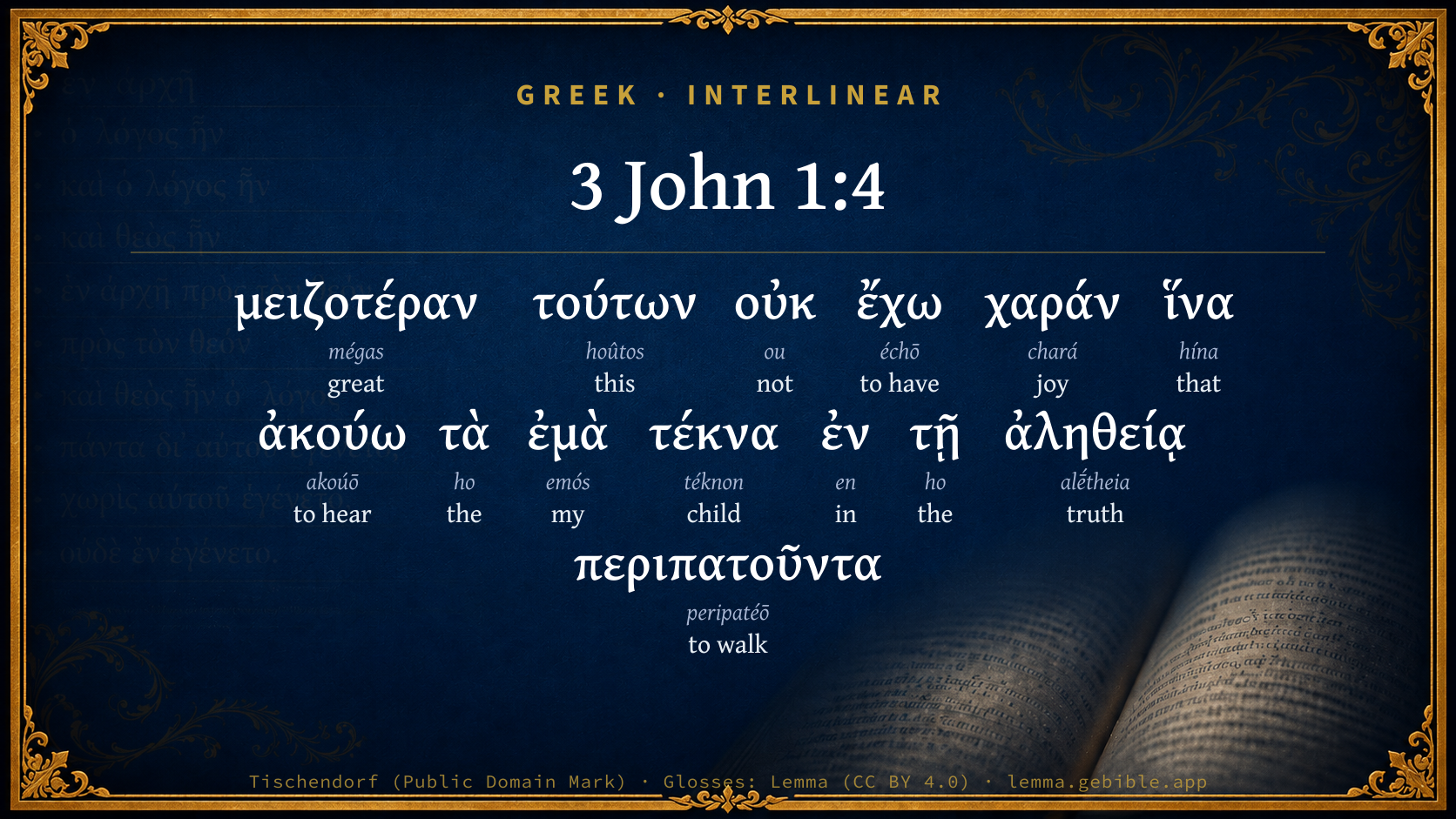
Greek (Tischendorf 8th ed.) 3 John 1:4 appears in the Greek New Testament. The text above is from the Tischendorf 8th edition. Each word links to its Strong’s number and a concise gloss. Click any word for its full Thayer’s Greek Lexicon entry.
Download image
Cite this verse

3 John 1:4 (World English Bible). Public Domain. Lemma interlinear Bible study tool, https://lemma.gebible.app/v/3-john/1/4.

Show BibTeX & RIS
BibTeX
RIS
English Translation
I have no greater joy than this, to hear about my children walking in truth.
World English Bible · Public Domain
Download a study sheet

One document with this verse’s original text, its word-by-word gloss line, the meaning frame, cross-references with their text, attributed commentary, and full source and license credits — printable, and it pastes into notes with its structure intact.

This verse Autodidact and up

Study sheet (.html) Plain text (.txt)

A passage Seminary Student

Up to 50 verses in one chapter. A passage sheet keeps up to 6 commentary sources and 12 cross-references per verse, in the order this page ranks them, and says so on the sheet whenever that leaves anything out. Ask for a single verse and you get the Autodidact verse sheet above.

Everything on this page stays free to read, with no account — the sheet is a download of what is already on screen, not access to it.

Want to remove ads? Support Godless Engineer
Compare translations 3

The same verse in 3 English versions, stacked beneath the original-language interlinear above. Click any original word for its lexicon entry.

Each is an independent rendering of the whole verse — the interlinear is not word-aligned to these translations.

Highlighted words mark where these versions differ — a whole-verse word diff, not a word-by-word alignment.

  • World English Bible Public Domain
    I have no greater joy than this, to hear about my children walking in truth.
  • King James Version Public Domain
    I have no greater joy than to hear that my children walk in truth.
  • unfoldingWord Literal Text CC BY-SA 4.0
    I have no greater joy than these things, that I hear my children are walking in the truth.

unfoldingWord Literal Text — © unfoldingWord, licensed CC BY-SA 4.0. Word-aligned USFM3 via Door43 (git.door43.org/unfoldingWord/en_ult).

Versions to compare (up to 4)

3 of 4 selected

Show all 19 translations

Every available English version of this verse, each an independent rendering of the whole verse.

  • World English Bible Public Domain
    I have no greater joy than this, to hear about my children walking in truth.
  • Berean Standard Bible Public Domain
    I have no greater joy than to hear that my children are walking in the truth.
  • Majority Standard Bible Public Domain
    I have no greater joy than to hear that my children are walking in truth.
  • King James Version Public Domain
    I have no greater joy than to hear that my children walk in truth.
  • American Standard Version (1901) Public Domain
    Greater joy have I none than this, to hear of my children walking in the truth.
  • Revised Version (1885) Public Domain
    Greater joy have I none than this, to hear of my children walking in the truth.
  • Geneva Bible (1599) Public Domain
    I haue no greater ioy then these, that is, to heare that my sonnes walke in veritie.
  • Douay-Rheims (1899) Public Domain
    I have no greater grace than this, to hear that my children walk in truth.
  • Young's Literal Translation Public Domain
    greater than these things I have no joy, that I may hear of my children in truth walking.
  • Literal Standard Version CC BY-SA 4.0
    I have no joy greater than these things, that I may hear of my children walking in truth.
  • Unlocked Literal Bible CC BY-SA 4.0
    I have no greater joy than this, to hear that my children walk in the truth.
  • unfoldingWord Literal Text CC BY-SA 4.0
    I have no greater joy than these things, that I hear my children are walking in the truth.
  • Darby Bible Public Domain
    I have no greater joy than these things that I hear of my children walking in the truth.
  • World Messianic Bible Public Domain
    I have no greater joy than this: to hear about my children walking in truth.
  • Webster's Bible Public Domain
    I have no greater joy than to hear that my children walk in truth.
  • Free Bible Version CC BY-SA 4.0
    Nothing makes me happier than to hear how my dear friends are following the truth.
  • Bible in Basic English Public Domain
    I have no greater joy than to have news that my children are walking in the true way.
  • Text-Critical English NT CC BY 4.0
    I have no greater joy than to hear that my children are walking in the truth.
  • Tyndale New Testament (1534) Public Domain
    I have no greater ioye then for to heare howe that my sonnes walke in veritie.

Literal Standard Version (2020), Covenant Press — licensed CC BY-SA 4.0. Text via the HelloAO Bible API (eBible.org). Unlocked Literal Bible (unfoldingWord) — licensed CC BY-SA 4.0. Text via the HelloAO Bible API (eBible.org). unfoldingWord Literal Text — © unfoldingWord, licensed CC BY-SA 4.0. Word-aligned USFM3 via Door43 (git.door43.org/unfoldingWord/en_ult). Free Bible Version, Dr. Jonathan Gallagher — licensed CC BY-SA 4.0. Text via the HelloAO Bible API (eBible.org).

Word by word

More ways to search: Search by grammar → Find every occurrence → Compare this word →

Practice this passage: Drill this verse → Learn its vocabulary →

χαράν
chará
G5479
“joy”
Noun, Accusative, Singular, Feminine
Part of Speech
Noun
Case
Accusative
Number
Singular
Gender
Feminine
Full Thayer's Definition

Origin: from G5463

TDNT: 14:59,1

1. joy, gladness a. the joy received from you b. the cause or occasion of joy 1. of persons who are one's joy
  1. μειζοτέραν mégas G3173 “great” Adjective, Accusative, Singular, Feminine, Comparative
  2. τούτων hoûtos G3778 “this” Demonstrative pronoun, Genitive, Plural, Neuter
  3. οὐκ ou G3756 “not” Particle, Negative
  4. ἔχω échō G2192 “to have” Verb, Present, Active, Indicative, 1st person, Singular
  5. ἵνα hína G2443 “that” Conjunction
  6. ἀκούω akoúō G191 “to hear” Verb, Present, Active, Subjunctive, 1st person, Singular
  7. τὰ ho G3588 “the” Article, Accusative, Plural, Neuter
  8. ἐμὰ emós G1699 “my” Possessive pronoun, 1st person, Accusative, Plural, Neuter
  9. τέκνα téknon G5043 “child” Noun, Accusative, Plural, Neuter
  10. ἐν en G1722 “in” Preposition
  11. τῇ ho G3588 “the” Article, Dative, Singular, Feminine
  12. ἀληθείᾳ alḗtheia G225 “truth” Noun, Dative, Singular, Feminine
  13. περιπατοῦντα peripatéō G4043 “to walk” Verb, Present, Active, Participle, Accusative, Plural, Neuter

About this verse

These counts appear in no published source. They are computed here, from the morphology-tagged text and Lemma’s own curated glosses. What Lemma adds →

14
words
13
distinct lemmas
General Epistles
section

Shared distinctive vocabulary

χαράν joy G5479 occurs in 57 verses of the Greek New Testament. Also found in:

Repetition

A word recurs within this verse:

Cross-references

14

Topical passages linked to 3 John 1:4 in the Treasury of Scripture Knowledge — connected by theme and wording, ordered by reader-vote popularity; previews shown in the World English Bible.

  • Galatians 4:19 My little children, of whom I am again in travail until Christ is formed in you--
  • Proverbs 23:24 The father of the righteous has great joy. Whoever fathers a wise child delights in him.
  • 1 Timothy 1:2 to Timothy, my true child in faith: Grace, mercy, and peace, from God our Father and Christ Jesus our Lord.
  • 2 Timothy 1:2 to Timothy, my beloved child: Grace, mercy, and peace, from God the Father and Christ Jesus our Lord.
  • 2 Kings 20:3 Remember now, Yahweh, I beg you, how I have walked before you in truth and with a perfect heart, and have done that which is good in your sight. Hezekiah wept sore.
  • 1 Kings 2:4 That Yahweh may establish his word which he spoke concerning me, saying, If your children take heed to their way, to walk before me in truth with all their heart and with all their soul, there shall not fail you (said he) a man on the throne of Israel.
  • Galatians 2:14 But when I saw that they didn't walk uprightly according to the truth of the Gospel, I said to Peter before them all, "If you, being a Jew, live as the Gentiles do, and not as the Jews do, why do you compel the Gentiles to live as the Jews do?
  • 1 Kings 3:6 Solomon said, You have shown to your servant David my father great loving kindness, according as he walked before you in truth, and in righteousness, and in uprightness of heart with you; and you have kept for him this great loving kindness, that you have given him a son to sit on his throne, as it is this day.
  • John 12:35–36 Jesus therefore said to them, "Yet a little while the light is with you. Walk while you have the light, that darkness doesn't overtake you. He who walks in the darkness doesn't know where he is going.
  • Philemon 1:10 I beg you for my child, whom I have become the father of in my chains, Onesimus,
  • Psalms 26:1–3 Judge me, Yahweh, for I have walked in my integrity. I have trusted also in Yahweh without wavering.
  • Isaiah 8:18 Behold, I and the children whom Yahweh has given me are for signs and for wonders in Israel from Yahweh of Hosts, who dwells in Mount Zion.
  • 1 Corinthians 4:14–15 I don't write these things to shame you, but to admonish you as my beloved children.
  • Isaiah 38:3 and said, Remember now, Yahweh, I beg you, how I have walked before you in truth and with a perfect heart, and have done that which is good in your sight. Hezekiah wept sore.

Cross-references courtesy of OpenBible.info (CC BY 4.0).

Where the printed editions differ

1 variant

Places in this verse where the major printed Greek editions disagree on the wording in a way that affects the translation — a comparison of editions, not a manuscript-by-manuscript collation. The editions are the modern critical texts (Nestlé-Aland 28/27, SBL, Westcott-Hort, Tregelles, Tyndale House) and the traditional texts behind the KJV (the Textus Receptus and the Byzantine/Majority text). It is not a claim about which reading is original.

  1. Different wording
    χαρὰν

    “joy”

    In NA28NA27TynSBLTregTRByz Not in WH

    χάριν (charin) 'grace' occurs in a few manuscripts (WH) instead of χαρὰν (charan) 'joy' in older manuscripts (NA28+NA27+Tyn+SBL+Treg+TR+Byz)

Textual data: Translators Amalgamated Greek New Testament (STEPBible TAGNT) · CC BY 4.0.

Commentary

Notes on 3 John 1:4 from classic Christian and Jewish commentators (each source and its license shown beneath its notes). The classic Christian expositions comment on the surrounding passage and are grouped to its opening verse, so a note may address several verses; the Jewish commentaries on the Tanakh (Rashi and others) are per-verse, so they appear only where the commentator wrote on this verse.

Lemma curates 59 commentaries, every one of them public domain or Creative Commons licensed, each selected and text-cleaned for this edition rather than reprinted as found. About our sources →

Trapp's Complete Commentary

John Trapp

4 I have no greater joy than to hear that my children walk in truth.

Ver. 4. I have no greater joy] {See Trapp on "2Jn 1:4"}

Walk in truth] Not walk to the alehouse, walk about with tales to shed blood, walk after the flesh, as too many of our hearers do, to our singular heartbreak.

John Trapp, A Commentary or Exposition upon All the Books of the Old and New Testament (1647–1656) — public domain. Text from a community e-Sword module.

The Biblical Illustrator

Joseph S. Exell

3Jn_1:4

I have no greater joy than to hear that my children walk in truth.

The Christian walking in the truth

This is little more than a repetition of a declaration made by the apostle in the foregoing epistle. He is addressing there a pious mother, and he congratulates her on the spiritual prosperity of some of her family. Here he is addressing a beloved friend, and he congratulates him on the prosperity of his soul in nearly the same words.

I. truth. What is truth? said Pilate to our Lord with a mixture of incredulity and scorn, as though truth were a thing nowhere to be discovered; and the same question has been asked by the wise men of the earth with the same feelings from Pilate downwards to our day. The real Christian knows where it is to be found, for he has found it. His God has not only made him feel its importance and enkindled in him a desire for it, he has shown him the thing itself, revealed, communicated His truth to him: so that the man has it; has it in his hand whenever he takes up his Bible; has it in his mind and heart, for he has read his Bible, and by Gods help has understood and believed it. That is the truth the apostle speaks of in this text. It is the revelation which God has made to us concerning spiritual and eternal things in His holy Word, and more particularly the gospel of the Lord Jesus Christ, which forms so main a part of that revelation.

II. Walking in it. The term walking in Scripture, when used as it is here, is always expressive, not of an act or two, but of a continued course of acting. To walk in the truth, then, means more than for a man once in his life to discover and embrace the truth; it implies besides this a daily familiarity with it, having it constantly before his mind, and his mind and his life being as constantly influenced and acted on by it.

1. That we hold fast Christs truth; having had our minds enlightened to discover and opened to receive it, that we retain it in our mind, and this in its pure, simple, unadulterated form.

2. A continued profession of Christs truth.

3. To live in the habitual practice of it.

III. This apostles joy when he hears of his fellow-Christians thus walking. He expresses this, you observe, in very strong terms. He does not say that he has no joy equal to this, but he does say that he has none above it: I have no greater joy than to hear that my children walk in truth. And this strong language plainly shows us two things.

1. The loftiness of his own character. This favoured, this honoured apostle, with all his remembrances of the past and all his glowing anticipations of the future, with heaven almost opening upon him, says he gets as much happiness from the holy walk of others as he does from any other source. We know where he learnt this. We see the Masters spirit shining forth again in the disciple. What was self to the blessed Jesus when the good of our lost souls was at stake?

2. The high importance of this holy walking in the truth. Such a man, we are sure, would never have rejoiced in a trifle.

(1) It is important, first to ourselves.

(a) It is the best test we can have of our belonging to Christ, of the sincerity and reality of our faith in Him.

(b) Our enjoyment of the gospel, our spiritual comfort and happiness, depends on it.

(c) Our sanctification or holiness depends altogether on the permanency of the place Christs truth has within us.

(2) Our continued walking in the truth is important also to our fellow-men. Every undecided, wavering professor of Christs gospel among us diffuses a bad influence around him--he does mischief in the world though he may not aim to do it; while every consistent follower of the truth does good in the world, though he may scarcely see it. (C. Bradley, M. A.)

The Christian ministers joy

I. To walk in truth implies--

1. Sincerity of principle, honesty of intention, in opposition to all dissimulation or guile.

2. Decided attachment to evangelical doctrine.

3. Habitual regard to personal holiness.

4. Progress in Christian excellency.

II. Why this walking in truth should occasion the joy of Christian ministers.

1. In your Christian walk we witness the reality of your personal religion.

2. Walking as Christians secures your personal happiness.

3. When you walk as Christians, we have evidence of ministerial fidelity--that the truth is spoken to you; that the way of truth is marked down and recommended.

4. In your walk as Christians, we observe the fruit of our efforts for your good.

5. When you walk as Christians, we behold the increase of the Redeemers cause in the world.

6. Walking as Christians, we see in you the partners of the felicity we hope for in a future world.

Conclusion--

1. If such as walk in truth are our joy, it is evident who are our grief--All they who walk not in truth; who walk in darkness; who walk disorderly; who walk in the flesh; who walk after their own ungodly lusts.

2. By your walking, not in truth, but in unrighteousness, the cause of God is dishonoured, his enemies triumph, his friends are painfully affected.

3. Let us all look well to ourselves, and take heed to our own spirit and conversation. (T. Kidd.)

Walk in truth

I. The subject matter of the apostolic ministry--it was truth; not only truth in the bare sense of the term, but truth in its highest sense, unmistakable truth, infallible truth, the truth without which we cannot be happy neither here nor hereafter. You may be without much knowledge in reference to geology, or astronomy, or botany, you may be without much knowledge of these things, and not suffer much; but in reference to this, if you have it not, you are a fool indeed, and if you have it, you are made wise unto salvation. It is necessary, for us while here, and for our well-being hereafter.

II. The manner of that ministry. I have no greater joy than to hear that my children walk in truth. I say that the apostles ministry was characterised by great earnestness and affection. There is no minister that will ever be useful without it.

III. The joy and satisfaction of the apostles ministry. The subject-matter of this joy of the apostles was to hear that his children walk in truth.

1. To walk in the truth is to maintain evangelical truth.

2. To walk in truth is constantly to keep and to enjoy the truth. It gives us solid peace, it is the peace of God, which passeth all understanding.

3. Once more, when spiritual children walk in truth they are consistent Christians. Walk is not the position of a lazy Christian. (H. Allen, M. A.)

The parents and pastors joy

I. First, then, one of the parents highest joys is his childrens walking in truth: he has no greater joy.

1. And here we must begin with the remark that it is a joy peculiar to Christian fathers and mothers. No parents can say from their hearts, We have no greater joy than to hear that our children walk in truth, unless they are themselves walking in truth. No wolf prays for its offspring to become a sheep.

2. Let us, then, remark next that the joy mentioned in the text is special in its object. I have no greater joy than this, to hear that my children walk in truth. There is the point, their practical religion, their actual exemplification of the power of the gospel upon their lives. This proves that the teaching was well received, that the feeling was not mere excitement, that the profession was not a falsehood or a mistake, but was done in truth.

3. It is a healthful joy, in which we may indulge to the full without the slightest fear, for it is superior in its character to all earthly joys. Now, when our children walk in truth and love to God, it makes us rejoice that another heart is consecrated to His service. We may well rejoice in the salvation and in the sanctification of our sons and daughters, because this is the way in which the kingdom of Christ is to be extended in the world.

4. I will tell you why this is peculiarly the great joy of some Christian parents--it is because they have made it a subject of importunate prayer. That which comes to us by the gate of prayer comes into the house with music and dancing.

5. This joy is quickening in its effect. All who have ever felt it know what an energy it puts into them. Have you some of your children converted while others remain unsaved? Then I charge you, let what the Lord has done for some encourage you concerning the rest.

6. Once more, this high joy of which we have spoken is very solemn in its surroundings, for it involves this alternative--What if my children should not walk in truth? Well, that means for us during this life many sorrows, nights of sleeplessness and days of anxiety.

II. You may view the text as specifying the pastors greatest reward. I have no greater joy than to hear that my children walk in truth. No minister ought to be at rest unless he sees that his ministry does bring forth fruit, and men and women are born unto God by the preaching of the Word. Those who are the preachers children are often known to him; they were to John, else he could not have spoken of them as my children, and could not have had joy in them as his children. From this I draw the inference that it is the duty of every one who receives spiritual benefit, and especially conversion, from any of Gods servants, to let them know it. Put on Christ publicly in baptism, according to His command: unite yourself with His Church, and commune with the people among whom you have been born unto God. It seems from our text that John was in the habit of hearing about his spiritual children: I have no greater joy than to hear--mark that--than to hear that my children walk in the truth. That implies that, if you make a profession of your faith, people will talk about you. John could not have heard if others had not spoken. (C. H. Spurgeon.)

A ministers chief joy

I. What is the great object of a ministers desire on behalf of his people.

1. He longs to behold in them a holy consistency, a high state of heavenly affections, and a careful attention to the duties of morality.

2. In them he expects to find a steadiness that bids defiance to temptation, and cannot be diverted from its purpose, either by the allurements of sense or the terrors of persecution.

3. As a parent wishes to see in his children a gradual advancement towards maturity both in their bodily and intellectual faculties, so does a minister long for his peoples progress towards perfection.

II. Whence it is that the attainment of that object fills him with such exalted joy.

1. Because it is by this only that the ends of their ministry are answered.

2. Because by this only can God be glorified.

3. Because without this they can have no hope of ever meeting their people in the realms of bliss. (Sketches of Sermons.)

The ministers greater joy

I. The highest spiritual relationship--my children.

1. Solicitude.

2. Endearment.

II. The greatest possible rejoicing.

1. It is the greater joy arising out of the greater subject. Mans salvation is Gods greater work.

2. It is the greater joy on account of the greater influence. The converts were exposed to sharp temptations, and subjected to fiery persecutions.

3. It is the greater joy on account of the greater prospect. (T. Davies, M. A.)

The Biblical Illustrator, edited by Joseph S. Exell (c. 1880s–1900s) — public domain. Text from a community e-Sword module.

Tyndale Open Study Notes

Tyndale Open Resources

1:4 As in 2 John (see 2 Jn 1:1-4), John’s emphasis is on knowing and following the truth in contrast to Diotrephes and his followers (3 Jn 1:9).

Tyndale Open Study Notes — © Tyndale Open Resources, licensed CC BY-SA 4.0. Text via the HelloAO Bible API.

Bengel's Gnomon

Johann Albrecht Bengel

3Jn 1:4. Τούτων) than these, joys.

Bengel's Gnomon of the New Testament — English translation (T&T Clark, Edinburgh, 1860) — public domain. Text from a community e-Sword module.

Meyer's Critical & Exegetical Commentary

Heinrich August Wilhelm Meyer

serves as confirmation of ἐχάρην λίαν

3Jn_1:4 serves as confirmation of ἐχάρην λίαν.

μειζότεραν] Grotius: est ad intendendam significationem comparativus e comparativo factus; similar formations occur in the classical language of poets and later writers; see Winer, p. 65; VII. p. 67; in the N. T. comp. Eph_3:8.

τούτων οὐκ ἔχω χαρὰν ἵνα κ.τ.λ.I have not a greater joy than this, that; τούτων is not used for ταύτης, but as an indefinite word is to be connected with the more definite ἵνα (Lücke); some commentators incorrectly supply ἤ before ἵνα. Joh_15:13 is to be compared with this passage; only that ταύτης is used there, but it does not refer, however, to something preceding, but finds its explanation in the following ἵνα.[17]

τὰ ἐμὰ τέκνα, not all Christians; but neither merely the converts of John, but the members of the Churches which were under the special fatherly direction of the apostle (so also Braune).

[17] In opposition to Meyer, who says on the passage cited: the usual view, according to which ἵνα is taken as the explanation of ταύτης, does not correspond to the idea of purpose which is contained in ἵνα, it may be observed that in the usus loquendi of the N. T. ἵνα has by no means retained the idea of purpose in its distinctness, and often serves, in reference to the demonstrative pronoun, to state the meaning of the latter.

Meyer — Critical and Exegetical Commentary on the New Testament — English translation by Peter Christie, edited by Frederick Crombie (T&T Clark, 1880) — public domain. Text from a community e-Sword module.

Expositor's Greek Testament

ed. W. Robertson Nicoll

3Jn 1:4 . Cf. Senec. Ep. xxxiv.: “Si agricolam arbor ad fructum perducta delectat, si pastor ex fœtu gregis sui capit voluptatem, si alumnum suum nemo aliter intuetur quam adulescentiam illius suam judicet: quid evenire credis his qui ingenia educaverunt, et quæ tenera formaverunt adulta subito vident?” Ev. sec. Heb. (quoted by Jerome on Eph 5:4 ): “Et numquam, inquit (Dominus), læti sitis nisi cum fratrem vestrum videritis in caritate”. μειζοτέραν , a double compar.; cf. ἐλαχιστοτέρῳ (Eph 3:8 ); our “lesser”; Germ. mehrere . τούτων : this use of the plur. ( ταῦτα ) rather than the sing ( τοῦτο ) is common. See Moulton’s Winer , p. 201. ἵνα , epexegetic of τούτων . Cf. Luk 1:43 and 1Jn 3:11 . τέκνα implies that Ganius was a convert of St. John. Cf. marg. note.

The Expositor's Greek Testament, edited by W. Robertson Nicoll (1897–1910) — public domain. Text from a community e-Sword module.

Cambridge Greek Testament for Schools and Colleges

4. Before ἀληθείᾳ insert τῇ with [940] [941][942]1 against [943][944][945]. For χαράν ([946][947][948][949][950], Thebaic) [951], Vulgate, and Memphitic have χάριν, which is very likely right.

[940] 5th century. Brought by Cyril Lucar, Patriarch of Constantinople, from Alexandria, and afterwards presented by him to Charles I. in 1628. In the British Museum. All three Epistles.

[941] 4th century. Brought to Rome about 1460. It is entered in the earliest catalogue of the Vatican Library, 1475. All three Epistles.

[942] 5th century. A palimpsest: the original writing has been partially rubbed out and the works of Ephraem the Syrian have been written over it. In the National Library at Paris. Part of the First and Third Epistles; 1Jn 1:1 to 1Jn 4:2; 3Jn 1:3-14. Of the whole N.T. the only Books entirely missing are 2 John and 2 Thessalonians.

[943] 4th century. Discovered by Tischendorf in 1859 at the monastery of S. Catherine on Mount Sinai, and now at Petersburg. All three Epistles.

[944] 9th century. All three Epistles.

[945] 9th century. All three Epistles.

[946] 4th century. Discovered by Tischendorf in 1859 at the monastery of S. Catherine on Mount Sinai, and now at Petersburg. All three Epistles.

[947] 5th century. Brought by Cyril Lucar, Patriarch of Constantinople, from Alexandria, and afterwards presented by him to Charles I. in 1628. In the British Museum. All three Epistles.

[948] 5th century. A palimpsest: the original writing has been partially rubbed out and the works of Ephraem the Syrian have been written over it. In the National Library at Paris. Part of the First and Third Epistles; 1Jn 1:1 to 1Jn 4:2; 3Jn 1:3-14. Of the whole N.T. the only Books entirely missing are 2 John and 2 Thessalonians.

[949] 9th century. All three Epistles.

[950] 9th century. All three Epistles.

[951] 4th century. Brought to Rome about 1460. It is entered in the earliest catalogue of the Vatican Library, 1475. All three Epistles.

4. μειζοτέραν τ. οὐκ ἔχω χαράν. The order is worth keeping, all the more so on account of the similar arrangement in Joh 15:13; μείζονα ταύτης ἀγάπην οὐδεὶς ἔχει, ἵνα τις τ. ψυχὴν αὐτοῦ θῇ. Greater joy have I none than this. The Vulgate is barbarously exact: majorem horum non habeo gratiam. Comp. majora horum for μείζω τούτων (Joh 1:50). ‘Gratiam’ implies the reading χάριν ([1032] and Memphitic), which Westcott and Hort adopt. The double comparative μειζοτέραν is analogous to ‘lesser’ in English. In Eph 3:8 we have ἐλαχιστότερος. Such forms belong to the later stages of a language, when common forms have lost strength. Comp. καλλιώτερος, καλλιστότατος, minimissimus, pessimissimus. Winer, 81. The plural pronoun τούτων (corrected in some copies to ταύτης) may either mean ‘these joys,’ or ‘these things,’ viz. the frequent reports of the brethren: comp. μείζω τούτων ὄψει (Joh 1:50). Winer, 201.

[1032] 4th century. Brought to Rome about 1460. It is entered in the earliest catalogue of the Vatican Library, 1475. All three Epistles.

ἵνα ἀκούω. There is no need either here or in Joh 15:13 to suppose an ellipse of ἤ after the comparative. In both cases the ἵνα clause is epexegetic of the preceding genitive pronoun; and ἵνα ἀκούω = τοῦ ἀκούειν in apposition with τούτων. Winer, 745, 425.

τὰ ἐμὰ τέκνα. My own children. The emphatic ἐμά (contrast 1Jn 2:1; 2Jn 1:4) perhaps indicates those who not only were under his Apostolic care, but had been converted by him to the faith.

περιπατοῦντα. See on 2Jn 1:4. For the participial construction comp. ὅσα ἠκούσαμεν γενόμενα εἰς τὴν Καφ. (Luk 4:23): ἀκούσας δὲ Ἰακὼβ ὄντα σιτία εἰς Αἴγυπτον (Act 7:12): and especially ἀκούομεν γάρ τινας περιπατοῦντας ἐν ὑμῖν (2Th 3:11). To hear of my own children walking in the truth.

Cambridge Greek Testament for Schools and Colleges (Cambridge University Press, 1896; 21 vols, various authors incl. Carr, Maclear, Plummer, Farrar, Lumby, Moule, M. R. James, Simcox) — public domain. Text from a community e-Sword module.

International Critical Commentary

4. μειζοτέραν] Cf. ἐλαχιστοτέρῳ, Eph 3:8; Deissmann, Bibel Studien, p. 142, who quotes Pap. Lond. 130, μεγιστότατος.

τούτων] explained by the clause introduced by ἵνα. The plural is used instead of the singular, as the writer is thinking of more than one occasion on which he had experienced the joy of which he speaks. If this explanation of the plural is correct there is no need to correct the text by supplying ἤ before ἵνα, as Wilamowitz suggests (Hermes, 1898, p. 531). In his interesting note on the Epistle he does not offer any explanation of τούτων. Cf. Joh 15:13, μείζονα ταύτης ἀγάπην οὐδεὶς ἔχει, ἵνα τις τὴν ψυχὴν αὐτοῦ θῇ. The ἤ is actually found in one Greek cursive.

χαράν] The variant χάριν is probably due to scribe, who substituted a commoner phrase. Cf. 2Co 1:15. For χαρά, cf. 1Jn 1:4; 2Jn 1:12; Phm 1:7.

τὰ ἐμὰ τέκνα] Those over whom he exercises his fatherly supervision, whether actually his “children in the faith” or not. The bearing of this phrase on the meaning of τέκνα in the Second Epistle should not be overlooked.

μειζοτεραν] μειζοτερονIb 78-157 (—): μειζονα137 | τουτων ουκ εχω] post χαρανH 257 (33) Ia 505. 192 (69) O 46 (154) | τουτων] ταυτης27. 29. 31. 40. 66**. 68. 69. 73 dscr al. fere. 10 sah. boh-ed. syrbodl Dam. | ουκ εχω] post χαρανC 31. 68 aeth. | ουκ] om. Ic 364 (137) | εχων B* | χαραν א A C K L P al. pler. cat. tol. arm. sah.] χαριν B 7. 35 vg. cop. | ινα] pr. η69 vg. (maiorem horum … quam ut) vid. sup. | ακουσωIa 216 δ355 (301) | τεκνα] σπλαγχναIc 114 (335).

International Critical Commentary — older volumes (1896–1929), various authors — public domain. Text from a community e-Sword module.

Geneva Bible (1599)

Geneva Bible translators

Than these joys.

Geneva Bible (1599) marginal notes — public domain. Text via Bolls.life.

Jamieson, Fausset & Brown

Robert Jamieson, A. R. Fausset & David Brown

my children--members of the Church: confirming the view that the "elect lady" is a Church.

Jamieson, Fausset & Brown — Commentary Critical and Explanatory on the Whole Bible (1871) — public domain (CC PDM 1.0). Text via the HelloAO Bible API.

Adam Clarke's Commentary

Verse 4. To hear that my children] From this it has been inferred that Caius was one of St. John's converts, and consequently not the Corinthian Caius, who was converted, most probably, by St. Paul. But the apostle might use the term children here as implying those who were immediately under his pastoral care, and, being an old man, he had a right to use such terms in addressing his juniors both in age and grace; and there is much both of propriety and dignity in the appellation coming from such a person.

Adam Clarke's Commentary on the Bible (1810–1826) — public domain. Text from a community e-Sword/MySword module.

The Cambridge Bible for Schools and Colleges

gen. ed. J. J. S. Perowne

4. I have no greater joy] In the Greek ‘greater’ is put first for emphasis, and this is worth preserving; Greater joy have I none than this. ‘Joy’ should perhaps rather be grace (χάριν) i.e. favour from God. The Greek for ‘greater’ is a double comparative (μειζοτέραν), like ‘lesser’ in English. In Eph_3:8 we have a comparative superlative. Such things belong to the later stage of a language, when ordinary forms are losing their strength. ‘Than this’ is literally ‘than these,’ where ‘these’ either means ‘these joys,’ or more likely ‘these things,’ viz. the frequent reports of the brethren. Comp. Joh_15:13.

to hear that my children walk in truth] Better, as R. V., to hear of my children walking in the truth. Similarly in Act_7:12; ‘When Jacob heard of corn being in Egypt.’ ‘My children’ means in particular members of the Churches in Asia which were under S. John’s Apostolic care.

The Cambridge Bible for Schools and Colleges (gen. ed. J. J. S. Perowne; Cambridge University Press, 1878–1918) — public domain. Text from a community e-Sword module.

John Gill's Exposition

I have no greater joy,.... Nothing that causes greater joy. The Vulgate Latin version reads "grace" or "thanks"; and then the sense is, that he had nothing to be more thankful for:

than to hear that my children walk in truth; meaning his spiritual children, those whose conversion he had been the instrument of; and among these it seems Gaius was one.

John Gill's Exposition of the Whole Bible (1746–1763) — public domain (CC PDM 1.0). Text via the HelloAO Bible API.

Albert Barnes' Notes on the Bible

I have no greater joy than to hear that my children walk in truth - That they adhere steadfastly to the truth, and that they live in accordance with it. This is such language as would be used by an aged apostle when speaking of those who had been converted by his instrumentality, and who looked up to him as a father; and we may, therefore, infer that Gaius had been converted under the ministry of John, and that he was probably a much younger man than he was. John, the aged apostle, says that he had no higher happiness than to learn, respecting those who regarded him as their spiritual father, that they were steadfast in their adherence to the doctrines of religion. The same thing may be:

(a) of all the ministers of the gospel, that their highest comfort is found in the fact that those to whom they minister, whether still under their care or removed from them, persevere in a steadfast attachment to the true doctrines of religion, and live accordingly; and,

(b) of all Christian parents respecting their own children. the highest joy that a Christian parent can have is to know that his children, whether at home or abroad, adhere to the truths of religion, and live in accordance with the requirements of the gospel of Christ.

If a child wished to confer the highest possible happiness upon his parents when with them, it would be by becoming a decided Christian; if, when abroad, in foreign lands or his own, he wished to convey intelligence to them that would most thrill their hearts with joy, it would be to announce to them that he had given his heart to God. There is no joy in a family like that when children are converted; there is no news that comes from abroad that diffuses so much happiness through the domestic circle as the intelligence that a child is truly converted to the Saviour. There is nothing that would give more peace to the dying pillow of the Christian parent, than to be able to leave the world with the assurance that his children would always walk in truth.

Albert Barnes' Notes on the Bible (1834–1885) — public domain. Text from a community e-Sword/MySword module.

Haydock's Catholic Bible Commentary

No greater grace. That is, nothing that gives me greater joy and satisfaction. (Challoner)

George Leo Haydock (1774–1849), Haydock's Catholic Family Bible and Commentary, 1859 edition — public domain. Excludes Psalms (Douay-Rheims chapter numbering differs from Protestant) and Deuterocanonical books (Catholic canon only).

Whedon's Commentary on the Bible

Daniel D. Whedon

4. My children—This would seem to imply that John numbered Gaius among his own converts, and was rejoiced unspeakably at his constancy and zeal.

Daniel D. Whedon (gen. ed.), Commentary on the Old and New Testaments (1874–1909) — public domain. Text from a community e-Sword module.

John Wesley's Explanatory Notes

I have no greater joy than this - Such is the spirit of every true Christian pastor. To hear that my children walk in the truth - Caius probably was converted by St. Paul. Therefore when St. John speaks of him. with other believers, as his children, it may be considered as the tender style of paternal love, whoever were the instruments of their conversion. And his using this appellation, when writing under the character of the elder, has its peculiar beauty.

John Wesley, Explanatory Notes Upon the Whole Bible (1754–1765) — public domain. Text via the GEBible commentary corpus.

The People's New Testament

B. W. Johnson

4. I have no greater joy. That which gave him the greatest joy was to know that the saints walked in the truth. My children. The aged John was wont to call the saints his children. See 1 John 2:1, 12, 18, 28; 4:4; 5:21.

B. W. Johnson's The People's New Testament with Notes (1889–1891) — public domain. Electronic text from the Christian Classics Ethereal Library (CCEL) ThML edition.

Alford’s Greek Testament

Henry Alford

4.] Explains ἐχάρην λίαν above. I have no greater (the form μειζότερος is condemned by some (Phryn. Lob. p. 136, Œc. h. l.) as barbarous. But these comparatives of comparatives and superlatives are found both in classical and in N. T. Greek: see Eph 3:8, and note) joy than this (lit. “than these things:” following the usage by which ταῦτα is so often put where one thing only is intended: cf. the formula, καὶ ταῦτα, “idque:” so Plato, Phæd. p. 62, d, ἀλλʼ ὁ ἀνόητος ἄνθρωπος τάχʼ ἂν οἰηθείη ταῦτα, φευκτέον εἶναι ἀπὸ τοῦ δεσπότου. See Kühner, Gr. ii. p. 48), that (explicative, as constantly in St. John after the demonstrative pronoun) I hear of my children walking in the truth (on the participial construction, see note on 2Jn 1:7. The expression τέκνα here seems rather to favour the idea that the κυρία of the 2nd Epistle is a Church: but see prolegg. to 2 John).

Henry Alford, The Greek Testament (1849–1861) — public domain. Text from a community e-Sword module.

Vincent's Word Studies in the New Testament

Marvin R. Vincent

Joy [χαραν] . The texts vary; some reading carin grace or favor from God, on which see 2 John 3. Note the Greek order : greater joy than this have I not.

My children [τα εμα τεκνα] . Lit., mine own children.

Walk [περιπατουντα] . Rev., rightly, walking. The participle expresses something habitual.

Marvin R. Vincent, Word Studies in the New Testament (1887–1900) — public domain. Text from a community e-Sword/MySword module.

Westcott on Hebrews & the Epistles of John

Brooke Foss Westcott

4. μειζοτέραν..«χάριν, ἵνα... majorem horum non habeo gratiam quam ut...V. 7 have no greater grace —favour from God—than these tidings, that I may hear... The plural τούτων ‘these things’ does not refer to what follows (‘that I may hear’) but to what precedes, the manifold

' testimonies which St John received of

the courageous resolution with which Gaius maintained the Truth in the face of difficulties. The end assured by such tidings was the open acknowledgment of the fidelity of disciples (‘that so I may hear’). Even if St John had himself no doubt of the fact, it would be a joy to know that it was also observed by others. For the construction see John xv. 13 note.

For the form μειζότερος compare ἐλαχιστότερος Eph. iii. 8.

ἔχω χάριν] The use of χάρις is re(xapa) of the common text itself a divine gift. The word is very rare in St John (2 John 3 note). Here it expresses the divine favour in a concrete form. So it is used of the gracious gift of men: 1 Cor. xvi. 3. ‘To have grace’ (or ‘a grace’) here corresponds with ‘giving’ (Rom. xii. 6, ὅσ.) and ‘receiving’ grace (Rom. i. 5). Ἔχειν χάριν is used elsewhere in different constructions and . senses:

τὰ ἐμὰ τι] mine own children

5᾽Δλ , \ YANNTE, πιστον

(Philem. 10), not simply ra τέκνα pov. Those Christians to whom the apostle had been the human author of spi-, ritual life: 1 Cor. iv. 14, 17; 1 Tim. i. 2, &c.; 2 John 1, 13. Texvia, the title of affection, would be used of all to whom he at present stood in the position of father: 1 John ii. 1, note.

ἐν τῇ aA. περιπ.Ὦ) The phrase is not found elsewhere in N. T. Comp. ἐν τῷ ἀγάπῃ) +. 2 John 6. For the image see I John i. 6, note.

3. The duty of generosity to the brethren (5---8).

Gaius appears to have incurred the displeasure of some in his Church by entertaining strange brethren. St John emphatically approves what he had done, and enforces such hospitality as a Christian duty.

In this brief notice we have a vivid sketch of the work and of the difficulties of the first ‘Evangelists’: Eph. iv. 11. Compare Doctr. of App. 11 ff.

5Beloced, thou makest sure whatsoever thou doest unto the brethren and strangers withal, °who bore witness to thy love before the church; whom thou wilt do well to help forward on their journey worthily of God; vfor they went out for the Name's sake, taking nothing from the Gentiles. 8 We therefore ought to welcome such that we may be fellow workers with the truth.

Brooke Foss Westcott (1825–1901), The Epistle to the Hebrews (1889) and The Epistles of St John (1883) — public domain (pre-1929). Text recovered from Internet Archive / Google Books OCR scans. Westcott’s Gospel of John commentary is not included (its OCR lost the chapter running-heads required for reliable verse-keying). Some Greek quoted in the Hebrews volume is imperfectly rendered by the OCR.

Lesson kit

Teaching starters — assembled from the data on this page, not authored interpretation. Every prompt links to the verse data it draws on. Edit before teaching.

3 John, in the General Epistles, opens this verse with 14 words (13 distinct Greek lemmas). Its most distinctive word is chará (“joy”). A historical commentator’s framing appears above. Read the whole chapter for the surrounding context.

Discussion questions

  1. What does “joy” (chará) contribute to the verse as a whole?
  2. How does Matthew 2:10, which shares the word «joy», read alongside this verse?
  3. What does the repetition of “the” (2× in this one verse) do in this verse?
  4. The translations on this page render this verse differently — a whole-verse word diff, not a word-by-word alignment. What might account for the different wordings?
  5. Compare how Trapp's Complete Commentary and The Biblical Illustrator read this verse. Where do they agree or differ?

Things to notice

Reading settings

Reading text

Shown beneath each verse's original-language words.

Old Testament
Old Testament edition

Read the OT as the Masoretic Hebrew (MT) or the Greek Septuagint (LXX).

English shown for the Greek Septuagint (in the Hebrew ↔ Greek comparison).

Comparing translations? Open the Compare panel on any verse page to stack up to four side by side.