
2 Timothy 4:17

Greek (Tischendorf 8th ed.) 2 Timothy 4:17 appears in the Greek New Testament. The text above is from the Tischendorf 8th edition. Each word links to its Strong’s number and a concise gloss. Click any word for its full Thayer’s Greek Lexicon entry.
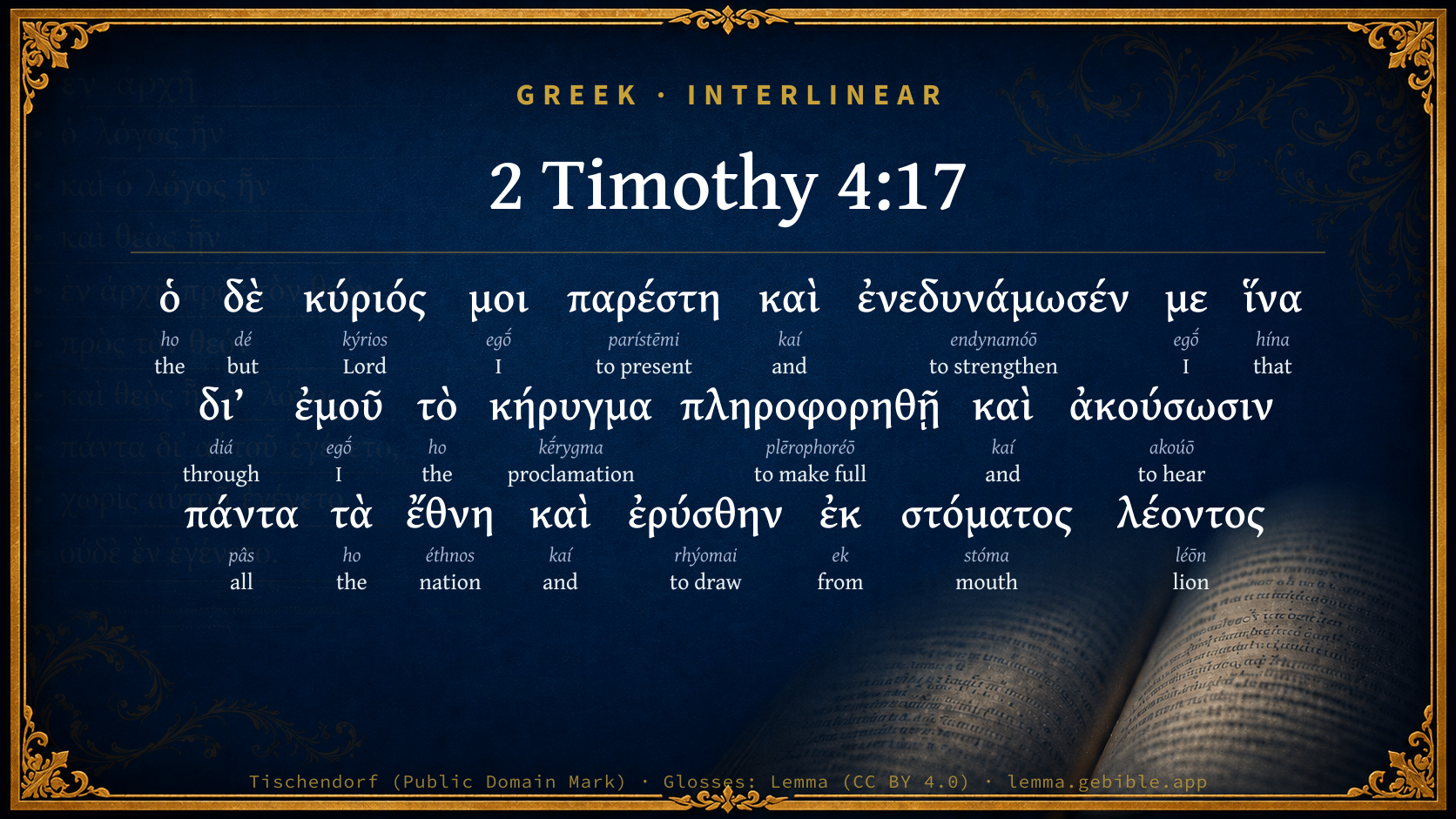
Download image
Cite this verse

2 Timothy 4:17 (World English Bible). Public Domain. Lemma interlinear Bible study tool, https://lemma.gebible.app/v/2-timothy/4/17.

Show BibTeX & RIS
BibTeX
RIS
English Translation
But the Lord stood by me, and strengthened me, that through me the message might be fully proclaimed, and that all the Gentiles might hear; and I was delivered out of the mouth of the lion.
World English Bible · Public Domain
Highlights
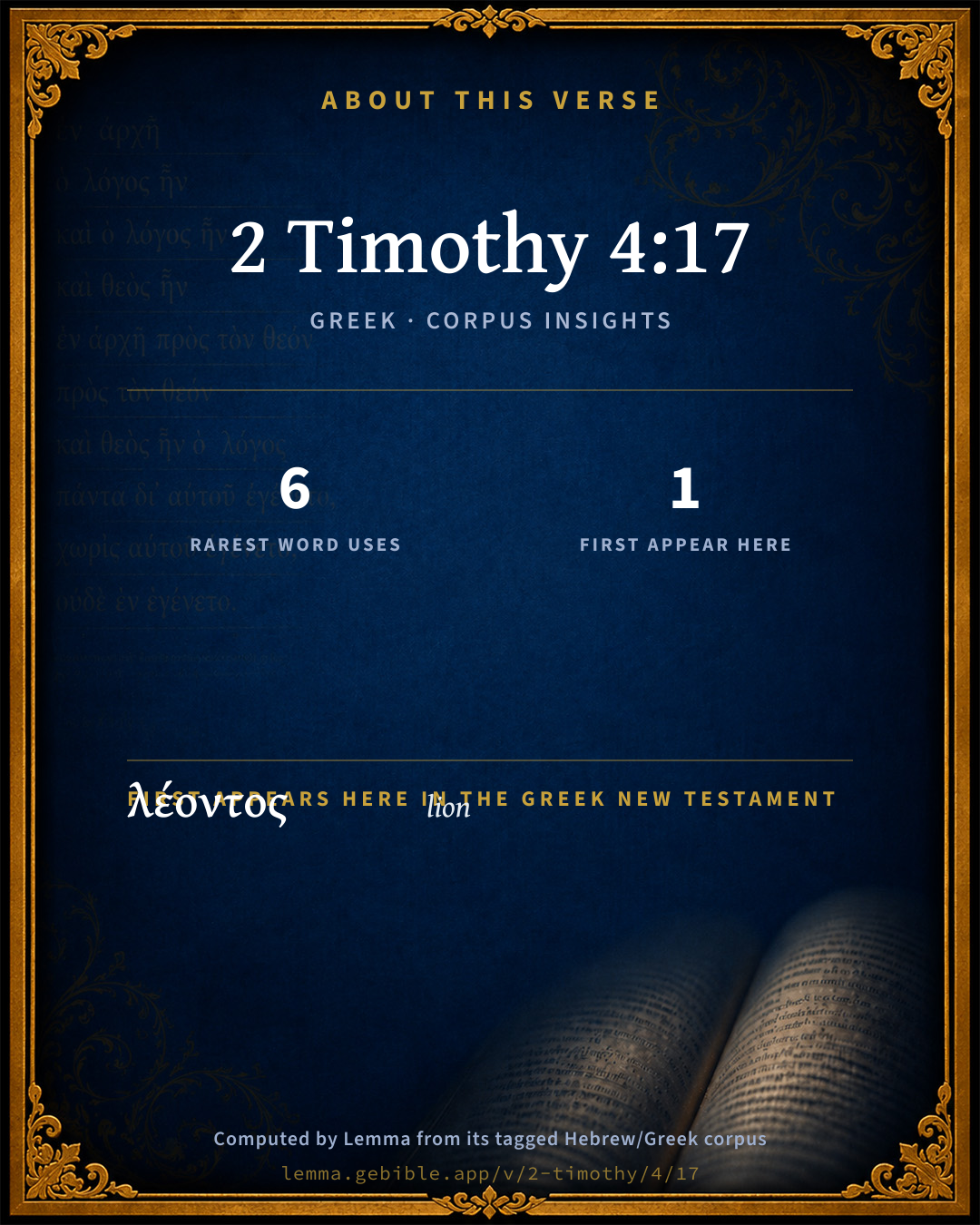
  • 1 first appearance in the Greek New Testament
Full analysis ↓
Download a study sheet

One document with this verse’s original text, its word-by-word gloss line, the meaning frame, cross-references with their text, attributed commentary, and full source and license credits — printable, and it pastes into notes with its structure intact.

This verse Autodidact and up

Study sheet (.html) Plain text (.txt)

A passage Seminary Student

Up to 50 verses in one chapter. A passage sheet keeps up to 6 commentary sources and 12 cross-references per verse, in the order this page ranks them, and says so on the sheet whenever that leaves anything out. Ask for a single verse and you get the Autodidact verse sheet above.

Everything on this page stays free to read, with no account — the sheet is a download of what is already on screen, not access to it.

Want to remove ads? Support Godless Engineer
Compare translations 3

The same verse in 3 English versions, stacked beneath the original-language interlinear above. Click any original word for its lexicon entry.

Each is an independent rendering of the whole verse — the interlinear is not word-aligned to these translations.

Highlighted words mark where these versions differ — a whole-verse word diff, not a word-by-word alignment.

  • World English Bible Public Domain
    But the Lord stood by me, and strengthened me, that through me the message might be fully proclaimed, and that all the Gentiles might hear; and I was delivered out of the mouth of the lion.
  • King James Version Public Domain
    Notwithstanding the Lord stood with me, and strengthened me; that by me the preaching might be fully known, and that all the Gentiles might hear: and I was delivered out of the mouth of the lion.
  • unfoldingWord Literal Text CC BY-SA 4.0
    But the Lord stood with me and strengthened me, so that through me the proclamation might be fulfilled and all the Gentiles might hear. And I was rescued out of the mouth of the lion.

unfoldingWord Literal Text — © unfoldingWord, licensed CC BY-SA 4.0. Word-aligned USFM3 via Door43 (git.door43.org/unfoldingWord/en_ult).

Versions to compare (up to 4)

3 of 4 selected

Show all 19 translations

Every available English version of this verse, each an independent rendering of the whole verse.

  • World English Bible Public Domain
    But the Lord stood by me, and strengthened me, that through me the message might be fully proclaimed, and that all the Gentiles might hear; and I was delivered out of the mouth of the lion.
  • Berean Standard Bible Public Domain
    But the Lord stood by me and strengthened me, so that through me the message would be fully proclaimed, and all the Gentiles would hear it. So I was delivered from the mouth of the lion.
  • Majority Standard Bible Public Domain
    But the Lord stood by me and strengthened me, so that through me the message would be fully proclaimed, and all the Gentiles would hear it. So I was delivered from the mouth of the lion.
  • King James Version Public Domain
    Notwithstanding the Lord stood with me, and strengthened me; that by me the preaching might be fully known, and that all the Gentiles might hear: and I was delivered out of the mouth of the lion.
  • American Standard Version (1901) Public Domain
    But the Lord stood by me, and strengthened me; that through me the message might me fully proclaimed, and that all the Gentiles might hear: and I was delivered out of the mouth of the lion.
  • Revised Version (1885) Public Domain
    But the Lord stood by me, and strengthened me; that through me the message might be fully proclaimed, and that all the Gentiles might hear: and I was delivered out of the mouth of the lion.
  • Geneva Bible (1599) Public Domain
    Notwithstanding the Lord assisted me, and strengthened me, that by me the preaching might be fully beleeued, and that al the Gentiles should heare: and I was deliuered out of the mouth of the lion.
  • Douay-Rheims (1899) Public Domain
    But the Lord stood by me, and strengthened me, that by me the preaching may be accomplished, and that all the Gentiles may hear: and I was delivered out of the mouth of the lion.
  • Young's Literal Translation Public Domain
    and the Lord stood by me, and did strengthen me, that through me the preaching might be fully assured, and all the nations might hear, and I was freed out of the mouth of a lion,
  • Literal Standard Version CC BY-SA 4.0
    but the LORD stood by me, and strengthened me, that the preaching might be fully assured through me, and all the nations might hear, and I was freed out of the mouth of a lion,
  • Unlocked Literal Bible CC BY-SA 4.0
    But the Lord stood by me and strengthened me so that, through me, the message might be fully proclaimed, and that all the Gentiles might hear it; and that I was rescued out of the lion's mouth.
  • unfoldingWord Literal Text CC BY-SA 4.0
    But the Lord stood with me and strengthened me, so that through me the proclamation might be fulfilled and all the Gentiles might hear. And I was rescued out of the mouth of the lion.
  • Darby Bible Public Domain
    But the Lord stood with [me], and gave me power, that through me the proclamation might be fully made, and all [those of] the nations should hear; and I was delivered out of the lion's mouth.
  • World Messianic Bible Public Domain
    But the Lord stood by me and strengthened me, that through me the message might be fully proclaimed, and that all the Gentiles might hear. So I was delivered out of the mouth of the lion.
  • Webster's Bible Public Domain
    Notwithstanding, the Lord stood with me, and strengthened me; that by me the preaching might be fully known, and that all the Gentiles might hear: and I was delivered out of the mouth of the lion.
  • Free Bible Version CC BY-SA 4.0
    But the Lord stood by me and gave me strength so that I could declare the whole of the message so that all the foreigners could hear it. I was rescued out of the lion's mouth!
  • Bible in Basic English Public Domain
    But the Lord was by my side and gave me strength; so that through me the news might be given out in full measure, and all the Gentiles might give ear: and I was taken out of the mouth of the lion.
  • Text-Critical English NT CC BY 4.0
    But the Lord stood by me and strengthened me, so that through me the proclamation might be fully made and all the Gentiles might hear. And I was rescued from the lion's mouth.
  • Tyndale New Testament (1534) Public Domain
    not withstondinge the Lorde assisted me and stregthed me that by me the preachinge shuld be fulfilled to the vtmost and that all the gentyls shuld heare. And I was delivered out of the mouth of the lyon.

Literal Standard Version (2020), Covenant Press — licensed CC BY-SA 4.0. Text via the HelloAO Bible API (eBible.org). Unlocked Literal Bible (unfoldingWord) — licensed CC BY-SA 4.0. Text via the HelloAO Bible API (eBible.org). unfoldingWord Literal Text — © unfoldingWord, licensed CC BY-SA 4.0. Word-aligned USFM3 via Door43 (git.door43.org/unfoldingWord/en_ult). Free Bible Version, Dr. Jonathan Gallagher — licensed CC BY-SA 4.0. Text via the HelloAO Bible API (eBible.org).

Word by word

More ways to search: Search by grammar → Find every occurrence → Compare this word →

Practice this passage: Drill this verse → Learn its vocabulary →

πληροφορηθῇ
plērophoréō
G4135
“to make full”
Verb, Aorist, Passive, Subjunctive, 3rd person, Singular
Part of Speech
Verb
Tense
Aorist
Voice
Passive
Mood
Subjunctive
Person
3rd person
Number
Singular
Full Thayer's Definition

Origin: from G4134 and G5409

TDNT: 11:09,9

1. to bear or bring full, to make full a. to cause a thing to be shown to the full 1. to fulfil the ministry in every part b. to carry through to the end, accomplish 1. things that have been accomplished c. to fill one with any thought, conviction, or inclination 1. to make one certain, to persuade, convince one 2. to be persuaded, persuaded, fully convinced or assured 3. to render inclined or bent on
  1. ὁ ho G3588 “the” Article, Nominative, Singular, Masculine
  2. δὲ dé G1161 “but” Conjunction
  3. κύριός kýrios G2962 “Lord” Noun, Nominative, Singular, Masculine
  4. μοι egṓ G1473 “I” Personal pronoun, 1st person, Dative, Singular
  5. παρέστη parístēmi G3936 “to present” Verb, Aorist, Active, Indicative, 3rd person, Singular
  6. καὶ kaí G2532 “and” Conjunction
  7. ἐνεδυνάμωσέν endynamóō G1743 “to strengthen” Verb, Aorist, Active, Indicative, 3rd person, Singular
  8. με egṓ G1473 “I” Personal pronoun, 1st person, Accusative, Singular
  9. ἵνα hína G2443 “that” Conjunction
  10. δι’ diá G1223 “through” Preposition
  11. ἐμοῦ egṓ G1473 “I” Personal pronoun, 1st person, Genitive, Singular
  12. τὸ ho G3588 “the” Article, Nominative, Singular, Neuter
  13. κήρυγμα kḗrygma G2782 “proclamation” Noun, Nominative, Singular, Neuter
  14. καὶ kaí G2532 “and” Conjunction
  15. ἀκούσωσιν akoúō G191 “to hear” Verb, Aorist, Active, Subjunctive, 3rd person, Plural
  16. πάντα pâs G3956 “all” Adjective, Nominative, Plural, Neuter
  17. τὰ ho G3588 “the” Article, Nominative, Plural, Neuter
  18. ἔθνη éthnos G1484 “nation” Noun, Nominative, Plural, Neuter
  19. καὶ kaí G2532 “and” Conjunction
  20. ἐρύσθην rhýomai G4506 “to draw” Verb, Aorist, Passive, Indicative, 1st person, Singular
  21. ἐκ ek G1537 “from” Preposition
  22. στόματος stóma G4750 “mouth” Noun, Genitive, Singular, Neuter
  23. λέοντος léōn G3023 “lion” Noun, Genitive, Singular, Masculine

About this verse

These counts appear in no published source. They are computed here, from the morphology-tagged text and Lemma’s own curated glosses. What Lemma adds →

24
words
18
distinct lemmas
Pauline Epistles
section

Notable vocabulary

The rarest word here is πληροφορηθῇ to make full G4135 — appearing just 6 times in the whole Greek New Testament.

First appearance in Scripture

This word makes its first canonical appearance in the Greek New Testament here:

  • λέοντος lion G3023

Shared distinctive vocabulary

πληροφορηθῇ to make full G4135 occurs in 6 verses of the Greek New Testament. Also found in:
Repetition

Words recur within this verse:

Cross-references

29

Topical passages linked to 2 Timothy 4:17 in the Treasury of Scripture Knowledge — connected by theme and wording, ordered by reader-vote popularity; previews shown in the World English Bible.

  • 1 Peter 5:8 Be sober and self-controlled. Be watchful. Your adversary the devil, walks around like a roaring lion, seeking whom he may devour.
  • Philippians 1:12–14 Now I desire to have you know, brothers, that the things which happened to me have turned out rather to the progress of the Gospel;
  • Psalms 22:21 Save me from the lion's mouth; Yes, from the horns of the wild oxen you have answered me.
  • 1 Samuel 17:37 David said, Yahweh who delivered me out of the paw of the lion, and out of the paw of the bear, he will deliver me out of the hand of this Philistine. Saul said to David, Go, and Yahweh shall be with you.
  • Daniel 6:22 My God has sent his angel, and has shut the lions' mouths, and they have not hurt me; because as before him innocence was found in me; and also before you, O king, have I done no hurt.
  • Acts 9:15 But the Lord said to him, "Go your way, for he is my chosen vessel to bear my name before the nations and kings, and the children of Israel.
  • Acts 18:9–10 The Lord said to Paul in the night by a vision, "Don't be afraid, but speak and don't be silent;
  • Acts 23:11 The following night, the Lord stood by him, and said, "Cheer up, Paul, for as you have testified about me at Jerusalem, so you must testify also at Rome."
  • Psalms 109:31 For he will stand at the right hand of the needy, To save him from those who judge his soul.
  • Isaiah 41:10 Don't you be afraid, for I am with you; don't be dismayed, for I am your God; I will strengthen you; yes, I will help you; yes, I will uphold you with the right hand of my righteousness.
  • Jeremiah 20:10–11 For I have heard the defaming of many, terror on every side. Denounce, and we will denounce him, [say] all my familiar friends, those who watch for my fall; peradventure he will be persuaded, and we shall prevail against him, and we shall take our revenge on him.
  • Hebrews 11:33 who, through faith subdued kingdoms, worked out righteousness, obtained promises, stopped the mouths of lions,
  • Matthew 10:19 But when they deliver you up, don't be anxious how or what you will say, for it will be given you in that hour what you will say.
  • 2 Peter 2:9 the Lord knows how to deliver the godly out of temptation and to keep the unrighteous under punishment for the day of judgment;
  • Psalms 37:39–40 But the salvation of the righteous is from Yahweh. He is their stronghold in the time of trouble.
  • Isaiah 41:14 Don't be afraid, you worm Jacob, and you men of Israel; I will help you, says Yahweh, and your Redeemer is the Holy One of Israel.
  • Jeremiah 15:20–21 I will make you to this people a fortified brazen wall; and they shall fight against you, but they shall not prevail against you; for I am with you to save you and to deliver you, says Yahweh.
  • Daniel 6:27 He delivers and rescues, and he works signs and wonders in heaven and in earth, who has delivered Daniel from the power of the lions.
  • Acts 27:23–24 For there stood by me this night an angel, belonging to the God whose I am and whom I serve,
  • Romans 16:25–26
  • Proverbs 20:2 The terror of a king is like the roaring of a lion: He who provokes him to anger forfeits his own life.
  • Proverbs 28:15 As a roaring lion or a charging bear, So is a wicked ruler over helpless people.
  • Jeremiah 2:30 In vain have I struck your children; they received no correction: your own sword has devoured your prophets, like a destroying lion.
  • Luke 21:15 for I will give you a mouth and wisdom which all your adversaries will not be able to withstand or to contradict.
  • 2 Corinthians 12:9 He has said to me, "My grace is sufficient for you, for my power is made perfect in weakness." Most gladly therefore I will rather glory in my weaknesses, that the power of Christ may rest on me.
  • Ephesians 3:8 To me, the very least of all saints, was this grace given, to preach to the Gentiles the unsearchable riches of Christ,
  • 1 Timothy 1:12 And I thank him who enabled me, Christ Jesus our Lord, because he counted me faithful, appointing me to service;
  • 2 Timothy 3:11 persecutions, and sufferings: those things that happened to me at Antioch, Iconium, and Lystra. I endured those persecutions. Out of them all the Lord delivered me.
  • Acts 26:17–18 delivering you from the people, and from the Gentiles, to whom I send you,

Cross-references courtesy of OpenBible.info (CC BY 4.0).

Commentary

Notes on 2 Timothy 4:17 from classic Christian and Jewish commentators (each source and its license shown beneath its notes). The classic Christian expositions comment on the surrounding passage and are grouped to its opening verse, so a note may address several verses; the Jewish commentaries on the Tanakh (Rashi and others) are per-verse, so they appear only where the commentator wrote on this verse.

Lemma curates 59 commentaries, every one of them public domain or Creative Commons licensed, each selected and text-cleaned for this edition rather than reprinted as found. About our sources →

Joseph Benson's Commentary

2Ti 4:17-18. Notwithstanding — I was not left entirely destitute; for, though men forsook me, the Lord stood with me — According to his promise, Luk 21:15; and strengthened me — With that inward fortitude of mind which no human support could have inspired; that by me the preaching — The gospel which we preach; might be fully known — Πληροφορηθη, literally, might be carried with a full sail; that is, fully and boldly declared. That the apostle could thus courageously bear witness to the gospel when all his friends forsook him, and his enemies were so fiercely raging against him, was a glorious testimony to the honour of Christianity. And that all the Gentiles might hear — This implies that he made his defence in a manner which he was persuaded would be taken notice of and reported abroad, much to the honour of that sacred cause which was dearer to him than his life. And I was delivered out of the mouth of the lion — By the lion Nero is generally thought to be meant, or rather his prefect, Helius Cesarianus, to whom Nero committed the government of the city in his absence, with power to put whomsoever he pleased to death. But the expression may be understood proverbially, as denoting an escape from the greatest danger; in which sense it is used Psa 22:21. And the Lord — Whose power and faithfulness are always the same; shall deliver me from every evil work — From all sin, and especially from doing any thing inconsistent with the honour of the gospel, and the salvation of my own soul; which is of far greater consequence than delivering me from death. And preserve me to his heavenly kingdom — An infinitely better kingdom than that of Nero.

Joseph Benson's Commentary on the Old and New Testaments (1811–1818) — public domain. Text from a community e-Sword module.

Tyndale Open Study Notes

Tyndale Open Resources

4:17 so that I might preach the Good News: Paul had turned his defense in court into proclamation of the Good News—just as in his earlier experiences (Acts 22:1–24:27; 26:1-29; see also 2 Tim 2:9-10; Phil 1:12-14). • for all the Gentiles to hear: Paul sensed that he had completed his task (2 Tim 4:7-8). The Old Testament specifically anticipates the conversion of the nations (e.g., Ps 22:27-29). • from certain death (literally from the mouth of a lion): The lion is often a metaphor for enemies (see Pss 7:2; 35:17; cp. Dan 6; Heb 11:33). Here, it might refer to literal lions in the amphitheater, to the emperor, to the false teachers, or to Satan (1 Pet 5:8; cp. Ps 22:21).

Tyndale Open Study Notes — © Tyndale Open Resources, licensed CC BY-SA 4.0. Text via the HelloAO Bible API.

Bengel's Gnomon

Johann Albrecht Bengel

2Ti 4:17. Ὁ δὲ Κύριος, but the Lord) the more on this account.—παρέστη, stood by me) This is more than παραγίνεσθαι, to be present.—ἐνεδυνάμωσε, strengthened me) The opposite is, forsook.—ἵνα διʼ ἑμοῦ, that by me) One single occasion is often of the greatest moment.—πάντα τὰ ἔθνη all the Gentiles) of whom Rome was the capital.—ἐῤῥύσθην ἐκ στόματος λέοντος, I was delivered out of the mouth of the lion) Psa 22:22, σῶσόν με ἐκ στόματος λέοντος. We may suppose that Paul had seen a vision under the form of a lion. The lion signifies either Nero, or some one who threatened danger. It is at all events a figurative expression; for he would have said, from the mouth of the lions, if he intended beasts without a figure. I was delivered, he says, not He delivered me, because, that the Lord had done it, was not outwardly apparent.

Bengel's Gnomon of the New Testament — English translation (T&T Clark, Edinburgh, 1860) — public domain. Text from a community e-Sword module.

Expositor's Greek Testament

ed. W. Robertson Nicoll

2Ti 4:17 . παρέστη : The Lord was my “patronus,” cf. Rom 16:2 . But the word is used in a purely local sense of the felt presence of a Divine Being in reff. in Acts.

ἐνεδυνάμωσεν : See note on 1Ti 1:12 .

πληροφορηθῇ : impleatur (Vulg.). As long as there had been no public proclamation of the gospel by Paul himself in Rome, the function of κῆρυξ had not been completely fulfilled by him.

ἐρύσθην ἐκ στόματος λέοντος : This is most naturally understood as an echo of Psa 21 (22):22, σῶσόν με ἐκ στόματος λέοντος λέοντος . ῥῦσαι occurs in the verse preceding. And what follows in the LXX seems to point to the most satisfactory explanation of the apostle’s meaning, καὶ ἀπὸ κεράτων μονοκερώτων τὴν ταπείνωσίν μου . διηγήσομαι τὸ ὄνομα σον τοῖς ἀδελφοῖς μου , κ . τ . λ . If St. Paul had not been strengthened to complete his κήρυγμα , his failure would have been his ταπείνωσις . As it was, he was delivered from that calamity, and enabled to declare God’s name to the Gentiles. It is impossible, in view of ἤδη σπένδομαι (2Ti 4:6 ), to suppose that delivery from death is implied. πρώτῃ (2Ti 4:16 ) proves that the apostle was aware that a second trial was awaiting him, the issue of which he knew would be his execution. It is still more impossible to suppose that literal wild beasts are meant. Paul’s Roman citizenship secured him from that degradation. The Greek commentators take “the lion” to mean Nero, “from his ferocity” (Chrys.). Cf. Esth. 14:13, of Ahasuerus; Joseph. Antiq . xviii. 6, 10, of Tiberius. It is no objection to this exegesis that the article is omitted before λέοντος , since, as we have seen, there is none in the Psalm. But deliverance from that lion’s mouth would be equivalent to acquittal by the Roman government; and it is evident that St. Paul was well aware that his sentence had been only deferred.

The Expositor's Greek Testament, edited by W. Robertson Nicoll (1897–1910) — public domain. Text from a community e-Sword module.

Cambridge Greek Testament for Schools and Colleges

17. ἀκούσωσιν. The rec. text has ἀκούσῃ with KL.

17. ὁ δὲ κύριός μοι παρέστη, but, in contrast to man’s unfaithfulness, the Lord, sc. Christ, stood by me.

καὶ ἐνεδυνάμωσέν με, and strengthened me. See, for St Paul’s use of this verb, the note on 1Ti 1:12.

ἵνα διʼ ἐμοῦ τὸ κήρυγμα πληροφορηθῇ, in order that by me the preaching, sc. of the Gospel, might be fulfilled. For πληροφορέω see on 2Ti 4:5 above; its force here is not ‘be fully known,’ as the A.V. has it, but ‘be fully performed, completed, fulfilled.’ How this was true is explained by the next clause καὶ ἀκούσωσιν πάντα τὰ ἔθνη. The opportunity given to St Paul of pleading his cause in the official centre of Rome, the mistress of the nations, was in a sense the ‘fulfilling’ of the preaching of the Gospel. For ἀκούσωσιν (certainly the right reading) see the crit. note.

καὶ ἐρύσθην ἐκ στόματος λέοντος, and I was rescued out of the mouth of the lion. That is, a verdict of non liquet was returned at the prima actio, and Paul was respited for the time. The phrase is evidently borrowed from the Greek Bible; it was said, e.g., of Daniel that he was rescued ἐκ στόματος τῶν λεόντων; cp. also Psalms 22 (21):21; Dan 6:20. But interpreters have been anxious to find a more definite allusion in the words ἐκ στόματος λέοντος. Thus (a) the λέων has been understood to be the lion of the amphitheatre to whom the martyrs were thrown. The cry Christianos ad leonem rises to one’s thoughts. But, after all, this was not the death with which St Paul was threatened, as the sequel proved. (b) The Greek commentators generally understand the λέων to be Nero, and if St Paul’s trial really took place before that Emperor (for we have no certainty that Nero was in Rome at this moment), this would give a vivid meaning to ἐκ στόματος λέοντος. A parallel is found in Josephus, where the death of Tiberius is announced to Agrippa in the words τέθνηκεν ὁ λέων (Antt. XVIII. 6. 10). But the absence of the article here before λέοντος makes this explanation very improbable. (c) The lion has been identified with Satan. Paul did not yield to weakness or betray the faith at the supreme moment of his trial, and he is thus said to have been rescued from the mouth of the lion, sc. the great ἀντίδικος, the devil, who is ὡς λέων ὠρυόμενος (1Pe 5:8). And the fact that there are apparent reminiscences of the phrases of the Lord’s Prayer in 2Ti 4:18 gives a certain attractiveness to the identification in 2Ti 4:17 of the lion out of whose mouth Paul was delivered with the πονηρός, the Evil One. Again, however, the absence of the definite article before λέοντος is a difficulty. We are inclined therefore, on the whole, to take the phrase ῥύεσθαι ἐκ στόματος λέοντος as almost proverbial, as expressive of deliverance out of imminent and deadly peril, such as Daniel’s story records; and there is thus no place for the identification of the λέων with any individual adversary, human or diabolical.

Cambridge Greek Testament for Schools and Colleges (Cambridge University Press, 1896; 21 vols, various authors incl. Carr, Maclear, Plummer, Farrar, Lumby, Moule, M. R. James, Simcox) — public domain. Text from a community e-Sword module.

Geneva Bible (1599)

Geneva Bible translators

Of Nero.

Geneva Bible (1599) marginal notes — public domain. Text via Bolls.life.

Jamieson, Fausset & Brown

Robert Jamieson, A. R. Fausset & David Brown

the Lord--the more because men deserted me.

stood with me--stronger than "came forward with me" (Greek, Ti2 4:16).

strengthened--Greek, "put strength in me."

by me--"through me"; through my means. One single occasion is often of the greatest moment.

the preaching--"the Gospel proclamation."

might be fully known--might be fully made (see on Ti2 4:5).

that all the Gentiles--present at my trial, "might hear" the Gospel proclaimed then. Rome was the capital of the Gentile world, so that a proclamation of the truth to the Romans was likely to go forth to the rest of the Gentile world.

I was delivered out of the mouth of the lion--namely, Satan, the roaring, devouring lion (Luk 22:31; Pe1 5:8). I was prevented falling into his snare (Ti2 2:26; Psa 22:21; Pe2 2:9); Ti2 4:18 agrees with this interpretation, "The Lord shall deliver me from every evil work," namely, both from evil and the evil one, as the Greek of the Lord's Prayer expresses it. It was not deliverance from Nero (who was called the lion) which he rejoiced in, for he did not fear death (Ti2 4:6-8), but deliverance from the temptation, through fear, to deny His Lord: so ALFORD.

Jamieson, Fausset & Brown — Commentary Critical and Explanatory on the Whole Bible (1871) — public domain (CC PDM 1.0). Text via the HelloAO Bible API.

Adam Clarke's Commentary

Verse 17. The Lord stood with me] When all human help failed, God, in a more remarkable manner, interposed; and thus the excellency plainly appeared to be of God, and not of man.

That by me the preaching might be fully known] When called on to make his defence he took occasion to preach the Gospel, and to show that the great God of heaven and earth had designed to illuminate the Gentile world with the rays of his light and glory. This must have endeared him to some, while others might consider him an opposer of their gods, and be the more incensed against him.

I was delivered out of the mouth of the lion.] I escaped the imminent danger at that time. Probably he was seized in a tumultuous manner, and expected to be torn to pieces. The words εκ στοματος or εκ βρυγμου λεοντος ῥυεσθαι, to be rescued from the mouth or jaws of the lion, are a proverbial form of speech for deliverance from the most imminent danger. Several writers think Nero to be intended by the lion, because of his rage and oppressive cruelty. But Helius Caesarinus was at this time prefect of the city; Nero being in Greece. He was a bloody tyrant, and Nero had given him the power of life and death in his absence. The apostle may mean him, if the words be not proverbial.

Adam Clarke's Commentary on the Bible (1810–1826) — public domain. Text from a community e-Sword/MySword module.

John Calvin's Commentaries

17 But the Lord assisted me He adds this, in order to remove the scandal which he saw might arise from that base desertion of his cause. Though the church at Rome had failed to perform its duty, he affirms that the gospel had suffered no loss by it, because, leaning on heavenly power, he was himself fully able to bear the whole burden, and was so far from being discouraged by the influence of that fear which seized on all, that it became only the more evident that the grace of God has no need of receiving aid from any other quarter. He does not boast of his courage, but gives thanks to the Lord; that, when reduced to extremities, he did not give way nor lose heart under so dangerous a temptation. He therefore acknowledges that he was supported by the arm of the Lord, and is satisfied with this, that the inward grace of God served for a shield to defend him against every assault. He assigns the reason —

That the proclamation might be confirmed The word “proclamation” is employed by him to denote the office of publishing the gospel among the Gentiles, which was especially assigned to him; for the preaching of others did not so much resemble a proclamation, in consequence of being confined to the Jews. And with good reason does he make use of this word in many passages. It was no small confirmation of his ministry, that, when the whole world foamed with madness against him, and on the other hand, all human assistance failed him, still he remained unshaken. Thus he gave practical demonstration that his apostleship was from Christ.

He now describes the manner of the confirmation, that all the Gentiles might hear that the Lord had so powerfully assisted him; for from this event they might infer that both their own calling and that of Paul were from the Lord.

And I was delivered out of the mouth of the lion. By the word “lion,” many suppose that he means Nero. For my part, I rather think that he makes use of this expression to denote danger in general; as if he had said, “out of a blazing fire,” or “out of the jaws of death.” He means that it was not without wonderful assistance from God, that he escaped, the danger being so great that but for this he must have been immediately swallowed up.

John Calvin's Commentaries (1540-1563) — public domain. Text from the Calvin Translation Society English edition (1840s-50s) via the Christian Classics Ethereal Library (ccel.org). Calvin's coverage is partial (roughly two-thirds of the Bible); uncommented books and verses are honest gaps, never fabricated. The 19th-century editor's footnotes and remarks are omitted so the notes are faithfully Calvin's own voice.

Ellicott's Commentary for English Readers

(17) Notwithstanding the Lord stood with me, and strengthened me.—Though men deserted him, yet One—even his Lord (Christ), who could do more for him than any friend, or advocate, or protector of earth—stood by him, and strengthened him by giving him courage and readiness.

That by me the preaching might be fully known.—More accurately rendered, might be fully performed: “impleatur,” as the Vulgate gives it. The strength and courage which the felt presence of his Lord gave him, enabled him on that occasion, when alone, friendless, accused of a hateful crime before the highest earthly tribunal in the capital city of the world, to plead not only for himself but for that great cause with which he was identified. He spoke possibly for the last time publicly [we know nothing of the final trial, when he was condemned] the glad tidings of which he was the chosen herald to the Gentile world. It is probable that this great trial took place in the Forum, in one of the Pauline Basilicas—so called after L. Æmilius Paulus. It is certain it was in the presence of a crowded audience. St. Paul evidently intimates this when he tells us how he spoke “that all the Gentiles might hear.” This was apparently the culminating point of St. Paul’s labours—the last stone of the laborious edifice of his life’s work. Had the courage of the Apostle of the Gentiles failed him on this most momentous occasion, the spirit of the sorely-tried Church of Rome had surely sunk, and that marvellous and rapid progress of the gospel in the West—which, in a little more than a hundred years, would make its influence felt in well-nigh every city and village of the empire—had been arrested.

And that all the Gentiles might hear.—Here alluding primarily to the crowded audience which had listened on this solemn occasion to St. Paul’s Apologia pro Christo; but there is another and deeper reference to those uncounted peoples in the isles of the Gentiles, who, by St. Paul’s work and words, would come to the saving knowledge of the truth as it is in Jesus.

And I was delivered out of the mouth of the lion.—Expositors have, in all ages, dwelt much on the question, “Who was to be understood under the figure of the lion?” The fathers mostly believe the Emperor Nero was here alluded to. Others have suggested that St. Paul was referring to the “lions” of the amphitheatre, from whom, at all events for the time, he had been delivered. It is, however, best to understand the expression as a figurative expression for extreme danger. His Master on that dread occasion stood by him, and gave him strength and wisdom over man to speak the words of life, and delivered him for the moment out of the imminent peril threatening him, allowing him, not only to speak his Master’s words there, but also thus to write this solemn farewell charge to Timothy and the Church. That such figurative language was not unusual, compare the Epistle of Ignatius to the Romans, iii.:8, in which writing the prisoner describes his journey from Syria to Rome as one long “fight with wild beasts,” and speaks of himself as “bound to ten leopards,” thus designating his soldier guards.

A Bible Commentary for English Readers, edited by Charles John Ellicott (1878–1897) — public domain. Text from a community e-Sword module.

The Cambridge Bible for Schools and Colleges

gen. ed. J. J. S. Perowne

17. the Lord stood with me] Again took my part.

strengthened me] ‘Infused strength into me.’ Cf. 1Ti_1:12; Php_4:13.

the preaching might be fully known] Lit. ‘the message preached,’ as in Tit_1:3. The neuter form of the noun requires this. Cf. 1Co_1:21 ‘through the foolishness of the preaching,’ where R.V. has only altered ‘preaching’ into ‘the preaching.’ Accordingly A.V. may stand here. ‘Fully known’ is the same word as in 2Ti_4:5, ‘fully performed’; indeed thus was made the proclamation of the name of Christ ‘before the Gentiles and kings’ (Act_9:15) in the world’s capital, before its highest magistrates, on a supreme trial of life and death.

out of the mouth of the lion] R.V. rightly lion. The phrase comes from Psa_22:21 and therefore has no defined limit of reference such as ‘the lion of the amphitheatre,’ or ‘Nero,’ or ‘Satan,’ though, it is true, the popular cry against the Christians later was ‘Christianos ad leonem,’ Tertull. Apol. c. 40; and the phrase used of the death of Tiberius earlier was ‘the lion is dead,’ Jos. Ant. xviii. 6. 10; and Satan going about to frighten the saint out of his ‘good confession’ is called ‘a roaring lion, 1Pe_5:8. ‘The lion’s mouth’ is each and all of these; the evil within and the evil without, ‘all adversities which may happen to the body, and all evil thoughts which may assault and hurt the soul’ (Collect 2nd S. in Lent).

The Cambridge Bible for Schools and Colleges (gen. ed. J. J. S. Perowne; Cambridge University Press, 1878–1918) — public domain. Text from a community e-Sword module.

John Gill's Exposition

Salute Prisca and Aquila,.... The same with Priscilla and Aquila: and so the Complutensian edition, and some copies, read here; who were of the same occupation with the apostle, and with whom he wrought at Corinth, and whom he left at Ephesus; and who seem by this salutation to have continued there, Act 18:2.

And the household of Onesiphorus: who also lived at Ephesus, and whose kindness to the apostle, when he was at Rome, is before mentioned, Ti2 1:16.

John Gill's Exposition of the Whole Bible (1746–1763) — public domain (CC PDM 1.0). Text via the HelloAO Bible API.

Trapp's Complete Commentary

John Trapp

17 Notwithstanding the Lord stood with me, and strengthened me; that by me the preaching might be fully known, and that all the Gentiles might hear: and I was delivered out of the mouth of the lion.

Ver. 17. The Lord stood] God is never so sweet and so seasonable to his saints as in the day of their deepest distress. He loves to help those that are forsaken of their hopes.

The preaching might be fully known] Or, soundly proved to be a divine ordinance, by my constancy and contempt of death.

Out of the mouth, of the lion] Nero, who first orientem fidem Romae cruentavit, as Tertullian speaketh, put Christians to death, and made a bloody decree, that whosoever confessed himself a Christian should, without any more ado, be put to death as a convicted enemy of mankind. Tertullian calleth him Dedicator damnationis Christianorum, The dedicator of the condemnation of Christians.

John Trapp, A Commentary or Exposition upon All the Books of the Old and New Testament (1647–1656) — public domain. Text from a community e-Sword module.

Albert Barnes' Notes on the Bible

Notwithstanding the Lord stood with me - Though all “men” forsook me, yet “God” did not. This expresses a universal truth in regard to the faithfulness of God; see Psa 27:10; compare Job 5:17-19; Isa 14:1-2.

That by me the preaching might be fully known - The word “preaching,” here probably means “the gospel as preached by him.” The word rendered “might be fully known” - πληροφορηθῃ plērophorē̄thē - means “might obtain full credence;” that is, might be fully confirmed, so that others might be assured of its truth. The apostle doubtless means that on his trial, though forsaken by all men, he was enabled to be so steadfast in his profession of the truth, and so calm in the prospect of death, that all who witnessed his trial saw that there was a reality in religion, and that the gospel was founded in truth. He had maintained as a preacher that the gospel was able to support the soul in trial, and he was now able to illustrate its power in his own case. He had proclaimed the gospel as the true system of religion, and he was now able to bear testimony to it with the prospect of approaching martyrdom.

The sentiment of this passage then is, that the truth of the gospel is made known, or that men may become fully assured of it, by the testimony which is borne to it by its friends in the near prospect of death. One of the most important means of establishing the truth of the gospel in the world has been the testimony borne to it by martyrs, and the spirit of unwavering confidence in God which they have evinced. And now, one of the most important methods of keeping up the knowledge of the value of religion in the world, and of convincing men of the truth of Christianity, is the spirit evinced by its friends when they are about to die. Men judge much, and justly, of the value of a system of religion by its power to comfort in the day of calamity, and to sustain the soul when about to enter on an untried state of being. That system is of little value to mankind which leaves us in the day of trial; that is of inestimable worth which will enable us to die with the firm hope of a brighter and better world. A Christian, having served his God faithfully in life, may, therefore, be eminently useful when he comes to die.

And that all the Gentiles might hear - Paul was at this time in Rome. His trial was before a pagan tribunal, and he was surrounded by Pagans. Rome, too, was then the center of the world, and at all times there was a great conflux of strangers there. His trial, therefore, gave him an opportunity of testifying to the truth of Christianity before Gentile rulers, and in such circumstances that the knowledge of his sufferings, and of the religion for which he suffered, might be conveyed by the strangers who witnessed it to the ends of the world. His main object in life was to make the gospel known to the Gentiles, and he had thus an opportunity of furthering that great cause, even on what he supposed might be the trial which would determine with him the question of life or death; compare the notes on Rom 1:10.

And I was delivered out of the mouth of the lion - This may either mean that he was delivered from Nero, compared with a lion, or literally that he was saved from being thrown to lions in the amphitheater, as was common in Rome; see the notes on 1Co 15:32.

It is not uncommon in the Scriptures to compare tyrants and persecutors with ravenous wild beasts; compare Psa 22:13, Psa 22:21; Jer 2:30. Nero is called a “lion” by Seneca, and it was usual among pagan writers to apply the term in various senses to princes and warriors; see Grotius, in loc. The common interpretation here has been, that this refers to Nero, and there is no improbability in the interpretation. Still, it is quite as natural to suppose that the punishment which had been appointed for him, or to which he would have been subjected, was to be thrown to lions, and that in some way, now unknown to us, he had been delivered from it. Paul attributes his deliverance entirely to the Lord - but what instrumental agency there may have been, he does not specify. It seems probable that it was his own defense; that he was enabled to plead his own cause with so much ability that he found favor even with the Roman emperor, and was discharged. If it had been through the help of a friend at court, it is hardly to be supposed that he would not have mentioned the name of him to whom he owed his deliverance.

Albert Barnes' Notes on the Bible (1834–1885) — public domain. Text from a community e-Sword/MySword module.

Haydock's Catholic Bible Commentary

The Lord stood, &c. All agree that Nero is here meant by the lion. St. John Chrysostom thinks that St. Paul was set at liberty after this first justification of his conduct, but that having afterwards converted the cupbearer of Nero, he was by him beheaded. (St. John Chrysostom, hom. x. p. 611.) --- But the Lord assisted and fortified me on this occasion by a vision, in which he assured me that he would prolong my life for the more perfect preaching of the gospel. (Bible de Vence) --- The times predicted by the apostle in this epistle, (ver. 3. and 4.) are now arrived; and the warnings he gives to Timothy and to all preachers of the word, should be sedulously attended to: preach the word: be instant in season and out of season; reprove, entreat, rebuke with all patience and doctrine. There will arrive a time when men will not bear sound doctrine; eager in the extreme to hear what flatters, they will have recourse to a variety of teachers not lawfully sent or ordained, calculated to tickle their ears: Assentatores populi, multitudinis levitatem voluptate quasi titillantes. (Cicero) In the same sense Plutarch says: Greek: ta ota apoknaiousin. It is yours, adds St. Paul, Greek: os kalos stratiotes Christou Iesou, [2 Timothy ii. 3.] as a valiant soldier of Jesus Christ, to oppose yourself as a wall to all these evils, to attend every branch of your ministerial duty, not to yield to either opponents or dangers, and to see that the gospel is both preached and practised in all its purity. Thus may the Church find in you, and in her other ministers, what she is soon to lose in me, knowing as I do that my course is nearly run. --- That by me the preaching may be accomplished, (or fulfilled) and that all the Gentiles may hear it. This is an argument that he wrote this letter in his first imprisonment. --- And I was delivered from the mouth of the lion; that is, according to the common exposition, from Nero. (Witham)

George Leo Haydock (1774–1849), Haydock's Catholic Family Bible and Commentary, 1859 edition — public domain. Excludes Psalms (Douay-Rheims chapter numbering differs from Protestant) and Deuterocanonical books (Catholic canon only).

Matthew Poole's English Annotations

Notwithstanding the Lord stood with me; that is, did not leave me. It is opened by the next word, and strengthened me; he gave me courage and inward ability, so as I was able to plead, and to defend my cause.

That by me the preaching might be fully known; that all men that heard me might fully know by God’s presence with me, seen in my courage, that my preaching was not from myself, or from men, but from God, the message of God by one to the sons of men.

And that all the Gentiles might hear; and that all the heathen present in the court of Rome might hear and believe.

And I was delivered out of the mouth of the Lion; and I was for the present delivered out of my great danger: or possibly he calls Nero (the Roman emperor at that time) a lion for his barbarous cruelties.

Matthew Poole's English Annotations on the Holy Bible (1683–1685) — public domain. Text from a community e-Sword/MySword module.

Whedon's Commentary on the Bible

Daniel D. Whedon

17. The Lord stood with me—An advocate and coadjutor, better than any man. The charge against Paul probably was the introduction of a new religion, unknown to his ancestors. Rome permitted every conquered people to adhere, each, to its own national faith; but inflicted death on innovators and inventors of new faiths. See note, Act_26:1. Paul maintained that his faith was no new invention, but the true historical continuity and development of old Hebraism. And here we can see how Alexander, who had, we suppose, been both Jew and Christian, might be able to withstand St. Paul’s words, by maintaining that Christianity was a contradiction of the old faith. This would draw Paul out to a full statement of Christianity. And thereby we can see, first, how the Lord, standing by him, would be a powerful inspirer and confirmer in unfolding the glorious truths of the gospel; and, second, how Paul can jubilantly boast that all the Gentiles would hear his plea for Christ. The trial was probably held in one of the large basilicas, and attended by a vast crowd of Romans.

Mouth of the lion—Nero, as all the old writers used to say. Yet it is probable that Nero was at this time absent from Rome. Hence, different commentators have each suggested a different lion. Whitby and others name Helius, the administrator in Nero’s absence; Wieseler, the Jewish prosecutor; others, the lions of the amphitheatre. Huther and Fairbairn take lion’s mouth as a single metaphorical phrase to express danger and death.

Daniel D. Whedon (gen. ed.), Commentary on the Old and New Testaments (1874–1909) — public domain. Text from a community e-Sword module.

The Pulpit Commentary

But for notwithstanding, A.V; by for with, A.V; through for by, A.V; message for preaching, A.V; proclaimed for known, A.V Stood by me (maoisth); as in Act_27:23; tiv, Rom_16:2 (where see also the use of prosta) a helper). Paristamai means simply to stand by the side of a person to be present. But, like paraginomai, it acquires the meaning of standing by for the purpose of helping. The contrast between the timid faithless friends who failed him like a deceitful, (Job_6:15) and the faithfulness of the Lord who was a very present Help in trouble, is very striking. Strengthened me (ejnedunamwse me); see 1Ti_1:12, note, andrugma). Act_6:8. The message (kh) The A.V preaching is far better. St. Paul means that gospel which he was commissioned to preach, and which tie did preach openly in full court when he was on his trial (see ver. 15, note). Might be fully proclaimed (plhroforhqh); see 2Ti_4:5, note; and comp. Rom_15:19. All the Gentiles might hear. (comp. Php_1:12-14) The brave, unselfish spirit of the apostle thinking more of the proclamation of the gospel than of his own life, is truly admirable. I was delivered out of the mouth of the lion. Surely there can be no doubt that, as Bengel says, this is a quotation fromsqhn, Psa_22:20, Psa_22:21. The verb ejrjrJu "I was delivered," comes from the twentieth verse, "Deliver my soul from the sword," and the phrase, ejk stomatov leontov, is found verbatim in ver. 21. The apostle means his deliverance from the executioner"s sword. In the next verse we find both the words rusetai and swsei, and the whole tone of the psalm breathes the same spirit as the saying, "The Lord stood by me." Dean Alford"s suggestion that the lion here is Satan, as in 1Pe_5:8, and the danger which the apostle escaped was not death, which he did not fear, but betraying the gospel under the fear of death, is ingenious, but rather far fetched, though not impossible. It may possibly have been part of what was in St. Paul"s mind.

The Pulpit Commentary (1880–1919), ed. H.D.M. Spence-Jones & Joseph S. Exell — public domain. Text from a community e-Sword module.

John Wesley's Explanatory Notes

The preaching - The gospel which we preach.

John Wesley, Explanatory Notes Upon the Whole Bible (1754–1765) — public domain. Text via the GEBible commentary corpus.

Fairbairn on Ezekiel, Jonah & the Pastoral Epistles

Patrick Fairbairn

Ver. 17. Though alone in one sense, however, the apostle was far from being alone in another: he had better and nobler defences than, human advocates or intercessors could provide: But the Lord stood by me, and strengthened me—ἐνεδυνάμωσέν με, replenished me with might; that is, inspired him with a holy boldness and energy for the occasion. And this, in order that through me the preaching [of the gospel] might be fully accomplished: πληροφορηθῇ, not “fully made known,” as in the Authorized Version, which the word never signifies, but, as at 2Ti 4:5, fully accomplished or performed—not left, so to speak, as an imperfect, half-executed work: and that all the Gentiles might hear. This seems strong language to use of a single address of St. Paul, delivered before a judicial tribunal in Rome. It could only have been used by him on the supposition that there was a very great, in some sense a representative, Roman audience present to listen. And the cause, we can easily conceive, did excite a considerable interest there, and bring into court a vast assemblage, partly no doubt composed of Christians and Jews, but still more of the Gentile population of Rome, who usually crowded the Forum. In that case, it was most probably in one of the large Basilicas connected with the Forum, which were capable of accommodating a vast concourse of spectators, that the cause was heard. And Paul, seizing the noble opportunity it presented, and specially assisted by divine grace for the occasion, made his defence by unfolding the great theme of that gospel which had been committed to him; proclaimed the wonderful facts of Christ’s life, and death, and resurrection, and of the solemn and momentous bearing which these were destined to have on the present well-being and eternal destiny of mankind. Such a vindication of the blessed gospel, and of his own connection with it, in such a place, and to such an audience, he might not unnaturally regard as the culmination of his work as an ambassador of Christ to the Gentiles.

As regards the immediate design of this great effort, it had the desired result, as is here added: And he—that is, the Lord—delivered me out of the mouth of the lion. There can be no doubt it means that he was rescued from the immediate danger that threatened him—got his acquittal on the first count, or in respect to the first stage of the charge brought against him. But when one goes to inquire what precisely is to be understood by being delivered out of the lion’s mouth, a great variety of answers present themselves: Nero, say some (most of the Fathers); the lions in the amphitheatre, others; others, again, his Jewish accuser (so Wieseler), or the jaws of death (ex praesenti incendio, vel ex faucibus mortis—Calvin, Ellicott); perhaps the farthest-fetched of any of them, and in sense the feeblest, is Alford’s, from or “in spite of desertion and discouragement.” It seems to me that the most natural way is to take the words as an appropriation of figurative language frequently occurring in the Psalms—in those Psalms which describe the experience of the writers in their darkest seasons of danger and distress. Lion or lions was the sort of personification under which at such times they often expressed the fierce and remorseless adversaries or crushing calamities that were ready to devour them; and to be delivered from the lion’s mouth was, in plain terms, to be set in a position of safety (Psa 22:21, Psa 35:17, Psa 57:4, etc.). So here: deliverance from the lion’s mouth was simply escape from the complication of adversaries and intriguers that were gnashing, as it were, their teeth at him: for the moment he was free. Nothing, I believe, will ever be gained by pressing the language closer; on the contrary, by doing so we rather impair its force, and get, besides, into a region of uncertainties.

Patrick Fairbairn — An Exposition of Ezekiel (1851), Jonah (1849), and The Pastoral Epistles (1874) — public domain. Text from a community e-Sword module.

Burkitt's Expository Notes on the New Testament

William Burkitt

That is, "Though man forsook me, God stood by me; the Lord Jesus strengthened me, that by me, thus standing up in the defence of the gospel, the preaching of it might be fully known, and that all the Gentiles might hear the defence of it; and thus, for that time, I was delivered out of Nero’s hands, that bloody lion’s mouth."

Learn, 1. That whilst God has any farther work for his servants to do, he will assist and sustain them in despite of all opposition and discouragement whatsoever; though Nero roar, and persecutor;s rage, and friends desert, yet God will stand by, God will deliver, till his faithful servants have finished their work; The Lord stood by me, and I was delivered out of the mouth of the lion, says the apostle.

See here the certain character of the church’s enemies: They are lions; lions for power, lions for policy, lions for terror, lions for cruelty; God sometimes delivers his people, and saves them from, sometimes suffers his dearest children to fall into, the paws, yea, the mouths of these devouring lions.

William Burkitt's Expository Notes on the New Testament (1700–1703) — public domain. Text from a community e-Sword module.

The People's New Testament

B. W. Johnson

17. The Lord stood with me. He had a better helper than man. He had an assurance that the Lord was with him. That by me. The Lord strengthened him, so that in his defense he could proclaim to the Gentiles boldly the principles of the gospel. For the manner in which he was wont to defend himself, see in Acts his famous speeches before Felix, Festus, and Agrippa. Out of the mouth of the lion. Probably a proverbial expression indicating deliverance from great danger. Some have thought it meant that he was delivered from being thrown to the lions.

B. W. Johnson's The People's New Testament with Notes (1889–1891) — public domain. Electronic text from the Christian Classics Ethereal Library (CCEL) ThML edition.

unfoldingWord translationNotes

Door43 World Missions Community

the Lord stood by me

Paul is speaking as if the Lord had physically stood with him. AT: "the Lord helped me" (See: Metaphor)

so that, through me, the message might be fully proclaimed

This can be stated in active form. AT: "so that I was able to speak all of the Lord's message" (See: Active or Passive)

I was rescued out of the lion's mouth

Paul is speaking about danger as if he had been threatened by a lion. This danger could have been physical, spiritual, or both. AT: "I was rescued from great danger" (See: Metaphor)

translationWords

lord

preach

Gentile

evil

save

heaven

kingdom

glory

eternity

amen

unfoldingWord translationNotes — © Distant Shores Media and the Door43 World Missions Community, licensed CC BY-SA 4.0. Source: git.door43.org/Door43/en_tn.

International Critical Commentary

17. ἐνεδυνάμωσε] cf. I 1:12 note; ἵνα . . . ἔθνη, that the Lord’s prophecy might be fulfilled (εἰς πάντα τὰ ἔθνη δεῖ πρῶτον κηρυχθῆναι τὸ εὐαγγέλιον, Mar 13:10), and my task completed (Act 9:15). The time of the fulfilment will depend on the interpretation of 16. It will be either (a) that all the Gentiles who were present at Rome at the time of the present trial might hear his proclamation of the Gospel in his defence; or more probably (b) that after my acquittal at my first trial I might complete my task and all the Gentiles—west of Rome as well as east, cf. Rom 15:20—might hear. This would support the belief that he went to Spain.

ἐκ στόματος λέοντος] a proverb for extreme danger, probably consciously borrowed from Psa_22 (cf. Psa 7:2, Psa 35:17, Ecclus 51:3, Esth 14:13 (LXX), Pss.-Sol 13:3 θηρία ἐπεδράμοσαν αὐτοῖς πονηρά· ἐν τοῖς ὀδοῦσιν αὐτῶν ἐτίλλοσαν σάρκας αὐτῶν, καὶ ἐν ταῖς μύλαις ἔθλων ὀστᾶ αὐτῶν· καὶ ἐκ τούτων ἁπάντων ἐρρύσατο ἡμᾶς κύριος): hence there is no need to attempt to identify the lion—whether with Nero (so Chrys., cf. Pro 19:12 βασιλέως ἀπειλὴ ὁμοία βρυγμῷ λέοντος: Josephus, Ant. xviii. 6. 10, τέθνηκεν ὁ λέων of Tiberius) or with Satan (1 P 5:8).

International Critical Commentary — older volumes (1896–1929), various authors — public domain. Text from a community e-Sword module.

Vincent's Word Studies in the New Testament

Marvin R. Vincent

Strengthened [ενεδυναμωσεν] . See on 1Ti 1:12.

The preaching [το κηρυγμα] . Better, the message (par excellence), the gospel message. Usually with a defining word, as of Jonah; of Jesus Christ; my preaching; our preaching. Absolutely, as here, 1Co 1:21; Tit 1:3.

Might be fully known [πληροφορηθη] . See on verse 5. Lit. might be fulfilled; fully carried out by being proclaimed before rulers in the capital of the world. Comp. Rom 14:19; Act 23:11; Act 28:31; Phi 1:12 - 14.

Out of the mouth of the lion [εκ στοματος λεοντος] . Figurative expression for danger of death. Comp. 1Co 14:32. As usual, all manner of special references have been imagined : the lions of the amphitheatre; Nero; the chief accuser; the Jews; the Devil.

Marvin R. Vincent, Word Studies in the New Testament (1887–1900) — public domain. Text from a community e-Sword/MySword module.

Lesson kit

Teaching starters — assembled from the data on this page, not authored interpretation. Every prompt links to the verse data it draws on. Edit before teaching.

2 Timothy, in the Pauline Epistles, opens this verse with 24 words (18 distinct Greek lemmas). Its most distinctive word is plērophoréō (“to make full”). A historical commentator’s framing appears above. Read the whole chapter for the surrounding context.

Discussion questions

  1. How does “to make full” (plērophoréō) shape what this verse is saying?
  2. The word “lion” first appears here in Scripture. What is being introduced at this debut?
  3. Luke 1:1 shares the word «to make full» with this verse. How do the two illuminate each other?
  4. “the” occurs 3× in this one verse. What is the effect of the repetition?
  5. These translations render this verse differently. What is at stake in choosing one wording over another?
  6. Reading how Joseph Benson's Commentary and Tyndale Open Study Notes read this verse, where do the two commentators agree and where do they part?

Things to notice

  • 1 word makes its first canonical appearance in Scripture here.
  • These translations choose different wording for 11 words in this verse.
  • “the” occurs 3× in this single verse.
  • 18 distinct Greek lemmas span 24 words in this verse.

Reading settings

Reading text

Shown beneath each verse's original-language words.

Old Testament
Old Testament edition

Read the OT as the Masoretic Hebrew (MT) or the Greek Septuagint (LXX).

English shown for the Greek Septuagint (in the Hebrew ↔ Greek comparison).

Comparing translations? Open the Compare panel on any verse page to stack up to four side by side.