Acts 15:13

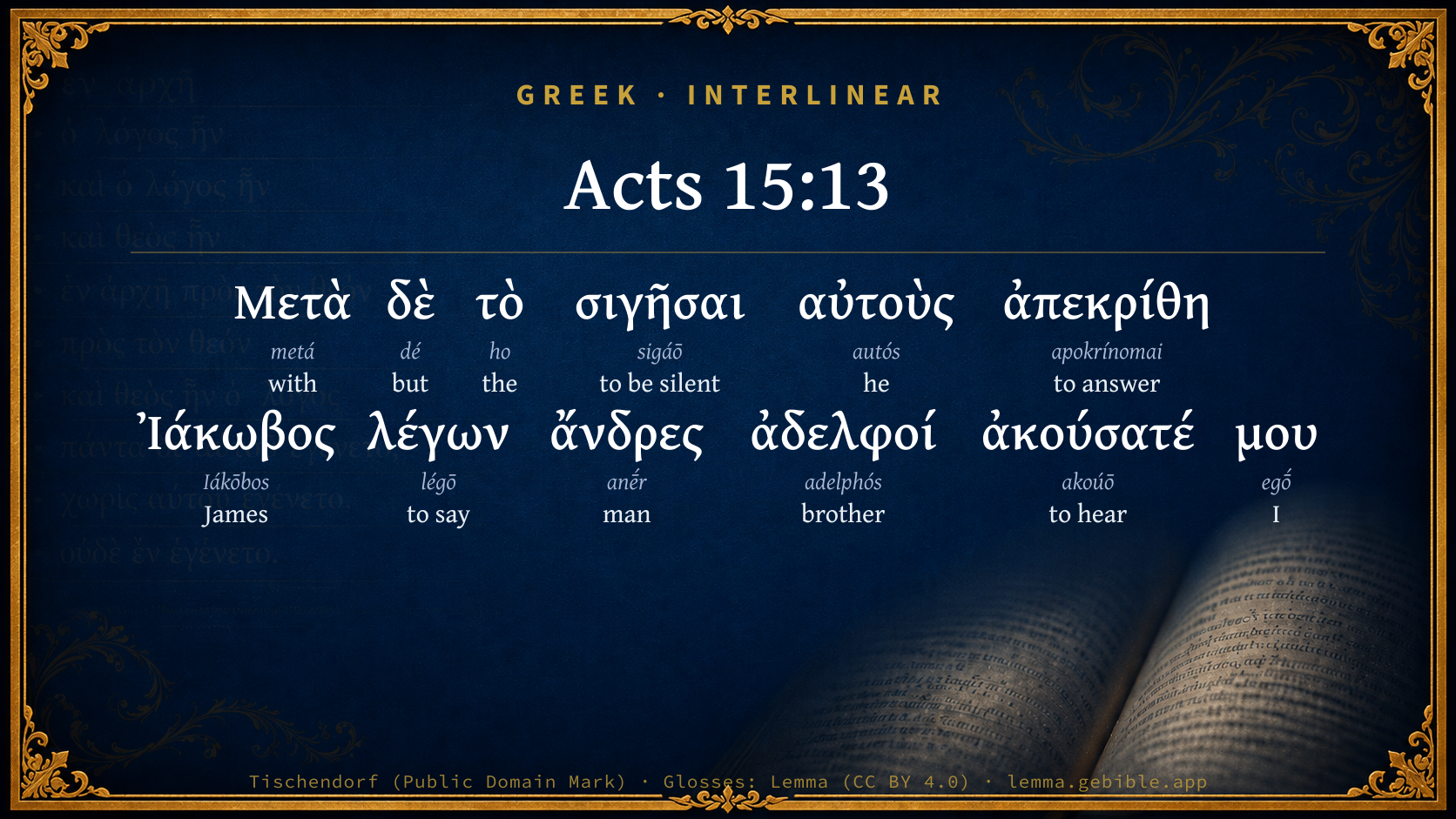
Greek (Tischendorf 8th ed.) Acts 15:13 appears in the Greek New Testament. The text above is from the Tischendorf 8th edition. Each word links to its Strong’s number and a concise gloss. Click any word for its full Thayer’s Greek Lexicon entry.
Download image
Cite this verse

Acts 15:13 (World English Bible). Public Domain. Lemma interlinear Bible study tool, https://lemma.gebible.app/v/acts/15/13.

Show BibTeX & RIS
BibTeX
RIS
English Translation
After they were silent, James answered, "Brothers, listen to me.
World English Bible · Public Domain
Download a study sheet

One document with this verse’s original text, its word-by-word gloss line, the meaning frame, cross-references with their text, attributed commentary, and full source and license credits — printable, and it pastes into notes with its structure intact.

This verse Autodidact and up

Study sheet (.html) Plain text (.txt)

A passage Seminary Student

Up to 50 verses in one chapter. A passage sheet keeps up to 6 commentary sources and 12 cross-references per verse, in the order this page ranks them, and says so on the sheet whenever that leaves anything out. Ask for a single verse and you get the Autodidact verse sheet above.

Everything on this page stays free to read, with no account — the sheet is a download of what is already on screen, not access to it.

Want to remove ads? Support Godless Engineer
Compare translations 3

The same verse in 3 English versions, stacked beneath the original-language interlinear above. Click any original word for its lexicon entry.

Each is an independent rendering of the whole verse — the interlinear is not word-aligned to these translations.

Highlighted words mark where these versions differ — a whole-verse word diff, not a word-by-word alignment.

  • World English Bible Public Domain
    After they were silent, James answered, "Brothers, listen to me.
  • King James Version Public Domain
    And after they had held their peace, James answered, saying, Men and brethren, hearken unto me:
  • unfoldingWord Literal Text CC BY-SA 4.0
    And after they stopped speaking, James answered, saying, “Men, brothers, listen to me.

unfoldingWord Literal Text — © unfoldingWord, licensed CC BY-SA 4.0. Word-aligned USFM3 via Door43 (git.door43.org/unfoldingWord/en_ult).

Versions to compare (up to 4)

3 of 4 selected

Show all 19 translations

Every available English version of this verse, each an independent rendering of the whole verse.

  • World English Bible Public Domain
    After they were silent, James answered, "Brothers, listen to me.
  • Berean Standard Bible Public Domain
    When they had finished speaking, James declared, “Brothers, listen to me!
  • Majority Standard Bible Public Domain
    When they had finished speaking, James declared, “Brothers, listen to me!
  • King James Version Public Domain
    And after they had held their peace, James answered, saying, Men and brethren, hearken unto me:
  • American Standard Version (1901) Public Domain
    And after they had held their peace, James answered, saying, Brethren, hearken unto me:
  • Revised Version (1885) Public Domain
    And after they had held their peace, James answered, saying, Brethren, hearken unto me:
  • Geneva Bible (1599) Public Domain
    And when they helde their peace, Iames answered, saying, Men and brethren, hearken vnto me.
  • Douay-Rheims (1899) Public Domain
    And after they had held their peace, James answered, saying: Men, brethren, hear me.
  • Young's Literal Translation Public Domain
    and after they are silent, James answered, saying, `Men, brethren, hearken to me;
  • Literal Standard Version CC BY-SA 4.0
    and after they were silent, James answered, saying, “Men, brothers, listen to me:
  • Unlocked Literal Bible CC BY-SA 4.0
    After they stopped speaking, James answered, saying, “Brothers, listen to me.
  • unfoldingWord Literal Text CC BY-SA 4.0
    And after they stopped speaking, James answered, saying, “Men, brothers, listen to me.
  • Darby Bible Public Domain
    And after they had held their peace, James answered, saying, Brethren, listen to me:
  • World Messianic Bible Public Domain
    After they were silent, Jacob answered, “Brothers, listen to me.
  • Webster's Bible Public Domain
    And after they held their peace, James answered, saying, Men, brethren, hearken to me.
  • Free Bible Version CC BY-SA 4.0
    After they had finished speaking, James spoke up, saying, “Brothers, listen to me.
  • Bible in Basic English Public Domain
    And when they had come to an end, James, answering, said, My brothers, give ear to me:
  • Text-Critical English NT CC BY 4.0
    When they had finished speaking, James replied, “Brothers, listen to me.
  • Tyndale New Testament (1534) Public Domain
    And when they helde their peace Iames answered sayinge: Men and brethren herken vnto me.

Literal Standard Version (2020), Covenant Press — licensed CC BY-SA 4.0. Text via the HelloAO Bible API (eBible.org). Unlocked Literal Bible (unfoldingWord) — licensed CC BY-SA 4.0. Text via the HelloAO Bible API (eBible.org). unfoldingWord Literal Text — © unfoldingWord, licensed CC BY-SA 4.0. Word-aligned USFM3 via Door43 (git.door43.org/unfoldingWord/en_ult). Free Bible Version, Dr. Jonathan Gallagher — licensed CC BY-SA 4.0. Text via the HelloAO Bible API (eBible.org).

Word by word

More ways to search: Search by grammar → Find every occurrence → Compare this word →

Practice this passage: Drill this verse → Learn its vocabulary →

About this verse

These counts appear in no published source. They are computed here, from the morphology-tagged text and Lemma’s own curated glosses. What Lemma adds →

12
words
12
distinct lemmas
Acts
section

Notable vocabulary

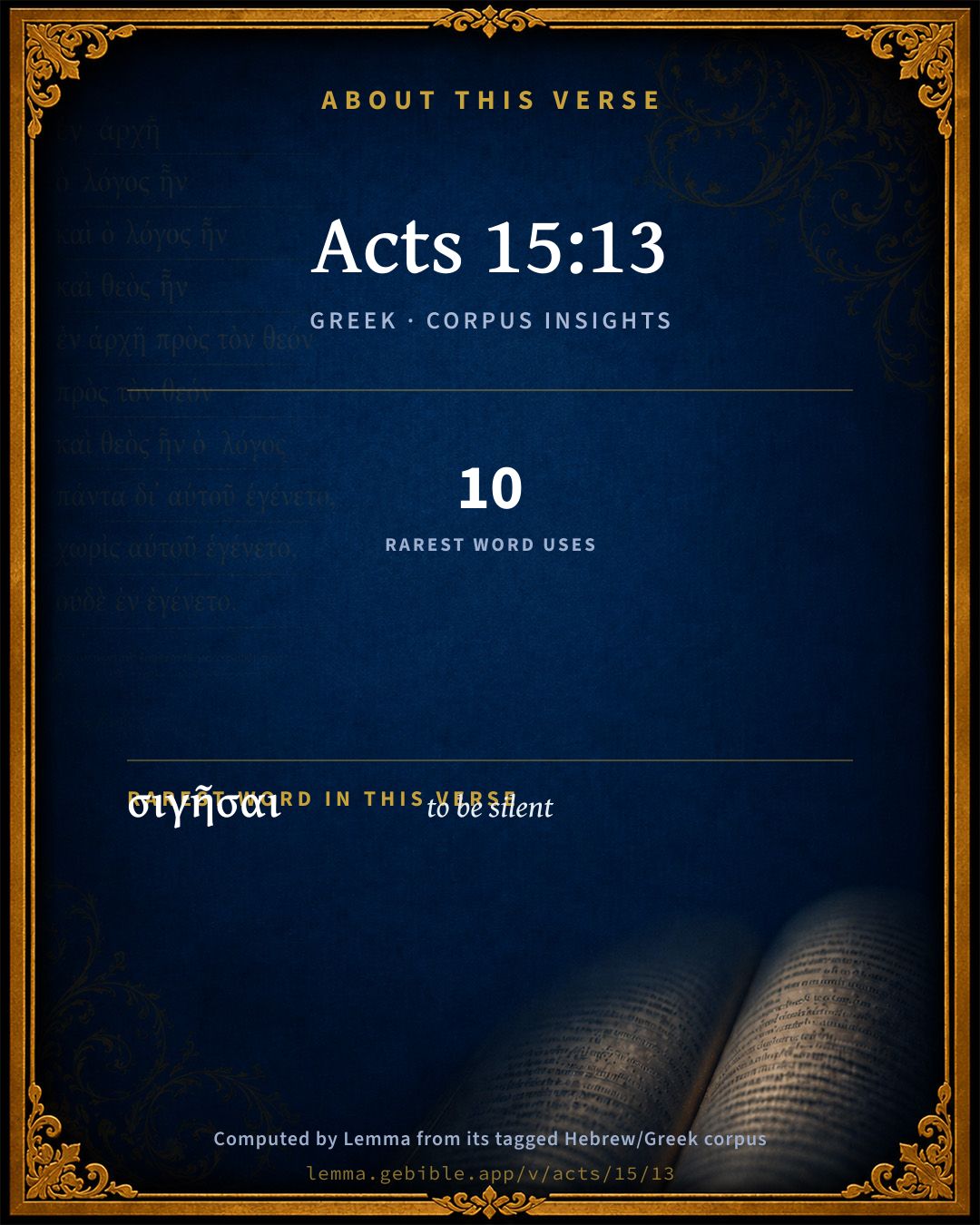
The rarest word here is σιγῆσαι to be silent G4601 — appearing just 10 times in the whole Greek New Testament.

Shared distinctive vocabulary

σιγῆσαι to be silent G4601 occurs in 10 verses of the Greek New Testament. Also found in:

Cross-references

14

Topical passages linked to Acts 15:13 in the Treasury of Scripture Knowledge — connected by theme and wording, ordered by reader-vote popularity; previews shown in the World English Bible.

  • Acts 12:17 But he, beckoning to them with his hand to be silent, declared to them how the Lord had brought him out of the prison. He said, "Tell these things to James, and to the brothers." Then he departed, and went to another place.
  • Galatians 2:9 and when they perceived the grace that was given to me, James and Cephas and John, they who were reputed to be pillars, gave to me and Barnabas the right hand of fellowship, that we should go to the Gentiles, and they to the circumcision.
  • Galatians 2:12 For before some people came from James, he ate with the Gentiles. But when they came, he drew back and separated himself, fearing those who were of the circumcision.
  • James 1:1 James, a servant of God and of the Lord Jesus Christ, to the twelve tribes which are in the Dispersion: Greetings.
  • Mark 15:40 There were also women watching from afar, among whom were both Mary Magdalene, and Mary the mother of James the less and of Joses, and Salome;
  • Acts 2:14 But Peter, standing up with the eleven, lifted up his voice, and spoke out to them, "You men of Judea, and all you who dwell at Jerusalem, let this be known to you, and listen to my words.
  • Acts 2:22 "Men of Israel, hear these words! Jesus of Nazareth, a man approved by God to you by mighty works and wonders and signs which God did by him in the midst of you, even as you yourselves know,
  • Acts 2:29 "Brothers, I may tell you freely of the patriarch David, that he both died and was buried, and his tomb is with us to this day.
  • Acts 7:2 He said, "Brothers and fathers, listen. The God of glory appeared to our father Abraham, when he was in Mesopotamia, before he lived in Haran,
  • Acts 21:18 The day following, Paul went in with us to James; and all the elders were present.
  • Acts 22:1 "Brothers and fathers, listen to the defense which I now make to you."
  • 1 Corinthians 14:30–33 But if a revelation is made to another sitting by, let the first keep silent.
  • Galatians 1:19 But of the other apostles I saw no one, except James, the Lord's brother.
  • James 1:19 So, then, my beloved brothers, let every man be swift to hear, slow to speak, and slow to anger;

Cross-references courtesy of OpenBible.info (CC BY 4.0).

Commentary

Notes on Acts 15:13 from classic Christian and Jewish commentators (each source and its license shown beneath its notes). The classic Christian expositions comment on the surrounding passage and are grouped to its opening verse, so a note may address several verses; the Jewish commentaries on the Tanakh (Rashi and others) are per-verse, so they appear only where the commentator wrote on this verse.

Lemma curates 59 commentaries, every one of them public domain or Creative Commons licensed, each selected and text-cleaned for this edition rather than reprinted as found. About our sources →

The Biblical Illustrator

Joseph S. Exell

Act_15:13-29

And after they had held their peace, James answered.

The decision of the council

This was a crisis in the history of the Church. The greatest disasters might have befallen it at this critical time. The man who saved the Church was Paul. There was in him a fine spirit of conciliation as to methods and usages; but when it came to the liberty of Christ, and the independence of the Church, he stiffened into inflexibility, and he gave place by subjection, no, not for an hour. The little picture before us enables us to look into the detail of early Church life. Note here--

I. The place of human thought and independence in the consideration of Christian problems. No man was hooted down on either side. In modern Christian controversy we have all seen lamentable spectacles. It makes one ashamed of the Christian cause when orthodox men employ a heterodox tone for the purpose of putting down an opponent. Take care how you maintain a good cause. I have seen an infidel display a nobler spirit than has been shown by his nominally Christian antagonist. Here the discussion was full, impartial and thorough; due deference was paid to the apostles and elders; all things were done decently and in order.

II. The beginning of Christian liberty. A wrong step here, and Christian liberty would have been lost. Paul was raised up at the very moment of time. He who made havoc of the Church now kept it together. Under the illumination of Paul the horizon of James widened. Sometimes the Church needs inspiration more than information. When the grate is full of fuel, what is wanting is a light. James began to see that Christian liberty was founded on prophecy. How did James become so great a man all of a sudden? Because he had touched the Pauline spirit. Great men make great men. We do not need a new Bible; we need new readers. It was actually found that in the Old Testament this very question had been settled. In every synagogue Moses was read, and nobody understood him.

III. The sight way of treating new converts. They were to begin by not doing things. The trouble with our new converts is that they are converted on Monday, and on Tuesday promoted to places of eminence. The apostles said, Brethren, you will do well to begin by not doing certain things. That is where we ought to begin.

IV. The happier aspects of controversy. But for this controversy, who knows when Paul and James might have been brought together? And after the controversy was over, the bishop writes: Our beloved Barnabas and Paul. James looked at the question partly from the characters of the men, and he called them men that have hazarded their lives for our Lord Jesus Christ. So judge in every controversy, This proof of devotion must go for something in the exciting controversy. It is not enough to be clever; we must be true. What have we done for the Lord Jesus? (J. Parker, D. D.)

Wherefore my judgment is, that ye trouble not them which from among the Gentiles turn to God.--

A triumph of spirituality and liberty

A few lessons come to us from a study of that first Ecclesiastical Council.

I. We see in this conference the true way of settling difficulties, both between churches and between individuals--it is by conferring together. That does not mean by writing letters, or making assertions at arms length, but by getting near to one another so that the persons distrusted may be seen and understood. If that letter had been sent from the Church at Antioch to the Church at Jerusalem, and Paul and Barnabas had not been seen--a living spirit can never be put into cold words--the judgment of the council might have been different; and St. Paul would have continued on his way, and there would have been a breach between those who ought to have been united. I have come to feel that letters almost always make more difficulties than they mend. Let those who misunderstand one another come together, take each other by the hand; while one says to the other, Now, perhaps, I do not understand you; you explain your meaning; let me explain mine. Few enmities could withstand that process. Only an egotist of the first water ever believes that he has all the truth. The life in nature has one manifestation in a flower; another in a tree; another in an animal, another in a man; none conflict; they are only varying manifestations of the one energy which pulsates from the sun. We have one name for the sum of life and all the manifestations of energy, and that is, the universe. The universe of matter and life is too vast for any individual to comprehend--how much more incomprehensible is the spiritual universe! Differences of opinion on doctrine and ritual will arise. There is but one right way to adjust such differences between individuals or in churches, and that is for those who feel themselves growing apart to take the first opportunity to look into each others eyes and clasp each others hands as brothers, and then bring all the things which separate into light.

II. The Council at Jerusalem makes very clear the distinction between liberty and authority in the Christian life. Christians recognise only one authority, and that is God. Just so fast and so far as the will of God concerning them can be learned, they are under obligation to obey. We are at liberty to believe everything that is true, and to do whatever is right and expedient; all encroachments on this liberty are to be resisted; and in the last analysis we ourselves must decide what is true, wise and right. How easy it would be if someone else could decide for us! Men are made strong by the exercise of their faculties. Those representatives of the venerable Church in Jerusalem came to Antioch with their Thus saith the law, and there the law was written in cold black letters as it was supposed to have been written by Moses himself, and they said: Can you get away from that? If the letter was to decide, the case was already closed. But St. Paul believed that there had been another revelation; that while law had been best for one time, it was not for all times; that he had a commission from Christ to preach His gospel wherever there were souls to be saved; and so, turning away from the letter, he boldly and confidently followed the spirit. But while we emphasise liberty and individual responsibility, we cannot fail also to see that, if we really desire to know what is true and right, we must be very careful about going contrary to what is generally believed to be truth and right by those who we have reason to believe are Christians. If, for instance, in this Church of nearly seven hundred and fifty members, seven hundred believe that one course of conduct is wrong, and one believes that it is right, that one ought to be very sure that he has not been influenced by prejudice, conceit, or some evil motive before he concludes that he is right and all the others are wrong. This Council at Jerusalem illustrates the proper relation of liberty and authority. When the Jewish party asked to have Titus circumcised, and so indicate that the law was still binding, Paul indignantly refused. When the meddlers came from Jerusalem and stirred up a misunderstanding, he said: Well, let us confer together; in other words, I am willing to find all the truth that there is anywhere; the only authority is in truth and right--that is in the revealed will of God--and all men are free from all other obligation except the obligation to obey the true and the right. To learn that, he was willing to go to Jerusalem. So should we be, or to go anywhere else.

III. This contest in the early Church makes plain the contrast between spirituality and formality in religion. Men are everlastingly inclined to put emphasis on things of no importance. The Pharisees who tithed mint, anise, and cumin are not yet all dead. Formality says: If you observe certain rites, you are doing all that is required of you. Spirituality says: Have the mind of Christ; wherever you can do good, do it; pray without ceasing; no one place alone is holy, but all places are equally holy because God is everywhere; live the life of love, and open your hearts in the day and in the night so that the Spirit of Truth may lead you at all times. Why do we have so many denominations? What is it that separates Christians but this everlasting tendency to put emphasis upon form rather than life? Life can always be trusted; it will make its own form. All we need to be anxious about is to make sure that our poor weak human hearts are open to the Divine life. No ceremony is of any value except so far as it contributes to growth in the spiritual life. The apostle violated all the traditions by which he was surrounded, but in doing so he tore a rift in the worlds darkness, and made it possible for the sunlight of the grace of God to flood a struggling race. But the question presses, If we are to trust the Spirit rather than forms, how are we to know whether a man has the Spirit? Well, first, what difference does it make whether we know or not? Who made us judges? To his own master he standeth or falleth. But we may know whether men have the Spirit. By this shall all men know that ye are My disciples, if ye have love one toward another. (A. H. Bradford, D. D.)

The Biblical Illustrator, edited by Joseph S. Exell (c. 1880s–1900s) — public domain. Text from a community e-Sword module.

Tyndale Open Study Notes

Tyndale Open Resources

15:13-19 James, the brother of Jesus, declared that the conversion of the Gentiles was clearly in accord with Scripture. He argued forcefully that it was contrary to the divine will to put unnecessary requirements on the admission of the Gentiles.

Tyndale Open Study Notes — © Tyndale Open Resources, licensed CC BY-SA 4.0. Text via the HelloAO Bible API.

Bengel's Gnomon

Johann Albrecht Bengel

Act 15:13. Μετὰ, after that) All things were done in order.

Bengel's Gnomon of the New Testament — English translation (T&T Clark, Edinburgh, 1860) — public domain. Text from a community e-Sword module.

Meyer's Critical & Exegetical Commentary

Heinrich August Wilhelm Meyer

Act_15:13. When these had finished speaking (σιγῆσαι), James, not the son of Alphaeus, but the brother of the Lord (Act_12:17), a strict legalist, and highly esteemed in Jerusalem as chief leader of the church, delivered his address having reference to these matters (ἀπεκρίθη). He first confirmed, by a prophetic testimony, the divine call of the Gentiles brought into prominence by Peter (Act_15:13-17), and then made his conciliatory proposal for the satisfaction of both partiesin concise, but all the more weighty language.

Meyer — Critical and Exegetical Commentary on the New Testament — English translation by Peter Christie, edited by Frederick Crombie (T&T Clark, 1880) — public domain. Text from a community e-Sword module.

Expositor's Greek Testament

ed. W. Robertson Nicoll

Act 15:13 . μετὰ δὲ τὸ σ ., i.e. , after Barnabas and Paul had ceased speaking. ἀπεκ . Ἰ . λ .: his speech may be divided into two parts: (1) reference to the prophecy foretelling the reception of the Gentiles; (2) his opinion on the conditions of that reception. ἀ . ἀκούσατέ μου : only here and in Jas 2:5 .

The Expositor's Greek Testament, edited by W. Robertson Nicoll (1897–1910) — public domain. Text from a community e-Sword module.

Geneva Bible (1599)

Geneva Bible translators

The son of Alphaeus, who is called the Lord’s brother.

Geneva Bible (1599) marginal notes — public domain. Text via Bolls.life.

Jamieson, Fausset & Brown

Robert Jamieson, A. R. Fausset & David Brown

James answered, saying, &c.--Whoever this James was (see on Gal 1:19), he was the acknowledged head of the church at Jerusalem, and here, as president of the assembly, speaks last, winding up the debate. His decision, though given as his own judgment only, could not be of great weight with the opposing party, from his conservative reverence for all Jewish usages within the circle of Israelitish Christianity.

Jamieson, Fausset & Brown — Commentary Critical and Explanatory on the Whole Bible (1871) — public domain (CC PDM 1.0). Text via the HelloAO Bible API.

Adam Clarke's Commentary

Verse 13. James answered] He was evidently president of the council, and is generally called bishop of Jerusalem. The rest either argued on the subject, or gave their opinion; James alone pronounced the definitive sentence. Had Peter been prince and head of the apostles, and of the Church, he would have appeared here in the character of judge, not of mere counsellor or disputant. Thy popish writers say that "James presided because the council was held in his own church." These men forget that there was not then what they term a Church on the face of the earth. The Church, or assembly of believers, then met in private houses; for there was no building for the exclusive purpose of Christian worship then, nor till long after. These writers also forget that the pope pretends to be the head of the catholic or universal Church; and, consequently, no man can preside where he is present, but himself. Peter did not preside here; and this was the first ecclesiastical council, and now, if ever, he should have assumed his character of prince and chief; but he did not; nor did any of the other apostles invite him to it, which they would have done had they thought that Jesus Christ constituted him head of the Church. From this very circumstance there is the most demonstrative evidence that Peter was no pope, and that the right of his pretended successor is a nonentity.

Adam Clarke's Commentary on the Bible (1810–1826) — public domain. Text from a community e-Sword/MySword module.

John Calvin's Commentaries

13. James answered, saying. Some old writers of the Church think that this James was one of the disciples, whose surname was Justus and Oblia, whose cruel death is recorded by Josephus in the Twentieth Book of his Antiquities. But would to God the old writers had travailed rather to know the man, than to set forth, with reigned praises, the holiness of a man whom they knew not. It is a childish toy and surmise, in that they say that it was lawful for him alone to enter into the most holy place. For if in that entering in there had been any religion, he had done it contrary to the law of God, forasmuch as he was not the highest priest. Secondly, it was a superstitious thing thus to foster the shadowish worship of the Temple. I omit other trifles. And they are greatly deceived in that they deny that he was one of the twelve apostles. For they are enforced to confess that it is he whom Paul commandeth so honorably, that he maketh him the chief among the three pillars of the Church, (Galatians 2:9.) Assuredly, a man inferior in order and degree could never have excelled the apostles so far; for Paul giveth him the title of an apostle. Neither is that worth the hearing which Jerome bringeth, [viz.] that the word is general there, seeing that the dignity of the order is there handled; forasmuch as Christ did prefer the apostles before other teachers of the Church.

Moreover, we may gather out of this place, that they made no small account of James, (Acts 21:18;) forasmuch as he doth with his voice and consent so confirm the words of Peter, that they are all of his mind. And we shall see afterwards how great his authority was at Jerusalem. The old writers think that this was because he was bishop of the place; but it is not to be thought that the faithful did at their pleasure change the order which Christ had appointed. Wherefore, I do not doubt but that he was son to Alpheus, and Christ’s cousin, in which sense he is also called his brother. Whether he were bishop of Jerusalem or no, I leave it indifferent; neither doth it greatly make for the matter, save only because the impudency of the Pope is hereby refuted, because the decree of the Council is set down rather at the appointment, and according to the authority of James than of Peter. And assuredly Eusebius, in the beginning of his Second Book, is not afraid to call James, whosoever he were, the Bishop of the Apostles. Let the men of Rome go now and boast that their Pope is head of the Universal Church, because he is Peter’s successor, who suffered another to rule him, if we believe Eusebius.

Men and brethren, hear me. James’ oration consisteth upon [of] two principal members; for, first, he confirmeth and proveth the calling of the Gentiles by the testimony of the prophet Amos; secondly, he showeth what is best to be done to nourish peace and concord among the faithful; yet so that the liberty of the Gentiles may continue safe and sound, and that the grace of Christ may not be darkened. Whereas Peter is in this place called Simeon, it may be that this name was diversely pronounced then. Whereas he saith that God did visit to take a people of the Gentiles, it is referred unto the mercy of God, whereby he vouchsafed to receive strangers into his family. It is, indeed, a harsh phrase, yet such as containeth a profitable doctrine; because he maketh God the author of the calling of the Gentiles, and pronounceth that it is through his goodness that they began to be reckoned among his people, when he saith that they were taken by him; but he proceedeth further, when he saith that he did visit that he might take. For this is his meaning, That at such time as the Gentiles were turned away from God he did mercifully look upon them; because we can do nothing but depart farther and farther from him, until such time as his fatherly look prevent us of his own accord.

In his name. The old interpreter hath, To his name, which is almost all one, though the preposition, it may be otherwise translated, to wit, For his name, or Upon his name. Neither shall the sense disagree, that the salvation of the Gentiles is grounded in the power or name of God, and that God did respect no other thing in calling them but his own glory; yet did I retain that which is more usual; to wit, that, in numbering them among his people, he would have them counted in his name, like as it shall be said shortly after, that his name is called upon by all those whom he gathereth together into his Church. The adverb of time, πρωτον, may be expounded two ways; if you read it, first, as the old interpreter and Erasmus have it, the sense shall be, that Cornelius and others were, as it were, the first fruits at whom God began the calling of the Gentiles; but it may be taken also comparatively, because there was already some token of the adoption of the Gentiles showed in Cornelius and his cousins, before that Barnabas and Paul preached the gospel to the Gentiles. And I do better like this latter sense.

John Calvin's Commentaries (1540-1563) — public domain. Text from the Calvin Translation Society English edition (1840s-50s) via the Christian Classics Ethereal Library (ccel.org). Calvin's coverage is partial (roughly two-thirds of the Bible); uncommented books and verses are honest gaps, never fabricated. The 19th-century editor's footnotes and remarks are omitted so the notes are faithfully Calvin's own voice.

Ellicott's Commentary for English Readers

(13) James answered.—The position which James the brother of the Lord (see Notes on Act_12:17; and Mat_12:46; Mat_13:55) occupies in the Council is clearly that of pre-eminence, justifying the title of Bishop of Jerusalem, which later writers give him. No one speaks after him; he sum up the whole debate; he proposes the decree which is to be submitted to the Council for approval.

A Bible Commentary for English Readers, edited by Charles John Ellicott (1878–1897) — public domain. Text from a community e-Sword module.

The Cambridge Bible for Schools and Colleges

gen. ed. J. J. S. Perowne

13–21. James sums up the discussion, and pronounces the decision of the Church on this Controversy

13. James] i.e. the brother of the Lord, and bishop of Jerusalem, see above on Act_12:17.

Men and brethren] See note on Act_1:16.

hearken unto me] The president’s summary takes no note of the “much disputing” (Act_15:7) but points out that a divine revelation had been made to Peter, and that it was accordant with the words of Old Testament prophecy. On these warrants he based his decision.

The Cambridge Bible for Schools and Colleges (gen. ed. J. J. S. Perowne; Cambridge University Press, 1878–1918) — public domain. Text from a community e-Sword module.

John Gill's Exposition

And after they had held their peace,.... Meaning not the multitude, but Paul and Barnabas; when they had finished their account, and had done speaking:

James answered; or rose up, as the Syriac version reads, he stood up and began to speak. This was James the son of Alphaeus, one of the twelve apostles, sometimes called the brother of the Lord; for the other James, the son of Zebedee and brother of John, was dead, being killed by Herod, Act 12:2 but this was the brother of Jude, and the same that wrote the epistle that bears his name: whether he was now bishop or pastor of the church at Jerusalem, is not certain; nor whether he was president in this council; the speeches made in it do not appear to be directed to him: he began his oration thus,

saying, men and brethren, hearken to me; the titles he uses, and the manner of desiring audience, were what were common with the Jews; see Act 2:14.

John Gill's Exposition of the Whole Bible (1746–1763) — public domain (CC PDM 1.0). Text via the HelloAO Bible API.

Trapp's Complete Commentary

John Trapp

13 And after they had held their peace, James answered, saying, Men and brethren, hearken unto me:

Ver. 13. James answered] Who seemed to be a pillar, Gal 2:9, and was so, both of the college of apostles and of the Church at Jerusalem.

John Trapp, A Commentary or Exposition upon All the Books of the Old and New Testament (1647–1656) — public domain. Text from a community e-Sword module.

Albert Barnes' Notes on the Bible

James answered - James the Less, son of Alpheus. See the notes on Act 12:1.

Hearken unto me - This whole transaction shows that Peter had no such authority in the church as the papists pretend, for otherwise his opinion would have been followed without debate. James had an authority not less than that of Peter. It is possible that he might have been next in age (compare 1Co 15:7); and it seems morally certain that he remained for a considerable part of his life in Jerusalem, Act 12:17; Act 21:18; Gal 1:19; Gal 2:9, Gal 2:12.

Albert Barnes' Notes on the Bible (1834–1885) — public domain. Text from a community e-Sword/MySword module.

Matthew Poole's English Annotations

After they had held their peace; Barnabas and Paul had finished their narrative.

James, who was surnamed the Just, and was the son of Alpheus, and a kinsman to our Saviour, now being president of this council.

Answered; that is, began to speak.

Matthew Poole's English Annotations on the Holy Bible (1683–1685) — public domain. Text from a community e-Sword/MySword module.

The Pulpit Commentary

Brethren for men and brethren, A.V., as ver. 7. James answered. James"s place as presiding bishop is here distinctly marked by his summing up the debate. "This (James)was bishop, as they say, and, therefore, he speaks last" (Chrysost., "Hem.," 33.). And again, "No word speaks John here, no word the other apostles, but held their peace, for James was invested with the chief rule." "He says well with authority, My sentence is (ibid.). A remarkable testimony against papal supremacy.

The Pulpit Commentary (1880–1919), ed. H.D.M. Spence-Jones & Joseph S. Exell — public domain. Text from a community e-Sword module.

Scofield Reference Notes

C. I. Scofield

Men and brethren

Dispensationally, this is the most important passage in the N.T. It gives the divine purpose for this age, and for the beginning of the next.

(1) The taking out from among the Gentiles of a people for His name, the distinctive work of the present, or church-age. The church is the ecclesia--the "called-out assembly." Precisely this has been in progress since Pentecost. The Gospel has never anywhere converted all, but everywhere has called out some.

(2) "After this viz. the out-calling I will return." James quotes from Amo 9:11; Amo 9:12. The verses which follow in Amos describe the final regathering of Israel, which the other prophets invariably connect with the fulfilment of the Davidic Covenant (e.g.); Isa 11:1; Isa 11:10-12; Jer 23:5-8.

(3) "And will build again the tabernacle of David," i.e. re-establish the Davidic rule over Israel 2Sa 7:8-17; Luk 1:31-33.

(4) "That the residue of men Israelites may seek after the Lord" cf Zec 12:7; Zec 12:8; Zec 13:1; Zec 13:2.

(5) "And all the Gentiles," etc. cf Mic 4:2; Zec 8:21; Zec 8:22. This is also the order of Rom 11:24-27.

The Scofield Reference Bible (1917 edition), notes by C. I. Scofield — public domain. Text from a community e-Sword module.

Kretzmann's Popular Commentary

Paul E. Kretzmann

The proposal of James:

v. 13. And after they had held their peace, James answered, saying, Men and brethren, hearken unto me:

v. 14. Simeon hath declared how God at the first did visit the Gentiles to take out of them a people for His name.

v. 15. and to this agree the words of the prophets, as it is written,

v. 16. After this I will return, and will build again the tabernacle of David which is fallen down; and I will build again the ruins thereof, and I will set it up,

v. 17. that the residue of men might seek after the Lord, and all the Gentiles upon whom My name is called, saith the Lord, who doeth all these things.

v. 18. Known unto God are all His works from the beginning of the world.

v. 19. Wherefore my sentence is that we trouble not them which from among the Gentiles a returned to God,

v. 20. but that we write unto them that they abstain from pollutions of idols, and from fornication, and from things strangled, and from blood.

v. 21. For Moses of old time hath in every city them that preach him, being read in the synagogues every Sabbath-day.

By the time Barnabas and Paul had finished their rehearsal of the success which attended their labors, the hearers could not have had any other impression but that the conversion of the Gentiles was a work of God, and that their discipleship, even without the observance of the ceremonial law, must necessarily he acceptable to Him. No one else, therefore, having asked for the privilege of the floor, James, that is, James the Just, the brother of the Lord, one of the pillars of the congregation at Jerusalem, according to common report its head after the removal of the apostles, arose and added the evidence of prophetical prediction to that of the facts presented by the previous speakers. Requesting the audience to listen carefully, he opened his remarks with a reference to the report of Peter: Simeon has explained in what manner God at first, from the beginning, resolved to gain a people out of the Gentiles unto His name, for the glory and praise of His holy name, and called by His name, as His children. With this fact agree the words of the prophets. Although James quotes only one of the prophets, he may either have had in mind the hook of the prophets or implied that the other prophets make similar statements. He quotes the words Amo 9:11-12 according to the Greek translation. There the Lord had promised to return after this, at the time fixed by Him in the future. He would then build anew, erect once more, the tent of David which had been destroyed, laid low. He does not speak of the Old Testament Church as the house of David, as in other places, but as a tent, a booth, a hut that had decayed and fallen into ruins. But this hut which was lying on the ground as though struck down by a storm the Lord wanted to build anew and to set upright again as the tabernacle of the New Testament. This rebuilding of the ruins took place in and through Jesus Christ, in order that those that remained of the people should seek the Lord most diligently, that the rest of men, that is, all the heathen, without respect of persons and of works, all upon whom His name is pronounced in the preaching of the Gospel, should strive to possess the blessings of the Lord. It was this Lord that was doing all these things, whose manner of performing them could not be gainsaid. For He was not in the habit of performing any of His works in a haphazard manner, but had worked according to definite plans from the beginning of the world. And He had made these facts known of old, from the beginning of the world. On the basis of this clear prophetical statement, whose fulfillment no one could deny after hearing the reports made to the assembly, James now ventured an opinion, not necessarily as the president of the meeting, but as a speaker that presents the result of his deliberations in the form of a resolution. He offered the motion that they should not trouble or molest in any way those people among the Gentiles that were turning to God, and had been accepted by Him in faith. But he suggested that letters be sent to them warning them against the contamination of idol worship, against committing fornication, against partaking of meat of strangled animals, and against eating blood, in the worship of idols was included idolatrous feasts, where meat was served that had been sacrificed to false gods. To some extent, also, the sins against the Sixth Commandment were practiced in connection with the temples of the idols, though these sins were prevalent otherwise as well, nameless breaches of the Christian law of purity taking place as a matter of fact. That is the will of God to the Christians of all times, that they avoid fornication and all uncleanness, and that they remain unspotted from the world and its lusts, including the unclean, idolatrous joys and delights of the world. But that James wanted to add the prohibition concerning the eating of animals that had been stunned or strangled without the loss of blood, and that of blood itself, Lev 17:13; Deu 12:16-23; Deu 15:23, was done for another reason. These practices had been forbidden in the Old Testament and were considered especially disgusting by the Jews, an abomination before the Lord. And the Jewish Christians had not yet been able to throw off this feeling of loathing and disgust, in the opinion of James, therefore, the Gentile Christians might well be asked to have some consideration for their Jewish brethren in this case. Christian charity demanded as much, especially where meals were eaten in common. James added, in concluding his speech, that Moses from ancient times had men in all cities that proclaimed him in the synagogues, since he was read in the services on every Sabbath, that is, his books were read and explained in the services. The chances were, therefore, that these Mosaic customs would be well known everywhere, and their non-observance might cause offense, as though the way of salvation in the New Testament were different from that of the Old. Then, also, there was danger that the intercourse between Jewish and Gentile Christians would cease entirely unless the latter would be willing, for charity’s sake, to observe a decree which would make brotherly communion possible. And finally, those that still clung to the outward observance of the Mosaic customs need not be apprehensive, since Moses was at this time still being read. James knew very well that this would change in time, but did not propose to force the issue by tactless haste. Note: The draught which James proposed was not a Compromise resolution, as has been stated. It was not his opinion that the heathen Christians should indeed not be burdened with the entire Law of Moses, but only with certain ordinances. Even the smallest particle of the Mosaic Law, laid upon them as a condition of salvation, would have taken away the faith of the Christians in the free grace and mercy of the Savior. His suggestion was merely a proposal for the sake of Christian order, not to burden believing hearts, but to simplify the problem of uniting two races in the same congregations without the danger of continual friction. These directions did not concern the way of salvation, for this the Gentile Christians had learned from the Gospel.

Paul E. Kretzmann, Popular Commentary of the Bible (1921–1924) — public domain. Text from a community e-Sword module.

Burkitt's Expository Notes on the New Testament

William Burkitt

Observe here, 1. The excellent order in which this grand debate was managed by the apostles; they do not break in upon one another like proud magisterial talkers, so full of themselves that they could not hear one another speak; but while one speaks, all the rest silently and attentively hear, no one stopping another by rude and uncivil interruption: After they had held their peace, James answered.

Observe, 2. The third and last speech uttered at this council at Jerusalem, was by St. James, the bishop, and residentiary apostle of the place; James said, Hearken unto me.

Where note, 1. He puts the council in mind of the special favour and grace of God in sending the gospel among the Gentiles, which he calls his visiting of them; and the design of God in that gracious visitation, namely, to take out of the Gentile world a people for his name.

Hence learn, 1. That when God gives his gospel to a people, he gives that people a merciful and gracious visitation.

2. That God’s design in visiting a nation with and by the gospel, is to take out of them, and from amongst them, a people for his name; that is, a people to call upon his name, a people to be called by his name, and a people to honour and glorify, to advance and magnify, his holy name.

Note, 2. With what wisdom and caution St. James, the president of the council, proceeds in the final deciding of this controversy: he proposes a mean betwixt the two extremes, between those that would have all the Mosaic rites imposed, and those that would have none at all: designing by this medium that neither the Jews should be too much offended, nor the Gentiles too heavily burdened; but brotherly love between both be maintained and preserved.

Note, 3. How St. James, in deciding of this controversy, appeals to scripture, ver. 15. to this agree the words of the prophets, as it is written. Not to the authority of the council: the holy canon of the scriptures ought to overrule all debates; this is the infallible judge, which all the councils are to appeal to, and none must presume to appeal from.

Note, lastly, That the sum of the council’s determination came to this, "That circumcision should not be imposed upon the Gentiles; that the Gentiles nevertheless should so far judaize, or comply with the Jews, as to abstain from meats offered to idols, from things strangled, and from blood, and from fornication." All which are called indifferent things, because the three first were made so by the death of Christ, (after which there was to be no more distinction, either of meats or nations,) and the fourth, namely, fornication, is reckoned amongst the indifferent things; because the Gentiles, though falsely, did think and speak it to be so; Non est flagitium adolescentem scortari.

To prevent therefore giving offence to the Jews, the Gentiles are required to abstain from these things, till time and fuller acquaintance with the gospel did better inform them concerning their Christian liberty.

From this example learn, That whatever differences do arise in a church about tolerable matters, and indifferent things, the nearest course to unity, and a charitable compliance, is for both parties to step towards, and meet one another; and what may be left at liberty without apparent prejudice to purity, to be left for peace sake.

William Burkitt's Expository Notes on the New Testament (1700–1703) — public domain. Text from a community e-Sword module.

Godbey's Commentary on the New Testament

William B. Godbey

13. Now James, the brother of our Lord and pastor of the Apostolic church at Jerusalem, rises after Peter and proceeds, delivering a number of focalized statements, which speak volumes appertaining to the gospel, church and human destiny.

William B. Godbey, Commentary on the New Testament (1896–1900) — public domain. Text from a community e-Sword module.

McGarvey & Pendleton's Commentaries

J. W. McGarvey

13-21. So far as recent indications of God's will were concerned, the argument was now complete and unanswerable; but the Jewish mind was prone to an underestimate of passing events, while they looked back with superior reverence to the law and the prophets. The Apostle James, knowing that they would reject all possible cotemporaneous evidences, if they appeared to conflict with the written word, determined to close up this avenue of escape from the argument already presented by sustaining it with the authority of the prophets. (13) " And, after they were silent, James answered, saying, Brethren, hear me. (14) Simeon has related how God first visited the Gentiles, to take out of them a people for his name, (15) and to this agree the words of the prophets, as it is written, (16) After this I will return and will rebuild the tabernacle of David which has fallen down. I will rebuild its ruins, and set it upright, (17) that the residue of men may seek after the Lord, even all the Gentiles upon whom my name is called, says the Lord, who does all these things. (18) Known to God from eternity are all his works. (19) Therefore, my judgment is, not to trouble those of the Gentiles who turn to God; (20) but to write to them that they abstain from the pollutions of idols. and from fornication, and from things strangled, and from blood. (21) For Moses, for generations past, has in every city those who preach him, being read in the synagogues every Sabbath. " In this speech James shows that God, who knows from eternity what his own works would be, had foretold, through the prophet, the work which he was then performing through the labors of Peter, Barnabas, and Paul. He had said that he would rebuild the tabernacle of David, in order that the residue of men, who had not known the Lord before, "even all the Gentiles, upon whom his name is called," should seek after the Lord; and now, he had, through these apostles, selected from among the Gentiles "a people for his name." The prophesy clearly covered all the ground claimed for it, and made the argument complete.

There was room for no other conclusion than the one which James deduced, that they should impose on the Gentiles, so far as the class of restrictions under consideration were concerned, only those necessary things which were necessary independent of the Mosaic law. Idolatry, with all the pollutions connected with it, was known to be sinful before the law of Moses was given; and so was fornication. The eating of blood, and, by implication, of strangled animals, whose blood was still in them, was forbidden to the whole world in the family of Noah. In the restrictions here proposed by James, therefore, there is not the slightest extension of the law of Moses, but a mere enforcement upon the Gentiles of rules of conduct which had ever been binding, and were to be perpetual. They are as binding to-day as they were then. To deny this would be to despise the combined authority of all the apostles, when enjoining upon the Gentile world, of which we form a part, restrictions which they pronounce necessary. One would be surprised that it was thought necessary to mention to Gentiles, who had turned to the Lord, the sinfulness of fornication, did we not know that among heathen nations of antiquity it was deemed innocent, and even sometimes virtuous.

The controversy now pending, in reference to the identity of the Jewish Church with the Church of Christ, renders it necessary that we should here pay some special attention to one remark made by James in this speech. He applies the prophesy concerning the rebuilding of the "tabernacle of David" to the reception of the Gentiles into the Church, and it is hence argued that this prophesy contemplated a reconstruction and extension of the dilapidated Jewish Church, and not the construction of a new one. The whole argument turns upon the meaning of the expression "tabernacle of David." If the metaphorical word tabernacle here means the Jewish Church, the argument would have force. But the Mosaic institution never sustained such a relation to David that it could, with propriety, be styled the " tabernacle of David. " If such had been the reference, the expression would undoubtedly have been, the tabernacle of Moses, which would have been unambiguous. But David was a king, and had a promise from God, that his " throne should be established forever;" that there should not fail him a man on the throne of Israel. This promise God confirmed with an oath, saying, "I have made a covenant with my chosen, I have sworn to David my servant, Thy seed will I establish forever, and build up thy throne to all generations." According to the apparent meaning of this promise, it had long since failed; for it had been many generations since a descendant of David had occupied his throne. It was during this period, in which the royal house of David was in ruins, that Amos uttered the prophesy, "I will return, and build again the tabernacle of David which is fallen down; I will build again the ruins thereof, and set it upright." The term tabernacle, therefore, must be put for the family who dwell in the tabernacle, and the reconstruction of it the re-establishment of the royal dignity which the family had lost. Hence, when the birth of Jesus was announced to Mary, the angel said: "The Lord shall give to him the throne of his father David, and he shall reign over the house of Jacob forever, and of his kingdom there shall be no end." Thus, the promise, when properly understood, is seen to refer neither to a continuous line of Jewish kings, descended from David, nor to a reconstruction of the Jewish Church, but to the perpetual reign of Jesus, the "seed of David according to the flesh." When, therefore, Jesus sat down upon his throne in heaven, the tabernacle of David was rebuilt, and now, by the labors of Peter, Barnabas, and Paul, the remainder of the prophesy of Amos was being fulfilled, by the extension of his kingdom among the Gentiles.

The closing paragraph of this speech appears, at first glance, to have no immediate connection with the preceding argument. But it was, doubtless, designed to anticipate an objection. The Pharisees might object, If you thus ignore the statue of Moses, his writings will fall into contempt, or be neglected by the people. No danger of this, says the speaker, for Moses is preached in every city, and read in the synagogues every Sabbath, and has been for generations past.

J. W. McGarvey (with Philip Y. Pendleton), Commentaries on the New Testament (The Fourfold Gospel, 1914; Acts; and the epistles) — public domain. Text from a community e-Sword/MySword module.

The People's New Testament

B. W. Johnson

13–21. James answered, saying. For other references to James see 1 Cor. 15:7; Gal. 1:19 and 2:9, and the Epistle of James. He is also mentioned several times in the Gospels, and seems, before the death of Jesus, to have been an unbeliever. It is probable that the speech of Peter, followed by the account given by Paul and Barnabas, convinced him, and led to the views he now expresses.

Simeon. Simon Peter.

To this agree the … prophets. The quotation he gives is from Amos 9:11, 12.

Build again the tabernacle of David. Restore the splendors of his family in the reign of the Messiah, “the Son of David.”

That the residue of men. The Gentile world. This grand prophecy of the calling of the Gentiles makes no mention of circumcision.

Known unto God are all his works. The meaning is, that this calling of the Gentiles is a part of the Divine plan known to God from the beginning.

Wherefore. Since it is evidently God's will, “My sentence is, that we do not trouble them.” Sentence. Decision.

That they abstain from the pollutions of idols. Four items are mentioned, which are all embraced in the apostolic letter as things forbidden. They were four common customs of the Gentile world, and matters on which there should be a clear understanding. The first does not mean only to refrain from worshiping idols, or eating meat offered in idol sacrifice, but from all the pollutions of the system of idolatry. Licentiousness and drunkenness received a sanction from religion. See Lecky's European Morals, chap. V., and Conybeare and Howson's Paul, chap. IV. Fornication. Chastity was the exception instead of the rule among Gentiles at this period. From things strangled. Because in strangling the blood was retained in the flesh. The use of blood was prohibited by the Mosaic law, and for wise reasons this prohibition was extended to Gentiles. The Roman epicures were wont to drown fowls in wine and then use the flesh. It was a common thing to drink wine mingled with blood. The only way to strike at these savage practices was to prohibit its use.

For Moses … hath. There are synagogues in every city. The use of blood would shock the Jews who have membership in these.

B. W. Johnson's The People's New Testament with Notes (1889–1891) — public domain. Electronic text from the Christian Classics Ethereal Library (CCEL) ThML edition.

unfoldingWord translationNotes

Door43 World Missions Community

Connecting Statement:

James begins to speak to the apostles and elders. (See: Acts 15:6)

General Information:

Here the word "they" refers to Paul and Barnabas. (See: Acts 15:12)

Brothers, listen

"Fellow believers, listen." James was probably speaking only to men.

in order to take from them a people

"so that he might choose from among them a people"

for his name

"for God's name." Here "name" refers to God. AT: "for himself" (See: Metonymy)

translationWords

James (brother of Jesus)

brother

Peter

God

grace

Gentile

people group

unfoldingWord translationNotes — © Distant Shores Media and the Door43 World Missions Community, licensed CC BY-SA 4.0. Source: git.door43.org/Door43/en_tn.

Cambridge Greek Testament for Schools and Colleges

13–21. JAMES SUMS UP THE DISCUSSION, AND PRONOUNCES THE DECISION OF THE CHURCH ON THIS CONTROVERSY

13. αὐτούς, i.e. Paul and Barnabas.

Ἰάκωβος, James, i.e. the brother of our Lord who was so called, and who was at the head of the Church in Jerusalem. See above on Act 12:17.

ἀκούσατέ μου, hearken unto me. The president’s summary takes no note of the ‘much questioning’ (Act 15:7) but points out that a divine revelation had been made to Peter, and that it was accordant with the words of Old Testament prophecy. On these warrants he based his decision.

Cambridge Greek Testament for Schools and Colleges (Cambridge University Press, 1896; 21 vols, various authors incl. Carr, Maclear, Plummer, Farrar, Lumby, Moule, M. R. James, Simcox) — public domain. Text from a community e-Sword module.

Alford’s Greek Testament

Henry Alford

13.] αὐτούς, viz. Paul and Barnabas. Both had spoken: doubtless wonders, unrecorded, had been wrought by the hand of Barnabas, which he had recounted.

Ἰάκωβος] See note, ch. 12:17, and the prolegg. to the epistle of James. I assume here, that this is James the Just, the brother of the Lord, the author of the Epistle: and though an απόστολος (Gal 1:19: see also note on ch. 14:4), not one of the twelve. If we may presume to judge from the character of his Epistle, to say nothing of the particulars which tradition has handed down concerning him, his decision would come with remarkable weight on this occasion. For he is, among all the sacred writers of the N. T., the representative of the strictest adherence to and loftiest appreciation of the pure standard of legal morality. All that the law was, from its intrinsic holiness, justice, and goodness (Rom 7:12), capable of being to Christians, he would be sure to attribute to it. And therefore when his judgment, as well as that of Peter, is given in favour of the freedom of the Gentiles, the disputers, even of the Pharisaic party, are silenced. There does not seem to be in the following speech any decision ex cathedra, either in the ἀκούσατέ μου, or in the ἐγὼ κρίνω (ver. 19): the decision lay in the weightiness, partly no doubt of the person speaking, but principally of the matter spoken by him.

Henry Alford, The Greek Testament (1849–1861) — public domain. Text from a community e-Sword module.

Vincent's Word Studies in the New Testament

Marvin R. Vincent

James. See Introduction to Catholic Epistles.

Marvin R. Vincent, Word Studies in the New Testament (1887–1900) — public domain. Text from a community e-Sword/MySword module.

Lesson kit

Teaching starters — assembled from the data on this page, not authored interpretation. Every prompt links to the verse data it draws on. Edit before teaching.

Acts, in the Acts, opens this verse with 12 words (12 distinct Greek lemmas). Its most distinctive word is sigáō (“to be silent”). A historical commentator’s framing appears above. Read the whole chapter for the surrounding context.

Discussion questions

  1. What does “to be silent” (sigáō) contribute to the verse as a whole?
  2. How does Luke 9:36, which shares the word «to be silent», read alongside this verse?
  3. These translations render this verse differently. What is at stake in choosing one wording over another?
  4. Compare how The Biblical Illustrator and Tyndale Open Study Notes read this verse. Where do they agree or differ?

Things to notice

Reading settings

Reading text

Shown beneath each verse's original-language words.

Old Testament
Old Testament edition

Read the OT as the Masoretic Hebrew (MT) or the Greek Septuagint (LXX).

English shown for the Greek Septuagint (in the Hebrew ↔ Greek comparison).

Comparing translations? Open the Compare panel on any verse page to stack up to four side by side.