John 19:8

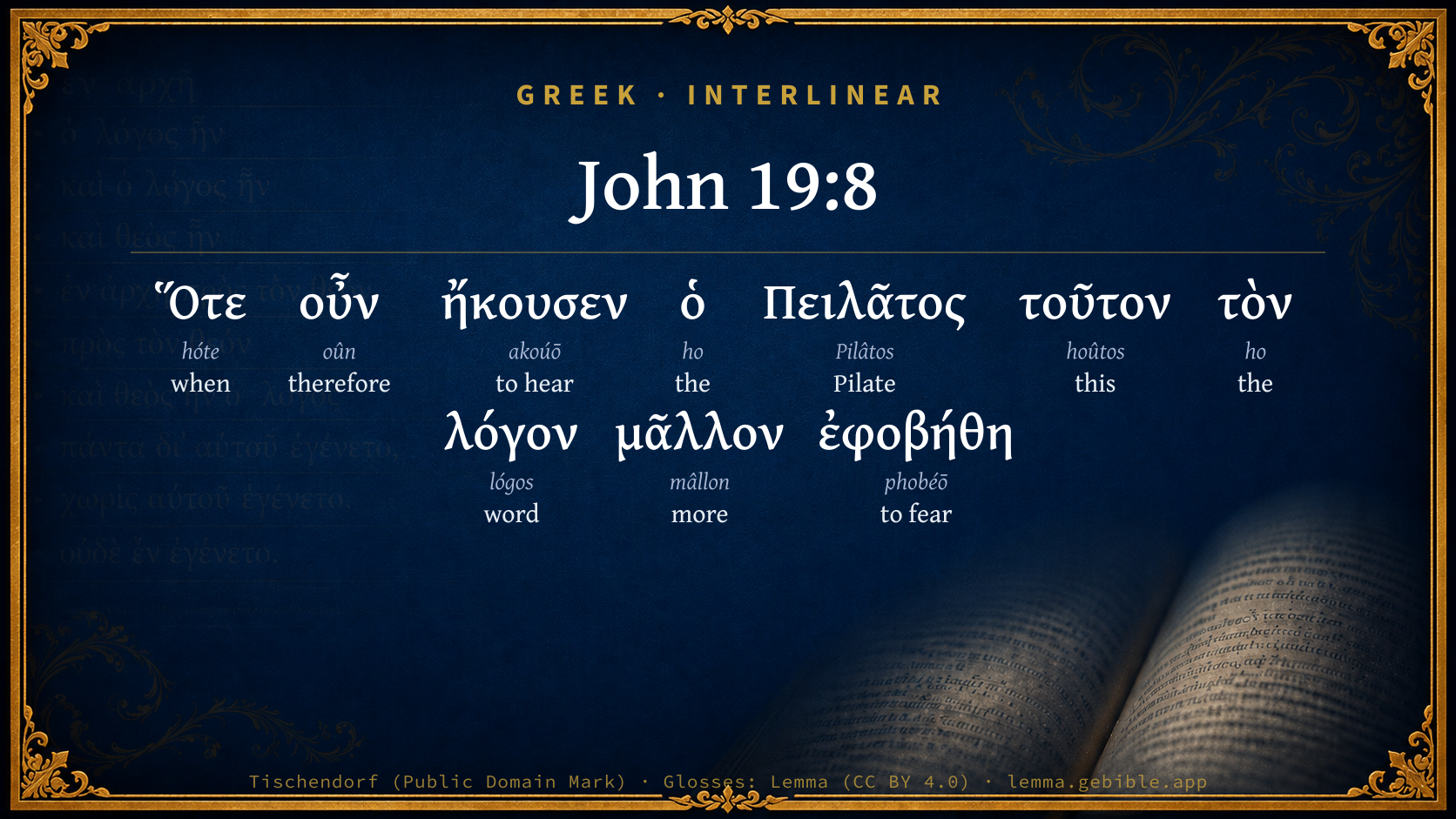
Greek (Tischendorf 8th ed.) John 19:8 appears in the Greek New Testament. The text above is from the Tischendorf 8th edition. Each word links to its Strong’s number and a concise gloss. Click any word for its full Thayer’s Greek Lexicon entry.
Download image
Cite this verse

John 19:8 (World English Bible). Public Domain. Lemma interlinear Bible study tool, https://lemma.gebible.app/v/john/19/8.

Show BibTeX & RIS
BibTeX
RIS
English Translation
When therefore Pilate heard this saying, he was more afraid.
World English Bible · Public Domain
Download a study sheet

One document with this verse’s original text, its word-by-word gloss line, the meaning frame, cross-references with their text, attributed commentary, and full source and license credits — printable, and it pastes into notes with its structure intact.

This verse Autodidact and up

Study sheet (.html) Plain text (.txt)

A passage Seminary Student

Up to 50 verses in one chapter. A passage sheet keeps up to 6 commentary sources and 12 cross-references per verse, in the order this page ranks them, and says so on the sheet whenever that leaves anything out. Ask for a single verse and you get the Autodidact verse sheet above.

Everything on this page stays free to read, with no account — the sheet is a download of what is already on screen, not access to it.

Want to remove ads? Support Godless Engineer
Compare translations 3

The same verse in 3 English versions, stacked beneath the original-language interlinear above. Click any original word for its lexicon entry.

Each is an independent rendering of the whole verse — the interlinear is not word-aligned to these translations.

Highlighted words mark where these versions differ — a whole-verse word diff, not a word-by-word alignment.

  • World English Bible Public Domain
    When therefore Pilate heard this saying, he was more afraid.
  • King James Version Public Domain
    When Pilate therefore heard that saying, he was the more afraid;
  • unfoldingWord Literal Text CC BY-SA 4.0
    Therefore, when Pilate heard this word, he became even more afraid,

unfoldingWord Literal Text — © unfoldingWord, licensed CC BY-SA 4.0. Word-aligned USFM3 via Door43 (git.door43.org/unfoldingWord/en_ult).

Versions to compare (up to 4)

3 of 4 selected

Show all 19 translations

Every available English version of this verse, each an independent rendering of the whole verse.

  • World English Bible Public Domain
    When therefore Pilate heard this saying, he was more afraid.
  • Berean Standard Bible Public Domain
    When Pilate heard this statement, he was even more afraid,
  • Majority Standard Bible Public Domain
    When Pilate heard this statement, he was even more afraid,
  • King James Version Public Domain
    When Pilate therefore heard that saying, he was the more afraid;
  • American Standard Version (1901) Public Domain
    When Pilate therefore heard this saying, he was the more afraid;
  • Revised Version (1885) Public Domain
    When Pilate therefore heard this saying, he was the more afraid;
  • Geneva Bible (1599) Public Domain
    When Pilate then heard that woorde, he was the more afraide,
  • Douay-Rheims (1899) Public Domain
    When Pilate therefore had heard this saying, he feared the more.
  • Young's Literal Translation Public Domain
    When, therefore, Pilate heard this word, he was the more afraid,
  • Literal Standard Version CC BY-SA 4.0
    When, therefore, Pilate heard this word, he was more afraid,
  • Unlocked Literal Bible CC BY-SA 4.0
    When Pilate heard this statement, he was even more afraid,
  • unfoldingWord Literal Text CC BY-SA 4.0
    Therefore, when Pilate heard this word, he became even more afraid,
  • Darby Bible Public Domain
    When Pilate therefore heard this word, he was the rather afraid,
  • World Messianic Bible Public Domain
    When therefore Pilate heard this saying, he was more afraid.
  • Webster's Bible Public Domain
    When Pilate therefore heard that saying, he was the more afraid;
  • Free Bible Version CC BY-SA 4.0
    When Pilate heard this he was more afraid than ever,
  • Bible in Basic English Public Domain
    When this saying came to Pilate's ears his fear became greater;
  • Text-Critical English NT CC BY 4.0
    When Pilate heard this, he was even more afraid.
  • Tyndale New Testament (1534) Public Domain
    When Pylate hearde that sayinge he was the moare afrayde

Literal Standard Version (2020), Covenant Press — licensed CC BY-SA 4.0. Text via the HelloAO Bible API (eBible.org). Unlocked Literal Bible (unfoldingWord) — licensed CC BY-SA 4.0. Text via the HelloAO Bible API (eBible.org). unfoldingWord Literal Text — © unfoldingWord, licensed CC BY-SA 4.0. Word-aligned USFM3 via Door43 (git.door43.org/unfoldingWord/en_ult). Free Bible Version, Dr. Jonathan Gallagher — licensed CC BY-SA 4.0. Text via the HelloAO Bible API (eBible.org).

Word by word

More ways to search: Search by grammar → Find every occurrence → Compare this word →

Practice this passage: Drill this verse → Learn its vocabulary →

About this verse

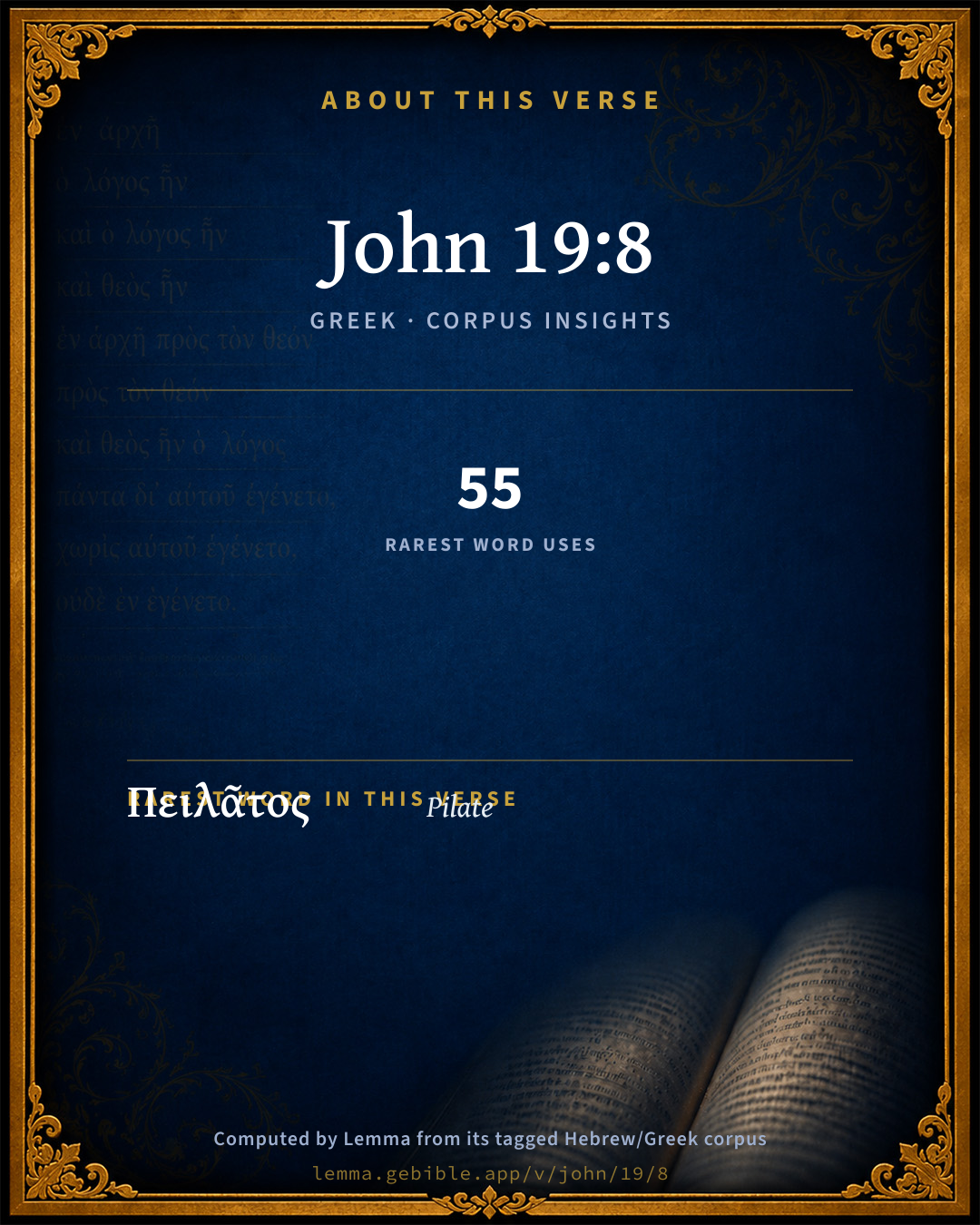
These counts appear in no published source. They are computed here, from the morphology-tagged text and Lemma’s own curated glosses. What Lemma adds →

10
words
9
distinct lemmas
Gospels
section

Shared distinctive vocabulary

Πειλᾶτος Pilate G4091 occurs in 53 verses of the Greek New Testament. Also found in:

Repetition

A word recurs within this verse:

Cross-references

2

Topical passages linked to John 19:8 in the Treasury of Scripture Knowledge — connected by theme and wording, ordered by reader-vote popularity; previews shown in the World English Bible.

  • John 19:13 When Pilate therefore heard these words, he brought Jesus out, and sat down on the judgment seat at a place called "The Pavement," but in Hebrew, "Gabbatha."
  • Acts 14:11–19 When the multitude saw what Paul had done, they lifted up their voice, saying in the language of Lycaonia, "The gods have come down to us in the likeness of men!"

Cross-references courtesy of OpenBible.info (CC BY 4.0).

Commentary

Notes on John 19:8 from classic Christian and Jewish commentators (each source and its license shown beneath its notes). The classic Christian expositions comment on the surrounding passage and are grouped to its opening verse, so a note may address several verses; the Jewish commentaries on the Tanakh (Rashi and others) are per-verse, so they appear only where the commentator wrote on this verse.

Lemma curates 59 commentaries, every one of them public domain or Creative Commons licensed, each selected and text-cleaned for this edition rather than reprinted as found. About our sources →

The Biblical Illustrator

Joseph S. Exell

Joh_19:8-12

When Pilate therefore heard that

Pilates second interview with Christ

I.

THE STARTLED INQUIRY--on the part of Pilate (Joh_19:9).

1. Its occasion

(1) Not the outcry of the Jews for Christs death. Pilate had already twice resisted that.

(2) Not the reminder that he, a governor, ought to respect their laws.

(3) But the intimation that Christ had called Himself The Son of God (Joh_19:7).

2. Its motive

(1) Not idle curiosity or angry impatience. The situation was too solemn for the former, too critical for the latter.

(2) Not horror at the supposed blasphemy. Pilate had not so high a religious consciousness.

(3) Not alarm lest he should be accused to Tiberius. It had not come to that yet.

(4) But semi-superstitious fear, lest Jesus, whose prefer-human greatness had impressed him, should after all be the offspring of some divinity--in which case it would be far from comfortable to him to fight against the gods.

3. Its import

(1) Not to what country dost thou belong? Pilate knew this.

(2) But of what race art Thou? human or divine? Next to Is there a God? the greatest question of the day.

II. MYSTERIOUS SILENCE--On the part of Christ (Joh_19:9).

1. Predicted (Isa_53:7).

2. Becoming. The question was

(1) Irrelevant. The problem before Pilate was that of Christs guilt or innocence, not of His origin.

(2) Unnecessary. Pilate had evidence enough, and had already decided that Jesus was without crime.

(3) Insincere Pilate was not prepared to accept the answer Christ might give. He had not done so on a former occasion (Joh_18:38).

(4) Too late. Pilate was not likely now to be able to extricate himself from the net in which he had been taken.

3. Eloquent--more significant than speech it proclaimed His Divine origin.

4. Perplexing. Pilate could not understand Him.

III. ANGRY REMONSTRANCE--On the part of Pilate (Joh_19:10).

1. Offended dignity. Pilate had marvelled greatly at his prisoners taciturnity when the mob first gnashed their teeth at Him (Mat_27:14); but was not he the embodiment of imperial authority, To me dost Thou not speak? putting ruffled pride and mortified vanity into his tones. Men whose causes and arguments are weak generally take shelter behind their self importance. Men commonly stand on their dignity when they have nothing else to stand on.

2. Mean intimidation. The vicegerent of Rome could not resist telling his prisoner that His life and death were in his hands! It was the speech of a small dignitary who was a great coward.

3. Mistaken assumption. Unjust judges and persecutors have often since supposed that they held the life of Christs followers and Christs cause: but they have erred as Pilate did.

IV. DIGNIFIED CORRECTION--on the part of Christ (Joh_19:11).

1. Pride rebuked. Pilate conceived of himself as a sort of deus minor invested with at least a delegated omnipotence: Christ tells Him that both he and Caesar were simply instruments by which God worked, and in particular that he had no power over Him except as the temporary holder of the magisterial office; and that it was owing to that circumstance entirely that he had anything to do with the case.

2. Error corrected. Whatever part Pilate had to play in this momentous drama and whatever authority he had to wield, he held it not from Caesar, who himself was a vassal of the King of kings, but from above Rom_13:1; Pro_8:15). Hence the exercise of that power was determined not by such an accident as the answer that might be extracted from Christ. A great and illuminating thought for Pilate.

3. Sin qualified. Pilate and his prisoner have changed places. Pilates sin was great--against evidence, conscience, heavens warning, and Christ could say nothing to underestimate these. Only He closes not the door of hope. In the transaction there had been a greater sinner--Caiaphas. In comparison with Pilates guilt that of the High Priest was as a mountain to a feather, an ocean to a stream. Lessons:

1. The judicial blindness into which an unbelieving soul may fall (2Co_3:4)--exemplified in the Jewish nation and the priests.

2. The paralysing fear of a guilty conscience (Job_18:11)--illustrated in Pilate.

3. The real reason why the Jews rejected Christ--He was not the sort of Messiah they wanted (1Co_1:23).

4. The dignified reticence with which heaven treats mens demands for more evidence--enough having been provided to enable all in earnest to decide the attitude they shall assume towards Christ (Luk_16:29; Luk_16:31).

5. The insufferable vanity which official dignity not unfrequently inspires in small souls.

6. The necessity of remembering that the source of all power and authority is God--to whom therefore all must eventually render account Rom_14:12).

7. The different degrees of culpability attaching to different sins Mat_11:22; Mat_11:24; Luk_12:47).

8. The duty of keeping silence (Jam_1:19). (T. Whitelaw, D. D.)

He was the more afraid.

Pilates fear

I. OF THE PEOPLE.

II. OF THE EMPEROR.

III. OF THE PRISONER. (S. S. Times.)

The cowardice of guilt

Men who have lost their innocence cannot preserve their courage. (Lord Clarendon.)

The Biblical Illustrator, edited by Joseph S. Exell (c. 1880s–1900s) — public domain. Text from a community e-Sword module.

Joseph Benson's Commentary

Joh 19:8-12. When Pilate heard that saying, he was the more afraid — He before feared to shed innocent blood, and now he became more afraid than ever to take his life; suspecting, probably, that the account which he heard of him might be true, and that he might be a divine person. For doubtless he had heard of some of the many miracles which Jesus had performed, and now, it seems, began to think that perhaps what had been currently reported was true, and that he really had performed the wonderful works ascribed to him. For it is very well known, that the religion which the governor professed directed him to acknowledge the existence of demi-gods and heroes, or men descended from the gods. Nay, the heathen believed that their gods themselves sometimes appeared on earth, in the form of men, Act 14:11-12. Pilate, therefore, went again into the judgment-hall — Being resolved to act cautiously; and saith unto Jesus, Whence art thou? — That is, From whom art thou descended? or what is this divine original which thou art charged with claiming? But Jesus — Knowing that his innocence was already apparent, even to the conviction of Pilate’s conscience; gave him no answer — To that question. Indeed, Pilate’s ordering, or allowing such cruelties to be inflicted on a person he knew to be innocent, rendered him unworthy of an answer. Then saith Pilate — Marvelling at his silence, and being displeased with it; Speakest thou not unto me? — Dost thou make me no reply, and not so much as speak to me in such a circumstance as this, in which thy life is so evidently concerned? Knowest thou not that I have power to crucify thee — To adjudge thee to that terrible death; and have power to release thee — If I please, notwithstanding all the clamourous demands of thine enemies? Jesus answered — With great calmness and mildness; Thou couldest have no power at all against me — For I have done nothing to expose myself to the power of any magistrate; except it were given thee — In an extraordinary way; from above — From the God of heaven, whose providence I acknowledge in all these events. Some have thought that the word ανωθεν, from above, refers to the situation of the temple, which stood much higher than the pretorium: and that it is as if Jesus had said, I know that whatever thou dost against me, is only in consequence of the sentence passed in yonder court held above, so that their guilt is greater than thine. But though this would very well account for the connection of the latter part of this verse, “I cannot think,” says Dr. Doddridge, “it altogether just; for had Providence permitted Pilate to seize Christ as one dangerous to Cesar’s dignity, he would have had as much power of putting him to death as he now had. It is therefore much more reasonable to suppose it refers to the permission of God’s providence.” Therefore he that delivered me unto thee — Namely, the Jewish high-priest, with his council, having far greater opportunities of being acquainted with God and his law than thou hast, and knowing, also, that I have done nothing amiss; hath the greater sin — Is more blameable than thou art. And from thenceforth Pilate sought to release him — That is, he was still further satisfied of the injustice of the prosecution, and of the innocence of Jesus, so that he endeavoured even more than before to have him released. For the reader will observe, that this was not the first attempt of Pilate to release Jesus. This evangelist himself tells us, (Joh 18:39,) that he had once before offered to release him. And the answer of the priests on this occasion corresponds thereto. They cried out, saying, If thou let this man go, thou art not Cesar’s friend — That is, thou art not faithful to the emperor; by which they insinuated that they would accuse him to his master, if he did not do his duty. This argument was weighty, and shook Pilate’s resolution to the foundation. He was frightened at the very thought of being accused to Tiberius, who in matters of government, as Tacitus and Suetonius testify, was apt to suspect the worst, and always punished the least crimes relative thereto with death. Whosoever maketh himself a king — Or rather, maketh, or calleth himself king, speaketh against Cesar. So Dr. Campbell reads the clause, observing, “the sentence is true, when βασιλεα [the word here used] is rendered king, but not when rendered a king. Judea, at that time, together with Syria, to which it was annexed, made a province of the empire. Nothing is more certain than that whoever in Judea called himself king, in the sense wherein the word was commonly understood, opposed Cesar. But it did not therefore hold, that whosoever called himself a king, opposed Cesar. For if the kingdom to which he laid claim was without the bounds of the Roman empire, the title in nowise interfered with the rights of the emperor.”

Joseph Benson's Commentary on the Old and New Testaments (1811–1818) — public domain. Text from a community e-Sword module.

Tyndale Open Study Notes

Tyndale Open Resources

19:8-9 Pilate . . . was more frightened than ever: He was superstitious, and the idea of gods appearing in the world was not uncommon (Acts 14:11). He sensed that more than a political fight was going on, so he asked Jesus, Where are you from? He did not mean Jesus’ birthplace, but whether Jesus was a divine man who had descended from heaven. • Why Jesus gave no answer is unclear. Perhaps it was because Pilate would not have been able to understand the answer—that true power comes only from God, and God had empowered Jesus (cp. John 19:11).

Tyndale Open Study Notes — © Tyndale Open Resources, licensed CC BY-SA 4.0. Text via the HelloAO Bible API.

Bengel's Gnomon

Johann Albrecht Bengel

Joh 19:8. Μᾶλλον, the more, rather) He did not assent to the Jews as to putting Jesus to death, but rather feared lest he should sin against the Son of God.

Bengel's Gnomon of the New Testament — English translation (T&T Clark, Edinburgh, 1860) — public domain. Text from a community e-Sword module.

Geneva Bible (1599)

Geneva Bible translators

Pilate’s conscience fighteth for Christ, but straightway it yieldeth, because it is not upholden with the singular virtue of God.

Geneva Bible (1599) marginal notes — public domain. Text via Bolls.life.

Jamieson, Fausset & Brown

Robert Jamieson, A. R. Fausset & David Brown

When Pilate . . . heard this saying, he was the more afraid--the name "SON OF GOD," the lofty sense evidently attached to it by His Jewish accusers, the dialogue he had already held with Him, and the dream of his wife (Mat 27:19), all working together in the breast of the wretched man.

Jamieson, Fausset & Brown — Commentary Critical and Explanatory on the Whole Bible (1871) — public domain (CC PDM 1.0). Text via the HelloAO Bible API.

Adam Clarke's Commentary

Verse 8. He was the more afraid] While Jesus was accused only as a disturber of the peace of the nation, which accusation Pilate knew to be false, he knew he could deliver him, because the judgment in that case belonged to himself; but when the Jews brought a charge against him of the most capital nature, from their own laws, he then saw that he had every thing to fear, if he did not deliver Jesus to their will. The Sanhedrin must not be offended-the populace must not be irritated: from the former a complaint might be sent against him to Caesar; the latter might revolt, or proceed to some acts of violence, the end of which could not be foreseen. Pilate was certainly to be pitied: he saw what was right, and he wished to do it; but he had not sufficient firmness of mind. He did not attend to that important maxim, Fiat justitia: ruat caelum. Let justice be done, though the heavens should be dissolved. He had a vile people to govern, and it was not an easy matter to keep them quiet. Some suppose that Pilate's fear arose from hearing that Jesus had said he was the Son of God; because Pilate, who was a polytheist, believed that it was possible for the offspring of the gods to visit mortals; and he was afraid to condemn Jesus, for fear of offending some of the supreme deities. Perhaps the question in the succeeding verse refers to this.

Adam Clarke's Commentary on the Bible (1810–1826) — public domain. Text from a community e-Sword/MySword module.

John Calvin's Commentaries

8. He was the more afraid. These words may be explained in two ways. The first is, that Pilate dreaded lest some blame should be imputed to him, if a tumult arose, because he had not condemned Christ. The second is, that, after having heard the name of the Son of God, his mind was moved by religion. This second view is confirmed by what immediately follows:

John Calvin's Commentaries (1540-1563) — public domain. Text from the Calvin Translation Society English edition (1840s-50s) via the Christian Classics Ethereal Library (ccel.org). Calvin's coverage is partial (roughly two-thirds of the Bible); uncommented books and verses are honest gaps, never fabricated. The 19th-century editor's footnotes and remarks are omitted so the notes are faithfully Calvin's own voice.

Ellicott's Commentary for English Readers

(8) When Pilate therefore heard that saying, he was the more afraid.—That is, as the verses which follow show, he was the more afraid because of his wonder who Jesus really was. He must have heard of some of the current impressions as to His life and words; he had himself heard Him claim a kingdom which is not of this world; his wife’s dream (Mat_27:19) had furnished an evil omen which the superstition of the most educated classes of the Roman empire would interpret as a message from the gods; and now the Jews speak of Him as one who claimed to be the Son of God. (Comp. Notes on the words of the Roman centurion in Mat_27:54.)

A Bible Commentary for English Readers, edited by Charles John Ellicott (1878–1897) — public domain. Text from a community e-Sword module.

The Cambridge Bible for Schools and Colleges

gen. ed. J. J. S. Perowne

8. that saying] Better, this word (logos), the charge of blasphemy.

he was the more afraid] The message from his wife and the awe which Christ’s presence was probably inspiring had already in some degree affected him. This mysterious claim still further excites his fears. Was it the offspring of a divinity that he had so infamously handled? Comp. Mat_27:54.

8–11. Inside the Praetorium; Christ’s origin is asked and not told; the origin of authority is told unasked.

The Cambridge Bible for Schools and Colleges (gen. ed. J. J. S. Perowne; Cambridge University Press, 1878–1918) — public domain. Text from a community e-Sword module.

John Gill's Exposition

When Pilate therefore heard that saying,.... That Jesus had asserted himself to be the Son of God, and that the Jews had a law to put such a person to death that was guilty of such blasphemy:

he was the more afraid; he was afraid to put him to death, or to consent to it before; partly on account of his wife's message to him, and partly upon a conviction of the innocence of Christ, in his own conscience: and now he was more afraid, since here was a charge brought against him he did not well understand the meaning of; and a law of theirs pretended to be violated hereby, which should he pay no regard to, might occasion a tumult, since they were already become very clamorous and noisy; and he might be the more uneasy, test the thing they charged him with asserting, should be really fact; that he was one of the gods come down in the likeness of man; or that he was some demi-god at least, or so nearly related to deity, that it might be dangerous for him to have anything to do with him this way: and in this suspicion he might be strengthened, partly from the writings of the Heathens, which speak of such sort of beings; and partly from the miracles he might have heard were performed by Jesus; and also by calling to mind what he had lately said to him, that his kingdom was not of this world, and that he was come into it to bear witness to the truth.

John Gill's Exposition of the Whole Bible (1746–1763) — public domain (CC PDM 1.0). Text via the HelloAO Bible API.

Trapp's Complete Commentary

John Trapp

8 When Pilate therefore heard that saying, he was the more afraid;

Ver. 8. He was the more afraid] Christ’s innocence did before triumph in Pilate’s conscience. But now, that he hears that he made himself the Son of God, he was in a mighty maze, "he was afraid," saith the text, of lifting up his hand against God. The greatest men, if not utterly debauched and satanized, cannot but quake at the apprehension of God: and as the worms, when it thunders, wriggle into the corners of the earth; Caligula (that dared his Jove to a duel with that hemistich in Homer, η μ αναειρ η εγω σε, Either kill me, or I will kill thee), when it thundered, covered his eyes with his cap, running under the bed or any bench hole. (Sueton. in Calig.)

John Trapp, A Commentary or Exposition upon All the Books of the Old and New Testament (1647–1656) — public domain. Text from a community e-Sword module.

Albert Barnes' Notes on the Bible

When Pilate therefore heard that saying - That they had accused him of blasphemy. As this was not the charge on which they had arraigned him before his bar, he had not before heard it, and it now convinced him more of their malignity and wickedness.

He was the more afraid - What was the ground of his fear is not declared by the evangelist. It was probably, however, the alarm of his conscience, and the fear of vengeance if he suffered such an act of injustice to be done as to put an innocent man to death. He was convinced of his innocence. He saw more and more clearly the design of the Jews; and it is not improbable that a pagan, who believed that the gods often manifested themselves to people, dreaded their vengeance if he suffered one who claimed to be divine, and who might be, to be put to death. It is clear that Pilate was convinced that Jesus was innocent; and in this state of agitation between the convictions of his own conscience, and the clamors of the Jews, and the fear of vengeance, and the certainty that he would do wrong if he gave him up, he was thrown into this state of alarm, and resolved again to question Jesus, that he might obtain satisfaction on the subjects that agitated his mind.

Albert Barnes' Notes on the Bible (1834–1885) — public domain. Text from a community e-Sword/MySword module.

Matthew Poole's English Annotations

It should seem that the Romans permitted judgments to the Jews according to their own laws, which the Roman governor was to see executed; or else, seeing the rabble in such a heat and disorder, he feared some breaking out.

Matthew Poole's English Annotations on the Holy Bible (1683–1685) — public domain. Text from a community e-Sword/MySword module.

Whedon's Commentary on the Bible

Daniel D. Whedon

8. The more afraid—That is, this expression so increased the awe of his former impression as to induce the following action, that he takes Jesus into the judgment hall for examination on this specific point.

Daniel D. Whedon (gen. ed.), Commentary on the Old and New Testaments (1874–1909) — public domain. Text from a community e-Sword module.

The Pulpit Commentary

Vers. 8-11. (f) Within the Praetorium. The fear of Pilate, and the apportionment of the measures of guilt by the majestic Sufferer.

When therefore Pilate heard this word he was more afraid, implying that John had seen all along that some element of "fear" had moved Pilate, and that now it was augmented. Superstition goes hand in hand with skepticism. Instead of this being (as Keim says) contrary to psychologic laws, the history of skepticism is constantly presenting the same features (cf. Herod Antipas the Sadducee, who would dogmatically have repudiated the idea of resurrection, crying out concerning Jesus, "It is John the Baptist, whom I beheaded: he is risen from the dead," etc.). We need not suppose that Pilate was suddenly affected by the truth of Jewish monotheism; but he may readily have believed that the wondrous Being before him was enshrouded in a mystery of supernatural portent and pretension that he could not fathom, and before which he trembled. The idea of Divine energy enshrined in and wielded by human beings was not altogether foreign to heathen thought and one centurion, at least, who was probably present on this very occasion, exclaimed that Jesus was a Son of God. (Mat_27:54)

The Pulpit Commentary (1880–1919), ed. H.D.M. Spence-Jones & Joseph S. Exell — public domain. Text from a community e-Sword module.

John Wesley's Explanatory Notes

He was the more afraid - He seems to have been afraid before of shedding innocent blood.

John Wesley, Explanatory Notes Upon the Whole Bible (1754–1765) — public domain. Text via the GEBible commentary corpus.

Cambridge Greek Testament for Schools and Colleges

8–11. Inside the Praetorium; Christ’s origin is asked and not told; the origin of authority is told unasked.

8. τ. τ. λόγον. This word: it is no mere ‘saying’ (ῥῆμα); like the word of Caiaphas, it has more meaning than the speakers know. It intensifies Pilate’s disquietude. The message from his wife and the awe which Christ’s presence was probably inspiring had already in some degree affected him. This mysterious claim still further excites his fears. Was it the offspring of a divinity that he had so infamously handled? Comp. Mat 27:54.

Cambridge Greek Testament for Schools and Colleges (Cambridge University Press, 1896; 21 vols, various authors incl. Carr, Maclear, Plummer, Farrar, Lumby, Moule, M. R. James, Simcox) — public domain. Text from a community e-Sword module.

Alford’s Greek Testament

Henry Alford

8.] This charge served to increase the fear which Pilate had before: see note on ch. 18:37. The name υἱὸς θεοῦ served also to confirm the omen already furnished by the dream of his wife. That this fear was not a fear of the Jews, nor of acting unjustly, but of the Person of Jesus, is evident from what follows.

Henry Alford, The Greek Testament (1849–1861) — public domain. Text from a community e-Sword module.

International Critical Commentary

8. ὅτε οὖν ἤκουσεν ὁ Πειλᾶτος τοῦτον τὸν λόγον κτλ. Observe that ἀκούειν followed by the acc. does not connote an intelligent hearing (see on 3:8); as Abbott says (Diat. 2586), “the hearing does not produce (upon Pilate) any result beyond emotion.”

μᾶλλον ἐφοβήθη, “he was more alarmed than he had been before” (see on 18:39).

International Critical Commentary — older volumes (1896–1929), various authors — public domain. Text from a community e-Sword module.

Vincent's Word Studies in the New Testament

Marvin R. Vincent

The more afraid. "These words of the Jews produced an effect on Pilate for which they were not prepared. The saying gives strength to a dreadful presentiment which was gradually forming within him. All that he had heard related of the miracles of Jesus, the mysterious character of His person, of His words and of His conduct, the strange message which he had just received from his wife - all is suddenly explained by the term" Son of God. "Was this extraordinary man truly a divine being who had appeared on the earth ? The truth naturally presents itself to his mind in the form of pagan superstitions and mythological legends" (Godet).

Marvin R. Vincent, Word Studies in the New Testament (1887–1900) — public domain. Text from a community e-Sword/MySword module.

Lesson kit

Teaching starters — assembled from the data on this page, not authored interpretation. Every prompt links to the verse data it draws on. Edit before teaching.

John, in the Gospels, opens this verse with 10 words (9 distinct Greek lemmas). Its most distinctive word is Pilâtos (“Pilate”). A historical commentator’s framing appears above. Read the whole chapter for the surrounding context.

Discussion questions

  1. What does “Pilate” (Pilâtos) contribute to the verse as a whole?
  2. How does Matthew 27:2, which shares the word «Pilate», read alongside this verse?
  3. What does the repetition of “the” (2× in this one verse) do in this verse?
  4. These translations render this verse differently; the difference is in the English rendering, not the original. What questions does that raise?
  5. Compare how The Biblical Illustrator and Joseph Benson's Commentary read this verse. Where do they agree or differ?

Things to notice

  • These translations choose different wording for 4 words in this verse.
  • “the” occurs 2× in this single verse.
  • 9 distinct Greek lemmas span 10 words in this verse.

Reading settings

Reading text

Shown beneath each verse's original-language words.

Old Testament
Old Testament edition

Read the OT as the Masoretic Hebrew (MT) or the Greek Septuagint (LXX).

English shown for the Greek Septuagint (in the Hebrew ↔ Greek comparison).

Comparing translations? Open the Compare panel on any verse page to stack up to four side by side.