Hebrews 4:2

Greek (Tischendorf 8th ed.) Hebrews 4:2 appears in the Greek New Testament. The text above is from the Tischendorf 8th edition. Each word links to its Strong’s number and a concise gloss. Click any word for its full Thayer’s Greek Lexicon entry.
Download image
Cite this verse

Hebrews 4:2 (World English Bible). Public Domain. Lemma interlinear Bible study tool, https://lemma.gebible.app/v/hebrews/4/2.

Show BibTeX & RIS
BibTeX
RIS
English Translation
For indeed we have had good news preached to us, even as they also did, but the word they heard didn't profit them, because it wasn't mixed with faith by those who heard.
World English Bible · Public Domain
Download a study sheet

One document with this verse’s original text, its word-by-word gloss line, the meaning frame, cross-references with their text, attributed commentary, and full source and license credits — printable, and it pastes into notes with its structure intact.

This verse Autodidact and up

Study sheet (.html) Plain text (.txt)

A passage Seminary Student

Up to 50 verses in one chapter. A passage sheet keeps up to 6 commentary sources and 12 cross-references per verse, in the order this page ranks them, and says so on the sheet whenever that leaves anything out. Ask for a single verse and you get the Autodidact verse sheet above.

Everything on this page stays free to read, with no account — the sheet is a download of what is already on screen, not access to it.

Want to remove ads? Support Godless Engineer
Compare translations 3

The same verse in 3 English versions, stacked beneath the original-language interlinear above. Click any original word for its lexicon entry.

Each is an independent rendering of the whole verse — the interlinear is not word-aligned to these translations.

Highlighted words mark where these versions differ — a whole-verse word diff, not a word-by-word alignment.

  • World English Bible Public Domain
    For indeed we have had good news preached to us, even as they also did, but the word they heard didn't profit them, because it wasn't mixed with faith by those who heard.
  • King James Version Public Domain
    For unto us was the gospel preached, as well as unto them: but the word preached did not profit them, not being mixed with faith in them that heard it.
  • unfoldingWord Literal Text CC BY-SA 4.0
    For we also are having good news proclaimed just as to them also. But the message of the hearing did not benefit them, not having been joined in faith with the ones having heard.

unfoldingWord Literal Text — © unfoldingWord, licensed CC BY-SA 4.0. Word-aligned USFM3 via Door43 (git.door43.org/unfoldingWord/en_ult).

Versions to compare (up to 4)

3 of 4 selected

Show all 19 translations

Every available English version of this verse, each an independent rendering of the whole verse.

  • World English Bible Public Domain
    For indeed we have had good news preached to us, even as they also did, but the word they heard didn't profit them, because it wasn't mixed with faith by those who heard.
  • Berean Standard Bible Public Domain
    For we also received the good news just as they did; but the message they heard was of no value to them, since they did not share the faith of those who comprehended it.
  • Majority Standard Bible Public Domain
    For we also received the good news just as they did; but the message they heard was of no value to them, since they did not share the faith of those who comprehended it.
  • King James Version Public Domain
    For unto us was the gospel preached, as well as unto them: but the word preached did not profit them, not being mixed with faith in them that heard it.
  • American Standard Version (1901) Public Domain
    For indeed we have had good tidings preached unto us, even as also they: but the word of hearing did not profit them, because it was not united by faith with them that heard.
  • Revised Version (1885) Public Domain
    For indeed we have had good tidings preached unto us, even as also they: but the word of hearing did not profit them, because they were not united by faith with them that heard.
  • Geneva Bible (1599) Public Domain
    For vnto vs was the Gospel preached as also vnto them: but the worde that they heard, profited not them, because it was not mixed with faith in those that heard it.
  • Douay-Rheims (1899) Public Domain
    For unto us also it hath been declared, in like manner as unto them. But the word of hearing did not profit them, not being mixed with faith of those things they heard.
  • Young's Literal Translation Public Domain
    for we also are having good news proclaimed, even as they, but the word heard did not profit them, not being mixed with faith in those who heard,
  • Literal Standard Version CC BY-SA 4.0
    for we also are having good news proclaimed, even as they, but the word heard did not profit them, not being mixed with faith in those who heard,
  • Unlocked Literal Bible CC BY-SA 4.0
    For we were told the good news just as they were. But that message did not benefit those who did not unite in faith with those who obeyed.
  • unfoldingWord Literal Text CC BY-SA 4.0
    For we also are having good news proclaimed just as to them also. But the message of the hearing did not benefit them, not having been joined in faith with the ones having heard.
  • Darby Bible Public Domain
    For indeed we have had glad tidings presented to us, even as they also; but the word of the report did not profit *them*, not being mixed with faith in those who heard.
  • World Messianic Bible Public Domain
    For indeed we have had good news preached to us, even as they also did, but the word they heard didn’t profit them, because it wasn’t mixed with faith by those who heard.
  • Webster's Bible Public Domain
    For to us was the gospel preached, as well as to them: but the word which they heard did not profit them, not being mixed with faith in them that heard it.
  • Free Bible Version CC BY-SA 4.0
    For we've heard the good news just like they did, but it didn't help them because they didn't accept and trust in what they heard.
  • Bible in Basic English Public Domain
    And, truly, the good news came to us, even as it did to them; but the hearing of the word did them no good, because they were not united in faith with the true hearers.
  • Text-Critical English NT CC BY 4.0
    For we also have received good news just as they did. But the message they heard did not benefit them, since they were not united by faith with those who listened.
  • Tyndale New Testament (1534) Public Domain
    For vnto vs was it declared as well as vnto them. But it proffited not them that they hearde the worde because they which hearde it coupled it not with fayth.

Literal Standard Version (2020), Covenant Press — licensed CC BY-SA 4.0. Text via the HelloAO Bible API (eBible.org). Unlocked Literal Bible (unfoldingWord) — licensed CC BY-SA 4.0. Text via the HelloAO Bible API (eBible.org). unfoldingWord Literal Text — © unfoldingWord, licensed CC BY-SA 4.0. Word-aligned USFM3 via Door43 (git.door43.org/unfoldingWord/en_ult). Free Bible Version, Dr. Jonathan Gallagher — licensed CC BY-SA 4.0. Text via the HelloAO Bible API (eBible.org).

Word by word

More ways to search: Search by grammar → Find every occurrence → Compare this word →

Practice this passage: Drill this verse → Learn its vocabulary →

συνκεκερασμένος
synkeránnymi
G4786
“to mix together”
Verb, Perfect, Passive, Participle, Nominative, Singular, Masculine
Part of Speech
Verb
Tense
Perfect
Voice
Passive
Mood
Participle
Case
Nominative
Number
Singular
Gender
Masculine
Full Thayer's Definition

Origin: from G4862 and G2767

TDNT: None

1. to mix together, commingle 2. to unite a. caused the several parts to combine into an organic structure, which is the body b. to unite one thing to another
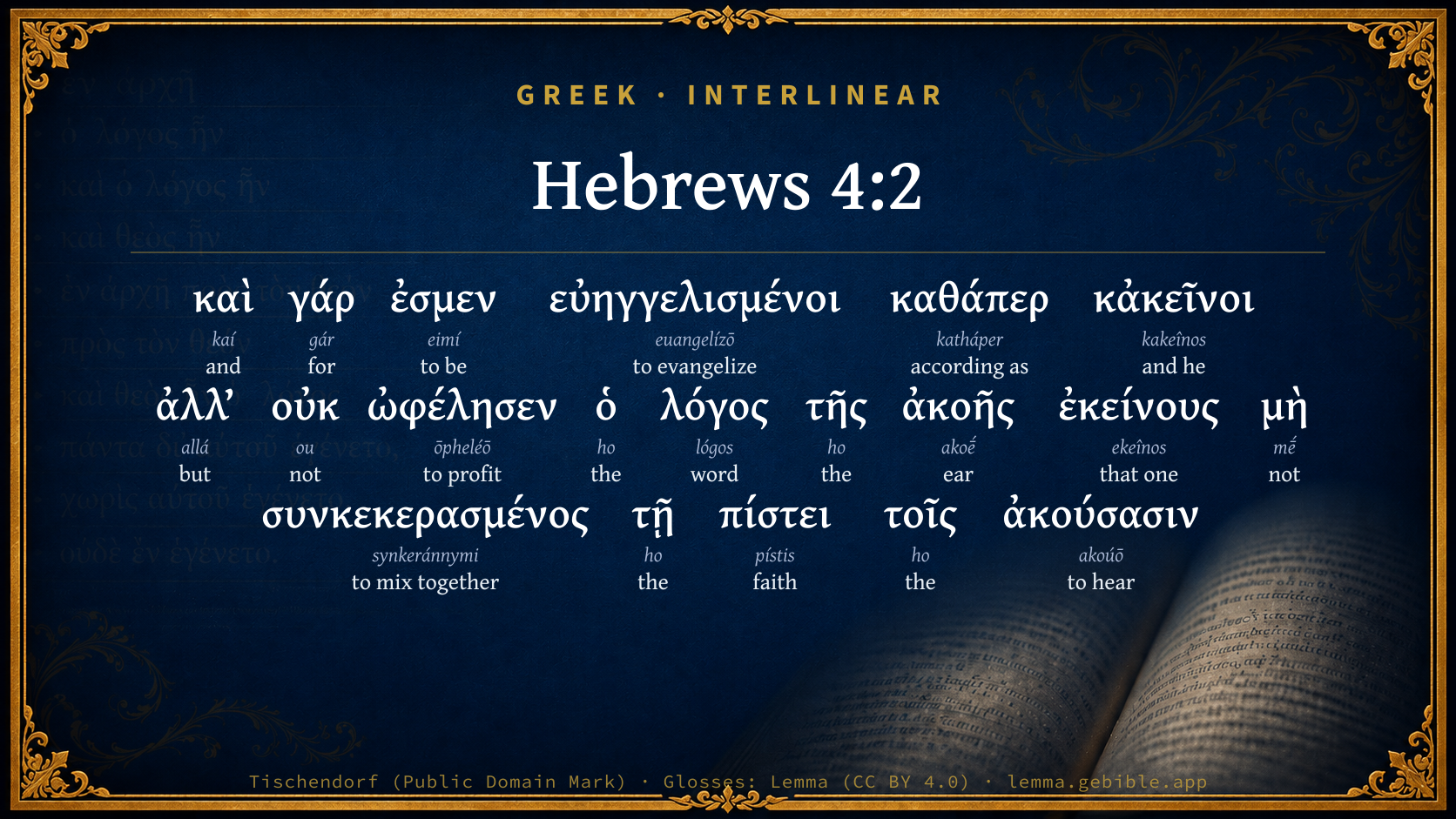
  1. καὶ kaí G2532 “and” Conjunction
  2. γάρ gár G1063 “for” Conjunction
  3. ἐσμεν eimí G1510 “to be” Verb, Present, Active, Indicative, 1st person, Plural
  4. εὐηγγελισμένοι euangelízō G2097 “to evangelize” Verb, Perfect, Passive, Participle, Nominative, Plural, Masculine
  5. καθάπερ katháper G2509 “according as” Adverb
  6. κἀκεῖνοι kakeînos G2548 “and he” Demonstrative pronoun, Nominative, Plural, Masculine, Aramaic form
  7. ἀλλ’ allá G235 “but” Conjunction
  8. οὐκ ou G3756 “not” Particle, Negative
  9. ὠφέλησεν ōpheléō G5623 “to profit” Verb, Aorist, Active, Indicative, 3rd person, Singular
  10. ὁ ho G3588 “the” Article, Nominative, Singular, Masculine
  11. λόγος lógos G3056 “word” Noun, Nominative, Singular, Masculine
  12. τῆς ho G3588 “the” Article, Genitive, Singular, Feminine
  13. ἀκοῆς akoḗ G189 “ear” Noun, Genitive, Singular, Feminine
  14. ἐκείνους ekeînos G1565 “that one” Demonstrative pronoun, Accusative, Plural, Masculine
  15. μὴ mḗ G3361 “not” Particle, Negative
  16. τῇ ho G3588 “the” Article, Dative, Singular, Feminine
  17. πίστει pístis G4102 “faith” Noun, Dative, Singular, Feminine
  18. τοῖς ho G3588 “the” Article, Dative, Plural, Masculine
  19. ἀκούσασιν akoúō G191 “to hear” Verb, Aorist, Active, Participle, Dative, Plural, Masculine

About this verse

These counts appear in no published source. They are computed here, from the morphology-tagged text and Lemma’s own curated glosses. What Lemma adds →

20
words
17
distinct lemmas
General Epistles
section

Notable vocabulary

The rarest word here is συνκεκερασμένος to mix together G4786 — appearing just 2 times in the whole Greek New Testament.

Shared distinctive vocabulary

συνκεκερασμένος to mix together G4786 occurs in 2 verses of the Greek New Testament. Also found in:

Repetition

A word recurs within this verse:

Cross-references

14

Topical passages linked to Hebrews 4:2 in the Treasury of Scripture Knowledge — connected by theme and wording, ordered by reader-vote popularity; previews shown in the World English Bible.

  • 1 Thessalonians 2:13 For this cause we also thank God without ceasing, that, when you received from us the word of the message of God, you accepted it not as the word of men, but, as it is in truth, the word of God, which also works in you who believe.
  • Romans 10:16–17 But they didn't all listen to the glad news. For Isaiah says, "Lord, who has believed our report?"
  • Hebrews 11:6 Without faith it is impossible to be well pleasing to him, for he who comes to God must believe that he exists, and that he is a rewarder of those who seek him.
  • Hebrews 3:18–19 To whom did he swear that they wouldn't enter into his rest, but to those who were disobedient?
  • 1 Timothy 4:8 For bodily exercise has some value, but godliness has value for all things, having the promise of the life which is now, and of that which is to come.
  • Acts 13:46 Paul and Barnabas spoke out boldly, and said, "It was necessary that God's word should be spoken to you first. Since indeed you thrust it from you, and judge yourselves unworthy of eternal life, behold, we turn to the Gentiles.
  • James 1:21 Therefore, putting away all filthiness and overflowing of wickedness, receive with humility the implanted word, which is able to save your souls.
  • Romans 2:25 For circumcision indeed profits, if you are a doer of the law, but if you are a transgressor of the law, your circumcision has become uncircumcision.
  • 1 Corinthians 13:3 If I dole out all my goods to feed the poor, and if I give my body to be burned, but don't have love, it profits me nothing.
  • Hebrews 3:12 Beware, brothers, lest perhaps there be in any one of you an evil heart of unbelief, in falling away from the living God;
  • Hebrews 4:6 Seeing therefore it remains that some should enter therein, and they to whom the good news was before preached failed to enter in because of disobedience,
  • Galatians 3:8 The Scripture, foreseeing that God would justify the Gentiles by faith, preached the Gospel beforehand to Abraham, saying, "In you all the nations will be blessed."
  • 1 Thessalonians 1:5 and that our Gospel came to you not in word only, but also in power, and in the Holy Spirit, and with much assurance. You know what kind of men we showed ourselves to be among you for your sake.
  • 1 Peter 1:12 To them it was revealed, that not to themselves, but to you, did they minister these things, which now have been announced to you through those who preached the Gospel to you by the Holy Spirit sent out from heaven; which things angels desire to look into.

Cross-references courtesy of OpenBible.info (CC BY 4.0).

Commentary

Notes on Hebrews 4:2 from classic Christian and Jewish commentators (each source and its license shown beneath its notes). The classic Christian expositions comment on the surrounding passage and are grouped to its opening verse, so a note may address several verses; the Jewish commentaries on the Tanakh (Rashi and others) are per-verse, so they appear only where the commentator wrote on this verse.

Lemma curates 59 commentaries, every one of them public domain or Creative Commons licensed, each selected and text-cleaned for this edition rather than reprinted as found. About our sources →

Tyndale Open Study Notes

Tyndale Open Resources

4:2 This good news is the message of salvation (2:3-4). • they didn’t share the faith of those who listened to God: Some manuscripts read they didn’t combine what they heard with faith. In either case, the hearers were deficient in faith, distrusting God’s word of promise.

Tyndale Open Study Notes — © Tyndale Open Resources, licensed CC BY-SA 4.0. Text via the HelloAO Bible API.

Bengel's Gnomon

Johann Albrecht Bengel

Heb 4:2. Γὰρ, for) This refers to φοβηθῶμεν, let us fear.—εὐηγγελισμένοι, to us was the Gospel preached [we have had the Gospel preached to us]) We should think that this expression is spoken especially to us, who are called Evangelical: Heb 4:6.—κᾀκεῖνοι [as well as they], as well as to them) The promise of the land of Canaan had been proclaimed to those men of old, Heb 4:6.—οὐκ ὠφέλησεν, did not profit) There is less said here than is intended (Meiosis). On the contrary [so far was it from profiting them], the unbelievers incurred the greatest guilt and punishment. Supply, nor will it be profitable to us without faith.—μὴ συγκεκραμένος, not being mixed with) The word is entirely mixed with and insinuated into the believing soul; and when it is thus mingled, it makes its way wonderfully, as a health-giving draught, and something more powerful even than that, Heb 4:12-13.—τῇ πίστει) with faith, the dative.—τοῖς ἀκούσασιν) So far as concerns them that heard it. Comp. Rom 4:12, note. To these are opposed οἱ πιστεύσαντες, those who believed, in the following verse.

Bengel's Gnomon of the New Testament — English translation (T&T Clark, Edinburgh, 1860) — public domain. Text from a community e-Sword module.

Meyer's Critical & Exegetical Commentary

Heinrich August Wilhelm Meyer

Heb_4:2 corroborates in its first half the καταλειπομένης, Heb_4:1, while the second half shows the danger of the ὑστερηκέναι in the example of others. The emphasis in the first half lies upon ἐσμὲν εὐηγγελισμένοι. The sense is not: for we, too, like them, have promise (to express this the addition of ἡμεῖς after καὶ γάρ would have been called for), but: for promise (sc. of entering into the κατάπαυσις, cf. Heb_4:1; Heb_4:3) have we indeed, even as they (the fathers), sc. had it.

Most arbitrarily is the meaning of this and the following verse apprehended by Ebrard. According to Ebrard, Heb_4:2 ff. proclaims as the reason why the Jews did not attain the promised κατάπαυσις, not their subjective unbelief, but the objective imperfection of the Old Testament revelation. With the second half of Heb_4:2, namely, a gradation (!) is supposed to begin, and the progress of thought to be as follows: The word which we have received is even infinitely better than the word which the Israelites received through Moses. For, first, the word spoken by Moses was unable to bring the people to faithit remained external to them; it set forth a promise, it is true, and also attached a condition, but it communicated no strength to fulfil this condition (Heb_4:2-5, comp. Heb_4:12-13); but, secondly, the promise there given was not even in its purport the true one; there, earthly rest was promised; here, spiritual and everlasting rest (Heb_4:6-10). That the context affords no warrant for the bringing out of such a meaning is self-evident. For neither does the author here distinguish such twofold word of promise, nor a twofold κατάπαυσις, nor can λόγος … μὴ συγκεκραμένος signify a word which could not prove binding.

Erroneous, too, is the view of the connection on the part of Delitzsch, to whom Riehm (Lehrbegr. des Hebräerbr. p. 798 ff.) accedes in all essential particulars. According to Riehm, the (as yet unproved) presupposition is first provisionally expressed in the parenthesis, Heb_4:1, in a simply assertory manner, viz. that there is still in existence a promise of entering into the rest of God, a promise of which the fulfilment is yet outstanding, and this presupposition is then repeated, Heb_4:2, in other expressions of a more general bearing, no doubt, but essentially in the same way of simple assertion. Upon this, however, the author now wishes to furnish proof that such presupposition is fully warranted. Accordingly, Heb_4:3, he formulates that presupposition in the most definite manner, inasmuch as in the opening words of Heb_4:3, εἰσερχόμεθα … πιστεύσαντες, he lays down the theme which is to be proved in the sequel. This proof is afforded in the following way: the rest of God has existed long; nevertheless, in the oath of God, mentioned in the words of the psalm, a rest of God is spoken of as yet future, and of a truth it is one and the same rest of God which, according to Gen_2:2in so far as God enjoys it alonehas existed from the beginning of the world, and, according to the word of the psalm,in so far as the people of God are to participate therein,is one yet approaching. Although thus the long present rest of God was the aim and end of the creative activity of God, yet it is not the final aim which God has proposed to Himself. On the contrary, it is clearly apparent, from a comparison of the word of God pronounced upon the Israelites in the time of Moses, a word confirmed by an oath, with the account of the rest of God on the seventh day, that, according to the gracious designs of God, the rest, which He has enjoyed alone from the foundation of the world, should eventually become a rest of God which He enjoys in communion with His people. It is therefore indubitably certain, that even after the completion of the work of creation and the ensuing of the rest of God, there is still something outstanding [unfulfilled], an ἀπολειπόμενον, and this consists in the fact that some, received by God into communion with Himself, are made partakers of that repose of God. This view is a mistaken one, because(1) As regards the assumed proof, the assertion that in the oath of God, spoken of in the words of the psalm, mention is made of a yet future rest of God, is entirely untrue. Not of a particular form of the rest of God, which is still future, is the discourse, but only the fact is represented as future that it is shared on the part of men who enter into it. For a rest of God which has already existed long is not opposed to a rest of God which is still future, nor is the rest of God, mentioned. Genesis 2., distinguished as of another kind than that mentioned in the psalm. On the contrary, the rest of God, orwhat is identical therewiththe Sabbath-rest of God, has existed in fact and without change from the time of the completion of the works of creation, and this same rest of God it is, the participation in which was once promised to the Israelites on the condition of faith, and now upon the same condition is promised to the Christians; it is a question therefore only of the Christians taking warning from the example of the fathers, and not, like them, losing the promised blessing through unbelief. (2) That the author was desirous of still proving the καταλείπεσθαι ἐπαγγελίαν, cannot at all be supposed. For this was a fact which, as self-evident from that which precedes, stood in no need of a demonstration; it is therefore expressed not only Heb_4:1, but also Heb_4:6, in a mere subsidiary clause, consequently in the form of logical subordination; and even Heb_4:9, in which it is introduced in an apparently independent form, decides nothing against our explanation, because Heb_4:9, while forming a certain conclusion to that which precedes, yet contains only the logical substructure for the exhortation attaching itself afresh at Heb_4:11. That at which the author alone aimed, in connection with Heb_4:2 ff., was therefore the impressive confirmation of the paraenesis, Heb_4:1; and just this paraenetic main tendency of our section likewise fails of attaining due recognition in connection with the explanation of Delitzsch and Riehm. But when Delitzsch thinks he can support his view, that the καταλειπομένης ἐπαγγελίας, Heb_4:1, is first proved in the sequel, by declaring the otherwise to be accepted thought that the promise of entering into Gods rest has remained without its fulfilment in the generation of the wilderness, and thus is still valid, to be entirely false, and exclaims: What logic that would be! The generation of the wilderness perished indeed, but the younger generation entered into Canaan, came to Shiloh (the place in the heart of the land, which has its name from the rest, Jos_18:1), and had now its own fixed land of habitation, whither Jehovah had brought and planted it, and where He fenced it in (2Sa_7:10); such conclusion would be justified only if the author had not understood the promise given to the fathers in the time of Moses, of entering into Gods κατάπαυσις, at the same time in a higher sense, but had regarded it as fulfilled by the occupation of Canaan under Joshua; such, however, according to the distinct statement of Heb_4:8, is not the case.

καί] after καθάπερ, the ordinary καί after particles of comparison. See Winer, Gramm., 7 Aufl. p. 409.

ὁ λόγος τῆς ἀκοῆς] Periphrasis of the notion ἐπαγγελία, Heb_4:1 : the word of that which is heard (ἀκοή in the passive sense, as Rom_10:16; Gal_3:2; 1Th_2:13; Joh_12:38), i.e. the word of promise which was heard by them, or proclaimed to them. This periphrasis is chosen in order already at this stage to point out that it was by the fault of the fathers themselves that the word of promise became for them an unprofitable word, one which did not receive its fulfilment. It remained for them a word heard only externally, whereas, if it was to profit them, they must manifest receptiveness for the same, must believingly and confidingly appropriate the same. This culpability on the part of the fathers themselves is brought into direct relief by the participial clause μὴ συγκεκραμένος τῇ πίστει τοῖς ἀκούσασιν, containing the indication of cause to οὐκ ὠφέλησεν, wherein τῇ πίστει forms an emphatic opposition to the preceding τῆς ἀκοῆς. The sense is: because it was not for the hearers mingled with faith; the dative τοῖς ἀκούσασιν denoting the subject, in relation to which the μὴ συγκ. τῇ πίστει took place. See Winer, Gramm., 7 Aufl. p. 206. Thus interpret Erasmus, translation, Calvin, Castellio, Gerhard, Owen, Calov, Limborch, Bengel, Kypke, Storr, Stuart, Reiche, Comm. Crit. p. 30; Riehm, Lehrbegr. des Hebräerbr. p. 696, note; Maier, and others.[63] But that the fault of this not being mingled was not in the word but in the men, was naturally understood from the connection. συγκεκραμένος is not to be connected with τοῖς ἀκούσασιν, so that τῇ πίστει would have to be taken as the dativus instrumentalis: because it did not, by means of faith, mingle with them that heard it, become fully incorporated with them (Schlichting, Jac. Cappellus, Dorscheus, S. Schmidt, Wolf, Rambach, Michaelis, Carpzov, Chr. Fr. Schmid, Valckenaer, Klee, Paulus, Stein, Delitzsch, Moll, Kurtz, Hofmann, Woerner). For manifestly the centres of thought for the adversative clause lie in τῆς ἀκοῆς and τῇ πίστει, while τοῖς ἀκούσασιν only takes up again the indication of the persons, already known to us from the ἐκείνους, although now as characterizing these persons in attaching itself to τῆς ἀκοῆς.

τοῖς ἀκούσασιν, however, not the mere demonstrative pronoun, is put by the author in order thus once more to place hearing and believing in suggestive contrast. Further, the author did not write μὴ συγκεκραμένος τῇ πίστει τῶν ἀκουσάντων, because he would thereby have conveyed the impression that the Israelites in the wilderness possessed indeed πίστις, but the word of promise which was heard did not blend into a unity with the same; whereas by means of μὴ συγκεκραμένος τῇ πίστει τοῖς ἀκούσασιν he denies altogether the presence of πίστις in them.

[63] Heinsius, Semler, Kuinoel, al., take τοῖς ἀκούσασιν as equivalent to ὑπὸ τῶν ἀκουσάντων, which is open to no grammatical objection (cf. Winer, Gramm., 7 Aufl. p. 206), and makes no alteration in the sense.

Meyer — Critical and Exegetical Commentary on the New Testament — English translation by Peter Christie, edited by Frederick Crombie (T&T Clark, 1880) — public domain. Text from a community e-Sword module.

Geneva Bible (1599)

Geneva Bible translators

He compareth the preaching of the Gospel to drink, which being drunk, that is to say, heard, profiteth nothing, unless it be tempered with faith.

By these words, His voice, he showeth that David meant the preaching of Christ, who was then also preached, for Moses and the Prophets respected none other.

Geneva Bible (1599) marginal notes — public domain. Text via Bolls.life.

Jamieson, Fausset & Brown

Robert Jamieson, A. R. Fausset & David Brown

gospel preached . . . unto them--in type: the earthly Canaan, wherein they failed to realize perfect rest, suggesting to them that they should look beyond to the heavenly land of rest, to which faith is the avenue, and from which unbelief excludes, as it did from the earthly Canaan.

the word preached--literally, "the word of hearing": the word heard by them.

not being mixed with faith in them that heard--So the Syriac and the Old Latin Versions, older than any of our manuscripts, and LUCIFER, read, "As the world did not unite with the hearers in faith." The word heard being the food which, as the bread of life, must pass into flesh and blood through man's appropriating it to himself in faith. Hearing alone is of as little value as undigested food in a bad stomach [THOLUCK]. The whole of oldest extant manuscript authority supports a different reading, "unmingled as they were (Greek accusative case agreeing with 'them') in faith with its hearers," that is, with its believing, obedient hearers, as Caleb and Joshua. So "hear" is used for "obey" in the context, Heb 4:7, "To-day, if ye will hear His voice." The disobedient, instead of being blended in "the same body," separated themselves as Korah: a tacit reproof to like separatists from the Christian assembling together (Heb 10:25; Jde 1:19).

Jamieson, Fausset & Brown — Commentary Critical and Explanatory on the Whole Bible (1871) — public domain (CC PDM 1.0). Text via the HelloAO Bible API.

Adam Clarke's Commentary

Verse 2. For unto us was the Gospel preached] Και γαρ εσμεν ευηγγελισμενοι. For we also have received good tidings as well as they. They had a gracious promise of entering into an earthly rest; we have a gracious promise of entering into a heavenly rest. God gave them every requisite advantage; he has done the same to us. Moses and the elders spoke the word of God plainly and forcibly to them: Christ and his apostles have done the same to us. They might have persevered; so may we: they disbelieved, disobeyed, and fell: and so may we.

But the word preached did not profit them] Αλλ ουκ ωφελησεν ὁ λογος της ακοης εκεινους. But the word of hearing did not profit them. The word and promise to which the apostle most probably refers is that in De 1:20; De 1:21: Ye are come unto to the mountain of the Amorites, which the Lord our God doth give unto to us. Behold, the Lord thy God hath set the land before thee; go up and possess it, as the Lord God of thy fathers hath said unto thee: fear not. Many exhortations they had to the following effect: Arise, that we may go up against them; for we have seen the land, and, behold, it is very good: and are ye still? Be not slothful to go, and to enter to possess the land; for God hath given it into your hands; a place where there is no want of any thing that is in the earth; Jdg 18:9-10. But instead of attending to the word of the Lord by Moses, the whole congregation murmured against him and Aaron, and said one to another, Let us make a captain, and let us return into Egypt; Nu 14:2; Nu 14:4. But they were dastardly through all their generations. They spoke evil of the pleasant land, and did not give credence to his word. Their minds had been debased by their Egyptian bondage, and they scarcely ever arose to a state of mental nobility.

Not being mixed with faith in them that heard] There are several various readings in this verse, and some of them important. The principal are on the word συγκεκραμενος, mixed; which in the common text refers to ο λογος, the word mixed; but, in ABCD and several others, it is συγκεκραμενους, referring to, and agreeing with, εκεινους, and may be thus translated: The word of hearing did not profit them, they not being mixed with those who heard it by faith. That is, they were not of the same spirit with Joshua and Caleb. There are other variations, but of less importance; but the common text seems best.

The word συγκεκραμενος, mixed, is peculiarly expressive; it is a metaphor taken from the nutrition of the human body by mixing the aliment taken into the stomach with the saliva and gastric juice, in consequence of which it is concocted, digested, reduced into chyle, which, absorbed by the lacteal vessels, and thrown into the blood, becomes the means of increasing and supporting the body, all the solids and fluids being thus generated; so that on this process, properly performed, depend (under God) strength, health, and life itself. Should the most nutritive aliment be received into the stomach, if not mixed with the above juices, it would be rather the means of death than of life; or, in the words of the apostle, it would not profit, because not thus mixed. Faith in the word preached, in reference to that God who sent it, is the grand means of its becoming the power of God to the salvation of the soul. It is not likely that he who does not credit a threatening, when he comes to hear it, will be deterred by it from repeating the sin against which it is levelled; nor can he derive comfort from a promise who does not believe it as a pledge of God's veracity and goodness. Faith, therefore, must be mixed with all that we hear, in order to make the word of God effectual to our salvation.

This very use of the word, and its explanation, we may find in Maximus Tyrius, in his description of health, Dissert. x., page 101. "Health," says he, it is a certain disposition ὑγρων και ξηρων και ψυχρων και θερμων δυναμεων, η ὑπο τεχνης συγκραθεισων καλως, η ὑπο φυσεως ἁρμοσθεισων τεχνικως, which consists in a proper mixture together of the wet and the dry, the cold and the hot, either by an artificial process, or by the skilful economy of nature."

Adam Clarke's Commentary on the Bible (1810–1826) — public domain. Text from a community e-Sword/MySword module.

John Calvin's Commentaries

2. For to us, etc. He reminds us that the doctrine by which God invites us to himself at this day is the same with that which he formerly delivered to the fathers; and why did he say this? That we may know that the calling of God will in no degree be more profitable to us than it was to them, except we make it sure by faith. This, then, he concedes, that the Gospel is indeed preached to us; but lest we should vainly glory, he immediately adds that the unbelieving whom God had formerly favored with the participation of so great blessings, yet received from them no fruit, and that therefore we also shall be destitute of his blessing unless we receive it by faith. He repeats the word hear for this end, that we may know that hearing is useless except the word addressed to us be by faith received.

But we must here observe the connection between the word and faith. It is such that faith is not to be separated from the word, and that the word separated from faith can confer no good; not indeed that the efficacy or power of the word depends on us; for were the whole world false, he who cannot lie would still never cease to be true, but the word never puts forth its power in us except when faith gives it an entrance. It is indeed the power of God unto salvation, but only to those who believe. (Romans 1:16.) There is in it revealed the righteousness of God, but it is from faith to faith. Thus it is that the word of God is always efficacious and saving to men, when viewed in itself or in its own nature; but no fruit will be found except by those who believe.

As to a former statement, when I said that there is no faith where the word is wanting, and that those who make such a divorce wholly extinguish faith and reduce it to nothing, the subject is worthy of special notice. For it hence appears evident that faith cannot exist in any but in the children of God, to whom alone the promise of adoption is offered. For what sort of faith have devils, to whom no salvation is promised? And what sort of faith have all the ungodly who are ignorant of the word? The hearing must ever precede faith, and that indeed that we may know that God speaks and not men.

John Calvin's Commentaries (1540-1563) — public domain. Text from the Calvin Translation Society English edition (1840s-50s) via the Christian Classics Ethereal Library (ccel.org). Calvin's coverage is partial (roughly two-thirds of the Bible); uncommented books and verses are honest gaps, never fabricated. The 19th-century editor's footnotes and remarks are omitted so the notes are faithfully Calvin's own voice.

Ellicott's Commentary for English Readers

(2) For unto us was.—Rather, for we have had glad tidings preached unto us, even as they had. The object of these words is to support Heb_4:1, “a promise being left.” How fitly the good news of the promise might, alike in their case and in ours, be designated by the same word as the “gospel,” will afterwards appear.

The word preached.—Literally, the word of hearing, i.e., the word which was heard (1Th_2:13). But this does not mean the word heard by them. As in Isa_53:1 (where the same word is found in the Greek version) the meaning is “our message,” “that which we have heard from God,” so here the words signify what was heard by those who declared the promise to the people, especially the message which Moses received from God.

Not being mixed with faith.—A change of reading in the Greek, which rests on the strongest authority, compels us to connect these words, not with the message, but with the people: “since they had not been united (literally, mingled) by faith with them that heard.” That the word of Moses and those associated with him in declaring God’s promise (perhaps Aaron, Joshua, Caleb) might benefit the people, speakers and hearers must be united by the bond of faith. Here the margin of the Authorised version preserves the true text, following the Vulgate and the earliest of the printed Greek Testaments (the Complutensian).

A Bible Commentary for English Readers, edited by Charles John Ellicott (1878–1897) — public domain. Text from a community e-Sword module.

The Cambridge Bible for Schools and Colleges

gen. ed. J. J. S. Perowne

2. For unto us was the gospel preached, as well as unto them] We should have expected rather “For unto them, as well as unto us,” if this had been the right translation. The better version however is “For indeed we too, just as they, have had a Gospel preached unto us.” The “Gospel” in this instance means the glad tidings of a future rest.

the word preached] Lit. “the word of hearing.” The function of the hearer is no less necessary than that of the preacher, if the spoken word is to be profitable.

not being mixed with faith in them that heard it] There is an extraordinary diversity in the MS. readings here. The best supported seems to be “because they were not united (lit. ‘tempered together’) by faith with them that heard (i.e. effectually listened to) it.” This would mean that the good news of rest produced no benefit to the rebellious Israelites, because they were not blended with Caleb and Joshua in their faith. They heard, but only with the ears, not with the heart. But there is probably some ancient corruption of the text. Perhaps instead of “with them that heard,” the true reading may have been “with the things heard.” The reading of our A. V. gives an excellent sense, if it were but well supported. The verb “to mingle” or “temper” occurs in 1Co_12:24.

The Cambridge Bible for Schools and Colleges (gen. ed. J. J. S. Perowne; Cambridge University Press, 1878–1918) — public domain. Text from a community e-Sword module.

John Gill's Exposition

For unto us was the Gospel preached,.... The Gospel is the good news and glad tidings of salvation by Christ; and this may be said to be preached, when men preach not themselves, nor read lectures of morality, nor mix law and Gospel together, nor make justification and salvation to be by works, nor set persons to make their peace with God, or get an interest in Christ; but when they preach Christ and salvation alone by him; and so it was preached to the Hebrews, and that more fully, and with more clearness, power, and success than formerly; and which is a privilege and blessing; and is sometimes blessed for the conviction of sinners, for regeneration, for the implanting of faith, and the comfort of believers. The words may be rendered, we were evangelized; as such may be said to be, who have a spirit of liberty, in opposition to a spirit of bondage; who live by faith on Christ alone; who derive their peace and comfort, not from their works, but from him; whose repentance and obedience are influenced by the love of God; and who desire to perform all duties aright, and depend on none: now though this was true of the apostle and others, yet is not the sense here, because of what follows,

as well as unto them, or "even as they"; for though the Gospel was preached to the Israelites in the wilderness, in the ministry of Moses, and by types and sacrifices; yet they were not evangelized by it, or cast into a Gospel mould, or brought into a Gospel spirit: however, it was preached unto them; which shows the antiquity of it; the sameness of the method of salvation in all ages; the necessity of salvation by Christ, and the unity of Christ's church under different dispensations:

but the word preached did not profit them; that is, the Gospel, which is here called the word of hearing, as it may be rendered; because it is and may be heard; and there is a necessity of hearing, in order to faith in Christ: the word signifies a rumour, or report: the Gospel is a report of Christ, his person and offices; of his great love to sinners, and of what he has done for them; but though it is a word of hearing, a report made, and the word preached, yet to some it is unprofitable; it has no good effect upon them; yea, it is the savour of death unto death to them, and the aggravation of condemnation; and the reason of the inefficacy and unprofitableness of the word to the Israelites was, its

not being mixed with faith in them that heard it; the Gospel is as food, and faith is the hand that receives it, and takes it, and tastes of it, and eats it, and concocts and digests it; and when this is the case, it is profitable and nourishing; but when it is otherwise, it is not. The Alexandrian copy, the Complutensian edition, and five of Beza's ancient copies, and as many of Stephens's, with others, read, "they were not mixed" referring it not to the word, but to persons; and so read the Arabic and Ethiopic versions: and the sense is, that the generality of the Israelites did not join themselves in faith, in believing in God, to Caleb and Joshua; who hearkened to the Lord, and received and obeyed his word; and so the word became useless to them: there ought to be an union or conjunction of the saints, and the bond of this union is love; and the thing in which they unite is faith, believing in Christ, and the doctrine of faith, which is but one; and though the word may be profitable to others who are not in the communion of the saints; yet forsaking the assembly of the saints, and not constantly attending with them, or not mixing with them continually in public worship, is one reason of the unprofitable hearing of the word when it is preached to them.

John Gill's Exposition of the Whole Bible (1746–1763) — public domain (CC PDM 1.0). Text via the HelloAO Bible API.

Trapp's Complete Commentary

John Trapp

2 For unto us was the gospel preached, as well as unto them: but the word preached did not profit them, not being mixed with faith in them that heard it.

Ver. 2. The word preached] Gr. ο λογος της ακοης, the word of hearing, i.e. the promise that fell from the preacher’s lips into their ears. Nescio quid divinum in auscultatione est, saith one; I know not what divine business there is in hearing; but sure I am that what we hear doth more deeply affect us, and more firmly abide with us, and stick by us, than what we read.

In them that heard it] In their hearts, as in so many vessels. Faith and the promise meeting make a happy mixture, a precious confection.

John Trapp, A Commentary or Exposition upon All the Books of the Old and New Testament (1647–1656) — public domain. Text from a community e-Sword module.

Albert Barnes' Notes on the Bible

For unto us was the gospel preached as well as unto them - This translation by no means conveys the sense of the original. According to this it would seem that the “gospel,” as we understand it, or the whole plan of salvation, was communicated to “them,” as well as to “us.” But this is by no means the idea. The discussion has reference only to “the promise of rest,” and the assertion of the apostle is that this “good news” of a promise of rest is made to us as really as it was made to “them.” “Rest” was promised to them in the land of Canaan - an emblem of the eternal rest of the people of God. That was unquestioned, and Paul took it for granted. His object now is, to show that a promise of “rest” is as really made to us as it was to them, and that there is the same danger of failing to secure it as there was then. It was important for him to show that there was such a promise made to the people of God in his time, and as he was discoursing of those who were Hebrews, he of course made his appeal to the Old Testament. The literal translation would be, “For we are evangelized - ἐσμεν εὐηγγελισμένοι esmen euēngelismenoi - as well as they.” The word “evangelize” means to communicate good news, or glad tidings; and the idea here is, that the good news, or glad tidings of “rest” is announced to us as really as it was to them. This the apostle proves in the following verses.

But the word preached - Margin, “Of hearing.” The word “preach” we also use now in a technical sense as denoting a formal proclamation of the gospel by the ministers of religion. But this is not the idea here. It means, simply, the word which “they heard;” and refers particularly to the promise of “rest” which was made to them. That message was communicated to them by Moses.

Did not profit them - They derived no advantage from it. They rejected and despised it, and were, therefore, excluded from the promised land. It exerted no influence over their hearts and lives, and they lived and died as though no such promise had been made. Thus, many persons live and die now. The offer of salvation is made to them. They are invited to come and be saved. They are assured that God is willing to save them, and that the Redeemer stands with open arms to welcome them to heaven. They are trained up under the gospel; are led early in life to the sanctuary; are in the habit of attending on the preaching of the gospel all their days, but still what they hear exerts no saving influence on their hearts. At the close of life all that could be truly said of them is, that they have not been “profited;” it has been no real advantage to them in regard to their final destiny that they have enjoyed so many privileges.

Not being mixed with faith in them that heard it - Margin, “Or, because they were not united by faith to.” There are some various readings on this text, and one of these has given occasion to the version in the margin. Many mss. instead of the common reading - συγκεκερασμένος sugkekerasmenos - by which the word “mixed” would be united to ὁ λόγος ho logos - “the word,” have another reading - sugkekrame&noujsungkekramenous - according to which the word “mixed” would refer to “them,” and would mean that they who heard the Word and rejected it were not “mixed,” or united with those who believed it. The former reading makes the best sense, and is the best sustained; and the idea is, that the message which was preached was not received into the heart by faith. They were destitute of faith, and the message did not profit them. The word “mixed” is supposed by many of the best critics to refer to the process by which “food” is made nutritive, by being properly “mixed” with the saliva and the gastric juice, and thus converted into chyme, and chyle, and then changed into blood.

If suitably “mixed” in this manner, it contributes to the life and health of the physical frame; if not, it is the means of disease and death. So it is supposed the apostle meant to say of the message which God sends to man. If properly received; if mixed or united with faith, it becomes the means of spiritual support and life. If not, it furnishes no aliment to the soul, and will be of no advantage. As food when properly digested incorporates itself with the body, and gives it support, so those critics suppose it to be of the Word of God, that it incorporates itself with the internal and spiritual man, and gives it support and life. It may be doubted, however, whether the apostle had any such allusion as this, and whether it is not rather a refinement of the critics than of Paul. The word used here properly denotes a mixing or mingling together, like water and wine, 2 Macc. 15:39; a uniting together in proper proportions and order, as of the body, 1Co 12:24; and it may refer here merely to a proper “union” of faith with the word, in order that it might be profitable. The idea is, that merely to “hear” the message of life with the outward ear will be of no advantage. It must be “believed,” or it will be of no benefit. The message is sent to mankind at large. God declares his readiness to save all. But this message is of no advantage to multitudes - for such reasons as these.

(1) Many do not attend to it at all. They do not even “listen” respectfully to it. Multitudes go not near the place where the gospel is proclaimed; and many, when there, and when they “seem” to attend, have their minds and hearts on other things.

(2) Many do not “believe” it. They have doubts about the whole subject of religion, or about the particular doctrines of the gospel - and while they do not believe it, how can they be benefitted by it? How can a man be profited by the records of “history” if he does not believe them? How can one be benefited by the truths of “science” if he does not believe them? And if a man was assured that by going to a certain place he might close a bargain that would be a great advantage to him, of what use would this information be to him if he did not believe a word of it? So of the knowledge of salvation; the facts of the history recorded in the Bible; the offer of eternal life.

(3) Men do not allow the message of life to influence their conduct, and of course it is of no advantage to them. Of what use can it be if they steadily resist all the influence which it would have, and ought to have, on their lives? They live as though it were ascertained that there is no truth in the Bible; no reason for being influenced by the offered hope of eternal life, or alarmed by the threatened danger of eternal death. Resolved to pursue a course of life that is at variance with the commands of God, they cannot be profited by the message of salvation. Having no faith which influences and controls the heart, they are not in the least benefited by the offer of heaven. When they die, their condition is in no wise made better by the fact that they were trained up in a pious family; that they were instructed in the Sunday School; that they had the Bible in their dwellings, and that they sat regularly under a preached gospel. For any “advantage” to be derived from all this in the future world, they might as well have never heard the message of life. Nay it would have been better for them. The only effect of these privileges is to harden them in guilt, and to sink them deeper in hell; see the notes, 2Co 2:16.

Albert Barnes' Notes on the Bible (1834–1885) — public domain. Text from a community e-Sword/MySword module.

Haydock's Catholic Bible Commentary

To us....hath been declared, as well as to them. That is, as the riches of the country of Chanaan [Canaan], was told by Josue [Joshua] and Caleb to the people, but they would not believe them; so the happiness of the kingdom of heaven has been preached by us to you: but the word they heard (literally, the word of hearing ) did not profit them, not being mixed, or received with faith: let not this be your case. (Witham) --- As the want of a firm faith was the cause of the punishment of the Israelites, of their privation of a promised inheritance, so Christians will be eternally excluded from the kingdom promised them, unless they steadily believe and obey the gospel of Jesus Christ. The reason who so few profit of the word, is because few take care to meditate on it, to digest it, and as it were, incorporate it with themselves by proper considerations.

George Leo Haydock (1774–1849), Haydock's Catholic Family Bible and Commentary, 1859 edition — public domain. Excludes Psalms (Douay-Rheims chapter numbering differs from Protestant) and Deuterocanonical books (Catholic canon only).

Matthew Poole's English Annotations

For unto us was the gospel preached, as well as unto them: the reason enforcing the former counsel is, their having mutually the same means, the one as the other, and if they fear not, may be guilty of the same sin; for the Hebrews and the whole church were evangelized by the outward publishing to them, and their professed reception of, the glad tidings of salvation by God the Son incarnate, who was to lead them in the way to God’s eternal rest; which if they had been truly evangelized and transformed by, they could never have been shut out of God’s rest; the same gospel being preached to both their forefathers and them, though more gloriously revealed to the latter, 2Co 3:10,11. For the gospel was preached to Abraham and to his offspring, that in his eminent Seed, the Lord Jesus Christ all nations should be blessed, Gen 22:18; compare Joh 8:56. He was the Angel of the covenant that was Lord of God’s hosts, and was to lead them into the literal and heavenly Canaan, Exo 23:20; Jos 5:13-15; Isa 11:10. So that none entered into either of God’s rests but by him alone, who so testifieth by himself, Joh 5:39,46, and by his Spirit, Act 15:11.

But the word preached did not profit them: the gospel was so preached to them, that they did or might hear it, Rom 10:14,15; compare Psa 92:4; Isa 52:7; yet did it not prove effectual to many of those Hebrews, to bring them either into the literal or heavenly Canaan, but they came short of God’s rest in both; they not performing what he required, he by an irreversible sentence excluded them: see Heb 3:17,19.

Not being mixed with faith in them that heard it; συγκεκραμενος a metaphor taking from mixing things in the stomach, as meat and drink, without the concoction of which there can be no nourishing the body; setting forth the sin of these Hebrews, who never received nor mixed this gospel which they heard with a sincere faith in their souls, so as, being digested thereby, it might be united with it. Thus that which was the mighty power and wisdom of God to salvation to those who believed, was a word of condemnation and eternal death to unbelievers, 1Co 1:18; 1Pe 2:2,3.

Matthew Poole's English Annotations on the Holy Bible (1683–1685) — public domain. Text from a community e-Sword/MySword module.

Whedon's Commentary on the Bible

Daniel D. Whedon

2. Gospel preached—Literally, we were evangelized; greeted with the glad announcement, gospelized. This gospel of the Old Testament, identical with the promise of Heb_4:1, was the glad announcement of a Canaan rest; ours, of a heavenly rest.

Mixed with faith—The word, when heard, must be mixed with faith, as food in the stomach must be mixed with gastric juice in order to nourishing and vitalizing our bodies. In the received Greek text the word mixed is nominative singular, and agrees with word, and so makes a clear, good meaning as above. But another, and perhaps true, reading, makes mixed to be accusative plural, and agree with them. The words then would imply that the hearers themselves were to be mixed with faith. That is, so fully should the soul of the hearers be filled and impregnated with faith, that the soul and the faith may be conceived as two elements or fluids mixed together. Them that heard it, is the Greek dative. So the whole may be thus read: The word did not profit them, as they were not impregnated with the faith fitting (or belonging) to the hearers of the word.

Daniel D. Whedon (gen. ed.), Commentary on the Old and New Testaments (1874–1909) — public domain. Text from a community e-Sword module.

The Pulpit Commentary

For truly we have had good tidings (or, a gospel) preached unto us, even as also they: but the word of hearing did not profit them, not being mingled by faith with those that heard it. The meaning and purpose of the first part of this verse is plain, as is also the general intention of the second; viz. to account parenthetically for the gospel to the Israelites under Moses having failed of its purpose, and at the same time to renew the warning of their example with respect to the gospel now preached to Christians. But the passage is still one of singular difficulty, on account both of the various readings of it, and of the peculiarity of the language used whatever reading be adopted. With respect to the various readings, the main and indeed only important question is between

(1) sugkekramenov agreeing with logov akohv , and

(2) sugkekramenouv , agreeing with ekeinouv . The variation between sugkekram and sugkekerasm , being only different forms of the participle, does not affect the meaning. Then the readings twn akousantwn and toiv, akousyeisin for toiv akousasi rest on such slight authority, and are so likely to have been substitutions (the latter to make the reading sugkekramenouv intelligible), that they need not be considered.

The reading of the Textus Receptus, following the Vulgate, is mh sugkekramenov th pistei toiv alousasin . But, the great preponderance of ancient authority (including that of all the uncial manuscripts except a) supports sugkekramenouv or sugkekerasmenouv . The latter, then, must be accepted as the true reading, if authority alone is to be our guide. But then comes the difficulty of making any sense of it. The only way of doing so is to understand toiv akousasin ("those who heard") in the sense of "those who hearkened;" the sense of the passage being "The word of hearing did not profit them, because they were not united by faith with those who not only heard, but hearkened and obeyed." Most of the Fathers, reading sugkekramenouv , take toiv akousasin to refer in this sense to Caleb and Joshua. But, if what has been said above be true as to these exceptions to the general unbelief not having been in the writer"s mind, such an allusion is highly improbable. Some (Alford, e.g.) take toiv akousasin with no historical reference, but as denoting hearkeners generally. Alford, however, though adopting this as the best solution of an acknowledged difficulty, confesses himself not satisfied with it, as well he may. A very serious objection to either view, even apart from the strangeness of the whole expression if such be its meaning, is that, though the verb akouein is certainly used elsewhere in the sense thus assigned to it, the whole context here suggests different one. Cf. supra, (Heb_3:16) tinesantev parepikranan : and especially o logov thv akohv immediately preceding. Akohv , denoting hearing only, seems to have suggested the use of the participle akousasin , to which it would therefore be most unnatural to assign a different meaning. If, then, all devices for making sense of the best supported text prove unsatisfactory, and if the Textus Receptus gives an intelligible meaning, we might surely be justified in adopting the latter, however ill supported. Internal evidence (though great caution should be used in our estimate of it) need not yield entirely to external, nor common sense to authority, in the determination of true readings. But in this case the argument from internal probability has now been strengthened by the discovery of the reading sugkekerasmenov in the Sinaitic Codex (a). This, then, being adopted, though the expression be peculiar, the meaning is no longer obscure, whether we take th pistei or toiv akousasin as governed by sugkekramenov . It may be either that "the word of hearing did not profit them because it was not mingled with their faith to those that heard;" or "because it was not mingled by faith with those that heard it." In the latter case the idea is that of the necessity of the spoken word entering the heart, and being (so to speak) assimilated by the hearers through the instrumentality of faith, in order to profit them.

The gospel profitless to an unbelieving heart.

With the Israelites their sin was not so much actual and active unbelief, a bold denial of Jehovah"s truth, as the lack of an actual and active faith. There was no active spiritual energy in them to meet the abundant energy of their liberating and guiding God. The parable of the seed in the four kinds of ground may well be applied to them. The great bulk of them gave not the slightest real attention to any Divine word of promise or duty. Some doubtless did mean to be docile, obedient, and patient; and a few at least must have been in real accord with Jehovah"s aim. But what availed a few, if the bulk of the people sat before Jehovah in carnal indifference? If we would profit by the greater gospel to us

I WE MUST BELIEVE IT TO BE TRUE. This very thing we think we do, and yet on inquiry we find we do it not. There is no mistake when a man feels he is dealing with realities. And the way in which we not seldom talk of the gospel or behave when it is set before us shows that to us it is no reality. And yet, just because it is a reality, we shall have to deal with it some day. True strength, peace, and blessedness lie in reconciliation with God. To believe the gospel as true is to come to know this in time. But sooner or later we shall have to know that strength, peace, and blessedness lie nowhere else.

II WE MUST BELIEVE THE WORK TO BE NEEDFUL. The gospel includes purification, trial, discipline, service. The gospel does not always look like a gospel. For instance, Jesus says, "It is expedient for you that I go away." The gospel has allowed its heralds and its recipients to be put in prison and to go to death. Trust is needed in the reality of love behind the appearance of indifference; the heart of the believer feeling God to be near when to the worldly spectators it may seem that nothing is near but trouble, pain, loss, confusion. We have to trust God as to his way, his time, or the gospel will be profitless to us.

III WE MUST GET OUT OF OUR HEARTS A PREFERENCE FOR BELIEVING THE FALSE. As our eyes look out upon the world with its opportunities and its varied scenes, its paths for ambition and adventure, we make gospels for ourselves out of the things we see. Nature seems full of evangelists, and we believe everything they have to say; and then at last discover the gospel to be one of our own making. For the time the false is more attractive than the true, and we mix strong faith with our hearing of it. But as a true gospel is profitless without faith, so a false gospel is profitless, however strong the faith may be. God"s truth cannot do without our faith, nor our faith without God"s truth. Y.

The Pulpit Commentary (1880–1919), ed. H.D.M. Spence-Jones & Joseph S. Exell — public domain. Text from a community e-Sword module.

John Wesley's Explanatory Notes

But the word which they heard did not profit them - So far from it, that it increased their damnation. It is then only when it is mixed with faith, that it exerts its saving power.

John Wesley, Explanatory Notes Upon the Whole Bible (1754–1765) — public domain. Text via the GEBible commentary corpus.

Burkitt's Expository Notes on the New Testament

William Burkitt

Observe here, 1. That the gospel is no new doctrine, no new law, but one and the same to all persons, and at all times, ever since the first publication of it in the original promise, Gen 3:15. It is the same for substance, though not for clearness of revelation; the same gospel was preached to Adam, to Abraham, to the Israelites in the wilderness, which was preached by Christ and his apostles, but with clearer light, evidence, and power in the administration of it; Unto us was the gospel, the same gospel, preached, as well as unto them.

Observe, 2. That the generality of persons, who have sat under the preaching of the gospel in all ages, have not savingly profited by it, The word preached did not profit: from the beginning it has been so, partly through carelessness, and want of due attention in the hearers, and partly for want of meditation upon, and particular application of, the word unto themselves after they have heard it; partly through the neglect of prayer for a blessing upon the word they hear; for those and the like causes the word preached did not nor does not profit.

Observe, 3. That unbelief in man’s heart is the great cause of that unprofitableness which is found in the word preached: unbelief hinders the efficacy of the word preached, by withholding men from yielding their assent to the truths thay hear, by hindering them from applying, from a particular and close applying, of the word they hear to their own consciences; and unbelief hinders men from calling upon God by prayer, for a blessing upon the word they hear.

Observe, 4. That the word preached then profits, and only then, when it is a mixed word: the original word is a metaphor taken either from seed, from meat, or from physic. As seed must be mixed with the soil, and with the dew and rain of heaven, or it will never spring and grow; or as meat must be mixed with the stomach, or it will not nourish; and as physic must meet and mix with the humour, gripe and put the patient to some pain, or it will never cure: so must the word be rooted in the heart, or it will never fructify in the life: it mest be mixed with faith, with love, with humility, with patience, or it will never bring forth fruit with joy.

William Burkitt's Expository Notes on the New Testament (1700–1703) — public domain. Text from a community e-Sword module.

The People's New Testament

B. W. Johnson

2. For unto us was the gospel preached. We have the promises of the gospel, but they had the promises of an earthly land of rest preached to them. They broke the covenant on which the promises were based. The word preached did not profit them. The reason was that it was not received in unfaltering faith. Hence they did not obey it. So unbelief would make the gospel to us of none effect.

B. W. Johnson's The People's New Testament with Notes (1889–1891) — public domain. Electronic text from the Christian Classics Ethereal Library (CCEL) ThML edition.

Cambridge Greek Testament for Schools and Colleges

2. συνκεκερασμένους. Rec. συγκεκραμένος. The accusative, with variations in the spelling, is supported by ABCDM. συγκεκραμένους EKL. See the note.

τοῖς ἀκούσασιν. This is the best supported reading, but among the many variations Nösselt conjectured τοῖς ἀκούσμασιν.

2. καὶ γάρ ἐσμεν εὐηγγελισμένοι καθάπερ κἀκεῖνοι. “For we have been evangelized” (have had a Gospel preached to us) “even as also they.” If the A. V. had been correct in rendering it “For unto us was the Gospel preached,” we should have had rather “For unto them as well as unto us.” The better version however is “For indeed we too, just as they, have had a Gospel preached unto us.” The “Gospel” in this instance means the glad tidings of a future rest. The position of the ἐσμεν gives emphasis to the fact, and to the warning involved in the κἀκεῖνοι.

ὁ λόγος τῆς ἀκοῆς. Lit., “the word of hearing.” The function of the hearer is no less necessary than that of the preacher, if the spoken word is to be profitable.

μὴ συνκεκερασμένους τῇ πίστει τοῖς ἀκούσασιν. Owing no doubt to the strangeness of the phrase “because they were not united by faith with them that heard” there is an extraordinary diversity in the readings here. The best supported seems to be that of the text, “because they were not tempered together by faith with them that heard (i.e. effectually listened to) it.” This would mean that the good news of rest produced no benefit to the rebellious Israelites, because they were not blended with Caleb and Joshua in their faith. They heard, but only with the ears, not with the heart. But there is probably some ancient corruption of the text. Perhaps instead of “with them that heard,” the true reading may have been “with the things heard.” The reading of our A. V. (συγκεκραμένος) gives an excellent sense, if it were but well supported. The verb, “to mingle” or “temper,” occurs in 1Co 12:24.

Cambridge Greek Testament for Schools and Colleges (Cambridge University Press, 1896; 21 vols, various authors incl. Carr, Maclear, Plummer, Farrar, Lumby, Moule, M. R. James, Simcox) — public domain. Text from a community e-Sword module.

Alford’s Greek Testament

Henry Alford

2.] The former half of this verse substantiates the καταλειπομένης of the last verse. The stress is not, ‘we, as well as they,’ which would require ἡμεῖς to be expressed: but lies on εὐηγγε λισμένοι, which includes both us and them.

For good tidings have been also announced (καὶ γάρ is often used where the γάρ in fact belongs to the chief word in the sentence, but is transposed back to the καί, because it cannot well stand third: see Hartung, i. 138.

This passive use of εὐαγγελίζομαι is found in reff.) to us, as likewise to them (they were not the same good tidings in the two cases: but the Writer treats them as the same. To them indeed it was primarily the inheritance of the land of promise: but even then, as proved below, the κατάπαυσίν μου had a further meaning, which meaning reaches even down to us): nevertheless the word of their hearing (τῆς ἀκοῆς, gen. of apposition; the word and the ἀκοή being commensurate: ‘the word of (consisting in) that which they heard.’ See note on ref. 1 Thess., where however ἀκοή is connected with παρʼ ἡμῶν. Delitzsch says here: “The classical use of ἀκοή (e. g. ἀκοὴν ἔχω λέγειν τῶν προτέρων, i. e. a tradition from the ancients, Plato, Phædr. p. 274 c) does not by itself explain the apostolic; but we must refer to the Heb. שְׁמוּעָה, that which is received by hearing, the tidings (with the gen. of the thing declared 2Sa 4:4, or of the declarer ref. Isa.). That is so called, which the Prophet hears from Jehovah and announces to the people, Isa 28:9: Jer_49 (29, LXX) 14: and thus there could not be a more appropriate word for that which is heard immediately or mediately from the mouth of the ἀκούσαντες (ch. 2:3), and thus for the N. T. preaching, so that the λόγος ἀκοῆς, considered as one idea (ref. 1 Thess.), betokens the N. T. word preached. The expression of this idea not being of itself a N. T. one, it may, without supposition of any reference to such passages as Exo 19:5 (ἐὰν ἀκοῇ ἀκούσητε τῆς φωνῆς μου), be used of God’s word spoken to Israel in the time of Moses”) did not profit them, unmingled as they were in faith with its hearers.

The passage is almost a locus desperatus. The question of reading may be solved by consulting the digest. The nominative, which apparently makes the sense so easy, “the word, not being mingled with faith in them that heard it,” rests on no manuscript authority, except that of the Codex Sinaiticus, but mainly on the Peschito and ancient Latin versions. It is notwithstanding retained by Mill, and Tischendorf Exo_7 [and 8], and defended, purely on subjective grounds, by Bleek, De Wette, Lünemann, Ebrard, and Delitzsch. I own that the temptation is strong to follow their example: but the evidence on the other side is very strong, and internal grounds seem to me as decisive in its favour as external. No doubt the difficulty is great: but not, I think, so great in reality, as on the other more tempting and apparently easy construction. I will first discuss this latter, and thus approach the question of the real meaning. The above rendering, “the word, not being mingled with faith in them that heard it,” is that of the great majority of modern expositors: who take τοῖς ἀκούσασιν as a dative either, α. commodi, “for,” or “with” (“chez”) the hearers; β. as = ὑπὸ τῶν ἀκουσάντων, the dative of the subject after a passive; or, γ. as = “with,” i. e. so that the hearers are they with whom the word was not mingled in, or by, faith. This latter appears to be the sense of the Syr.: “quoniam non commixtus erat per fidem cum iis qui eum audierant:” (Etheridge’s rendering however is “because not contempered with faith in them that heard it:”) and the general understanding of this has been, that as food profits not, unless assimilated and mingled with the body of the eater, so the word did not profit, there being no assimilation of it by faith with (or, according to (α) and (β), it not being mingled with faith in) the hearers. Ebrard, alone of all Commentators, strikes out confidently and with some assumption a different path, and, taking this reading, understands that not the non-receptivity of the hearers, but the incapacity of the O. T. word itself to carry faith with it, is meant. I need hardly remind the reader that such a sense is directly against the argument, which knows of but one word,—and against the plain assertion of ver. 12, which Ebrard tries, without the least indication in the text itself, to interpret of the N. T. word only. It is indeed lamentable that an able expositor, such as Ebrard on the whole is, should suffer himself to be so often carried away by unworthy crotchets, and when so carried away, to speak so confidently of them. But let us now discuss this whole class of renderings. The first objection to it appears to me to be, that it connects μὴ συγκεκραμένος with λόγος. Bleek felt this, and tried to help the sense by the conjecture τοῖς ἀκούσμασιν, originally suggested, from Thdrt.’s explanation, by Nösselt. It would be surely unnatural that the word itself, and not the hearers, should be alleged as in any way the ground of their rejection. And if it be replied, that it is not the word itself, but the circumstance of its being not mixed with faith in them, I answer that such may have been the fact, but considering what our Writer says of the word of God in ver. 12, it seems to me very unlikely that he should so have expressed it. Then again the μή presents a difficulty on this interpretation. The usages of μή with participles are very difficult to limit accurately, amidst all the varieties of subjectivity introduced by personification and hypothesis: but I think we may safely say, that the occurrence of μὴ συγκεκραμένος applied to λόγος, and indicative of mere historical matter of fact, would not be so likely as that of μὴ συγκεκρασμένους, where persons are treated of. And yet more: it seems hardly probable from the form of the sentence, that ἐκείνους and τοῖς ἀκούσασιν should refer to the same persons, as they must do, in case of the nominative reading being adopted. Why not in this case αὐτοῖς, or ἐν αὐτοῖς, or simply τῇ πίστει? I feel however another, and a still weightier objection, to the art. τῇ, in that case. It might doubtless be there, and capable of a good meaning: but when we examine the habit of our Writer, we find that he never uses ἡ πίστις for ‘faith,’ abstract, but always for ‘the faith,’ concrete, of some person spoken of. And this usage is very marked: for in ch. 11:1, where he gives a definition of Faith in the abstract, it is ἔστιν δὲ πίστις ἐλπιζομένων ὑπόστασις, not ἡ δὲ πίστις ἐστὶν κ.τ.λ. The other places where he uses it with the art. are ch. 11:39, μαρτυρηθέντες διὰ τῆς πίστεως, “by their faith:”—12:2, εἰς τὸν τῆς πίστεως ἀρχηγόν, “of the faith:”—and 13:7, ὧν μιμεῖσθε τὴν πίστιν, “whose faith” … So that I conceive we cannot understand here otherwise than, ‘in their faith,’ although the word ‘their’ may be too strong when expressed in English, as almost implying the existence of real faith in them, which did not exist. And I own this consideration sets so strong a barrier against the rec. reading συγκεκραμένος, that, it seems to me, no difficulty consequent on adopting the other reading can bear me over it. On these grounds then, as well as external evidence, I feel that the accusative plural should be inflexibly maintained. Then, how are we to understand the sentence? The modern Commentators all declare that it cannot be understood at all. The Fathers, with the exceptions of Cyr.-alex. once, Thdrt. in one edition (both unreal ones, see Bleek, p. 505),—and Lucifer of Cagliari, all read the accus.; and mostly explain the clause, that they (ἐκεῖνοι) were not mingled in (in respect of) faith with those who really listened and obeyed, viz. Joshua and Caleb. So Chrys.: but his homilies on this Epistle have been so imperfectly reported, that he seems not unfrequently very confused: here, e. g., making Caleb and Joshua those who were not mixed with the multitude; so that Thl., who himself takes the above view, naïvely says of Chrys., τοῦτο δὲ κατὰ τὴν μεγάλην αὐτοῦ κ. βαθεῖαν σοφίαν ὁ ἅγιος οὗτος εἰπών, ἐμοὶ γοῦν τῷ ἀναξίῳ οὐκ ἔδωκε νοῆσαι πῶς αὐτὸ εἶπεν. And so Œc. and Photius (in Bleek), Hammond, Cramer, Matthæi, &c. But the objection to this reference will already have been seen by the student. The exceptions to the general unbelief are not brought out by our Writer, anxious to include all under it for the greater warning to his readers. Theodoret, though quoting ἀκούσασιν, seems to have read ἀκούσμασιν or ἀκουσθεῖσιν, for he interprets μὴ πιστῶς δεξαμένους, κ. τῇ τοῦ θεοῦ δυνάμει τεθαῤῥηκότας, κ. οἷον τοῖς θεοῦ λόγοις (one ms. reads θεολόγοις) ἀνακραθέντας. And Theodore of Mopsuestia says, οὐ γὰρ ἦσαν κατὰ τὴν πίστιν τοῖς ἐπαγγελθεῖσι συνημμένοι· ὅθεν οὕτως ἀναγνωστέον· μὴ συγκεκραμένους τῇ πίστει τοῖς ἀκουσθεῖσιν, ἵνα εἴπῃ ταῖς πρὸς αὐτοὺς γεγεννημέναις ἐπαγγελίαις τοῦ θεοῦ διὰ Μωυσέως. We have also a testimony from Irenæus of a character hardly to be doubted, pointing to the same reading. It occurs iii. 19.1, p. 212, “Qui nude tantum hominem Eum dicunt ex Joseph generatum, perseverantes in servitute pristinæ inobedientiœ moriuntur, nondum commisti verbo Dei Patris.” If we could set aside the objection to ἀκουσθεῖσιν, that it has next to no external authority in its favour, it would be a not improbable reading, for we have this very participle in ch. 2:1; and in Stobæus xlv. 8, we find these lines from Menander: δεῖ τὸν πολιτῶν προστατεῖν αἱρούμενον τὴν τοῦ λόγου μὲν δύναμιν οὐκ ἐπίφθονον, ἤθει δὲ χρηστῷ συγκεκραμένην ἔχειν. But at present, it cannot come into question as a reading at all. Besides which, there would be this objection to it, that ἀκούσαντες has already occurred in this passage, and as implying those who heard the word, ch. 3:16. Taking then τοῖς ἀκούσασιν, and rejecting the idea that it means Caleb and Joshua, or implies yielding assent and obedience, we have but this way open to us, which, though not without difficulty, is yet neither sinnlos nor contertwidrig. ὁ λόγος τῆς ἀκοῆς having been mentioned in the general sense of ‘the word heard,’ οἱ ἀκούσαντες is also in the general sense of ‘its hearers,’ and the assumption is made, that the word heard has naturally recipients, of whom the normal characteristic is ‘faith.’ And so these men received no benefit from ‘the word of hearing,’ because they were not one in faith with its hearers; did not correspond, in their method of receiving it, with faithful hearers, whom it does profit. So that I would take τοῖς ἀκούσασιν not as historical, ‘those who heard it,’ as in Joh 5:25, οἱ νεκροὶ ἀκούσονται.… κ. οἱ ἀκούσαντες ζήσονται. I fairly own that this interpretation does not satisfy me: but it seems the only escape from violation either of the rules of criticism or of those of grammar: and therefore I am constrained to accept it until some better is suggested.

Henry Alford, The Greek Testament (1849–1861) — public domain. Text from a community e-Sword module.

Vincent's Word Studies in the New Testament

Marvin R. Vincent

For unto us was the gospel preached [και γαρ εσμεν ευηγγελισμενοι] . Lit. we have had good tidings proclaimed to us. The translation of the A. V. is unfortunate, since it conveys the technical and conventional idea of preaching the gospel, which is entirely out of place here. The reference is to the special announcement of the rest of God; the glad tidings that God has provided a rest for his people. This announcement was made to the fathers, and signified to them the promise of the rest in Canaan. It has been proclaimed to us, and to us is the announcement of the heavenly rest. The emphasis is on the entire statement, "we have had the good tidings proclaimed to us," rather than on we as contrasted with they.

The word preached [ο λογος της ακοης] . Lit. the word of the message. See on 1Th 2:13.

Not being mixed with faith in them that heard it [μη συνκεκερασμενους τη πιστει τοις ακουσασιν] . Rend. because not incorporated by faith in them that heard. 182 A body of obedient hearers with whom the erring Israelites were not incorporated would be an idea foreign to the discussion. Moreover, in ch. 3 16, the writer has declared that there were practically no believing hearers. He says that although the good tidings were announced to them, they did not profit them. The word did not profit them because it (the word) was not assimilated by faith in those that heard. They did not make the promise of rest their own. Their history was marked by continual renewals and rejections of the promise.

Marvin R. Vincent, Word Studies in the New Testament (1887–1900) — public domain. Text from a community e-Sword/MySword module.

Westcott on Hebrews & the Epistles of John

Brooke Foss Westcott

2. καὶ γάρ... For indeed... Comp. v. 12; X. 34; xii. 29; xiii. 22. The omission of the pronoun (ἡμεῖς) throws the emphasis upon ἐσμὲν evry. (comp. xiii 10). ‘For indeed we have received a message of good tidingn—a promiso of rest—even as alav thoy (v. 6).

For the construction see Matt. xi. 5 || Lk. vii. 22; 2 Bam. xviii. 31; Jool fi. 32; and compnre viii. 5 (ἐσμ. εὐηγγ.} marks the present continnanco of tho moasago, which wns not simply one past announcement (0. 6 ol ap. εὐαγγελισθέντεε).

The Vulg. renders the phraso very inadequately: efenim et nobis nunti-

4 καὶ πάρεσμεν O°.

atum σοί. It may be added that tho noun εὐαγγέλιον, which is found in all St Paul’s Epistles except that to Titus, does not occur in the Epistle.

καθάπερ] Elsewhere in the N.T. (not v. 4) only in St Paul’s Epistles (about τς times).

ἀλλά... τοῖς ἀκούσασιν] It is possible that there is here some primitive corruption of the text (see Additional Note) At the same time tho general drift of the is clear, and both the readings which have found acceptance on adequate authority, (1) συνκεκερασμένους [-xexpaptvovs}, and (2) συνκεκερασμένος [-κεκραμένοςἾ, can be brought into agreement with it.

(1) If the former (συνκεκερασμένουε) be adoptod, the sense must be: ‘But the mere hearing did not profit them because they were not united by faith with them that traly heard, ‘ with the body of the faithful,’ or, perhaps, ‘sith them that first heard,’ ‘with those to whom the message was given’ (comp. fi. 3), that is, Moses and Joshua and Caleb. - The verb συγκεράννυσθαι is used of the intimate association of familiar friendship in classical and late Greek; but this pregnant senee of οἱ ἀκούσαντες after ὁ λόγος τῆς ἀκοῆς and ἐὰν ἀκούσητε of the Psalm appears to be unnatural.

(2) If on the other hand we read συνκεκερασμένος there is a choice of two constructions. We may either (a) take τῇ πίστει a8 the dative of the instrument joining τοῖς ἀκούσασιν Closely with ovsxe xepacpévos : ‘tho word did not profit them because it wae not incorporated by faith tin them that heard; ‘bocauac thoy woro not vitally inspired with the divine message though they outwardly received it.’ Or again (5) we may connect τῇ πίστει with συνκεκερασμένοε, and rots

μὴ ἰσυνκεκερασμένοεϊ τῇ πίστει τοῖς ἀκούσασιν.

(al. πνεύματι), and Lightfoot ad luc,

3—7. The present exporience of Christians confirms the privilege of faith (3); The fact that the rest itself is alrendy realised is witnessed by the record of creation (4); Tho fact that the promise of the rest still remains is implied by the exclusion of the un-

kar, pov: om. pov O°,

atom, A; ἢ 6",

faithful from it (5); And a fresh word of God polnte to the end not yet reached (6, 7).

9 For we that believe enter into the rest of God; even as Ile hath said,

As 7 eware in my wrath,

They shall not enter into my rest ; although the works were finished Srom the foundation of the world. ‘ For He hath said as we know (some-

_ where) of the seventh day on this wise:

And God rested on the seventh day Srom all 17 works ;

5 And in this place again:

‘They shall not enter into my rest,

Secing therefore it remaineth that some should enter into it, and they to tohom the good tidings were before preached entered not in because of disobedience, 1 He again defineth a certain day, Today, saying in David afler so long a time as hath been said before,

Today, Uf ye shall hear His voice, Harden not your hearts.

Brooke Foss Westcott (1825–1901), The Epistle to the Hebrews (1889) and The Epistles of St John (1883) — public domain (pre-1929). Text recovered from Internet Archive / Google Books OCR scans. Westcott’s Gospel of John commentary is not included (its OCR lost the chapter running-heads required for reliable verse-keying). Some Greek quoted in the Hebrews volume is imperfectly rendered by the OCR.

Lesson kit

Teaching starters — assembled from the data on this page, not authored interpretation. Every prompt links to the verse data it draws on. Edit before teaching.

Hebrews, in the General Epistles, opens this verse with 20 words (17 distinct Greek lemmas). Its most distinctive word is synkeránnymi (“to mix together”). A historical commentator’s framing appears above. Read the whole chapter for the surrounding context.

Discussion questions

  1. What does “to mix together” (synkeránnymi) contribute to the verse as a whole?
  2. 1 Corinthians 12:24 shares the word «to mix together» with this verse. How do the two illuminate each other?
  3. “the” occurs 4× in this one verse. What is the effect of the repetition?
  4. The translations on this page render this verse differently — a whole-verse word diff, not a word-by-word alignment. What might account for the different wordings?
  5. Reading how Tyndale Open Study Notes and Bengel's Gnomon read this verse, where do the two commentators agree and where do they part?

Things to notice

Reading settings

Reading text

Shown beneath each verse's original-language words.

Old Testament
Old Testament edition

Read the OT as the Masoretic Hebrew (MT) or the Greek Septuagint (LXX).

English shown for the Greek Septuagint (in the Hebrew ↔ Greek comparison).

Comparing translations? Open the Compare panel on any verse page to stack up to four side by side.