2 Peter 1:18

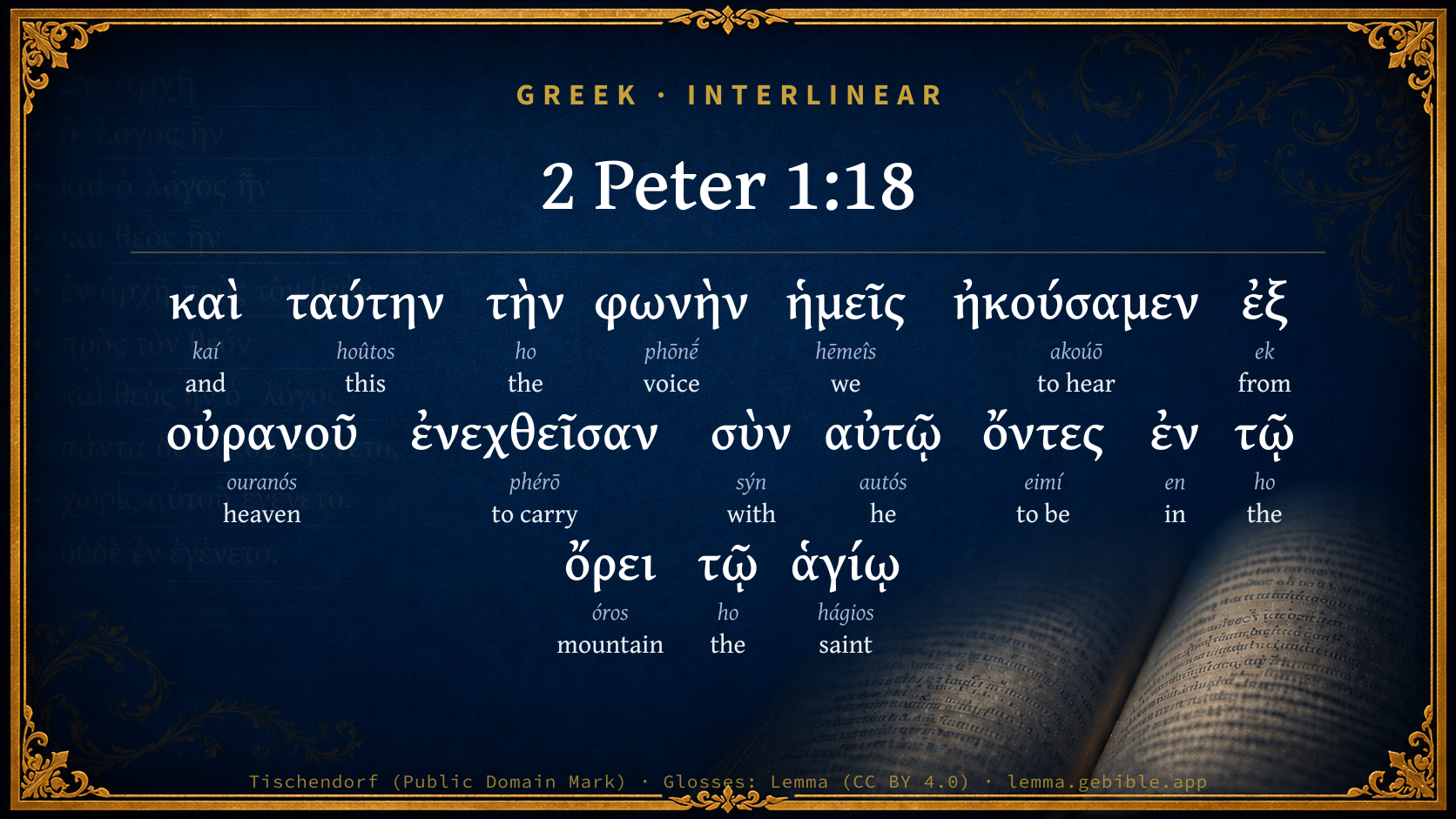
Greek (Tischendorf 8th ed.) 2 Peter 1:18 appears in the Greek New Testament. The text above is from the Tischendorf 8th edition. Each word links to its Strong’s number and a concise gloss. Click any word for its full Thayer’s Greek Lexicon entry.
Download image
Cite this verse

2 Peter 1:18 (World English Bible). Public Domain. Lemma interlinear Bible study tool, https://lemma.gebible.app/v/2-peter/1/18.

Show BibTeX & RIS
BibTeX
RIS
English Translation
This voice we heard come out of heaven when we were with him in the holy mountain.
World English Bible · Public Domain
Download a study sheet

One document with this verse’s original text, its word-by-word gloss line, the meaning frame, cross-references with their text, attributed commentary, and full source and license credits — printable, and it pastes into notes with its structure intact.

This verse Autodidact and up

Study sheet (.html) Plain text (.txt)

A passage Seminary Student

Up to 50 verses in one chapter. A passage sheet keeps up to 6 commentary sources and 12 cross-references per verse, in the order this page ranks them, and says so on the sheet whenever that leaves anything out. Ask for a single verse and you get the Autodidact verse sheet above.

Everything on this page stays free to read, with no account — the sheet is a download of what is already on screen, not access to it.

Want to remove ads? Support Godless Engineer
Compare translations 3

The same verse in 3 English versions, stacked beneath the original-language interlinear above. Click any original word for its lexicon entry.

Each is an independent rendering of the whole verse — the interlinear is not word-aligned to these translations.

Highlighted words mark where these versions differ — a whole-verse word diff, not a word-by-word alignment.

  • World English Bible Public Domain
    This voice we heard come out of heaven when we were with him in the holy mountain.
  • King James Version Public Domain
    And this voice which came from heaven we heard, when we were with him in the holy mount.
  • unfoldingWord Literal Text CC BY-SA 4.0
    And we ourselves heard this voice, having been brought from heaven, being with him on the holy mountain.

unfoldingWord Literal Text — © unfoldingWord, licensed CC BY-SA 4.0. Word-aligned USFM3 via Door43 (git.door43.org/unfoldingWord/en_ult).

Versions to compare (up to 4)

3 of 4 selected

Show all 19 translations

Every available English version of this verse, each an independent rendering of the whole verse.

  • World English Bible Public Domain
    This voice we heard come out of heaven when we were with him in the holy mountain.
  • Berean Standard Bible Public Domain
    And we ourselves heard this voice from heaven when we were with Him on the holy mountain.
  • Majority Standard Bible Public Domain
    And we ourselves heard this voice from heaven when we were with Him on the holy mountain.
  • King James Version Public Domain
    And this voice which came from heaven we heard, when we were with him in the holy mount.
  • American Standard Version (1901) Public Domain
    and this voice we `ourselves' heard borne out of heaven, when we were with him in the holy mount.
  • Revised Version (1885) Public Domain
    and this voice we ourselves heard come out of heaven, when we were with him in the holy mount.
  • Geneva Bible (1599) Public Domain
    And this voyce we heard when it came from heauen, being with him in the Holy mount.
  • Douay-Rheims (1899) Public Domain
    And this voice we heard brought from heaven, when we were with him in the holy mount.
  • Young's Literal Translation Public Domain
    and this voice we -- we did hear, out of heaven borne, being with him in the holy mount.
  • Literal Standard Version CC BY-SA 4.0
    and we heard this voice borne out of Heaven, being with Him at the holy mountain.
  • Unlocked Literal Bible CC BY-SA 4.0
    We ourselves heard this voice brought from heaven when we were with him on the holy mountain.
  • unfoldingWord Literal Text CC BY-SA 4.0
    And we ourselves heard this voice, having been brought from heaven, being with him on the holy mountain.
  • Darby Bible Public Domain
    and this voice *we* heard uttered from heaven, being with him on the holy mountain.
  • World Messianic Bible Public Domain
    We heard this voice come out of heaven when we were with him on the holy mountain.
  • Webster's Bible Public Domain
    And this voice which came from heaven we heard, when we were with him on the holy mount.
  • Free Bible Version CC BY-SA 4.0
    We ourselves heard this voice speak from heaven when we were with him on the holy mountain.
  • Bible in Basic English Public Domain
    And this voice came from heaven even to our ears, when we were with him on the holy mountain.
  • Text-Critical English NT CC BY 4.0
    We ourselves heard this voice come from heaven when we were with him on the holy mountain.
  • Tyndale New Testament (1534) Public Domain
    This voyce we hearde when it came from heven beynge with him in the holy mounte.

Literal Standard Version (2020), Covenant Press — licensed CC BY-SA 4.0. Text via the HelloAO Bible API (eBible.org). Unlocked Literal Bible (unfoldingWord) — licensed CC BY-SA 4.0. Text via the HelloAO Bible API (eBible.org). unfoldingWord Literal Text — © unfoldingWord, licensed CC BY-SA 4.0. Word-aligned USFM3 via Door43 (git.door43.org/unfoldingWord/en_ult). Free Bible Version, Dr. Jonathan Gallagher — licensed CC BY-SA 4.0. Text via the HelloAO Bible API (eBible.org).

Word by word

More ways to search: Search by grammar → Find every occurrence → Compare this word →

Practice this passage: Drill this verse → Learn its vocabulary →

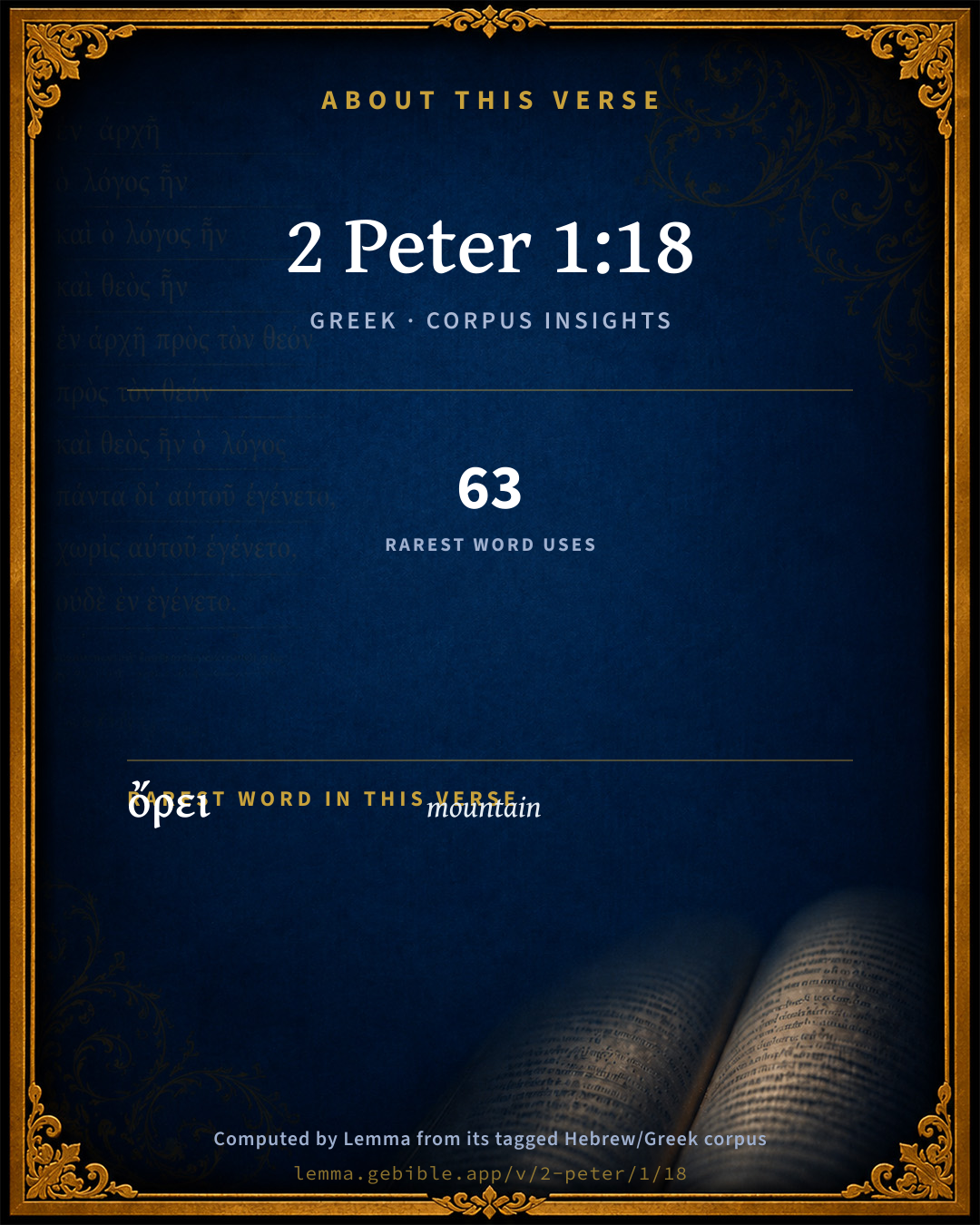
ὄρει
óros
G3735
“mountain”
Noun, Dative, Singular, Neuter
Part of Speech
Noun
Case
Dative
Number
Singular
Gender
Neuter
Full Thayer's Definition

Origin: "probably from an obsolete oro (to rise or "rear", perhaps akin to G142 , cf G3733 )"

TDNT: 12:55,7

1. a mountain
  1. καὶ kaí G2532 “and” Conjunction
  2. ταύτην hoûtos G3778 “this” Demonstrative pronoun, Accusative, Singular, Feminine
  3. τὴν ho G3588 “the” Article, Accusative, Singular, Feminine
  4. φωνὴν phōnḗ G5456 “voice” Noun, Accusative, Singular, Feminine
  5. ἡμεῖς hēmeîs G2249 “we” Personal pronoun, 1st person, Nominative, Plural
  6. ἠκούσαμεν akoúō G191 “to hear” Verb, Aorist, Active, Indicative, 1st person, Plural
  7. ἐξ ek G1537 “from” Preposition
  8. οὐρανοῦ ouranós G3772 “heaven” Noun, Genitive, Singular, Masculine
  9. ἐνεχθεῖσαν phérō G5342 “to carry” Verb, Aorist, Passive, Participle, Accusative, Singular, Feminine
  10. σὺν sýn G4862 “with” Preposition
  11. αὐτῷ autós G846 “he” Personal pronoun, Dative, Singular, Masculine
  12. ὄντες eimí G1510 “to be” Verb, Present, Active, Participle, Nominative, Plural, Masculine
  13. ἐν en G1722 “in” Preposition
  14. τῷ ho G3588 “the” Article, Dative, Singular, Neuter
  15. τῷ ho G3588 “the” Article, Dative, Singular, Neuter
  16. ἁγίῳ hágios G40 “saint” Adjective, Dative, Singular, Neuter

About this verse

These counts appear in no published source. They are computed here, from the morphology-tagged text and Lemma’s own curated glosses. What Lemma adds →

17
words
15
distinct lemmas
General Epistles
section

Repetition

A word recurs within this verse:

Cross-references

5

Topical passages linked to 2 Peter 1:18 in the Treasury of Scripture Knowledge — connected by theme and wording, ordered by reader-vote popularity; previews shown in the World English Bible.

  • Matthew 17:6 When the disciples heard it, they fell on their faces, and were very afraid.
  • Exodus 3:5 He said, "Don't come close. Take off your sandals from off your feet, for the place you are standing on is holy ground."
  • Joshua 5:15 The prince of Yahweh's host said to Joshua, Put off your shoe from off your foot; for the place whereon you stand is holy. Joshua did so.
  • Genesis 28:16–17 Jacob awakened out of his sleep, and he said, "Surely Yahweh is in this place, and I didn't know it."
  • Isaiah 11:9 They shall not hurt nor destroy in all my holy mountain; for the earth shall be full of the knowledge of Yahweh, as the waters cover the sea.

Cross-references courtesy of OpenBible.info (CC BY 4.0).

Commentary

Notes on 2 Peter 1:18 from classic Christian and Jewish commentators (each source and its license shown beneath its notes). The classic Christian expositions comment on the surrounding passage and are grouped to its opening verse, so a note may address several verses; the Jewish commentaries on the Tanakh (Rashi and others) are per-verse, so they appear only where the commentator wrote on this verse.

Lemma curates 59 commentaries, every one of them public domain or Creative Commons licensed, each selected and text-cleaned for this edition rather than reprinted as found. About our sources →

Bengel's Gnomon

Johann Albrecht Bengel

2Pe 1:18. Ἡμεῖς, we) John also was still alive.—ἐξ οὐρανοῦ, from heaven) from God.—τῷ ἁγίῳ, the holy) The mountain was holy from that very circumstance; at any rate, at that very time.

Bengel's Gnomon of the New Testament — English translation (T&T Clark, Edinburgh, 1860) — public domain. Text from a community e-Sword module.

Meyer's Critical & Exegetical Commentary

Heinrich August Wilhelm Meyer

2Pe_1:18. καὶ ταύτην … ἐνεχθεῖσαν; the author is anxious to show prominently that he has been an ear-witness of that divine voice, as well as an eye-witness of the μεγαλειότης of Christ.

ἐξ οὐρανοῦ ἐνεχθ. is added by way of emphasis, in order to lay stress on the fact that Christ received that testimony directly from heaven.

ἐν τῷ ὄρει τῷ ἁγίῳ] From the epithet τῷ ἁγίῳ it must not, with Grotius, be concluded that the reference here is to the hill on which the temple stood, and that what is alluded to is not the transfiguration, but the incident recorded in Joh_12:28. Without any reason, de Wette asserts that that epithet (instead of which Mat_17:1 has: ὑψηλόν) betrays a view of the case more highly coloured with the belief in miracles than that of the apostles, and belonging to a later period; Calvin already gives the correct interpretation: montem sanctum appellat, qua ratione terra sancta dicitur, in qua Mosi Deus apparuit; quocunque enim accedit Dominus, ut est fons omnis sanctitatis, praesentiae suae odore omnia sanctificat; Dietlein: the in the holy is added, not to designate the mountain, but in order to distinguish it on account of this event; so, too, Brückner and the modern commentators generally.

Meyer — Critical and Exegetical Commentary on the New Testament — English translation by Peter Christie, edited by Frederick Crombie (T&T Clark, 1880) — public domain. Text from a community e-Sword module.

Expositor's Greek Testament

ed. W. Robertson Nicoll

2Pe 1:18 . ἐν τῷ ὄρει τῷ ἁγίῳ . The phrase indicates a view of the place and incident which has been taken up into and sanctified in the religious consciousness of the Church. The Gnostic Acts of Peter use the phrase “in monte sacro”. ἅγιος signifies a place where Jehovah manifested Himself, cf. Exo 3:5 , Isa 52:1 .

The Expositor's Greek Testament, edited by W. Robertson Nicoll (1897–1910) — public domain. Text from a community e-Sword module.

Jamieson, Fausset & Brown

Robert Jamieson, A. R. Fausset & David Brown

which came--rather as Greek, "we heard borne from heaven."

holy mount--as the Transfiguration mount came to be regarded, on account of the manifestation of Christ's divine glory there.

we--emphatical: we, James and John, as well as myself.

Jamieson, Fausset & Brown — Commentary Critical and Explanatory on the Whole Bible (1871) — public domain (CC PDM 1.0). Text via the HelloAO Bible API.

Adam Clarke's Commentary

Verse 18. And this voice - we heard] That is, himself, James, and John heard it, and saw this glory; for these only were the εποπται, beholders, on the holy mount. It is worthy of remark that our blessed Lord, who came to give a new law to mankind, appeared on this holy mount with splendour and great glory, as God did when he came on the holy mount, Sinai, to give the old law to Moses. And when the voice came from the excellent glory, This is my Son, the beloved One, in whom I have delighted; hear him: the authority of the old law was taken away. Neither Moses nor Elijah, the law nor the prophets, must tabernacle among men, as teaching the whole way of salvation, and affording the means of eternal life; these things they had pointed out, but these things they did not contain; yet the fulfilment of their types and predictions rendered their declarations more firm and incontestable. See below.

Adam Clarke's Commentary on the Bible (1810–1826) — public domain. Text from a community e-Sword/MySword module.

John Calvin's Commentaries

18. In the holy mount. He calls it the holy mount, for the same reason that the ground was called holy where God appeared to Moses. For wherever the Lord comes, as he is the fountain of all holiness, he makes holy all things by the odor of his presence. And by this mode of speaking we are taught, not only to receive God reverently wherever he shews himself, but also to prepare ourselves for holiness, as soon as he comes nigh us, as it was commanded the people when the law was proclaimed on Mount Sinai. And it is a general truth,

“Be ye holy, for I am holy, who dwell in the midst of you.” (Leviticus 11:44; 19:2.)

John Calvin's Commentaries (1540-1563) — public domain. Text from the Calvin Translation Society English edition (1840s-50s) via the Christian Classics Ethereal Library (ccel.org). Calvin's coverage is partial (roughly two-thirds of the Bible); uncommented books and verses are honest gaps, never fabricated. The 19th-century editor's footnotes and remarks are omitted so the notes are faithfully Calvin's own voice.

Ellicott's Commentary for English Readers

(18) And this voice which came from heaven we heard.—Rather, And this voice we heard borne from heaven: We were ear-witnesses of the voice coming from heaven, as we were eye-witnesses of His majesty. It was no vision, it was no hallucination. We all heard, and we all saw; so that I have the highest authority for what I would now impress upon you. A voice which I myself heard borne from heaven to earth, in the midst of glory which I myself saw, foretelling the glory that is yet to come.

In the holy mount.—It is, perhaps, not even “partly right” to say that the epithet “holy” indicates a view of the event later than that of the Evangelists, and points to a miracle-loving age. Rather, it indicates a view many centuries older than the Evangelists—that wherever God had specially manifested Himself was “holy ground” (Exo_3:5; Josh. V. 15. Comp. Gen_28:16-17; Exo_19:12; Act_7:33.) The expression would be natural to any Jew speaking of the Transfiguration. (See Introduction, I. c.)

A Bible Commentary for English Readers, edited by Charles John Ellicott (1878–1897) — public domain. Text from a community e-Sword module.

The Cambridge Bible for Schools and Colleges

gen. ed. J. J. S. Perowne

18. And this voice which came from heaven we heard …] More accurately, as better expressing the force of the special word used here as in the previous verse, And this voice borne from heaven we heard.… The “we” is emphatic, as giving prominence to the fact of the personal testimony of the Apostle and his two brother-disciples.

when we were with him in the holy mount] It has been urged by some critics that the description of the Mount of the Transfiguration by the term which in Old Testament language was commonly applied to Zion (Psa_2:6) indicates the phraseology of a later age than that of the Apostles. It is obvious, however, in answer, that the scene of the manifestation of the Divineglory of which he speaks could not appear as other than “holy ground”—holy as Horeb had been of old (Exo_3:5; Act_7:33)—to the Apostle who had been there. Comp. Jos_5:15. Whether, as the Gospel narrative indicates, it was on the heights of Hermon (Mat_16:13), or, as later tradition reported, on Mount Tabor, it would remain for ever as a consecrated spot in the Apostle’s memory. It may, perhaps, be inferred from the tone in which he thus speaks of it, that he assumes that his readers had already some knowledge of the fact referred to.

The Cambridge Bible for Schools and Colleges (gen. ed. J. J. S. Perowne; Cambridge University Press, 1878–1918) — public domain. Text from a community e-Sword module.

John Gill's Exposition

And this voice, which came from heaven, we heard,.... Peter, who wrote this epistle, and James and John, the favourite disciples of Christ; and who were a sufficient number to bear witness of what they then saw and heard:

when we were with him; and saw his glory, and the glory of Moses and Elias, and were so delighted with his company, and theirs, and with communion with him, that Peter, in the name of the rest, desired to stay there:

in the holy mount; the Ethiopic version reads, "in the mountain of his sanctuary"; and so Grotius understands it of Mount Moriah, on which the temple was built, called the holy hill, and the holy hill of Zion; and supposes that this voice was heard in the temple, and that it refers to Joh 12:28, but without any foundation; for the mount on which Christ was transfigured is here meant; and which was either, as is generally said, Tabor, a mountain in Galilee; or it may be Lebanon, which was near Caesarea Philippi, in the parts of which Christ then was: and it is called "holy", from his presence or transfiguration on it, who is the Holy One; just as the land on which Moses was, and the city and temple of Jerusalem, and Mount Sion, and Sinai, are called "holy", from the presence of the holy God there, Exo 3:5. Now such a declaration of the honour and glory of Christ, as the Son of God, being made by God the Father, in a voice from heaven, which the apostles heard with their ears, at the same time that they saw with their eyes his human body glorified in an amazing manner, was to them a confirming evidence that he would come again in power and glory; and upon this evidence they declared, and made known to the saints, the power and coming of Christ; though not on this evidence only, but also upon the more sure word of prophecy, which entirely agrees with it.

John Gill's Exposition of the Whole Bible (1746–1763) — public domain (CC PDM 1.0). Text via the HelloAO Bible API.

Trapp's Complete Commentary

John Trapp

18 And this voice which came from heaven we heard, when we were with him in the holy mount.

Ver. 18. When we were with him] Witnesses of his glory, and the same were shortly after witnesses of his agony. Envy not the gifts or honours of others, since they have them upon no other terms than to undergo the sorer trials.

In the holy mount] Holy for the while, as are our churches, during the public assemblies, viz. with a relative, not an inherent holiness.

John Trapp, A Commentary or Exposition upon All the Books of the Old and New Testament (1647–1656) — public domain. Text from a community e-Sword module.

Albert Barnes' Notes on the Bible

And this voice which came from heaven we heard - To wit, Peter, and James, and John.

When we were with him in the holy mount - Called “holy” on account of the extraordinary manifestation of the Redeemer’s glory there. It is not certainly known what mountain this was, but it has commonly been supposed to be Mount Tabor. See the notes at Mat 17:1.

Albert Barnes' Notes on the Bible (1834–1885) — public domain. Text from a community e-Sword/MySword module.

Matthew Poole's English Annotations

We; I, and James, and John.

Heard: the apostle avoucheth himself to have been an ear-witness, as well as eye-witness, of Christ’s glory, hereby intimating that there was as much certainty of the gospel, even in a human way, as could possibly be obtained of any thing that is done in the world, seeing men can be humanly certain of nothing more than of what they perceive by their senses: compare 1Jo 1:1,3.

The holy mount; so called, not because of any inherent holiness in it, but because of the extraordinary manifestation of God’s presence there; in the same sense as the ground is called holy where God appeared to Moses and to Joshua, Exo 3:5; Jos 5:15.

Matthew Poole's English Annotations on the Holy Bible (1683–1685) — public domain. Text from a community e-Sword/MySword module.

Whedon's Commentary on the Bible

Daniel D. Whedon

18. This voice… we heard—And hearing, the three fell to the ground.

Holy mount—Now generally admitted to be Mount Hermon, called holy because of this manifestation there, just as Moses at the burning bush in Horeb stood on “holy ground.” See Exo_3:5. The apostle’s personal presence, his personal seeing, and his personal hearing, as described by himself, show his competency for this solemn authentication. The facts thus testified to exhibit Christ as the proclaimed Son of God, and as possessing the full dignity and glory of that sonship.

How the transfiguration proves the second coming, is a difficult question with expositors. Some take it, as Wordsworth, as a type and pledge of the coming; but this is nowhere affirmed in Scripture; nor do we agree that Mat_16:28, to which they refer, points to either the transfiguration or the coming. The transfiguration did present our Lord in his glorious personality and divine Lordship irrespective of any advent.

Daniel D. Whedon (gen. ed.), Commentary on the Old and New Testaments (1874–1909) — public domain. Text from a community e-Sword module.

The Pulpit Commentary

And this voice which came from heaven we heard; rather, and this voice borne from heaven we heard. The pronoun is emphatic; we, the apostles who had that high privilege. They heard the voice when it was borne (ejnecqeisan; he repeats for emphasis the remarkable word of verse 17) from heaven, they heard it come from heaven. When we were with him in the holy mount. This description of the Mount of the Transfiguration supposes a knowledge of the history in St. Peter"s readers; but it gives no support to the theory of a post-apostolic date. Mount Horeb was "holy ground," because God appeared there to Moses, because it was the scene of the giving of the Law. Mount Zion was a holy hill, because God had chosen it to be a habitation for himself; the Mount of the Transfiguration was holy, because there God the Son manifested forth his glory. God hallows every place which he pleases to make the scene of his revealed presence. This whole passage shows the deep and lasting impression which the Transfiguration made on those who were privileged to witness it. (comp. Joh_1:14)

The Pulpit Commentary (1880–1919), ed. H.D.M. Spence-Jones & Joseph S. Exell — public domain. Text from a community e-Sword module.

John Wesley's Explanatory Notes

And we - Peter, James, and John. St. John was still alive. Being with him in the holy mount - Made so by that glorious manifestation, as Mount Horeb was of old, Exod. iii, 4, 5.

John Wesley, Explanatory Notes Upon the Whole Bible (1754–1765) — public domain. Text via the GEBible commentary corpus.

Scofield Reference Notes

C. I. Scofield

holy mount

Where the reference is to things, the meaning of "holy" or "sanctified" is, simply, set apart for the use of God, or rendered sacred by the divine presence.

The Scofield Reference Bible (1917 edition), notes by C. I. Scofield — public domain. Text from a community e-Sword module.

The People's New Testament

B. W. Johnson

18. And this voice we ourselves heard. Peter, and James and John, his companions on the holy mount. James was now dead, but John was still alive.

B. W. Johnson's The People's New Testament with Notes (1889–1891) — public domain. Electronic text from the Christian Classics Ethereal Library (CCEL) ThML edition.

Cambridge Greek Testament for Schools and Colleges

18. ἐν τῷ ἁγίῳ ὄρει. It was the Transfiguration that made the mountain holy (Bigg), just as the vision of the Burning Bush made that site “holy ground” (Exo 3:5). The “holy hill” par excellence of the O.T. is Mount Sion.

It is interesting to note that the Acts of Peter (see Introd.) make St Peter select the story of the Transfiguration as the subject of a special discourse, perhaps from a recollection of the passage before us; there, too, the phrase holy mountain is used.

Cambridge Greek Testament for Schools and Colleges (Cambridge University Press, 1896; 21 vols, various authors incl. Carr, Maclear, Plummer, Farrar, Lumby, Moule, M. R. James, Simcox) — public domain. Text from a community e-Sword module.

Alford’s Greek Testament

Henry Alford

18.] Substantiation of the personal testimony above adduced by reference to the fact. And this voice we (Apostles: Peter, James, and John) heard borne from heaven (not, as E. V. ungrammatically, “this voice which came from heaven” (τὴν ἐξ οὐρ. ἐν.): we heard it borne, witnessed its coming, from heaven), being with Him in the holy mount (De Wette is partly right, when he says that this epithet “holy” shews a later view of the fact than that given us in the evangelistic narrative: but not right when he designates that later view wunderglaubigere. The epithet would naturally arise when the gospel history was known, as marking a place where a manifestation of this divine presence and glory had taken place. The place whereon Moses stood is said, ref. Exod., to be holy ground. So that really all we can infer from it is, that the history was assumed to be already well known: which is one entirely consistent with the probable date of the Epistle: see Prolegg. It is hardly necessary to refute Grotius’s idea, that Mount Sion is meant, and that the voice referred to is that related in Joh 12:28).

Henry Alford, The Greek Testament (1849–1861) — public domain. Text from a community e-Sword module.

Vincent's Word Studies in the New Testament

Marvin R. Vincent

Voice [φωνην] . Note the same word in the account of Pentecost (Act 2:6), where the A. V. obscures the meaning by rendering, when this was noised abroad; whereas it should be when this voice was heard.

Which came [ενεχθεισαν] . Lit., having been born. See on ver. 17. Rev., This voice we ourselves [ημεις, ωε, εμπηατιχ] heard come (better, born) out of heaven.

Holy mount. It is scarcely necessary to notice Davidson's remark that this expression points to a time when superstitious reverence for places had sprung up in Palestine. "Of all places to which special sanctity would be ascribed by Christ 's followers, surely that would be the first to be so marked where the most solemn testimony was given to the divinity of Jesus. To the Jewish Christian this would rank with Sinai, and no name would be more fitly applied to it than that which had so constantly been given to a place on which God first revealed himself in his glory. The 'holy mount of God ' (Eze 28:14) would now receive another application, and he would see little of the true continuity of God 's revelation who did not connect readily the old and the new covenants, and give to the place where the glory of Christ was most eminently shown forth the same name which was applied so oft to Sinai" (Lumby).

Marvin R. Vincent, Word Studies in the New Testament (1887–1900) — public domain. Text from a community e-Sword/MySword module.

Lesson kit

Teaching starters — assembled from the data on this page, not authored interpretation. Every prompt links to the verse data it draws on. Edit before teaching.

2 Peter, in the General Epistles, opens this verse with 17 words (15 distinct Greek lemmas). Its most distinctive word is óros (“mountain”). A historical commentator’s framing appears above. Read the whole chapter for the surrounding context.

Discussion questions

  1. What does “mountain” (óros) contribute to the verse as a whole?
  2. Matthew 17:6 shares this passage’s theme. How do the two illuminate each other?
  3. “the” occurs 3× in this one verse. What is the effect of the repetition?
  4. These translations render this verse differently. What is at stake in choosing one wording over another?
  5. Reading how Bengel's Gnomon and Meyer's Critical & Exegetical Commentary read this verse, where do the two commentators agree and where do they part?

Things to notice

Reading settings

Reading text

Shown beneath each verse's original-language words.

Old Testament
Old Testament edition

Read the OT as the Masoretic Hebrew (MT) or the Greek Septuagint (LXX).

English shown for the Greek Septuagint (in the Hebrew ↔ Greek comparison).

Comparing translations? Open the Compare panel on any verse page to stack up to four side by side.