Acts 13:48

Greek (Tischendorf 8th ed.) Acts 13:48 appears in the Greek New Testament. The text above is from the Tischendorf 8th edition. Each word links to its Strong’s number and a concise gloss. Click any word for its full Thayer’s Greek Lexicon entry.
Download image
Cite this verse

Acts 13:48 (World English Bible). Public Domain. Lemma interlinear Bible study tool, https://lemma.gebible.app/v/acts/13/48.

Show BibTeX & RIS
BibTeX
RIS
English Translation
As the Gentiles heard this, they were glad, and glorified the word of God. As many as were appointed to eternal life believed.
World English Bible · Public Domain
Download a study sheet

One document with this verse’s original text, its word-by-word gloss line, the meaning frame, cross-references with their text, attributed commentary, and full source and license credits — printable, and it pastes into notes with its structure intact.

This verse Autodidact and up

Study sheet (.html) Plain text (.txt)

A passage Seminary Student

Up to 50 verses in one chapter. A passage sheet keeps up to 6 commentary sources and 12 cross-references per verse, in the order this page ranks them, and says so on the sheet whenever that leaves anything out. Ask for a single verse and you get the Autodidact verse sheet above.

Everything on this page stays free to read, with no account — the sheet is a download of what is already on screen, not access to it.

Want to remove ads? Support Godless Engineer
Compare translations 3

The same verse in 3 English versions, stacked beneath the original-language interlinear above. Click any original word for its lexicon entry.

Each is an independent rendering of the whole verse — the interlinear is not word-aligned to these translations.

Highlighted words mark where these versions differ — a whole-verse word diff, not a word-by-word alignment.

  • World English Bible Public Domain
    As the Gentiles heard this, they were glad, and glorified the word of God. As many as were appointed to eternal life believed.
  • King James Version Public Domain
    And when the Gentiles heard this, they were glad, and glorified the word of the Lord: and as many as were ordained to eternal life believed.
  • unfoldingWord Literal Text CC BY-SA 4.0
    But hearing this, the Gentiles were rejoicing and glorifying the word of the Lord, and as many as were appointed to eternal life believed.

unfoldingWord Literal Text — © unfoldingWord, licensed CC BY-SA 4.0. Word-aligned USFM3 via Door43 (git.door43.org/unfoldingWord/en_ult).

Versions to compare (up to 4)

3 of 4 selected

Show all 19 translations

Every available English version of this verse, each an independent rendering of the whole verse.

  • World English Bible Public Domain
    As the Gentiles heard this, they were glad, and glorified the word of God. As many as were appointed to eternal life believed.
  • Berean Standard Bible Public Domain
    When the Gentiles heard this, they rejoiced and glorified the word of the Lord, and all who were appointed for eternal life believed.
  • Majority Standard Bible Public Domain
    When the Gentiles heard this, they rejoiced and glorified the word of the Lord, and all who were appointed for eternal life believed.
  • King James Version Public Domain
    And when the Gentiles heard this, they were glad, and glorified the word of the Lord: and as many as were ordained to eternal life believed.
  • American Standard Version (1901) Public Domain
    And as the Gentiles heard this, they were glad, and glorified the word of God: and as many as were ordained to eternal life believed.
  • Revised Version (1885) Public Domain
    And as the Gentiles heard this, they were glad, and glorified the word of God: and as many as were ordained to eternal life believed.
  • Geneva Bible (1599) Public Domain
    And when the Gentiles heard it, they were glad, and glorified the woorde of the Lord: and as many as were ordeined vnto eternall life, beleeued.
  • Douay-Rheims (1899) Public Domain
    And the Gentiles hearing it, were glad, and glorified the word of the Lord: and as many as were ordained to life everlasting, believed.
  • Young's Literal Translation Public Domain
    And the nations hearing were glad, and were glorifying the word of the Lord, and did believe -- as many as were appointed to life age-during;
  • Literal Standard Version CC BY-SA 4.0
    And the nations hearing were glad, and were glorifying the word of the LORD, and believed—as many as were appointed to continuous life;
  • Unlocked Literal Bible CC BY-SA 4.0
    As the Gentiles heard this, they were glad and praised the word of the Lord. As many as were appointed to eternal life believed.
  • unfoldingWord Literal Text CC BY-SA 4.0
    But hearing this, the Gentiles were rejoicing and glorifying the word of the Lord, and as many as were appointed to eternal life believed.
  • Darby Bible Public Domain
    And [those of] the nations, hearing it, rejoiced, and glorified the word of the Lord, and believed, as many as were ordained to eternal life.
  • World Messianic Bible Public Domain
    As the Gentiles heard this, they were glad and glorified the word of God. As many as were appointed to eternal life believed.
  • Webster's Bible Public Domain
    And when the Gentiles heard this, they were glad, and glorified the word of the Lord: and as many as were ordained to eternal life, believed.
  • Free Bible Version CC BY-SA 4.0
    When the foreigners heard this they were overjoyed, praising the Lord's word, and all those chosen for eternal life trusted in God.
  • Bible in Basic English Public Domain
    And the Gentiles, hearing this, were glad and gave glory to the word of God: and those marked out by God for eternal life had faith.
  • Text-Critical English NT CC BY 4.0
    When the Gentiles heard this, they began rejoicing and glorifying the word of the Lord, and all who were appointed to eternal life believed.
  • Tyndale New Testament (1534) Public Domain
    The getyls hearde and were glad and glorified the worde of the Lorde and beleved: even as many as were ordeyned vnto eternall lyfe.

Literal Standard Version (2020), Covenant Press — licensed CC BY-SA 4.0. Text via the HelloAO Bible API (eBible.org). Unlocked Literal Bible (unfoldingWord) — licensed CC BY-SA 4.0. Text via the HelloAO Bible API (eBible.org). unfoldingWord Literal Text — © unfoldingWord, licensed CC BY-SA 4.0. Word-aligned USFM3 via Door43 (git.door43.org/unfoldingWord/en_ult). Free Bible Version, Dr. Jonathan Gallagher — licensed CC BY-SA 4.0. Text via the HelloAO Bible API (eBible.org).

Word by word

More ways to search: Search by grammar → Find every occurrence → Compare this word →

Practice this passage: Drill this verse → Learn its vocabulary →

τεταγμένοι
tássō
G5021
“to appoint”
Verb, Perfect, Passive, Participle, Nominative, Plural, Masculine
Part of Speech
Verb
Tense
Perfect
Voice
Passive
Mood
Participle
Case
Nominative
Number
Plural
Gender
Masculine
Full Thayer's Definition

Origin: a prolonged form of a primary verb (which latter appears only in certain tenses)

TDNT: 08:27,1

1. to put in order, to station a. to place in a certain order, to arrange, to assign a place, to appoint 1. to assign (appoint) a thing to one b. to appoint, ordain, order 1. to appoint on one's own responsibility or authority 2. to appoint mutually, i.e. agree upon
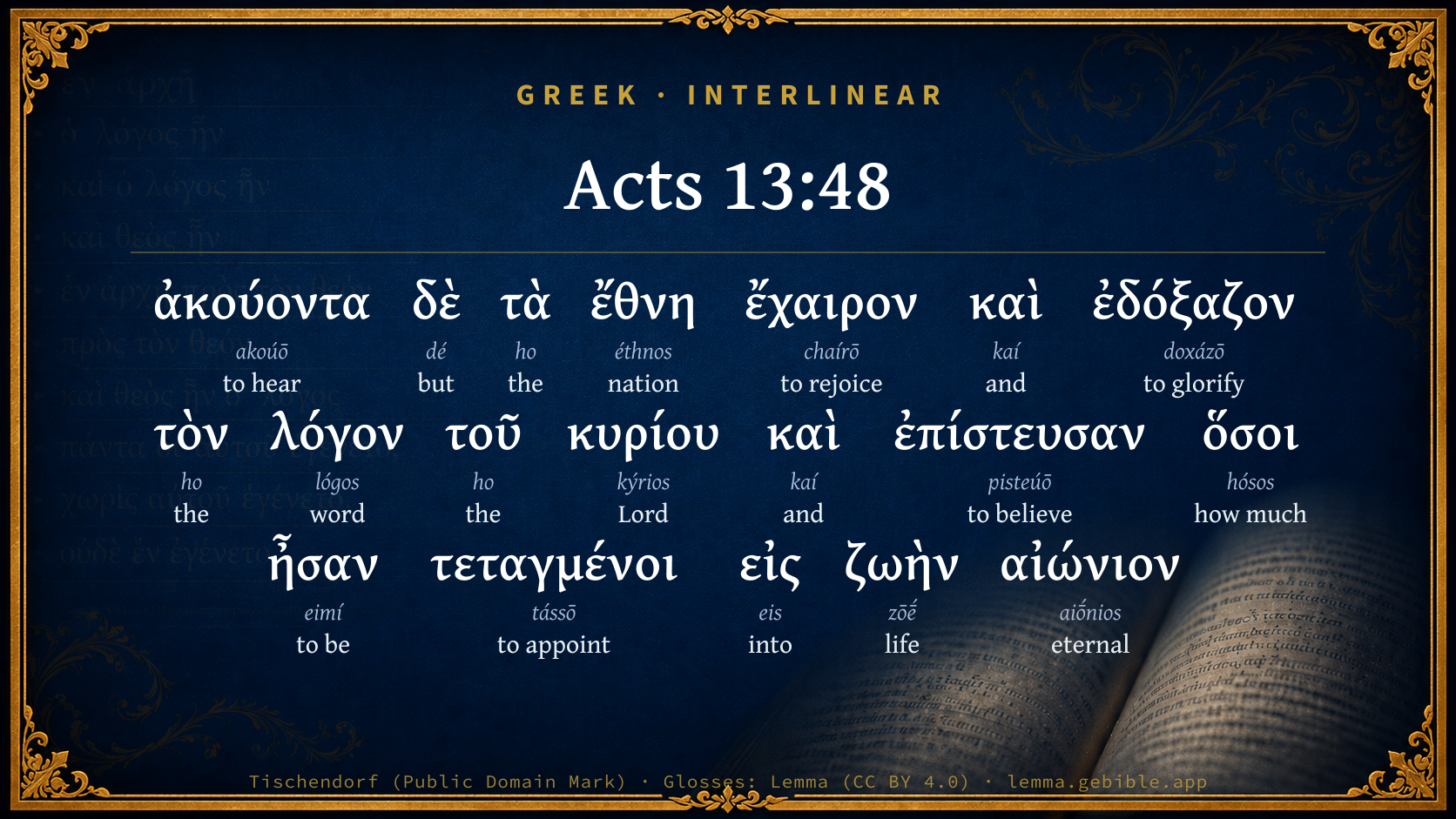
  1. ἀκούοντα akoúō G191 “to hear” Verb, Present, Active, Participle, Nominative, Plural, Neuter
  2. δὲ dé G1161 “but” Conjunction
  3. τὰ ho G3588 “the” Article, Nominative, Plural, Neuter
  4. ἔθνη éthnos G1484 “nation” Noun, Nominative, Plural, Neuter
  5. ἔχαιρον chaírō G5463 “to rejoice” Verb, Imperfect, Active, Indicative, 3rd person, Plural
  6. καὶ kaí G2532 “and” Conjunction
  7. ἐδόξαζον doxázō G1392 “to glorify” Verb, Imperfect, Active, Indicative, 3rd person, Plural
  8. τὸν ho G3588 “the” Article, Accusative, Singular, Masculine
  9. λόγον lógos G3056 “word” Noun, Accusative, Singular, Masculine
  10. τοῦ ho G3588 “the” Article, Genitive, Singular, Masculine
  11. κυρίου kýrios G2962 “Lord” Noun, Genitive, Singular, Masculine
  12. καὶ kaí G2532 “and” Conjunction
  13. ἐπίστευσαν pisteúō G4100 “to believe” Verb, Aorist, Active, Indicative, 3rd person, Plural
  14. ὅσοι hósos G3745 “how much” Correlative pronoun, Nominative, Plural, Masculine
  15. ἦσαν eimí G1510 “to be” Verb, Imperfect, Active, Indicative, 3rd person, Plural
  16. εἰς eis G1519 “into” Preposition
  17. ζωὴν zōḗ G2222 “life” Noun, Accusative, Singular, Feminine
  18. αἰώνιον aiṓnios G166 “eternal” Adjective, Accusative, Singular, Feminine

About this verse

These counts appear in no published source. They are computed here, from the morphology-tagged text and Lemma’s own curated glosses. What Lemma adds →

19
words
16
distinct lemmas
Acts
section

Notable vocabulary

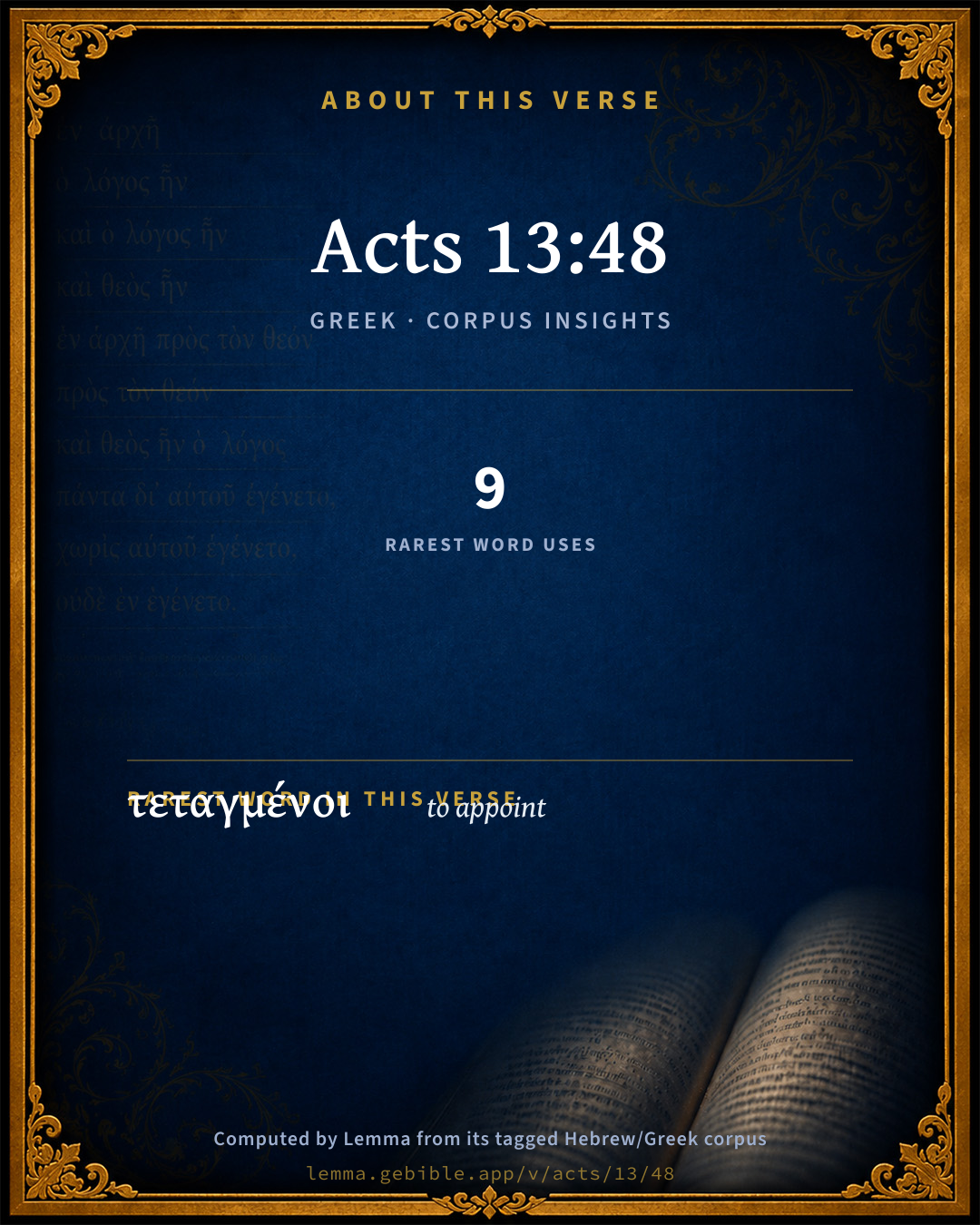
The rarest word here is τεταγμένοι to appoint G5021 — appearing just 9 times in the whole Greek New Testament.

Shared distinctive vocabulary

τεταγμένοι to appoint G5021 occurs in 9 verses of the Greek New Testament. Also found in:

Repetition

Words recur within this verse:

Cross-references

16

Topical passages linked to Acts 13:48 in the Treasury of Scripture Knowledge — connected by theme and wording, ordered by reader-vote popularity; previews shown in the World English Bible.

  • Romans 8:29–30 For whom he foreknew, he also predestined to be conformed to the image of his Son, that he might be the firstborn among many brothers.
  • Ephesians 1:4 even as he chose us in him before the foundation of the world, that we would be holy and without blemish before him in love;
  • Romans 11:7 What then? That which Israel seeks for, that he didn't obtain, but the chosen ones obtained it, and the rest were hardened.
  • John 10:16 I have other sheep, which are not of this fold. I must bring them also, and they will hear my voice. They will become one flock with one shepherd.
  • John 10:26–27 But you don't believe, because you are not of my sheep, as I told you.
  • John 11:52 and not for the nation only, but that he might also gather together into one the children of God who are scattered abroad.
  • Ephesians 2:5–10 even when we were dead through our trespasses, made us alive together with Christ (by grace you have been saved),
  • 2 Thessalonians 2:13–14 But we are bound to always give thanks to God for you, brothers loved by the Lord, because God chose you from the beginning for salvation through sanctification of the Spirit and belief in the truth;
  • Acts 2:41 Then those who gladly received his word were baptized. There were added that day about three thousand souls.
  • Acts 22:10 I said, 'What shall I do, Lord?' The Lord said to me, 'Arise, and go into Damascus. There you will be told about all things which are appointed for you to do.'
  • Ephesians 1:19 and what is the exceeding greatness of his power toward us who believe, according to that working of the strength of his might
  • Luke 7:8 For I also am a man placed under authority, having under myself soldiers. I tell this one, 'Go!' and he goes; and to another, 'Come!' and he comes; and to my servant, 'Do this,' and he does it."
  • Romans 15:9–12 and that the Gentiles might glorify God for his mercy. As it is written, "Therefore will I give praise to you among the Gentiles, And sing to your name."
  • Acts 2:47 praising God, and having favor with all the people. The Lord added to the assembly day by day those who were being saved.
  • Acts 28:23 When they had appointed him a day, many people came to him at his lodging. He explained to them, testifying about the Kingdom of God, and persuading them concerning Jesus, both from the law of Moses and from the prophets, from morning until evening.
  • Romans 13:1 Let every soul be in subjection to the higher authorities, for there is no authority except from God, and those who exist are ordained by God.

Cross-references courtesy of OpenBible.info (CC BY 4.0).

Where the printed editions differ

1 variant

Places in this verse where the major printed Greek editions disagree on the wording in a way that affects the translation — a comparison of editions, not a manuscript-by-manuscript collation. The editions are the modern critical texts (Nestlé-Aland 28/27, SBL, Westcott-Hort, Tregelles, Tyndale House) and the traditional texts behind the KJV (the Textus Receptus and the Byzantine/Majority text). It is not a claim about which reading is original.

  1. Different wording
    κυρίου

    “Lord”

    In NA28NA27TynSBLTregTRByz Not in WH

    θεοῦ (theou) 'of God' occurs in a few manuscripts (WH) instead of κυρίου (kuriou) 'Lord' in older manuscripts (NA28+NA27+Tyn+SBL+Treg+TR+Byz)

Textual data: Translators Amalgamated Greek New Testament (STEPBible TAGNT) · CC BY 4.0.

Commentary

Notes on Acts 13:48 from classic Christian and Jewish commentators (each source and its license shown beneath its notes). The classic Christian expositions comment on the surrounding passage and are grouped to its opening verse, so a note may address several verses; the Jewish commentaries on the Tanakh (Rashi and others) are per-verse, so they appear only where the commentator wrote on this verse.

Lemma curates 59 commentaries, every one of them public domain or Creative Commons licensed, each selected and text-cleaned for this edition rather than reprinted as found. About our sources →

The Biblical Illustrator

Joseph S. Exell

Act_13:48

And when the Gentiles heard this, they were glad.

Right relation to the truth

On hearing the gospel the Gentiles--

I. Were glad.

1. This should be, but alas is not, the uniform effect of gospel hearing.

(1) Some are indifferent, for they feel no need of it.

(2) Some are critical. They may feel their need, but are not disposed to receive the gospel as a supply for their need.

(3) Some are hostile and reject the gospel utterly as a possible supply for their need, and look elsewhere--to formalism, infidelity, worldliness.

2. These Gentiles were glad.

(1) They heard attentively, with candid minds, with eager desire. They were convinced and so they believed, and the Word of God had its proper effect on them; it became Good tidings of great joy.

(2) This gladness was that of conscious pardon, satisfied longing, Divine acceptance, joyful anticipation.

3. If the gospel has not made those who profess to have accepted it glad, it is probably for one or two reasons.

(1) They have not received the whole of it. A spoonful of water will not quench thirst, but will only aggravate it.

(2) They have received it in an adulterated form.

II. They glorified the word of God. This was the inevitable result of their gladness.

1. They were thankful for it. Thanklessness dishonours the gospel. The least that a man can do who receives a gift is to express his gratitude for it.

2. They praised it. Specimens of such praise we have in the Psalms--notably in Psa_119:1-176. It is refreshing to turn to this record in an age of Bible disparagement. When a man receives a gift he is not only thankful for it, but examines it, or puts it to some use, so that he may properly appraise its value. Every candid examination of Gods Word, and self application of its truth, will give it enhanced worth.

3. They made it known to others (verse 49). The gospel is not meant for its immediate recipients. It is a gift for men. Only as it has free course is it fully glorified. Conclusion: Gladness is the inspiration of true service. It is as steam to machinery. Has the gospel made you happy? Go then and make others glad. (J. W. Burn.)

The first last and the last first

I. The first last.

1. Who are the first? Those who have earliest experienced the Divine love, and are considered most richly endowed.

2. Why do they become last? Because they do not use to their salvation the love of God, and become proud of their gifts.

3. How do they become last? By receiving, according to the measure of their small fidelity, only an inferior position in the kingdom of God (Mat_20:10), or, as the reward of their complete unfaithfulness, by being excluded entirely from the blessings of that kingdom (verse 46).

II. The last first.

1. Who are the last? Those who are called at a later period, and who possess inferior gifts.

2. Why do they become first? Because the knowledge of their defects makes them desirous of salvation.

3. How do they become first? By being themselves in the kingdom of God, and assisting in its wider extension (verses 49, 52). (Lisco.)

The Word of God the revealer of the thoughts of many hearts

I. Of the Gentiles--i.e., of those who were hitherto at a distance and strangers to the Word of God (verses 48, 49).

1. They rejoice in its contents.

2. They praise the grace of God.

3. They receive it by faith.

4. They taste the blessedness of believing.

II. Of the Jews--i.e., the self-righteous who will not be saved by grace (verse 50).

1. They are inflamed with hatred against the evangelical message.

2. They interest others against it.

3. They persecute the messengers of salvation.

III. Of believers, who experience in themselves the power of the Word.

1. Their faith is not perplexed by calamity (verse 51).

2. They experience holy joy (verse 52).

3. They grow in the grace of God through the Holy Ghost (verse 52). (Lisco.)

The gospel appreciated by the outcasts

The man who has grown accustomed to luxuries is the man who turns his meat over, and picks off a bit here, and a bit there; for this is too fat, and that is too gristly. Bring in the poor wretches who are half-starved. Fetch in a company of labourers who have been waiting all day at the docks, and have found no work, and in consequence have received no wage. Set them down to a joint of meat. It vanishes before them. See what masters they are of the art of knife and fork! They find no fault; they never dream of such a thing. If the meat had been a little coarse, it would not have mattered to them; their need is too great for them to be dainty. Oh, for a host of hungry souls! How pleasant to feed them! How different from the task of persuading the satiated Pharisees to partake of the gospel! Go for them, beloved! Lay yourselves out to reach poor, needy souls. They will come to Jesus, though the self-righteous will not. (C. H. Spurgeon.)

As many as were ordained to eternal life believed.--

Eternal life

1. The Jews put from them the Word of God, and thus judged themselves. This was not a Divine judgment; that came afterwards to ratify and give effect to what was done already. And the judgment that the Jews by the rejection of Christ passed upon themselves, unconsciously but really, was that they were unworthy of eternal life. Their case is typical. Men who despise the gospel do now for themselves what will be done for them at the Day of Judgment.

2. The Gentiles, on the contrary, accepted the gospel, and thus fulfilled the conditions on which eternal life was given. They thus judged themselves, and were judged worthy--i.e., qualified, ready--for eternal life. Ordained is misleading. The original is a military word suggestive of the putting an army in order, drawing it up for battle--the disposition of the troops. As many as were disposed--i.e., were in an attitude for--eternal life, believed, i.e., accepted it. The Jews were in no such attitude--hence their unbelief, and loss of eternal life.

I. Eternal life is--

1. A quantitative term--everlasting duration. But this is its lower meaning. This is true of all souls. The wicked as well as the good will live forever. But the life of the former will be the death that never, never dies.

2. A qualitative term. What sort of life? Not bare existence, but a life of eternal--

(1) Union with God.

(2) Holiness.

(3) Happiness.

II. The disposition for eternal life. The Gentiles who were so disposed--

1. Heard the Word of God with gladness. Then how indisposed must those be who in our modern congregations are indifferent to it, or who hear it captiously, or only to reject it.

2. Accepted it, and more than that, they glorified it. It met their ease thoroughly, and they felt and acknowledged that it did so. Thus they were in an attitude for eternal life, and so--

3. Believed. He that believeth on the Son hath everlasting life.

4. Enjoyed eternal life. They were filled with joy--the evidence of it, and with the Holy Ghost--its source. (J. W. Burn.)

The Biblical Illustrator, edited by Joseph S. Exell (c. 1880s–1900s) — public domain. Text from a community e-Sword module.

Joseph Benson's Commentary

Act 13:48. And when the Gentiles heard this — That such things had been prophesied concerning them many ages ago, and that the way was now open for their admission into covenant with the true God, and that the Lord Jesus had commanded his apostles to receive them into his church, and to admit them to all the benefits of the Messiah’s kingdom, without subjecting them to the law of Moses; they were glad — And well they might be so, for they had now the door of faith set wide open to them; and glorified the word of the Lord — Which had invited them to share in all the blessings of his grace, and brought to them the knowledge of salvation. And as many as were ordained to eternal life believed — From this expression some infer, that God’s ordination, or decree, is the sole or principal cause of men’s faith, and that he hath thereby fixed the number of those that shall believe, and whom he will finally save. But if so, consequently the want, or absence, of such ordination or decree, in behalf of others, is the sole or principal reason of their unbelief; and by God withholding it, he has fixed the number of those that shall not believe, and so shall finally perish. For if the reason why these persons believed was only, or chiefly this, that they were ordained to believe, and obtain eternal life, then the reason why the rest believed not must be only, or chiefly this, that they were not so ordained by God. And, if so, what necessity could there be, that the word of God should first be preached to them, Act 13:46. Was it only that their damnation might be greater? This seems to charge that lover of souls, whose tender mercies are over all his works, with the greatest cruelty, as it makes him determine from all eternity, not only that so many souls, as capable of salvation as any others, shall perish everlastingly, but also that the dispensations of his providence shall be such toward them, as shall necessarily tend to the aggravation of their condemnation. And what could even their most malicious enemy do more? What is it that Satan himself aims at by all his temptations, but the aggravation of the future punishment of sinners? Therefore, to assert that God had determined his word should be spoken to these Jews for this very end, (which assertion must follow from such an interpretation of the text,) is to make God more instrumental to their ruin than even the devil himself; and is certainly wholly irreconcilable with his declarations, that he is not willing any should perish, but would have all men to be saved. Further, the apostle gives this reason, why he turned from the Jews to the Gentiles, that the Jews had thrust the word of God from them, and judged themselves unworthy of eternal life, Act 13:46; whereas, according to this doctrine, this could be no sufficient reason of his turning from them to the Gentiles; for it was only they among the Jews whom God had not ordained to eternal life, who thus refused to believe, and obey the word of God. And as many among the Gentiles as were not thus ordained must necessarily do the same; and so there could be no sufficient reason why he should turn to the Gentiles on that account. Once more, “If as many as [in that assembly] were ordained to eternal life, believed under that sermon of Paul, [when almost the whole city came together to hear the word of God,] it follows, that all who believed not then were eternally shut up in unbelief: and that all the elect believed at once; that they who do not believe at one time, shall not believe at another; and that when Paul returned to Antioch, few souls, if any, could be converted by his ministry; God having at once taken as many as were ordained to eternal life, and left all the rest to Satan.” — Fletcher. We are therefore obliged to look out for another sense of the word τεταγμενοι, and that is easily found. It is a passive participle of the verb τασσω, which, although it has various significations, is never used to express eternal predestination of any kind. It is rendered ordained here, and Rom 13:1; (where the margin certainly more properly renders it ordered;) elsewhere, as chap. Act 15:2, to determine; 1Co 16:15, to addict one’s self; and frequently to dispose, place, or appoint. In the Greek classics, in its passive form, it is generally used of men, who, having been appointed for some military expedition, (and set in their proper offices, as it is rendered, Luk 7:8,) were drawn up in battle array for that purpose. So that it expresses, or refers, at once to the action of their commander, marshalling them, and to their own presenting themselves in their proper places, to be led on to the intended expedition. So Dr. Doddridge, who adds, “This I take to be precisely its sense here, and have therefore chosen the word determined, as having an ambiguity something like that in the original. The meaning of the sacred penman seems to be, that all who were deeply and seriously concerned about their eternal happiness, (whether that concern began now, or were of longer date,) openly embraced the gospel: for surely none could be said to believe who did not make an open profession of Christianity.” In a similar sense, the clause is understood by Dr. Hammond, who renders it, As many as were disposed for eternal life believed: and by Dr. Heylin, whose translation and gloss upon it is, As many as were in a fit disposition for eternal life believed. Dr. Waterland also, and many of the most learned expositors, interpret it in the same manner, namely, as describing those who were, at this time, in a disposition to comply with the terms on which God, by his apostle, now offered them eternal life; that is, to repent, believe, and obey the gospel. In other words, “As many as were brought to a resolution of courageously facing all opposition in the way to it, believed, and openly embraced the Christian religion, as the best means to prepare them for an endless life of the greatest virtue and purity, as well as of the greatest glory and most perfect happiness.” The Syriac, likewise, one of the most ancient versions of the New Testament, has rendered the passage in the same sense, which is of great moment, as that translation was made before the meaning of this place was disputed by the different sects and parties of Christians. The sum is: All those, and only those, now believed, who yielded to, instead of resisting the convictions produced in their minds by the preaching of the truth, and the influence of the grace of God, which truth was preached with equal clearness to others, and which grace, in a similar way, visited and strove with others: for God had not reprobated the rest. It was his will that they also should have been saved, but by yielding to inclinations, affections, and passions, which they themselves knew to be sinful, and to which they were under no necessity of yielding, they rejected the counsel of God against themselves, and thrust salvation from them. For they who then repented and believed were not constrained so to do, but grace and mercy were then freely and copiously offered to them, and pressed upon them, and they did not put it away, but yielded to its influence. So that a great multitude, even of such as, it seems, had been idolatrous Gentiles, were converted. Those who wish for further satisfaction on this verse, may find it in Hammond, Whitby, and Dodd, upon it: in Sellon’s Arguments against General Redemption considered. Works, vol. 2. p. 128: and in Fletcher’s Checks to Antinomianism. Works, Am. ed., vol. 2. pp. 77, 78.

Joseph Benson's Commentary on the Old and New Testaments (1811–1818) — public domain. Text from a community e-Sword module.

Bengel's Gnomon

Johann Albrecht Bengel

Act 13:48. Ἀκούοντα) hearing this, that light is vouchsafed to them, and that this was foretold long before.—ἔχαιρον, were glad) with most grateful piety. [A mark of the best disposition.—V. g.]—ὄσοι ἦσαν τεταγμένοι εἰς ζωὴν αἰώνιον, as many as were ordained to eternal life) To the Jews, who were judging themselves unworthy of eternal life, there are openly put in antithesis those of the Gentiles, who having been ordained to the same life, take up (receive) faith: for so a man’s own destruction is wont to be ascribed by Scripture to himself; but his salvation, to GOD: Rom 9:22, note. Therefore GOD is meant, who ordained the Gentiles to everlasting life. For a man cannot ordain himself (if we may be allowed so to speak) to everlasting life, except by believing. But here the ordination is mentioned prior to faith; therefore the ordination is the act of God. However Luke is not speaking of eternal predestination: for truly, no doubt, whom God hath foreknown, them He also predestinated; and whom He predestinated, them He also called: and therefore faith follows the Divine foreknowledge, and it is from the former that the latter is known: Rom 8:29-30; 1Th 1:4. But Luke simply says here, As many as were ordained, although the Vulgate has prærdinatos, “preordained:” and being an inspired writer no doubt, but at the same time also an historian, in assigning the causes of events connected with men’s salvation, he is wont nowhere to mention the election made from eternity, but the present operation of grace by the Gospel (which operation no doubt flows from election). Therefore the correlatives are these, Salvation is offered; the word is received: ch. Act 2:40-41, “Save yourselves,—they—received his word.” The Lord adds many who believe, Act 2:47 to Act 5:14, “Believers were added to the Lord.” The hand of the Lord is with them that preach; many believe: ch. Act 11:21. The Lord appoints Paul His minister; Paul obeys: ch. Act 26:16; Act 26:19. “God sends; the Gentiles hear:” ch. Act 28:28: comp. Mat 21:43; Eph 2:8; Php 2:13; Php 2:12, etc. Therefore Luke describes such an ordaining, as took place at the very time of hearing; and, as Aretius observes, in this assembly they believed who were τεταγμένοι, that is, they on whom the gift of God was bestowed at that hour, enabling them to believe. It is all the same as if Luke said, They believed whomsoever the Father drew at that time and gave to the Son: Joh 6:44; Joh 6:37. Those WHOSE HEART the LORD hath touched and OPENED: as Luke expresses himself in a passage altogether similar, describing the same τάξιν, ordaining, Act 16:14-15. With this comp. 1Sa 10:26: upon whom the Lord bestowed faith, Php 1:29. Comp. the full and striking note of Raphelius in ‘Herodotea.’ The verb, τάττω, I ordain, itself is nowhere used of eternal predestination, which is otherwise expressed by such a variety of phrases; but it is very often said (for the Hebr. שות and שום) concerning those things which GOD ordains in time:τάξω σε εἰς τέκνα, Jer 3:19; τάξω αὐτὴν ὠς γῆν ἄνυδρον, Hos 2:5; τἁξει αὐτοὺς (Luther renders und wird sie zurichten) ὡς ἵππον εὐπρεπῆ Zec 10:3: Add Eze 16:14, “The beauty which I, ἔταξα, appointed,” or “put upon thee;” Hab 1:12, “Thou hast ordained it (τέταχας αὐτὸ) for judgment;” ch. Act 3:19, τάξει τοὺς πόδας μου; Mal 1:3, ἔταξα τὰ ὄρια εἰς ἀφανισμον, “I appointed his mountains to be laid waste;” Job 14:13. Nor is the Preterite in this passage opposed to this view, ἦσαν τεταγμένοι: for this form of speaking does not always look far backwards: Joh 13:5, “The towel wherewith He, ἦν διεζωσμένος, was (not had been) girded.” They were ordained, not had been: nor was the ordaining itself completed in one single moment: comp. Act 13:44; Act 13:43; Act 13:42, and Joh 4:39; Joh 4:35; Joh 4:30. Moreover the ὅσοι, as many, admirably expresses the power of the Divine ordaining, and the readiness and multitude of the hearers answering to it. All these, and these alone, believed, who were ordained: GOD was not unwilling that the rest should believe: 1Ti 2:4. For it is not GOD that judges bad men, but it is bad men themselves who judge themselves unworthy of eternal life: nor were those persons who believed absolutely forced to entertain faith; but grace afforded itself at that time in especial abundance; and hence the hearers afforded (lent) themselves obediently, so as not to repel it (with this comp. Act 13:46), but to receive it gladly (with this comp. ch. Act 17:11), and that too in such large numbers, that the apostles, when they subsequently returned, had none in that town to make disciples of, but had only to ‘confirm’ those already made: ch. Act 14:21-22. For this reason it was that this passage especially demanded a magnificent and peculiar mode of expression to suit this particular point of time, wherein the Gentiles, as contrasted with the contumacious Jews, were being brought to the faith: and this was the beginning and a specimen of their further conversion. For Scripture is wont with peculiar emphasis to ascribe great successes, such as lie beyond the hope and ability of men, even of those who are saints, to Divine grace: Mat 24:24; 2Th 2:13; Rev 13:8. But such success is here denoted by Luke. This ordaining to eternal life includes two things: 1) The gate of faith being opened, so that a much richer opportunity of entering, than before, might be given to all; as also a ripeness of souls towards entertaining faith, of the kind that is described, Joh 4:35. It is in this way that in Zosimus those who have any injunction laid on them, or business given them, are called οἱ εἰς τοῦτο τεταγμένοι. 2) A most really present (immediate) and effectual operation of Divine grace, which conferred faith on the hearers. The former flowed from the antecedent will (of God): the latter, from the consequent will. If regard is had to the former, the antithesis is to the Jews, in this manner: The Jews had been ordained to eternal life: Mat 22:8; but they did not believe, but repelled the word of GOD, and judged themselves not worthy of eternal life: then the Gentiles were ordained, and these believed. If regard is had to the latter, the antithesis is to the same Jews, who were not ordained. That both is expressed by the verb τεταγμένοι, ordained, is to be inferred from the ὅσοι, as many. If regard were had only to the former, the ὅσοι, as many, seems to be comprehensive [for it would include the Jews who, though ordained, did not believe]: if regard were had only to the latter, the ὄσοι, as many, appears too narrow; for [it would include the believing Gentiles alone, whereas] by this very expression a multitude is meant, not in a restricted, but in a comprehensive sense. Τεταγμένοι, ordained, is construed with the preposition εἰς, to: for this participle is not to be taken absolutely. Let all cease to obscure by a gloomy and suspicious interpretation the joyous and florid Epiphonema (subjoined exclamation. See Append.) of Luke.

Bengel's Gnomon of the New Testament — English translation (T&T Clark, Edinburgh, 1860) — public domain. Text from a community e-Sword module.

Meyer's Critical & Exegetical Commentary

Heinrich August Wilhelm Meyer

Act_13:48-49. Τὸν λόγον τ. Κυρίου] see on Act_8:25.

ὅσοι ἦσαν τεταγμένοι εἰς ζωὴν αἰώνιον] as many of them as were ordained to eternal (Messianic) life. Luke regards, in accordance with the Pauline conception (Romans 9; Eph_1:4-5; Eph_1:11; Eph_3:11; 2Th_2:13, al.), the believing of those Gentiles as ensuing in conformity to their destination, ordered by God already (namely, from of old), to partake of eternal life. Not all in general became believers, but all those who were divinely destined to this ζωή; and not the rest. Chrysostom correctly remarks: ἀφωρισμένοι τῷ Θεῷ. The τάξις of God in regard to those who became believers was in accordance with His πρόγνωσις, by means of which He foreknew them as credituros; but the divine τάξις was realized by the divine κλῆσις effectual for faith (Rom_8:28-30)of which Paul, with his preaching, was here the instrument. It was dogmatic arbitrariness which converted our passage into a proof of the decretum absolutum;[13] see Beza and Calvin in loc., and Canon. Dordrac. p. 205, ed. Augusti. For Luke leaves entirely out of account the relation of being ordained to free self-determination; the object of his remark is not to teach a doctrine, but to indicate a historical sequence. Indeed, the evident relation, in which this notice stands to the apostles own words, ἐπειδὴ … ζωῆς (Act_13:46), rather testifies against the conception of the absolute decree, and for the idea, according to which the destination of God does not exclude (comp. Act_2:41) individual freedom (ὡς οὐ κατʼ ἀνάγκην, Chrysostom); although, if the matter is contemplated only from one of those two sides which it necessarily has, the other point of view, owing to the imperfection of mans mode of looking at it, cannot receive proportionally its due, but appears to be logically nullified. See, more particularly, the remark subjoined to Rom_9:33. Accordingly, it is not to be explained of the actus paedagogicos (Calovius), of the praesentem gratiae operationem per evangelium (Bengel), of the drawing of the Father, Joh_6:44; Joh_6:37, etc., with the Lutheran dogmatic writers; but the literal meaning is to be adhered to, namely, the divine destination to eternal salvation: ἔθετο αὐτοὺς ὁ Θεὸς εἰς περιποίησιν σωτηρίας, 1Th_5:9. Morus, Rosenmüller, Kuinoel, and others, with rationalizing arbitrariness, import the sense: quibus, dum fidem doctrinae habebant, certa erat vita beata et aeterna, by which the meaning of the word τεταγμένοι is entirely explained away. Others take ἦσαν τεταγμ. in the middle sense (quotquot se ordinaverant ad vitam aeternam), as Grotius, Krebs, Loesner, and others,[14] in which case τεταγμ. is often understood in its military sense (qui ordines servant; see Maji Obss. III. p. 81 ff.): qui de agmine et classe erant sperantium vel contendentium ad vitam aeternam (Mede in Wolf). But it is against the middle rendering of τεταγμ. (comp. on Act_20:13), that it is just seized on in order to evade an unpleasant meaning; and for the sensus militaris of τεταγμ. no ground at all is afforded by the context, which, on the contrary, suggests nothing else than the simple signification ordained for τεταγμ., and the sense of the aim for εἰς ζωὴν αἰών. Others join εἰς ζωὴν αἰώνιον to ἐπίστευσαν, so that they understand τεταγμ. either in the usual and correct sense destinati (so Heinrichs), or quotquot tempus constituerant (Markland), or congregati (Knatchbull), in spite of the simple order of the words and of the expression πιστεύειν εἰς ζωὴν αἰώνιον being without example; for in 1Ti_1:16 εἰς defines the aim. Among the Rabbins, also, the idea and expression ordinati (מוכנים) ad vitam futuri saeculi (as well as the opposite: ordinati ad Gehennam) are very common. See the many passages in Wetstein. But Wetstein himself interprets in an entirely erroneous manner: that they were on account of their faith ordained to eternal life. The faith, foreseen by God, is subsequent, not previous to the ordination; by the faith of those concerned their divine τάξις becomes manifest and recognised. See Rom_8:30; Rom_10:14; Eph_1:11; Eph_1:13, al.

[13] In which case Beza, for example, proceeds with logical self-deception: Ergo vel non omnes erant vitae aeternae destinati, vel omnes crediderunt. Rather it is to be said: Omnes erant vitae aeternae destinati, sed credituri. This excludes from the divine τάξις of salvation those who reject the faith through their own fault.

[14] Hofmanns view, Schriftbew. I. p. 238, amounts to the same thing: who, directed unto eternal life, were in a disposition of mind corresponding to the offer of it. The comparison of 1Co_16:15 does not suit. Lange, II. p. 173, in a similar manner evades the meaning of the words: those who under Gods ordination were at that time ripe for faith. Comp. already Bretschneider, dispositi,that is to say, apti facti oratione Pauli.

Meyer — Critical and Exegetical Commentary on the New Testament — English translation by Peter Christie, edited by Frederick Crombie (T&T Clark, 1880) — public domain. Text from a community e-Sword module.

Expositor's Greek Testament

ed. W. Robertson Nicoll

Act 13:48 . ἐδόξ . τὸν λ . τοῦ Κ .: δοξ . τὸν Θ .; frequent in Luke and Paul, cf. 2Th 3:1 for the nearest approach to the exact phrase here. ὅσοι ἦσαν τεταγ .: there is no countenance here for the absolutum decretum of the Calvinists, since Act 13:46 had already shown that the Jews had acted through their own choice. The words are really nothing more than a corollary of St. Paul’s ἀναγκαῖον : the Jews as a nation had been ordained to eternal life they had rejected this election but those who believed amongst the Gentiles were equally ordained by God to eternal life, and it was in accordance with His divine appointment that the Apostles had turned to them. Some take the word as if middle, not passive: “as many as had set themselves unto eternal life,” and in support of this Rendall refers to 1Co 16:15 , ἔταξαν ἑαυτοὺς (see also Blass, in loco ). The rendering here given by Rendall may be adopted without pressing the military metaphor in the verb, as has sometimes been done; see Wendt’s note, p. 308 (1888). St. Chrysostom takes the expression (rightly as Wendt thinks): ἀφωρισμένοι τῷ Θεῷ . Mr. Page’s note, in loco , should be consulted.

The Expositor's Greek Testament, edited by W. Robertson Nicoll (1897–1910) — public domain. Text from a community e-Sword module.

Geneva Bible (1599)

Geneva Bible translators

Therefore either all were not appointed to everlasting life, or else all should have believed: but because that is not so, it followeth, that some certain were ordained, and therefore God did not only foreknow, but also foreordain, that neither faith nor the effects of faith should be the cause of his ordaining or appointment, but his ordaining the cause of faith.

Geneva Bible (1599) marginal notes — public domain. Text via Bolls.life.

Jamieson, Fausset & Brown

Robert Jamieson, A. R. Fausset & David Brown

when the Gentiles heard this, they were glad--to perceive that their accession to Christ was a matter of divine arrangement as well as apostolic effort.

and glorified the word of the Lord--by a cordial reception of it.

and as many as were ordained to eternal life believed--a very remarkable statement, which cannot, without force, be interpreted of anything lower than this, that a divine ordination to eternal life is the cause, not the effect, of any man's believing.

Jamieson, Fausset & Brown — Commentary Critical and Explanatory on the Whole Bible (1871) — public domain (CC PDM 1.0). Text via the HelloAO Bible API.

Adam Clarke's Commentary

Verse 48. As many as were ordained to eternal life believed.] This text has been most pitifully misunderstood. Many suppose that it simply means that those in that assembly who were fore-ordained; or predestinated by God's decree, to eternal life, believed under the influence of that decree. Now, we should be careful to examine what a word means, before we attempt to fix its meaning. Whatever τεταγμενοι may mean, which is the word we translate ordained, it is neither προτεταγμενοι nor προορισμενοι which the apostle uses, but simply τεταγμενοι, which includes no idea of pre-ordination or pre-destination of any kind. And if it even did, it would be rather hazardous to say that all those who believed at this time were such as actually persevered unto the end, and were saved unto eternal life. But, leaving all these precarious matters, what does the word τεταγμενος mean? The verb ταττω or τασσω signifies to place, set, order, appoint, dispose; hence it has been considered here as implying the disposition or readiness of mind of several persons in the congregation, such as the religious proselytes mentioned Ac 13:43, who possessed the reverse of the disposition of those Jews who spake against those things, contradicting and blaspheming, Ac 13:45. Though the word in this place has been variously translated, yet, of all the meanings ever put on it, none agrees worse with its nature and known signification than that which represents it as intending those who were predestinated to eternal life: this is no meaning of the term, and should never be applied to it. Let us, without prejudice, consider the scope of the place: the Jews contradicted and blasphemed; the religious proselytes heard attentively, and received the word of life: the one party were utterly indisposed, through their own stubbornness, to receive the Gospel; the others, destitute of prejudice and prepossession, were glad to hear that, in the order of God, the Gentiles were included in the covenant of salvation through Christ Jesus; they, therefore, in this good state and order of mind, believed. Those who seek for the plain meaning of the word will find it here: those who wish to make out a sense, not from the Greek word, its use among the best Greek writers, and the obvious sense of the evangelist, but from their own creed, may continue to puzzle themselves and others; kindle their own fire, compass themselves with sparks, and walk in the light of their own fire, and of the sparks which they have kindled; and, in consequence, lie down in sorrow, having bidden adieu to the true meaning of a passage so very simple, taken in its connection, that one must wonder how it ever came to be misunderstood and misapplied. Those who wish to see more on this verse may consult Hammond, Whitby, Schoettgen, Rosenmuller, Pearce, Sir Norton Knatchbull, and Dodd.

Adam Clarke's Commentary on the Bible (1810–1826) — public domain. Text from a community e-Sword/MySword module.

John Calvin's Commentaries

48. And when the Gentiles heard. The matter of the Gentiles’ joy was this, [viz.] when they heard that they were not called to salvation at a sudden, as if this had not been decreed before by God, but that that is now at length fulfilled which was foretold many years before. For doubtless it was small confirmation of their faith, because salvation was promised to them by the coming of Christ, whereby it did also come to pass that they did with more earnest desire and reverence embrace the gospel. To glorify the word of God may be expounded two manner of ways, either that they did confess that it was true which was prophesied by Isaiah, or that they embraced the doctrine which was set before them with faith. Assuredly there is a full subscription noted out, because they dispute or doubt no longer, so soon as they saw that Paul had gotten the victory. And surely we do then honor the word of God as we ought, when we submit ourselves obediently to it by faith; as it cannot be more grievously blasphemed than when men refuse to believe it. And here we see how the Gentiles were not hindered, by that stubbornness which they saw in the Jews, from giving their name to Christ. With like courage must we despise and tread under foot the pride of the wicked, when, by their obstinacy, they study to stop the way before us.

And they believed. This is an exposition of the member next going before, at least in my judgment.: For Luke showeth what manner [of] glory they gave to the word of God. And here we must note the restraint, [reservation,] when he saith that they believed, (but) not all in general, but those who were ordained unto life. And we need not doubt but that Luke calleth those τεταγμενους, who were chosen by the free adoption of God. For it is a ridiculous cavil to refer this unto the affection of those which believed, as if those received the gospel whose minds were well-disposed. For this ordaining must be understood of the eternal counsel of God alone. Neither doth Luke say that they were ordained unto faith, but unto life; because the Lord doth predestinate his unto the inheritance of eternal life. And this place teacheth that faith dependeth upon God’s election. And assuredly, seeing that the whole race of mankind is blind and stubborn, those diseases stick fast in our nature until they be redressed by the grace of the Spirit, and that redressing floweth from the fountain of election alone. For in that of two which hear the same doctrine together, the one showeth himself apt to be taught, the other continueth in his obstinacy. It is not, therefore, because they differ by nature, but because God doth lighten [illumine] the former, and doth not vouchsafe the other the like grace. We are, indeed, made the children of God by faith; as faith, as touching us, is the gate and the first beginning of salvation; but there is a higher respect of God. For he doth not begin to choose us after that we believe; but he sealeth his adoption, which was hidden in our hearts, by the gift of faith, that it may be manifest and sure. For if this be proper to the children of God alone to be his disciples, it followeth that it doth not appertain unto all the children of Adam in general. No marvel, therefore, if all do not receive the gospel; because, though our heavenly Father inviteth all men unto the faith by the external voice of man, yet doth he not call effectually by his Spirit any save those whom he hath determined to save. Now, if God’s election, whereby he ordaineth us unto life, be the cause of faith and salvation, there remaineth nothing for worthiness or merits.

Therefore, let us hold and mark that which Luke saith, that those were ordained before unto life, who, being in-grafted into the body of Christ by faith, do receive the earnest and pledge of their adoption in Christ. Whence we do also gather what force the preaching of the gospel hath of itself. For it doth not find faith in men, save only because God doth call those inwardly whom he hath chosen, and because he draweth those who were his own before unto Christ, (John 6:37.) Also Luke teacheth in the same words, that it cannot be that any of the elect should perish. For he saith not that one or a few of the elect did believe, but so many as were elect. For though God’s election be unknown to us until we perceive it by faith, yet is it not doubtful or in suspense in his secret counsel; because he commendeth all those whom he counteth his to the safeguard and tuition of his Son, who will continue a faithful keeper even unto the end. Both members are necessary to be known. When election is placed above faith, there is no cause why men should challenge to themselves any thing in any part of their salvation. For if faith, wherein consisteth salvation, which is unto us a witness of the free adoption of God, which coupleth us to Christ, and maketh his life ours, whereby we possess God with his righteousness, and, finally, whereby we receive the grace of sanctification, be grounded without us in the eternal counsel of God; what good things so ever we have, we must needs acknowledge that we have received it of the grace of God, which doth prevent us of its own accord. Again, because many entangle themselves in doubtful and thorny imaginations, whilst that they seek for their salvation in the hidden counsel of God, let us learn that the election of God is therefore approved by faith, that our minds may be turned unto Christ as unto the pledge of election, and that they may seek no other certainty save that which is revealed to us in the gospel; I say, let this seal suffice us, that

“whosoever believeth in the only-begotten Son of God hath eternal life,” (John 3:36.)

John Calvin's Commentaries (1540-1563) — public domain. Text from the Calvin Translation Society English edition (1840s-50s) via the Christian Classics Ethereal Library (ccel.org). Calvin's coverage is partial (roughly two-thirds of the Bible); uncommented books and verses are honest gaps, never fabricated. The 19th-century editor's footnotes and remarks are omitted so the notes are faithfully Calvin's own voice.

Ellicott's Commentary for English Readers

(48) They were glad, and glorified the word of the Lord.—Both verbs are in the tense of continued action. The joy was not an evanescent burst of emotion. The “word of the Lord” here is the teaching which had the Lord Jesus as its subject.

As many as were ordained to eternal life believed.—Better, as many as were disposed for. The words seem to the English reader to support the Calvinistic dogma of divine decrees as determining the belief or unbelief of men, and it is not improbable, looking to the general drift of the theology of the English Church in the early part of the seventeenth century, that the word “ordained” was chosen as expressing that dogma. It runs, with hardly any variation, through all the chief English versions, the Rhemish giving the stronger form “pre-ordinate.” The Greek word, however, does not imply more than that they fell in with the divine order which the Jews rejected. They were as soldiers who take the place assigned to them in God’s great army. The quasi-middle force of the passive form of the verb is seen in the Greek of Act_20:13, where a compound form of it is rightly rendered “for so he had appointed,” and might have been translated for so he was disposed. It lies in the nature of the case that belief was followed by a public profession of faith, but the word “believed” does not, as some have said, involve such a profession.

A Bible Commentary for English Readers, edited by Charles John Ellicott (1878–1897) — public domain. Text from a community e-Sword module.

The Cambridge Bible for Schools and Colleges

gen. ed. J. J. S. Perowne

48. and as many as were ordained to eternal life believed] In the controversies on predestination and election this sentence has constantly been brought forward. But it is manifestly unfair to take a sentence out of its context, and interpret it as if it stood alone. In Act_13:46 we are told that the Jews had judged themselves unworthy of eternal life, and all that is meant by the words in this verse is the opposite of that expression. The Jews were acting so as to proclaim themselves unworthy; the Gentiles were making manifest their desire to be deemed worthy. The two sections were like opposing troops, ranged by themselves, and to some degree, though not unalterably, looked upon as so arranged by God on different sides. Thus the Gentiles were ordering themselves, and were ordered, unto eternal life. The text says no word to warrant us in thinking that none could henceforth change sides.

The Cambridge Bible for Schools and Colleges (gen. ed. J. J. S. Perowne; Cambridge University Press, 1878–1918) — public domain. Text from a community e-Sword module.

John Gill's Exposition

But they shook off the dust of their feet against them,.... As Christ directed his apostles to do; See Gill on Mat 10:14.

And came unto Iconium, a city in Lycaonia; here it is placed both by Ptolomy (c) and Strabo (d); Pliny says (e), that

"there was a tetrarchy granted out of Lycaonia, on that part which borders on Galatia, consisting of fourteen cities, the most celebrated city being Iconium.''

It was called by the Syrians , "Ik-ona", which signifies "the bosom of sheep"; the country round about it being famous for feeding great numbers of sheep; and here afterwards was a church of Christ, a bosom for his sheep; it is now in the hands of the Turks, and is called "Conia", or "Cogne".

(c) Geograph. l. 5. c. 6. (d) Ib. l. 12. (e) Nat. Hist. l. 5. c. 27.

John Gill's Exposition of the Whole Bible (1746–1763) — public domain (CC PDM 1.0). Text via the HelloAO Bible API.

Trapp's Complete Commentary

John Trapp

48 And when the Gentiles heard this, they were glad, and glorified the word of the Lord: and as many as were ordained to eternal life believed.

Ver. 48. Glorified in the word] That is, received it into their hearts (as some copies read this text, εδεξαντο), suffering it to indwell richly in them (as becometh such a guest), Col 3:16; yea, to rule and bear sway, yielding thereunto the obedience of faith, which is the greatest honour that can be done to the word; as the contrary is, to despise prophesying, 1Th 5:19, to cast God’s word behind our backs, Psa 50:17, to trample on it; which the very Jews and Turks are so far from, that they carefully take up any paper that lieth on the ground, lest it should be any part of the Scripture, or have the name of God written in it. (Paraeus, Proleg. in Gen.)

As many as were ordained, &c.] Election therefore is the fountain, whence faith floweth; men are not elected of faith foreseen, and because they believe, as the Arminians would have it.

John Trapp, A Commentary or Exposition upon All the Books of the Old and New Testament (1647–1656) — public domain. Text from a community e-Sword module.

Albert Barnes' Notes on the Bible

When the Gentiles heard this - Heard that the gospel was to be preached to them. The doctrine of the Jews had been that salvation was confined to themselves. The Gentiles rejoiced that from the mouths of Jews themselves they now heard a different doctrine.

They glorified the word of the Lord - They honored it as a message from God; they recognized and received it as the Word of God. The expression conveys the idea of praise on account of it, and of reverence for the message as the Word of God.

And as many as were ordained - ὅσοι ἦσαν τεταγμένοι hosoi ēsan tetagmenoi. Syriac, “Who were destined,” or constituted. Vulgate, “As many as were foreordained (quotquot erant praeordinati) to eternal life believed.” There has been much difference of opinion in regard to this expression. One class of commentators has supposed that it refers to the doctrine of election - to God’s ordaining people to eternal life, and another class to their being disposed themselves to embrace the gospel - to those among them who did not reject and despise the gospel, but who were disposed and inclined to embrace it. The main inquiry is, what is the meaning of the word rendered “ordained”? The word is used only eight times in the New Testament: Mat 28:16, “Into a mountain where Jesus had appointed them”; that is, previously appointed - before his death; Luk 7:8, “For I also am a man set under authority”; appointed, or designated as a soldier, to be under the authority of another; Act 15:2, “They determined that Paul and Barnabas, etc., should go to Jerusalem”; Act 22:10, “It shall be told thee of all things which are appointed for thee to do”; Act 23:23, “And when they appointed him a day,” etc.: Rom 13:1, “the powers that be are ordained of God; 1Co 16:15, They have addicted themselves to the ministry of saints.” The word τάσσω tassō, properly means “to place” - that is, to place in a certain rank or order. Its meaning is derived from arranging or disposing a body of soldiers in regular military order. In the places which have been mentioned above, the word is used to denote the following things:

(1) To command, or to designate, Mat 28:16; Act 22:10; Act 28:23.

(2) To institute, constitute, or appoint, Rom 13:1; compare 2Sa 8:11; 1Sa 22:7.

(3) To determine, to take counsel, to resolve, Act 15:2.

(4) To subject to the authority of another, Luk 7:8.

(5) To addict to; to devote to, 1Co 16:15. The meaning may be thus expressed:

(1) The word is never used to denote an internal disposition or inclination arising from one’s own self. It does not mean that they disposed themselves to embrace eternal life.

(2) It has uniformly the notion of an ordering, disposing, or arranging from without; that is, from some other source than the individual himself; as of a soldier, who is arranged or classified according to the will of the proper officer. In relation to these persons it means, therefore, that they were disposed or inclined to this from some other source than themselves.

(3) It does not properly refer to an eternal decree, or directly to the doctrine of election - though that may be inferred from it; but it refers to their being then in fact disposed to embrace eternal life. They were then inclined by an influence from without themselves, or so disposed as to embrace eternal life. That this was done by the influence of the Holy Spirit is clear from all parts of the New Testament, Tit 3:5-6; Joh 1:13. It was not a disposition or arrangement originating with themselves, but with God.

(4) This implies the doctrine of election. It was, in fact, that doctrine expressed in an act. It was nothing but God’s disposing them to embrace eternal life. And that he does this according to a plan in his own mind a plan which is unchangeable as he himself is unchangeable is clear from the Scriptures. Compare Act 18:10; Rom 8:28-30; Rom 9:15-16, Rom 9:21, Rom 9:23; Eph 1:4-5, Eph 1:11. The meaning may be expressed in few words - who were then disposed, and in good earnest determined, to embrace eternal life, by the operation of the grace of God upon their hearts.

Eternal life - Salvation. See the notes on Joh 3:36.

Albert Barnes' Notes on the Bible (1834–1885) — public domain. Text from a community e-Sword/MySword module.

Haydock's Catholic Bible Commentary

As many as were pre-ordained to eternal life,[3] by the free election, and special mercies, and providence of God. (Witham) --- Some understand this as if it meant, predisposed by their docility, to receive the word of life. But the Fathers unanimously understand it literally of predestination, which is defined by St. Thomas Aquinas, serm. i. qu. 23. a. 1. "The disposition of God, by which he prepares, what he will himself perform, according to his infallible foreknowledge." In other words, it is the manner in which God conducts a reasonable creature to its proper destiny, which is eternal life. In this mystery of the Catholic faith, which cannot be clearly explained to human understanding, because it is a mystery, there are nevertheless several points, which we know for certain. 1st. Though it is certain, that this decree of the Almighty is infallible, and must have its effect, yet it is far removed from the blasphemy of Calvinists, who pretend that it destroys free-will, and therefore removes all motives of exertion to good works. 2nd. For it is a point of Catholic faith, that this foreknowledge of the Almighty no ways interferes with man’s liberty, but leaves him still a perfectly free agent, and therefore responsible for his actions. 3rd. It is likewise decreed by the Council of Trent, that no one can certainly know that he is of the number of the predestined, without a special revelation to that effect. These are the most essential points, which it concerns us to know of this doctrine. As to the consequences which may be drawn from these positions, it were better for us to submit our understandings to the obedience of faith, than entangle ourselves in a maze of abstruse errors, far removed from our comprehension. Would that this sober line of conduct were pursued by many moderns, who at present talk and write so much on this subject, and to such little purpose. How excellently well does the great genius of the Latin Church, St. Augustine, say: Melius est dubitare de occultis, quam litigare de occultis! How much wiser and better is it to confess our ignorance on mysteries, than idly to dispute on mysteries! (lib. viii. de Gen. ad litt. chap. 5.)

===============================

[BIBLIOGRAPHY]

Præordinati, Greek: tetagmenoi, on which St. John Chrysostom says, Greek: toutesti aphorismenoi, prædefiniti.

====================

George Leo Haydock (1774–1849), Haydock's Catholic Family Bible and Commentary, 1859 edition — public domain. Excludes Psalms (Douay-Rheims chapter numbering differs from Protestant) and Deuterocanonical books (Catholic canon only).

Matthew Poole's English Annotations

When the Gentiles heard this they were glad; there can be no true rest or peace in any to whom Christ is not manifested; the apostle telling us, that we have peace with God through our Lord Jesus Christ, Rom 5:1; and the kingdom of God is peace and joy in the Holy Ghost.

Glorified the word of the Lord; they magnified the goodness of God, which appeared in the gospel unto them.

As many as were ordained to eternal life, believed; God, who ordered the end, ordereth the means, and gives them opportunities to hear the word, and by it graciously worketh faith in them whom he hath appointed to eternal life; without which faith, purging the heart, there is no hope of life eternal.

Matthew Poole's English Annotations on the Holy Bible (1683–1685) — public domain. Text from a community e-Sword/MySword module.

Whedon's Commentary on the Bible

Daniel D. Whedon

48. Gentiles… glad—When now these Gentiles learn from the gracious words of Hebrew prophecy that this Gospel was promised to them of old, their hearts go forward with eager joy to embrace it.

Ordained to eternal life—Should be rendered, disposed to eternal life. It plainly refers to the eager predisposition just above mentioned in the heart of many of these Gentiles on learning that old prophecy proclaims a Messiah for them. As many as were so inclined to the eternal life now offered committed themselves by faith to the blessed Jesus.

Rarely has a text been so violently wrenched from its connections with the context, and strained beyond its meaning for a purpose, than has been this clause in support of the doctrine of predestination. There is not the least plausibility in the notion that Luke in this simple history is referring to any eternal decree predestinating these men to eternal life. The word here rendered ordained usually signifies placed, positioned, disposed. It may refer to the material or to the mental position. It is a verb in the passive form, a form which frequently possesses a reciprocal active meaning; that is, it frequently signifies an action performed by one’s self upon one’s self. Thus, in Rom_9:22, The vessels of wrath fitted to destruction are carefully affirmed, even by predestinarians, to be fitted by themselves. Indeed, the very Greek word here rendered ordained is frequently used, compounded with a preposition, in the New Testament itself, in the passive form with a reciprocal meaning. Thus, Rom_13:1, Be subject unto the higher powers, is literally, place yourselves under the higher powers. So, also, Rom_8:7; 1Co_16:16; Jas_4:7, and many other texts. The meaning we give is required by the antithesis between the Jews in Act_13:46 and these Gentiles. The former were indisposed to eternal life, and so believed not; these were predisposed to eternal life, and so believed. The permanent faith of the soul was consequent upon the predisposition of the heart and the predetermination of the will.

Daniel D. Whedon (gen. ed.), Commentary on the Old and New Testaments (1874–1909) — public domain. Text from a community e-Sword module.

The Pulpit Commentary

As for when, A.V.; God for the Lord, A.V. and T.R. As many as were ordained to eternal life believed. This can only refer to the predestination or election of God, viewed as the moving cause of their faith (Eph_1:4, Eph_1:5, Eph_1:11, Eph_1:12; Php_1:6; 2Ti_2:9; 1Pe_1:2. See the Seventeenth Article of Religion)

The Pulpit Commentary (1880–1919), ed. H.D.M. Spence-Jones & Joseph S. Exell — public domain. Text from a community e-Sword module.

John Wesley's Explanatory Notes

As many as were ordained to eternal life - St. Luke does not say fore-ordained. He is not speaking of what was done from eternity, but of what was then done, through the preaching of the Gospel. He is describing that ordination, and that only, which was at the very time of hearing it. During this sermon those believed, says the apostle, to whom God then gave power to believe. It is as if he had said, "They believed, whose hearts the Lord opened;" as he expresses it in a clearly parallel place, speaking of the same kind of ordination, chap. xvi, 14, &c. It is observable, the original word is not once used in Scripture to express eternal predestination of any kind. The sum is, all those and those only, who were now ordained, now believed. Not that God rejected the rest: it was his will that they also should have been saved: but they thrust salvation from them. Nor were they who then believed constrained to believe. But grace was then first copiously offered them. And they did not thrust it away, so that a great multitude even of Gentiles were converted. In a word, the expression properly implies, a present operation of Divine grace working faith in the hearers.

John Wesley, Explanatory Notes Upon the Whole Bible (1754–1765) — public domain. Text via the GEBible commentary corpus.

Kretzmann's Popular Commentary

Paul E. Kretzmann

Success and persecution:

v. 48. And when the Gentiles heard this, they were glad, and glorified the Word of the Lord; and as many as were ordained to eternal life believed.

v. 49. And the Word of the Lord was published throughout all the region. V 50. But the Jews stirred up the devout and honorable women and the chief men of the city, and raised persecution against Paul and Barnabas, and expelled them out of their coasts.

v. 51. But they shook off the dust of their feet against them, and came unto Iconium.

v. 52. And the disciples were filled with joy and with the Holy Ghost.

The reference of Paul and Barnabas to the passage from Isaiah and its application to the present situation filled the heathen that were present with great joy. With many others, they may have had the idea that the redemption was for the Jews only, or at least that the only way of obtaining its blessings was by joining the Jewish Church first through the rite of circumcision. So they praised the Word of the Lord, through which they were assured of acceptance into the kingdom of God directly, without the intermediate process of joining the Jewish synagogue. And they believed, not all, but as many as were ordained or appointed unto eternal life by God, not in consequence of an absolute decree. but in Christ Jesus, through the redemption in His blood, Eph 1:4-5. Their belief was the result of this gracious determination and foreknowledge, predestination, of God, which is spoken of at length in other passages of Scriptures, Eph 1:3-6; Rom 8:28-30, And this fact is a source of great comfort. The faith of a Christian and his preservation in this faith is not a matter which depends upon his own reason and strength, a precarious basis at best, but upon the grace of God in Christ Jesus, assured to him before the foundation of the world. "The eternal election of God not only sees and knows in advance the salvation of the elect, but also by the gracious and good will of God in Christ Jesus is a reason which effects, procures, helps, and promotes our salvation, and what pertains thereto; whereon also our salvation is so firmly founded that the portals of hell cannot prevail against it, as is written: ’As many as were ordained to eternal life believed. ’" The result of this enthusiastic acceptance of the Word was also felt in ever-widening circles, for the Word of the Lord was carried through this entire region. It was spread not only in Antioch, but went far and wide through the entire district of Pisidia adjacent to the city. But the Jews, now angrier than ever on account of the success of the Gospel, urged on, incited, the devout women of the leading and influential families of the city as well as the first, the representative men, whom they probably approached through their wives. The best families in the city, including the administrative class, were involved, the social and political forces of the district were arrayed against them. So a persecution was stirred up against Paul and Barnabas, and they were expelled from the city, not by mob law in this instance, but by magisterial action. They were. probably ordered to leave the city at once and accompanied, none too gently, by the police officers. But the missionaries, nothing daunted, shook off the dust of their feet against them, as a protest, a testimony, and a warning, Mat 10:14; Mar 6:11; Luk 9:5, and proceeded to the city of Iconium as their next station. And the disciples that had been gained, far from being discouraged or being filled with grief and fear, were rather strengthened in their faith and filled with joy and the Holy Ghost. Even the ignominious expulsion of the teachers was a further proof of the truth of the Lord’s words, and so far as their faith was concerned, its certainty and its joy no human power could deprive them of, since these were gifts of the Holy Spirit. Hatred and enmity of the Gospel of Jesus Christ will result in persecution as often as the enemies can get or make an opportunity. But the more the world jeers and the unbelievers rage, the greater is the comfort which the Christians have of their faith.

Summary

On their first missionary journey, Paul and Barnabas make a tour of Cyprus, then cross over to Perga, in Pamphylia, and travel to Pisidian Antioch, where Paul preaches the Gospel with great success; but both teachers are expelled from the city, due to Jewish hatred and jealousy.

Paul E. Kretzmann, Popular Commentary of the Bible (1921–1924) — public domain. Text from a community e-Sword module.

McGarvey & Pendleton's Commentaries

J. W. McGarvey

48. In the next paragraph we have a statement, the meaning of which has excited no little controversy. (48) " On hearing this the Gentiles rejoiced, and glorified the word of the Lord, and as many as were determined for eternal life believed. " The controversy turns upon the meaning of the clause osoi eoan tetagmenoi eis zoen aioniou, rendered, in the common version, "as many as were ordained to eternal life." The Calvinistic writers united in referring it to the eternal election and foreordination taught in their creeds. They contend, therefore, for the rendering "were ordained," or "were appointed." If their interpretation were admitted, it would involve the passage in some difficulties which none of them seem to have noticed. If it be true that "as many as were foreordained to eternal life believed," then there were some of the foreordained left in that community who did not believe. Hence, all those who did not then believe, whether adults or infants, were among the reprobate, who were predestinated to everlasting punishment. Now it is certainly most singular that so complete a separation of the two parties should take place throughout a whole community at one time; and still more singular that Luke should so far depart from the custom of inspired writers as to state the fact. Again, the same statement implies that all who believed on that occasion were of the elect. For, if the parties who believed were those who had been foreordained to eternal life, then none of the non-elect could have been among the number. Here is another anomalous incident: that on this occasion all who believed were of the number who would finally be saved, and that Luke should be informed of the fact and make it known to his readers. Certainly we should not adopt an interpretation involving conclusions so anomalous, unless we are compelled to do so by the obvious force of the words employed.

It is worthy of more that the efforts of Calvinistic writers to prove that this is the meaning of these words consist chiefly in strong assertions to that effect, and in attempts to answer the feebler class of the objections urged against it. Thus Dr. Hackett asserts: "This is the only translation which the philology of the passage allows." But he makes no effort to prove that the New Testament usage of the principal word involved allows this translation. The word rendered ordained in this passage is tasso -a term which is not employed in a single instance in the New Testament in the sense of foreordained. Where that idea is to be expressed, other words are uniformly employed.

The word in question is a generic term, having no single word in English to fully represent it. Its generic sense is best represented by our phrase, set in order. In its various specific applications, however, we have single terms which accurately represent it. Thus, when Jesus etaxato set in order a certain mountain in Galilee as a place to meet his disciples, or the Jews in Rome taxamenoi set in order a day to meet Paul, we best express the idea by appointed. But when Paul says of civil rulers that "the existing authorities tetagmenai eisin were set in order by God," he does not intend to affirm that God had appointed those rulers, but merely asserts his general providence in their existence and arrangement. The idea is best expressed in English by using the phrase set in order, or by saying they were arranged by God. When he asserts of the household of Stephanas, in Corinth, that etaxan eautous they set themselves in order for ministering to the saints, we would say they devoted themselves to ministering to the saints. But when the brethren in Antioch had been puzzled by the disputation between Paul and Barnabas and "certain men who came down from Judea," in reference to circumcision, and they finally etaxan, set in order, to send some of both parties to the apostles and elders in Jerusalem for a decision, the common version very correctly renders it, "they determined that Paul and Barnabas and certain others of them should go."

In reference to the propriety of this last rendering, Dr. Hackett asserts that this term " was not used to denote an act of the mind ;" the awkward translation of this passage to which the assertion forces him is evidence conclusive against it. He renders it, "They appointed that Paul and Barnabas and certain others of them should go up to Jerusalem." This is an ungrammatical use of the word appointed. When a mission has been determined upon, we appoint the individuals who shall be sent, but we do not appoint that they shall go. Evidently, the state of the case was this: the brethren were at first un determined what to do in reference to the question in dispute, but finally determined to send to Jerusalem for an authoritative decision of it. When a man is undetermined in reference to a pressing question, his mind is in confusion; but when he determines upon his course, it is no longer confusion, but is set in order. The term in question, therefore, meaning primarily to set in order, is most happily adapted to the expression of such a state of mind. Our English word dispose has a similar usage. It means to arrange in a certain order, and applies primarily to external objects; but when one's mind is found arranged in accordance with a certain line of conduct, we say he is disposed to pursue it.

We scarcely need observe, after the above remarks, that the specific meaning attached to the generic term in question, in any particular passage, is to be determined by the context. In the passage we are now considering, the context has no allusion to any thing like an appointment of one part, and a rejection of the other; but the writer draws a line of distinction between the conduct of certain Gentiles and that of the Jews addressed by Paul in the closing paragraph of his speech. To render the contrast between the two more conspicuous, he throws his words into antithesis with those of Paul. Paul had said to the Jews, "You put the word of God from you;" Luke says of the Gentiles, "They glorified the word of the Lord." Paul said, "You judge yourselves unworthy of everlasting life;" Luke says, many of the Gentiles " were determined for everlasting life." It is an act of the mind to which Paul objects on the part of the Jews, and it is as clearly an act of mind in the Gentiles which Luke puts in contrast with it. At some previous time in their history, these Gentiles, like all others, had been undetermined in reference to everlasting life, either because they were not convinced that there was such a state, or because they hesitated to seek for it. But now their minds were set in order upon the subject, by being determined to labor for the eternal life which Paul preached.

It now remains, in order to full eludication of the passage, that we account for the connection indicated between their being determined for everlasting life, and their believing. The former stands as a cause which led to the latter. Let it be noted that everlasting life is not contemplated as the object of their belief, for, if it was, they would have had to believe in it, before they could determine for it; so that the order of the two mental acts would be reversed. But, in common with the Jews, who had been their religious instructors, they already believed in a future state, and what they now learned to believe by Paul's preaching was the gospel of Christ. Those of them who had, either through previous religious instruction, or through the influence of Paul's preaching, heartily determined for eternal life, were in a better frame of mind to appreciate the evidence in favor of that Christ through whom alone it could be obtained, than the others who were so undetermined upon the subject that they appeared to judge themselves unworthy of such a destiny. Such was the difference between the two classes in the audience, and Luke's object is to declare the result of the difference in the fact that the one class believed, and the other thrust the word of God from them. To say that the difference had been wrought in them exclusively by divine agency would be to rob them of responsibility. Or to say that the favorably-disposed party had become so exclusively by their own self-determining energy would be to deny the influence of divine truth. Neither of these positions can be true; but, while it was an act of their own minds to determine for eternal life, it was God who had induced them to do so; at the same time, the other party determined against eternal life, in despite of the same divine influence exerted upon them.

J. W. McGarvey (with Philip Y. Pendleton), Commentaries on the New Testament (The Fourfold Gospel, 1914; Acts; and the epistles) — public domain. Text from a community e-Sword/MySword module.

The People's New Testament

B. W. Johnson

48. When the Gentiles heard this, they were glad. Glad, not only that the gospel was offered to them, but that in sacred writings of the Jews, it was declared that the Gentiles should have the gospel. They, too, had always been embraced in God's plan of redemption. As many as were ordained to eternal life. This passage has been used as a proof text for the extreme Calvinism that makes God arbitrarily select some for salvation and reject others. Wesley, on the other hand, says: “The original word rendered ordained is not once used in the Scriptures to express eternal predestination of any kind. The sense is that those, and those only, now ordained, now believed. Not that God rejected the rest; it was his will that they also should be saved, but they thrust salvation from them. Nor were those who then believed forced to believe. Grace was offered to them and they did not thrust it away.” It is God's ordination that those of humble, teachable, honest hearts, seeking the truth and life, shall come to life when it is offered, and such accepted the gospel on this occasion. Believed. “Made a public profession of their faith.”—Dean Howson.

B. W. Johnson's The People's New Testament with Notes (1889–1891) — public domain. Electronic text from the Christian Classics Ethereal Library (CCEL) ThML edition.

unfoldingWord translationNotes

Door43 World Missions Community

praised the word of the Lord

Here "word" refers to the message about Jesus that they had believed. AT: "praised God for the message about the Lord Jesus" (See: Metonymy)

As many as were appointed to eternal life

This can be stated in active form. AT: "As many as God appointed to eternal life believed" or "All the people whom God had chosen to receive eternal life" (See: Active or Passive)

The word of the Lord was spread out through the whole region

Here "word" refers to the message about Jesus. This can be stated in active form. AT: "Those who believed spread the word of the Lord through the whole region" or "Those who believed went everywhere in the region and told others about the message of Jesus" (See: Metonymy and Active or Passive)

translationWords

Gentile

praise

appoint

eternity

word of God

unfoldingWord translationNotes — © Distant Shores Media and the Door43 World Missions Community, licensed CC BY-SA 4.0. Source: git.door43.org/Door43/en_tn.

Cambridge Greek Testament for Schools and Colleges

48. καὶ ἐπίστευσαν ὅσοι ἦσαν τεταγμένοι εἰς ζωὴν αἰώνιον, and as many as were ordained unto eternal life believed. In the controversies on predestination and election this sentence has constantly been brought forward. But it is manifestly unfair to take a sentence out of its context, and interpret it as if it stood alone. In Act 13:46 we are told that the Jews had adjudged themselves unworthy of eternal life, and all that is meant by the words in this verse is the opposite of that expression. The Jews were acting so as to proclaim themselves unworthy; the Gentiles were making manifest their desire to be deemed worthy. The two sections were like opposing troops, ranged (τεταγμένοι = marshalled) by themselves, and to some degree, though not unalterably, looked upon as so arranged by God on different sides. Thus the Gentiles were ordering themselves, and were ordered unto eternal life. The text says no word to warrant us in thinking that none could henceforth change sides. Nor is the rendering ‘ordained’ necessarily an evidence of the Calvinistic bias of our translators. The same rendering is found in other English versions and the Rhemish, strange to say, is even stronger, having ‘pre-ordinate.’

Cambridge Greek Testament for Schools and Colleges (Cambridge University Press, 1896; 21 vols, various authors incl. Carr, Maclear, Plummer, Farrar, Lumby, Moule, M. R. James, Simcox) — public domain. Text from a community e-Sword module.

Alford’s Greek Testament

Henry Alford

48. τεταγμένοι] The meaning of this word must be determined by the context. The Jews had judged themselves unworthy of eternal life: the Gentiles, as many as were disposed to eternal life, believed. By whom so disposed, is not here declared: nor need the word be in this place further particularized. We know, that it is God who worketh in us the will to believe, and that the preparation of the heart is of Him: but to find in this text pre-ordination to life asserted, is to force both the word and the context to a meaning which they do not contain. The key to the word here is the comparison of ref. 1 Cor. εἰς διακονίαν τοῖς ἁγίοις ἔταξαν ἑαυτούς, with ref. Rom. αἱ οὖσαι (ἐξουσίαι) ὑπὸ τοῦ θεοῦ τεταγμέναι εἰσίν: in both of which places the agents are expressed, whereas here the word is absolute. See also ch. 20:13. The principal interpretations are: (1) Calvin, &c., who find here predestination in the strongest sense: ‘orainatio ista nonnisi ad æternum Dei consilium potest referri’ … ‘ridiculum autem cavillum est referre hoc ad credentium affectum, quasi Evangelium receperint qui animis rite dispositi erant.’ So the Vulgate, ‘præordinati:’ and Aug. ‘destinati: (2) ‘Qui juxta ordinem a Deo institutum dispositi erant’ (Franz, Calov.: but not Bengel (as De W.), who explains it as I have done above): (3) ‘Quibus, dum fidem doctrinæ habebant, certa erat vita beata’ (Morus, Kuinoel): (4) ‘Qui ad vitam æternam se ordinarant’ (Grot., Limborch, Wolf, al.): (5) ‘Quotquot erant dispositi, applicati, i.e. apti facti oratione Pauli ad vitam æt. adipiscendam’ (Bretschneider): (6) taking τετ. militari sensu, ‘Qui de agmine et classe erant sperantium vel contendentium ad v. æ.’ (Mede, and similarly Schöttg.) There are several other renderings, but so forced as to be mere caricatures of exegesis: see Meyer. It may be worth while to protest against all attempts to join ἐπίστευσαν with εἰς ζωὴν αἰώνιον, which usage will not bear. Wordsworth well observes that it would be interesting to enquire what influence such renderings as this of præordinati in the Vulgate version had on the minds of men like St. Augustine and his followers in the Western Church in treating the great questions of free will, election, reprobation, and final perseverance: and on some writers in the reformed churches who, though rejecting the authority of that version, were yet swayed by it away from the sense of the original here and in ch. 2:47. The tendency of the Eastern Fathers, who read the original Greek, was, he remarks, in a different direction from that of the Western School.

Henry Alford, The Greek Testament (1849–1861) — public domain. Text from a community e-Sword module.

Lesson kit

Teaching starters — assembled from the data on this page, not authored interpretation. Every prompt links to the verse data it draws on. Edit before teaching.

Acts, in the Acts, opens this verse with 19 words (16 distinct Greek lemmas). Its most distinctive word is tássō (“to appoint”). A historical commentator’s framing appears above. Read the whole chapter for the surrounding context.

Discussion questions

  1. The word tássō carries the sense “to appoint.” How does it shape the verse?
  2. How does Matthew 28:16, which shares the word «to appoint», read alongside this verse?
  3. What does the repetition of “the” (3× in this one verse) do in this verse?
  4. The translations on this page render this verse differently — a whole-verse word diff, not a word-by-word alignment. What might account for the different wordings?
  5. Compare how The Biblical Illustrator and Joseph Benson's Commentary read this verse. Where do they agree or differ?

Things to notice

Reading settings

Reading text

Shown beneath each verse's original-language words.

Old Testament
Old Testament edition

Read the OT as the Masoretic Hebrew (MT) or the Greek Septuagint (LXX).

English shown for the Greek Septuagint (in the Hebrew ↔ Greek comparison).

Comparing translations? Open the Compare panel on any verse page to stack up to four side by side.