Genesis 24:52

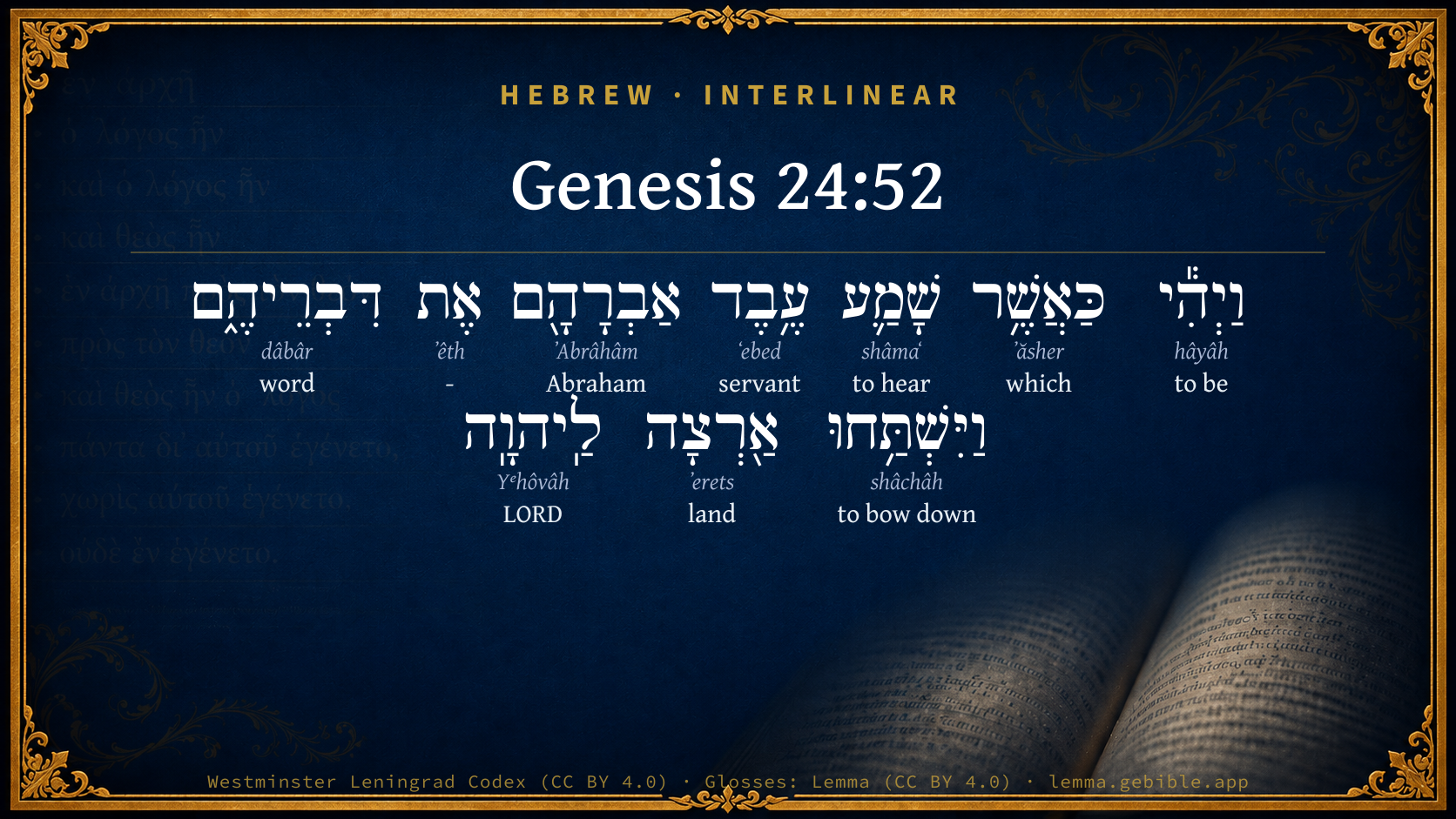
Hebrew (Westminster Leningrad Codex) Genesis 24:52 appears in the Hebrew Old Testament. The text above is from the Westminster Leningrad Codex. Each word links to its Strong’s number, a concise gloss, and parsing drawn from the Open Scriptures Hebrew Bible morphology. Click any word for its full Brown-Driver-Briggs (BDB) entry.
Download image
Cite this verse

Genesis 24:52 (World English Bible). Public Domain. Lemma interlinear Bible study tool, https://lemma.gebible.app/v/genesis/24/52.

Show BibTeX & RIS
BibTeX
RIS
English Translation
It happened that when Abraham's servant heard their words, he bowed himself down to the earth to Yahweh.
World English Bible · Public Domain
Download a study sheet

One document with this verse’s original text, its word-by-word gloss line, the meaning frame, cross-references with their text, attributed commentary, and full source and license credits — printable, and it pastes into notes with its structure intact.

This verse Autodidact and up

Study sheet (.html) Plain text (.txt)

A passage Seminary Student

Up to 50 verses in one chapter. A passage sheet keeps up to 6 commentary sources and 12 cross-references per verse, in the order this page ranks them, and says so on the sheet whenever that leaves anything out. Ask for a single verse and you get the Autodidact verse sheet above.

Everything on this page stays free to read, with no account — the sheet is a download of what is already on screen, not access to it.

Want to remove ads? Support Godless Engineer
Compare translations 3

The same verse in 3 English versions, stacked beneath the original-language interlinear above. Click any original word for its lexicon entry.

Each is an independent rendering of the whole verse — the interlinear is not word-aligned to these translations.

Highlighted words mark where these versions differ — a whole-verse word diff, not a word-by-word alignment.

  • World English Bible Public Domain
    It happened that when Abraham's servant heard their words, he bowed himself down to the earth to Yahweh.
  • King James Version Public Domain
    And it came to pass, that, when Abraham's servant heard their words, he worshipped the LORD, bowing himself to the earth.
  • unfoldingWord Literal Text CC BY-SA 4.0
    Then it happened, when the servant of Abraham heard their words, that he bowed down to the ground before Yahweh.

unfoldingWord Literal Text — © unfoldingWord, licensed CC BY-SA 4.0. Word-aligned USFM3 via Door43 (git.door43.org/unfoldingWord/en_ult).

Versions to compare (up to 4)

3 of 4 selected

Show all 18 translations

Every available English version of this verse, each an independent rendering of the whole verse.

  • World English Bible Public Domain
    It happened that when Abraham's servant heard their words, he bowed himself down to the earth to Yahweh.
  • Berean Standard Bible Public Domain
    When Abraham’s servant heard their words, he bowed down to the ground before the LORD.
  • Majority Standard Bible Public Domain
    When Abraham’s servant heard their words, he bowed down to the ground before the LORD.
  • King James Version Public Domain
    And it came to pass, that, when Abraham's servant heard their words, he worshipped the LORD, bowing himself to the earth.
  • American Standard Version (1901) Public Domain
    And it came to pass, that, when Abraham's servant heard their words, he bowed himself down to the earth unto Jehovah.
  • Revised Version (1885) Public Domain
    And it came to pass, that, when Abraham’s servant heard their words, he bowed himself down to the earth unto the LORD.
  • Geneva Bible (1599) Public Domain
    And when Abrahams seruant heard their wordes, he bowed himselfe toward the earth vnto the Lord.
  • Douay-Rheims (1899) Public Domain
    WHich when Abraham's servant heard, falling down to the ground he adored the Lord.
  • Young's Literal Translation Public Domain
    And it cometh to pass, when the servant of Abraham hath heard their words, that he boweth himself towards the earth before Jehovah;
  • Literal Standard Version CC BY-SA 4.0
    And it comes to pass, when the servant of Abraham has heard their words, that he bows himself toward the earth before YHWH;
  • Unlocked Literal Bible CC BY-SA 4.0
    When Abraham's servant heard their words, he bowed himself down to the ground to Yahweh.
  • unfoldingWord Literal Text CC BY-SA 4.0
    Then it happened, when the servant of Abraham heard their words, that he bowed down to the ground before Yahweh.
  • Darby Bible Public Domain
    And it came to pass, when Abraham's servant heard their words, that he bowed down to the earth before Jehovah.
  • World Messianic Bible Public Domain
    When Abraham’s servant heard their words, he bowed himself down to the earth to the LORD.
  • Webster's Bible Public Domain
    And it came to pass, that when Abraham's servant heard their words, he worshipped the LORD, bowing himself to the earth.
  • Free Bible Version CC BY-SA 4.0
    As soon as Abraham's servant heard their decision, he bowed down in worship to the Lord.
  • Bible in Basic English Public Domain
    And at these words, Abraham's servant went down on his face and gave praise to the Lord.
  • JPS Tanakh (1917) Public Domain
    And it came to pass, that, when Abraham's servant heard their words, he bowed himself down to the earth unto the LORD.

Literal Standard Version (2020), Covenant Press — licensed CC BY-SA 4.0. Text via the HelloAO Bible API (eBible.org). Unlocked Literal Bible (unfoldingWord) — licensed CC BY-SA 4.0. Text via the HelloAO Bible API (eBible.org). unfoldingWord Literal Text — © unfoldingWord, licensed CC BY-SA 4.0. Word-aligned USFM3 via Door43 (git.door43.org/unfoldingWord/en_ult). Free Bible Version, Dr. Jonathan Gallagher — licensed CC BY-SA 4.0. Text via the HelloAO Bible API (eBible.org).

Word by word

More ways to search: Search by grammar → Find every occurrence → Compare this word →

Practice this passage: Drill this verse → Learn its vocabulary →

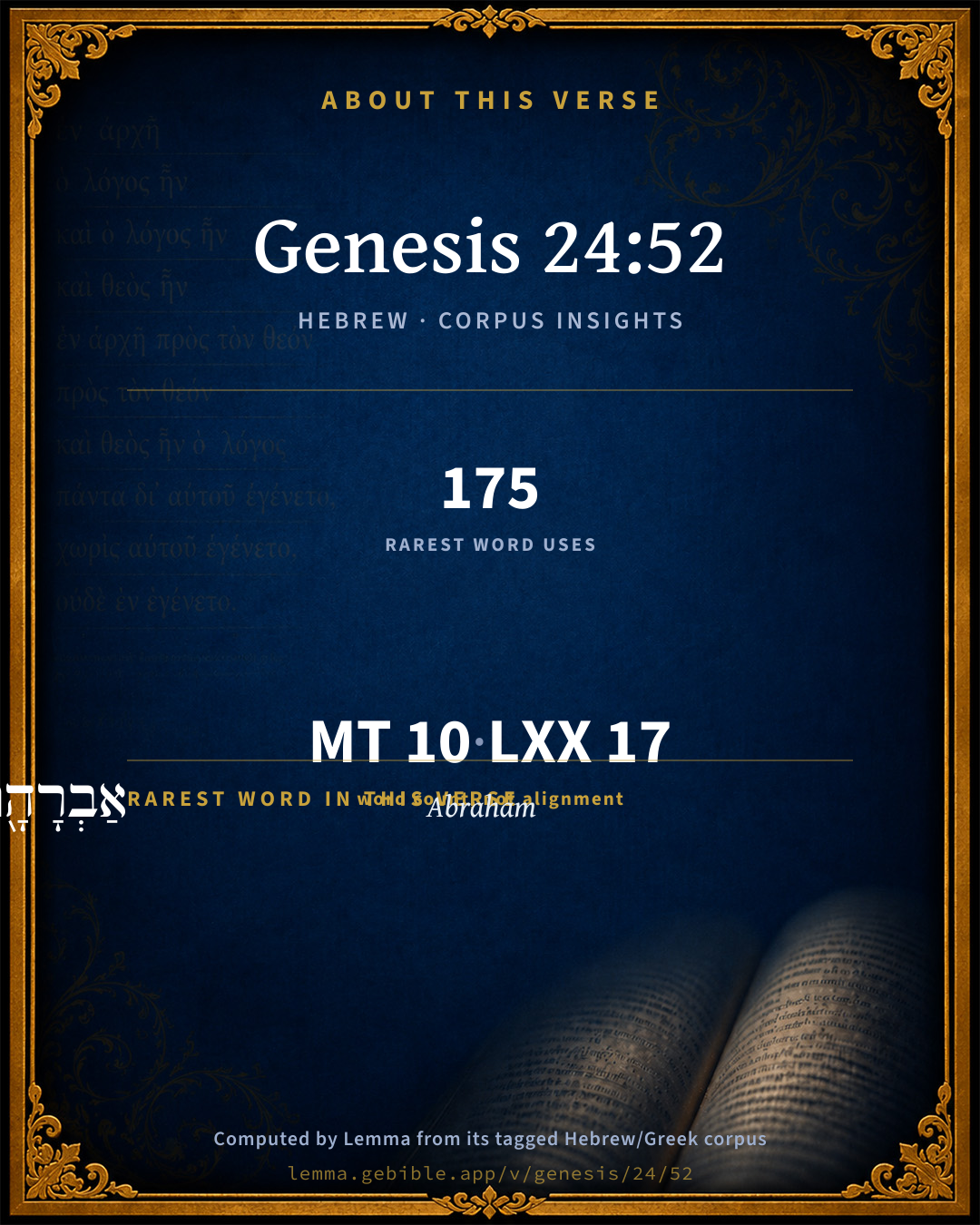
אַבְרָהָ֖ם
ʼAbrâhâm
H85
“Abraham”
Noun, Proper
Part of Speech
Noun
Type
Proper
Full BDB Definition

Origin: contracted from H1 and an unused root (probably meaning to be populous)

TWOT: 4b

Abraham = "father of a multitude" or " chief of multitude" - friend of God and founder of Hebrew nation via God's elective covenant
  1. וַיְהִ֕י hâyâh H1961 “and · to be” Conjunction + Verb, Qal, Sequential Imperfect, 3rd Person, Masculine, Singular
  2. כַּאֲשֶׁ֥ר ʼăsher H834 “like/as · which” Preposition + Particle, Relative
  3. שָׁמַ֛ע shâmaʻ H8085 “to hear” Verb, Qal, Perfect, 3rd Person, Masculine, Singular
  4. עֶ֥בֶד ʻebed H5650 “servant of” Noun, Common, Masculine, Singular, Construct
  5. אֶת ʼêth H853 “-” Particle, Direct Object
  6. דִּבְרֵיהֶ֑ם dâbâr H1697 “words · their” Noun, Common, Masculine, Plural, Construct + Suffix, Personal, 3rd Person, Masculine, Plural
  7. וַיִּשְׁתַּ֥חוּ shâchâh H7812 “and · to bow down” Conjunction + Verb, Hithpael, Sequential Imperfect, 3rd Person, Masculine, Singular
  8. אַ֖רְצָה ʼerets H776 “land · toward” Noun, Common, Both, Singular, Absolute + Suffix, Demonstrative
  9. לַֽיהוָֽה Yᵉhôvâh H3068 “to/for · LORD” Preposition + Noun, Proper

About this verse

These counts appear in no published source. They are computed here, from the morphology-tagged text and Lemma’s own curated glosses. What Lemma adds →

10
words
10
distinct lemmas
Pentateuch
section

Grammatical profile

  • 3 verbs
  • 5 nouns
  • 2 particles

Verb forms

  • וַיְהִ֕י Qal · Sequential Imperfect
  • שָׁמַ֛ע Qal · Perfect
  • וַיִּשְׁתַּ֥חוּ Hithpael · Sequential Imperfect

Hebrew & Septuagint length

In English translation the verse runs 18 words from the Hebrew and 23 from the Septuagint (LXX English) — closely comparable.

A rough comparison of the two English renderings, which tokenize alike — not a word-level alignment.

Word counts can differ between the Hebrew and the Greek without any difference in meaning — e.g. the Hebrew direct-object marker אֵת has no separate Greek word, and Greek often adds the article ὁ.

In the original languages it is 10 Hebrew tokens and 17 Greek tokens — but the two are counted differently (Hebrew bundles its prefixes and suffixes into one token; the Greek is in lemma form), so that isn’t a like-for-like length.

Cross-references

10

Topical passages linked to Genesis 24:52 in the Treasury of Scripture Knowledge — connected by theme and wording, ordered by reader-vote popularity; previews shown in the World English Bible.

  • Genesis 24:26 The man bowed his head, and worshiped Yahweh.
  • Genesis 24:48 I bowed my head, and worshiped Yahweh, and blessed Yahweh, the God of my master Abraham, who had led me in the right way to take my master's brother's daughter for his son.
  • Psalms 95:6 Oh come, let's worship and bow down. Let's kneel before Yahweh, our Maker,
  • Psalms 116:1–2 I love Yahweh, because he listens to my voice, And my cries for mercy.
  • 1 Chronicles 29:20 David said to all the assembly, Now bless Yahweh your God. All the assembly blessed Yahweh, the God of their fathers, and bowed down their heads, and worshiped Yahweh, and the king.
  • 2 Chronicles 20:18 Jehoshaphat bowed his head with his face to the ground; and all Judah and the inhabitants of Jerusalem fell down before Yahweh, worshipping Yahweh.
  • Psalms 34:1–2 I will bless Yahweh at all times. His praise will always be in my mouth.
  • Psalms 107:21–22 Let them praise Yahweh for his loving kindness, For his wonderful works to the children of men!
  • Matthew 2:11 They came into the house and saw the young child with Mary, his mother, and they fell down and worshiped him. Opening their treasures, they offered to him gifts: gold, frankincense, and myrrh.
  • Acts 10:25–26 When it happened that Peter entered, Cornelius met him, fell down at his feet, and worshiped him.

Cross-references courtesy of OpenBible.info (CC BY 4.0).

Hebrew and Greek witnesses Masoretic Hebrew ↔ Greek Septuagint

The same verse in the two great witnesses to the Old Testament, shown verse-for-verse.

These are two independent witnesses, not word-aligned to each other, and the Septuagint is shown in lemma (dictionary) form.

Hebrew Genesis 24:52 Masoretic · Westminster Leningrad Codex

וַיְהִ֕י כַּאֲשֶׁ֥ר שָׁמַ֛ע עֶ֥בֶד אַבְרָהָ֖ם אֶת דִּבְרֵיהֶ֑ם וַיִּשְׁתַּ֥חוּ אַ֖רְצָה לַֽיהוָֽה

It happened that when Abraham's servant heard their words, he bowed himself down to the earth to Yahweh.

World English Bible · Public Domain

Greek LXX Genesis 24:52 Septuagint · lemma form

γίγνομαι δέ ἐν ὁ ἀκούω ὁ παῖς ὁ αβρααμ ὁ ῥῆμα οὗτος προςκυνέω ἐπί ὁ γῆ κύριος

And it came to pass when the servant of Abraam heard these words, he bowed himself to the Lord down to the earth.

LXX2012 (modern English Septuagint) · Public Domain

Hebrew: Westminster Leningrad Codex (CC BY 4.0). Greek: Septuagint (public domain); English from LXX2012 (modern English Septuagint) (Public Domain). How the Septuagint differs from the Hebrew →

Targum (Aramaic paraphrase)

2

The Targum is the ancient Jewish Aramaic paraphrase of the Hebrew Scriptures — an interpretive translation, not the Hebrew text itself. Onkelos (literal) and Pseudo-Jonathan (expansive) render the Torah, and Jonathan the Prophets. Coverage is partial: where no permissively-licensed English translation exists for a verse, only the Aramaic is shown. This is verse-level text, not a word-by-word alignment to the Hebrew.

  1. Targum Onkelos Torah (Genesis–Deuteronomy)
    וַהֲוָה כַּד שְׁמַע עַבְדָּא דְאַבְרָהָם יָת פִּתְגָּמֵיהוֹן וּסְגֵד עַל אַרְעָא קֳדָם יְיָ

    (no public-domain English translation for this verse)

    Targum Onkelos — Aramaic: “Onkelos Genesis” (public domain); “Onkelos Exodus” (public domain); “Onkelos Leviticus” (public domain); “Onkelos Numbers” (public domain); “Onkelos Deuteronomy” (public domain). English: “Sefaria Community Translation” (CC0 1.0 (public-domain dedication)); “J.W. Etheridge. The Targums of Onkelos and Jonathan Ben Uzziel on the Pentateuch. London: Longmans, Green, 1862” (public domain). Text via Sefaria.

  2. Targum Pseudo-Jonathan Torah (Genesis–Deuteronomy)
    וַהֲוָה כַּד שְׁמַע עַבְדָא דְאַבְרָהָם יַת פִּתְגָמֵיהוֹן וּסְגִיד עַל אַרְעָא קֳדָם יְיָ

    And when Abraham's servant heard these words, he worshipped on the ground before the Lord.

    Targum Pseudo-Jonathan — Aramaic: “Targum Jonathan on Genesis” (public domain); “Targum Jonathan on Exodus” (public domain); “Targum Jonathan on Leviticus” (public domain); “Targum Jonathan on Numbers” (public domain); “Targum Jonathan on Deuteronomy” (public domain). English: “The Targum of Jonathan ben Uzziel, trans. J. W. Etheridge, London, 1862” (public domain). Text via Sefaria.

Commentary

Notes on Genesis 24:52 from classic Christian and Jewish commentators (each source and its license shown beneath its notes). The classic Christian expositions comment on the surrounding passage and are grouped to its opening verse, so a note may address several verses; the Jewish commentaries on the Tanakh (Rashi and others) are per-verse, so they appear only where the commentator wrote on this verse.

Lemma curates 59 commentaries, every one of them public domain or Creative Commons licensed, each selected and text-cleaned for this edition rather than reprinted as found. About our sources →

Trapp's Complete Commentary

John Trapp

Gen 24:52 And it came to pass, that, when Abraham’s servant heard their words, he worshipped the LORD, [bowing himself] to the earth.

Ver. 52. He worshipped.] {See Trapp on "Gen 24:48"}

Bowing himself to the earth.] This humble posture he had learned, belike, of his holy master, who walked before God in a humble familiarity. God loves to be acquainted with men in the walks of their obedience; yet he takes state upon him in his ordinances, and will be trembled at in his judgments.

John Trapp, A Commentary or Exposition upon All the Books of the Old and New Testament (1647–1656) — public domain. Text from a community e-Sword module.

Joseph Benson's Commentary

Gen 24:52. He worshipped the Lord — As his good success went on, he went on to bless God. Those that pray without ceasing, should in every thing give thanks, and own God in every step of mercy.

Joseph Benson's Commentary on the Old and New Testaments (1811–1818) — public domain. Text from a community e-Sword module.

John Calvin's Commentaries

52. He worshipped. Moses again repeats that Abraham’s servant gave thanks to God; and it is not without reason that he so often inculcates this religious duty; because, since God requires nothing greater from us, the neglect of it betrays the most shameful indolence. The acknowledgment of God’s kindness is a sacrifice of sweet-smelling savor; yea, it is a more acceptable service than all sacrifices. God is continually heaping innumerable benefits upon men. Their ingratitude, therefore, is intolerable, if they fail to exercise themselves in celebrating those benefits.

John Calvin's Commentaries (1540-1563) — public domain. Text from the Calvin Translation Society English edition (1840s-50s) via the Christian Classics Ethereal Library (ccel.org). Calvin's coverage is partial (roughly two-thirds of the Bible); uncommented books and verses are honest gaps, never fabricated. The 19th-century editor's footnotes and remarks are omitted so the notes are faithfully Calvin's own voice.

The Cambridge Bible for Schools and Colleges

gen. ed. J. J. S. Perowne

52. bowed himself down] Cf. Gen_24:26; Gen_24:48. The servant renders thanks to Jehovah before proceeding to ratify the betrothal.

The Cambridge Bible for Schools and Colleges (gen. ed. J. J. S. Perowne; Cambridge University Press, 1878–1918) — public domain. Text from a community e-Sword module.

John Gill's Exposition

And they said, we will call the damsel,.... Who perhaps through modesty had withdrawn herself to her own apartment, while the man and her friends were discoursing on this subject:

and inquire at her mouth; what she says to it, whether willing to go directly or not; the matter in question was referred to her, and left to her decision.

John Gill's Exposition of the Whole Bible (1746–1763) — public domain (CC PDM 1.0). Text via the HelloAO Bible API.

John Wesley's Explanatory Notes

He worshipped the Lord - As his good success went on, he went on to bless God: those that pray without ceasing should in every thing give thanks, and own God in every step of mercy.

John Wesley, Explanatory Notes Upon the Whole Bible (1754–1765) — public domain. Text via the GEBible commentary corpus.

Keil & Delitzsch

C. F. Keil & F. Delitzsch

After receiving their assent, the servant first of all offered thanks to Jehovah with the deepest reverence; he then gave the remaining presents to the bride, and to her relations (brother and mother); and after everything was finished, partook of the food provided.

Keil & Delitzsch — Biblical Commentary on the Old Testament (1861–1891) — public domain (CC PDM 1.0). Text via the HelloAO Bible API. (Old Testament only.)

unfoldingWord translationNotes

Door43 World Missions Community

their words

"what Laban and Bethuel said"

he bowed himself down

Bowing down before God is an expression of worship to him. (See: Symbolic Action)

articles of silver and articles of gold

"silver and gold items" or "things made of silver and gold"

precious gifts

"expensive gifts" or "valuable gifts"

translationWords

Abraham

servant

bow

Yahweh

Rebekah

unfoldingWord translationNotes — © Distant Shores Media and the Door43 World Missions Community, licensed CC BY-SA 4.0. Source: git.door43.org/Door43/en_tn.

Rashi

Rabbi Shlomo Yitzchaki (Rashi)

וישתחו ארצה HE PROSTRATED HIMSELF — From this we may learn that we should thank God for good news (Genesis Rabbah 60:6).

Rashi on the Tanakh — English translations: “The Judaica Press complete Tanach with Rashi, translated by A. J. Rosenberg” (CC BY 4.0); “Pentateuch with Rashi's commentary by M. Rosenbaum and A.M. Silbermann, 1929-1934” (public domain); “The Metsudah Tanach series, Lakewood, N.J” (CC BY 4.0); and “The Book of Joshua, Metsudah Publications, 1997” (CC BY 4.0). Text via Sefaria.

Radak

Rabbi David Kimhi (Radak)

ויהי..וישתחו ארצה, prostrating himself on the ground with arms and feet extended.

Radak on the Tanakh — English translations: “Sefaria Community Translation” (CC0 1.0 (public-domain dedication)); “Eliyahu Munk, HaChut Hameshulash” (CC BY 4.0); “Rabbi Mike Feuer, Jerusalem Anthology” (CC BY 4.0); and “R. David Kimhi on the first book of Psalms, Translated by R.G. Finch, London, 1919” (public domain). Text via Sefaria.

Lesson kit

Teaching starters — assembled from the data on this page, not authored interpretation. Every prompt links to the verse data it draws on. Edit before teaching.

Genesis, in the Pentateuch, opens this verse with 10 words (10 distinct Hebrew lemmas). Its most distinctive word is ʼAbrâhâm (“Abraham”). A historical commentator’s framing appears above. Read the whole chapter for the surrounding context.

Discussion questions

  1. How does “Abraham” (ʼAbrâhâm) shape what this verse is saying?
  2. How does Genesis 24:26, which shares this passage’s theme, read alongside this verse?
  3. These translations render this verse differently. What is at stake in choosing one wording over another?
  4. «וַיְהִ֕י» is a Qal Sequential Imperfect verb. How does that grammatical form shape the action described?
  5. Compare how Trapp's Complete Commentary and Joseph Benson's Commentary read this verse. Where do they agree or differ?

Things to notice

Reading settings

Reading text

Shown beneath each verse's original-language words.

Old Testament
Old Testament edition

Read the OT as the Masoretic Hebrew (MT) or the Greek Septuagint (LXX).

English shown for the Greek Septuagint (in the Hebrew ↔ Greek comparison).

Comparing translations? Open the Compare panel on any verse page to stack up to four side by side.