Genesis 21:26

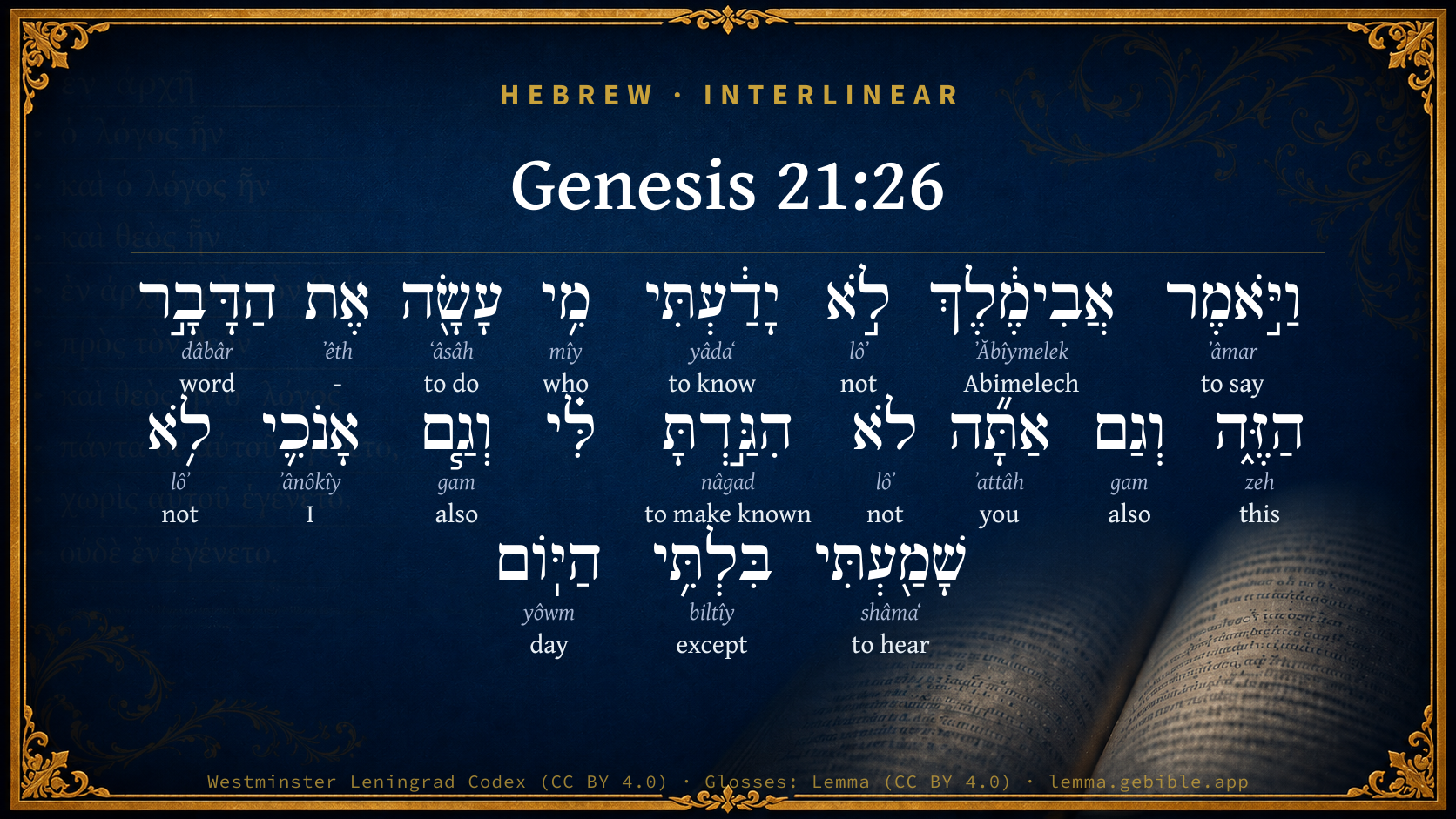
Hebrew (Westminster Leningrad Codex) Genesis 21:26 appears in the Hebrew Old Testament. The text above is from the Westminster Leningrad Codex. Each word links to its Strong’s number, a concise gloss, and parsing drawn from the Open Scriptures Hebrew Bible morphology. Click any word for its full Brown-Driver-Briggs (BDB) entry.
Download image
Cite this verse

Genesis 21:26 (World English Bible). Public Domain. Lemma interlinear Bible study tool, https://lemma.gebible.app/v/genesis/21/26.

Show BibTeX & RIS
BibTeX
RIS
English Translation
Abimelech said, "I don't know who has done this thing. Neither did you tell me, neither did I hear of it, until today."
World English Bible · Public Domain
Download a study sheet

One document with this verse’s original text, its word-by-word gloss line, the meaning frame, cross-references with their text, attributed commentary, and full source and license credits — printable, and it pastes into notes with its structure intact.

This verse Autodidact and up

Study sheet (.html) Plain text (.txt)

A passage Seminary Student

Up to 50 verses in one chapter. A passage sheet keeps up to 6 commentary sources and 12 cross-references per verse, in the order this page ranks them, and says so on the sheet whenever that leaves anything out. Ask for a single verse and you get the Autodidact verse sheet above.

Everything on this page stays free to read, with no account — the sheet is a download of what is already on screen, not access to it.

Want to remove ads? Support Godless Engineer
Compare translations 3

The same verse in 3 English versions, stacked beneath the original-language interlinear above. Click any original word for its lexicon entry.

Each is an independent rendering of the whole verse — the interlinear is not word-aligned to these translations.

Highlighted words mark where these versions differ — a whole-verse word diff, not a word-by-word alignment.

  • World English Bible Public Domain
    Abimelech said, "I don't know who has done this thing. Neither did you tell me, neither did I hear of it, until today."
  • King James Version Public Domain
    And Abimelech said, I wot not who hath done this thing; neither didst thou tell me, neither yet heard I of it, but to day.
  • unfoldingWord Literal Text CC BY-SA 4.0
    Then Abimelech said, “I do not know who has done this thing. And also you did not tell me, and also I have not heard about it until today.”

unfoldingWord Literal Text — © unfoldingWord, licensed CC BY-SA 4.0. Word-aligned USFM3 via Door43 (git.door43.org/unfoldingWord/en_ult).

Versions to compare (up to 4)

3 of 4 selected

Show all 18 translations

Every available English version of this verse, each an independent rendering of the whole verse.

  • World English Bible Public Domain
    Abimelech said, "I don't know who has done this thing. Neither did you tell me, neither did I hear of it, until today."
  • Berean Standard Bible Public Domain
    Abimelech replied, “I do not know who has done this. You did not tell me, so I have not heard about it until today.”
  • Majority Standard Bible Public Domain
    Abimelech replied, “I do not know who has done this. You did not tell me, so I have not heard about it until today.”
  • King James Version Public Domain
    And Abimelech said, I wot not who hath done this thing; neither didst thou tell me, neither yet heard I of it, but to day.
  • American Standard Version (1901) Public Domain
    And Abimelech said, I know not who hath done this thing. Neither didst thou tell me, neither yet heard I of it, but to-day.
  • Revised Version (1885) Public Domain
    And Abimelech said, I know not who hath done this thing: neither didst thou tell me, neither yet heard I of it, but today.
  • Geneva Bible (1599) Public Domain
    And Abimelech saide, I knowe not who hath done this thing: also thou toldest me not, neither heard I of it but this day.
  • Douay-Rheims (1899) Public Domain
    And Abimelech answered: I knew not who did this thing: and thou didst not tell me, and I heard not of it till today.
  • Young's Literal Translation Public Domain
    and Abimelech saith, `I have not known who hath done this thing, and even thou didst not declare to me, and I also, I have not heard save to-day.'
  • Literal Standard Version CC BY-SA 4.0
    and Abimelech says, “I have not known who has done this thing, and even you did not declare to me, and I also, I have not heard except today.”
  • Unlocked Literal Bible CC BY-SA 4.0
    Abimelech said, “I do not know who has done this thing. You did not tell me before now; I have not heard of it until today.”
  • unfoldingWord Literal Text CC BY-SA 4.0
    Then Abimelech said, “I do not know who has done this thing. And also you did not tell me, and also I have not heard about it until today.”
  • Darby Bible Public Domain
    And Abimelech said, I do not know who has done this, neither hast thou told me [of it], neither have I heard [of it] but to-day.
  • World Messianic Bible Public Domain
    Abimelech said, “I don’t know who has done this thing. You didn’t tell me, and I didn’t hear of it until today.”
  • Webster's Bible Public Domain
    And Abimelech said, I know not who hath done this thing: neither didst thou tell me, neither yet have I heard of it, but to-day.
  • Free Bible Version CC BY-SA 4.0
    “I don't know who did this, and you didn't mention it before. I haven't heard anything about it until today,” Abimelech responded.
  • Bible in Basic English Public Domain
    But Abimelech said, I have no idea who has done this thing; you never gave me word of it, and I had no knowledge of it till this day.
  • JPS Tanakh (1917) Public Domain
    And Abimelech said: 'I know not who hath done this thing; neither didst thou tell me, neither yet heard I of it, but to-day.'

Literal Standard Version (2020), Covenant Press — licensed CC BY-SA 4.0. Text via the HelloAO Bible API (eBible.org). Unlocked Literal Bible (unfoldingWord) — licensed CC BY-SA 4.0. Text via the HelloAO Bible API (eBible.org). unfoldingWord Literal Text — © unfoldingWord, licensed CC BY-SA 4.0. Word-aligned USFM3 via Door43 (git.door43.org/unfoldingWord/en_ult). Free Bible Version, Dr. Jonathan Gallagher — licensed CC BY-SA 4.0. Text via the HelloAO Bible API (eBible.org).

Word by word

More ways to search: Search by grammar → Find every occurrence → Compare this word →

Practice this passage: Drill this verse → Learn its vocabulary →

אֲבִימֶ֔לֶךְ
ʼĂbîymelek
H40
“Abimelech”
Noun, Proper
Part of Speech
Noun
Type
Proper
Full BDB Definition

Origin: from H1 and H4428

TWOT: None

Abimelech = "Melek is father" or " my father is king" - king of Gerar in Abraham's time - king of Gath in David's time; maybe title of Philistine kings - son of Gideon by a concubine - priest, son of Abiathar
  1. וַיֹּ֣אמֶר ʼâmar H559 “and · to say” Conjunction + Verb, Qal, Sequential Imperfect, 3rd Person, Masculine, Singular
  2. לֹ֣א lôʼ H3808 “not” Particle, Negative
  3. יָדַ֔עְתִּי yâdaʻ H3045 “to know” Verb, Qal, Perfect, 1st Person, Common, Singular
  4. מִ֥י mîy H4310 “who” Particle, Interrogative
  5. עָשָׂ֖ה ʻâsâh H6213 “to do” Verb, Qal, Perfect, 3rd Person, Masculine, Singular
  6. אֶת ʼêth H853 “-” Particle, Direct Object
  7. הַדָּבָ֣ר dâbâr H1697 “the · word” Particle, Definite Article + Noun, Common, Masculine, Singular, Absolute
  8. הַזֶּ֑ה zeh H2088 “the · this” Particle, Definite Article + Pronoun, Demonstrative, Masculine, Singular
  9. וְגַם gam H1571 “and · also” Conjunction + Particle, Accusative
  10. אַתָּ֞ה ʼattâh H859 “you” Pronoun, Personal, 2nd Person, Masculine, Singular
  11. לֹא lôʼ H3808 “not” Particle, Negative
  12. הִגַּ֣דְתָּ nâgad H5046 “to make known” Verb, Hiphil, Perfect, 2nd Person, Masculine, Singular
  13. וְגַ֧ם gam H1571 “and · also” Conjunction + Particle, Accusative
  14. אָנֹכִ֛י ʼânôkîy H595 “I” Pronoun, Personal, 1st Person, Common, Singular
  15. לֹ֥א lôʼ H3808 “not” Particle, Negative
  16. שָׁמַ֖עְתִּי shâmaʻ H8085 “to hear” Verb, Qal, Perfect, 1st Person, Common, Singular
  17. בִּלְתִּ֥י biltîy H1115 “except” Conjunction
  18. הַיּֽוֹם yôwm H3117 “the · day” Particle, Definite Article + Noun, Common, Masculine, Singular, Absolute

About this verse

These counts appear in no published source. They are computed here, from the morphology-tagged text and Lemma’s own curated glosses. What Lemma adds →

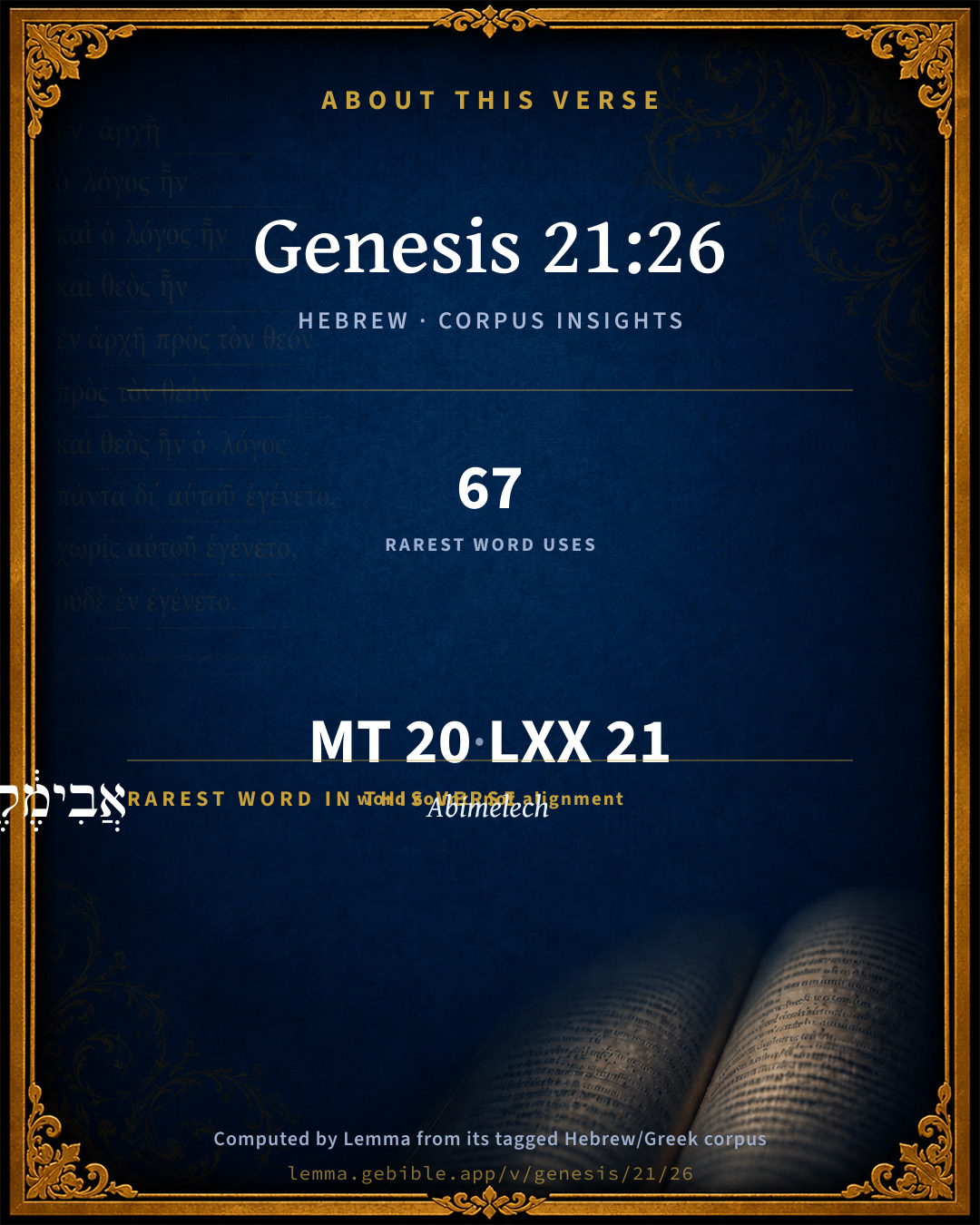
20
words
16
distinct lemmas
Pentateuch
section

Grammatical profile

  • 5 verbs
  • 3 nouns
  • 3 pronouns
  • 1 preposition
  • 1 conjunction
  • 7 particles

Verb forms

  • וַיֹּ֣אמֶר Qal · Sequential Imperfect
  • יָדַ֔עְתִּי Qal · Perfect
  • עָשָׂ֖ה Qal · Perfect
  • הִגַּ֣דְתָּ Hiphil · Perfect
  • שָׁמַ֖עְתִּי Qal · Perfect

Repetition

Words recur within this verse — often emphatic in Hebrew:

  • וְגַם also H1571 ×2
  • לֹ֣א not H3808 ×3

Hebrew & Septuagint length

In English translation the verse runs 23 words from the Hebrew and 28 from the Septuagint (LXX English) — closely comparable.

A rough comparison of the two English renderings, which tokenize alike — not a word-level alignment.

Word counts can differ between the Hebrew and the Greek without any difference in meaning — e.g. the Hebrew direct-object marker אֵת has no separate Greek word, and Greek often adds the article ὁ.

In the original languages it is 20 Hebrew tokens and 21 Greek tokens — but the two are counted differently (Hebrew bundles its prefixes and suffixes into one token; the Greek is in lemma form), so that isn’t a like-for-like length.

Cross-references

2

Topical passages linked to Genesis 21:26 in the Treasury of Scripture Knowledge — connected by theme and wording, ordered by reader-vote popularity; previews shown in the World English Bible.

  • Genesis 13:7 There was a strife between the herdsmen of Abram's cattle and the herdsmen of Lot's cattle: and the Canaanite and the Perizzite lived then in the land.
  • 2 Kings 5:20–24 But Gehazi the servant of Elisha the man of God, said, Behold, my master has spared this Naaman the Syrian, in not receiving at his hands that which he brought: as Yahweh lives, I will run after him, and take somewhat of him.

Cross-references courtesy of OpenBible.info (CC BY 4.0).

Hebrew and Greek witnesses Masoretic Hebrew ↔ Greek Septuagint

The same verse in the two great witnesses to the Old Testament, shown verse-for-verse.

These are two independent witnesses, not word-aligned to each other, and the Septuagint is shown in lemma (dictionary) form.

Hebrew Genesis 21:26 Masoretic · Westminster Leningrad Codex

וַיֹּ֣אמֶר אֲבִימֶ֔לֶךְ לֹ֣א יָדַ֔עְתִּי מִ֥י עָשָׂ֖ה אֶת הַדָּבָ֣ר הַזֶּ֑ה וְגַם אַתָּ֞ה לֹא הִגַּ֣דְתָּ לִּ֗י וְגַ֧ם אָנֹכִ֛י לֹ֥א שָׁמַ֖עְתִּי בִּלְתִּ֥י הַיּֽוֹם

Abimelech said, "I don't know who has done this thing. Neither did you tell me, neither did I hear of it, until today."

World English Bible · Public Domain

Greek LXX Genesis 21:26 Septuagint · lemma form

καί εἶπον αὐτός αβιμελεχ οὐ γιγνώσκω τίς ποιέω ὁ πρᾶγμα οὗτος οὐδέ σύ ἐγώ ἀποἀγγέλλω οὐδέ ἐγώ ἀκούω ἀλλά ἤ σήμερον

And Abimelech said to him, I know not who has done this thing to you, neither did you tell it me, neither heard I it but only today.

LXX2012 (modern English Septuagint) · Public Domain

Hebrew: Westminster Leningrad Codex (CC BY 4.0). Greek: Septuagint (public domain); English from LXX2012 (modern English Septuagint) (Public Domain). How the Septuagint differs from the Hebrew →

Targum (Aramaic paraphrase)

2

The Targum is the ancient Jewish Aramaic paraphrase of the Hebrew Scriptures — an interpretive translation, not the Hebrew text itself. Onkelos (literal) and Pseudo-Jonathan (expansive) render the Torah, and Jonathan the Prophets. Coverage is partial: where no permissively-licensed English translation exists for a verse, only the Aramaic is shown. This is verse-level text, not a word-by-word alignment to the Hebrew.

  1. Targum Onkelos Torah (Genesis–Deuteronomy)
    וַאֲמַר אֲבִימֶלֶךְ לָא יְדָעִית מָאן עֲבַד יָת פִּתְגָּמָא הָדֵין וְאַף אַתְּ לָא חַוֵּיתָ לִּי וְאַף אֲנָא לָא שְׁמָעִית אֱלָּהֵין יוֹמָא דֵין

    (no public-domain English translation for this verse)

    Targum Onkelos — Aramaic: “Onkelos Genesis” (public domain); “Onkelos Exodus” (public domain); “Onkelos Leviticus” (public domain); “Onkelos Numbers” (public domain); “Onkelos Deuteronomy” (public domain). English: “Sefaria Community Translation” (CC0 1.0 (public-domain dedication)); “J.W. Etheridge. The Targums of Onkelos and Jonathan Ben Uzziel on the Pentateuch. London: Longmans, Green, 1862” (public domain). Text via Sefaria.

  2. Targum Pseudo-Jonathan Torah (Genesis–Deuteronomy)
    וַאֲמַר אֲבִימֶלֶךְ לָא יָדַעְנָא מַן הוּא דְעָבַד יַת פִּתְגָמָא הָדֵין וְאוּף אַנְתְּ לָא חֲוַות לִי וְאוּף אֲנָא לָא שָׁמַעֲנָא מִן חוֹרָנִין אֱלָהֵין יוֹמָא דֵין מִנָךְ

    And Abimelek said, I knew not who did this thing; neither hast thou shown it to me; nor have I heard it from others, till today from thyself.

    Targum Pseudo-Jonathan — Aramaic: “Targum Jonathan on Genesis” (public domain); “Targum Jonathan on Exodus” (public domain); “Targum Jonathan on Leviticus” (public domain); “Targum Jonathan on Numbers” (public domain); “Targum Jonathan on Deuteronomy” (public domain). English: “The Targum of Jonathan ben Uzziel, trans. J. W. Etheridge, London, 1862” (public domain). Text via Sefaria.

Commentary

Notes on Genesis 21:26 from classic Christian and Jewish commentators (each source and its license shown beneath its notes). The classic Christian expositions comment on the surrounding passage and are grouped to its opening verse, so a note may address several verses; the Jewish commentaries on the Tanakh (Rashi and others) are per-verse, so they appear only where the commentator wrote on this verse.

Lemma curates 59 commentaries, every one of them public domain or Creative Commons licensed, each selected and text-cleaned for this edition rather than reprinted as found. About our sources →

Trapp's Complete Commentary

John Trapp

Gen 21:26 And Abimelech said, I wot not who hath done this thing: neither didst thou tell me, neither yet heard I [of it], but to day.

Ver. 26. I wot not who hath done this thing.] A fault it might be in Abraham, not to complain to the king. For many a good prince is even bought and sold by his officers and counsellors; as it was said of Aurelian the Emperor, who might know nothing but as they informed him. As of another German prince it was said, Esset alius, si esset apud alios .{ a}

{a} Bucholc.

John Trapp, A Commentary or Exposition upon All the Books of the Old and New Testament (1647–1656) — public domain. Text from a community e-Sword module.

Geneva Bible (1599)

Geneva Bible translators

Wicked servants do many evils unknown to their masters.

Geneva Bible (1599) marginal notes — public domain. Text via Bolls.life.

Adam Clarke's Commentary

Verse 26. I wot not who hath done this thing] The servants of Abimelech had committed these depredations on Abraham without any authority from their master, who appears to have been a very amiable man, possessing the fear of God, and ever regulating the whole of his conduct by the principles of righteousness and strict justice.

Adam Clarke's Commentary on the Bible (1810–1826) — public domain. Text from a community e-Sword/MySword module.

Ellicott's Commentary for English Readers

(26) I wot not.—This explains the reason of Abimelech’s visit. The king’s herdsmen had robbed Abraham of a well, a species of property jealously defended in the East because of its great value, and Abraham in some way had made his displeasure felt. Abimelech, ever friendly towards Abraham, by whose nobleness of character he had been greatly impressed, comes to learn the cause of the coolness, and to enter into a more close and lasting alliance with the patriarch. With Oriental indirectness, he makes no complaint, and speaks only of his wish for continued friendship, but by his allusion to his past kindness hints that this had not been received as it ought. Abraham fully understands his real meaning, and tells him what had happened; whereupon the matter is set right, and Abraham requites his previous generosity with gifts of cattle.

A Bible Commentary for English Readers, edited by Charles John Ellicott (1878–1897) — public domain. Text from a community e-Sword module.

John Gill's Exposition

And Abraham set seven ewe lambs of the flock by themselves. Separate from the sheep and oxen he gave to Abimelech, and from those that were used in making the covenant.

And Abraham set seven ewe lambs of the flock by themselves. Separate from the sheep and oxen he gave to Abimelech, and from those that were used in making the covenant.

Genesis 21:29

gen 21:29

gen 21:29

gen 21:29And Abimelech said unto Abraham,.... Observing what he had done, and not knowing the design of it:

what mean these seven ewe lambs which thou hast set by themselves? he understood what the sheep and oxen were for, that they were presents to him, at least some of them, and the rest were for the solemnizing and ratifying the covenant between them; but what these were for he could not devise.

John Gill's Exposition of the Whole Bible (1746–1763) — public domain (CC PDM 1.0). Text via the HelloAO Bible API.

Matthew Poole's English Annotations

By which he wisely and truly suggests, that Abraham should not have smothered the grudge in his mind so long time, but should instantly have reproved him for it, and endeavoured a speedy redress, which hereby he intimates that he was ready to give.

Matthew Poole's English Annotations on the Holy Bible (1683–1685) — public domain. Text from a community e-Sword/MySword module.

Whedon's Commentary on the Bible

Daniel D. Whedon

26. I wot not — Or, I knew not. By this protest Abimelech really reproves Abraham, as if he had been lacking in frankness towards him.

Daniel D. Whedon (gen. ed.), Commentary on the Old and New Testaments (1874–1909) — public domain. Text from a community e-Sword module.

The Pulpit Commentary

And Abimelech said, I wet not who hath done this thing. There is no reason to question the sincerity of the Philistine monarch in disclaiming all knowledge of the act of robbery committed by his servants. Neither didst thou toll me, neither yet heard I of it, but today. The prince rather complains that Abraham had done him an injustice.

The Pulpit Commentary (1880–1919), ed. H.D.M. Spence-Jones & Joseph S. Exell — public domain. Text from a community e-Sword module.

Radak

Rabbi David Kimhi (Radak)

ויאמר...וגם אנכי לא שמעתי, seeing that neither you nor anyone else has told me about this I cannot be held responsible for this.

Radak on the Tanakh — English translations: “Sefaria Community Translation” (CC0 1.0 (public-domain dedication)); “Eliyahu Munk, HaChut Hameshulash” (CC BY 4.0); “Rabbi Mike Feuer, Jerusalem Anthology” (CC BY 4.0); and “R. David Kimhi on the first book of Psalms, Translated by R.G. Finch, London, 1919” (public domain). Text via Sefaria.

Lesson kit

Teaching starters — assembled from the data on this page, not authored interpretation. Every prompt links to the verse data it draws on. Edit before teaching.

Genesis, in the Pentateuch, opens this verse with 20 words (16 distinct Hebrew lemmas). Its most distinctive word is ʼĂbîymelek (“Abimelech”). A historical commentator’s framing appears above. Read the whole chapter for the surrounding context.

Discussion questions

  1. What does “Abimelech” (ʼĂbîymelek) contribute to the verse as a whole?
  2. How does Genesis 13:7, which shares this passage’s theme, read alongside this verse?
  3. What does the repetition of “also” (2× in this one verse) do in this verse?
  4. The translations on this page render this verse differently — a whole-verse word diff, not a word-by-word alignment. What might account for the different wordings?
  5. «וַיֹּ֣אמֶר» is a Qal Sequential Imperfect verb. How does that grammatical form shape the action described?
  6. Compare how Trapp's Complete Commentary and Geneva Bible (1599) read this verse. Where do they agree or differ?

Things to notice

Reading settings

Reading text

Shown beneath each verse's original-language words.

Old Testament
Old Testament edition

Read the OT as the Masoretic Hebrew (MT) or the Greek Septuagint (LXX).

English shown for the Greek Septuagint (in the Hebrew ↔ Greek comparison).

Comparing translations? Open the Compare panel on any verse page to stack up to four side by side.