Colossians 1:6

Greek (Tischendorf 8th ed.) Colossians 1:6 appears in the Greek New Testament. The text above is from the Tischendorf 8th edition. Each word links to its Strong’s number and a concise gloss. Click any word for its full Thayer’s Greek Lexicon entry.
Download image
Cite this verse

Colossians 1:6 (World English Bible). Public Domain. Lemma interlinear Bible study tool, https://lemma.gebible.app/v/colossians/1/6.

Show BibTeX & RIS
BibTeX
RIS
English Translation
which has come to you; even as it is in all the world and is bearing fruit and growing, as it does in you also, since the day you heard and knew the grace of God in truth;
World English Bible · Public Domain
Download a study sheet

One document with this verse’s original text, its word-by-word gloss line, the meaning frame, cross-references with their text, attributed commentary, and full source and license credits — printable, and it pastes into notes with its structure intact.

This verse Autodidact and up

Study sheet (.html) Plain text (.txt)

A passage Seminary Student

Up to 50 verses in one chapter. A passage sheet keeps up to 6 commentary sources and 12 cross-references per verse, in the order this page ranks them, and says so on the sheet whenever that leaves anything out. Ask for a single verse and you get the Autodidact verse sheet above.

Everything on this page stays free to read, with no account — the sheet is a download of what is already on screen, not access to it.

Want to remove ads? Support Godless Engineer
Compare translations 3

The same verse in 3 English versions, stacked beneath the original-language interlinear above. Click any original word for its lexicon entry.

Each is an independent rendering of the whole verse — the interlinear is not word-aligned to these translations.

Highlighted words mark where these versions differ — a whole-verse word diff, not a word-by-word alignment.

  • World English Bible Public Domain
    which has come to you; even as it is in all the world and is bearing fruit and growing, as it does in you also, since the day you heard and knew the grace of God in truth;
  • King James Version Public Domain
    Which is come unto you, as it is in all the world; and bringeth forth fruit, as it doth also in you, since the day ye heard of it, and knew the grace of God in truth:
  • unfoldingWord Literal Text CC BY-SA 4.0
    which being present among you just as also in all the world, is bearing fruit and growing, just as also in you, from the day you heard and learned about the grace of God in truth,

unfoldingWord Literal Text — © unfoldingWord, licensed CC BY-SA 4.0. Word-aligned USFM3 via Door43 (git.door43.org/unfoldingWord/en_ult).

Versions to compare (up to 4)

3 of 4 selected

Show all 19 translations

Every available English version of this verse, each an independent rendering of the whole verse.

  • World English Bible Public Domain
    which has come to you; even as it is in all the world and is bearing fruit and growing, as it does in you also, since the day you heard and knew the grace of God in truth;
  • Berean Standard Bible Public Domain
    that has come to you. All over the world this gospel is bearing fruit and growing, just as it has been doing among you since the day you heard it and truly understood the grace of God.
  • Majority Standard Bible Public Domain
    that has come to you. All over the world this gospel is bearing fruit and growing, just as it has been doing among you since the day you heard it and truly understood the grace of God.
  • King James Version Public Domain
    Which is come unto you, as it is in all the world; and bringeth forth fruit, as it doth also in you, since the day ye heard of it, and knew the grace of God in truth:
  • American Standard Version (1901) Public Domain
    which is come unto you; even as it is also in all the world bearing fruit and increasing, as `it doth' in you also, since the day ye heard and knew the grace of God in truth;
  • Revised Version (1885) Public Domain
    which is come unto you; even as it is also in all the world bearing fruit and increasing, as it doth in you also, since the day ye heard and knew the grace of God in truth;
  • Geneva Bible (1599) Public Domain
    Which is come vnto you, eue as it is vnto al the world, and is fruitful, as it is also amog you, from ye day that ye heard and truely knew ye grace of God,
  • Douay-Rheims (1899) Public Domain
    Which is come unto you, as also it is in the whole world, and bringeth forth fruit and groweth, even as it doth in you, since the day you heard and knew the grace of God in truth.
  • Young's Literal Translation Public Domain
    which is present to you, as also in all the world, and is bearing fruit, as also in you, from the day in which ye heard, and knew the grace of God in truth;
  • Literal Standard Version CC BY-SA 4.0
    which has come to you, as also in all the world, and is bearing fruit, as also in you, from the day in which you heard, and knew the grace of God in truth,
  • Unlocked Literal Bible CC BY-SA 4.0
    which has come to you. This gospel is bearing fruit and is growing in all the world. It has been doing this in you also from the day you heard it and learned about the grace of God in truth.
  • unfoldingWord Literal Text CC BY-SA 4.0
    which being present among you just as also in all the world, is bearing fruit and growing, just as also in you, from the day you heard and learned about the grace of God in truth,
  • Darby Bible Public Domain
    which are come to you, as [they are] in all the world, [and] are bearing fruit and growing, even as also among you, from the day ye heard [them] and knew indeed the grace of God, in truth:
  • World Messianic Bible Public Domain
    which has come to you, even as it is in all the world and is bearing fruit and growing, as it does in you also, since the day you heard and knew the grace of God in truth,
  • Webster's Bible Public Domain
    Which is come to you, as it is in all the world; and bringeth forth fruit, as it doth also in you, since the day ye heard of it, and knew the grace of God in truth:
  • Free Bible Version CC BY-SA 4.0
    that came to you just as it has gone throughout the whole world, spreading widely and bringing results. It's done the same for you too, ever since you heard it and realized the true nature of God's grace.
  • Bible in Basic English Public Domain
    Which has come to you; and which in all the world is giving fruit and increase, as it has done in you from the day when it came to your ears and you had true knowledge of the grace of God;
  • Text-Critical English NT CC BY 4.0
    that has come to you. This gospel has gone out into all the world, where it is bearing fruit, just as it has been doing among you since the day you heard it and understood the grace of God in truth.
  • Tyndale New Testament (1534) Public Domain
    which is come vnto you even as it is in to all the worlde and is frutefull as it is amonge you from the fyrst daye in the which ye herde of it and had experiece in the grace of God in the trueth

Literal Standard Version (2020), Covenant Press — licensed CC BY-SA 4.0. Text via the HelloAO Bible API (eBible.org). Unlocked Literal Bible (unfoldingWord) — licensed CC BY-SA 4.0. Text via the HelloAO Bible API (eBible.org). unfoldingWord Literal Text — © unfoldingWord, licensed CC BY-SA 4.0. Word-aligned USFM3 via Door43 (git.door43.org/unfoldingWord/en_ult). Free Bible Version, Dr. Jonathan Gallagher — licensed CC BY-SA 4.0. Text via the HelloAO Bible API (eBible.org).

Word by word

More ways to search: Search by grammar → Find every occurrence → Compare this word →

Practice this passage: Drill this verse → Learn its vocabulary →

καρποφορούμενον
karpophoréō
G2592
“to bear fruit”
Verb, Present, Middle, Participle, Nominative, Singular, Neuter
Part of Speech
Verb
Tense
Present
Voice
Middle
Mood
Participle
Case
Nominative
Number
Singular
Gender
Neuter
Full Thayer's Definition

Origin: from G2593

TDNT: 13:16,4

1. to bear fruit 2. to bear, bring forth, deeds 3. to bear fruit of one's self
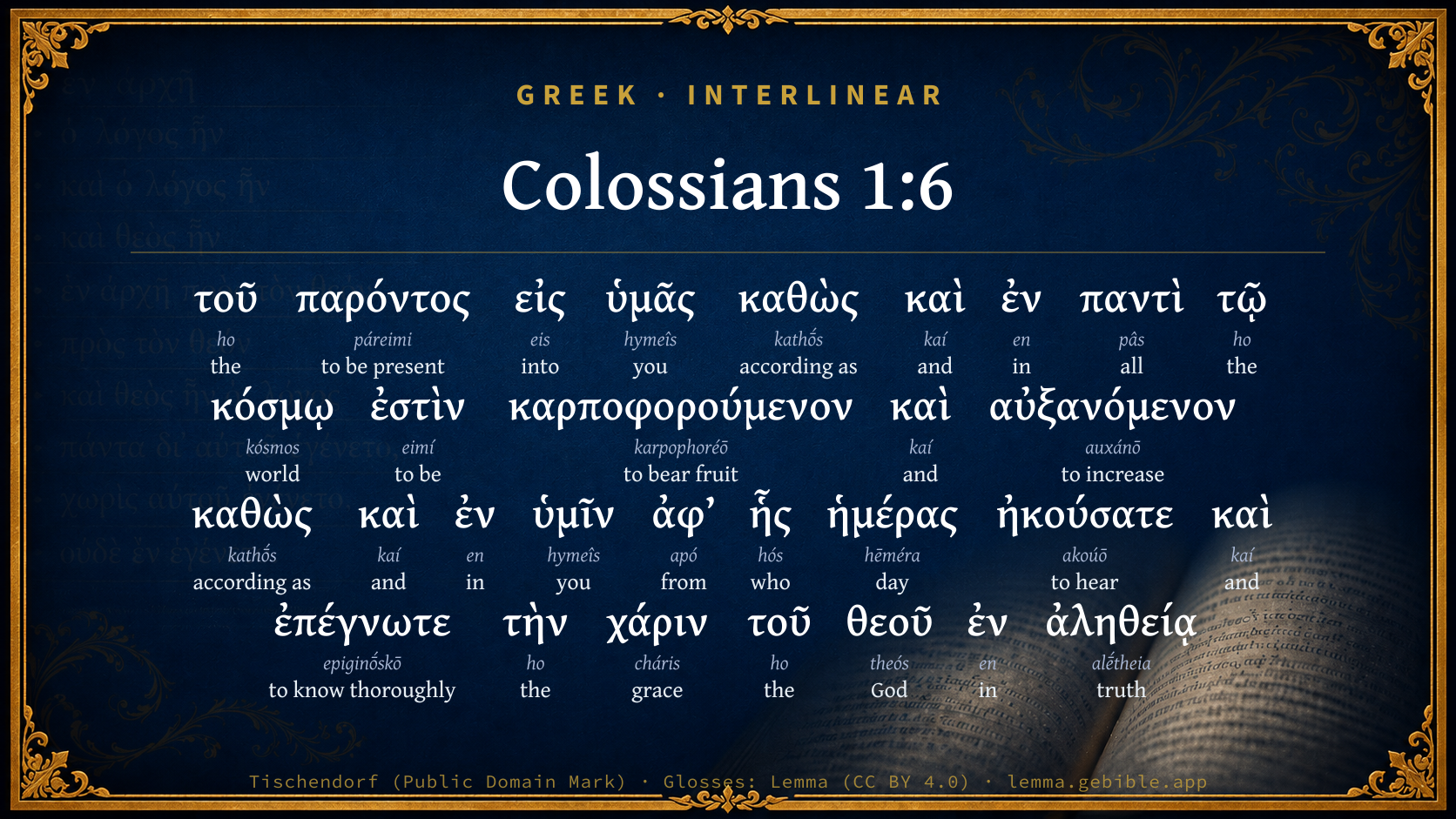
  1. τοῦ ho G3588 “the” Article, Genitive, Singular, Neuter
  2. παρόντος páreimi G3918 “to be present” Verb, Present, Active, Participle, Genitive, Singular, Neuter
  3. εἰς eis G1519 “into” Preposition
  4. ὑμᾶς hymeîs G5210 “you” Personal pronoun, 2nd person, Accusative, Plural
  5. καθὼς kathṓs G2531 “according as” Adverb
  6. καὶ kaí G2532 “and” Conjunction
  7. ἐν en G1722 “in” Preposition
  8. παντὶ pâs G3956 “all” Adjective, Dative, Singular, Masculine
  9. τῷ ho G3588 “the” Article, Dative, Singular, Masculine
  10. κόσμῳ kósmos G2889 “world” Noun, Dative, Singular, Masculine
  11. ἐστὶν eimí G1510 “to be” Verb, Present, Active, Indicative, 3rd person, Singular
  12. καὶ kaí G2532 “and” Conjunction
  13. αὐξανόμενον auxánō G837 “to increase” Verb, Present, Passive, Participle, Nominative, Singular, Neuter
  14. καθὼς kathṓs G2531 “according as” Adverb
  15. καὶ kaí G2532 “and” Conjunction
  16. ἐν en G1722 “in” Preposition
  17. ὑμῖν hymeîs G5210 “you” Personal pronoun, 2nd person, Dative, Plural
  18. ἀφ’ apó G575 “from” Preposition
  19. ἧς hós G3739 “who” Relative pronoun, Genitive, Singular, Feminine
  20. ἡμέρας hēméra G2250 “day” Noun, Genitive, Singular, Feminine
  21. ἠκούσατε akoúō G191 “to hear” Verb, Aorist, Active, Indicative, 2nd person, Plural
  22. καὶ kaí G2532 “and” Conjunction
  23. ἐπέγνωτε epiginṓskō G1921 “to know thoroughly” Verb, Aorist, Active, Indicative, 2nd person, Plural
  24. τὴν ho G3588 “the” Article, Accusative, Singular, Feminine
  25. χάριν cháris G5485 “grace” Noun, Accusative, Singular, Feminine
  26. τοῦ ho G3588 “the” Article, Genitive, Singular, Masculine
  27. θεοῦ theós G2316 “God” Noun, Genitive, Singular, Masculine
  28. ἐν en G1722 “in” Preposition
  29. ἀληθείᾳ alḗtheia G225 “truth” Noun, Dative, Singular, Feminine

About this verse

These counts appear in no published source. They are computed here, from the morphology-tagged text and Lemma’s own curated glosses. What Lemma adds →

30
words
20
distinct lemmas
Pauline Epistles
section

Notable vocabulary

The rarest word here is καρποφορούμενον to bear fruit G2592 — appearing just 8 times in the whole Greek New Testament.

Shared distinctive vocabulary

καρποφορούμενον to bear fruit G2592 occurs in 8 verses of the Greek New Testament. Also found in:

Repetition

Words recur within this verse:

Cross-references

35

Topical passages linked to Colossians 1:6 in the Treasury of Scripture Knowledge — connected by theme and wording, ordered by reader-vote popularity; previews shown in the World English Bible.

  • John 15:16 You didn't choose me, but I chose you, and appointed you, that you should go and bear fruit, and that your fruit should remain; that whatever you will ask of the Father in my name, he may give it to you.
  • Philippians 1:11 being filled with the fruits of righteousness, which are through Jesus Christ, to the glory and praise of God.
  • Colossians 1:23 if it is so that you continue in the faith, grounded and steadfast, and not moved away from the hope of the Gospel which you heard, which is being proclaimed in all creation under heaven; of which I, Paul, was made a servant.
  • Romans 10:17–18 So faith comes by hearing, and hearing by the word of God.
  • Romans 16:26
  • 1 Peter 5:12 Through Silvanus, our faithful brother, as I consider him, I have written to you briefly, exhorting, and testifying that this is the true grace of God in which you stand.
  • Psalms 98:3 He has remembered his loving kindness and his faithfulness toward the house of Israel. All the ends of the earth have seen the salvation of our God.
  • Matthew 24:14 This Gospel of the Kingdom will be preached in the whole world for a testimony to all the nations, and then the end will come.
  • Matthew 28:19 Therefore go, and make disciples of all nations, baptizing them in the name of the Father and of the Son and of the Holy Spirit,
  • Mark 4:8 Others fell into the good ground, and yielded fruit, growing up and increasing. Some brought forth thirty times, some sixty times, and some one hundred times as much."
  • Mark 16:15 He said to them, "Go into all the world, and preach the Gospel to the whole creation.
  • John 4:23 But the hour comes, and now is, when the true worshippers will worship the Father in spirit and truth, for the Father seeks such to be his worshippers.
  • Acts 12:24 But the word of God grew and multiplied.
  • Romans 1:13 Now I don't desire to have you unaware, brothers, that I often planned to come to you, and was hindered so far, that I might have some fruit among you also, even as among the rest of the Gentiles.
  • Titus 2:11–12 For the grace of God has appeared, bringing salvation to all men,
  • 1 Peter 1:2–3 according to the foreknowledge of God the Father, in sanctification of the Spirit, that you may obey Jesus Christ and be sprinkled in his blood: Grace to you and peace be multiplied.
  • Psalms 110:3 Your people offer themselves willingly in the day of your power, in holy array. Out of the womb of the morning, you have the dew of your youth.
  • Mark 4:26–29 He said, "The Kingdom of God is as if a man should cast seed on the earth,
  • Acts 11:18 When they heard these things, they held their peace, and glorified God, saying, "Then God has also granted to the Gentiles repentance to life!"
  • Acts 16:14 A certain woman named Lydia, a seller of purple, of the city of Thyatira, one who worshiped God, heard us; whose heart the Lord opened to listen to the things which were spoken by Paul.
  • Acts 26:18 to open their eyes, that they may turn from darkness to light and from the power of Satan to God, that they may receive remission of sins and an inheritance among those who are sanctified by faith in me.'
  • Romans 15:19 in the power of signs and wonders, in the power of God's Spirit; so that from Jerusalem, and around as far as to Illyricum, I have fully preached the Gospel of Christ;
  • 1 Corinthians 15:10–11 But by the grace of God I am what I am. His grace which was bestowed on me was not futile, but I worked more than all of them; yet not I, but the grace of God which was with me.
  • 2 Corinthians 6:1 Working together, we entreat also that you not receive the grace of God in vain,
  • Ephesians 4:23 and that you be renewed in the spirit of your mind,
  • Ephesians 5:9 for the fruit of the Spirit is in all goodness and righteousness and truth,
  • Philippians 4:17 Not that I seek for the gift, but I seek for the fruit that increases to your account.
  • Colossians 1:10 that you may walk worthily of the Lord, to please him in all respects, bearing fruit in every good work, and increasing in the knowledge of God;
  • 1 Thessalonians 1:5 and that our Gospel came to you not in word only, but also in power, and in the Holy Spirit, and with much assurance. You know what kind of men we showed ourselves to be among you for your sake.
  • 1 Thessalonians 2:13 For this cause we also thank God without ceasing, that, when you received from us the word of the message of God, you accepted it not as the word of men, but, as it is in truth, the word of God, which also works in you who believe.
  • 2 Thessalonians 2:13 But we are bound to always give thanks to God for you, brothers loved by the Lord, because God chose you from the beginning for salvation through sanctification of the Spirit and belief in the truth;
  • Romans 15:28 When therefore I have accomplished this, and have sealed to them this fruit, I will go on by way of you to Spain.
  • 2 Corinthians 10:14 For we don't stretch ourselves too much, as though we didn't reach to you. For we came even as far as to you with the Gospel of Christ,
  • Ephesians 3:2 if it is so that you have heard of the administration of that grace of God which was given me toward you;
  • Ephesians 4:21 if indeed you heard him, and were taught in him, even as truth is in Jesus:

Cross-references courtesy of OpenBible.info (CC BY 4.0).

Where the printed editions differ

1 variant

Places in this verse where the major printed Greek editions disagree on the wording in a way that affects the translation — a comparison of editions, not a manuscript-by-manuscript collation. The editions are the modern critical texts (Nestlé-Aland 28/27, SBL, Westcott-Hort, Tregelles, Tyndale House) and the traditional texts behind the KJV (the Textus Receptus and the Byzantine/Majority text). It is not a claim about which reading is original.

  1. Extra text
    καὶ αὐξανόμενον

    “and increasing”

    In NA28NA27TynSBLWHTregByz Not in TR

    καὶ αὐξανόμενον (kai auxanomenon) 'and increasing' is only in older manuscripts (NA28+NA27+Tyn+SBL+WH+Treg+Byz)

Textual data: Translators Amalgamated Greek New Testament (STEPBible TAGNT) · CC BY 4.0.

Commentary

Notes on Colossians 1:6 from classic Christian and Jewish commentators (each source and its license shown beneath its notes). The classic Christian expositions comment on the surrounding passage and are grouped to its opening verse, so a note may address several verses; the Jewish commentaries on the Tanakh (Rashi and others) are per-verse, so they appear only where the commentator wrote on this verse.

Lemma curates 59 commentaries, every one of them public domain or Creative Commons licensed, each selected and text-cleaned for this edition rather than reprinted as found. About our sources →

The Biblical Illustrator

Joseph S. Exell

Col_1:6-8

Which is come unto you as it is in all the world.

The true gospel universally the same

I. In Its adaptation and enterprise. Which is come unto you, as it is in all the world. The gospel, though first proclaimed to the Jews, was net confined to them. It reached and changed the Colossians. In them all races were represented. The worlds greatest blessings are not indigenous; are not even sought; they are sent from above. Systems of philosophy lived only in the soil that produced them. Heresies are ethnic; truth is catholic. The success of Mohammedanism was of a different character, and effected by different means. It depended more on the scimitar than the Koran. Alexander, Sesostris, and others achieved similar conquests, and as rapidly, by the force of arms. The victories of the gospel were won by moral weapons.

II. In its results. Bringeth forth fruit and increaseth as it does also in you. The fruit-bearing denotes its inward and subjective influence on the soul and life; the increasing refers to its outward and diffusive influence as it makes progress in the world. The metaphor used by the apostle suggests that the gospel, as a tree, not only bears fruit, but grows, sending forth its roots more firmly and widely, and extending its branches in the air. We cannot monopolize that which is intended for the world. It is intensely practical, and aims at results corresponding with its character. The individual who is most spiritually fruitful will be most active.

III. In the manner of its reception. Since the day ye heard of it, and knew the grace of God in truth. Faith cometh by hearing, and hearing by the Word of God. The mode of receiving the gospel is the same to all. It is apprehended by the understanding, approved by the judgment and embraced by the affections. It is not enough that it falls on the ear like the strain of a seraphic melody, not enough that it enters the understanding as a clearly conceived, full-orbed truth, not enough that it ripples through the sphere of the emotions as an unspeakable ecstasy; unless, aided by the Divine Spirit, it be cordially embraced by the heart and conscience as the whole truth--the only truth that saves. It is in the gospel only that we hear of the grace of God--the good news that He has provided redemption and restoration for the race. Nature, with all its revelations, is dumb on this subject. Providence, with its vast repertory of mingled mystery and bounty, unfolds it not. It is only by believing the gospel that, like the Colossians, we can know the grace of God in truth.

IV. In the method of its propagation.

1. It is propagated by preaching as ye also learned, lit., as ye were instructed, in the truth of the previous verse. Probably Epaphras first preached the gospel at Colosse and the neighbouring cities. Preaching is the Divinely-instituted means of disseminating the gospel. It cannot be superseded by any other agency. It pleased God by the foolishness of preaching to save.

2. It is propagated by men thoroughly qualified for the work.

(1) The apostle recognized Epaphras as a co-labourer with himself. The preacher must labour as belonging to Christ, as dependent on Him, and as attached to Him. With all frankness, affection, and modesty, the great apostle acknowledges Epaphras as a dear fellow-labourer. Envy and jealousy of the gifts and reputation of others are pernicious and unjustifiable.

(2) The apostle recognized Epaphras as a faithful minister of Christ.

(3) The apostle recognized Epaphras as a man of deep spiritual insight. Who also declared unto us your love in the spirit. Love is the leading characteristic of the gospel. Lessons:

1. The universality of the gospel a strong evidence of the: Divine authorship.

2. Though all the world were to reject the gospel it would still be true.

3. To whomsoever the gospel comes, the imperative duty is to believe it. (George Barlow.)

The gospel, its spread and fruitfulness

I. The admirable progress and great and sudden spread of the gospel.

1. The gospel had come to the Colossians, a people living in Phrygia, a province infamous for its abominations, whence had issued the mysteries and infernal devotions of Cybele, the most detestable of pagan idols, and in whose service were committed the most shameful horrors. Whence it appears that the knowledge of Gods Word is a donation of mere grace, and not the payment of merit. The apostle tells them, not that they had come to the gospel, but it to them; to show us that it is God who comes to us, who prevents us by His grace, according to His good pleasure. The sick go to the physician; here the Physician of souls goes to the sick (Luk_19:10; Isa_65:1).

2. The gospel was come into all the world. This is not at all astonishing if the other apostles and evangelists laboured each according to his measure. We read of the extraordinary diffusion of the gospel in Justin, Clement, Tertullian, and even Tacitus acknowledges that there was a very great multitude of Christians in Rome.

3. The apostle mentions this--

(1) To confirm them the more in the faith of the gospel. Not that truth depends on its success; though all the world were against it that would be unshaken. Yet it is a consolation to the believer to see the extensive diffusion of his faith; and the more converts, the greater the confirmation.

(a) It was not full thirty years since the crucifixion; how, then, could the doctrine of the Cross have made so great a way in so little time, surmounted so many obstacles, flown into so many places, if it were not Divine. What other system has accomplished so much.

(b) Then it had no force of arms to advance it, or charms of eloquence and philosophy to commend it. Its missionaries were fishermen and artizans, without credit or experience, persecuted, derided, killed. Yet it spread everywhere.

(2) Besides the confirmation of their faith the apostle designed to fortify them against the errors which were being sown in the Church.

II. Its divine efficacy.

1. It brings forth fruit--faith, love, etc. It is this energy of the gospel which Christ represents in Mat_13:1-58. Wherever the gospel went it transformed (Isa_41:19; Isa_55:10-11), and those whom it transformed used it to transform others.

(1) It brought forth fruit instantly--not as nature. The moment the gospel is rightly received it produces fruit. Receive it then at once (Psa_95:7-8). One of the most pernicious artifices of the enemy is to induce men to defer conversion. You cannot be the Lords too soon.

(2) But if we are required to bear fruit at once, it follows not that we may soon after cease to do so, as certain trees which, if they are the first to flourish are the first to fade (Psa_92:14).

2. The faith of the gospel is the knowledge of the grace of God, because it is not possible to enjoy this heavenly doctrine if the man has not received the mercy it offers in Jesus Christ. This grace is the heart and substance of the gospel. When Paul says that they beard and knew the grace of God in truth, he means either--

(1) That they received it in sincerity, without hypocrisy; or

(2) That it was delivered to them pure, and without mixture of Pharisaical superstition or philosophical vanity; or

(3) So as it is declared in the gospel, not on error and fictions, as in the false religions; nor in shadow or figure as in the law, but nakedly and simply as it is in itself. Of these three expositions the first is commendatory of the Colossians, the second of Epaphras, the third of the gospel itself. (J. Daille.)

The progress of Christianity

The following statement, a conjectural but probable representation of the progressive increase of Christians in the world, is attributed to Sharon Turner:

1st century, 500,000;

2nd, 2,000,000;

3rd, 5,000,000;

4th, 10,000,000;

5th, 15,000,000;

6th, 20,000,000;

7th, 24,000,000;

8th, 30,000,000;

9th, 40,000,000;

10th, 50,000,000;

11th, 70,000,000;

12th, 80,000,000;

13th, 75,000,000;

14th, 80,000,000;

15th, 100,000,000;

16th, 125,000,000;

17th, 155,000,000;

18th, 200,000,000.

Although this is only a mere approximation, and a very loose one, to the actual facts, yet it is interesting and instructive. With the exception of the thirteenth century (tenebrosum, as the late Dr. Miller called it)

, the progress of the truth has been ever onward. From every defeat it has arisen afresh, and what has never been the ease in any other system, religious, social, or intellectual, has revived anew from the ashes of its own inward corruptions. In this nineteenth century, the Christian population of the world cannot be far from three hundred millions; and its progress now is more rapid than in any period since the apostolic age. What imagination can forecast the conquests of the next fifty years! The leaven is working in every land. The old empires of idolatry and superstition are effete, and ready to vanish; while new Christian empires are born almost in a day. Every new discovery in nature, or invention in art, helps to speed the gospel. Trade, commerce, revolution, exploration, all prepare the way and herald the approach of the heralds of the cross. (Dr. Haven.)

The Biblical Illustrator, edited by Joseph S. Exell (c. 1880s–1900s) — public domain. Text from a community e-Sword module.

The Pulpit Commentary

That is come unto you, even as also (it is) in all the world, bearing fruit and increasing, as in you also. (Rom_1:8; 1Th_1:8; 2Co_2:14; Acts if. 47; 5:14; 6:7; 9:31; 11:21; 12:24; 19:20) The words, "and increasing," are added to the text on the testimony, all but unanimous, of the older witnesses. Their propriety is manifest; for the success of the gospel at Colossae was a gratifying evidence, both of its inherent fruitfulness, and of its rapid progress in the Gentile world. Stationary at Rome (see Introduction, and with his messengers coming and going, and news reaching him from time to time of the advance of the Christian cause, the strong expression, "in all the world," is natural to St. Paul. From Rome "all the world" is surveyed, just as what takes place at Rome seems to resound "in all the world". (Rom_1:8) Bearing fruit (verb in middle voice, implying inherent energy) precedes growing the first "describing the inner working," the second" the outward extension of the gospel" (Lightfoot). For "bearing fruit," (comp. Eph_5:9; Gal_5:22; Php_1:11; Joh_15:8, 16: and for "growing," 2Th_3:1; Mat_13:31-33; and parallel passages; see also ver. 11. In the last clause the expression "doubles back upon itself" in a fashion characteristic of St. Paul, whose sentences grow and change their form like living things while he indites them: comp. Col_3:13; 1Th_1:5-8 1Th_4:1, R.V) the coming of the gospel to Colossae suggests the thought of its advent in the world, and this gives place to the fuller idea of its fruitfulness and expansion, which in turn is evidenced by its effect at Colossae. Since the day that ye heard (it), and knew well the grace of God in truth. (ver. 5; (Col_2:6, Col_2:7; Eph_1:13 Eph_4:21; 1Th_2:1, 1Th_2:2, 1Th_2:13; 1Co_2:1-5 1Co_15:1-11; 2Co_1:19; Gal_1:6, 11 3:1-3; 2Ti_3:14) For their progress had been continuous (comp. Php_1:5) Meyer and Ellicott, with the A.V, better maintain the connection of thought in understanding "the gospel" as object of "heard." The verb ejpegnwte, knew well, with ejpignwsiv (ver. 9, etc.), belongs specially to the vocabulary of this group of Epistles. Knowledge, in 1 Corinthians, is denoted by the simple gnosis. But this word became at an early time the watchword of the heretical Gnostics; ("men of knowledge:" comp. 1Ti_6:20) and the false teachers of Colossae pretended to an intellectual superiority, asserted, we may imagine, in much the same way (comp. Col_2:2-4, Col_2:8, Col_2:23) The apostle now prefers the more precise and distinctive epignosis (epiginwskw), meaning" accurate" or" advanced knowledge" (see Lightfoot here, and on ver. 9). "To hear the gospel" is "to know well the grace of God" (Act_20:24; Rom_3:21-26; 2Co_5:20-21; 2Co_6:1; Joh_1:17) the full knowledge of which "in truth" (ver. 5; Eph_4:14, Eph_4:15, Eph_4:20-24) would preserve the Colossians from knowledge falsely so called.

HOMILIES BY W.F. ADNENEY

Ver. 6.

The fruitfulness of the gospel

I THE GOSPEL IS FRUITFUL. It is not a barren doctrine. It is a living truth that produces effects in the hearts of men which are made manifest through the influence of them on external conduct. It is fruitful in two ways.

1. In increase. The truth spreads like leaven; the mustard seed grows into a great tree; the two or three in an upper room multiply into the thousands of Pentecost and into the millions, the Churches of modern Christendom.

2. In good influences. The tree not only puts forth new shoots and so grows in size, it blossoms and bears fruit. The fruits of the gospel are the same graces as are elsewhere called "the fruits of the Spirit". (Gal_5:22, Gal_5:23) Christianity makes happier and better men of us. These fruits are as visible as the fact of the numerical increase of the Church. All modern history bears witness to them, especially in the elevation of woman, the abolition of slavery, the recognition of national justice, the spread of a spirit of humanity, the creation of institutions of charity, and, better still, the doing of innumerable nameless deeds of kindness.

II THE FIELD OF THE GOSPEL"S FRUITFULNESS IS THE WORLD. It was not preached in the whole world in St. Paul"s day, nor is it even yet. But the process of bearing fruit throughout the world then began and still continues.

1. The fruit is seen in this world. The ripest fruit may not be perfected here, but if there is no fruit on earth there will be none in heaven. The gospel is first of all good news of peace on earth it promises blessings for the present life. (1Ti_4:8)

2. The gospel brings blessings to the whole earth. It is suited to all kinds of men, of all nations and in all ages, because it speaks to the common heart of mankind, offering the supply of universal wants and conferring graces that are universally good.

3. The gospel bears fruit throughout the world by first of all bearing fruit in the Church. "As it doth in you also." We can only enjoy the fruits of the gospel by entering the kingdom of Christ. The fruitfulness of the Church is the direct cause of the spread of Christianity throughout the world. Thus God is glorified in our fruitfulness. (Joh_15:8)

III THE SECRET OF THE GOSPEL"S FRUITFULNESS IS THE TRUE KNOWLEDGE OF THE GRACE OF GOD OF WHICH IT IS THE DECLARATION.

1. The energy of fruit bearing resides in the grace of God. When men feel that grace they become new creatures. The constraining love of Christ works the miracle.

2. The receipt of this energy defends on the knowledge of Divine grace. It does not work by magic, but through an understanding of its truths. Therefore it is vain to pray for the increased fruitfulness of the gospel without also preaching the gospel.

3. A true understanding of the grace of God is necessary for its fruitfulness. It must be known "in truth." Perversions of the gospel hinder the fruitfulness of Christianity. The gospel tells of facts. Let us see those facts clearly separated from the errors and imaginations of human theology. W.F.A.

The Pulpit Commentary (1880–1919), ed. H.D.M. Spence-Jones & Joseph S. Exell — public domain. Text from a community e-Sword module.

The Preacher's Complete Homiletical Commentary

Joseph S. Exell (gen. ed.)

CRITICAL AND EXPLANATORY NOTES

Col_1:6. In all the world.—A hyperbolic expression, by which the apostle at the world’s centre, Rome, seems to say the messengers of the gospel, go forth to the utmost bounds of the empire. The faith you have received is no local cult, nor is it an ephemeral excitement. And bringeth forth fruit.—The R.V. adds to “bearing fruit,” “and increasing.” It is not a gospel that is decadent, on which a few fruits may be found, but with too evident traces that soon fruitfulness will be past.

Col_1:7. As ye learned of Epaphras.—Short for Epaphroditus, but not he of Php_2:25. He is one of the Colossians; beyond that and his prayerful zeal for them we know nothing of the only one whom St. Paul calls “a fellow-servant.”

MAIN HOMILETICS OF THE PARAGRAPH.—Col_1:6-8

The True Gospel universally the Same.

Wherever the gospel comes it carries with it the ineffaceable impress of its divine origin, and of its universal adaptability to the condition of humanity. There are certain truths that are self-evident to the understanding, and are not susceptible of proof. They are axiomatic, and must be admitted as such before any satisfactory system can be constructed upon them. Of this character are the fundamental truths of the gospel. Their authority is supreme, and their evidential force irresistible. But a truth may be universally self-evident, and not be universally adopted. It is at this point the guilt of the unbeliever is incurred. The gospel comes to mankind with ever-accumulating evidences of its divine truthfulness; but men resist it. This is the condemnation. “He that believeth on the Son is not condemned; but he that believeth not is condemned already” (Joh_3:18). The false teachers, against whom the apostle warns the Colossians, sought to spoil the gospel by the intermixture of ideas from Jew and Gentile.

I. The true gospel is universally the same in its adaptation and enterprise.—“Which is come unto you, as it is in all the world” (Col_1:6). The gospel, though first proclaimed to the Jews, was not confined to them. It reached, penetrated, and changed the Colossians. In them all races were represented. Their conversion was typical of the possibilities of the gospel for all. The world’s greatest blessings are not indigenous, are not even sought; they are sent from above. There is not a human being the gospel cannot benefit; it adapts itself to the wants of all. The gospel started from Judea with a world-wide mission, and was eager to fulfil it. Its enterprise was irresistible. It soon spread throughout Asia, Europe, and Africa—the regions embracing the Roman empire, which was then virtually the whole world. Its marvellous propagation proved its universal adaptability. The celebrated systems of philosophy among the Grecians lived only in the soil that produced them. Heresies are at best ethnic; truth is essentially catholic. In less than a quarter of a century Christianity was diffused through the entire world. The success of Mahometanism was of a different character and effected by different means. It depended more on the scimitar than the Koran. Alexander, Sesostris, and others achieved similar conquests, and as rapidly, by the force of arms. The victories of the gospel were won by moral weapons. It is the greatest privilege of any nation to possess the gospel, and its most solemn duty to make it known to the world.

II. The true gospel is universally the same in its results.—“Bringeth forth fruit, and increaseth” (as the most valuable MSS. read) “as it doth also in you” (Col_1:6). The effects produced on the Colossians by their reception of the gospel were a sample of the results in other parts of the world. The fruit-bearing denotes its inward and subjective influence on the soul and life; the increasing refers to its outward and diffusive influence as it makes progress in the world. The metaphor used by the apostle suggests that the gospel, as a tree, not only bears fruit, but grows, sending forth its roots more firmly and widely, and extending its branches in the air. Thus it bears fruit and makes advancement (Spence). There are some plants which exhaust themselves in bearing fruit and then wither. The gospel is a plant whose seed is in itself, and its external growth keeps pace with its reproductive energy. We cannot monopolise the benefits of the gospel to ourselves; it is intended for the world, and wherever it comes it brings forth fruit. It is intensely practical, and aims at results, corresponding with its character, purpose, and power.

III. The true gospel is universally the same in the manner of its reception.—“Since the day ye heard of it, and knew the grace of God in truth” (Col_1:6). Faith cometh by hearing, and hearing by the word of God. The mode of receiving the gospel is the same to all. It is apprehended by the understanding, approved by the judgment, and embraced by the affections. It is not enough that it falls on the ear like the strain of a seraphic melody, not enough that it enters the understanding as a clearly conceived, full-orbed truth, not enough that it ripples through the sphere of the emotions as an unspeakable ecstasy, unless, aided by the divine Spirit, it be cordially embraced by the heart and conscience as the whole truth—the only truth that saves and regenerates. It is in the gospel only that we “hear of the grace of God”—the good news that He has provided redemption and restoration for the race. Nature, with all her revelations of beauty, wisdom, and power, is dumb on this subject. Providence, with its vast repertory of mingled mystery and bounty, unfolds it not. It is only by believing the gospel that, like the Colossians, we can “know the grace of God in truth.”

IV. The true gospel is universally the same in the method of its propagation.—

1. It is propagated by preaching. “As ye also learned” (Col_1:7)—more correctly, “Even as ye were instructed” in the truth mentioned in the preceding verse. It is believed Epaphras first preached the gospel at Colossæ, and, under the direction of Paul, he was probably also evangelist to the neighbouring cities of Hierapolis and Laodicea. Preaching is the divinely instituted means of disseminating the gospel. It cannot be superseded by any other agency. Its success has been marvellous.

2. It is propagated by men thoroughly qualified for the work.—

(1) The apostle recognised Epaphras as a co-labourer with himself. “Our dear fellow-servant” (Col_1:7). The preacher must labour as belonging to Christ, as entirely dependent on Him, and as deeply attached to Him. He is not a servant of the Church; he is a servant for the Church, in doctrine, supplication to God, and varied endeavours among men. With all frankness, affection, and modesty, the great apostle acknowledges Epaphras as “a dear fellow-labourer.” Envy and jealousy of the gifts and reputation of others are pernicious and unjustifiable.

(2) The apostle recognised Epaphras as a faithful minister of Christ. It was a great honour to be a fellow-servant with Paul, but greater still to be a minister of Christ, the Lord of glory, the Head of the Church, the Monarch of men and angels; commissioned by Him to proclaim the most vital truths and promote the best interests of the people. Moreover, he is called a faithful minister: the appellation of minister he had in common with many others; the praise of faithfulness is confined to few. “The great secret lies in these three things—Christ, immortal souls, self-humiliation” (Bishop Wilson).

(3) The apostle recognised Epaphras as a man of deep spiritual insight. “Who also declared unto us your love in the Spirit” (Col_1:8). Love is the leading characteristic of the gospel. It is announced as a message of God’s love to man, and its object is to produce love in every believing heart. Epaphras apprehended this prominent feature in the message itself, discerned its origin in the work of the Spirit, and rejoiced in declaring its exercise towards the apostle, towards God, and towards all men.

Lessons.—

1. The universality of the gospel a strong evidence of its divine authorship.

2. Though all the world were to reject the gospel it would still be true.

3. To whomsoever the gospel comes the imperative duty is to believe it.

GERM NOTES ON THE VERSES

Col_1:6. The Gospel manifests Itself.

I. It spreads its good news in all possible places.—“Which is come unto you, as it is in all the world.”

II. Produces unmistakable spiritual results.—“And bringeth forth fruit, as it doth also in you.”

III. Is a revelation of divine grace.—“The grace of God in truth.”

IV. To be an evident blessing it must be heard and thoroughly believed as the only truth.—“Since the day ye heard of and knew.”

Col_1:7-8. A Successful Preacher—

I. Is affectionately recognised as a faithful minister of Christ (Col_1:7).

II. Attributes his success to the work of the Spirit (Col_1:8).

III. Regards the exercise of love in his hearers as a prominent feature of success (Col_1:8).

The Preacher's Complete Homiletical Commentary (gen. ed. Joseph S. Exell; Funk & Wagnalls, c. 1892) — public domain (pre-1929). A full-Bible homiletical/sermon-outline anthology covering 65 of 66 books (2 John is absent from the source module). Text from a community e-Sword module.

Tyndale Open Study Notes

Tyndale Open Resources

1:6 bearing fruit everywhere by changing lives: The Good News is effective to change lives and bring about spiritual growth (cp. 1:10).

Tyndale Open Study Notes — © Tyndale Open Resources, licensed CC BY-SA 4.0. Text via the HelloAO Bible API.

Bengel's Gnomon

Johann Albrecht Bengel

Col 1:6. Εἰς) εἰς and ἐν here are parallel.—καὶ ἔστι, and is) After the participle, the form of expression here takes again the indicative mood; see Col 1:26, ch. Col 2:13-14; [of the Gospel] present, i.e. which is come to you,—and (repeat which from the preceding clause) is producing fruit.—καρποφορούμενον, producing fruit) viz. [supply] in all the world.—καθὼς, even as) when travelling abroad they recognise with great joy the same fruits of the Gospel in every clime; and its fruits prove that it is the word of truth. Comp. presently after, even as, Col 1:7. For there is an interchange, and at length a movement or tendency [of Gospel fructification] towards the Colossians for the propagation of the word. [An inclination arises on the part of the Colossians in their turn to propagate the truth].—ἈΦʼ Ἧς, from what) construed with in you.—ἐν ἀληθείᾳ, in truth) i.e. in the truth of the Gospel testimony, and of faith flowing from the testimony and directed toward the testimony.

Bengel's Gnomon of the New Testament — English translation (T&T Clark, Edinburgh, 1860) — public domain. Text from a community e-Sword module.

Meyer's Critical & Exegetical Commentary

Heinrich August Wilhelm Meyer

Col_1:6. In what he had just said, ἣν προηκούσατε … εὐαγγελίου, Paul now desires to make his readers sensible of the great and blessed fellowship in which, through the gospel, they are placed, in order that they may by this very consciousness feel themselves aroused to faithfulness towards the gospel, in presence of the heretical influences; ἐπειδὴ μάλιστα οἱ πολλοὶ ἐκ τοῦ κοινωνοὺς ἔχειν πολλοὺς τῶν δογμάτων στηρίζονται, Chrysostom. Comp. Oecumenius: προθυμοτέρους αὐτοὺς περὶ τὴν πίστιν ποιεῖ ἐκ τοῦ ἔχειν πάντας κοινωνούς.

εἰς ὑμᾶς] not ἐν ὑμῖν, because the conception of the previous arrival predominates; 1Ma_11:63. Often so with παρεῖναι in classical authors (Herod. i. 9, vi. 24, viii. 60; Polyb. xviii. 1.1; comp. Act_12:20). See Bornemann and Kühner, ad Xen. Anab. i. 2. 2; Bremi, ad Aeschin. p. 320; and generally, Nägelsbach, z. Ilias, p. 158 f., ed. 3. Observe, moreover, the emphasis of τοῦ παρόντος: it is there! it has not remained away; and to the presence is then added the bearing fruit.

καθὼς καὶ ἐν παντὶ τ. κόσμῳ] A popular hyperbole. Comp. Rom_1:8; Act_17:6, and see Col_1:23. The expression is neither arbitrarily to be restricted, nor to be used against the genuineness of the Epistle (Hilgenfeld), nor yet to be rationalized by as regards the idea (Baumgarten-Crusius) and the like; although, certainly, the idea of the catholicity of Christianity is expressed in the passage (comp. Rom_10:18; Mar_14:9; Mar_16:15; Mat_24:14).

καὶ ἔστι καρποφ. κ.τ.λ.] Instead of continuing: καὶ καρποφορουμένου κ.τ.λ., Paul carries onward the discourse with the finite verb, and thus causes this element to stand out more independently and forcibly:[14] and it is fruit-bearing and growing (see Maetzner, ad Lycurg. Leocr. p. 108; Heindorf, ad Plat. Soph. p. 222 B; Winer, p. 533 [E. T. 717]), by which is indicated the fact, that the gospel, wherever it is present, is also in course of living dynamical development, and this state of development is expressed by ἔστι with the participle. This general proposition based on experience: καὶ ἔστι καρποφ. κ. αὐξαν., is then by ΚΑΘῺς Κ. ἘΝ ὙΜῖΝ confirmed through the experience found also among the readers; so that Pauls view passes, in the first clause (τοῦ παρόντος … κόσμῳ), from the special to the general aspect, and in the second, from the general to the special. With ΚΑΡΠΟΦΟΡ. (not occurring elsewhere in the middle) is depicted the blissful working in the inward and outward life (comp. Gal_5:22; Eph_5:9); and with αὐξανόμ. the continuous diffusion, whereby the gospel is obtaining more and more adherents and local extension. Comp. Theodoret: καρποφορίαν τοῦ εὐαγγ. κέκληκε τὴν ἐπαινουμένην πολιτείαν· αὔξησιν δὲ τῶν πιστευόντων τὸ πλῆθος. Huther and de Wette groundlessly refrain from deciding whether ΑὐΞ. is intended to refer to the outward growth or to the inward (so Steiger), or to both. See Act_6:7; Act_12:24; Act_19:20. Comp. Luk_13:19; Mat_13:32. The μᾶλλον στηρίζεσθαι, which Chrysostom finds included in αὐξ., is not denoted, but presupposed by the latter. Comp. Theophylact. The figure is taken from a tree, in which the καρποφορία does not exclude the continuance of growth (not so in the case of cereals).

ἈΦʼ Ἧς ἩΜΈΡ. Κ.Τ.Λ.] since the first beginning of your conversion which so happily took place (through true knowledge of the grace of God), that development of the gospel proceeds among you; how could ye now withdraw from it by joining yourselves to false teachers?

ΤῊΝ ΧΆΡΙΝ ΤΟῦ ΘΕΟῦ] contents of the gospel, which they have heard; the object of ἠκούσ. is the gospel, and Τ. ΧΆΡΙΝ Τ. ΘΕΟῦ belongs to ἘΠΈΓΝΩΤΕ; and by ἘΝ ἈΛΗΘΕΊᾼ (2Co_7:14), equivalent to ἈΛΗΘῶς (Joh_17:8), the qualitative character of this knowledge is affirmed: it was a true knowledge, corresponding to the nature of the χάρις, without Judaistic and other errors. Comp. on Joh_17:19. Holtzmann hears in ἠκούσατε … ἀληθῶς the first tones of the foreign theme, which is then in Col_1:9-10 more fully entered upon. But how conceivable and natural is it, that at the very outset the danger which threatens the right knowledge of the readers should be present to his mind!

[14] If καί is not genuine, as Bleek, Hofmann, and others consider (see the critical remarks), the passage is to be translated: as it also in the whole world is fruit-hearing, by which Paul would say that the gospel is present among the readers in the same fruit-bearing quality which it developes on all sides. But in that case the following καθὼς καὶ ἐν ὑμῖν would necessarily appear as very superfluous. No doubt we might, after the preceding παρόντος, take the ἐστί, with F. Nitzsch, as equivalent to πάρεστι (see Stallb. ad Plat. Phaed. p. 59 B); and to this comes also the punctuation in Tisch. 8, who puts a comma after ἐστίν. But how utterly superfluous would this ἐστί then be!

Meyer — Critical and Exegetical Commentary on the New Testament — English translation by Peter Christie, edited by Frederick Crombie (T&T Clark, 1880) — public domain. Text from a community e-Sword module.

Expositor's Greek Testament

ed. W. Robertson Nicoll

Col 1:6 . This word of the truth has been defined as the Gospel, but Paul now proceeds to indicate more precisely what he means by this term. It is that Gospel which they have already received, not the local perversion of it that has recently been urged on their notice, but that which is spreading in the whole world, its truth authenticated by its ever-widening area and deepening influence on its adherents, and which manifests the same inherent energy among the Colossians themselves, in the form in which they learnt it from their teacher Epaphras. καθὼς καὶ ἐν παντὶ … ἐν ὑμῖν . According to the TR. καὶ ἔστι , two statements are made that the Gospel is present with the Colossians as it is present in all the world, and that it is bearing fruit and increasing as it is among the Colossians. The omission of καὶ before ἐστὶν καρ . creates a little awkwardness, since καθὼς καὶ ἐν ὑμῖν seems then superfluous. Lightfoot takes ἐστ . καρ . together as a periphrasis for καρποφορεῖται , but this construction is very rare in Paul. The symmetry of clauses is much better preserved if, with Soden and Haupt, we write ἔστιν , καρ . We thus get the same double comparison as with the TR. , Paul passing from the special to the general, and from the general back to the special. For the hyperbole ἐν π . τ . κόσμῳ , Cf. 1Th 1:8 , Rom 1:8 ; Rom 10:18 . As Gess points out ( Christi Person und Werk , ii., 1, p. 228), Paul wishes here and in Col 1:23 to widen the outlook of the Colossians, since the more isolated the community the greater the danger from seducers. For the similar feeling that local idiosyncrasies are to be controlled by the general custom of the Church, Cf. 1Co 11:16 ; 1Co 14:36 ( Cf. 33). καρποφορούμενον καὶ αὐξανόμενον . The former of these participles expresses the inward energy of the Gospel (dynamic middle) in its adherents, the latter its extension in the world by gathering in new converts. ἀφʼ ἧς ἡμέρας . This expresses the further fact that the progress of the Gospel has been continuous from the first in the Colossian Church. ἠκούσατε … Θεοῦ . It is uncertain whether χάριν is governed by both verbs (so Lightf., Kl [3] , Ol., Sod., Abb.) or by the latter only (so Mey., Ell., Haupt). In the former case ἠκούς . will mean “were instructed in”. But it is simpler to translate “ye heard it [ i.e. , the Gospel] and knew the grace of God”, ἐπέγνωτε should strictly imply full knowledge, but as the reference is to the time of their conversion it seems doubtful whether this shade of meaning should be pressed. ἐπίγνωσις is in his mind. The word occurs twice in the context. The grace of God is probably mentioned in opposition to the false teachers doctrine of ordinances and rigorous asceticism. ἐν ἀληθείᾳ : not to be taken as if an adjective with χάριν , “the true grace of God,” for there is no false grace of God, but with ἐπεγ . in the sense that they knew the Gospel as it truly is, in its genuine reality, in opposition to the travesty of it recently introduced.

[3] Klöpper.

The Expositor's Greek Testament, edited by W. Robertson Nicoll (1897–1910) — public domain. Text from a community e-Sword module.

Cambridge Greek Testament for Schools and Colleges

6. ἐν παντὶ τῷ κόσμῳ ἐστὶν καρποφορούμενον. Text. Rec. inserts καί after κόσμῳ, with DbcGKL, Old Lat. Vulg. Syrr. It is an attempt to improve a very difficult construction, but is practically limited to “Western” authorities.

καὶ αὐξανόμενον, omitted by Text. Rec. with DbcK and many late MSS. perhaps by a mere error of sight, cf. Col 1:9. But apart from the external evidence we might have supposed the words to be added from Col 1:10.

6. τοῦ παρόντος εἰς ὑμᾶς, “which (i.e. the Gospel) is come unto you.” πάρειμι εἰς† frequently in Classics, e.g. Thuc. vi. 88, cf. 1Ma 11:63. In N.T. with πρός, Act 12:20; 2Co 11:8; Gal 4:18; Gal 4:20†.

καθὼς. He wishes to bring out the fact that they do not stand alone. Others, yes even the whole world, are experiencing the vigorous life of the true Gospel.

καὶ ἐν παντὶ τῷ κόσμῳ. πᾶς ὁ κόσμος, Rom 3:19†, cf. “Mark” Mar 16:15. ὅλος ὁ κ., Rom 1:8; 1Jn 2:2; Mat 16:26 (|| Luke), Mat 26:13 (|| Mark)†. An hyperbole (Col 1:23, 1Th 1:8 b; 2Co 2:14; Rom 1:8; cf. Rom 10:18) made easier to St Paul by his habit of choosing important towns as his centres of mission work, and regarding their several districts as evangelised through them, cf. 1Th 1:8 a Act 19:10. St John’s letters to the Seven Churches imply a similar mode of thought.

ἐστὶν καρποφορούμενον καὶ αὐξανόμενον καθὼς καὶ ἐν ὑμῖς. The punctuation is exceedingly doubtful.

(1) Consider it first as printed. St Paul in this case purposely uses the paraphrastic present, 2Co 9:12, and perhaps Col 2:23 (cf. Blass, § 62. 2), “to express continuity of present action” (Lightfoot), and then, after still further enlarging the contents of the analogy in the preceding καθώς by καὶ αὐξανόμενον, doubles back upon the analogy, and states that even the fuller blessing is found in the Colossians (καθὼς κ. ἐν ὑμῖν).

The construction is intelligible, but very awkward, and it has no real parallel in the N.T. 1Th 4:1 has been adduced (καθὼς παρελάβετε παρʼ ἡμῶν τὸ πῶς δεῖ ὑμᾶς περιπατεῖν καὶ ἀρέσκειν θεῷ, καθὼς καὶ περιπατεῖτε), but in that passage the second καθὼς introduces a fresh fact, that their “walk” corresponded to the lesson in it that they had “received.”

(2) Print ἐστίν, καρποφορ. κ.τ.λ. In this case the force of the first καθὼς stops at ἐστίν. The Gospel has come as far as you, even as it is, in fact, in all the world. καρποφορ. κ.τ.λ. then becomes an additional, but loosely appended, thought of the success of the Gospel in the world. To this very naturally is added the further statement that it is successful not only in the world but also in the Colossians (καθ. κ. ἐν ὑμῖν). This second method of punctuation is perhaps preferable in that it puts less force upon the language.

καρποφορούμενον. The middle comes here only in the Greek Bible. The active, though used of plants in Hab 3:17, Wis 10:7, suits excellently persons (e.g. Col 1:10) or the ground (Mar 4:28). Even in Mat 13:23 (and more clearly in ||s) the thought of the seed is merged in that of the person. For the middle comprises the notion of having life in itself, which persons and the earth do not possess. “The middle denotes the inherent energy, the active the external diffusion. The Gospel is essentially a reproductive organism, a plant ‘whose seed is in itself’ ” (Lightfoot).

καὶ αὐξανόμενον. αὐξάνομαι is connected with καρποφορεῖν also in Col 1:10. Observe that in the parable of the Sower Mat 13:23 reads ὅς δὴ καρποφορεῖ καὶ ποιεῖ κ.τ.λ., and Mar 4:8, ἐδίδου καρπόν, ἀναβαίνοντα καὶ αὐξανόμενα. St Paul’s words are apparently a reminiscence of our Lord’s parable, but he divides the Gospel term, “seed,” into its component parts, (1) the message (Col 1:6), and (2) those who receive the message (Col 1:10).

Of the two words καρποφ. implies that the activity of the Gospel is seen in its effect on life; believers are changed in character. αὐξαν in its spread; believers are continually being added. Compare Col 1:10 note.

καθὼς καὶ ἐν ὑμῖν, vide supra.

ἀφʼ ἦς ἡμέρας. To be closely connected with the preceding words. The proper result of the Gospel among you was not postponed for a single day.

ἠκούσατε. The object (the Gospel) is understood (cf. Col 1:9), “since the day ye heard of it” (A.V.). For though it is possible to connect ἠκούσατε with τὴν χάριν (“since the day ye heard and knew the grace of God” R.V.), this construction is improbable, because (1) ἐν ἀληθείᾳ must go solely with ἐπέγνωτε; (2) the καθώς of Col 1:7, “heard … the grace … even as ye learned,” would be tautological.

καὶ ἐπέγνωτε. The verb occurs in Colossians here only. Cf. Col 1:9. On the much disputed question of the force of ἐπὶ in this compound see J. A. R.’s valuable detached note in his Ephesians, pp. 248–254, where he shows that in the Classics (and he sees no occasion to depart from this in the N.T.) “the preposition is not intensive, but directive.… So that to perceive a particular thing, or to perceive who a particular person is, may fitly be expressed by ἐπιγινώσκειν.”

Moulton (Gram. Proleg. 1906, p. 113) attributes less force to the ἐπί, saying only that it makes the aorist more decisive, and in the present “includes the goal in the picture of the journey there.”

τὴν χάριν τοῦ θεοῦ, i.e. His love to man as shown in the Gospel. Compare Act 20:24 διαμαρτύρασθαι τὸ εὐαγγέλιον τῆς χάριτος τοῦ θεοῦ and 32 (both addressed to the Elders of the Church at Ephesus), Tit 2:11; 1Pe 1:10.

“The true Gospel as taught by Epaphras was an offer of free grace, a message from God; the false Gospel, as superposed by the heretical teachers, was a code of rigorous prohibitions, a system of human devising. It was not χάρις but δόγματα (Col 2:14); not τοῦ θεοῦ but τοῦ κόσμου, τῶν ἀνθρώπων (Col 2:8; Col 2:20; Col 2:22)” Lightfoot.

In addition to these thoughts there is probably that of the universality of the offer of salvation, whether in contrast to Jewish exclusiveness generally, or, as perhaps with special reference here, to the apparently esoteric doctrine of the false teachers at Colossae in particular.

J. A. R., Ephesians, pp. 220–226, has a valuable detached note upon χάρις, showing that St Paul used it in part to bring out “the surprising mercy of God, by which those who had been wholly outside the privileged circle [of Israel] were now the recipients of the Divine favour” (p. 224).

ἐν ἀληθείᾳ. Not adjectival with τὴν χάριν τοῦ θεοῦ, but adverbial with ἐπέγνωτε, cf. Mat 22:16; 2Jn 1:1; 3Jn 1:1. It is more than “in sincerity,” and rather “in right and accurate fashion.” See especially Mat 22:16, with the parallel passages Mar 12:14, Luk 20:21. You knew in proper fashion, you not only heard the message, but grasped its contents rightly. Observe the undercurrent of assurance that their first perception of the Gospel was better than that which the false teachers desired to see in them now.

Cambridge Greek Testament for Schools and Colleges (Cambridge University Press, 1896; 21 vols, various authors incl. Carr, Maclear, Plummer, Farrar, Lumby, Moule, M. R. James, Simcox) — public domain. Text from a community e-Sword module.

Jamieson, Fausset & Brown

Robert Jamieson, A. R. Fausset & David Brown

Which is come unto you--Greek, "Which is present among you," that is, which has come to, and remains with, you. He speaks of the word as a living person present among them.

as it is in all the world--virtually, as it was by this time preached in the leading parts of the then known world; potentially, as Christ's command was that the Gospel should be preached to all nations, and not be limited, as the law was, to the Jews (Mat 13:38; Mat 24:14; Mat 28:19). However, the true reading, and that of the oldest manuscripts, is that which omits the following "and," thus (the "it is" of English Version is not in the original Greek): "As in all the world it is bringing forth fruit and growing (so the oldest manuscripts read; English Version omits 'and growing,' without good authority), even as it doth in you also." Then what is asserted is not that the Gospel has been preached in all the world, but that it is bearing fruits of righteousness, and (like a tree growing at the same time that it is bearing fruit) growing in numbers of its converts in, or throughout, all the world.

heard of it--rather, "heard it."

and knew--rather, "came to know"; became fully experimentally acquainted with.

the grace of God in truth--that is, in its truth, and with true knowledge [ALFORD].

Jamieson, Fausset & Brown — Commentary Critical and Explanatory on the Whole Bible (1871) — public domain (CC PDM 1.0). Text via the HelloAO Bible API.

Adam Clarke's Commentary

Verse 6. Which is come unto you] The doctrine of the Gospel is represented as a traveller, whose object it is to visit the whole habitable earth; and, having commenced his journey in Judea, had proceeded through Syria and through different parts of Asia Minor, and had lately arrived at their city, every where proclaiming glad tidings of great joy to all people.

As it is in all the world] So rapid is this traveller in his course, that he had already gone nearly through the whole of the countries under the Roman dominion; and will travel on till he has proclaimed his message to every people, and kindred, and nation, and tongue.

In the beginning of the apostolic age, the word of the Lord had certainly free course, did run and was glorified. Since that time the population of the earth has increased greatly; and, to follow the metaphor, the traveller still continues in his great journey. It is, the glory of the present day that, by means of the British and Foreign Bible Society, Bibles are multiplied in all the languages of Europe; and by means of the Christian missionaries, Carey, Marshman, and Ward, whose zeal, constancy, and ability, have been rarely equalled, and perhaps never surpassed, the sacred writings have been, in the compass of a few years, translated into most of the written languages of India, in which they were not previously extant. In this labour they have been ably seconded by the Rev. Henry Martyn, one of the East India Company's chaplains, who was taken to his great reward just when he had completed a pure and accurate version of the New Testament into Persian. The Rev. R. Morrison, at Canton, has had the honour to present the whole of the New Testament, in Chinese, to the immense population of that greatest empire of the earth. May that dark people receive it, and walk in the light of the Lord! And, by means of the Wesleyan missionaries, the sacred writings have been printed and widely circulated in the Singhalese and Indo- Portuguese, through the whole of the island of Ceylon, and the pure word of the Gospel has been preached there, and also on the whole continent of India, to the conversion of multitudes. Let every reader pray that all these noble attempts may be crowned with unlimited success, till the earth is filled both with the knowledge and glory of the Lord. Talia secla currite! Amen.

And bringeth forth fruit] Wherever the pure Gospel of Christ is preached, it is the seed of the kingdom, and must be fruitful in all those who receive it by faith, in simplicity of heart.

After καρποφορουμενον, bringeth forth fruit, ABCD*EFG, many others, both the Syriac, Erpen's Arabic, the Coptic, Sahidic, AEthiopic, Armenian, Slavonic, Vulgate, and Itala, together with many of the fathers, add και αυξανομενον, and increaseth. It had not only brought forth fruit, but was multiplying its own kind; every fruit containing seed, and every seed producing thirty, sixty, or a hundredfold. This reading is very important, and is undoubtedly genuine.

The grace of God in truth] Ye were fruitful, and went on increasing in the salvation of God, from the time that ye heard and acknowledged this doctrine to be of God, to spring from the grace or benevolence of God; and received it in truth, sincerely and uprightly, as his greatest gift to man.

Adam Clarke's Commentary on the Bible (1810–1826) — public domain. Text from a community e-Sword/MySword module.

John Calvin's Commentaries

6 As also in all the world it brings forth fruit. This has a tendency both to confirm and to comfort the pious — to see the effect of the gospel far and wide in gathering many to Christ. The faith of it does not, it is true, depend on its success, as though we should believe it on the ground that many believe it. Though the whole world should fail, though heaven itself should fall, the conscience of a pious man must not waver, because God, on whom it is founded, does nevertheless remain true. This, however, does not hinder our faith from being confirmed, whenever it perceives God’s excellence, which undoubtedly shews itself with more power in proportion to the number of persons that are gained over to Christ.

In addition to this, in the multitude of the believers at that time there was beheld an accomplishment of the many predictions which extend the reign of Christ from the East to the West. Is it a trivial or common aid to faith, to see accomplished before our eyes what the Prophets long since predicted as to the extending of the kingdom of Christ through all countries of the world? What I speak of, there is no believer that does not experience in himself. Paul accordingly had it in view to encourage the Colossians the more by this statement, that, by seeing in various places the fruit and progress of the gospel, they might embrace it with more eager zeal. Αὐξανόμενον, which I have rendered propagatur, (is propagated,) does not occur in some copies; but, from its suiting better with the context, I did not choose to omit it. It also appears front the commentaries of the ancients that this reading was always the more generally received.

Since the day ye heard it, and knew the grace. Here he praises them on account of their docility, inasmuch as they immediately embraced sound doctrine; and he praises them on account of their constancy, inasmuch as they persevered in it. It is also with propriety that the faith of the gospel is called the knowledge of God’s grace; for no one has ever tasted of the gospel but the man that knew himself to be reconciled to God, and took hold of the salvation that is held forth in Christ.

In truth means truly and without pretense; for as he had previously declared that the gospel is undoubted truth, so he now adds, that it had been purely administered by them, and that by Epaphras. For while all boast that they preach the gospel, and yet at the same time there are many evil workers, (Philippians 3:2,) through whose ignorance, or ambition, or avarice, its purity is adulterated, it is of great importance that faithful ministers should be distinguished from the less upright. For it is not enough to hold the term gospel, unless we know that this is the true gospel — what was preached by Paul and Epaphras. Hence Paul confirms the doctrine of Epaphras by giving it his approbation, that he may induce the Colossians to adhere to it, and may, by the same means, call them back from those profligates who endeavored to introduce strange doctrines. He at the same time dignifies Epaphras with a special distinction, that he may have more authority among them; and lastly, he presents him to the Colossians in an amiable aspect, by saying that he had borne testimony to him of their love. Paul everywhere makes it his particular aim, that he may, by his recommendation, render those who he knows serve Christ faithfully, very dear to the Churches; as, on the other hand, the ministers of Satan are wholly intent on alienating, by unfavourable representations, the minds of the simple from faithful pastors.

John Calvin's Commentaries (1540-1563) — public domain. Text from the Calvin Translation Society English edition (1840s-50s) via the Christian Classics Ethereal Library (ccel.org). Calvin's coverage is partial (roughly two-thirds of the Bible); uncommented books and verses are honest gaps, never fabricated. The 19th-century editor's footnotes and remarks are omitted so the notes are faithfully Calvin's own voice.

Ellicott's Commentary for English Readers

(6) Which is come unto you . . .—There is much variety of reading here, but the text followed by our version is certainly incorrect. The probable reading is, which is come unto you, just as in all the world it is now bringing forth fruit and growing, as also it does in you. In this sentence there are two lessons implied. First, the universality of the gospel, in which it stands contrasted, as with all local and national religions, whether of Judaism or of Paganism, so also with the secret doctrines of Gnostic speculation, intelligible only to the initiated few. Next, the test of its reality both by practical fruit of action, and by the spiritual growth connected therewith. In relation to the former, “faith without works” is “dead”; in relation to the other it is “imperfect,” needing to be developed into maturity (Jas_2:20; Jas_2:22). Both these lessons were evidently needed, in consequence of the appearance at Colossæ of the occult mysticism and the unpractical speculation noted in Col_2:8; Col_2:10; Col_2:18. But the Church itself was still faithful. Hence the last words, “as also it does in you,” turning back again to Colossæ in particular, are an insertion of kindly courtesy—one of the insertions of apparent afterthought not unfrequent in St. Paul’s Epistles—intended to show that the implied warning is by no means a condemnation.

A Bible Commentary for English Readers, edited by Charles John Ellicott (1878–1897) — public domain. Text from a community e-Sword module.

The Cambridge Bible for Schools and Colleges

gen. ed. J. J. S. Perowne

6. is come unto you] Lit., “is present to you;” but the A.V. and R.V. are idiomatically right.

as it is in all the world; and bringeth forth, &c.] The word “and” here is textually doubtful; the adverse evidence though not decisive is considerable. If it is omitted, the rendering will be, as also in all the world it is fruit-bearing; and the meaning will be, practically, “it has reached you, as it reaches others everywhere, as a secret of fruit-bearing power.”

“In all the world:”—“in all the cosmos,” as Mar_16:15. Cp. Mat_4:8; Mat_26:13; and, for a similar hyperbole, Rom_1:8, and below, Col_1:23. Here the cosmos, which sometimes means the universe at large (Act_17:24), sometimes human society (1Co_5:10), sometimes man as alienated with all his interests from God (Gal_6:14; 1Jn_3:1; 1Jn_3:13, etc.), is used by a perfectly lawful liberty of speech for space indefinitely large, places indefinitely many. The readers would well understand that Paul meant not that the Gospel had reached every spot of Europe, Asia, and Africa, but that wherever, in the already vast extent of its range among men, it had come, it proved always its proper power.

“Bringeth forth fruit:”—the Greek verb is (here only in Greek literature, apparently) in the middle voice, and this indicates specially the innate, congenital, fruit-bearing power of the Gospel. It is “essentially a reproductive organism, a plant whose seed is in itself” (Lightfoot). Hence the Christian is, if we may put it so, nothing if not a fruit-bearer (Mat_7:17-20; Luk_13:6; Joh_15:2-8; Joh_15:16; Rom_6:22; Gal_5:22; Php_1:11; Jas_3:17).

Here add, with full MS. and other evidence, and increaseth, or, in view of the reading advocated above, and increasing. The noble and beautiful fact is thus given us that the Gospel’s fruit-bearing does not exhaust its source but rather developes the outcome. Transferring the imagery from the Gospel to its believing recipients, we gather that the more freely the Christian yields, as it were, his soul and his life to the fruitful energy of the Spirit (Gal_5:22) the stronger will he become for always ampler production. And so it is with the believing Church as a whole.

as it doth also in you] “The comparison is thus doubled back, as it were, on itself” (Lightfoot). He returns, careless of literary symmetry, to the thought closest to his heart, the fruitful and growing life of faith at Colossœ, which is now his bright example and illustration of the blessing experienced “in all the world.”

since the day] From the very first hour of intelligent faith the Divine secret of fruit and growth had worked; as it was, and is, always meant to do.

ye heard of it, and knew] Better, ye heard and knew.

“Knew:”—the Greek verb is a strong one, epiginôscein. It, or its kindred noun epignôsis, occurs e.g. Mat_11:27; Rom_3:20; 1Co_13:12; Eph_1:17; Eph_4:13; below, Col_1:9-10, Col_2:2, Col_3:10; 2Ti_2:25; 2Ti_3:7; Heb_10:26; 2Pe_1:8; 2Pe_2:20. The structure of the word suggests developed knowledge; the N.T. usage tends to connect it with spiritual knowledge. The Colossians had not only heard and, in a natural sense, understood the Gospel; they had seen into it with the intuition of grace (cp. 1Co_2:12; 1Co_2:14).

the grace of God] His free and loving gift of Christ to the believing soul, and Church, to be “all in all;” “righteousness, sanctification, and redemption” (1Co_1:30). This they had “heard” as Gospel, and “known” as life and peace.

For the phrase, cp. Act_11:23; Act_13:43; Act_14:26; Act_15:40; Act_20:24; Rom_5:15; 1Co_1:4; 1Co_3:10; 1Co_15:10; 2Co_1:12; 2Co_6:1; 2Co_8:1; 2Co_9:14; Gal_1:15; Gal_2:21; Eph_3:2; Eph_3:7; 2Th_1:12; Tit_2:11; Heb_12:15; 1Pe_4:10; 1Pe_4:12, and cp. Col_1:10.

in truth] The words, grammatically, may refer to the reality of either the reception or the thing received. Order and connexion, and the drift of the whole Epistle, with its warning against a visionary and illusory “other Gospel,” favour the latter. So we render, or explain, in (its) reality; in its character as the revelation of eternal fact and pure spiritual truth. Cp. Eph_4:21, and our note.

The Cambridge Bible for Schools and Colleges (gen. ed. J. J. S. Perowne; Cambridge University Press, 1878–1918) — public domain. Text from a community e-Sword module.

John Gill's Exposition

Which is come unto you,.... That is, the Gospel, which came to them from God, from heaven, from Christ, out of Jerusalem, from whence the word of the Lord was to come, by the ministers of the Gospel, who being sent, came to Colosse, and there preached it; and so the Syriac version renders the words , "which is preached unto you". And a wonderful instance of the free grace of God this was; they did not seek, inquire for, and go after the Gospel, but it came to them; and so Christ was found of them by it, who sought him not, and made manifest in his person, grace, and righteousness to them that asked not after him: for this Gospel came not to them in, word only, but with the power of the Holy Spirit: it was come, , "into you", as the phrase may be rendered, into their very hearts, and wrought effectually there, enlightening, convincing, comforting, and instructing them; where it had a place, and remained; for the words may be read, as they are by the Arabic version, "which is present with you". The Gospel is always in one place or another, and will be to the end of the world; but it is not always in the same place; but as yet it was not removed from Colosse; it was still with them in the external ministry of it, and it remained in their hearts in the powerful and comfortable experience of it:

as it is in all the world; as it was come into, and preached to all the world, and was made useful, and continued in all the world at that time. Christ gave his disciples a commission to go into all the world, and preach the Gospel to every creature; it was no more to be restrained to a particular nation, but was made general and common to all the nations of the world, and accordingly they preached it to all; and by this time had delivered the joyful message to the greater part of the world, which is sometimes meant by all the world, and the whole world; or it had been now preached in all the known and habitable parts of the world by one apostle and another, some being sent into one part, and some into another; so that the grace of God appeared to all men, and the doctrine of it had been preached to every creature under the heaven, according to Christ's commission; the Gospel of the kingdom was to be preached in all the world, for a witness to all nations, before the end of the Jewish state came, or before the destruction of Jerusalem, which was not many years after the writing of this epistle. Now this shows, that it was the same Gospel which had been preached at Colosse by their faithful minister there, as had been preached in other areas, and in all parts of the world by the apostles; which is said in the commendation of the Gospel, it being one, uniform, consistent, and all of a piece in every place, and as preached by every faithful minister, and might serve greatly to confirm the Colossians in their faith of it:

and bringeth forth fruit: by which is meant, either the conversion of sinners, the fruit of the Gospel ministry, when attended with a divine blessing and power; or the graces of the Spirit, as faith, hope, love, repentance, humility, self-denial, &c. with all the effects thereof, in new obedience, and a godly conversation, which come from Christ, the green fir tree, and are produced by the Spirit, through the preaching of the Gospel. The Vulgate Latin adds, "and increaseth"; the Syriac version has the same; and it is so read in some Greek copies, as in the Alexandrian copy, two of Stephens's, and in the Complutensian edition; and may intend the spread of the Gospel among others, besides those who first received it, and the growing fruitfulness of the professors of it under its influence:

as it doth also in you, since the day ye heard of it; as soon as ever it came among them they hearkened to it, they were inclined to hear it externally, and a divine power going along with it, giving them hearing ears, and understanding hearts, they heard it, so as to know it, love it, and believe it; and from that time it brought forth fruit, and increased in them, and they continued in the faith and profession of it; so that as the Gospel is commended both from the large spread and efficacy of it, as well as its uniformity in every place, these Colossians also are commended for their hearing of it, both externally and internally, and for their perseverance in it: and which is further illustrated in the following clause,

and knew the grace of God in truth: by "the grace of God" may be meant the love and favour of God, in the mission and gift of his Son, to be the Saviour and Redeemer of lost sinners, displayed in the Gospel, of which they had a comfortable experience, it being shed abroad in their hearts by the Spirit; or the blessings of grace revealed in the Gospel, as free justification by the righteousness of Christ, full pardon of sin, according to the riches of grace, and adoption of children, arising out of the love and free favour of God, of which they had had a real application made to them through the Gospel, by the Spirit of God; or rather the doctrine of grace itself, so called because it is a declaration of the free grace of God in the salvation of sinners and the means of implanting grace in the heart. This they knew not merely in a notional and speculative manner, but experimentally; for the Gospel was not only come to them, but into them; they had a spiritual knowledge of it, and affection for it; they felt the power of it in their hearts, and tasted and relished the sweetness of it; and owned and "acknowledged" it, as the word here used may be rendered; for as with the heart they believed it so with the mouth they made public profession of it: and this they did "in truth"; they came by the knowledge of the love of God, and the blessings of grace, and the doctrines of it, by the Gospel, the word of truth; in and through that they became acquainted with these things; and having known and embraced the doctrine of the Gospel of the grace of God, in the truth of it, without any mixture of error, as it had been purely, and without adulteration, truly and faithfully preached by their minister, they professed it truly heartily, and sincerely, and without hypocrisy; which is another part of their commendation, and involves in it the praise of their minister also, which is enlarged upon in the following verses.

John Gill's Exposition of the Whole Bible (1746–1763) — public domain (CC PDM 1.0). Text via the HelloAO Bible API.

Trapp's Complete Commentary

John Trapp

6 Which is come unto you, as it is in all the world; and bringeth forth fruit, as it doth also in you, since the day ye heard of it, and knew the grace of God in truth:

Ver. 6. As it is in all the world] Eusebius saith that the gospel spread at first through the world like a sunbeam, Αθροως οια τις ηλιου Βολη. The reformation begun by Luther in Germany went on abroad Christendom, as if he had been carried upon angels’ wings. That of the Church of England is such as former ages despaired of, the present admireth, and the future shall stand amazed at. It is that miracle, saith one, which we are in these times to look for. (Spec. Europ.)

John Trapp, A Commentary or Exposition upon All the Books of the Old and New Testament (1647–1656) — public domain. Text from a community e-Sword module.

Albert Barnes' Notes on the Bible

Which is come unto you - It has not been confined to the Jews, or limited to the narrow country where it was first preached, but has been sent abroad to the Gentile world. The object of the apostle here seems to be, to excite in them a sense of gratitude that the gospel had been sent to them. It was owing entirely to the goodness of God in sending them the gospel, that they had this hope of eternal life.

As it is in all the world - It is confined to no place or people, but is designed to be a universal religion. It offers the same blessedness in heaven to all; compare the notes at Col 1:23.

And bringing forth fruit - The fruits of righteousness or good living; see the notes at 2Co 9:10. The meaning is, that the gospel was not without effect wherever it was preached. The same results were observable everywhere else as in Colossae, that it produced most salutary influences on the hearts and lives of those who received it. On the nature of the “fruits” of religion, see the notes at Gal 5:22-23.

Since the day ye heard of it - It has constantly been producing these fruits since you first heard it preached.

And knew the grace of God in truth - Since the time ye knew the true grace of God; since you became acquainted with the real benevolence which God has manifested in the gospel. The meaning is, that ever since they had heard the gospel it had been producing among them abundantly its appropriate fruit, and that the same thing had also characterized it wherever it had been dispensed.

Albert Barnes' Notes on the Bible (1834–1885) — public domain. Text from a community e-Sword/MySword module.

Haydock's Catholic Bible Commentary

In the whole world; i.e. a great part of it. (Witham) --- This epistle was written in the year 62, at which time the gospel had spread itself through the whole world by the preaching not only of the apostles, but of their disciples, and by the noise which this new religion made. (Calmet) --- St. Augustine sheweth with St. Paul, that the Church and Christ’s gospel was to grow daily, and to spread all over the world; which cannot stand with what heretics allude of the failure of the Church, nor with their own obscure conventicles. (ep. lxxx. ad finem.)

George Leo Haydock (1774–1849), Haydock's Catholic Family Bible and Commentary, 1859 edition — public domain. Excludes Psalms (Douay-Rheims chapter numbering differs from Protestant) and Deuterocanonical books (Catholic canon only).

Matthew Poole's English Annotations

Which is come unto you, as it is in all the world; and passing the narrow bounds of Judea, unto all or most of the regions of the world, Col 1:23; Mat 24:14; Act 2:5; Rom 1:8; 10:18. So admirable was the progress of it east, west, north, and south, well nigh over the world as it was then known to the Greeks and Romans; whereupon the apostle might well write, Christ was

believed on in the world, 1Ti 3:16; as Christ had said he was the light of the world, and, by a figure of part for the whole, would upon his death draw all men to him, Joh 12:32,46. Yet let not the Rhemists, or any other Romanist, think that the promulgation of the mysteries of the gospel then is any proof of the verity of the Romish religion in these latter ages, when by tyranny they impose for doctrines the traditions of men: they do not bring forth that genuine fruit which the Colossians did.

And bringeth forth fruit; viz. becoming the gospel, (as the Philipplans did, Phi 1:27), and true repentance, Mat 3:8; 13:23; Joh 15:16; and real holiness, abiding in the hearts and lives of men, and effectually working in them that believe it, Isa 55:10 Act 5:14; Act 6:7; 12:24,16,17,20; 1Th 2:13; which the practical religion of the papists generally bears no proportion to, being contrary to that.

As it doth also in you, since the day ye heard of it; which from the first receiving of the gospel, was found growing amongst the true converts at Colosse, though it should seem false teachers crept in to choke the good fruit with their tares.

And knew the grace of God in truth; however, they who had real experience of the grace of God and the excellency of the knowledge of Christ, Psa 3:8, did hold, bringing forth fruit in old age, Psa 92:14.

Matthew Poole's English Annotations on the Holy Bible (1683–1685) — public domain. Text from a community e-Sword/MySword module.

Whedon's Commentary on the Bible

Daniel D. Whedon

6. Come unto you—Literally, is present with you. The gospel in its onward course had reached them, and was then abiding with them, even as it was also in all the world. We must not misconstrue this hyperbolical expression into a literal assertion of the universal diffusion of Christianity at that period, or even of its spread throughout the Roman empire. The missionary labours, so prominent in the history of later years, forbid such an interpretation, while the establishment of the gospel in many of the chief centres in so brief a time, justifies the readily intelligible language without our forcing upon it a meaning which cannot be confirmed by the facts. If, however, with recent editors, we omit the word and, this clause connects with what follows rather than with what precedes, and the statement becomes one of fruit-bearing in all the world.

Fruit—The best MSS.

read, and is bringing forth fruit and increasing: the former referring to its work in themselves individually, in their growing holiness of character and life, and the latter to its extension to other people around them. The personal spiritual growth of converts, and additions to their numbers, marked its career everywhere. It had been conspicuously so at Colosse from the very first.

In truth—In its true form, unmixed with Jewish or Gnostic perversions.

Daniel D. Whedon (gen. ed.), Commentary on the Old and New Testaments (1874–1909) — public domain. Text from a community e-Sword module.

John Wesley's Explanatory Notes

It bringeth forth fruit in all the world - That is, in every place where it is preached. Ye knew the grace of God in truth - Truly experienced the gracious power of God.

John Wesley, Explanatory Notes Upon the Whole Bible (1754–1765) — public domain. Text via the GEBible commentary corpus.

Scofield Reference Notes

C. I. Scofield

grace

Grace (in salvation). vs. 2Th 2:16; Rom 3:24. (See Scofield "Joh 1:17").

The Scofield Reference Bible (1917 edition), notes by C. I. Scofield — public domain. Text from a community e-Sword module.

The People's New Testament

B. W. Johnson

6. Which is come to you. The gospel had come to them, being now spread abroad in all the world. That is not to be taken literally, but affirms the wide diffusion of the gospel. Bringeth forth fruit. It always bears fruit in holy lives wherever received.

B. W. Johnson's The People's New Testament with Notes (1889–1891) — public domain. Electronic text from the Christian Classics Ethereal Library (CCEL) ThML edition.

Alford’s Greek Testament

Henry Alford

6.] which is present (emphatic: is now, as it was then: therefore not to be rendered as an imperfect, which stultifies the argument, cf. ἐστὶν καρποφ … ἀφʼ ἧς ἡμ. below. οὐ παρεγένετο, φησίν, κ. ἀπέστη· ἀλλʼ ἔμεινε, κ. ἐστὶν ἐκεῖ, Chrys.) with you (pregnant construction,—‘came to and remains with:’ see reff., and Herod. vi. 24, παρῆν ἐς Ἀσίην, and al. frequently) as it is also in all the world (ἐπεὶ δὴ μάλιστα οἱ πολλοὶ ἐκ τοῦ κοινωνοὺς ἔχειν πολλοὺς τῶν δογμάτων στηρίζονται, διὰ τοῦτο ἐπήγαγεν ‘καθ. κ. ἐν π. τ. κόσ.’ πανταχοῦ κρατεῖ· πανταχοῦ ἕστηκεν. Chrys. The expression παντὶ τῷ κόσμ. is no hyperbole, but the pragmatic repetition of the Lord’s parting command. Though not yet announced to all nations, it is παρὼν ἐν παντὶ τῷ κόσμῳ—the whole world being the area in which it is proclaimed and working) bearing fruit and increasing (the paragraph is broken and unbalanced. The filling up would be, to insert καί after κόσμῳ as in rec. Then it would be, ‘which is present with you, as also in all the world, and καρπ. and αὐξ. (in all the world), as also among you.’ But neglecting this, the Apostle goes forward, more logically indeed (for the reference in the rec. of κ. ἐστὶν καρπ. to the second member of the foregoing comparison, is harsh), but not so perspicuously, enlarging the παρόντος of his first member into ἐστὶν καρπ. κ. αὐξ. in the second, and then in these words, for fear he should be supposed to have predicated more of the whole world than of the Colossians, returning to καθ. κ. ἐν ὑμ. Again: on καρπ. κ. αὐξ., cf. Thdrt.: καρποφορίαν τοῦ εὐαγγελίου κέκληκε τὴν ἐπαινουμένην πολιτείαν. αὔξησιν δὲ τῶν πιστευόντων τὸ πλῆθος. As Mey. observes, the figure is taken from a tree, whose καρποφορία does not exclude its growth: with corn, it is otherwise) as also (it is καρπ. κ. αὐξ.) among you, from the day when ye heard (it) (the Gospel: better thus, than with De W., to go on to τὴν χάριν τοῦ θεοῦ for the object of both verbs: ἐπεγν. being not simultaneous with ἠκούσ., and ἐν ἀληθ. not being thus satisfied: see below) and knew (ἐπ-, intensitive, but too delicately so to be expressed by a stronger word in our language) the grace of God in truth (not adverbial, ‘truly,’ as Beza, Olsh., Mey., De W., al., which would make ἐν ἀλ. a mere qualification to ἐπέγνωτε: still less, as Storr, al., τὴν χάριν ἀληθῆ, or as Grot., ἐν τῷ λόγῳ τῆς ἀλ.: but generally said, ‘truth’ being the whole element, in which the χάρις was proclaimed and received: ‘ye knew it in truth,’—in its truth, and with true knowledge, which surely differs very appreciably from the adverbial sense (against Ellicott): οὐκ ἐν λόγῳ, φησίν, οὐδὲ ἐν ἀπάτῃ, ἀλλʼ ἐν αὐτοῖς τοῖς ἔργοις),

Henry Alford, The Greek Testament (1849–1861) — public domain. Text from a community e-Sword module.

International Critical Commentary

6. τοῦ παρότος εἰς ὑμᾶς. A quite classical use of παρεῖναι as implying “has come and remains.” οὐ παρεγένετο καὶ ἀπέστη, ἀλλʼ ἔμεινε καὶ ἔστιν ἐκεῖ, Chrys.; cf. Act 12:20. It needs, then, no further addition.

καθὼς καὶ ἐν παντὶ τῷ κόσμῳ ἐστὶν καρποφορούμενον. παντὶ τῷ κόσμῳ here is not an insignificant hyperbole, but intimates the catholicity of the true gospel in opposition to the merely local character of false gospels; compare ver. 23.

Tischendorf, Exo_8, places a comma after ἐστίν. This construction escapes the irregularity involved in the doubling back of the comparison by the second καθώς. The comparison then may be either as to the mere fact of the presence of the gospel, so that ἐστίν = “exists,” or as to the contents of it, which agrees better with the designation of the gospel as λόγος τῆς ἀληθειας. The readers then are assured that the gospel which has come to and remains with them is the same as in the whole world; they need have no fear that it was imperfect; it is the false teachers that are not in agreement with the universal gospel. So Soden. But most comm. connect ἐστί with καρποφορούμενον καὶ αὐξ.

καί is prefixed to ἐστίν in Dbc G K L, etc. Old Lat., Vulg., Syr. (both), Chyrs.

It is absent from א A B C D* 17, al. Boh., Arm., Eth. The evidence against it, therefore, is quite decisive. It was doubtless added to simplify the construction, and is defended on the ground of this simplicity by Olshausen and Eadie. Ellicott, who had previously hesitated, thinking that it might have been omitted to modify the hyperbole, omitted the word in his 5th ed.

καρποφορούμενον. The middle voice is not elsewhere found; its force here is probably intensive, denoting the inherent energy, while the active (which is used below, ver. 10) would rather denote external diffusion (Lightfoot). Verbs like σιδηροφορεῖσθαι, τυμπανοφορεῖσθαι are not parallel, since in them φορεῖσθαι means “to wear.”

Those comm. who connect ἐστίν with the participles explain this periphrastic present as expressing continuity of action, as in 2Co 9:12, οὐ μόνον ἐστὶν προσαναπληροῦσα, κ.τ.λ., and Phil: 2:26, ἐπιποθῶν ῃν.

καὶ αὐξανόμενον rests on preponderant evidence, א A B C D* G I, Vss. Rec. omits, with Dbc K, etc.

αὐξανόμενον doubtless refers to the outward expansion, as καρποφ. to the personal, inner working. “The gospel is not like those plants which exhaust themselves in bearing fruit and wither away. The external growth keeps pace with the reproductive energy,” Lightfoot. Observe the order; first the preservation of the gospel amongst those who received it, and after that its extension to new circles. Both are to the Colossians a proof of its truth and sufficiency.

καθὼς καὶ ἐν ὑμῖν, so that they did not come behind their brethren in this respect.

If we connect the participles with ἐστίν, the comparison is very curiously doubled back on itself. Moreover, as Olshausen observes (defending the addition of καί after κόσμῳ), the words καθὼς καὶ ἐν ὑμῖν do not fit the beginning of the proposition, καθὼς καὶ ἐν παντὶ τῷ κόσμῳ, since the Colossians are, of course, included with the rest in the whole world. Lightfoot explains the irregularity thus: “The clause reciprocating the comparison is an afterthought springing out of the apostle’s anxiety not to withhold praise where praise can be given,” and he compares 1Th 4:1 (not Rec.),παρακαλοῦμεν ἐν Κυρίῳ Ἰησοῦ ἵνα, καθὼς παρελάβετε παρʼ ἡμῶν τὸ πῶς δεῖ ὑμᾶς περιπατεῖν καὶ ἀρέσκειν Θεῷ, καθὼς καὶ περιπατεῖτε, ἵνα περισσεύητε μᾶλλον. But that passage is not really parallel; for καθὼς καὶ περιπατεῖτε is entirely distinct from καθὼς παρελάβετε, and is a courteous admission that they were actually walking as they had been taught. Here there is nothing of the kind, and the difficulty (apart from that mentioned by Olshausen) is that we have the mere repetition,“in you as also in all the world, as also in you.” The difficulty, of course, disappears in the Rec. Text with the insertion of καί; or, since we are compelled to omit καί, with the adoption of the construction above referred to, as then the comparison in καθὼς καὶ ἐν ὑμῖν is with καρποφ. καὶ αὐξ.

ἀφʼ ἧς ἡμέρας, κ.τ.λ. To be closely joined with καθὼς καὶ ἐν ὑμῖν; the fruitfulness and growth began at once, so that it was independent of these later παραδόσεις.

ἠκούσατε καὶ ἐπέγνωτε τὴν χάριν. There is no occasion to regard τὴν χάριν as the object of the latter verb only (as Meyer, Alford, Ellicott, Eadie understanding “it,” i.e. the gospel, as the object of ἠκούσατε). χάρις was the content of the gospel message, which is called τὸ εὐαγγέλιον τῆς· χάριτος τοῦ Θεοῦ(Act 20:24), and as such may be said to be heard. We can hardly, indeed, say, with Lightfoot, that St. Paul uses χάρις as a “synonyme for the gospel,” of which use he gives as instances 2Co 6:1, 2Co 8:9, γινώσκετε τὴν χάριν τοῦ Κυρίου ἡμῶν Ἰησοῦ Χριστοῦ, ὅτι διʼ ὑμᾶς ἐπτώχευσε πλούσιος ὤν. Here the word suggests a contrast with the false gospel, which was one of δόγματα (2:14). Compare Gal 2:21, οὐκ ἀθετῶ τὴν χάριν τοῦ Θεοῦ.

ἐπέγνωτε implies not so much developed knowledge as active conscious recognition, or taking knowledge of; cf. Act 3:10, Act 3:4:13, Act 3:22:24, 29, 27:39, 28:1; 1Co 14:37; 2Co 1:14 (ἐπέγνωτε ἡμᾶς ἀπὸ μέρους).

ἐν ἀληθείᾳ. Even although the gospel was itself λόγος τῆς ἀληθείας, there was the possibility that as known by them it was imperfect; hence this is added to guard them against the error of the false teachers, who insisted on supplementing it by their philosophy (2:8, 28).

International Critical Commentary — older volumes (1896–1929), various authors — public domain. Text from a community e-Sword module.

Vincent's Word Studies in the New Testament

Marvin R. Vincent

Which is come unto you [του παροντος εις υμας] . Lit., which is present unto you. Has come and is present. Compare Luk 11:7, "are with me into bed."

In all the world. Hyperbolical. Compare Rom 1:8; 1Th 1:8; Act 17:6. Possibly with a suggestion of the universal character of the Gospel as contrasted with the local and special character of false Gospels. Compare ver. 23.

And bringeth forth fruit [και εστι καρποφορουμενον] . Lit., and is bearing fruit. The text varies. The best texts omit and. Some join esti is with the previous clause, as it is in all the world, and take bearing fruit as a parallel participle. So Rev. Others, better, join is with the participle, "even as it is bearing fruit." This would emphasize the continuous fruitfulness of the Gospel. The middle voice of the verb, of which this is the sole instance, marks the fruitfulness of the Gospel by its own inherent power. Compare the active voice in ver. 10, and see Mr 4:28, " the earth bringeth forth fruit aujtomath of herself, self - acting. For a similar use of the middle, see show, Eph 2:7; worketh, Gal 5:6.

Increasing [αυξανομενην] . Not found in Tex. Rec., nor in A. V., but added in later and better texts, and in Rev. "Not like those plants which exhaust themselves in bearing fruit. The external growth keeps pace with the reproductive energy" (Lightfoot). "It makes wood as well" [μαχλαρεν] .

Marvin R. Vincent, Word Studies in the New Testament (1887–1900) — public domain. Text from a community e-Sword/MySword module.

Lightfoot's Colossians and Philemon

J. B. Lightfoot

τὴν ἀποκειμένην] ‘which is stored up.’ It is the θησαυρὸς ἐν οὐρανῷ of the Gospels (Matt. vi. 20, 21, Luke xii. 34, xviii. 22).

προηκούσατε] ‘of which ye were told in time past.’ The preposition seems intended to contrast their earlier with their later lessons—the true Gospel of Epaphras with the false gospel of their recent teachers (see the next note). The expression would gain force, if we might suppose that the heretical teachers obscured or perverted the doctrine of the resurrection (comp. 2 Tim. ii. 18); and their speculative tenets were not unlikely to lead to such a result. But this is not necessary; for under any circumstances the false doctrine, as leading them astray, tended to cheat them of their hope; see ver. 23. The common interpretations, which explain προ- as meaning either ‘before its fulfilment’ or ‘before my writing to you,’ seem neither so natural in themselves nor so appropriate to the context.

τῆς ἀληθείας τοῦ εὐαγγελίου] ‘the truth of the Gospel,’ i.e. the true and genuine Gospel as taught by Epaphras, and not the spurious substitute of these later pretenders: comp. ver. 6 ἐν ἀληθείᾳ. See also Gal. ii. 5, 14, where a similar contrast is implied in the use of ἡ ἀληθεία τοῦ εὐαγγελίου.

6. τοῦ παρόντος εἰς ὑμᾶς ‘which reached you.’ The expression παρεῖναι εἰς is not uncommon in classical writers; comp. παρεῖναι πρὸς in Acts xii. 20, Gal. iv. 18, 20. So also εὑρεθῆναι εἰς (Acts viii. 40), γενέσθαι εἰς (e.g. Acts xxv. 15), and even εἶναι εἰς (Luke xi. 7). See Winer § l. p. 516 sq.

ἐν παντὶ τῷ κόσμῳ] For a similar hyperbole see Rom. i. 8 ἐν ὅλῳ τῷ κόσμῳ; comp. 1 Thess. i. 8, 2 Cor. ii. 14, ἐν παντὶ τόπῳ. More lurks under these words than appears on the surface. The true Gospel, the Apostle seems to say, proclaims its truth by its universality. The false gospels are the outgrowths of local circumstances, of special idiosyncrasies; the true Gospel is the same everywhere. The false gospels address themselves to limited circles; the true Gospel proclaims itself boldly throughout the world. Heresies are at best ethnic: truth is essentially catholic. See ver. 23 μὴ μετακινούμενοι ἀπὸ τῆς ἐλπίδος τοῦ εὐαγγελίου ὁῦ ἠκούσατε, τοῦ κηρυχθέντος ἐν πάσῃ κτίσει τῇ ὑπὸ τὸν οὐρανόν.

ἐστὶν καρποφορούμενον] ‘is constantly bearing fruit.’ The fruit, which the Gospel bears without fail in all soils and under every climate, is its credential, its verification, as against the pretensions of spurious counterfeits. The substantive verb should here be taken with the participle, so as to express continuity of present action; as in 2 Cor. ix. 12 οὐ μόνον ἐστὶν προσαναπληροῦσα κ.τ.λ., Phil. ii. 26 ἐπιποθῶν ἦν. It is less common in St Paul than in some of the Canonical writers, e.g. St Mark and St Luke; but probably only because he deals less in narrative.

Of the middle καρποφορεῖσθαι no other instance has been found. The voice is partially illustrated by κωδωνοφορεῖσθαι, σιδηροφορεῖσθαι, τυμπανοφορεῖσθαι, though, as involving a different sense of -φορεῖσθαι ‘to wear,’ these words are not exact parallels. Here the use of the middle is the more marked, inasmuch as the active occurs just below (ver. 10) in the same connexion, καρποφοροῦντες καὶ αὐξανόμενοι. This fact however points to the force of the word here. The middle is intensive, the active extensive. The middle denotes the inherent energy, the active the external diffusion. The Gospel is essentially a reproductive organism, a plant whose ‘seed is in itself.’ For this ‘dynamic’ middle see Moulton’s note on Winer § xxxviii. p. 319.

καὶ αὐξανόμενον] The Gospel is not like those plants which exhaust themselves in bearing fruit and wither away. The external growth keeps pace with the reproductive energy. While καρποφορούμενον describes the inner working, αὐξανόμενον gives the outward extension of the Gospel. The words καὶ αὐξανόμενον are not found in the received text, but the authority in their favour is overwhelming.

καθὼς καὶ ἐν ὑμῖν The comparison is thus doubled back, as it were, on itself. This irregularity disappears in the received text, καὶ ἐστὶν καρποφορούμενον καθὼς καὶ ἐν ὑμῖν, where the insertion of καὶ before καρποφορούμενον straightens the construction. For a similar irregularity see 1 Thess. iv. 1 παρακαλοῦμεν ἐν Κυρίῳ Ἰησοῦ ἵνα, καθὼς παρελάβετε παρ’ ἡμῶν τὸ πῶς δεῖ ὑμᾶς περιπατεῖν καὶ ἀπέσκειν θεῷ, καθὼς καὶ περιπατεῖτε, ἵνα περισσεῦητε μᾶλλον, where again the received text simplifies the construction, though in a different way, by omitting the first ἵνα and the words καθὼς καὶ περιπατεῖτε. In both cases the explanation of the irregularity is much the same; the clause reciprocating the comparison (here καθὼς καὶ ἐν ὑμῖν, there καθὼς καὶ περιπατεῖτε) is an afterthought springing out of the Apostle’s anxiety not to withhold praise where praise can be given.

For the appearance of καὶ in both members of the comparison, καὶ ἐν παντὶ τῷ κόσμῳ ... καθὼς καὶ, comp. Rom. i. 13 καὶ ἐν ὑμῖν καθὼς καὶ ἐν τοῖς λοιποῖς ἕθνεσιν; and in the reversed order below, iii. 13 καθὼς καὶ ὁ Κύριος ἐχαρίσατο ὑμῖν, ὅυτως καὶ ὑμεῖς (with the note): see also Winer liii. p. 549 (ed. Moulton). The correlation of the clauses is thus rendered closer, and the comparison emphasized.

ἠκούσατε καὶ ἐπέγνωτε] The accusative is governed by both verbs equally, ‘Ye were instructed in and fully apprehended the grace of God.’ For this sense of ἀκούειν see below, ver. 23. For ἐπιγινώσκειν as denoting ‘advanced knowledge, thorough appreciation,’ see the note on ἐπίγνωσις, ver. 9.

τὴν χάριν τοῦ Θεοῦ] St Paul’s synonyme for the Gospel. In Acts xx. 24 he describes it as his mission to preach τὸ εὐαγγελίοντης χάριτος τοῦ θεοῦ. The true Gospel as taught by Epaphras was an offer of free grace, a message from God; the false gospel, as superposed by the heretical teachers, was a code of rigorous prohibitions, a system of human devising. It was not χάρις but δόγματα (ii. 14); not τοῦ θεοῦ but τοῦ κόσμου, τῶυ ἀνθρώπων (ii. 8, 20, 22). For God’s power and goodness it substituted self-mortification and self-exaltation. The Gospel is called ἡ χάρις τοῦ θεοῦ again in 2 Cor. vi. 1, viii. 9, with reference to the same leading characteristic which the Apostle delights to dwell upon (e.g. Rom. iii. 24, v. 15, Eph. ii. 5, 8), and which he here tacitly contrasts with the doctrine of the later intruders. The false teachers of Colossæ, like those of Galatia, would lead their hearers ἀθετεῖν τὴν χάριν τοῦ Θεοῦ (Gal. ii. 21); to accept their doctrine was ἐκπίπτειν τῆς χάριτος (Gal. v. 4).

J. B. Lightfoot, St Paul's Epistles to the Colossians and Philemon: a revised text with introductions, notes and dissertations (London: Macmillan, 1875) — public domain. Electronic text from Project Gutenberg (ebook #50857). Covers Colossians and Philemon only (the verse-by-verse notes; introductions and dissertations are omitted); Lightfoot's companion Galatians and Philippians volumes are not included, as the available public-domain scans carry garbled Greek that cannot be faithfully reproduced.

Lesson kit

Teaching starters — assembled from the data on this page, not authored interpretation. Every prompt links to the verse data it draws on. Edit before teaching.

Colossians, in the Pauline Epistles, opens this verse with 30 words (20 distinct Greek lemmas). Its most distinctive word is karpophoréō (“to bear fruit”). A historical commentator’s framing appears above. Read the whole chapter for the surrounding context.

Discussion questions

  1. What does “to bear fruit” (karpophoréō) contribute to the verse as a whole?
  2. How does Matthew 13:23, which shares the word «to bear fruit», read alongside this verse?
  3. What does the repetition of “according as” (2× in this one verse) do in this verse?
  4. These translations render this verse differently. What is at stake in choosing one wording over another?
  5. Compare how The Biblical Illustrator and The Pulpit Commentary read this verse. Where do they agree or differ?

Things to notice

  • These translations choose different wording for 16 words in this verse.
  • “according as” occurs 2× in this single verse.
  • 20 distinct Greek lemmas span 30 words in this verse.

Reading settings

Reading text

Shown beneath each verse's original-language words.

Old Testament
Old Testament edition

Read the OT as the Masoretic Hebrew (MT) or the Greek Septuagint (LXX).

English shown for the Greek Septuagint (in the Hebrew ↔ Greek comparison).

Comparing translations? Open the Compare panel on any verse page to stack up to four side by side.