Revelation 5:11

Greek (Tischendorf 8th ed.) Revelation 5:11 appears in the Greek New Testament. The text above is from the Tischendorf 8th edition. Each word links to its Strong’s number and a concise gloss. Click any word for its full Thayer’s Greek Lexicon entry.
Download image
Cite this verse

Revelation 5:11 (World English Bible). Public Domain. Lemma interlinear Bible study tool, https://lemma.gebible.app/v/revelation/5/11.

Show BibTeX & RIS
BibTeX
RIS
English Translation
I saw, and I heard something like a voice of many angels around the throne, the living creatures, and the elders; and the number of them was ten thousands of ten thousands, and thousands of thousands;
World English Bible · Public Domain
Download a study sheet

One document with this verse’s original text, its word-by-word gloss line, the meaning frame, cross-references with their text, attributed commentary, and full source and license credits — printable, and it pastes into notes with its structure intact.

This verse Autodidact and up

Study sheet (.html) Plain text (.txt)

A passage Seminary Student

Up to 50 verses in one chapter. A passage sheet keeps up to 6 commentary sources and 12 cross-references per verse, in the order this page ranks them, and says so on the sheet whenever that leaves anything out. Ask for a single verse and you get the Autodidact verse sheet above.

Everything on this page stays free to read, with no account — the sheet is a download of what is already on screen, not access to it.

Want to remove ads? Support Godless Engineer
Compare translations 3

The same verse in 3 English versions, stacked beneath the original-language interlinear above. Click any original word for its lexicon entry.

Each is an independent rendering of the whole verse — the interlinear is not word-aligned to these translations.

Highlighted words mark where these versions differ — a whole-verse word diff, not a word-by-word alignment.

  • World English Bible Public Domain
    I saw, and I heard something like a voice of many angels around the throne, the living creatures, and the elders; and the number of them was ten thousands of ten thousands, and thousands of thousands;
  • King James Version Public Domain
    And I beheld, and I heard the voice of many angels round about the throne and the beasts and the elders: and the number of them was ten thousand times ten thousand, and thousands of thousands;
  • unfoldingWord Literal Text CC BY-SA 4.0
    And I looked and heard the sound of many angels around the throne and the living creatures and the elders, and the number of them was myriads of myriads and thousands of thousands,

unfoldingWord Literal Text — © unfoldingWord, licensed CC BY-SA 4.0. Word-aligned USFM3 via Door43 (git.door43.org/unfoldingWord/en_ult).

Versions to compare (up to 4)

3 of 4 selected

Show all 19 translations

Every available English version of this verse, each an independent rendering of the whole verse.

  • World English Bible Public Domain
    I saw, and I heard something like a voice of many angels around the throne, the living creatures, and the elders; and the number of them was ten thousands of ten thousands, and thousands of thousands;
  • Berean Standard Bible Public Domain
    Then I looked, and I heard the voices of many angels and living creatures and elders encircling the throne, and their number was myriads of myriads and thousands of thousands.
  • Majority Standard Bible Public Domain
    Then I looked, and I heard the voices of many angels encircling the throne and the living creatures and the elders, and their number was myriads of myriads and thousands of thousands.
  • King James Version Public Domain
    And I beheld, and I heard the voice of many angels round about the throne and the beasts and the elders: and the number of them was ten thousand times ten thousand, and thousands of thousands;
  • American Standard Version (1901) Public Domain
    And I saw, and I heard a voice of many angels round about the throne and the living creatures and the elders; and the number of them was ten thousand times ten thousand, and thousands of thousands;
  • Revised Version (1885) Public Domain
    And I saw, and I heard a voice of many angels round about the throne and the living creatures and the elders; and the number of them was ten thousand times ten thousand, and thousands of thousands;
  • Geneva Bible (1599) Public Domain
    Then I behelde, and I heard the voice of many Angels round about the throne, and about the beastes and the Elders, and there were ten thousand times ten thousand, and thousand thousands,
  • Douay-Rheims (1899) Public Domain
    And I beheld, and I heard the voice of many angels round about the throne, and the living creatures, and the ancients; and the number of them was thousands of thousands,
  • Young's Literal Translation Public Domain
    And I saw, and I heard the voice of many messengers round the throne, and the living creatures, and the elders -- and the number of them was myriads of myriads, and thousands of thousands --
  • Literal Standard Version CC BY-SA 4.0
    And I saw, and I heard the voice of many messengers around the throne, and the living creatures, and the elders—and the number of them was myriads of myriads, and thousands of thousands—
  • Unlocked Literal Bible CC BY-SA 4.0
    Then I looked and heard the sound of many angels who encircled the throne and the living creatures and the elders. Their total number was ten thousands of ten thousands and thousands of thousands.
  • unfoldingWord Literal Text CC BY-SA 4.0
    And I looked and heard the sound of many angels around the throne and the living creatures and the elders, and the number of them was myriads of myriads and thousands of thousands,
  • Darby Bible Public Domain
    And I saw, and I heard [the] voice of many angels around the throne and the living creatures and the elders; and their number was ten thousands of ten thousands and thousands of thousands;
  • World Messianic Bible Public Domain
    I looked, and I heard something like a voice of many angels around the throne, the living creatures, and the elders. The number of them was ten thousands of ten thousands, and thousands of thousands,
  • Webster's Bible Public Domain
    And I beheld, and I heard the voice of many angels around the throne, and the living beings, and the elders: and the number of them was ten thousand times ten thousand, and thousands of thousands;
  • Free Bible Version CC BY-SA 4.0
    As I looked I heard the voices of millions of angels around the throne, together with the living creatures and the elders,
  • Bible in Basic English Public Domain
    And I saw, and there came to my ears the sound of a great number of angels round about the high seat and the beasts and the rulers; and the number of them was ten thousand times ten thousand, and thousands of thousands;
  • Text-Critical English NT CC BY 4.0
    Then I looked, and I heard something like the voice of many angels surrounding the throne, the living creatures, and the elders. Their number was myriads of myriads and thousands of thousands,
  • Tyndale New Testament (1534) Public Domain
    And I behelde and I herd the voyce of many angylles aboute the trone and about the bestes and the elders and I herde thousand thousandes

Literal Standard Version (2020), Covenant Press — licensed CC BY-SA 4.0. Text via the HelloAO Bible API (eBible.org). Unlocked Literal Bible (unfoldingWord) — licensed CC BY-SA 4.0. Text via the HelloAO Bible API (eBible.org). unfoldingWord Literal Text — © unfoldingWord, licensed CC BY-SA 4.0. Word-aligned USFM3 via Door43 (git.door43.org/unfoldingWord/en_ult). Free Bible Version, Dr. Jonathan Gallagher — licensed CC BY-SA 4.0. Text via the HelloAO Bible API (eBible.org).

Word by word

More ways to search: Search by grammar → Find every occurrence → Compare this word →

Practice this passage: Drill this verse → Learn its vocabulary →

κύκλῳ
kýklōi
G2945
“around”
Noun, Dative, Singular, Masculine
Part of Speech
Noun
Case
Dative
Number
Singular
Gender
Masculine
Full Thayer's Definition

Origin: "as if dative case of kuklos (a ring, "cycle" - akin to G2947 )"

TDNT: None

1. in a circle, around, round about, on all sides
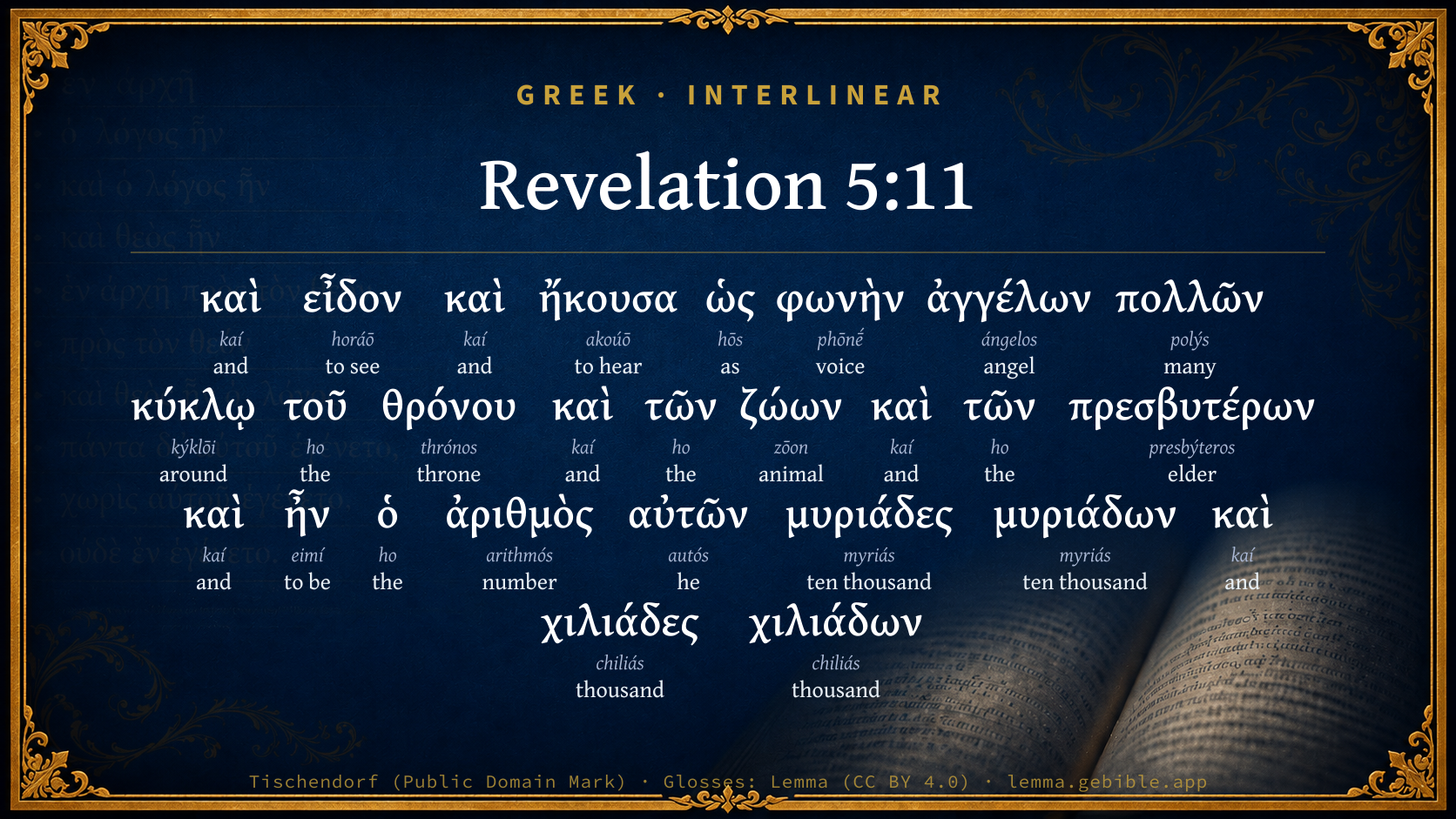
  1. καὶ kaí G2532 “and” Conjunction
  2. εἶδον horáō G3708 “to see” Verb, Aorist, Active, Indicative, 1st person, Singular
  3. καὶ kaí G2532 “and” Conjunction
  4. ἤκουσα akoúō G191 “to hear” Verb, Aorist, Active, Indicative, 1st person, Singular
  5. ὡς hōs G5613 “as” Adverb
  6. φωνὴν phōnḗ G5456 “voice” Noun, Accusative, Singular, Feminine
  7. ἀγγέλων ángelos G32 “angel” Noun, Genitive, Plural, Masculine
  8. πολλῶν polýs G4183 “many” Adjective, Genitive, Plural, Masculine
  9. τοῦ ho G3588 “the” Article, Genitive, Singular, Masculine
  10. θρόνου thrónos G2362 “throne” Noun, Genitive, Singular, Masculine
  11. καὶ kaí G2532 “and” Conjunction
  12. τῶν ho G3588 “the” Article, Genitive, Plural, Neuter
  13. ζώων zōon G2226 “animal” Noun, Genitive, Plural, Neuter
  14. καὶ kaí G2532 “and” Conjunction
  15. τῶν ho G3588 “the” Article, Genitive, Plural, Masculine
  16. πρεσβυτέρων presbýteros G4245 “elder” Adjective, Genitive, Plural, Masculine, Comparative
  17. καὶ kaí G2532 “and” Conjunction
  18. ἦν eimí G1510 “to be” Verb, Imperfect, Active, Indicative, 3rd person, Singular
  19. ὁ ho G3588 “the” Article, Nominative, Singular, Masculine
  20. ἀριθμὸς arithmós G706 “number” Noun, Nominative, Singular, Masculine
  21. αὐτῶν autós G846 “he” Personal pronoun, Genitive, Plural, Masculine
  22. μυριάδες myriás G3461 “ten thousand” Adjective, Nominative, Plural, Feminine
  23. μυριάδων myriás G3461 “ten thousand” Adjective, Genitive, Plural, Feminine
  24. καὶ kaí G2532 “and” Conjunction
  25. χιλιάδες chiliás G5505 “thousand” Noun, Nominative, Plural, Feminine
  26. χιλιάδων chiliás G5505 “thousand” Noun, Genitive, Plural, Feminine

About this verse

These counts appear in no published source. They are computed here, from the morphology-tagged text and Lemma’s own curated glosses. What Lemma adds →

27
words
17
distinct lemmas
Revelation
section

Notable vocabulary

The rarest word here is κύκλῳ around G2945 — appearing just 8 times in the whole Greek New Testament.

Shared distinctive vocabulary

κύκλῳ around G2945 occurs in 8 verses of the Greek New Testament. Also found in:

Repetition

Words recur within this verse:

  • μυριάδες ten thousand G3461 ×2
  • χιλιάδες thousand G5505 ×2
  • καὶ and G2532 ×6
  • τοῦ the G3588 ×4

Cross-references

15

Topical passages linked to Revelation 5:11 in the Treasury of Scripture Knowledge — connected by theme and wording, ordered by reader-vote popularity; previews shown in the World English Bible.

  • Daniel 7:10 A fiery stream issued and came forth from before him: thousands of thousands ministered to him, and ten thousand times ten thousand stood before him: the judgment was set, and the books were opened.
  • Hebrews 12:22 But you have come to Mount Zion, and to the city of the living God, the heavenly Jerusalem, and to innumerable hosts of angels,
  • Psalms 148:2 Praise him, all his angels! Praise him, all his host!
  • Revelation 4:4 Around the throne were twenty-four thrones. On the thrones were twenty-four elders sitting, dressed in white garments, with crowns of gold on their heads.
  • Revelation 4:6 Before the throne was something like a sea of glass, similar to crystal. In the midst of the throne, and around the throne were four living creatures full of eyes before and behind.
  • Psalms 68:17 The chariots of God are tens of thousands and thousands of thousands. The Lord is among them, from Sinai, into the sanctuary.
  • Revelation 19:6 I heard something like the voice of a great multitude, and like the voice of many waters, and like the voice of mighty thunders, saying, "Hallelujah! For the Lord our God, the Almighty, reigns!
  • 2 Kings 6:16–18 He answered, Don't be afraid; for those who are with us are more than those who are with them.
  • Revelation 4:9–10 When the living creatures give glory, honor, and thanks to him who sits on the throne, to him who lives forever and ever,
  • Revelation 5:6 I saw in the midst of the throne and of the four living creatures, and in the midst of the elders, a Lamb standing, as though it had been slain, having seven horns, and seven eyes, which are the seven Spirits of God, sent out into all the earth.
  • Revelation 5:14 The four living creatures said, "Amen!" The elders fell down and worshiped.
  • Revelation 7:11 All the angels were standing around the throne, the elders, and the four living creatures; and they fell on their faces before his throne, and worshiped God,
  • Deuteronomy 33:2 He said, Yahweh came from Sinai, Rose from Seir to them; He shined forth from Mount Paran, He came from the ten thousands of holy ones: At his right hand was a fiery law for them.
  • Psalms 103:20 Praise Yahweh, you angels of his, Who are mighty in strength, who fulfill his word, Obeying the voice of his word.
  • 1 Kings 22:19 [Micaiah] said, Therefore hear you the word of Yahweh: I saw Yahweh sitting on his throne, and all the host of heaven standing by him on his right hand and on his left.

Cross-references courtesy of OpenBible.info (CC BY 4.0).

Where the printed editions differ

2 variants

Places in this verse where the major printed Greek editions disagree on the wording in a way that affects the translation — a comparison of editions, not a manuscript-by-manuscript collation. The editions are the modern critical texts (Nestlé-Aland 28/27, SBL, Westcott-Hort, Tregelles, Tyndale House) and the traditional texts behind the KJV (the Textus Receptus and the Byzantine/Majority text). It is not a claim about which reading is original.

  1. Extra text
    ὡς

    “like”

    In Byz Not in NA28NA27TynSBLWHTregTR

    ὡς (hōs) 'like' is only in a few manuscripts (Byz)

  2. Extra text
    καὶ ἦν ὁ ἀριθμὸς αὐτῶν μυριάδες μυριάδων

    “and was the number of them myriads of myriads”

    In NA28NA27TynSBLWHTregByz Not in TR

    καὶ ἦν ὁ ἀριθμὸς αὐτῶν μυριάδες μυριάδων (kai ēn ho arithmos autōn muriades muriadōn) 'and was the number of them myriads of myriads' is only in older manuscripts (NA28+NA27+Tyn+SBL+WH+Treg+Byz)

Textual data: Translators Amalgamated Greek New Testament (STEPBible TAGNT) · CC BY 4.0.

Commentary

Notes on Revelation 5:11 from classic Christian and Jewish commentators (each source and its license shown beneath its notes). The classic Christian expositions comment on the surrounding passage and are grouped to its opening verse, so a note may address several verses; the Jewish commentaries on the Tanakh (Rashi and others) are per-verse, so they appear only where the commentator wrote on this verse.

Lemma curates 59 commentaries, every one of them public domain or Creative Commons licensed, each selected and text-cleaned for this edition rather than reprinted as found. About our sources →

The Biblical Illustrator

Joseph S. Exell

Rev_5:11-13

The voice of many angels round about the throne.

The great festal gathering and song of heaven

I. The complacency with which Christ looks back on His own atoning work and sufferings.

II. The perpetual efficacy of the Saviours sacrifice.

III. The continued identity of Christs person as God-man mediator.

IV. Redemption is the grand theme of adoration for unredeemed angels as well as for the redeemed family of God.

V. The pre-eminent dignity and bliss of the ransomed saints.

VI. The unity which pervades the heavenly ranks.

VII. The vision seems intended to prepare the Church on earth for her own sufferings, and reconcile her to her approaching tribulation. (J. R. Macduff, D. D.)

The hymn of the angels and of creation:

I. First let us understand the attitude and position of the angels. They are round about the throne of God, around the elders--that is, the Church--and around the living creatures. They are, therefore, the sentinels and the guardians of Divine and human things. So they stand equally around the emblem of eternal power, around the fourfold forms of life, around its drudgery as well as its ambition, and around the Church, distressed and broken and divided and betrayed. No thought of fear dims the lustre of their eyes, nor lessens the precision and the emphasis of their song. And it is worthy of notice that they secure ample leisure for worship. It is a lesson that ought not to be lost upon our hurrying age. Thank heaven, there are still secluded corners of our land where the shriek of steam-engines, the clamour of crowded streets, the driving of pulse and brain, is unknown; where the valleys laugh and sing with the standing corn, where the hilltops are silent as the seas, and where jaded brains may shape some thought of God. But heaven is busy too, and there is work enough to be accomplished. There are sinners lost in the wilds of the hill, and in loathsome dens of the city, who will need to be brought home. There are claims and needs and dangers of the Church the world over--energies to be cherished, works to be encouraged, impurities to be purged, sorrows and disappointments to be assuaged. And with all these interests in hand their eye is upon the throne, for here only do angels and men alike behold, and thence only receive the interpretation of life and the wisdom and guidance for work. And well were it, not only for its honesty, but even more for its progress, if the commerce of England and Scotland and Ireland were directed by the laws which abide in God. Only those who obey can worship, and only those who rightly worship can truly live. And so--

II. The central thought of the angels, like that of the Church, was the worthiness of Christ. Worthy is the Lamb that was slain. And as it was in the mind of the Church, so here again this worthiness is associated with sacrifice. For most men suffer only when they must, and they fail to perceive that sacrifice at once tests what we are, and makes us what we ought to be. In this way Christs sacrifice proved His essential worth, and, beyond this, proves to-day His permanent worth to His people. It is not His power alone. That never elicits adoration. It is the goodness that reigns paramount within Him which men worship and love.

III. The response of creation. The poet of Palestine had said, many a year before St. John lived, that there is neither speech nor language throughout the earth in which the voice of the firmament is not heard. The songs of the spheres was another method of expressing the same truth. The sky vibrates with praise as the great stars stand out in their places. Earth, with its thousand voices, said Coleridge, praises God. And while these call to man, whatever his tongue or his worship, man the world round feels that he must respond. He cannot help worshipping. Under the gaslight, and in the heated atmosphere of some remote meeting-place in the big town, he may lustily proclaim that God is nothing to him. But when the gas is out and the cheering companions are gone, when he is alone on the mountain-side, and the thunder booms out its terror above and the lightning flashes death around him, a voice within answers the voices without, and the infidel is compelled to pray. And as man must worship, so his worship adopts a more expansive form than that which angels take as yet (Rev_7:12). His eyes, too, are indeed filled with the image of the Lamb. What mind can forget Calvary and Olivet? But away beyond the present fact he contemplates the continuous recognition, and age upon age he hears the same hymn. And further yet, and fuller, the worship of the Lamb broadens into the worship of the Godhead. It is offered to Him that sitteth upon the throne. And it expresses the spiritual history of every saint. We see ourselves in this hymn. When first our life lay before us, and we took it up and placed it upon the altar of Gods salvation, Jesus Christ was all, was everything to us. Then as faith deepened and threw up the greater and stronger life, we saw Jesus in all things. And then we beheld the love of the Father to be as great and tender as the love of the Son, and the strength of the Holy Ghost gathered round us and within us, and God in His blessed Trinity embraced all things. (W. M. Johnston, M. A.)

Christ the object of angelic worship

I. The homage here represented as rendered to the Saviour by the angelic hosts.

1. Angels are the worshippers to whom our attention is more particularly directed in the text.

2. The nature of the homage which they render Him. The particulars here specified relate rather to the natural than the moral attributes of our Saviour, to His greatness rather than His goodness; that is, to His prerogatives and glories which He most obscured in His humbled state, or of which He then emptied Himself, as the Scripture expresses it.

3. The ground of this homage. As a person inherently possessed of all Divine excellences and glories, the Son of God, in common with the Father, has an incontestable title to the worship and obedience of the heavenly hosts. He has a further claim as the author and preserver of their existence, and as the source and dispenser of all their happiness. It is not, however, on this ground, strong as it is, that the homage manifested in the text is rendered Him. Look to the passage and you will at once perceive that the basis on which the Son of God is worshipped, both by the representatives of the Church and by the angelic hosts, is His death or sacrifice. But does the death of Christ give Him any new or peculiar claims to the homage of the heavenly hierarchies who are not immediately interested in its benefits? Unquestionably it does, and some of these claims it is not difficult to discover. His death was not only in itself the most extraordinary event that ever took place, it afforded incomparably the most magnificent display that ever was exhibited of generosity and kindness, of compassion and tenderness. It is an essential part of true excellence to admire excellence in another, and the admiration ought to be proportioned to the measure of excellence displayed. What a resistless impulse, then, must it communicate to the adoration and praise of the holy angels, to contemplate the death of the Son of God. Recollect next the display of the Divine character and perfections exhibited in the death of Christ, and you will see in it another reason to ampel the hosts of heaven to honour and adore Him. Consider, again, that while the death of Christ contributes so much to advance the honour of God, it contributes not less to promote the happiness of man. They rejoice over one sinner that repenteth. In further illustration of this topic, I might add that it is the opinion of the great Mr. Howe, and of some other eminent divines, that angels, though not redeemed by Christ, are confirmed in happiness in consequence of their union to Him. It is further certain that in Him angels and saints are united in one harmonious and happy association, and that it has pleased the Father by Him to reconcile all things unto Himself; by Him, I say, whether they be things in earth or things in heaven. And these wonderful arrangements furnish angels with another reason to worship and serve the Lamb that was slain.

II. The argument suggested by their conduct to induce us to render the Lamb a similar homage.

1. We have a direct and personal interest in His death. If His matchless love excites, as well it may, the admiration even of creatures not immediately interested, and impels them to prepare new honours for His name, what words can express the claims which He has to our admiration, gratitude, and praise?

2. We are still in circumstances of danger. Many and formidable are the enemies who seek our ruin, numerous and painful are the toils and hardships we must encounter ere we reach our Fathers loved abode. There is one, and only one, who can protect you amid your multitudinous dangers, and bring you to the land which you wish to reach. Jesus Christ, the captain of salvation, having been made perfect through sufferings, will conduct you to glory, if only you will confide in Him. What an argument to love and trust, to adore and praise Him!

3. I might remark that, allowing He has conferred on angels higher capacities and higher joys, our happiness has been procured by Him at a price far more costly. To communicate to angels existence and happiness required nothing more than a simple volition of His irresistible will, a single word of His omnipotent voice. It was not thus that the happiness of the apostate race could be restored, that the redemption of our lost world was to be achieved.

Lessons:

1. How inconceivably glorious must heaven be, and how worthy of our earnest desire and our constant pursuit!

2. How reasonable that we should render Divine honours to the Lord Jesus.

3. How important that we cultivate a love to the exercises of heaven.

4. This subject suggests a test by which we may ascertain whether we are fit for heaven. To ascertain your meetness for heaven you have then only to inquire whether you take delight in devotional exercises and in holy pursuits and enjoyments.

5. This subject shows us the folly of the irreligious. Think of heaven with all its joys and splendours. Contrast with this hell with its horrors, a place of outer darkness and of gnashing of teeth. (R. Balmer, D. D.)

Worthy is the Lamb that was slain.--

The worthy sacrifice of Christ

I. Contemplate Christ as He is represented under the character of a lamb. The lamb is an appropriate symbol of innocence and meekness. Never were the lamb-like virtues brought to so severe a test, and never were they so strikingly portrayed. A recluse in his cell may reason justly on the duties of forbearance and forgiveness, but it is difficult to carry into practice the dictates of sober solitude, yet Jesus gave not only the theory but the practice of every possible virtue.

II. Meditate on the death of Christ.

1. He was slain decretively in the purposes of Jehovah.

2. He was slain emblematically by the sacrifices under the Levitical dispensation.

3. He was slain instrumentally by the hands of the Jews.

4. He was slain really by the justice of God for the sins of His people.

III. Celebrate His praise.

1. He is worthy of the trust and confidence of His people.

2. He is worthy of the adoration and praise of the redeemed spirits above.

3. He is worthy the adoration of the purest intelligences of the universe.

4. He is worthy of the final conquest of the world. (T. Adkins.)

Christ the Lamb slain

I. The wonderful person of the glorious sufferer will furnish occasion of unceasing admiration to the great multitude before the throne.

II. The multitude before the throne will have occasion to give glory to the great Redeemer when they contemplate the mysterious nature of His sufferings.

III. Similar acknowledgments will be called forth when the saints in heaven remember their sins as the procuring cause of the Saviours sufferings.

IV. The sufferings of the Redeemer are considered by the multitude before the throne as the result of a plan contrived by the infinite wisdom of God in His eternal counsels.

V. The sufferings of the Redeemer are considered by the multitude before the throne as the genuine effect of His own uncontrolled and sovereign pleasure. To Himself alone, and to the free exercise of His own good will, this act of grace and humiliation must be referred.

VI. The sufferings of the Redeemer are considered by those who stand around the throne as affording the brightest manifestation of the Divine perfections.

VII. The sufferings of the Redeemer present new occasion of admiration and triumph to the multitude before the throne, because thereby redemption is completely purchased. (John Russell.)

Glory ascribed in heaven to the Lamb

1. The sacrifice of Christ has had the effect of developing the hidden perfections and glories of God in what may be considered their Christian and evangelical aspect, both in the Church above and in the Church below, consequently all glory is due to Christ upon this principle.

2. The elementary state cud high reward of heaven is the result of our Saviours work, and consequently the glory must be due to Him.

3. The relationship in which the triumphant Church will stand to her Lord will induce these sentiments, and lead to this triumphant song. In what relationship does He stand to us here? God with us. In what relation does He appear to the Church above? God with them. (J. Dixon.)

The worthiness of Christ to receive mans riches

I. Because He is the original proprietor of it. The gold that any man holds in his hands is his in a very secondary sense; his property a few years ago was in the possession of others, and a few years hence it will pass from him into other hands. All material wealth belongs to Christ.

II. Because He has enabled you to procure it. Why have you wealth more than others? Has it come to you through heirdom, legacy, or your own industry? In either case you have it through Christ.

III. Because He gives you the qualification to enjoy it. Who gave you the unmiserly spirit, the bodily health, the mental capacity by which you can enjoy your riches?

IV. Because He will make the best use of it.

1. The best use of it for yourselves. There is no better investment. Your contributions to Him serve you in many ways.

(1) Serve to test your character.

(2) Serve to detach you from materialism.

(3) Serve to ennoble your character. It is a great thing to be trusted, to be thrown upon your honour. Christ trusts you.

2. The best use of it for the world. When you are gone Christs Church will be here working with the means you have entrusted to it, and working to spread truth, virtue, and happiness through the world. (Homilist.)

Praise a duty

No other duty is enjoined so often in the Scriptures as praise. The Bible is full of music. The woods in the summer days are not so full of bird-notes as this sacred book is of voices of song. Christian life can realise the Divine thought for it only by being songful. The old fable of the harp of Memnon, that it began to breathe out sweet music the moment the morning light swept its chords, has its true fulfilment in the human soul, which, the instant the light of Divine love breaks upon it gives forth notes of gladness and praise. (J. R. Miller, D. D.)

.

The Biblical Illustrator, edited by Joseph S. Exell (c. 1880s–1900s) — public domain. Text from a community e-Sword module.

Joseph Benson's Commentary

Rev 5:11-14. And I beheld — The many angels; and heard the voice — And the number of them; round about the throne — Of the Divine Majesty; and the living creatures and the elders — So forming the third circle. It is remarkable that men are represented, through the whole vision, as nearer to God than any of the angels. And the number of them was ten thousand times ten thousand, and thousands of thousands — An innumerable multitude. And yet these are but a part of the holy angels; afterward, (Rev 7:11,) St. John heard them all. Saying, with a loud voice — With united ardour and harmony, there not being a cold and languid mind in the whole assembly; Worthy is the Lamb — The elders said, Rev 5:9, Worthy art thou; being more nearly allied to him, and addressing him with greater familiarity than the angels; to receive power, &c. — The seven-fold praise answers the seven seals, of which the four former represent all visible, the latter all invisible things made subject to the Lamb. And every creature — In the whole universe; which is in heaven — on the earth — under the earth — in the sea — “As the inhabitants of the watery elements are necessarily mute, we are not to understand by this that they seemed to grow vocal in the praises of Christ, upon this occasion, but rather that heaven, earth, and sea are used to signify that all nature, in its different ways, concurred in the praise; that is, the whole constitution of it contributed to furnish out matter of praise; just as inanimate, as well as rational creatures, are called upon to praise God, in several of the Psalms, especially in Psalms 148.” — Doddridge. And all that are in them — In every varied form of nature; heard I saying, Blessing, &c. — This praise, from all creatures, begins before the opening of the first seal; but it continues from that time to eternity, according to the capacity of each. His enemies must acknowledge his glory, but those in heaven say, Blessed be God and the Lamb. And the four living creatures said, Amen — To this hymn, to testify their hearty concurrence. And the four and twenty elders, at the same time, fell down before the throne, and worshipped him that liveth for ever and ever — Acknowledging him to be infinitely superior to all those services which the most exalted powers of created nature are capable of rendering. This royal manifesto is, as it were, a proclamation, showing how Christ fulfils all things, and every knee bows to him, not only on earth, but also in heaven, and under the earth. This book exhausts all things, (1Co 15:27-28,) and is suitable to a heart enlarged as the sand of the sea. It inspires the attentive and intelligent reader with such a magnanimity, that he accounts nothing in this world great; no, not the whole frame of visible nature, compared to the immense greatness of what he is here called to behold; yea, and in part to inherit. St. John has in view, through the whole of the following vision, what he has been now describing; namely, the four living creatures, the elders, the angels, and all creatures, looking together at the opening of the seven seals.

Joseph Benson's Commentary on the Old and New Testaments (1811–1818) — public domain. Text from a community e-Sword module.

Tyndale Open Study Notes

Tyndale Open Resources

5:11-12 A huge angelic chorus numbering thousands and millions provides an antiphonal response; all heaven responds to creation’s confession of Christ’s sacrifice.

Tyndale Open Study Notes — © Tyndale Open Resources, licensed CC BY-SA 4.0. Text via the HelloAO Bible API.

Bengel's Gnomon

Johann Albrecht Bengel

Rev 5:11. Μυριάδες μυριάδων καὶ χιλιάδες χιλιάδων) μυριὰς is ten thousand; μυριάδες (if only you understand δύο, as ch. Rev 12:14, καιροὺς, that is, δύο) are twenty thousand. Thence myriads of myriads are 200,000,000; and so moreover thousands of thousands, 2,000,000. The lesser number added to the greater forbids both of them from being taken too indefinitely.

Bengel's Gnomon of the New Testament — English translation (T&T Clark, Edinburgh, 1860) — public domain. Text from a community e-Sword module.

Meyer's Critical & Exegetical Commentary

Heinrich August Wilhelm Meyer

Rev_5:11-12. Καὶ εἰδον. Without foundation, Ebrard: John sees something new, viz., he hears, according to the arbitrary conception that εἰδον designates, in the weakened wide sense, visionary observation in general. Correctly, Beng., De Wette, etc.: John sees the hosts of angels whose voice he hears. Cf. Rev_6:1 sqq.

Around the throne of God, and the four beings, and the twenty-four elders, the attention of the seer is completely occupied; he sees now the heavenly host,[1954] an innumerable multitude: καὶ ἠν ὁ ἀριθμὸς αὐτῶν μυριάδες μυριάδων καὶ χιλιάδες χιλιάδων. The statement of numbers is still fuller than in Dan_7:10,[1955] and indicates by its indefinitenessfor it is not said how many are the myriads of myriadsactual innumerability. Incorrectly, Bengel: A less number added to the greater forbids both to be taken too indefinitely. The anti-climax[1956] has the meaning that even the preceding very great number is still insufficient, but not that with the immense number the distinction vanishes.[1957]

ΛΈΓΟΝΤΕς, cf. Rev_14:1; Rev_14:8.

ΦΩΝῇ ΜΕΓΆΛῌ, cf. Rev_1:10.

ΛΑΒΕῖΝ, in adoring acknowledgment.[1958]

ΤῊΝ ΔΎΝΑΜΙΝ. The article notes the power as peculiar to the Lamb; this, as also the ΔΌΞΑΝ and ΤΙΜῊΝ, is shared with the enthroned God.[1959] The force of the art., placed at the beginning, which in Rev_4:11 and Rev_7:12 is expressly repeated before each particular conception, affects the entire connection. Beng., excellently: These seven words of praise must be expressed as though they were a single word, because they all stand with one another after a single article.[1960]

ΠΛΟῦΤΟΝ. Mentioned also in 1Ch_29:11-12;[1961] is not to be limited to the possession and distribution of spiritual goods,[1962] but is in every respect unconditioned wealth in all blessings,[1963] as it belongs to the all-sufficient God, and likewise to the Lamb who shares all his glory, and, therefore, also his throne.[1964]

ΕὐΛΟΓΊΑ, not blessing,[1965] but praise, honor. The seven items of the ascription of praise have, in other respects, nothing whatever to do with the seven seals,[1966] but are accumulated in this number,[1967] in order to express their holy completeness.

[1954] 1Ki_12:14.

[1955] χίλιαι-g0- χιλιάδες-g0-

καὶ-g0- μύριαι-g0- μυριάδες-g0-.

[1956] Cf. also Psa_68:18.

[1957] Hengstenb.

[1958] Rev_4:11. Ew., De Wette, Ebrard, etc.

[1959] Rev_4:11.

[1960] Cf. also Hengstenb.

[1961] Cf. Eph_3:8; Joh_1:16.

[1962] De Wette, Hengstenb., who refers to Rev_5:9-10.

[1963] Cf. Act_17:25; Jam_1:17.

[1964] Cf. Vitr., Ew.

[1965] Beng.

[1966] Against Beng.

[1967] As also Rev_7:12.

Meyer — Critical and Exegetical Commentary on the New Testament — English translation by Peter Christie, edited by Frederick Crombie (T&T Clark, 1880) — public domain. Text from a community e-Sword module.

Expositor's Greek Testament

ed. W. Robertson Nicoll

Rev 5:11 . This outer circle of myriads (the following χιλιάδες is an anti-climax) of angelic retainers a favourite trait in the later Jewish pageants of heaven does not address praise directly to the Lamb.

The Expositor's Greek Testament, edited by W. Robertson Nicoll (1897–1910) — public domain. Text from a community e-Sword module.

Geneva Bible (1599)

Geneva Bible translators

A number finite, but almost infinite for one infinite indeed, as Dan. 7:10.

By this is meant a great number.

The consent of the common order of Angels, answering in melody unto their Princes that stood by the throne.

Geneva Bible (1599) marginal notes — public domain. Text via Bolls.life.

Jamieson, Fausset & Brown

Robert Jamieson, A. R. Fausset & David Brown

I beheld--the angels: who form the outer circle, while the Church, the object of redemption, forms the inner circle nearest the throne. The heavenly hosts ranged around gaze with intense love and adoration at this crowning manifestation of God's love, wisdom, and power.

ten thousand times ten thousand--Greek, "myriads of myriads."

Jamieson, Fausset & Brown — Commentary Critical and Explanatory on the Whole Bible (1871) — public domain (CC PDM 1.0). Text via the HelloAO Bible API.

Adam Clarke's Commentary

Verse 11. The voice of many angels] These also are represented as joining in the chorus with redeemed mortals.

Ten thousand times ten thousand] "Myriads of myriads and chiliads of chiliads;" that is, an infinite or innumerable multitude. This is in reference to Da 7:10.

Adam Clarke's Commentary on the Bible (1810–1826) — public domain. Text from a community e-Sword/MySword module.

Ellicott's Commentary for English Readers

(11) And I beheld . . .—More literally, And I saw, and I heard a voice of many angels around the throne, and the living beings, and the elders; and the number of them was myriads of myriads, and thousands of thousands. The chorus of the redeemed is followed by a chorus of angels; for “that which is the highest act of love, towards whatever persons it was manifested, from whatever calamities it saved them, must be the highest manifestation of the divine character and will; therefore must be the cause of delight to all creatures, fallen or unfallen. If the Revelation is true, there can be no breach in the sympathies of any part of God’s voluntary and intelligent universe.” It is needless to observe that the numbers are not to be taken literally; they are simply employed to express the countless throng of that “innumerable company of angels” (Heb_12:22) which raised the song—

“Loud as from numbers without number, sweet

As from blest voices, uttering joy.”

—Paradise Lost, iii. 346, 347.

A Bible Commentary for English Readers, edited by Charles John Ellicott (1878–1897) — public domain. Text from a community e-Sword module.

The Cambridge Bible for Schools and Colleges

gen. ed. J. J. S. Perowne

11. I beheld] See on Rev_4:1. The sense is, of course, that he saw the Angels whose voice he heard.

round about] We cannot tell if they formed a complete circle round the Throne, or a semicircle between it and the Seer, or a semicircle on the side away from him. But though we cannot answer these questions, it is worth while to ask them: for it is plain that St John did see a definite picture.

ten thousand times ten thousand] Lit. myriads of myriads, the Greek (and Hebrew) language having a single word for the number 10,000: so that the effect is as if we should say “millions of millions and thousands of thousands” (in Gen_24:60 words equivalent to these are translated “thousands of millions.”) In Dan_7:10 the order is the reverse, “thousand thousands … and ten thousand times ten thousand,” with the obvious motive of a climax: here the effect is, “there were hundreds of millions massed together, and if you counted those in the mass, the numbers you would leave over would be millions still.” The passage in Daniel is also imitated in Enoch xiv. 24, xl. 1.

The Cambridge Bible for Schools and Colleges (gen. ed. J. J. S. Perowne; Cambridge University Press, 1878–1918) — public domain. Text from a community e-Sword module.

John Gill's Exposition

And I beheld, and heard the voice of many angels,.... Immaterial spirits, made by Christ, and worshippers of him, and ministering spirits to him and his, the holy and elect angels, who are confirmed in their state by Christ; these John beheld in a visionary way, and heard the voices and articulate sounds formed by them; and there were many of them; how many there are, or were here, cannot be said; we read of a multitude of heavenly host that appeared at the incarnation of Christ, and of more than twelve legions of angels, that Christ could have had of his Father for a word speaking, at the time of his apprehension, who would have rescued him out of the hands of his enemies; yea, that company is innumerable. The Syriac version reads, "as the voice of many waters"; these were

round about the throne; were near to God, stood before him, behind his face, hearkened to his voice, and observed his orders: so with the Jews, the four angels, Michael, Gabriel, Uriel, and Raphael, are said (l) to be , "round about his throne", the throne of God: it follows here,

and the beasts and the elders; the sense is not, that John heard the voice of the living creatures, and of the elders, as well as, and together with, the voice of many angels; for he had heard their voice and song before, but that the angels whose voice he heard, as they were round about the throne, so they were round about the living creatures, and round about the elders: the angels are near unto, and encompass the ministers of the Gospel; they are about them, and give them intimations and discoveries of the mind and will of God, as an angel did to John, Rev 1:1, and another to Paul, Act 27:23, and sometimes direct them where to go and preach the Gospel, as in Act 16:9, and surround them for their safety and protection: so horses and chariots of fire, by whom angels are meant, were round about the prophet Elisha, Kg2 6:16, and they were also round about the elders, the churches, and particular believers; angels and saints are near to one another; and angels are very friendly to the saints, and so them many good offices; they all belong to the same family, and are social worshippers of God; the angels are the guards that encamp round about them that fear the Lord, and often protect them from enemies and dangers; and it may be observed, that the saints are nearer the Lamb and the throne than the angels be; according to this account, there was a throne, and one that sat on it, who is the living God; nearest to the throne stood the Lamb; next to the Lamb stood the four living creatures, the ministers of the Gospel; next to them the elders, or churches, and members thereof; and in the outermost ring, and as encompassing all, stood the ministering angels, they being servants; whereas the saints are the heirs of salvation, and the bride, the Lamb's wife, and therefore nearer him:

and the number of them was ten thousand times ten thousand, and thousands of thousands; that is, an innumerable company of them; a like number is mentioned in Dan 7:10 to which this seems to refer; see Psa 68:17. The Jews speak of nine hundred and six thousand millions of ministering angels, that stand constantly before the Lord (m).

(l) Bemidbar Rabba sect. 2. fol. 179. 1. (m) Yalkut Simeoni, par. 2. fol. 69. 1.

John Gill's Exposition of the Whole Bible (1746–1763) — public domain (CC PDM 1.0). Text via the HelloAO Bible API.

Trapp's Complete Commentary

John Trapp

11 And I beheld, and I heard the voice of many angels round about the throne and the beasts and the elders: and the number of them was ten thousand times ten thousand, and thousands of thousands;

Ver. 11. Round about the throne and the beasts] That is, round about the beasts and the elders. Angels encamp about the saints, as ministering spirits, and are glad of the office, that their God manifested in the flesh may be seen of them, 1Ti 3:16, and the multifarious wisdom of God in man’s redemption be displayed unto them, Eph 3:10.

John Trapp, A Commentary or Exposition upon All the Books of the Old and New Testament (1647–1656) — public domain. Text from a community e-Sword module.

Albert Barnes' Notes on the Bible

And I beheld - And I looked again.

And I heard the voice of many angels - The inhabitants of heaven uniting with the representatives of the redeemed church in ascribing honor to the Lamb of God. The design is to show that there is universal sympathy and harmony in heaven, and that all worlds will unite in ascribing honor to the Lamb of God.

Round about the throne and the beasts and the elders - In a circle or area beyond what was occupied by the throne, the living creatures, and the elders. They occupied the center, as it appeared to John, and this innumerable company of angels surrounded them. The angels are represented here, as they are everywhere in the Scriptures, as taking a deep interest in all that pertains to the redemption of people, and it is not surprising that they are here described as uniting with the representatives of the church in rendering honor to the Lamb of God. Compare the notes on 1Pe 1:12.

And the number of them was ten thousand times ten thousand - 100 million - a general term to denote either a countless number, or an exceedingly great number. We are not to suppose that it is to be taken literally.

And thousands of thousands - Implying that the number before specified was not large enough to comprehend all. Besides the “ten thousand times ten thousand,” there was a vast uncounted host which one could not attempt to enumerate. The language here would seem to be taken from Dan 7:10; “Thousand thousands ministered unto him, and ten thousand times ten thousand stood before him.” Compare Psa 68:17; “The chariots of God are twenty thousand, even thousands of angels.” See also Deu 33:2; 1Ki 22:19.

Albert Barnes' Notes on the Bible (1834–1885) — public domain. Text from a community e-Sword/MySword module.

Haydock's Catholic Bible Commentary

The number of them was thousands of thousands.[4] In the Greek also, ten thousand times ten thousand. (Witham)

===============================

[BIBLIOGRAPHY]

Millia millium, Greek: muriades muriadon, kai chiliades chiliadon.

George Leo Haydock (1774–1849), Haydock's Catholic Family Bible and Commentary, 1859 edition — public domain. Excludes Psalms (Douay-Rheims chapter numbering differs from Protestant) and Deuterocanonical books (Catholic canon only).

Matthew Poole's English Annotations

And I beheld, I still attended diligently,

and I heard the voice of many angels round about the throne and the beasts and the elders; and I heard many angels, with the living creatures and the elders; (from whence we gather, that we must not, by the living creatures, or elders, understand angels, for they are mentioned apart by themselves, neither could they say, as Rev 5:9,10, that Christ had redeemed them with his blood); these angels joined in this harmony with the church to give glory to Christ.

And the number of them was ten thousand times ten thousand, and thousands of thousands; their number was infinite, not to be numbered. See the like, Dan 7:10.

Matthew Poole's English Annotations on the Holy Bible (1683–1685) — public domain. Text from a community e-Sword/MySword module.

Whedon's Commentary on the Bible

Daniel D. Whedon

11. I beheld… heard—In larger circle, around the circle of the elders, there now beams upon the eye an overwhelming assemblage of angels, pouring their song upon the ear of our apostle. They are now for the first time, and but transiently, visible. The number of them was, in the Greek, myriads of myriads and chiliads of chiliads, the sonorousness of which is still more sonorous in our English translation, the billowy roll of which is most magnificent. The Septuagint of Dan_7:10 reads, “Thousand of thousands ministered unto him, and myriads of myriads stood before him,” giving by climax the greater number last. John gives the lesser number last, as if not satisfied with the greater number alone without a supplement.

Daniel D. Whedon (gen. ed.), Commentary on the Old and New Testaments (1874–1909) — public domain. Text from a community e-Sword module.

The Pulpit Commentary

And I beheld marks a new feature of the vision, viz. the introduction of the angelic host as taking part in the adoration of the Lamb. (see on Rev_4:1) And heard the voice of many angels; a voice. The angels who have "desired to look into" the mystery of the redemption of the world (1Pe_1:12) have now had declared to them "by the Church the manifold wisdom of God, according to the eternal purpose which he purposed in Christ Jesus our Lord"; (Eph_3:10, Eph_3:11) and are thus enabled to join in the song of the redeemed. Round about the throne and the beasts and the elders. The innumerable company of angels encircle the throne and the beasts and the elders. Thus the throne is in the vision seen as occupying the centre, the four living creatures are placed round it in different directions; the elders form the next circle, and the angels enclose the whole. The Lamb is in the midst before the throne. (see on Rev_4:6) "Thus," says Bisping, "the redeemed creation stands nearer to the throne of God than even the angels." (see Heb_2:5) And the number of them was ten thousand times ten thousand, and thousands of thousands. The readings vary here, though the sense of the passage is not affected. After presbuterwn , "elders,

(1) the Authorized and Revised Versions, following a, A, B, P, etc., render as above;

(2) 1, Erasmus, Stephens edit. 1550 (though the last probably per errorem), omit "and the number of them was ten thousand times ten thousand;

(3) Vulgate, both manuscripts and Clementine edition, simply omit "ten thousand times ten thousand;

(4) 38, Andreas (one manuscript) omit only the last words, "and thousands of thousands." The number is, of course, not to be taken literally, but as expressive of an exceeding great multitude.

Vers. 11-14. The angelic and universal chorus.

Now the song bursts out beyond the circles of the redeemed host. "The voice of many angels," even "ten thousand times ten thousand, and thousands of thousands," bears onwards the same burden of song, "Worthy is the Lamb," and the chorus is completed only when it is taken up by "every created thing which is in the heaven, and on the earth, and under the earth, and on the sea;" and the song ascribes "the blessing, and the honour, and the glory, and the dominion" unto "him that sitteth on the throne, and unto the Lamb," and that "forever and ever." "The whole creation join in one To bless the sacred Name Of him that sits upon the throne, And to adore the Lamb.

The vision is prophetic it anticipates the final condition, the ultimate triumph of redemption, the ultimate acknowledgment of it. It is the song from the redeemed, and declares the widespread influence of redemption. It is creation"s song. All creatures, "every created thing," praises the creating and redeeming Lord.

I IT IS THE UNIVERSAL RECOGNITION OF THE BLESSINGS OF REDEMPTION.

1. The angelic host, forming a semi-chorus, exult in the gracious work of the Lamb in which figure must be seen represented the total idea of redemption by "the Lamb of God." Angels, who desired to "look into" these things, have found in them matter for praise. High above the incidents of the human history rises the image of him to whom all is due.

2. The "great voice" of the many angels "and the living creatures and the elders" is exceeded by that of "every created thing" in heaven, earth, and sea, even "all things that are in them." This voice of the entire, the grand chorus, the holy seer heard. It was his to discern the beneficent effect of redemption, his to catch the re-echoing song of all things as they praised the holy Name. It stands as the counterpart to "God cursed the ground for man"s sake." All is ordered and readjusted. The disturbance by sin gives place to the harmony of all creation "in him" in whom all things are "gathered together in one.

3. All is followed by the solemn "Amen," the reverent assent of the four living creatures representatives of all creature life, not excluding the Church.

II IT IS CREATION"S TESTIMONY TO THE GLORY OF GOD IS THE REDEMPTION OF MEN.

III IT IS DECLARATIVE OF THE UNIVERSAL INTEREST IN THE HISTORY OF THE REDEEMED RACE. The angels, who rejoiced over one sinner repenting, rejoice now in the completed work of the universal redemption. They who saw "first the blade," and sang over it, now behold "the full corn in the ear," and offer their loudest praise to the Lord of the harvest. Herein is signified the unity of the entire creation. Subtle links bind all in one. Each part is helpful to the other. There is mutual harmony, and there are mutual dependence and relationship. The whole finds its termination in a new act of adoring worship: "The four and twenty elders fell down and worshipped." As is most meet, the praise of all is paid to him "of whom and to whom and for whom are all things.

The Church below may learn:

1. The certainty of the final triumph of the Lamb in his own conquering work of redemption.

2. The identification of the work of redemption with the purposes of creation.

3. The duty of praise to God for this his unspeakable gift.

4. The sympathy of the angelic and universal life in the spiritual career of the redeemed. R.G.

Vers. 11-14. The worthiness of Christ to receive man"s riches.

"And I beheld," etc. We learn here that all heaven, with its "ten thousand times ten thousand, and thousands of thousands," agree in declaring that Christ, who is in the midst of the throne, is worthy to receive, not only power, wisdom, strength, honour, and glory, but riches, all riches mental and material. Who will gainsay the testimony of witnesses so enlightened, so honest, and so numerous? We shall regard the word as referring to material riches, gold. Gold is precious in more senses than one; it is a moral potentiality, and hence it is thought of in heaven and sung about there. Our subject isChrist is worthy to receive man"s worldly wealth. How can he receive it? He is far up the heights of the universe, beyond the vision and the reach of man. How do the monarchs receive the tributes of their people? Not directly, but through established agencies. Christ has established an agency on this earth for this purpose, and that agency is his Church. Whatever is done to further the evangelizing views and well being of his Church, he regards as being done to him. "Inasmuch as ye have done it unto the least of these my brethren, ye have done it unto me." Why is Christ worthy to receive your wealth?

I BECAUSE HE IS THE ORIGINAL PROPRIETOR OF IT. The gold that any man holds in his hand is his in a very secondary sense. His property a few years ago was in the possession of others, and a few years hence it will pass from him into other hands. All material wealth belongs to Christ. "The beasts of the forest are mine, and the cattle upon a thousand hills;" "The wild beasts of the field are mine," etc.. (see also Job_41:11 Deu_10:14 2Ch_20:1-9) Man is but the trustee of his wealth; Christ is the Proprietor.

II BECAUSE HE HAS ENABLED YOU TO PROCURE IT, Why have you wealth more than others? Has it come to you through heirdom, legacy, or your own industry? In either case you have it through Christ. Perhaps you ascribe it to your shrewdness, your industry, your management: but whence came these? All business aptitudes and opportunities are the gift of Christ. All the conditions by which your wealth has been attained are according to his arrangement.

III BECAUSE HE GIVES YOU THE QUALIFICATIONS TO ENJOY IT. Do you enjoy your wealth? enjoy all the conveniences, comforts, and powers which it imparts? If so, why? All do not. The miser does not, the invalid does not, the idiot does not. Who gave you the unmiserly spirit, the bodily health, the mental capacity, by which you enjoy your riches? All the qualifications that you have for enjoying your property are his gifts.

IV BECAUSE HE WILL MAKE THE BEST USE OF IT.

1. The best use of it for yourselves. There is no better investment. In truth it is for your sake that Christ wishes you to give it to him. He could have planted churches on every hill, schools in every valley, written his Bible on the broad heavens; but he knew right well that you would be better blest by contributing of your property to the diffusion of his truth. Your contributions to him serve you in many ways.

(1) Serve to test your character. Until you can give freely that which you value most, what evidence have you of your love to him? None.

(2) Serve to detach you from materialism. Wealth tends to materialize the soul. Every contribution to spiritual objects counteracts the tendency. It is another step up the ladder whose foot is deep down in materialism, but whose top reaches to the holy heavens of spirit and love.

(3) Serve to ennoble your character. It is a great thing to be trusted, to be thrown upon your honour. Christ trusts you.

2. The best use of it for the world. When you are gone, Christ"s Church will be here working with the means you have entrusted to it, and working to spread truth, virtue, and happiness through the world. "Worthy is the Lamb to receive riches." Don"t shirk collections, don"t regard them as trials. Hail them as blessings, and remember that "it is more blessed to give than to receive. D.T.

The Pulpit Commentary (1880–1919), ed. H.D.M. Spence-Jones & Joseph S. Exell — public domain. Text from a community e-Sword module.

John Wesley's Explanatory Notes

And I saw - The many angels. And heard - The voice and the number of them. Round about the elders - So forming the third circle. It is remarkable, that men are represented through this whole vision as nearer to God than any of the angels. And the number of them was - At least two hundred millions, and two millions over. And yet these were but a part of the holy angels. Afterward, chap. vii, 11, St. John heard them all.

John Wesley, Explanatory Notes Upon the Whole Bible (1754–1765) — public domain. Text via the GEBible commentary corpus.

Scofield Reference Notes

C. I. Scofield

beasts

living creatures. (See Scofield "Eze 1:5").

The Scofield Reference Bible (1917 edition), notes by C. I. Scofield — public domain. Text from a community e-Sword module.

Kretzmann's Popular Commentary

Paul E. Kretzmann

The choruses of praise:

v. 11. And I beheld, and I Heard the voice of many angels round about the throne and the beasts and the elders; and the number of them was ten thousand times ten thousand and thousands of thousands;

v. 12. saying with a loud voice, Worthy is the Lamb that was slain to receive power, and riches, and wisdom, and strength, and honor, and glory, and blessing.

v. 13. And every creature which is in heaven and on the earth and under the earth, and such as are in the sea, and all that are in them, heard I saying, Blessing and honor and glory and power be unto Him that sitteth upon the throne and unto the Lamb forever and ever.

v. 14. And the four beasts said, Amen. And the four and twenty elders fell down and worshiped Him that liveth forever and ever.

The hymn of praise is here taken up by a larger circle of blessed spirits and creatures, in a sacred concert with such, magnificent antiphonal singing as pertains to the halls of heaven alone: And I saw, and I heard as the voice of many angels round about the throne and the living beings and the elders, and their number was myriads of myriads and thousands of thousands. The very angels go into ecstasies over the work of redemption as performed by the Lamb that was slain. With eyes and ears that mere held open by the inexpressible wonder of it all John took notice of the countless celestial beings as they circled round the throne and the cherubs and the elders, their voices rising in such anthems of glory as pertain to the realms of eternal joy.

Their song is practically a repetition of that of the elders: Saying with a mighty voice, Worthy is the Lamb that was slain to receive power and riches and wisdom and strength and honor and glory and praise. Although this outer circle of angels does not address its praise directly to Christ, yet the angels laud and magnify the work of redemption by which mankind has been redeemed from everlasting ruin; for the angels themselves have a desire to look into the depths of God’s love shown in the salvation of the world. They declare the Lamb that was sacrificed for the sins of the world to be worthy of all the great gifts and blessings which came upon Him, were given to Him, at the time of His exaltation to the right hand of God. "Honor and glory and praise are due to Him whose victorious death has won Him the power of bestowing incalculable riches on His people, and of lifting the veil of the future, where He finds this in the interest of His Church."

And still wider are drawn the circles of adoring praise: And every creature in heaven and on the earth and beneath the earth and on the sea and all that are in them I heard saying, To Him that sits upon the throne and to the Lamb be praise and honor and glory and might forever and ever. Here the fulfillment of St. Paul’s words, Php 2:10-11, is recorded and described, that in the name of Christ every knee should bow. of things in heaven and on earth and under the earth, and that, all tongues should confess that Jesus is the Lord. See Psa 103:22; Psa 145:10. Whether willingly or unwillingly, every creature is obliged to acknowledge the deity, the divine godhead, of Christ, the exalted Son of Man, to praise, magnify, and bless Him, to yield itself to His dominion, to confess that to Him all the strength and wealth and wisdom of life rightly belong. And thus God is glorified, also in the glorification of His Son. The praise of God the Creator and the praise of Christ the Redeemer are blended in one final song which will continue to be chanted throughout eternity. To this great song of praise the antiphonal Amen of the cherubs answered: And the four living beings said, Amen; and the eiders fell down and worshiped. Verily it shall be so: all the earth shall be full of His glory. All the earth shall fear the Lord, and all the inhabitants of the world shall stand in awe of Him, Psa 33:8.

Summary

The prophet sees the book of the counsels of God, whose seals could be broken only by Christ, the Lamb that was slain, a fact which caused the elders to break forth in a hymn of praise which was afterwards taken up not only by myriads of angels, but by the chorus of all creatures.

Paul E. Kretzmann, Popular Commentary of the Bible (1921–1924) — public domain. Text from a community e-Sword module.

Burkitt's Expository Notes on the New Testament

William Burkitt

Observe here, 1. The office of the holy angels in heaven declared; they stand round about the throne of God continually, as nobles and chief ministers of state attend upon a prince, waiting his pleasure, and expecting his commands.

Observe, 2. The numberless number of them, thousands of thousands, and ten thousand times ten thousand; and as Almighty God is attended by an innumerable company of angels in heaven, so do the holy angels stand ready to accompany and protect his people here on earth, They encamp round about them. Psa 34:7

Observe, 3. How readily and cheerfully the holy angels joined with the elders in blessing and praising Christ for the invaluable fruits and benefits of man’s redemption: those beneficent spirits rejoice in our happiness; they joy at the conversion of a sinner, and triumph at the glorification of a saint. Here they are said to sing with a loud voice, to show their affection and zeal in the work of blessing and praising God for Jesus Christ, who is an head of confirmation to them, as he was an head of redemption unto us.

Observe, 4. How the angels give the same worship, pay the same homage, ascribe the same honour to Christ, which they do to God the Father: this had never been given, had he not been essentially God: the angels pronounce and proclaim Jesus Christ worthy of omnipotent power; and that honour, glory, and blessing, do appertain to him for evermore.

Observe lastly, That not only all the angels, but all the creatures in heaven, in earth, under the earth, and in the sea, all and every one of them, do worship Christ with religious worship, and pay him divine honour; adore him that sits on the throne, and the Lamb, for ever and ever: that is, the rational part of the world, to wit, angels and men, actively; the sensitive part of the world, objectively; the diabolical part, passively: Christ extorts that glory from them by their torments, which they refuse to give unto him by confessions and voluntary acknowledgements.

What greater argument than this can we desire for our satisfaction, that Christ is truly and essentially God? He thinks it no robbery to be equal with God, to share with him in all that honour and homage, in all that adoration and religious worship, which the whole creation do pay to Almighty God; for thus do the angels and elders above, and the whole church-militant here below, chant forth the praises of the Creator and Redeemer, saying,

Blessing, and glory, and renown, We now give all together, To him that in the throne sits down, And to the Lamb for ever. Amen, Hallelujah.

William Burkitt's Expository Notes on the New Testament (1700–1703) — public domain. Text from a community e-Sword module.

The People's New Testament

B. W. Johnson

11. And I beheld … many angels. The countless multitudes of angels also unite in the praises of the Lamb.

B. W. Johnson's The People's New Testament with Notes (1889–1891) — public domain. Electronic text from the Christian Classics Ethereal Library (CCEL) ThML edition.

unfoldingWord translationNotes

Door43 World Missions Community

ten thousands of ten thousands and thousands of thousands

Use an expression in your language that shows that it is a huge number. AT: "millions" or "too many thousands to count" (See: Numbers)

Worthy is the Lamb who has been slaughtered

"The Lamb who has been slaughtered is worthy"

to receive power, wealth, wisdom, strength, honor, glory, and praise

These are all things that the Lamb has. Being praised for having them is spoken of as receiving them. This can be restated to remove the abstract nouns. See how you translated a similar sentence in Revelation 4:11. AT: "for everyone to honor, glorify, and praise him because he is powerful, wealthy, wise, and strong" (See: Metonymy and Abstract Nouns)

translationWords

power

wise

honor

glory

praise

unfoldingWord translationNotes — © Distant Shores Media and the Door43 World Missions Community, licensed CC BY-SA 4.0. Source: git.door43.org/Door43/en_tn.

Cambridge Greek Testament for Schools and Colleges

11. καὶ εἶδον. Here we might almost translate “in my vision,” though it is no doubt implied that he saw the Angels whose voice he heard.

κύκλῳ. We cannot tell if they formed a complete circle round the Throne, or a semicircle between it and the Seer, or a semicircle on the side away from him. But though we cannot answer these questions, it is worth while to ask them: for it is plain that St John did see a definite picture.

μυριάδες μυριάδων. Lit. “myriads of myriads,” the Greek (and Hebrew) language having a single word for the number 10,000: so that the effect is as if we should say “millions of millions and thousands of thousands” (in Gen 24:60 words equivalent to these are translated “thousands of millions”). In Dan 7:10 the order is the reverse, “thousand thousands … and ten thousand times ten thousand,” with the obvious motive of a climax: here the effect is, “there were hundreds of millions massed together, and if you counted those in the mass, the numbers you would leave over would be millions still.” The passage in Daniel is also imitated in Enoch xiv. 24, xl. 1.

Cambridge Greek Testament for Schools and Colleges (Cambridge University Press, 1896; 21 vols, various authors incl. Carr, Maclear, Plummer, Farrar, Lumby, Moule, M. R. James, Simcox) — public domain. Text from a community e-Sword module.

Vincent's Word Studies in the New Testament

Marvin R. Vincent

Ten thousand times ten thousand [μυριαδες μυριαδων] . Lit., ten thousands of ten thousands. Compare Psa 68:17; Dan 8:10. Muriav, whence the English myriad, means the number ten thousand. So, literally, Act 19:19, ajrguriou muriadav pente fifty - thousand pieces of silver; lit., five ten - thousands. In the plural used for an unlimited number. See Luk 12:1; Act 21:20; Heb 12:22; Jude 1:14.

Thousands [χιλιαδες] . Ciliav, a collective term like, muriav, meaning the number one thousand, is almost invariably used with men in Revelation. See chapter Rev 7:4; Rev 11:13. Only once with a material object (chapter Rev 21:16). With inferior objects cilioi a thousand is used. See chapter Rev 11:3; Rev 12:6. These words are the theme of Alford's noble hymn - "Ten thousand times ten thousand In sparkling raiment bright, The armies of the ransomed saints Throng up the steeps of light : 'Tis finished, all is finished, Their fight with death and sin; Fling open wide the golden gates, And let the victors in."

Marvin R. Vincent, Word Studies in the New Testament (1887–1900) — public domain. Text from a community e-Sword/MySword module.

Lesson kit

Teaching starters — assembled from the data on this page, not authored interpretation. Every prompt links to the verse data it draws on. Edit before teaching.

Revelation, in the Revelation, opens this verse with 27 words (17 distinct Greek lemmas). Its most distinctive word is kýklōi (“around”). A historical commentator’s framing appears above. Read the whole chapter for the surrounding context.

Discussion questions

  1. The word kýklōi carries the sense “around.” How does it shape the verse?
  2. Mark 3:34 shares the word «around» with this verse. How do the two illuminate each other?
  3. “ten thousand” occurs 2× in this one verse. What is the effect of the repetition?
  4. The translations on this page render this verse differently — a whole-verse word diff, not a word-by-word alignment. What might account for the different wordings?
  5. Reading how The Biblical Illustrator and Joseph Benson's Commentary read this verse, where do the two commentators agree and where do they part?

Things to notice

  • These translations choose different wording for 17 words in this verse.
  • “ten thousand” occurs 2× in this single verse.
  • 17 distinct Greek lemmas span 27 words in this verse.

Reading settings

Reading text

Shown beneath each verse's original-language words.

Old Testament
Old Testament edition

Read the OT as the Masoretic Hebrew (MT) or the Greek Septuagint (LXX).

English shown for the Greek Septuagint (in the Hebrew ↔ Greek comparison).

Comparing translations? Open the Compare panel on any verse page to stack up to four side by side.