
Acts 26:14

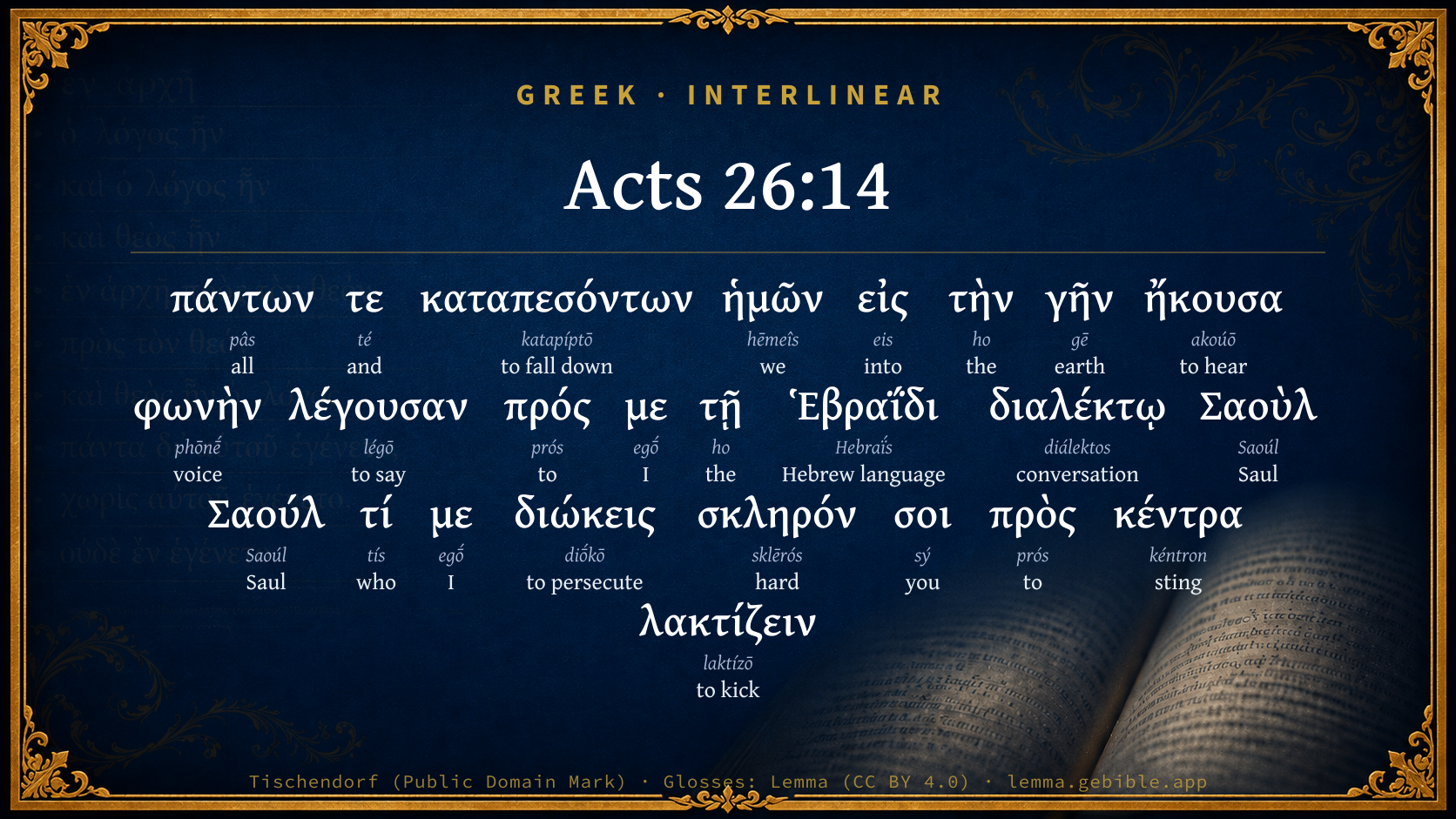
Greek (Tischendorf 8th ed.) Acts 26:14 appears in the Greek New Testament. The text above is from the Tischendorf 8th edition. Each word links to its Strong’s number and a concise gloss. Click any word for its full Thayer’s Greek Lexicon entry.
Download image
Cite this verse

Acts 26:14 (World English Bible). Public Domain. Lemma interlinear Bible study tool, https://lemma.gebible.app/v/acts/26/14.

Show BibTeX & RIS
BibTeX
RIS
English Translation
When we had all fallen to the earth, I heard a voice saying to me in the Hebrew language, 'Saul, Saul, why are you persecuting me? It is hard for you to kick against the goads.'
World English Bible · Public Domain
Highlights
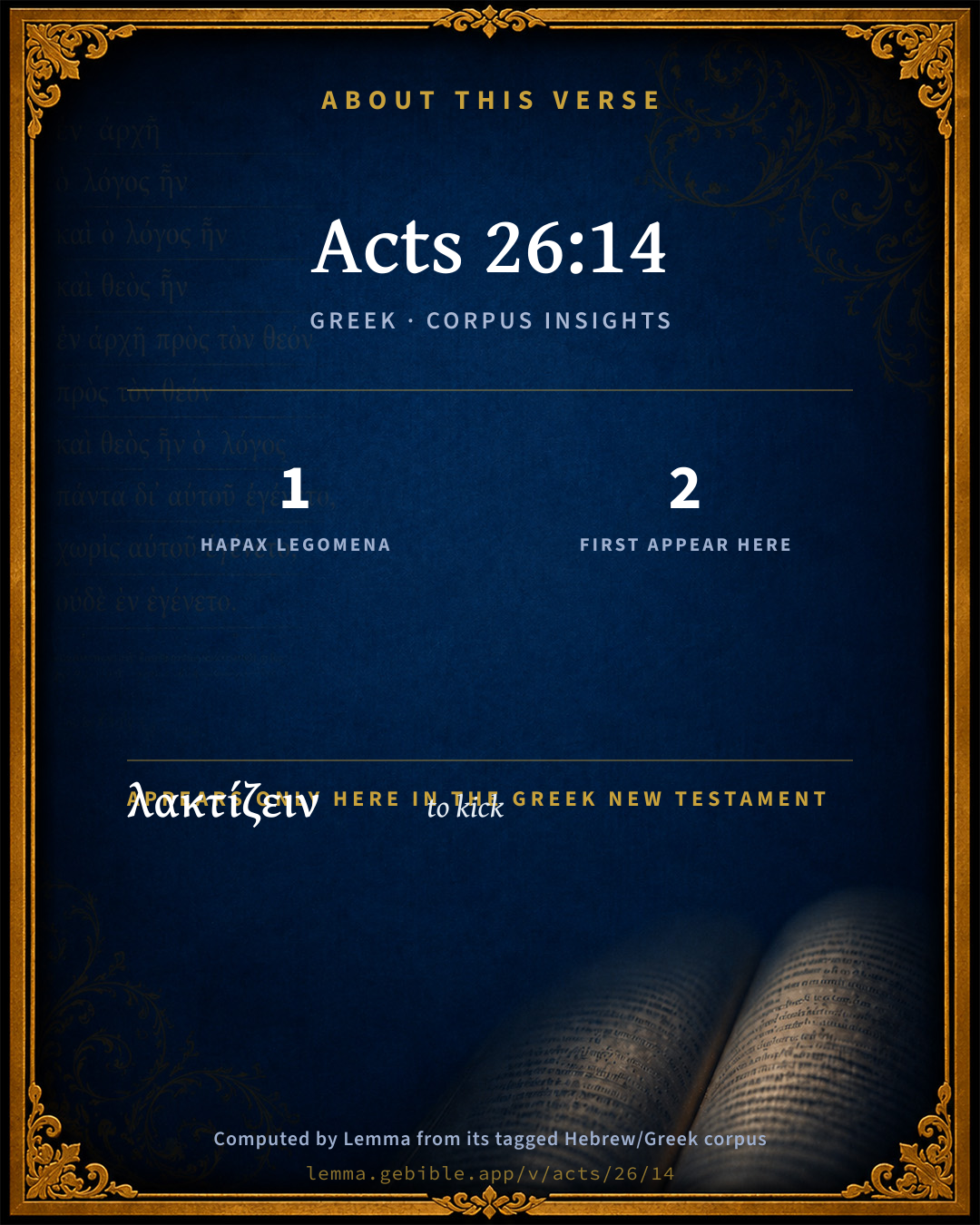
  • 1 hapax legomenon — only here in the Greek New Testament
  • 2 first appearances in the Greek New Testament
Full analysis ↓
Download a study sheet

One document with this verse’s original text, its word-by-word gloss line, the meaning frame, cross-references with their text, attributed commentary, and full source and license credits — printable, and it pastes into notes with its structure intact.

This verse Autodidact and up

Study sheet (.html) Plain text (.txt)

A passage Seminary Student

Up to 50 verses in one chapter. A passage sheet keeps up to 6 commentary sources and 12 cross-references per verse, in the order this page ranks them, and says so on the sheet whenever that leaves anything out. Ask for a single verse and you get the Autodidact verse sheet above.

Everything on this page stays free to read, with no account — the sheet is a download of what is already on screen, not access to it.

Want to remove ads? Support Godless Engineer
Compare translations 3

The same verse in 3 English versions, stacked beneath the original-language interlinear above. Click any original word for its lexicon entry.

Each is an independent rendering of the whole verse — the interlinear is not word-aligned to these translations.

Highlighted words mark where these versions differ — a whole-verse word diff, not a word-by-word alignment.

  • World English Bible Public Domain
    When we had all fallen to the earth, I heard a voice saying to me in the Hebrew language, 'Saul, Saul, why are you persecuting me? It is hard for you to kick against the goads.'
  • King James Version Public Domain
    And when we were all fallen to the earth, I heard a voice speaking unto me, and saying in the Hebrew tongue, Saul, Saul, why persecutest thou me? it is hard for thee to kick against the pricks.
  • unfoldingWord Literal Text CC BY-SA 4.0
    And when we all had fallen to the ground, I heard a voice speaking to me in the Hebrew language, ‘Saul, Saul, why are you persecuting me? It is hard for you to kick against a goad.’

unfoldingWord Literal Text — © unfoldingWord, licensed CC BY-SA 4.0. Word-aligned USFM3 via Door43 (git.door43.org/unfoldingWord/en_ult).

Versions to compare (up to 4)

3 of 4 selected

Show all 19 translations

Every available English version of this verse, each an independent rendering of the whole verse.

  • World English Bible Public Domain
    When we had all fallen to the earth, I heard a voice saying to me in the Hebrew language, 'Saul, Saul, why are you persecuting me? It is hard for you to kick against the goads.'
  • Berean Standard Bible Public Domain
    We all fell to the ground, and I heard a voice say to me in Hebrew, ‘Saul, Saul, why do you persecute Me? It is hard for you to kick against the goads.’
  • Majority Standard Bible Public Domain
    We all fell to the ground, and I heard a voice say to me in Hebrew, ‘Saul, Saul, why do you persecute Me? It is hard for you to kick against the goads.’
  • King James Version Public Domain
    And when we were all fallen to the earth, I heard a voice speaking unto me, and saying in the Hebrew tongue, Saul, Saul, why persecutest thou me? it is hard for thee to kick against the pricks.
  • American Standard Version (1901) Public Domain
    And when we were all fallen to the earth, I heard a voice saying unto me in the Hebrew language, Saul, Saul, why persecutest thou me? it is hard for thee to kick against the goad.
  • Revised Version (1885) Public Domain
    And when we were all fallen to the earth, I heard a voice saying unto me in the Hebrew language, Saul, Saul, why persecutest thou me? it is hard for thee to kick against the goad.
  • Geneva Bible (1599) Public Domain
    So when we were all fallen to the earth, I heard a voyce speaking vnto me, and saying in the Hebrew tongue, Saul, Saul, why persecutest thou me? It is hard for thee to kicke against pricks.
  • Douay-Rheims (1899) Public Domain
    And when we were all fallen down on the ground, I heard a voice speaking to me in the Hebrew tongue: Saul, Saul, why persecutest thou me It is hard for thee to kick against the goad.
  • Young's Literal Translation Public Domain
    and we all having fallen to the earth, I heard a voice speaking unto me, and saying in the Hebrew dialect, Saul, Saul, why me dost thou persecute? hard for thee against pricks to kick!
  • Literal Standard Version CC BY-SA 4.0
    and we all having fallen to the earth, I heard a voice speaking to me, and saying in the Hebrew dialect, Saul, Saul, why do you persecute Me? [It is] hard for you to kick against goads!
  • Unlocked Literal Bible CC BY-SA 4.0
    When we all fell to the ground, I heard a voice speaking to me that said in the Hebrew language, 'Saul, Saul, why do you persecute me? It is hard for you to kick a goad.'
  • unfoldingWord Literal Text CC BY-SA 4.0
    And when we all had fallen to the ground, I heard a voice speaking to me in the Hebrew language, ‘Saul, Saul, why are you persecuting me? It is hard for you to kick against a goad.’
  • Darby Bible Public Domain
    And, when we were all fallen to the ground, I heard a voice saying to me in the Hebrew tongue, Saul, Saul, why persecutest thou me? [it is] hard for thee to kick against goads.
  • World Messianic Bible Public Domain
    When we had all fallen to the earth, I heard a voice saying to me in the Hebrew language, ‘Saul, Saul, why are you persecuting me? It is hard for you to kick against the goads.’
  • Webster's Bible Public Domain
    And when we had all fallen to the earth, I heard a voice speaking to me, and saying in the Hebrew language, Saul, Saul, why persecutest thou me? It is hard for thee to kick against the goads.
  • Free Bible Version CC BY-SA 4.0
    All of us fell to the ground. Then I heard a voice speaking to me in Aramaic, ‘Saul, Saul, why are you persecuting me? It's hard for you to fight against me!’
  • Bible in Basic English Public Domain
    And when we had all gone down on the earth, a voice came to me, saying in the Hebrew language, Saul, Saul, why are you attacking me so cruelly? It is hard for you to go against the impulse which is driving you.
  • Text-Critical English NT CC BY 4.0
    When we had all fallen down to the ground, I heard a voice saying to me in the Hebrew language, ‘Saul, Saul, why are yoʋ persecuting me? It is hard for yoʋ to kick against the goads.’
  • Tyndale New Testament (1534) Public Domain
    When we were all fallen to the erth I hearde a voyce speakynge vnto me and sayinge in the Hebrue tonge: Saul Saul why persecutest thou me? It is harde for the to kicke agaynste the pricke.

Literal Standard Version (2020), Covenant Press — licensed CC BY-SA 4.0. Text via the HelloAO Bible API (eBible.org). Unlocked Literal Bible (unfoldingWord) — licensed CC BY-SA 4.0. Text via the HelloAO Bible API (eBible.org). unfoldingWord Literal Text — © unfoldingWord, licensed CC BY-SA 4.0. Word-aligned USFM3 via Door43 (git.door43.org/unfoldingWord/en_ult). Free Bible Version, Dr. Jonathan Gallagher — licensed CC BY-SA 4.0. Text via the HelloAO Bible API (eBible.org).

Word by word

More ways to search: Search by grammar → Find every occurrence → Compare this word →

Practice this passage: Drill this verse → Learn its vocabulary →

λακτίζειν
laktízō
G2979
“to kick”
Verb, Present, Active, Infinitive
Part of Speech
Verb
Tense
Present
Voice
Active
Mood
Infinitive
Full Thayer's Definition

Origin: from adverb lax (heelwise)

TDNT: 04:03,5

1. to kick, strike with the heel
  1. πάντων pâs G3956 “all” Adjective, Genitive, Plural, Masculine
  2. τε té G5037 “and” Particle
  3. καταπεσόντων katapíptō G2667 “to fall down” Verb, Aorist, Active, Participle, Genitive, Plural, Masculine
  4. ἡμῶν hēmeîs G2249 “we” Personal pronoun, 1st person, Genitive, Plural
  5. εἰς eis G1519 “into” Preposition
  6. τὴν ho G3588 “the” Article, Accusative, Singular, Feminine
  7. γῆν gē G1093 “earth” Noun, Accusative, Singular, Feminine
  8. ἤκουσα akoúō G191 “to hear” Verb, Aorist, Active, Indicative, 1st person, Singular
  9. φωνὴν phōnḗ G5456 “voice” Noun, Accusative, Singular, Feminine
  10. λέγουσαν légō G3004 “to say” Verb, Present, Active, Participle, Accusative, Singular, Feminine
  11. πρός prós G4314 “to” Preposition
  12. με egṓ G1473 “I” Personal pronoun, 1st person, Accusative, Singular
  13. τῇ ho G3588 “the” Article, Dative, Singular, Feminine
  14. Ἑβραΐδι Hebraḯs G1446 “Hebrew language” Noun, Dative, Singular, Feminine
  15. διαλέκτῳ diálektos G1258 “conversation” Noun, Dative, Singular, Feminine
  16. Σαοὺλ Saoúl G4549 “Saul” Noun, Proper, indeclinable
  17. Σαούλ Saoúl G4549 “Saul” Noun, Proper, indeclinable
  18. τί tís G5101 “who” Interrogative pronoun, Accusative, Singular, Neuter
  19. με egṓ G1473 “I” Personal pronoun, 1st person, Accusative, Singular
  20. διώκεις diṓkō G1377 “to persecute” Verb, Present, Active, Indicative, 2nd person, Singular
  21. σκληρόν sklērós G4642 “hard” Adjective, Nominative, Singular, Neuter
  22. σοι sý G4771 “you” Personal pronoun, 2nd person, Dative, Singular
  23. πρὸς prós G4314 “to” Preposition
  24. κέντρα kéntron G2759 “sting” Noun, Accusative, Plural, Neuter

About this verse

These counts appear in no published source. They are computed here, from the morphology-tagged text and Lemma’s own curated glosses. What Lemma adds →

25
words
21
distinct lemmas
Acts
section

Notable vocabulary

1 hapax legomenon — a word that appears only here in the entire Greek New Testament:

  • λακτίζειν to kick G2979

First appearance in Scripture

These words make their first canonical appearance in the Greek New Testament here:

  • κέντρα sting G2759
  • λακτίζειν to kick G2979

Shared distinctive vocabulary

καταπεσόντων to fall down G2667 occurs in 3 verses of the Greek New Testament. Also found in:
Repetition

Words recur within this verse:

Cross-references

9

Topical passages linked to Acts 26:14 in the Treasury of Scripture Knowledge — connected by theme and wording, ordered by reader-vote popularity; previews shown in the World English Bible.

  • Acts 21:40 When he had given him permission, Paul, standing on the stairs, beckoned with his hand to the people. When there was a great silence, he spoke to them in the Hebrew language, saying,
  • Acts 9:7 The men who traveled with him stood speechless, hearing the sound, but seeing no one.
  • Acts 22:2 When they heard that he spoke to them in the Hebrew language, they were even more quiet. He said,
  • Acts 22:7–9 I fell to the ground, and heard a voice saying to me, 'Saul, Saul, why are you persecuting me?'
  • Zechariah 2:8 For thus says Yahweh of hosts: 'For honor he has sent me to the nations which plundered you; for he who touches you touches the apple of his eye.
  • Zechariah 12:2 "Behold, I will make Jerusalem a cup of reeling to all the surrounding peoples, and on Judah also will it be in the siege against Jerusalem.
  • Acts 9:4–5 He fell on the earth, and heard a voice saying to him, "Saul, Saul, why do you persecute me?"
  • 1 Corinthians 10:22 Or do we provoke the Lord to jealousy? Are we stronger than he?
  • Proverbs 13:15 Good understanding wins favor; But the way of the unfaithful is hard.

Cross-references courtesy of OpenBible.info (CC BY 4.0).

Commentary

Notes on Acts 26:14 from classic Christian and Jewish commentators (each source and its license shown beneath its notes). The classic Christian expositions comment on the surrounding passage and are grouped to its opening verse, so a note may address several verses; the Jewish commentaries on the Tanakh (Rashi and others) are per-verse, so they appear only where the commentator wrote on this verse.

Lemma curates 59 commentaries, every one of them public domain or Creative Commons licensed, each selected and text-cleaned for this edition rather than reprinted as found. About our sources →

MacLaren's Expositions of Holy Scripture

Alexander MacLaren

Acts

CHRIST’S REMONSTRANCES

Act 26:14.

‘Can the Ethiopian change his skin, or the leopard his spots?’ No. But God can change the skin, because He can change the nature. In this story of the conversion of the Apostle Paul-the most important thing that happened that day-we have an instance how brambles may become vines; tares may become wheat; and a hater of Jesus Christ may be changed in a moment into His lover and servant, and, if need be, His martyr.

Now the very same motives and powers which were brought to bear upon the Apostle Paul by miracle are being brought to bear upon every one of us; and my object now is just to trace the stages of the process set forth here, and to ask some of you, if you, like Paul, have been ‘obedient to the heavenly vision.’ Stages, I call them, though they were all crowded into a moment, for even the lightning has to pass through the intervening space when it flashes from one side of the heavens to another, and we may divide its path into periods. Time is very elastic, as any of us whose lives have held great sorrows or great joys or great resolutions well know.

I. The first of these all but simultaneous and yet separable stages was the revelation of Jesus Christ.

Of course to the Apostle it was mediated by miracle; but real as he believed that appearance of the risen Lord in the heavens to be, and valid as he maintained that it was as the ground of his Apostleship, he himself, in one of his letters, speaks of the whole incident as being the revelation of God’s Son in him. The revelation in heart and mind was the main thing, of which the revelation to eye and ear were but means. The means, in his case, are different from those in ours; the end is the same. To Paul it came like the rush of a cataract that the Christ whom he had thought of as lying in an unknown grave was living in the heavens and ruling there. You and I, I suppose, do not need to be convinced by miracle of the resurrection of Jesus Christ; but the bare fact that Jesus was living in the heavens would have had little effect upon Saul, unless it had been accompanied with the revelation of the startling fact that between him and Jesus Christ there were close personal relations, so that he had to do with Jesus, and Jesus with him.

‘Saul, Saul! why persecutest thou Me?’ They used to think that they could wake sleep-walkers by addressing them by name. Jesus Christ, by speaking His name to the Apostle, wakes him out of his diseased slumber, and brings him to wholesome consciousness. There are stringency and solemnity of address in that double use of the name ‘Saul, Saul!’

What does such an address teach you and me? That Jesus Christ, the living, reigning Lord of the universe, has perfect knowledge of each of us, and that we each stand isolated before Him, as if all the light of omniscience were focussed upon us. He knows our characters; He knows all about us, and more than that, He directly addresses Himself to each man and woman among us.

We are far too apt to hide ourselves in the crowd, and let all the messages of God’s love, the warnings of His providences, as well as the teachings and invitations and pleadings of His gospel, fly over our heads as if they were meant vaguely for anybody. But they are all intended for thee, as directly as if thou, and thou only, wert in the world. I beseech you, lay this to heart, that although no audible sounds may rend the silent heavens, nor any blaze may blind thine eye, yet that as really, though not in the same outward fashion as Saul, when they were all fallen to the earth, felt himself to be singled out, and heard a voice ‘speaking to him in the Hebrew tongue, saying, Saul, Saul!’ thou mayest hear a voice speaking to thee in the English tongue, by thy name, and directly addressing its gracious remonstrances and its loving offers to thy listening ear. I want to sharpen the blunt ‘whosoever’ into the pointed ‘thou.’ And I would fain plead with each of my friends hearing me now to believe that the gospel of Jesus Christ is meant for thee, and that Christ speaks to thee. ‘I have a message from God unto thee,’ just as Nathan said unto David. ‘Thou art the man!’

Do not lose yourselves in the crowd or hide yourselves from the personal incidence of Christ’s offer, but feel that you stand, as you do indeed, alone the hearer of His voice, the possible recipient of His saving mercy.

II. Secondly, notice, as another stage in this process the discovery of the true character of the past.

‘Why persecutest thou Me?’ Now I am not going to be tempted from my more direct purpose in this sermon to dwell even for a moment on the beautiful, affecting, strengthening thought here, of the unity of Jesus Christ with all the humble souls that love Him, so as that, whatsoever any member suffers, the Head suffers with it. I must leave that truth untouched.

Saul was brought to look at all his past life as standing in immediate connection with Jesus Christ. Of course he knew before the vision that he had no love to Him whom he thought to be a Galilean impostor, and that the madness with which he hated the servants was only the glancing off of the arrow that he would fain have aimed at the Master. But he did not know that Jesus Christ counted every blow struck at one of His servants as being struck at Him. Above all he did not know that the Christ whom he was persecuting was reigning in the heavens. And so his whole past life stood before him in a new aspect when it was brought into close connection with Christ, and looked at as in relation to Him.

The same process would yield very remarkable results if applied to our lives. If I could only get you for one quiet ten minutes, to lay all your past, as far as memory brought it to your minds, right before that pure and loving Face, I should have done much. One infallible way of judging of the rottenness or goodness of our actions is that we should bring them where they will all be brought one day, into the brightness of Christ’s countenance. If you want to find out the flaws in some thin, badly-woven piece of cloth, you hold it up against the light, do you not? and then you see all the specks and holes, and the irregular threads. Hold up your lives in like fashion against the light, and I shall be surprised if you do not find enough there to make you very much ashamed of yourselves. Were you ever on the stage of a theatre in the daytime? Did you ever see what miserable daubs the scenes look, and how seamy it all is when the pitiless sunshine comes in? Let that great light pour on your life, and be thankful if you find out what a daub it has been, whilst yet colours and brushes and time are at your disposal, and you may paint the future fairer than the past.

Again, this revelation of Saul’s past life disclosed its utter unreasonableness. That one question, ‘Why persecutest thou Me?’ pulverised the whole thing. It was like the wondering question so unanswerable in the Psalm, ‘Why do the heathen rage, and the people imagine a vain thing?’ If you take into account what you are, and where you stand, you can find no reason, except utterly unreasonable ones, for the lives that I fear some of us are living-lives of godlessness and Christlessness. There is nothing in all the world a tithe so stupid as sin. There is nothing so unreasonable, if there be a God at all, and if we depend upon Him, and have duties to Him, as the lives that some of you are living. You admit, most of you, that there is such a God; you admit, most of you, that you do hang upon Him; you admit, in theory, that you ought to love and serve Him. The bulk of you call yourselves Christians. That is to say, you believe, as a piece of historical fact, that Jesus Christ, the Son of God, came into this world and died for men. And, believing that, you turn your back on Him, and neither love nor serve nor trust Him nor turn away from your iniquity. Is there anything outside a lunatic asylum more madlike than that? ‘Why persecutest thou?’ ‘And he was speechless,’ for no answer was possible. Why neglectest thou? Why forgettest thou? Why, admitting what thou dost, art thou not an out-and-out Christian? If we think of all our obligations and relations, and the facts of the universe, we come back to the old saying, ‘The fear of the Lord is the beginning of wisdom,’ and any man who, like many of my hearers, fails to give his heart and life to Jesus Christ will one day have to say, ‘Behold, I have played the fool, and erred exceedingly.’ Wake up, my brother, to apply calm reason to your lives while yet there is time, and face the question, Why dost thou stand as thou dost to Jesus Christ? There is nothing sadder than the small share that deliberate reason and intelligent choice have in the ordering of most men’s lives. You live by impulse, by habit, by example, by constraint of the outward necessities of your position. But I am sure that there are many amongst us now who have very seldom, if ever, sat down and said, ‘Now let me think, until I get to the ultimate grounds of the course of life that I am pursuing.’ You can carry on the questions very gaily for a step or two, but then you come to a dead pause. ‘What do I do so-and-so for?’ ‘Because I like it.’ ‘Why do I like it?’ ‘Because it meets my needs, or my desires, or my tastes, or my intellect.’ Why do you make the meeting of your needs, or your desires, or your tastes, or your intellect your sole object? Is there any answer to that? The Hindoos say that the world rests upon an elephant, and the elephant rests upon a tortoise. What does the tortoise rest on? Nothing! Then that is what the world and the elephant rest on. And so, though you may go bravely through the first stages of the examination, when you come to the last question of all, you will find out that your whole scheme of life is built upon a blunder; and the blunder is this, that anybody can be blessed without God.

Further, this disclosure of the true character of his life revealed to Saul, as in a lightning flash, the ingratitude of it.

‘Why persecutest thou Me?’ That was as much as to say, ‘What have I done to merit thy hate? What have I not done to merit rather thy love?’ Paul did not know all that Jesus Christ had done for him. It took him a lifetime to learn a little of it, and to tell his brethren something of what he had learned. And he has been learning it ever since that day when, outside the walls of Rome, they hacked off his head. He has been learning more and more of what Jesus Christ has done for him, and why he should not persecute Him but love Him.

But the same appeal comes to each of us. What has Jesus Christ done for thee, my friend, for me, for every soul of man? He has loved me better than His own life. He has given Himself for me. He has lingered beside me, seeking to draw me to Himself, and He still lingers. And this, at the best, tremulous faith, this, at the warmest, tepid love, this, at the completest, imperfect devotion and service, are all that we bring to Him; and some of us do not bring even these. Some of us have never known what it was to sacrifice one inclination for the sake of Christ, nor to do one act for His dear love’s sake, nor to lean our weakness upon Him, nor to turn to Him and say, ‘I give Thee myself, that I may possess Thee.’ ‘Do ye thus requite the Lord, O foolish people and unwise?’ I have heard of wounded soldiers striking with their bayonets at the ambulance men who came to help them. That is like what some of you do to the Lord who died for your healing, and comes as the Physician, with bandages and with balm, to bind up the brokenhearted. ‘Saul, Saul, why persecutest thou Me?’

III. Lastly, we have here a warning against self-inflicted wounds.

That second clause of the remonstrance on the lips of Christ in my text is, according to the true reading, not found in the account of Paul’s conversion in the ninth chapter of this book. My text is from Paul’s own story; and it is interesting to notice that he adds this eminently pathetic and forcible appeal to the shorter account given by the writer of the book. It had gone deep into his heart, and he could not forget.

The metaphor is a very plain one. The ox-goad was a formidable weapon, some seven or eight feet in length, shod with an iron point, and capable of being used as a spear, and of inflicting deadly wounds at a pinch. Held in the firm hand of the ploughman, it presented a sharp point to the rebellious animal under the yoke. If the ox had readily yielded to the gentle prick, given, not in anger, but for guidance, it had been well. But if it lashes out with its hoofs against the point, what does it get but bleeding flanks? Paul had been striking out instead of obeying, and he had won by it only bloody hocks.

There are two truths deducible from this saying, which may have been a proverb in common use. One is the utter futility of lives that are spent in opposing the divine will. There is a strong current running, and if you try to go against it you will only be swept away by it. Think of some little fishing coble coming across the bow of a great ocean-going steamer. What will be the end of that? Think of a pony-chaise jogging up the line, and an express train thundering down it. What will be the end of that? Think of a man lifting himself up and saying to God, ‘I will not!’ when God says, ‘Do thou this!’ or ‘Be thou this!’ What will be the end of that? ‘The world passeth away, and the lusts thereof, but he that doeth the will of God abideth for ever.’ ‘It is hard for thee to kick against the pricks’-hard in regard to breaches of common morality, as some of my friends sitting quietly in these pews very well know. It is hard to indulge in sensual sin. You cannot altogether dodge what people call the ‘natural consequences’; but it was God who made Nature; and so I call them God-inflicted penalties. It is hard to set yourselves against Christianity. I am not going to speak of that at all now, only when we think of the expectations of victory with which so many antagonists of the Cross have gaily leaped into the arena, and of how the foes have been forgotten and there stands the Cross still, we may say of the whole crowd, beginning with the earliest, and coming down to the latest brand-new theory that is going to explode Christianity -’it is hard to kick against the pricks.’ Your own limbs you may wound; you will not do the goad much harm.

But there is another side to the proverb of my text, and that is the self-inflicted harm that comes from resisting the pricks of God’s rebukes and remonstrances, whether inflicted by conscience or by any other means; including, I make bold to say, even such poor words as these of mine. For if the first little prick of conscience, a warning and a guide, be neglected, the next will go a great deal deeper. The voice which, before you do the wrong thing, says to you, ‘Do not do it,’ in tones of entreaty and remonstrance, speaks, after you have done it, more severely and more bitterly. The Latin word remorse, and the old English name for conscience, ‘again-bite’-which latter is a translation of the other-teach us the same lesson, that the gnawing which comes after wrong done is far harder to bear than the touch that should have kept us from the evil. The stings of marine jelly-fish will burn for days after, if you wet them. And so all wrong-doing, and all neglect of right-doing of every sort, carries with it a subsequent pain, or else the wounded limb mortifies, and that is worse. There is no pain then; it would be better if there were. There is such a possibility as to have gone on so obstinately kicking against the pricks and leaving the wounds so unheeded, as that they mortify and feeling goes. A conscience ‘seared with a hot iron’ is ten times more dreadful than a conscience that pains and stings.

So, dear brethren, let me beseech you to listen to the pitying Christ, who says to us each, more in sorrow than in anger, ‘It is hard for thee to kick against the pricks.’ It is no pleasure to Him to hold the goad, nor that we should wound ourselves upon it. He has another question to put to us, with another ‘why,’ ‘Why should ye be stricken any more? Turn ye, turn ye; why will ye die, O house of Israel?’

There is another metaphor drawn from the employment of oxen which we may set side by side with this of my text: ‘Take My yoke upon you, and ye shall find rest unto your souls.’ The yoke accepted, the goad is laid aside; and repose and healing from its wounds are granted to us. Dear brethren, if you will listen to the Christ revealed in the heavens, as knowing all about you, and remonstrating with you for your unreasonableness and ingratitude, and setting before you the miseries of rebellion and the suicide of sin, then you will have healing for all your wounds, and your lives will neither be self-tormenting, futile, nor unreasonable. The mercy of Jesus Christ lavished upon you makes your yielding yourselves to Him your only rational course. Anything else is folly beyond comparison and harm and loss beyond count.

Alexander MacLaren, Expositions of Holy Scripture (1904–1910) — public domain. Text from a community e-Sword module.

Bengel's Gnomon

Johann Albrecht Bengel

Act 26:14. Τῇ Ἑβραΐδι διαλέκτῳ, in the Hebrew tongue) Paul himself, in this instance, did not speak in Hebrew. For in ch. Act 22:7, which narrates the same incident, he did not, when speaking in Hebrew, add this, in the Hebrew language. The Hebrew language was the language of Christ on earth and from heaven.—σκληρόν σοι, it is hard for thee) Lightfoot observes, it is a Hebrew adage.

Bengel's Gnomon of the New Testament — English translation (T&T Clark, Edinburgh, 1860) — public domain. Text from a community e-Sword module.

Meyer's Critical & Exegetical Commentary

Heinrich August Wilhelm Meyer

Act_26:14-15. See on Act_9:4 ff.; comp. Act_22:7 f.

τῇ Ἑβρ. διαλ.] It was natural that the exalted Christ should make no other language than the native tongue of the person to be converted the medium of his verbal revelation. Moreover, these words confirm the probability that Paul now spoke not, as at Act_21:40, in Hebrew, but in Greek.

σκληρόν σοι πρὸς κέντρα λακτίζειν] hard for thee, to kick against goads! i.e. it is for thee a difficult undertaking, surpassing thy strength, and not to be accomplished by thee (compare Gamaliels saying, Act_5:39), that thou (as my persecutor) shouldest contend against my will. Ἡ δὲ τροπὴ ἀπὸ τῶν βοῶν· τῶν γὰρ οἱ ἄτακτοι κατὰ τὴν γεωργίαν κεντριζόμενοι ὑπὸ ἀροῦντος, λακτίζουσι τὸ κέντρον καὶ μᾶλλον πλήττονται, Schol. ad Pind. Pyth. ii. 173. Comp. Aesch. Agam. 1540 (1624): πρὸς κέντρα μὴ λάκτιζε. See other examples from Greek and Roman writers in Grotius and Wetstein; also Blomfield, ad Aesch. Prom. 331; Elmsl. ad Eur. Bacch. 794.

Meyer — Critical and Exegetical Commentary on the New Testament — English translation by Peter Christie, edited by Frederick Crombie (T&T Clark, 1880) — public domain. Text from a community e-Sword module.

Expositor's Greek Testament

ed. W. Robertson Nicoll

Act 26:14 . See notes on Act 9:7 and Act 22:7 , and reading above in β . τῇ Ἑβραΐδι διαλ .: this is intimated in Act 9:4 and Act 22:7 by the form Σαούλ , but here the words are inserted because Paul was speaking in Greek, or perhaps he spoke the solemn words, indelible in his memory, as they were uttered, in Hebrew, for Agrippa (Alford). σκληρόν σοι κ . τ . λ .: a proverb which finds expression both in Greek and in Latin literature (see instances in Wetstein): cf. Scholiast on Pind., Pyth. , ii., 173: ἡ δὲ τροπὴ ἀπὸ τῶν βοῶν · τῶν γὰρ οἱ ἄτακτοι κατὰ τὴν γεωργίανκεντριζόμενοι ὑπὸ τοῦ ἀροῦντος , λακτίζουσι τὸ κέντρον καὶ μᾶλλον πλήττονται . Cf. also Aesch., Agam. , 1633 ( cf. Prom. , 323), Eur., Bacch. , 791, and in Latin, Terence, Phorm. , i., 2, 27; Plautus, Truc. , iv., 2, 59; and there may have been a similar proverb current among the Hebrews. Blass, Gram. , pp. 5, 6, thinks that the introduction of the proverb on this occasion before Festus and Agrippa points to the culture which Paul possessed, and which he called into requisition in addressing an educated assembly. It is not wise to press too closely a proverbial saying with regard to Saul’s state of mind before his conversion; the words may simply mean to intimate to him that it was a foolish and inefficacious effort to try to persecute Jesus in His followers, an effort which would only inflict deeper wounds upon himself, an effort as idle as that described by the Psalmist, Psa 2:3-4 . At all events Paul’s statement here must be compared with his statements elsewhere, 1Ti 1:13 ; see Witness of the Epistles , p. 389 ff., and Bethge, Die Paulinischen Reden , p. 275.

The Expositor's Greek Testament, edited by W. Robertson Nicoll (1897–1910) — public domain. Text from a community e-Sword module.

Ellicott's Commentary for English Readers

(14) It is hard for thee to kick against the pricks.—See Note on Act_9:5. Here there is no doubt as to the genuineness of the reading.

A Bible Commentary for English Readers, edited by Charles John Ellicott (1878–1897) — public domain. Text from a community e-Sword module.

The Cambridge Bible for Schools and Colleges

gen. ed. J. J. S. Perowne

14. I heard a voice speaking unto me, and saying] The oldest MSS. have only “a voice saying unto me.” Saul alone gathered the import of what was said. His companions only heard the sound, not the words. Cp. Dan_10:7.

in the Hebrew tongue [R. V. language] Which is therefore represented by a different orthography of the proper name, not “Saulos,” the usual Greek form, but “Saoul,” a transliteration of the Hebrew.

it is hard for thee to kick against the pricks [goad] This is the only place where the oldest MSS. give these words. See note on Act_9:5. The figure is from an ox, being driven on in his work. When restive or lazy, the driver pricks him, and in ignorance of the consequences, he kicks back, and so gets another wound. The words would imply that God had been guiding Saul towards the true light for some time before, and that this zeal for persecution was a resistance of the divine urging. It is not unusual for men who are moved to break away from old traditions at such times, by outward acts, to manifest even more zeal than before for their old opinions, as if in fear lest they should be thought to be falling away. This may have been Saul’s case, his kicking against the goads.

The Cambridge Bible for Schools and Colleges (gen. ed. J. J. S. Perowne; Cambridge University Press, 1878–1918) — public domain. Text from a community e-Sword module.

John Gill's Exposition

And when we were all fallen to the earth,.... Saul, and the men that were with him, for fear of the divine Majesty, who by this extraordinary light was thought to be present: the other narratives only relate Saul's falling to the earth; how this is to be reconciled to their standing speechless, in Act 9:7; see Gill on Act 9:7.

I heard a voice speaking unto me, &c. See Gill on Act 10:4. See Gill on Act 10:5.

John Gill's Exposition of the Whole Bible (1746–1763) — public domain (CC PDM 1.0). Text via the HelloAO Bible API.

Trapp's Complete Commentary

John Trapp

14 And when we were all fallen to the earth, I heard a voice speaking unto me, and saying in the Hebrew tongue, Saul, Saul, why persecutest thou me? it is hard for thee to kick against the pricks.

Ver. 14. I heard a voice] I not only saw a sign. So in the transfiguration, a voice came forth to them from the excellent glory. Signo verbum est coniungendum. God in the sacraments, for the furtherance of our faith, affects both our learned senses, as Aristotle calleth our sight and hearing; giving us his word both audible and visible.

John Trapp, A Commentary or Exposition upon All the Books of the Old and New Testament (1647–1656) — public domain. Text from a community e-Sword module.

Haydock's Catholic Bible Commentary

It is generally supposed that St. Paul addresses king Agrippa in the Greek language, which was the common tongue of a great part of the East. (Bible de Vence)

George Leo Haydock (1774–1849), Haydock's Catholic Family Bible and Commentary, 1859 edition — public domain. Excludes Psalms (Douay-Rheims chapter numbering differs from Protestant) and Deuterocanonical books (Catholic canon only).

Matthew Poole's English Annotations

In the Hebrew tongue; whereby it appears, that Paul spake not now before Agrippa in the Hebrew tongue, as he did before the Jews at Jerusalem, Act 21:40.

It is hard for thee to kick against the pricks: this is a proverb borrowed from the Greeks, as some think, but used in many languages, denoting any who endeavour such things as will ruin or detriment themselves: and so do all persecutors; for they cannot harden themselves against God, his truth, or servants, and prosper, Job 9:4. Not to speak of other pricks, there is never an attribute in God, nor ever a faculty in their own souls, but they kick against, and will be themselves at last pricked by.

Matthew Poole's English Annotations on the Holy Bible (1683–1685) — public domain. Text from a community e-Sword/MySword module.

Whedon's Commentary on the Bible

Daniel D. Whedon

14. In the Hebrew tongue—A new circumstance, showing both the particularity of the apostle’s own memory, and indicating that Jesus acknowledged his Israelite brotherhood even in commissioning his apostle to the Gentiles.

Daniel D. Whedon (gen. ed.), Commentary on the Old and New Testaments (1874–1909) — public domain. Text from a community e-Sword module.

The Pulpit Commentary

Saying unto me in the Hebrew language for speaking unto me, and saying in the Hebrew tongue, A.V. and T.R.; goad for pricks, A.V. I heard a voice saying, etc.. (see Act_9:7, note) In the Hebrew language. This is an additional detail not mentioned in Act_9:4 orzein Act_22:8; but recalled here, as tending to confirm St. Paul"s claim to be a thorough Jew, a Hebrew of the Hebrews, and, moreover, to represent Christianity as a thing not alien from, but rather in thorough harmony with, the true national life and spirit of Israel. It is hard for thee to kick, etc. This, also, according to the best manuscripts, is an additional detail not mentioned before. The proverb Prontra lakti) to kick against the ox-goads, as the unbroken bullock does to his own hurt, instead of quietly submitting, as he must do at last, to go the way and the pace his master chooses he should go, is found in Pindar, Aeschylus, Euripides, Plautus, Terence, etc. The passages are given in Bochart, "Hierozoicon.," part 1. lib. it. Acts 39.; in Kninoel, and in Bishop Wordsworth. The passage in Eurip., "Baach," 1. 793, 794 (750, 751), brings out the force of the proverb, viz. fruitless resistance to a superior power, most distinctly: Better to sacrifice to him, than, being mortal, by vainly raging against God, to kick against the goads." Saul had better yield at once to the constraining grace of God, and no longer do despite to the Spirit of grace. It does not appear clearly that the proverb was used by the Hebrews. Dr. Donaldson ("Christian Orthodoxy," p. 293) affirms that" there is no Jewish use of this proverbial expression." And this is borne out by Lightfoot, who adduces the two passages, Deu_32:15 and 1Sa_2:9, as the only evidences of the existence of such a proverb, together with a rabbinical saying, "R. Bibai sat and taught, and R. Isaac Ben Cahna kicked against him" ("Exereit. on Act_9:5). It is, therefore, a curious question how this classical phrase came to be used here. Bishop Wordsworth says, Even in heaven our Lord did not disdain to use a proverb familiar to the heathen world." But, perhaps, we may assume that such a proverb was substantially in use among the Jews, though no distinct evidence of it has been preserved; and that St. Paul, in rendering the Hebrew words of Jesus into Greek, made use of the language of Euripides, with which he was familiar, in an ease bearing a strong analogy to his own, viz. the resistance of Pentheus to the claims of Bacchus. This is to a certain extent borne out by the use of the words qeomacov and qeomacein; (Act_5:39 Act_23:9) the latter of which is twice used in the "Bacchae" of Euripides, though not common elsewhere. It is, however, found in RAPC 2Ma 7:19.

The Pulpit Commentary (1880–1919), ed. H.D.M. Spence-Jones & Joseph S. Exell — public domain. Text from a community e-Sword module.

John Wesley's Explanatory Notes

In the Hebrew tongue - St. Paul was not now speaking in Hebrew: when he was, chap. xxiii, 7, he did not add, In the Hebrew tongue. Christ used this tongue both on earth and from heaven.

John Wesley, Explanatory Notes Upon the Whole Bible (1754–1765) — public domain. Text via the GEBible commentary corpus.

Scofield Reference Notes

C. I. Scofield

heard

Cf. (See Scofield "Act 9:7").

The Scofield Reference Bible (1917 edition), notes by C. I. Scofield — public domain. Text from a community e-Sword module.

McGarvey & Pendleton's Commentaries

J. W. McGarvey

See notes on verse 12

J. W. McGarvey (with Philip Y. Pendleton), Commentaries on the New Testament (The Fourfold Gospel, 1914; Acts; and the epistles) — public domain. Text from a community e-Sword/MySword module.

Cambridge Greek Testament for Schools and Colleges

14. λέγουσαν πρός με with אABCI omitting καὶ λέγουσαν afterwards. The Vulg. has only ‘loquentem mini.’

14. ἤκουσα φωνὴν λέγουσαν πρός, I heard a voice saying unto me. Saul alone gathered the import of what was said. His companions merely heard the sound, but nothing of the words. Cf. Dan 10:7.

τῇ Ἑβραΐδι διαλέτῳ, in the Hebrew language. And this is represented in the proper name, which is not Σαῦλος as usual, but Σαούλ, a transliteration of the Hebrew form.

σκληρόν σοι πρὸς κέντρα λακτίξειν, it is hard for thee to kick against the pricks (lit. the goads). This is the only place where the oldest MSS. give these words. See note on Act 9:5. The figure is from an ox, being driven on in his work. When restive or lazy, the driver pricks him, and in ignorance of the consequences, he kicks back, and so gets another wound. The words would imply that God had been guiding Saul towards the true light for some time before, and that this zeal for persecution was a resistance offered to the divine urging. It is not unusual for men who are moved to break away from old traditions at such times, by outward acts, to manifest even more zeal than before for their old opinions, as if in fear lest they should be thought to be falling away. This may have been Saul’s case, his kicking against the goads. The figure is very common in classical literature. Cf. Aesch. Prom. 323; Eur. Bacchæ 791.

Cambridge Greek Testament for Schools and Colleges (Cambridge University Press, 1896; 21 vols, various authors incl. Carr, Maclear, Plummer, Farrar, Lumby, Moule, M. R. James, Simcox) — public domain. Text from a community e-Sword module.

Alford’s Greek Testament

Henry Alford

14. τῇ Ἑβρ. διαλ.] These words are expressed here only. In ch. 9 (see note) we have the fact remarkably preserved by the Hebrew form Σαούλ; in ch. 22 he was speaking in Hebrew (Syro-Chald.), and the notice was not required. (Beware again of the supposed emphatic με of Wordsworth.)

σκληρ. σοι πρ. κ. λ.] This is found here only; in ch. 9 the words are spurious, having been inserted from this place. The metaphor is derived from oxen at plough or drawing a burden, who, on being pricked with the goad, kick against it, and so cause it to pierce deeper. (See Schol. on Pind. I. c. below.) It is a Greek, and not (apparently) a Hebrew proverb; but this is no reason why it should not be used in Hebrew, just as it is in Latin. Instances of its use are Pind. Pyth. ii. 173: χρὴ δὲ πρὸς θεὸν οὐκ ἐρίζειν … φέρειν δʼ ἐλαφρῶς ἐπαυχένιον λαβόντα ζυγὸν ἀρήγει. ποτὶ κέντρον δέ τοι λακτιζέμεν τελέθει ὀλισθηρὸς οἶμος. Æschyl. Agam. 1633: πρὸς κέντρα μὴ λάκτιζε, μὴ πήσας μογῇς. Eurip. Bacch. 791: θυμούμενος πρὸς κέντρα λακτίζοιμι, θνητὸς ὢν θεῷ. See also Æsch. Prom. 323, and other examples in Wetst.; Plautus (Truc. iv. 2. 59); and Terence, Phorm. i. 2. 27: ‘Nam quæ inscitia est advorsum stimulum calces?’

Henry Alford, The Greek Testament (1849–1861) — public domain. Text from a community e-Sword module.

Vincent's Word Studies in the New Testament

Marvin R. Vincent

It is hard for thee to kick against the pricks. Or, goads. The sharp goad carried in the ploughman's hand, against which the oxen kick on being pricked. The metaphor, though not found in Jewish writings, was common in Greek and Roman writings. Thus, Euripides (" Bacchae, "791) :" Being enraged, I would kick against the goads, a mortal against a God. "Plautus (" Truculentus, 4, 2, 55) :" If you strike the goads with your fists, you hurt your hands more than the goads. "" Who knows whether at that moment the operation of ploughing might not be going on within sight of the road along which the persecutor was traveling? (Howson," Metaphors of St. Paul ").

Marvin R. Vincent, Word Studies in the New Testament (1887–1900) — public domain. Text from a community e-Sword/MySword module.

Lesson kit

Teaching starters — assembled from the data on this page, not authored interpretation. Every prompt links to the verse data it draws on. Edit before teaching.

Acts, in the Acts, opens this verse with 25 words (21 distinct Greek lemmas). Its most distinctive word is laktízō (“to kick”). A historical commentator’s framing appears above. Read the whole chapter for the surrounding context.

Discussion questions

  1. How does “to kick” (laktízō) shape what this verse is saying?
  2. This verse holds 1 word here found nowhere else in the Greek New Testament. What might the rare word draw attention to?
  3. 2 words here appear for the first time in Scripture. What is being introduced at this debut?
  4. Luke 8:6 shares the word «to fall down» with this verse. How do the two illuminate each other?
  5. “Saul” occurs 2× in this one verse. What is the effect of the repetition?
  6. These translations render this verse differently; the difference is in the English rendering, not the original. What questions does that raise?
  7. Reading how MacLaren's Expositions of Holy Scripture and Bengel's Gnomon read this verse, where do the two commentators agree and where do they part?

Things to notice

  • 1 word in this verse appears nowhere else in the Greek New Testament.
  • 2 words make their first canonical appearance in Scripture here.
  • These translations choose different wording for 13 words in this verse.
  • “Saul” occurs 2× in this single verse.
  • 21 distinct Greek lemmas span 25 words in this verse.

Reading settings

Reading text

Shown beneath each verse's original-language words.

Old Testament
Old Testament edition

Read the OT as the Masoretic Hebrew (MT) or the Greek Septuagint (LXX).

English shown for the Greek Septuagint (in the Hebrew ↔ Greek comparison).

Comparing translations? Open the Compare panel on any verse page to stack up to four side by side.